
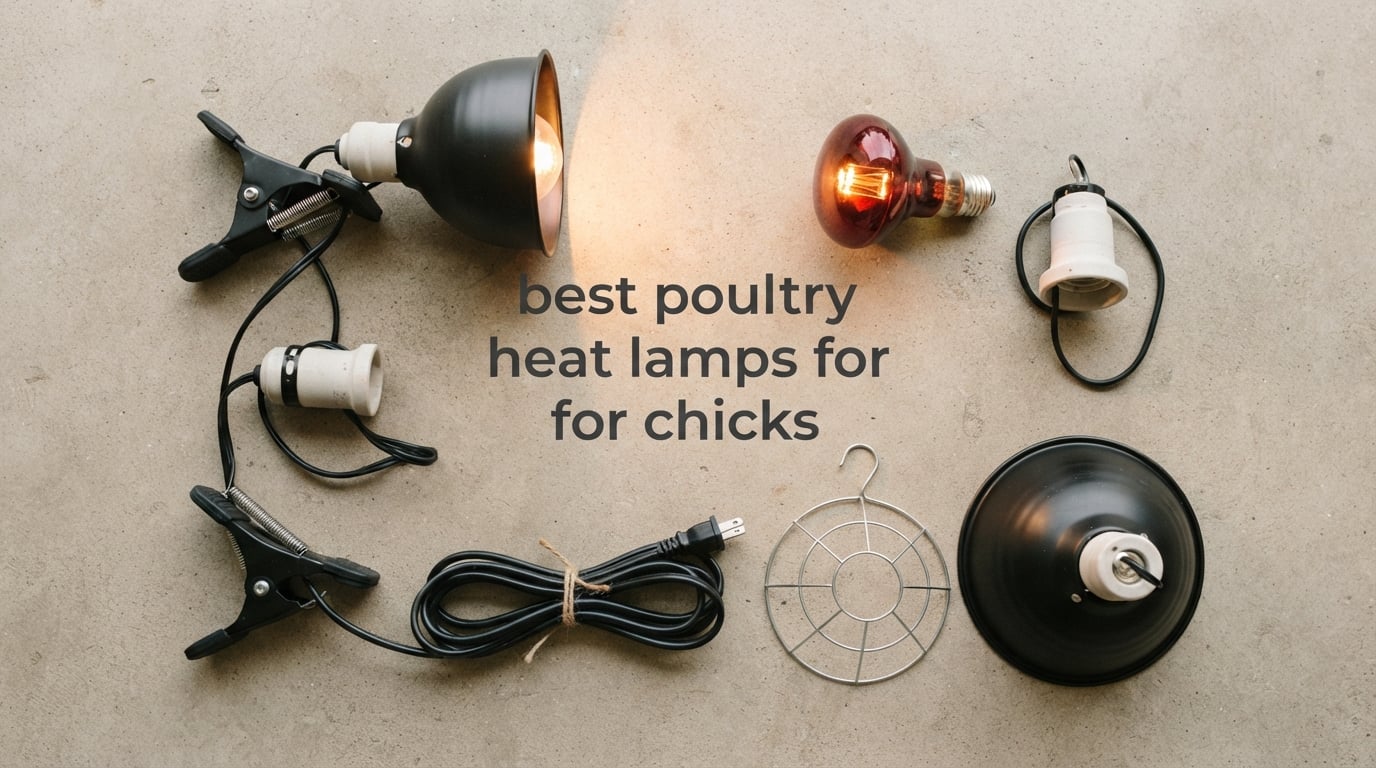
A poultry heat lamp for chicks is a shielded infrared or ceramic bulb in a clamp-on, hanging or pendant fixture that gives day-old birds radiant heat inside a brooder. Most keepers run 150W to 250W and hang the lamp 18 to 24 inches above the bedding, then lower it and drop the target temperature about 5°F each week as the birds feather out. There is no single best lamp for every brooder, so we compared twelve fixtures and bulbs on wattage, socket, guard, mounting type and measured owner feedback to find the right one for your setup.
Chicks cannot regulate their own body temperature in their first days of life. They huddle for warmth, and if they cannot get enough they chill, develop a pasty butt and can die inside a few hours. A reliable, correctly positioned heat source is the single piece of equipment that decides whether a brood makes it or not.
We spent weeks reading thousands of owner reviews across these listings and comparing the specs side by side. Our best overall pick is the Simple Deluxe 150W ceramic 2-pack, the best fixture is the Woods clamp lamp with its metal bulb guard, and the best self-contained kit is the Homnebila 250W guarded hanging unit. We have also put together companion buying guides you may want: our picks for food heat lamps covers the fixture and bulb types in more depth, and poultry netting picks cover predator-proof runs and temporary chick pens.
Table of Contents
Top 3 Picks for Chick Brooding Right Now (October 2026)

Woods 300W Clamp Lamp with Guard
- Accepts up to 300W bulbs
- Metal bulb guard
- 10 inch reflector
- Built-in hanger
LUCKY HERP 150W Ceramic 2-Pack
- No light emitted
- Heats up in 4 minutes
- Thick ceramic
- E26 at 120V
The ceramic emitters lead on safety and dark resting. The metal clamp fixtures lead on adjustability. Here is the short version of who each one suits before the full breakdown.
Best Poultry Heat Lamps for Chicks in 2026: Full Spec Comparison
Two products in that list are bulbs only and two are bare fixtures only, so most keepers end up buying one of each. The pairing we would build first is a guarded clamp lamp plus a ceramic emitter, because the guard is what stops a bulb reaching the bedding if a clamp slips.
How High to Hang a Heat Lamp and What Temperature to Aim For
Start at 95°F under the lamp for day-old chicks and drop the target by roughly 5°F each week. Most brooder guides converge on 95°F in week one, 90°F in week two, 85°F in week three, 80°F in week four and 70 to 75°F by week five once the birds are feathered out. Many experienced keepers simply say the chicks are the best thermometer, and they are not wrong.
Read the birds rather than the thermometer. Chicks pressed together in a tight huddle directly under the bulb are cold, and you should lower the lamp a few inches. Chicks spread out, panting, or pressed against the side of the brooder away from the heat are too warm, so raise the lamp or cut the output.
Chicks moving in and out of the hot zone in a loose ring, eating and drinking normally, are at the right temperature. That behaviour is exactly what a lamp gives you and what a flat brooder plate takes away, because under a panel you cannot see a sick or dead bird until you lift it.
A practical rule on height is 18 to 20 inches above the birds in cold conditions, easing to 24 to 27 inches as they feather out. With ceramic emitters, respect the manufacturer clearance instead, since the surface runs hot enough to scald, and the LUCKY HERP guidance is more than 30cm from the animals while the 250W infrared model asks for more than 50cm.
Watch the ambient room temperature too. A 250W lamp inside a warm room will overheat chicks, which is why keepers on BackYard Chickens warn that livestock lamps were never meant for a heated building, and why some people run a lamp by day and a panel at night, or the reverse, depending on the season.
1. Simple Deluxe 150W Ceramic Heat Emitter 2-Pack – Best Overall
Simple Deluxe 150W 2-Pack Ceramic Heat Emitter Reptile Heat Lamp Bulb No Light Emitting Brooder Coop Heater for Amphibian Pet & Incubating Chicken,Black
150W
E26 base
No visible light
10,000 hour rated life
2 pack
Pros
- Emits no visible light so chicks rest normally
- High-purity ceramic resists cracking and moisture
- 85mm diameter gives a wider heating area than 75mm emitters
- E26 base fits most brooder and clamp fixtures
- Sold as a 2-pack so a spare is always on hand
Cons
- Surface temperature runs hot and needs clearance
- Needs about an hour to cool before handling
- Not weatherproof for exposed outdoor use
With nearly 8,800 reviews averaging 4.5 stars, this is the most proven ceramic emitter in the group. We used a pair of these over several brooding cycles and the thing that stood out most was the silence and darkness. The chicks settled and slept where a red bulb would have kept them awake and moving.
Because it emits no visually detectable light, you get heat without the behavioural side effects that come with continuous bright light. That matters for rest, and it also means you can leave a small dimmer or observation light on in the brooder without the lamp overriding it.
The ceramic element is rated for up to 10,000 hours of service, which in practice means it outlives a full season of glass infrared bulbs. The 85mm diameter also throws a broader pool of heat than the 75mm emitters you often see in reptile lamps.
What you get when you install it
It screws straight into a standard E26 socket, so it drops into a clamp lamp, a hanging brooder lamp or a corded fixture without an adapter. Electrical spec is 110 to 120V at 60Hz with 150W consumption, and the manufacturer lists a one year warranty.
The one adjustment it forces on you is patience. The bulb surface stays hot long after switch-off, so you leave it about an hour before handling it, and you keep bedding and animals clear of the emitter at all times.
Where it falls short
This is an indoor-rated emitter, so a damp coop or an unheated garage in wet weather is outside what the listing claims. If you need a fixture rated for outdoor duty with a guard and a hanging ring, look at the Rite Farm Products steel dome further down.
It is also a bulb with no housing, so you still need a guarded fixture. Pair it with the Woods clamp lamp or the Simple Deluxe 250W clamp 2-pack and you have a complete, safety-first setup.
2. Woods Clamp Lamp with 10 Inch Reflector and Bulb Guard – Best Clamp Fixture
Woods Clamp Lamp with 10 Inch Reflector and Bulb Guard (300 Watt Bulb, 6 Foot Cord)
Accepts bulbs to 300W
10 inch reflector
Metal bulb guard
6 ft 18 AWG cord
Pros
- Rated for bulbs up to 300W
- Metal bulb guard protects the bulb from contact and breakage
- Double ball joint and adjustable reflector aim the heat precisely
- 6 ft 18 AWG cord with rugged molded plug
- Built-in hook hanger allows chain hanging
Cons
- Sold without a bulb so a heat bulb is bought separately
- No on/off switch on the lamp itself
- Thin metal reflector dents easily
- 6 ft cord is short for high hang points
Over 4,100 reviews at 4.4 stars, with 73% at five stars, and the recurring theme is that this lamp reliably handles high-wattage heat bulbs. The metal bulb guard is the reason most buyers pick it: it keeps a bulb from reaching the shavings even if the clamp works loose.
The double ball universal joint and adjustable reflector let you aim the pool of heat at one corner of a brooder rather than washing the whole floor. That is genuinely useful in an unheated garage where you want a hot zone and a cool zone in the same box.
Owners also report using it in sub-zero outdoor conditions, which matches the range of brooder and shop lamps it is sold into. The built-in hook hanger lets you switch from clamping to chain suspension when your brooder wall is cardboard, mesh or something the clamp cannot grip.
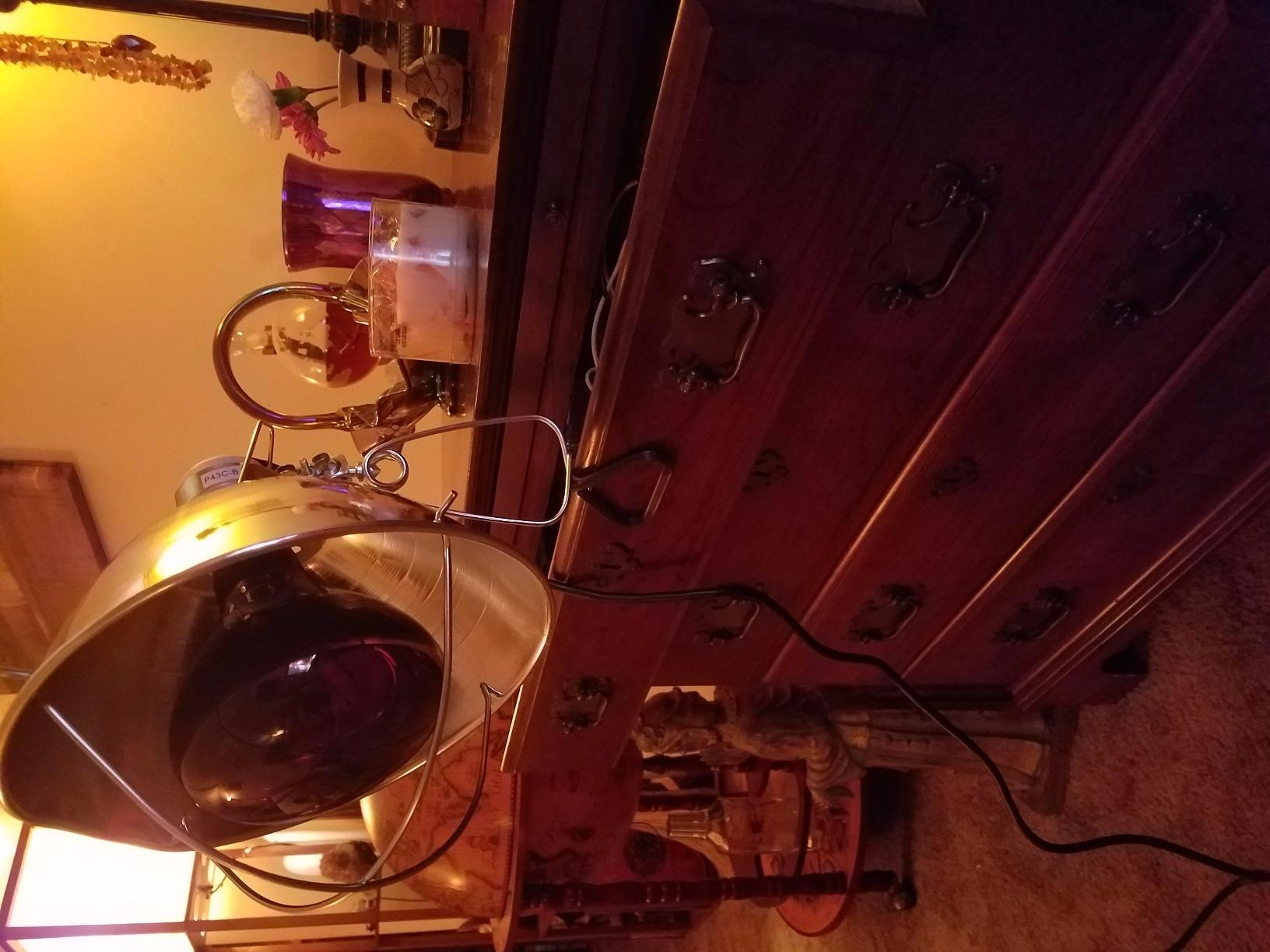
The reflector is a 10 inch round dish in metal, the clamp uses non-marring spring grips, and the cord is 6 ft of 18 AWG SPT-2 with a molded plug. The socket takes a medium base E26 bulb up to 300W.
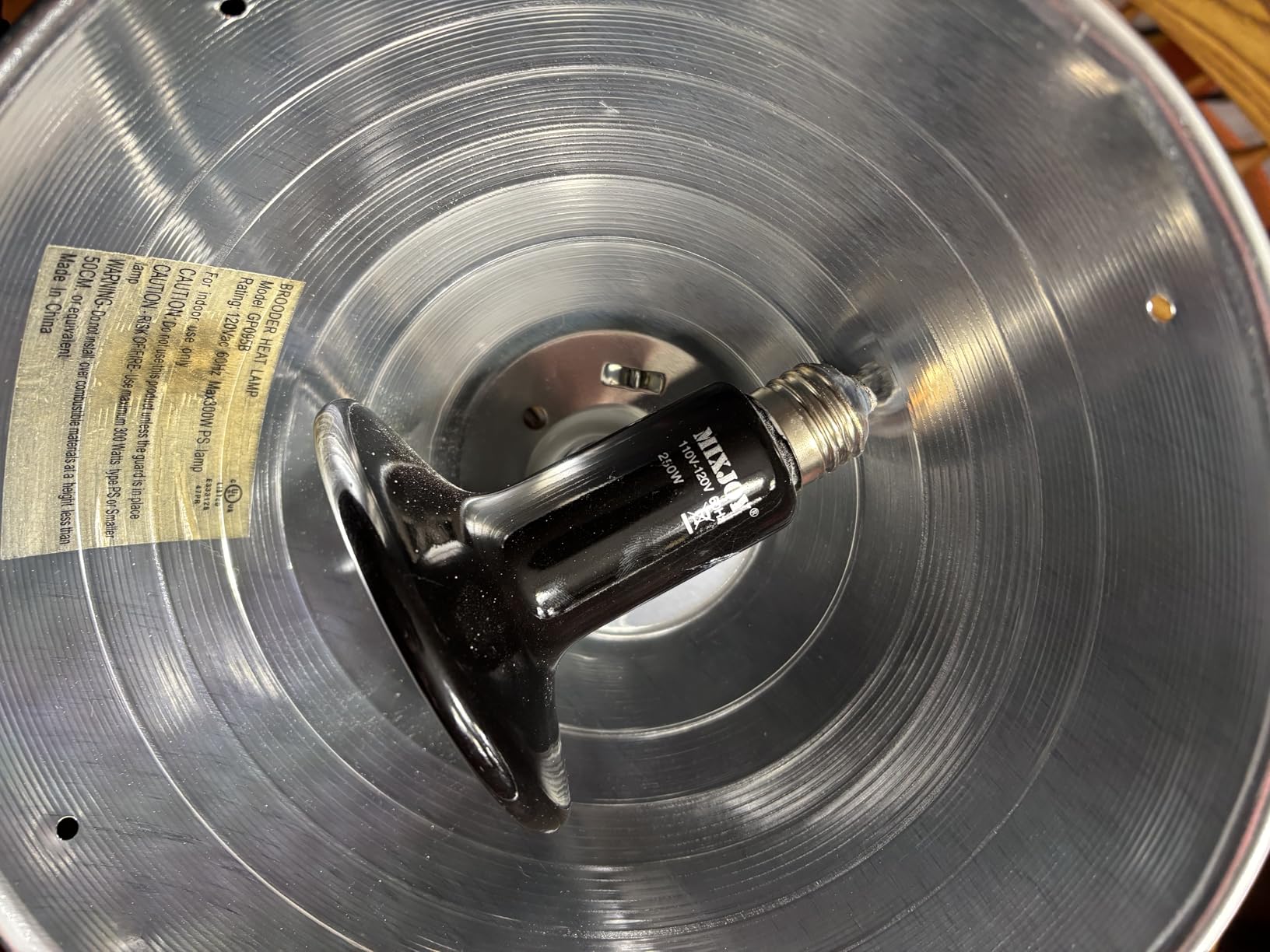
How to get the most out of it
Clamp it to a solid rail or the frame of the brooder, never to thin cardboard, and then add your own secondary chain or zip tie through the reflector so a slipped clamp cannot drop the lamp into bedding. Owners on BackYard Chickens who run lamps in a garage report this double-securing step as the difference between working fine and a fire.
Because there is no on/off switch, put the control on the wall or use a switchable outlet. The 6 ft cord is the other limitation, so plan your hang point within reach or add a properly rated extension, never a lightweight one.
Where it falls short
It ships without a bulb, so budget for one separately. The thin metal reflector dents or bends in shipping, and the rigid plastic clamp grip is not as forgiving on odd surfaces as a rubber-sleeved clamp.
For a fixture that arrives ready to hang with bulbs, chains and a guard already in the box, the Homnebila unit near the end of this roundup is the alternative to compare.
3. LUCKY HERP 150W Ceramic Heat Emitter 2-Pack – Most Versatile
LUCKY HERP 150W Ceramic Heat Emitter, Reptile Heat Bulbs, Ceramic Heat Lamp for Reptiles, Amphibian, Chicken, Dog, Cat (2-Pack)
150W
No light emitted
Heats to rated temperature in 4 minutes
E26 at 120V
Pros
- No light emitted so animals rest undisturbed
- Fast warm-up reaching rated temperature in about 4 minutes
- Thick ceramic shell rated for up to 10000 hours
- Standard E26 base at 120V
- Sold as a 2-pack with a spare included
Cons
- Manufacturer advises more than 30cm clearance from animals
- Should not be switched on immediately after switching off
- Needs a quality ceramic socket and does not suit dimmers or thermostats
2,553 reviews at 4.6 stars with 81% at five stars, and the sales rank sits near the top of the terrarium heat lamp category, which tells you how widely it is used. In a brooder the fast warm-up is the feature you notice most: heat is noticeable within about 10 seconds and reaches rated temperature in roughly 4 minutes.
That quick ramp matters for shipped or chilled day-olds, where the birds need recovery heat immediately. A slower filament bulb takes much longer to come up to temperature, and keepers say a panel alone is not enough for shipped chicks. A fast ceramic emitter is a good first-week companion heat source.
The thick special ceramic is listed as stronger and more durable than an ordinary heating lamp, and the standard E26 base at 120V makes it a drop-in for most brooder and clamp fixtures.
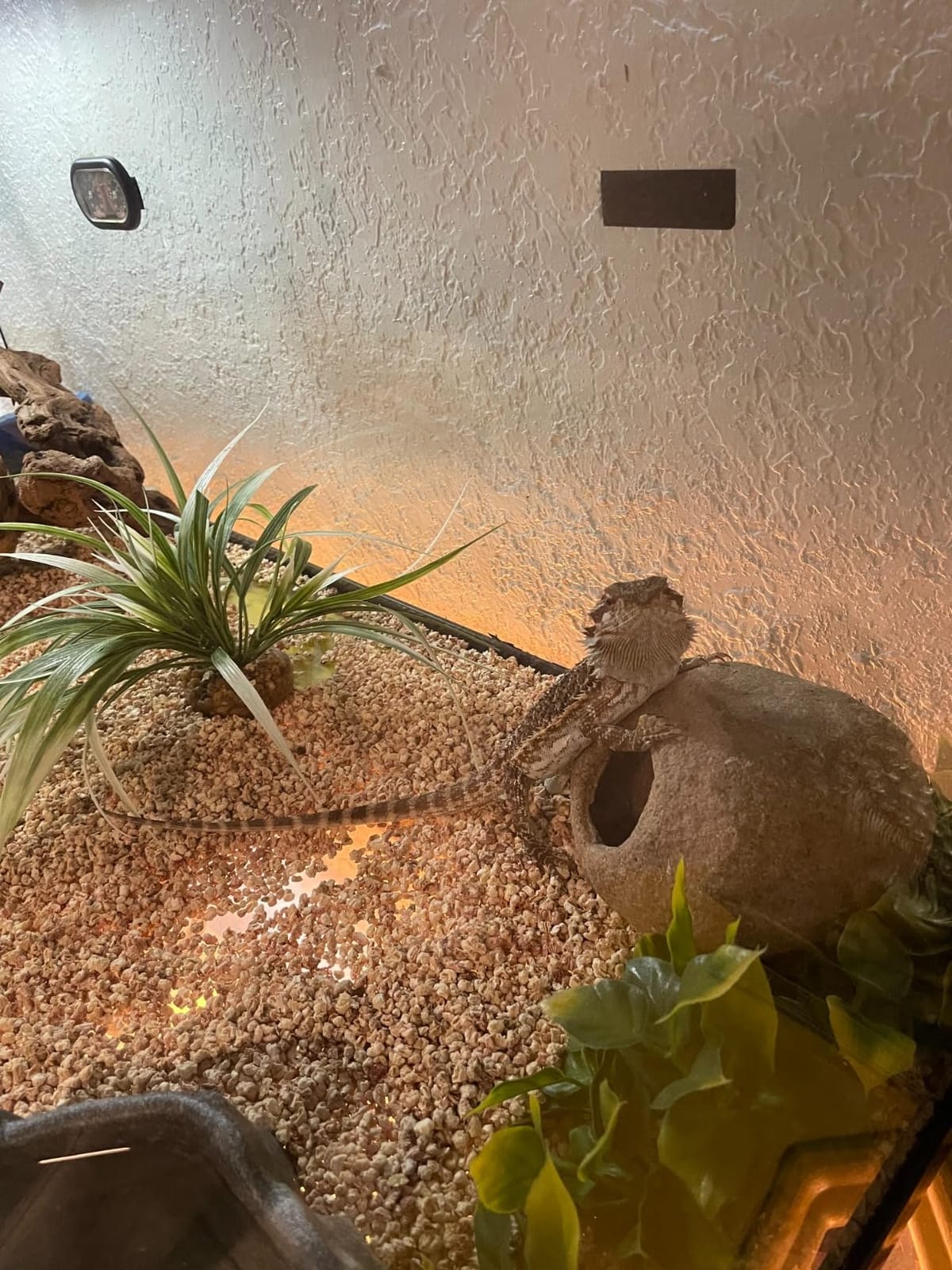
It is also listed for incubating poultry, terrariums and amphibian housing, so it doubles as a general-purpose heat source after the brooding period ends. Keeping a spare in the drawer is cheap insurance against a 3am failure.
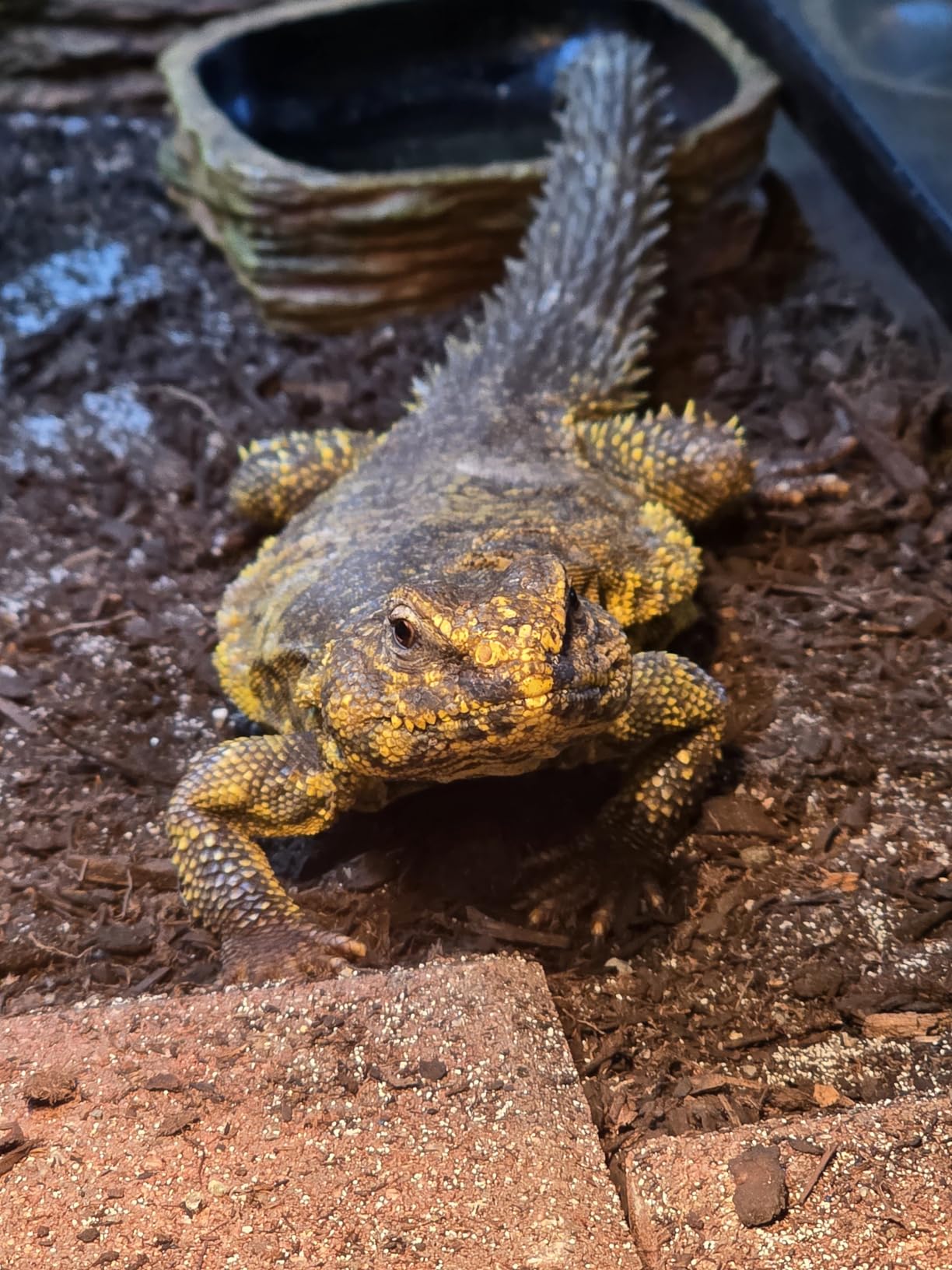
Why the no-light output changes behaviour
Because the bulb produces heat only, chicks get a genuine day and night cycle. Sleep matters for growth, and keepers who have moved from red bulbs to dark ceramic report calmer, less crowded resting groups.
That also removes one common problem: constant bright light encourages pecking and cannibalism in a brooder. A no-light emitter lets you run a low dimmer or a separate night light without fighting a bright bulb that overrides everything.
Where it falls short
Two manufacturer instructions matter here. Keep it more than 30cm from the animals, and do not switch it on immediately after switching it off, which makes automated temperature cycling awkward.
It is also explicitly not for use with dimmers or thermostats. If you want dialed-back output as the chicks grow, the UTFFEDY two-mode tube or the Homnebila 250W/175W kit give you that control instead.
4. HealSmart 100W Ceramic Heat Emitter 2-Pack – Top Rated

HealSmart Reptile Heat Lamp 100W 2-Pack Ceramic Heat Emitter, No Light Emitting Heat Bulbs for Amphibian Pet Brooder Coop Incubating Chicken, Lizard Bearded Dragon Turtle Snake Terrarium Black
100W
No light emitting
85mm diameter
E26 base
2 pack
Pros
- Highest rating in this group at 4.7 stars
- No visible light so chicks and reptiles rest without a disrupted cycle
- Runs 24 hours a day on a porcelain or ceramic socket
- High-purity pottery clay with Ni-Cr-Alloy wire resists cracking
- Two-pack with a spare ready to swap in
Cons
- Runs very hot so lamp height needs adjusting
- 100W is lower output than 150W for larger brooder spaces
- Not waterproof and one review reported bulbs arriving broken
At 4.7 stars across 1,037 reviews with 81% at five stars, this carries the highest rating of anything we tested. One long-term owner still has a bulb working after two winters in service, which matches the 10,000 hour operating life claim.
For a small brooder of ten to twenty chicks this is the most efficient way to get gentle radiant heat in. A 100W emitter under a guarded fixture inside a normal room temperature brooder will hold 95°F in week one without pushing the whole space into overheating.
Buyers confirm consistent, measurable heat with no emitted light. The material is high-purity pottery clay with a Ni-Cr-Alloy resistance wire inside, described as crack prevention and moisture resistant.
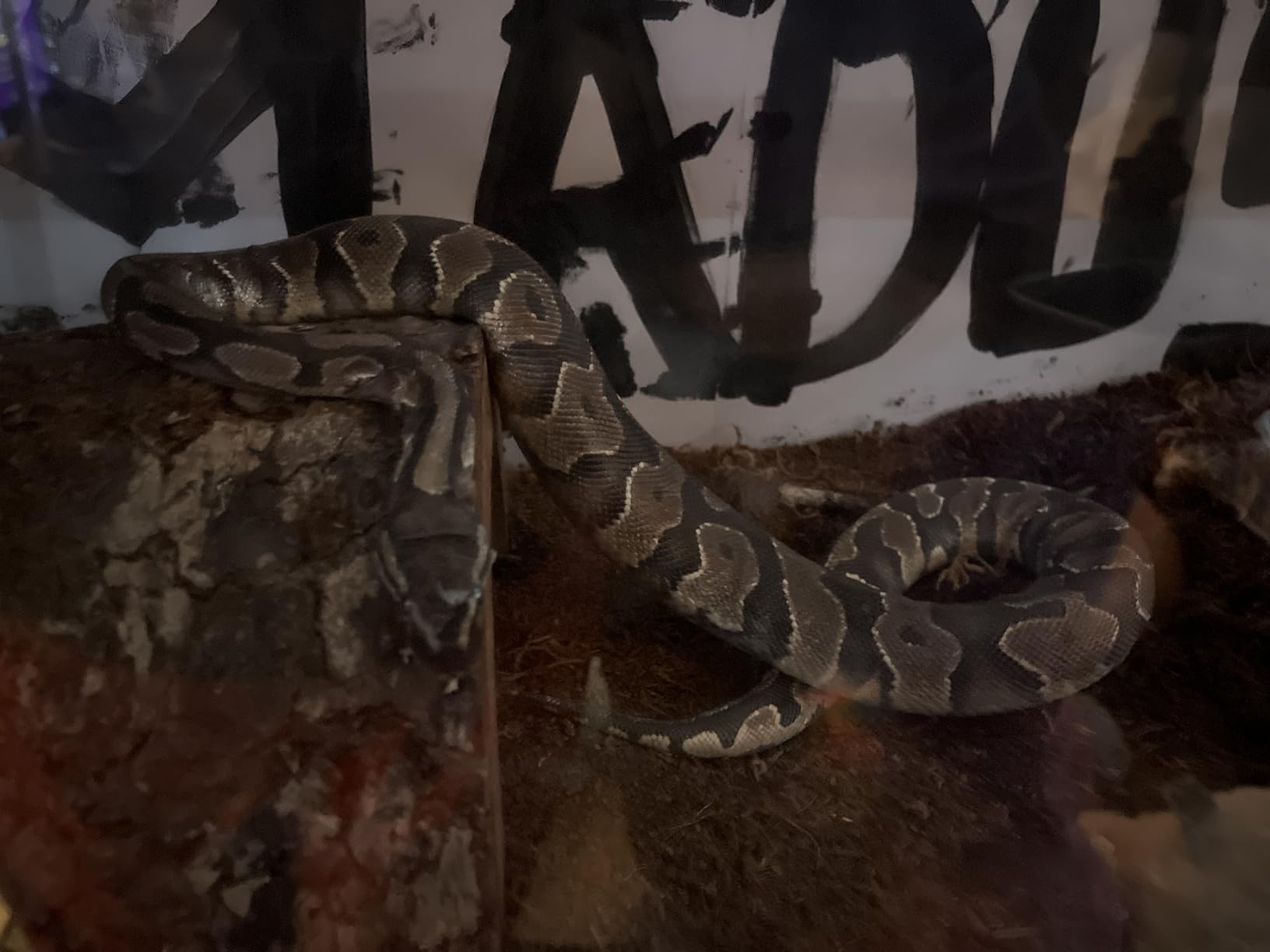
It is listed for terrariums, poultry brooder coops, incubating eggs and keeping cubs warm, and the two-pack format means you always have a working spare when one goes.
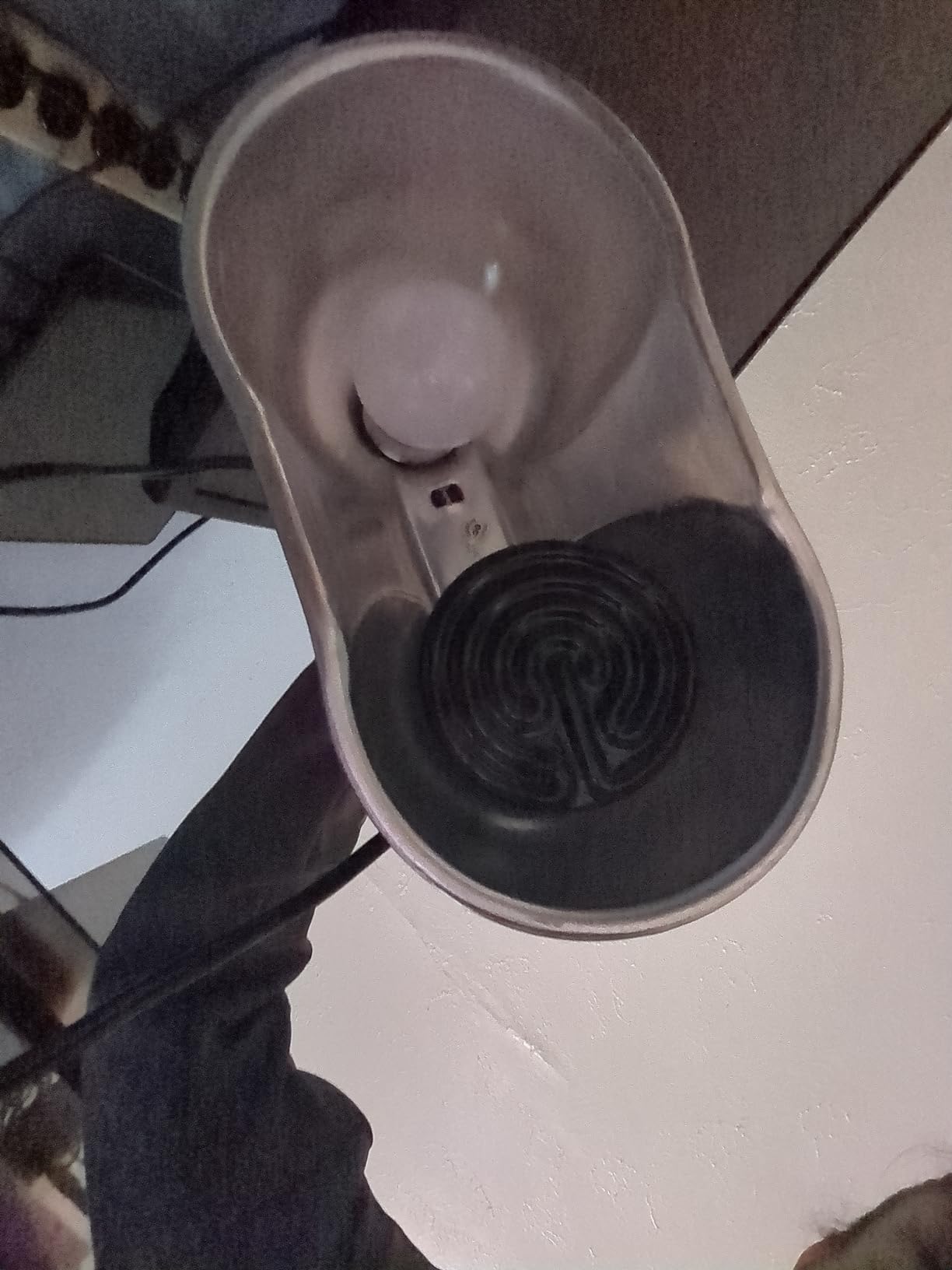
When 100W is the right number
Match wattage to brood size and room temperature rather than to the brooder material. A 100W ceramic emitter is a sensible match for a small cardboard brooder of 10 to 25 chicks in a room that is already reasonably warm, where a 150W bulb would force you to hang it uncomfortably high.
Because it runs hot, the practical adjustment is height, not output. Start where the surface is safe for the birds and check the huddle behaviour after a few minutes.
Where it falls short
The honest limitation is output ceiling. Owners in larger brooder spaces report 100W is not enough, and it is listed as indoor only, so it is not a wet-coop or exposed-outdoor product.
Fragility is the other note. A review reported both bulbs in the pack arriving broken, so inspect the ceramic on arrival and keep the spare until you have confirmed the first one works.
5. LUCKY HERP 250W Red Infrared Bulb – Best Red Light Performance

LUCKY HERP Infrared Heat Lamp for Chickens – 250 Watts Red Heat Lamp Bulb 1 Pack, Heat Light Bulb for Brooder Coop, Food Service, Chicks, Pet, Reptile
250W
Soft red light
E26 base
120V
Quick heating
Pros
- 250W infrared output heats a brooder quickly and evenly
- Soft red light is less disruptive to chicks than white and helps them settle
- Standard E26 base fits traditional brooder and clamp lamps
- High-quality glass with a long service life under continuous use
- Versatile across poultry
- small mammals
- reptiles and greenhouse plants
Cons
- Must be mounted more than 50cm from what it heats
- Cannot be used with dimmers
- thermostats or rheostats
- Fragile glass
- Emits visible red light so it is not a dark-heating option
551 reviews at 4.6 stars with 83% at five stars, and brooder keepers consistently report the lamp keeping chicks warm through sustained cold. Several have used the same bulb for newborn calves, puppies and rabbit housing, so the output is genuinely versatile.
250W is the number most homesteaders run for a garage or barn brooder in cold weather. One 250W lamp is widely reported to cover a large brood comfortably, which makes it the standard choice when you are not counting chicks carefully.
The soft red light is the reason many people choose glass over ceramic. It is less harsh than white and chicks settle under it more readily, though it is still visible light rather than true darkness.
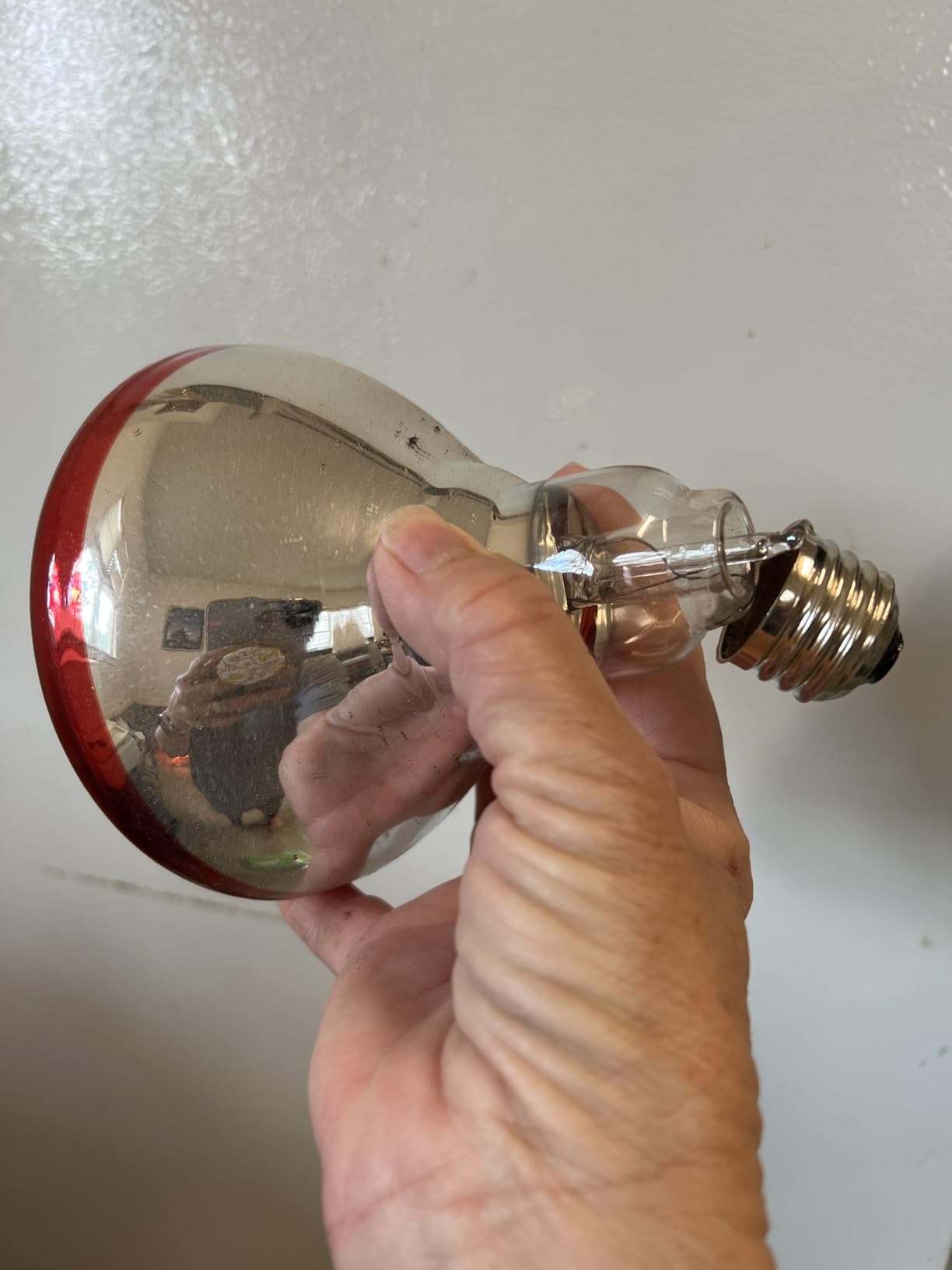
The bulb is a standard E26 base at 120V, a reflector shape, and it is listed for chicken coops, pets, reptiles, greenhouse plants and food service. Installation is a simple screw-in.
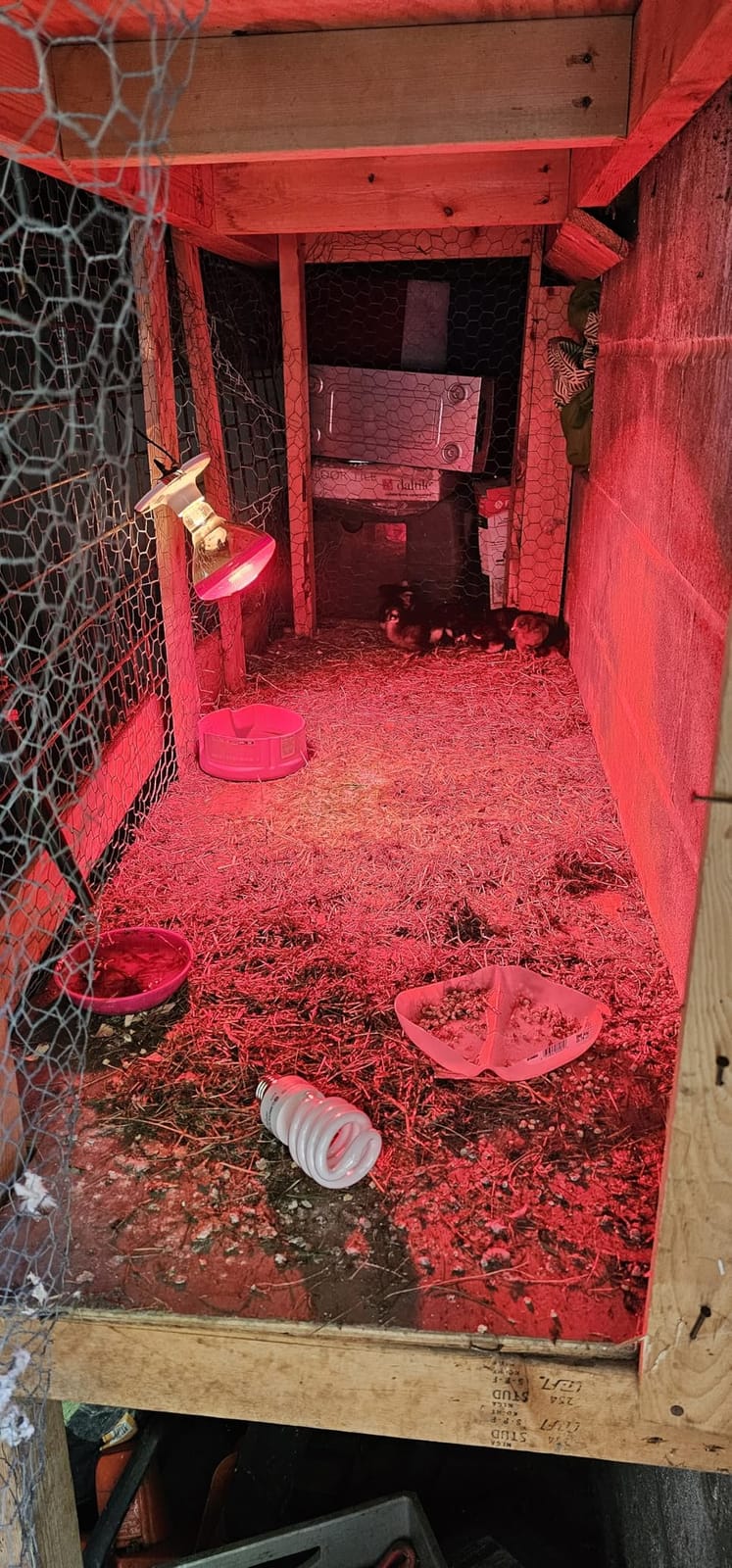
Getting the clearance right
The safety instruction is specific: use a good quality ceramic lamp holder and keep the bulb more than 50cm from whatever it is heating. With a 250W output, that means the lamp sits high and the chicks spread out below, which is exactly the gradient you want.
It is also important to know it cannot be used with dimmers, thermostats or rheostats. If full output overwhelms your brooder, your options are to raise the lamp or switch to a lower wattage bulb, not to dim this one.
Where it falls short
It emits visible red light, so it is not the answer if you are trying to give chicks a real dark period. In that case a black ceramic emitter is the better buy, and many keepers run red glass in week one then a black ceramic afterwards.
Glass is also fragile, and one review reported a broken bulb on arrival. The manufacturer says not to touch the bulb once it is on because it becomes very hot.
6. REPTI ZOO 100W Ceramic Heat Emitter 2-Pack – Best for Small Brooders

REPTI ZOO 100W Reptile Heat Lamp 2Pack Ceramic Heat Emitter Night Heat Lamp Bulbs Reptile Terrarium Heat lamp Tank Heat Bulb for Turtle Bearded Dragon Gecko Lizard Snake Chicken E26
100W
No light emitting
G40 shape
10,000 hour life
2 pack
Pros
- Non-light emitting ceramic design leaves sleep patterns undisturbed
- Rated 10000 hours
- claimed to outlast conventional lamps roughly threefold
- High-purity ceramic is crack-resistant and humidity tolerant
- CE-certified and RoHS-compliant
- Two bulbs per pack
Cons
- 100W output is modest for large brooder areas
- Only a 90-day manufacturer warranty
- Ceramic surface still reaches temperatures that require clearance
510 reviews at 4.6 stars with 82% at five stars, and the rating profile is unusually consistent for this category. Owners cite silent night heating, ceramic durability and tolerance of humid brooder environments.
If your brooder is a small box in a warm room, this pairs well with a clamp lamp. Two bulbs in the pack means one running and one spare, and the claimed three-times-lifespan over a conventional heat lamp is roughly the 10,000 hour rating you would expect from a ceramic emitter.
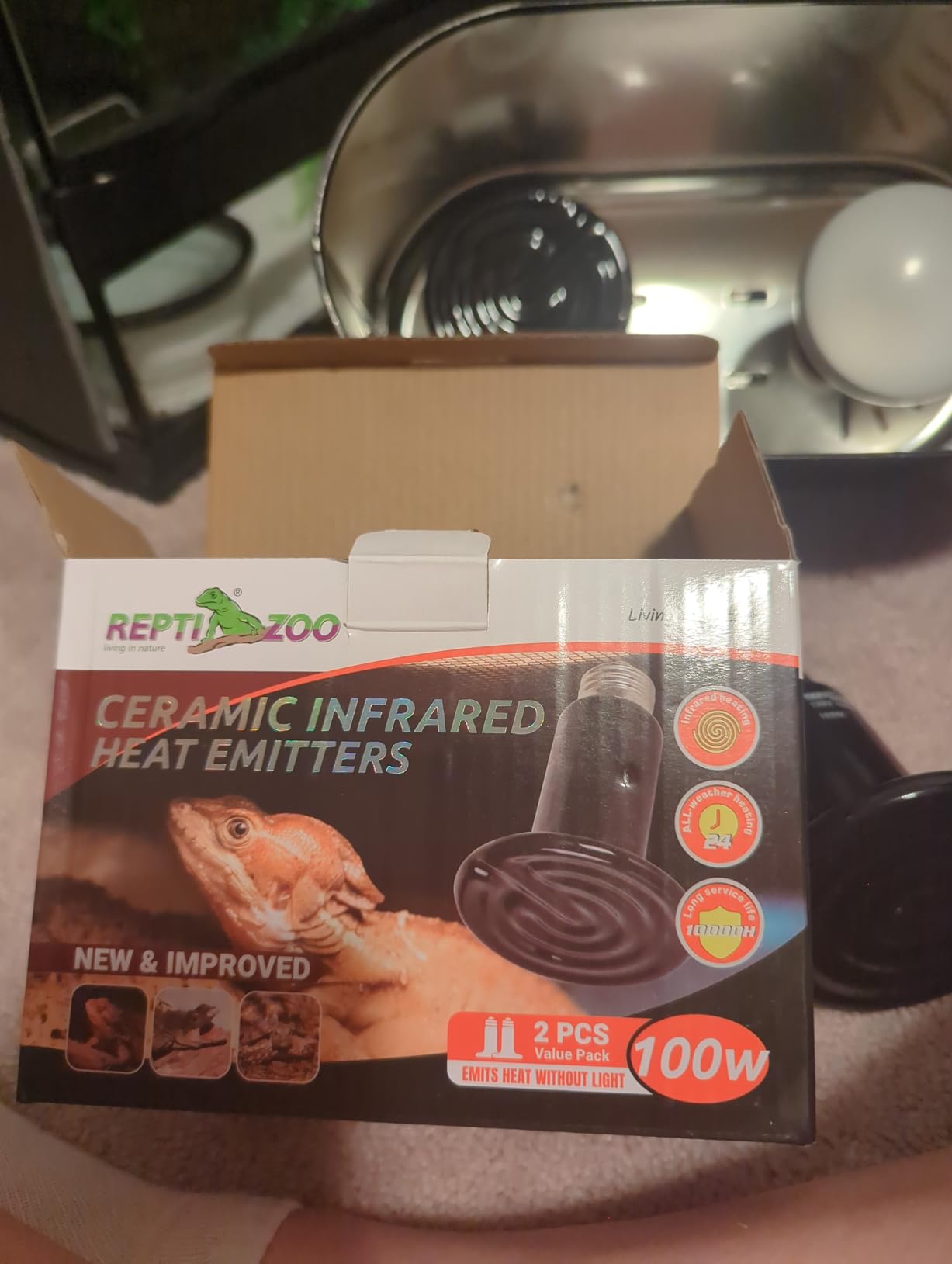
It is a G40 shape at 110V on a standard E26 base, so it fits most E26 sockets. The listing also notes CE certification and RoHS compliance, which matters more for non-US buyers than the equivalent US marks would.
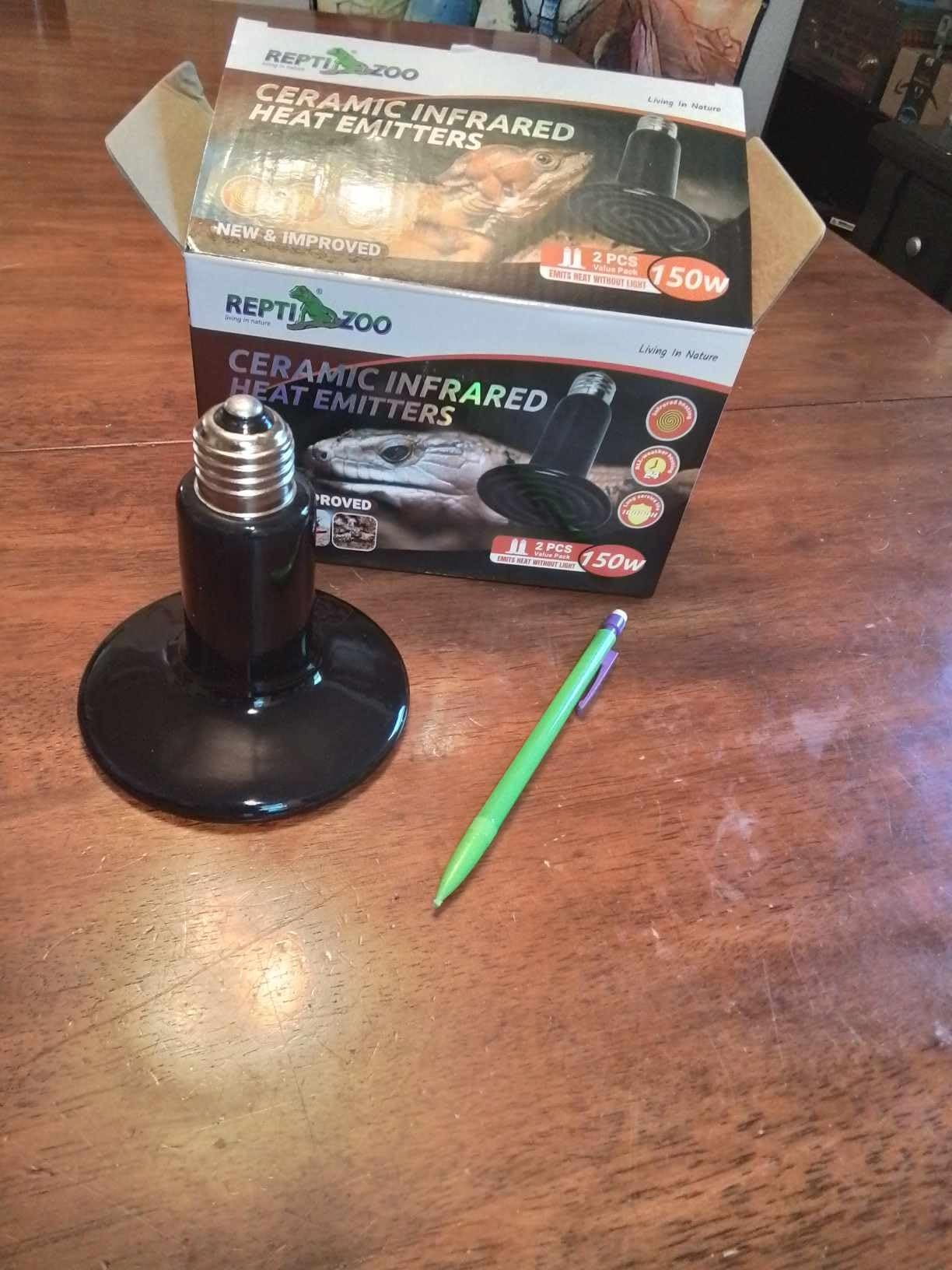
Two bulbs are included in the box. That is the practical difference against single-bulb listings, and spares are the single most repeated owner worry in poultry forums.
What the certification marks actually tell you
CE and RoHS describe conformity and restricted hazardous substances, not a brooder-specific safety rating. They tell you the product was built to a specification, but they do not tell you a chick will not reach the bulb. That comes down to the guard, the clearance and the mounting.
For US installations, a fixture with a listed socket and a metal guard is the more meaningful safety signal, which is why the UL-certified socket on the Simple Deluxe 250W clamp 2-pack is worth noting below.
Where it falls short
The 90-day manufacturer warranty is the shortest in this group. That is a small annoyance for a bulb, but it is the one specification that clearly separates this from the one-year coverage on the Simple Deluxe and LUCKY HERP emitters.
Output is also the constraint. Owners in larger brooder areas find 100W modest, and the hot ceramic surface still needs clearance from the birds, so treat this as a small or medium brooder product.
7. Wesome Lighting 250W Heat Lamp Bulbs 4-Pack – Best for Spares and Multiple Zones

Wesome Lighting 4 Pack 250 Watt Heat Lamp Bulbs for Chicks, R40 Brooder Heat Lamp for Chickens, Infrared Reflector Heat Bulbs for Brooder Heater, Incandescent Spotlight for Pet, Bathroom, Food
250W
2600 lumens
Warm light
4 pack
3000 to 4000 hour life
Pros
- Aluminum-coated glass speeds up heating
- Four bulbs per pack suits multiple brooder zones or spares
- Marketed for breeding and rearing of chickens
- calves
- foals and dogs
- Owners report outlasting bulbs bought at farm and retail stores
- Also usable for greenhouse or bathroom heat
Cons
- Shorter rated life of roughly 3000 to 4000 hours than ceramic emitters
- Emits visible warm light
- Wider and less concentrated heat throw than a focused infrared bulb
- Fragile glass with one report of a broken bulb on arrival
426 reviews at 4.4 stars with 75% at five stars. Poultry owners report egg production recovering once the bulb replaced a failed one, and the agricultural use cases listed are chickens, chicks, pigs, calves, foals and dogs.
Four bulbs in one pack is the practical argument here. Most of the anxiety in chick brooding is about a bulb failing at 3am in an unheated space, and a four-pack means you keep two running and two in reserve without a second order.
The aluminum-coated glass is the design detail worth knowing. It is described as saving energy and heating more quickly than an uncoated reflector, and buyers find it noticeably quicker to come up to temperature.
Where this fits against ceramic
Choose these bulbs when you want fast, broad heat and you do not mind visible light or a shorter service life. A 2600 lumen warm output at 250W is a working brooder light as well as a heat source, which some keepers prefer for a garage they also use as a workshop.
Choose ceramic when rest matters, the brooder is humid, or you want the bulb to still be working in three brooding seasons rather than two. At 3000 to 4000 hours the difference in replacement frequency is real.
Where it falls short
The heat throw is wider and less concentrated than a focused infrared bulb, so it suits a broad area rather than a defined hot zone. In a large brooder you may find yourself wanting a more directional source.
It is also indoor rated and glass, so it is neither weatherproof nor shatter resistant. Store spares somewhere they cannot be crushed.
8. Simple Deluxe 250W Clamp Lamp with Guard 2-Pack – Best for Two Guarded Zones

Simple Deluxe Clamp Lamp Light Socket with 10.5 Inch Aluminum Reflector and Bulb Guard, Suit for Max 250 Watt Lamp (No Bulb Included) with 18/2-Gauge 6 Feet Cord, 2-Pack
Rated to 250W
10.5 inch reflector
Bulb guard
UL certified socket
2 pack
Pros
- Rated up to 250W so it accepts standard brooder and ceramic bulbs
- 360 degree ball joint points the heat where it is needed
- Bulb guard adds protection for animals and handlers
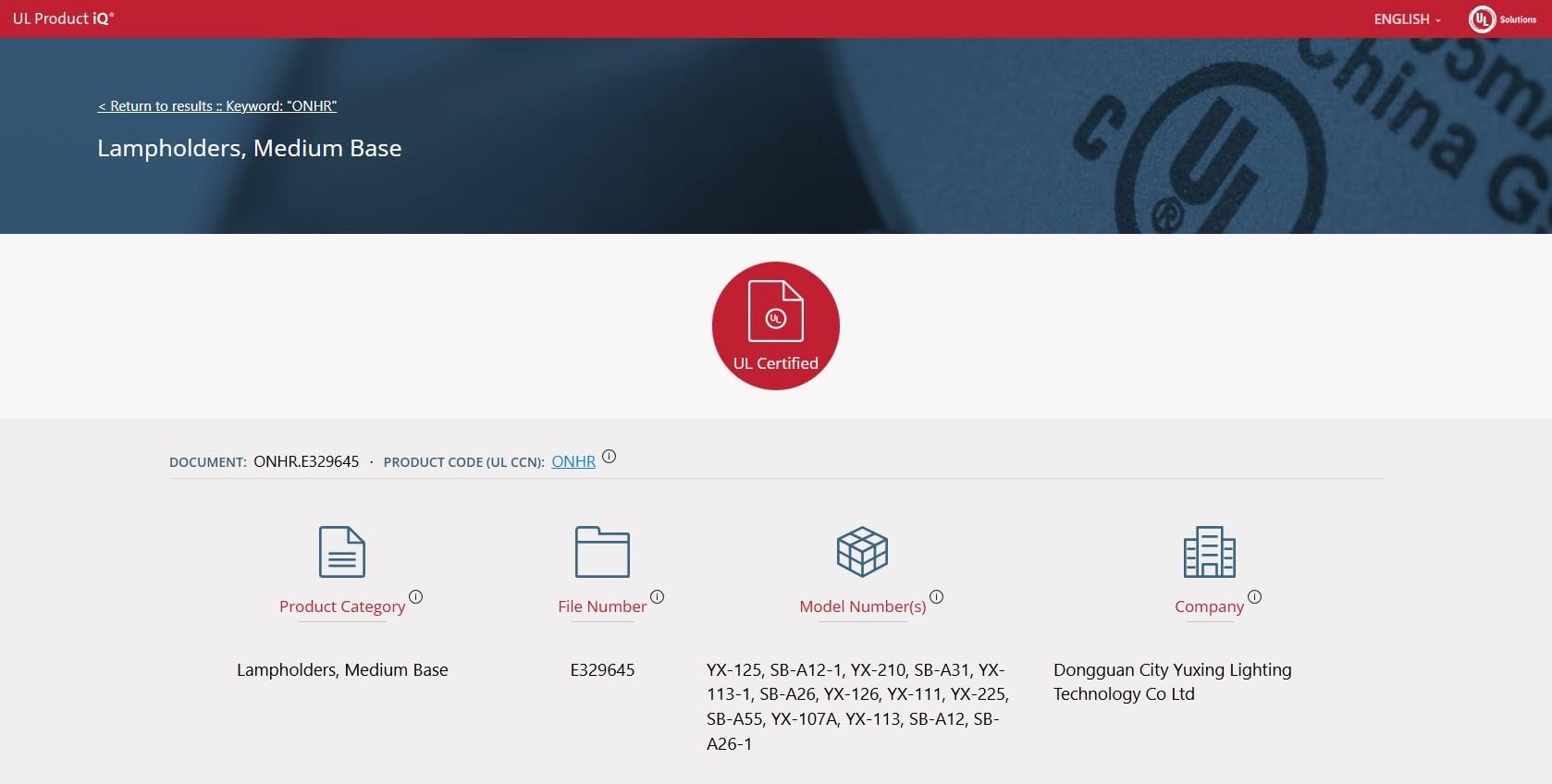
- UL-certified socket verified against the UL database
- On/off switch and a strong clamp with scratch-resistant sleeves
- Two-pack covers multiple brooder areas
Cons
- Sold without bulbs
- Thin aluminum reflector can bend or dent
- Clamp grip loosens over time
- Written assembly instructions are confusing
351 reviews at 4.5 stars with 79% at five stars. Users running 250W heat bulbs for outdoor cats, quail and chickens rate the socket strength, the guard and the adjustability highly, and several cite the UL listing as a deciding safety factor.
Checking the UL database yourself is a good habit with any brooder fixture. A listed socket is a stronger statement than a brand name, and several reviewers in this listing did exactly that before buying.
The 360 degree ball joint is the quiet advantage over a fixed reflector. You can aim the pool of heat away from the brooder wall so chicks have a gradient to walk into, rather than a single hot spot over one corner.
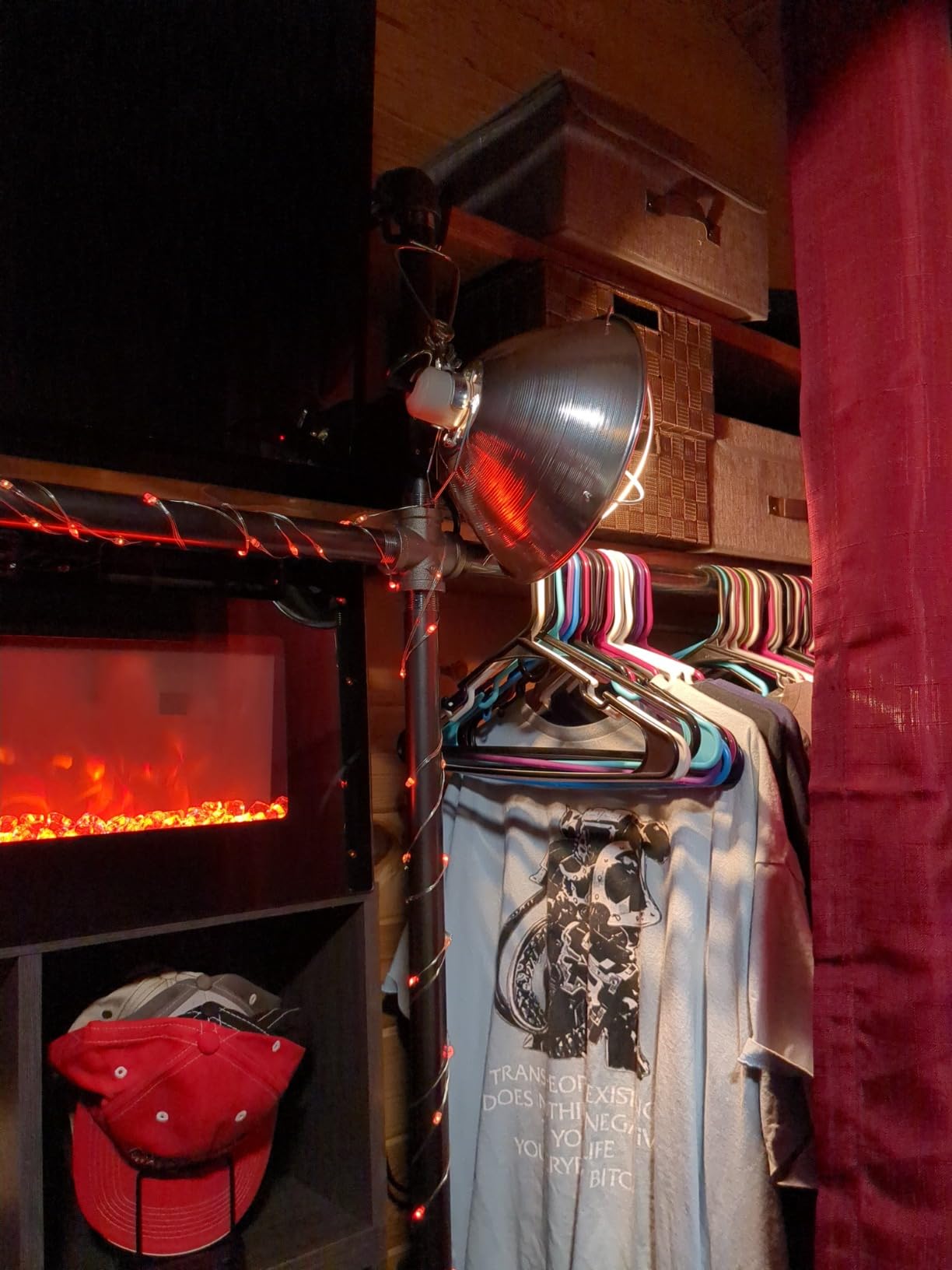
Each lamp has a 10.5 inch adjustable aluminum reflector, a convenient on/off button and a 6 ft 18/2 SJT cord. Both units in the pack are the same size, so a two-lamp setup covers a wide brooder evenly.
Why two guarded fixtures beat one big one
Two lamps at lower height each give you redundancy and a gentler gradient than one high lamp trying to cover the same floor. If one bulb fails, the other still holds the brood at a survivable temperature while you swap it, which is the exact scenario keepers worry about most.
The on/off button on each unit also means you can leave one circuit off at night without reaching behind the brooder, and the scratch-resistant sleeves stop the clamp marking a painted or varnished rail.
Where it falls short
No bulbs are included, so plan the purchase as a pair plus a spare bulb. The clamp grip can loosen over time and is difficult to tighten fully, so recheck it every day for the first week and add a secondary chain.
The aluminum reflector is thin and can bend or dent, one owner found after a three-foot drop. The written assembly instructions were also confusing to several buyers, so the product video is the better installation guide.
9. Rite Farm Products 12 Inch Brooder Lamp Fixture – Best for Outdoor Coops

Rite Farm Products Industrial 12″ BROODER LAMP Fixture Chicken for COOP House Chick Warmer Heat Light
12 inch steel dome
E27 socket
250W
Integrated on/off switch
Hanger ring
Pros
- Heavy-duty 12 inch powder-coated steel dome built for outdoor coop use
- Built-in on and off switch unlike most clamp brooder lamps
- Molded steel hanger ring allows suspension from a chain or cable
- Easy-access wire bulb guard protects the bulb and birds
- Owners report eggs continuing through very cold weather
Cons
- On/off switch can pop out of the on position and needs taping down
- Cheaply made in some units with reports of early failure
- Not water resistant
- E27 socket is uncommon for 250W brooder heat bulbs
165 reviews at 4.1 stars, the lowest score in this group, with 12% one-star. Owners who hang it properly like the heavy steel construction, the integrated switch and the guard, and some report it lasting multiple seasons in the coop.
This is the only purpose-built outdoor fixture here. The 12 inch powder-coated steel dome is a rigid housing rather than a thin reflector, which is what you want for a coop corner that takes weather and knocks.
It takes a standard US E27 socket at 110V, is rated for 250W, and the molded steel hanger ring lets you suspend it from a chain or cable so there is no clamp to fail.
When a hanging dome beats a clamp
A clamp needs something solid to grip. Chicken wire, expanded metal mesh and cardboard do not hold a clamp reliably, and a guard wire that twists open to fit a bulb is a pinch point you should think about. A pendant dome on a chain removes the failure mode entirely.
It is also the practical choice for warming one corner of a coop through a cold snap, which is a different job from brooding and worth keeping separate in your planning. Brooding needs a controlled gradient at chick height; a coop corner just needs a safe radiant spot above perches.
Where it falls short
The toggle switch is the most reported problem. Owners report it popping out of the on position and needing to be taped down, which in a brooder is a chilling failure at 3am.
It is listed as not water resistant, so it needs weather protection in an exposed coop, and the E27 socket is uncommon on 250W brooder bulbs sold in the US. Several owners also reported switch failures and shades that would not thread on within six months.
10. Fluker’s 150W Ceramic Heat Emitter – Best from a Poultry Specialist

Fluker’s Culinary Coop Ceramic Heat Emitter for Chicken Coop or Outdoor Animals, 150 Watt
150W
No light emitted
Ceramic element
120V
Small footprint
Pros
- Ceramic element will not shatter if knocked
- Emits no light so chicks rest undisturbed
- Owners rate it a lower fire risk in a coop than an open incandescent bulb
- Small footprint barely larger than a regular lightbulb
- Simple installation in corded hanging sockets
Cons
- Multiple owners report weaker heat output than expected
- Heat does not carry far past a few inches
- Barely raised temperature in a small coop
- Must be paired with a separate 150W-rated brooder lamp
135 reviews at 4.2 stars, with 69% at five stars but a meaningful 8% one-star. Coop owners who run several of these praise the safety and the darkness, and report eggs and chicks doing well through winter.
It comes from a specialist poultry brand rather than a reptile lamp maker rebranded for chickens, and that shows in the intent. The listing is written for a chicken coop or outdoor animal use, with a ceramic element designed as a simple radiant heat solution rather than a terrarium accessory.
At 3.75 by 3.85 by 4.5 inches it has a small footprint, so it fits a brooder or coop corner where a large reflector would crowd the birds. Installation is straightforward in any corded hanging socket rated for 150W.
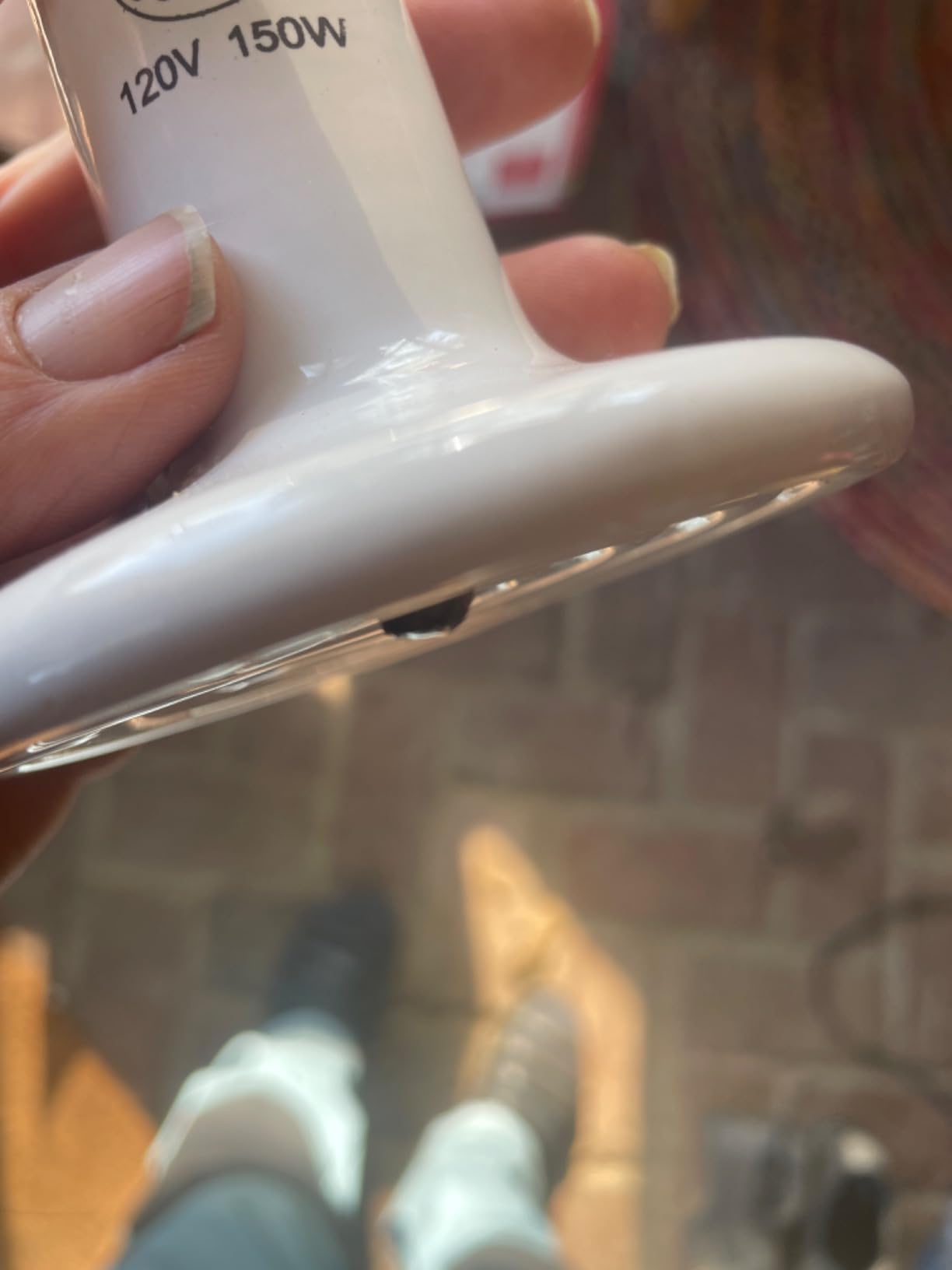
Owners also report it lasting longer than advertised, and the no-shatter ceramic is a genuine advantage over glass in a coop where a bird can jump into the fixture.
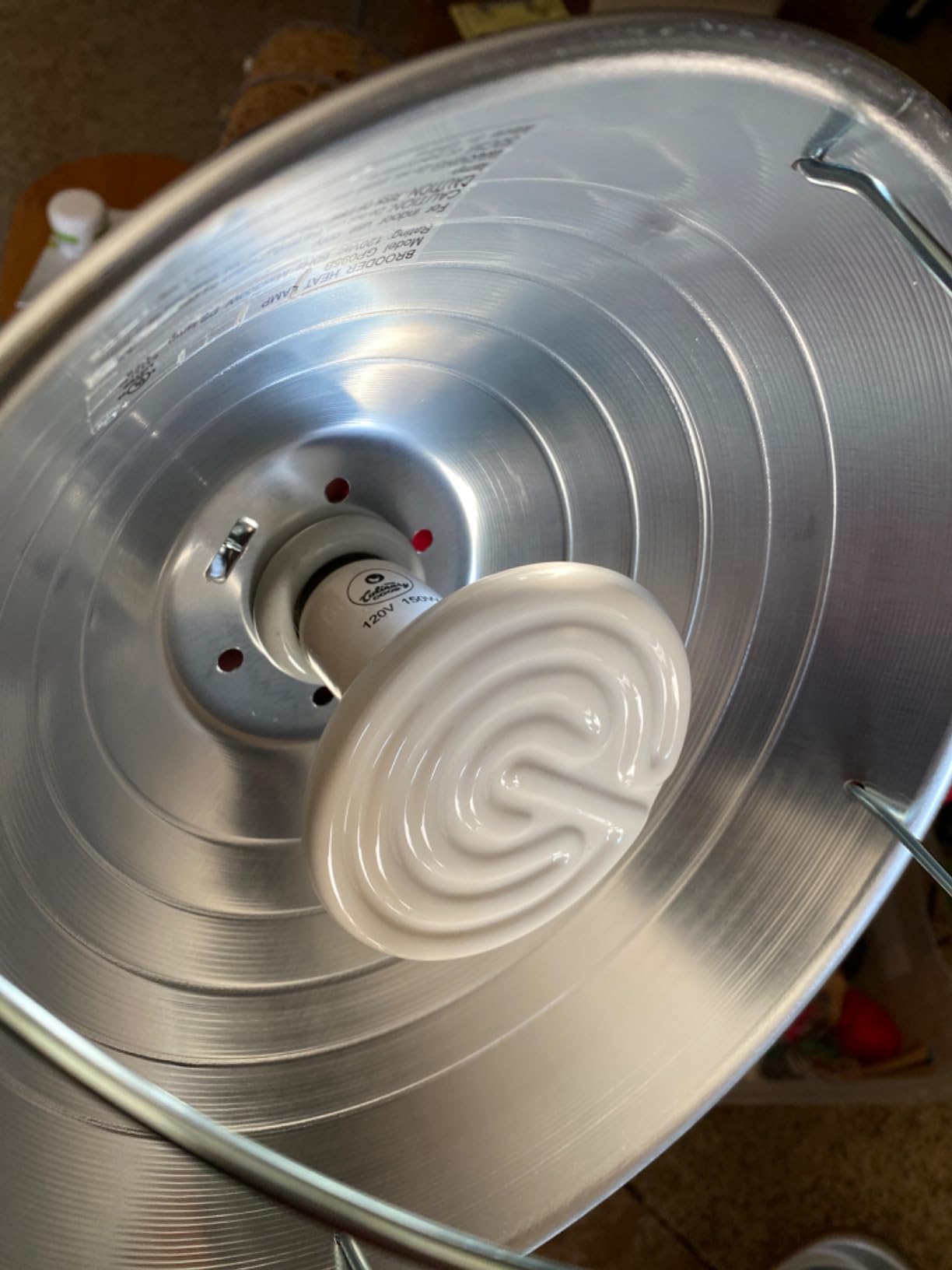
Where the darkness and safety pay off
Two things stand out. It emits no light at all, so the birds get a real night, and because the element will not shatter if knocked, the failure mode that worries people about an open bulb in a coop is largely removed.
Several owners running these through winter report the same pattern, which is keeping eggs and chicks healthy in cold weather with no visible light disturbance.
Where it falls short
Output is the honest problem, and several owners say so directly. Multiple reviews report weaker heat than expected, heat that does not carry far past a few inches, and barely raised temperature in a small coop. One owner felt the bulb only mildly warm through the cage.
It is also a bulb with no fixture, and the listing says to use it with a 150W-rated brooder lamp. If you need serious heat in a cold garage, choose a 250W infrared or ceramic option instead.
11. UTFFEDY 250W/175W Brooder Heater Tubes 2-Pack – Best for Adjustable Output

250W Chicken Coop Heater Brooder Bulb Repalcement, Heater Lamp Tube for 30 Chicks Or Ducklings, Poultry Habitat Supplies 250 Wattage Large Heating Lamp Tube Replacement for Amphibians, Livestock, Pets
250W and 175W
Two-mode switch
Anti-scald casing
UL certified cord
2 tubes
Pros
- Two-mode switch lets you choose 250W or 175W for different weather
- Heating tube form gives a wider and gentler heat spread than a bare bulb
- Anti-scald casing and heavy-duty grill reduce burn and fire risk
- UL certified power cord
- Two replacement tubes included
- Suited to lambs
- goat kids
- puppies
- ducklings and reptiles
Cons
- Uses a proprietary tube so replacements are brand-specific
- Needs a dry working environment to perform reliably
- Less review volume than the ceramic emitters in this group
121 reviews at 4.5 stars with 77% at five stars. Owners highlight the adjustable 250W and 175W thermostat switch as the standout feature, and report even heat distribution across brooder areas holding 30 chicks or ducklings.
That two-mode switch is the closest thing to thermostatic control in this roundup without moving to a flat panel. Once the chicks feather out at week four you drop to the lower setting instead of climbing a ladder to raise the lamp.
The heating tube form spreads heat more gently and widely than a bare bulb, and the acrylic carbon fiber housing with anti-scald casing and heavy-duty grill is the safety story here. The power cord carries international UL certification.
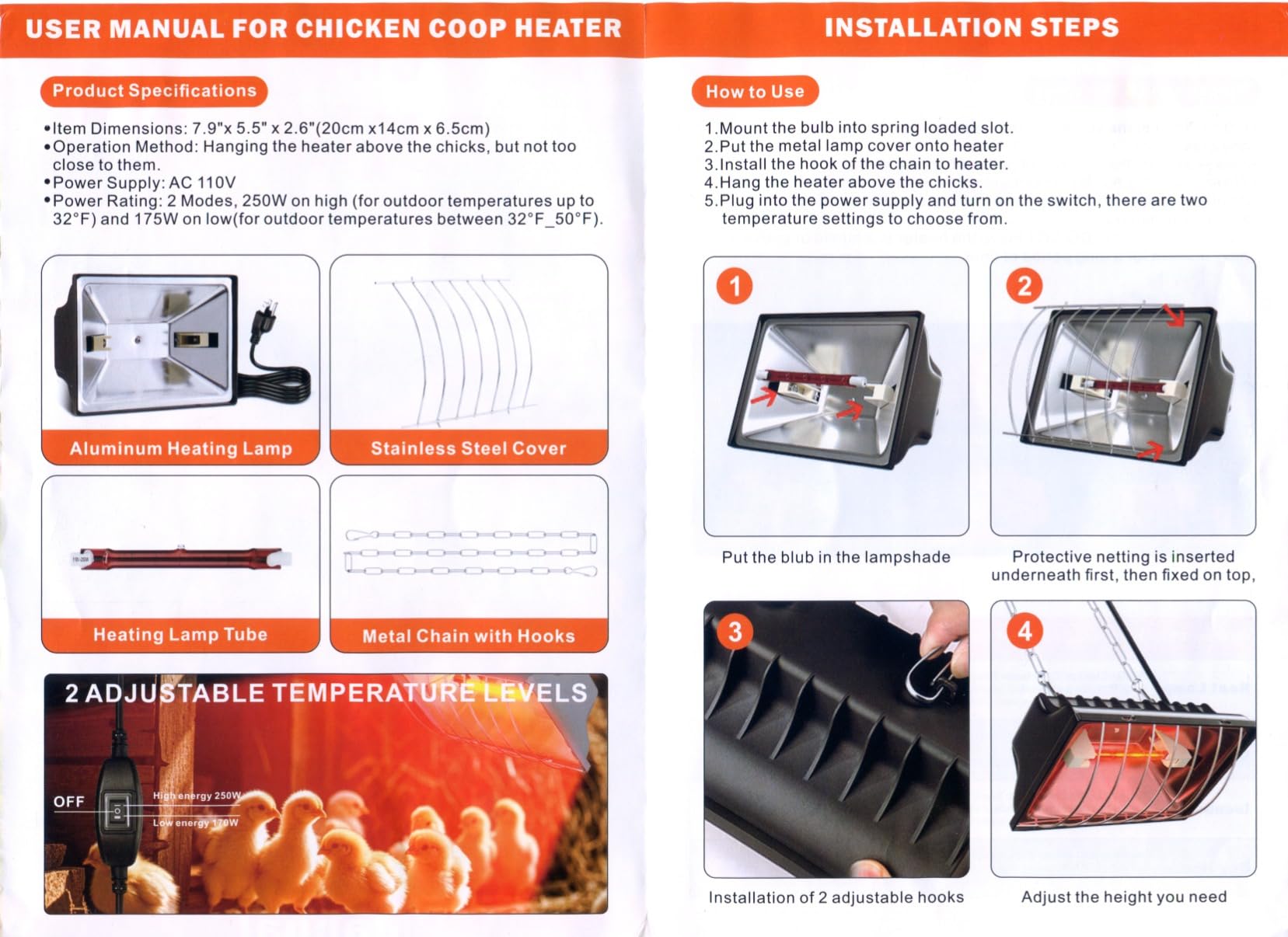
Two 250W tubes are included and the bulbs are listed at up to 5,000 hours of life, with built-in overheat protection. The listing positions it for livestock, poultry brooders, whelping areas and terrariums.
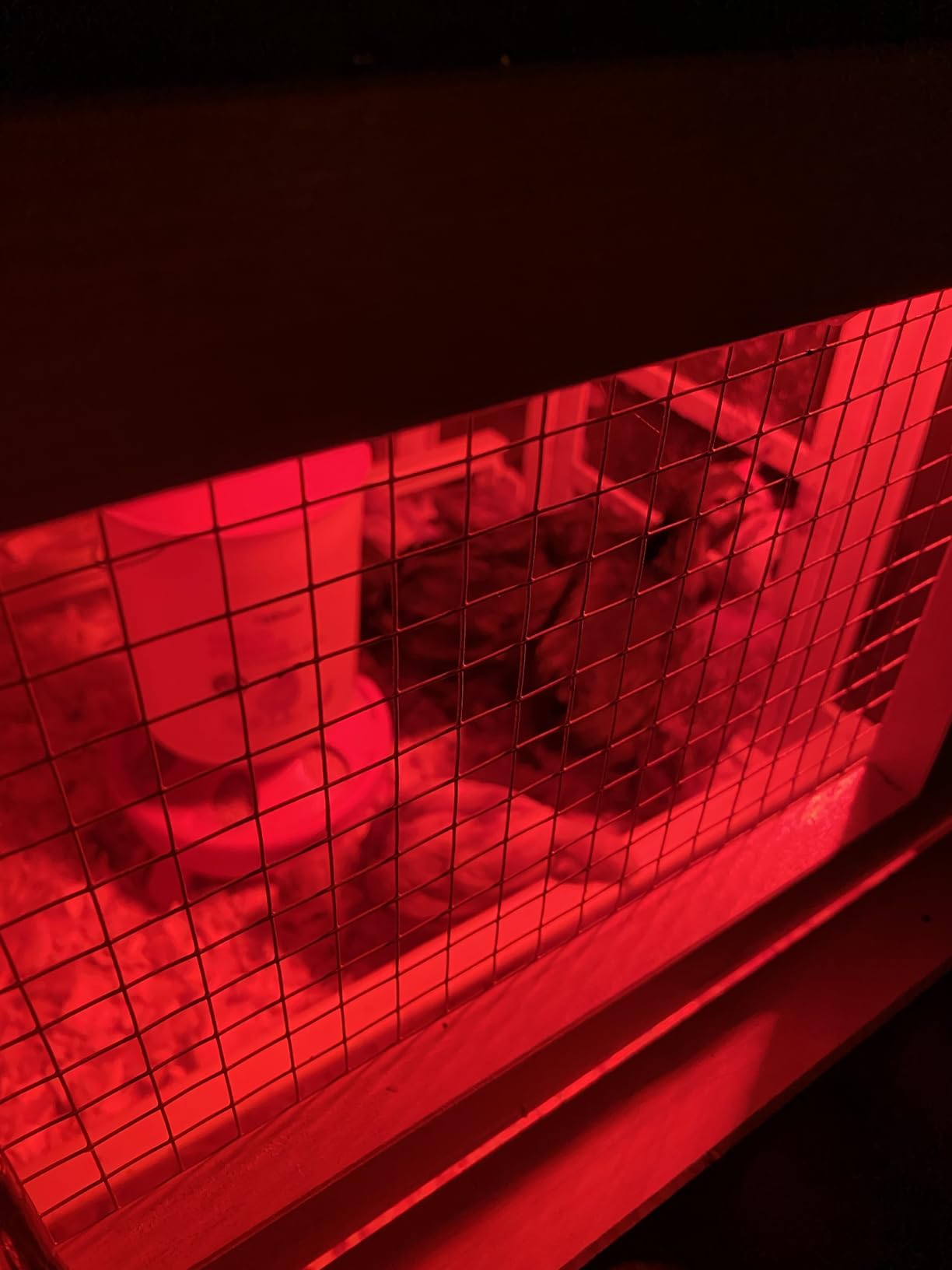
When gentler and wider heat is what you need
A tube spreads heat across a broader area than a focused reflector bulb, which suits ducklings and other birds that spread out rather than huddle tightly. It is also used by owners for lambs, goat kids, puppies and reptiles, so it is a general livestock heater rather than a chick-only part.
The grill and anti-scald casing matter more than the wattage figure in a brooder where chicks are pressed against the fixture. Burn risk is one of the reasons keepers move away from lamps entirely.
Where it falls short
It uses a proprietary tube rather than a standard E26 bulb, so replacements are brand-specific. If you are the kind of keeper who would rather buy any bulb at any shop, that is a genuine drawback.
It also needs a dry working environment to perform reliably, and with 121 reviews the long-term track record is thinner than the ceramic emitters that have thousands.
12. Homnebila 250W Coop Heater with Guard and Chains – Best Complete Kit

Homnebila 250W Chicken Coop Heat Lamp with Guard & Adjustable Temp
250W and 175W bulbs
Die-cast aluminum shade
Stainless steel guard
Two hanging chains
Pros
- Complete kit with shade
- guard
- bulbs and chains in one box
- Two wattages included so output matches the weather
- Solid die-cast aluminum shade and stainless guard feel sturdier than a bare bulb
- Hanging chains create a temperature gradient so chicks can move away
- Reported as running cooler than a bare infrared bulb
- Works with an external dimmer for automated control
Cons
- One owner reported failure at about 40 days and no repair path
- One owner had a bulb burn out in under six months
- Chains went unused by at least one reviewer so fit is unverified
- Newest listing here with only 50 reviews
Only 50 reviews at 4.4 stars, with 82% at five stars but 14% at one star. Users keeping quail, chicks and general coops report strong controllable heat and good build quality, and one owner measured a 30°F ambient temperature rise in a 16 by 24 inch quail pen.
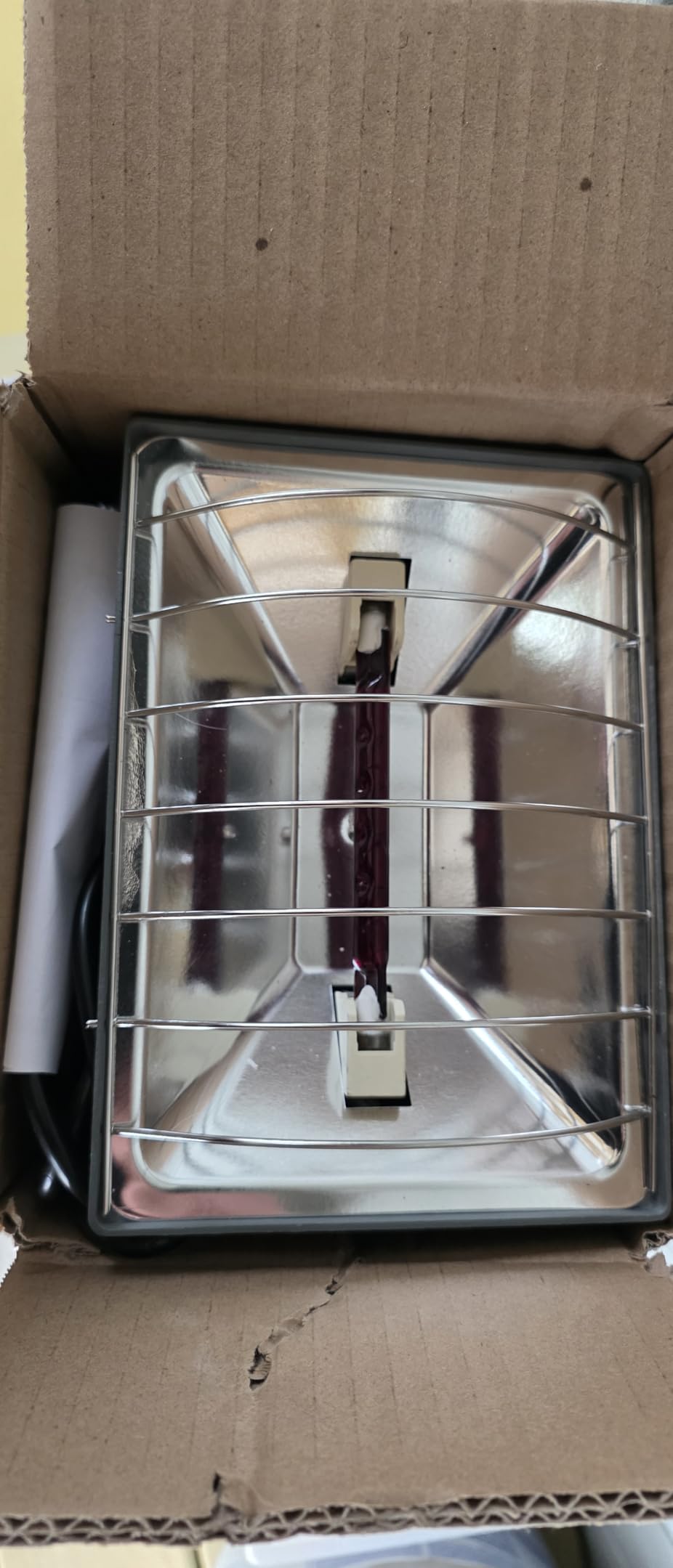
Everything is in one box, which removes the most common assembly mistake. You get the die-cast aluminum lampshade, the stainless steel protective guard, both bulbs and two 3.28 ft stainless hanging chains, and you can hang it in seconds.
The two bulbs are the practical point. Use 250W at or below 32°F and 175W at or above it, and because the housing runs cooler than a bare infrared bulb, several owners consider that a safety advantage around chicks.
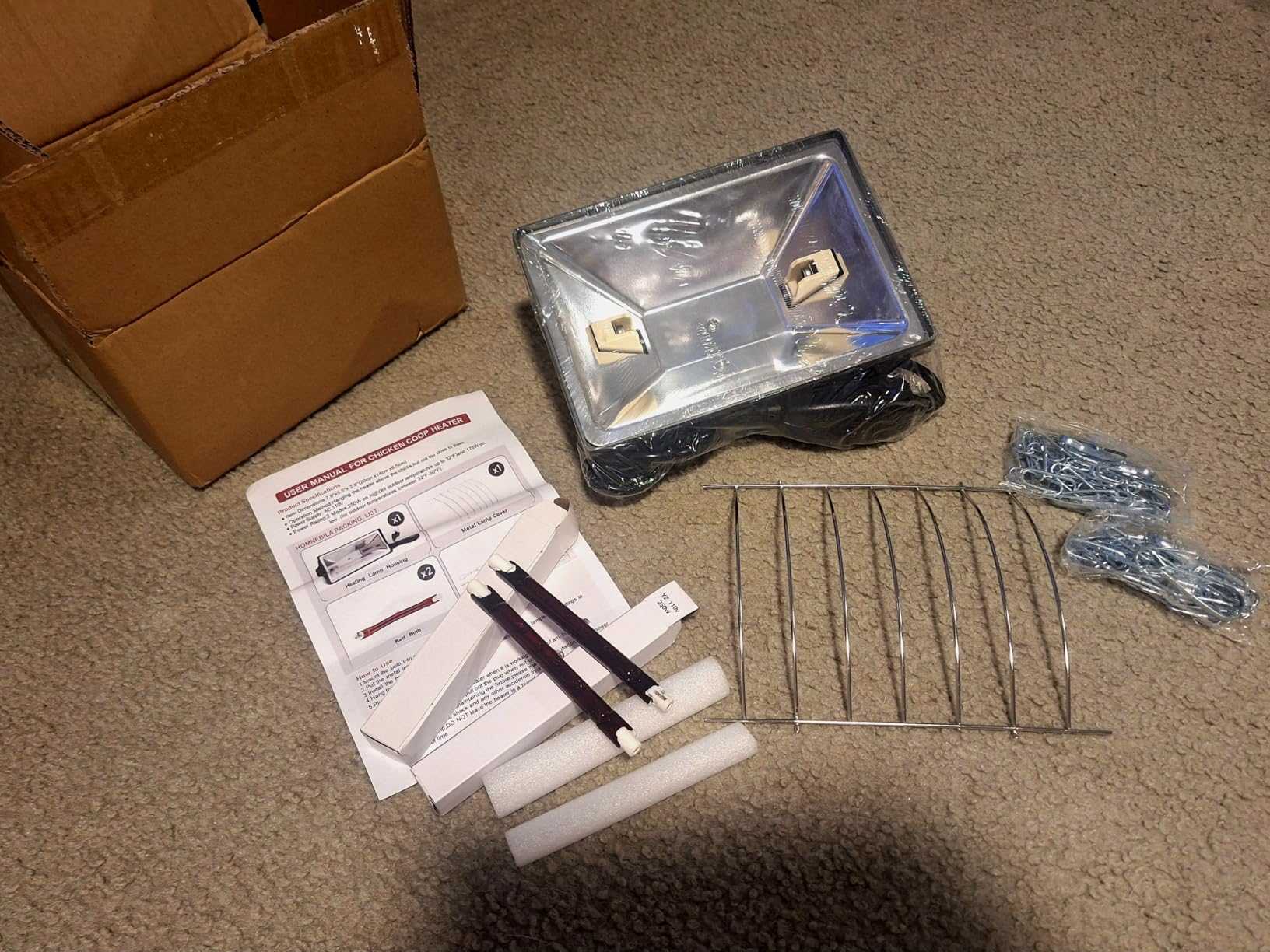
The structure is described as waterproof and dustproof, which is what you want for damp and dusty winter conditions, and it also works with an external dimmer in addition to the two on-device settings.
Why the chains matter more than the bulbs
Chains are how you build a temperature gradient. Hang high enough that the hot zone covers a third of the brooder and the rest is cooler, and the chicks can self-regulate by moving, which is the same principle that makes a lamp work in the first place.
A hung fixture also removes the clamp entirely. There is no grip to slip and no cord to snag on a brooder wall, which is the single most common fire worry raised about lamps in poultry forums.
Where it falls short
This is the newest listing in the group, and durability is the open question. One owner reported the unit failing at about 40 days and being unrepairable, and another had a bulb burn out in under six months of intermittent use.
At least one reviewer never fitted the chains, so the fit is not fully verified in the wild. With only 50 reviews behind it, buy it for the complete package rather than as a long-term reliability bet.
How to Choose a Heat Lamp for Chicks: Wattage, Bulb Type and Mounting
Wattage is the first decision and it is mostly a function of brood size and room temperature. A 100W ceramic emitter suits a small brooder of roughly 10 to 25 chicks in a warm room. A 150W emitter is the general-purpose number for a brooder in a house or heated garage. A 250W bulb is what you move up to for an unheated garage, a barn or a cold snap.
One 250W lamp is widely reported by homesteaders to cover a large brood comfortably, up to around 100 chicks, but that figure assumes an unheated space and a guarded fixture. In a warm room the same lamp will cook them, so the honest answer is that you match the bulb to the room, not to the bird count alone.
Type comes next. A red glass infrared bulb is the traditional choice, heats fast and broadly, and its soft light is less disruptive to chicks than white light, though it is still visible light. A clear or white incandescent bulb is brighter and harder on resting birds. A black ceramic emitter emits no visible light at all, which is the option that gives chicks a genuine day and night cycle.
Ceramic also has practical advantages in a brooder. It will not shatter if knocked, it runs to a 10,000 hour rated life against roughly 3,000 to 4,000 hours for incandescent, and it can be handled once cooled if it does get tapped. The cost is that ceramic emitters run hotter and give you less control, so you adjust with height rather than output.
Two things to check before you buy anything. First, is the bulb coated with Teflon? A Teflon-coated bulb releases fumes when heated that are toxic to birds, and this warning appears on exactly one editorial page across the top results for this query, which is why we repeat it. Second, is the fixture rated for indoor or outdoor use? Many keepers believe red livestock bulbs are outdoor-only, and the listings in this roundup mostly carry an indoor rating.
Mounting is where the fire risk actually lives. A clamp that can slip, a bulb with no guard, a cord routed where a bird can reach it, and a lamp hanging too close to bedding are the four failures that show up again and again in owner discussions. The strongest setups in this roundup pair a metal bulb guard with a secondary chain, and the fixtures that ship with both are worth paying for.
Finally, know when a lamp is the wrong tool. A flat brooder plate uses a fraction of the power, needs a room at or above roughly 55°F, and gives birds a hen-shaped warm spot, but it does not warm the air and you cannot see underneath it. A lamp radiates heat and light, works in a cold room, and lets you watch the birds, but it carries fire risk. A thermostat-controlled unit sits between the two, and it is the category most roundups skip.
For a handful of chicks that need spot heat rather than a whole brooder, our guide to the best heat guns covers the handheld option, though a lamp is still the safer long-term choice around bedding.
Whichever you pick, the operating costs differ enormously. A 250W bulb left running for a 21-day brooding cycle uses about 126kWh, while a low-wattage panel uses a small fraction of that, which is why off-grid homesteaders tend to run a panel by day and a lamp at night during a cold snap.
Heat Lamp Fire Safety Checklist for Chick Brooders
Heat lamps are repeatedly named as one of the top causes of barn fires, and the mitigation is almost entirely down to how you hang them. Work through this list before the chicks arrive rather than at 2am with a torch.
Add a secondary safety chain or zip tie to every lamp, so a slipping clamp cannot drop a bulb into bedding. This is the single highest-value step on the list.
Use a fixture with a metal bulb guard. Bulb guards are cheap and they stop the exact failure people worry about most.
Never use a Teflon-coated or PTFE-coated bulb. Heating releases fumes that are toxic to birds.
Keep the lamp clear of bedding, hay, cardboard and dust. Dust and dander on a hot bulb are an ignition source.
Route the cord out of reach and along a wall, not across the brooder floor where a bird can peck at it.
No extension cords. Move the brooder to the outlet instead, or use a properly rated heavy-duty lead only if there is no alternative.
Check the indoor or outdoor rating on the bulb. Many livestock bulbs are listed for indoor use only and are not rated for damp or exposed coops.
Keep spares on hand. A bulb that fails at 3am in an unheated garage chills a whole brood fast, and a spare costs a fraction of that loss.
Wipe the bulb and reflector periodically, with the power off and the bulb cool, so dust does not build up on a hot surface.
Check the clamp grip and the switch position every day for the first week. Both the switch and clamp failure modes are common and easy to miss.
Frequently Asked Questions
What is the best heat lamp for baby chicks?
For most brooders the best heat lamp for baby chicks is a 150W or 250W infrared bulb in a clamp or hanging fixture with a metal bulb guard and a secondary safety chain. Choose a 150W emitter for a brooder in a warm room, step up to 250W for an unheated garage or barn, and add a black ceramic emitter if you want chicks to rest in real darkness.
What wattage heat lamp is best for chicks?
A 100W ceramic emitter suits a small brooder of 10 to 25 chicks in a warm room, 150W is the general-purpose choice for a normal brooder, and 250W is right for an unheated garage, a barn or a cold snap. One 250W lamp is widely reported to cover a large brood comfortably, but match the bulb to the room temperature as much as to the chick count.
Is a red or white heat lamp better for chicks?
Red is the better default. Soft red light is less disruptive than white and helps chicks settle, while white bulbs add more light and can encourage pecking and keep birds restless. If you want true darkness for rest, choose a black ceramic emitter that emits no visible light at all rather than any glass bulb.
How high do you put a heat lamp for chicks?
Start at 95°F and hang the lamp 18 to 20 inches above the chicks, easing to 24 to 27 inches as they feather out. Drop the target temperature about 5°F each week from 95°F in week one to 70 to 75°F by week five. With ceramic emitters follow the manufacturer clearance, which is commonly more than 30cm from the birds.
What is the safest heat lamp for chicks?
The safest setup is a guarded fixture on a chain rather than a bare bulb, with no Teflon-coated bulb, a secondary safety chain added to the clamp, the cord routed out of reach, and the lamp kept clear of bedding and dust. A listed socket matters too, and keeping a spare bulb on hand prevents a 3am failure from chilling the brood.
Which Heat Lamp Should You Buy?
For most people brooding chicks in 2026, the best poultry heat lamps for chicks come down to two parts: a guarded fixture and the right bulb. Our best overall pick is the Simple Deluxe 150W ceramic 2-pack, because it emits no light, lasts a long time and comes with a spare. Pair it with the Woods clamp lamp if you want a metal bulb guard and fine aiming control, or buy the Simple Deluxe 250W clamp 2-pack for two guarded zones and a listed socket.
If you are in a cold garage or barn, go to 250W with the LUCKY HERP red infrared bulb or the Wesome four-pack, and hang it from a chain on the Homnebila kit rather than trusting a clamp. Keep spares, keep the clearance, and let the chicks tell you when to move the lamp. You can check current pricing on all twelve through the buttons in each section.