
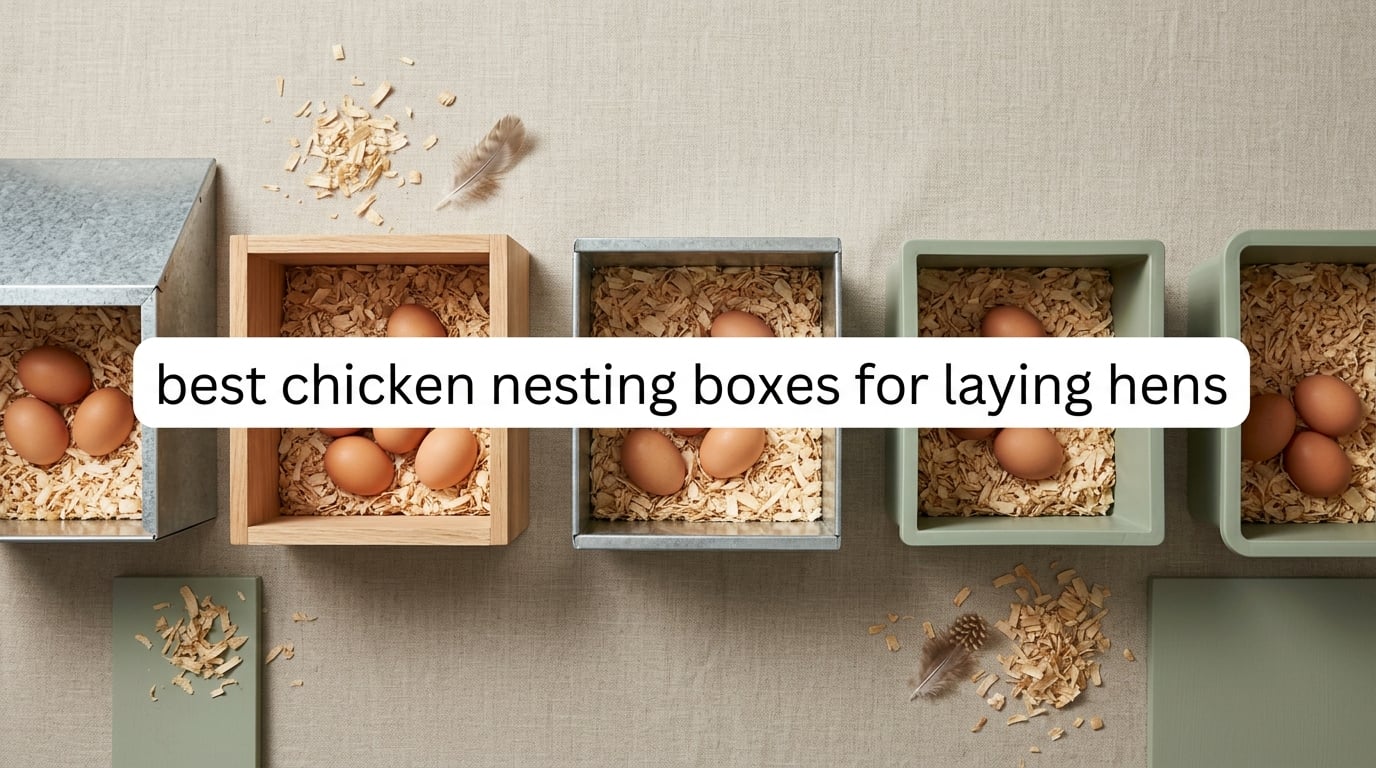
The short answer: buy one box per four to five hens, size it at roughly 12 by 12 by 12 inches for standard breeds, and mount it below the roost in a dim corner. Those three rules decide whether your flock actually uses the box or lays on the coop floor where eggs get stepped on, soiled and eaten.
Everything below that answer is detail. I compared 10 of the best chicken nesting boxes for laying hens currently on the market, running through the specs, the mounting options and the failure points that owners actually report. The list covers roll-out and roll-away metal units, open-front plastic boxes, and solid wood boxes for keepers who care more about warmth than egg collection. Ratings and specifications were checked on October 2026.
One thing worth saying up front, because no product page will tell you this: the best nesting box in the world still fails if it is mounted badly. A flawless box above the roost gets ignored, and no amount of product quality fixes that. Read the placement section before you spend anything.
If you are still setting the flock up from scratch, our guides to the [best chicken brooders](https://zamd.net/best-chicken-brooders/), [best chicken feeders](https://zamd.net/best-chicken-feeders/) and [best chicken waterers](https://zamd.net/best-chicken-waterers/) cover the rest of the equipment list.
Table of Contents
Top 3 Picks for Laying Hens In 2026

Brower 2-Tier 6-Hole Galvanized Steel
- Galvanized steel
- 6 bays over 2 tiers
- 30-40 hen capacity
- Folding perches

ZenxyHoC Two-Tier 6 Compartments
- Roll-out egg tray
- Removable collection trays
- Hangs on wall
- Swing perch

Touri 6 Pcs Nesting Boxes
- 6 boxes per pack
- Tool-free Velcro mount
- Wipe-clean plastic
- 14 inch compartments
Those three cover the widest range of situations. The Brower is the one to buy if you have a real flock and want the hardware to last a decade. The ZenxyHoC does the same job for roughly a third of the outlay with a roll-out floor that keeps eggs out of reach. The Touri pack is the honest answer for two to six hens who just need somewhere sheltered to lay.
The 10 Best Chicken Nesting Boxes at a Glance (October 2026)
| Product | Specifications | Action |
|---|---|---|
| Brower 2-Tier 6-Hole Galvanized Steel Nest |
|
Check Latest Price |
| ZenxyHoC Two-Tier 6 Compartment |
|
Check Latest Price |
 Toriexon 6 Compartment Metal Nest Toriexon 6 Compartment Metal Nest |
|
Check Latest Price |
| Touri 6 Pcs Nesting Boxes |
|
Check Latest Price |
 Eggluuz 6 Compartment Roll-In Nest Eggluuz 6 Compartment Roll-In Nest |
|
Check Latest Price |
 PETSFIT 4 Holes PVC Roof Nest PETSFIT 4 Holes PVC Roof Nest |
|
Check Latest Price |
 Kinchoix 10 Compartment Metal Nest Kinchoix 10 Compartment Metal Nest |
|
Check Latest Price |
 Bavlesfuire 3 Compartment Wood Nest Bavlesfuire 3 Compartment Wood Nest |
|
Check Latest Price |
 Tiflev 4 Hole Roll Away Nest Tiflev 4 Hole Roll Away Nest |
|
Check Latest Price |
 AugFir 2 Compartment Extra Large AugFir 2 Compartment Extra Large |
|
Check Latest Price |
Every box in that table serves at least four to five hens, which is the number that matters more than the product itself.
1. Brower 2-Tier 6-Hole Galvanized Steel Nest for Large Flocks
Brower 2-Tier 6-Hole Galvanized Steel Chicken Nesting Box, 30 to 40 Hen Capacity – Outdoor Poultry Laying Station with Hinged Folding Perches, Ventilated Design & Slanted Roof – Made in the USA
Galvanized steel
6 bays across 2 tiers
30-40 hen capacity
37 x 33 x 24.5 inch
Pros
- Hot-dip galvanized steel resists rust and harsh weather
- Tool-free build with all hardware included in 30-45 minutes
- Double-bolted folding perch rods that close the boxes against overnight roosting
- Side ventilation and sloped roof cut moisture and top perching
- Removable bottoms can be hosed or pressure washed
Cons
- Raw sheet-metal edges are sharp before assembly
- Panels can arrive bent so fasteners need re-tightening
- Included perch wood is unfinished and rough
- Heavy once built so two people help
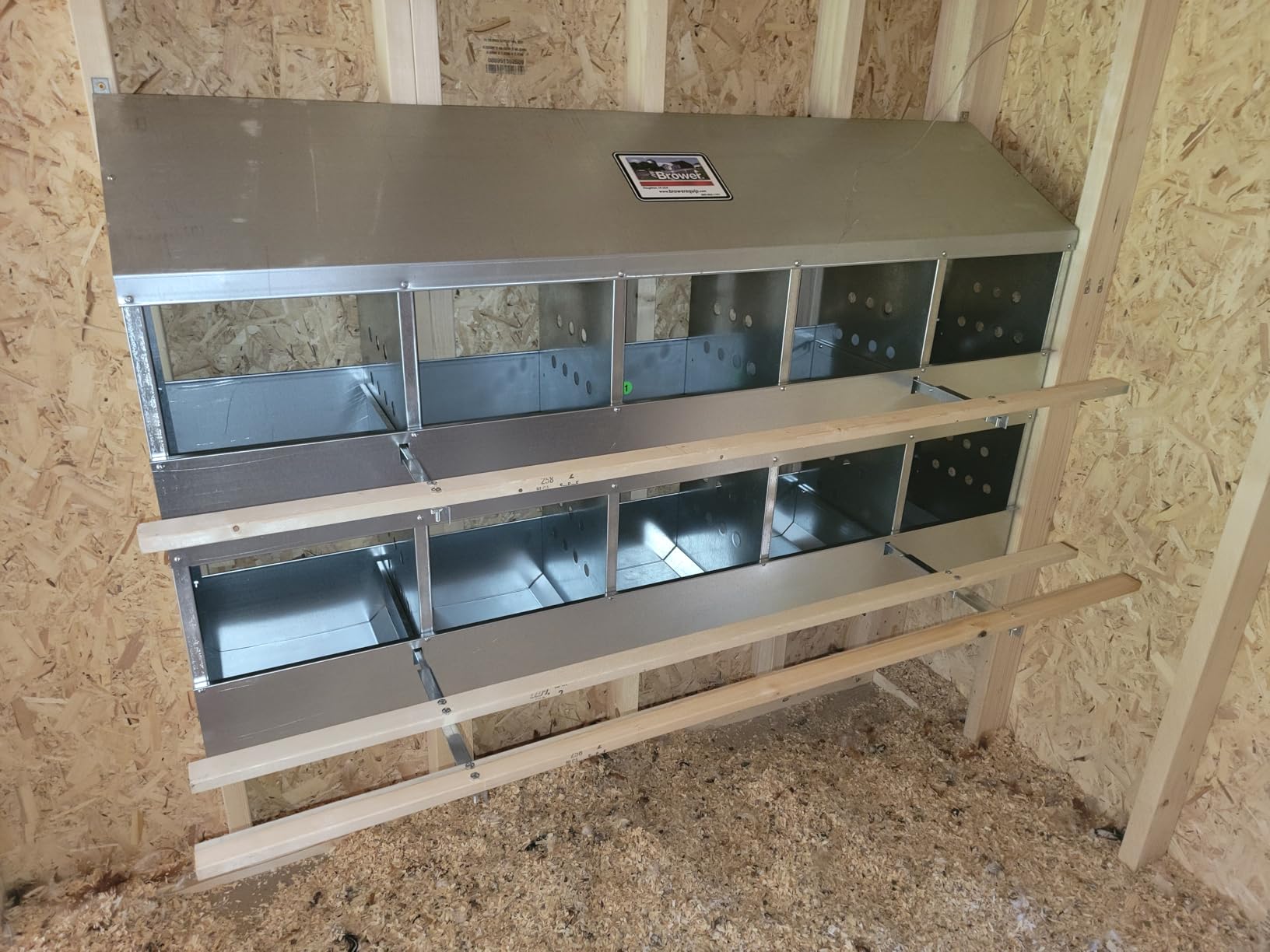
Six bays spread over two tiers, and the manufacturer rates it for 30 to 40 hens. That is a genuinely large-capacity unit and it is the reason this box tops my list for anyone past a dozen birds. The whole thing is galvanized steel, so it is the easiest box here to hose down and the hardest one to wreck.
The folding perches are the part I would not give up. Owners pull them back at night and the boxes are effectively sealed, so hens roost on the perch rods instead of bedding in the nests. Many keepers report their birds moved into the boxes within days of installing the unit.
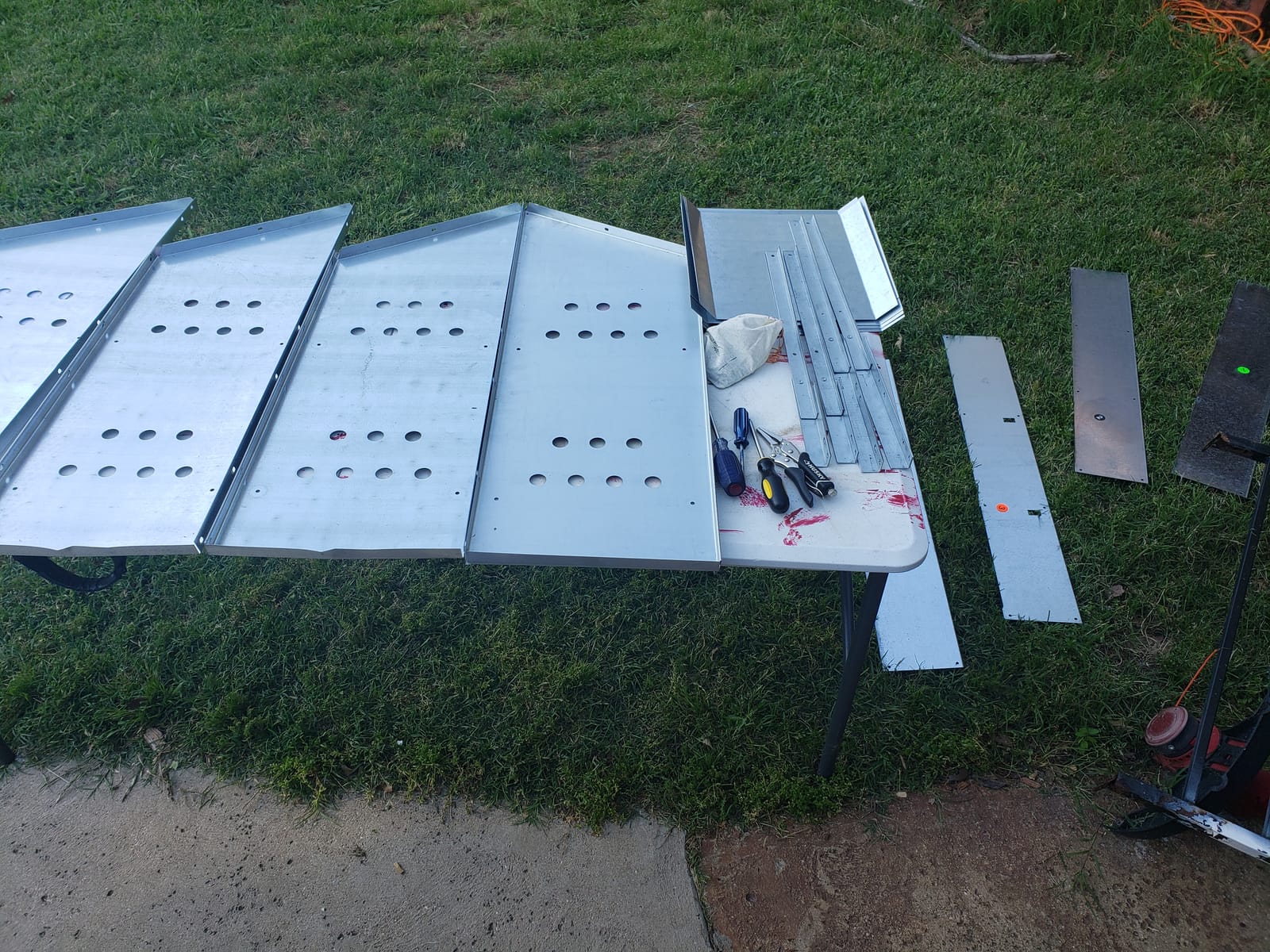
Assembly is tool-free and takes 30 to 45 minutes with the hardware in the box, but it is a two-person job once the panels are up. Wear gloves for the unassembled stage. The sheet metal arrives with raw cut edges and the corners are sharp enough to draw blood, which is the single most common complaint in the reviews.
Two smaller issues are worth planning around. The included perch wood is unfinished and rough, so a lot of owners fit their own trim. And the nesting inserts in the upper compartments can tip out because there is no retaining lip, so bedding needs to be packed in a little firmly.
How it performs in a wet climate and in winter
Galvanized steel is the answer for anyone in a damp region or dealing with persistent red mite pressure. The non-porous surface holds no crevices for mites to breed in the way raw wood does, and pressure washing the removable bottoms is fast and effective.
Cold is the trade-off. Keepers in cold regions consistently say metal feels less comfortable to a hen sitting on it through a lay, and that is one of the reasons wood boxes still have a fan base.
When this is the wrong box for you
It is too much hardware for a small flock. Six bays in a 37 by 33 inch footprint eats a large slice of a walk-in or urban coop, and at that weight it needs solid mounting. If you have fewer than ten hens, the four-compartment and six-compartment wall-mount boxes further down this list do the same job in a smaller footprint.
2. ZenxyHoC Two-Tier 6 Compartment Roll-Out Nest
ZenxyHoC Two-Tier Chicken Nesting Box Red 6 Compartments
Roll-out slanted floor
6 compartments over 2 tiers
Detachable trays
30 x 20 x 30 inch
Pros
- Slanted floor sends eggs into a protected collection tray
- Detachable trays make deep cleaning fast without dismantling
- Side ventilation holes control heat and moisture
- Pre-drilled hanging holes save coop floor space
Cons
- Plastic support can crack under load after about two months
- Included screws are small and tedious to work
- Compartments run tight for large breeds
- Paint finish chips after about a year
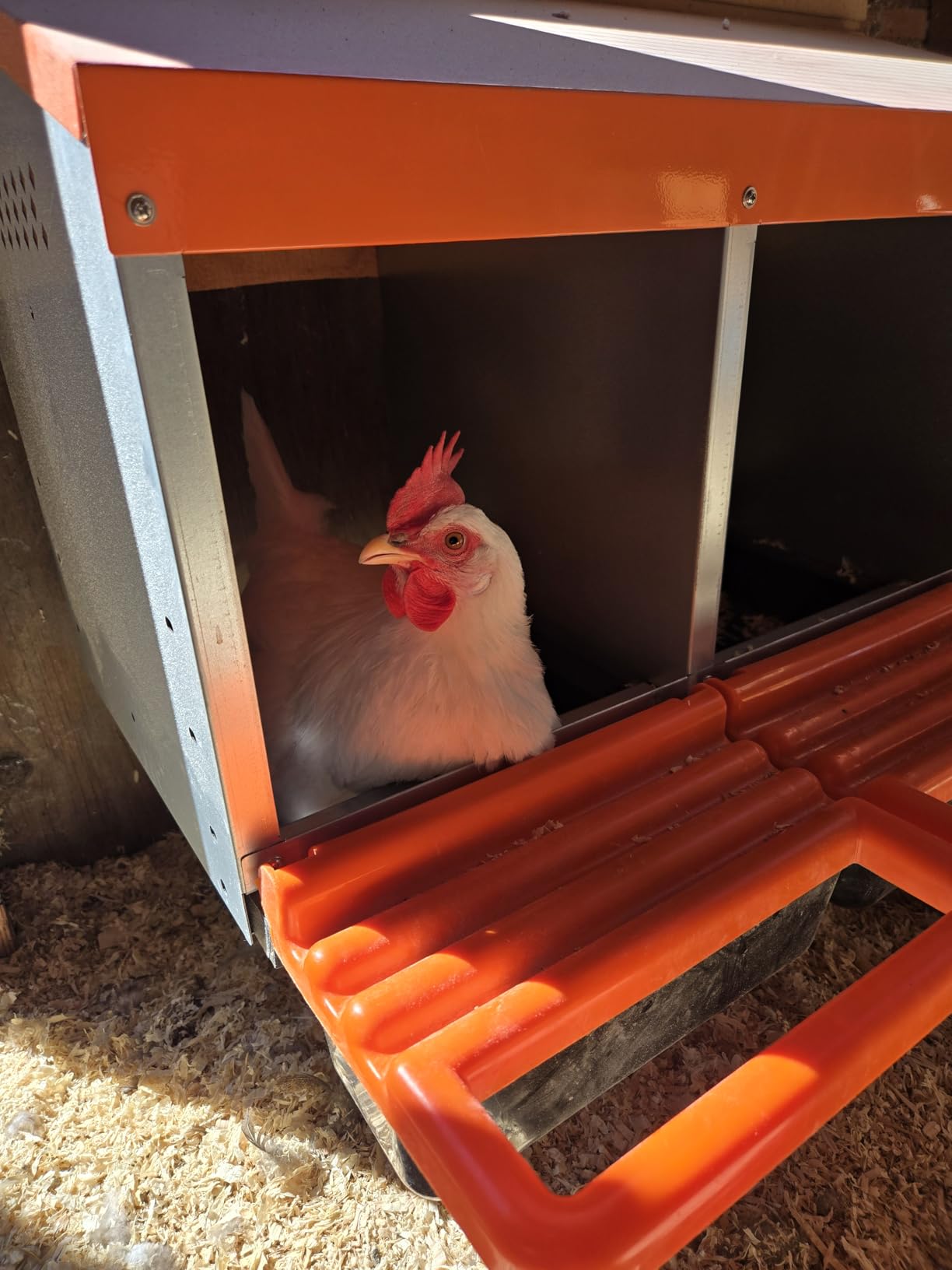
This is the roll-out design most people are asking about, at a price that does not require a second thought. The slanted floor means a hen never stands on her egg: when she lays, the egg rolls forward into a covered tray.
She cannot peck it, dirty it or push it around. Owners report that this feature alone cut their broken egg count to nearly nothing.
The detachable collection trays are what I would call the daily-use feature. You pull the tray out, scrape the bedding into a bucket, rinse it, and slide it back. No dismantling, no reaching into a cramped bay with a torch. On a wet or muddy cycle, that is the difference between cleaning the boxes and ignoring them.
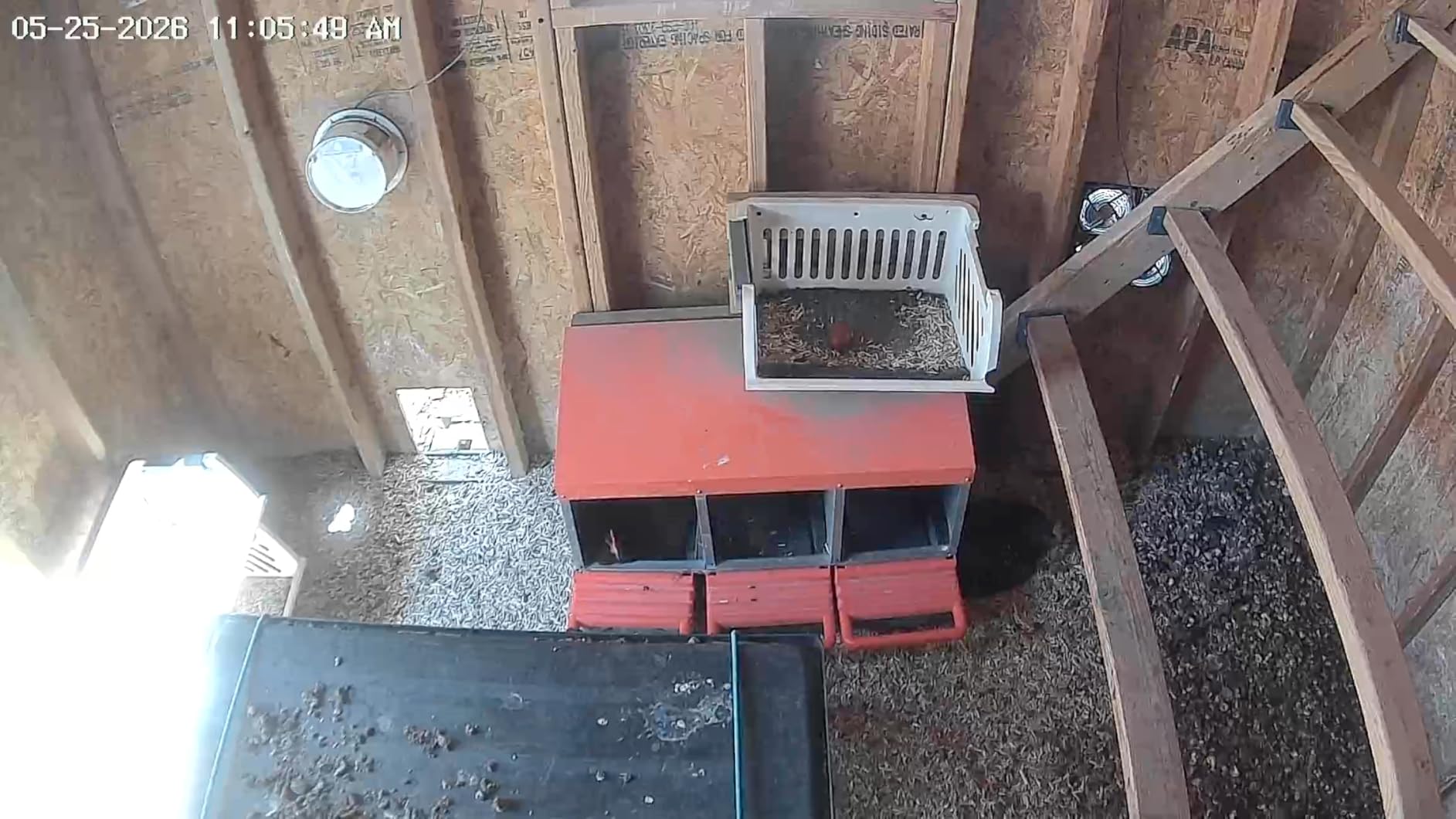
The weak point is hardware quality. Reviewers name the small screws and thin instructions repeatedly, and one report describes the load-bearing plastic support cracking after roughly two months of use. Check that component before a heavy winter.
Paint also chips with handling, which matters mostly in an exposed run where rain reaches the unit.
Sizing is the other thing to check against your flock. These compartments are on the snug side for Orpingtons, Wyandottes and other large breeds. If that is your flock, go to the extra-large plastic boxes or the roomy six-compartment metal unit further down.
Is the roll-out mechanism worth the premium over an open-front box
For anyone with more than a handful of hens, yes, and the reason is egg eating. Once a hen discovers that eggs are food, one bird teaches the whole flock in a day, and a flock that has learned the trick is very hard to break. Roll-out boxes remove the reward entirely because the egg is not in the nest. Keepers running more than about ten birds consistently point to this as the feature that paid for itself.
How to install it so the roll actually works
It hangs from pre-drilled holes, which means the wall does the structural work, but the angle has to be right. Mount it so the tray edge sits slightly lower than the back of the nest floor, or eggs will sit still. Fix it on solid framing, not thin panel, and check the swing perch is closed at night. Bedding packed too deeply into a bay can also block the roll, so keep it shallow.
3. Toriexon 6 Compartment Metal Nest with Roomy Bays
Toriexon Chicken Nesting Box, 6 Compartment Metal Nesting Box
Galvanized steel
6 spacious compartments
Removable divider and nest pad
All hardware included
Pros
- Heavy-duty galvanized steel that resists collapsing
- Spacious bays give hens room to turn and settle
- Removable divider and nest pad simplify cleaning
- Universal size works for backyard and larger flocks
Cons
- Front-access design leaves eggs within reach of the hen
- Green finish is the only colour option
- Metal feels cold in an unheated coop
If your birds are on the large end and the roll-out boxes feel cramped, this is the roomy open-front option. Owners single out the compartment size as the reason to buy it, saying hens can turn around and settle rather than squeezing in. For mixed flocks with Silkies alongside big Orpingtons it is not perfect, but it is the most forgiving of the metal boxes here.
The removable divider and nest pad do most of the maintenance work. Take both out, hose the shell, dry it, put bedding back. All screws and nuts are included and the assembly is straightforward with a basic spanner.
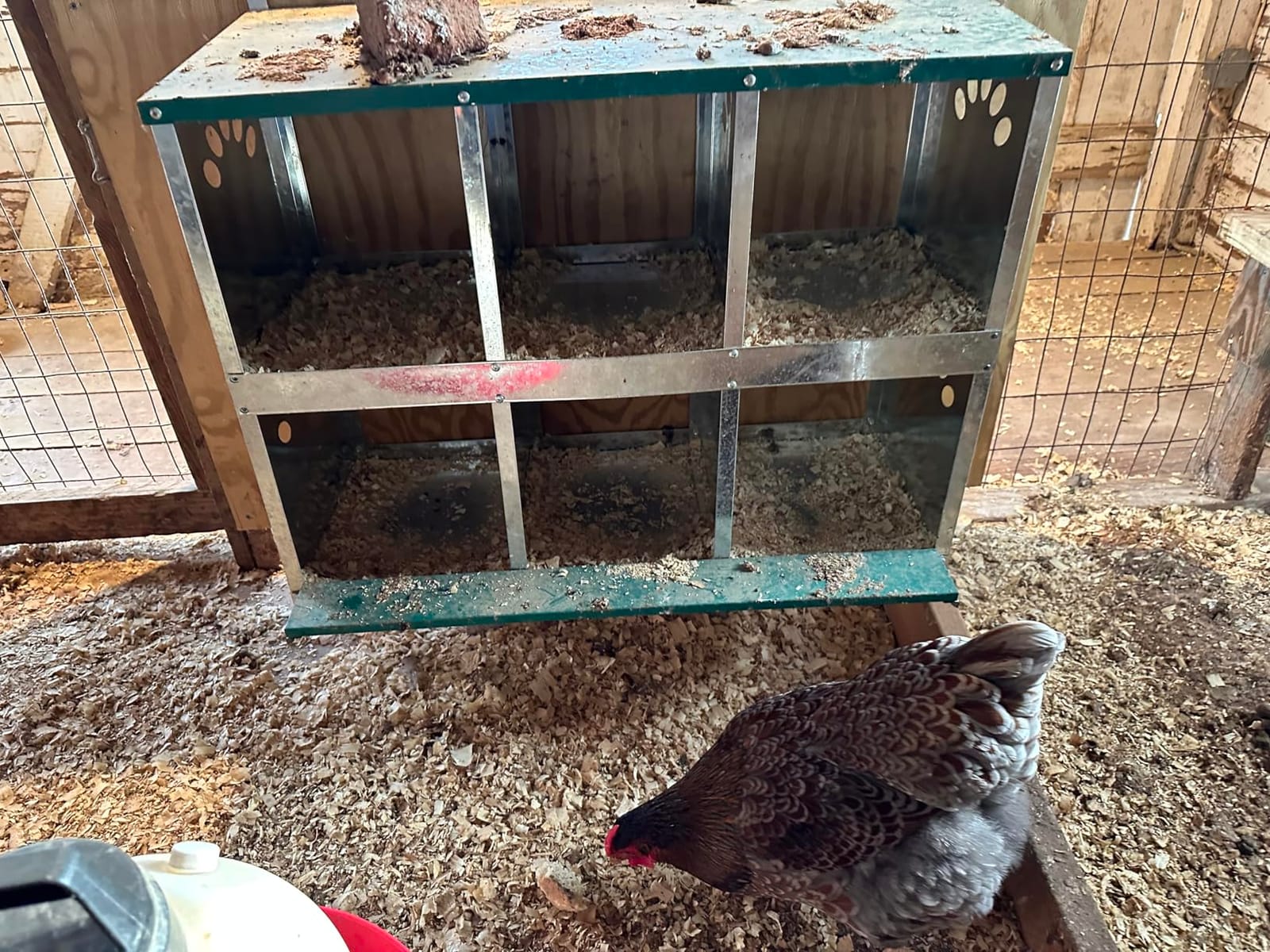
Be clear-eyed about what front access means. The hen sits on top of her egg and can reach it. There is no tray, so you are collecting from inside the bay, and the egg is exposed to be soiled or pecked. In practice that rarely becomes a serious problem unless a flock has already picked up egg eating, but it is the trade you make against the roll-out designs.
The metal also conducts cold straight through. In a northern winter in an unheated coop, a hen sitting in bare steel for twenty minutes will notice. Lining each bay with a deep bed of dry shavings solves most of that, and it is the single easiest improvement you can make to any of these boxes.
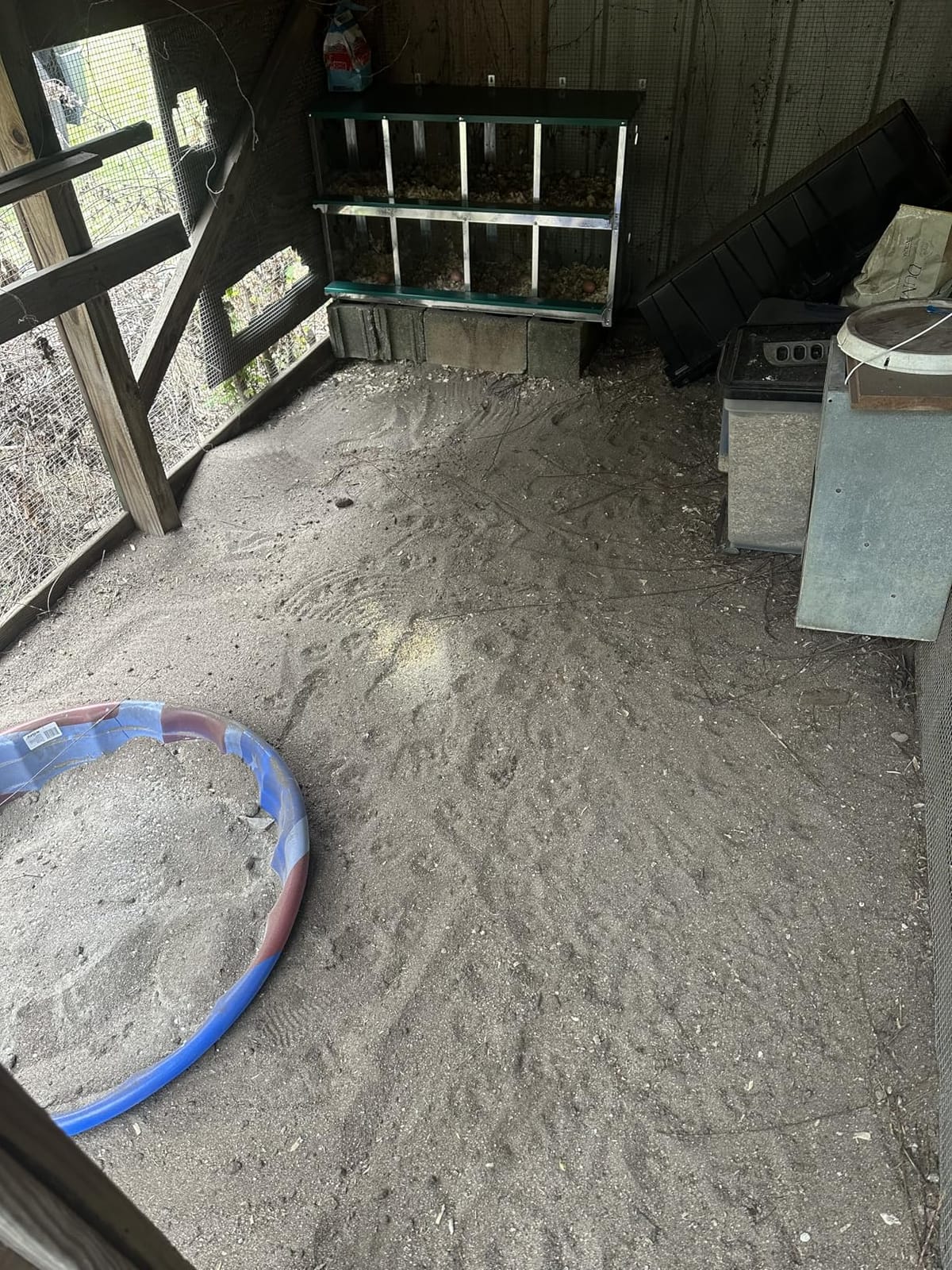
Best setup for mixed-size flocks
Because the bays are generous, this is the unit I would pick for a flock with varied breed sizes rather than a uniform one. Add a deep bedding layer and use a nest pad in the two smaller bays if bantams are in the group, so the smallest birds can still curl up. Keep the front lip at a four-inch height, which is the community consensus figure and stops eggs rolling out.
Cleaning and mite considerations
Galvanized steel sheds water and has no grain for mites to hide in, so a thorough hose-down genuinely does the job. The removable inserts are what make it practical, since you can scrub each piece separately. In a mite-heavy season, treat the whole unit and the surrounding coop rather than just the boxes, because the parasite lives in crevices well away from the nest.
4. Touri 6 Pcs Nesting Boxes for Small Flocks
Touri 6 Pcs Chicken Nesting Boxes, Durable
6 boxes per pack
Each bay 14.25 x 12.5 x 12.25 inch
0.2 inch PP walls
Velcro no-drill mounting
Pros
- Tool-free Velcro setup takes about a minute with no drilling
- Individually sized boxes fit any coop layout
- Soft PP wipes clean and will not rust
- Bright orange finish is easy for hens to spot
- Weighs about 5.5 pounds for the whole pack
Cons
- Flexible plastic is less rigid than metal and can warp
- Open front gives eggs no protection from pecking
- Not insulated so it offers little warmth in cold weather
- Six bays cover only a small flock
Six separate boxes, each 14.25 by 12.5 by 12.25 inches, and the whole pack weighs 5.5 pounds. That combination is genuinely useful because you can spread the boxes around the coop rather than bolting a fixed bank in one corner. Some keepers mount two inside and two in a second location to break up a dominant nesting spot.
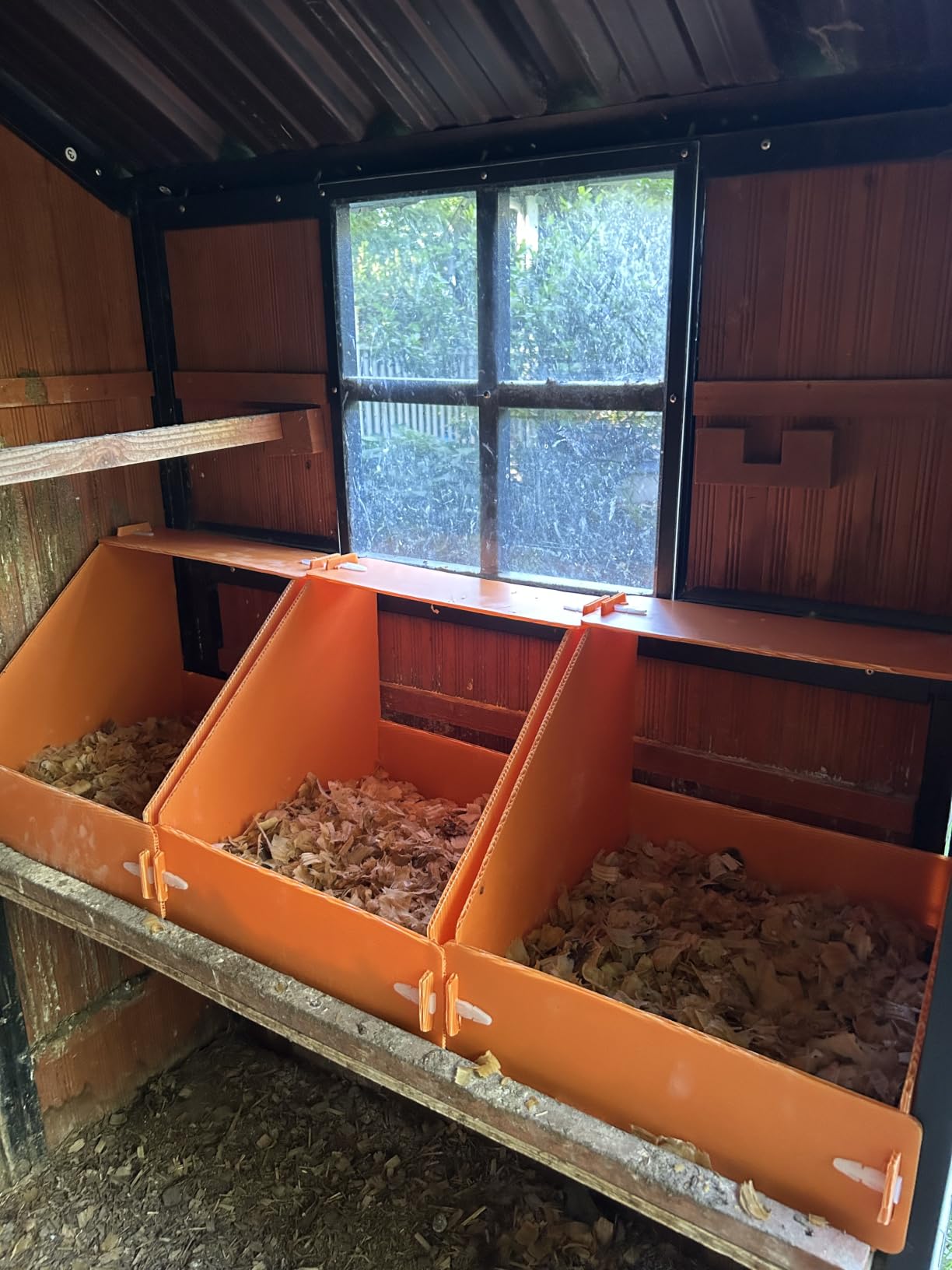
Installation is the standout feature. Velcro attachment means no drilling, no screws and roughly a minute of work, which matters enormously if you are still adjusting where the boxes should go. The bright orange finish is not decoration either. Hens find it faster than a dark box, and it is supposed to deter some pests too.
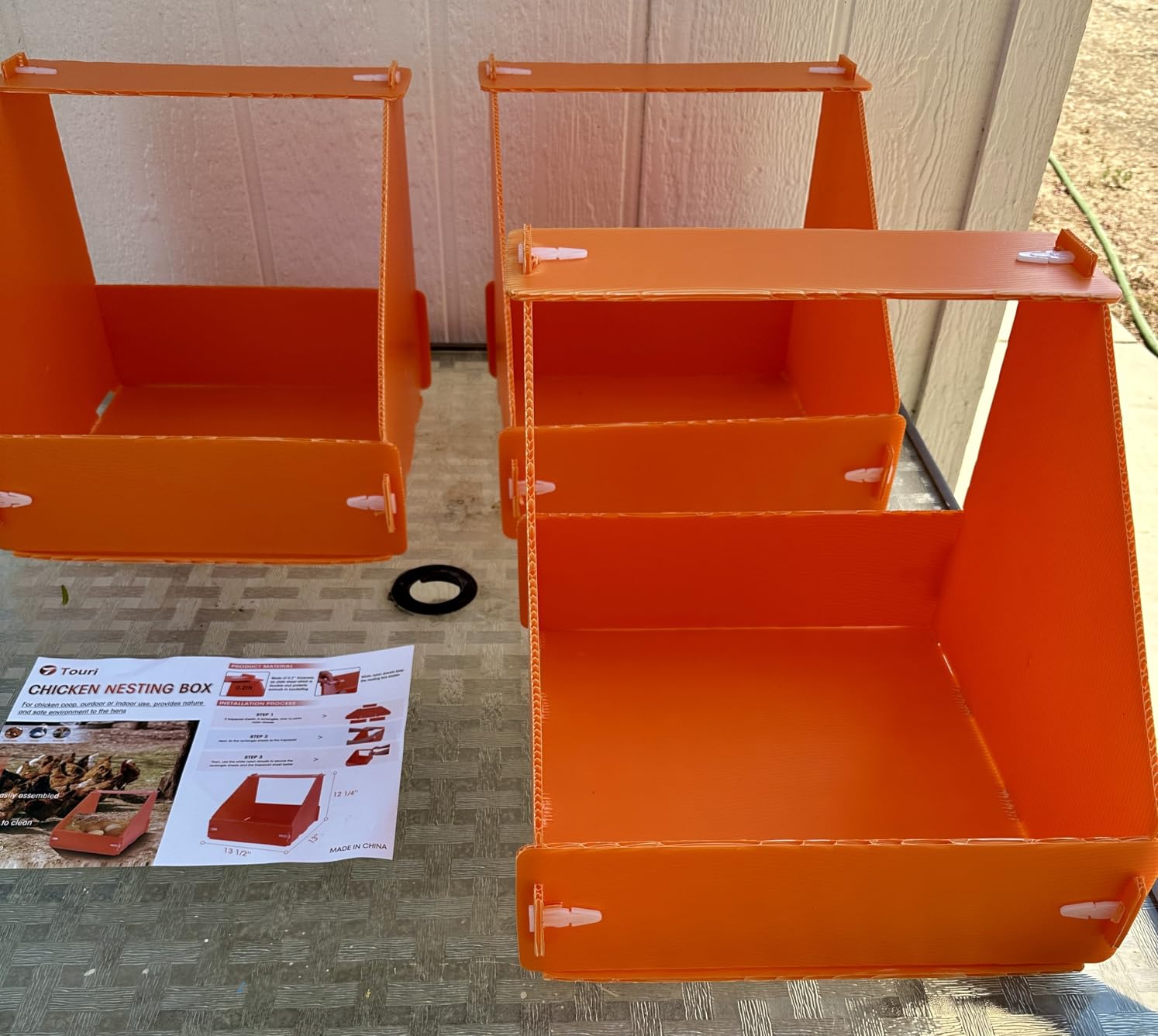
The plastic is 0.2 inch PP plate, which is soft enough to flex. Owners who have had them a couple of seasons report some warping, particularly in summer heat or where the box is in direct sun. It is not a structural failure, but do not expect the same decade of service you get from galvanized steel.
The second limitation is capacity. Six open-front bays sound like a lot until you apply the four-to-five hens per box rule, which is a comfortable maximum for around 25 to 30 birds and a squeeze beyond that. And with an open front the eggs stay with the hen, so a flock that develops egg eating will keep that habit.
Who this pack suits best
First-time keepers with two to six hens, anyone fitting out a mobile or free-range coop that has to be light enough to move, and anyone who wants a DIY-adjacent setup they can rearrange. It is also the sensible first box for a young flock, because you can move the boxes as the birds grow into them.
Where it will let you down
Uninsulated plastic in a hard winter is the honest answer. A hen laying in a thin plastic box in a freezing shed gets cold feet and some keepers see laying drop in cold snaps. The fix is bedding, used generously, or a wooden box instead. For a warm climate or a spring-to-autumn flock, none of that applies and this pack does the job at a fraction of the cost.
5. Eggluuz 6 Compartment Nest with Roll-In Egg Tray
Eggluuz Chicken Nesting Box, 6 Compartments Egg Laying Nests Boxes for Hens
6 compartments
Egg roll-in collection tray
Galvanized sides and roof
31.5 x 20.5 x 30.2 inch
Pros
- Slightly inclined floor rolls eggs into a tray so you never reach into the nest
- Galvanized steel sides and roof resist rust and weather
- Rust-proof plastic trays rinse clean easily
- Perforated bottoms drain water and shed debris
Cons
- An egg can stay in the nest if it lands before rolling
- Small hardware is fiddly and instructions are thin
- Weighs over 34 pounds so mounting takes two people
- Steep tray angle limits bedding inside the compartments
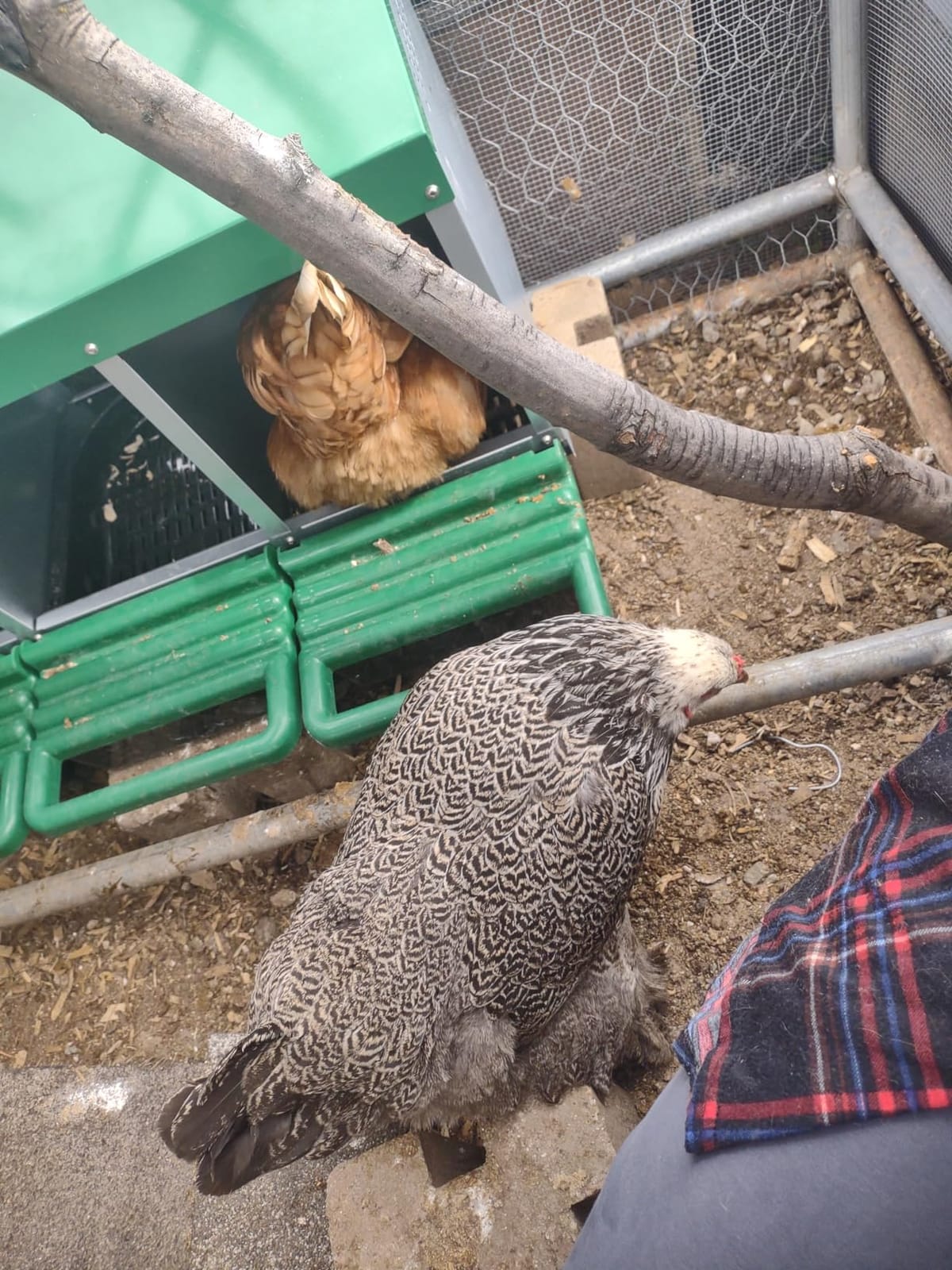
This one scores well above its category average for a simple reason: the egg collection works. The floor is inclined enough that a laid egg rolls into a plastic tray at the front, and the tray pulls out for collection. You never put your hand into a nest, which means you never disturb a sitting hen and you never bring the flock’s attention to the egg.
The material split is sensible. Galvanized steel for the sides and roof where rain and sun hit, plastic for the trays where water and cleaning matter most. Perforated bottoms shed water and debris, which matters more than it sounds in a wet winter.
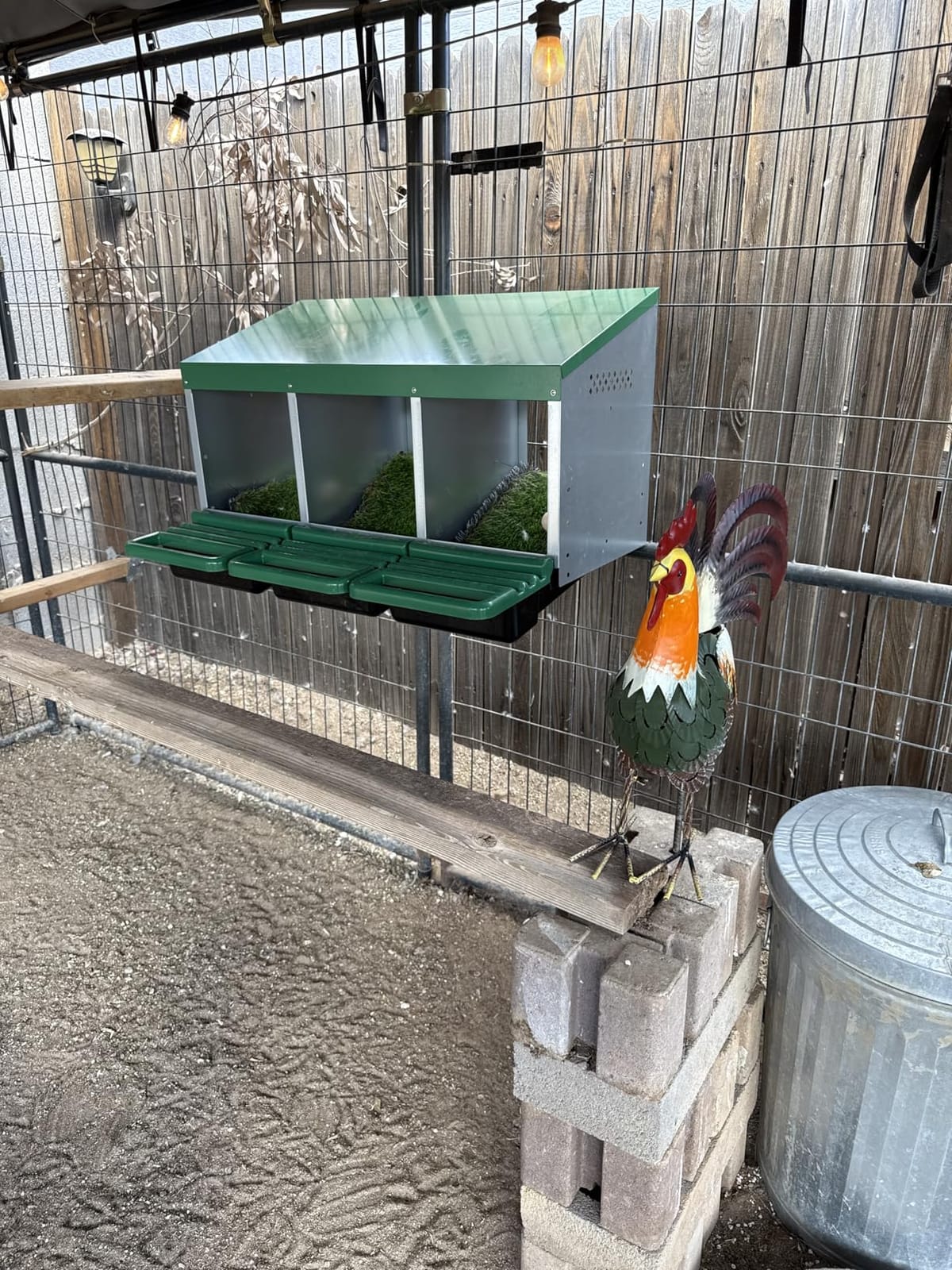
Two limitations follow directly from the geometry. The roll is not instant, so an egg that lands flat at the back of the nest can stay put and the hen may still peck it. And because the tray angle is steep, you cannot bed the compartments deeply. You are working with a thin layer at the nest end, so watch for damp and keep it dry.
At over 34 pounds this needs two people to lift onto the wall, and the small hardware and thin instructions are the most common assembly complaints. Keyhole hanging holes make repositioning easy once it is up, which partly makes up for the installation friction.
Roll-out or open-front: what actually happens in practice
Any sloped design trades a small failure rate for a large gain. An egg that fails to roll is still an egg in a protected bay that you can reach. An egg on an open-front floor is an egg under a hen, in droppings, in the way of her feet, and in reach of a beaked neighbour. Over a laying year the roll-out designs come out clearly ahead, which is why most of the highest-rated boxes in this list use one.
How to set the angle and keep the tray working
Get the unit dead level or a touch nose-down, or the roll stalls. Keep bedding out of the tray path entirely, because shavings pushed into the channel stop eggs dead. Check the tray is fully seated after every collection, since a part-seated tray catches eggs at the lip. The front lip should be around four inches so nothing rolls out of the front of the bay.
6. PETSFIT 4 Hole Nest with PVC Roof and Privacy Panel
PETSFIT 4 Holes Chicken Nesting Box, PVC Waterproof Roof, Privacy Cover
Solid fir wood
PVC waterproof roof
Privacy back panel
46 x 12 x 18 inch
Pros
- Solid wood feels more natural to hens and insulates better than plastic or metal
- PVC roof sheds rain and snow without rusting
- Black back panel blocks wind and gives privacy in cold weather
- Mounts on a wall or sits on the ground
Cons
- Back panel is plastic and feels flimsy
- Interior slats may need trimming to fit
- Factory coating can be thin
- Compartment interior is small for standard hens
Solid fir with a PVC roof is the combination that makes sense on an exterior wall, where the box takes rain from above and wind from behind. Wood insulates, so a hen sitting in it in cold weather is comfortable, and the PVC roof will not rot or rust the way a felt or bare timber lid eventually will.
The black back panel is the part I would keep. A dark, enclosed back blocks drafts and gives the bay the dim, sheltered feel that makes a hen settle instead of scanning the coop. That privacy matters more than most product pages admit, and it is also why curtain strips work when the box is open-fronted.
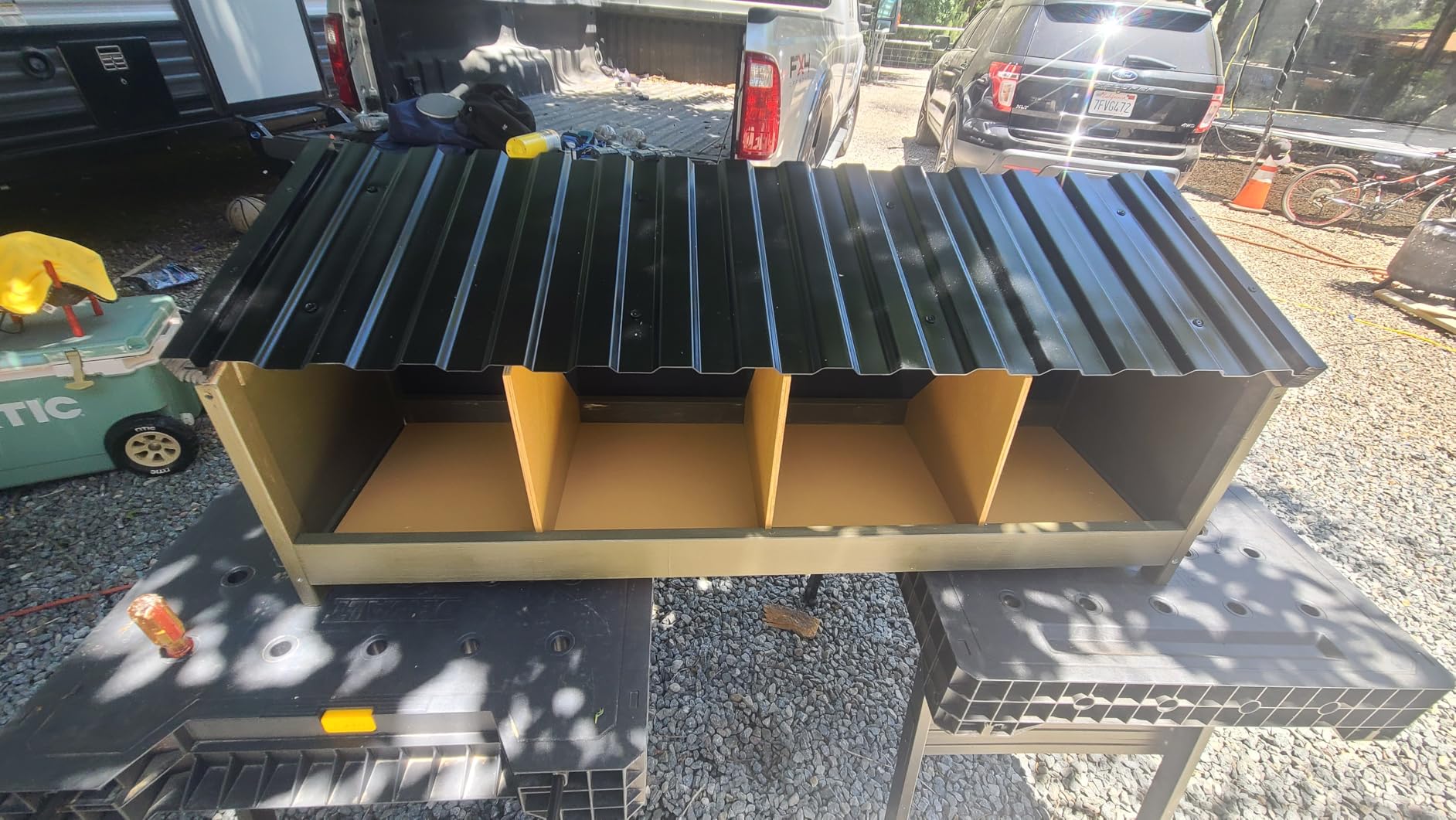
The wood needs sealing. Owners report the factory coating arriving thin, and natural fir will grey and check if it is left exposed, so plan a coat of exterior paint or sealant in the first dry spell. The back panel is plastic and flexes, which is fine functionally but feels cheap next to the timber.
The real constraint is the compartment interior. It is on the small side, and some standard and larger breeds hesitate to enter. Check your biggest bird can turn around inside before you commit, because a hen that cannot fit will simply lay on the floor and you will be back to square one.
Best placement for a box on an outside wall
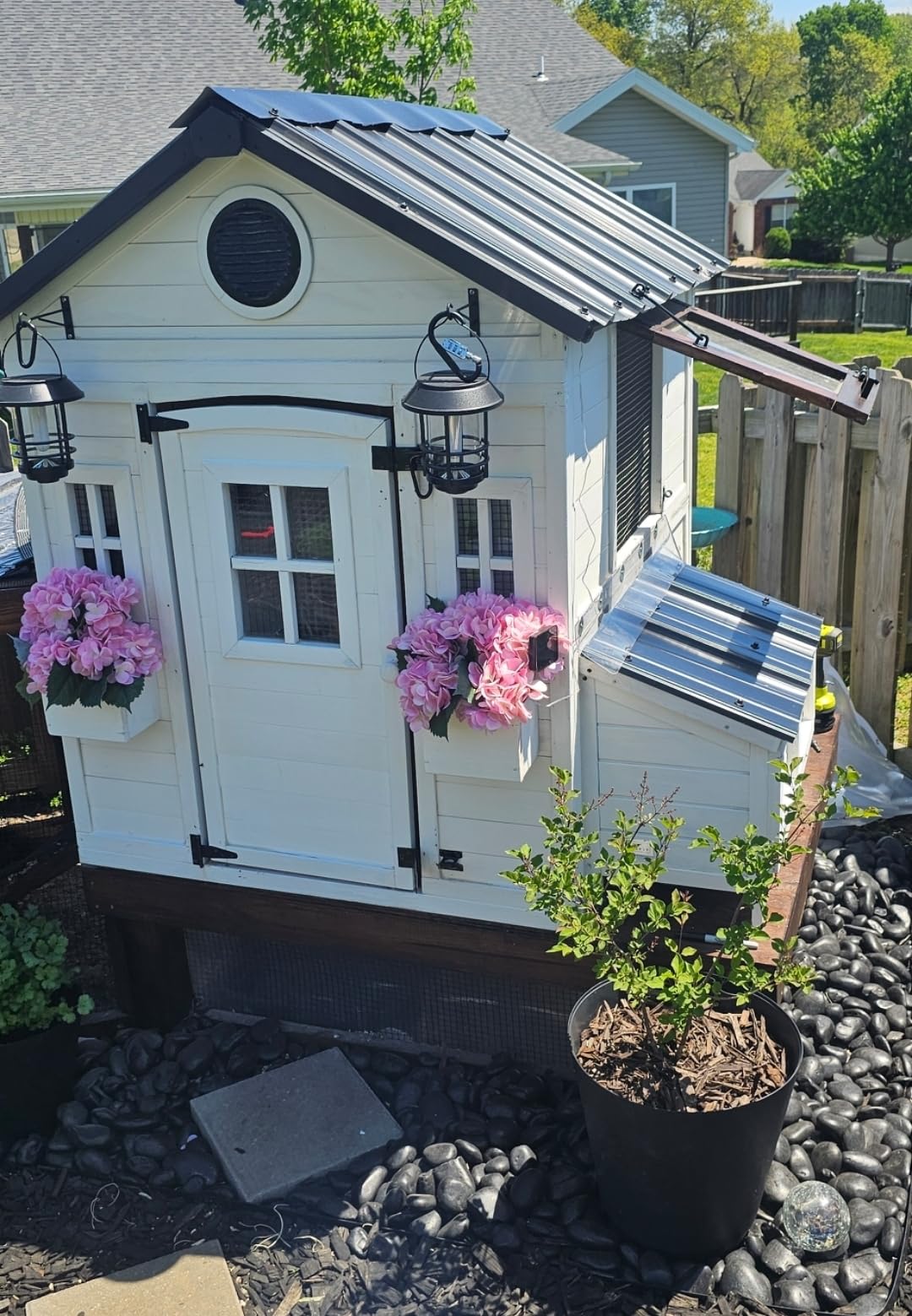
Mount it high enough on the wall to keep rats and mice out, low enough that a hen can reach it, and always under shelter or with a real overhanging roof. A box on a sun-exposed wall with a shallow roof will get rain inside, and wet bedding is the fastest route to a hen abandoning the nest. Fit a solid splash board above the PVC roof if the wall faces prevailing wind and rain.
Wood versus metal in cold and heat
This is the clearest wood case in the list. Metal conducts cold and heat directly, wood does not, and a hen spends about 20 minutes sitting in the box each morning. In a northern winter a wood box with deep bedding holds a workable temperature while a bare metal bay feels like a fridge. The reverse applies in a hot climate, where the enclosed wood box is also more sheltered. The trade is durability and mite resistance, both of which favour metal.
7. Kinchoix 10 Compartment Metal Nest for Big Flocks
Chicken Nesting Boxes – 10 Compartment Metal Poultry Nest Box Wall Mount for Chickens, Hens, Ducks – Easy Egg Collection – Large Vented Holes Chicken Coop Equipment (10 Compartment)
10 galvanized steel compartments
13.7 x 12 x 13.7 inch each
Chicken-shaped vent perforations
3 year warranty
Pros
- Heavy-duty galvanized steel with no fragile plastic parts
- Ten compartments cover a genuinely large flock in one unit
- Rinses clean with a garden hose
- Pre-drilled holes and aligned screws allow assembly in about 20 minutes
Cons
- Some units arrive with bent panels that will not align
- Compartment depth is shallow so eggs can be kicked out and broken
- Roosting rail is narrow and uncomfortable
- Printed instructions are weak
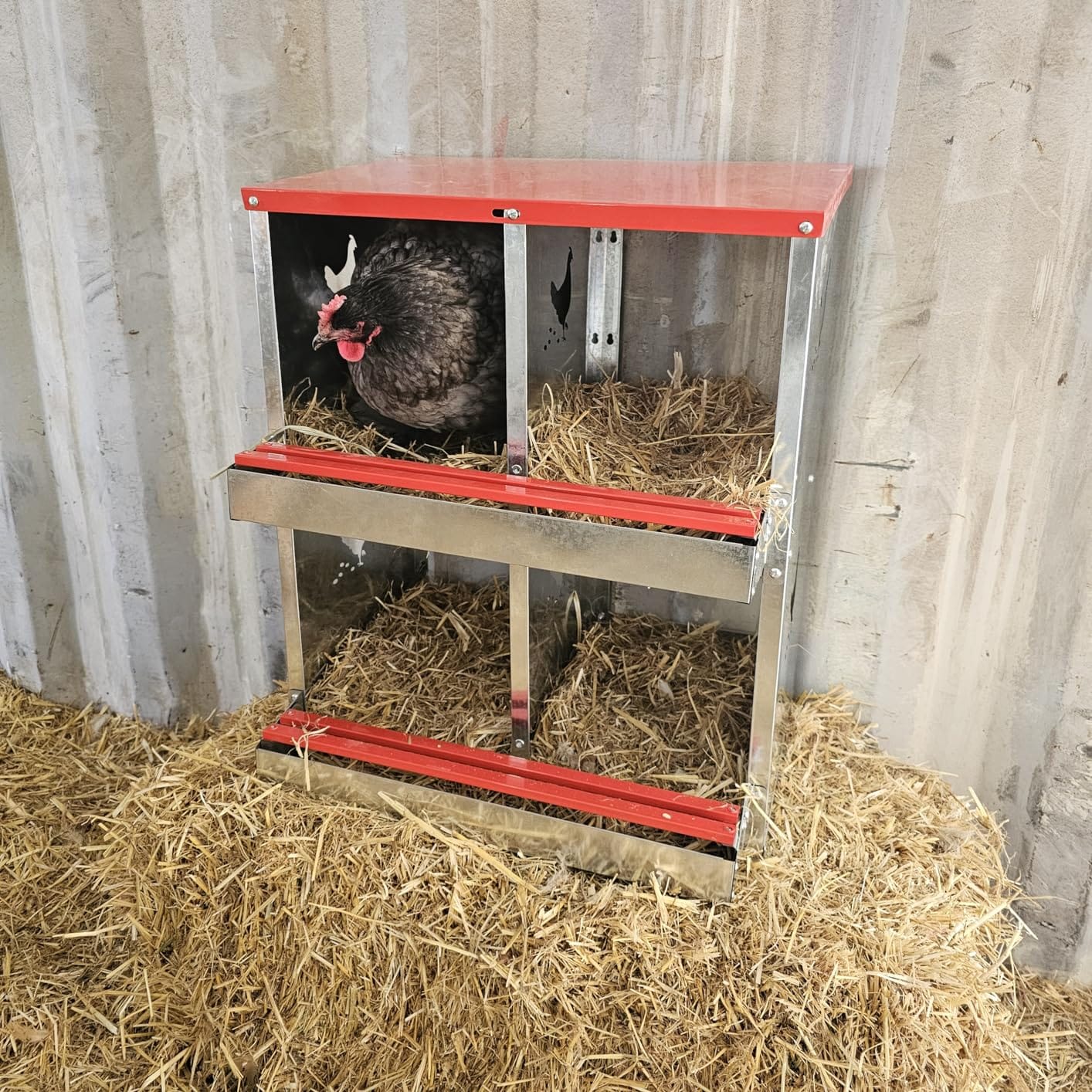
Ten bays in a single wall-mounted unit is the highest capacity here, and for a flock of 25 or more it is the straightforward choice. One box per four to five hens puts 25 birds at five boxes, so ten bays means real headroom and, more usefully, enough spare capacity that one unpopular bay does not create crowding.
The build is all metal with no plastic parts to fatigue or crack, it rinses clean with a hose, and it carries a 3-year warranty, which is uncommon in this category. Pre-drilled holes and aligned screws mean the build is closer to 20 minutes than an evening.

Inspect the panels the moment they arrive. Bent sheet is the most common complaint and one buyer returned the unit over it, though the triple-layer cardboard and foam packaging reduces how often it happens. If a panel is bowed, straighten it before tightening anything or the screws will never line up.
Depth is the design compromise. At 13.7 inches deep by 12 wide, the bay is narrower and shallower than the wooden boxes, and owners report hens kicking eggs out onto the tray lip where they break. A deeper bed of shavings reduces it. The roosting rail is also narrow, so plan to add your own wider perch bar if this rail is the one they use to get up.
How to size this against a 25-hen flock
Twenty-five hens need five boxes by the four-to-five rule. This unit has ten, so you are deliberately over-provided. That is a reasonable choice for a large flock because hens are not distributed evenly, they pick favourites and crowd them. Extra bays spread the pressure and, just as importantly, give you somewhere to move a box if a whole section of the coop is too bright or too exposed.
Predators and mounting height
This is a wall-mount unit with a 5-inch deep profile, and low-mounted ground-level boxes are where rats and weasels start. Fix it on solid framing, at least a couple of feet off the ground, and make sure the flock cannot reach the mounting hardware. Chicken-shaped side perforations handle airflow without opening a gap anything with teeth wants.
8. Bavlesfuire 3 Compartment Solid Wood Nest Box
Chicken Nesting Box 3 Compartments – Wall Mount Wooden Egg Laying Nest Box for Chicken Coop, Easy to Assemble & Versatile Use for Hens, Ducks, Chickens
Solid wood
3 compartments
11.42 x 14.96 x 12 inch
Insulates better than metal
Pros
- Solid wood regulates temperature better than metal in heat or cold
- Perches and baffles hold straw in and stop eggs rolling or being attacked
- Ample compartment space suits a range of breeds
- Installation tools
- video and instructions included
Cons
- Open front gives less egg protection than roll-away models
- Wood needs sealing or painting to last outdoors
- Fixed construction cannot be broken into separate boxes for cleaning
- Wall mounting needs solid framing behind the unit
This is the box to buy for a cold-weather flock that will not get a roll-out mechanism. Solid wood holds a workable temperature through a freezing morning, and three generous compartments at 11.42 by 14.96 by 12 inches are big enough that a large hen can turn around and settle properly.
The perches and baffles are the useful part. The perch gives a landing point so a hen does not have to jump up into the bay, and the baffles stop straw and eggs rolling out. Egg rolling onto a shared tray or bare floor is a leading cause of breakage, and these two details take care of it without the cost of a roll-out box.
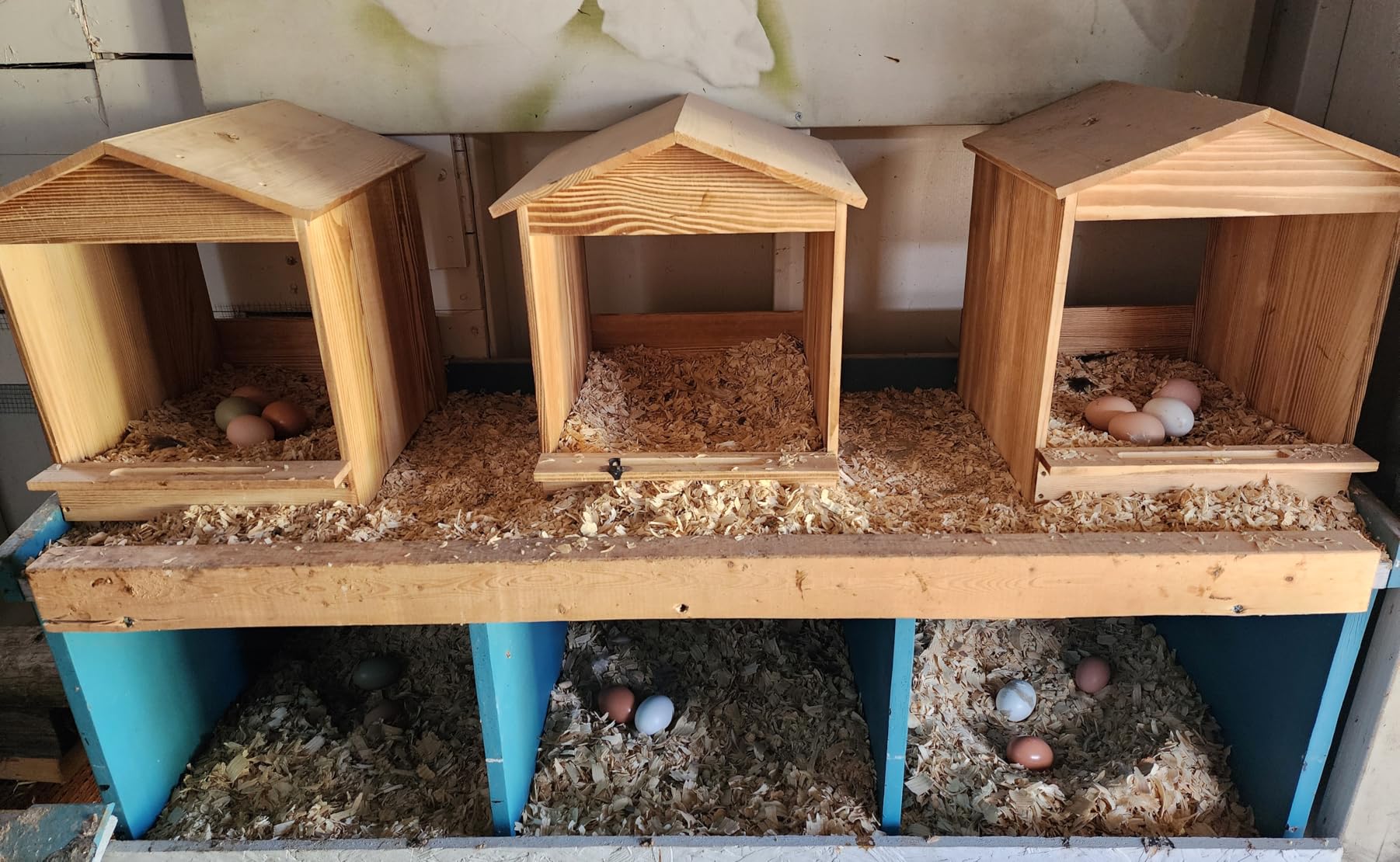
The wood is the maintenance item. Untreated solid wood outdoors will grey, swell and eventually rot at the joints, so seal or paint it before it goes up and touch it up annually. Owners also note that the fixed one-piece construction means you cannot carry a single box to the tap, so cleaning happens with a brush and a bucket on the spot.
Wall mounting needs real framing behind it. This unit is not light, and fixing it to thin coop panel will pull away over time. The included tools, instructions and install video are genuinely useful here because getting the mounting height right is most of the job.
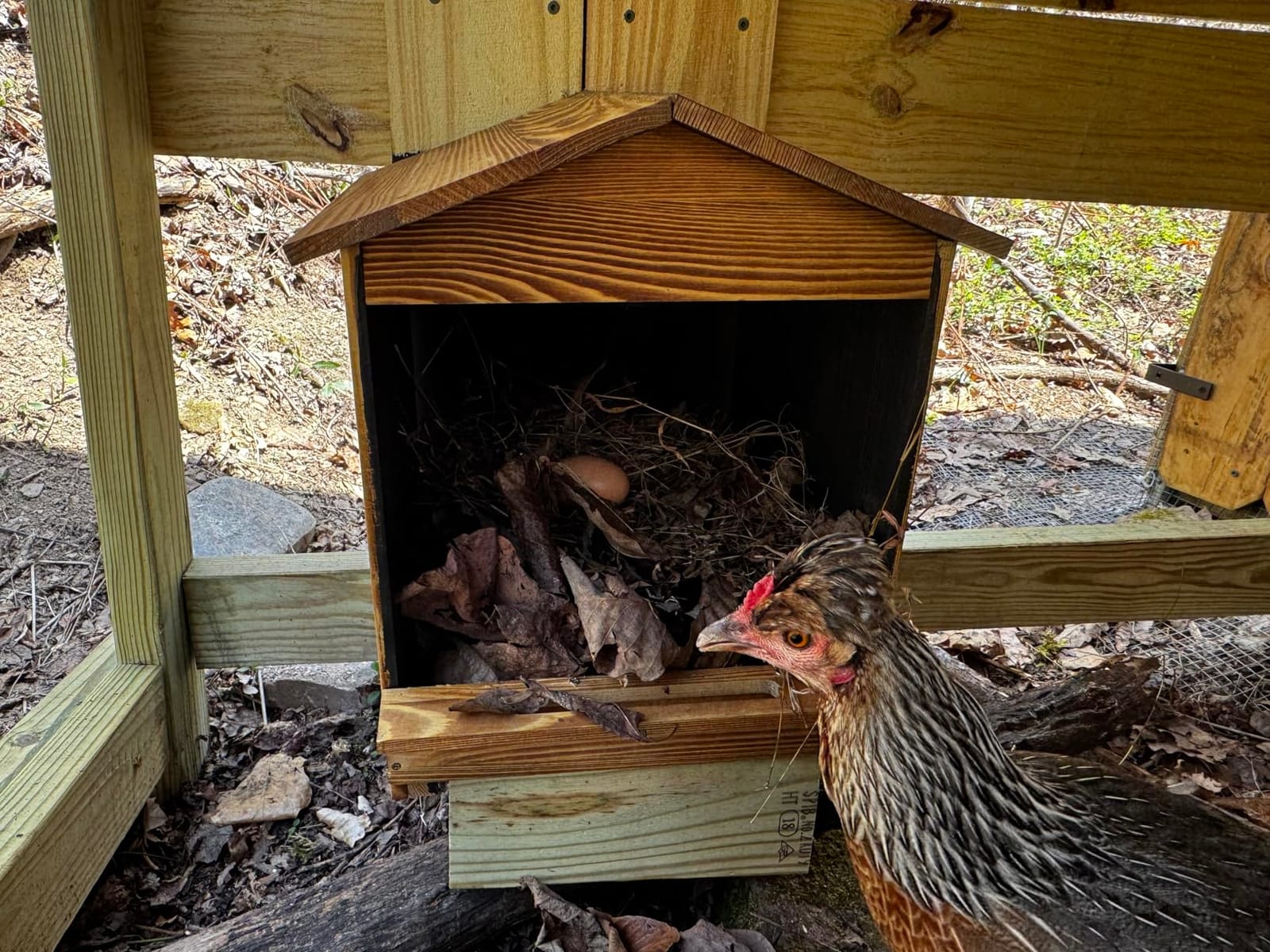
How it handles a northern winter
Better than anything metal on this list, and that is not marketing. Wood does not conduct, so a hen sitting for 20 minutes on a 14 by 12 by 12 wood bay in a cold shed stays comfortable where a hen in a bare steel bay will get up early and pace. Add a deep, dry bed of shavings and the box holds warmth far better. The cost is that mites can shelter in wood grain, so give it a steam or boiling-water clean at the end of the season.
Wood versus the roll-out metal boxes on egg protection
Wood wins on comfort and loses on egg security. With an open front the hen stays in contact with her egg, so breakage and pecking are more likely, and the baffles only reduce the fallout by catching what rolls.
A roll-out box removes the problem entirely. If your climate is mild and your hens are few, the comfort difference probably matters more. If you already have an egg-eating problem, buy the roll-out instead.
9. Tiflev 4 Hole Double-Decker Roll Away Nest
Chicken Nesting Boxes, Roll Away Nest Box for Egg Collector, 4 Holes Orange
4 holes in 2 tiers
21 x 20 x 30 inch
Powder-coated galvanized steel
Includes a dummy egg
Pros
- Tilted trays roll eggs into a covered channel that cuts broken and pecked eggs
- Powder-coated steel that wipes clean easily
- Double-decker layout uses vertical space and saves floor area
- Pull-out trays on each level make bedding changes simple
Cons
- No back panel so it needs a solid wall or a plywood backing
- Poor instructions and one side covers a different model
- Must be mounted high enough for eggs to roll
- Orange trays can tip forward unless fully pushed back
Two tiers of two compartments in a 21 by 20 inch footprint. That is the whole point of this box. If your coop is a small urban walk-in where floor space is the constraint, stacking vertically is how you get four bays out of the area that one box would use.
It is also a roll-away design, and owners report that it quickly ended egg eating and dirty eggs in their flocks. The powder-coated galvanized steel is not flimsy, and each level has its own pull-out tray so you can change bedding on one floor without disturbing the other.
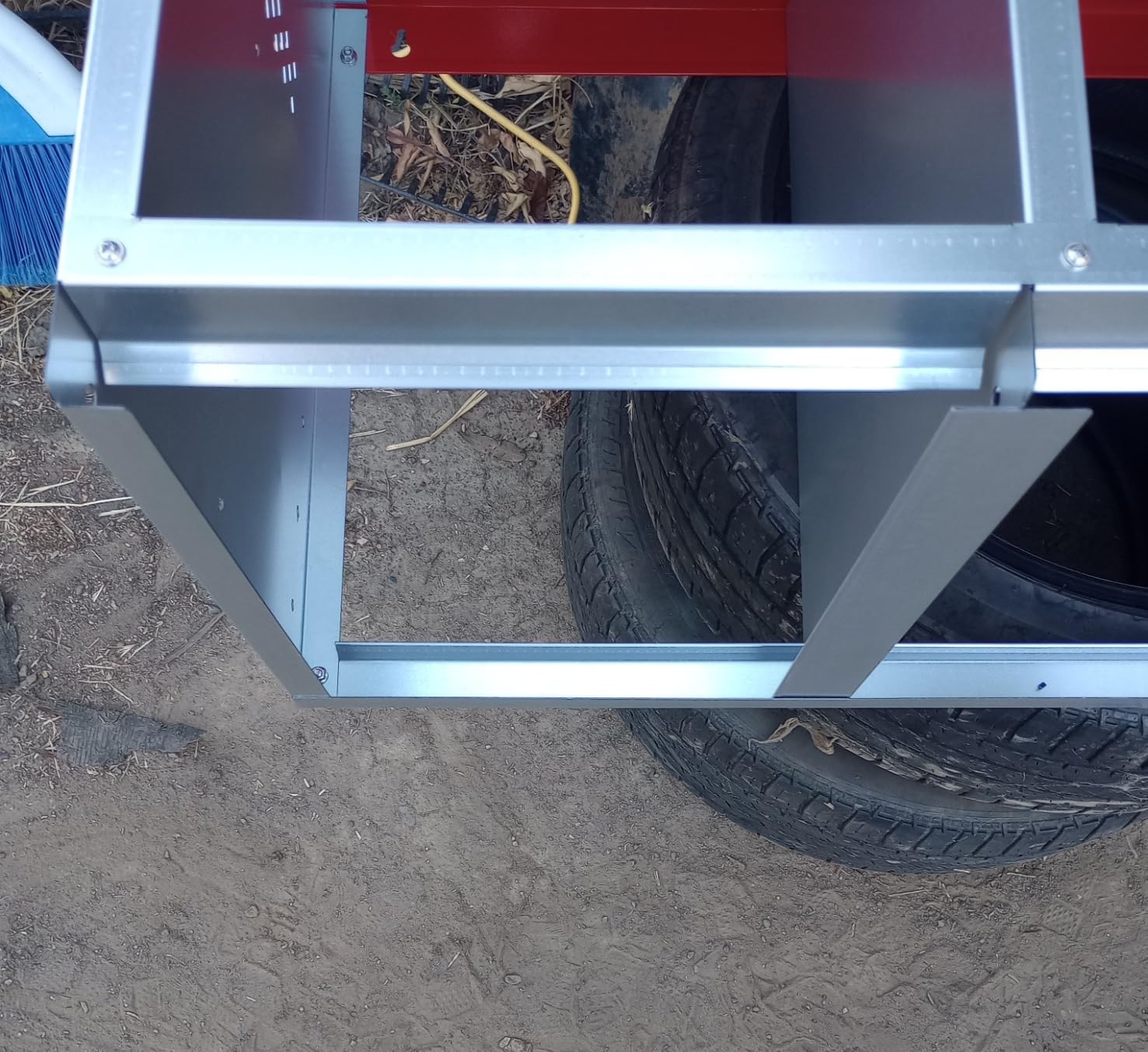
There is no back panel, which is the main thing to plan for. It has to go against a solid wall, or you need to bolt a sheet of plywood behind it, and that plywood is the sort of surface mites and draughts get behind. Fix the instructions problem by ignoring them and mounting from a photo instead, because one of the printed sides is documented as covering a different model.
Mounting height decides whether the roll works at all. Too low and eggs will not travel, too high and small hens will not reach it. The trays can tip forward if not fully pushed home, so check that every time you collect.
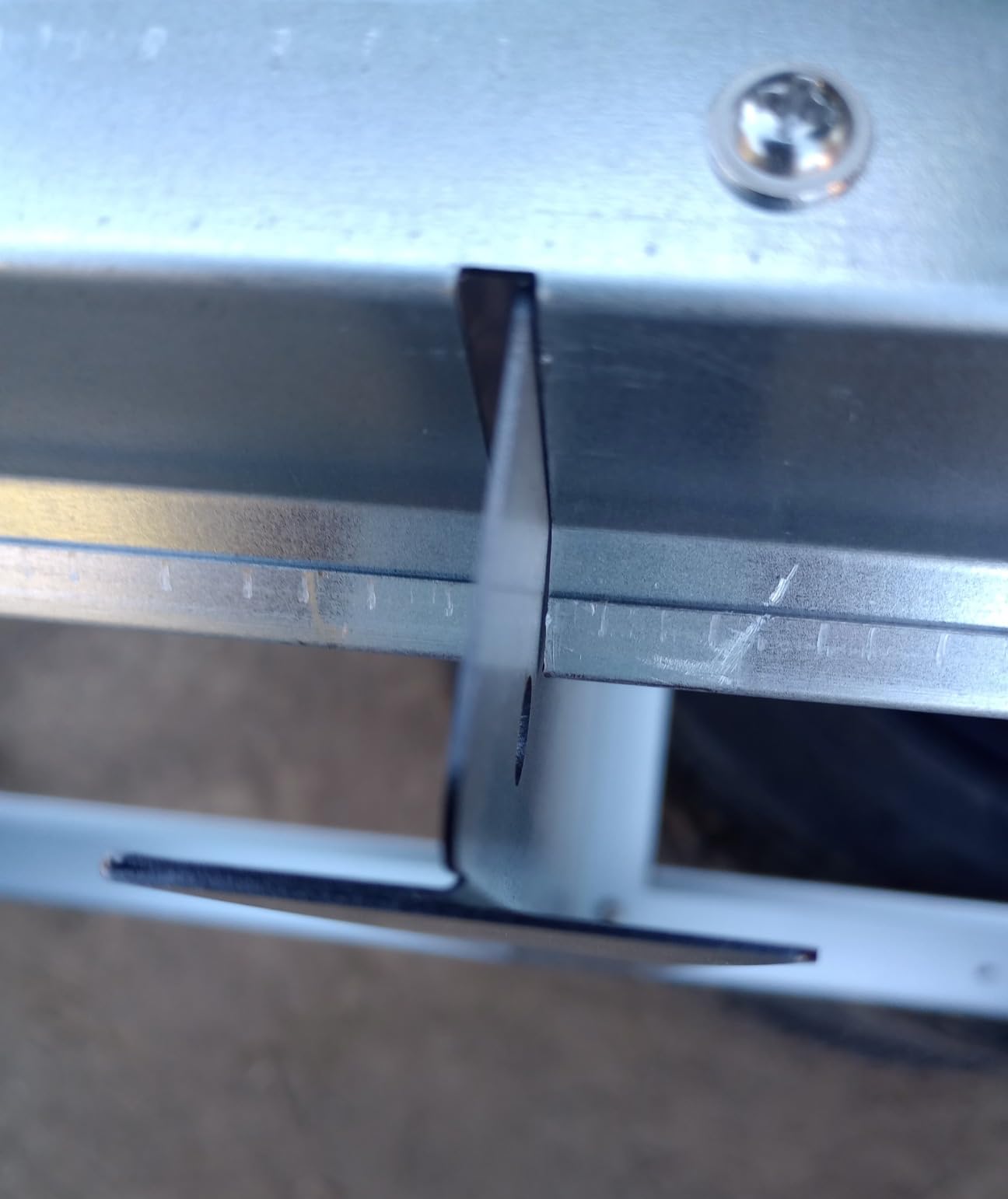
Best fit for a small or mobile coop
A four-bay vertical unit suits a flock of about 8 to 10 hens in a small space, and it suits a mobile or trailer coop better than most options because the footprint is small and the whole thing hangs off one wall. If you move the coop regularly, unscrew it rather than trying to carry it mounted, and re-check the tray seating afterwards.
The dummy egg trick and why this box ships with one
It includes a dummy egg, which is not a gimmick. A golf ball or a fake egg sitting in the nest tells a pullet that the box is the place to lay, and pullets copy the flock. The included egg is a reasonable head start, though a real golf ball is better because it will not break. Place it in each bay when you first install the box, and keep it there for the first fortnight.
10. AugFir 2 Compartment Extra Large Roll Away Boxes
Chicken Nesting Box, 2 Compartment Nesting Boxes for Chickens, Large Chicken Laying Boxes for Egg Collection & Hen on Nest, Roll Away Nesting Boxes Chicken (Extra Large)
2 extra-large compartments
11 x 12 x 26 inch
All-weather plastic
Drill-free or wall mount
Pros
- Roll-away sloped design collects eggs through a front lid away from the hen
- All-weather plastic means no rust and a very light unit
- Extra-large compartments suit medium to large hens
- Drainage holes and built-in vents keep the interior dry
Cons
- Plastic flexes over time under heavy long-term use
- Egg roll only works when mounted level or slightly tilted
- No channel lock so a large egg can stall in the nest
- Two compartments per package
Extra-large compartments is the phrase that matters here, and it is the reason this unit shows up in lists for large-breed flocks. A hen that can fit comfortably will use the box rather than search for somewhere else, which is the single best cure for floor eggs that costs the least money.
Everything else about it is designed for moving. At 8.5 pounds for two boxes, all-weather plastic that will not rust and can sit out in rain without degrading, this one is easy to handle in a field.
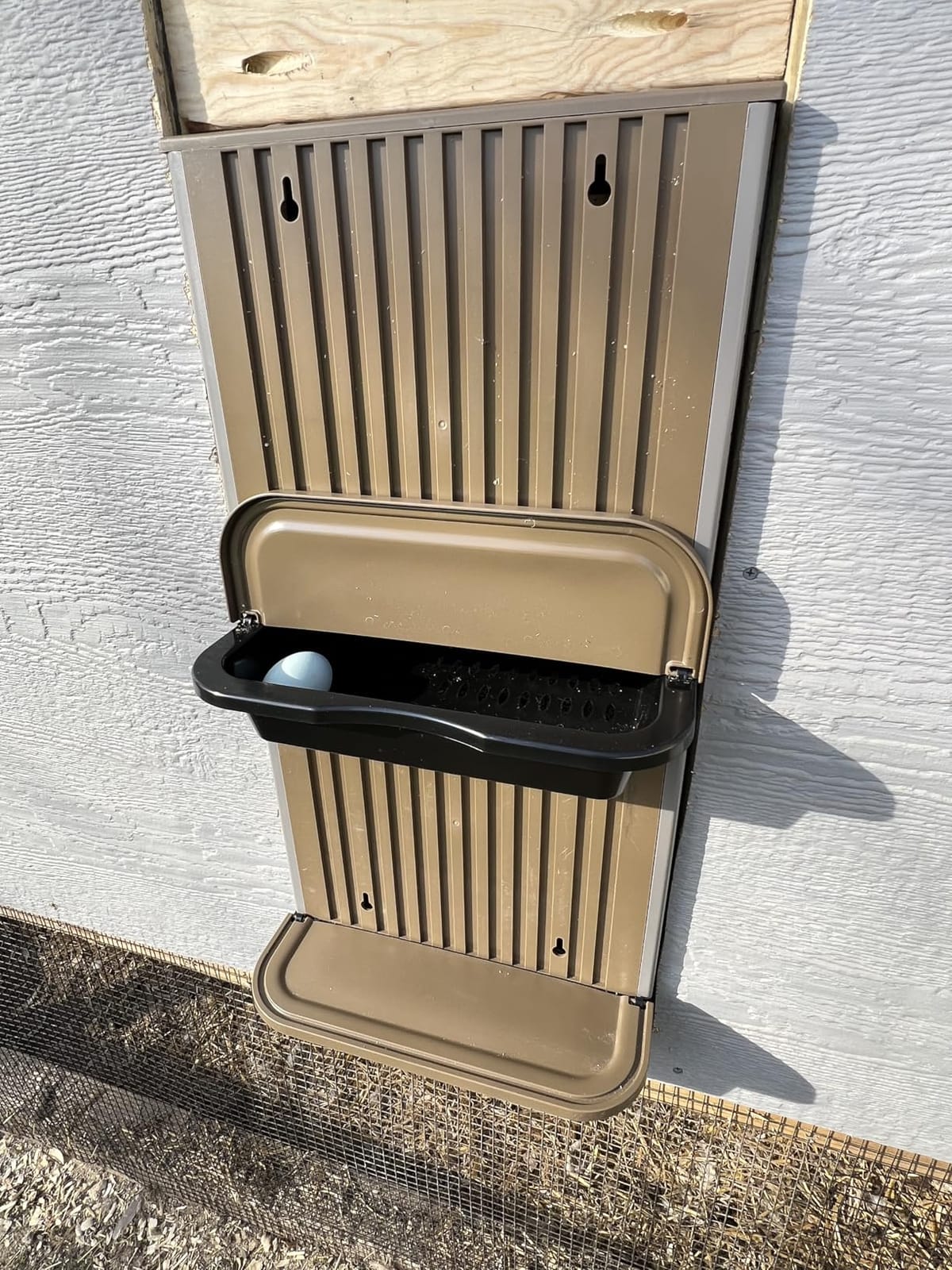
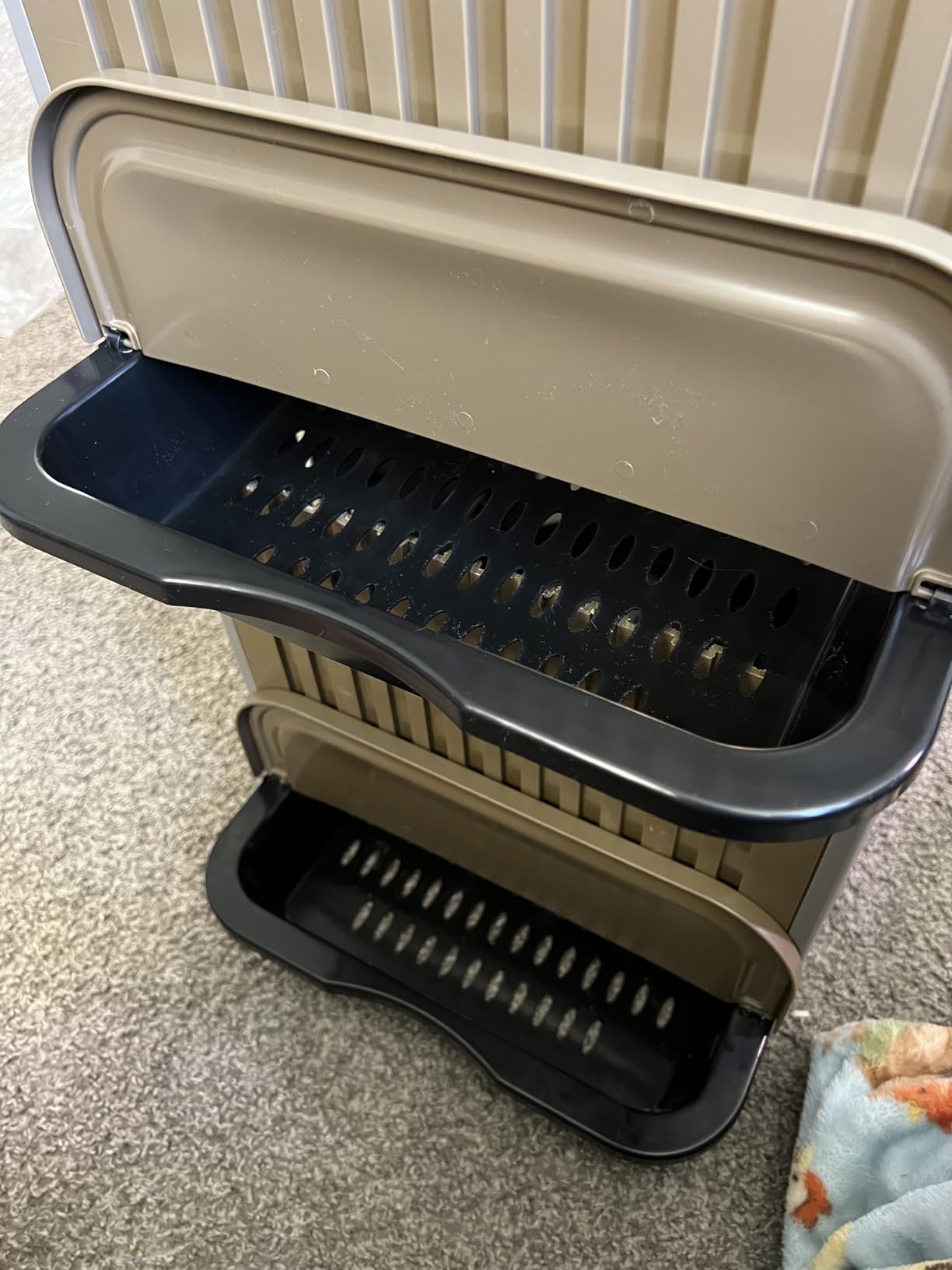
Stackable and orientable mounting is unusually flexible, and it means you can fit a small flock into a shape your coop does not otherwise suit. The front collection lid means the eggs leave through the front rather than over the top, which is better on a wall-mounted box where you cannot reach down into the nests.
Plastic does flex, and over a few seasons of heavy use that shows. The roll also depends entirely on correct mounting, so a unit hung slightly off level will leave eggs sitting in the nest. There is no channel lock, so a notably large egg can stall, which is rare but not impossible with a big breed.
Why size beats mechanism for small flocks
For two to six hens, a box that is genuinely roomy and easy to move beats one with a fancier egg collection. A pullet that does not fit will not use the box, and no tray mechanism compensates for a hen that refuses to enter. If your birds are large, pay for space. If your birds are small and numerous, the compartment count matters more and a metal six-bay is the better buy.
Best use on a mobile or free-range setup
This is the box for a coop that moves. Weight, rust resistance and drill-free fixing all matter more when the whole structure is dragged across a field twice a week. Fit it on the shaded side of the coop, because boxes mounted on an exposed run lose the privacy that makes a hen settle, and keepers report visibly lower use on the sunny open side.
How Many Nesting Boxes Do You Need?
One box per four to five hens, and three boxes for up to twelve birds. Work the arithmetic as one box for the first four hens, then one more for every five after that.
So two hens need one box, six hens need two, seven hens need two, ten hens need two to three, twelve hens need three, twenty hens need four to five, and twenty-five hens need five to six. Any unit you buy should be sized from the flock you have today, not the flock you imagine having next spring.
Do not be alarmed when three hens pile into one box and ignore the rest. Crowding into a favourite nest is normal behaviour and it does not mean you are short of boxes. Owners who bought extra to solve the crowding report that it does not help, and a roosting bird blocking a box is a bigger real problem than the number of bays.
One genuinely useful exception: a flock mixing bantams and large breeds benefits from one oversized box. Small birds get pushed out of standard bays by bigger birds, and a single extra-large bay gives them somewhere to lay that is theirs.
What Size Nesting Box Do You Need?
About 12 inches square with an open front and a low lip is the right starting point for most laying hens. A 12 by 12 by 12 inch interior with a front lip of roughly four inches is the community standard and it suits standard breeds cleanly.
For bantams and Silkies, go down to about 10 inches square. A standard box is not wasted on a bantam, but a deep one can be, because a small hen will not settle in a cavernous bay. For large breeds such as Orpingtons and Wyandottes, go up to 14 inches square, and check the depth as well as the width.
Height matters in one specific case. If your roost is high, a tall box lets droppings fall in from above. If the height is wrong, nothing else you buy will fix it.
Wood, Plastic or Metal: Which Material Holds Up?
Choose galvanized steel for durability, mite resistance and easy washing, solid wood for warmth in cold or hot climates, and plastic for light weight, rust-proofing and cheap mounting. The three solve different problems, and no material wins all of them.
Galvanized steel is the hardest-wearing and the easiest to sanitise. It has no grain for mites to shelter in, and you can hose or pressure-wash removable bottoms without damage. The costs are weight, price and cold conduction, which makes a bare steel bay uncomfortable in a freezing coop.
Solid wood insulates in both directions, so a hen is warmer in winter and more sheltered in summer. It feels more natural to birds and is the community favourite for comfort. The trade is that wood rots at joints, needs sealing, and its cracks and grain are exactly where red mite breed. Steam cleaning works but takes more effort.
Plastic sits in the middle: it will not rot or rust, wipes clean, weighs almost nothing, and is the practical choice for mobile coops. It is the least rigid, so it flexes and can warp in heat, and it offers the least insulation of the three. Open-front plastic also leaves eggs with the hen.
Where to Mount Nesting Boxes
Mount boxes below and to the side of the roost, a couple of feet off the ground, in the darkest corner of the coop. This single rule does more to stop floor eggs than any product choice.
Hens instinctively roost high and lay low, so a nest at or above roost height confuses them. Boxes level with the roost or above are the primary cause of floor eggs and dirty nests according to experienced keepers, and the fix is usually free.
There is a real counter-argument worth knowing about. Extension service advice points out that boxes directly under a roost collect droppings all night, so a straight under-roost position trades dirty eggs for fouled bedding.
The resolution is a horizontal offset: put the boxes below roost height but set to one side, so they sit in the hens’ downward path without being in the falling stream.
If you must raise the boxes higher, add a ramp or ladder. Hens will not reliably fly up to an elevated box and will simply stop using it, which is a problem owners hit repeatedly. A short ramp with a perch board at the bottom solves it.
Finally, treat the box as part of the predator plan. Ground-level and low-mounted boxes are the easiest route in for rats and weasels, so keep them off the floor, use solid framing rather than thin panel, and add a short apron or skirt where the flock cannot reach the fixings.
Bedding, Cleaning and the Weekly Routine
Put about two to three inches of dry bedding in the bottom of each box. Pine shavings, dry straw or hay all work, and pine shavings come out best in keeper recommendations for staying dry and easy to scoop.
The rule that matters is dry. Damp bedding is the leading cause of box abandonment, and it is also what you get in a plastic or metal box with a perforated bottom after a wet week. Check it every morning in bad weather, replace anything damp immediately, and never top up old bedding instead of changing it. A thick layer of clean, dry material is what makes a hen settle in rather than look for somewhere better.
Daily, collect the eggs. Leaving eggs in the box teaches the flock that eggs are a food source, and a flock that learns egg eating is nearly impossible to break. Collect at least twice a day during peak laying, from a roll-out box, this takes a few seconds.
Weekly, strip the bedding and replace it. With a roll-out or removable tray this is a scoop and a rinse. With a fixed wooden floor it is a shovel, and that difference in effort is the main practical reason people pay more for a tray.
Monthly, scrub the trays and the shell with a hose or a stiff brush, and check every fixing, hinge and perch rod. At the end of the season, steam or boiling-water clean a wooden box and treat the whole coop for mites, not just the nests.
How to Get Hens to Actually Use the Box
Install the box correctly, keep it dim and dry, bed it deeply, and put a golf ball in it. Most hens that ignore a box are being told to ignore it, and the reasons are almost always fixable.
Start with height and light. If the box is at or above roost level, move it down. If the coop has a window or a bare bulb shining on the bay, block it. A dark, sheltered corner is what a hen is looking for, and a brightly lit box is a box she avoids.
Second, fill it properly. Two to three inches of clean, dry shavings, a perch at the entrance, and a front lip of about four inches so eggs stay put. A box with a bare floor or a lip so low that eggs roll out gets abandoned within days.
Third, mark the spot. Put a golf ball, a fake ceramic egg or a clean egg in the nest. Pullets learn where to lay by following the flock, and a golf ball is the single most recommended trick in keeper groups precisely because it never breaks and it never spoils.
Fourth, deal with a monopolised box. If three hens use one bay and ignore the rest, either move the favourite box somewhere less bright or add a second box on the other side of the coop. Extra bays alone rarely change the habit.
If eggs are still ending up on the floor after those four steps, work the checklist in order: roost height first, then bedding, then light, then mites, then the number of boxes. Height and light cause most cases, and both are free to fix.
DIY and Upcycled Alternatives
A plywood box built to 12 by 12 by 14 inches with an open front and a four-inch lip works exactly as well as anything on this list. The build is simple: cut five panels, assemble with exterior screws, sand every edge, add a 1 by 2 perch across the front, and mount it below the roost.
Sanding is not optional. Sharp or unfinished edges are named repeatedly as a reason keepers abandon a wooden box, and a hen that scrapes her vent against a rough lip will lay somewhere else.
Milk crates, five-gallon buckets cut down, and storage totes are all in regular use as nests. A milk crate is roughly the right size already, a bucket needs a low entrance cut into it and bedding added, and a tote works as a floor box if you cut a door and fix it low. The limitation with all of them is the same: an open-front crate gives the hen full access to her egg.
Plenty of keepers start with crates, confirm their hens lay reliably, and then upgrade to a roll-out box. Nothing is wasted and the DIY route is a fine first step for a flock under six hens.
Frequently Asked Questions
What size nesting boxes are best for laying hens?
About 12 by 12 by 12 inches with an open front and a front lip of roughly four inches suits most standard breeds. Use about 10 inches square for bantams and Silkies, and 14 inches square for large breeds such as Orpingtons and Wyandottes. Depth matters too, since a shallow bay lets hens kick eggs out and break them.
How many nesting boxes do I need for 6 hens?
Two boxes. The working rule is one nesting box per four to five hens, so six hens need two. For 7 hens two is still enough, 10 hens need two to three, 12 hens need three, 20 hens need four to five, and 25 hens need five to six.
What is the best material to use for chicken nesting boxes?
Galvanized steel for durability, mite resistance and easy washing. Solid wood if warmth matters most in a cold or hot climate, since it insulates in both directions. Plastic if weight and rust-proofing matter, such as on a mobile or free-range coop. Wood needs sealing and can harbour mites in its grain.
Do chickens like nesting boxes high or low?
Low, and below the roost. A box at or above roost height is the leading cause of floor eggs and dirty nests. Mount boxes a couple of feet off the ground, in the darkest corner, and set them to one side of the roost rather than directly beneath it so they do not collect overnight droppings. Add a ramp if the boxes must sit higher.
What do you put in the bottom of a nesting box?
Two to three inches of dry bedding. Pine shavings, dry straw or hay all work, and pine shavings are the most commonly recommended for staying dry and easy to scoop. Keep it dry at all times, because damp bedding is the leading cause of box abandonment. Change the bedding weekly rather than topping up old material.
Do chickens sleep in their nesting boxes at night?
They should not. Hens roost on bars, and sleeping in the nest soils the bedding and fouls the eggs. Boxes placed below the roost with a folding or swing perch that you close at night prevent this. If hens are roosting on top of the boxes, move the boxes lower or the roost further away.
Verdict: The Best Chicken Nesting Boxes for Laying Hens
The Brower 2-Tier 6-Hole is the best chicken nesting box in this list for most flocks. Six galvanized bays, folding perches that shut the boxes at night, removable bottoms you can pressure wash, and a 4.5 rating across more than 1,500 reviews. It is heavy and it is overkill for six hens, but for anything above ten birds it is the one I would mount.
Buy the ZenxyHoC if you want roll-out egg collection without the Brower weight or outlay. Buy the Tiflev for a small urban or mobile coop where vertical space is the constraint, the AugFir extra-large pair for large breeds or a coop that gets moved, and the Bavlesfuire solid wood box if your winters are cold and your flock is small.
Whatever you choose, spend the time on placement before you spend the money on the box. One box per four to five hens, 12 inches square for standard birds, mounted low and dark below and to the side of the roost, two to three inches of dry bedding, and a golf ball inside. That is the combination that actually gets eggs out of the nest and off the coop floor, and no product on this list substitutes for it.
Once the flock is established, our guides to the [best chicken feeders](https://zamd.net/best-chicken-feeders/), [best chicken waterers](https://zamd.net/best-chicken-waterers/) and [best chicken pluckers](https://zamd.net/best-chicken-pluckers/) cover the rest of your setup.