
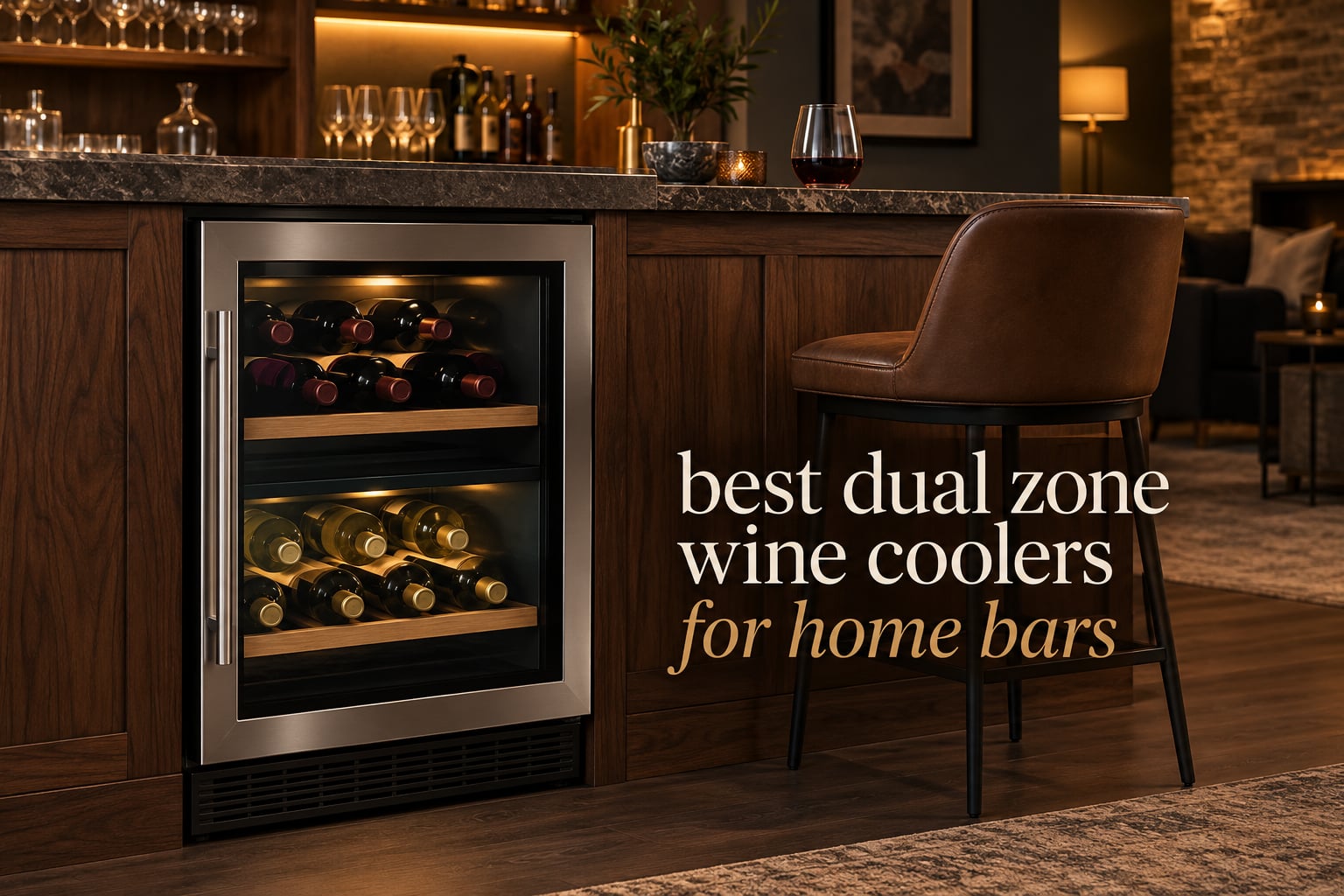
A home bar is a small design problem before it is a purchase problem. You have a cabinet opening, a circuit, a run of millwork, and a guest list that changes every time. The appliance has to disappear into that opening, hold two temperatures at once, and stay quiet enough that nobody stops talking when it kicks in. That is a narrower brief than the wine fridge category usually acknowledges.
After going through twelve dual zone wine coolers and comparing their zone splits, widths, ventilation layouts, noise ratings and shelf designs against what a bar build actually demands, these are the best dual zone wine coolers for home bars in 2026. Every pick below states one honest drawback, because a list where nothing has a weakness is a list nobody should spend money from.
We also leaned on the numbers that matter in a built room: cabinet opening width, door swing, handle projection, and the gap the unit needs to vent. A cooler that scores well on paper can still be the wrong box for your bar, and measuring before you buy costs nothing.
Table of Contents
What Does Dual Zone Actually Mean?
A dual zone wine cooler is a wine refrigerator with two independently controlled temperature compartments, so you can hold reds near 60°F and whites or sparkling near 48°F at the same time in one cabinet. Each compartment has its own thermostat and sensor rather than sharing one temperature setting.
That matters more than the spec sheet suggests. A single zone forces a compromise: set it for whites and your reds come out thin and cool, set it for reds and your whites lose their chill. Dual zone removes the compromise, and for a bar that serves both, that is the whole point of buying a dual temperature zone unit in the first place.
Here is the reference we use throughout this guide. Serve reds at 55-65°F, whites and sparkling at 45-50°F, and rosé at 50-55°F. If a unit’s two zones cannot both sit inside their bands at the same time, it is a single zone wearing two thermometers.
One more piece of vocabulary before the picks. A wine cooler is a small thermoelectric unit, usually a few bottles. A wine refrigerator is the compressor cabinet you are shopping for. They are different products, and plenty of listings blur the line.
Top 3 Best Dual Zone Wine Coolers for Home Bars in 2026
Tylza 30-Bottle 15-Inch
- 30 bottles
- 40-55F and 55-65F zones
- 6 beech shelves
- built-in or freestanding

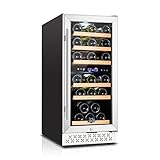
The Tylza is our editor’s choice because it does the two things a bar build cannot compromise on: a genuine 15-inch footprint that fits a narrow cabinet opening, and two zones with a real gap between them. Six beech wood shelves also make it a better bottle cradle than the wire racks common at this width.
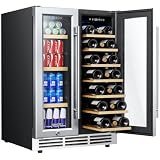
If your bar pours beer and cider as heavily as wine, the EUHOMY is the smarter cabinet. One side runs 35-50°F for cans, the other 41-64°F for bottles, and 40dB is easy to live with once guests are talking.
The ROVSUN is our value pick and the easiest unit to move into an existing corner. At 20 inches wide and 33.4 inches tall it clears most bar cabinets, and the 240-degree door opening means you can reach the back row without pulling the shelf out.
All 12 Dual Zone Wine Coolers Compared Side by Side (October 2026)
Every unit below is compressor cooled and has two independently controlled zones. Width is the first column to check, because it decides whether the cabinet gets cut before or after you order. Use the table to narrow the field, then read the individual reviews for the drawbacks.
| Product | Specifications | Action |
|---|---|---|
| Tylza 30-Bottle 15-Inch Dual Zone |
|
Check Latest Price |
| EUHOMY 24-Inch Wine and Beverage Cooler |
|
Check Latest Price |
 Velieta 179-Bottle Dual Zone Wine Cooler Velieta 179-Bottle Dual Zone Wine Cooler |
|
Check Latest Price |
| ROVSUN 33-Bottle Dual Zone Wine Cooler |
|
Check Latest Price |
 Ivation 33-Bottle Dual Zone Wine Cooler Ivation 33-Bottle Dual Zone Wine Cooler |
|
Check Latest Price |
 Kalamera 24-Inch 46-Bottle Dual Zone Cooler Kalamera 24-Inch 46-Bottle Dual Zone Cooler |
|
Check Latest Price |
 BODEGA 30-Bottle 15-Inch Dual Zone Cooler BODEGA 30-Bottle 15-Inch Dual Zone Cooler |
|
Check Latest Price |
 Whynter 92-Bottle Dual Zone Wine Cooler Whynter 92-Bottle Dual Zone Wine Cooler |
|
Check Latest Price |
 BODEGA 46-Bottle 24-Inch Dual Zone Cooler BODEGA 46-Bottle 24-Inch Dual Zone Cooler |
|
Check Latest Price |
 Yeego 52-Bottle Left-Hinged Dual Zone Cooler Yeego 52-Bottle Left-Hinged Dual Zone Cooler |
|
Check Latest Price |
 ORYMUSE 52-Bottle 24-Inch Dual Zone Cooler ORYMUSE 52-Bottle 24-Inch Dual Zone Cooler |
|
Check Latest Price |
 ORYMUSE 30-Inch Wine and Beverage Cooler ORYMUSE 30-Inch Wine and Beverage Cooler |
|
Check Latest Price |
1. Tylza 30-Bottle 15-Inch Dual Zone Wine Cooler for Narrow Bar Openings
Tylza Mini Fridge 15 Inch Wine Cooler Under Counter, 30 Bottles Dual Zone Wine Fridge with Safty Lock, Wine Refrigerator Freestanding, Built-in Wine Cellars
30 bottles
40-55F upper and 55-65F lower
23.0 x 15.0 x 33.5 inch
6 beech wood shelves
Pros
- Genuine 15 inch width fits a narrow cabinet opening
- Two zones with a real 10 degree gap
- Six beech wood shelves with bottle fixators
- Built-in or freestanding in the same box
- Key lock with two keys
Cons
- Right-hinge door only
- Wood shelves may not take very large bottles
- 1 year warranty
This is the unit I keep coming back to for bar cabinetry. At 14.96 inches wide and 33.46 inches tall it drops into a standard 15-inch opening without a fudge factor, which is more than I can say for most 24-inch units pretending to be compact.
The zones are split 40-55°F on top and 55-65°F on the bottom. Put reds in the lower compartment and whites and Champagne in the upper one, and both bands hold at the same time rather than trading places.
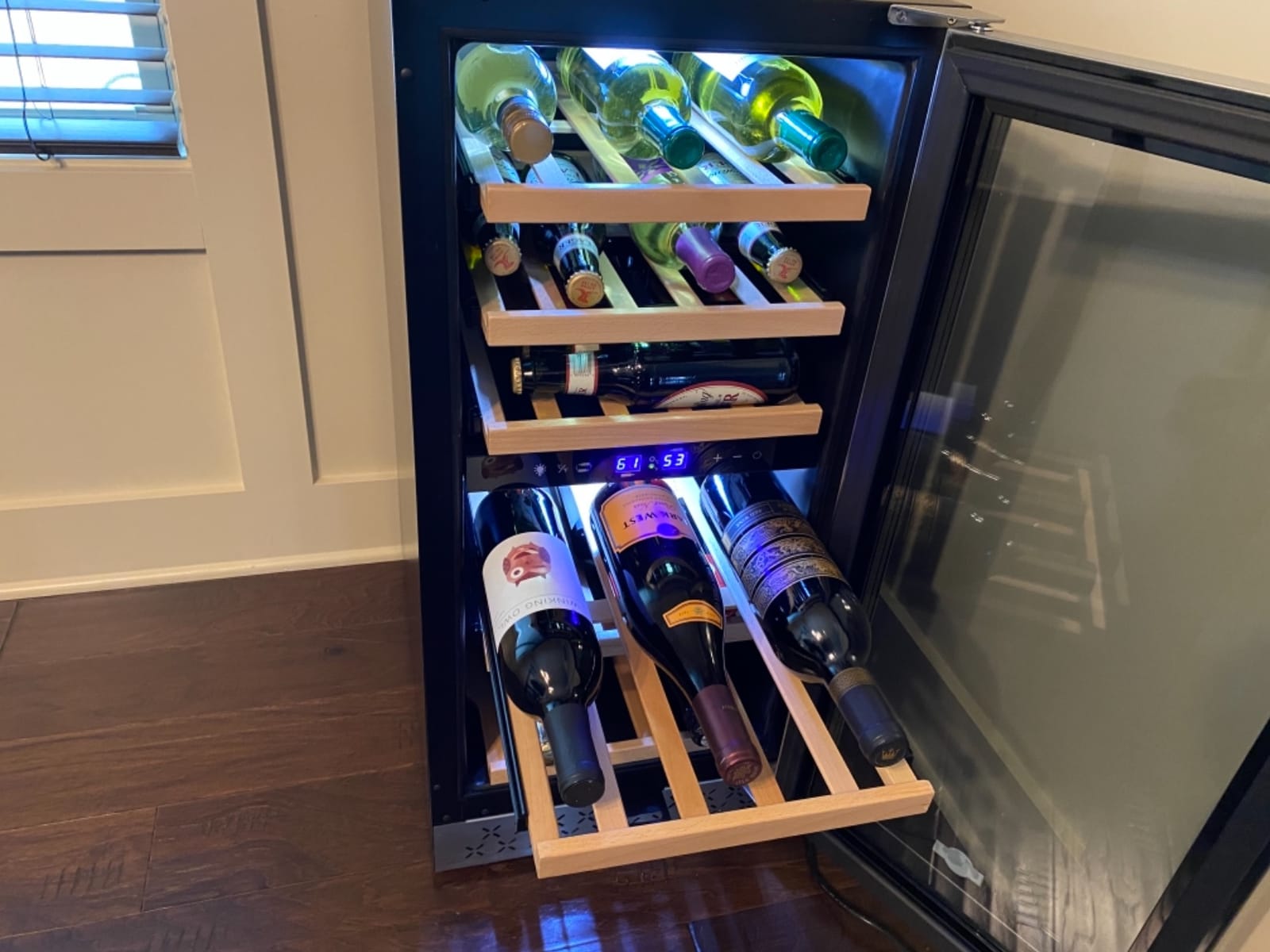
Six beech wood shelves with fixators carry the 30 bottle rating. Wood is a better cradle than wire for cork closures, and the fixators stop a bottle rolling onto its neighbour when someone pulls one from the middle.
The digital panel has a temperature memory function, so if the power drops the unit comes back to the settings you had rather than resetting to a factory default. That matters in a bar where a tripped breaker should not mean reorganising the whole cabinet.
Check the depth before you cut the cabinet
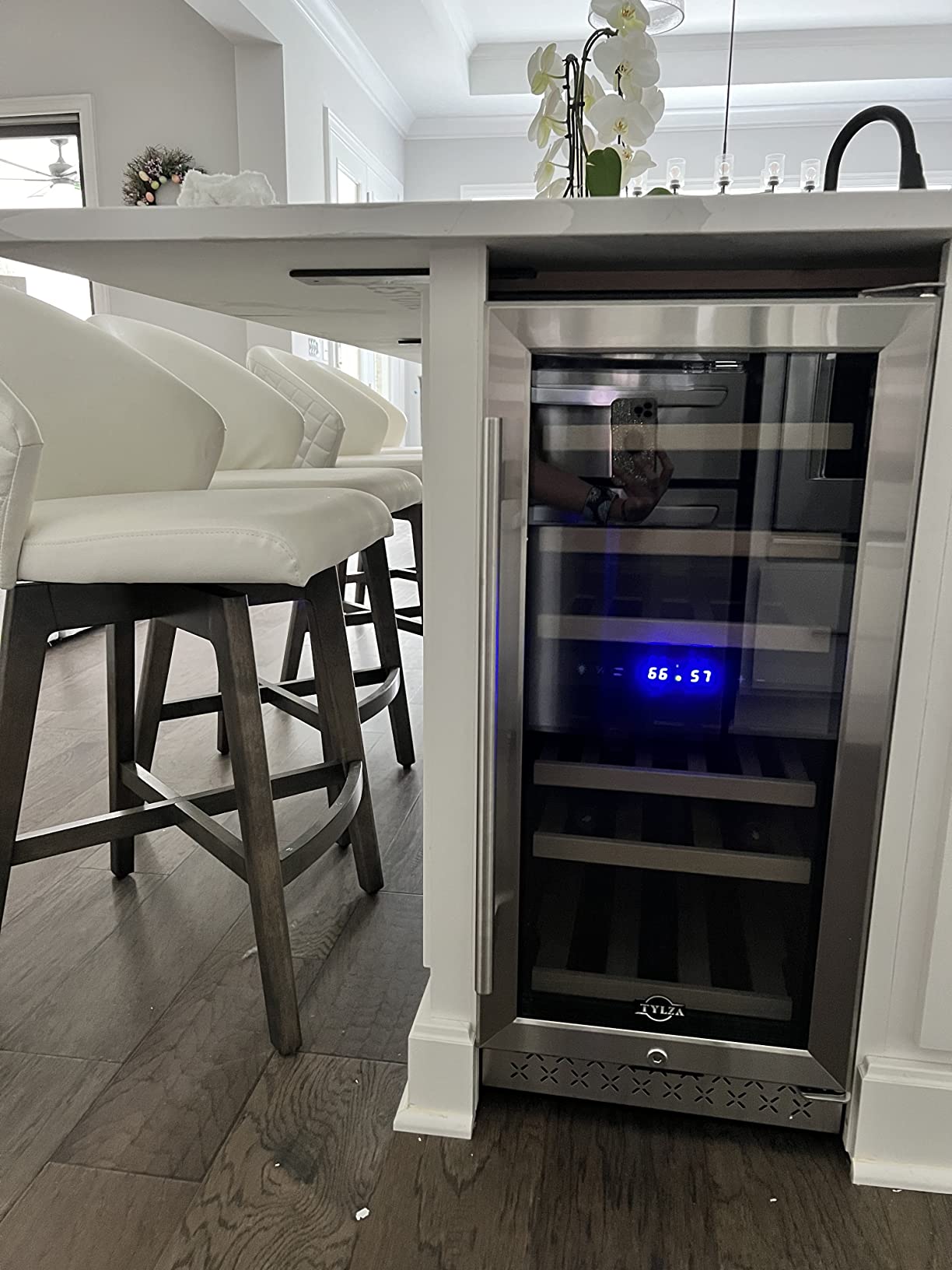
Listed dimensions are 23.03 inches deep by 14.96 wide by 33.46 tall. Owners building built-in millwork repeatedly report that the listed depth does not include the door swing, so measure the opening with the door fully open and with the handle pulled out, not just the body of the unit.
Because it is rated for both built-in and freestanding installs, you can stage it free-standing first, live with it for a few weeks, and only then commission the cabinetmaker. That is the cheapest way I know to find out whether 15 inches was the right call.
Where it falls short in a built room
The door hinges on the right only, so if the cabinet opening puts the unit against a wall on the right, the door will not open past 90 degrees and the back row of bottles becomes hard to reach.
Reviewers also note the wood shelves may need a shelf removed to accept larger formats, and the warranty runs one year. Neither is a deal breaker, but both are worth knowing before you frame a cabinet around it.
2. EUHOMY 24-Inch Dual Zone Wine and Beverage Cooler for Bars That Stock Beers
EUHOMY 24 Inch Wine and Beverage Refrigerator, Dual Zone Wine Cooler
21 bottles and 88 cans
35-50F beverage zone, 41-64F wine zone
40dB compressor
97 pounds
Pros
- One cabinet holds cans and bottles
- Front ventilation suits built-in installs
- 40dB compressor is easy to live with
- Power failure temperature recovery
- ETL DOE and CEC certified
Cons
- Some reports of temperature inconsistency
- Condensation reported in the wine bay
- Display cannot be switched off
- Body is wider than most 24-inch units
This is the one to buy when the bar sells more cans than bottles. The left zone runs 35-50°F for beer, juice and soda, while the right zone holds 41-64°F for wine. Two glass doors open independently, so a guest reaching for a lager does not swing the whole cabinet open.
The claimed load is 21 wine bottles plus 88 cans of 330ml, spread across seven wooden shelves and three wire shelves. In practice the can figure holds when the wire racks are used as intended; the wine count drops if you load larger formats.
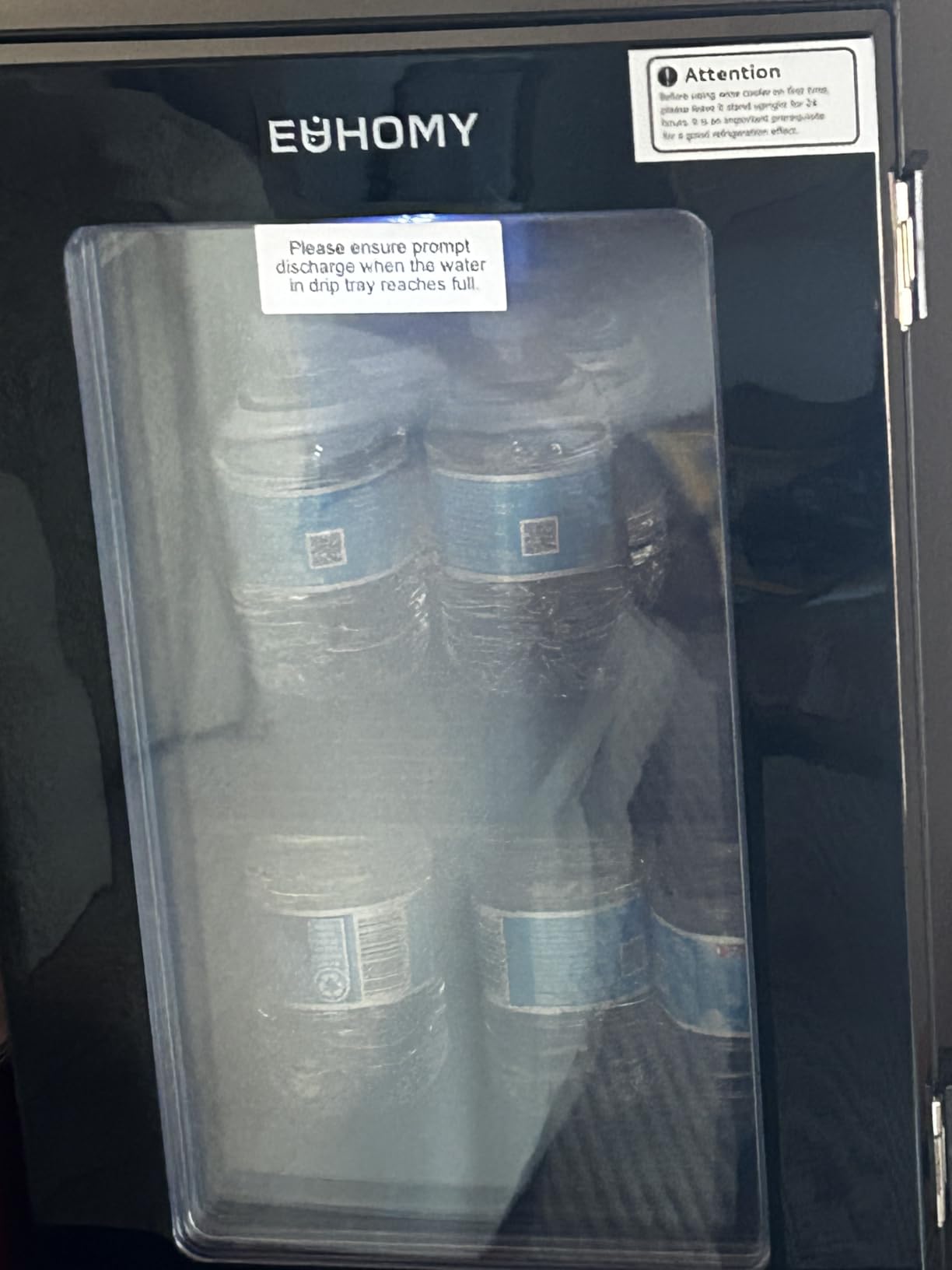
At 40dB this is a compressor unit you can stand next to during a party. It is not silent, but the compressor only runs when the cabinet needs it, and a low ambient load means it cycles less often than a fully stocked unit.
Front ventilation makes it a legitimate built-in candidate, and the 360-degree fan circulation helps hold both bays at their set points. Annual energy consumption is listed at 168 kilowatt hours.
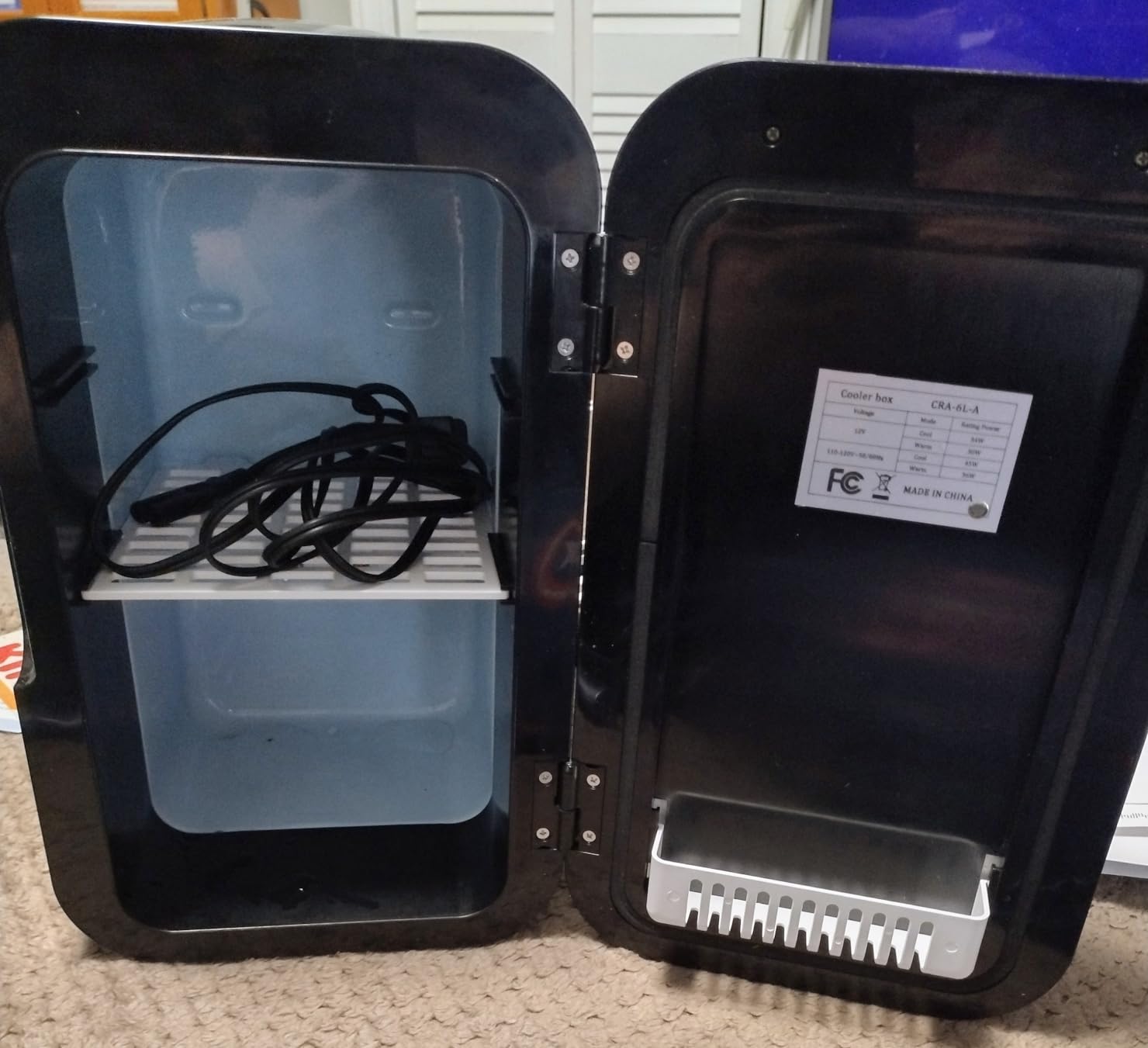
Measure for the depth, not just the width
The body measures 23.5 inches wide but 24.4 inches deep, and the depth is what surprises people. In a bar run, the back of the cabinet and the wall behind it need to clear that figure plus room for the door to swing and the handle to project.
Measure the opening twice and plan the door swing before the millwork is cut, because retrofitting cabinetry is the expensive mistake owners describe most often. You also need a nearby outlet on a dedicated circuit, and a clear path for the door to open past the handle.
Where the two-zone split gets compromised
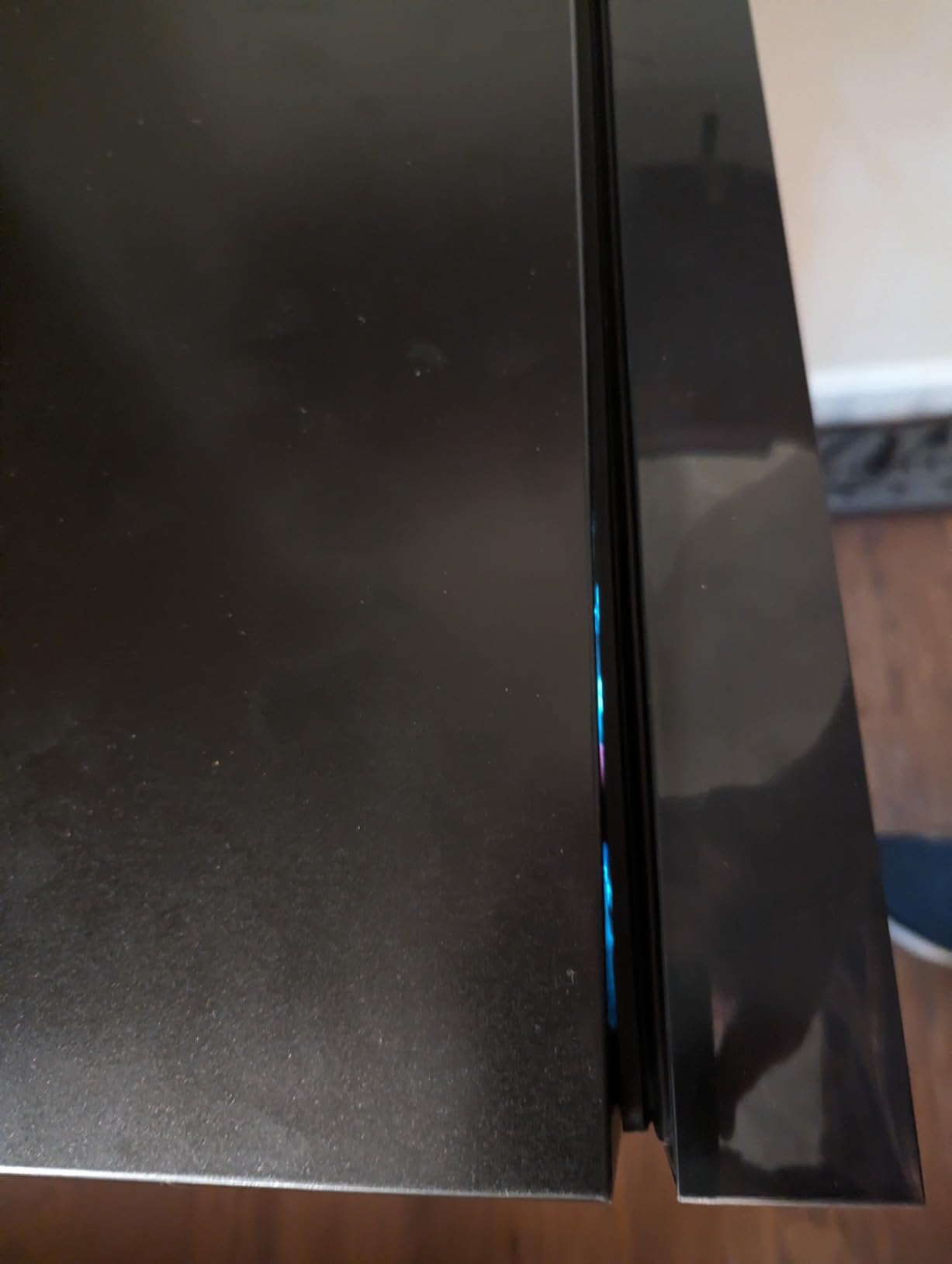
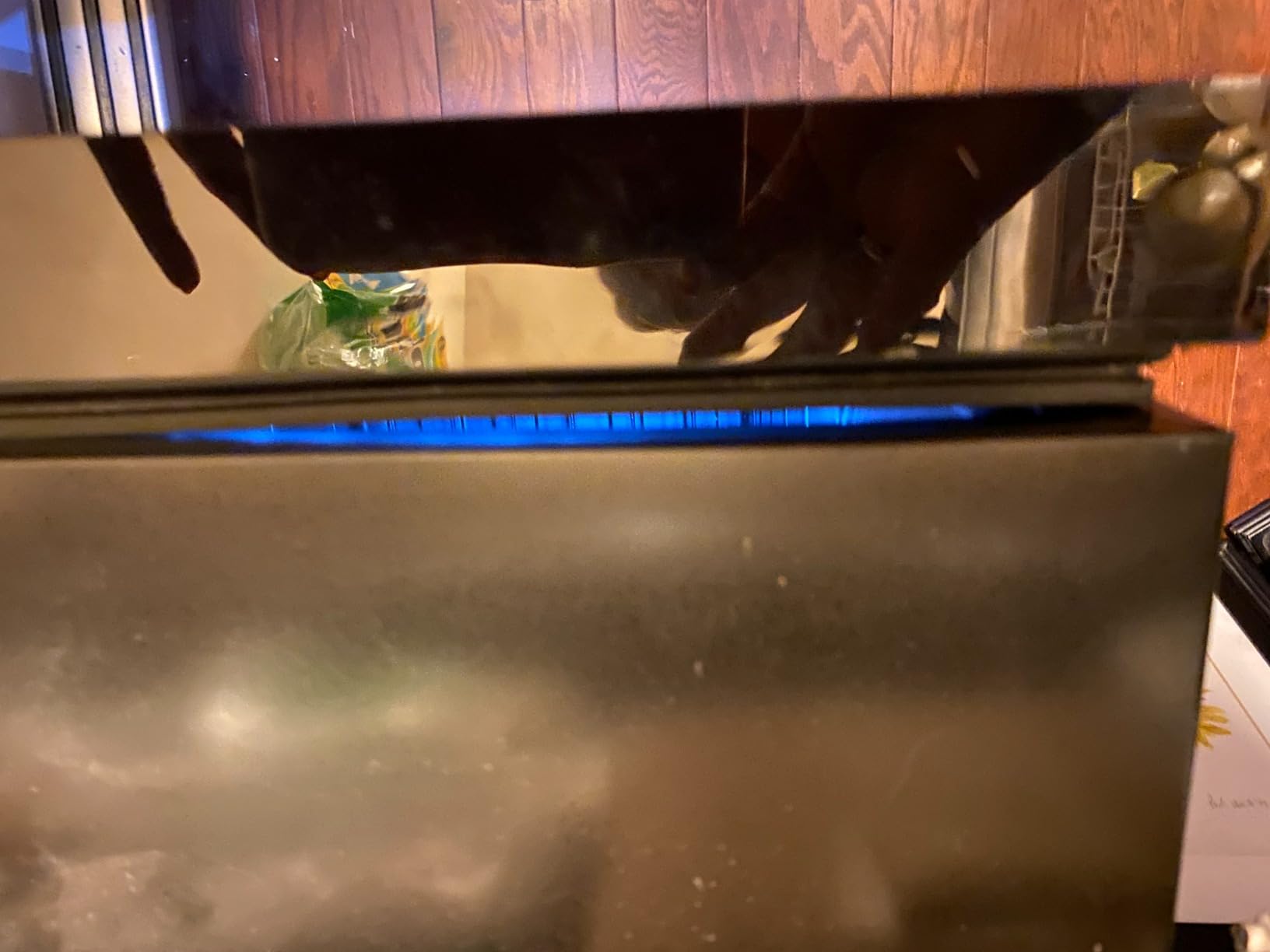
Some users report temperature inconsistency between the two bays, and condensation has been reported inside the wine side when the beverage side is opened repeatedly. Cold air from the can zone migrates, and that is the price of a combo cabinet.
The display cannot be switched off, which shows as a blue glow behind the glass after closing up. It is a minor irritation, but in a finished bar with dim lighting it is the kind of detail you notice every night.
3. Velieta 179-Bottle Dual Zone Wine Cooler for Serious Collections
Velieta 24 Inch Wine Cooler Fridge Dual Zone, Professional Large Capacity High Wine Refrigerator with Powerful Compressor, Quiet Operation and Elegant Design-KMHJ408D
179 bottle capacity
40-55F upper and 55-65F lower
27.2 x 23.5 x 63.0 inch
Compressor, freestanding only
Pros
- Largest bottle count in this roundup
- Dual zones with a proper 10 degree gap
- Blue UV-protective light for tannin
- Iron shelves protect labels
- Temperature memory and key lock
Cons
- 63 inch tall freestanding unit
- 200 pounds and four casters
- Only four shelves for 179 bottles
- Not rated for built-in installation
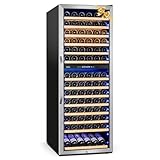
This is the freestanding floor unit for a bar where wine is the whole point rather than an accessory. It holds 179 standard 750ml Bordeaux bottles, split with 40 in the top zone and the balance below, and it stands 62.99 inches tall on casters.
The zones are 40-55°F above and 55-65°F below. That gives you a real champagne position in the top bay at 50°F and a red position in the lower bay at 62°F without moving anything when dinner is over.
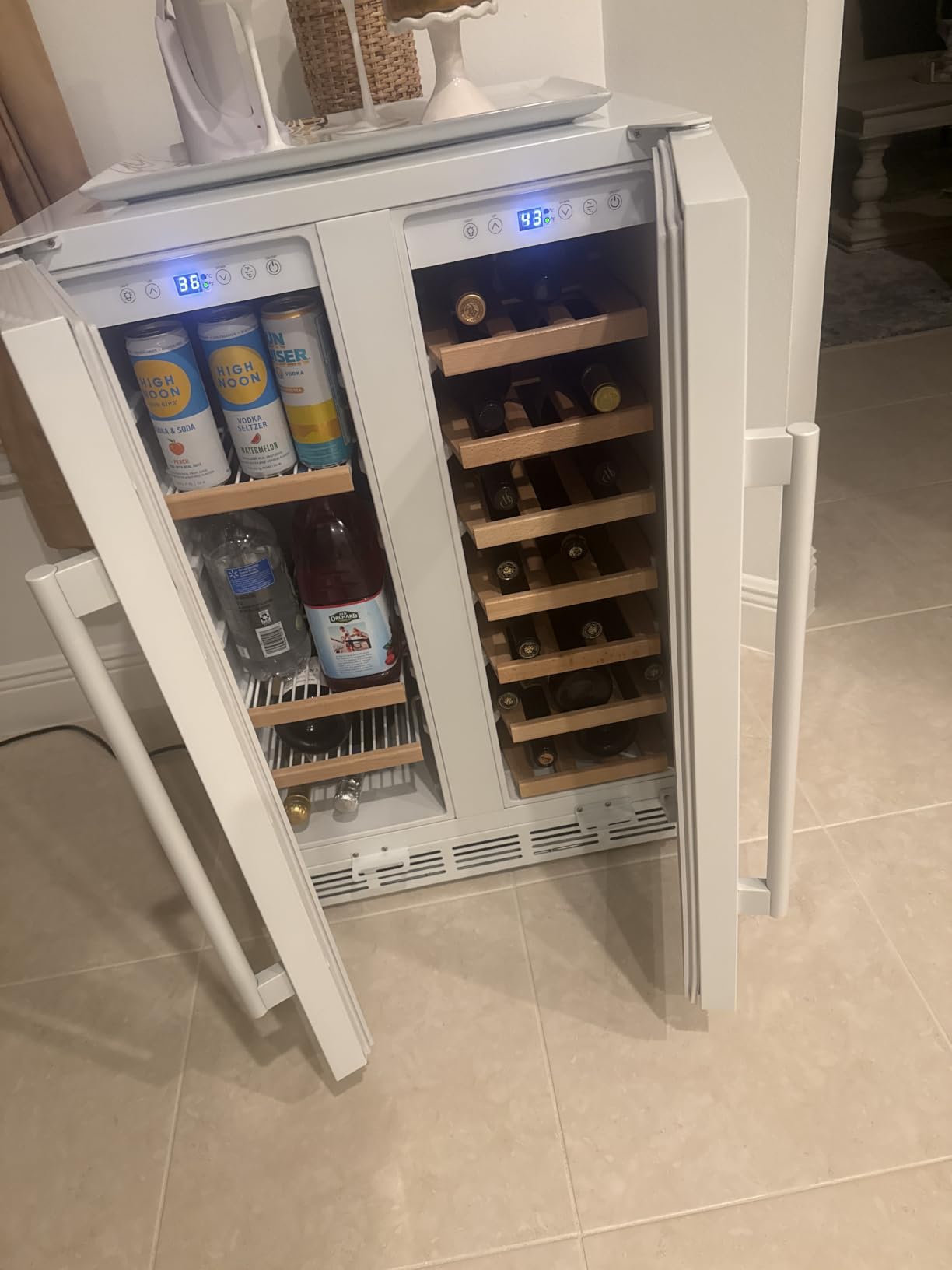
Blue interior lighting is a deliberate choice rather than a styling one. Blue light is the least damaging to tannins and will not fade printed labels, which matters when you are storing bottles you intend to keep.
Iron shelves are listed for label protection, and the smart LED control panel shows both set points at once. Temperature memory restores your settings after a power cut, and the key lock keeps a shared bar from being raided.
Plan the room before you plan the bar
At 27.16 inches deep by 23.54 wide by 62.99 tall, this is a floor appliance, not cabinetry. It needs an outlet within reach of the cord, several inches of clearance around the vents, and a floor that will take 200 pounds plus its load of bottles.
Because it is freestanding only, you cannot wrap it in millwork without giving up the airflow it needs. In a finished bar the usual move is to place it at the end of a run as a freestanding element with a matching panel rather than burying it.
Four shelves for 179 bottles is the catch
The shelf count is low for the capacity, so the layout depends heavily on how you stack. Users report that the top zone works better than the lower one because of the shelf density, and that large formats cut the real number noticeably.
Annual energy consumption is listed at 224.3 kilowatt hours, the highest figure in this group, and it is a heavy unit on four casters. If you want a cabinet that disappears into the build, this is the wrong shape; if you want volume, nothing else here matches it.
4. ROVSUN 33-Bottle Dual Zone Wine Cooler for Flexible Bar Layouts
ROVSUN 33 Bottle Wine Fridge, Dual Zone Wine and Beverage Refrigerator with Independent Temp Control & LED Control Panel, Freestanding Wine Cooler Chiller for Red White Wine, Champagne, Beer
33 bottle capacity
41-64F dual zone
17.0 x 20.0 x 33.4 inch
Freestanding, 240 degree door
Pros
- 20 inch width fits tight bar corners
- 240 degree door opening reaches back rows
- Independent zone control across 41-64F
- Adjustable shelves accept larger bottles
- Low noise compressor
Cons
- Freestanding only
- Some reports of ice buildup after two years
- Temperature buttons can fail over time
- Listing mixes 18-bottle and 33-bottle variants
This is the easiest unit in the roundup to drop into an existing room without a cabinetmaker. At 20 inches wide and 33.4 tall it fits most bar credenza bays, and the freestanding rating means you can slide it in, level the feet and plug it in the same afternoon.
Both zones are controlled independently across a 41-64°F range. The rotary scroll compressor and advanced air circulation keep the two compartments separated enough that a red at 62°F and a white at 50°F can sit side by side.
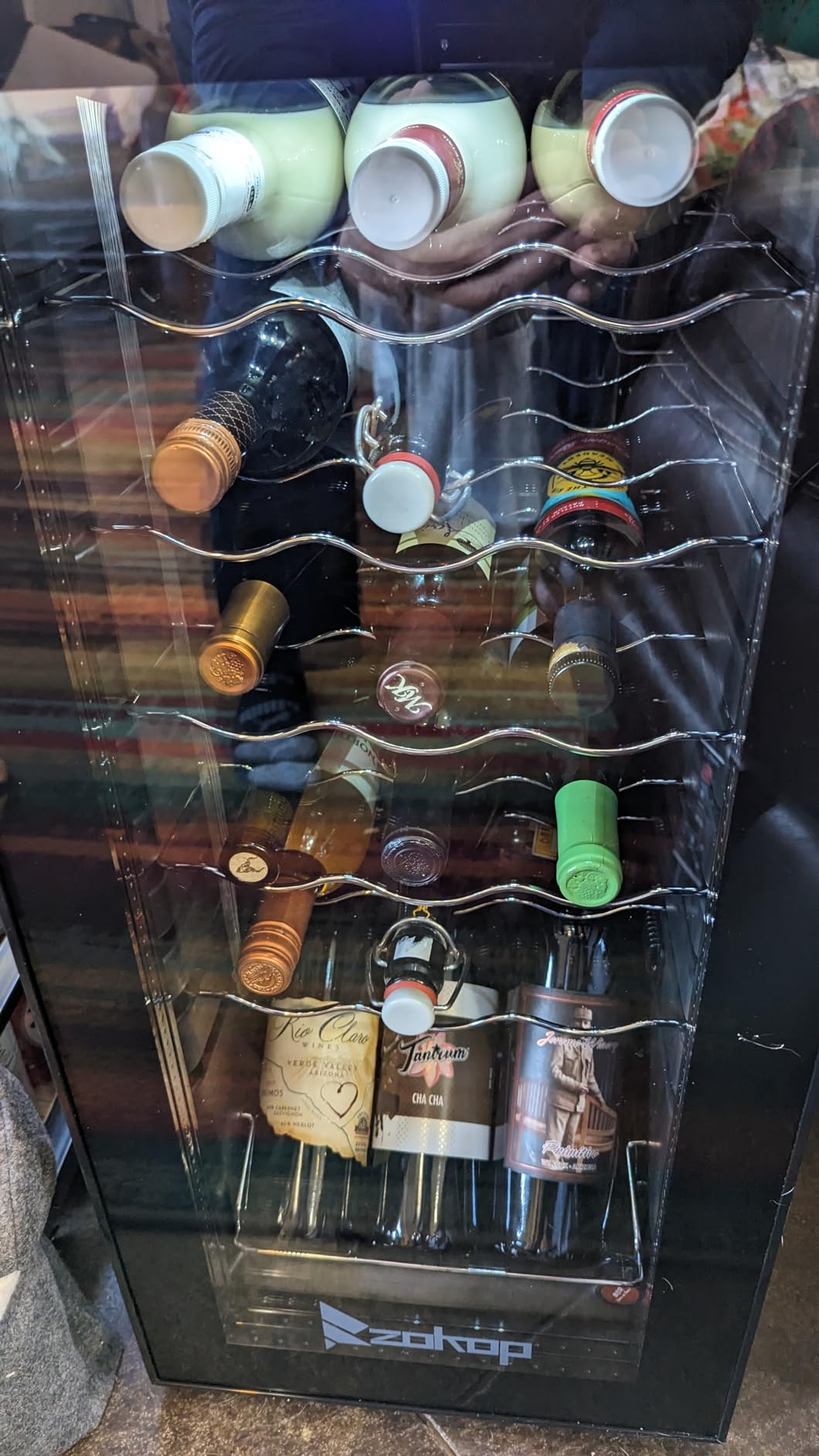
The 240-degree door opening is the feature that separates it in a bar. Most glass doors stop around 180 degrees, which means the far corner of the deepest shelf stays out of reach. A wider swing gets the whole rack visible from where you are standing.
Adjustable shelves mean you can reconfigure for Champagne or magnums rather than arguing with the factory layout. The stainless steel frame with double-layer tempered glass reads well against a dark bar front.
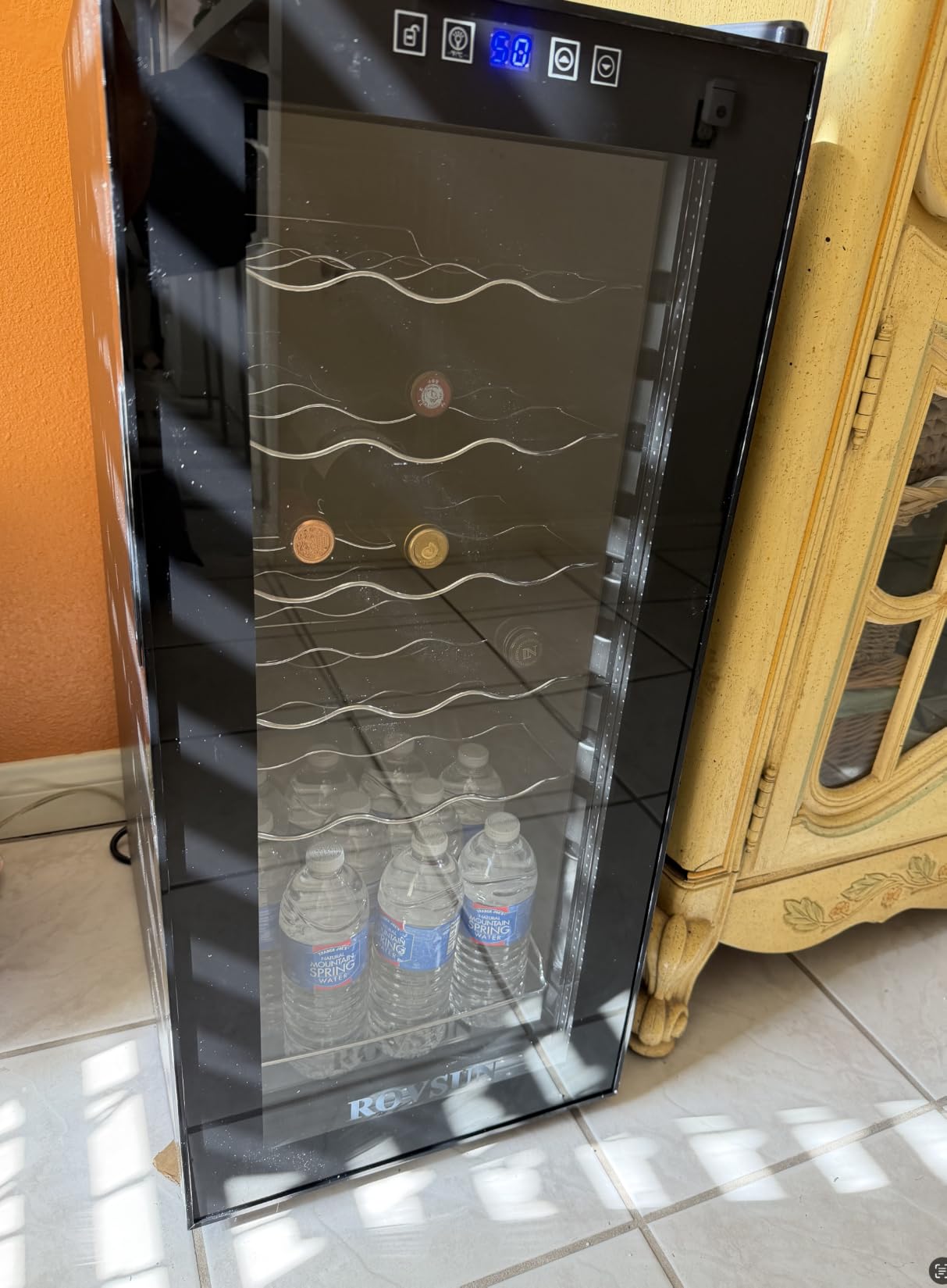
Great for a trial run before you build
Because it is freestanding, the smart move is to stage this unit where the built-in cabinet will go and live with it for a few weeks. You learn its real capacity with your own bottles, and you learn whether 33 bottles is enough for how your guests actually drink.
Owners also pair a unit like this with a separate rack for empty glassware and service pieces rather than cramming it. If you need a starting point for the storage side of the build, our home wine rack picks cover the shelving side.
Two-year durability is where value picks split
Some reviewers report ice buildup appearing after about two years of use, and others report the temperature buttons on the control panel eventually stopping responding. Neither complaint is universal, but both point at the control electronics rather than the cooling system.
It is also worth checking the variant before you order. The listing includes an 18-bottle and a 33-bottle version, and buyers have reported receiving a different capacity than they expected. Confirm the model number on the box, not just the colour of the image.
5. Ivation 33-Bottle Dual Zone Wine Cooler for the Loud-Room Test
Ivation 33 Bottle Dual Zone Wine Cooler Refrigerator w/Lock | Large Freestanding Wine Cellar For Red, White, Champagne & Sparkling Wine | 41f-64f Digital Temperature Control Fridge Glass Door Black
33 bottles
Upper 54-64F and lower 41-57F
16.9 x 19.5 x 33.4 inch
62 pounds, UV glass door
Pros
- Two zones with inverted temperature order
- UV-resistant double-paned glass
- 62 pounds is easy to reposition
- Temperature memory and key lock
- Soft LED interior lighting
Cons
- Upper zone overshoots set point for some users
- Metallic vibration on compressor start
- Display brightness cannot be dimmed
- Real capacity is closer to 20-24 with larger formats
Ivation runs the zones the opposite way round from most of this list. The upper zone is 54-64°F and the lower is 41-57°F, so reds sit at eye level and whites are reached by bending down. In a bar where the shelf is above a counter, that ordering is worth thinking about.
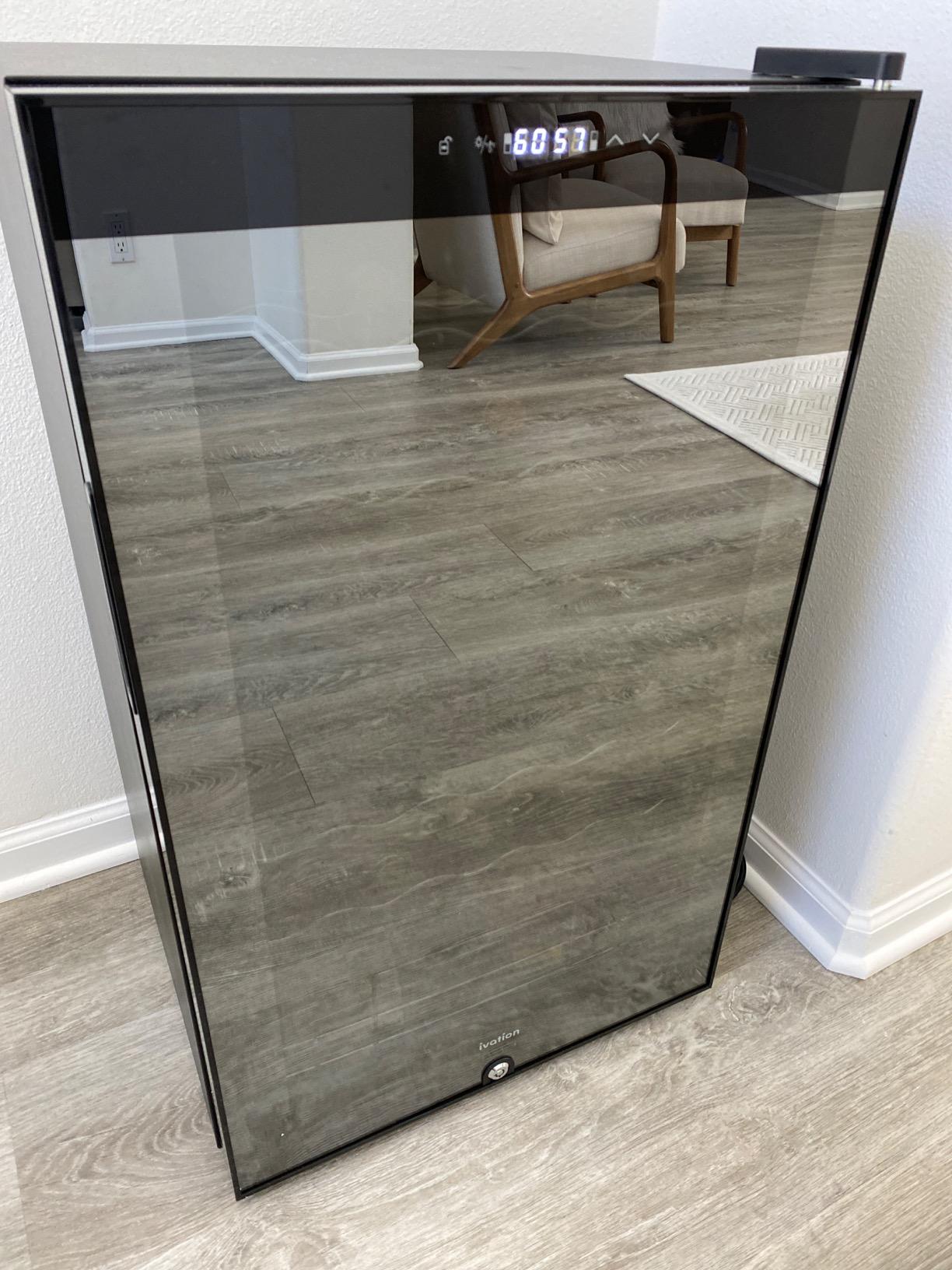
Capacity is 33 bottles across seven removable wire shelves, in a 16.93 by 19.49 by 33.39 inch body weighing 62 pounds. That is one of the lighter bodies here, and it moves easily enough to change a floor plan.
The UV-resistant double-paned thermopane glass is a genuine specification rather than marketing language, and it matters for a bar where the cabinet sits under a downlight. Labels stay legible and the wine does not get a spotlight treatment every evening.
Digital touch controls include a lock function and temperature memory. Annual energy consumption is listed at 171.3 kilowatt hours per year, which is reasonable for a 3.2 cubic foot compressor cabinet.
What the noise actually sounds like
Owners describe it as quiet when idle and noticeably metallic when the compressor starts. The pattern is the same one we hear across this category: a short start-up sound, then a fan that blends into conversation.
At 62 pounds with no fixed install, you can place it where the compressor start is furthest from the seating. Vibration from a hard floor can travel through a cabinet base, so a pad under the feet helps more than most buyers expect.
Plan for fewer bottles than the number says
Reviewers report that real capacity lands closer to 20-24 bottles once larger formats go in. Treat 33 as a ceiling for standard 750ml Bordeaux bottles and a starting point for anything wider.
The upper zone has also been reported to overshoot its set point on some units, and the LCD brightness cannot be dimmed. In a dark bar that display is a small, permanent light source you should plan around rather than discover later.
6. Kalamera 24-Inch 46-Bottle Dual Zone Wine Cooler with FSC Wood Shelves
Kalamera 24 inch Wine Cooler, 37 Bottle Dual Zone Built-in or Freestanding
46 bottle capacity
40-50F upper and 50-66F lower
22.4 x 23.4 x 33.0 inch
102 pounds, built-in ready
Pros
- 46 bottle capacity in a 24-inch body
- Five FSC-certified wooden shelves
- Built-in or freestanding installation
- 40-66F range suits reds through whites
- Brand operating since 2014
Cons
- Highest energy use in this group at 332 kWh
- Left-hinge only despite the description
- Heaviest 24-inch unit at 102 pounds
- Refrigerant type not clearly listed
The Kalamera is the pick when the shelf material matters more than the sticker. Five FSC-certified wooden shelves with bottle stoppers damp vibration better than wire, and cork closures sit on a flat wooden surface rather than a grid.
Capacity is quoted at 46 bottles, with 37 standard bottles and room for larger formats as the extra count. The body measures 22.4 inches deep by 23.4 wide by 33 tall at 102 pounds, and it is rated for both built-in and freestanding installs.
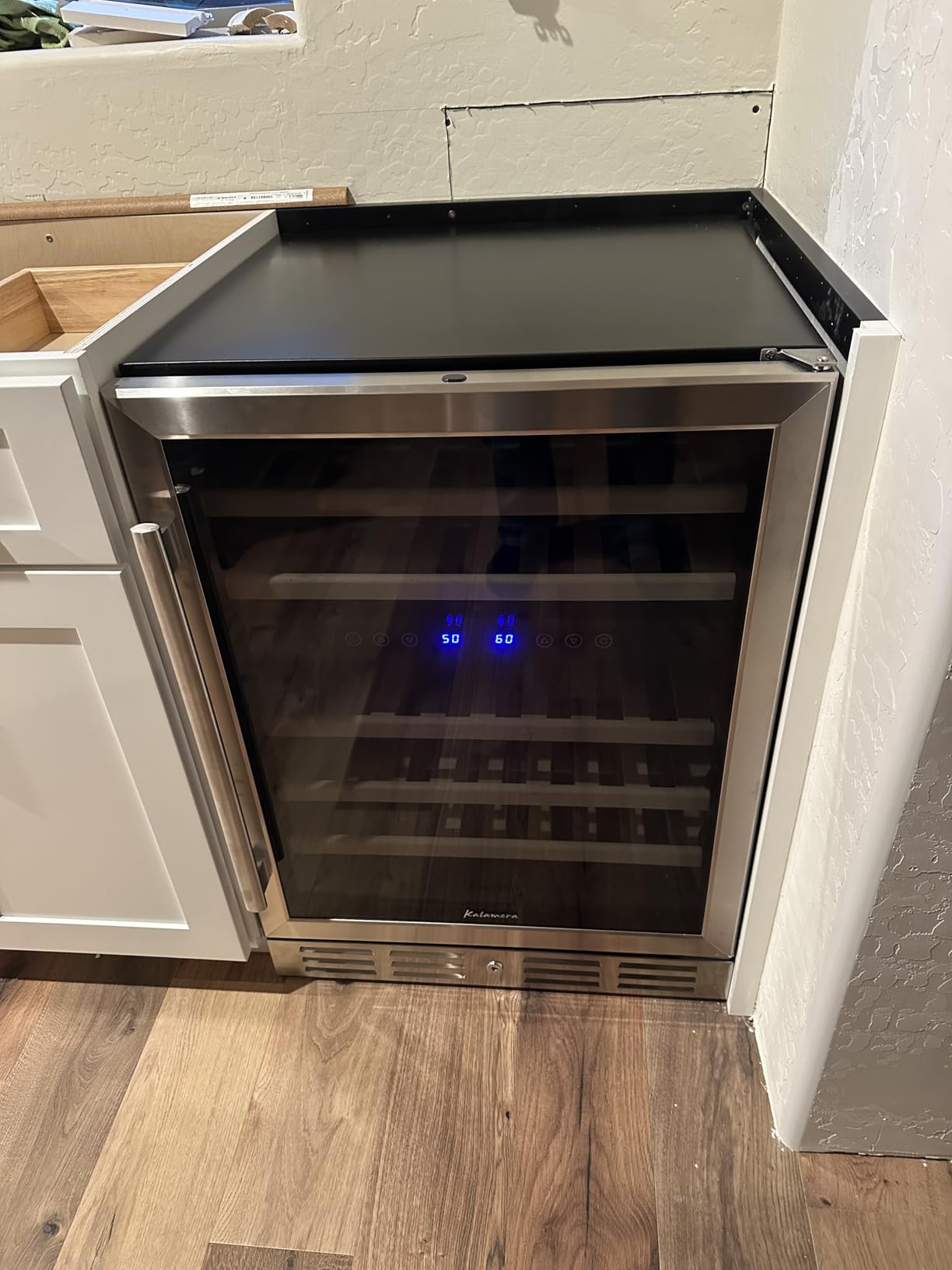
Zone ranges are 40-50°F on top and 50-66°F below. That 16-degree lower range covers a proper cellar-style red position rather than a narrow window, and it is a genuinely wide band for the lower compartment on a 24-inch cabinet.
Temperature memory, an LED control display, interior lighting and a key lock round out the feature set. The stainless steel reversible glass door and adjustable levelling feet are both practical touches in a built room.
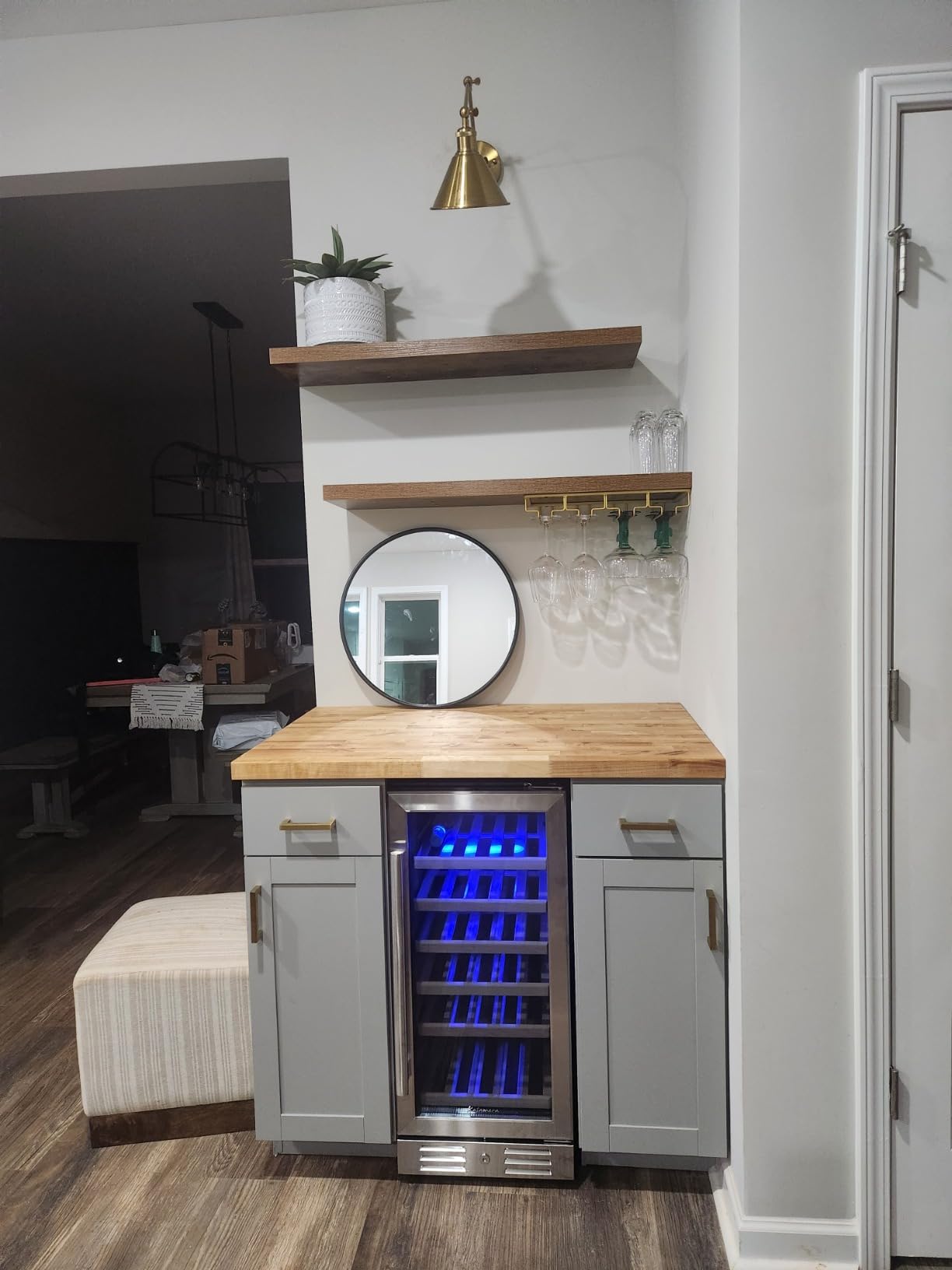
Verify the hinge before the cabinet is finished
The listing describes a reversible door, and the specification records the shipped unit as left-hinge only. Owners have reported this discrepancy directly, so confirm the hinge side with the seller before your millwork is committed.
At 102 pounds this is a two-person lift. If it is going into a built-in cavity, leave the back panel off until it is positioned and levelled.
Energy use is the honest drawback
Annual consumption is listed at 332.15 kilowatt hours, the highest figure among the 24-inch units here. Over years of running, that shows up on a meter, and it is worth weighing against the shelf quality you are paying for.
Reviewers also raise the same question about the refrigerant type, which is not clearly specified on the listing. For a built-in unit sealed inside cabinetry, ask the seller directly rather than assuming it matches the R-600A used by most of this group.
7. BODEGA 30-Bottle 15-Inch Dual Zone Wine Cooler with a 41-72°F Range
BODEGA 15 Inch Wine Fridge, 30 Bottle Dual Zone Wine Cooler, 41-72℉ Compressor Wine Refrigerator with Tempered Glass Door, Built-in or Freestanding Wine Cooler for Home Kitchen Bar (3.2 cu.ft).
30 bottles
41-72F in 1 degree steps
22.4 x 15.0 x 33.6 inch
42dB, front vent for built-in
Pros
- One of the widest temperature spans in the group
- 42dB compressor rating
- Front ventilation for a real built-in
- 99 percent UV blocking double glass
- Key lock and automatic lock
Cons
- Only five shelves for 30 bottles
- 15 inch width limits larger formats
- Wood-look shelves are not solid wood
- Some reports of 45dB in practice
This is the second 15-inch unit in the roundup, and it wins on range. The two zones adjust from 41°F to 72°F in single-degree steps, which means a bar can hold whites at 46°F and a fortified or cellar-style red at 66°F without running out of headroom.
Dimensions are 22.44 inches deep by 14.96 wide by 33.58 tall in 3.2 cubic feet. Thirty bottles fit across five adjustable shelves, and the door is double-glazed tempered glass with a stainless steel frame and UV filtering.
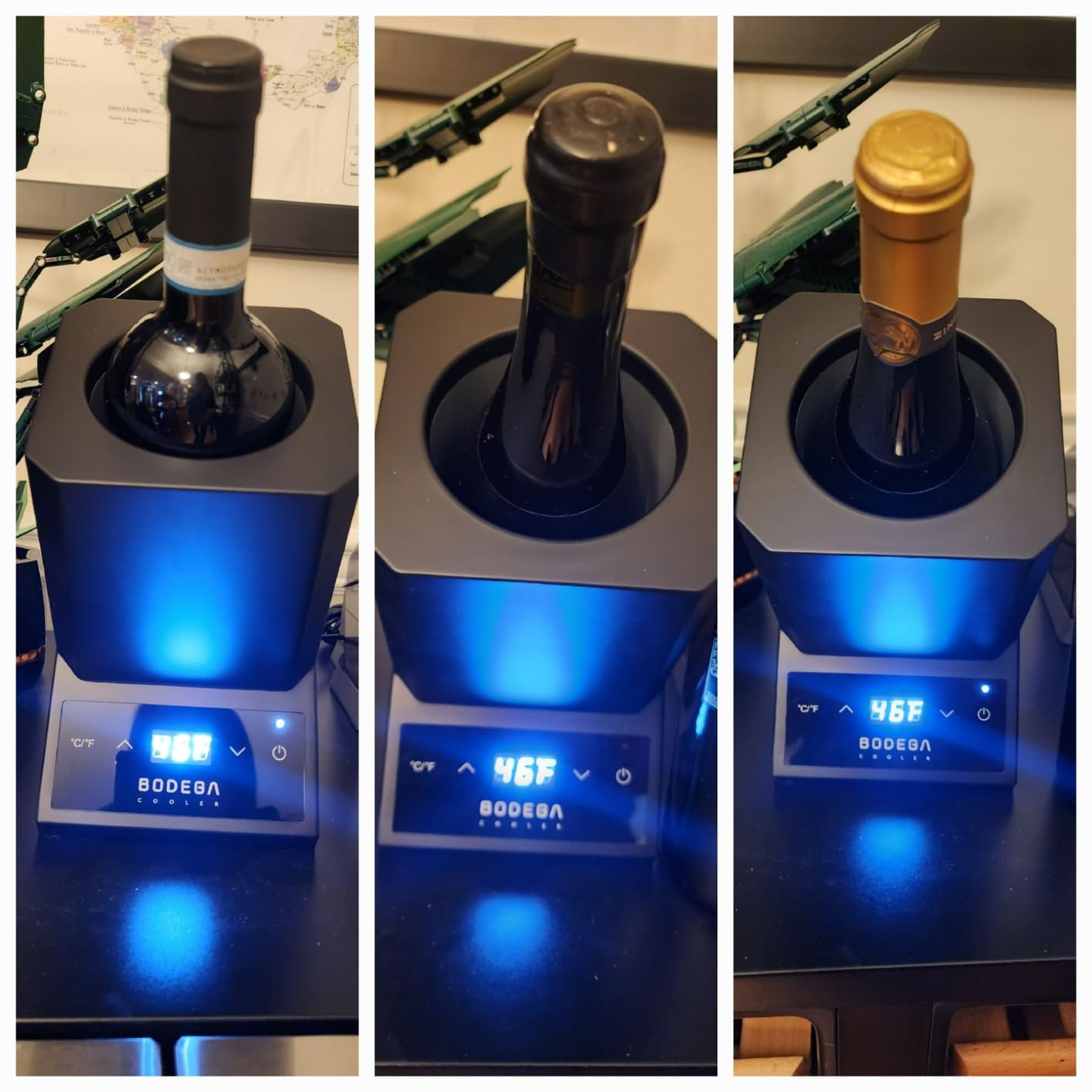
Front air vent cooling is what makes it a genuine built-in rather than a freestanding unit shoved into a hole. That single design decision decides whether the compressor gets the air it needs once the cabinet is closed around it.
There is also a temperature memory function, an automatic lock and a key security lock, plus adjustable feet that handle up to two inches of uneven floor or base height.
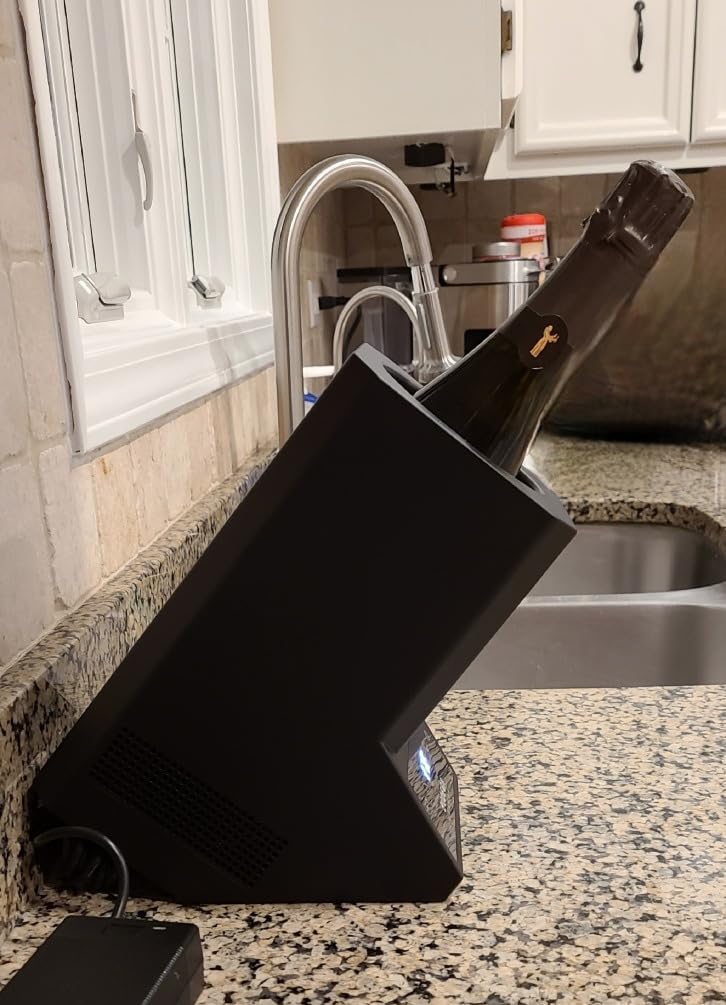
How narrow is too narrow
A 15-inch opening constrains more than the width. The 14.96 inch body leaves no room for magnums or Champagne on their sides, and a 72-degree door swing in a tight bay means you will be reaching in rather than looking in.
For a bar cabinet between two wall segments, narrow is the only option that works. For an open end bay, a 20-inch or 24-inch unit gives you noticeably better shelf geometry for the same rough footprint in the millwork.
Where the dB rating and the shelf spec fall short
The stated noise is as low as 42dB, and some users report closer to 45dB once the unit is loaded and cycling. That is still a compressor, so it is audible in a quiet room and masked by conversation when the bar is busy.
Five shelves for a 30 bottle rating is tight, and the shelves are wood-look rather than solid wood. Support is listed at 12 months, which is standard for the category but worth confirming against the seller before the unit goes behind a finished panel.
8. Whynter 92-Bottle Dual Zone Wine Cooler for a Built-In Bar Wall
Whynter Large Capacity Dual Zone Wine Refrigerator, 92 Bottle, BWR-0922DZ
92 bottle capacity
40-65F in both zones
22.25 x 23.5 x 55.0 inch
159 pounds, reversible door
Pros
- 92 bottle capacity with 12 slide-out shelves
- Both zones adjustable across 40-65F
- Reversible door swing for corner installs
- Smoked double-pane glass blocks UV
- Cylinder lock with two keys
Cons
- 159 pounds and a 55 inch tall body
- Shelves have no side rails
- Slide-out shelves only extend part way
- Freestanding despite built-in wording
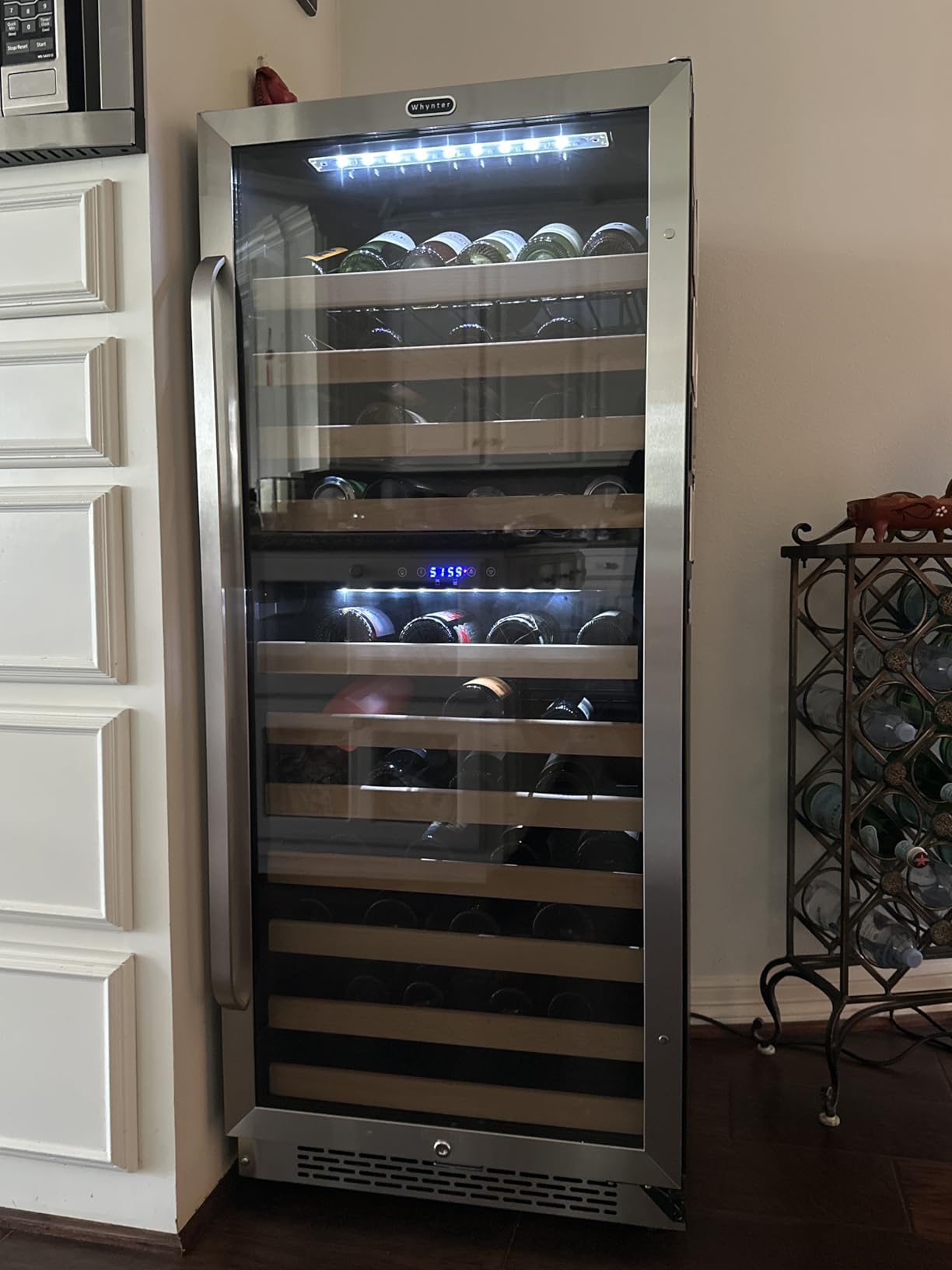
Whynter is the unit to look at when the bar wall is the destination rather than a counter. Ninety-two standard bottles across 12 removable wooden-faced wire slide-out shelves, with a display shelf for six bottles at incline near the door.
Both zones are adjustable across 40-65°F, so you are not locked into a fixed red band and a fixed white band. The top zone is listed at 40 bottles, or 30 once the display shelf is fitted, and the bottom zone at 52.
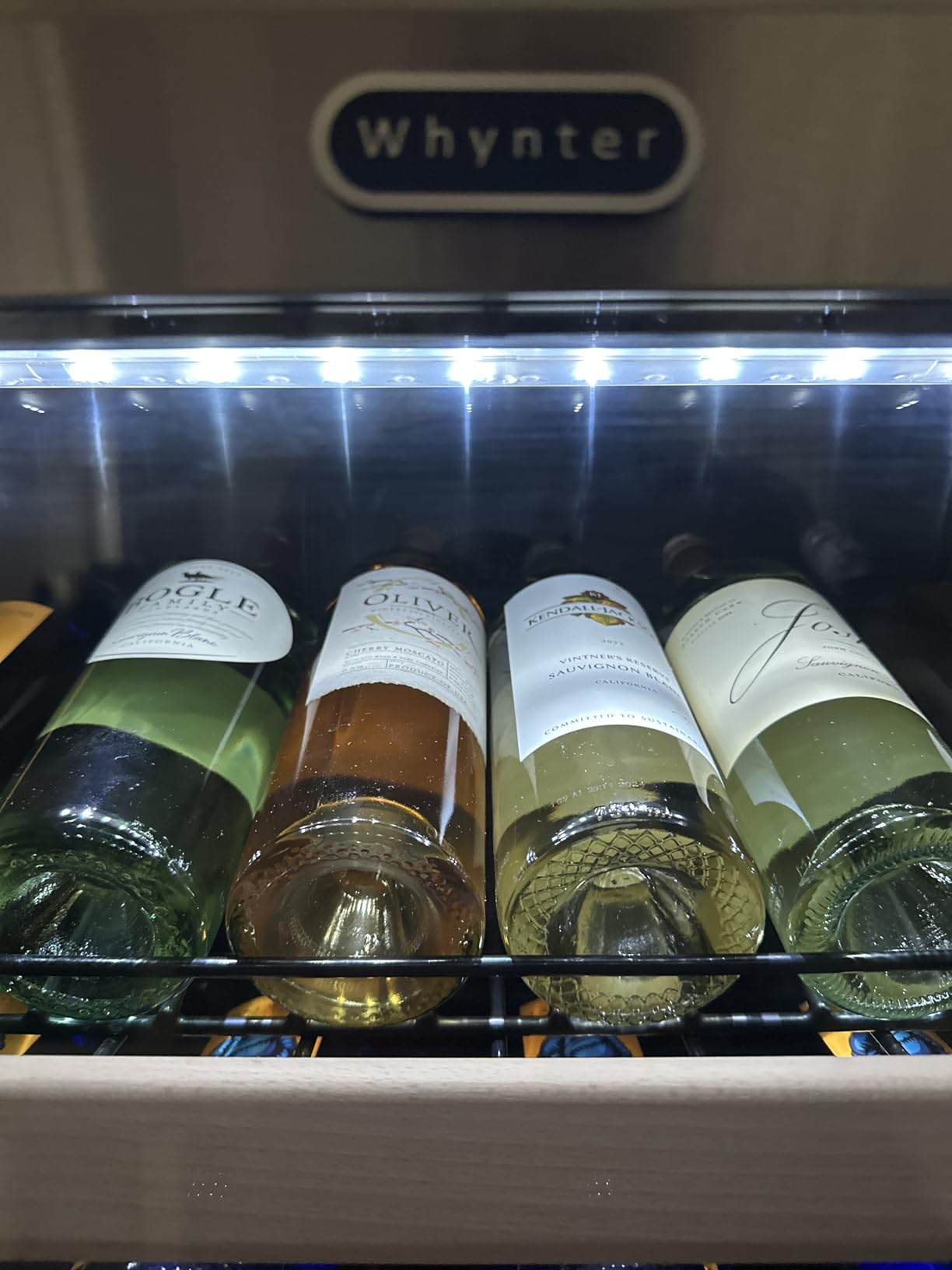
Two details matter for a build. The reversible door swing lets you mount it with the hinge on whichever side the cabinet allows, and the double-pane gray-smoked glass filters UV without turning the bottles into silhouettes.
Nine soft white LED lights, a Fahrenheit and Celsius toggle, a cylinder lock with two keys and adjustable levelling feet are all included. The compressor uses fan-forced circulation with R-600a refrigerant.
Depth with the handle is the number to use
The body is 22.25 inches deep, 23.5 wide and 55 tall, and the listing gives a 24 inch maximum depth with the door open. That 24 inch figure is the one to take to your cabinetmaker, not the body depth.
At 159 pounds you will want two people and a dolly. In a bar wall, cut access panels rather than planning to lift it in through a finished face frame.
The shelf design is the real drawback
Users report that the wire shelves have no side rails, so a bottle near the edge can slide off, and that the slide-out racks only extend part way. Both are design choices, not faults, but they shape how you load the cabinet.
Reviewers also mention noise being noticeable in a kitchen or TV room, cosmetic shipping damage on a large unit, and mixed long-term durability reports. Treat the one-year warranty as the realistic service window and plan a service path before the cabinetry goes in.
9. BODEGA 46-Bottle 24-Inch Dual Zone Wine Cooler for Quiet Rooms
BODEGA 24 Inch Dual Zone Wine Fridge, 46 Bottle Built-in Wine Cooler with Compressor Cooling, Double-Layer UV Glass Door, Digital Thermostat & ≤35dB Quiet – Freestanding Fridge for Home Kitchen Bar
46 bottles
41-53F upper and 53-72F lower
22.4 x 23.4 x 33.0 inch
35dB, five beech shelves
Pros
- Lowest published noise figure in the roundup at 35dB
- 46 bottles on five beech wood shelves
- Vibration absorption system built in
- Auto-defrost and power-outage memory
- 99 percent UV blocking double glass
Cons
- Only five shelves for 46 bottles
- Right-hinge door only
- Needs 2 inch clearance top and back for built-in
- Warranty runs 12 months
If your bar sits in an open-plan living space and you are worried about the compressor, this is the unit to shortlist first. The published noise figure is 35dB or less, and reviewers repeatedly single out how little it registers during a gathering.
It holds 46 bottles across five slide-out beech wood shelves in a 22.4 by 23.4 by 33 inch frame. The zone split is 41-53°F above for whites and 53-72°F below for reds, which matches serving guidance closely.
Wood shelves plus a built-in vibration absorption system is the combination that matters for longer aging. Cork closures stay in contact with a damp wooden surface rather than a wire grid, and the compressor is isolated from the cabinet frame.
Auto-defrost runs automatically, so there is no defrost schedule to remember in a bar nobody wants to open with a hair dryer. A power-outage memory chip restores both set points after an outage.
The two-inch clearance is not optional
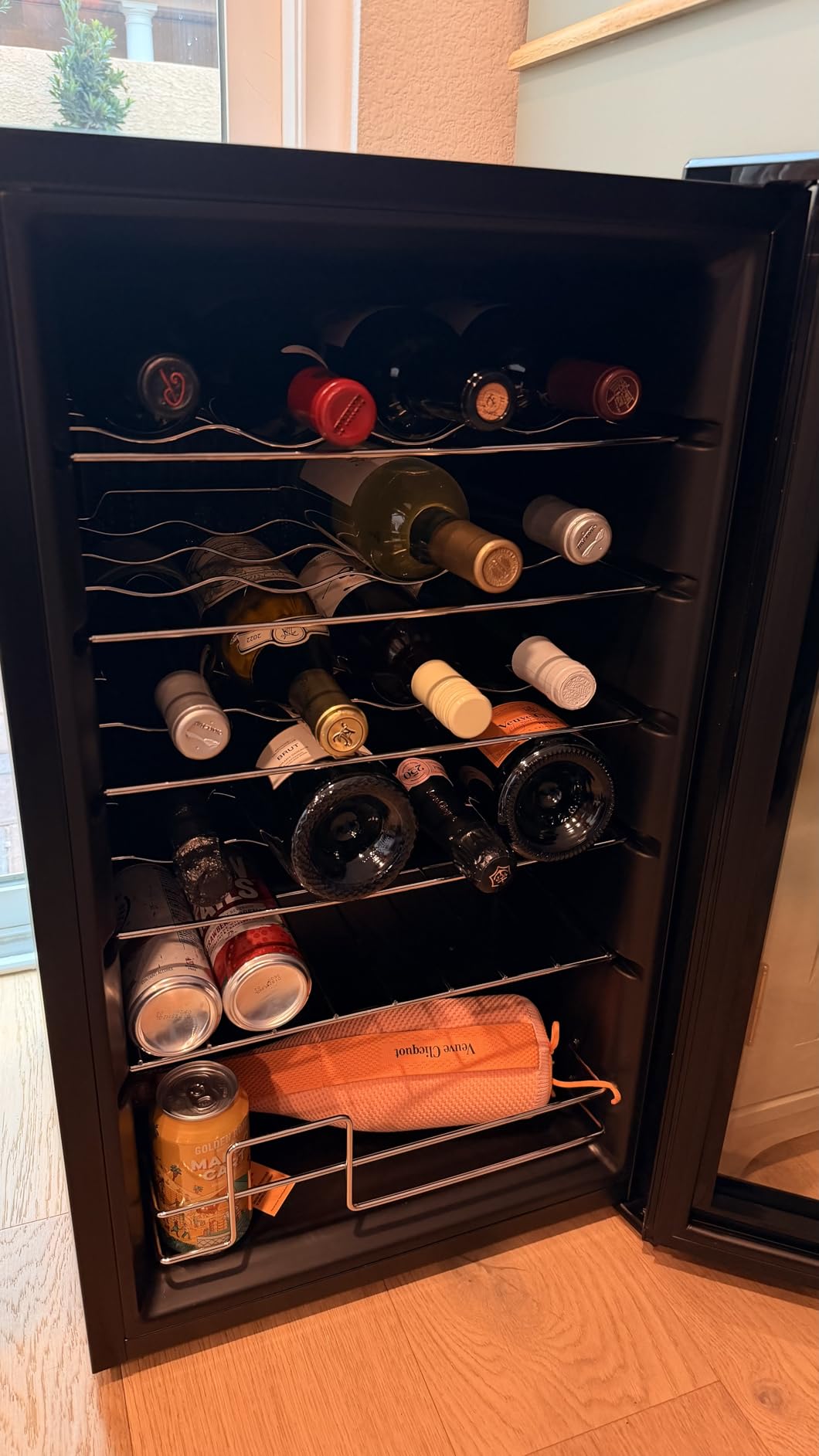
For a built-in install, the manufacturer calls for two inches of clearance at the top and back. Skip it and the compressor runs hotter, cycles more and ages faster, which is exactly the failure pattern owners complain about in freestanding units pushed under counters.
Front ventilation means the unit breathes out of the front kick plate, so the cabinet face needs an open slot. Design that in at the millwork stage; retrofitting it is messy.
Five shelves is the trade for the noise level
The honest caveat is shelf density. Five shelves carrying 46 bottles means tighter spacing than the capacity number suggests, and large formats will force you to remove a shelf.
The door is right-hinge only, and the warranty is 12 months with 24 hour support response listed. For a bar that runs year round, that support window is worth confirming in writing before the unit goes behind a finished panel.
10. Yeego 52-Bottle Left-Hinged Dual Zone Wine Cooler for Specific Layouts
Yeego 24 Inch Wine Fridge, 52 Bottle Dual Zone Wine Cooler with Left Hinged
52 bottles
40-65F in both zones
22.4 x 23.4 x 32.3 inch
Fixed left hinge, five beech shelves
Pros
- 52 bottles on five beech wood shelves
- Both zones adjustable across 40-65F
- Built-in under-counter or freestanding
- Left hinge suits left-bay cabinets
- ETL certified with temperature memory
Cons
- Fixed left hinge
- not reversible
- Some warranty claims settled parts only
- Middle shelves tight for larger formats
- Shelves pull out only halfway
The Yeego earns its place because of its hinge, not its brochure. It is a fixed left-hinged unit, and if your bar cabinet has the appliance bay on the left of a peninsula, a reversible model installed the wrong way will block the door and waste the whole build.
Capacity is 52 standard Bordeaux bottles across five removable beech wood shelves, with adjustable layout for Champagne and Burgundy formats. Body measures 22.4 inches deep by 23.4 wide by 32.3 tall, the shortest 24-inch-width unit here.
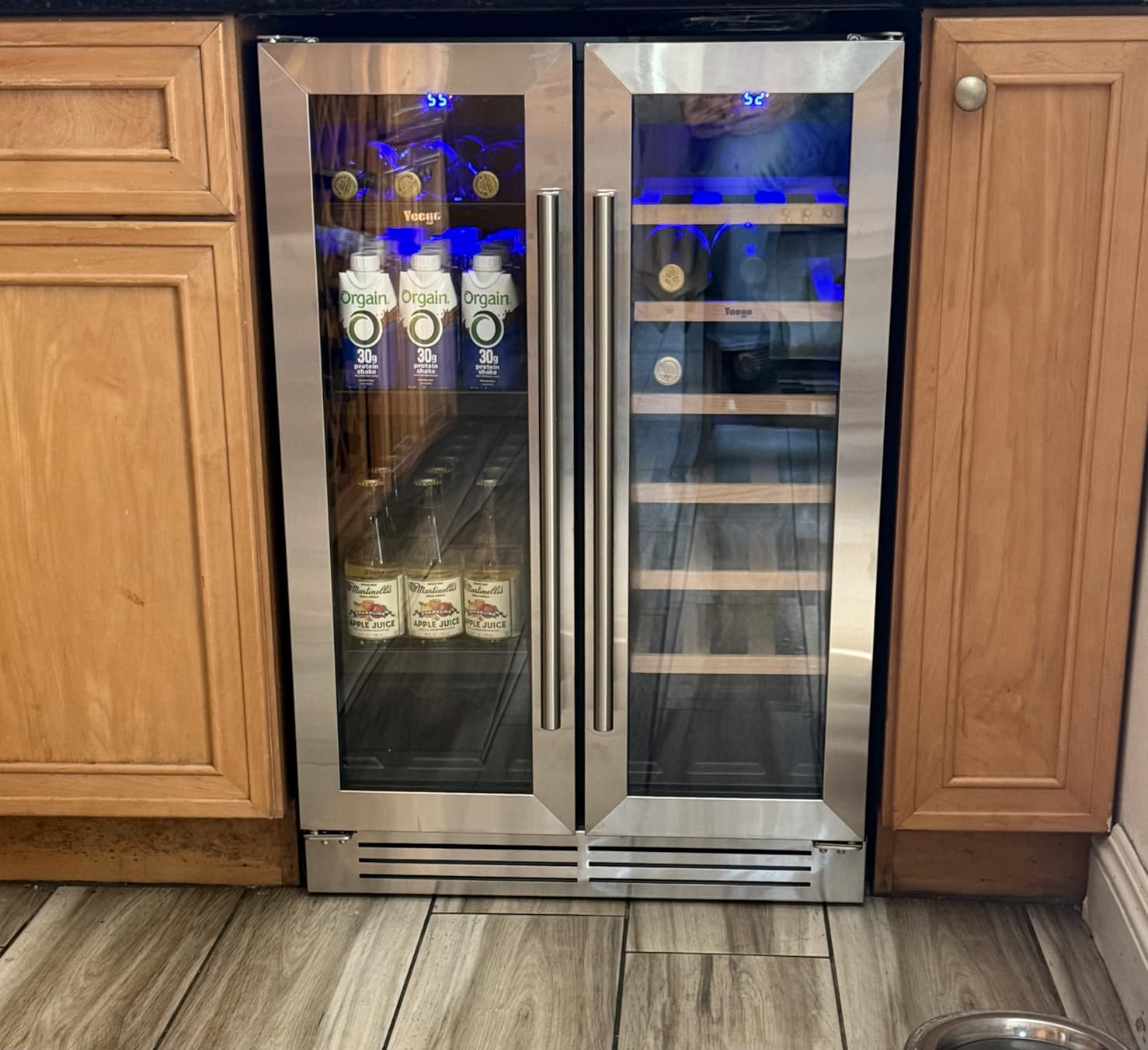
Both zones run independently from 40°F to 65°F, with the manufacturer positioning the upper zone for Champagne and whites and the lower zone for reds. Compressor cooling with internal fan circulation and double-layer tempered glass handle UV.
Customer service is reported as responsive, and the unit is ETL certified. Front ventilation means it works as a built-in under-counter appliance or freestanding on levelling feet.
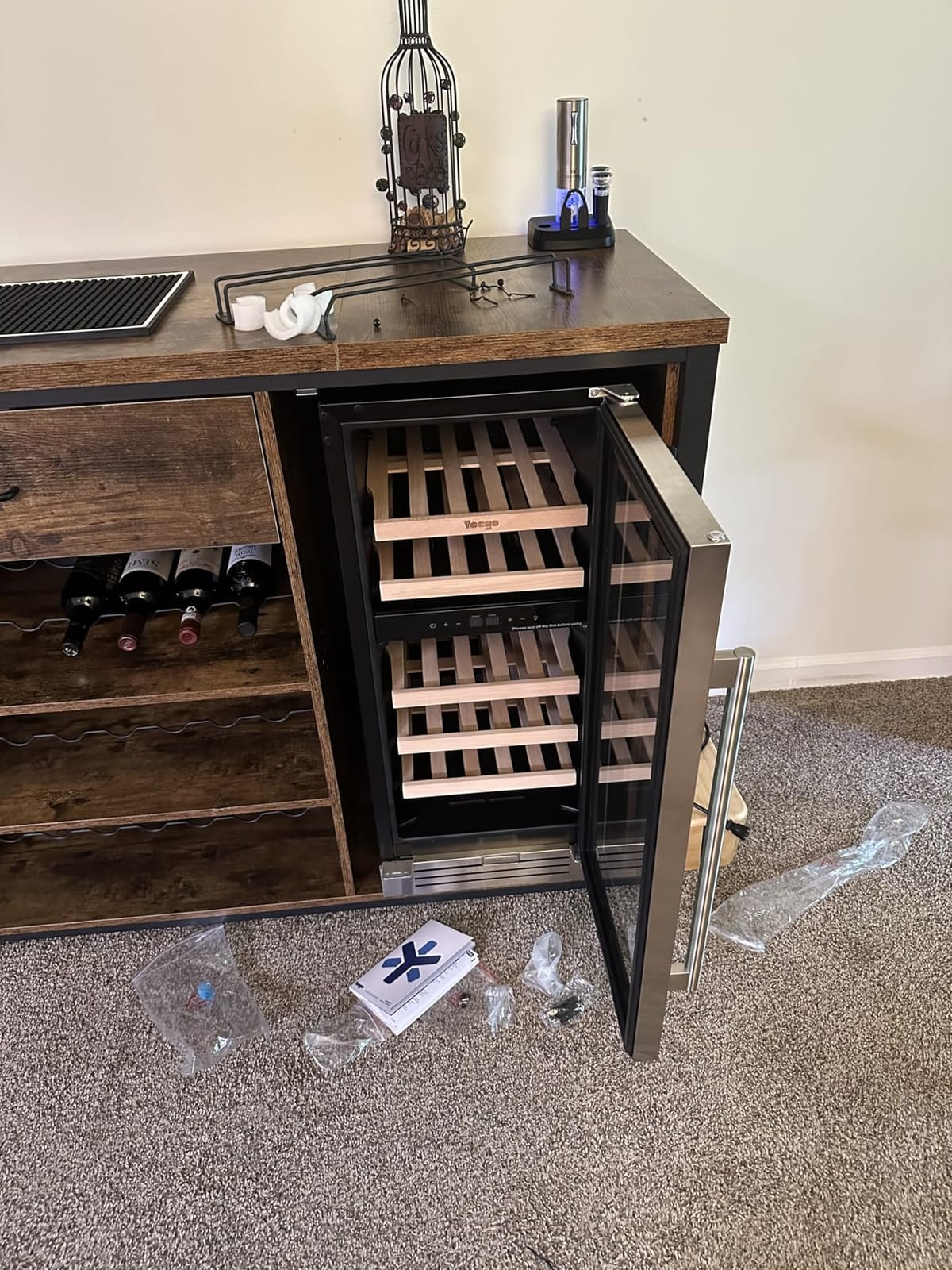
Allow time before you load it
The manufacturer specifies a 24 to 36 hour settling period before first use, with the unit upright. Skipping it and loading bottles immediately is the fastest way to see condensation on the glass and doubt the purchase.
Because the hinge is fixed, plan the door swing against adjacent seating. A left-hinged door opening into the room needs roughly 24 inches of clear space in front of the cabinet face once the door is fully open.
Shelf spacing and warranty terms
Reviewers report the middle shelves being tight for larger bottles and the drawers pulling out only halfway, which limits how far back you can see. The adjustable layout helps, but you are trading reach for bottle count.
Some warranty claims have been reported as parts-only with no labour covered. Ask the seller for the warranty terms in writing before the unit goes into millwork, because a sealed cabinet turns a simple swap into a panel removal.
11. ORYMUSE 52-Bottle 24-Inch Dual Zone Wine Cooler for New Builds
ORYMUSE 24 Inch Dual Zone Wine Cooler, 52 Bottle Built-In Wine Fridge
52 bottles on 6 beech shelves
40-55F upper and 55-65F lower
22.6 x 23.4 x 34.3 inch
88 pounds, 170 kWh per year
Pros
- 52 bottles on six beech wood shelves
- An extra shelf versus other 52-bottle units
- Digital touchscreen with power-loss memory
- Front ventilation for built-in
- DOE and ETL certified
Cons
- Fewer reviews than the rest of the field
- Left-hinge only
- Listing shows conflicting shelf and model numbers
- 12 month warranty
Of the 52-bottle units, this one has the most shelf real estate: six adjustable beech wood shelves instead of five. That extra shelf is what stops larger formats from forcing a removal, which is the single most common capacity complaint in this category.
The zones are 40-55°F above and 55-65°F below, a clean split for reds against whites and sparkling. The body is 22.63 inches deep by 23.42 wide by 34.25 tall and weighs 88 pounds, which is manageable for two people.
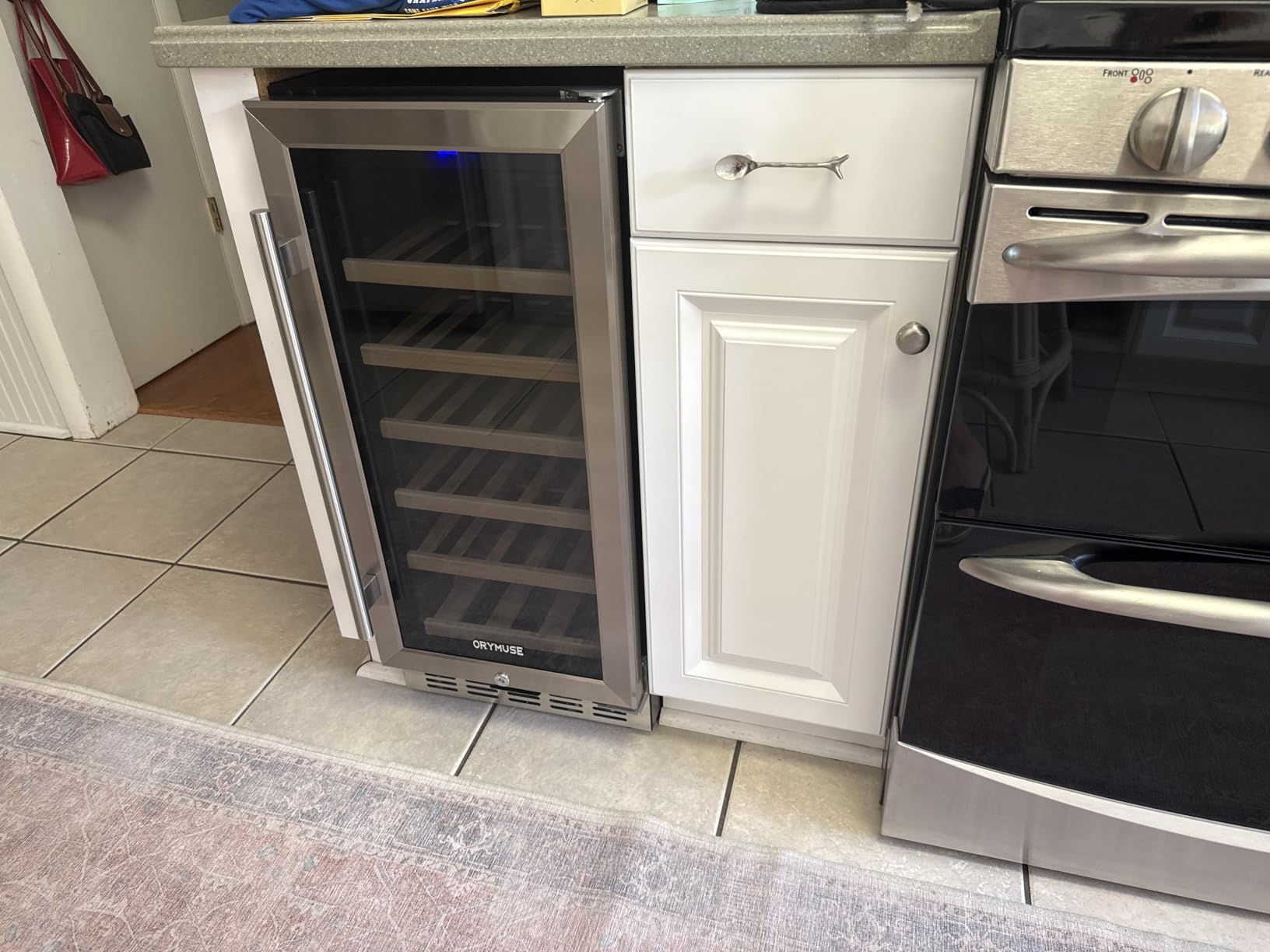
Digital touchscreen controls, power-loss temperature memory, a built-in safety lock and interior LED lighting cover the daily-use list. Front ventilation makes the built-in rating credible rather than nominal, and R-600A refrigerant is the most common in this group.
Annual energy consumption is listed at 170 kilowatt hours, which is at the better end for a 52-bottle cabinet. The manufacturer specifies a 24 hour settling period upright before first use.
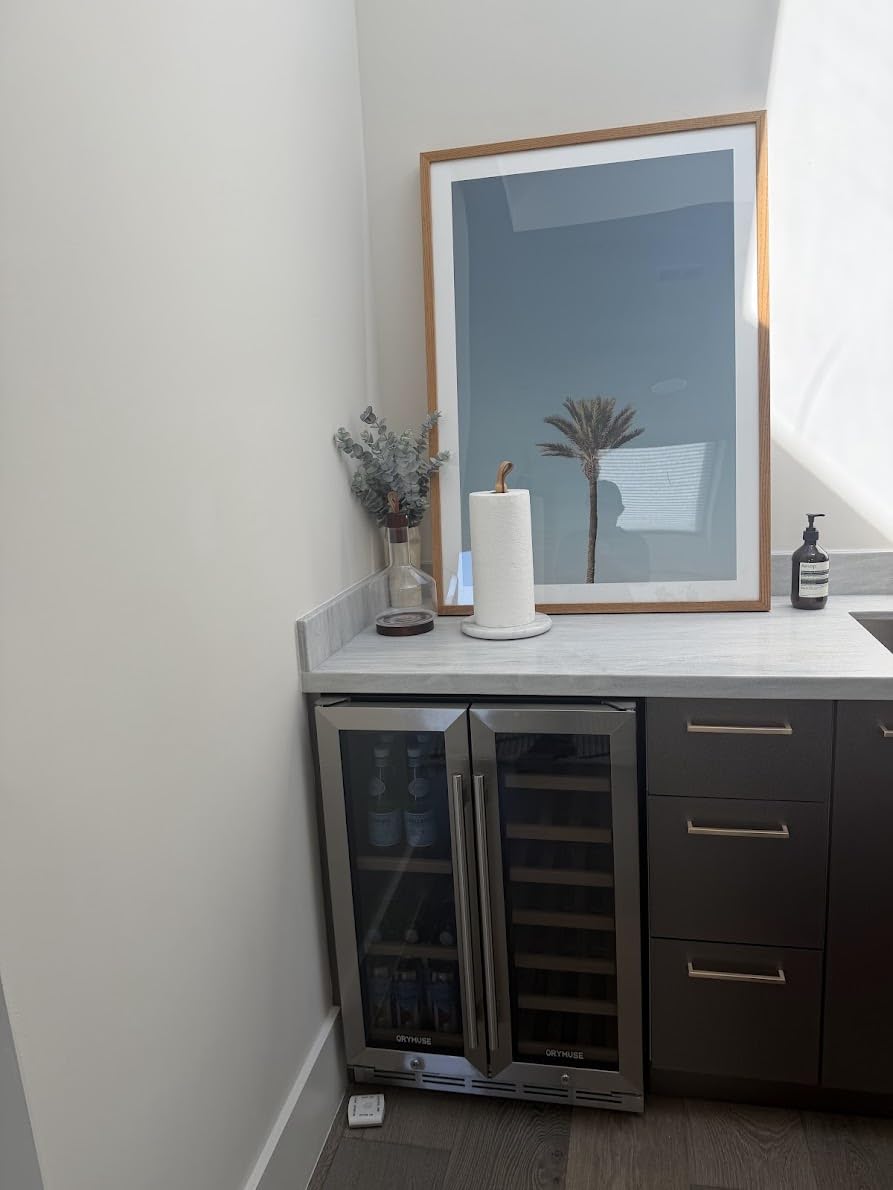
Fewer reviews means less long-term evidence
This listing carries 180 reviews, well below the rest of this roundup. The rating is high, but a shorter history means less evidence about behaviour after three or four years of continuous running, which is exactly the information a buyer cares most about.
If you are risk averse, treat that as the reason to check the warranty terms carefully and to keep the unit accessible for service rather than sealing it behind an unremovable panel.
Confirm the model number on the box
The listing itself shows conflicting numbers, including a different model identifier and a different shelf count. Buyers have reported spec inconsistencies on this page, so verify the model and shelf count against the manual in the box before you commit cabinetry.
The door is left-hinge only, which is worth checking against your bay layout. The warranty runs 12 months from purchase.
12. ORYMUSE 30-Inch Dual Zone Wine and Beverage Cooler for Full-Size Bars
ORYMUSE 30 Inch Dual Zone Wine and Beverage Refrigerator, 30 Bottle 110 Can
30 bottles and 110 cans
35-50F left and 41-64F right
23.0 x 30.3 x 34.3 inch
French doors, under 40dB
Pros
- Widest cabinet here at 30.3 inches
- Soft-close magnetic French doors
- Left can zone and right wine zone
- Under 40dB compressor
- Child safety lock on the bottom door
Cons
- Only 30 bottles despite 6.5 cubic feet
- Shelves reported as flimsy
- Some temperature consistency complaints
- Door seal and gasket issues reported
At 30.31 inches wide, this is the only unit here that needs a 30-inch cabinet opening, and that is exactly why it makes the list. Some bar builds have a full-height bay on one side of a back bar, and this is the cabinet that fills it while carrying both wine and cans.
The split runs left zone 35-50°F for beverages and right zone 41-64°F for wine, with 10 adjustable shelves, four in the beer zone and six in the wine zone. Soft-close magnetic French doors are a real quality touch at this width.
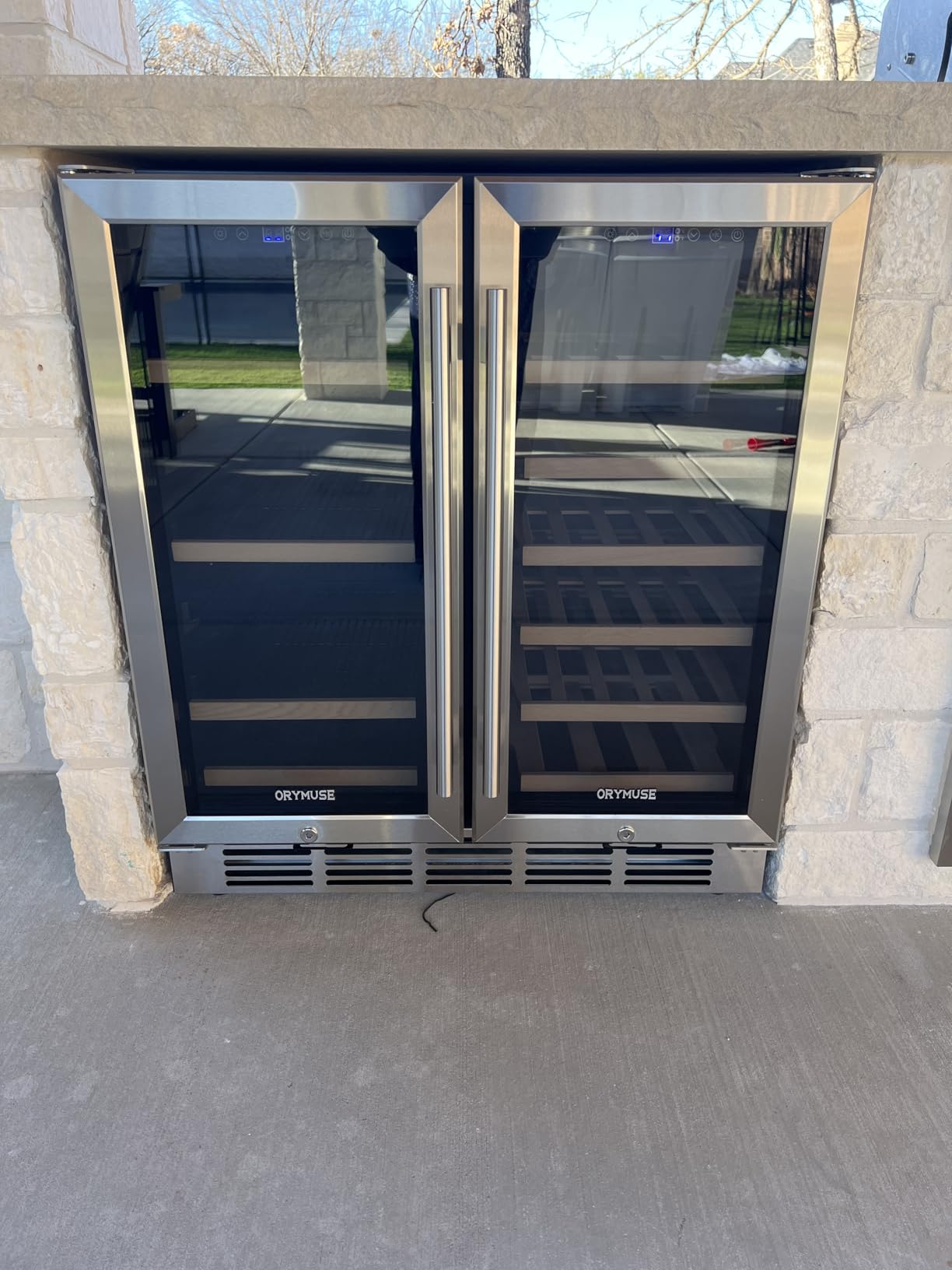
Compressor cooling is listed under 40dB, front ventilation allows a built-in install, and R-600A refrigerant matches most of this roundup. Annual energy consumption is listed at 185 kilowatt hours.
A bottom door lock gives you a child safety control that matters in a house where guests and family overlap. The touch screen controls and blue LED lighting are straightforward to use in a dim room.
Big cabinet, modest wine count
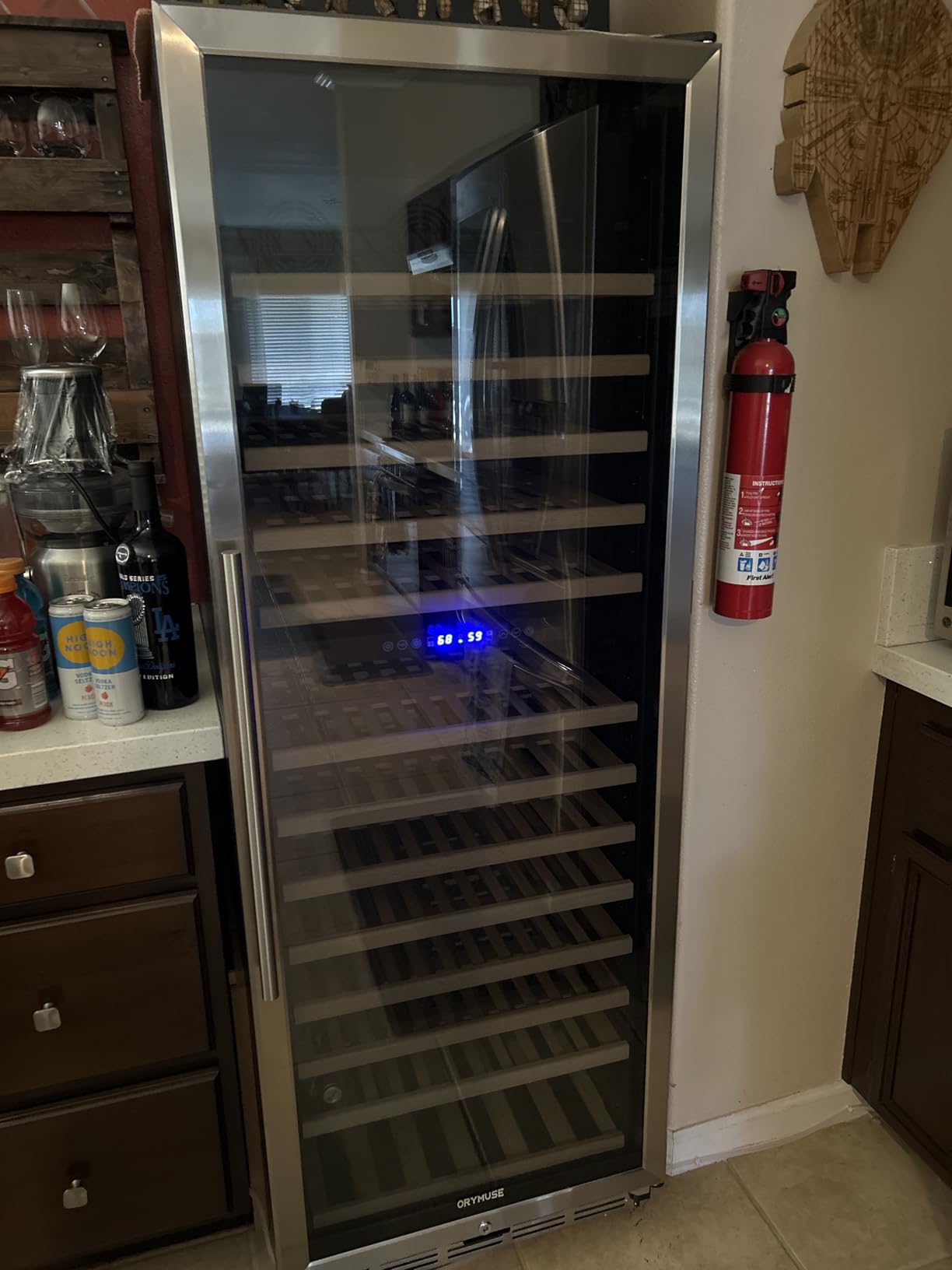
You are buying 30 bottles of wine storage plus a serious can cooler, not 30 inches of wine cellar. If the number on the box is the only reason you are considering it, the smaller 24-inch combo is the better fit.
Shelves have also been described as flimsy wire rather than solid metal. For cans that is fine. For a cellar-style collection, pick a unit with wooden shelves.
Zones and seals are the reported weak points
Some reviews report temperature consistency issues, and door seal or gasket problems have been mentioned. Gaskets are the component most likely to need replacing in a sealed millwork install, so plan for panel access rather than a fixed panel.
There are 181 reviews on this listing. Like the other newer model here, the field is short, and some variants have been reported with a single temperature setting. Verify the zone controls are independent before you commit.
How to Choose a Dual Zone Wine Cooler for a Home Bar
Dual zone versus single zone, honestly
A dual zone wine cooler is worth it if your bar serves both reds and whites at the same sitting. A single zone forces one compromise temperature for both, and the wine you pull for the wrong bottle is the wine that disappoints.
It is not worth it if you only drink one style, or if you are storing for the long term and opening nothing for a year. In those cases a single zone with a wider, better-controlled range serves you better and costs less. Users report dual zone satisfaction is highest when the split matches how they actually drink, not when the spec sheet looks impressive.
The temperature reference to build your zones around: reds 55-65°F, whites 45-50°F, rosé 50-55°F, sparkling 45-50°F. A 24-inch cabinet with 46 bottles splits into roughly 20 bottles in the cool zone and 26 in the warmer one, which matches how most home bars actually pour.
Compressor versus thermoelectric, and what a bar needs
All twelve units here are compressor cooled, and that is the right call for a bar. A compressor moves heat out of the cabinet properly, holds a stable set point in a warm room and handles a full load of bottles. Thermoelectric units are quieter and cheaper but drift with ambient temperature and hold large cabinets poorly.
The trade is noise. A compressor is a mechanical device that cycles. The difference between 35dB and 45dB is the gap between a unit you forget is running and one you notice in a quiet room. Neither is silent, and both are masked once guests are talking, which is why we publish the figures rather than hiding them.
Wine and wine zones versus wine and beverage zones
Wine and wine zoning suits a bar where wine is the point. Both zones stay within the 40-65°F band, so you get a genuine red position and a genuine white position, and neither bay is compromised.
Wine and beverage zoning suits a bar that also pours beer, cider and canned cocktails. The can zone runs colder, at 35-50°F, which is where those drinks belong. The cost is that the wine zone has to sit higher, at 41-64°F, which is fine for reds and borderline for whites. Choose this layout for drinking, not for collecting.
Sizing to your cabinet opening
Measure the opening before you choose a brand, because the body width and the opening width are not the same number. These are the common footprints you will meet in a bar build.
A 15-inch opening takes the Tylza and the BODEGA 15-inch, both at roughly 14.96 inches wide. A 15-inch bay also exists in some kitchen cabinet runs, which is where these two earn their place.
An 18 to 20 inch bay takes the ROVSUN at 20 inches and the Ivation at 19.49 inches. Both are freestanding, which makes them easy to stage before a build.
A 24-inch opening is the standard for a bar cabinet and takes most of this list, but note that several 23.4 to 23.5 inch bodies need side clearance, so the true opening is often closer to 24 inches. A 30-inch opening is rare and takes the ORYMUSE French door unit only.
Height is the other half. Counter-height units here run 32.3 to 34.3 inches, and the tall Velieta at 63 inches and the Whynter at 55 inches are floor appliances, not cabinet fillers. The standard under-counter height a bar builder works to is 34 to 36 inches, with ventilation clearance on top of that.
Front ventilation decides whether a built-in install works
Front-vented units expel air through the toe kick or face of the cabinet, which is what you want when the unit is boxed in. Rear-vented or freestanding-only units need clearance at the back and sides, and pushing them under a counter without that clearance is the overworking pattern owners complain about most often.
Buyers stress measuring door swing and handle projection before cutting cabinetry, and say retrofit mistakes are expensive. A cabinet face also needs a vent slot at the base for a front-vented unit, and top and back clearance of a couple of inches for anything installed tight.
Bottle geometry is why rated capacity misleads
Rated capacity assumes a standard 750ml Bordeaux bottle. A standard bottle is about 2.75 inches in diameter and 11.75 inches long, and racks are built around those numbers.
Champagne and Burgundy bottles are wider and taller, so they will not sit on the same rack spacing. Reviewers repeatedly report real capacity landing well below the printed figure once larger formats go in, and we have seen 33 bottle claims become 20 to 24 in practice.
Before you order, measure the widest bottle you plan to store and check the rack spacing for it. A short answer: if Champagne is central to how you serve, buy the unit with more shelves rather than the one with the bigger headline number.
Noise, vibration and electrical requirements
Treat noise as a room question rather than a number. Below 40dB is unobtrusive during conversation, around 42dB is noticeable in a quiet room, and above 45dB you will hear it cycle. A bar with hard floors and a hollow millwork base transmits vibration, so a pad under the levelling feet helps.
On power, most owners confirm a dedicated 15-amp outlet is the right call for a built-in bar cabinet, positioned within reach of the cord but not in a place where a chair leg or a bottle can reach it. A compressor that trips a shared circuit every time the microwave runs is an unhappy marriage.
For energy and lifespan, expect to run one of these continuously. The annual figures here range from 160 to 332 kilowatt hours depending on capacity and how warm the room is. A realistic service life is 8 to 12 years, and warranties on this group are mostly 12 months, so an accessible install panel is worth more than a nicer door finish.
Humidity, UV and maintenance
Wine wants a stable, moderately humid environment and protection from light. Look for a built-in air filter or charcoal purifier, and treat the UV-filtering glass specification as a real requirement for a lit bar rather than a nice-to-have. Smoked double-pane glass is the strongest of the doors in this roundup for protecting labels.
Lighting counts as much as glass in a finished room, so plan the fixture above the cabinet at the same time as the cutout. If the bar doubles as an evening work spot, our monitor light bar picks cover glare-free task lighting for the counter area.
A simple routine keeps most units healthy: wipe the door gasket with a damp cloth every month so it seals properly, vacuum the vent openings twice a year, and check that the levelling feet are still level after the first full year. Load bottles on the widest shelves for anything larger than standard and leave the rear vent path clear.
One last placement note. If any part of the bar is outdoors or on a covered patio, keep the unit out of direct sun. Solar exposure is a leading cause of premature failure in beverage coolers, and no compressor unit on this list is rated for unshaded outdoor installation. If you are planning a bar that travels, our dual zone portable fridge picks cover that separate category.
Frequently Asked Questions
What does dual zone mean in a wine cooler?
A dual zone wine cooler has two compartments with independent thermostats and sensors, so each holds its own temperature at the same time. One zone stays cool for whites and sparkling around 45-50F while the other sits warmer for reds at 55-65F. A single zone unit has one thermostat and forces a compromise between the two.
Is a dual zone wine cooler worth it for a home bar?
Yes, if your bar serves reds and whites in the same sitting. Independent zones remove the compromise that a single-temperature cabinet forces, so nobody gets a red that is too cool or a white that has lost its chill. It is not worth it if you drink one style only or are storing long term and opening nothing.
What is the quietest dual zone wine cooler?
Among compressor units, the BODEGA 46-bottle 24-inch model publishes a figure of 35dB or less, the lowest we saw in this group. Most owners describe these coolers as audible when the compressor starts and unnoticeable during conversation. The EUHOMY 24-inch runs at a stated 40dB and the ORYMUSE 30-inch under 40dB.
Why does my wine cooler make a buzzing noise?
A buzz usually means the compressor is cycling, which is normal, or that the unit is transmitting vibration through a hard floor or hollow cabinet base. Levelling the feet and adding a vibration pad resolves most cases. A rattling sound that persists when the compressor is off usually points to a loose shelf or bottle rather than the cooling system.
Can a freestanding wine cooler go under a counter?
Only if it is genuinely rated for built-in or under-counter installation with front ventilation. Rear-vented freestanding units need clearance at the back and sides, and boxing them in without that clearance makes the compressor run hotter and fail earlier. Check that the listing says built-in rated and confirm the required top and back clearance before cutting cabinetry.
Which Dual Zone Wine Cooler Should You Build Your Bar Around?
For most home bar builds, the Tylza 30-bottle 15-inch dual zone wine cooler is the one to plan around. It fits a narrow cabinet opening that most 24-inch units cannot, the two zones have a genuine temperature gap, and six beech wood shelves handle a real collection without forcing you to remove a shelf for larger bottles.
Build a bar that pours beer and you will be happier with the EUHOMY 24-inch combo instead, where cans get their own colder zone. A floor unit for a genuine collection points to the Velieta 179-bottle cabinet or the Whynter 92-bottle model. For a tight corner and a trial run before the millwork is cut, the ROVSUN is the easiest place to start.
Whatever you choose, measure the opening, confirm the hinge side, check the clearance figures and plan an outlet on a dedicated circuit before anyone cuts wood. Get those four things right and the wrong unit is still usable. Skip them and the right unit will fight the cabinetry.
Last updated October 2026.