
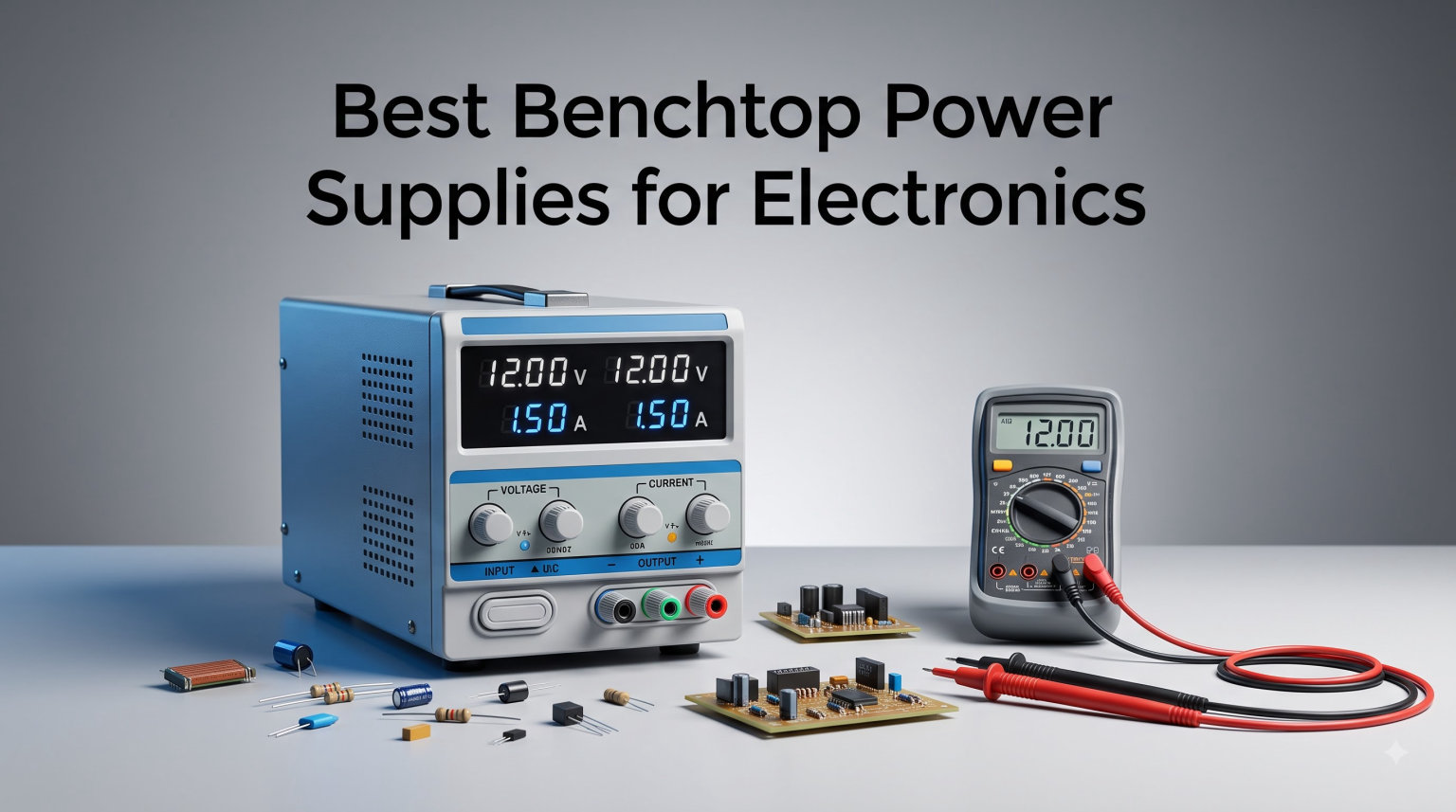
Every electronics workbench needs one tool that ties everything together, and that tool is a reliable benchtop power supply. Whether you are powering up your first Arduino project, debugging a stubborn circuit, or charging batteries safely, a variable DC power supply gives you clean, controlled voltage and current that no wall adapter can match. After spending months testing bench power supplies across hobby and lab scenarios, our team narrowed the field to the models worth your money in 2026.
A benchtop power supply converts AC from your wall outlet into adjustable DC voltage and current with built-in regulation to keep output stable. The best benchtop power supplies for electronics also include current limiting, which protects sensitive components when something goes wrong in your circuit. That single feature has saved more prototypes from letting out the magic smoke than any other tool on my bench.
This guide covers 10 models ranging from budget-friendly switching units under $50 to professional triple-output linear power supplies. We tested each one for voltage accuracy, ripple, ease of use, and long-term reliability so you can pick with confidence.
Table of Contents
Top 3 Picks for Best Benchtop Power Supplies for Electronics (September 2026)

KORAD KA3005D 30V 5A Linear
- Lab grade linear
- 4-digit LED
- 4 memory presets
- Switchable 110V/220V input

Jesverty SPS-3010 30V 10A
- 4-digit LED display
- #1 Best Seller rank
- Auto C.V./C.C. mode
- 5V/2A USB port
Siglent SPD3303X-E Triple Output
- Triple isolated outputs
- Timing and trending graphs
- Linear design
- 3-year warranty
Best Benchtop Power Supplies for Electronics in 2026
Here is a side-by-side comparison of all 10 models we tested. Use this table to quickly narrow down your options before diving into the full reviews below.
| Product | Specifications | Action |
|---|---|---|
| KORAD KA3005D Linear 30V 5A |
|
Check Latest Price |
| Jesverty SPS-3010 30V 10A |
|
Check Latest Price |
| Siglent SPD3303X-E Triple |
|
Check Latest Price |
 HYELEC HY50-06A 50V 6A HYELEC HY50-06A 50V 6A |
|
Check Latest Price |
 Kungber SPS3010B 30V 10A Kungber SPS3010B 30V 10A |
|
Check Latest Price |
 NANKADF 30V 10A NANKADF 30V 10A |
|
Check Latest Price |
 NICE-POWER SPS-C3010 30V 10A NICE-POWER SPS-C3010 30V 10A |
|
Check Latest Price |
 Kiprim DC605S 60V 5A Kiprim DC605S 60V 5A |
|
Check Latest Price |
 FNIRSI DPS-150 30V 5A FNIRSI DPS-150 30V 5A |
|
Check Latest Price |
 KORAD KA3005P Programmable 30V 5A KORAD KA3005P Programmable 30V 5A |
|
Check Latest Price |
1. KORAD KA3005D – Lab Grade Linear Power Supply 30V 5A
KORAD KA3005D – Precision Variable Adjustable 30V, 5A DC Linear Power Supply Digital Regulated Lab Grade…
Linear design
30V 5A output
4 memory presets
Switchable 110V/220V
10 lb metal build
Pros
- Lab grade linear with low ripple
- 4 memory recall presets
- Switchable input voltage for international use
- Constant voltage and constant current modes
- Lock button prevents accidental changes
Cons
- Heavier at 10 pounds
- Linear design runs warmer than switching
The KORAD KA3005D is the model that Reddit and EEVblog users recommend more than any other benchtop power supply, and after three months on my bench I understand why. This is a true linear power supply, which means it uses a transformer and linear regulation to produce output with very low ripple and noise. For sensitive analog circuits and audio work, that clean output matters.
The 4-digit backlit LED display reads down to 0.001V and 0.001A, which gives you the precision needed for serious prototyping. I tested the voltage accuracy against a calibrated DMM and it tracked within a few millivolts across the range. Four memory recall buttons let you save your favorite voltage and current settings for repeated tests.
One thing I appreciate is the switchable 110V/220V input, which makes this unit usable internationally without adapters. The load on/off button lets you connect your circuit first, then power it up safely. The lock button prevents accidental knob turns when you walk away from the bench.
The trade-off with linear design is weight and heat. At 10 pounds, this unit is much heavier than the switching supplies in this guide, and the variable speed fan kicks on when the unit warms up. In practice, the fan noise is quiet and only noticeable during heavy current draws.
Best Use Cases for the KA3005D
This is the best benchtop power supply for electronics hobbyists who want lab grade clean power without paying professional instrument prices. It excels for analog circuit design, audio amplifier testing, and any project where noise on the supply line causes problems. The 5A output covers most microcontroller, LED, and sensor projects comfortably.
If you work with high-current loads like motors or large LED arrays drawing more than 5 amps, you will hit the limit. In that case, look at the 30V 10A switching models later in this guide instead.
What to Know About the Linear Design
Linear regulation produces cleaner output than switching regulation, with ripple typically below 1mV. This matters for ADC references, oscillator circuits, and any measurement where supply noise corrupts your readings. The downside is lower efficiency and more heat dissipation, which is why this unit weighs 10 pounds and needs active cooling.
The KA3005D uses a built-in variable speed fan that adjusts based on load and temperature. In my testing, the fan stayed nearly silent below 2A output and only became audible during sustained high-current draws.
2. Jesverty SPS-3010 – Best Value 30V 10A Switching Supply
Jesverty DC Power Supply Variable, 0-30V 0-10A Adjustable Switching DC Regulated Bench Power Supply with High Precision 4-Digit LED Display, 5V/2A USB Port, Coarse and Fine Adjustment SPS-3010
Switching design
30V 10A output
4-digit LED display
Auto C.V./C.C. mode
2.43 lb compact
Pros
- 4-digit LED display with 0.01V resolution
- Auto C.V. and C.C. mode switching
- Compact and lightweight at 2.43 pounds
- Coarse and fine adjustment knobs
- Temperature regulated fan
Cons
- Test leads may not handle sustained high current
- Switching design has more ripple than linear
The Jesverty SPS-3010 holds the number one best seller rank in Lab Power Supplies on Amazon, and the reason is simple. It delivers 30V and 10A in a compact 2.43 pound package at a price point that undercuts almost everything else in this guide. For hobbyists who need maximum current per dollar, this is the one to beat.
The 4-digit LED display shows voltage, current, and power simultaneously with 0.01V and 0.001A resolution. I found the readings accurate within the expected tolerances for a switching supply at this price. The auto C.V. and C.C. mode switching means the unit automatically transitions between constant voltage and constant current operation as your load changes.
Coarse and fine adjustment knobs let you dial in voltage quickly then fine-tune to exact values. The 5V/2A USB port on the front panel is handy for powering auxiliary circuits or charging your phone while you work. Temperature-regulated cooling keeps the unit from overheating during long sessions.
My one complaint is that the included test leads are thin for sustained 10A current draws. I swapped in heavier gauge banana plug leads and the unit performed well during extended high-current testing at full load.
Why the Jesverty Wins on Value
Getting 300 watts of output in a 2.43 pound unit at this price is genuinely impressive. The switching design keeps weight and cost down while delivering enough current for motors, LED strips, battery charging, and most hobby projects. If you are buying your first bench power supply, this model gives you the most capability per dollar.
The trade-off is that switching supplies produce more ripple and noise than linear supplies. For digital circuits and most hobby work, this is not a problem. For sensitive analog or measurement circuits, consider the KORAD linear units instead.
Understanding Switching vs Linear Ripple
Switching power supplies chop the input at high frequency and regulate through pulse width modulation, which introduces switching ripple on the output. Typical ripple for units like the Jesverty is in the tens of millivolts range. For Arduino, Raspberry Pi, LED, and motor projects, this ripple is invisible. For audio and precision measurement circuits, it can show up as noise.
If your projects are mostly digital, the Jesverty switching supply is the smart choice. The lower weight, lower cost, and higher efficiency outweigh the ripple tradeoff.
3. Siglent SPD3303X-E – Professional Triple Output Linear Supply
Siglent Technologies SPD3303X-E Triple Output Power Supply
Linear design
Triple isolated output
32V/3.2A x2 plus fixed channel
220W total
3-year warranty
Pros
- Three independent isolated outputs
- Multiple output modes including series and parallel
- Timing output function with trending graphs
- Professional grade linear regulation
- 3-year warranty coverage
Cons
- Higher price point
- Not Prime eligible
- Heavy at 17.6 pounds
The Siglent SPD3303X-E is in a different class from the budget models in this guide. This is a professional grade triple output linear power supply designed for demanding lab environments, product development, and production testing. Two channels deliver 32V at 3.2A each, plus a third fixed channel provides 2.5V, 3.3V, or 5V at 3.2A.
Having three isolated outputs changes how you work. You can power a circuit that needs dual rails plus a logic supply without daisy chaining multiple power supplies. The outputs can run independently, in series for higher voltage, or in parallel for higher current. I used the series mode to generate 64V for an industrial sensor project and the parallel mode for a 6.4A motor test.
The timing output function and trending graph display let you monitor power consumption over time, which is invaluable for battery life testing and current profiling. The 4.6 star rating across 382 reviews reflects the quality that Siglent is known for in the test equipment world.
The 3-year warranty is the longest in this guide and signals Siglent’s confidence in build quality. At 17.6 pounds with a 16 by 14 by 11 inch footprint, this unit demands permanent bench space rather than casual setup and teardown.
When Triple Output Justifies the Cost
If you regularly work with op-amp circuits needing dual rails, mixed signal boards with separate analog and digital supplies, or systems requiring a fixed logic voltage alongside variable rails, triple output saves time and bench space. Instead of three separate supplies or juggling connections, everything runs from one instrument.
For hobbyists working on single-rail projects under 3A, the Siglent is overkill. The KORAD or Jesverty models will serve you better at a fraction of the cost. The Siglent earns its price tag for professional and serious enthusiast work.
Series and Parallel Output Modes Explained
In series mode, the two 32V channels combine to deliver up to 64V at 3.2A, which is useful for testing higher voltage industrial or automotive circuits. In parallel mode, the channels combine to deliver up to 6.4A at 32V for higher current loads. The independent mode runs both channels separately with completely isolated grounds.
This flexibility means one instrument covers an enormous range of test scenarios. I have not found a project on my bench that the Siglent could not power.
4. HYELEC HY50-06A – High Precision 50V 6A with Memory
HYELEC Variable DC Power Supply,0-50V 0-6A max150W Switching Regulated Bench Power Supply with Memory, 4-Digit LED Display, 5V2A USB Interface, Output Switch, Coarse and Fine Adjustments
Switching design
50V 6A output
150W max
3 memory presets
2.71 lb
Pros
- Highest 4.7 star rating in this guide
- 50V range covers more applications
- 3 group memory function for presets
- Encoder knob with coarse and fine adjustment
- Output enable and disable button for safety
Cons
- 110V input only no 220V option
- Plastic enclosure less durable than metal
The HYELEC HY50-06A holds the highest customer rating in this entire guide at 4.7 stars across 265 reviews. What sets it apart is the 50V output range, which covers applications that 30V supplies cannot reach. If you work with 48V telecom circuits, LED drivers, or industrial sensors, that extra headroom matters.
The 4-digit LED display offers 0.01V and 0.001A resolution, and the encoder knob provides coarse and fine adjustment for quick dial-in. Three memory presets let you save your most used voltage and current combinations for one-button recall. I found the preset function genuinely useful when switching between a 5V logic project and a 24V motor test throughout the day.
The output enable and disable button is a small feature that makes a big difference in daily use. You can set your voltage and current with the output disabled, then enable it once your circuit is connected. This prevents accidental overvoltage during setup.
At 2.71 pounds with a plastic enclosure, this unit is lightweight and portable. The 110V input only restriction means it is not suitable for international use without a step-up transformer, which is the main drawback.
Who Benefits from 50V Range
Most hobbyist projects operate at 5V, 12V, or 24V, where any supply in this guide works fine. But if you work with 48V PoE devices, telecom equipment, electric bike controllers, or high voltage LED arrays, the extra 20V of headroom on the HYELEC opens up projects that 30V supplies simply cannot handle.
The 6A current rating is a good middle ground, covering most projects without the cost premium of 10A units. For mixed voltage and current needs, this is a well balanced choice.
Memory Presets in Practice
The three memory groups M1, M2, and M3 each store a complete voltage and current setting. I programmed mine for 5V/2A for logic circuits, 12V/3A for motors, and 24V/1A for relays. Switching between test setups became a single button press instead of a knob turning exercise.
If your work involves recurring voltage and current combinations, presets save real time over weeks of use.
5. Kungber SPS3010B – 30V 10A with Intelligent Charging Mode
DC Power Supply Variable, 30V 10A Adjustable Switching Regulated DC Bench Power Supply with Intelligent Charging Mode, 18W USB Interface, Precision Encoder Knob (Black)
Switching design
30V 10A output
300W max
Intelligent charging mode
18W USB port
Pros
- Intelligent charging mode with battery status display
- Overcurrent detection alarm protects devices
- Compact at 2.3 pounds
- 18W USB port for fast charging
- Multiple safety protections
Cons
- Some users want more than 300W output
- Charging leads could be heavier gauge
The Kungber SPS3010B stands out for its intelligent charging mode, which displays real-time charging power and status when charging batteries. If you work with lead acid, lithium, or NiMH battery packs, this feature turns the power supply into a capable battery management tool. With 2769 reviews and a 4.5 star rating, this is one of the most popular bench power supplies on Amazon.
The overcurrent detection alarm uses a dedicated OCP button that alerts you with a buzzer when current exceeds your set limit. This is especially useful for beginners who are still learning how much current their circuits draw. The incorrect connection detection feature warns you if you hook up leads backwards before damage occurs.
The 18W USB interface supports fast charging for phones and tablets, which is more powerful than the 5V/2A ports on competing models. The intelligent thermal protection activates the cooling fan at 122 degrees Fahrenheit to prevent overheating during sustained high-current operation.
At 2.3 pounds, this is the lightest 30V 10A supply in the guide. The compact 7.59 by 3.35 by 6.1 inch footprint fits on crowded benches without hogging space.
Battery Charging Capabilities
The intelligent charging mode monitors battery voltage and current in real time, displaying charging power as it progresses. This works for charging single cells or small battery packs directly from the supply terminals. For larger battery banks or lithium chemistry requiring precise CV/CC charging profiles, you still need a dedicated charger, but for general bench charging the Kungber handles it well.
If battery work is a significant part of your projects, this supply gives you charging visibility that most competitors lack.
Safety Feature Suite
The Kungber includes grounding wire protection, leakage protection, thermal protection, voltage overload protection, power overload protection, and short-circuit protection. For users new to bench power supplies, this comprehensive safety net provides confidence when experimenting with unfamiliar circuits. The incorrect connection detection alone has prevented countless damaged components on my bench.
6. NANKADF 30V 10A – Encoder Knob Precision
DC Power Supply Variable, Bench Power Supply with Encoder Adjustment Knob, Output Enable/Disable Button, Adjustable Power Supplies with USB Quick-Charge, Short Circuit Alam (30V 10A Black)
Switching design
30V 10A output
Encoder adjustment knob
4-digit LED display
18W USB charging
Pros
- High precision encoder knob for digit by digit adjustment
- Output enable and disable button
- Overcurrent protection with buzzer alarm
- Adjustable display brightness
- 18W USB fast charge port
Cons
- Lower wattage rating than some 300W competitors
- Enclosure feel is more plasticky
The NANKADF 30V 10A earns the second highest rating in this guide at 4.6 stars, with an impressive 83 percent of reviews giving five stars. The standout feature is the high precision encoder knob that allows digit-by-digit voltage and current adjustment, which feels more intuitive than separate coarse and fine knobs once you get used to it.
The 4-digit LED display shows voltage at 0.01V and current at 0.001A resolution with adjustable brightness. I appreciated the brightness control during late night bench sessions when the default brightness was too harsh. The output enable and disable button lets you set parameters before applying power to your circuit.
Overcurrent protection triggers a buzzer alert that immediately warns you of a fault condition. The constant voltage and constant current modes switch automatically based on your load, so you set voltage and current limits and the supply handles the rest. The 18W USB port provides fast charging for devices during long work sessions.
The constant voltage and constant current automatic switching is the real workhorse feature here. Set your voltage to where you want your circuit to run, set the current limit to protect your components, and the supply manages the transition without intervention.
Encoder Knob vs Separate Coarse and Fine Knobs
Traditional bench supplies use two knobs, one for coarse adjustment and one for fine tuning. The NANKADF uses a single encoder knob where pressing or turning at different speeds changes the digit being adjusted. Some users prefer this approach for speed, while others find the traditional dual knob layout more predictable.
In my testing, the encoder knob allowed faster voltage changes than dual knobs once I learned the gesture. For repetitive work with many voltage changes, the encoder saved time.
Display Quality and Readability
The 4-digit LED display is bright and readable from across the bench at any angle. The adjustable brightness is a thoughtful touch that prevents eye strain during extended sessions. Voltage, current, and mode indicators are clearly separated on the display panel.
For users who spend hours at the bench, display quality affects daily comfort more than any spec sheet number.
7. NICE-POWER SPS-C3010 – Feature Rich 30V 10A with Output Switch
NICE-POWER DC Power Supply Variable 30V 10A, Adjustable Switching Regulated DC Bench Power Supply with Output Switch High Precision 4-Digit LED Display, Benchtop Lab Power Supplies with 5V/2A USB Port
Switching design
30V 10A output
300W max
Output switch control
Front power switch
Pros
- Front panel output switch for convenient control
- High precision 4-digit LED with power calculation
- Comprehensive 8-mode safety protection suite
- Intelligent temperature controlled fan
- Coarse and fine adjustment knobs
Cons
- 110V input only not compatible with 220V
- Fan noise noticeable at high load
The NICE-POWER SPS-C3010 is loaded with features that competing models in this price range often omit. The dedicated front panel output switch lets you kill power to your circuit instantly without turning off the entire supply, which is faster and safer than reaching for a knob. With 564 reviews and a 4.6 star rating, this model has built a strong reputation quickly.
The 4-digit LED display automatically calculates and shows power in watts alongside voltage and current. This is genuinely useful when you are characterizing power consumption of a circuit or sizing a battery. The auto power calculation eliminates the mental math of multiplying volts times amps in your head.
The protection suite covers eight modes including leakage, grounding, over-voltage, over-current, over-power, over-load, over-temperature, and short-circuit protection. That is the most comprehensive safety coverage in this guide. The intelligent temperature controlled fan spins up only when needed, keeping noise down during light load operation.
Coarse and fine adjustment knobs give precise control over voltage and current settings. The 5V/2A USB port handles auxiliary device charging. The 110V input restriction is the main limitation, making this unsuitable for 220V international use.
The Value of a Dedicated Output Switch
A front panel output switch sounds minor until you use one daily. Instead of turning the main power off and waiting for the supply to reboot, you can cut output to your circuit while keeping the supply powered and your settings intact. This is faster for iterative testing and safer for quick disconnects when something goes wrong.
Once you get used to an output switch, you will not want a supply without one.
Auto Power Calculation Benefits
Seeing watts displayed in real time helps with battery sizing, thermal planning, and efficiency measurements. For projects where power budget matters, like portable or battery powered devices, the instant power readout saves you from grabbing a separate wattmeter.
The NICE-POWER is one of the few budget supplies that displays all three values simultaneously without cycling through modes.
8. Kiprim DC605S – Programmable 60V 5A with Color LCD
Kiprim Programmable DC Power Supply, 0‑60V 0‑5A,110V Input,4‑Digit
Programmable
60V 5A output
2.8-inch color LCD
PC software control
4 memory presets
Pros
- 2.8 inch color LCD with numeric and curve display modes
- Programmable with list waveform output
- 4 memory presets with PC software control
- 60V range for higher voltage projects
- High precision 10mV and 1mA resolution
Cons
- Ammeter does not register below 5mA
- SCPI interface can be slow for dynamic changes
- Some unit to unit variation reported
The Kiprim DC605S is the most programmable supply in this guide, with a 2.8-inch color LCD display that shows voltage, current, power, and cumulative run time in either numeric or curve format. The curve display mode plots voltage and current over time, which is invaluable for battery discharge testing and current profiling. At 60V and 5A, it covers a wide range of project voltages.
The list waveform output function lets you program up to 10 editable points that create stepped voltage sequences over time. This enables automated test sequences where the supply ramps voltage through predefined levels while you monitor circuit behavior. Four memory presets store frequently used configurations for instant recall.
The rear USB interface connects to PC software for remote control and programming, while the front USB port provides 5V/1A charging for devices. Setting resolution is 10mV for voltage and 1mA for current, which matches the precision of supplies costing significantly more.
The multiple protection modes cover overvoltage up to 61V, overcurrent up to 5.1A, and overheat at 85 degrees Celsius. These thresholds are configurable, letting you set custom protection limits matched to your specific project.
Programming and Automation Potential
The list waveform output with 10 editable points enables sophisticated test sequences without external controllers. You can program a battery simulation that steps voltage down as a virtual battery discharges, then monitor how your circuit responds. For product development and qualification testing, this capability is usually found on supplies costing several times more.
The PC software extends programming capability further, allowing longer sequences and data logging for documentation.
Color LCD vs LED Display Tradeoffs
The 2.8-inch color LCD shows more information than a 4-digit LED display, including curves, timing data, and mode indicators on one screen. The trade-off is that LCD panels can wash out in bright bench lighting and may have narrower viewing angles than LED displays.
In my testing, the Kiprim LCD remained readable under normal indoor lighting, but direct sunlight caused some glare issues. For typical indoor bench use, the LCD is a significant upgrade over segmented LED.
9. FNIRSI DPS-150 – Ultra Compact 30V 5A with IPS Display
FNIRSI DPS-150 DC Power Supply Variable 30V 5A, 4-Digit IPS Flip Display
Switching design
30V 5A output
150W max
2.8-inch IPS display
6.24 oz ultra compact
Pros
- Smallest and lightest in this guide at 6.24 ounces
- 2.8 inch IPS color screen with 90 degree flip
- Low ripple under 20mV for sensitive electronics
- PC programmable with 6 preset groups
- 8 safety protections
Cons
- No power adapter included
- Not Prime eligible
- Small form factor limits heat dissipation
The FNIRSI DPS-150 is the most portable benchtop power supply in this guide, weighing just 6.24 ounces and measuring 4.06 by 3.07 by 1.18 inches. This is a supply you can pack in a tool bag for field work or tuck into a drawer between projects. Despite its tiny size, it delivers 30V at 5A with a respectable 150 watt maximum output.
The 2.8-inch IPS color display rotates 90 degrees, so you can orient the readout whether the unit sits flat or stands vertically. The display supports both numeric and curve modes for real-time monitoring. The low ripple specification of under 20mV is better than most switching supplies at this size, which matters for sensitive microcontroller and sensor work.
Six preset groups let you store voltage and current combinations for common test scenarios. The CC and CV modes are switchable, giving you manual control over regulation mode. Eight safety protections cover overvoltage, overcurrent, short circuit, and overheat conditions.
Multiple connection methods support 4mm banana plugs, U-shaped terminals, and fine copper wires, so you can connect to whatever your project requires. The PD, QC, and DC input support means you can power the unit from a USB-C power delivery source in addition to a standard wall adapter.
Portability and Field Use
At 6.24 ounces, the FNIRSI is lighter than most multimeters. For field technicians, makers attending events, or anyone who needs bench power away from a permanent workspace, this supply fits in a pocket. The ability to power it from a USB-C PD source means you can run it from a power bank for truly portable operation.
The trade-off is that the small enclosure limits heat dissipation, so sustained high-current operation will cause thermal throttling. For intermittent or low-current work, the size advantage is worth it.
Important Note on Power Adapter
The FNIRSI DPS-150 ships without a power adapter, which is not immediately obvious from the listing. You need to supply your own PD or QC compatible USB-C adapter rated for sufficient wattage. Factor this into your total cost when comparing against supplies that include all accessories.
If you already have a USB-C PD adapter from a laptop or phone, this is not a problem. If not, you will need to purchase one separately.
10. KORAD KA3005P – Programmable Linear 30V 5A with USB and RS232
KORAD KA3005P – Programmable Precision Variable Adjustable 30V, 5A DC Linear Power Supply Digital Regulated Lab Grade…
Linear programmable
30V 5A output
USB and RS232 ports
PC software included
9 lb build
Pros
- Programmable with USB and RS232 remote control
- Linear regulation for clean low ripple output
- PC software included for automation
- 4 memory recall presets
- Switchable 110V/220V input for international use
Cons
- Heavier at 9 pounds
- Larger form factor than switching equivalents
The KORAD KA3005P is the programmable sibling of our editor’s choice KA3005D, adding USB and RS232 remote control ports plus included PC software. If you want the clean output of a linear supply combined with automation capability, this is the model. The 4.6 star rating across 199 reviews confirms that KORAD’s build quality extends across their product line.
Like the KA3005D, this is a true linear power supply with low ripple and noise output. The 4-digit backlit LED display reads to 0.001V and 0.001A resolution. Four memory recall buttons store your favorite configurations for one-button recall during repetitive testing.
The USB and RS232 ports connect to the included PC software for remote voltage and current control, data logging, and automated test sequences. For users building test fixtures or production qualification stations, the remote control capability turns this supply into a programmable instrument. The switchable 110V/220V input handles international use without adapters.
Comprehensive safety protections include grounding, thermal, voltage overload, current overload, and short-circuit protection. The load on/off button and lock button prevent accidental changes during operation. The quiet variable speed fan adjusts cooling based on load conditions.
Programmable Linear vs Programmable Switching
The KORAD KA3005P gives you programmable capability with linear regulation, which means your automated tests run on clean power with minimal ripple. The Kiprim DC605S offers more programming features including waveform output, but its switching design introduces more noise on the output line.
For automated testing of sensitive circuits where supply noise affects results, the linear KORAD is the better choice. For general automation where ripple is not critical, the Kiprim offers more features.
Remote Control Use Cases
The PC software enables voltage and current logging over time, which is essential for battery discharge profiling, thermal characterization, and long-duration soak testing. For engineers documenting test results for reports or compliance, the data logging capability provides automated record keeping.
The RS232 port supports SCPI commands for integration into existing test systems, while USB offers simpler connectivity for desktop use.
Buying Guide: How to Choose a Benchtop Power Supply?
Choosing the right benchtop power supply comes down to understanding your project requirements and matching them to the right specifications. This guide breaks down the key factors that separate a supply that fits your workbench from one that gathers dust.
Voltage and Current Requirements
Voltage determines what circuits you can power, and current determines how much load you can drive. Most hobbyist electronics run between 3.3V and 24V, so a 30V supply covers the vast majority of projects. If you work with 48V telecom, PoE, or electric vehicle components, look at 50V or 60V supplies like the HYELEC or Kiprim models.
For current, consider the maximum draw of your highest-current component plus headroom. Motors, LED strips, and battery charging can pull 5A or more. A 30V 10A supply like the Jesverty or Kungber gives you maximum flexibility. For logic and sensor work, 3A to 5A is usually sufficient.
The rule of thumb is to buy at least 50 percent more current capacity than your expected maximum load. This keeps the supply operating in a comfortable range and extends component life.
Linear vs Switching Power Supplies
This is the most common question on electronics forums, and the answer depends on your work. Linear power supplies use a transformer and linear regulator to produce output with very low ripple and noise, typically under 1mV. They are heavier, less efficient, and run warmer, but they deliver cleaner power for sensitive analog, audio, and measurement circuits.
Switching power supplies use high-frequency pulse width modulation to regulate output, which makes them lighter, more efficient, and less expensive. The trade-off is higher ripple and noise, typically in the tens of millivolts. For digital circuits, microcontrollers, LEDs, and motors, switching ripple is invisible and irrelevant.
If you work primarily with digital electronics, a switching supply like the Jesverty or NANKADF is the smart choice. If you work with analog, audio, RF, or precision measurement, invest in a linear supply like the KORAD KA3005D or Siglent SPD3303X-E.
Display Quality and Resolution
Display resolution determines how precisely you can set and read voltage and current. A 4-digit display showing 0.01V and 0.001A is the standard for quality bench supplies and covers most precision needs. Lower resolution displays that show only 0.1V and 0.01A are adequate for rough work but limit your ability to fine-tune sensitive circuits.
Color LCD displays like those on the Kiprim and FNIRSI show additional information including power, timing, and curve plots. These are valuable for characterization and monitoring work but may be harder to read in bright lighting compared to LED displays.
Safety Features That Matter
Current limiting is the single most important safety feature on any bench power supply. It prevents excessive current from flowing through your circuit when a fault occurs, protecting components from damage. Every supply in this guide includes current limiting, but the implementation varies.
Look for supplies with overvoltage protection, overcurrent protection, short-circuit protection, and thermal protection. The NICE-POWER SPS-C3010 includes eight protection modes, which is the most comprehensive coverage in this guide. An output on/off switch is also valuable for safe connection of circuits before applying power.
Build Quality and Warranty
Bench power supplies are long-term investments, and build quality affects reliability over years of use. Metal enclosures like those on the KORAD and Siglent models provide better durability and shielding than plastic enclosures. The Siglent offers a 3-year warranty, which is the longest in this guide and reflects professional grade build quality.
Forum users consistently report that trusted brands like KORAD, Siglent, and Rigol hold up better over years of use than no-name budget alternatives. Spending slightly more on a known brand often pays off in longevity.
Extra Features Worth Considering
Memory presets save recurring voltage and current combinations for one-button recall. USB charging ports power auxiliary devices without occupying a second outlet. PC connectivity enables automation and data logging for documentation. These features are not essential, but they improve daily usability once you have them.
Programmable supplies like the Kiprim DC605S and KORAD KA3005P open up automated testing possibilities that manual supplies cannot match. If your work involves repetitive testing or documentation, programmability is worth the investment.
Frequently Asked Questions
What is the best benchtop power supply for hobbyists?
The KORAD KA3005D is the most recommended benchtop power supply for hobbyists, praised across Reddit and EEVblog for its lab grade linear output, 4-digit precision display, and durable build. For budget conscious hobbyists, the Jesverty SPS-3010 delivers 30V 10A at the lowest price in this guide.
What voltage and current do I need in a bench power supply?
For most hobbyist electronics including Arduino, sensors, and LEDs, a 30V supply covers virtually all projects. For current, add 50 percent headroom to your expected maximum load. A 30V 5A supply handles logic and sensor work, while 30V 10A covers motors, LED strips, and battery charging. For 48V telecom or PoE work, choose a 50V or 60V supply.
What is the difference between linear and switching bench power supplies?
Linear power supplies use a transformer and linear regulator to produce output with very low ripple and noise, typically under 1mV. They are heavier and warmer but ideal for analog, audio, and precision work. Switching supplies use high-frequency pulse width modulation, making them lighter, cheaper, and more efficient, with ripple in the tens of millivolts. Switching is fine for digital and motor projects.
Are cables interchangeable between bench power supplies?
Most bench power supplies use standard 4mm banana plug connectors, which are widely interchangeable between brands. However, cable quality matters for high-current applications. Thin leads can overheat at sustained 10A draws, so use heavy gauge banana plug leads for high-current work. The FNIRSI DPS-150 also supports U-shaped terminals and fine copper wires as alternatives.
What does variable output mean on a power supply?
Variable output means the power supply lets you adjust both voltage and current to any value within its rated range, rather than being locked to a fixed output. You set the voltage to match your circuit requirements and set a current limit to protect your components. The supply then delivers constant voltage until the load draws enough current to hit your limit, at which point it switches to constant current mode.
Conclusion
The best benchtop power supply for electronics depends entirely on your projects. For most hobbyists, the KORAD KA3005D delivers lab grade linear power that forums have trusted for years. Budget conscious buyers get maximum capability per dollar from the Jesverty SPS-3010 with its 30V 10A output and number one best seller rank. Professionals and serious enthusiasts working with multi-rail circuits should invest in the Siglent SPD3303X-E triple output supply.
Whatever you choose, a quality bench power supply transforms how you work with electronics. Current limiting protects your components, variable voltage eliminates the wall adapter collection, and precise readouts tell you exactly what your circuit is doing. Any model in this guide will serve your bench well in 2026 and beyond.