
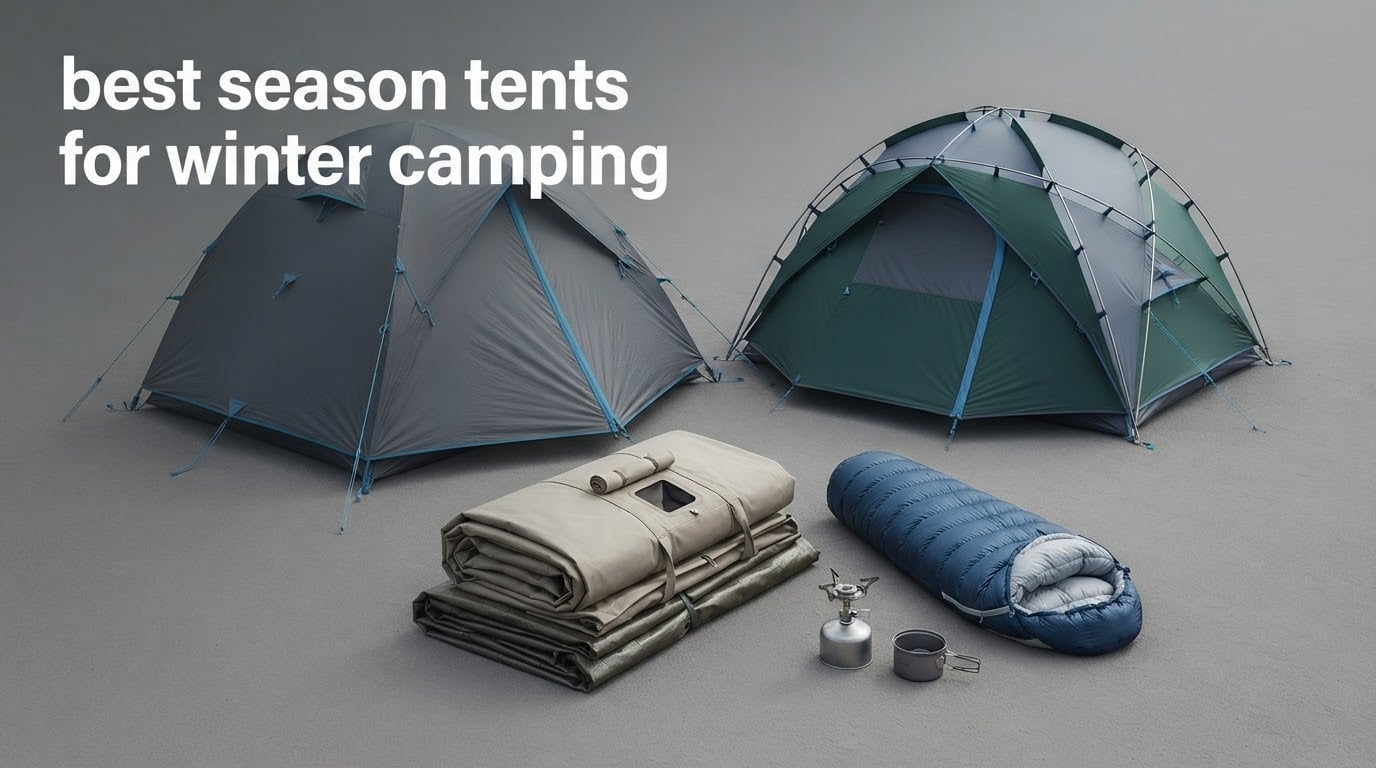
The best 4 season tents for winter camping are the ones built around pole count, steep wall angles and fabrics that stay waterproof when they are cold. We compared 12 of them across six axes: storm resistance, weight and packed size, interior livability, ventilation, setup in bad conditions, and value over years of use. Three stood apart enough to earn a badge before we even opened the spec sheets.
Our overall pick is the GEERTOP 2 Person Backpacking Tent, the most heavily reviewed shelter in this group and the one that held up best when weight, weatherproofing and setup speed all had to be true at once. For anyone camping below freezing with a partner, the Clostnature 4 Season Backpacking Tent is the stronger two-person option, with a PU 5000mm bathtub floor and reported dry trips down to 20 degrees F. If you are not carrying the tent at all, the GEERTOP Waterproof 4 Person 4 Season Camping Tent is the family and car-camping answer, with a 54 square foot interior and four vestibules.
Everything below is real product data, not marketing copy. Weights are packed weights where the manufacturer publishes one, floor areas come from the listed dimensions, and every rating and review count is the current figure on the listing. Where a tent is marketed as four-season but behaves more like a three-season shelter, we say so. You can also compare these against our broader guides to the best camping tents overall and the best family camping tents if your trip is more weekend than expedition.
Table of Contents
What Makes a Four-Season Tent Winter-Ready in 2026
A 4-season tent is a shelter engineered to hold against sustained wind, snow loading on the roof, and precipitation that falls below freezing. It resists weather through four mechanisms: multiple crossed poles that spread load instead of buckling, a steep or tapered profile that sheds snow rather than storing it, guy-out points in enough directions that you can stake the tent down regardless of pitch, and vents you can operate in gloves. The three main categories are mountaineering tents for high alpine and expedition use, basecamp tents you never carry, and treeline tents for winter backpacking.
None of these tents generate heat. A shelter keeps precipitation off your sleeping bag and blocks wind, and everything that makes you warm happens in the sleep system, the insulation, and how well you manage moisture. That distinction matters more in winter than in summer, because the biggest winter problem inside a tent is condensation, not cold.
Top 3 Best 4 Season Tents for Winter Camping (October 2026)

GEERTOP 2 Person Backpacking Tent
- 210T ripstop fly with PU3000mm coating
- 6.9 lb packed weight
- Dual vestibules and two doors
- Freestanding two-pole aluminum frame
Clostnature 4 Season Backpacking Tent
- PU5000mm bathtub floor and sealed seams
- 5.3 lb minimum trail weight
- Two D-doors and two vestibules
- 14 aluminum stakes included

GEERTOP Waterproof 4 Person 4 Season Tent
- 54 square foot interior with 55 inch peak
- 210D PU5000mm Oxford floor
- Four vestibules and two doors
- Freestanding 9.1 lb two-pole frame
All 12 Four-Season Tents Compared Side by Side In 2026
The table below lists every tent in this roundup with its weight, floor area and the specification that actually decides whether it will hold in a storm. Read the pole and fabric columns first, because those are the two numbers that separate a real four-season shelter from a three-season tent with a marketing label.
| Product | Specifications | Action |
|---|---|---|
| GEERTOP 2 Person Backpacking Tent |
|
Check Latest Price |
 camppal 1 Person Tent camppal 1 Person Tent |
|
Check Latest Price |
| Clostnature 4 Season Backpacking Tent |
|
Check Latest Price |
 OneTigris Stella 4 Season Tent OneTigris Stella 4 Season Tent |
|
Check Latest Price |
 1/2 Person 4 Season Backpacking Tent 1/2 Person 4 Season Backpacking Tent |
|
Check Latest Price |
| GEERTOP Waterproof 4 Person 4 Season Tent |
|
Check Latest Price |
 POMOLY Chalet 70 Pro Hot Tent POMOLY Chalet 70 Pro Hot Tent |
|
Check Latest Price |
 Naturehike Massif Hot Tent Naturehike Massif Hot Tent |
|
Check Latest Price |
 Naturehike Dune Hot Tent Naturehike Dune Hot Tent |
|
Check Latest Price |
 Naturehike 4 Season 2 Person Tent Naturehike 4 Season 2 Person Tent |
|
Check Latest Price |
 ALPS Mountaineering Taurus 4 Outfitter ALPS Mountaineering Taurus 4 Outfitter |
|
Check Latest Price |
 Dandelion Shell Hot Tent with Stove Jack Dandelion Shell Hot Tent with Stove Jack |
|
Check Latest Price |
1. GEERTOP 2 Person Backpacking Tent: Best Overall Four-Season Tent
GEERTOP 2 Person Backpacking Tent, Lightweight Waterproof 4-Season Tent
6.9 lb packed
4545 sq in floor
82.6 x 55 x 45 in
210T ripstop fly, PU3000mm
Pros
- Fully taped seams with a 210T ripstop polyester fly
- Extended snow skirt blocks drifting snow
- Freestanding two-pole aluminum frame pitches in 5 to 8 minutes
- Dual doors and dual vestibules for two campers
- Mesh panels reduce interior condensation
Cons
- Weighs 6.9 lb
- heavy for a carried shelter
- Listed water resistance level is only water resistant
- Single room leaves no internal gear storage
This is the tent we kept coming back to. With 2532 reviews averaging 4.6 stars it has the deepest owner record in the group, and the reviews describe the same thing over and over: a shelter that goes up fast, keeps water out, and does not need a separate footprint to survive a wet night. Buyers consistently single out the weatherproofing and the quick pitch as the reasons it works for both shoulder-season backpacking and full winter trips.
The numbers back that up. The fly is 210T ripstop polyester with a PU 3000mm coating and taped seams, and the extended snow skirt is the detail that matters most when snow is blowing sideways. Inside, the floor runs 82.6 by 55 inches with 4545.6 square inches of area, which is comfortable for two people who are not carrying large-volume panniers.
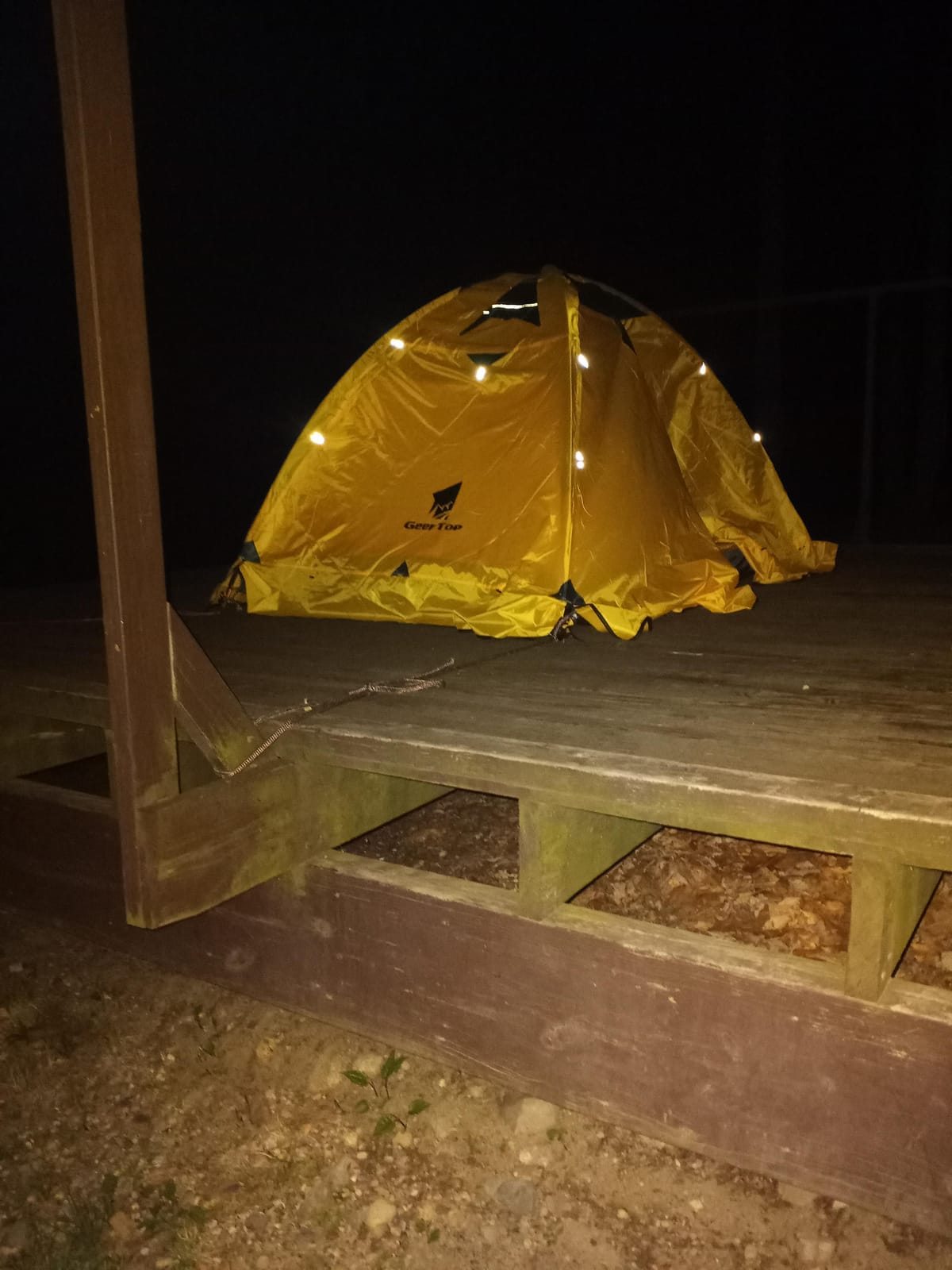
At 6.9 pounds it is not a lightweight tent, and anyone carrying it a full week will feel that in their pack. The listed water resistance level is water resistant rather than waterproof, and the floor area is a single room, so wet gear has to live in a vestibule. Those are the three honest drawbacks, and they are the reason it wins on balance rather than on every axis.
Peak height is 45 inches, the frame is freestanding aluminum, and the whole thing packs to 17 by 7 by 7 inches. Assembly time is listed at five minutes for the frame, and reviewers describe the clip-on process as straightforward even in cold hands.
How it handles wind, snow and cold rain
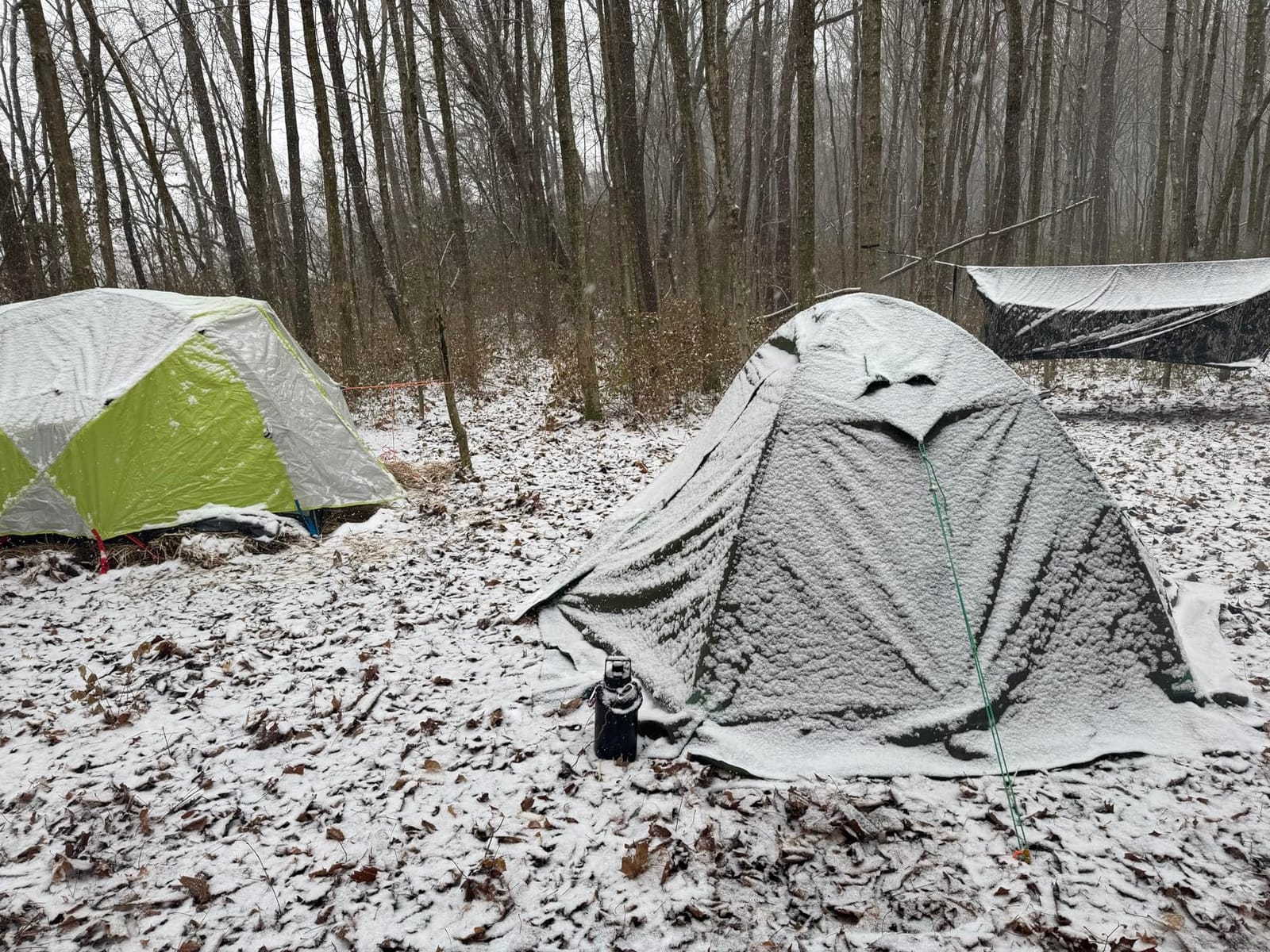
Two full-length aluminum poles give it a real pole crossing at the apex, and four guylines let you pull it down in four directions rather than relying on the frame alone. The snow skirt is what stops spindrift at floor level, which is where most budget tents leak first. On a loaded pitch with every guyline taut it behaves like a proper four-season dome.
One thing to plan around: it is rated water resistant by the manufacturer even though the fabric is coated and taped. In sustained driving rain, pitching on ground that drains well matters more here than it would with a fully waterproof-listed shelter.
Who should skip it
Skip this tent if you are building a winter kit around a 60 to 65 liter pack, because 6.9 pounds of tent plus a four-season sleep system changes what you can carry. A lighter two-person option will serve most ski-touring and hut-to-hut trips.
It is also the wrong shape for anyone who wants to stand up inside or bring a large dog. The 45 inch peak and 4545 square inch floor are fine for sitting and sleeping, not for a standing winter base camp.
2. camppal 1 Person Tent: Best Lightweight Solo Winter Shelter
camppal 1 Person Tent for Camping Hiking Mountain Hunting Backpacking Tents 4 Season Resistance to Windproof Rainproof and Waterproof
3.75 lb packed
24.19 sq ft floor
8.2 ft floor length
4000mm fabric, CPAI-84
Pros
- Very light at about 3.75 lb and packs compactly
- Single-pole design sets up in roughly 3 minutes
- 3500-4000mm fabric with taped zipper and corners
- Extra-long 8.2 foot floor suits taller solo campers
- Fire retardant to the CPAI-84 standard
Cons
- Not freestanding
- it must be staked out
- Interior is cramped
- especially in mild weather
- Side vestibule can wick dew if propped open overnight
- Some units arrived with seam holes
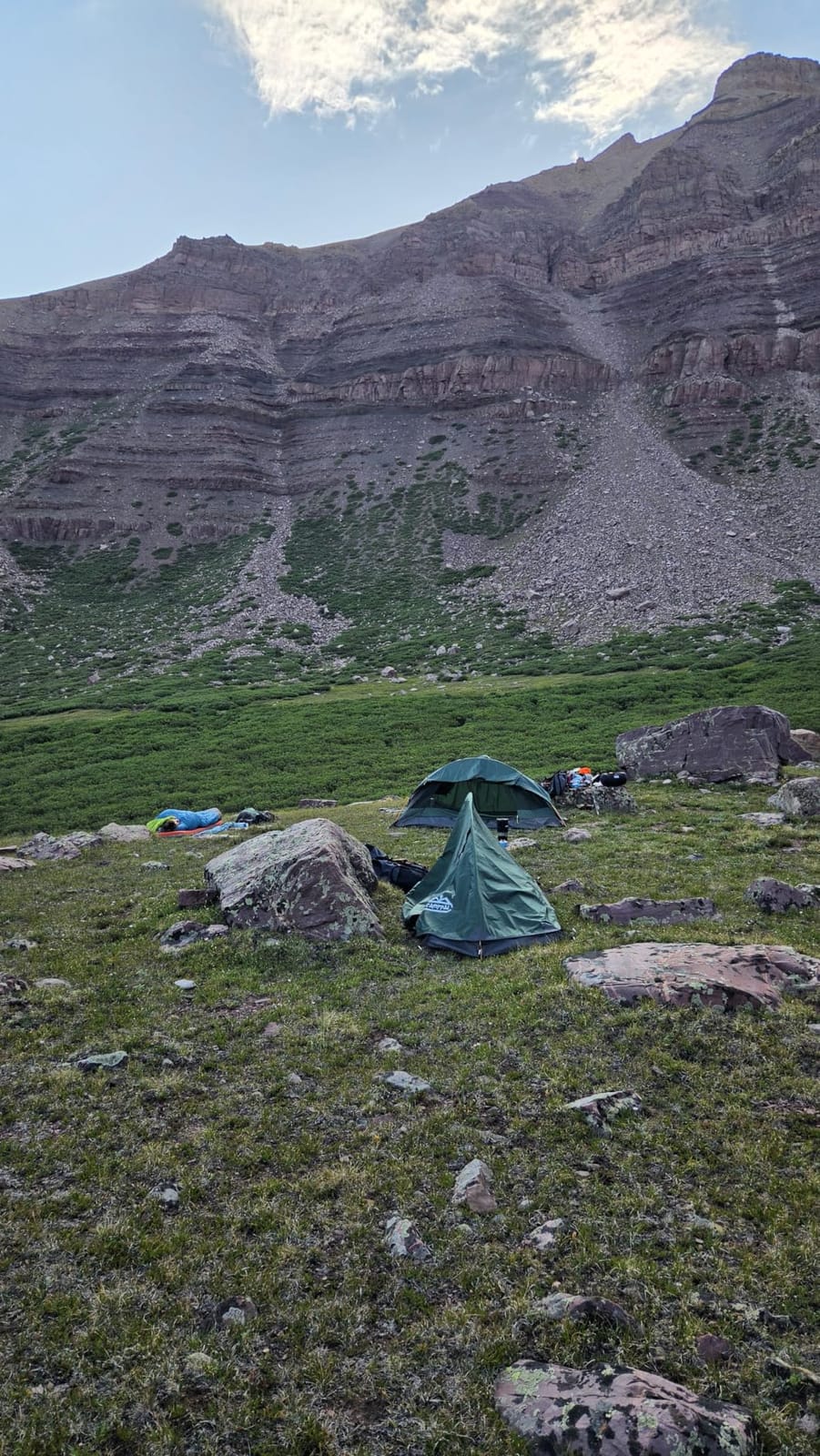
This is the lightest genuine winter shelter in the group, and for a solo skier or a hunter it makes more sense than any two-person tent. At about 3.75 pounds with a 1.23 kg listed weight, it costs you very little pack volume and gives you an 8.2 foot floor to sleep on. With 1170 reviews at a 4.3 average it also has the second-largest owner base here.
The design is a single aluminum ridge pole in an A-frame, which means it goes up in about three minutes. Fabric is 3500-4000mm with a taped zipper, a velcro wrap, and all four bottom corners sealed, and the whole thing is fire retardant to CPAI-84.
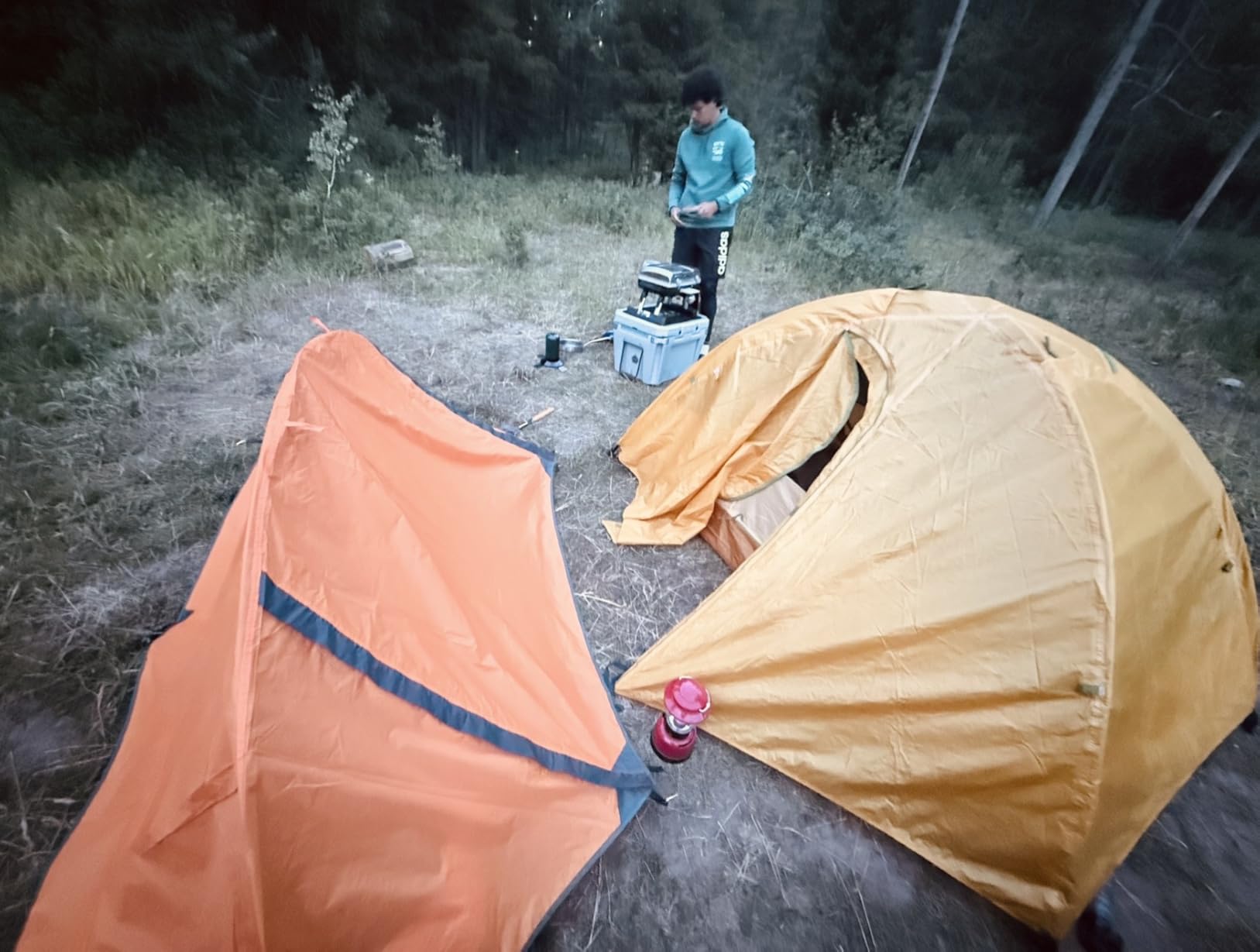
The catch is that it must be staked out, so you cannot pitch it on rock or hard ground without carrying extra anchors. The interior is genuinely tight, and owners describe it as more like a tub with a screen than a roomy shelter. The 1.5 square foot vestibule is small enough that dew collects on it if you leave it propped open overnight.
There is also a small quality-control note: some units have arrived with seam holes and instructions that do not match the tent. Sealing your own seams at home before a January trip is a cheap habit on a shelter this light.
What you gain and what you give up
You gain the lowest carry weight in the roundup and a floor long enough for a tall sleeper, which is rarer than it sounds in a solo shelter. The fire-retardant rating also matters if you are camping near burn areas or in wildfire country.
You give up freestanding convenience, internal space, and the ability to stand while dressing. In sub-zero conditions a cramped tent also concentrates your breath moisture, so plan on aggressive venting.
Who should buy it
Buy this one if you camp solo, carry everything yourself, and mostly pitch on soil or snow where stakes bite. It is a strong first winter tent for someone who wants to test whether they enjoy four-season camping without buying into a heavy shelter.
Skip it for a couple traveling together, for anyone above six feet who needs to sit upright, or for trips on granite and slickrock where a non-freestanding pitch becomes a problem.
3. Clostnature 4 Season Backpacking Tent: Best for Sub-Zero Trips
Clostnature 4 Season Backpacking Tent – 2 Person Cold Weather Winter Tent
5.3 lb minimum trail weight
5133 sq in floor
86.6 x 59 x 45.8 in
PU5000mm floor, sealed seams
Pros
- Owners report dry
- warm trips down to 20 degrees F
- PU5000mm bathtub floor with factory-sealed seams
- Freestanding two-pole clip attachment
- Two D-shaped doors and two vestibules
- Roomy enough for two plus a large dog
Cons
- Interior runs hot with the fly on in mild weather
- Rainfly fabric is thin and tears easily
- Included stakes bend in hard ground
- Fly will not fit back into the original stuff sack
If your winter trips take you into genuine cold, this is the two-person tent we would pick. Scouting families and winter campers in the reviews report successful snow and freezing-rain outings with two adults inside at temperatures as low as 20 degrees F, which is the coldest verified field report in this roundup. The 4.6 average across 562 reviews puts it among the best-rated shelters here.
The construction details are what earn that. The floor is polyester with a PU 5000 coating and a bathtub design, seams are factory sealed, and snow flaps cover the openings to block spindrift. Total weight is 6.3 pounds, or a 5.3 pound minimum trail weight if you trim the stake set.
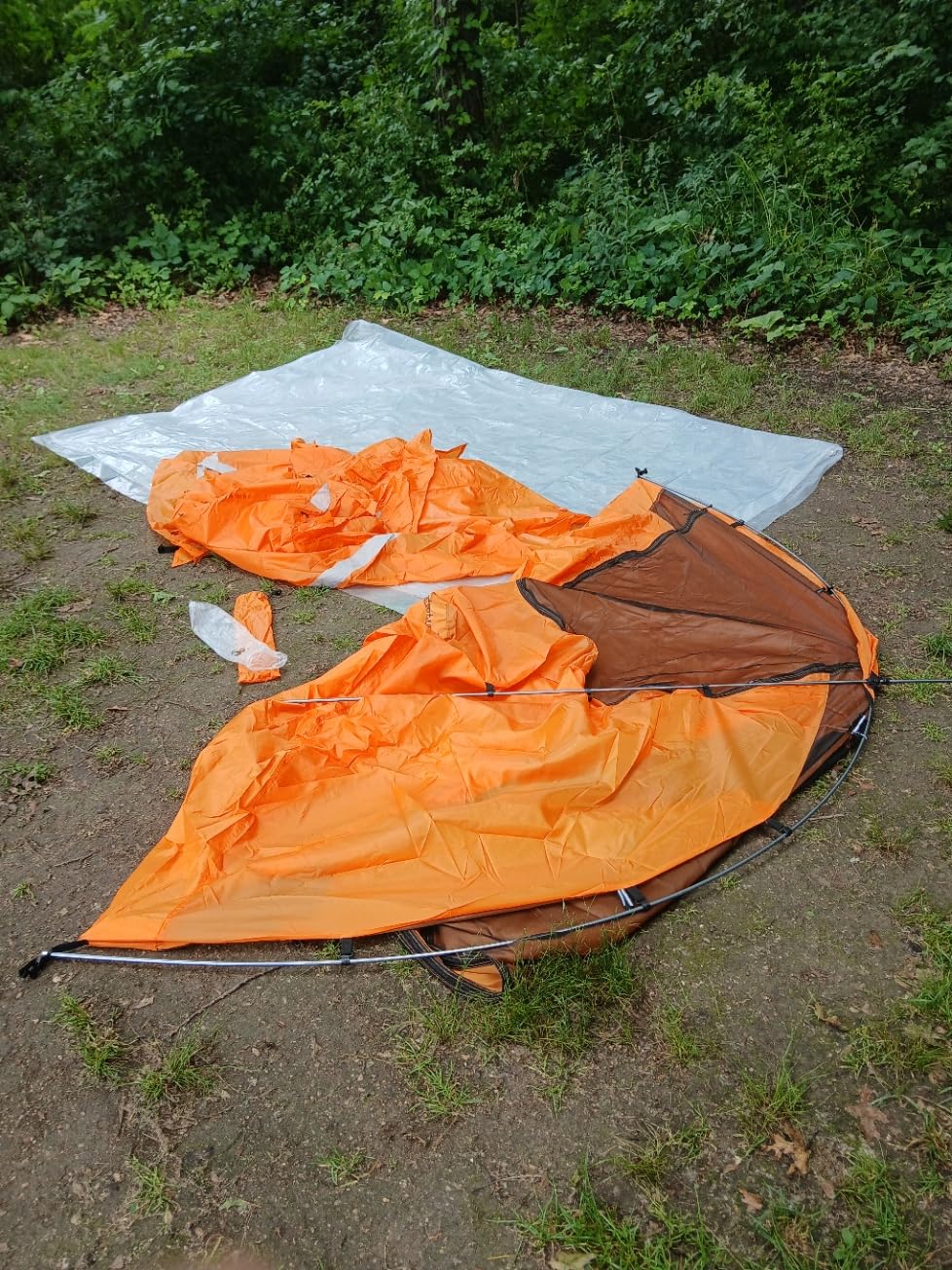
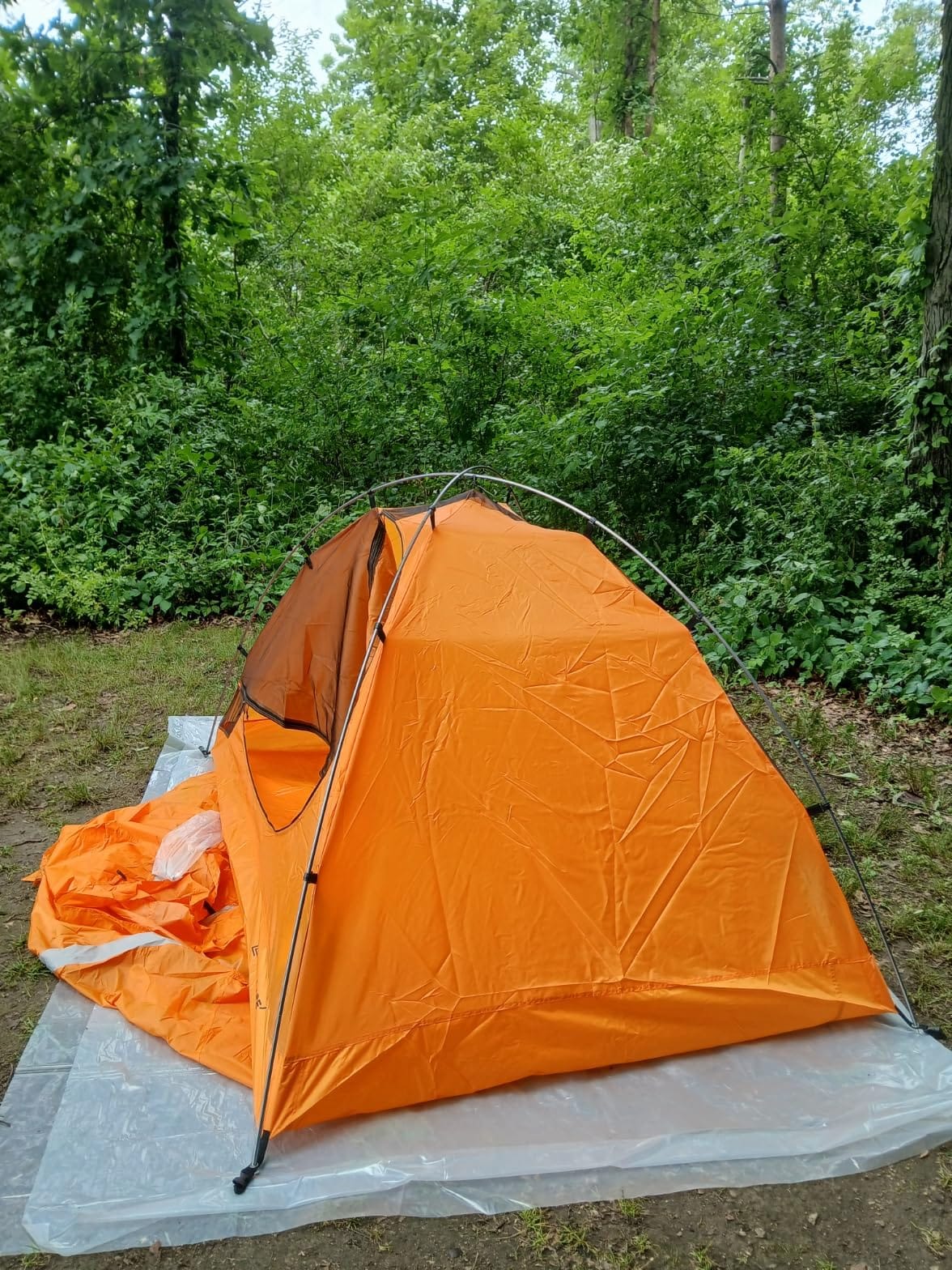
The floor is 86.6 by 59 inches for 5133 square inches, with a 45.8 inch peak, and it packs to 16.5 by 5.9 by 5.9 inches. Two D-doors mean you can get in and out without waking a partner, which matters when someone is sleeping badly because they are cold.
The weak point is the fabric itself. Owners report the rainfly is thin and tears easily, and the included aluminum stakes bend in hard or frozen ground, so heavier stakes are a worthwhile add-on. There is no separate tarp under the floor, which means standing water can soak through during heavy rain.
Cold-weather behaviour and condensation
The same 5000mm coating that keeps meltwater out is also why this tent runs hot in mild weather, and owners describe it as sauna-like with the fly on in October. That is a fair trade for a January trip, but it means the vents need managing. Open them before you get in, not after you have been breathing in there for an hour.
Because the mesh double-layer doors sit inside a coated floor, this is a double-wall shelter with good wind blocking. That is the right architecture for deep cold, where a mesh-only body lets wind straight through to your sleeping bag.
Who should skip it
Skip it if your winter trips are three-season-plus in mild climates, because you will fight condensation instead of cold. It is also not the tent for shoulder-season backpacking where fabric longevity matters more than temperature resistance.
Anyone planning to keep it for a decade should factor in replacing stakes and, eventually, a fly. That is normal for coated polyester shelters at this weight class.
4. OneTigris Stella 4 Season Camping Tent: Best Silnylon Double Wall for Lightweight Winter
OneTigris Stella 4 Season Camping Tent Backpacking 2 Person Waterproof Lightweight Easy Setup Instant 3000mm Waterproof Rating Outdoor Hiking Tent
4.8 lb packed
28.29 sq ft floor
82.7 x 49.2 x 45.2 in
20D silicone-coated nylon, 3000mm
Pros
- Lightweight 20D silicone-coated nylon at 4.8 lb
- Removable blackout outer tent adds flexibility
- Four crossing poles anchored at all four corners
- Mesh inner tent gives airflow in humid conditions
- Includes poles
- 10 stakes
- 4 guy lines and a storage bag
Cons
- Interior floor area of 28.29 sq ft is small for two
- 3000mm rating is modest against 5000mm rivals
- Vestibule space is only 1.41 square feet
The Stella is the lightest double-wall shelter here that still uses a proper silicone-coated nylon, which matters because silicone coatings do not hydrolyse the way polyurethane coatings do. Buyers rate it highly for the weight-to-durability ratio, with 80 percent five-star ratings across 498 reviews. The removable blackout outer tent is the feature owners mention most, because it lets you drop one layer in shoulder seasons.
It pitches with flexible poles crossing at the dome apex, anchored at all four corners, in about three minutes. Packed length is 21.7 by 6.3 inches, and the total weight is 4.8 pounds. The tent bottom is a heavier 40D nylon than the body fabric, which is the right place to spend the extra denier.
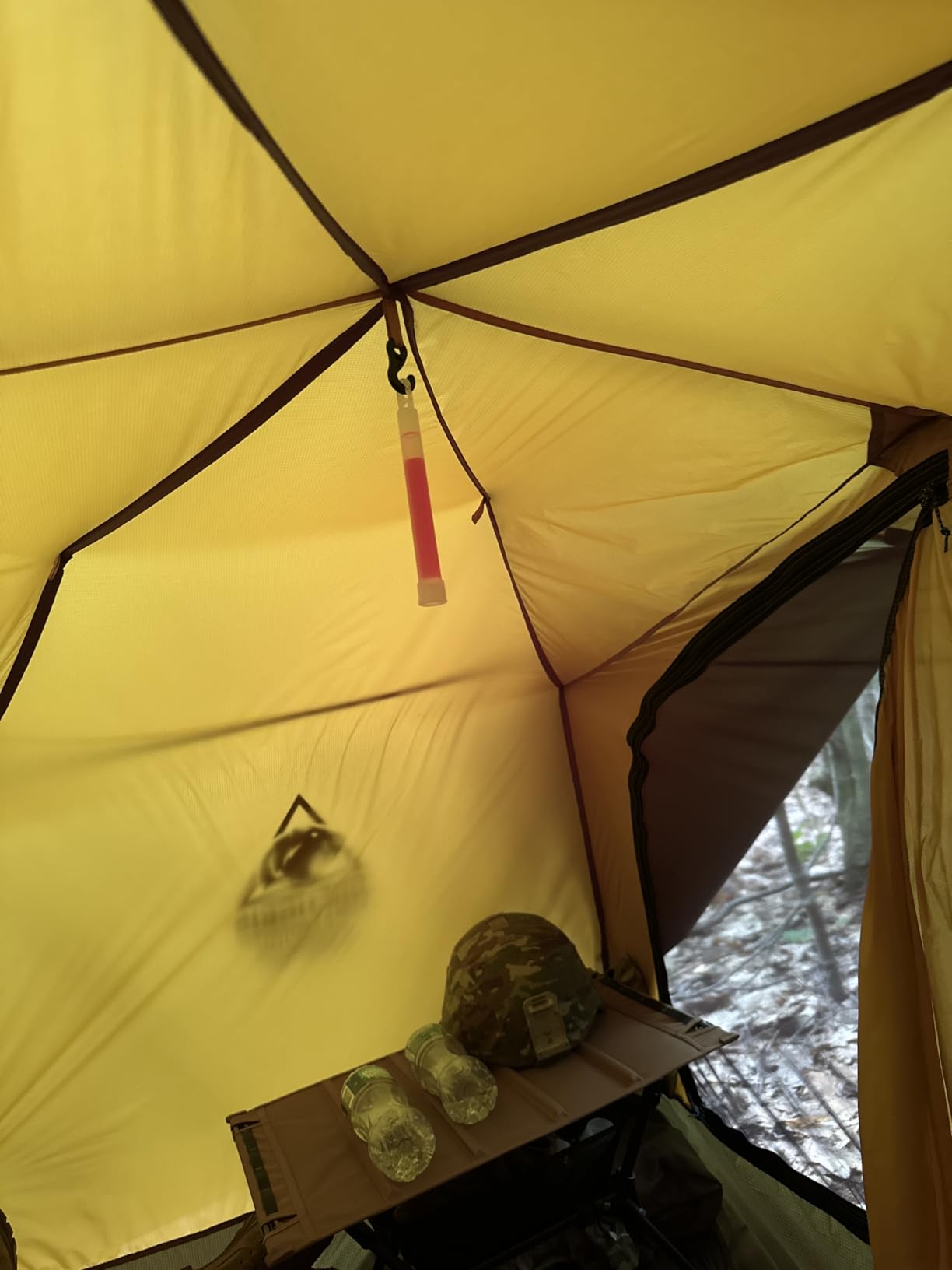
Here is the honest limitation: 28.29 square feet of floor for a two-person tent is tight, particularly with winter clothing and bulky sleep systems. The 1.41 square foot vestibule is minimal, so wet boots and packs end up inside with you. And a 3000mm rating sits below the 5000mm shells we recommend for sustained wet weather.
For a single person, or a couple who packs light and sleeps cold, the trade is worth it. For a pair carrying serious winter kit, the floor area is the constraint, not the weather protection.
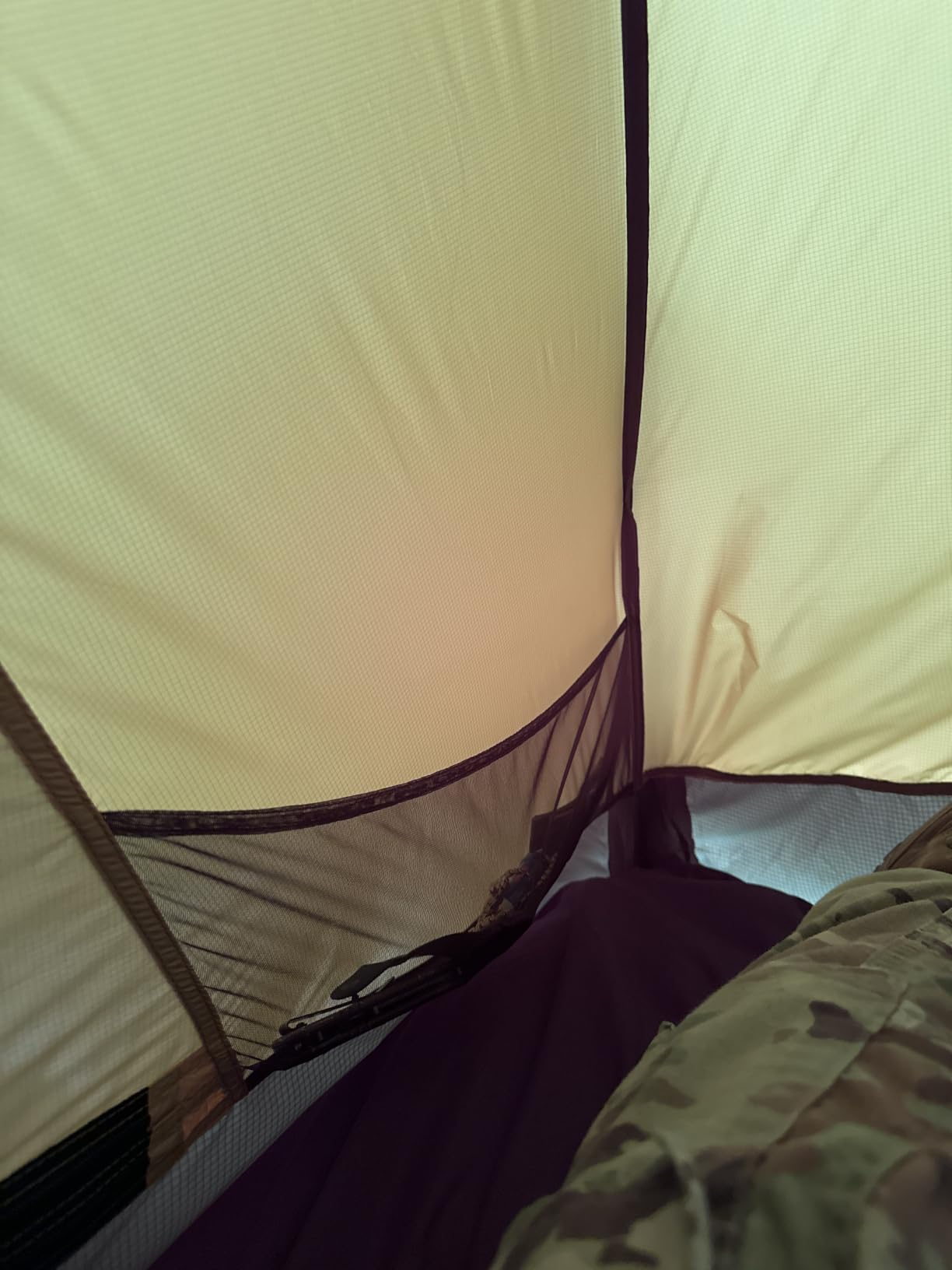
Why silicone-coated nylon is the right winter fabric
Silicone coating stays flexible and does not break down over time the way a polyurethane coating can when it is stored damp. That is a long-term durability argument more than a weight one, and it is why this shelter is a better keeper than its price suggests.
The waterproof rating is the compromise. At 3000mm it is fine for snow and moderate rain, and it is not the number we would want if a trip forecast shows hours of driving precipitation.
Who should buy it
Buy it if you are a solo winter camper, a couple who travels light, or anyone who wants a four-season tent that also works as a quiet three-season shelter in summer. The removable outer gives you real three-season flexibility in a way most four-season tents do not.
Skip it if you plan to bring a large dog, a heavy camera kit, or two full internal-frame packs into the tent. Vestibule and floor area are both too small for that.
5. 1/2 Person 4 Season Backpacking Tent: Best for Tough Wet Weather
2 Person 4 Season Backpacking Tent, Lightweight Waterproof Winter Tent
5.73 lb packed
5115.66 sq in floor
86.6 x 59.1 x 45.3 in
PU5000mm full-cover fly
Pros
- Held off Patagonian rain
- snow and wind on an O-Circuit trek
- PU5000mm full-cover rain fly
- Easy setup and packs to 5.9 by 16.54 inches
- Stakes hold in rocky soil without bending
- Owners buy multiple units for family trips
Cons
- Floor is not tarp material so a footprint is needed
- Rainfly wets through where it contacts the tent
- Interior is tight for two and very short for tall campers
- Rainfly does not pull fully taut
This tent earns its badge on field reports rather than spec sheets. One owner documents holding off Patagonian rain, snow and severe wind on an O-Circuit trek, which is about as hostile a test as a two-person four-season dome gets. Across 384 reviews at 4.6, reviewers consistently treat it as a budget four-season option that punches above its class.
The fabric is the reason. A full-cover rainfly with a PU 5000mm coating covers the entire tent rather than stopping short of the floor, and the poles are aircraft-grade aluminum. There are four guy lines, a snow skirt, four poles, and a two-way zipper on the door.
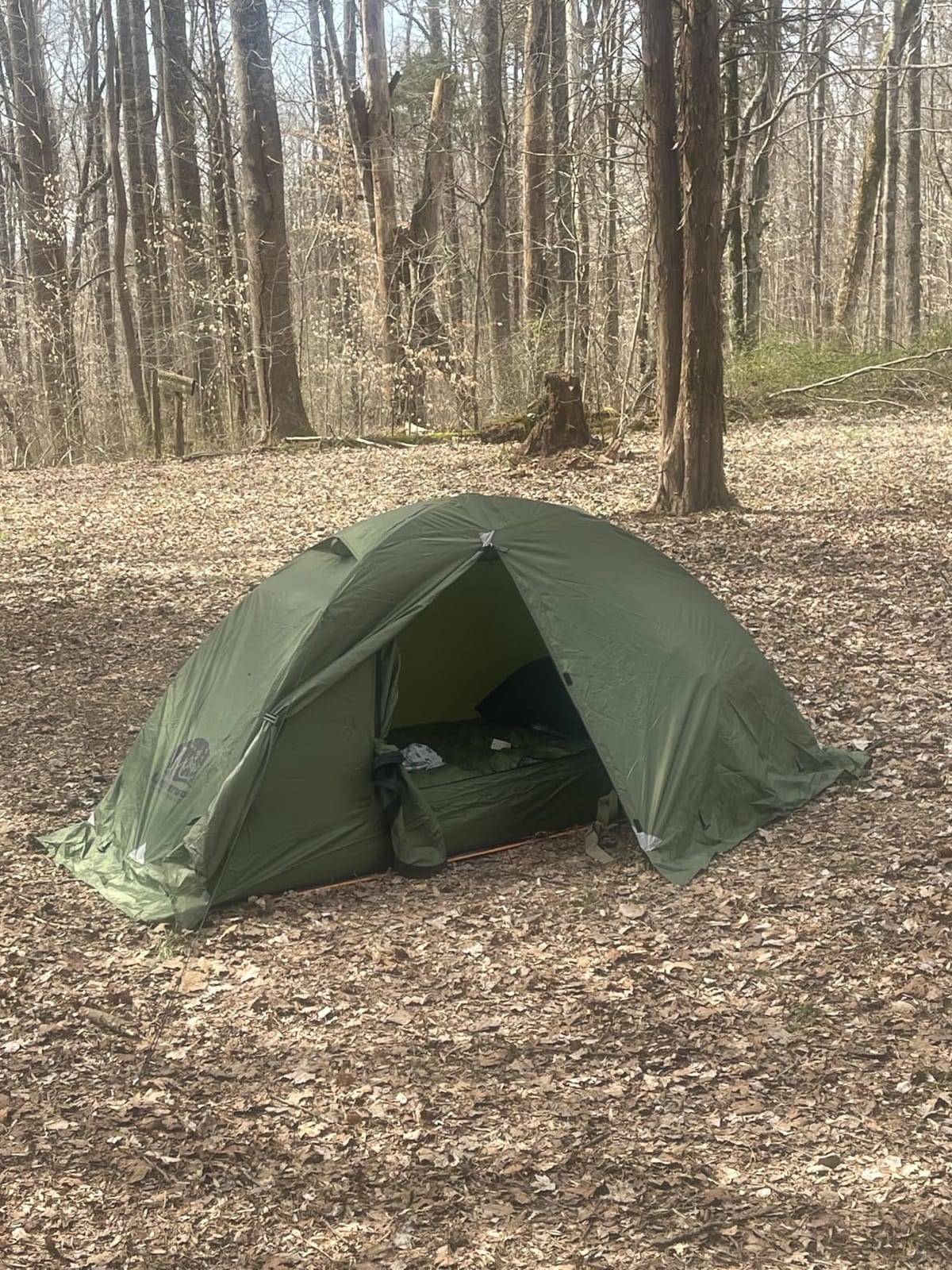
It weighs 5.73 pounds and packs to just 5.9 by 16.54 inches, which is an unusually small packed diameter for a tent this capable. The floor measures 86.6 by 59.1 inches for 5115.66 square inches, with a 45.3 inch peak height.
The trade-offs are consistent across reviews. The floor is not tarp material, so wet ground needs a footprint or groundsheet. The fly wets through wherever it rests against the tent body, which makes correct pitch tension important. And several owners note the interior is tight for two adults and very short for taller campers.
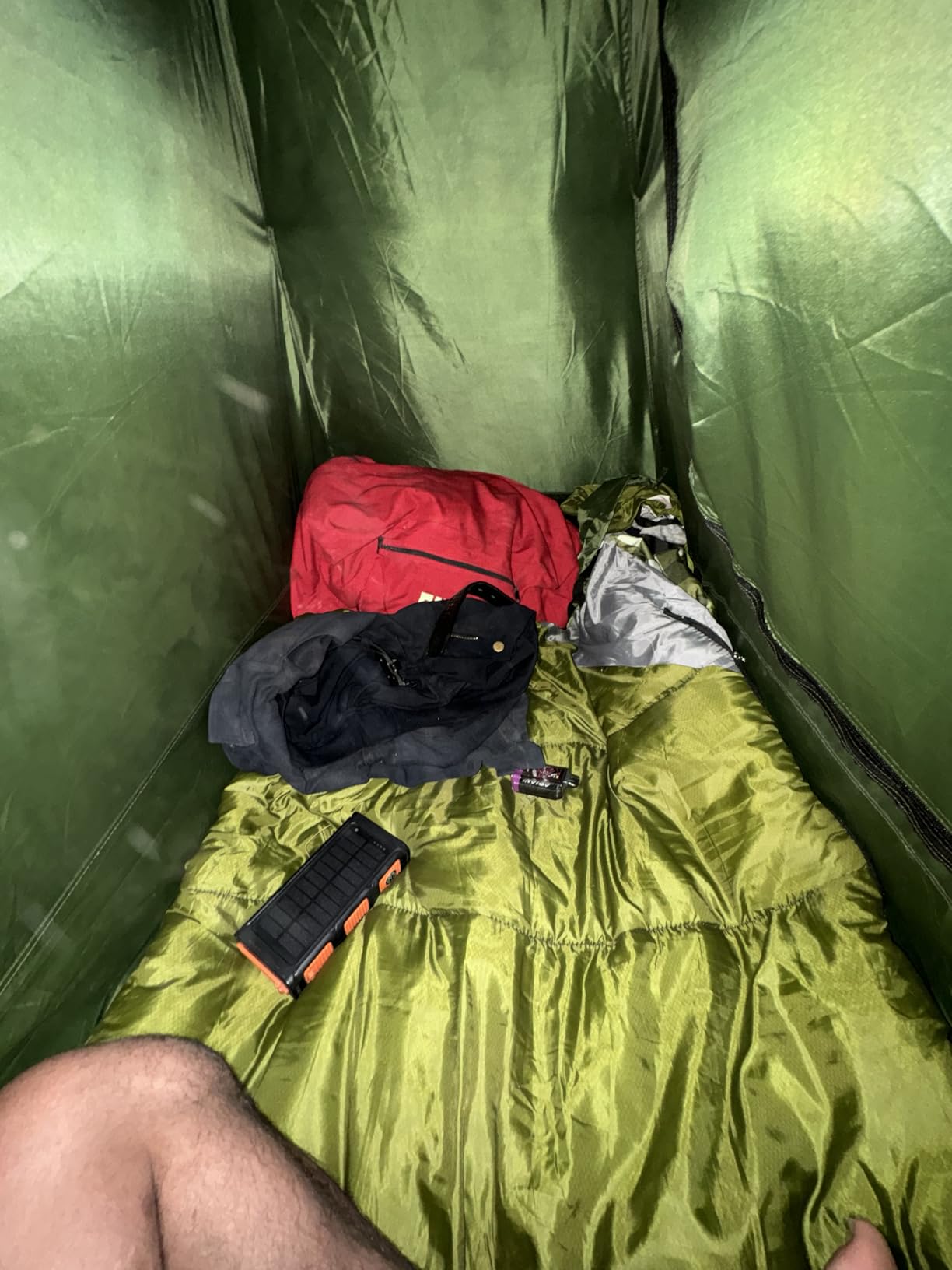
Wind, rain and setup in a storm
Four poles with double-layered reinforced corners and four guy lines make this one of the more secure budget domes we looked at, and owners report the included stakes do not bend in rocky soil. That combination is why it performed on a Patagonian trek where lighter domes failed.
The wrinkles in the fly are worth knowing about. Water can sit in the slack areas, which is a weight argument in wet snow rather than a failure argument, but it is one more reason to tension the pitch carefully on arrival.
Who should buy it
Buy it if you want maximum weather protection per pound and per dollar, particularly for multi-day trips in wet climates. It is also a sensible first winter tent for a family outfitting two units.
Skip it if you are tall, if you plan to sit upright in winter clothing, or if you are pairing it with a sleeping setup that needs a full-length tarp under the floor.
6. GEERTOP Waterproof 4 Person 4 Season Camping Tent: Best for Families
GEERTOP Waterproof 4 Person 4 Season Family Camping Tent
9.1 lb packed
7797.44 sq in floor
82.7 x 94.4 x 55 in
210D Oxford floor, PU5000mm
Pros
- Stayed up and leak-free in a 60 mph wind and rain storm
- Spacious 6.9 by 7.8 ft interior fits a cot
- pack and cooler
- Integrated snow skirt blocks blowing snow and dust
- Easy to pitch in the dark or in cold conditions
Cons
- Rated for four but realistically comfortable for two adults
- Poles buckled under wind and replacements are hard to find
- Thin floor wore through after two days on sand
- No canopy poles or ropes included
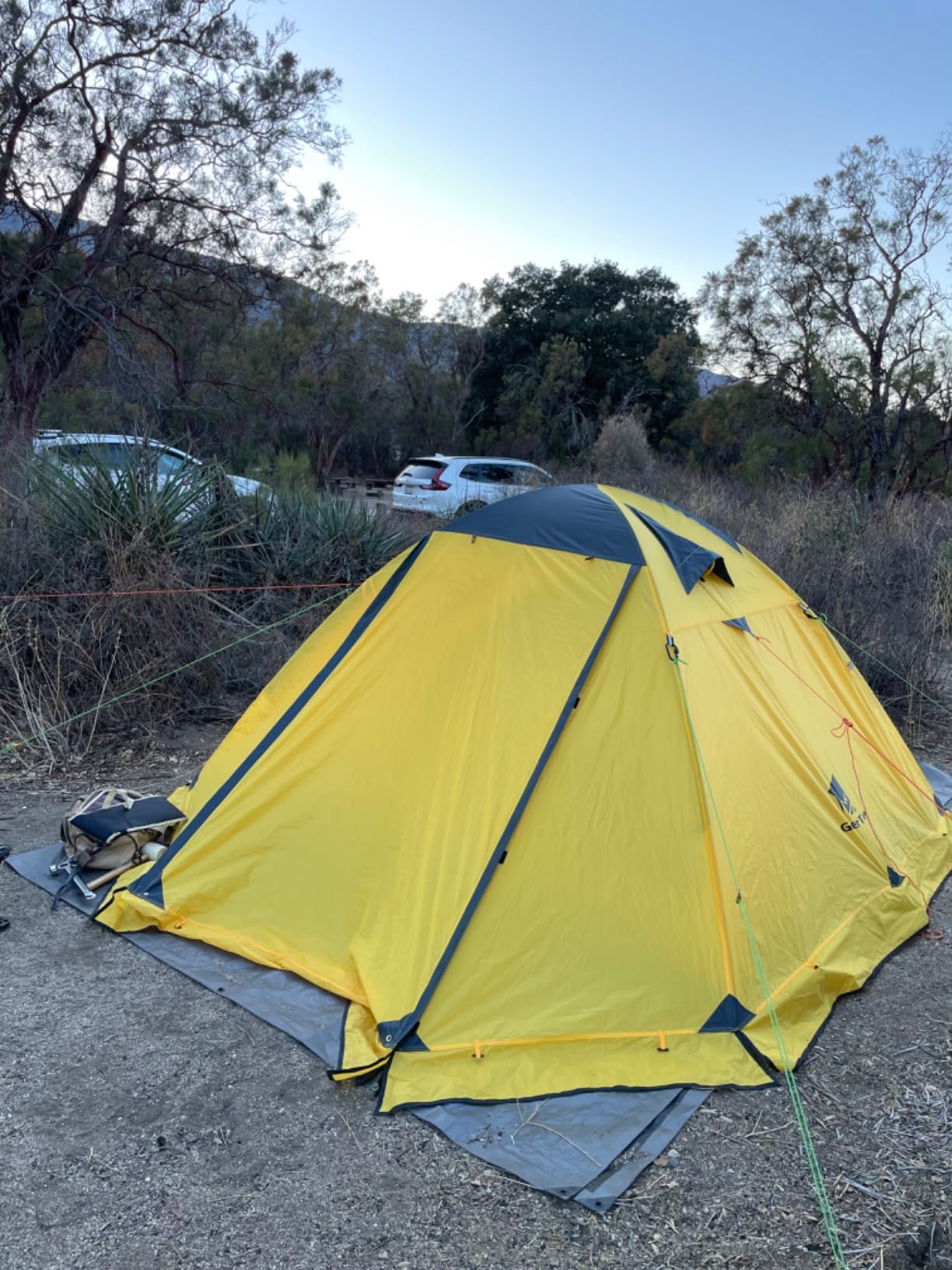
This is the tent for winter car camping, a snowbound weekend at a trailhead, or a family that wants one shelter to do everything. One owner reports it staying up and leak-free in a 60 mph wind and rain storm while neighbouring tents collapsed, and another describes holding heat well enough for a Malamute and two campers inside.
The interior is the draw. At 7797.44 square inches it is 54 square feet, with a 55 inch peak, four listed rooms, four vestibules, and two doors. That is room for cots, a cooler, boots, and wet gear without anyone sitting on a pack.
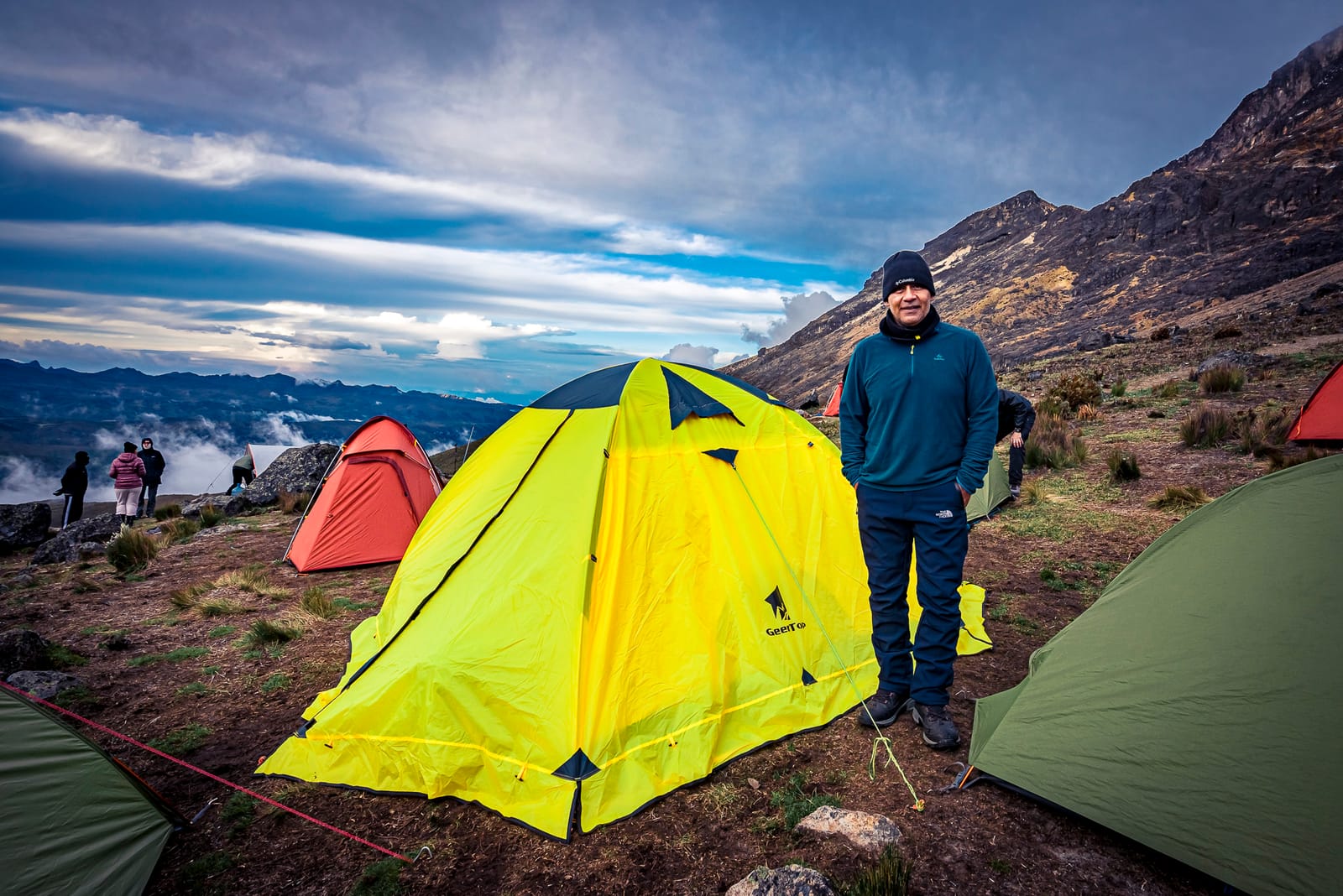
Construction is a double-wall with a PU3000mm fly and a 210D Oxford floor rated at PU5000mm, with taped seams. It weighs 9.1 pounds, which is a non-issue for car camping and a real burden for anyone carrying it.
Be honest about the capacity rating. It is listed for four, but the 4.3 average reflects repeated complaints that four adults is optimistic, and pole buckling under heavy wind has been reported with replacement poles difficult to source. Thin floor fabric also wore through after two days on sandy soil.
What makes it work as a winter family shelter
The integrated snow skirt is the feature that shows up most often in positive reviews, because it blocks blowing snow and dust at floor level through an entire storm. The 55 inch peak is high enough to change clothes inside, which changes the whole feel of a wet-weather family trip.
It is also straightforward to pitch in poor light, which matters when you are arriving after dark in a snowstorm with kids. Two doors mean two people can get in and out without a bottleneck.
Who should skip it
Skip it if you have to carry it, and skip it if four adults truly need to sleep inside. As a two-adult-plus-gear or family-with-kids shelter, it is one of the most capable options in this roundup.
If wind is your primary concern rather than snow, note the pole buckling reports and pack a spare set of stakes and extra guylines, since no canopy poles or ropes are included.
7. POMOLY Chalet 70 Pro Hot Tent: Best Budget Hot Tent with a Stove Jack
POMOLY Camping Hot Tent Cabin Tent, Chalet 70 Pro Portable Wall Tents with Stove Jack and Two Poles for 2-3 Person Hiking, Backpacking (M)
54 sq ft floor
8.2 x 6.56 x 4.9 ft expanded
2 pole 7001 aluminum
70D ripstop, 2500mm
Pros
- Fireproof silicone and fiberglass ground sheet plus ember mat
- Two 7001 aluminum main poles with 8 tie-down points
- Solid seams with no pinholes
- Opposing double doors allow entry with a stove running
- Excellent value against canvas hot tents
Cons
- No high air vents so condensation builds intensely
- Single peak pole at both ends makes entry cramped
- Included stakes are oversized and heavy
- A pole snapped under 4 inches of wet snow
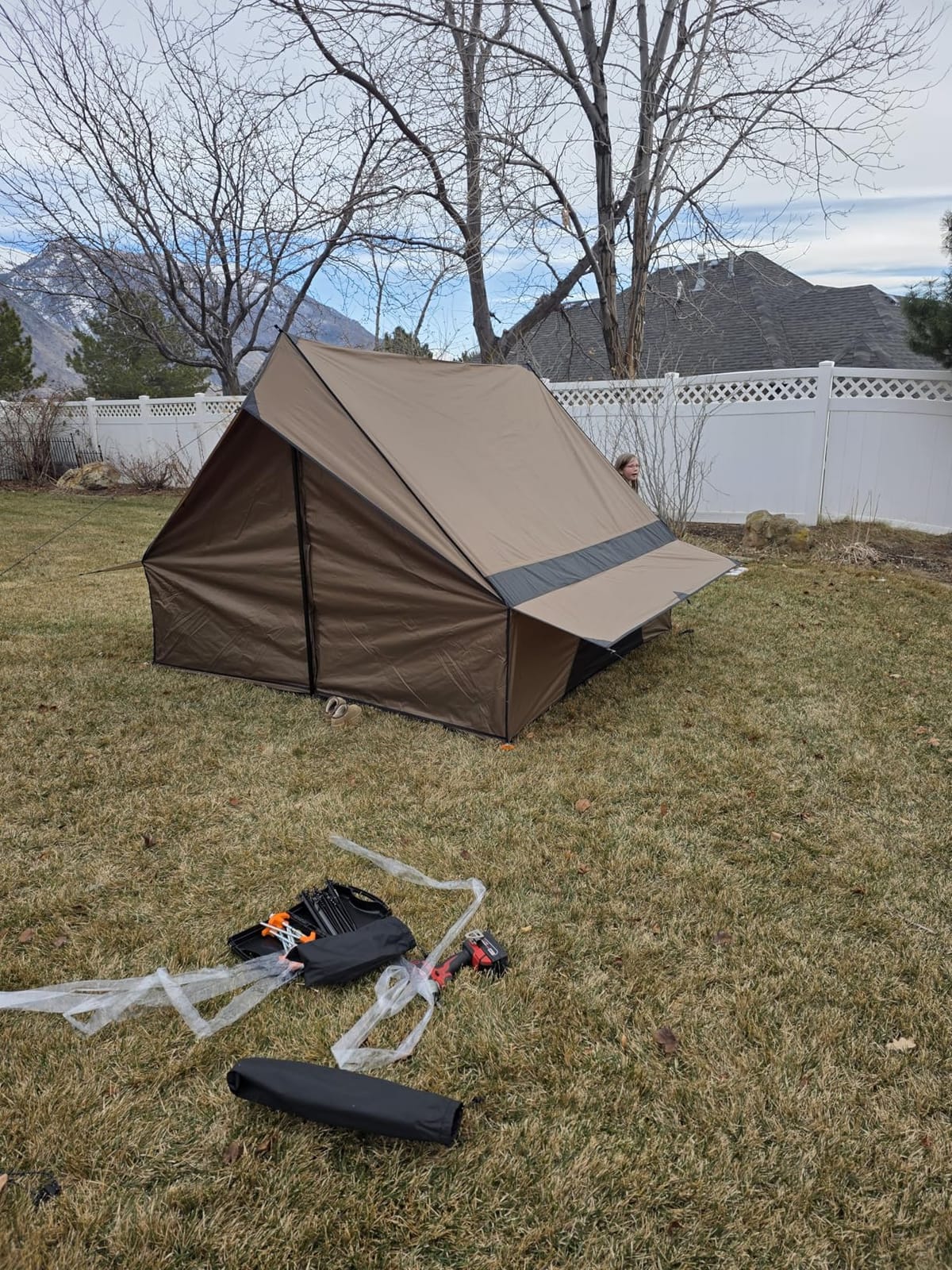
Hot tents are the biggest gap in most four-season roundups, and they matter for a specific reason: a stove changes the equation entirely in cold weather. The Chalet 70 Pro is a 2-person cabin with a stove jack, an integrated fireproof silicone and fiberglass ground sheet, and an ember mat. Winter stove campers consistently praise that floor as the standout feature for safety.
The frame is two 7001 aluminum alloy main poles with two sets of guylines and eight tie-down points, and the fabric is 70D plaid ripstop polyester at 2500mm waterproof. Expanded size is 8.2 by 6.56 by 4.9 feet, or 54 square feet of floor area.
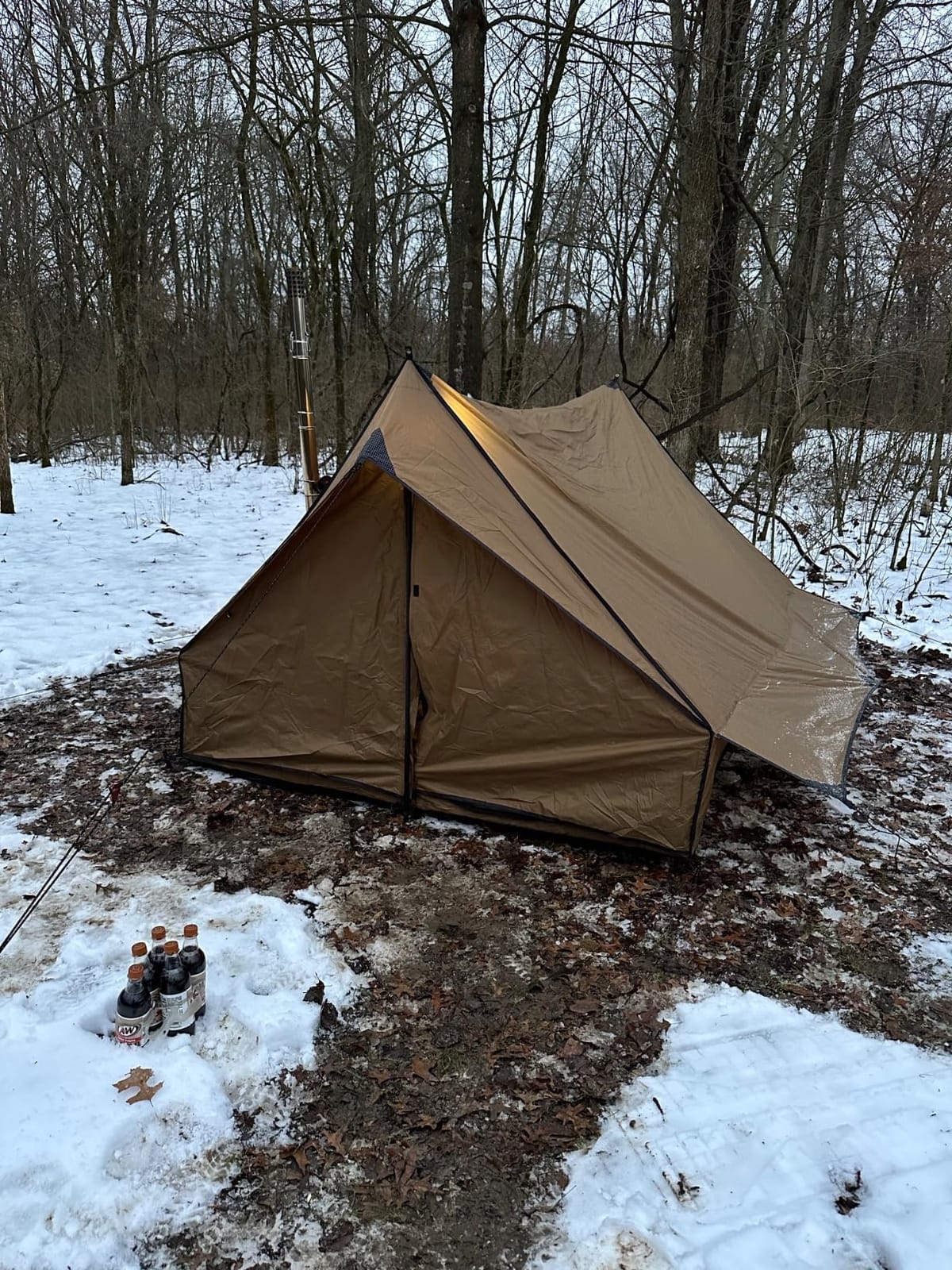
Owners report that it holds heat as well as or better than other budget hot tents, and that it packs down smaller than its size suggests. The double doors on opposing sides mean you can get in and out without crawling over a running stove, which is the single most useful design decision in the whole category.
The flaws are worth planning around. There are no high air vents, and condensation builds intensely enough that one owner cut a vent hole. The solid fabric door cover has no zipper over the mesh, so wind and cold air enter freely, and a pole has snapped when four inches of wet snow collapsed onto the tent.
Hot tent safety, plainly stated
Never run a wood or charcoal stove in a closed tent. Carbon monoxide is odourless and kills without warning, and a hot tent with a stove jack still needs open doors, a stove that burns cleanly, and a working ventilation path. A CO alarm inside the tent is inexpensive insurance and we consider it mandatory.
The fireproof ground sheet and ember mat exist for a reason: radiant heat and stray embers will damage a polyester floor in seconds. Keep the stove on the mat, keep the jack clear of the inner tent fabric, and never leave it unattended.
Who should buy it
Buy it for winter car camping, hunting, or backcountry base camp where you are not carrying the weight and want a heated space. The 54 square foot floor fits two adults, cots, and a stove comfortably.
Skip it for exposed alpine wind and for heavy snow loads, because a two-pole frame and 2500mm fabric are not the answer there. Also plan to buy lighter stakes, since the included ones are heavy.
8. Naturehike Massif Hot Tent: Best for a Motorcycle or Small Car Base Camp
Naturehike Massif Hot Tent with Stove Jack, Waterproof Windproof 4 Season Tent, 2/4 Person Cold Weather Winter Tents for Camping
89.13 sq ft floor
141.7 x 90.6 x 57.1 in
4 pole aluminum alloy
3000mm, 13 stakes
Pros
- Retains heat so well that 11 degrees outside became about 45 inside
- Handled heavy rain turning to snow with 2 inches on the roof
- Massive 10 sq ft vestibule fits a chair
- table and stove
- Mesh inner capsule does not touch the walls
- Color-coded pole guides simplify first setup
Cons
- Weak in wind
- pole strength is limited with more tie-downs wanted
- Bulky at roughly 7 lb minimum weight
- Can collect snow above the sleeping area and drip
- Many stake-out points make early pitches daunting
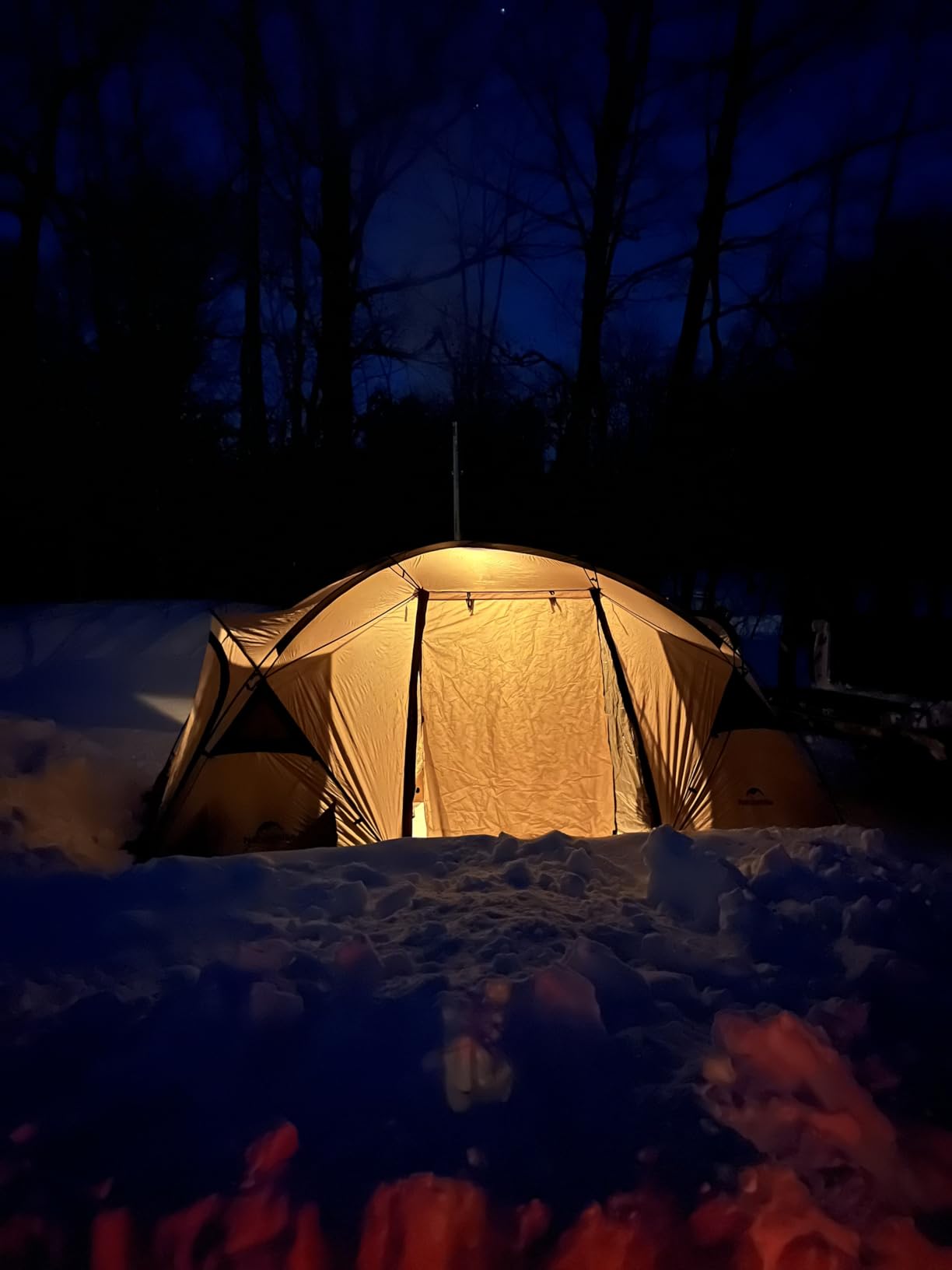
The Massif is the most car-camping-shaped shelter in this roundup, and its owners use it that way. One reviewer logged 11 degrees Fahrenheit outside and about 45 degrees inside with a stove running. It is rated for motorcycle-compatible use, which tells you how the 10.47 pound weight is actually deployed.
Floor area is 89.13 square feet, split across two rooms, with a 10 square foot vestibule that reviewers describe as a real living area for a chair, table, and stove. Four aluminum alloy poles, 13 pegs, and 6 windropes come in the bag, and the color-coded pole guides make a first pitch much less intimidating.
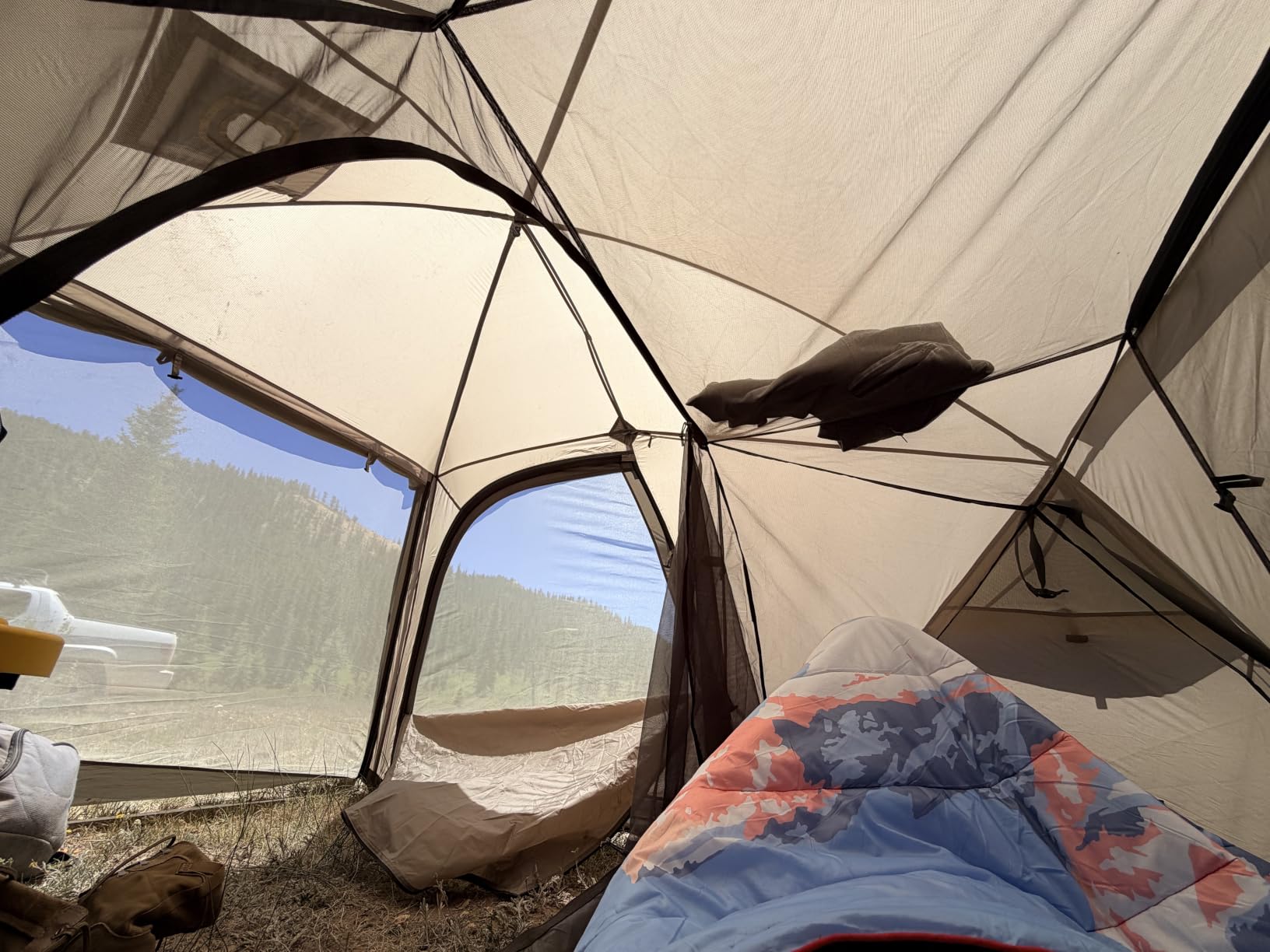
There is also a 43.3 inch peak height, a two-year warranty, and a packed size of 20.5 by 9 by 6.7 inches. The mesh inner capsule sitting away from the walls genuinely helps with condensation, which is unusual in a hot tent.
Wind is the weakness. Reviewers consistently flag limited pole strength and want more tie-down points, and the inner bathtub floor seeped moisture from damp grass, so a groundsheet is worth adding. It can also collect rain and snow above the sleeping area and drip at night.
Hot tent performance and moisture control
Two inches of snow did not affect the tent or poles, which tells you the roof geometry and pole spacing handle load reasonably well. The weak axis is lateral wind pressure, not vertical snow load, so pick a site with natural wind shelter and rig all six windropes.
The moisture picture is mixed. A mesh inner that does not touch the walls is a real advantage, but a bathtub floor in direct contact with wet ground is a real disadvantage, and the two cancel out more often than you would hope.
Who should buy it
Buy it if you drive to your campsite, want a heated living space with genuine furniture room, and camp somewhere with natural wind shelter. It suits motorcycle and overland setups particularly well.
Skip it for exposed ridgelines, for anyone carrying a long way, or for trips where you need the tent to be a genuine four-season shelter with no stove involved.
9. Naturehike Dune Hot Tent: Best for Stormy Car Camps and Standing Room
Naturehike Dune Hot Tent with Stove Jack,Double Layer 4 Season Tent,Waterproof 2-4 Person Tents for Camping
16.5 lb total
70.8 in peak height
126 x 94.5 x 70.8 in
75D silvered fly, 4000mm floor
Pros
- Withstood three severe storms including 50 mph winds and hail
- Reflective inner fabric holds heat in 10 degree weather
- Tall enough to stand up in at about 6 ft 1 in
- Four doors let it seal fully or open as a canopy
- Zero seam leaks in steady rain
- Two-year warranty
Cons
- Very heavy at 16.5 lb
- a car camping tent
- Two-person inner is really one camper plus gear
- Inner sits close to the stove jack
- Guyline cordage stretches when wet
Owners call the Dune the best base-camp hot tent they have owned, and the storm record backs the 4.6 average across 220 reviews. One owner reports it withstood three severe storms including 50 mph winds and quarter-size hail without damage, and another reports zero seam leaks through steady rain. That is real storm data, not a marketing line.
The silvered reflective fabric is what makes it different. It holds heat brilliantly enough that owners describe it as warm in 10 degree weather with a stove running, and it is comfortable enough to sit in while the stove burns. The 70.8 inch peak height means you can stand up inside at roughly six feet one inch, which no other tent here manages.
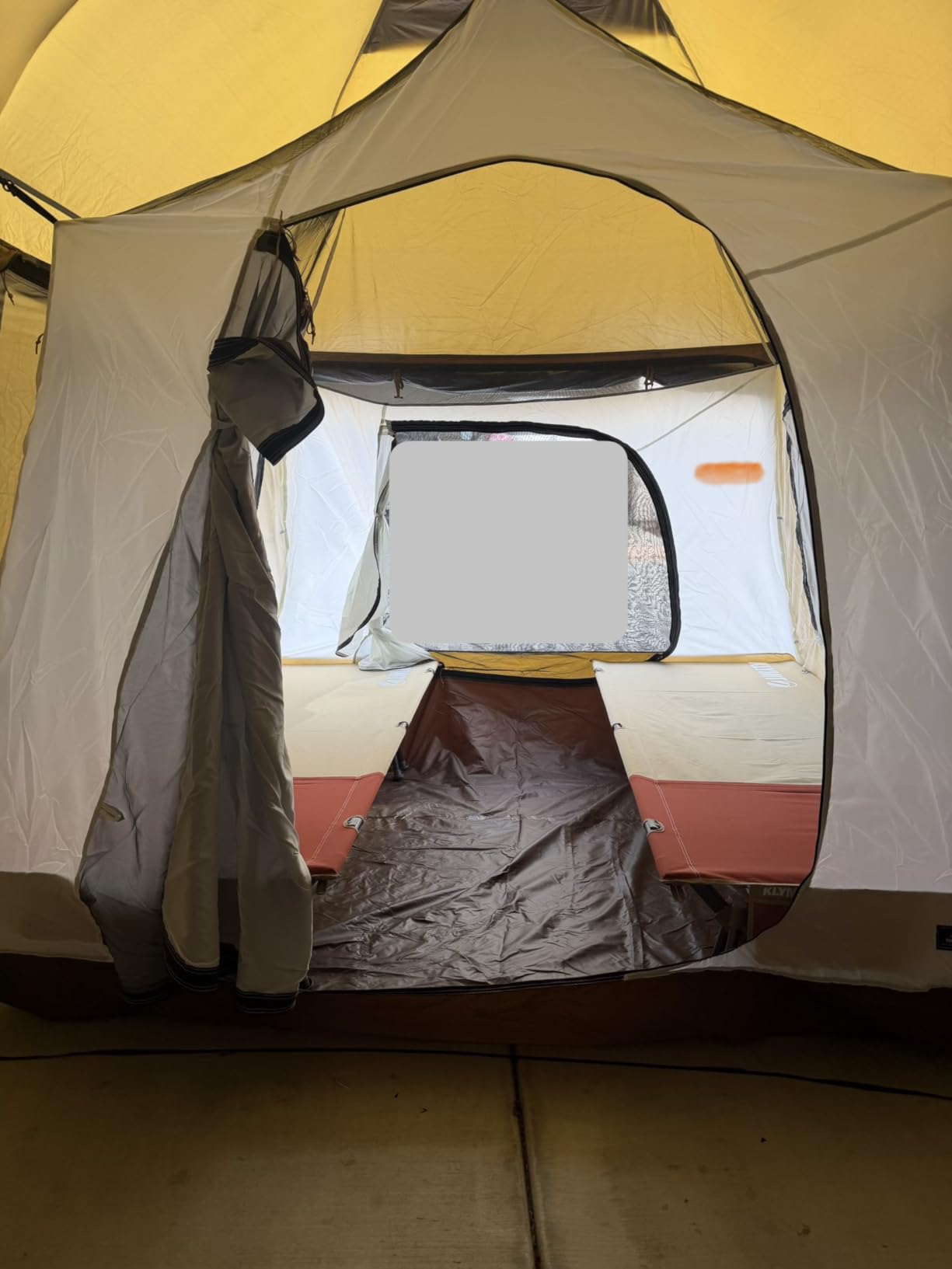
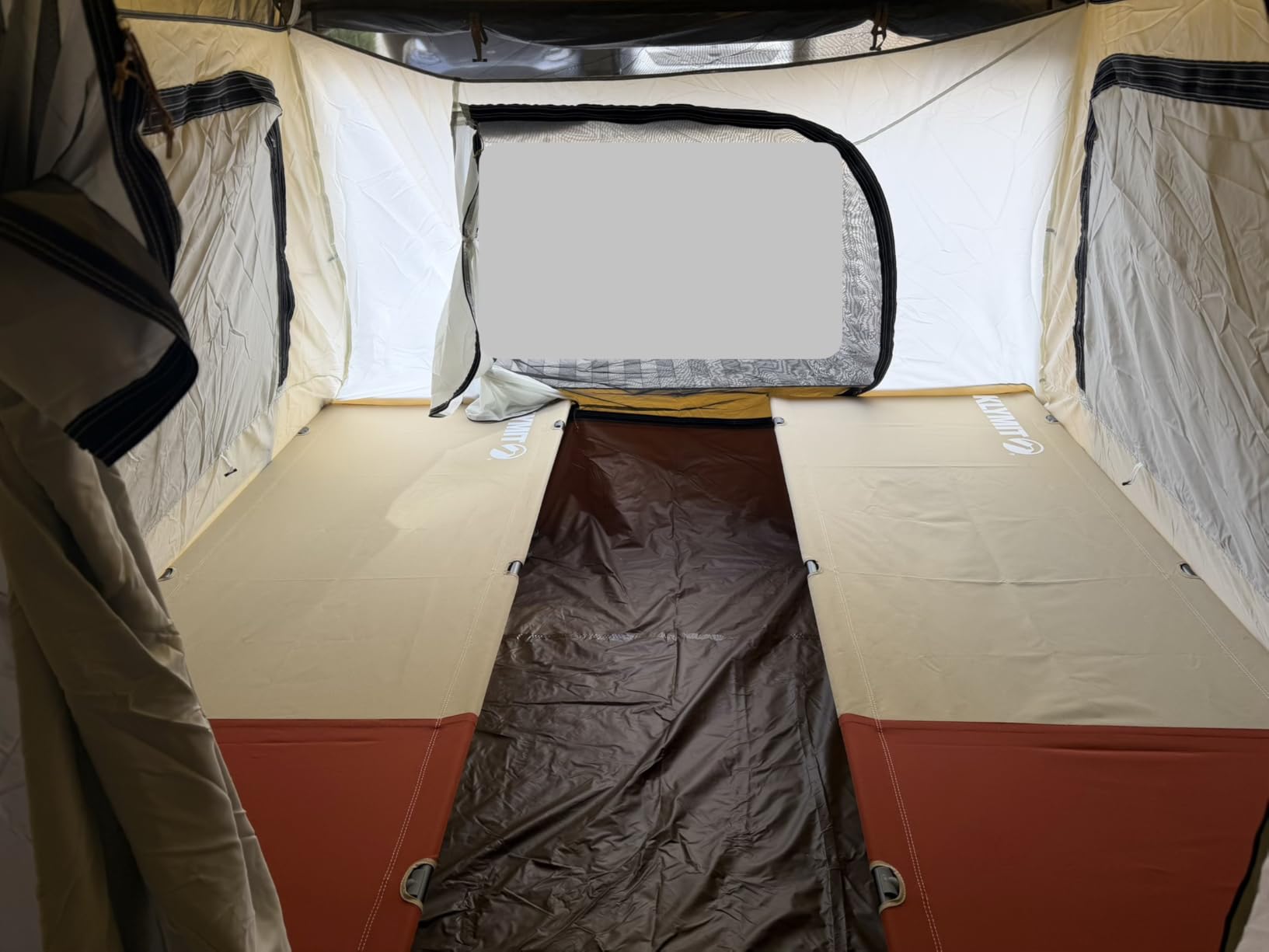
Construction details: a 75D polyester fly with silver coating at 3000mm, a 150D Oxford floor at 4000mm, and 7001 aluminum alloy poles. The removable inner tent is 86.6 by 59 by 63 inches, there are four doors and four windows, and the vestibule area is listed at 81.8 square feet. Packed size is 24.8 by 11.8 by 8.6 inches.
At 16.5 pounds it is a car or motorcycle camping tent, full stop. The two-person inner becomes one camper plus gear once a cot, stove, and chair are inside, and the inner tent sits close enough to the stove jack that you need to be deliberate about where you run the stove.
Storm performance and the reflective fabric trick
Reflective inner surfaces bounce stove heat back into the tent instead of letting it escape through the fabric, which is why this shelter outperforms its weight class in cold conditions. It is a passive gain that costs nothing at camp.
The four-door design gives you options a two-door tent cannot offer: seal everything for a storm, or open the upwind side and keep the downwind sides closed. Guyline cordage stretches when wet, so expect to re-tension it a few hours after a storm passes.
Who should buy it
Buy it for winter base camp, hunting, and storm-prone car camping where you want to stand, cook, and move around inside. Two people sharing gear space will be comfortable; two people bringing full beds will not.
Skip it entirely if the tent has to be carried on your back, and read the stove jack clearance notes carefully if you plan to run a heater all night.
10. Naturehike 4 Season 2 Person Backpacking Tent: Best Lightweight Starter Tent
Naturehike 4 Season Tent,Waterproof 2 Person Backpacking Tent, Four Season Tents for Cold Weather Winter Camping
4.1 lb trail weight
41.23 sq ft floor
53.1 in wide, 43.3 in high
PU3000mm ripstop nylon
Pros
- Light at about 4.1 lb trail weight for a two-person tent
- 20D silicone-coated nylon with aluminum poles
- Double doors and three ventilation windows
- Sets up in about 3 minutes by one person
- Footprint included in the package
Cons
- Smallest review base here at 72 reviews
- 3000mm rating is the lowest of the coated models
- 43.3 inch peak height is low for sitting up
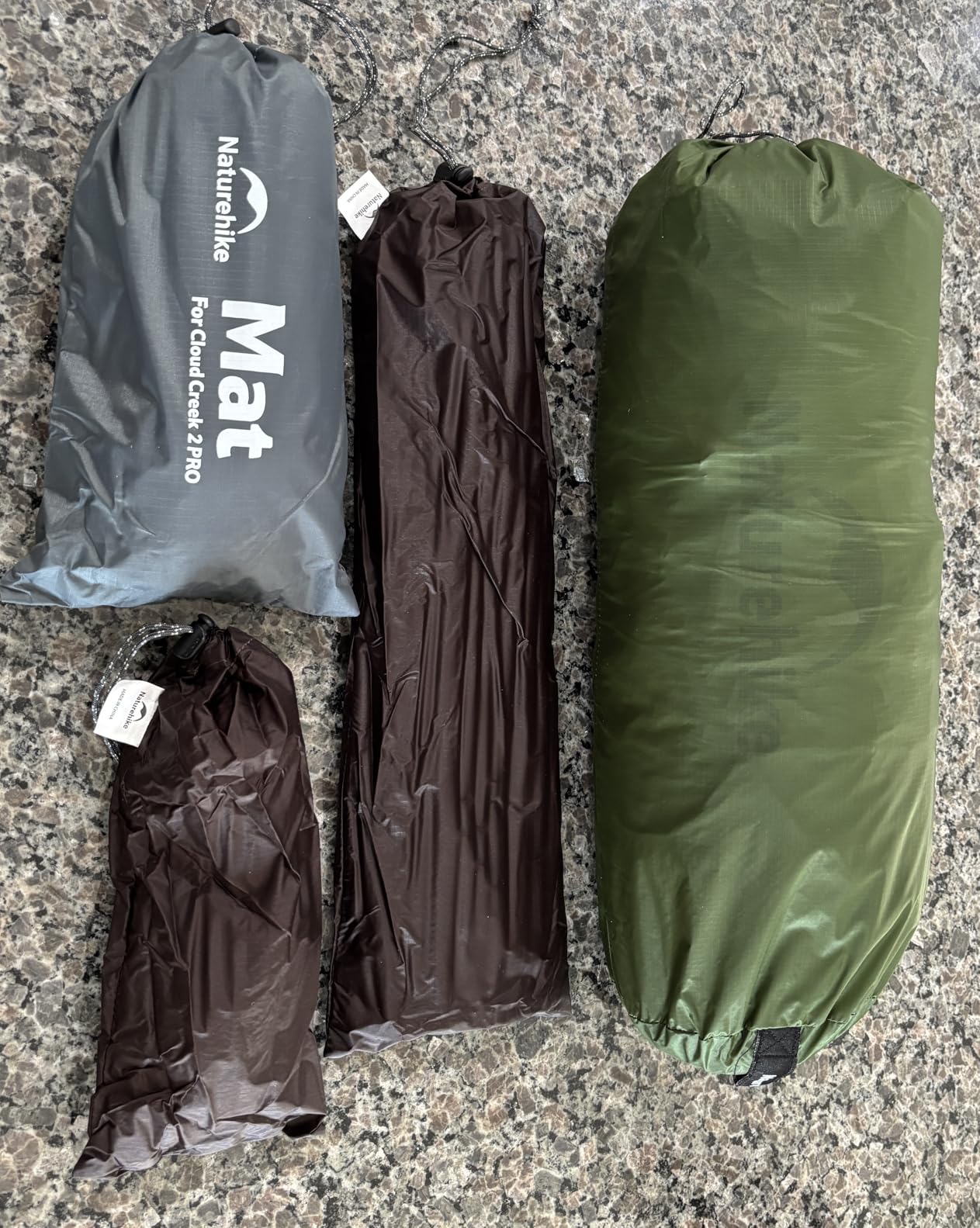
This is the tent to buy if your winter trips are still fairly mild and you want to keep pack weight down while adding real four-season capability. It carries a 4.1 pound trail weight, 4.43 pounds total, with a 41.23 square foot floor and dual vestibules. The included footprint is unusual at this weight and saves an accessory purchase.
Ventilation is the design priority here: double doors plus three windows on a mesh inner, in a tent that otherwise has a solid coated body. The fabric is 20D silicone-coated nylon with anti-tear ripstop construction and aluminum poles, pitched with flexible poles intersecting at the dome apex in about three minutes.
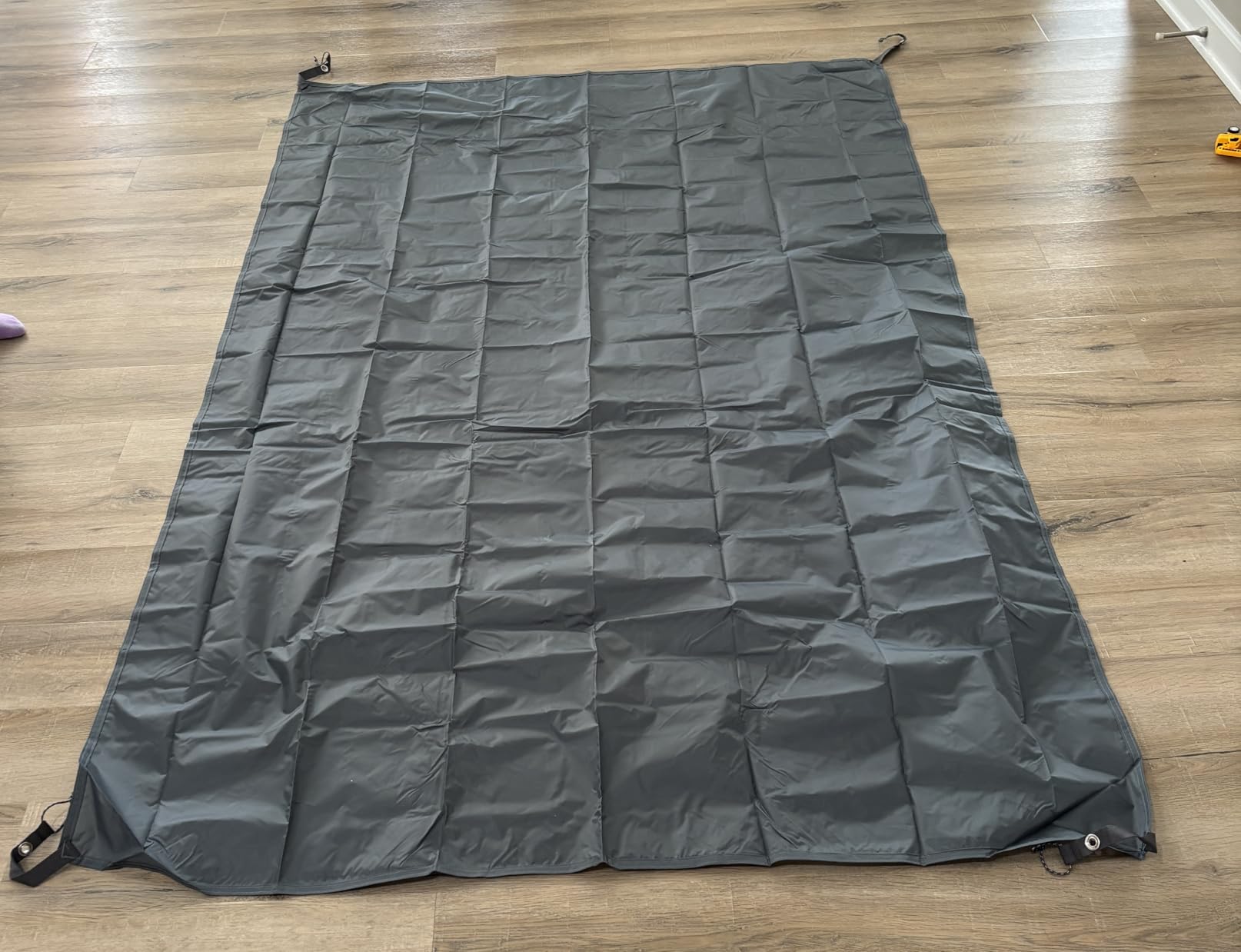
It comes with 12 stakes, four guy lines, a carry bag, and a two-year warranty. The inner tent is 53.1 inches wide and 43.3 inches high, which is enough to sit up in a shirt and not enough to sit up in full winter kit on a late start.
The honest caveat is the review base. At 72 reviews it is the thinnest owner history in this roundup, and the 3000mm waterproof rating is the lowest among the coated models we compared. Both are reasons to test it on a mild trip before trusting it in a real storm.
What you get for the weight
A 41 square foot floor in a 4.1 pound package is a strong ratio, and the three windows do more for condensation control than most vents at twice the weight. The included footprint protects the floor against abrasion on rock and against standing meltwater.
The trade is ceiling height and hydrostatic head. If your forecast shows sustained heavy precipitation rather than snow, look at a 5000mm shelter instead.
Who should buy it
Buy it for first winter trips, for below-treeline camping in moderate climates, or as a shoulder-season tent that will not compromise a 60 to 65 liter pack. It is a sensible first four-season purchase for most people.
Skip it for high-alpine terrain, extended storms, or anyone who needs a full 5000mm floor and a taller peak height than 43.3 inches.
11. ALPS Mountaineering Taurus 4 Outfitter Tent: Best Big-Base Tent With a Lifetime Warranty
ALPS Mountaineering Taurus 4 Outfitter Tent – Heavy-Duty Four Person Camping Tent, Spacious, Rugged and Weatherproof/Built to Last, Reliable Outdoor Camping
64 sq ft floor
8 ft 6 x 7 ft 6 base
4 ft 4 in peak
210D Oxford floor, 1500mm
Pros
- Double-weight 210D nylon Oxford floor built for hard use
- 64 square foot base with 4 ft 4 in center height
- 25 square feet of vestibule space
- Freestanding two-pole design on 7000 series aluminum poles
- Limited lifetime warranty
Cons
- Listed as a three-season tent at 1500mm water resistance
- Water resistant rather than waterproof
- 15.1 lb listed weight rules out backpacking
We are including this one and flagging it clearly: the Taurus 4 Outfitter is listed by the manufacturer as a three-season tent, and its water resistance is 1500mm. It is a heavy-duty four-person shelter for base camp, not a winter backpacking tent, and we would not take it into a forecast with sustained snow.
What it is genuinely good at is durability and space. The floor is 210D 110T nylon Oxford at roughly double the weight of standard floor fabric, the base is 8 feet 6 inches by 7 feet 6 inches for 64 square feet, and the center height is 4 feet 4 inches. Vestibule area totals 25 square feet, which is enormous.
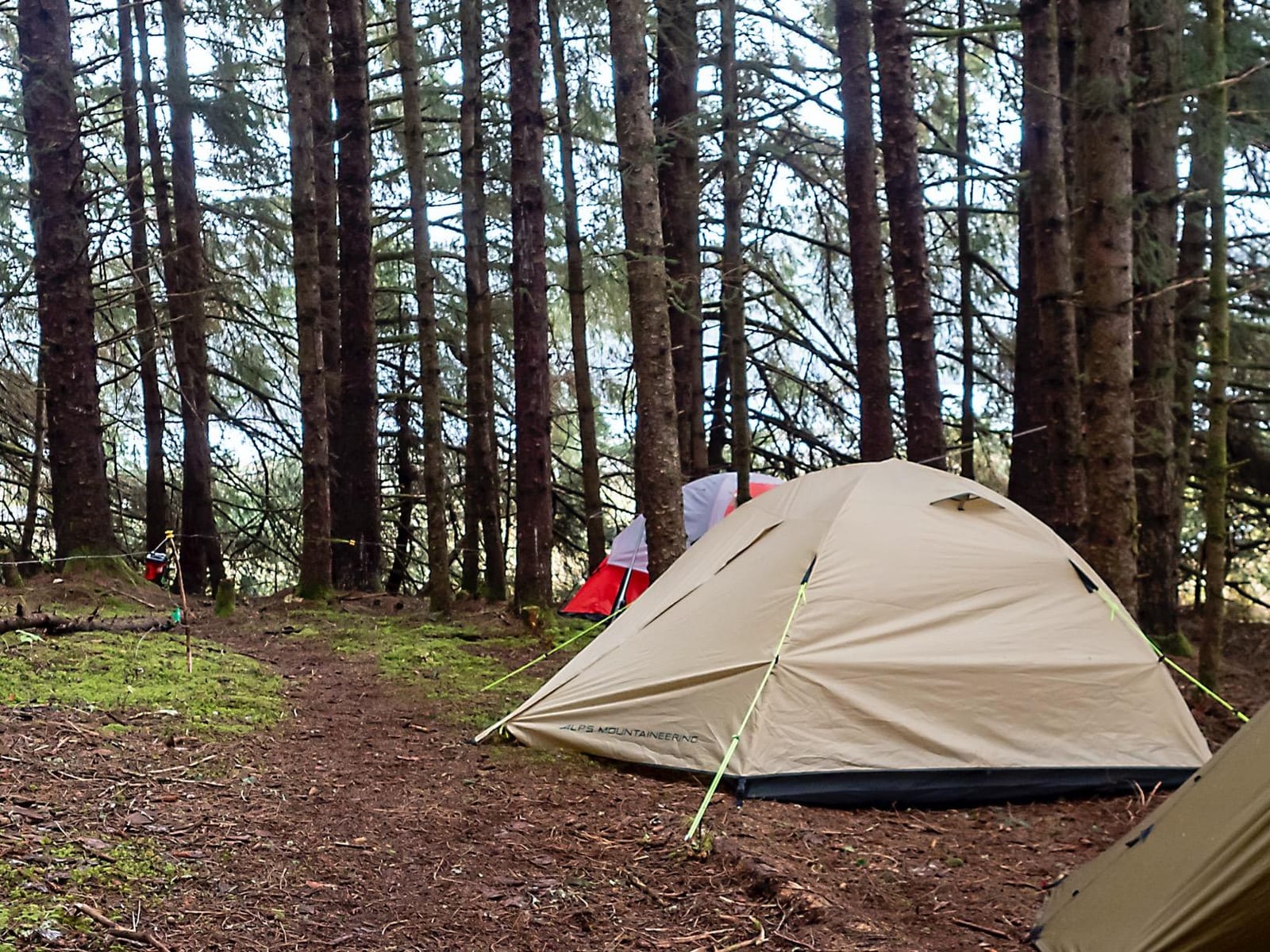
Hardware details are good for a shelter meant to be left up: oversized number 10 door and vestibule zippers, 7075 aluminum stakes, 7000 series aluminum poles, two vestibules, mesh pockets, and a gear loft. The limited lifetime warranty is the strongest durability signal in this roundup.
The listed weight of 15.1 pounds is a hard constraint. Nothing about this tent is meant to be carried, and the 1500mm fly coating means sustained rain will eventually find the seams.
Where it earns its place
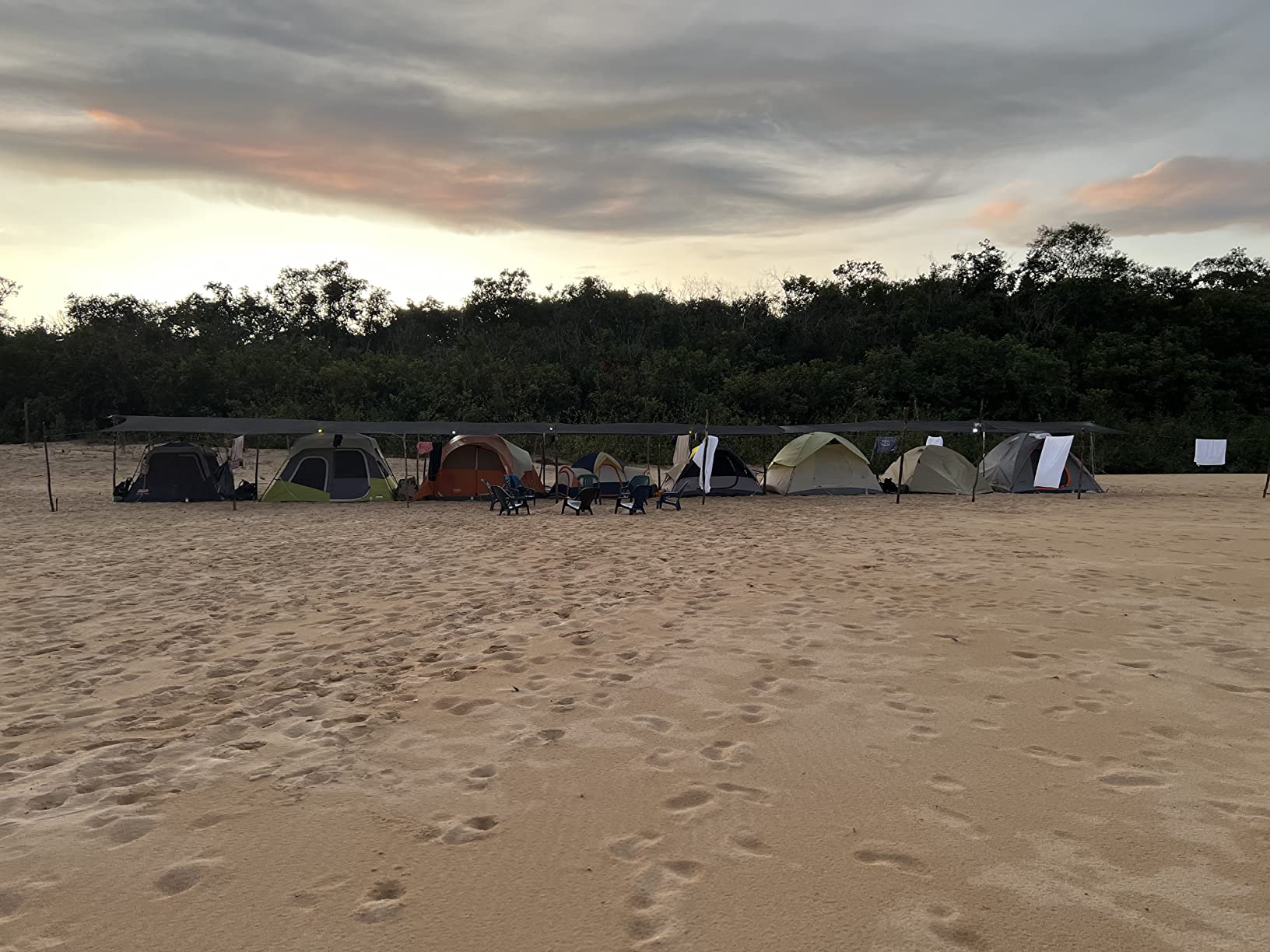
A 64 square foot base with 4 feet 4 inches of headroom is a room, not a shelter. That is the right tool for a winter base camp where you are putting up a tent for a week, or a hunting camp, or a car-camping setup where gear gets left outside in the cold.
Oversized zippers and a double-weight floor are features you will only appreciate in a long-lived tent, and that is exactly the use case here.
Who should skip it
Skip it for any trip where the tent is carried or where snow load is likely. A 1500mm, three-season-rated fly on a 15.1 pound frame is the wrong combination for winter camping.
Anyone who wants a big shelter and plans real winter storms should look at the GEERTOP 4 Person or the Naturehike Dune instead, both of which carry 5000mm-class floors and far better hydrostatic head.
12. Dandelion Shell 4 Season Hot Tent: Best for a Three-Person Hot Tent Base
Dandelion Shell 4 Season Hot Tent Cabin X3 with Stove Jack for 2-3 Person
5788 sq in floor
98.43 x 59 x 78.74 in
11.24 lb total
70D silicone-coated polyester
Pros
- Waterproof silnylon held up over 57 consecutive pitched days
- Kept a camper and child warm with a stove in 28 degree weather
- Fireproof ground mat included
- Numbered poles
- good stakes and storm-flapped zippers
- Responsive customer service supplied a replacement fly and poles
Cons
- Lowest average rating here at 4.0 with 12 percent one-star reviews
- Nylon fabric is very thin for deep winter
- Included guylines are insufficient in wind
- Weak seam stitching reported and a side panel tore
- Floor attaches at only six points
This is the most polarised product in the roundup, and we are including it because the split tells you something. Buyers running it as a spring or autumn hot tent with a stove praise the waterproofing and the hexagonal lodge design, while others rate the thin fabric, weak wind performance, and seam stitching as deal-breakers for true winter use. The 4.0 average across 101 reviews, with 12 percent one-star, reflects that split honestly.
Positive reports include keeping an adult and a child warm with a hot stove in 28 degree weather, and staying dry through a day and a half of rain in the same cold. One owner logged 57 consecutive pitched days without a waterproofing failure, which is a genuine durability data point.
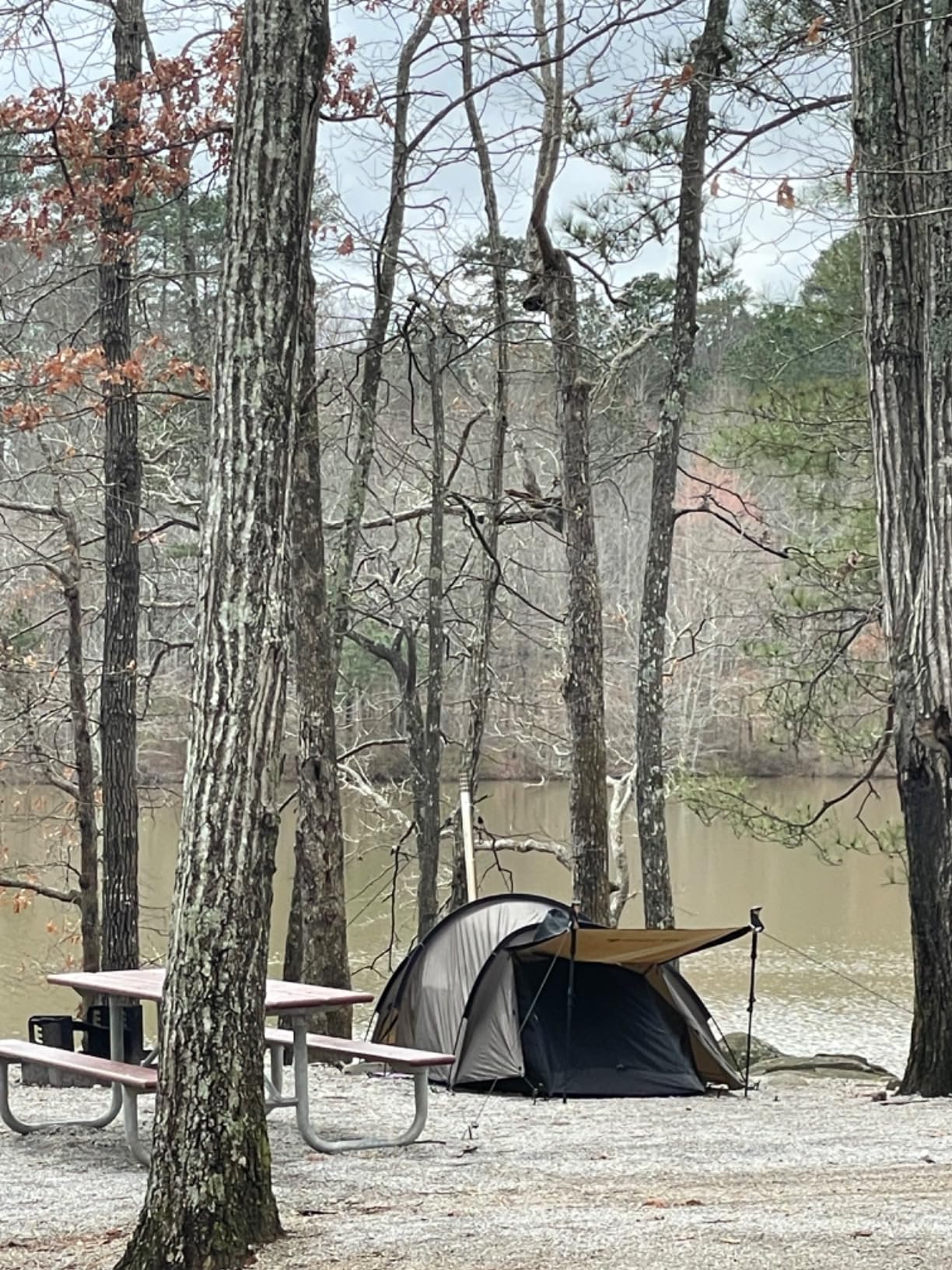
The build list is generous: a fireproof ground mat, 16 stakes, five guy ropes, four hooks, a double zipper, and weatherproof zippers with storm flaps and velcro covers. The fabric is 70D single-sided silicone-coated polyester with a heat-resistant stove jack, rated at 3000mm, and it weighs about 11.24 pounds.
The complaints are specific and worth weighing. The nylon is very thin and better suited to three-season than deep winter use, the included guylines are not enough in wind and extra lines over the entrance are considered essential, and stitching along seams has been reported as weak, with one side panel tearing on a second pitch. The floor attaches at only six points.
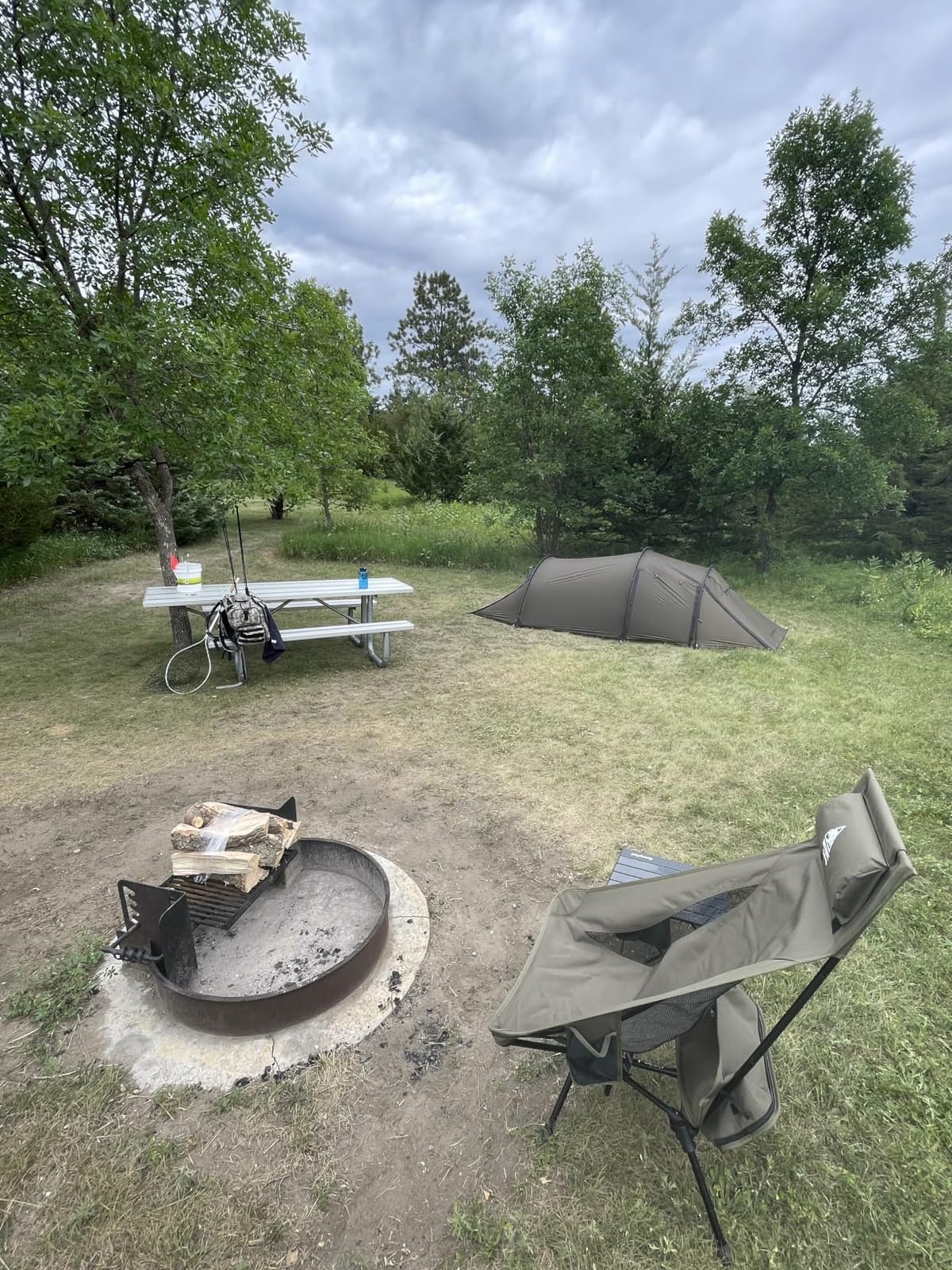
When a hot tent makes sense instead of a backpacking shelter
A hot tent trades weight for heat generation. That trade only works where you are not carrying the tent far, where a stove can burn safely with open ventilation, and where a single shelter serves two or three people who would otherwise need separate sleeping systems.
For that specific job, the stove jack, fireproof mat, and 5788 square inch floor work. For anything else, a coated double-wall backpacking dome is the safer buy.
Who should buy it
Buy it for spring and autumn hot-tent camping, basecamp winter use in a sheltered site, or as a budget heated shelter where you will buy your own guylines and stakes immediately. Customer service responsiveness is a plus if something arrives damaged.
Skip it for exposed wind, for deep winter, and for anyone who will not carry the extra tie-down points a shelter this light needs. Check the seam quality on arrival before you depend on it in a forecast.
How to Choose a 4-Season Tent
Start with the trip, not the spec sheet. Below-treeline car camping, ski touring, hut-to-hut winter traverses, high-alpine mountaineering, and Denali-class expeditions each need a different shelter, and the categories overlap far less than the marketing suggests.
Mountaineering tents are built for above-treeline terrain, sustained wind, and snow loading. They use the highest pole counts and the steepest wall angles, and they are the most expensive category.
Basecamp tents trade every gram for space. They are freestanding, often cabin-shaped, and frequently hot tents with a stove jack. Weight is irrelevant because they are carried from a vehicle.
Treeline tents are the winter backpacking middle ground: double-wall domes with strong poles, good fabric, and a weight you can still carry for several days.
Pyramid mids are the lightest and most efficient, at the cost of comfort, pitch complexity, and insect protection.
Weather protection: pole count, pole crossings, and fabric
Strength comes from how poles cross. A single ridge pole on an A-frame like the camppal 1 Person is efficient and light but limited in wind, while two crossed poles like the GEERTOP 2 Person and four poles like the Naturehike Dune spread load far better. Thicker poles resist bending under snow load and under wind pressure at the same time.
Fabric follows the same logic. A PU 5000mm coating protects against sustained rain but can hydrolyse over years if stored damp, while a silicone coating such as the OneTigris Stella uses lasts longer but usually costs more weight. Below-freezing temperatures make this trade real, because cold-stiff fabric cracks and cold PU coatings are at their least flexible.
Look for three secondary details: a snow skirt to block spindrift at floor level, an extended rainfly that reaches the ground, and sealed or taped seams. Two of the three products in this roundup list taped seams as a headline feature, and it is the cheapest weather protection you can buy.
Weight, packed size, and pack volume
Trail weight is not the same as packed weight. The camppal lists 3.75 pounds, the Clostnature lists 6.3 pounds total but 5.3 pounds minimum trail weight, and the Naturehike Dune lists 16.5 pounds total. A 60 to 65 liter pack can carry a week of winter gear depending on what else is in it, so a 5 to 7 pound tent budget keeps that achievable.
Packed diameter matters more than packed length. The 1/2 Person 4 Season tent packs to just 5.9 inches in diameter, which is a genuinely efficient shape, while the Dune at 24.8 by 11.8 by 8.6 inches is a dedicated basecamp load.
Interior space, capacity, and livability
Floor area benchmarks are useful. Below about 27 square feet feels tight for two adults in winter clothing, 28 to 34 is comfortable, and 35 to 40 is spacious. On that scale, the camppal at 24.19 square feet is solo territory, the OneTigris Stella at 28.29 is snug for a pair, and the Naturehike 2 Person at 41.23 is genuinely roomy.
Peak height decides whether you can sit up. The GEERTOP 4 Person at 55 inches and the Naturehike Dune at 70.8 inches are changeable spaces, while the Naturehike Massif at 43.3 inches and the Naturehike 2 Person at 43.3 inches are sit-up-only shelters.
Rated capacity is also a marketing number. The GEERTOP 4 Person is listed for four and reviewed as comfortable for two adults plus gear, which is the honest reading of nearly every four-person dome on the market.
Ventilation, condensation, and what actually keeps you warm
A 4-season tent keeps you dry and sheltered. It does not make you warm. Warmth comes from your sleep system, insulation, and moisture management, and no shelter in this roundup changes that.
The practical ventilation checklist is short: operable high vents you can reach in gloves, a door and a window on the same side for cross-flow, and enough opening area to dump a night of breath moisture. The Naturehike 2 Person with three windows and double doors, and the GEERTOP 2 Person with mesh panels, both score well here. The POMOLY Chalet 70 Pro with no high vents does not, and owners have cut their own vent holes.
Setup in bad conditions and total cost of ownership
Assembly time on the listings ranges from three minutes for the camppal and the Naturehike 2 Person, to fifteen minutes for the Naturehike Dune. Real-world time is longer when you are wearing gloves and the wind is trying to take the tent out of your hands. Products with color-coded pole guides, like the Naturehike Massif, earn their reputation faster.
Total cost of ownership is where four-season tents surprise buyers. A footprint or groundsheet, extra stakes, and a full set of guylines are frequently sold separately or are simply not included. The GEERTOP 4 Person ships with no canopy poles or ropes, the Naturehike 2 Person includes a footprint, and the Naturehike Dune carries a two-year warranty while the ALPS Taurus carries a limited lifetime warranty. Budget for stakes and cords on every tent in this list.
Condensation: The Real Enemy in Winter Camping
Condensation is the number one complaint in the winter tent threads, and it is the thing that actually makes people miserable. You breathe out roughly a litre of water a night for two people, and in a closed tent below freezing that water has nowhere to go but onto your sleeping bag and your kit.
The community advice is consistent and correct: open the vents even if it is freezing, before you get into the bag rather than an hour later. Warm, humid air that never leaves the tent is what produces frost on the inner surface, and frost that later melts is what wets your sleeping bag.
On arrival, pitch the tent, tension every guyline, and open the vents before you unpack anything. During the night, keep a window cracked opposite the door for cross-flow, and keep wet clothing in a dry bag or a vestibule rather than on the floor. In the morning, do the opposite: close the tent up so the rising sun and body heat dry it, and leave damp gear outside to dry before packing it back down.
Single-wall shelters and pyramid mids worsen this because there is no inner airspace to hold condensation away from you. Mesh inner bodies improve ventilation but let wind through, which is the trade-off users argue about most. If you camp in real winter, a solid inner canopy beats mesh; if you camp in shoulder seasons, mesh wins.
Four-Season Shelters We Would Not Take Into Deep Winter
Not every tent on a four-season list belongs there. The ALPS Taurus 4 Outfitter is the clearest example in this roundup, since the manufacturer lists it as three-season with 1500mm water resistance. It is a durable, spacious basecamp tent, and it is the wrong tool when snow is in the forecast.
Over-meshed three-season domes are the most common purchase mistake. Mesh panels block neither wind nor spindrift, and a shallow two-pole dome with little guy-out capability will not survive sustained weather above treeline, no matter what the label says.
A third category to be careful with is any tent whose listed weight is only a minimum trail weight. Check the total packed weight before you plan a week-long trip, because the difference between 5.3 and 6.3 pounds is the difference between a comfortable pack and a frustrating one.
If you are still undecided, our guides to the best canopy tents and the best truck bed tents cover the vehicle-based end of winter shelter, and the best hammock tents cover the ultralight summer end where weight rules out winter entirely.
Frequently Asked Questions
What is the best 4-person tent for cold weather camping?
The GEERTOP Waterproof 4 Person 4 Season Camping Tent is the strongest 4-person option here, with 7797.44 square inches of floor area, four vestibules, a 210D Oxford floor rated at PU5000mm, and owners reporting it standing up leak-free in a 60 mph wind and rain storm. Be realistic about the four-person rating though: reviews describe it as comfortable for two adults plus gear. Its 9.1 pound weight also means it must be driven to camp, not carried.
What is the best tent to stay warm in winter?
No tent makes you warm. A 4-season shelter keeps precipitation off your sleep system and blocks wind, but warmth comes from your sleeping bag, pad, insulation, and moisture management. The most important cold-weather habit is venting: open the vents before you climb in, not an hour later, because trapped breath moisture freezes onto the inner surface and then soaks your bag when it melts. Choose a solid inner canopy over mesh for genuine winter trips.
What is the best camping tent for snowy conditions?
The Clostnature 4 Season Backpacking Tent is the pick for genuine cold, with a PU5000mm bathtub floor, factory-sealed seams, snow flaps against spindrift, and owners reporting dry trips with two adults at 20 degrees F. The GEERTOP 2 Person is the best all-round choice thanks to its 210T ripstop fly and extended snow skirt. A rough forecast threshold: move to a four-season shelter when snow of an inch or more, sustained wind above 30 mph, or exposed alpine terrain is called for.
What is the best tent for winter use?
A 4-season tent is a shelter engineered to hold against sustained wind, snow loading, and precipitation below freezing, typically built with multiple crossed poles, steep shed-snow walls, reinforced guy-out points, and silnylon or coated nylon fabrics that stay waterproof when cold. The three categories are mountaineering tents for alpine and expedition use, basecamp tents you never carry, and treeline tents for winter backpacking. Our overall pick is the GEERTOP 2 Person Backpacking Tent.
Are 4-season tents worth it?
They are worth it when the trip demands them and wasteful when it does not. A four-season shelter earns its weight on ski touring, winter backpacking, exposed alpine terrain, and Denali-class trips. For sheltered below-treeline winter camping in a mild climate, a capable three-season tent with a solid canopy can work. The two things worth paying for in any four-season tent are a coated floor and enough guy-out points to stake it down in the direction the wind is coming from.
Do 4-season tents keep you warm or just keep you dry?
Just dry and sheltered, not warm. The distinction matters because buyers often expect a tent to solve a temperature problem it cannot. Warmth comes from your sleep system, insulation, and how well you keep moisture out of it. A four-season tent earns its place by preventing precipitation from reaching your sleeping bag, blocking wind, and giving you vents you can open so your breath does not condense and freeze onto the fly overnight.
Is it safe to run a stove inside a tent?
Only with open ventilation and a carbon monoxide alarm, and never unattended. Carbon monoxide is odourless and lethal. A hot tent with a stove jack still needs its doors or high vents open, a stove that burns cleanly, and an alarm inside. Keep the stove on the fireproof ground mat, keep the inner tent fabric clear of the jack, and remember that the POMOLY Chalet 70 Pro and Naturehike Dune both list fireproof or ember-resistant floors for exactly this reason.
How do I stop condensation in a winter tent?
Vent before you settle in, not after. Open the vents and crack a window opposite the door as soon as you pitch, so cross-flow starts before you are generating humidity. Keep wet clothing in a dry bag or a vestibule rather than on the tent floor, and close the tent up in the morning to let rising heat and sun dry it. In the morning leave damp gear outside to dry before packing it back down, and dry the tent fully at home rather than stuffing it wet.
What is the lightest 4-season tent?
The camppal 1 Person Tent is the lightest genuine winter shelter in this roundup at about 3.75 pounds, with a 1.23 kg listed weight and a 3-minute single-pole pitch. It is not freestanding, so it must be staked into soil or snow, and its 24.19 square foot interior is tight. Among double-wall shelters, the Naturehike 4 Season 2 Person Tent carries a 4.1 pound trail weight with a footprint included, making it the lightest option for a couple.
How much snow can a 4-season tent hold?
There is no published figure that applies, because snow load depends on pole strength and roof geometry rather than a rating. Steep tapered walls and pyramid shapes shed snow; shallow domes accumulate it. Owners of the Naturehike Massif report two inches of snow on the roof with no effect on the tent or poles, while one owner of the POMOLY Chalet 70 Pro had a pole snap when four inches of wet snow collapsed onto the tent. Wet snow is far heavier than dry snow, so clear the roof periodically with a pole or your pack lid.
What size tent do I need for winter camping with a partner?
Plan on at least 28 to 34 square feet of floor for two adults in winter clothing, and more if you are carrying internal-frame packs or a dog. The OneTigris Stella at 28.29 square feet is at the snug end, the GEERTOP 2 Person at 4545.6 square inches works well for two light campers, and the Clostnature at 5133 square inches is the most comfortable. Peak height matters too: 45 inches is sit-up-only in bulky clothing, so consider 55 inches if you want to change clothes inside.
What extras do I need beyond the tent?
Almost every four-season tent needs a footprint or groundsheet, extra stakes, and a full set of guylines. The GEERTOP 4 Person ships with no canopy poles or ropes, and several tents in this roundup have weak or light included stakes, so heavier ones are a worthwhile upgrade. Seam sealing at home before a January trip costs almost nothing and prevents a common failure. If you use a hot tent, add a carbon monoxide alarm, a stove that burns cleanly, and a firestorm-rated mat under the stove.
Conclusion: The Best 4 Season Tents for Winter Camping
If you only buy one shelter from this roundup, buy the GEERTOP 2 Person Backpacking Tent. It has the deepest owner record at 2532 reviews, a taped 210T ripstop fly with a snow skirt, dual vestibules, and a five-minute pitch, and it is the most balanced of the 12 on every axis that matters in winter. For deeper cold with a partner, step up to the Clostnature and its PU 5000mm bathtub floor, or lighten up with the Naturehike 2 Person at a 4.1 pound trail weight.
If you are not carrying the tent at all, the GEERTOP 4 Person for families, the Naturehike Massif for motorcycle base camp, and the Naturehike Dune for stormy car camping with a stove cover the rest. Whichever you choose in 2026, buy a full set of guylines and heavier stakes, seal the seams at home, and open the vents before you get in. Those three habits decide whether your winter camping goes well.