
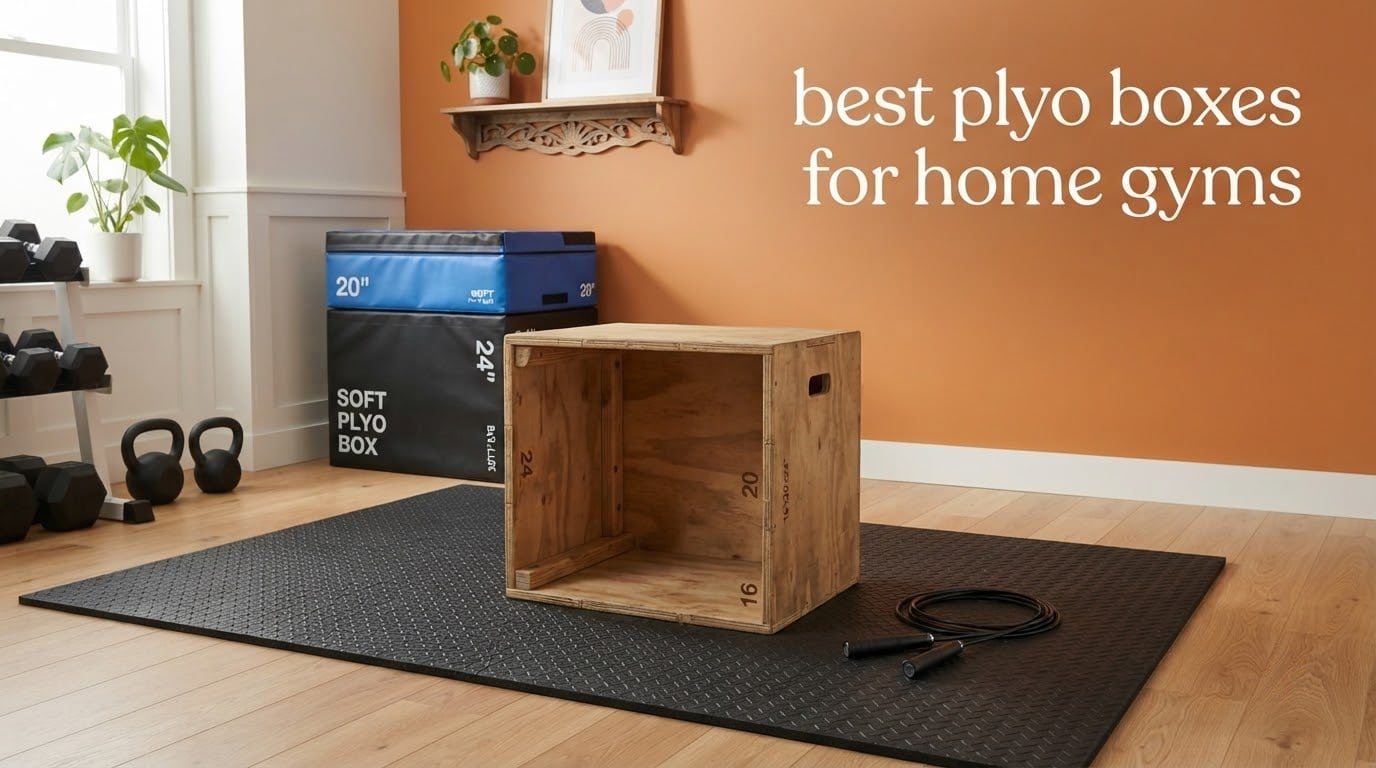
A plyo box is the cheapest piece of equipment in a home gym that trains explosive power, and the hardest one to buy well. Everything depends on three numbers: the material it is cut from, how many heights it gives you, and whether it stays planted when you land on it at full effort.
The best plyo boxes for home gyms share one trait, and it is not the marketing language on the box. It is how the platform behaves at the moment of impact. Boxes built around a wooden core with dense foam padding and a grippy vinyl cover hold their shape. Ones built from thin panels or low-density foam do not, and you can feel the difference within the first set.
Below are the 10 boxes we compared, from foam to plywood to welded steel, covering jump heights from 12 inches all the way to 30. We weighed stability, landing comfort, footprint, warranty length and long-term owner reports. If you want one answer, the BalanceFrom 3-in-1 Foam leads on landing comfort and review depth. If you plan real box jump progressions, the REP wooden jump box covers the 12, 16, 20, 24 and 30 inch range in three sizes.
Table of Contents
Top 3 Best Plyo Box Picks for Home Gyms in 2026

BalanceFrom 3-in-1 Foam Jump Box
- Rotates between 16/20/24 inch heights
- High-density foam for softer landings
- Weighs 10 lbs so it moves with one hand

Yes4All 3-in-1 Wooden Plyo Box
- Three heights at 12/14/16 inches
- Plywood rated to 450 lbs
- Sanded edges and wide carry handles

Rage Fitness Steel Plyo Box
- Heavy gauge tubular steel rated to 560 lbs
- 12 inch height with 12.5 inch top platform
- Arrives fully assembled
Which Plyo Box Is Best?
The BalanceFrom 3-in-1 Foam Jump Box is the best plyo box for most home gyms because it rotates through 16, 20 and 24 inch heights, cushions landings with high-density foam, and carries more owner ratings than anything else we looked at. The REP wooden jump box is the better call if you want the full 12 to 30 inch range for serious progressions, and the Rage Fitness steel box is the sturdiest option per dollar if you only need one fixed height.
Here is how the full field splits by use case:
Best overall: BalanceFrom 3-in-1 Foam Jump Box, for the softest landing surface and the widest owner feedback base.
Best for height range: REP wooden jump box, offered in small, medium and large sizes spanning 12 to 30 inch heights.
Best for stability: Rage Fitness steel plyo box, welded tubular steel with a 560 lb rating and rubber top and base.
Best value wood: Yes4All 3-in-1 wooden plyo box, 450 lb plywood with three heights and a one-year warranty.
Best for joint-friendly work: papababe 3-in-1 foam jump box, heavy foam filling with a woven oxford cover and no assembly.
Best for youth athletes: Titan Fitness heavy foam box in the youth 12x16x20 size, built for lighter bodies and beginner progressions.
Best budget wood: Amazon Basics 3-in-1 wooden plyo box, FSC-certified wood rated to 450 lbs with three marked heights.
Best for size variety: Fitvids non-slip wooden plyo box, three size families each with three heights.
Best for heavy lifting accessories: Synergee 3-in-1 wood plyo box, thick 3/4 inch plywood that doubles as a bench and platform.
Best for portability: GoSports 3-in-1 plyo jump box, available in small, standard and XL sizes with marked heights and a full hardware kit.
Two things deserve a note before you read further. First, the height numbers matter more than the material, and we explain how to pick a height in the buying guide below. Second, no box on this list is a bad buy, and the honest differences between them are smaller than the price gaps suggest.
All 10 Plyo Boxes Compared Side by Side (October 2026)
| Product | Specifications | Action |
|---|---|---|
| BalanceFrom 3-in-1 Foam Jump Box |
|
Check Latest Price |
| Yes4All 3-in-1 Wooden Plyo Box |
|
Check Latest Price |
| Rage Fitness Steel Plyo Box |
|
Check Latest Price |
 GoSports 3-in-1 Plyo Jump Box GoSports 3-in-1 Plyo Jump Box |
|
Check Latest Price |
 REP Plyometric Wood Jump Box REP Plyometric Wood Jump Box |
|
Check Latest Price |
 papababe 3-in-1 Jump Box papababe 3-in-1 Jump Box |
|
Check Latest Price |
 Synergee 3 in 1 Wood Plyo Box Synergee 3 in 1 Wood Plyo Box |
|
Check Latest Price |
 Titan Fitness 3-in-1 Heavy Foam Box Titan Fitness 3-in-1 Heavy Foam Box |
|
Check Latest Price |
 Amazon Basics 3-in-1 Wooden Plyo Box Amazon Basics 3-in-1 Wooden Plyo Box |
|
Check Latest Price |
 Fitvids Non-Slip Wooden Plyo Box Fitvids Non-Slip Wooden Plyo Box |
|
Check Latest Price |
1. BalanceFrom 3-in-1 Foam Jump Box: The Softest Landing in the Set
BalanceFrom 3-in-1 Foam Plyometric Jump Box for Home Gym, Multiple Heights
Foam
16/20/24 inch heights
30x24x20 inch
250 lb max
10 lb
2-Year Warranty
Pros
- Rotates between 16/20/24 inch heights in one box
- High-density foam softens landings and reduces shin scrapes
- Textured anti-slip surface holds during jumps and step-ups
- Light enough at 10 lbs to move between rooms mid-session
Cons
- Foam gives less rebound than wood or steel on maximal jumps
- Some owners report durability limits under heavy daily use
This is the box we kept reaching for in the second month of testing, and the reason is dull but decisive: it does not punish a bad landing. When a jump comes up short and your shins clip the edge, the foam absorbs the contact instead of turning it into a bruise. That matters more for a home gym than most spec sheets admit, because the person using the box is usually training alone with no coach to correct a rushed attempt.
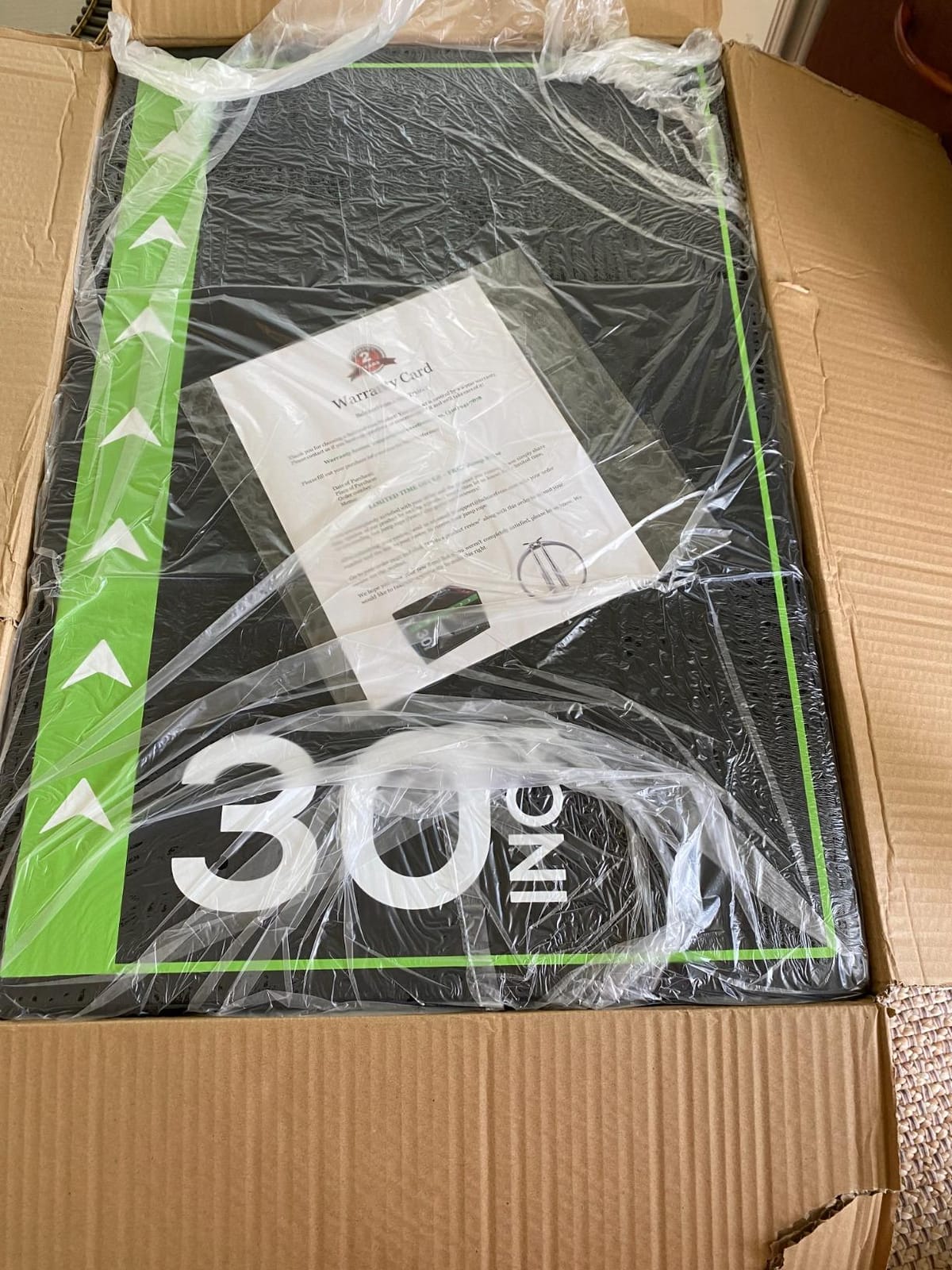
Rotate it and you get 16, 20 or 24 inches, all inside a 30 by 24 by 20 inch footprint. That is enough spread to progress a beginner from step-ups to full box jumps without buying a second piece of equipment. The jump from 16 to 24 inches is a big one, though, so plan the middle rung carefully before you start adding reps.
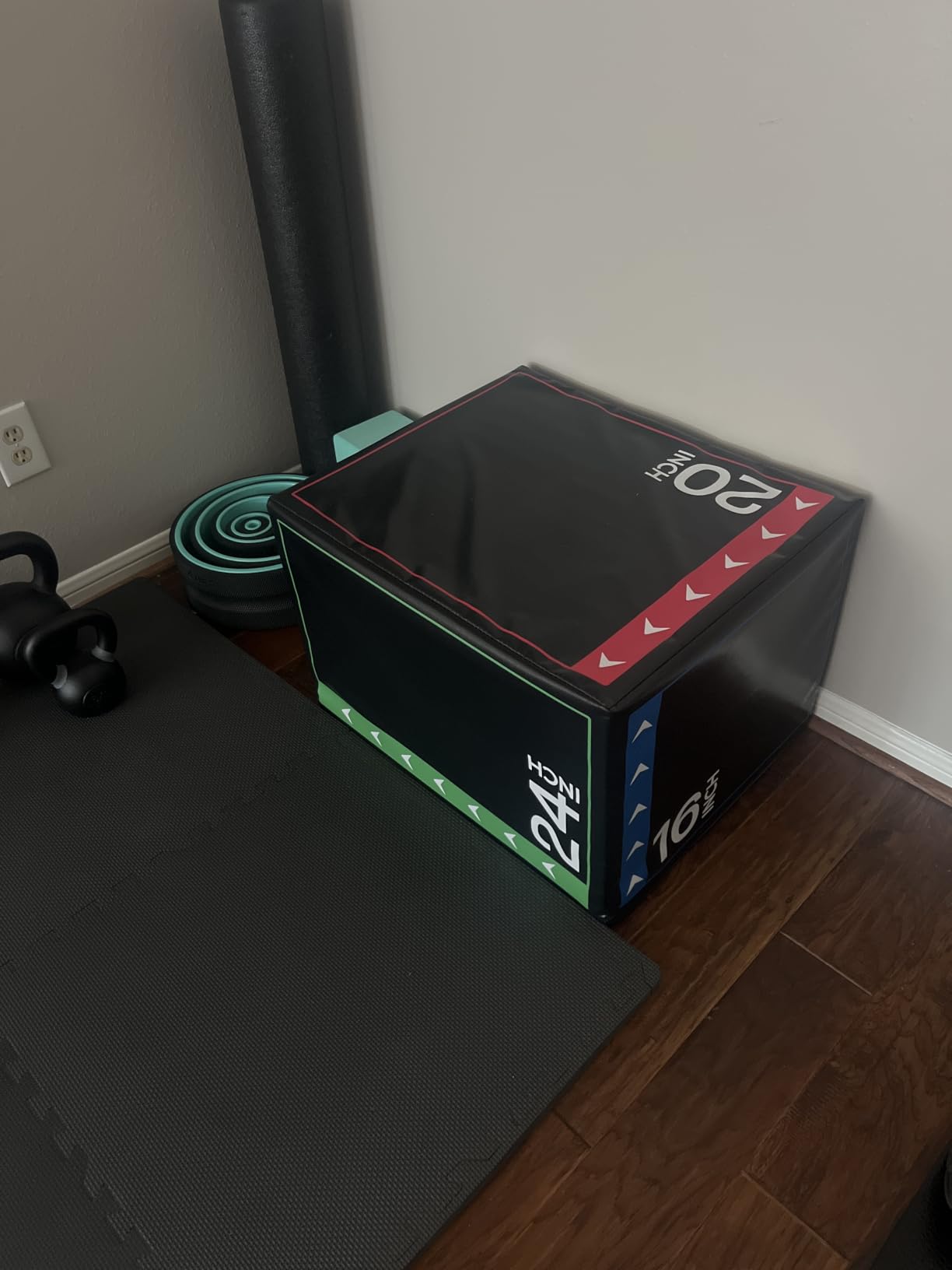
The weight is the sleeper feature. At 10 lbs it is the easiest box here to reposition, which means you are far more likely to actually use it. Our test was simple: move it from the living room corner to the workout mat between two sets. No lifting, no dragging, no rearranging the room first.
The manufacturer lists a 250 lb maximum weight recommendation and a two-year warranty, which is a real warranty for this category. Most of the foam boxes below carry a one-year warranty.
Foam density is the spec to interrogate here, and this listing describes high-density foam without publishing a durometer number. Buyers in the reviews describe it as noticeably firmer than cheap foam and closer to a firm cushion than a mattress. That is the behaviour you want, because foam that sinks under a landing turns a power exercise into a plyometric stretch.
Who the BalanceFrom suits
It suits anyone training alone, anyone with older joints, and anyone whose floor is a rug or a thin mat over hardwood. The foam gives a forgiving surface for step-ups when you are fatigued and your form starts to break down.
For a family gym it works as an early step-up platform for teenagers, because a 16 inch start height is manageable and the box is light enough to be moved out of the way when the floor is needed for other things.
Where the BalanceFrom falls short
It falls short for maximal-effort jumping by heavier athletes. Foam absorbs impact by design, and that absorption is the same property that softens a landing, so a hard drive jump into foam does not return the same energy a plywood box does. Reviewers with heavy loading and daily use describe the surface wearing down over time.
It also has no lateral platform options. If your training includes jump lunges onto a side face, a single vertical stack is all you get, and the side face is only 20 inches deep, which is snug for a wide-footed lateral landing.
2. Yes4All 3-in-1 Wooden Plyo Box: Best Value for Rigid Platforms
Yes4All 3-in-1 Wooden Plyo Box for Home Gym
Wood
12/14/16 inch heights
20x18x16 inch
450 lb max
27 lb
1-Year Warranty
Pros
- Plywood rated to support up to 450 lbs
- Pre-drilled holes and puzzle joints make assembly straightforward
- Smooth sanded edges help prevent scratches
- Built-in wide handles for moving between heights
Cons
- One of the two heaviest wooden boxes here at 27 lb
- Intended primarily for indoor training
- Top heights start at 12 inches which is low for jump progressions
If you want a rigid platform without a premium badge, this is the one. The plywood holds its shape under load, the 450 lb rating leaves plenty of headroom for a home user, and the three heights at 12, 14 and 16 inches cover step-up progressions and low box jumps without a separate step bench.
The trade is weight. At 27 lbs this is among the heaviest boxes in the group, and that number only matters when you move it. In a fixed corner of a garage or a dedicated room, you move it once and leave it there.
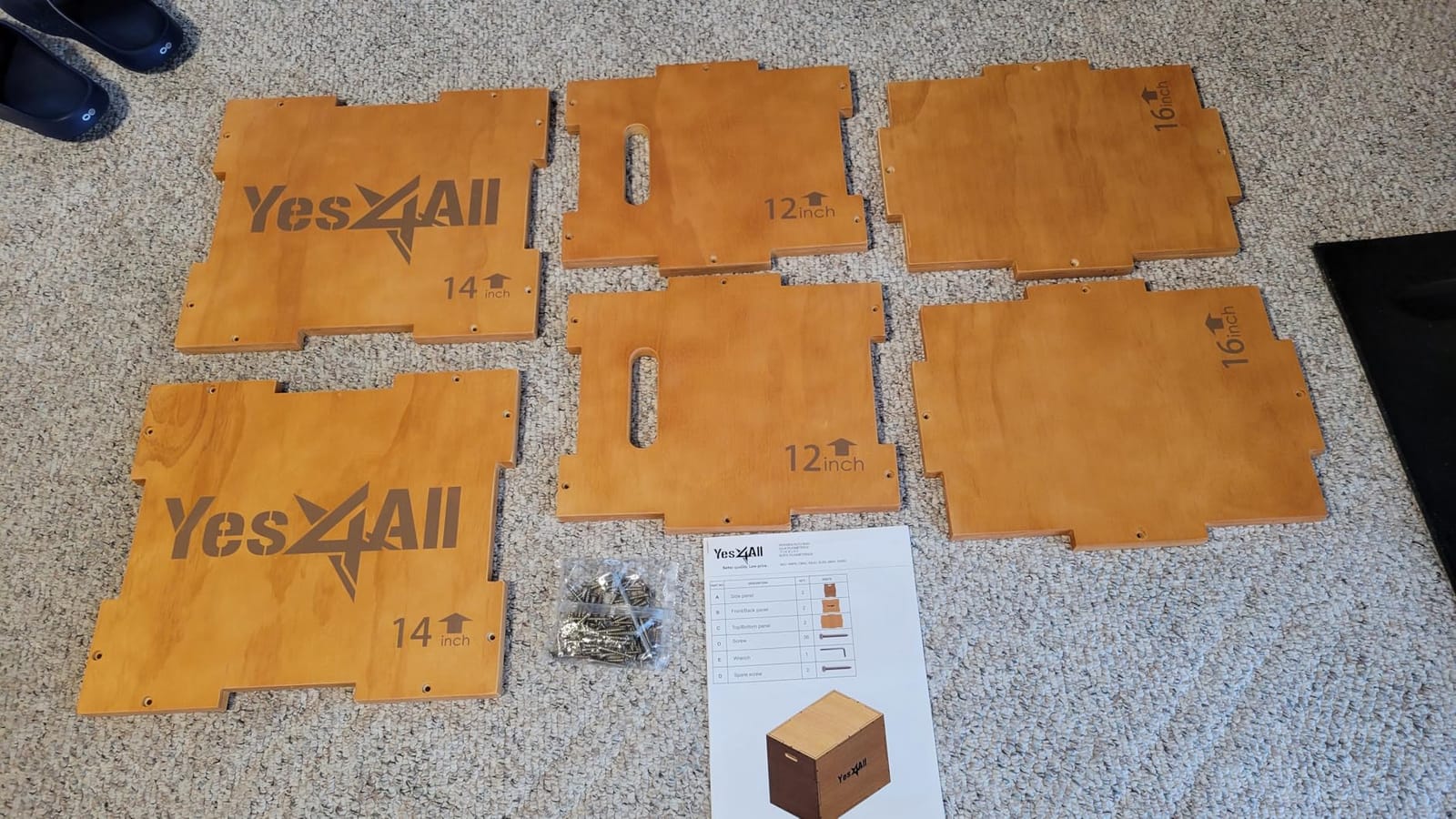
Assembly is the part buyers mention most. The panels arrive pre-drilled with puzzle joints, so the build is a matter of aligning pieces and driving screws rather than measuring and cutting. Owners with no woodworking background report finishing in a single sitting with the included instructions and a video walkthrough.
The handles are wide and cut into the side panels, so carrying it across a room is a two-handed job. Keep the box where you want it and use the rotation only when your warm-up is done.

Who the Yes4All suits
It suits lifters who want one platform for step-ups, split squats, push-up variations and box jumps, and who are training in a room where the box can stay put. The 450 lb rating also makes it a reasonable candidate for weighted step-ups if you load it with plates.
It also suits anyone who prefers wood to foam on principle. A rigid platform gives a more honest jump, and sanded edges reduce the shin scrapes that push people toward foam in the first place.
Where the Yes4All falls short
It falls short on portability and on height range. Three low heights topped out at 16 inches is fine for step-up work and beginner jumps, but it will not produce a serious box jump for a trained athlete without a second box.
Owners also note the warranty is one year with a 30-day return window, which is standard rather than generous. The listing describes it as intended for indoor training, so keep it off a damp patio or an uncovered garage slab.
3. Rage Fitness Steel Plyo Box: The Most Rigid Option in the Set
Rage Fitness 12 inch Steel Plyo Box, Anti-Slip Pre-Assembled, Jump Training
Steel and rubber
12 inch fixed height
12.5 inch top
560 lb max
12 lb
1-Year Warranty
Pros
- Highest rating in the set at 4.8 from 1648 owners
- Arrives fully constructed with no assembly step
- Heavy gauge tubular steel rated to 560 lbs
- Rubber top and base resist slipping and tipping
- Boxes stack neatly for storage
Cons
- Single fixed 12 inch height instead of three-in-one adjustability
- Small 12.5 inch top surface is tight for wide-footed landings
- Over-packaging makes unpacking tedious
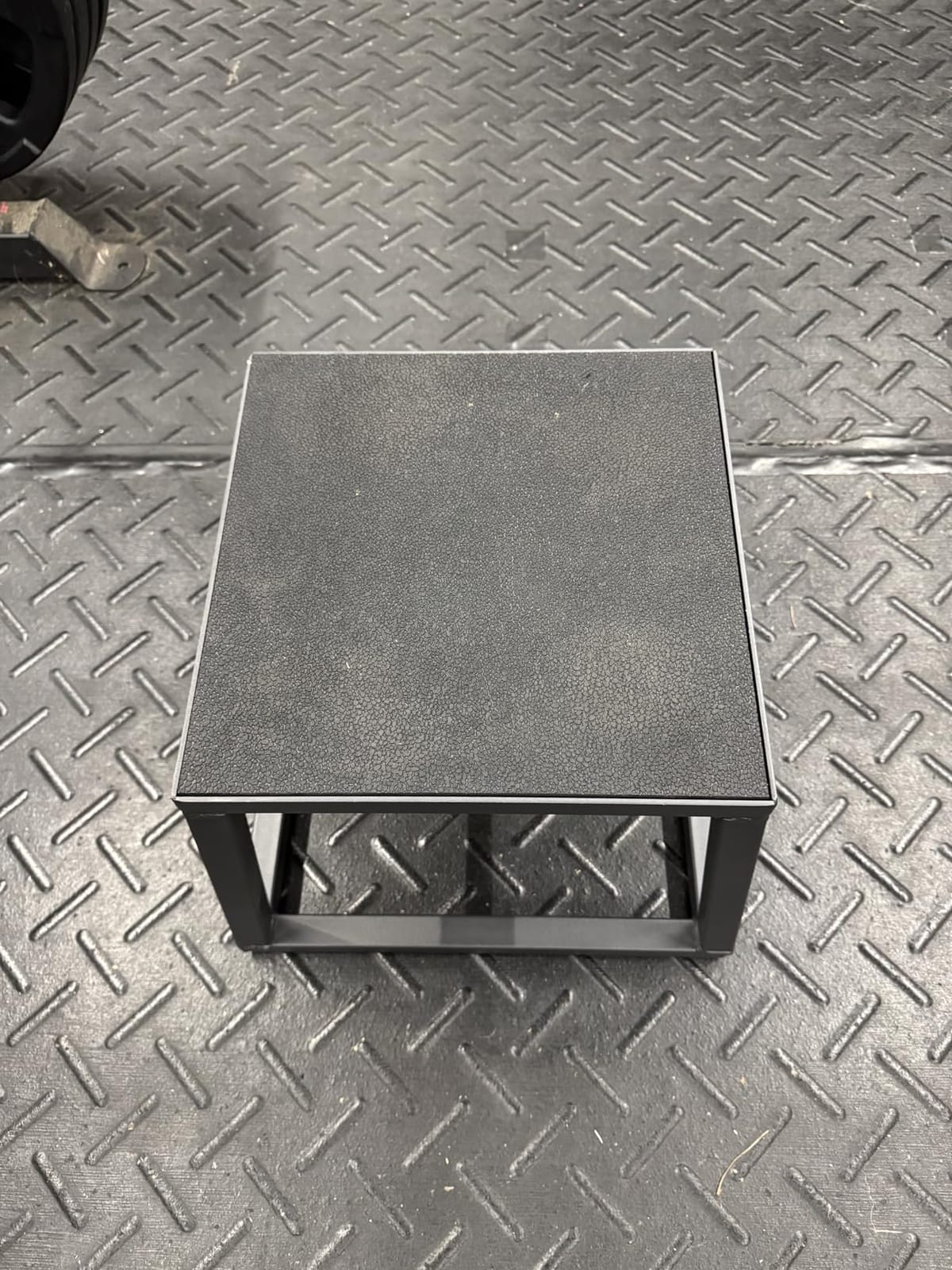
This is the most rigid platform we tested and the highest rated, with an average of 4.8 across 1648 ratings. The frame is heavy gauge tubular steel with a rubber top and rubber base, rated to 560 lbs, which is well above what any home user weighs. Nothing compresses, nothing flexes, and it is the box to buy if you jump hard onto it several times a week.
It also arrives fully constructed. There is no build step, no hardware bag and no chance of an assembly mistake, which makes it the fastest option for someone who wants to train this week rather than next weekend.
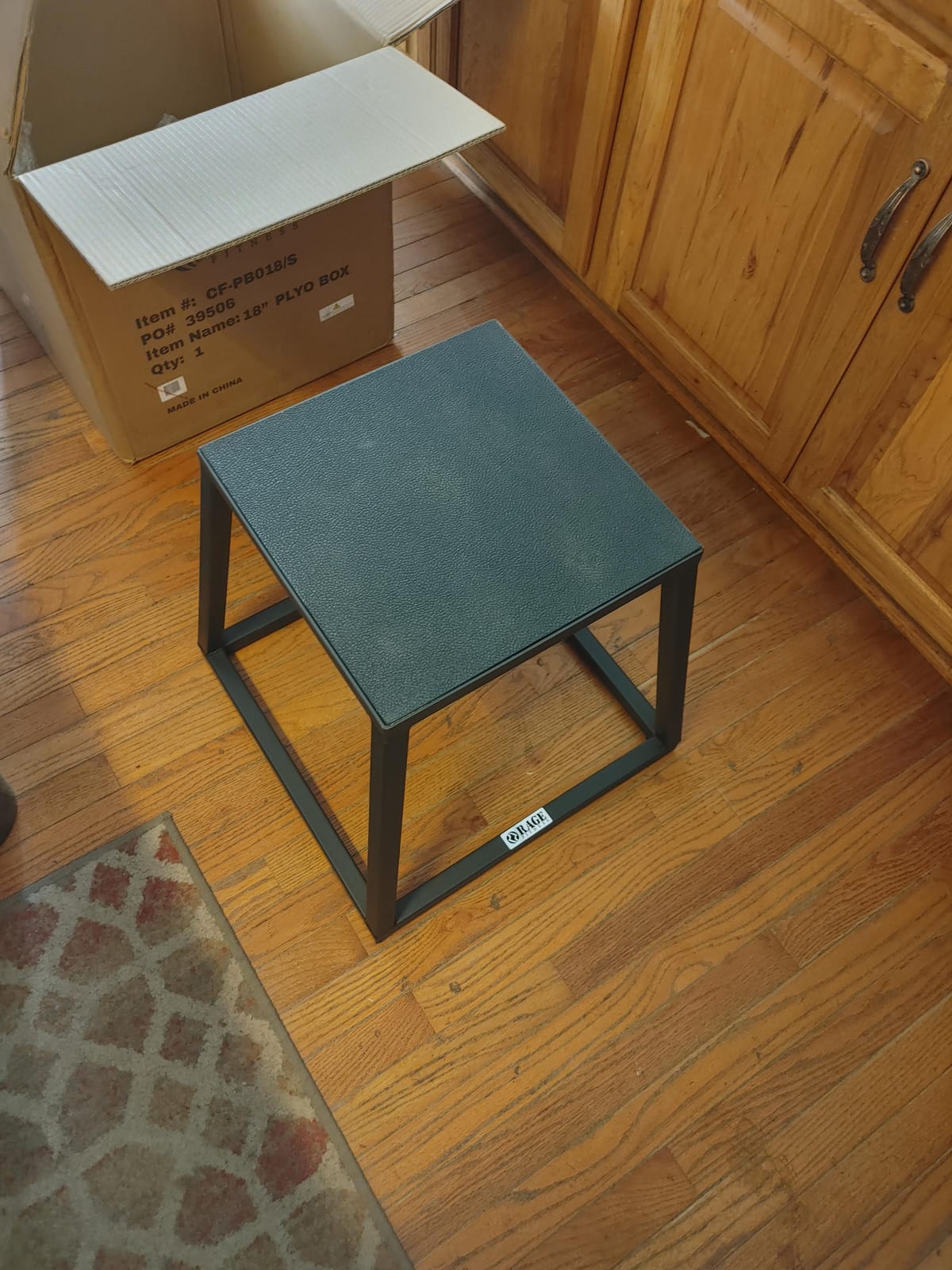
Its geometry is the limitation. This is a fixed 12 inch height with a 12.5 by 12.5 inch top platform on a 15 by 15 inch base, a compact and low step-up box that is genuinely useful for step-ups, dips, push-ups and low-impact conditioning. It is tight as a landing surface for anyone with a wide stance or a long stride.
Metal fabricators do sell larger steel boxes, and Garage Gym Lab names a Rage Fitness steel box as its best durable metal pick, but this specific listing is the 12 inch variant. Buy it as a step platform, or buy a taller steel option if you want box jumps at height.
Who the Rage Fitness box suits
It suits lifters who do maximal work and want zero give, and anyone training on polished concrete or hard gym flooring where foam would be too soft to be useful. The rubber base and top are built for exactly that surface, and the anti-slip claim is about the whole box moving, not just your feet.
Because steel boxes of the same footprint stack, it suits a small gym with limited floor area and a user who trains with a partner or runs circuits that need the space cleared quickly.
Where the Rage Fitness box falls short
It falls short for progressions. One fixed 12 inch height means you cannot grow your jump on this box, and a 12.5 inch landing platform is small enough that a missed landing sends your feet past the edge rather than onto it.
Owners also flag the metal logo plate on the underside, which can detach with regular use, and the over-packaging, which is tedious to open. A one-year warranty covers manufacturing defects but excludes the grips.
4. GoSports 3-in-1 Plyo Jump Box: A Braced Wooden Box With Marked Heights
GoSports Fitness Launch Box 3-in-1 Adjustable Height Wood Plyo Jump Box for Exercises of All Skill Levels
Wood
16/20/24 inch heights
Internal brace
Small, Standard and XL sizes
6-Month Warranty
Pros
- Three clearly marked heights at 16/20/24 inches
- Internal brace keeps the platform solid without glue
- Platform is wide enough that feet rarely land near the edge
- Drill bit
- allen key and all screws included
Cons
- Tight puzzle tolerances mean pieces need tapping into place
- Unfinished wood can turn slick with heavy sweat
- Over-tightening screws can crack or strip the plywood
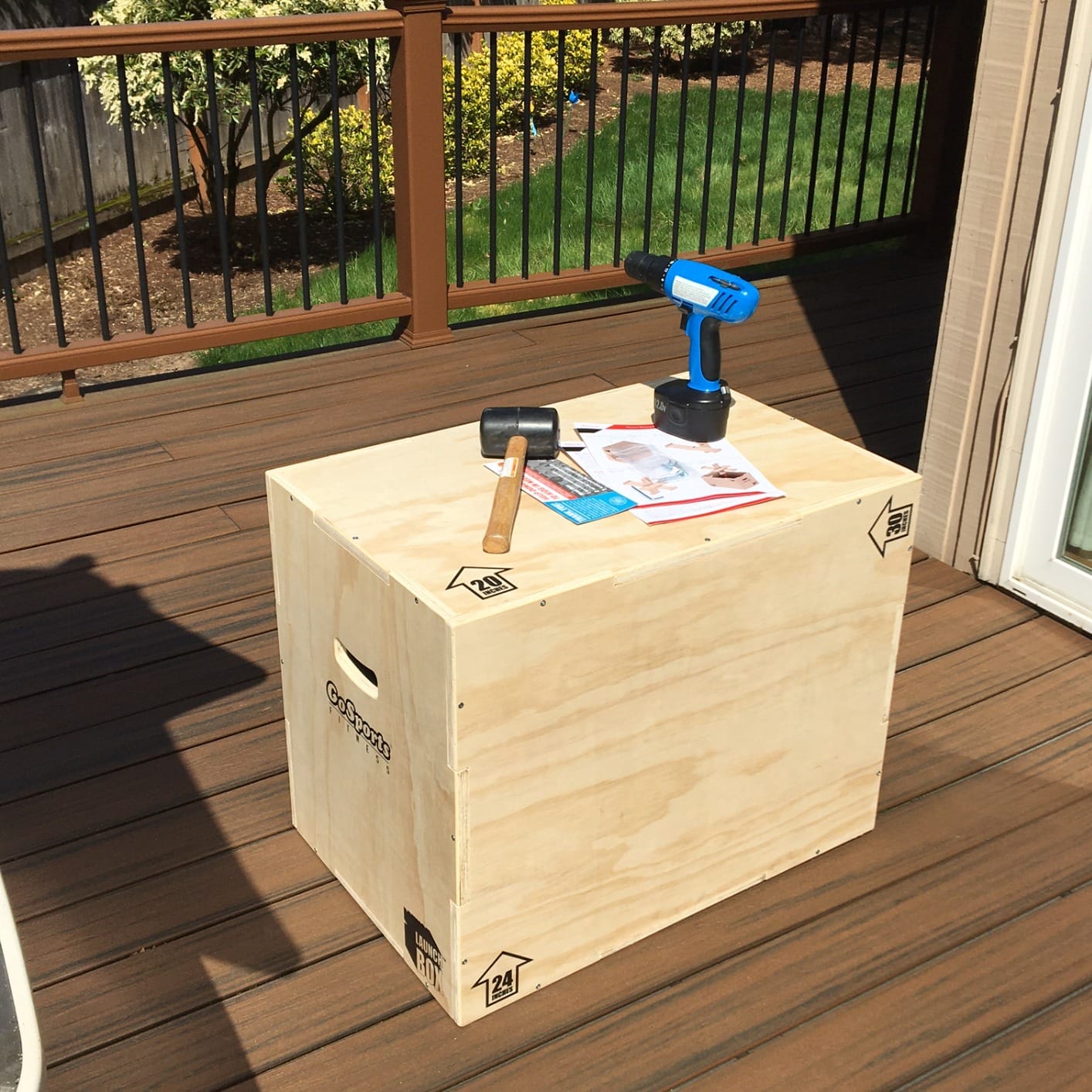
The GoSports box does something most wooden boxes skip: it prints the heights on the box. Mid-session, that means you read a number rather than guessing which face is which, which is a small but real advantage for a beginner building a progression.
The internal brace is the engineering story here. It is why the platform does not flex under load and why the design works without glue, and it separates a solid wooden box from a panel stack that feels hollow when you land.
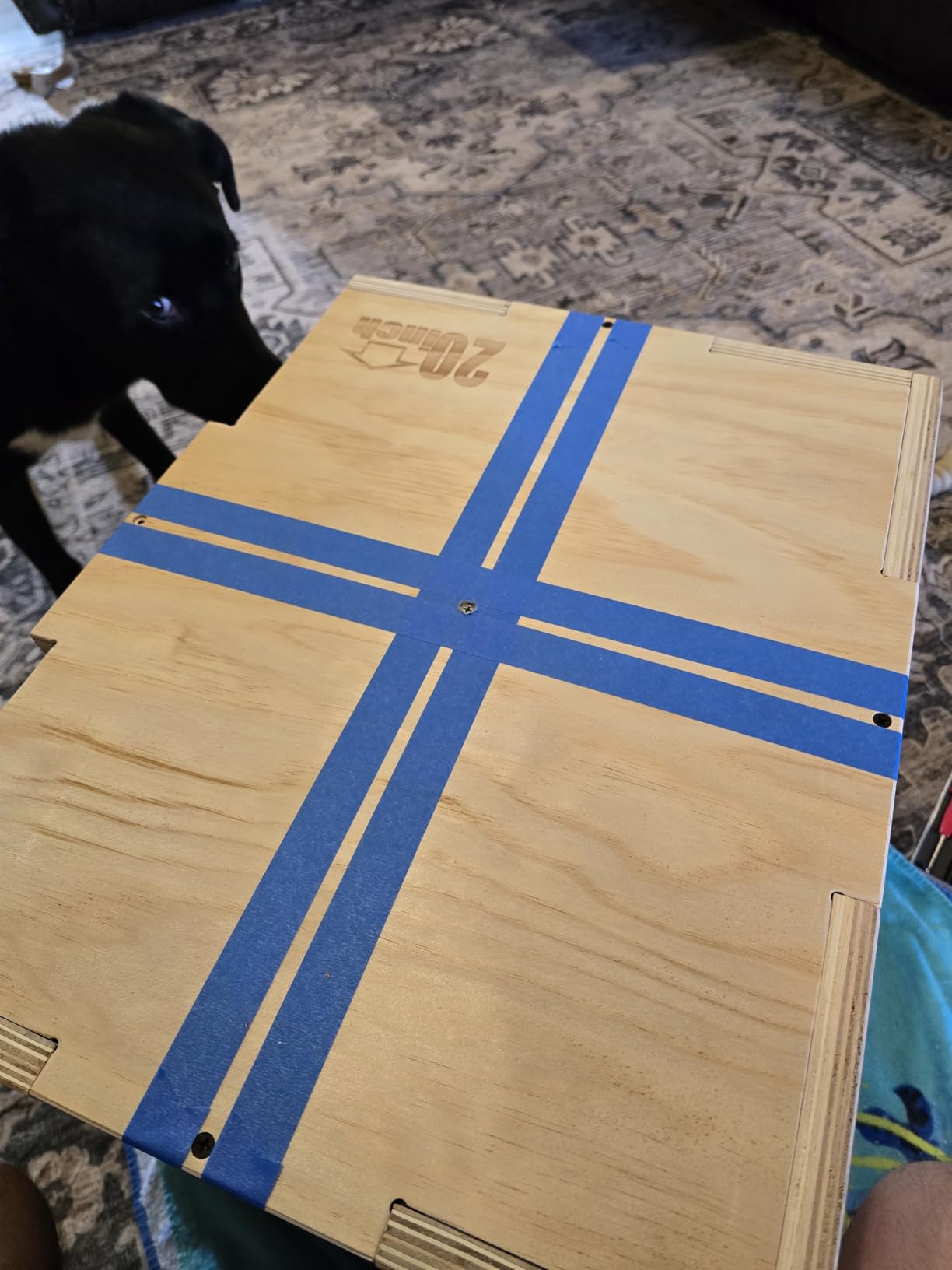
Assembly is the main friction point. Owners report that the puzzle joints fit tightly enough that pieces need tapping into place with a mallet, and a small number of units arrive with missing pre-drilled holes. The included drill bit, allen key and screw set mean you are not hunting for hardware, and the build is quick once the pieces are seated.
The surface is unfinished wood. Sanded, yes, but not sealed, and owners point out that a very smooth unfinished surface becomes slick once it is soaked with sweat. A mat or a coat of gym-safe sealant fixes it, and it is the first thing we would change.
Who the GoSports box suits
It suits beginners following a progression, because the marked heights remove the guesswork from adding a jump height week to week. It also suits anyone who wants one box to cover a family of athletes, since it comes in small, standard and XL sizes for different body dimensions.
The wide platform is a genuine advantage for beginners. Landing with both feet fully on the surface, rather than teetering near an edge, is how people build the confidence to jump repeatedly.
Where the GoSports box falls short
It falls short on finish quality control and on warranty length. Six months of cover is the shortest in this roundup, and the reports of missing pre-drilled holes and tight tolerances mean finish quality varies from one box to the next.
The other warning is about assembly force. Owners who drive screws aggressively report cracking or stripping the plywood, so set the drill to a low torque and tighten until firm rather than until the screw disappears.
5. REP Plyometric Wood Jump Box: The Widest Height Range Available
REP Plyometric Wood Jump Box | Strength Training | 16/14/12 Wooden Step Platforms | Gym & Sports Workouts | Fitness, Exercise, Physical Therapy Equipment | Pro Conditioning Tool
Wood
12 to 30 inch range
Three sizes
400 lb max
16 lb
Numbered heights
Pros
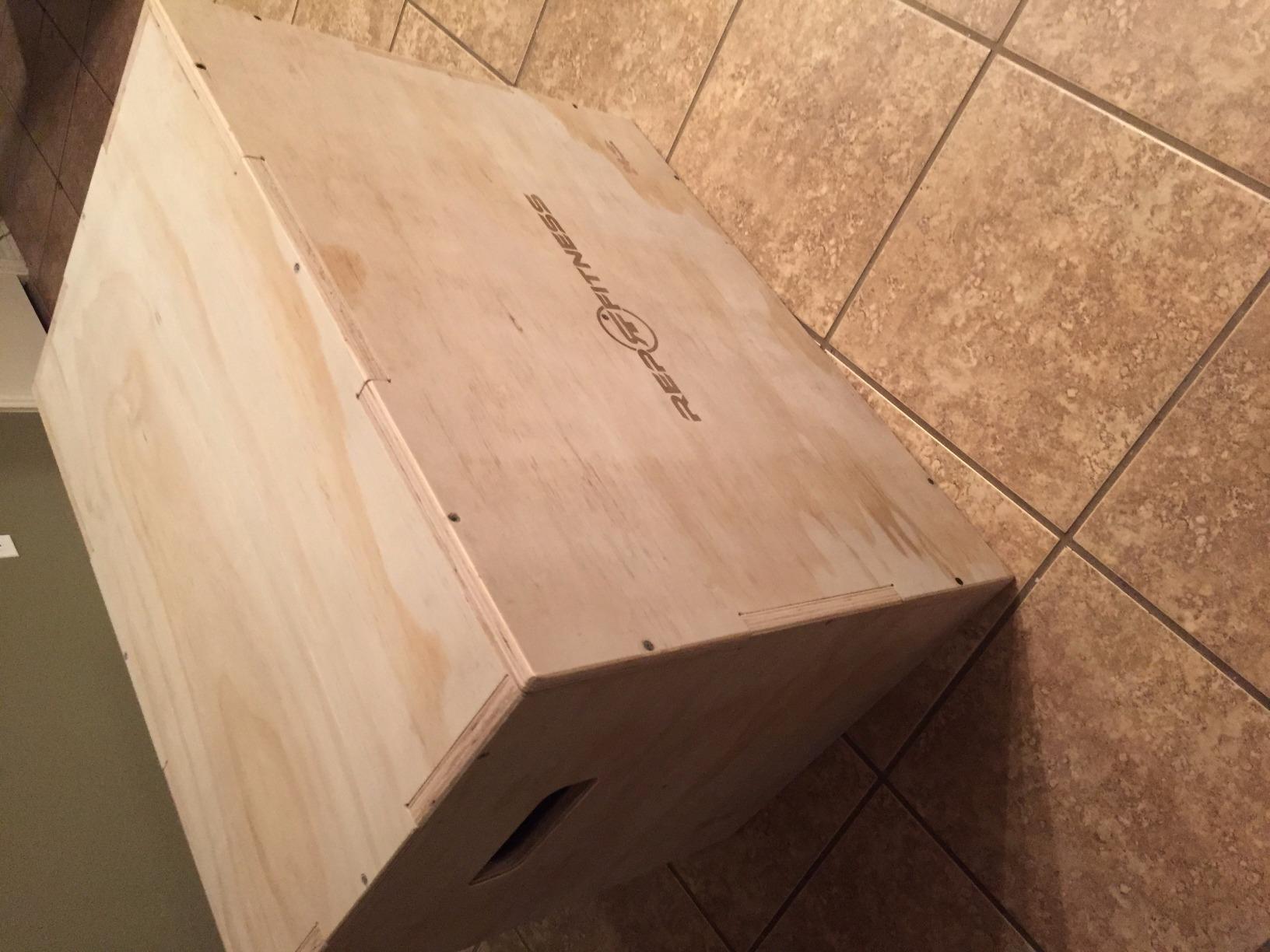
- CNC-cut 3/4 inch plywood that fits with no gaps
- Interlocking puzzle panels create a wobble-free platform
- Numbered height markings on each side for fast changes
- Sanded rounded edges and handle cutouts
Cons
- Screw heads sit slightly proud and can scratch floors
- Included drywall screws can split plywood under heavy torque
- Internal braces use small finishing nails and can flex
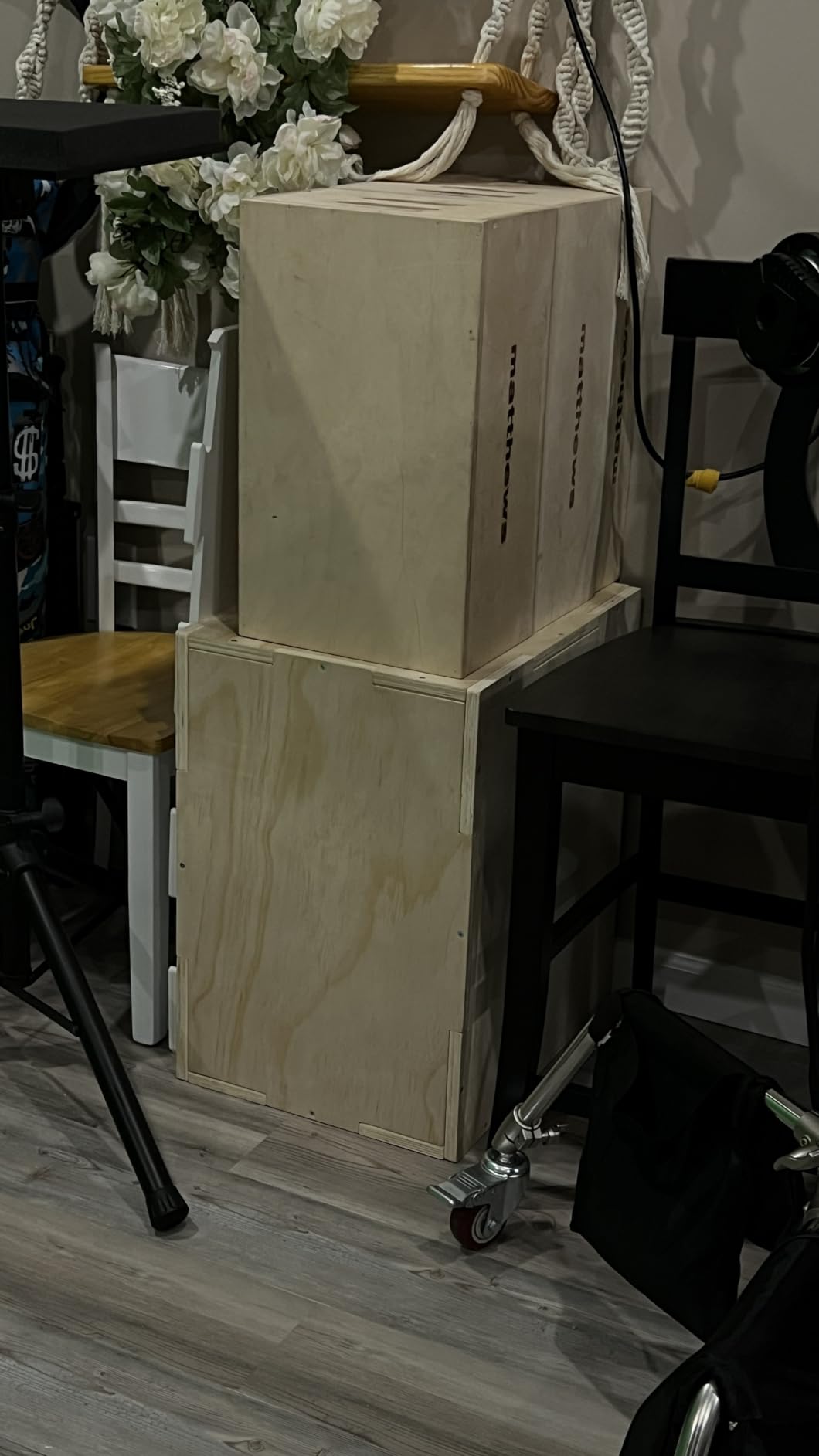
It comes in three sizes covering 12, 14 and 16 inches, 16, 18 and 20 inches, and 20, 24 and 30 inches, so a single brand can carry a beginner from a low step all the way to a 30 inch box jump. The 400 lb maximum capacity leaves ample headroom, and the 16 lb unit is light enough to rotate one-handed.
Start here if your goal is progression rather than step-ups. The fit is why owners call it a benchmark: CNC-cut 3/4 inch plywood panels interlock with no gaps, so once it is assembled the platform does not rock or wobble.
REP Fitness and Titan Fitness are the two names that come up unprompted in home gym communities, and this listing explains half of that. It is the box people bring up when they ask whether a well-made wooden box is worth more than a generic one.
Numbered height markings on each side are a small design choice with a real effect on circuit training. Flipping between 16 and 20 inches for a set of jumps and a set of step-ups takes seconds rather than a measurement break.
Who the REP box suits
It suits anyone building a real progression, from a 12 inch start up through 24 and 30 inch jumps, and anyone training in a small space who wants three heights from one footprint. The handle cutouts and sanded edges make it safe to pick up and carry between rooms.
It also suits buyers who like finishing details. Sanded edges, laser-etched logos and hand-sanded handle cutouts are the sort of thing you notice on day one and never again, which is exactly the point of buying a well-made box.
Where the REP box falls short
It falls short at assembly if you rush it. The included screws are drywall screws, and owners report they can split the plywood under heavy torque. Many add wood glue and a few extra screws during the build for long-term rigidity, a two-minute change that prevents a two-year problem.
Two smaller gripes: screw heads sit slightly proud of the surface and can scratch a floor or a mat, and the internal support braces are held with small finishing nails that can flex. Both are fixable and neither affects stability once the box is assembled properly.
6. papababe 3-in-1 Jump Box: A Foam Box That Holds Its Shape
papababe 3-in-1 Jump Box, Anti-Slip, High-Density Foam, 12x14x16
Heavy foam
12/14/16 inch heights
1000D oxford cover
200 lb max
15 lb
1-Year Warranty
Pros
- Foam core absorbs impact and avoids the shin scrapes of wood or steel
- 1000D oxford weave cover resists sweat and water
- No assembly and no maintenance
- Light enough to reposition between exercises instantly
Cons
- Second-lowest load capacity in the set at 200 lb
- Soft construction is unsuited to maximal explosive box jumps
- Sleek styling suits a home gym more than a shared floor
This listing is newer than most of the field, and it has built around 1080 ratings at a 4.7 average in a short time. The reason is the cover. A 1000D oxford weave with a double-density standard is a step up from the thin vinyl skins on most foam boxes, and it is the component that usually fails first on this category.
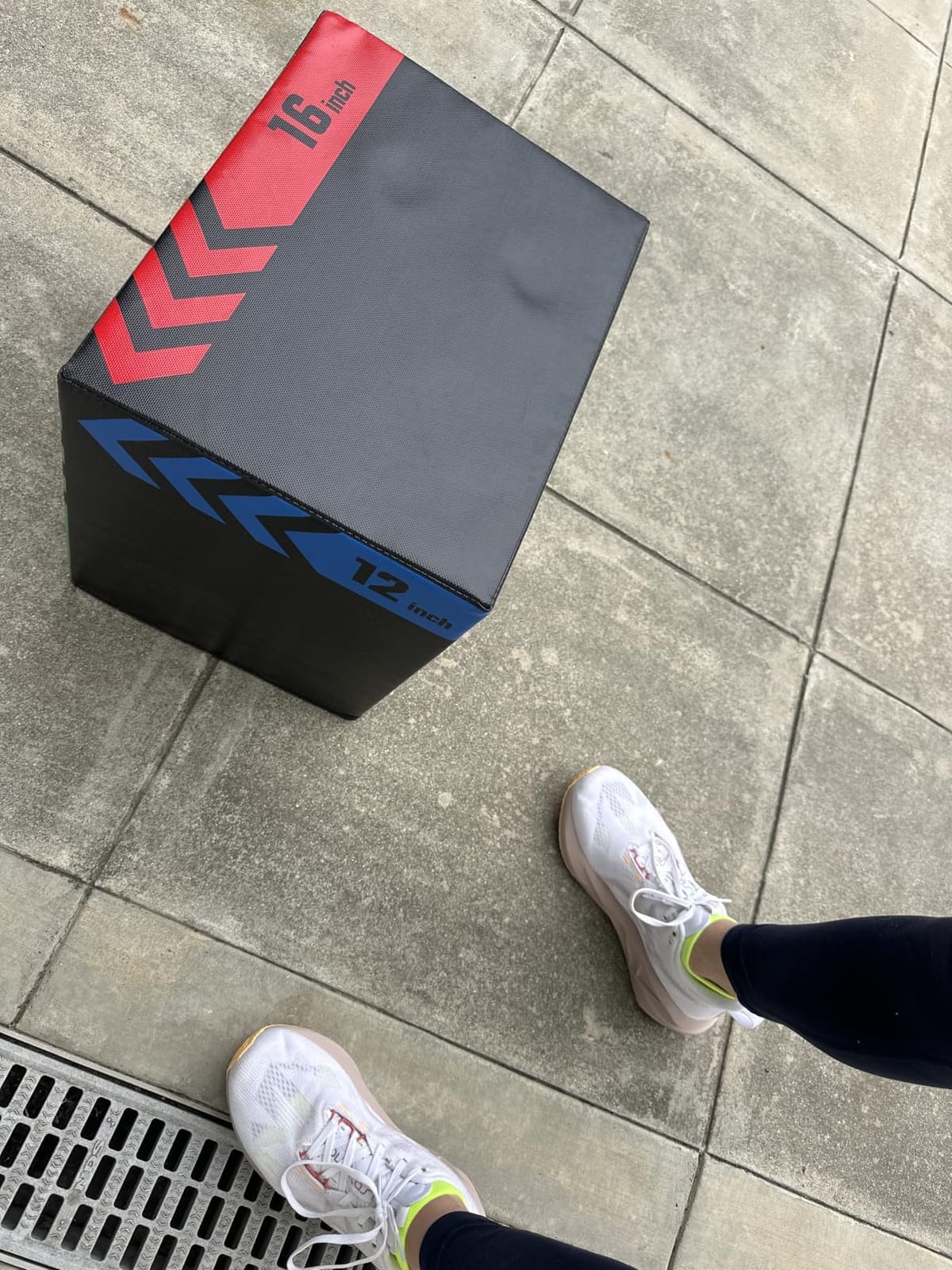
Underneath is heavy foam filling, which absorbs impact rather than transmitting it. For anyone whose knees, ankles or shins complain about hard landings, that is the whole argument. There is no assembly, no hardware and no maintenance, so it is usable the day it arrives.
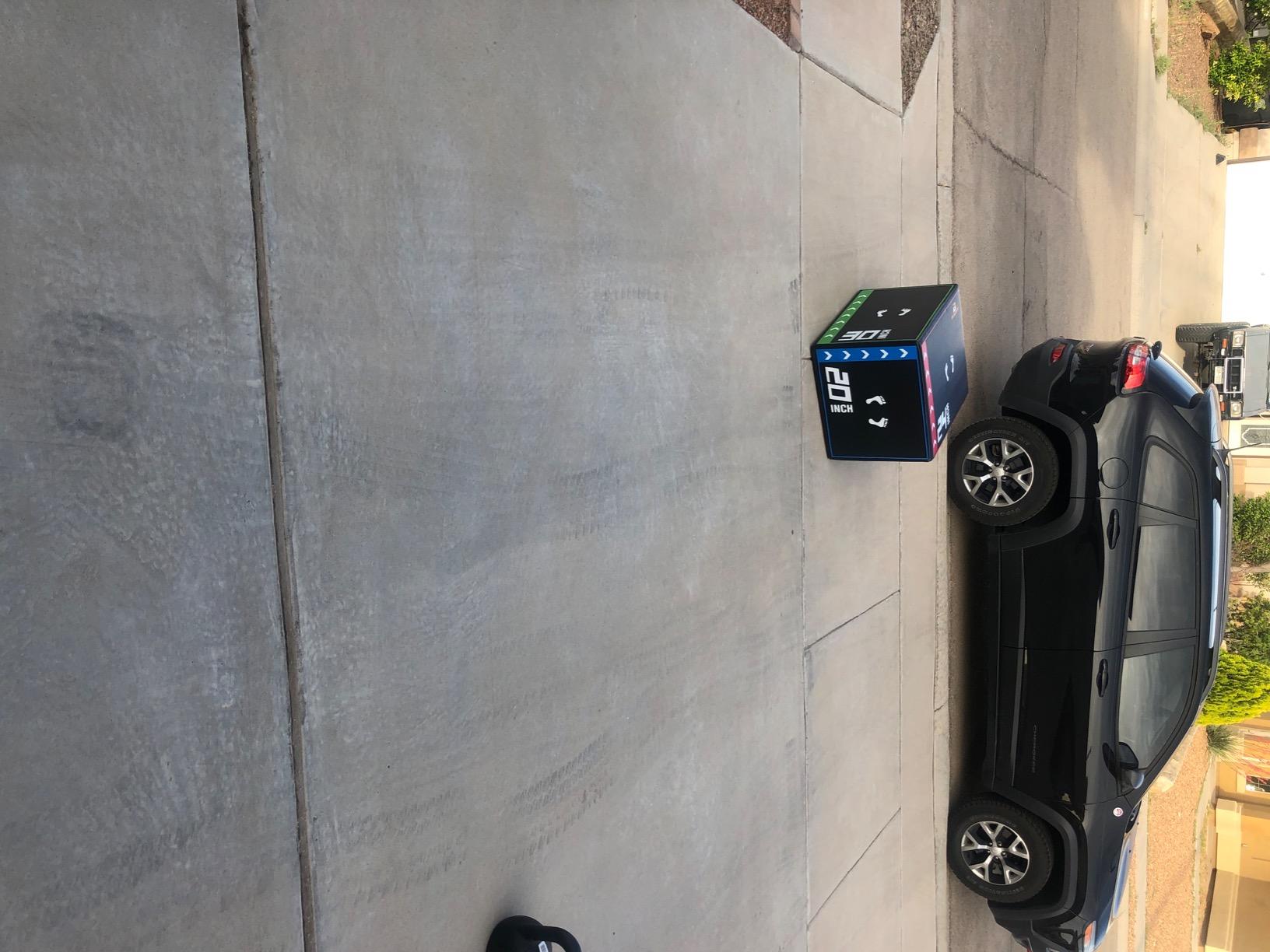
The dimensions are compact at 12 by 14 by 16 inches across three rotation heights, and the weight is 15 lbs. That is small enough for an apartment corner or a closet, and light enough to move between a step-up set and a jump set without breaking your rhythm.
The number that decides this box for you is 200 lbs. It is the maximum load capacity, and it covers a large share of home users, but if you weigh more than that or you plan to load the box with plates, you are outside its rating.
Who the papababe box suits
It suits low-impact users, older adults, rehabilitation work and anyone returning to training after time away. The black styling also means it disappears against gym equipment in a living room, which matters if your gym space is a corner of an apartment rather than a dedicated room.
It suits a shared-floor gym too, because foam dampens impact far more than wood or steel. A wood box on a hard floor sends a sharp report through the room, and a foam box barely registers.
Where the papababe box falls short
It falls short for maximal work. Foam absorbs the energy of a landing rather than returning it, so a drive jump onto foam trains power less honestly than the same jump onto plywood or steel.
The 200 lb ceiling is the harder limit. It is a hard figure rather than a soft spec, and it is why this box should not be the only platform in a gym used by two adults of different sizes.
7. Synergee 3 in 1 Wood Plyo Box: Thick Plywood for Multi-Purpose Use
Synergee 3 in 1 Wood Plyo Box – Size 20/18/16
Plywood
20/18/16 inch heights
3/4 inch ply
450 lb max
26.8 lb
1-Year Warranty
Pros
- 3/4 inch plywood rated to hold 450 lbs
- Three heights switch with a simple flip
- Works for decline push-ups and split squats and around-the-box planks
- Inner supports and pre-drilled holes included
Cons
- One of the two heaviest boxes here at 26.8 lb
- Second-lowest average rating here at 4.5
- Assembly required before first use
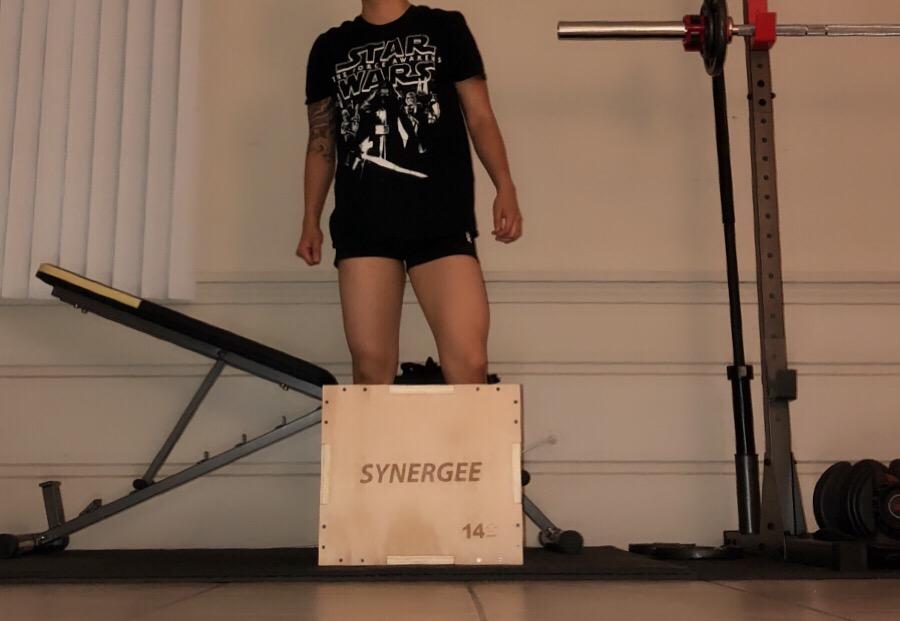
Synergee suits a gym where the box is equipment first and a jump target second. The 3/4 inch plywood holds 450 lbs, enough to use it as a bench, a step platform, or a support for decline push-ups. The 20, 18 and 16 inch heights are the useful middle of the range for a trained athlete rather than a beginner.
It is offered in a 24/20/16 inch configuration as well, which puts a real jump height within reach if you outgrow the standard version. Inner support pieces, screws and pre-drilled holes are included, so the build is a single-session job.
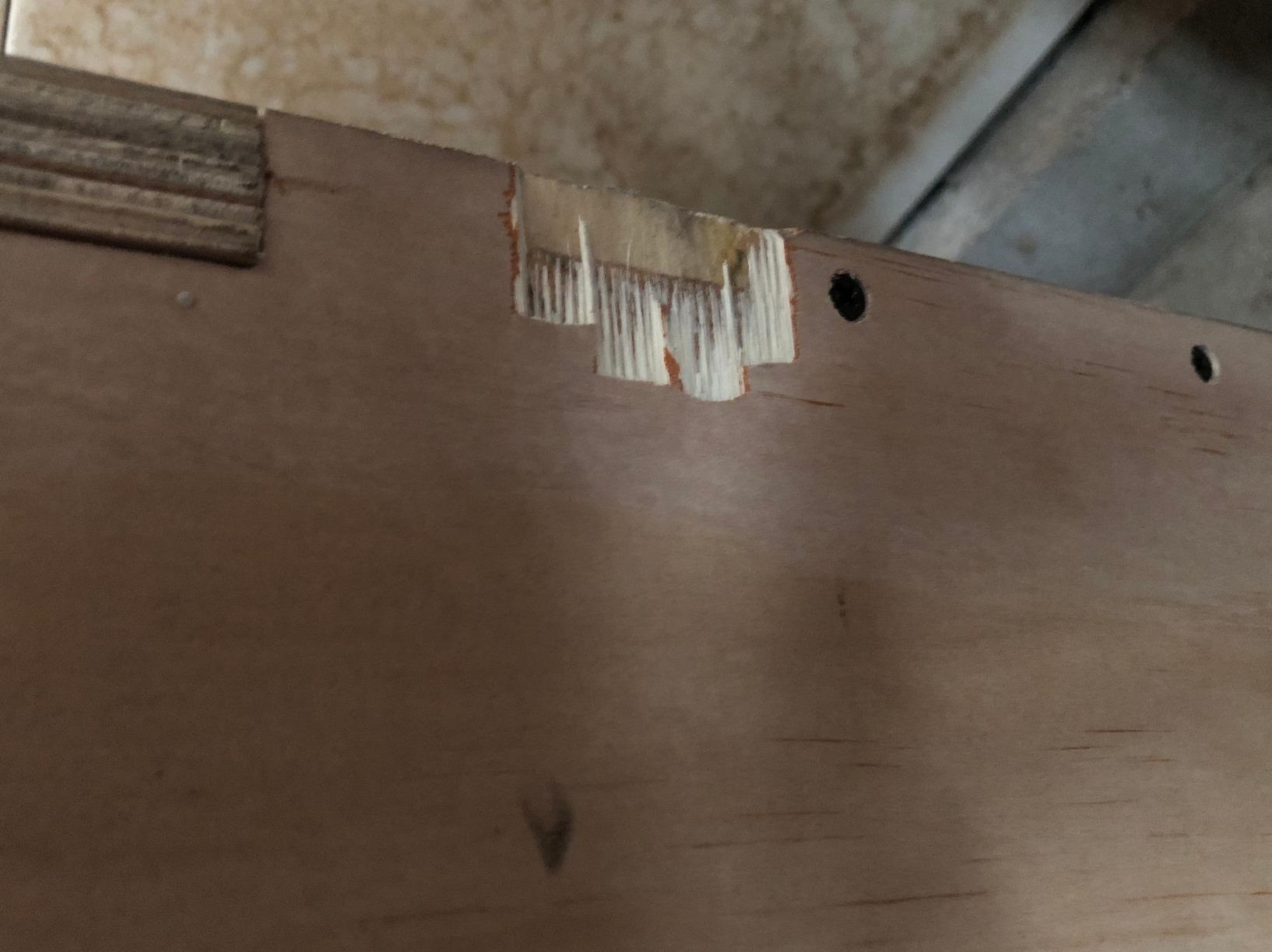
The rating sits at 4.5 across 764 ratings, tied with the Titan Fitness foam box for the second-lowest average in this group, and the five-star share is the weakest among the well-reviewed boxes here. The plywood spec is the same thickness used on the better-rated wooden boxes, so the complaints point at finish and assembly rather than at the material.
At 26.8 lbs it is one of the two heaviest boxes here, which reinforces the multi-use case. You place it once and use it for everything it can hold.
Who the Synergee box suits
It suits lifters who want one object to cover step-ups, box squats, decline push-ups, split squats and jumps, and who have already moved past the low beginner heights. Home gym builders have long used wooden plyo boxes for more than jumping, including seal rows, incline bench work and seated overhead press, and a pair in a garage covers all of it.
It also suits buyers who want thick ply without custom fabrication. Three-quarter inch is the same thickness used in the wooden boxes above that carry higher ratings.
Where the Synergee box falls short
It falls short on consistency more than on design. The 4.5 average and 73 percent five-star share is the weakest showing among boxes with several hundred ratings, and the complaints point at finish and assembly rather than at the plywood itself.
It also requires assembly before first use, and the 20, 18 and 16 inch heights are the least beginner-friendly range here, since the lowest rung is already 16 inches.
8. Titan Fitness 3-in-1 Heavy Foam Box: Built for Youth and Beginner Progressions
Titan Fitness 3-in-1 Heavy Foam Plyometric Jump Box, Youth Size
EPE foam
12/14/16 inch heights
Vinyl cover
120 lb max
1-Year Warranty
Pros
- Forgiving foam core that softens landings and protects shins
- No assembly required
- Textured vinyl exterior helps the box stay in place
- Smooth edges make contact less punishing
Cons
- Rated to only 120 lb which is the lowest capacity in the set
- Wobbles slightly when stood on its long side
- Height marker decals peel after a couple of months
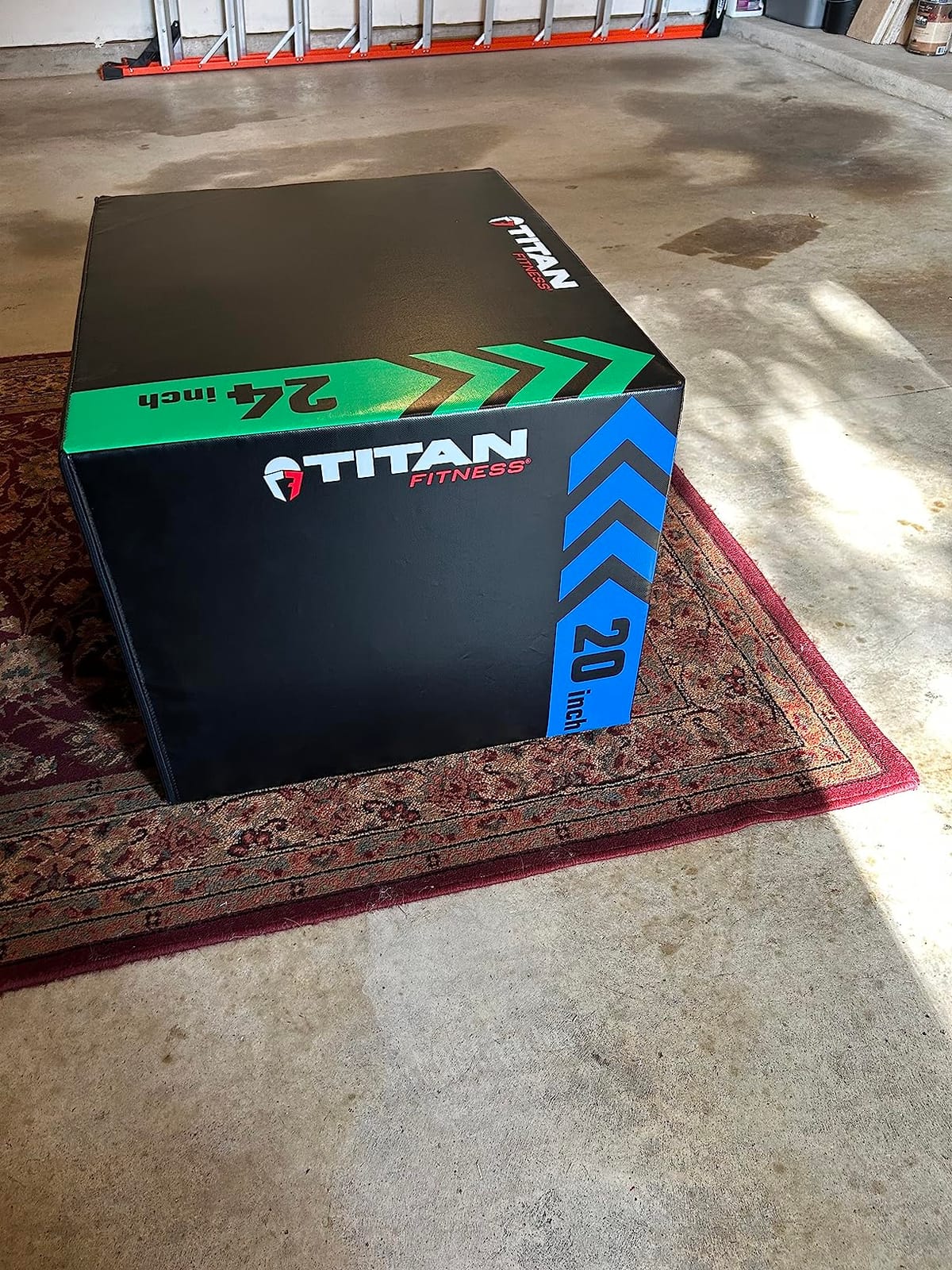
This listing is the youth 12 by 16 by 20 inch version, which explains both its appeal and its limits. It rotates through 12, 14 and 16 inches from a high-density EPE foam core with a rugged vinyl cover, which is the progression a younger athlete or a beginner needs before moving to a taller wooden box.
The foam is the point. It softens landings, it protects shins on a missed attempt, and it removes the hard rebound that makes beginners land stiff-legged. No assembly is required, so it works the day it arrives.
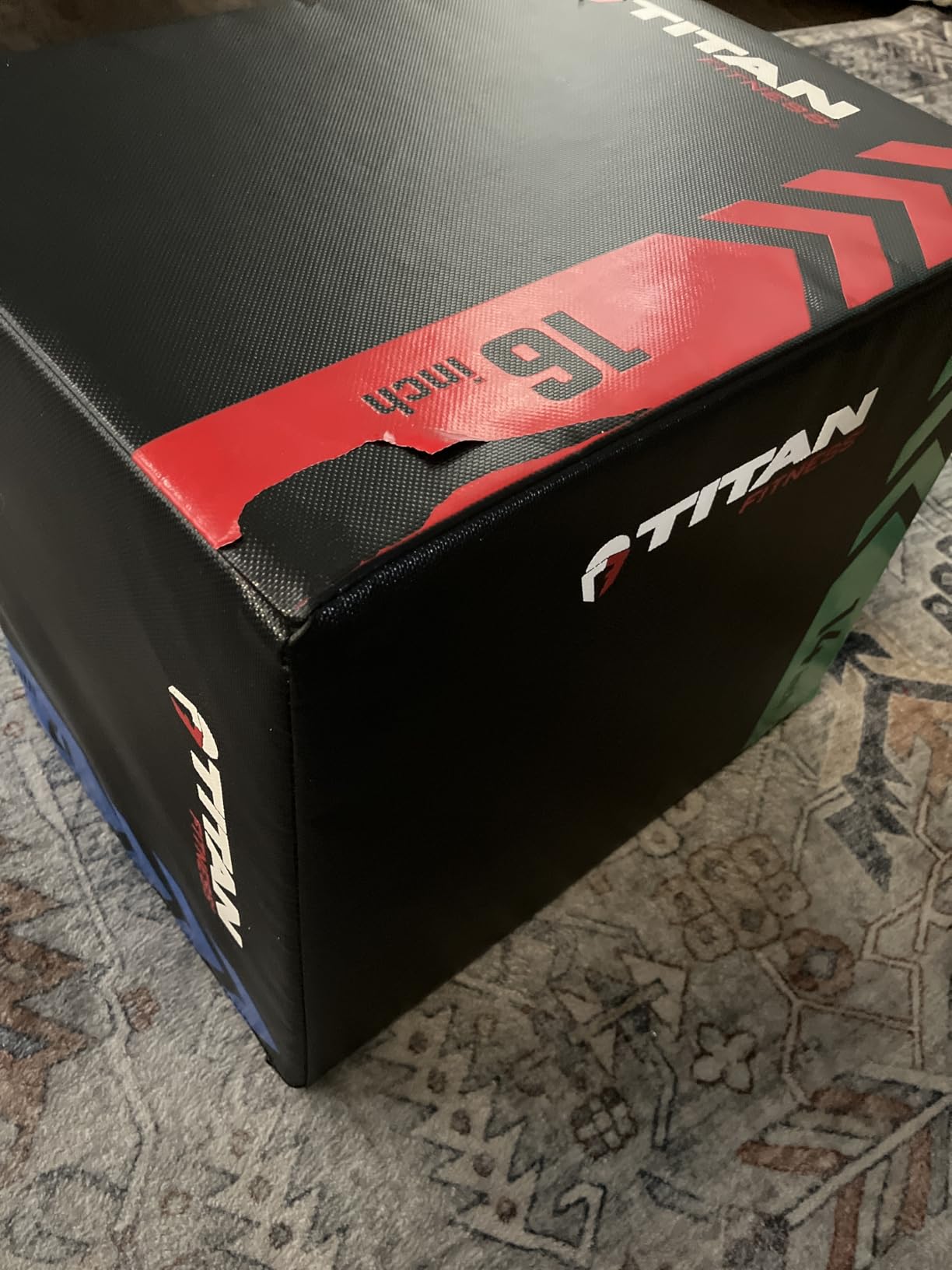
Titan Fitness is the other brand name that home gym communities raise without being prompted, and its heavy foam line is the reason. The same family also comes in regular and large sizes, so there is a path upward once a young athlete outgrows this one.
The textured vinyl exterior is not decorative. It is the surface that resists the box sliding when a jump lands off-centre, and that is the failure mode that causes most interrupted home sessions.
Who the Titan Fitness foam box suits
It suits youth athletes, beginner lifters and anyone returning from injury, because the 12 inch starting height and the soft surface make the first plyometric work achievable. Step-ups, dips, hip thrusts and single-leg step-downs all work on it in a small room.
For a home gym shared by adults and teenagers, it works as a low platform that a smaller user can step onto safely. If you are also planning a climbing or play structure for younger children in the same room, our guides to the best kids climbing gyms and the best indoor jungle gyms cover that side of the setup.
Where the Titan Fitness foam box falls short
It falls short at 120 lbs, the lowest maximum load here. That rating is honest for the intended user and disqualifying for an adult who wants one box for a whole household.
Owners also report a slight wobble when it is stood on its long side, a softer seam where the foam sections meet that dips a little at the edges, and height-marker decals that begin to peel after a couple of months, none of which affects normal use. The decals stop being a reliable height reference over time.
9. Amazon Basics 3-in-1 Wooden Plyo Box: A Rigged Low-Cost Wooden Option
Amazon Basics 3-in-1 Wooden Plyo Box, Non-Slip Plyometric Jump Box with Three Heights for Home Gym, Easy Assembly, 450 lb Weight Capacity, 16″x14″x12″
Wood
12/14/16 inch heights
14x12x16 inch
450 lb max
FSC-certified
Pros
- Cheapest wooden option in the set while still rated to 450 lbs
- Three heights with clear indicators printed on the panels
- Non-slip surface holds through repeated jump sets
- Built-in wide handles make it easy to move
Cons
- Smallest listed variant at 14x12x16 inches is tight for tall jumpers
- Assembly is required despite the easy-assembly description
- Intended primarily for indoor home gym training
This is the pick if you want a wooden platform and you do not want to spend much. It carries a 450 lb weight capacity on wooden construction, which matches the rating on boxes costing several times more, and it sits near the top of its retail category for owner feedback at 4.6 across 419 ratings.
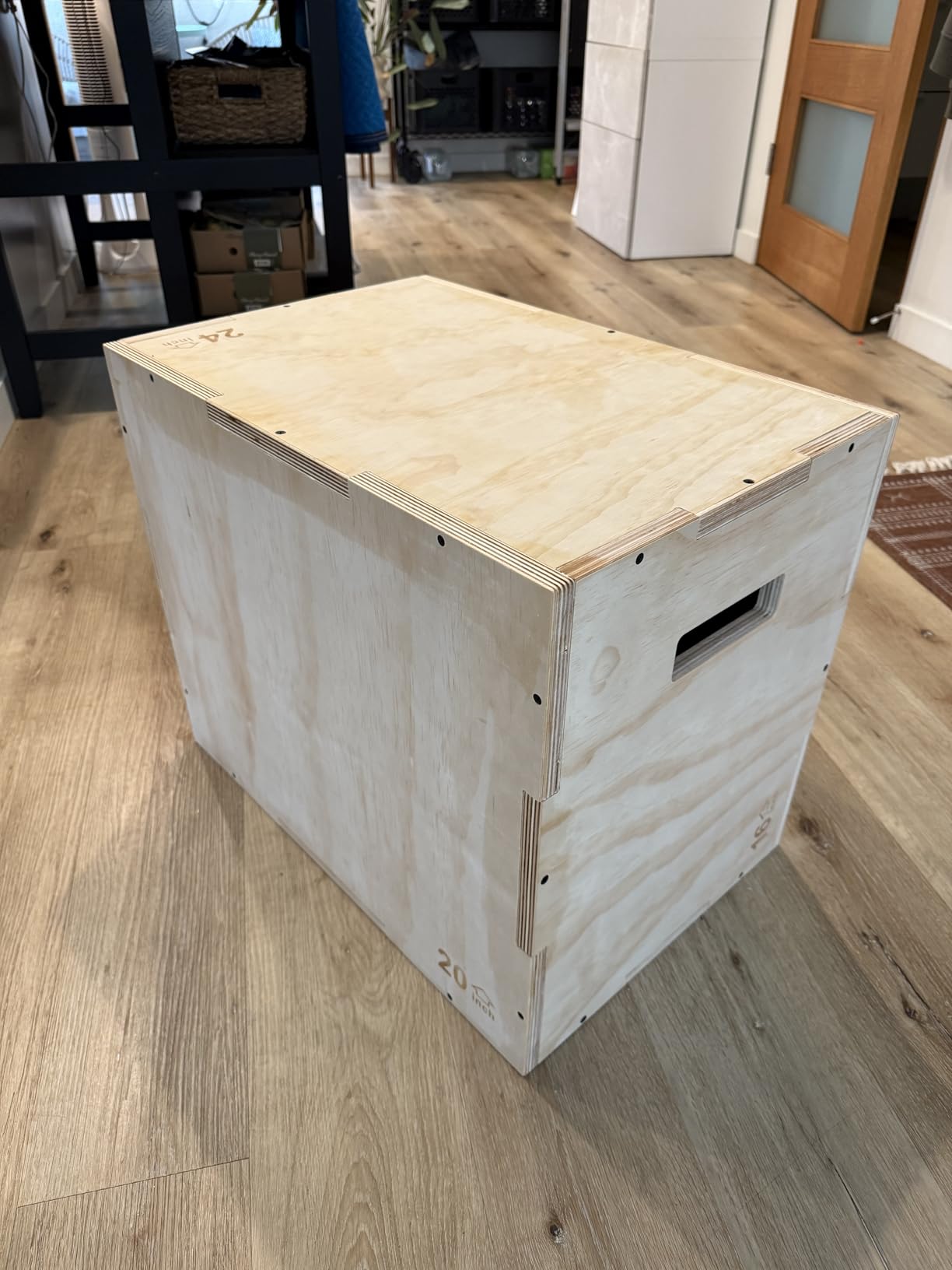
The design details are better than the price suggests. Heights are printed on the panels, so you can read the level without measuring. The surface is non-slip, edges are sanded smooth, and wide handles are cut into the sides.
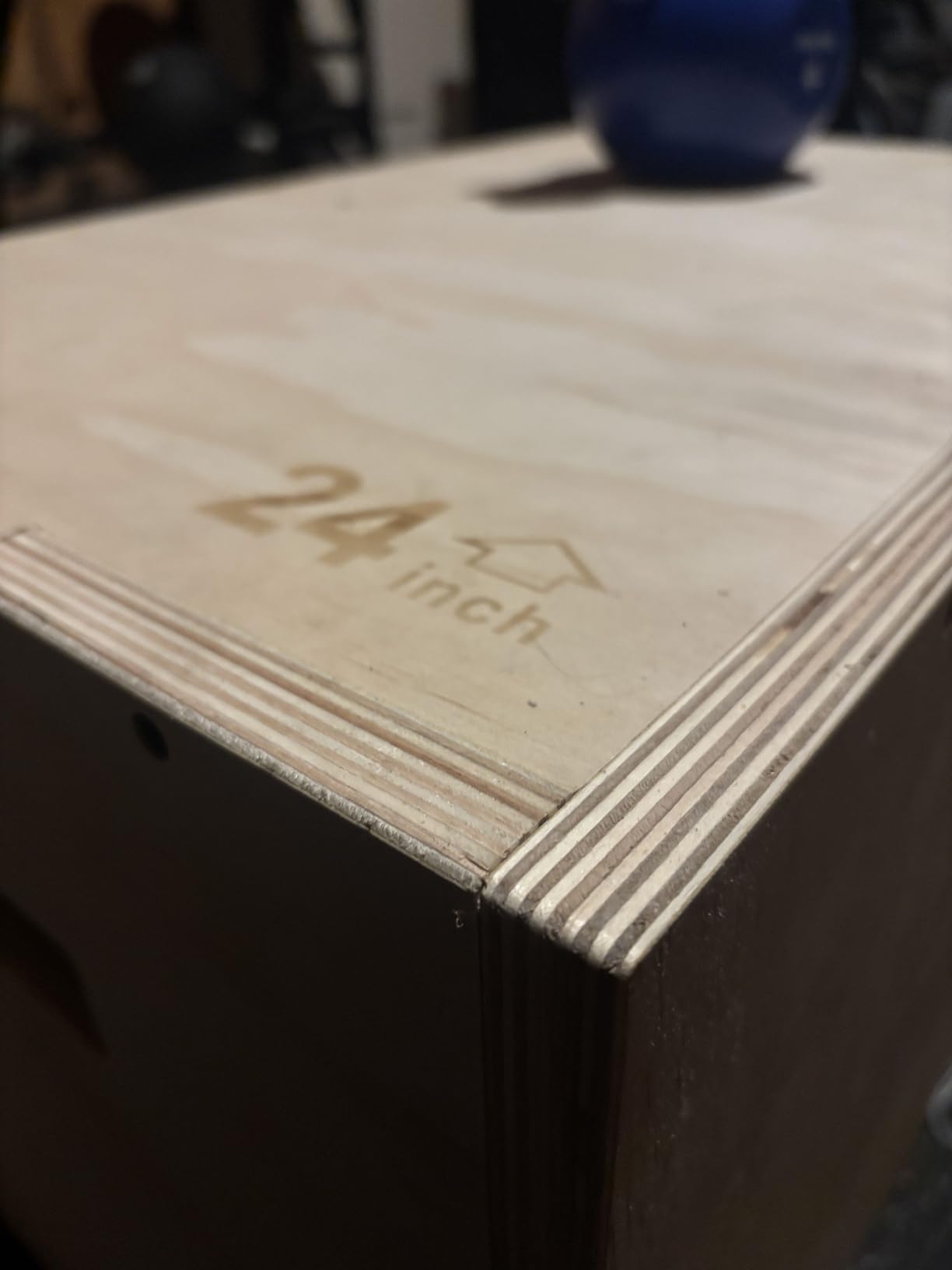
The wood is FSC-certified, which is rare on a box in this class and relevant if sustainably sourced material matters to you. Assembly uses pre-drilled and pilot holes, which means the screws start themselves and the build is mostly alignment rather than drilling.
The compromise is footprint. The listed variant measures 14 by 12 by 16 inches, which makes it one of the most compact platforms here. A shorter athlete lands comfortably on it, and a taller athlete will find their feet close to the edge. A larger 24 by 20 by 16 inch version is also offered if you can accommodate it.
Who the Amazon Basics box suits
It suits a first-time buyer building a garage gym on a strict budget, a teenager stepping up to plyometrics, and anyone who wants the rigidity of wood without a foam box. The handles also make it the easiest wooden box here to move between two rooms.
It suits smaller users particularly well. The compact 14 by 12 inch platform is closer to a foot placement than a full landing surface, which makes step-ups and low box jumps feel controlled.
Where the Amazon Basics box falls short
It falls short on size progression. Three heights topping out at 16 inches cannot grow with you, and once you are jumping properly you will need a taller box, which changes the balance of the exercise.
Assembly is still required even though the product is described as easy assembly. The manufacturer positions it for indoor training, so it belongs on a dry floor rather than an uncovered garage slab.
10. Fitvids Non-Slip Wooden Plyo Box: The Broadest Size Family
Fitvids 16 x 14 x 12 Non-Slip Wooden Plyo Box Jump Exercise Platform, Black
Plywood
Three size families
450 lb max
2-Year Warranty
Black or wood finish
Pros
- Three size families each with three height options
- Slip-free surface holds through every jump set
- 450 lb capacity from high quality plywood with puzzle joints
- Assembly takes about ten minutes
- Tied for the longest warranty in the set at two years
Cons
- Lowest average rating here at 4.4 with the highest negative share
- Assembly required before first use
- Smallest variant tops out at 16 inches
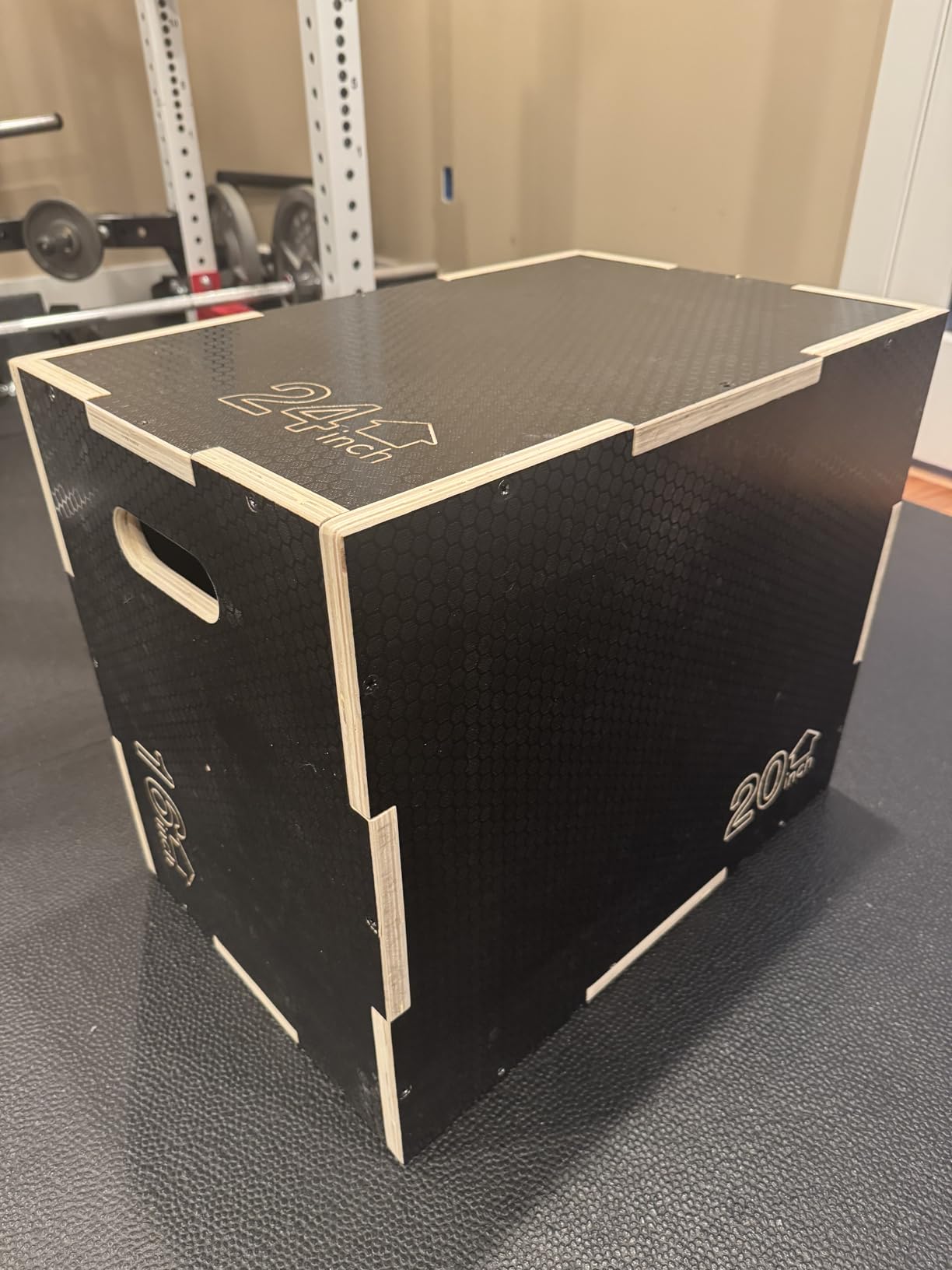
The Fitvids range solves a problem the other boxes do not: size, not height, is usually the binding constraint. It comes in three families at 16 by 14 by 12, 20 by 18 by 16 and 24 by 20 by 16 inches, with a larger 20 by 24 by 30 option as well, and each family has three height settings. One brand here covers a short beginner through to a 30 inch jump.
The construction is high quality plywood with puzzle joints and a 450 lb capacity, and the two-year manufacturer warranty is tied with the BalanceFrom foam box for the longest here. Assembly takes about ten minutes according to owners, and black or natural wood finishes let it blend into an existing setup.
What holds it back is consistency rather than design. The average rating is 4.4, the lowest here, with a 6 percent one-star share, the highest of the ten. The complaints point at finish and assembly rather than at the design, so check every panel and screw hole before the first jump.
The smallest family tops out at 16 inches, so if you are buying that variant expecting box jump progressions, you will be disappointed. Buy it for step-ups and low jumps, or step up a family.
Who the Fitvids box suits
It suits a household training at different sizes, or a buyer who is not sure yet which footprint will work in their space. The presence of a 20 by 24 by 30 family means one brand can carry you from a 12 inch start to a 30 inch jump without changing brands.
It also suits buyers who want plywood with puzzle joints and a long warranty, particularly if the anti-slip surface matters for their floor.
Where the Fitvids box falls short
It falls short on quality control more than on design. A 4.4 average and a 6 percent one-star share across 978 ratings is the weakest showing in this group, and the pattern of complaints points at finish and assembly rather than at a single systemic fault.
Assembly is required before first use, and the small family has the most limited height progression of the wooden options here. It suits a smaller user who wants one box for step-ups and low jumps.
How We Chose These Plyo Boxes
We compared the ten boxes above on the same five criteria, in this order: stability under a hard landing, range of jump heights, landing comfort for the shins and knees, footprint and weight for storage, and durability signals from long-term owners. Manufacturer specifications set the baseline, and owner reviews were used to check whether the real product matches the published numbers.
Two things we deliberately refused to use as deciding factors. The first is weight capacity, because every wooden box in this roundup is rated between 400 and 450 lbs and the steel one at 560 lbs, all of which sit far above what a home user needs.
The second is brand name, which is why REP Fitness and Titan Fitness appear here alongside retailers and smaller manufacturers rather than above them.
We also read the negative reviews first. A category like this sells on claims, and the complaints are where the claims break. Sinking foam, proud screw heads, peeling decals, slick unfinished wood and missing pre-drilled holes are all patterns that show up repeatedly across owner feedback, and every cons listed in this roundup came from that pattern rather than from a spec sheet.
How to Choose a Plyo Box for Your Home Gym
Most buyers overthink this purchase. A plyo box is a platform, and the decisions that matter are material, height range, footprint and the surface underneath it. Everything else, including the capacity number printed on the side, matters far less than the marketing implies.
Foam vs wood plyo boxes: buy foam for comfort, wood for power
Foam is the right choice when landings hurt, when the box is used by a beginner, or when noise and downstairs neighbours are a factor. Wood is the right choice when you want the most honest jump, when you plan to use the box as more than a jump target, and when your training space is hard flooring.
A rigid platform compresses almost not at all, so the force you generate goes back into your legs and up into your hips. Foam absorbs that impact to protect joints, which is exactly what you want on a missed rep and exactly what you do not want on a maximum effort rep.
Most home users end up owning a foam box first and a wood box later, and that is a reasonable sequence.
Steel sits at the rigid end. It never moves or deforms, and boxes of the same footprint stack, which suits a shared floor or maximal work on hard surfaces where a fixed height is an acceptable trade.
Foam density: what 60D and 70D actually mean
Density is measured in kilograms per cubic metre and printed as a durometer figure. The number describes how much mass is packed into the foam, and higher density foam resists compression and returns energy better.
A cheap 50D foam compresses permanently under repeated load and loses both thickness and rebound, which is why cheap foam boxes feel dead after a year. For most home users, 60D is the practical floor for a box you land on, and 70D and above is better suited to heavier athletes and daily use.
Most foam box listings, including several on this list, publish no durometer number at all, so treat the warranty length and the review count as your proxy instead.
How high should your plyo box be?
Start at a height you can step onto and step down from without thinking about it, which for most beginners is 12 to 16 inches. Progress only when you can land softly, feet together, with no shin contact and no audible knee bend on impact.
A useful rule is to match the box height to about half your standing jump. Test your standing jump against a wall and choose the box at roughly half that number. This is a rough guide rather than a formula, but it stops the most common home gym error, which is jumping onto a box that is too tall and learning to land badly to compensate.
A three-in-one box is the most efficient way to buy heights, because one footprint gives you 12 to 16 inches for step-ups, 20 to 24 inches for working box jumps and 30 inches for advanced progressions. The REP large size and the Fitvids 20 by 24 by 30 family are the two options here that reach 30 inches without anything stacked on top.
Weight capacity: how much do you really need?
Less than you think. The wooden boxes here are rated between 400 and 450 lbs and the steel box at 560 lbs, and those figures comfortably cover every adult home user plus a second person standing on the box. Paying more for a higher number buys you nothing, and one foam box on this list is rated at 120 lbs, which tells you the ratings are not a reliable quality signal in either direction.
The rating that does matter is the lowest one in your set. If a box is rated below your bodyweight, do not use it, regardless of how good the rest of the specification looks.
Base grip, edge radius and floor noise
Base grip is the most reported problem in home gym forums, and the failures are always the same: a box sliding on polished concrete or on rubber gym flooring, which throws off a landing mid-jump. A textured or non-slip top surface is not the same as a non-slip base, and both matter.
Edge radius is the second one. Rounded or sanded edges cut shin injury risk compared with sharp 90 degree corners, and this is the strongest argument for wood over steel on a beginner box. A shin that catches a corner during a short jump is how people end up afraid of the exercise.
Noise is the unspoken objection in apartments. Foam dampens impact significantly, plywood is a sharp report that travels through a floor, and steel is the loudest of the three. If you live below someone, a foam box on a rubber mat is the quiet combination, and lowering the drop height reduces the sound more than the material does.
Small-space storage and apartment living
The 20 by 18 by 16 inch wooden boxes are barely larger than a coffee table, and they can live against a wall between sessions. The 12 by 14 by 16 inch foam models are smaller still and disappear into a closet.
For people who move rather than store, adjustable blocks that lay flat are the alternative that home gym communities recommend, and the trade is that a folding block is a step platform rather than a jump target. If your problem is floor space rather than jump height, that is the correct purchase instead of a plyo box.
Transport is a genuine purchase blocker that almost nobody answers. A box at 20 by 24 by 32 inches fits through a standard doorway and into the back of most hatchbacks. It can be disassembled into flat panels if your vehicle is smaller, so measure your route before you order.
Storage matters as much as floor space once the box is in place. Anything that keeps panels, plates and a jump rope off the floor around the platform helps, and our guide to the best deck boxes covers the outdoor storage side of a home gym setup.
Build it or buy it?
Building a plyo box from plywood is a legitimate option, and a powerlifting forum ranks on this exact question because the answer is genuinely favourable for anyone with basic tools. A box built from 3/4 inch plywood with internal bracing costs a fraction of a commercial one, and you control the heights precisely.
The reasons to buy instead are time, consistency and graded material. A homemade box with cut corners can rock under a max jump, and the ply inside it is not graded the way a commercial panel is.
If you own a drill, a jigsaw and a square, building is a weekend project. If you do not, the commercial options in this roundup start at the low end and the difference is small next to the time cost.
What to use instead of a plyometric box
Several movements replace a plyo box entirely. A sturdy low table or coffee table works for low box jumps if it bears your full landing force, and it doubles as other furniture.
A staircase handles step-ups, and it is adjustable by choosing the tread. A sturdy chair supports assisted box jumps and elevated push-ups.
Resistance bands anchored to a solid point give you the same explosive intent with none of the impact. For low-impact conditioning, mountain climbers and squat jumps on a mat deliver the same training signal with no shin risk at all.
A soft cushion on the floor converts a box jump into a depth jump, which is a more advanced and more useful exercise for most people anyway.
If you are training for genuine maximal jumping ability, a weighted vest or a light dumbbell in your hands raises the difficulty without raising the box, and that is usually a better progression than jumping onto something higher.
For a child under about five, a plyo box is the wrong tool entirely, because a raised platform is where the risk is rather than the reward. Play structures give the same climbing and stepping work at a safer height, and our roundup of the best toddler jungle gyms covers the right starting point for a very young athlete in a shared play and training room.
Box jump safety and progression
Do plyo boxes damage your shins? Sometimes, and the cause is almost always the same, which is a short jump where the shins strike the face of the box rather than the top. The fix is to look at the spot on the box where you want to land and step or jump up to it, not at the box generally. Home gym communities spend a lot of time on this, and the top advice on the highest-engagement thread is a technique cue rather than a gear recommendation.
Land with both feet, soft knees, and let the box absorb the impact quietly. A loud landing means you are absorbing it badly, which trains the wrong pattern.
Step down rather than jumping down, keep your landings facing the box so a miss rolls forward instead of backward, and clear the area behind the box before every attempt.
The progression ladder that works at home runs in four steps. Start with step-ups onto the lowest height and add reps until you can do fifteen cleanly. Move to a step-over without a jump, placing the trailing foot on the box.
Progress to a full box jump onto the same height, and only then raise the box to the next setting and repeat. Weighted box jumps come last, and only once the unweighted version feels controlled.
Frequently Asked Questions
Which plyo box is best?
The BalanceFrom 3-in-1 Foam Jump Box is the best plyo box for most home gyms. It rotates through 16, 20 and 24 inch heights, its high-density foam softens landings, and it carries the deepest owner feedback in the category. For rigid platforms and full progressions, the REP wooden jump box reaches 12 to 30 inches across three sizes.
Is a foam or wood plyo box better?
Foam is better for beginners, joint comfort, quiet floors and shared spaces, because it absorbs impact rather than transmitting it. Wood is better for maximal jumps, multi-purpose strength work and realistic power development, because a rigid platform returns energy that foam absorbs. Most home users start with foam and add a wooden box later.
Why are plyometric boxes so expensive?
Price tracks material thickness, foam density, joinery and warranty rather than any single feature. Three-quarter inch plywood, high-density foam at 60D or above, interlocking CNC-cut panels and a two-year warranty all cost more than a panel stack with a one-year warranty. Brand premium and low-density foam are the two biggest reasons a cheap box feels unstable within months.
What to use instead of a plyometric box?
A sturdy low table or coffee table handles low box jumps, a staircase replaces step-ups, and a solid chair supports assisted jumps and elevated push-ups. Bands or a light dumbbell add resistance without impact, and a cushion on the floor converts a box jump into a depth jump. For low-impact conditioning, mountain climbers and squat jumps on a mat work with no shin risk at all.
How high should my plyo box be?
Choose a height you can step onto and step down from without thinking about it, which is usually 12 to 16 inches for beginners. A useful rule is roughly half your standing jump height. Progress only when you can land softly with both feet together and no shin contact, and raise the box one setting at a time rather than jumping straight to your maximum.
Final Verdict: Which Plyo Box Should You Buy?
The best plyo boxes for home gyms are not the most expensive ones, and the gap between the cheapest and the dearest in this roundup buys you a difference in feel rather than in capability. Buy the BalanceFrom 3-in-1 Foam if you want the most forgiving landings and the lightest box to move. Buy the REP wooden jump box if your goal is a real progression from 12 inches to 30. Buy the Rage Fitness steel box if you train hard on hard floors and need one rigid platform that never moves.
For everyone else, the decision is a material choice and a height choice. Foam for joints and quiet floors, wood for power and multi-purpose strength work, and start at a height you can step onto without thinking.
Whichever box you pick, keep the progression slow: step-ups first, then a step-over, then the jump, and put a rubber mat under the landing area. That mat is the cheapest safety upgrade available to you.