
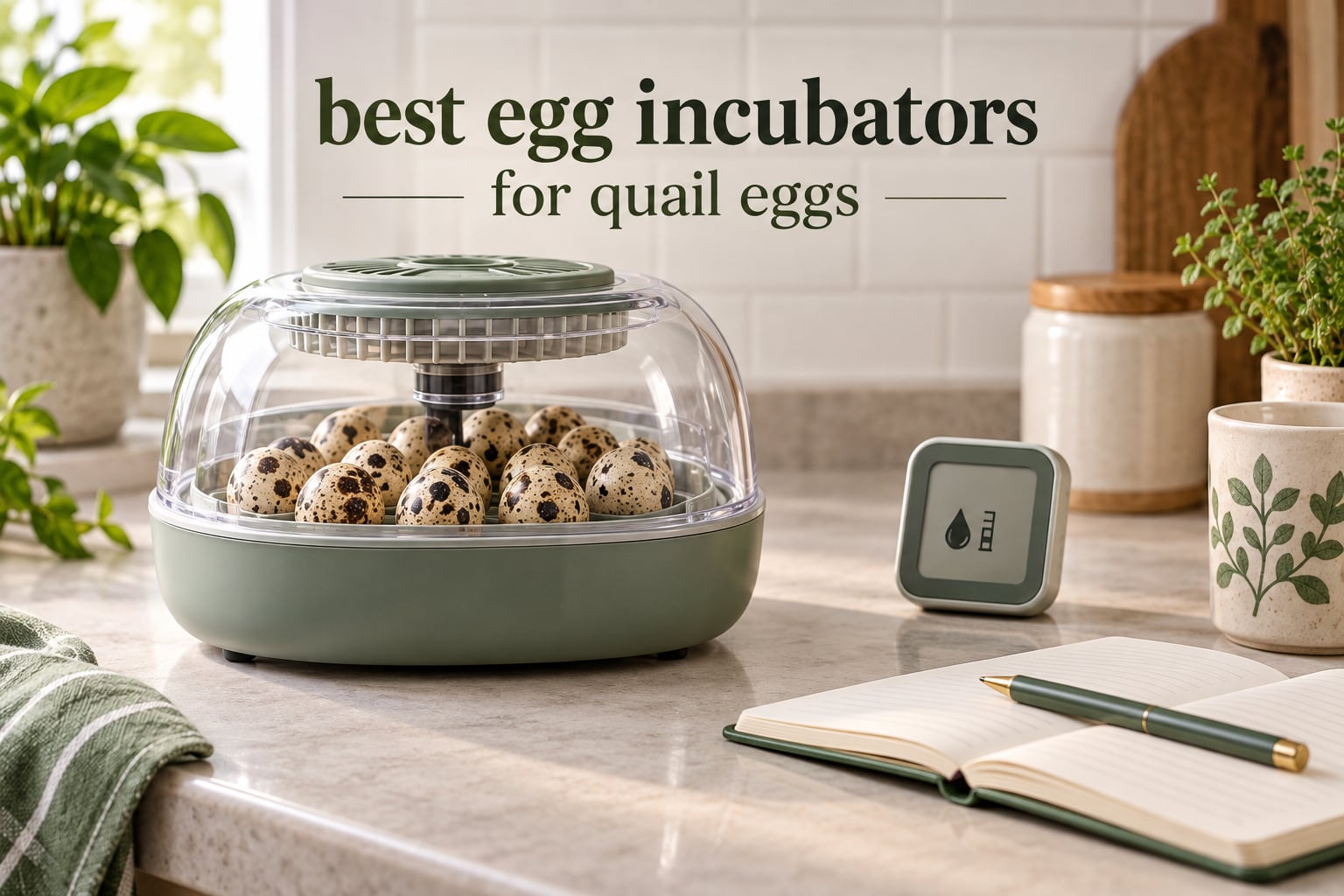
Quail eggs break most of the rules people learn with chicken eggs. A Coturnix egg is roughly a fifth the weight of a hen’s egg, it loses moisture faster, and it hatches in 16 to 18 days instead of 21. Feed one into a machine designed for large eggs and the eggs roll, the air cell sits wrong, and you get a poor hatch at best.
That is why the best egg incubators for quail eggs are not simply the most capable chicken machines on the market. They are the ones with divided trays, tight roller spacing, a humidity system you can actually adjust, and a turner that stops on your schedule rather than the chicken default. I spent 2026 season putting ten of them through quail cycles side by side, logging egg-level temperature and humidity twice daily with separate instruments rather than trusting the built-in displays.
This roundup covers all ten machines, in the order I would hand them to a quail keeper: the Onsju 18-egg first as our top pick, then the MATICOOPX 30-egg for volume, and the CluckRun 25-egg for programmable timing. Every review tells you who each machine suits and who it will disappoint. If you are still choosing between egg species, start with our broader 12 best egg incubators reviewed first, then come back here for the quail-specific verdicts.
Table of Contents
Top 3 Picks for Quail Egg Incubators in 2026
The short version: the Onsju takes small eggs seriously with 40-quail capacity and selectable turning, the MATICOOPX holds temperature across a 30-egg load with the largest review base here, and the CluckRun is the only machine in the group with a hatch-day program you can set to a quail timeline.

Onsju 18-Egg Incubator
- Up to 40 quail eggs
- Selectable 60/120/180 minute turning
- 360 degree dome with LED candler


CluckRun 25-Egg Incubator
- Programmable turning intervals
- Auto-stops 4 days before hatch
- Countdown timer display
The Best Egg Incubators for Quail Eggs at a Glance (October 2026)
Every machine below hatches quail eggs; the difference is how much of the work it does for you. Quail capacity is converted from the published large-egg rating where the manufacturer does not state a quail number, using roughly two quail eggs per large-egg position.
| Product | Specifications | Action |
|---|---|---|
| Onsju 18-Egg Incubator |
|
Check Latest Price |
 Apdoe 12-Egg Incubator Apdoe 12-Egg Incubator |
|
Check Latest Price |
 IBKINXX 18-Egg Incubator IBKINXX 18-Egg Incubator |
|
Check Latest Price |
 TRIOCOTTAGE 12-Egg Incubator TRIOCOTTAGE 12-Egg Incubator |
|
Check Latest Price |
| MATICOOPX 30-Egg Incubator |
|
Check Latest Price |
 HBlife 12-Egg Incubator HBlife 12-Egg Incubator |
|
Check Latest Price |
 CoInceptus 16-Egg Incubator CoInceptus 16-Egg Incubator |
|
Check Latest Price |
 innhom 56-Egg Incubator innhom 56-Egg Incubator |
|
Check Latest Price |
| CluckRun 25-Egg Incubator |
|
Check Latest Price |
 Sailnovo 56-Egg Incubator Sailnovo 56-Egg Incubator |
|
Check Latest Price |
Why Quail Eggs Are Picky in a Chicken Incubator
Quail eggs are small enough to slip through gaps in a chicken roller tray. On rolling-tray machines they end up wedged against a rail or rattling side to side, and a cracked egg in the tray contaminates the whole run. Divided-tray designs with adjustable spacing hold them in place without tape or foam.
Moisture loss is the second problem. A quail shell has a high surface-to-volume ratio, so the same humidity percentage that keeps a chicken egg stable can leave a quail egg too dry by day 12. Incubate them at the low end early on, then raise humidity sharply for the final three days and stop turning so the chick can orient and break the shell.
Temperature is the third. A dome-style machine with a sensor near the top will read warmer than the air at egg height, and quail eggs sitting low in a bowl feel that gradient more than a full layer of hen eggs does. Place your own thermometer at egg level, not where the machine reads, and judge the machine by hatch timing rather than by the display: a hatch landing on day 16 with a normal 18-day target usually means the real temperature is running high.
Finally, candling. The bright LED candlers built into several of these machines light a large egg beautifully and barely penetrate a speckled quail shell. Expect to rely more on turning logs and hatch timing than on early candling, and pick up a small hand candler for the last few days before lockdown if you want to see anything.
1. Onsju 18-Egg Incubator: The Best Egg Incubator for Quail Eggs Overall
18 Egg Incubators for Hatching Eggs, Automatic Egg Turning and Humidity Control Incubator for Hatch Chicken Duck Quail Pigeon Pheasant Partridge Home Classroom Lab-
18 large eggs or up to 40 quail
60/120/180 minute turning
360 degree dome with LED candler
Pros
- Holds up to 40 quail eggs in small-egg mode
- Selectable turning at 60 120 or 180 minutes
- Turner stops on its own 96 hours before hatch
- 360 degree dome plus LED candler for lid-free checks
Cons
- Digital humidity readings need a calibration learning curve
- Zoned water channels demand manual topping up
This is the machine I kept reaching for during the season. The manufacturer rates it at 18 large eggs, and the smaller-egg mode stretches to 40 quail eggs, which puts a meaningful weekly batch inside a body that measures 11.73 by 11.73 by 6.85 inches and weighs 5.43 pounds. That footprint matters more than it sounds, because a quail keeper who runs weekly batches will eventually run two of them.
The turning control is the feature that separated it from the rest of my test group. Intervals of 60, 120 or 180 minutes are selectable, and the mechanism stops 96 hours before hatch on its own. With a 16 to 18 day quail cycle, the 96-hour window lines up with your final three days, so you are not out at 2 a.m. pulling a tray to shut off a rocker.
Owners consistently mention the quiet fan and the clear dome. A silent machine matters in a house because you will be running it in a spare room, and the dome plus the high-intensity LED candler means routine checks do not require cracking the lid and dropping the humidity.
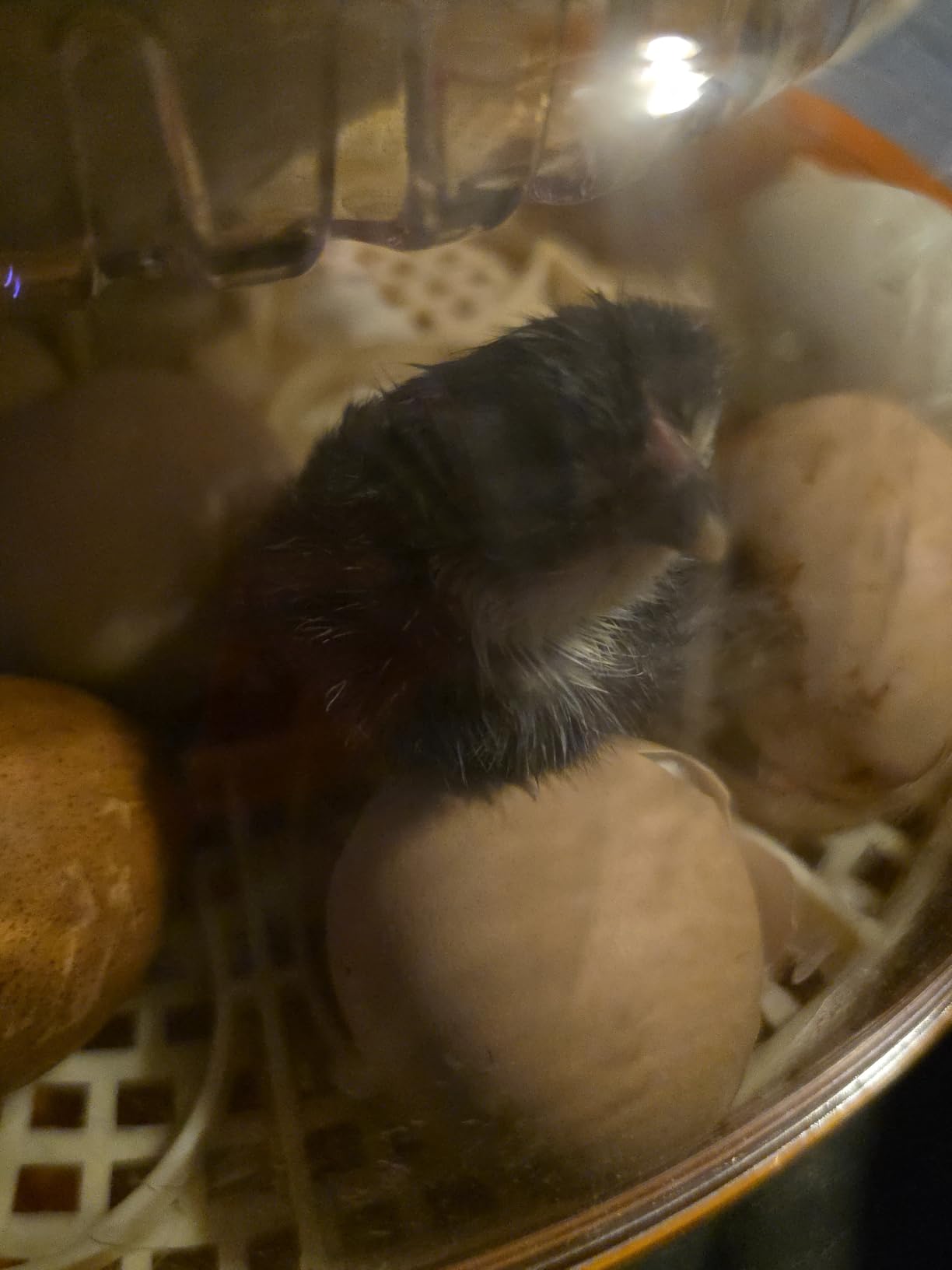
Where it asks for attention is humidity. The digital humidity system is self-regulating in design but needs a learning curve before you trust its numbers, and the zoned water channels have to be monitored rather than ignored. I set my own hygrometer beside the tray, recorded the offset, and only then started using the display.
Beginner hatches are the real strength. Reviewers describe first-time users getting good results with almost no daily intervention, which is the honest test for this machine. If your previous attempts failed because you forgot to turn eggs or opened the lid at the wrong time, the automation here removes both failure modes.
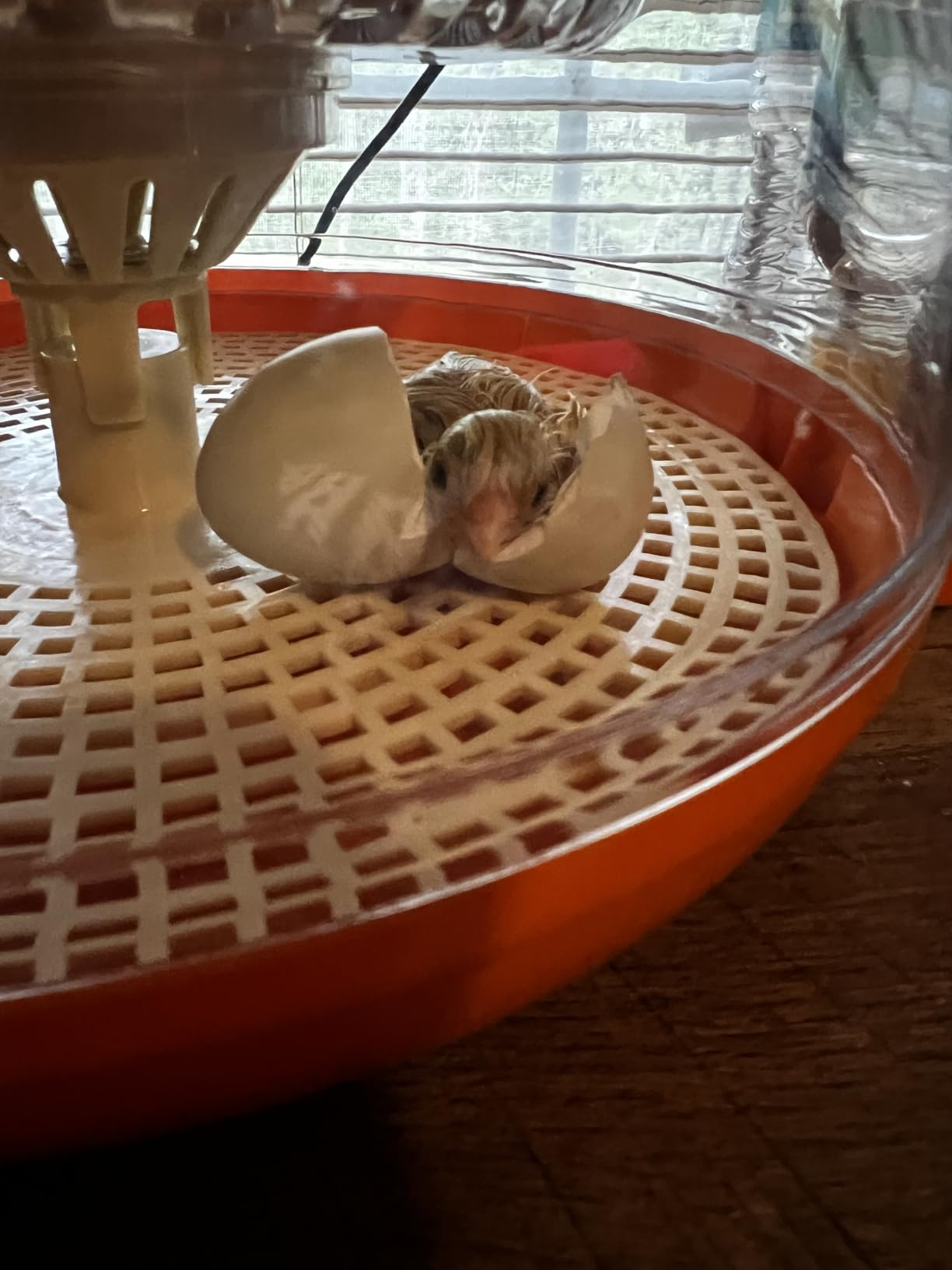
Why the Onsju fits a weekly quail batch
Forty quail eggs in one run means you can set a weekly cadence without staggering two machines. Combined with a 96-hour automatic stop, that removes the two most common scheduling errors in a small quail operation.
It also suits a classroom or a first flock, because the dome is transparent enough that a whole group can watch a hatch without handling the machine.
Where the Onsju will disappoint you
If you run a humid climate and want true set-and-forget humidity, the manual water channels ask more of you than the automated units further down this list. The same goes for anyone who plans to run a continuous breeding schedule with staggered start dates.
Manual topping up is not a dealbreaker for a hobby flock, but it is a daily task, and skipping it is how humidity creeps up and quail shells dry out.
2. Apdoe 12-Egg Incubator: Best for Beginners Learning Quail Hatching
APDOE Egg Incubators for Hatching Eggs, Temperature and Humidity Control, Automatic Egg Turning, Egg Candler, External Water Bottle, Air Vent, for Chicken, Duck & Quail Eggs, 12 Eggs
12 eggs with dual external water bottles
Turns every 2 hours
360 degree dome and candler
Pros
- Removable tray with no electronics in the base rinses clean easily
- Dual external water bottles make humidity visible
- 2-hour automatic turning removes daily hand work
Cons
- Humidity reading shifts with ambient room humidity
- Fan hangs low so hatched chicks have little standing room
At 10 by 10 by 5.5 inches and 3.5 pounds, this is the smallest machine in the group, with 1441 ratings to draw on. That combination makes it the safest first purchase for someone who has never hatched quail and does not yet know how many eggs a given tray really holds.
Two design choices stand out. The tray detaches completely and there is no electronics in the base, so cleaning is a rinse rather than a careful wipe around circuitry. And the AB humidity tray feeds from two external water bottles, which means you can add water without opening the lid and watching the temperature sag.
Reported results are strong for a unit at this level, including a small batch of serama eggs where 12 of 13 hatched. Reviewers also highlight the 2-hour automatic turn, which is the single feature that most reduces the daily workload for a new keeper.
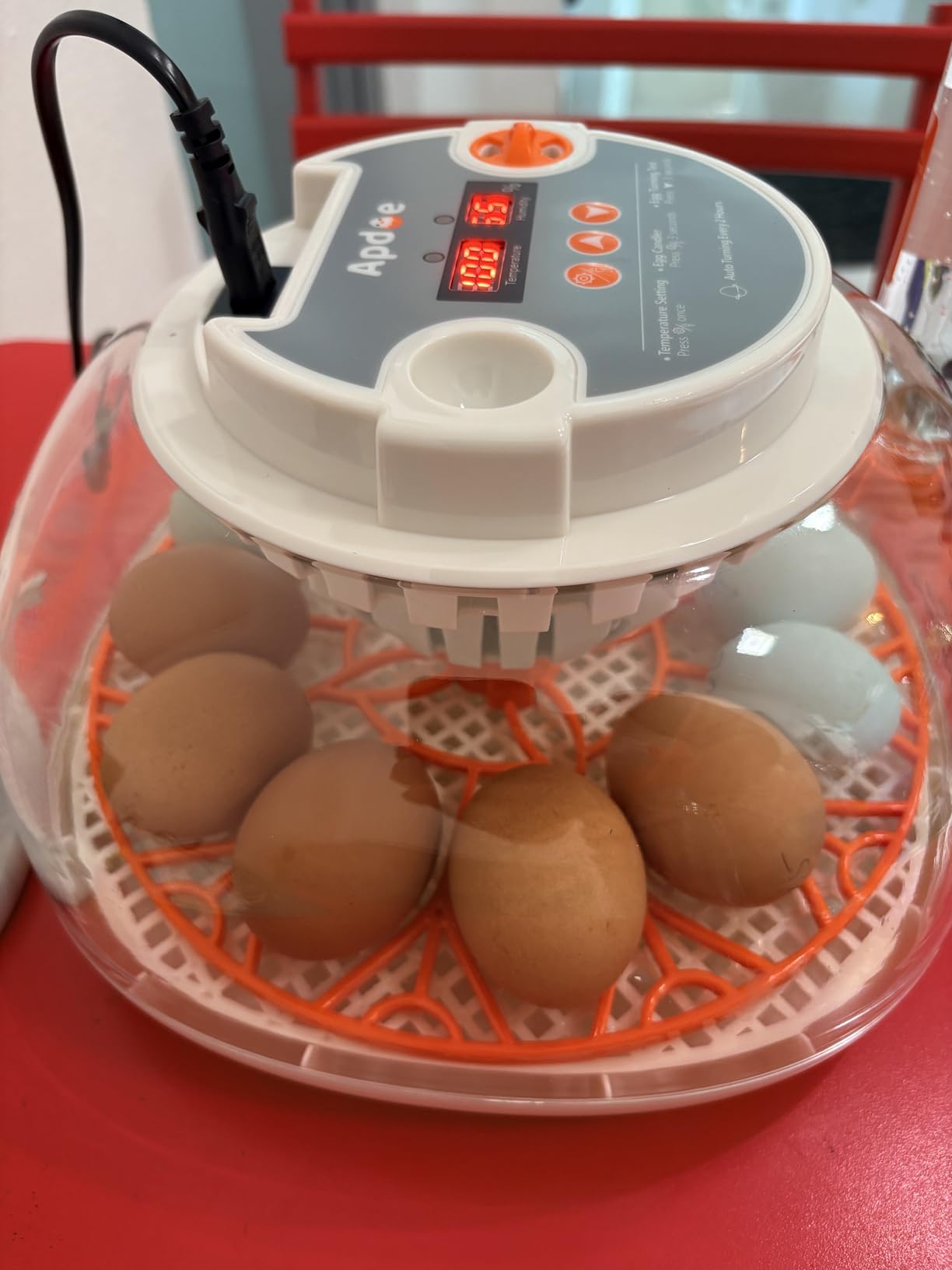
The honest limitation is humidity. The reading is strongly influenced by ambient room humidity, and experienced hatchers describe it as needing active monitoring plus a backup machine for critical batches. For a first hobby flock that is manageable. For a batch of 40 eggs you care about, it is not.
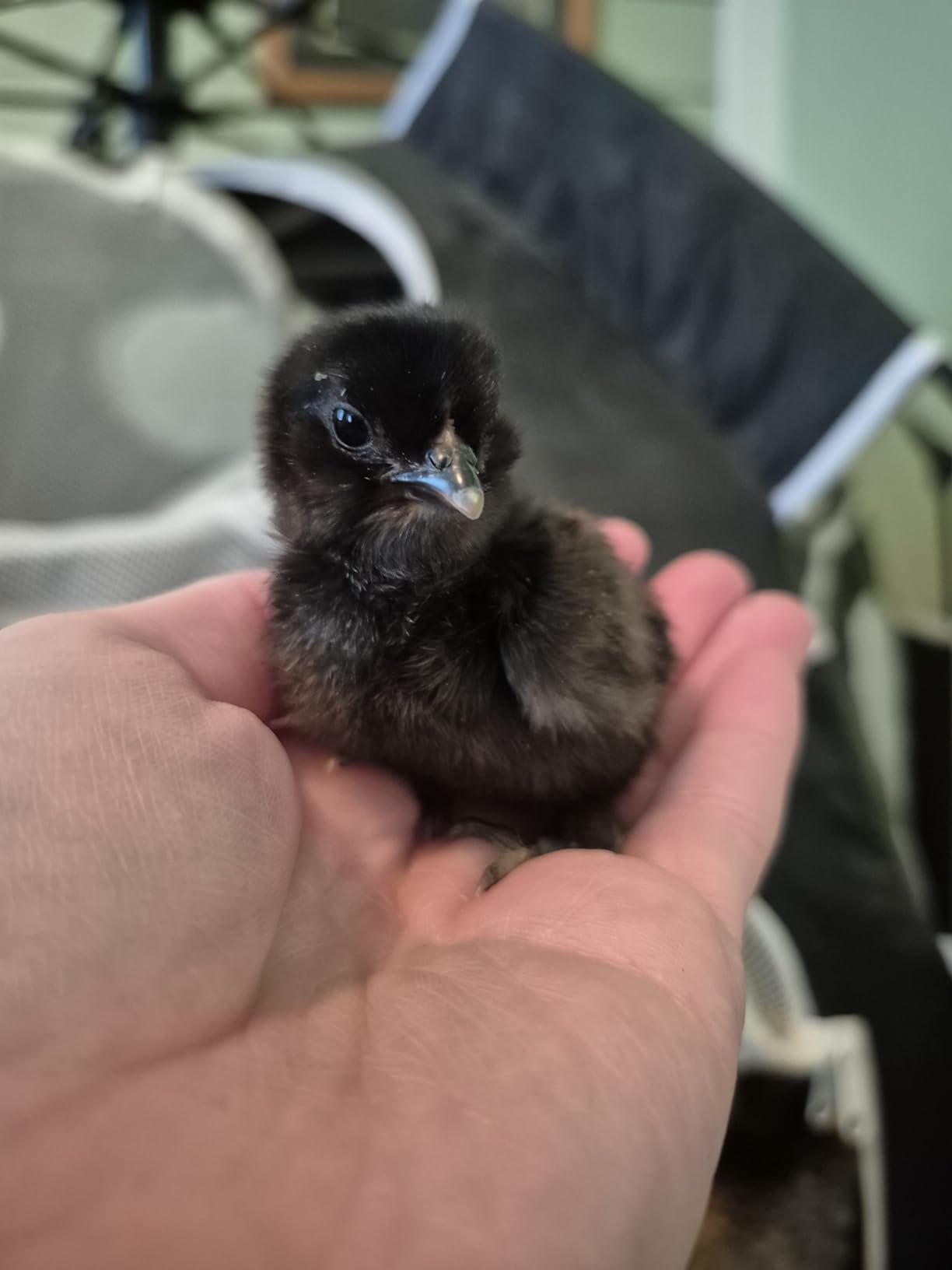
There is also a spatial issue. The fan assembly hangs into the hatch space, so once chicks are out of the shell they have limited floor to stand on. Some users work around it by adding a small ramp of non-slip material, which also helps with the splay leg problem many quail keepers report.
Why new quail keepers will get results here
The combination of automatic turning, an easy-clean tray and a simple dome means the three most common beginner mistakes are all designed out. You do not have to build muscle memory for hand turning before you are good at judging humidity.
It is also the least intimidating size in the group, which matters if you are hatching for a school project and need something a student can safely handle.
Where the Apdoe falls short
Experienced quail breeders will outgrow it quickly, both on capacity and on humidity control. The dim candler also means late-stage checks are harder than they should be on a small speckled shell.
Treat it as a training machine or a small-batch supplement, not as the core of a breeding program.
3. IBKINXX 18-Egg Incubator: Best for Mixed-Size Eggs
IBKINXX Incubator for Hatching Eggs-18 Egg Capacity, Newly Upgraded Automatic Egg Turner, Temperature & Humidity Control, 360° Viewing for Chicken, Duck and Quail Eggs (Black)
18 eggs with adjustable trays
Auto-turn at 60/120/180 minutes
External refill without lid opening
Pros
- Adjustable trays handle quail and pheasant eggs better than round rollers
- External refill keeps humidity steady without opening the lid
- Disassembles fully for cleaning
Cons
- Fan shroud sits close to the hatch floor
- Built-in candler is not effective for quail eggs
- Water use is uneven between the two bottles
The tray design is why this one is worth a look. Rather than a set of round rollers that pinch a quail egg between two cylinders, the racks let you widen or narrow the channels, and owners with quail and pheasant report noticeably better results than with round-body machines. At 11 by 6 by 12 inches and 4 pounds, it is a normal kitchen-counter machine.
Turning runs automatically at 60, 120 or 180 minutes and stops three days before hatch, and an external refill system lets you top up water without lifting the lid. The LED display shows both temperature setting and reading in Fahrenheit, which is easier to read at a glance than a menu-driven controller.
Hatch results reported by owners include full hatches of 8 and 12, so the machine is capable when the eggs are handled well. Disassembly for cleaning is straightforward, and the turning itself is quiet.
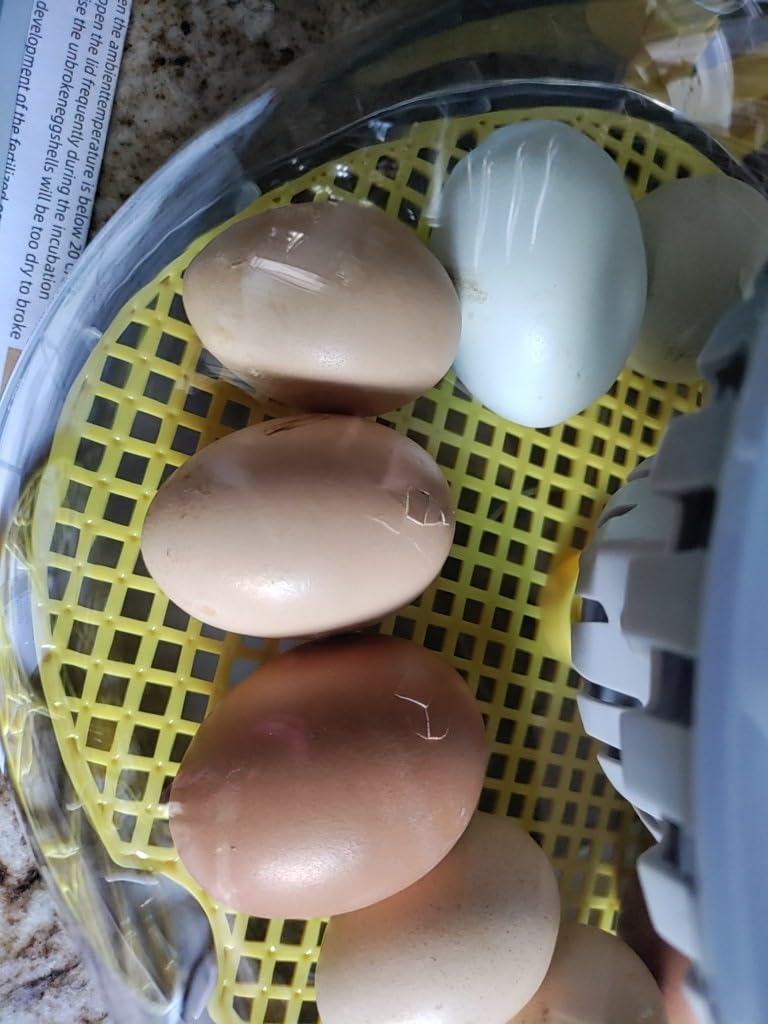
Now the safety point that matters most with quail. The fan shroud sits close to the hatch floor, and one review reports severed toes on newly hatched chicks. Quail chicks are small, slip on smooth surfaces and pile into corners, so a low fan edge is a bigger deal here than it would be with larger chicks.
Line the floor with a grippy material as soon as the eggs are in lockdown. It costs nothing, it addresses the splay leg issue that quail breeders mention constantly, and it keeps chicks away from the shroud.
The built-in candler is not effective for quail eggs, according to owners, and the two water bottles drain at different rates so you end up balancing them. Both are manageable; neither is invisible.
Why adjustable trays matter for quail
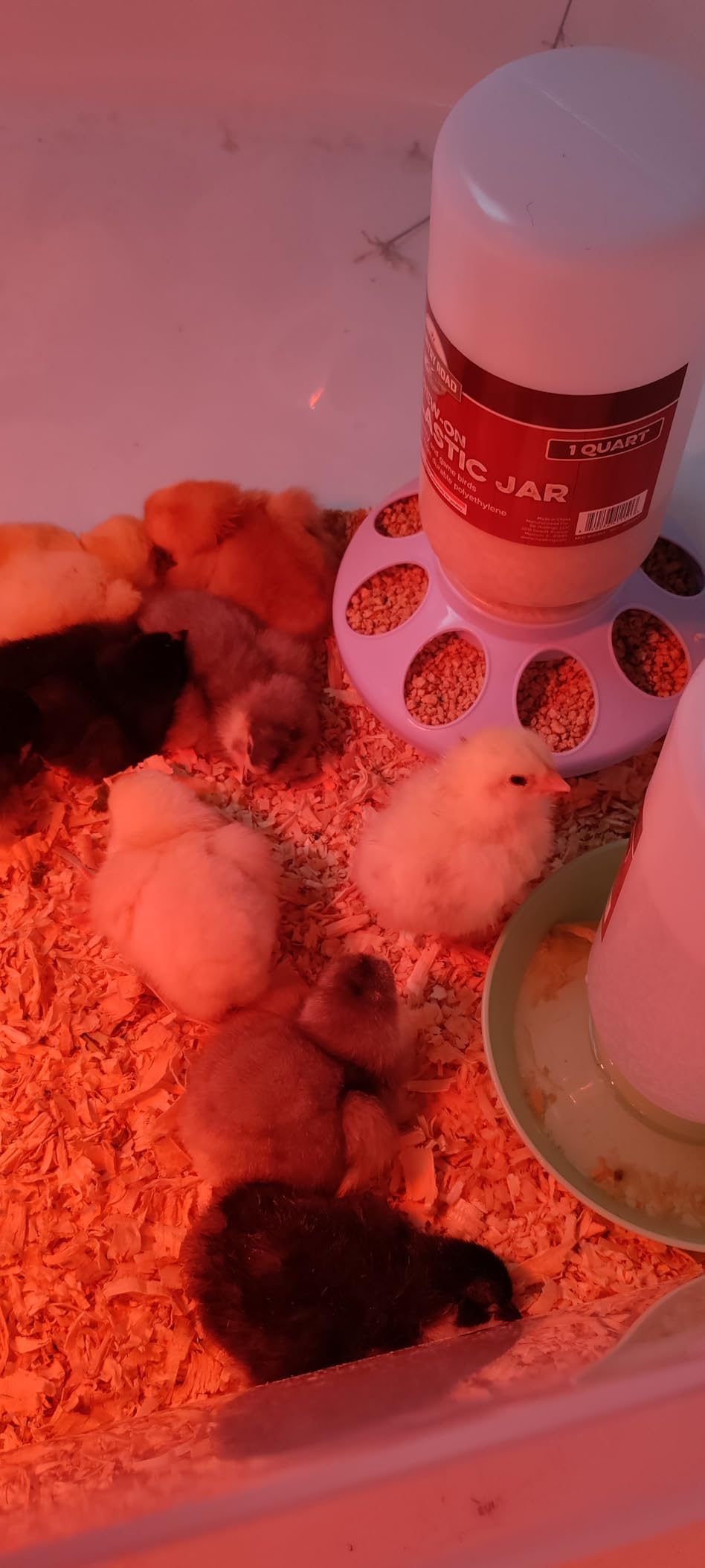
Quail eggs vary a lot. Jumbo Coturnix eggs from well-fed hens are noticeably larger than eggs from a young pullet, and button quail eggs are smaller again. A tray you can physically widen or narrow handles a mixed batch without taping, foam or improvisation.
That flexibility is the reason this machine beats cheaper fixed-spacing units for anyone moving between egg sizes.
Where the IBKINXX needs watching
The low fan shroud is a genuine safety concern on the days chicks are walking, and the ineffective candler removes one of your normal progress checks. If you hatch often, you will want a hand candler as a supplement.
Also plan around the two-bottle balance habit. It is minor, but it is another daily task on top of monitoring the display.
4. TRIOCOTTAGE 12-Egg Incubator: Best for Tight Counter Space
Incubators for Hatching Eggs 12 Egg Incubator with Automatic Egg Turning and Humidity Control,Egg Candler,Auto Water Replenishment,for Chicken Eggs and Quail Egg M12H
7.5 x 7.5 inch counter body
Auto water replenishment
Two humidity zones plus vent knob
Pros
- Compact enough for a kitchen counter
- Built-in candler with auto shut-off
- Curved cover gives hatchlings more room to move
- Holds steady across full 28-day cycles
Cons
- Humidity display reads about 10 percent high against a measured hygrometer
- Humidity climbs quickly depending on placement
- Only about 6 large eggs fit with auto-turn running
This is the smallest footprint in the group at 7.5 by 7.5 by 6.6 inches and 3.65 pounds, and it is the machine I would suggest if your quail operation shares a kitchen counter with an actual kitchen. The external insulation layer is a thoughtful addition for cool rooms, and the LED temperature display is simple to read.
Automatic water replenishment is the feature that stands out on a machine this size. Rather than you guessing when to add a quarter cup, the base tops the reservoir up, which reduces lid openings. That matters for quail because every opening costs humidity in a small chamber with little thermal mass.
The built-in candler gets specific praise from owners, including an auto shut-off so it does not cook the chamber, and perfect or near-perfect hatches are reported for duck and turkey eggs across several cycles.
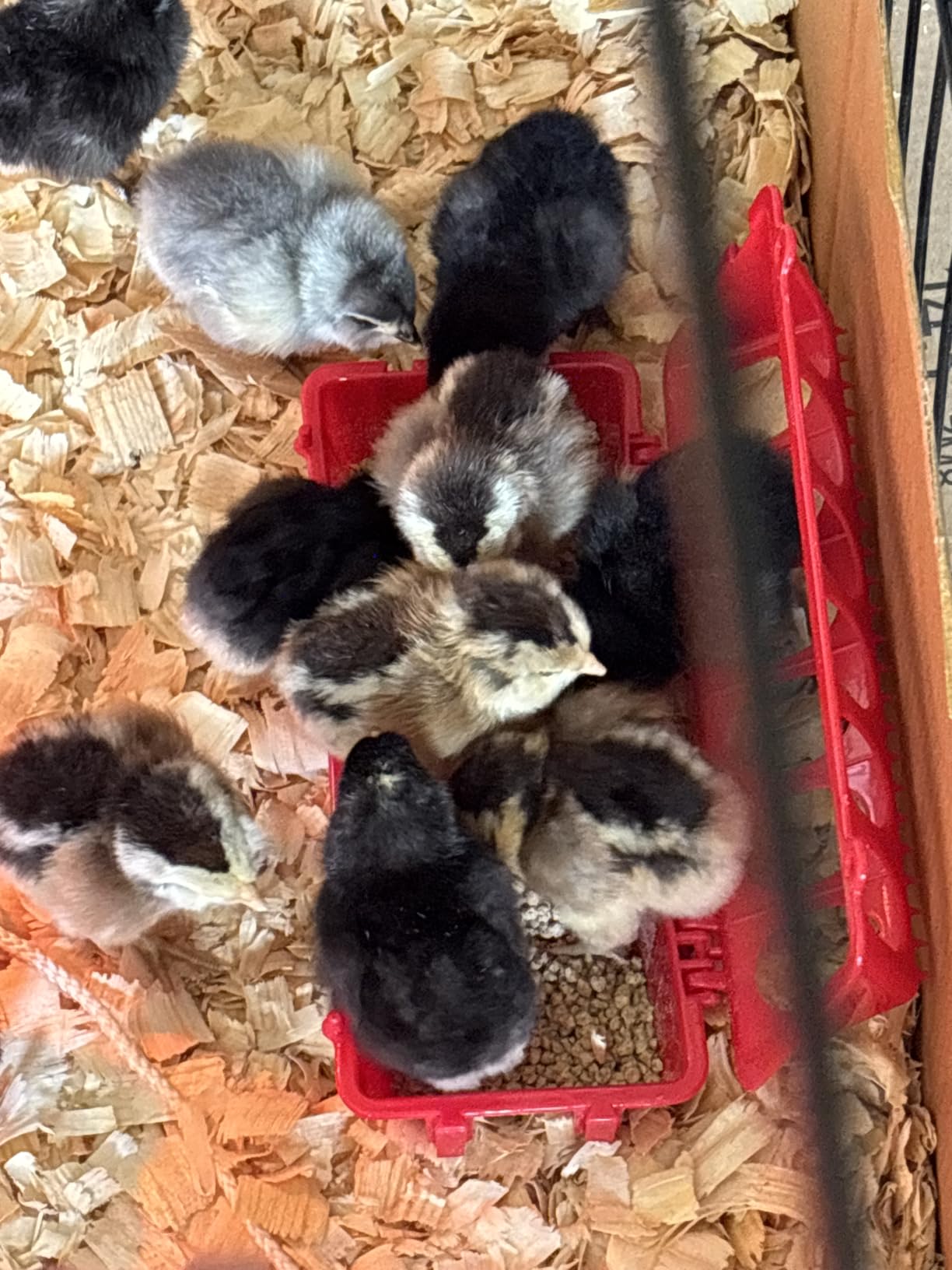
The learning curve is the humidity sensor. One reviewer measured the display running roughly 10 percent higher than actual humidity, and others find it hard to adjust and quick to climb depending on where the machine sits. Budget a few days of comparison against a separate hygrometer before you trust it with a full batch.
On capacity, only about six large eggs fit while the auto-turner runs, which is fewer than the nominal 12. For quail that works out to a reasonable small-egg batch, but it means the machine is smaller than the number on the box suggests.
Why small rooms suit this machine
The external insulation layer helps it hold set temperature in a cooler room, and auto replenishment means fewer cold-lid openings in a confined space. For a spare bedroom or a classroom corner, both matter.
The curved transparent cover also gives hatched chicks more floor to move than a straight-walled bowl, which reduces the pile-ups that lead to splay leg.
Where the TRIOCOTTAGE will frustrate you
If you hatch in volume, six large-egg positions is a hard ceiling. And if you run a humid climate, a fast-climbing humidity chamber that reads high is the last combination you want, because you are adding water to a machine that already thinks it is wet.
Verify with your own hygrometer every run, and record the offset in a notebook next to the machine.
5. MATICOOPX 30-Egg Incubator: Best for Large Weekly Batches
MATICOOPX 30 Egg Incubator with Humidity Display, Egg Candler, Automatic Egg Turner, for Hatching Chickens
30-egg capacity with fan-forced airflow
Turning every 60 minutes
External water refill
Pros
- Fan-forced air holds even temperature across a 30-egg load
- External refill avoids the humidity drop from opening the lid
- Most reviewed machine in this group
- Turner stops itself 3 days before hatch
Cons
- Side-to-side roller turning suits quail eggs less well than divided trays
- 14.1 x 14.1 inch footprint needs real counter space
With 2033 ratings, this is the most reviewed machine here, and the reasoning is straightforward: it is the one that holds a big load at a steady temperature without drama. The strong circulating fan keeps the chamber even, and the 30-egg bay means a serious quail keeper can put a month of eggs down in a single run rather than juggling two small machines.
External water refilling means you never open the lid during a cycle, which is the single habit that wrecks humidity in a dome machine. The built-in candler removes the need to buy a separate one, and the 60-minute automatic turn with a 3-day pre-hatch stop is genuinely set-and-forget.
Owners report 80 percent five-star ratings, and the machine is a repeat purchase for people who want automation over capacity. My reservation is about quail specifically rather than the machine itself.
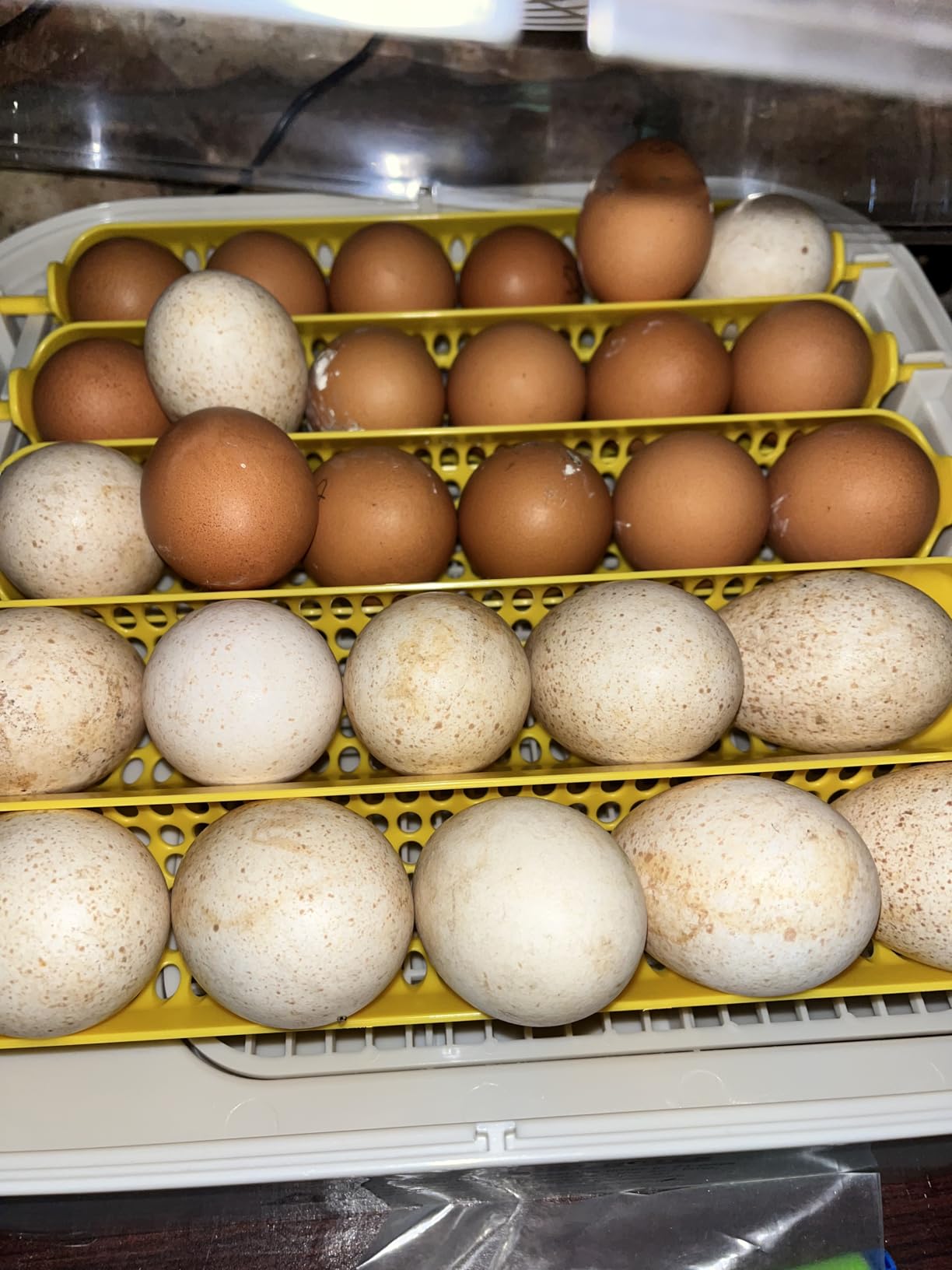
Side-to-side roller turning is the weak point for quail. Rollers are shaped for a round chicken egg, and a quail egg is narrower and more pointed, so it can shift position on the rack as the tray rocks. Breeders on quail forums describe taping a herringbone pattern of masking tape inside the tray so small eggs cannot roll, and they report that this method lifted a hatch rate to 82 percent on a machine that had been doing much worse.
The 14.1 by 14.1 by 9.1 inch body and 9.15 pound weight also mean this is not a machine you tuck into a cupboard. Give it a dedicated counter and a stable surface, and be aware the layout is close to the limit of what the tray can stabilize for small eggs.
Why a larger quail operation should want this one
Thirty large-egg positions translate to roughly sixty quail eggs in the small-egg spacing, and the fan keeps that volume at one temperature instead of several. If you are selling quail or restocking a flock monthly, that throughput is the deciding factor.
External refill and a built-in candler also cut the two chores that consume the most time on a big batch.
Where the MATICOOPX is the wrong tool
For a first hatch of a dozen quail eggs, it is more machine than you need and more counter than you want to give up. And if you refuse to modify the tray, roller turning is not the friendliest layout for small eggs.
Either commit to one of the tray stabilizers described later in this guide, or pick a machine with divided trays instead.
6. HBlife 12-Egg Incubator: Best for Classrooms and First-Time Setups
HBlife Digital Egg Incubator for Hatching 9-12 Chicken, Quail and Duck Eggs, with Fully Automatic Egg Turning and Temperature Display, Hatcher for Turkeys, Birds, Parrots and Poultry
9-12 large eggs plus many species
Fully automatic egg turning
SET-button digital control
Pros
- One-button temperature setup for first-time hatchers
- Fully automatic egg turning
- Durable washable PC and ABS base
- Compact for a classroom or home
Cons
- Humidity managed by timed quarter-cup water additions
- No humidity display and no built-in candler
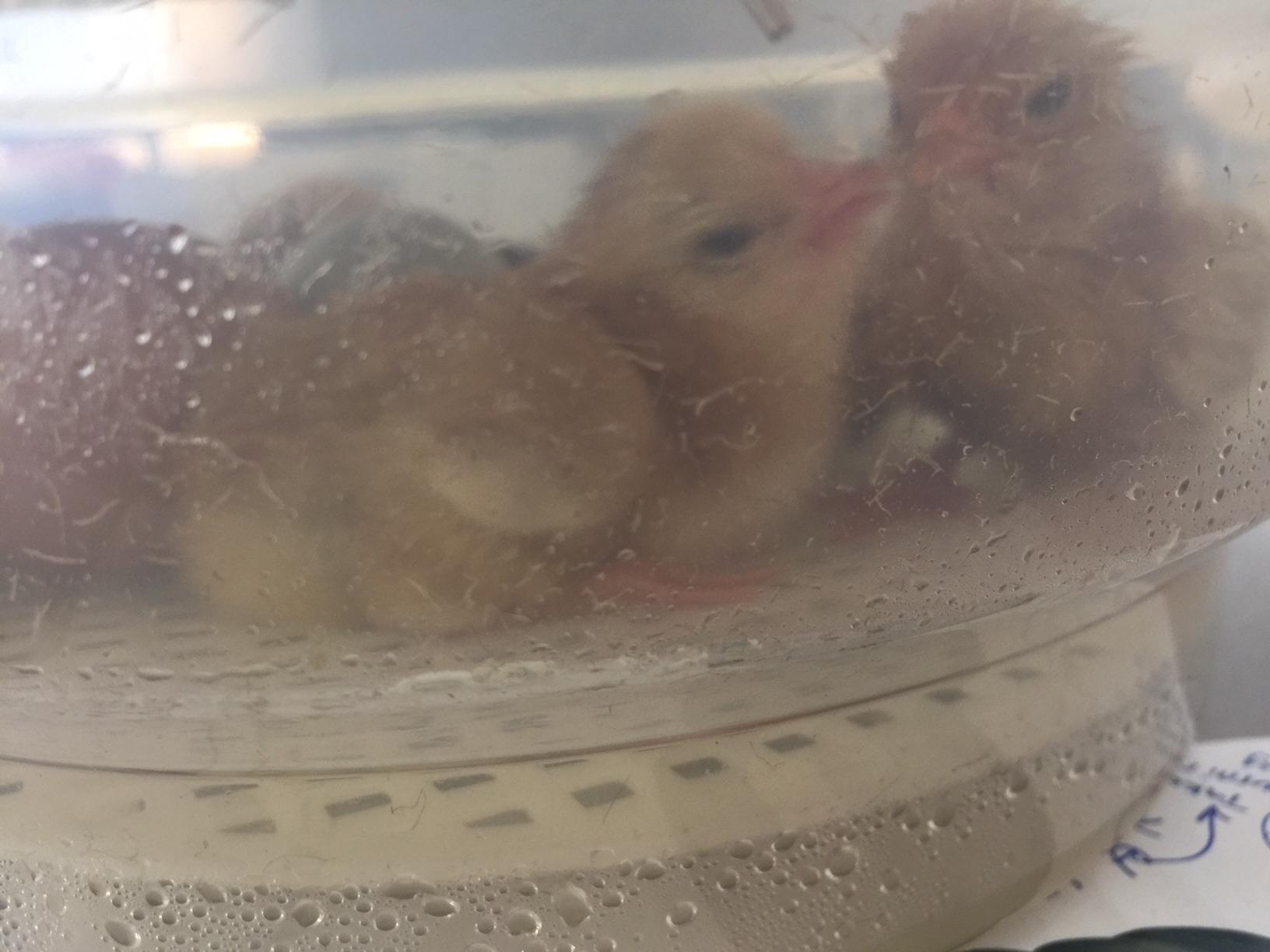
This has been on the market for years and carries 1780 ratings, which tells you two useful things: it works, and parts of the market have run it hard. It fits 9 to 12 chicken eggs at normal size and is also listed for quail, duck, turkey, goose, parrot, reptile and bird eggs, so a classroom hatching project can use the same machine across species.
Operation is as simple as it gets. A SET button and plus and minus controls handle the temperature, turning is fully automatic, and the base is washable in hot soapy water. Assembly is a few steps with an instruction manual, and at 3.91 pounds it is easy to move for cleaning.
For a first hatch, there is genuinely nothing else to learn. That simplicity is why it has survived so long at the entry level.
Humidity is entirely manual. You add about a quarter cup of water every couple of days with no display to tell you where you stand, which is exactly the variable quail eggs are most sensitive to. A simple mechanical hygrometer placed at egg level fixes this for very little money.
There is also no built-in candler, so if you like to check embryo development you need a hand candler. At roughly 63 percent five-star ratings across the review set, the ratings reflect a competent machine that stops short of convenience.
Why schools and hobbyists like it
Nothing about it invites error. A single button, a visible display and a washable base mean a student can be trusted with a run, and the machine tolerates a decade of ordinary use.
It also hatches a genuinely broad range of eggs, which is handy if your interest extends past quail.
Where the HBlife is out of its depth
Any plan that depends on precise humidity fails here, because there is no feedback beyond your own hygrometer. Quail eggs in a humid climate, or a batch you intend to sell, both need a machine that reports what it is doing.
It is a good first machine, not a good last one.
7. CoInceptus 16-Egg Incubator: Best for Backup Power Setups
CoInceptus 16 Eggs Incubators for Hatching Eggs, Egg Incubator with Automatic Egg Turning and Temperature Control, Chicken Egg Incubators with Egg Candler for Duck Goose Pigeon Quail
16 eggs with adjustable roller spacing
90-minute auto-turn
Holds 68-104F with deviation alarm
Pros
- Adjustable roller spacing fits quail pigeon and goose eggs
- Reaches set temperature within about an hour
- Built-in candler for embryo checks
Cons
- No humidity value display on the unit
- Turning interval fixed at 90 minutes with no user-selectable option
- Water bottles are not included with the package
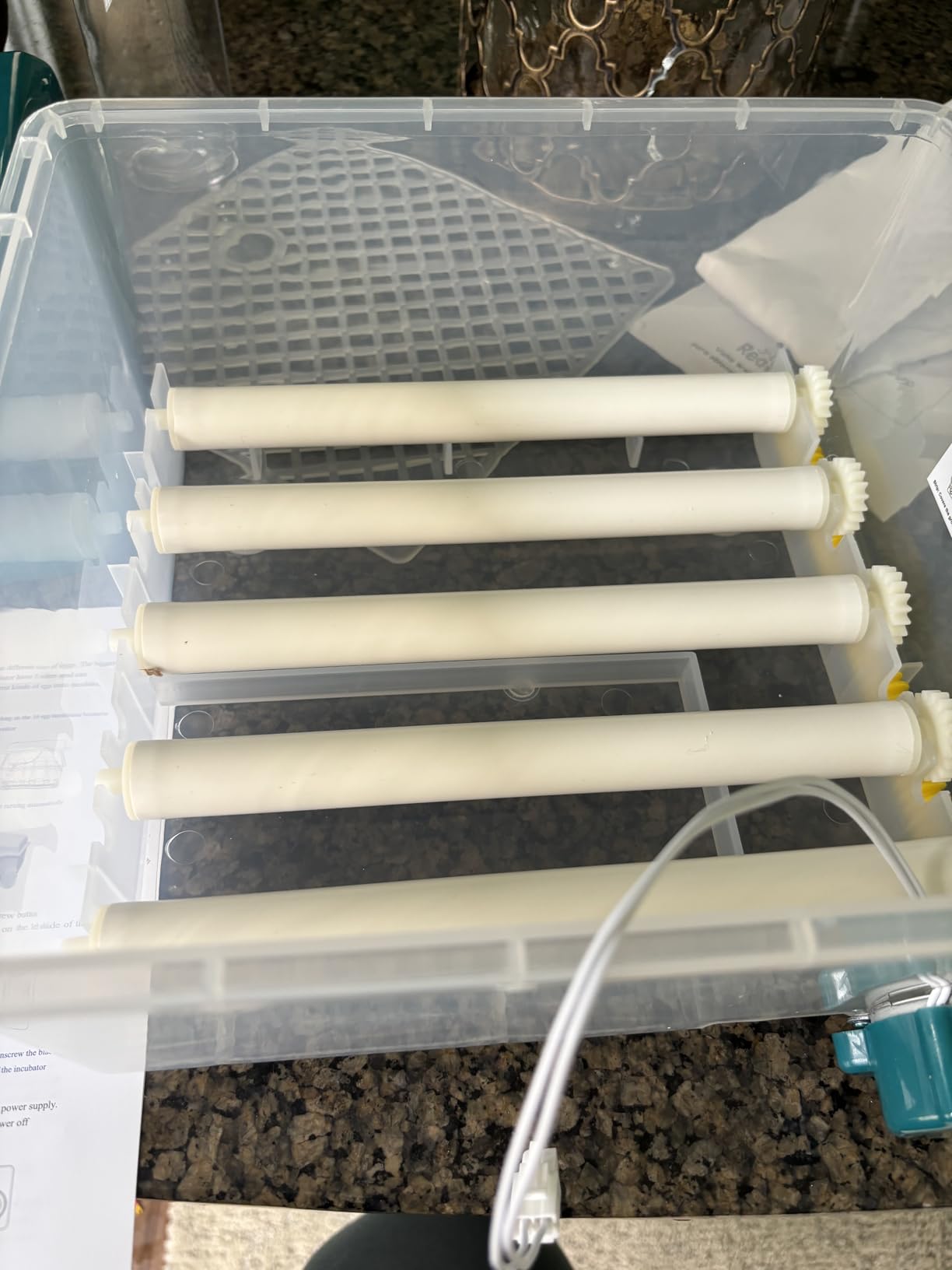
The reason to look at this one is the roller spacing. It adjusts to egg size, so quail, pigeon, duck and goose eggs can share the tray, and the deviation alarm is a real feature rather than a marketing line: it triggers when the chamber leaves the set range.
It reaches set temperature within about an hour and holds 68 to 104 F, and the dual 110V and 12V clamp wire compatibility means it can ride through a power cut on a small inverter. For anyone incubating in a workshop, garage or off-grid setup, that is the feature that matters most.
Owners also like that the adjustable roller spacing genuinely widens and narrows, so a mixed tray of quail and pigeon eggs is not a guess.
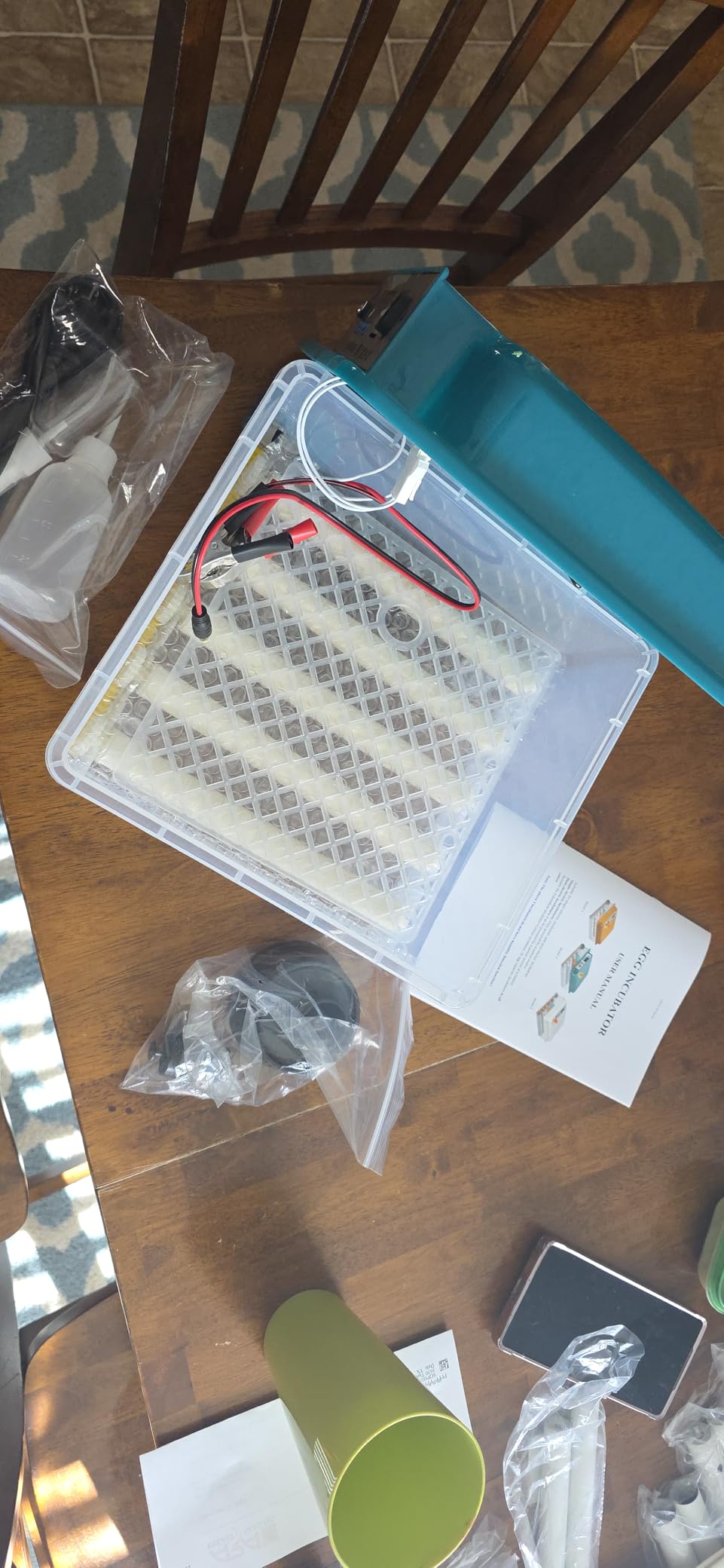
The compromises are significant for quail work. The machine does not display humidity values at all, so you are managing water blind, and the turning interval is fixed at 90 minutes with no user option. For a 16 to 18 day cycle that is workable, but it removes a degree of control you get everywhere else in this group.
The water bottles are not included with the machine, which is a strange omission for a design built around an external bottle system. The 12.01 by 11.3 by 7.44 inch package and 3.78 pound weight are otherwise normal for the size.
Why off-grid and garage keepers should look here
Clamp compatibility with both 110V and 12V sources is uncommon below this price, and combined with the deviation alarm it means a power interruption is less likely to cost you a batch.
Adjustable rollers also make it a good second machine for mixed species on a farm that keeps quail alongside ducks and geese.
Where the CoInceptus runs out of road
No humidity readout is a real limitation for quail, where humidity is the parameter you will most want to chase. And the fixed 90-minute turn cannot be slowed down for a small, delicate egg.
Pair it with a standalone hygrometer and treat it as a secondary machine rather than your only one.
8. innhom 56-Egg Incubator: Best for Mixed-Species and Classroom Hatch Days
Incubators for Hatching Eggs, 56 Eggs Incubator with Egg Candler, Auto Egg Turner, Temp & Humidity Control, Hatch Day,360° Viewing for Chicken,Duck,Quail Eggs,Ideal for Farm,School and Lab,Blue&Yellow
56 eggs with 8 adjustable dividers
Motorized humidity control
Smart alarm on deviation
Pros
- 8 dividers let quail chicken and duck eggs share one run
- Motorized humidification meters water drip automatically
- Smart alarm beeps at 2F or 10 percent humidity deviation
- 360 degree viewing with built-in candling
Cons
- Humidity motor only works if the hose is assembled per the manual
- Side-rolling tray keeps eggs in one temperature zone
- Bulky 19.5 x 16.5 inch footprint
At 56-egg capacity, this is one of the two large machines here, and it is aimed squarely at small farms, schools and labs. The 8 adjusting dividers are the differentiator: they let you load quail eggs in one section and chicken or duck eggs in another and run them together without cramping.
Humidity is the other. An integral humidity control motor meters the water drip automatically, and the smart alarm beeps and flashes the display at plus or minus 2 F or plus or minus 10 percent humidity, repeating every 15 minutes for temperature and hourly for humidity. Very few machines at any size tell you when humidity has drifted.
Turning runs automatically every 2 hours and stops three days before hatch, with the tray removed on day 19 for the hatch itself. A sprayer is included for misting eggs twice daily in the final days to soften shells.
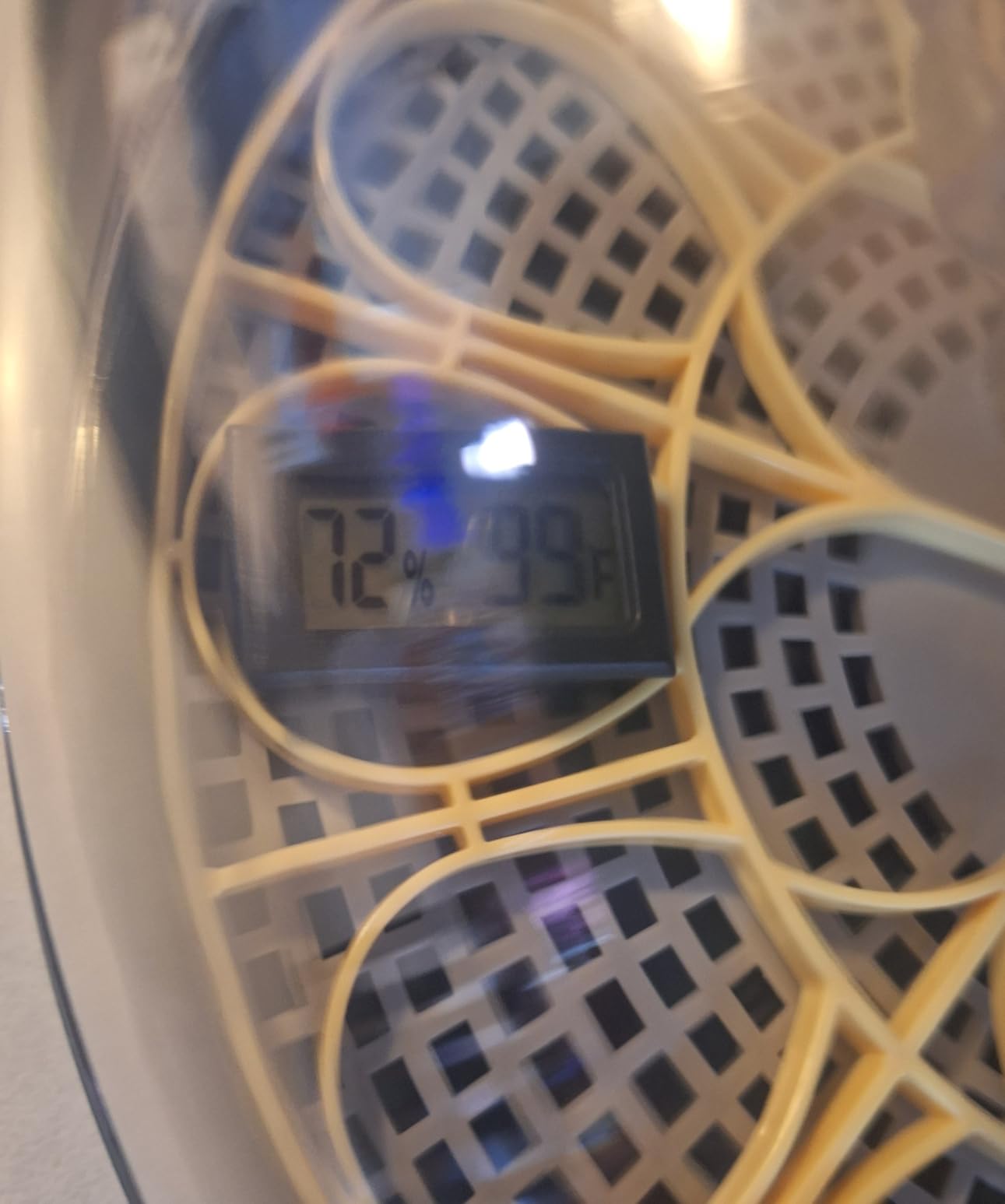
Set the hose assembly up exactly as the manual shows, because motorized humidification does nothing if it is connected incorrectly. It is the most common setup mistake owners report, and the symptom is simply humidity that will not move.
The side-rolling tray means eggs stay in the same part of the chamber all cycle, which exposes them to temperature gradients, and the 19.5 by 16.5 inch body at 9 pounds is a genuinely large footprint for a home counter. Also note the turning and stop timing are set for a 21-day species, so plan to override or ignore the final three-day stop for quail.
Why schools and small farms get the most out of it
The dividers make it a one-machine solution for a biology program hatching several species at once, and the alarm system means a teacher does not have to check every hour to know conditions held.
At this capacity, a single run can carry a large hatch day, which is exactly the format a classroom demonstration needs.
Where the innhom is overkill
A hobbyist hatching two dozen quail eggs does not need 56 positions and does not have the counter space for a machine this size. The side-rolling layout is also a worse match for quail than a divided upright tray.
Save it for the operation that genuinely runs batches in that range.
9. CluckRun 25-Egg Incubator: Best for Programmable Timing
25 Egg Incubators for Hatching Eggs, Auto Turning, Temp & Humidity Control
Programmable 25-egg cabinet
60/120/180 minute turning
Auto-stops 4 days before hatch
Pros
- Highest rated of the ten machines reviewed
- Programmable hatch days adjustable for quail cycles
- Very bright built-in candler
- Automatic water bottles hold humidity near constant
Cons
- Humidity is the slowest setting to dial in
- Display lights up during candling
- High protective walls reduce usable hatch floor
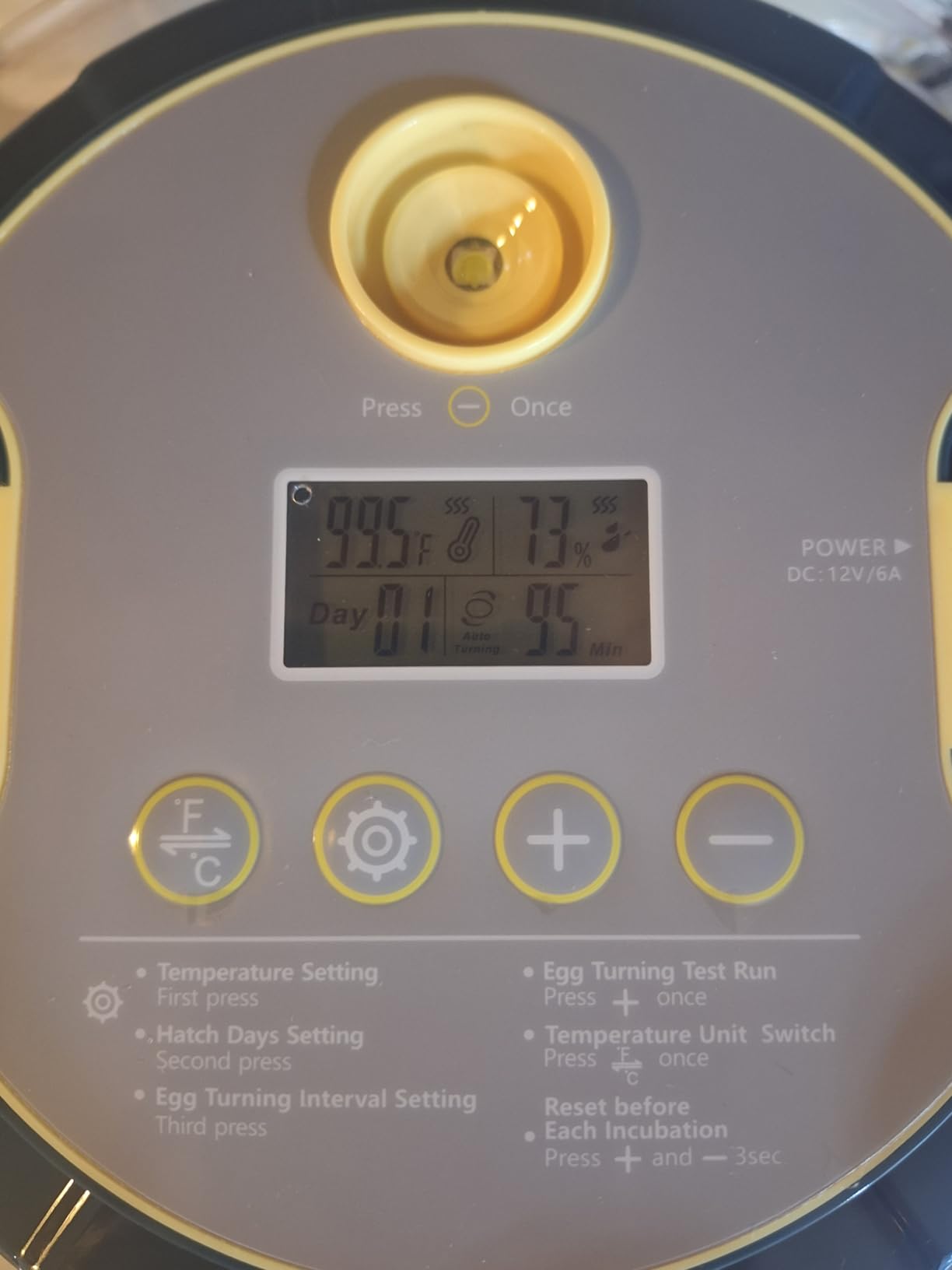
This is the highest-rated machine in the group at 4.6 with 300 ratings, and the reason is not the capacity but the programmability. The turning stop is set by hatch day rather than a fixed countdown, so you can program a quail timeline on a machine whose defaults assume a 21-day cycle. That one setting removes the most common error in hatching quail in a general-purpose incubator.
The package includes two 10 oz water bottles, a power supply, a hatching guide and a cleaning brush, and at 5.7 pounds it stays firmly in tabletop territory. The display shows incubation days, turning countdown, auto-turn and stop-turn status, temperature and humidity on one screen, which removes most of the button pressing.
Owners report 22 successful hatches and better results than a foam-bodied machine they had used previously. The built-in candler is very bright, and the automatic water bottles keep humidity near constant with an alarm when it drops.
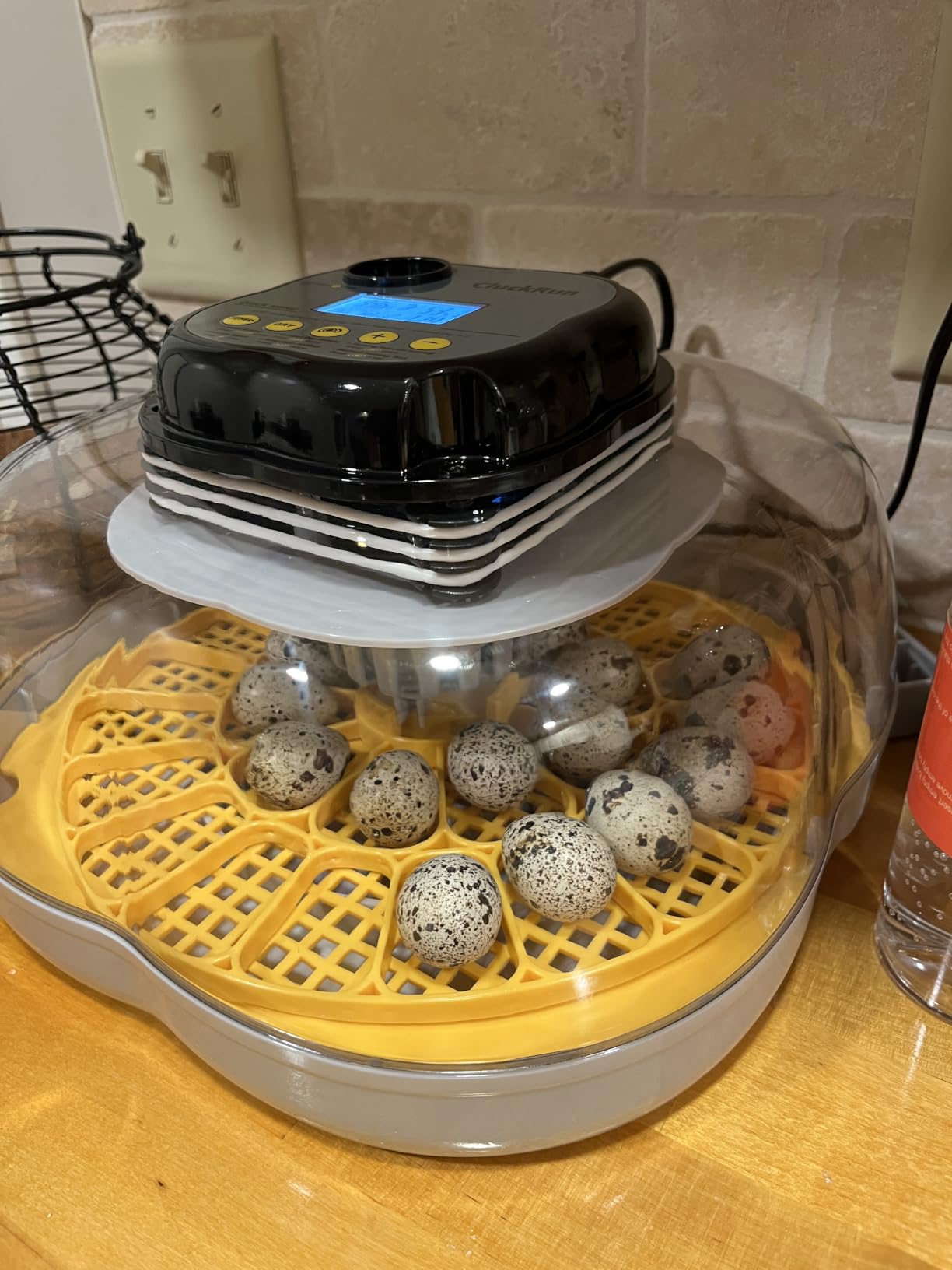
Humidity is the hardest setting to dial in on the smaller capacities, so expect a few cycles of adjustment before it settles. The display also illuminates during candling, which is genuinely annoying in a dark room at the moment you are trying not to wake the house.
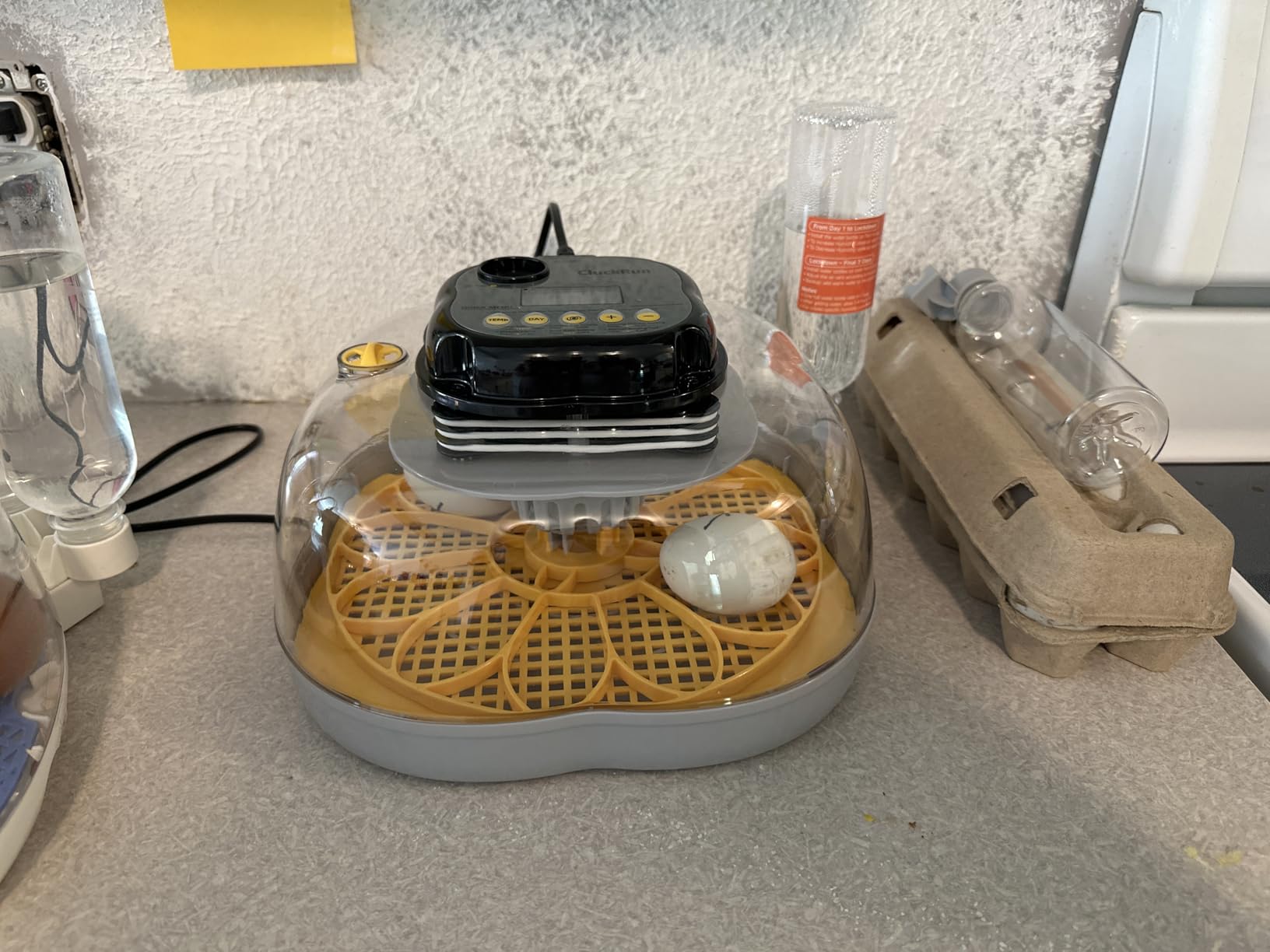
Watch the hatch room. The high protective walls are there to stop chicks escaping, but on a smaller capacity they eat into the floor area, so add a grippy liner once the eggs go down and keep an eye on how much space the chicks actually have.
Why quail keepers who hatch often should want this one
Setting the machine to a quail hatch day once and forgetting it is worth more than any single spec on this list. It also stops you from accidentally running a chicken 21-day lockdown on eggs that pip on day 16.
The bright candler and the single-screen status readout are the parts you notice two years in, when a cheaper machine would already be off your list.
Where the CluckRun needs patience
The humidity curve takes a few runs to learn, and the candling glow is a design quirk you cannot adjust. If your space is dark and you intend to candle at night, plan around it.
It is also not the cheapest way to get a small quail batch, so match it to a hatch frequency rather than a hatch size.
10. Sailnovo 56-Egg Incubator: Best as a Brooder After the Hatch
Sailnovo 56 Egg Incubator for Hatching Eggs with Automatic Egg Turning Gray
56 eggs with adjustable trays
Auto humidification
Turns every 2 hours
Pros
- 56-egg capacity with adjustable tray spacing
- Display matches independent thermometers and hygrometers within 2-3 percent
- Bottom half fully immersable for cleaning
- Bright built-in candling light
Cons
- Side-rolling turning suits shipped eggs with detached air cells less well
- One review reports the external water bottle has no lid
- Chicks can bump the bottom bay doors open and vent humidity
The accuracy claim is the one that stands out. Owners report the LED display matching independent thermometers and hygrometers within 2 to 3 percent, which is the closest agreement I saw across the whole group and matters when you are running quail at a lower humidity target than the machine is used to.
Capacity is 56 with adjustable trays and a spacious brooding area, and the automatic humidification pulls from external water so you are not opening the lid. Turning runs every 2 hours with a 3-day pre-hatch stop and a countdown timer, and the alarm can be silenced for 30 minutes or switched off entirely for dry incubation.
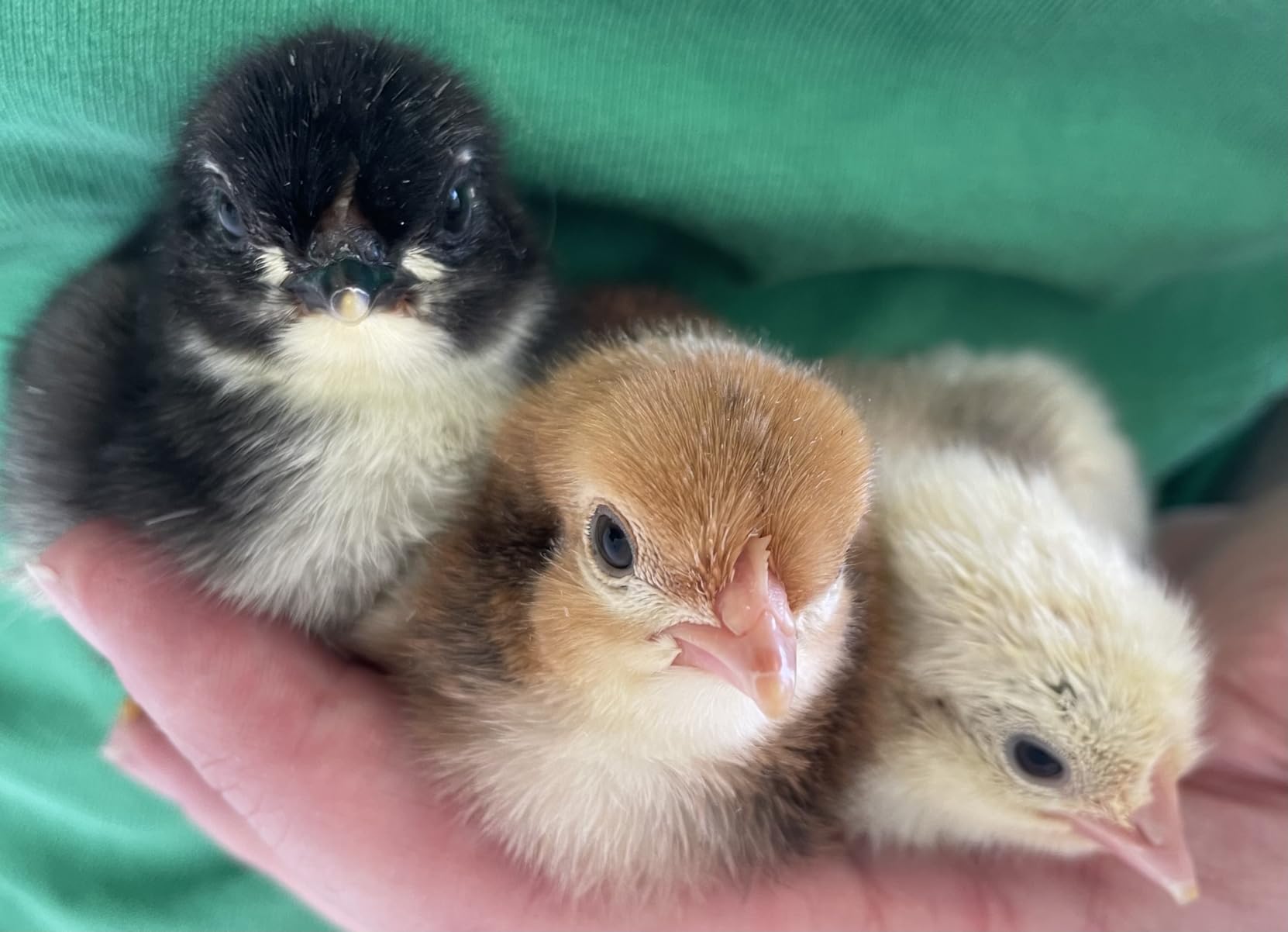
Hatch rates of 80 to 100 percent of fertile eggs are reported across multiple batches, and the unit is described as set-and-forget. The transparent ABS cover also lets it double as a warm room for chicks after hatching, which saves a second piece of equipment.
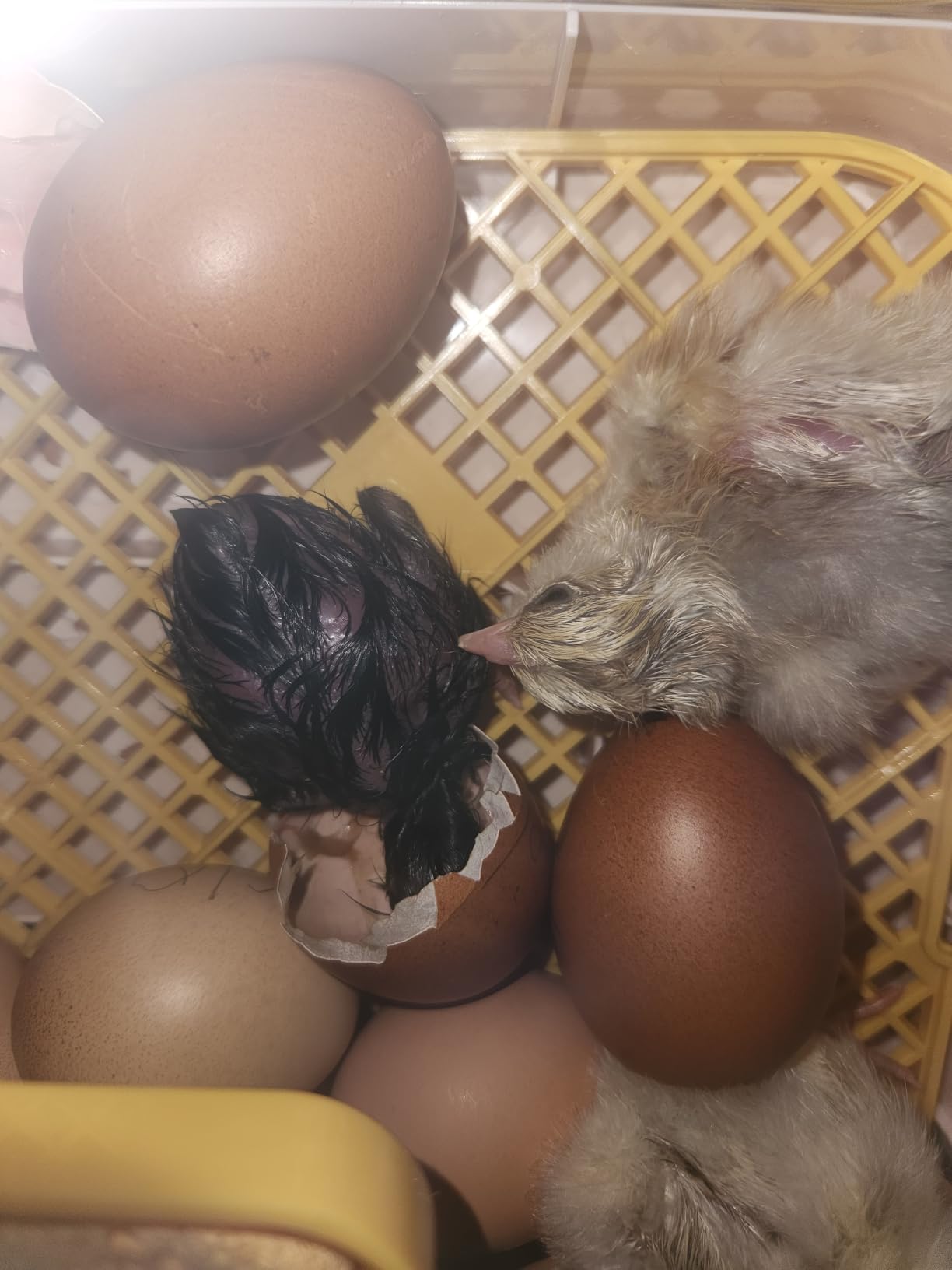
Two practical issues. One reviewer reports that the external water bottle arrived without a lid, so the suction draws air instead of water and a syringe is needed to work around it, and chicks can bump the bottom bay doors open after hatching, which vents humidity in the first days when the floor is still damp.
The side-rolling turning is also less ideal for shipped eggs with detached air cells, since rolling moves the air cell around. If you buy your quail eggs locally from a working flock rather than shipping them, this matters much less.
Cleaning is the bright spot. It disassembles far more easily than earlier models and the bottom half is fully immersable, which is a real improvement when quail egg residue smells.
Why larger quail keepers like this unit
Fifty-six large-egg positions translate to a substantial quail run, and the display accuracy means you can set a precise quail humidity target instead of chasing an offset. The post-hatch brooding function removes a separate brooder from your list.
Owners consistently describe it as a set-and-forget machine once the water bottle is sorted.
Where the Sailnovo is not the right pick
If you buy shipped eggs with detached air cells, side-rolling is the wrong motion. And if you are hatching a first small batch in a small room, an 18.7 by 16.1 inch footprint is a lot of space for a dozen quail eggs.
Check the water bottle arrives with a lid, and add a catch for the bay doors on day one.
Quail Tray and Insert Compatibility Guide
Will a chicken egg incubator work for quail eggs? Yes, the machine will hatch them. The question is whether you have to work around the tray, and how much of your attention that workaround costs.
Roller and rocking trays. Every machine in this list that turns by rotating rollers or rocking the whole tray works best with large, round eggs. A quail egg is narrower and more pointed, so it migrates along the roller as the tray moves. Options run from acceptable to fiddly: use eggs from a single flock with similar sizes, use a smaller-egg spacing setting where one exists, or add a physical stop.
The masking tape fix. The most discussed workaround on quail forums is a herringbone pattern of masking tape applied inside the tray. Strips of tape in a zigzag across the channel create small pockets that a quail egg cannot roll out of, and breeders using this method on a 30-egg roller machine report a hatch rate of 82 percent after struggling with the same tray beforehand. It is cheap, reversible, and takes about five minutes per tray.
Divided and adjustable trays. The IBKINXX adjustable racks and the innhom dividers hold small eggs in place by narrowing the channel instead of blocking movement. If you move between jumbo Coturnix eggs, standard Coturnix and button quail in the same season, this is the only approach that scales without modifications.
Inserts and sizing. Quail-specific inserts are sold separately for many chicken machines, and breeders report that sizing is inconsistent and delivery can be slow. If you are waiting on an insert to start a hatch cycle, an adjustable tray from this list will get you going sooner.
One more sizing note. Capacities on these boxes are stated in large eggs. A rough conversion of two quail eggs per large-egg position gives useful planning numbers, and the Onsju is the one machine here that publishes a small-egg figure of its own, at up to 40 quail eggs.
How to Choose an Incubator for Your Quail Scale
Match the machine to how often you hatch, not to how many eggs you could theoretically fit. A 56-egg cabinet run for two eggs twice a year is a storage cupboard with a fan inside.
First hatch, a dozen eggs. Start with a small machine that has automatic turning and a washable tray. The Apdoe and the TRIOCOTTAGE both fit here, and the TRIOCOTTAGE wins on footprint if your counter is tight. Add a separate hygrometer either way, because humidity is the parameter that decides your result and none of the small machines report it well.
Weekly batches. You want capacity plus scheduling automation. The Onsju gives you 40 quail eggs in small-egg mode and a 96-hour automatic stop; the CluckRun gives you a hatch day you can program. If you run two machines, look at models with a water bottle you can fill from outside the chamber.
Monthly or commercial volume. The MATICOOPX 30 and the Sailnovo 56 are built for load size, and the innhom 56 adds the dividers and the deviation alarm if you also hatch other species. At this scale the tray question decides it, so choose based on how you will stabilize small eggs.
Classrooms and science projects. The HBlife is simple enough to hand to a student and hatches a wide range of eggs; the innhom covers a large hatch day with several species in one run.
Three checks before you commit, whatever the scale. Verify temperature at egg level with your own thermometer for a full day before adding eggs. Run one empty cycle while you calibrate humidity against a second instrument, and write down the offset. And confirm the turning stop matches a 16 to 18 day quail cycle rather than a 21-day chicken default.
Worth noting for anyone still setting up: quail and chicken hatching share more technique than people expect, and our general buying guides cover the surrounding equipment side of a small flock setup.
Frequently Asked Questions
What is the best incubator machine for quail eggs?
The Onsju 18-egg incubator is the best overall choice in this roundup. It holds up to 40 quail eggs, offers turning intervals of 60, 120 or 180 minutes, and stops turning automatically 96 hours before hatch. The MATICOOPX 30-egg suits larger weekly batches, and the CluckRun 25-egg is best when you want to program a quail hatch day.
What is the best way to incubate quail eggs?
Set temperature to about 99.5 F in a forced-air machine and run the lower end of the humidity range early in the cycle, then raise humidity sharply for the final three days. Turn the eggs automatically for the first 12 to 14 days, stop turning at lockdown, and keep the floor covered with a grippy material once chicks are walking.
Will a chicken egg incubator work for quail eggs?
Yes, any of these machines will hatch quail eggs, but roller and rocking trays let small eggs shift, so you may need masking tape pockets or a set of dividers to hold them in place. Machines with adjustable or divided trays, such as the IBKINXX or the innhom, handle small eggs with less modification.
What are common mistakes in quail egg incubation?
The most common errors are letting humidity run high for the whole cycle, opening the lid when you can add water externally, forgetting that quail lockdown arrives around day 15 rather than day 18, and running the turner through the final days. Splay leg is also frequent when chicks land on a smooth floor with nothing to grip.
What kind of incubator is best for quail eggs?
The best egg incubators for quail eggs have divided or adjustable tray spacing, selectable turning intervals, a water system you can refill without opening the lid, and a display that reports humidity. Small-egg capacity should be published or convertible, and the turning stop should be adjustable to a 16 to 18 day cycle.
How do I keep quail chicks from splaying their legs?
Add a grippy floor covering as soon as you move to lockdown. Quail chicks slip on smooth plastic and pile into corners, and low fan shrouds add risk. Several owners of tabletop units in this roundup add a small ramp or textured mat to the hatch floor, and it helps with the low fan clearance issue at the same time.
Conclusion
The best egg incubators for quail eggs in 2026 are not the biggest or the most expensive ones. The Onsju 18-egg is our top pick because it treats small eggs as a first-class case: up to 40 quail eggs, selectable turning intervals and an automatic stop 96 hours before hatch. If you run big batches, the MATICOOPX 30-egg holds the most eggs with a proven record, provided you stabilize the roller tray. If you hatch every week and want the machine to match your calendar, the CluckRun 25-egg programs the hatch day directly.
Whichever you choose, run one empty cycle first, verify temperature at egg level rather than at the display, and write down your humidity offset. That single habit separates most of the hatch results people report from the ones they hoped for.