
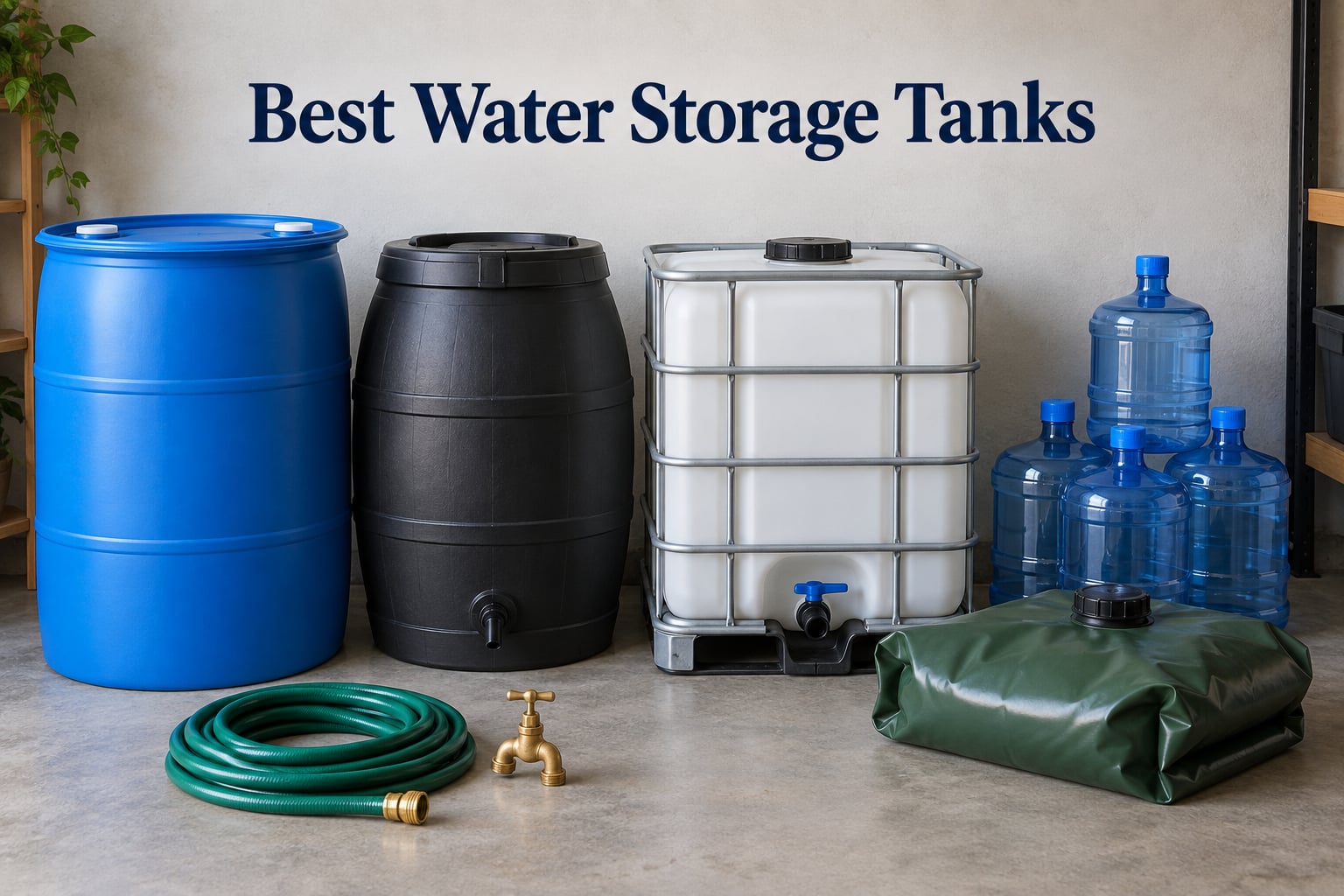
Most people buy a water storage tank after the tap runs dry, which is exactly the wrong time to start shopping. Municipal supply fails for reasons that have nothing to do with weather: a main breaks under a street, a pump fails, a boil-water advisory covers your neighborhood, or a line freeze splits somewhere you cannot see. A correctly sized tank turns a bad week into a manageable one.
We compared 12 of the best water storage tanks available now, from a 5-gallon stackable jar to a 100-gallon bathtub liner, and ranked them on the things that actually decide whether a tank is useful: how much usable water it holds, what it is made of, whether the parts that fail are replaceable, and how the owners who already have one describe living with it. Every capacity, dimension, weight and rating in this guide comes from the manufacturer specification and from the reviews people wrote after filling the tank, not from a marketing page.
Three use cases shape almost every decision here. Emergency supply is about drinking, cooking and sanitation water held for weeks at a time. Rainwater harvesting is about a durable vessel that lives outside under a downspout. RV, camper and portable storage is about a container that survives being hauled and poured through fittings. If your situation is well water or pump pressure rather than storage, our guide to well pressure tanks covers that side of the system, and our picks for portable RV waste tanks handle the other half of a camper plumbing loop.
Table of Contents
How We Chose and Ranked These 12 Tanks?
We ranked these tanks on review volume first, because a 4.7 average across thousands of owners tells you more than a 4.8 across forty. After that we weighed usable capacity against the space the tank occupies, material and UV stabilization, the presence of a real spigot or valve rather than a plug, warranty length, and whether consumable parts like gaskets and spigots are sold separately.
We excluded anything without a verifiable specification sheet, and we flag tanks that are not potable-rated rather than quietly implying they are. One tank in this group is labelled non-potable by its own manufacturer, and we say so where it appears. We do not rank on price, and we do not claim any of these was lab-tested for bacterial purity. What we did was read the failure reports as carefully as the praise, because the difference between a good tank and a bad one is usually one seam, one valve, or one spigot.
Top 3 Best Water Storage Tanks for 2026

Camco Rhino 21-Gal RV Tote Tank
- UV-stabilized HDPE
- No-flat wheels
- Tow adapter and sewer hose kit

waterBOB 100 Gallon Bathtub Bladder
- Up to 100 gallons
- Food-grade BPA-free liner
- Folds to shoebox size

FCMP Outdoor 50-Gallon Rain Barrel
- Large top opening
- Flat back
- Multi-barrel connection kit
All 12 Water Storage Tanks at a Glance (September 2026)
| Product | Specifications | Action |
|---|---|---|
| Camco Rhino 21-Gal RV Tote Tank |
|
Check Latest Price |
| waterBOB 100 Gallon Bathtub Bladder |
|
Check Latest Price |
 RTS Home Accents 50-Gal Rain Barrel RTS Home Accents 50-Gal Rain Barrel |
|
Check Latest Price |
| FCMP Outdoor 50-Gallon Rain Barrel |
|
Check Latest Price |
 Legacy 5-Gallon Stackable 6-Pack Legacy 5-Gallon Stackable 6-Pack |
|
Check Latest Price |
 MXQMKL 63 Gallon Foldable Bladder MXQMKL 63 Gallon Foldable Bladder |
|
Check Latest Price |
 RomoTech 50 Gallon Square Poly Tank RomoTech 50 Gallon Square Poly Tank |
|
Check Latest Price |
 BayTec 55 Gallon Blue Water Barrel BayTec 55 Gallon Blue Water Barrel |
|
Check Latest Price |
 WaterPrepared 55 Gallon Stackable Tank WaterPrepared 55 Gallon Stackable Tank |
|
Check Latest Price |
 Augason Farms 55-Gallon Water Barrel Augason Farms 55-Gallon Water Barrel |
|
Check Latest Price |
 Chapin 97005 25 Gallon Utility Tank Chapin 97005 25 Gallon Utility Tank |
|
Check Latest Price |
 Ameri-Kart 36 Gallon RV Fresh Water Tank Ameri-Kart 36 Gallon RV Fresh Water Tank |
|
Check Latest Price |
1. Camco Rhino 21-Gallon RV Tote Tank – Best Overall Portable Tank
Camco Rhino 21-Gal RV Portable Tote Tank – Made in the USA
21 gallon capacity
UV-stabilized blow-molded HDPE
34.5 lb empty
Measures 20.1 by 12.5 by 40 inch
Pros
- Largest review base in the group at over 27k ratings
- UV-stabilized HDPE body resists sun damage
- No-flat wheels and oversized handle move easily when full
- Sewer hose and steel tow adapter included in kit
Cons
- Ribbed handle underside presses into the hand when full
- Smaller capacities mean multiple trips for large jobs
- Heavy to reposition once filled
This is the tank with the deepest well of real-world use behind it, and that matters more than any spec line. Owners use it to move waste water from an RV tank to a dump station, to haul water to a site, and to drain anything holding liquid, and the body is blow-molded high-density polyethylene with UV stabilization rather than a thin unreinforced shell. At 21 gallons this is a working tote rather than a household reserve, and it holds its shape when full without any wall flex to worry about.
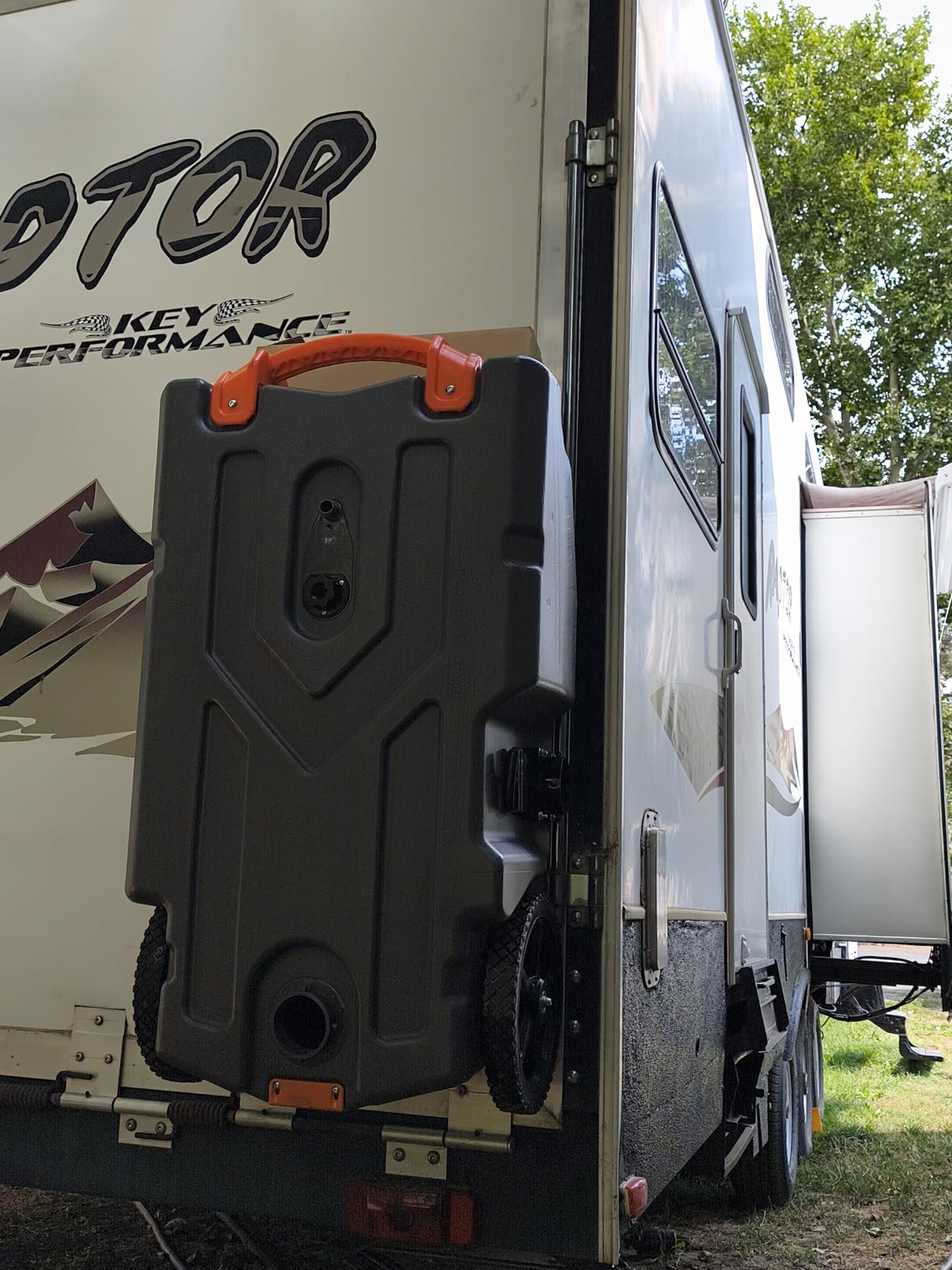
The mobility hardware is the part that separates it from a plain storage bin. Two oversized no-flat wheels roll over gravel, grass and dirt, and a steel tow adapter lets a truck or golf cart pull it rather than drag it. An oversized handle sits at the top for lifting when the wheels are not in play.
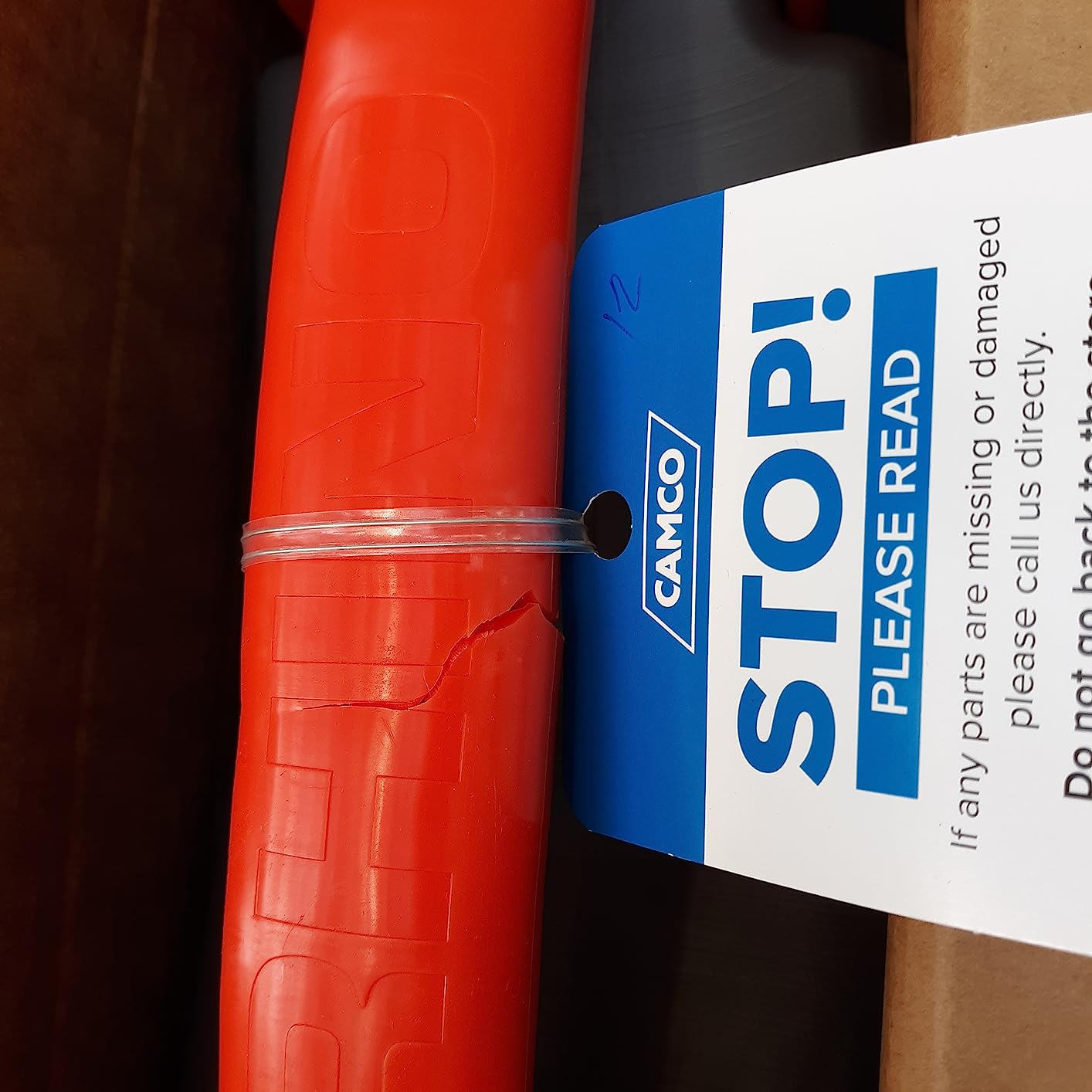
What arrives in the box matters for a job where you need everything to work at once. You get a 3 foot sewer hose with swivel fittings, a 15 inch grey water hose, clear elbows, storage caps and the tow adapter, so there is no separate accessory order on the day you discover you need one. A built-in drain hole and an integrated tank rinser cover the cleanup end, and the smooth interior means rinsing takes minutes rather than an afternoon.
The listed weight is 34.5 pounds empty, which is a fair number to lift by hand and an easy number to roll. Camco backs it with a 2-year limited warranty and lists spare part availability for five years, and spare parts are the detail that separates a tank you keep for a decade from one you replace in five years.
What you get that cheaper totes do not
The difference is the accessory kit and the wheels, and both remove steps from a job that is already unpleasant. Camco also builds this tote in several capacities, so if 21 gallons means several trips for your workload you can size up without changing systems. A ladder hook and tie-down strap grooves let it hang on a camper ladder or strap down for transport.
Reviews repeatedly describe the wheels as the reason the tank is easy to reposition, and the same reviews note that the handle becomes uncomfortable once the tank is full, which is normal for a molded grip of this style. If you are buying strictly as an emergency water container, this is more portable than a fixed barrel but smaller in capacity than the 50 and 55 gallon models further down.
Where it falls short
It is a portable tote, not a fixed storage vessel, and it is not marketed as potable-rated. Nothing in the listed specification says food-grade certification, so treat it as a water transport and reserve container. The plastic blow-molded form also means capacity is capped well below what a household outage actually requires, so most owners end up with a second, larger container alongside it.
2. waterBOB 100-Gallon Bathtub Bladder – Best for Emergency Supply in a Rent
waterBOB Bathtub Emergency Water Storage Bladder Up To 100 Gallon Capacity – Food Grade Liner with Hand Pump for Hurricane and Disaster Preparedness – BPA Free Drinking Water Container
Up to 100 gallon capacity
Food-grade LLDPE liner, BPA-free
1.3 lb empty
Fills a standard bathtub in about 20 minutes
Pros
- Turns a bathtub into 100 gallons of reserve
- Collapses to roughly shoebox size when empty
- Food-grade liner meets USFDA guidelines
- Hand pump and fill sock included
Cons
- Effectively single-use
- hard to dry out completely
- Thin liner punctures easily on sharp debris
- Hard to siphon once the level drops low
Few products solve a real problem as cleanly. If you live in an apartment, a condo, or a house where a 50 gallon drum will not fit and a permanent installation is not an option, this liner drops into the bathtub you already have and turns it into a 100 gallon reservoir. That is the largest emergency reserve in this roundup and it occupies zero floor space when not in use.
Setup is genuinely fast. It fits a standard bathtub, fills in roughly 20 minutes, and the sealed food-grade liner is BPA-free and meets USFDA food-grade guidelines, which puts it ahead of most soft bladders in the potable category. A fill sock attaches to the faucet and a hand siphon pump is included for drawing water into jugs and pitchers.
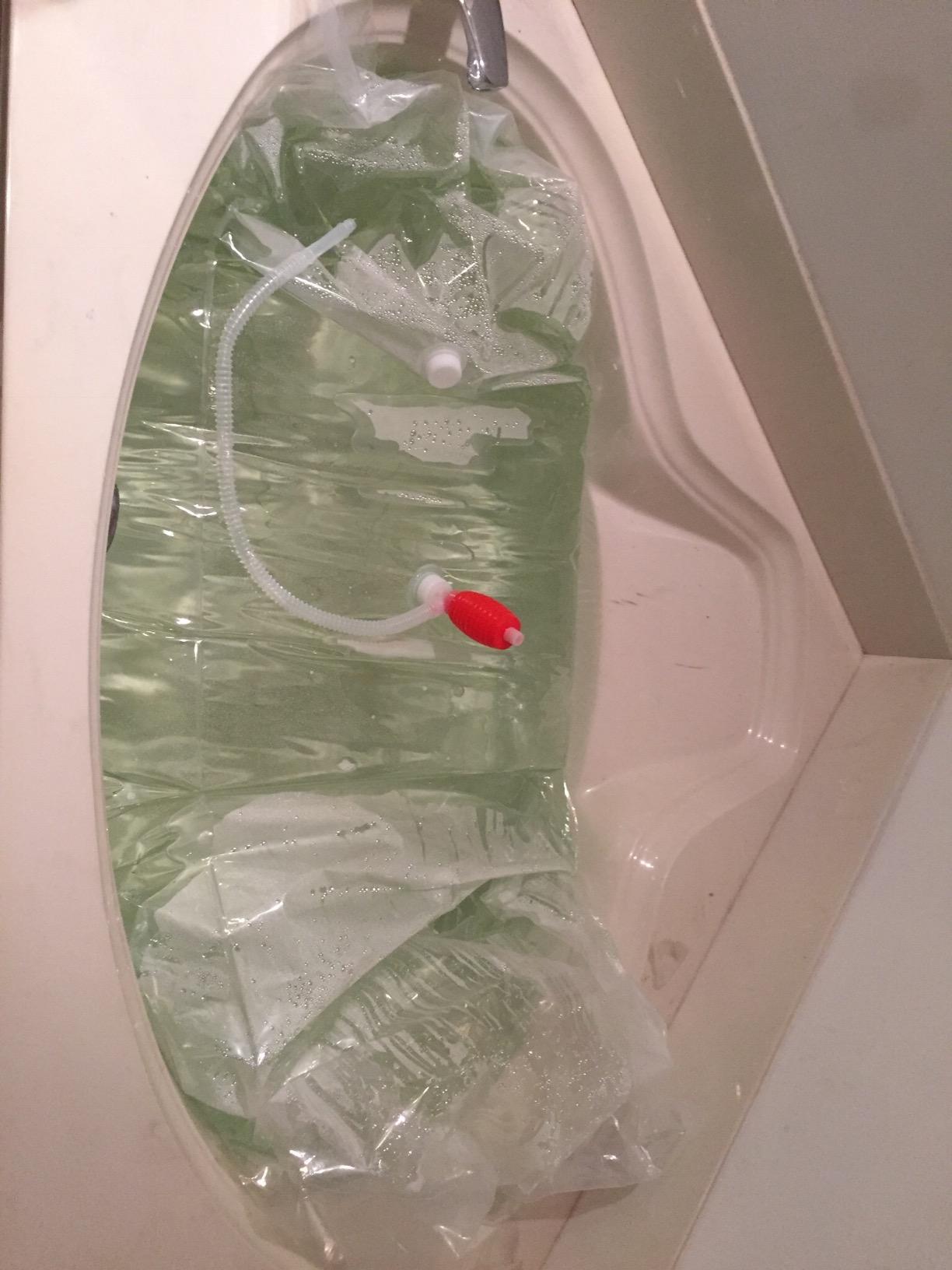
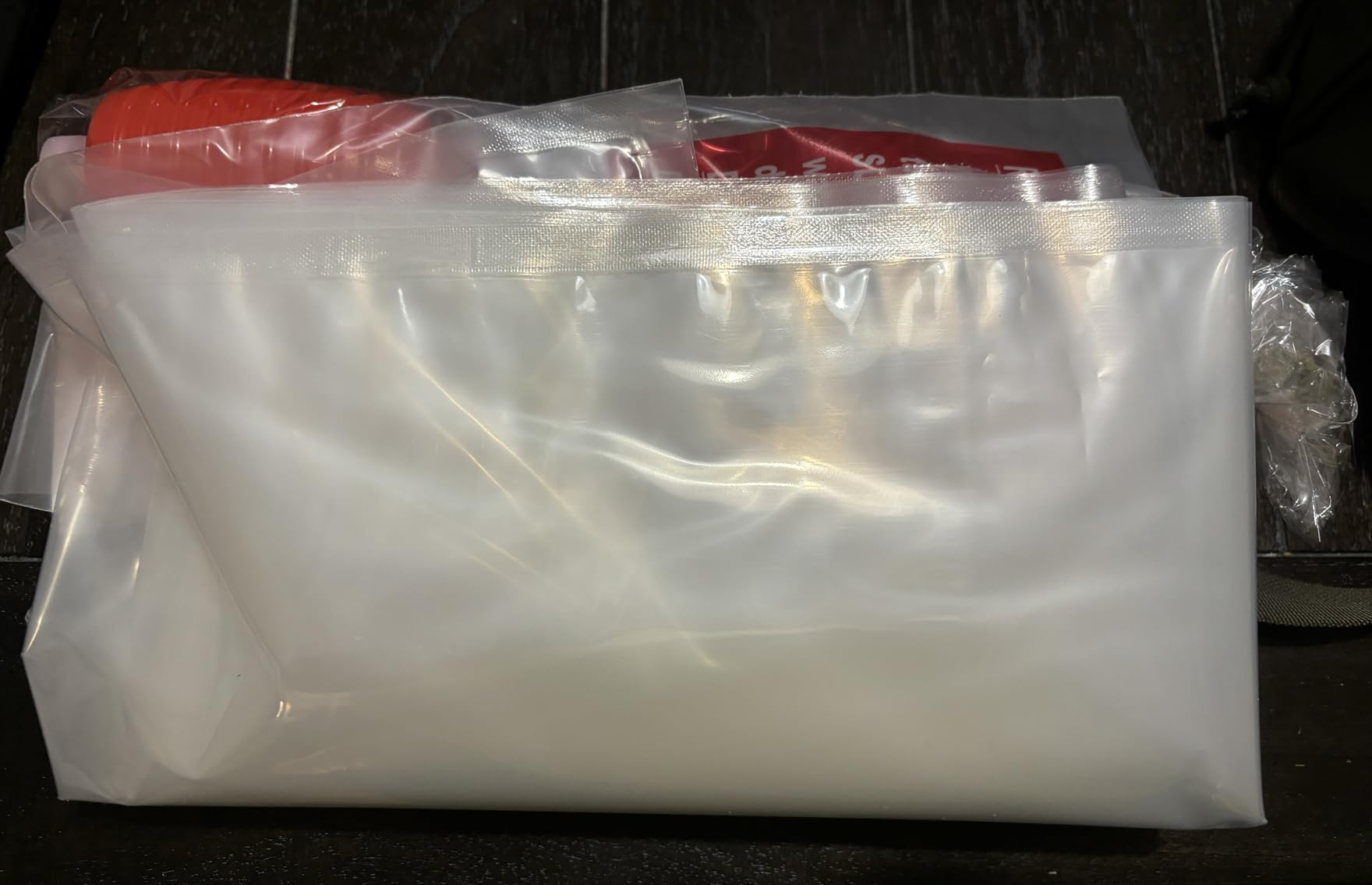
The stated freshness window is up to 16 weeks, which is the honest time horizon for stored water in any container and much longer than most people assume. Owners describe using it through hurricanes, freezes and outages and describe the collapse-and-store behaviour as the reason it is worth owning: when the water is gone the whole thing folds down to about the size of a shoebox and goes in a closet.
Two design details explain the complaints you will find in reviews. The fill funnel has to be held or taped in place for the whole 20 minutes of filling, because nothing holds it by itself. And once the level drops low, siphoning gets genuinely hard, so you end up tilting the tub to get the last of it out.
Why it belongs in an emergency kit
It is the only tank here that scales a household reserve to 100 gallons without a footprint, a stand, or a permit conversation. The liner is food-grade and BPA-free, so the water inside is protected from dust, film and debris for the duration of an outage, and the included pump means you can dispense without a fixed tap. Reviews of 5400-plus owners repeatedly frame it as the highest reserve per unit of stored space available.
It is also the right pick for a bug-out shelter or a cabin, because the empty weight is 1.3 pounds and it fits in a vehicle without any special arrangement. Setup needs no tools and no permanent modification, which matters if you are renting or if you want a kit that works in more than one building.
Where it falls short
Treat it as a single-deployment tool rather than a permanent fixture. The liner is difficult to dry completely, which is how mold starts, and a thin bladder punctures readily if it lands on a nail, a wire or a sharp piece of debris in a garage. If you want a tank you fill once and keep for years, this is the wrong category entirely.
3. RTS Home Accents 50-Gallon ECO Rain Barrel – Best Recycled-Plastic Rain Barrel
RTS Home Accents 50-Gallon ECO Rain Barrel Made with 100% Recycled Plastic, Flat Back Rain Water Collection Barrel, Black
50 gallon capacity
100% recycled UV-resistant polyethylene
18 lb empty
24 by 19 by 34 inches
Pros
- Flat back sits flush against a wall or fence
- Attractive textured finish
- Built-in overflow for linking barrels
- Made from 100% recycled plastic
Cons
- Flat back can bulge and warp over time
- Included plastic spigot is low quality
- Top screen is undersized and often needs trimming
- Front overflow opening lets mosquitoes in
The case for this barrel is appearance and footprint. The flat back sits flush against a house wall or fence under a downspout, so it does not stand off the wall the way a round barrel does, and the textured surface reads as garden furniture rather than an industrial drum. It holds 50 gallons, weighs 18 pounds empty, and measures 24 by 19 by 34 inches.
It is also one of the few tanks here made from 100% recycled plastic with UV resistance, which is a real differentiator rather than a marketing flourish. The built-in overflow valve lets you link multiple barrels so overflow from one feeds the next, and a top debris screen is included.
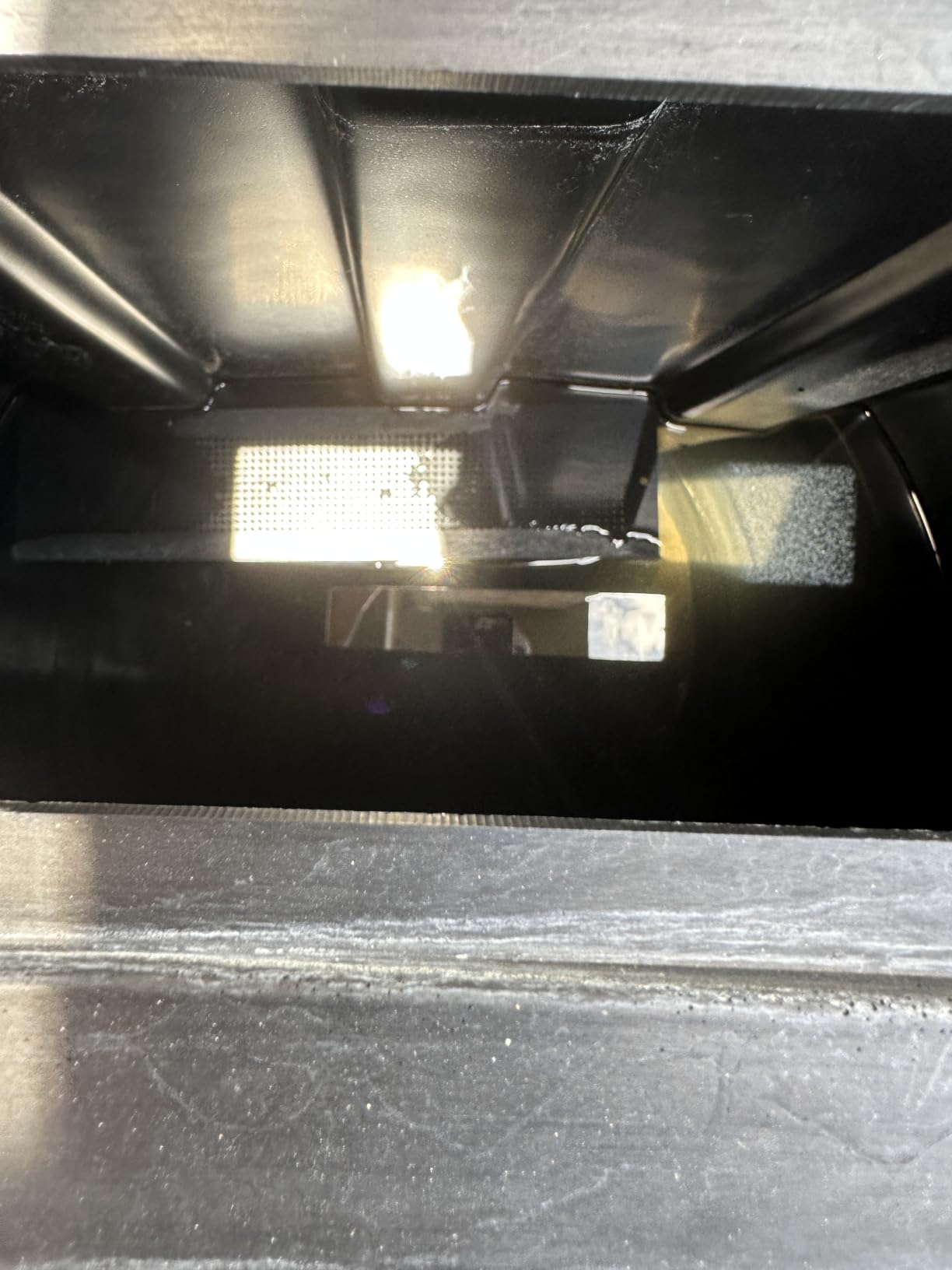
Where it falls short is hardware, and the reviews are consistent about it. The included plastic spigot is the weak point, and a large share of owners replace it with a brass valve before the first season. The top screen is undersized, frequently does not seat without trimming, and the screws supplied are not stainless, so they streak and eventually seize.
Two more failure reports are worth knowing before you buy. The flat back is a flat plastic back, and under the full 415 pound water load it can bulge and warp over months of use. And the overflow opening is a plain front-facing hole, which is an open invitation to mosquitoes in warm months. A handful of owners also report seam leaks around the spigot boss on early units.
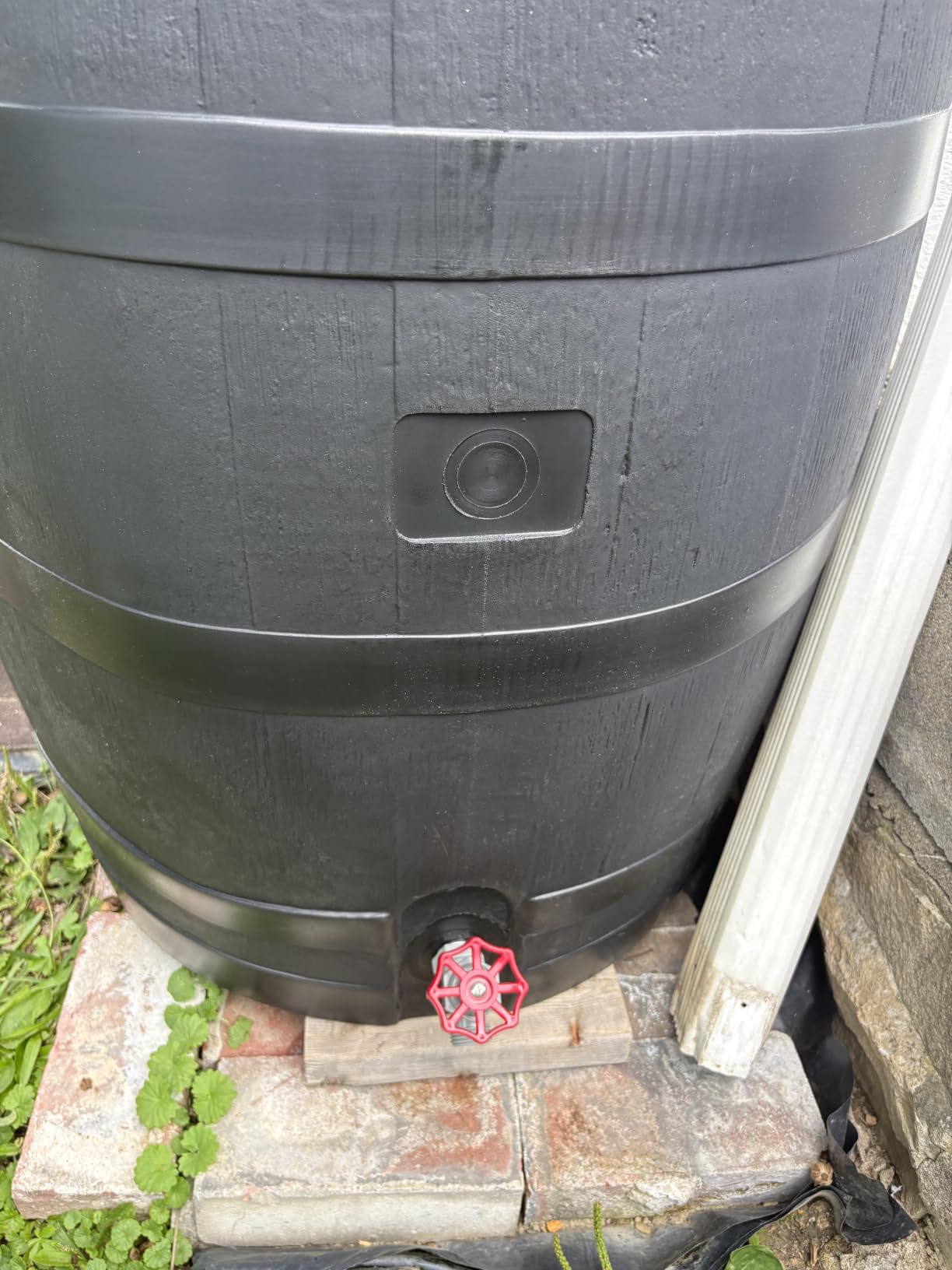
Best fit for a visible downspout
If the barrel sits in a front yard where guests and neighbors will see it, this is the one that looks intentional. The recycled material also means less new resin entering the stream, and a 1-year manufacturer warranty covers the barrel itself. Customer service gets praised for replacing defective barrels, which softens the hardware complaints considerably.
For irrigation use, treat the water as non-potable. Harvested roof water carries whatever the roof carries, and no rain barrel in this group changes that without a filtration system behind it.
Where it falls short
At 4.2 stars from more than 3600 owners, this is among the lowest-rated tanks we list, and the gap comes almost entirely from the spigot and screen rather than from the barrel. Budget for a brass replacement valve and stainless fasteners on day one. If you want hardware that survives contact with weather, the FCMP barrel later in this guide comes with a fuller kit and a better track record on that specific point.
4. FCMP Outdoor 50-Gallon Rain Barrel – Best for Rainwater Harvesting
FCMP Outdoor Rain Barrel, Flat-Back Rainwater Catcher with Spigots, 50 Gallon, Black – Portable Water Storage Container Tank for Home, Garden, and Backyard
50 gallon capacity
Polyethylene construction
25 lb empty
24 by 24 by 32 inches
Pros
- Large top opening eases filling where there is no gutter
- Full-width screen seats firmly and resists animals
- Flat back chains to other barrels easily
- Extended hose spigot is easier to reach
Cons
- Included flat overflow hose is kinked and too short
- Light when empty so it can tip in a storm
- Spigot flow is weak without a stand
- Hose clips fall off easily
This is the barrel to beat for rainwater harvesting, and the reason is the opening. The top opening is large enough to fill by hand or with a bucket, which matters enormously when you are collecting from a roof where no downspout lands near the barrel, or when the downspout is too high to reach. A full-width aluminum mesh screen seats inside the frame and stays put even when something climbs on it.
The flat back fits against a wall and the side spigots are designed for linking barrels, so a second FCMP can be chained alongside the first to double the reserve. At 25 pounds empty and 24 by 24 by 32 inches, it is a standard residential footprint, and polyethylene means it will not rust and does not need painting.
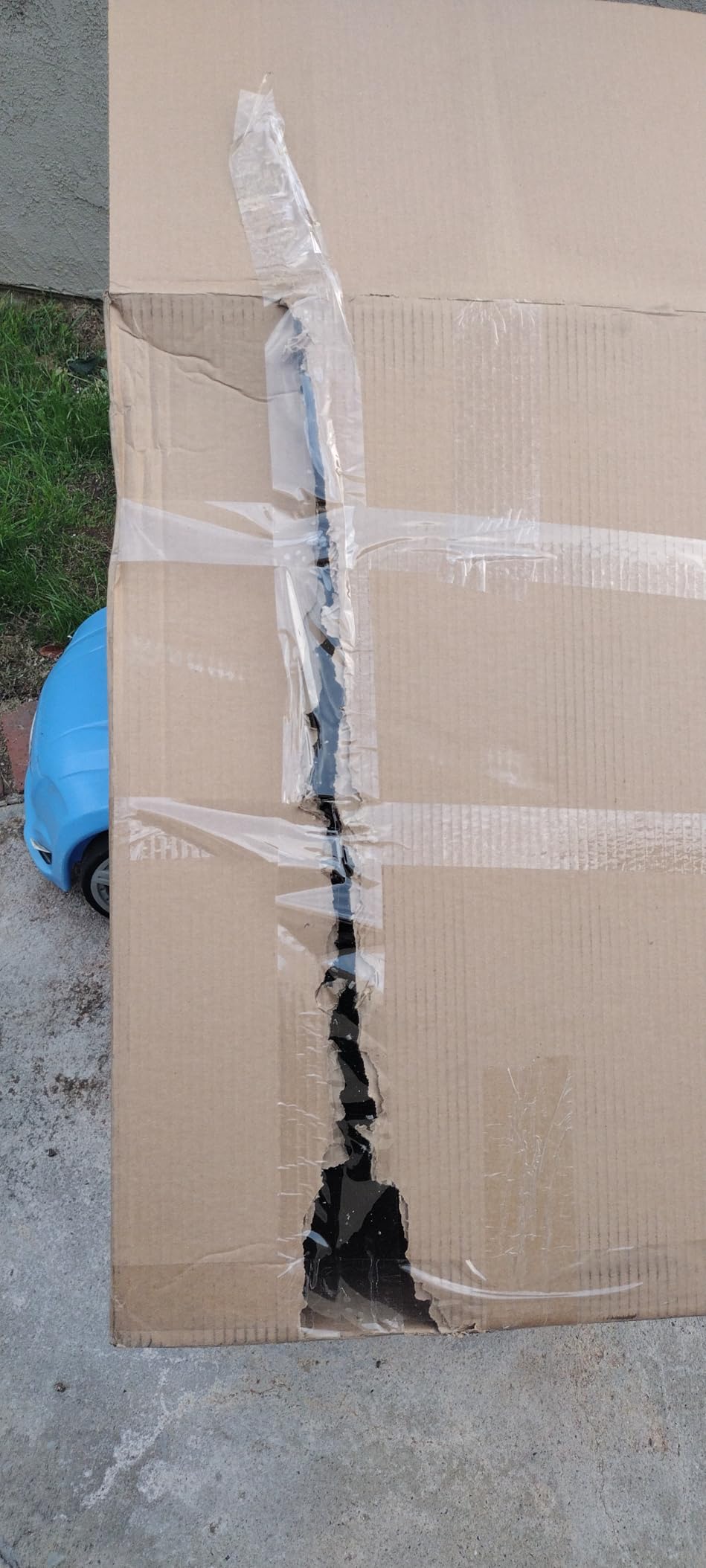
The kit is the most complete of the rain barrels we list. You get the debris screen, a garden hose, a shut-off thumb valve, hanging hose clips, an overflow hose and a multi-barrel connection kit in the box, which covers the parts that competing barrels leave as separate accessories. The spigot sits on an extended hose rather than at the base, so it is far easier to reach and to connect a watering can to.
Owners upgrading from an older barrel frequently name the opening and the screen as the reason, and they report the same weakness repeatedly: the supplied flat overflow hose arrives kinked, collapses under its own weight, and is too short to route anywhere useful. Several have replaced it with PVC and had no further trouble.
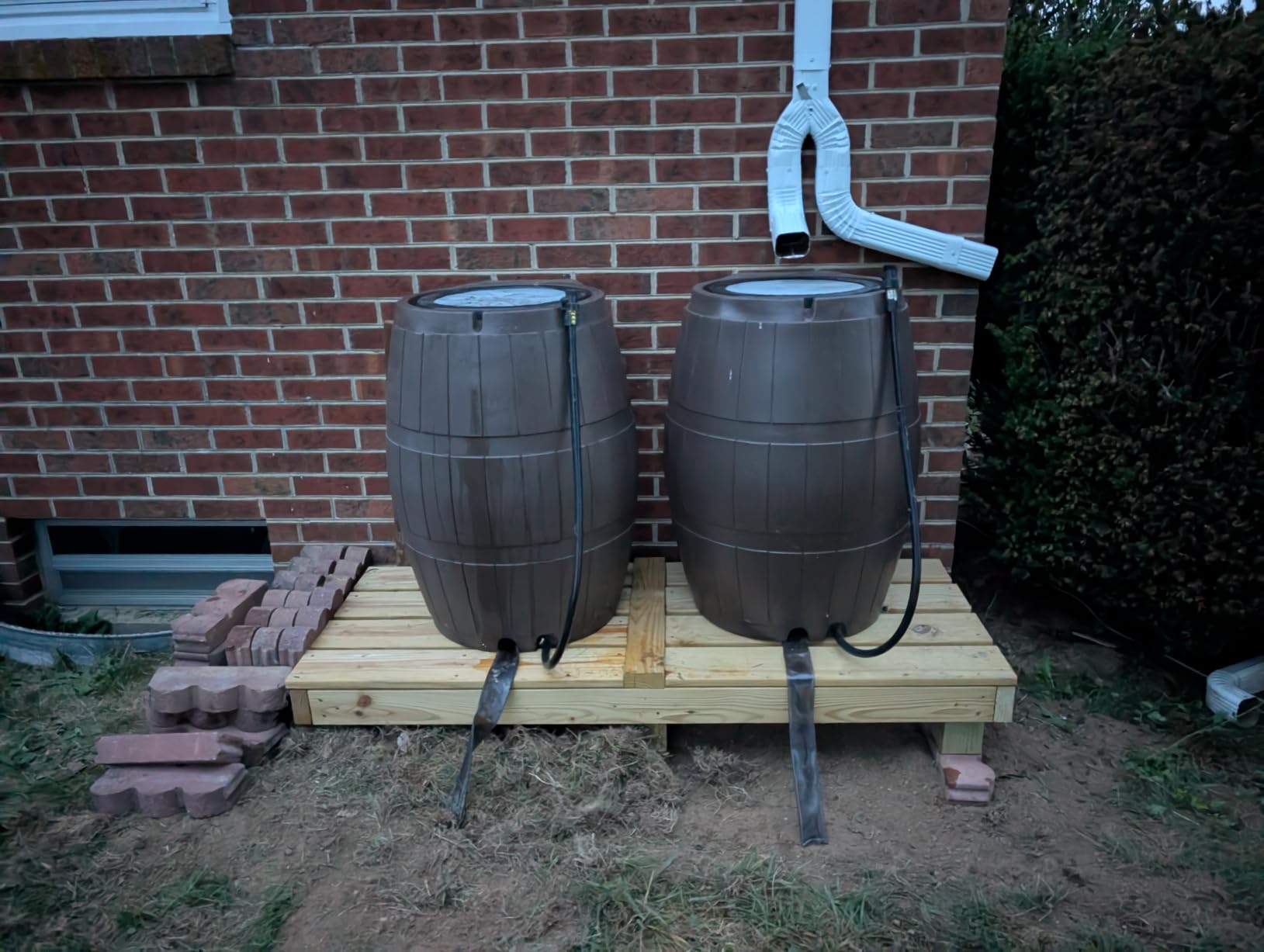
How to get good pressure from it
Spigot flow is gravity, so the single biggest practical upgrade is elevation. Owners who set the barrel on blocks or a stand report the difference immediately, and a stand is sold separately for this purpose. The second fix is replacing the flat overflow hose with rigid pipe, which removes both the collapse and the length problem.
Because it is empty only 25 pounds, it needs ballast or a stand to avoid tipping in a storm, which is a real consideration in areas with high winds. For a genuine drinking-water system, pair it with a first-flush diverter and filtration, because the barrel itself does not treat what the roof collects.
Where it falls short
The included hose clips fall off easily, and there is no drain plug, so you cannot fully empty and winterize it the way you can with a barrel that has a 1-inch drain. Owners also note that it is not sold with a stand, so budget for one. A 1-year limited replacement warranty covers manufacturing defects only, which is a thinner commitment than some other tanks in this group offer.
5. Legacy Premium 5-Gallon Stackable 6-Pack – Best Stackable Emergency Set
5-Gallon Stackable Water Storage Containers, 6-Pack
Six 5 gallon tanks, 30 gallons total
BPA-free food-grade plastic
40 lb per tank when full
15 by 10 by 12 inches each
Pros
- Stackable ribs lock containers together when stacked
- Dark blue body blocks light to slow freshness loss
- Food-grade BPA-free plastic with a 2.25 inch fill opening
- Kit includes spigots
- caps
- strap wrench and treatment drops
Cons
- Each full tank weighs about 40 lb
- Threaded sealed caps are slower than snap lids
- Sold in 1
- 2
- 4 or 6 tank configurations
Stackability is the whole argument here, and this set is the clearest expression of it. Each 5-gallon tank measures 15 by 10 by 12 inches, and molded ribs on the top of one tank lock into the base of the next, so a column of six occupies a 15 by 10 inch floor area. In a garage corner, a basement shelf, or a storm shelter, that is the difference between 30 gallons of reserve you can actually store and 30 gallons you cannot.
The material is BPA-free food-grade plastic, which puts it in the potable category alongside the stainless and certified polyethylene options. The dark blue exterior blocks light, which slows algae and biological growth during long storage, and that matters more for multi-month storage than any other design feature on a plastic tank.
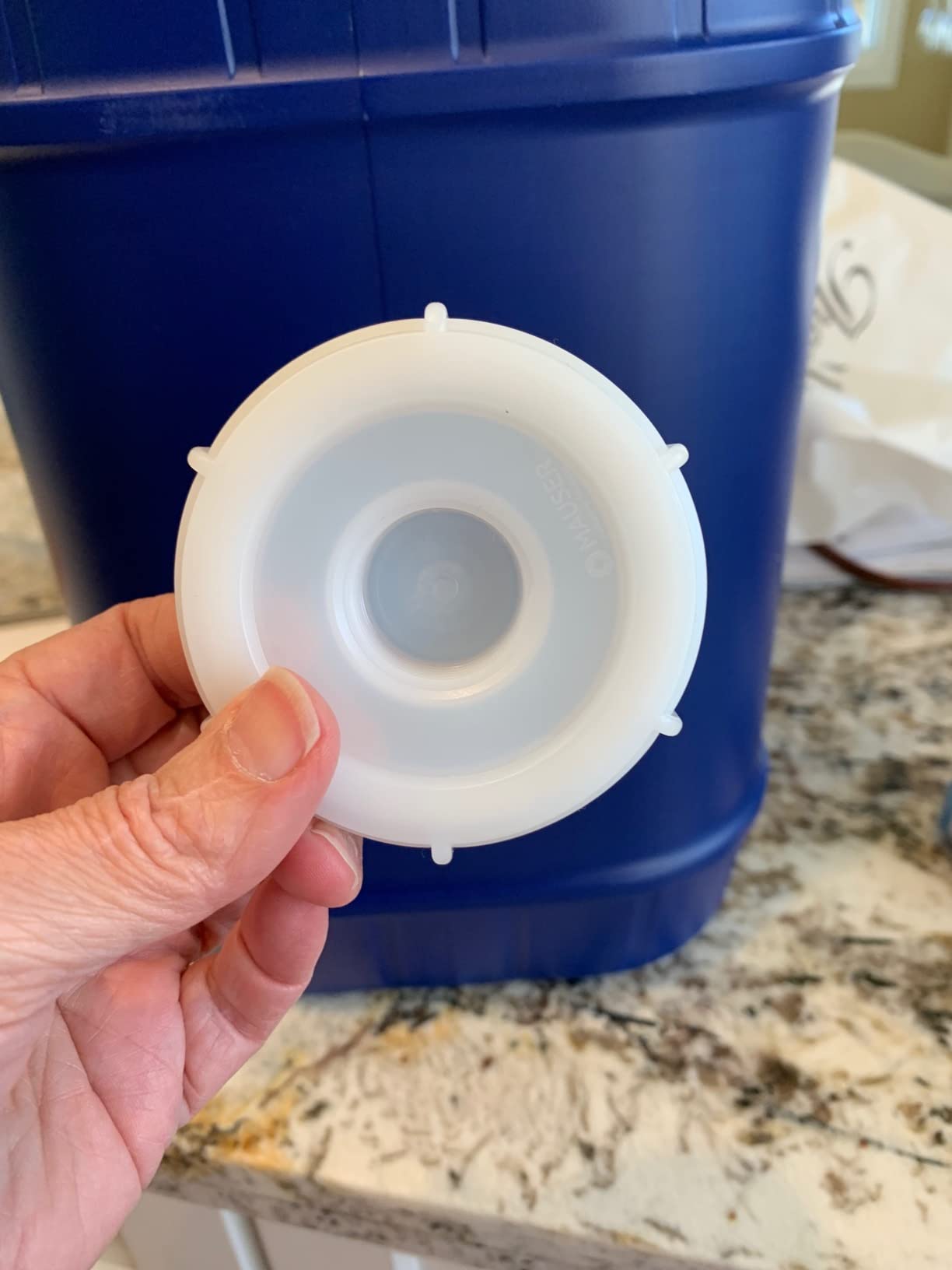
What makes this more than six plastic tubs is the accessories. You get two spigots with prepared caps, a strap wrench to tighten the lids without cross-threading, and water treatment drops rated effective for up to 5 years. That last item is the part that separates a preparedness product from a storage bin, because it is the only thing in this entire group that addresses water quality over a multi-year horizon.
The 2.25 inch opening with 3/4 inch threaded sealed caps is generous for filling, and the built-in carry handle is what makes a full tank movable at all. Sealed caps rather than snap lids protect against a tank that loses its seal in a garage over a summer, which is a genuine long-storage failure mode.
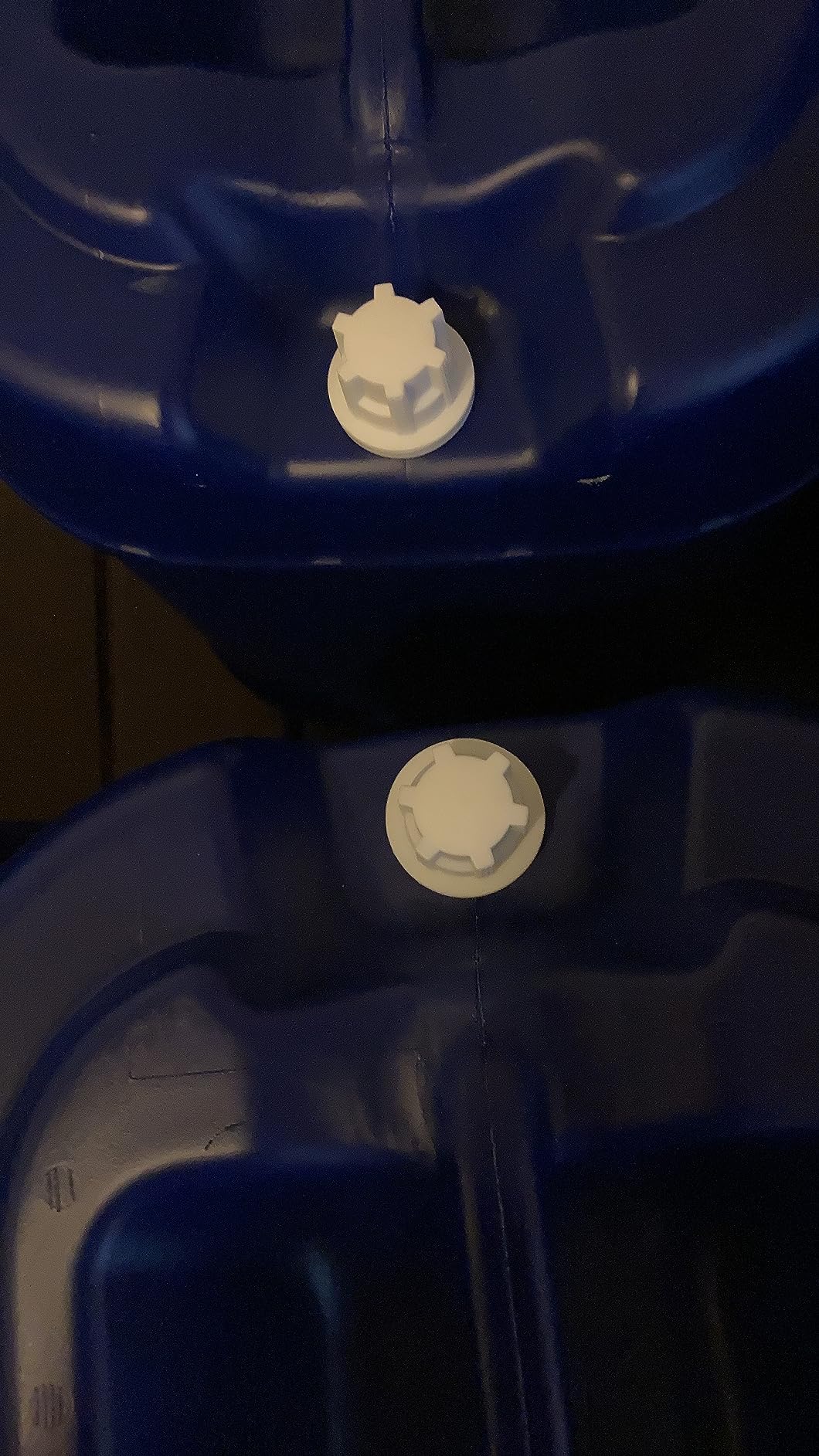
Why stacking beats one big tank indoors
A single 55 gallon drum weighs roughly 460 pounds full, which means two people, a stand, and a permanent location. Six of these weigh 40 pounds each and can be carried one at a time, filled one at a time, and consumed one at a time, which is exactly how emergency water gets used. If your storage is indoors and your household is small, a stack of small containers beats one heavy fixed vessel in almost every practical way.
The configuration is flexible too, since this set is offered as 1, 2, 4 or 6 tanks with or without water treatment. Start with two and add as your budget and your space allow.
Where it falls short
Forty pounds per filled tank is heavy enough to matter for anyone with back or shoulder problems, and the threaded sealed caps are slower to open and close than a snap lid, which is a poor trade in an actual emergency. Thirty gallons is also a small reserve: it covers drinking and cooking for a couple of people for a week, not a family for a month. Treat it as a component of a larger plan rather than the whole plan.
6. MXQMKL 63-Gallon Foldable Water Bladder – Best Non-Potable Bulk Hauler
240 L/63 gal Water Bladder Storage Containers,Foldable Portable Water Tank
240 L or 63.4 gallon capacity
0.9 mm double-sided PVC mesh
5.7 lb empty
39.3 by 23.6 by 15.7 inches
Pros
- Folds flat for storage and costs far less than rigid tanks of similar size
- Thick 0.9 mm mesh holds water when intact
- Useful for irrigation
- fire reserve and agricultural jobs
- Rated -50 to +60 Celsius
Cons
- Non-potable use only by manufacturer specification
- Included valve threads and adapters are often wrong and leak
- Ports and seams can rupture around the fill fitting
- Water shifts during transport unless strapped
Sometimes the right answer is not a tank at all. This is a soft bladder of 240 liters, or 63.4 gallons, made from 0.9 mm double-sided PVC mesh that folds completely flat when empty and weighs 5.7 pounds. It is a bulk water carrier for irrigation, fire reserve, agricultural work and emergency drought supply, and the manufacturer rates the service life at 8 to 10 years across a -50 to +60 Celsius range.
Construction is high-frequency welded with reinforcing ribs around the port, which is the right approach for a soft container. The inlet is DN25, the outlet valve is DN20, and the port is sleeved so a hose connection seats properly. Sizes run from 113 L up to 4000 L in black and blue.
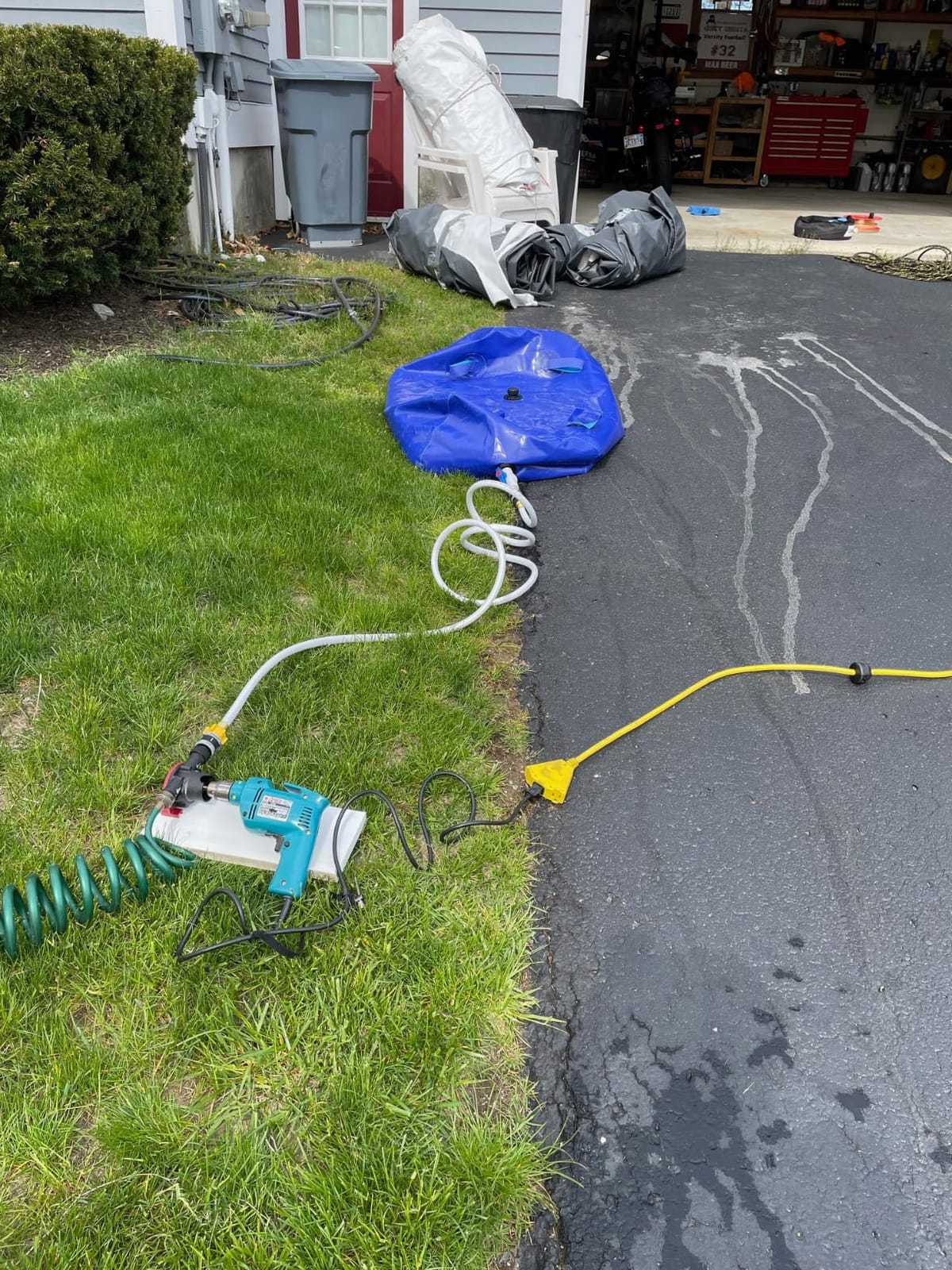
Be clear about one thing before anything else: this is rated non-potable by its own manufacturer. It is a bulk water bag for irrigation, firefighting supply, ballast and agricultural transport, not a drinking water container. That is not a defect, it is just a category boundary, and it is why it can be this large and this cheap.
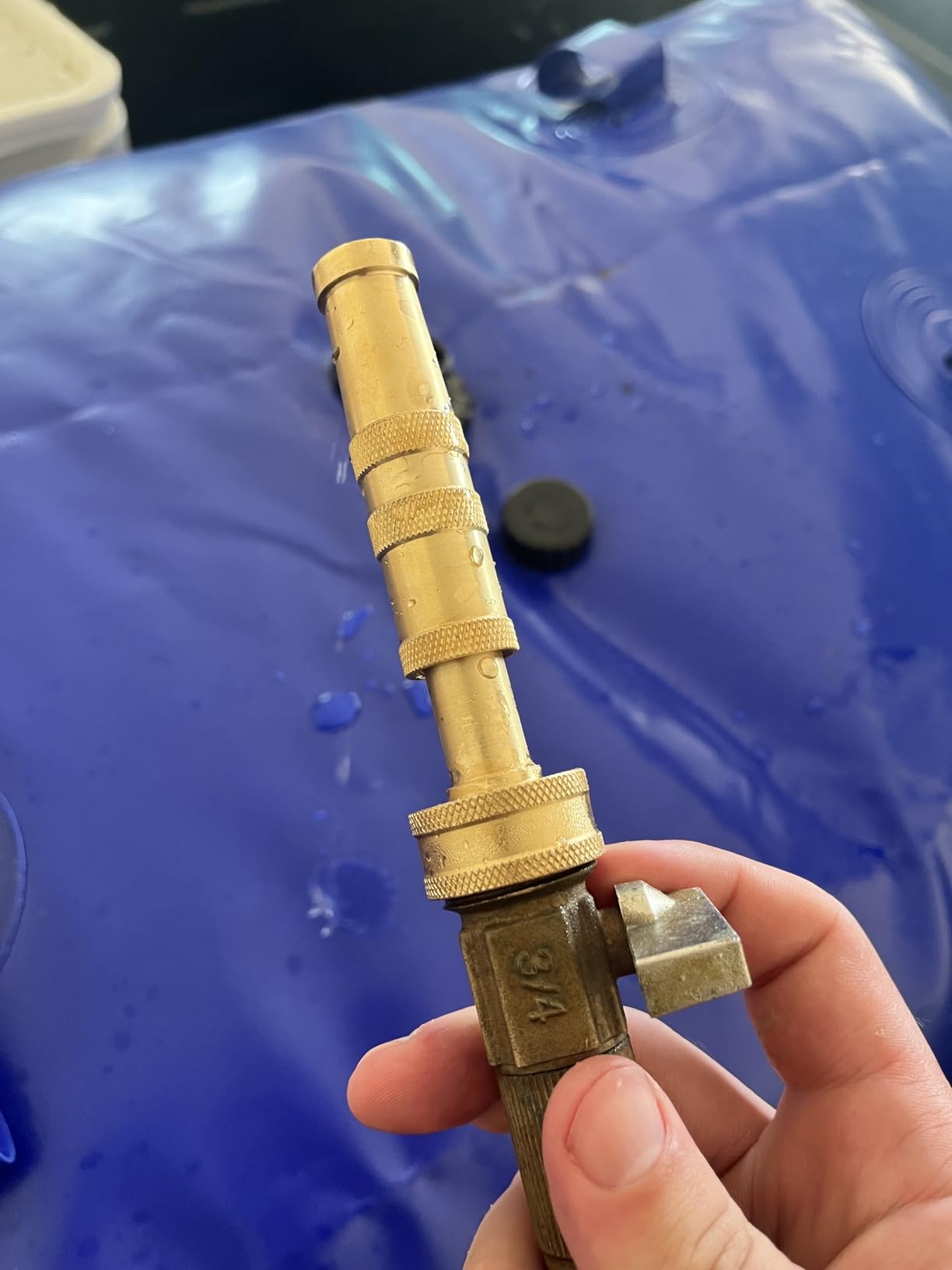
The reviews are enthusiastic about the material and consistently disappointed by the hardware. Owners praise the thickness and the value, and use it for garden irrigation, fire reserve and even wakeboard ballast. But the included ball valves and adapters frequently arrive with the wrong thread standard, and a fair number of buyers report seam or fitting failures that forced a patch or a return.
Where a soft bladder wins outright
Nothing else in this group does what this does. A 63 gallon rigid tank needs a truck bed and tie-downs; this goes in the back of a hatchback and comes out folded into a drawer. For agricultural irrigation, fire reserve and construction water transfer, the low cost per gallon and the storage footprint are genuinely difficult to argue with, and owners note actual delivered volume can run under the advertised figure, so size accordingly.
Expect to replace the valve. That is the single most common recommendation in the reviews and it is a two-minute fix with a standard 3/4 inch ball valve. The reinforcement around the fill fitting is the weak point, so support that area and do not lift the bag by it.
Where it falls short
It is not a drinking water container, and the reinforcement around the fill port is where ruptures start. Water also moves inside the bag during transport, so it must be strapped down rather than simply laid in a cargo area. In transport, this is a genuinely useful tool. In a household emergency drinking water plan, it does not belong.
7. RomoTech 50-Gallon Square Polyethylene Tank – Best for Truck and Trailer Hauling
RomoTech 82123919 50 Gallon Square Polyethylene Water Storage Tank
50 gallon capacity
Rotomolded medium-density polyethylene
25 lb empty
36 by 19 by 22 inches
Pros
- Rotomolded body stays rigid when full with no bulging
- Translucent walls and molded graduations show level without opening
- 5-inch lid opening simplifies filling and cleaning
- Tie-down channels accept saddle straps
Cons
- Some tanks leak from the middle seam or drain fitting out of the box
- 3/4 inch NPT outlet does not always thread cleanly
- Outlet sits too high to fully drain
- Listed dimensions exclude the cap
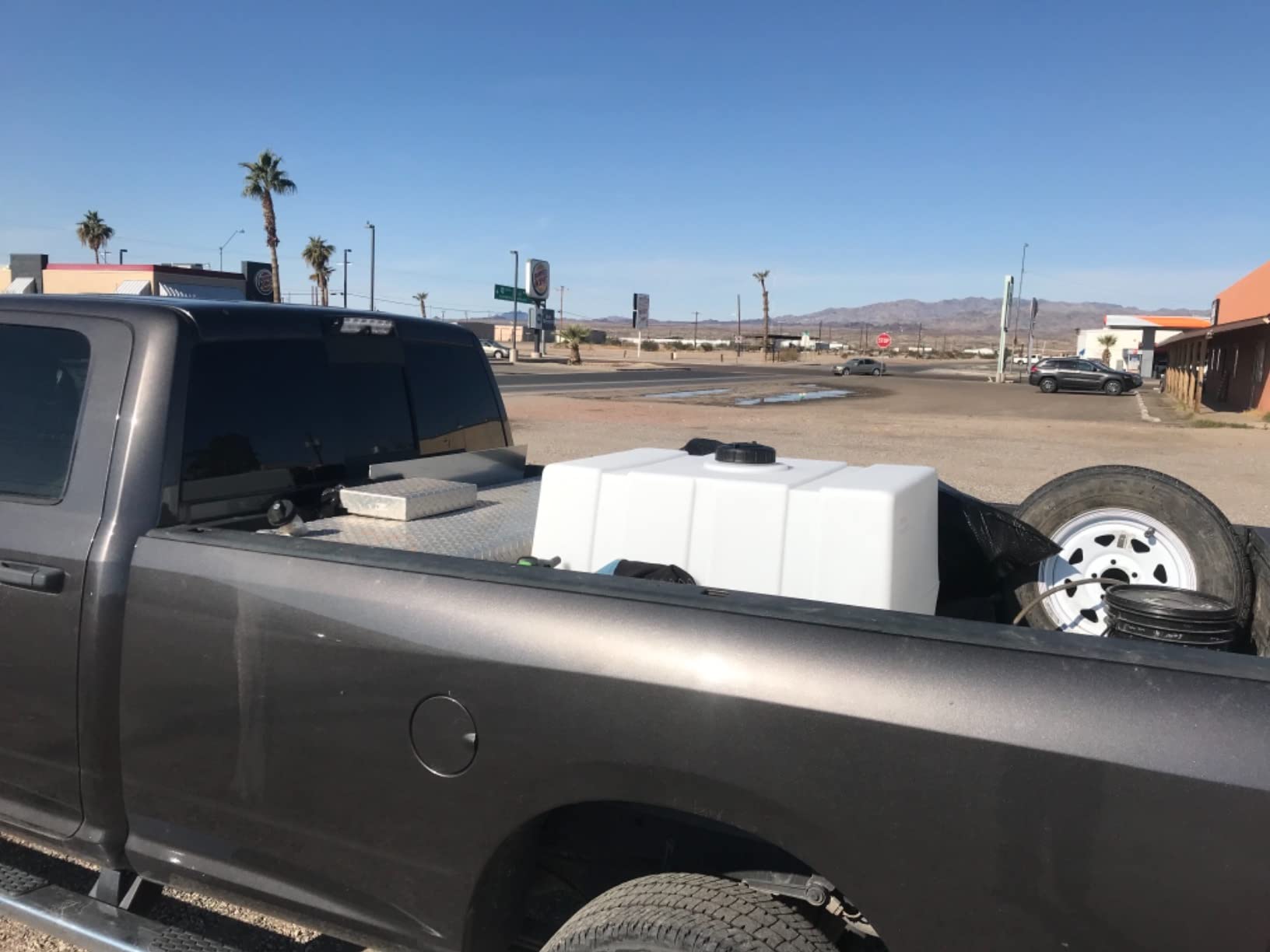
This is a working tank rather than a storage ornament, and the rotomolded medium-density polyethylene body is what makes it work. Rotational molding produces a single-piece wall with no seams to fail along the sides, and owners consistently describe the tank staying rigid when full with no flex or bulging. At 25 pounds empty and 36 by 19 by 22 inches, it is a low, wide shape that sits flat in a truck bed or on a trailer.
Two design features are genuinely useful in the field. The tank is translucent with molded gallon and liter graduations, so you check the level by looking at it rather than by lifting a lid in the rain. And molded tie-down channels accept standard saddle straps, so securing it for highway speed is a strap and a channel, not rope and improvisation.
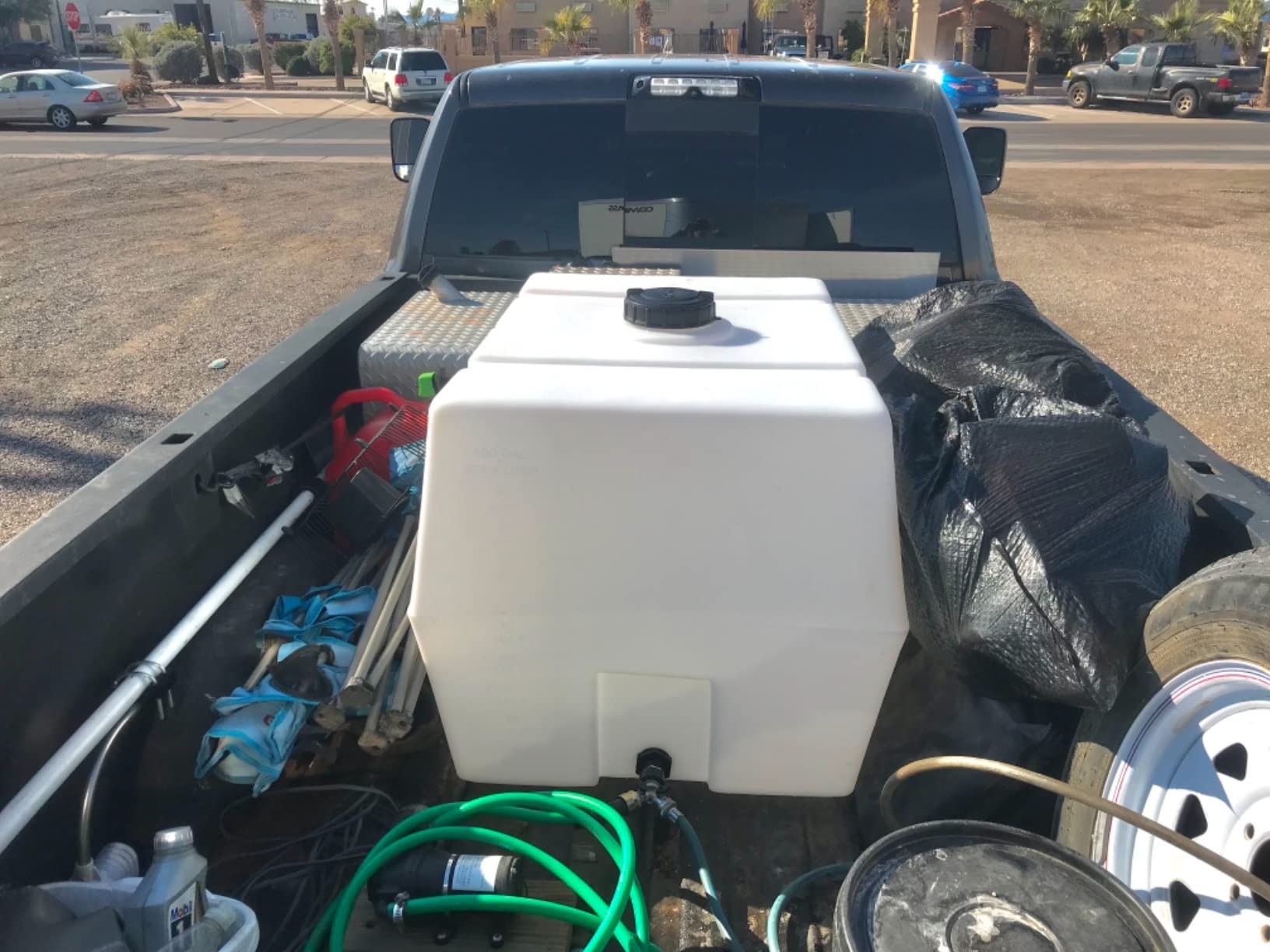
Filling and draining run through a 5.5 inch lid with a 5 inch opening and a built-in bulkhead fitting with a 3/4 inch NPT outlet. The wide opening means a hose, a funnel or a brush all fit through it for cleaning, which is the difference between a tank you can maintain and one you tolerate. It is also available in 30 and 100 gallon sizes for the same workflow.
Quality control is the weakness, and the reviews are direct about it. Some tanks arrive leaking from the middle seam or the drain fitting. The 3/4 inch NPT outlet does not always thread cleanly onto standard fittings, so budget a short adaptor run. And the outlet is not positioned low enough to fully drain, which leaves residual water that you have to tip or siphon out.
Why haulers keep buying it
The tie-down channels and the low square footprint are the reason this tank shows up on farms, at job sites and behind pressure washers. Translucency with molded graduations means nobody is guessing at a level in bad light, and the rotomolded body is rated for non-flammable liquids up to 140 degrees F contact temperature, which widens what you can carry. Owners report using it for off-grid water hauling and RV fresh and grey water transfer.
Inspect the seam and the drain fitting the day it arrives, while returns are still easy. That single ten-minute check catches the most common complaint in this product’s reviews.
Where it falls short
There is no included hardware of any kind, so you are buying fittings and straps separately. Outlet placement means it will never fully empty, which is a real problem if you plan to store something in it over winter. The listing dimensions also exclude the cap, so measure with the lid on before committing a truck bed or a shelf to it.
8. BayTec 55-Gallon Blue Water Barrel – Best Solid-Mold Potable Barrel
55 Gallon Blue Water Barrel | Solid Mold |2 Inch Bung Holes, Good for Long Term Drinking Water Use | BPA Free
55 gallon capacity
One-piece solid-mold HDPE
24 lb empty
23 by 23 by 35 inches
Pros
- Heavy-gauge one-piece solid mold feels very well built
- Pressure checked and leak tested before dispatch
- Fine threads keep caps secure in the bung holes
- BPA-free
- food-grade and UN-DOT certified
Cons
- Arrives with no box
- so barrels can show scratches or dents
- New drums carry a strong plastic or sterilizing odor to wash out
- Sealed bung tops make interior cleaning harder
Solid-mold is the phrase that matters here, and it distinguishes this barrel from a blow-molded one. It is a one-piece heavy-gauge HDPE drum with two 2 inch bung holes, pressure checked and leak tested before it leaves the manufacturer, and UN-DOT certified. At 24 pounds empty and 23 by 23 by 35 inches, it is a standard 55 gallon footprint, which means existing stands, racks and pump platforms fit it.
It is food-grade and BPA-free, so it can hold drinking water for long-term backup, and the same certification covers rainwater collection. Owners who buy it for potable backup and owners who buy it for garden irrigation are equally satisfied, which is unusual for a product in this category. Threads on the caps are noted specifically as keeping them secure in the bung holes, which is the detail that stops a full barrel from leaking in a garage.
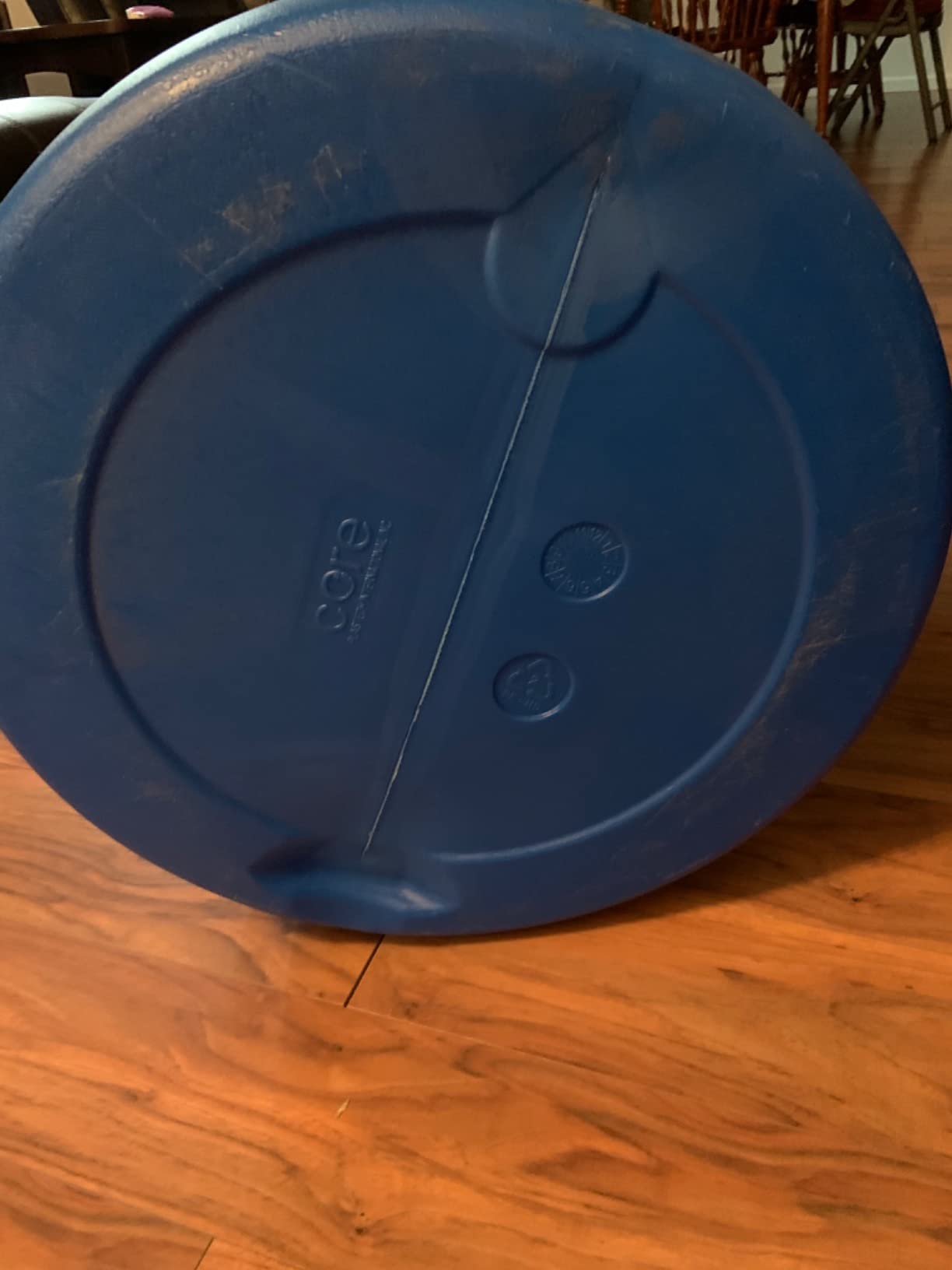
Two arrival conditions are worth planning around. The barrel travels with no box or outer covering, so cosmetic scratches, dirt and occasional dents are normal and worth a wipe-down before filling. And new HDPE drums frequently carry a strong plastic or sterilizing chemical odor, which washes out after a rinse and does not indicate anything wrong with the barrel.
You can also read the water level without opening anything by shining a light down into an opening, which is a practical trick for a sealed drum. The same barrel is available in 15 and 30 gallon sizes, and it is also rated for oil storage, so it is a genuinely general-purpose drum rather than a single-purpose one.

Why solid-mold construction matters
A one-piece solid mold has far fewer stress concentrations than a blow-molded shell, which is why owners describe this barrel as feeling substantially heavier and more rigid than expected. Combined with factory leak testing, that makes it the tank in this group we would trust most for long-term potable backup in a basement or garage. If you want rainwater collection and drinking water reserve from the same vessel, this is the one.
Two bung holes give you flexibility on fittings, and the UN-DOT certification means the construction standard is documented rather than asserted. For anyone moving water rather than only storing it, that is meaningful.
Where it falls short
The sealed bung tops make interior cleaning genuinely difficult, and a drum you cannot clean is a problem for long-term potable storage. There is no spigot or siphon included, so plan your draw method before you fill it. And because the barrel arrives bare, treat any dents carefully, especially around the bung boss area where stress cracks start.
9. WaterPrepared 55-Gallon Stackable Tank – Best for Tight Indoor Spaces
WaterPrepared 55 Gallon Unique Stackable Utility Water Tank, Blue
55 gallon capacity
Stackable oval HDPE footprint
22 by 23 by 30 inches
Roughly 460 lb when full
Pros
- Stackable oval footprint uses less space than a horizontal 55 gallon drum
- Pre-tested for leaks and arrives tight
- Brass spigot is higher quality than typical plastic valves
- Opaque body blocks light to slow impurity growth
Cons
- Roughly 460 lb full
- so a stand is effectively required
- Spigot sits low and often needs a brass extension
- New tanks can contain loose plastic shavings to rinse out
The shape is the argument. A conventional 55 gallon drum is a cylinder on a pallet footprint, and two of them do not stack. This tank uses a stackable oval footprint of 22 by 23 by 30 inches, so a second tank sits on the first and the floor area stays the same. For a garage with a low ceiling or a basement corner, that is a real capacity gain rather than a cosmetic detail.
Construction is rugged high-density polyethylene in a UV-proof blend, described by the manufacturer as inhibiting bacterial build-up during long storage, and the opaque body blocks light for the same reason. Each tank is pre-tested for leaks before shipment, which is why owners report tanks that arrive tight and stay tight when full.
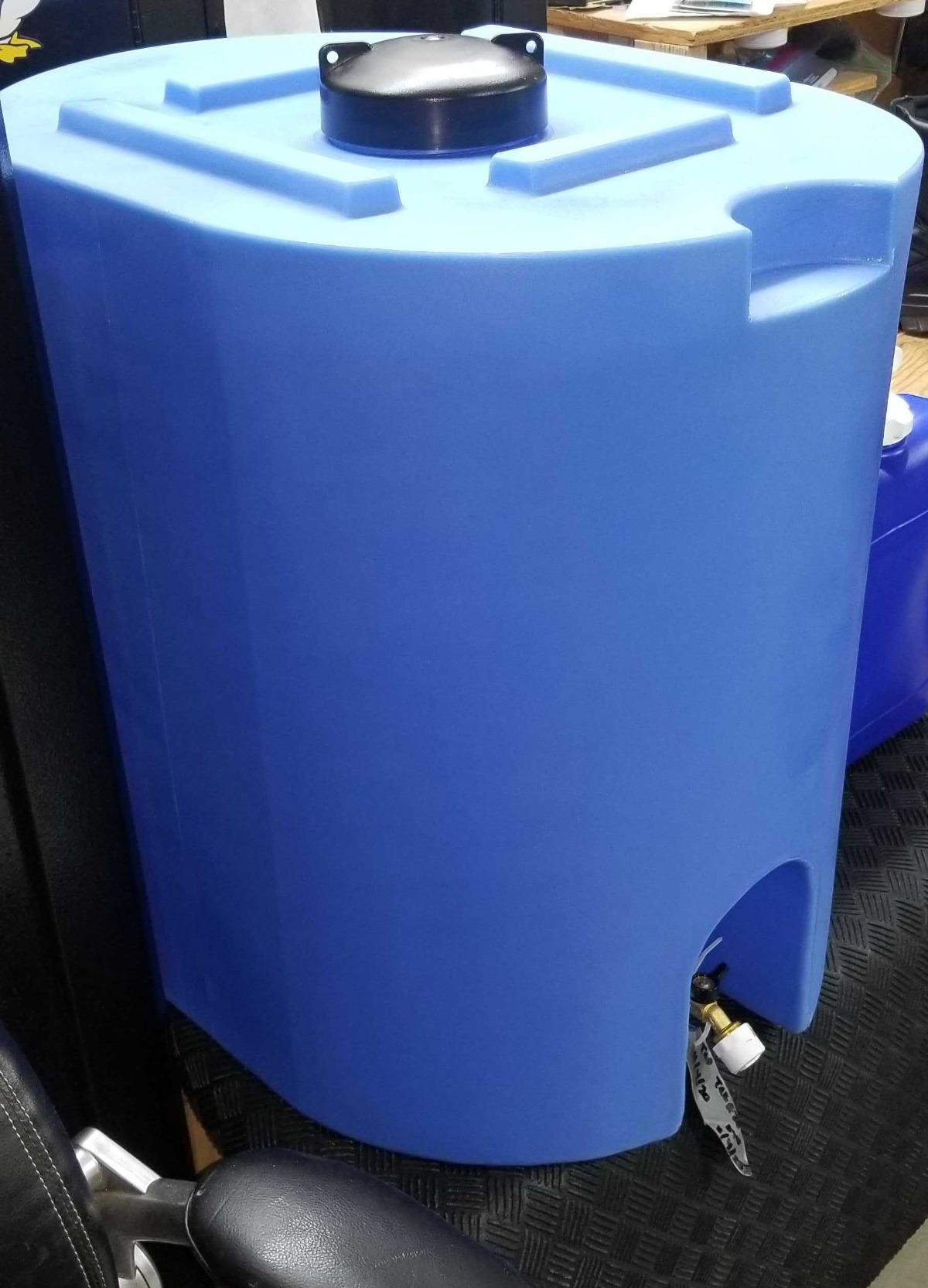
Two practical details extend its usefulness. The large cap makes filling straightforward, and the tank is narrow enough to pass through a standard doorway, which means you can bring it into a finished basement or a storage room that a straight-sided drum will not fit. The integrated spigot connects to standard garden hoses, and it is a brass spigot, which is a step up from the plastic valves that drag down most rain barrels.
Owners who supply a well-water home through power outages appear repeatedly in the reviews for this tank, which tells you something about where it is being used. The recurring setup note is that the filled weight demands a proper stand, and the spigot position is low enough that an extension or a custom platform is the normal next purchase.
When stacking actually pays off
Stacking matters when the constraint is floor area rather than gallons. A second 55 gallon tank on top of the first doubles the reserve in the same footprint, and the stacking feature is worth the most when floor area is the binding constraint. It is sold as a 1-pack or a 3-pack, so the same footprint can carry 165 gallons.
The brass spigot is the detail owners mention most when comparing it to cheaper barrels, because a plastic spigot is the first thing to fail. Rinsing the interior a couple of times after delivery clears the loose plastic shavings that some new tanks carry, and then the tank is ready to fill.
Where it falls short
Fifty-five gallons of water weighs roughly 460 pounds, which makes a full tank a two-person lift in this group. Without a stand you will be reaching to the floor for the spigot, so budget for a platform and for a way to fill it. The listing also gives two different dimension sets, one for the stackable design and one for the overall unit, so measure both before committing a space.
10. Augason Farms 55-Gallon Water Barrel – Best for Indoor Potable Reserve
Augason Farms lon Water Storage Barrel – BPA-Free Plastic Barrel 55-Gallon
55 gallon capacity
Food-grade BPA-free plastic, FDA spec met
18 lb empty
22.95 by 22.95 by 35.13 inches
Pros
- Meets FDA specification for food-grade material
- No plastic odor reported by owners
- Lightest of the 55 gallon drums here at 18 pounds empty
- Sealed top with two built-in plug fittings
Cons
- Internal lip prevents fully draining and traps water
- No spigot or siphon included
- Two small access holes make filling and cleaning awkward
- Bottom can balloon in very cold weather without bracing
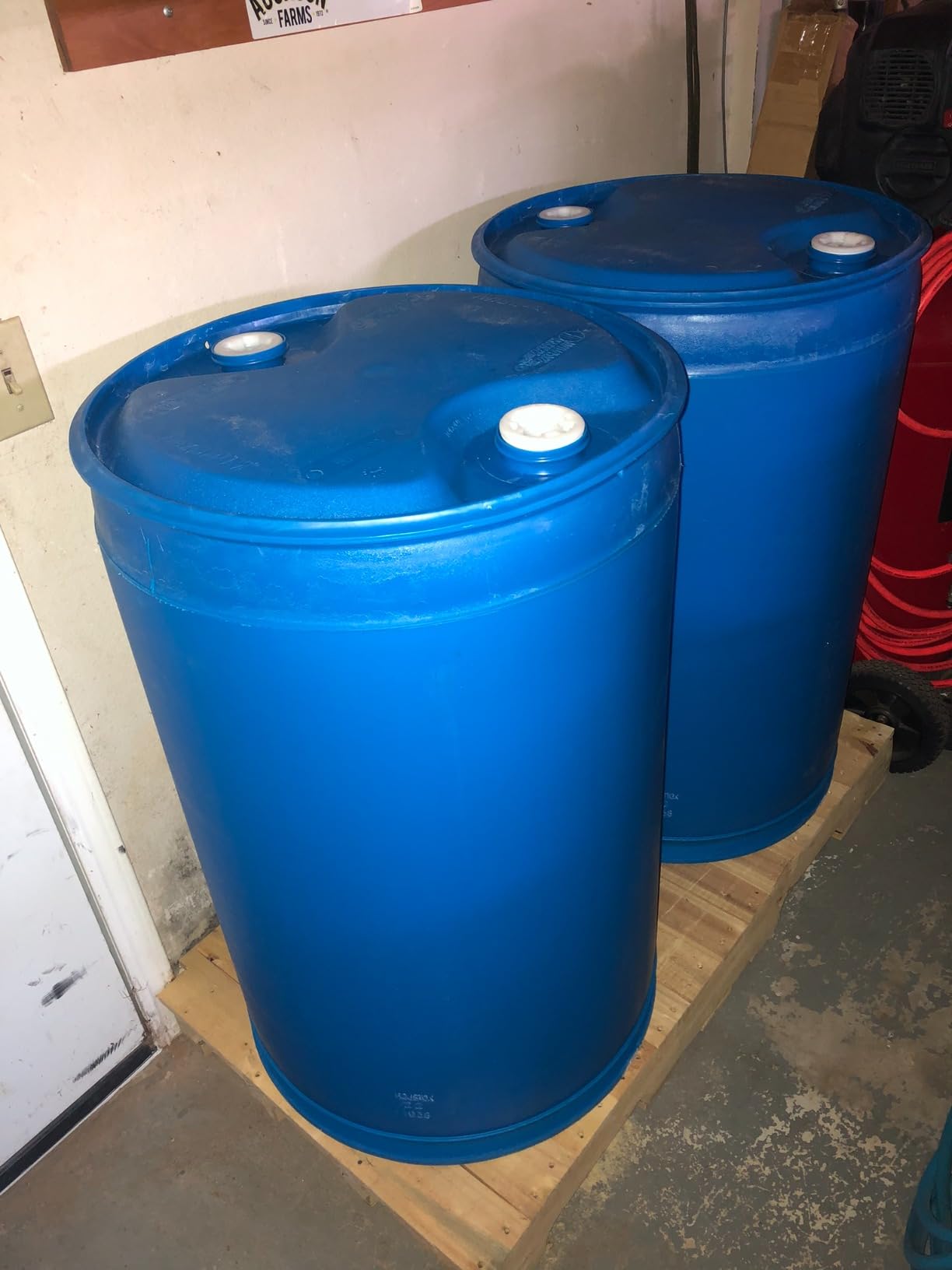
This is the one we would put in a basement or on a garage shelf, and the reason is the material rather than the shape. The plastic is food-grade, BPA-free, and made to FDA specification, and owners report no plastic odor, which is the complaint that disqualifies a lot of new drums from indoor use. At 18 pounds empty it is the lightest 55 gallon drum in this group.
The sealed top has two built-in plug fittings for filling and access, and preparedness buyers routinely purchase multiple units and stack or line them along a wall. Because it is light when empty, moving it around to find the right spot before filling is a one-person job, which matters because you only get that chance once.

It is rated for drinking, cleaning and cooking during an outage, and at 55 gallons it holds about three weeks of drinking and cooking water for two people, or a shorter but complete reserve for a family. The dimensions are 22.95 by 22.95 by 35.13 inches, so it fits a standard 55 gallon stand and pump platform.
The design has one significant drawback that owners mention more than any other. An internal lip in the barrel prevents it from fully draining, so residual water stays behind and makes interior cleaning harder. The two access holes are also small relative to the barrel, so filling and cleaning are more awkward than on a tank with a wide lid.
Why indoor potable use is the target
For drinking water held indoors, three things matter and this tank addresses all three. It is certified to an FDA food specification rather than merely described as food-safe. It has no reported plastic odor, which is what actually drives people to abandon stored drinking water. And it is light enough when empty that a single person can position it exactly where it needs to be.
Plan your draw method in advance, because no spigot or siphon is included. A drum dolly is the standard recommendation for moving it once filled, and that is the point at which the 18 pound empty weight stops helping you.
Where it falls short
Accessories can be missing depending on the seller, so confirm what is in the box before you rely on it. The sealed top with two small holes makes both filling and cleaning more work than a wide-lid tank, and the internal lip means it will never fully empty, which is a real problem in a freeze. Owners also report the bottom can balloon out in very cold weather if the barrel is not braced.
11. Chapin 97005 25-Gallon Utility Tank – Best for Farms, Gardens and Acreage
Chapin 97005: 25 Gallon Water Storage Tank, Utility Water Tank, Water Supply, for Farms, Acreage, Gardens, Orchards, Translucent White
25 gallon capacity
Translucent chemical-resistant poly
19 lb empty
6-inch cap and 1-inch drain
Pros
- Translucent walls make the water level visible at a glance
- 6-inch cap simplifies filling and cleaning
- Light enough to haul on a truck
- tractor or trailer
- Made in the USA with a 1-year limited warranty
Cons
- 1-inch drain leaves a noticeable amount of water behind
- Lowest-rated tank here at 4.1 stars with 12% one-star reviews
- Inconsistent build quality between tanks
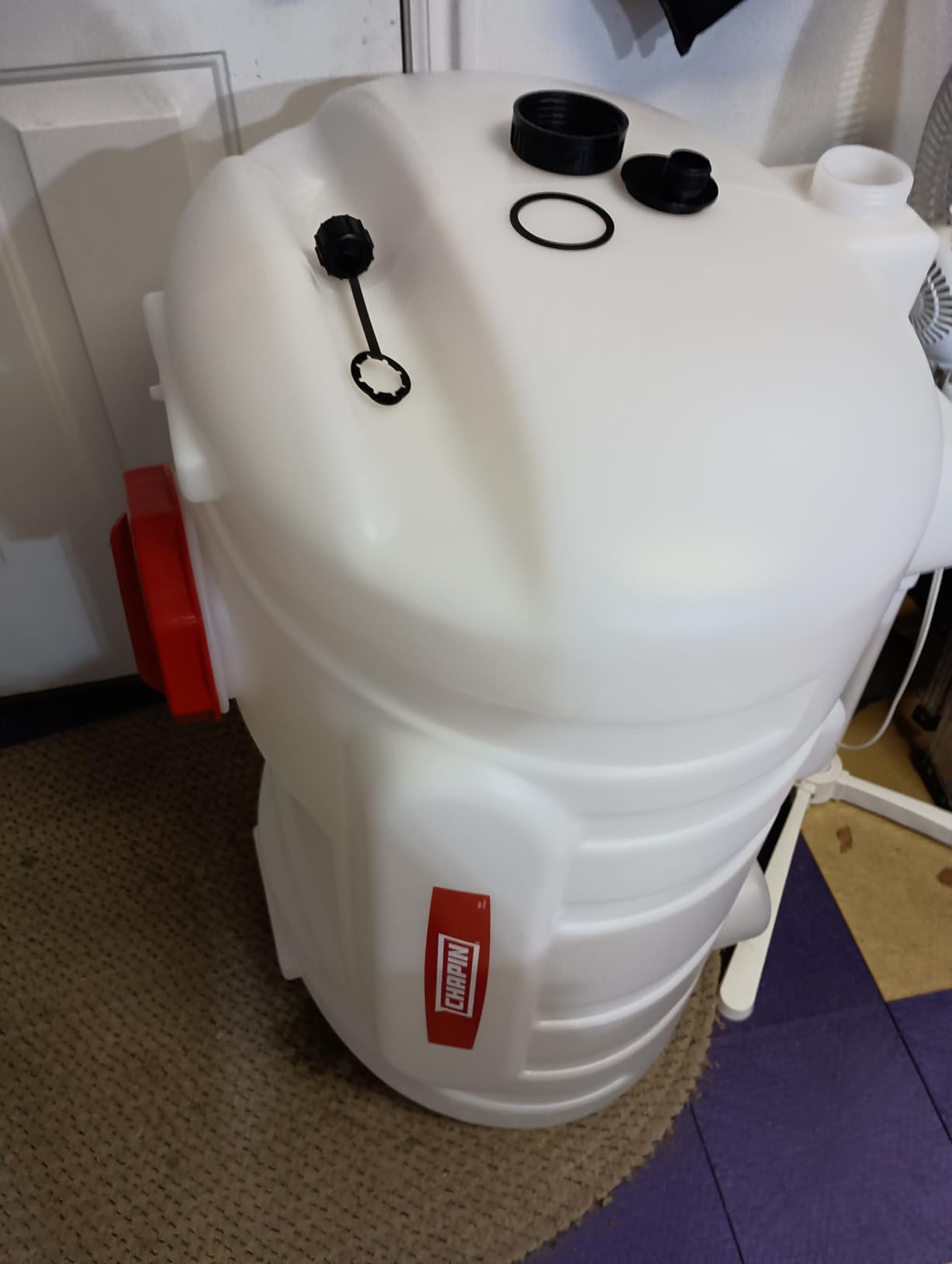
Chapin builds this one for property work rather than for emergency reserve, and the specification reflects that. It is 25 gallons of chemical-resistant poly with UV and fade-resistant protection, translucent so you can see the liquid level without a gauge, and it weighs 19 pounds empty, which is light enough to haul on a truck, tractor or trailer. Nitrile seals are specified for water service, which is the correct seal material for the job.
The 6-inch-wide cap is the best feature on this tank. On a farm or in a garden, wide access is what lets you fill it from a hose, scrub it out, and check inside without a tool, and it is larger relative to the tank than the lid on the 50 and 55 gallon drums here.
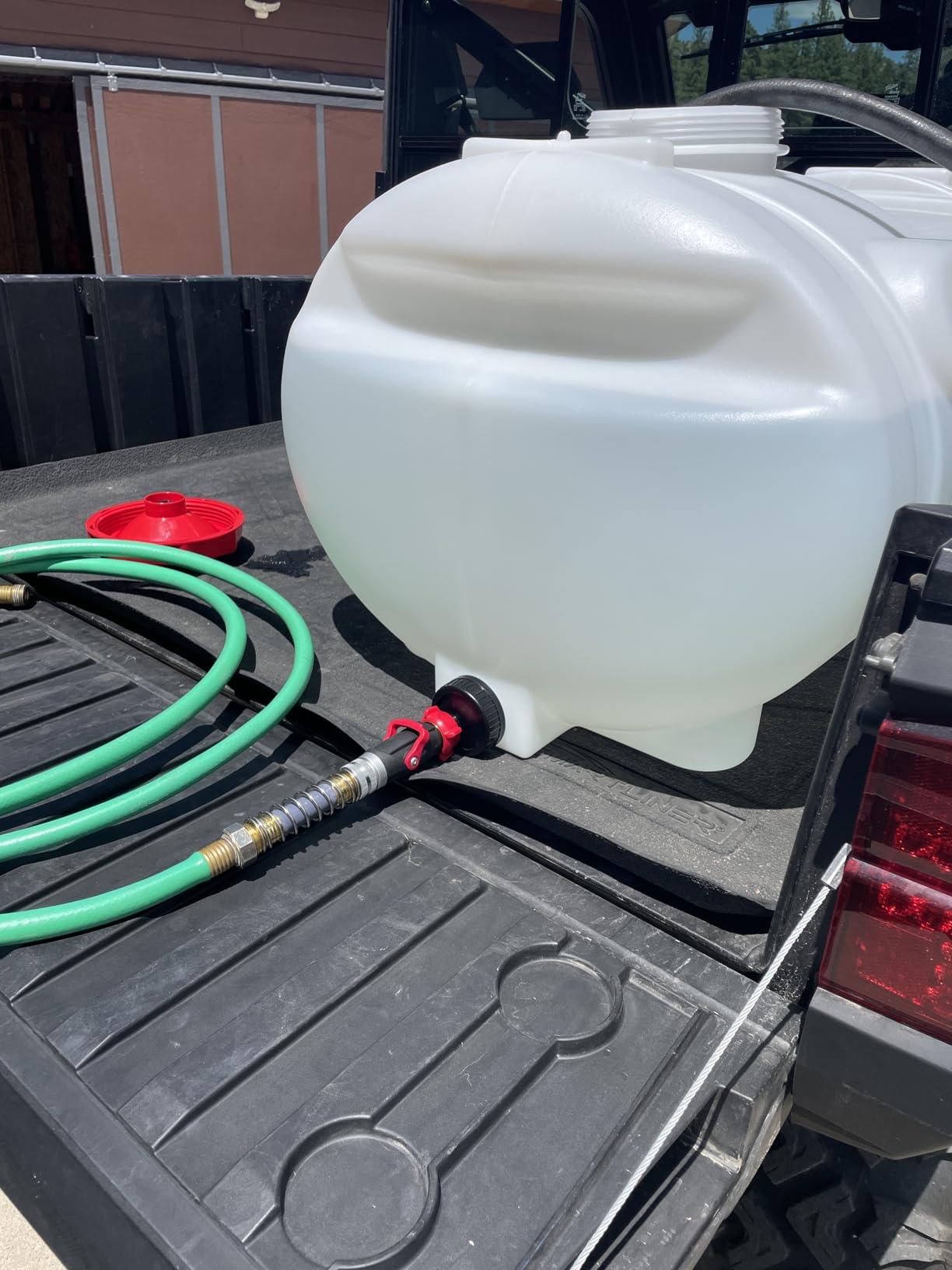
Chapin also makes this tank in 15, 40 and 60 gallon sizes, so the same lid, drain and material carry across a range of property needs. It is made in the USA with US-based customer service and a 1-year limited warranty, which is a thinner warranty than the multi-year commitments some other tanks in this group carry.
We are ranking this tank lowest in the group, and it is worth being straight about why. At 4.1 stars from more than 660 owners with 12% one-star reviews, it has the most inconsistent quality of any tank we list, and the pattern in the complaints is consistent rather than random. The 1-inch drain is the recurring one, because it sits too high in the tank and leaves a meaningful amount of water behind every time.
Where it earns its place
For gardens, orchards, acreage and livestock watering on a budget, it does the job. The visible water level removes the need to open the cap and look, which in a garden with a spigot in use is the feature you will use most. The 1-year limited warranty and US-based service are real support, and Chapin is a long-established manufacturer in this category.
If you buy it, buy it for irrigation and utility water rather than for drinking. Nothing in the listed specification indicates food-grade certification, and we would not store potable water in it.
Where it falls short
Beyond the drain issue, the listing copy is inconsistent, describing both 15 and 25 gallon capacities on the same page, so verify the model number on the tank itself. The uneven build quality between units is the reason for the one-star share, and the honest response is to inspect it on arrival and keep the return window open. For drinking water, choose one of the certified barrels earlier in this guide instead.
12. Ameri-Kart 36-Gallon RV Fresh Water Tank – Best for RV Potable Replacement
Ameri-Kart 36 Gallon RV Fresh Water Tank, Potable Water Storage Tank for Drinking, Cooking, Cleaning, Showering, for Campers, Trailers, Motorhomes, RVs, Cube Shape, 37″ x 16″ x 15″ (WT-5549)
36 gallon capacity
BPA-free impact-resistant plastic
18.51 lb empty
Cube shape 37 by 16 by 15 inches
Pros
- Direct replacement fit for common RV and trailer fresh water tanks
- Meets IAPMO standards and is QAI Laboratories certified
- Multiple bung locations for flexible fitting layouts
- Built-in 1.5 inch and 0.5 inch threaded female NPT fittings
- Includes a testing certificate
Cons
- Mounting hardware
- gate valves
- piping and hoses not included
- Some arrive with a bowed side needing reshaping before install
- May need a reducer to adapt 1.5 inch drain to 3/4 inch plumbing
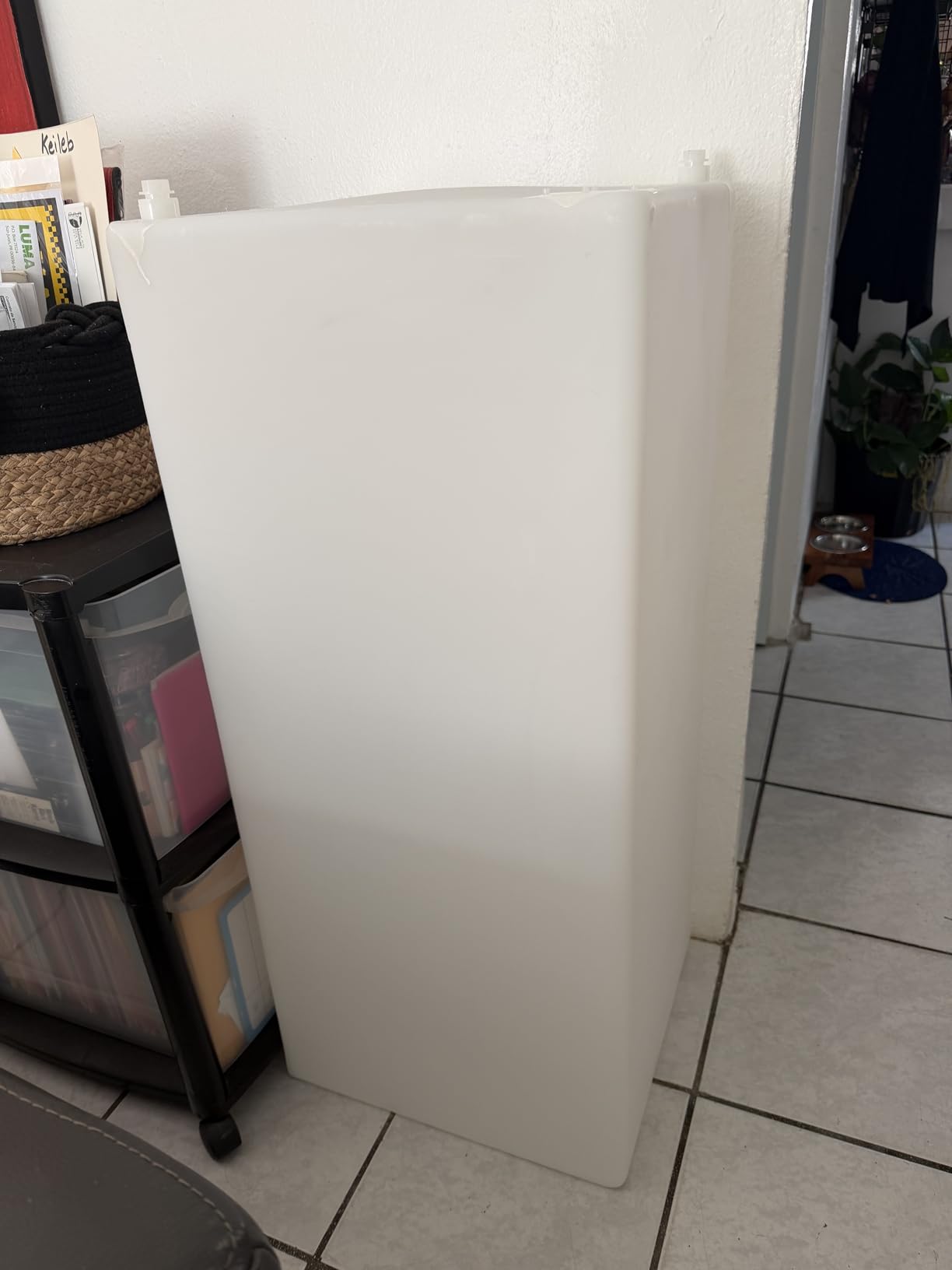
This is the only tank here built specifically as a potable fresh water tank for a vehicle, and it is certified rather than described. It meets IAPMO standards and is QAI Laboratories certified, and the construction is described as sanitary and leak-proof. At 36 gallons it is the largest certified potable vessel in this roundup built for a vehicle, and its cube shape at 37 by 16 by 15 inches is designed to fit between a frame rail and an interior wall.
The fitting layout is what makes it a genuine replacement part. It carries two 1.5 inch balloon-style threaded female NPT fittings and two 0.5 inch threaded female NPT fittings, so you can run the supply and the fill on the face that suits your plumbing rather than fighting a single fixed port. The same manufacturer makes shapes from 7 to 56 gallons in cube and low-profile forms.
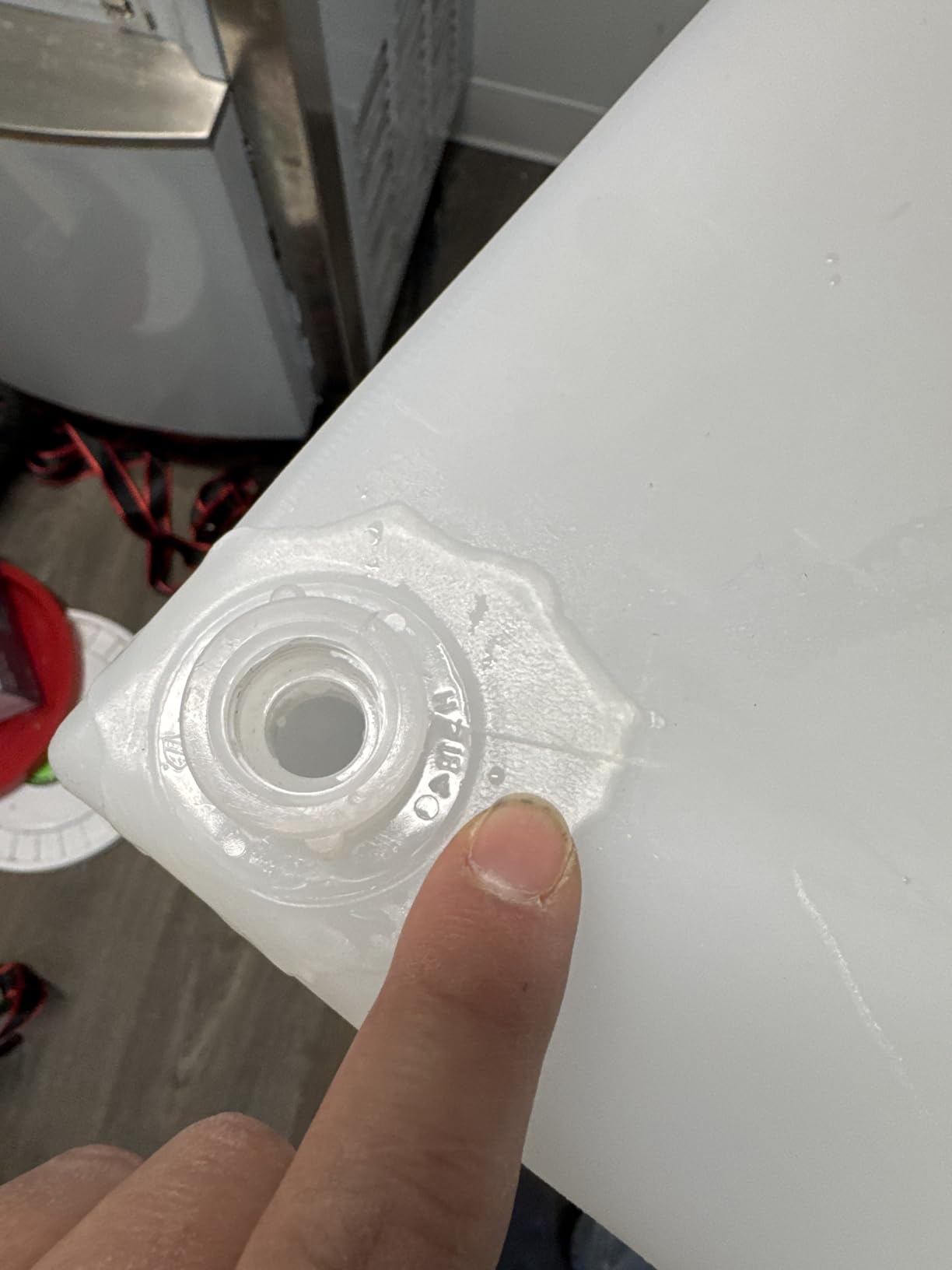
The material is BPA-free, weather- and impact-resistant plastic, made in Elkhart County, Indiana, which is where a large share of American RV plumbing is built. Owners replacing a failed OEM tank report that these drop in at the correct dimensions, fit their existing plumbing, and stay leak-free, and several note the thick walls specifically. A testing certificate is included with the unit.
Read the handling instructions before you install, because they are not optional advice. The tank is not designed to be pressurized and should not be hung by straps. It should be emptied when not in use and cleaned at least once a year, which is a stricter maintenance standard than any fixed storage tank in this group and is the correct one for a container mounted under a vehicle.
What certification actually buys you here
IAPMO standards plus QAI Laboratories certification plus BPA-free material is a stronger combination than any single claim elsewhere in this roundup, and it is the reason this tank appears at all despite the smallest review count. Certification means the material has been tested against a published standard for potable contact rather than described by the manufacturer in its own words.
For anyone replacing a failed fresh water tank it is also the most likely part to fit, because the fittings match common RV layouts and the shape family covers most frame spaces. Measure your existing tank including clearance for fittings before ordering, since a cube shape can run into a curved wall.
Where it falls short
Nothing needed to install it is included: no mounting hardware, gate valves, piping, hoses or fittings. That turns a weekend swap into a parts run, and the 1.5 inch drain may need a reducer to reach 3/4 inch plumbing. Some units also arrive with a bowed or swollen side from packaging and need heat and flattening before they will seat properly, so allow time for that before your trip.
How Much Water Do You Actually Need?
Start with the federal emergency planning figure of 1 gallon of water per person per day, then double it. The doubling is not padding. It covers cooking, washing, drinking and sanitation, and it absorbs the difference between a leak and a catastrophe. The formula is people multiplied by 1 gallon multiplied by days of supply, multiplied by 2.
Worked example: a family of four wants two weeks of independence. Four people times 1 gallon is 4 gallons a day. Two weeks is 14 days, so 56 gallons. Double it and the target is 112 gallons, which rounds up neatly to two 55 gallon drums. A single person for one week lands at 14 gallons, which is three of the 5-gallon stackable tanks and a quarter of a 55 gallon drum.
That is the whole method, and it takes about a minute. Pick your days honestly, because the number people most often under-set is days, not gallons. Two weeks is a reasonable floor for drinking, cooking and hygiene. Longer than that is not a tank problem, it is a water rotation problem, and you need multiple containers with a plan for moving through them.
Which Tank Material Should You Buy?
Rotomolded polyethylene resists corrosion and does not rust, weighs a fraction of steel, and is available in the widest range of portable sizes. It is the right default for most households, and the RomoTech in this roundup is a clean example of what rotational molding does well.
Stainless steel lasts far longer, often measured in decades rather than seasons, and it resists corrosion outright. It is heavy, it costs more, and it is a fixed installation rather than something you carry. If your tank is going to sit beside a house for twenty years and you can afford to pour a pad, steel is the longest-lived answer.
Fiberglass is the middle path: lighter and more durable than polyethylene, more expensive, and available above ground or underground. It is the standard choice for buried tanks and for larger residential capacities, and it is rarely the cheapest route per gallon. Reinforced concrete is essentially a building material, durable and long-lived, but it is a poured job with a crew rather than a product you set on a pad.
Soft bladders and pillow tanks trade durability for portability and cost, and they fold to nothing when empty. Use them for irrigation, fire reserve and transport. Do not use them for drinking water, because their liners are thin, puncture-prone and generally not food-certified. One product in this roundup carries an explicit non-potable rating from its manufacturer for exactly this reason.
Food-Grade and Potable Water: What to Check Before You Fill
Look for a certification, not an adjective. The meaningful marks are NSF/ANSI 61 for drinking water system components, an FDA food-grade specification, or IAPMO certification for RV and plumbing components. Words like food-safe, BPA-free and heavy-duty on their own tell you almost nothing about whether water will taste clean after six months in a warm garage.
BPA-free in particular is a narrow claim about one specific chemical and should never be read as potable certification. The Augason Farms barrel in this roundup meets an FDA specification, the Ameri-Kart RV tank is IAPMO and QAI certified, and the Camco Rhino tote and the MXQMKL bladder carry no food-grade certification at all, which is why we describe them as transport and non-potable respectively.
Two design features affect water quality more than the label does. An opaque or dark-colored body blocks light and slows biological growth, which is why the dark blue Legacy tanks and the blue drums outperform translucent polyethylene for long storage. And stored water has a realistic shelf life of about 16 weeks in any container, with the treatment drops rated to 5 years in the Legacy set being the exception rather than the rule.
IBC Totes: When a Repurposed Tote Works and When to Skip It
A repurposed tote is a legitimate option at 275 gallons, and 330 gallons is the larger size people encounter. They are cheap by the gallon, they come with a metal cage, and they can be moved by forklift rather than by hand, which is the practical advantage over any rigid tank in this roundup. Owners report 275 gallon totes going straight from a roof into service for garden irrigation.
The drinking water question has a clear answer: a tote is only as safe as its history. HDPE absorbs chemical residue, and residue persists in the wall of the container regardless of how many times it is rinsed. People in preparedness forums consistently avoid totes that hauled chemicals for exactly this reason, and the concern is well founded. Never repurpose a tote that carried anything other than food or water.
If you do use one for potable water, buy a new food-grade tote rather than a used one, and choose the configuration owners prefer: a 6 inch vented lid so filling is easier, and a 2 inch ball valve so draining is faster. Sanitize it before use with a diluted unscented bleach solution, let it stand, rinse thoroughly, and dry it fully. For a first real supply, a purpose-built certified barrel from this roundup is the lower-risk choice.
Placement, Maintenance and Realistic Lifespan
Place tanks in shade where you can, because ultraviolet degradation is the most common long-term failure for polyethylene. Owners of translucent tanks report both UV brittleness and algae growth on translucent units exposed to direct sun, and the fix is the same as the prevention: keep them shaded, opaque where possible, and closed.
Anchor anything over about 100 gallons. The RomoTech has molded tie-down channels for saddle straps, and the Camco tote has strap grooves, but an unanchored full barrel is a serious hazard in a storm or a seismic event. Leave clearance for the fill method and for a stand if the spigot is low, since you will fill it more than once.
Leaking is the number one complaint we saw across all 12 tanks, and it is almost never the body. It is the spigot, the middle seam on rotomolded tanks, or a drain boss that was not seated. Inspect seams and fittings on arrival, replace plastic spigots with brass before the first season, and keep the receipt. Also watch for rodent damage, which is not a manufacturing defect but a very real reason to use a metal cage or a screened enclosure.
Finally, run a turnover schedule. Stored drinking water has a realistic life of about 16 weeks in most containers, so plan to consume and refill rather than fill once and forget. For water you intend to hold for years, sanitize on an annual cycle and keep a spare spigot and gasket set on hand, because replaceable parts are what separate a tank you keep for a decade from one you replace in five years.
Frequently Asked Questions
What is the ideal water tank size for a residential home?
The federal emergency planning figure is 1 gallon of water per person per day, and you should double it to cover cooking, washing and sanitation. A family of four needing two weeks of supply lands on 112 gallons, which rounds up to two 55 gallon drums. For a single person for one week, 14 gallons is enough.
How do you determine what size water tank you need?
Multiply the number of people by 1 gallon per person per day, multiply that by the number of days of supply you want to cover, and double the result. Then round up to a tank size that actually exists. Decide your day count honestly, because days is the number people most often under-set.
What type of water tank is the best?
Rotomolded polyethylene is the best default for most households because it resists corrosion, does not rust, and is light enough to move. Stainless steel lasts far longer and is worth it for a fixed twenty-year installation. Fiberglass is the middle path, and soft bladders are for irrigation and transport rather than drinking water.
What is the best container to store water long-term?
A certified food-grade barrel in an opaque body is the safest choice for drinking water held for months. Look for an FDA food-grade specification or NSF/ANSI 61 certification rather than words like food-safe or BPA-free. Budget about 16 weeks of shelf life in any container and plan a rotation schedule rather than filling once and forgetting.
Are IBC totes safe for drinking water?
Only when you know the history. HDPE absorbs chemical residue that persists in the container wall no matter how many times it is rinsed, so never repurpose a tote that carried anything other than food or water. For potable use, buy a new food-grade tote with a 6 inch vented lid and a 2 inch ball valve, and sanitize it before filling.
How long can you keep water in an IBC tote?
Plan on the same window as any other container, about 16 weeks for drinking water, and rotate through your supply rather than filling once and forgetting. For irrigation, fire reserve and other non-potable uses, a tote can stay in service for years as long as it is shaded, secured and inspected for seam and fitting leaks.
Final Verdict: Which Water Storage Tank Should You Buy?
The best water storage tank for most people is the Camco Rhino 21-gallon tote, because it carries the deepest review history in the group and its wheels, tow adapter and included hose kit make it work on the hardest surface you will ever drag a full tank across. For drinking water held indoors, the BayTec 55-gallon solid-mold barrel and the Augason Farms 55-gallon drum are the two that meet a food-grade standard without fuss.
For a rental or an outage you cannot plan around, the waterBOB turns a bathtub into 100 gallons in twenty minutes. For rainwater, put the FCMP barrel on a stand and replace the overflow hose. Size first with the 1 gallon per person per day formula, then pick the shape that fits the space you actually have, because the best tank in the world is the one you can still reach the spigot on. Our related guides cover aquarium tanks and tool storage cabinets for the rest of your household planning.