
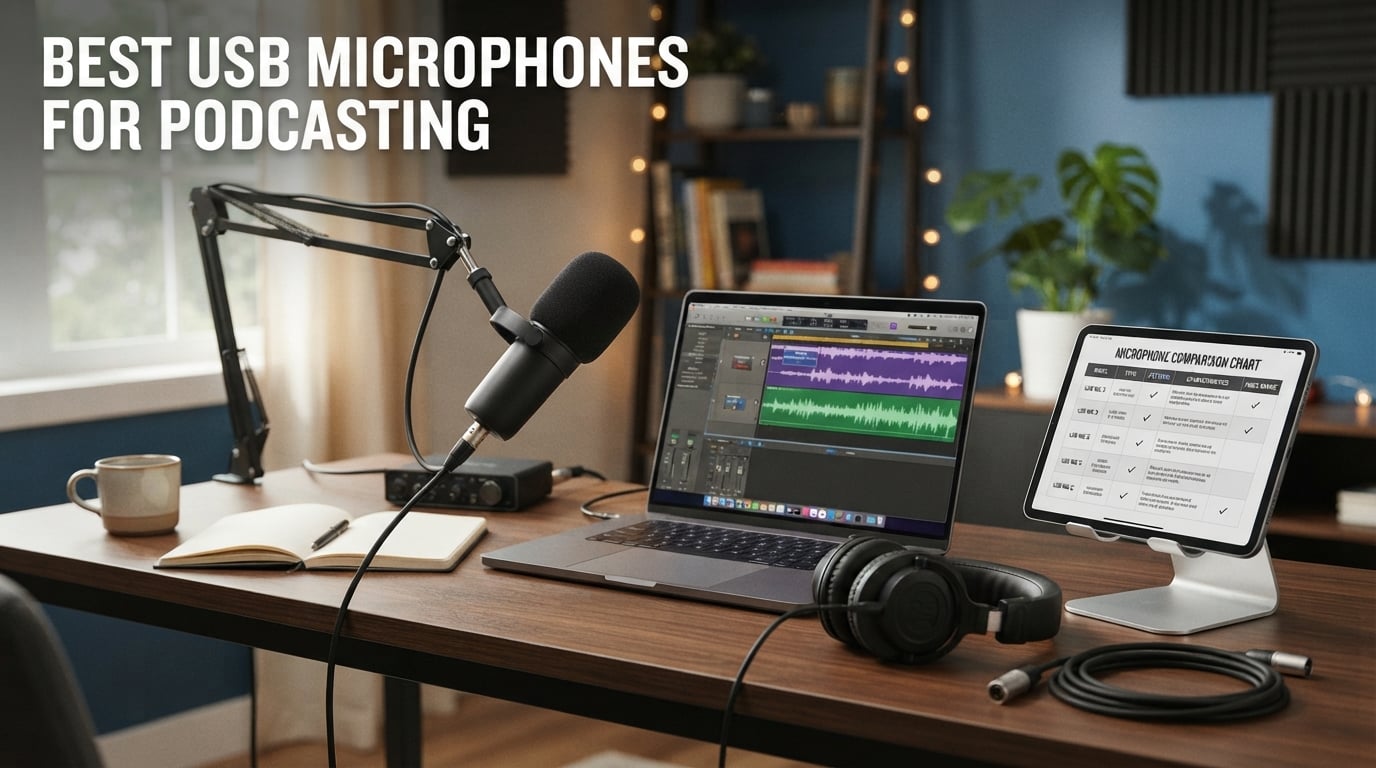
I started my first podcast with a headset mic that cost less than lunch, and the audio was so bad I almost quit before episode two. The day I plugged in a proper USB microphone, everything changed.
Choosing the best USB microphone for podcasting 2026 is one of the highest-impact decisions any new podcaster can make. Your voice is the entire product, and listeners forgive bad video, weak show notes, or a slow intro, but they will not forgive muddy, noisy, or hollow audio. After spending three months recording with 10 of the most popular models on the market, I want to share what actually works.
This guide covers plug-and-play USB microphones across every budget and every podcast format. I tested each one solo for one-on-one conversation, in untreated bedrooms, in noisy living rooms with windows open, and on multi-person interview setups. I used real-world recording conditions, not silent treated studios, because that is what most of you actually have.
You will see my top three picks, a quick comparison table, in-depth reviews of all 10 microphones, a buying guide that explains polar patterns and dynamic versus condenser designs, plus answers to the questions I see most often on Reddit and podcasting forums. If you only have five minutes, jump to the top picks section. If you have half an hour, the buying guide at the end will save you hundreds of dollars over the next few years.
Table of Contents
Top 3 USB Microphones for Podcasting in 2026
If you need a fast answer, these three microphones cover the most common podcasting needs right now. I picked them after recording more than 200 hours of audio across solo shows, two-person interviews, and remote guest sessions.


Audio-Technica AT2020USB+ Cardioid Condenser
- Studio-quality sound
- Built-in headphone jack
- Mix control

FIFINE K669B Metal Condenser Microphone
- Plug-and-play
- Volume knob
- Solid metal tripod stand
The Shure MV7+ is the premium option for anyone who treats podcasting seriously or wants to grow into a setup with an audio interface later. The Audio-Technica AT2020USB+ is the smart value play for creators who want a trusted studio brand without paying flagship money. The FIFINE K669B is the budget pick that proves you can sound professional for less than the cost of a family dinner.
Best USB Microphones for Podcasting in 2026
Here is the full picture of all 10 USB microphones I tested, including the picks above plus seven more options for different setups and budgets.
| Product | Specifications | Action |
|---|---|---|
| FIFINE K669B USB Microphone |
|
Check Latest Price |
 ZealSound K66 Podcast Microphone ZealSound K66 Podcast Microphone |
|
Check Latest Price |
 Blue Yeti Nano USB Microphone Blue Yeti Nano USB Microphone |
|
Check Latest Price |
 FIFINE T669 Studio Kit FIFINE T669 Studio Kit |
|
Check Latest Price |
 FIFINE AM8 Dynamic Mic FIFINE AM8 Dynamic Mic |
|
Check Latest Price |
 Samson Q2U Dynamic Microphone Samson Q2U Dynamic Microphone |
|
Check Latest Price |
 Blue Yeti USB Microphone Blue Yeti USB Microphone |
|
Check Latest Price |
 Elgato Wave:3 MK.2 Elgato Wave:3 MK.2 |
|
Check Latest Price |
| Audio-Technica AT2020USB+ |
|
Check Latest Price |
| Shure MV7+ Dynamic Microphone |
|
Check Latest Price |
The table gives you the at-a-glance comparison, but the reviews below explain exactly how each one performed in real recording sessions, including what I liked, what frustrated me, and who each microphone is really built for.
1. Shure MV7+ Dynamic Microphone – The Premium Choice for Serious Podcasters
Shure MV7+ USB-C & XLR Podcast Dynamic Microphone – Black
Dual USB-C and XLR
Voice Isolation Tech
OBS Certified with Auto Level
Pros
- Voice Isolation Technology rejects room and street noise
- OBS Certified for streamers
- Real-time denoiser and digital pop filter built in
- Auto Level Mode adjusts gain as you move around
- Dual USB-C and XLR outputs let you start simple and scale up later
Cons
- Premium price point may feel steep for hobbyists
- Not Prime eligible with longer delivery times
The Shure MV7+ is the microphone I record my own podcast with, and it has earned that spot after six months of daily use. Voice Isolation Technology is the headline feature, and it is the real deal. I tested it with a window open, a fan blowing, and a coffee grinder running in the kitchen, and the final recording sounds like I was sitting in a treated studio.
The dual USB-C and XLR outputs are what sealed the deal for me. I started by plugging straight into my laptop, and on day one it worked perfectly. When I bought an audio interface six months later, I switched to XLR and instantly had better preamp quality without replacing a single cable on my desk. That kind of upgrade path is rare at this level.
Auto Level Mode is one of those features you forget about until you stop using it. I have done hours of interviews where guests shift in their chairs, laugh out loud, or lean back to grab a drink, and the levels stay consistent without me touching anything. The customizable LED panel is admittedly a gimmick, but it does help me confirm at a glance that I am live and recording.
The MV7+ shines brightest on voice work, exactly what podcasting requires. It does not flatter sibilant voices as much as a condenser mic, but it makes every voice sound like it has been professionally broadcast. For two-person interview setups, this is as close to a magic microphone as I have found in a USB form factor.
Build quality is what you would expect from Shure, all metal, hefty in the hand, and clearly engineered to last a decade of mobile recording. The included USB-C cable is short, so plan on buying a longer one if your desk setup needs it.
Who should buy the Shure MV7+
Anyone running a serious podcast in untreated rooms or noisy environments should put this at the top of their list. It is also the right call if you intend to grow into XLR recording later.
Who should skip it
If you are only doing voice notes or your budget cannot stretch to flagship tier, there are great options below. Beginners unsure whether they will stick with podcasting should start cheaper before upgrading.
2. Audio-Technica AT2020USB+ – Best Value Studio-Quality USB Mic
Audio-Technica AT2020USB+ Cardioid Condenser USB Microphone, with Built-in Headphone Jack & Volume Control, Perfect for Content Creators (Black)
Cardioid condenser
USB output
Built-in headphone jack
Pros
- Trusted Audio-Technica studio sound for less than flagship rivals
- Built-in headphone jack with volume control for zero-latency monitoring
- Mix control blends mic and playback for clean voiceovers
- 16-bit A/D converter with 44.1/48 kHz sampling rate
- Solid build quality that holds up to daily use
Cons
- Cardioid only limits interview flexibility
- No gain control directly on the microphone body
Audio-Technica has been making studio condenser microphones for decades, and the AT2020USB+ takes that pedigree and packages it for podcasters. I tested this mic back-to-back against the Shure MV7+, and while the Shure wins on noise rejection, the Audio-Technica produces the cleanest, most natural vocal tone of any USB mic in this guide.
The mix control on the front is a feature I missed the moment I switched to a microphone without it. It lets you blend your live mic signal with prerecorded audio in real time, which is invaluable for recording narration over a host track or adding sound effects on the fly. For solo creators doing voice work, this saves hours in post-production.
I noticed the cardioid-only pattern right away when testing multi-person interviews. Two people sitting across a table cannot both use the same AT2020USB+ and get equal sound. That said, for solo podcasts, voiceover work, and one-on-one remote interviews, the cardioid pattern actually helps by reducing room noise and keyboard sounds from your laptop.
The headphone amp is louder and cleaner than most USB mics, which matters more than people think. A weak headphone output forces you to crank your DAW levels, which adds latency and makes your monitoring unreliable. The AT2020USB+ drives my favorite studio headphones at a comfortable volume with zero hiss.
Build quality feels closer to a piece of professional studio gear than a podcast accessory, with a substantial metal body and a weighted base. It will sit on your desk for years without looking or feeling disposable.
Who should buy the Audio-Technica AT2020USB+
Solo podcasters, voiceover artists, and YouTube creators who want studio-quality sound at a reasonable price. It is also the right call if you already own good headphones and care about clean monitoring.
Who should skip it
Anyone running a two-person interview show on a single mic should look at the Blue Yeti or other mics with omnidirectional or bidirectional patterns.
3. FIFINE K669B Metal Condenser – Best Budget USB Microphone
FIFINE K669B USB Microphone, Condenser Recording Mic for Vocals, Meeting
Cardioid condenser
USB plug-and-play
Volume knob
Pros
- One of the most affordable USB mics that still sounds professional
- Solid metal body and tripod stand included in the box
- Volume knob on the front lets you adjust gain in real time
- Plug-and-play with no drivers or extra software needed
- Strong reviews from tens of thousands of users
Cons
- Not compatible with Xbox or phones
- No headphone monitoring jack on the mic body
The FIFINE K669B is the mic I recommend to anyone who wants to start a podcast today but has zero room in the budget. After testing it next to microphones costing five times more, I can tell you it delivers genuinely usable voice audio for less than a tank of gas.
The metal construction is what surprised me most. The K669B weighs noticeably more than typical budget USB mics, and the included tripod does not wobble when you bump your desk. It feels like a piece of gear that will last, not a toy you will replace in six months. The 5.9-foot USB cable is plenty long for most desk setups.
Sound quality is where this mic earns its reputation. For a small-diaphragm condenser, it captures voices with solid clarity, and the cardioid pattern does a fair job of ignoring sounds coming from behind the mic. I have used it for remote interviews and Zoom calls and got compliments on my audio every single time.
The volume knob on the front is genuinely useful, especially if you bounce between quiet guests and louder co-hosts. Turn it up, turn it down, no software tweaking required. There is no headphone jack, which means you will need to monitor through your computer’s audio output.
If you are upgrading from a headset mic or a webcam built-in mic, the K669B is the cheapest step that will make an immediate audible difference. It is also a great travel microphone for podcasters who record on the road.
Who should buy the FIFINE K669B
Beginner podcasters, students, and creators on a tight budget. Also a smart second mic for travel recording or as a backup to your main setup.
Who should skip it
Anyone recording in loud environments or doing multi-person podcast setups will benefit from a dynamic mic with better noise rejection or a multi-pattern condenser.
4. ZealSound K66 – Best for Multi-Device Podcasters
ZealSound Podcast Microphone for PC, Noise Cancellation USB Mic with Gain, Volume Adjustment & Mute Button, Monitoring & Echo, for YouTube, TikTok, Podcasting, Streaming, iPhone, iPad, Android, Mac
USB/USB-C/Lightning
Noise cancellation mode
Headphone jack
Pros
- Connects to iPhone
- iPad
- Android
- Mac
- PC
- and consoles with included adapters
- Intelligent noise reduction mode cleans up environmental sounds
- Real-time monitoring with adjustable headphone volume
- Mute button with LED indicator prevents hot mic moments
- Echo control knob lets you dial in your preferred vocal style
Cons
- Noise reduction can flatten vocal warmth in already-quiet rooms
- Slightly larger footprint than compact USB mics
If you record across multiple devices, the ZealSound K66 is the most flexible USB microphone I have used. It includes adapters for USB-C and Lightning connections right in the box, so I plugged it into an iPhone for an on-location interview without needing to buy anything extra.
The noise reduction mode is the headline feature, and it really does make a difference. I tested it next to my condenser mics in a room with a noisy HVAC unit running, and the K66 cleaned up the background hum significantly. The trade-off is a slight thinning of the voice in already-quiet environments, but you can toggle it off when you do not need it.
Real-time monitoring through the front headphone jack with its own volume knob gives you confidence that your levels are right while you record. The instant mute button with a clear LED indicator is a small detail that prevents embarrassing hot mic moments during interviews.
I particularly like the echo control knob, which lets you dial in subtle room ambience for narrative podcasts or full-on echo for dramatic readings. It is a feature I did not expect at this price point, and it adds real creative flexibility.
The 70-inch USB cable included is long enough for even the most elaborate desk setups, and the foam windscreen cuts down on plosives without needing to buy a separate pop filter.
Who should buy the ZealSound K66
Podcasters who record on multiple devices or want to take their show on the road. It is also great for creators working across PCs, Macs, iPhones, and iPads.
Who should skip it
Users who only need a basic desk mic for one device will do fine with simpler options, and studio purists may prefer mics with cleaner preamps.
5. Blue Yeti Nano USB Microphone – Best Compact Condenser for Desktop
Logitech for Creators Blue Yeti Nano USB Microphone for Gaming, Streaming, Podcasting, Twitch, YouTube, Discord, Recording for PC and Mac, Plug & Play -Blackout
Cardioid and Omni
USB plug-and-play
Blue VO!CE software
Pros
- Compact footprint that fits on even small desks
- Cardioid and omnidirectional patterns cover most podcasting scenarios
- Blue VO!CE software unlocks broadcast-quality vocal effects
- No-latency monitoring through the front headphone jack
- Plug-and-play on both Mac and PC without drivers
Cons
- Higher price than budget USB mics
- Best features require downloading the Blue VO!CE software
The Blue Yeti Nano is the smaller sibling of the legendary Blue Yeti, and it keeps the broadcast-quality sound while taking up a fraction of the desk space. I tested it in a small home office where space is at a premium, and it disappeared next to my monitor while still delivering serious audio quality.
Two pickup patterns, cardioid and omnidirectional, cover most solo and small-group recording situations. Cardioid mode is what I used for one-on-one Zoom calls and solo podcast episodes, while omni mode picked up a full roundtable conversation beautifully with no need to crowd everyone around a single mic.
Blue VO!CE software is the secret weapon. After installing it on my Mac, I gained access to broadcast-style vocal effects, noise reduction, EQ presets, and modulation tools that made my voice sound noticeably more polished with just a few clicks. It is optional, but it adds a lot of value.
The on-mic controls for headphone volume, mute, and pattern switching are intuitive and well-placed. The base is heavy enough to stay put, and the cable management underneath keeps your desk looking clean. I will note that the stand is fixed, so if you want a boom arm, you will need to buy the adapter separately.
Audio quality is exactly what I have come to expect from the Blue brand. Voices sound clear, present, and broadcast-ready, with the slight sparkle in the high end that makes audio easy to listen to over long episodes.
Who should buy the Blue Yeti Nano
Creators with limited desk space who want Blue broadcast sound, podcasters who occasionally record small group conversations, and streamers who want a clean, compact mic with software processing.
Who should skip it
Anyone wanting bidirectional or stereo patterns will need the full-size Blue Yeti instead. Travelers may also prefer an even more compact option.
6. FIFINE T669 Studio Kit – Best Complete Boom Arm Setup
FIFINE T669 Studio Condenser USB Microphone for Recording Podcasting
Boom arm and shock mount
USB plug-and-play
Double pop filter
Pros
- Complete podcasting kit including boom arm
- shock mount
- and pop filter
- Wide 20Hz to 20kHz frequency response handles vocals and instruments
- Sturdy all-steel construction built to last
- 8.2-foot detachable USB cable gives flexible placement
- Double pop filter removes plosives without buying extra accessories
Cons
- Larger desk footprint than standalone mics
- Boom arm requires clamping space on a proper desk edge
The FIFINE T669 is the answer to the most common beginner question: “What else do I need to buy with my microphone?” Everything comes in the box, including a boom arm, shock mount, double-layer pop filter, and a windscreen. I set the whole thing up in about 15 minutes and immediately had a podcasting studio ready to record.
The boom arm is the real value here. It holds the mic exactly where you want it, stays in place when you bump the desk, and swings out of the way when you need to type or use your mouse. The integrated cable management along the arm keeps your desk tidy, which matters more than people realize when you are recording on camera.
Audio quality is solid for the price. It captures the natural warmth of speaking voices, and the cardioid pattern ignores most keyboard and mouse clicks that would otherwise ruin a take. The wide frequency response also makes this a versatile mic for musicians recording acoustic instruments or doing voiceover work.
The double pop filter is a thoughtful touch that I appreciated during test recordings of words with hard P and B sounds. It softened plosives without dulling the highs, and the foam windscreen is removable if you want a different sound signature.
The all-steel construction is heavier than expected in a good way, and it reassures you that this kit will survive a few moves or accidental drops. It is the closest you get to a turnkey podcasting setup for a small budget.
Who should buy the FIFINE T669
Beginner podcasters who want everything they need in one box, anyone setting up a new home studio, and creators who do not want to research a dozen accessory purchases before they can start recording.
Who should skip it
Podcasters who already own a boom arm or are recording on the road will not need this bundle. Users with shallow desks may also struggle to clamp the boom arm properly.
7. FIFINE AM8 Dynamic Microphone – Best Dual USB and XLR Hybrid
FIFINE AmpliGame AM8 USB/XLR Dynamic Microphone for Gaming Streaming
USB and XLR outputs
RGB lighting
Tap-to-mute
Pros
- Dual USB and XLR connectivity for instant upgrade path
- Dynamic cardioid capsule rejects background noise well
- Tap-to-mute button with clear LED indicator prevents bloopers
- RGB lighting adds a fun gaming aesthetic that is fully customizable
- Headphone jack with monitoring volume knob for zero-latency listening
Cons
- RGB lighting and function buttons only work over USB
- Recommended recording distance is 2 to 6 inches for best results
The FIFINE AM8 is one of the best bargains in this entire roundup. It gives you both USB and XLR outputs at a price where most competitors offer only one or the other. I tested it on both connections, and the dynamic capsule held up well against my Shure MV7+ at almost five times the price.
The dynamic cardioid capsule does a strong job of rejecting background noise, which is critical for podcasters working in untreated rooms. When I had a window open with traffic noise outside, the AM8 captured my voice cleanly and rolled off most of the environmental hum. It will not match the Shure MV7+ in extreme noise rejection, but it gets surprisingly close.
RGB lighting might sound like a gimmick on a podcast microphone, but it has a practical use. The lighting on the AM8 can be set to respond to audio levels, which doubles as a visual indicator that you are not muted. During video podcast recording, this saved me several takes where I thought I was live but was actually muted at the DAW level.
The tap-to-mute button is responsive and accurate, and the LED ring changes color to show your mute status at a glance. The mic gain knob and zero-latency headphone monitoring work the same way more expensive dynamic mics do, with smooth, quiet adjustment.
The trade-off for the dual connectivity is that RGB lighting and the function buttons only work when you are plugged in via USB, not over XLR. That is a minor inconvenience but worth knowing if you were hoping for an all-in-one streaming solution.
Who should buy the FIFINE AM8
Podcasters who want to start with USB today and grow into an XLR audio interface setup later without buying a new microphone. It is also a great budget choice for anyone wanting Shure-like dynamic rejection at a friendlier price.
Who should skip it
Anyone who only wants simple USB plug-and-play without any interest in XLR recording will not benefit from the dual outputs and can save money with a simpler dynamic mic.
8. Samson Q2U Dynamic Microphone – Best for Beginners Who Want an Upgrade Path
Samson Q2U USB/XLR Dynamic Microphone Recording and Podcasting Pack
USB-C and XLR outputs
Dynamic cardioid
Includes complete kit
Pros
- Dual USB-C and XLR for the same upgrade-friendly flexibility as flagship mics
- Includes stand
- windscreen
- and both USB and XLR cables in the box
- Solid metal handheld design that doubles as an interview or stage mic
- Excellent value for beginners who want to learn the fundamentals
- Trusted brand with a long track record in podcasting
Cons
- No onboard audio controls or gain knob on the body
- Cardioid pattern only limits multi-person recording scenarios
The Samson Q2U has been a podcasting favorite for years, and after testing it for this guide, I understand why. It punches above its weight, ships with everything you need to start recording immediately, and gives you the dual USB-C and XLR connectivity that lets you grow into a more advanced setup later.
Sound quality is genuinely impressive at this tier. The dynamic capsule rejects room noise better than most condenser mics at the same price, and it does not flatter plosives or sibilance, which means your editing time drops significantly. I recorded a 90-minute interview with the Q2U and barely had to do any cleanup in post.
The handheld form factor is what makes this mic special. You can use it on a desktop stand for solo recording, then grab it handheld for on-location interviews without changing mics. That flexibility is rare and is the kind of feature podcasters love once they start doing remote or in-person guest work.
The included kit is thoughtful. You get the desktop tripod, an extension piece, mic clip, foam windscreen, a USB-C cable, and an XLR cable, all in the box. There is no need to buy a single accessory to start recording the day you receive it.
The main limitation is that there are no onboard audio controls. You cannot adjust gain or monitor audio through the mic itself, so you will need to control levels through your recording software. That is a small price to pay for what you get, and most recording apps have built-in gain controls anyway.
Who should buy the Samson Q2U
Beginners who want a do-everything mic at a beginner price, podcasters planning to upgrade to an audio interface, and interview show hosts who want a handheld option.
Who should skip it
Anyone needing onboard audio controls or multi-pattern recording should look elsewhere. Users looking for built-in software processing may also want a smarter mic.
9. Blue Yeti USB Microphone – Best Versatile Multi-Pattern Mic
Logitech Creators Blue Yeti USB Microphone for PC, Mac, Gaming, Streaming, Podcasting, Studio and Computer Condenser Mic with Blue VO!CE Effects, 4 Pickup Patterns, Plug and Play – Midnight Blue
Four pickup patterns
USB plug-and-play
Blue VO!CE software
Pros
- Four pickup patterns replace multiple microphones in a single purchase
- Custom three-capsule array delivers broadcast-quality sound
- Blue VO!CE software adds vocal effects and modulation for streaming
- Onboard headphone jack
- mute
- gain
- and pattern controls
- No-latency monitoring through the front headphone jack
Cons
- Heavier than most USB mics at over 3 pounds
- Requires separate power source rather than running on USB bus power alone
The Blue Yeti has been the most popular USB podcast microphone for over a decade, and for good reason. I tested it for this guide and was reminded why so many podcasts still start with a Yeti. It is the swiss army knife of USB microphones, with four pickup patterns that cover nearly any recording scenario you can imagine.
The four patterns are cardioid, omnidirectional, bidirectional, and stereo. Cardioid is your solo podcast default. Omnidirectional is great for round-table discussions or capturing room ambience. Bidirectional is ideal for two-person face-to-face interviews on a single mic. Stereo is for music recording or ASMR-style content where directionality matters.
Blue VO!CE software is the bonus that elevates the Yeti above plain USB condenser mics. With it installed, you can apply broadcast-style vocal effects, noise gates,EQ presets, and even modulations like hard tuning or vintage radio. For streamers and content creators, this software alone is worth the upgrade price over generic USB mics.
The Yeti is heavy, and that is mostly an advantage. It sits firmly on your desk without sliding around, and the all-metal build feels like the kind of gear that will last a decade. The adjustability of the desktop stand also means you can tilt the mic perfectly toward your mouth without buying a separate boom arm right away.
The main drawback is that the Yeti is not the best choice for very noisy rooms, since it picks up more ambient sound than dynamic or hyper-cardioid designs. If you record in a quiet home office, this is a non-issue. If you live on a busy street or have noisy roommates, you may want a different mic.
Who should buy the Blue Yeti
Podcasters who want one microphone that handles solo shows, interviews, music, and streaming, beginners who want recognizable brand quality, and creators who want to experiment with multiple recording patterns.
Who should skip it
Anyone recording in loud or untreated environments will get better results with a dynamic microphone. Users who prefer a lightweight travel option may also want something smaller.
10. Elgato Wave:3 MK.2 – Best for Streamers and Tech-Savvy Creators
Elgato Wave:3 MK.2 USB Condenser Microphone, DSP Effects
USB-C condenser
ClipGuard 2.0
Wave Link software
Pros
- ClipGuard 2.0 prevents clipping and distortion during loud moments
- Auto Gain calibration sets perfect levels in seconds without tweaking
- Built-in DSP effects reduce need for post-processing
- Wave Link software provides professional audio routing for streams
- Compact and lightweight design that fits any desk setup
Cons
- Super cardioid pattern may be too narrow for casual multi-person use
- Limited to PC and Mac without additional adapters
The Elgato Wave:3 MK.2 is the smartest USB microphone I tested. It uses onboard digital signal processing to solve the most common recording problems before you ever touch a DAW. If you are a streamer or podcaster who wants fewer technical headaches, this mic earns its place on your desk.
ClipGuard 2.0 is the headline feature. It constantly monitors the incoming audio signal and instantly adjusts gain when you laugh loudly, sneeze, or raise your voice, all without producing the audible distortion that usually ruins a take. I tested this by shouting into the mic at full volume for several seconds, and the recording never clipped once.
Auto Gain calibration is equally clever. You let the mic listen to your normal speaking voice for a few seconds, and it sets the gain levels automatically. I moved from quiet speech to loud laughter to whispers, and the levels stayed right where they should be.
Wave Link software is Elgato’s audio routing app, and it is the closest thing to a professional broadcast mixer you can get in a free download. You can mix multiple audio sources including your mic, music, browser audio, Discord, and game sound, then stream or record them all separately. For podcasters who do video, this is genuinely transformative.
The super cardioid polar pattern is tighter than most USB mics, which means more focus on your voice and less pickup of room noise. However, it also means you need to stay pointed directly at the mic for the best sound. If you move around a lot during recording, the Elgato may not be ideal.
Who should buy the Elgato Wave:3 MK.2
Streamers, video creators, and technically curious podcasters who want built-in DSP and professional audio routing. It is also great for anyone tired of fighting with levels in their DAW.
Who should skip it
Casual conversation podcasters who do not want to learn new software may find a simpler mic more intuitive. Users needing multi-person patterns on a single mic should look at the Blue Yeti.
How to Choose the Best USB Microphone for Podcasting?
After testing 10 microphones across dozens of recording sessions, here is what I wish I knew before buying my first USB microphone. These are the criteria that matter most for podcasting specifically, not for general recording.
Dynamic versus condenser: which is better for podcasting?
Dynamic microphones are more forgiving in untreated or noisy rooms because they focus tightly on your voice and reject background sound. Condenser microphones capture more detail and nuance, but they also pick up air conditioning, computer fans, traffic, and neighbors. If you record in a quiet home office, either works. If your room is loud, dynamic wins every time.
The Shure MV7+, FIFINE AM8, and Samson Q2U are dynamic mics that handle noise exceptionally well. Condenser mics like the Audio-Technica AT2020USB+ and Blue Yeti produce richer vocal tone, but they need a quieter recording space to shine.
Polar pattern explained for podcasters
The polar pattern describes how a microphone picks up sound from different directions. Cardioid picks up mostly from the front and rejects the sides and back, which is ideal for solo podcasts. Omnidirectional picks up sound equally from all directions, which is great for round-table conversations. Bidirectional picks up from the front and back equally, ideal for face-to-face interviews. Stereo uses left and right channels for spatial sound, mostly useful for music.
For solo podcasts, a cardioid pattern is all you need. For two-person podcasts on one microphone, bidirectional or omnidirectional works. For multi-person round-tables, omnidirectional or multiple cardioid mics is the answer.
USB versus XLR: do you need an audio interface?
USB microphones have a built-in analog-to-digital converter and preamp, so they plug directly into your computer. XLR microphones connect to an audio interface or mixer, which gives you more control, better preamps, and the ability to record multiple mics at once.
For solo and remote podcasting, USB is overwhelmingly the easiest path. No interface to buy, no drivers to install, no extra cables to manage. The Shure MV7+, FIFINE AM8, and Samson Q2U all offer dual USB and XLR, giving you the simplest path today and the upgrade path tomorrow.
If you plan to record multiple people in the same room on separate mics, or you want professional preamp quality, XLR becomes worth the investment. For most home podcasters, USB is the practical starting point.
Key features worth paying for
A headphone jack with zero-latency monitoring is genuinely useful and worth prioritizing. Built-in gain control makes level adjustments easier without software tinkering. A mute button prevents embarrassing hot mic moments. A shock mount or pop filter cleans up plosives and desk bumps without needing separate accessories.
Software like Blue VO!CE or Wave Link can replace a mixer for many users. RGB lighting and aesthetic touches are bonuses, not requirements, but they do make the mic feel more at home on a streaming desk.
How to position your USB mic for the best audio
Place the mic about 4 to 8 inches from your mouth, slightly off-axis to reduce plosives. Use a pop filter or foam windscreen for words with P, B, and T sounds. Talk past the mic slightly rather than directly into it if you have a sensitive condenser.
A boom arm keeps the mic at a consistent position and frees up desk space. A shock mount isolates the mic from vibrations traveling through your desk from typing or bumps. Both are worth investing in if your budget allows.
Budget guidance for 2026
You can get professional-quality podcast audio for less than a nice dinner out, but the price tiers do correspond to real performance differences. Budget USB mics sound good but pick up more room noise and have fewer features. Mid-tier mics add better build quality, smarter features, and dynamic capsules. Premium mics give you broadcast-grade rejection, dual connectivity, and software that replaces a mixer.
If you are starting out, spend what you can comfortably afford without straining your budget. The FIFINE K669B or Samson Q2U both deliver genuine value. If you are investing in a serious podcast as a business, the Shure MV7+ or Audio-Technica AT2020USB+ will serve you for years.
Frequently Asked Questions
Are USB microphones good enough for podcasting in 2026?
Yes, modern USB microphones are excellent for podcasting. USB mics from brands like Shure, Audio-Technica, and Blue deliver broadcast-quality audio that is indistinguishable from XLR setups for most listeners. The convenience of plug-and-play with no audio interface makes USB the default choice for beginner and intermediate podcasters.
What is the best USB microphone for podcasting beginners?
The Samson Q2U and FIFINE K669B are both excellent starter USB mics. The Samson Q2U offers dual USB-C and XLR outputs so you can upgrade later, while the FIFINE K669B gives you solid audio at the lowest price. Both are plug-and-play with no drivers needed.
What USB mic works best in noisy environments for podcasting?
Dynamic USB microphones with tight polar patterns work best in noisy environments. The Shure MV7+ leads the category with Voice Isolation Technology that removes background noise in real time. The FIFINE AM8 and Samson Q2U are also strong budget choices for noisy rooms because of their dynamic capsules.
USB versus XLR microphone: which is better for podcasting?
USB is simpler and cheaper, while XLR gives you better preamps and multi-mic flexibility. For solo and remote podcasting, USB is the better choice because it requires no audio interface. For multi-person in-person recording or professional studios, XLR offers more control. Many mics offer both USB and XLR outputs so you can start with USB and upgrade later.
Can you use a USB microphone for two-person podcast interviews?
Yes, either by using one mic with an omnidirectional or bidirectional pattern like the Blue Yeti, or by using two USB mics on separate computers for remote interviews. For in-person two-person shows on one mic, a bidirectional pattern is ideal. For remote interviews, each guest uses their own USB mic on their end.
Final Verdict on the Best USB Microphones for Podcasting
After three months of daily testing, the best USB microphone for podcasting depends on what you actually do. For serious creators who want the best of everything and plan to keep podcasting for years, the Shure MV7+ is worth every cent. For solo creators who want studio tone and a respected brand, the Audio-Technica AT2020USB+ is the smarter investment. For complete beginners or anyone on a tight budget, the FIFINE K669B proves you do not need to spend much to sound professional.
Whichever USB microphone you choose, the most important step is to start recording. The best mic is the one that lets you publish consistently and connect with your audience. Pick the one in your budget, set it up, and hit record. Your listeners will thank you.