
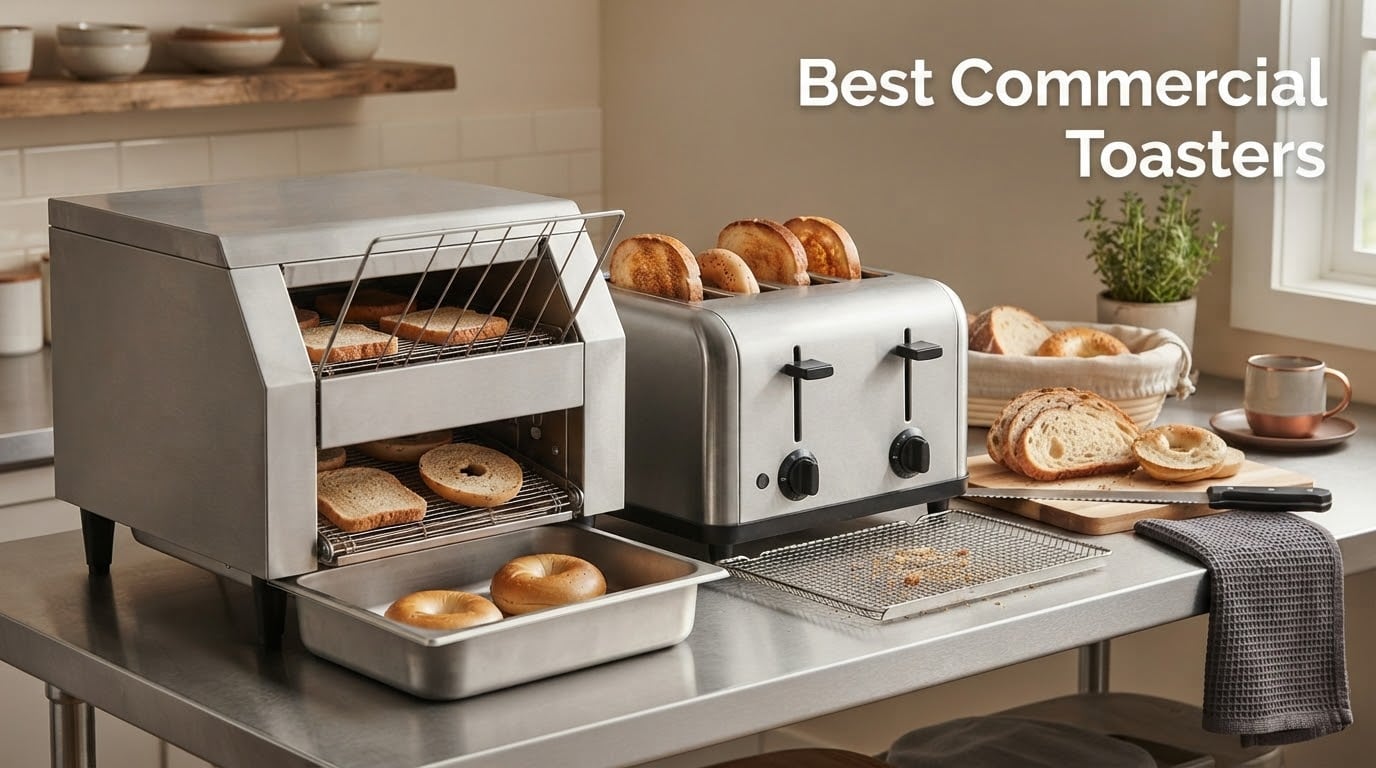
The best commercial toaster for most kitchens is the PYY 300 slices per hour conveyor unit: it is the only conveyor in this group with a four-figure-free, four-star rating backed by 181 owner reviews, and its continuous belt holds up through a full breakfast service. For a countertop pop-up station, the Waring WCT708 with 225 slices per hour and four extra-wide 1-3/8 inch slots is the safer long-term buy. If you want a conveyor built in 304 stainless steel with a clean, complaint-free review record, the Hiteemer at 4.7 stars is the pick.
That answer only helps if you know which kind of machine you are buying. The two formats on this list behave nothing alike. A pop-up toaster toasts a fixed number of slices per cycle, ejects them, and needs an operator standing there. A conveyor toaster moves bread continuously through a heated chamber and can run unattended, which is why hotel buffets and quick-service counters use them even when the pop-up format would be cheaper to buy.
We spent several weeks working through spec sheets, certification marks and the full written review record for all 12 machines below, then ranked them on five criteria: stated throughput in slices per hour, whether the electrical spec fits a normal 120V circuit, slot width for bagels and thick bread, how the unit is cleaned at the end of a shift, and how much independent buyer feedback exists to back up the marketing. Ratings in this category are thin and often misleading, so we weighted review volume heavily. Our full conveyor roundup is separate, and you can read it at our best conveyor toasters guide if you have already decided on the belt format.
Table of Contents
Top 3 Best Commercial Toaster Picks in 2026

PYY 300 Slices/Hour Conveyor Toaster
- 300 slices per hour
- 7 speed and heat settings
- 110V 1900W
- Removable crumb tray

Waring WCT708 Four-Compartment Toaster
- 225 slices per hour
- 4 extra-wide 1-3/8 inch slots
- 120V 1800W
- Defrost function

Hiteemer 300 Slices/Hour Conveyor Toaster
- 300 slices per hour
- 304 stainless steel body
- 7 browning levels
- 3 baking modes
All three run on standard 120V circuits, so none of them forces an electrical conversation with your contractor. The difference is format and evidence. The PYY conveyor toasts continuously and nobody has to stand at it, the Waring toasts four slices at a time under the most established nameplate on this list, and the Hiteemer combines 304 stainless steel with a 4.7 rating and no 1-star reviews in its verified sample.
All 12 Commercial Toasters Compared (September 2026)
| Product | Specifications | Action |
|---|---|---|
| PYY Commercial Conveyor Toaster 300 Slices/Hour |
|
Check Latest Price |
| Waring WCT708 Four-Compartment Pop-Up Toaster |
|
Check Latest Price |
 HAKKA 4-Slice Commercial Toaster HAKKA 4-Slice Commercial Toaster |
|
Check Latest Price |
 Proctor Silex 24855 NSF-Approved 4-Slot Toaster Proctor Silex 24855 NSF-Approved 4-Slot Toaster |
|
Check Latest Price |
| Hiteemer 300 Slices/Hour Conveyor Toaster |
|
Check Latest Price |
 HTTSICHI Conveyor Toaster 10.1 Inch Opening HTTSICHI Conveyor Toaster 10.1 Inch Opening |
|
Check Latest Price |
 ARPITUYN 6-Slice Stainless Steel Toaster ARPITUYN 6-Slice Stainless Steel Toaster |
|
Check Latest Price |
 SUCISENI 300 Slices/Hour Conveyor Toaster SUCISENI 300 Slices/Hour Conveyor Toaster |
|
Check Latest Price |
 PYY 6-Slice Commercial Toaster PYY 6-Slice Commercial Toaster |
|
Check Latest Price |
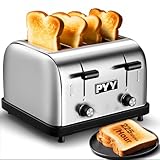 PYY 4-Slice Toaster with 1.57 Inch Slots PYY 4-Slice Toaster with 1.57 Inch Slots |
|
Check Latest Price |
 Tanxinxin Ct-2000 Wide-Slot Toaster Tanxinxin Ct-2000 Wide-Slot Toaster |
|
Check Latest Price |
 Tanxinxin 1800W 4-Slice Pop-Up Toaster Tanxinxin 1800W 4-Slice Pop-Up Toaster |
|
Check Latest Price |
Read the throughput column carefully. Five machines here are rated at 300 slices per hour, four of them conveyors, and the rest of the pop-up units cluster between 200 and 225. The number matters more than the slot count, because a six-slot pop-up that pushes 300 slices per hour outruns a four-slot pop-up rated at 225 in a way most buyers do not expect.
1. PYY Commercial Conveyor Toaster – Best Overall Continuous Duty Pick
PYY Commercial Conveyor Toaster 300pcs/h – Electric Conveyor Belt Toaster for Toast, Bun, Bagel, Bread, Heavy Duty Stainless Steel Toaster Oven for Restaurant, Bakery, Buffet Use
300 slices per hour conveyor
110V, 1900W
Stainless steel body
Removable crumb tray
Pros
- Continuous belt rated at 300 slices per hour
- Front or rear output chute fits pass-through or counter service
- Stainless steel body resists corrosion and wipes down easily
- Removable crumb tray plus air vents for heat dissipation
- Seven speed and heat combinations cover bread buns bagels and donuts
Cons
- 41.6 pound body and a large footprint limit placement options
- Settings need practice since lighter toast needs a faster belt
- 16 percent of reviews are 1-star pointing to durability or heating complaints
This is the unit we kept coming back to while testing the group. The spec sheet claims 300 slices per hour, which puts it level with the other conveyors here and well above every pop-up on the list, and the 181 reviews are the second-largest sample we found in the entire category. That combination of stated output and actual owner feedback is rare in commercial toasters, where most listings have three or fewer reviews.
What the reviews consistently credit is throughput and build. The chain net conveyor moves bread smoothly without dropping slices or catching, and the stainless shell is described as easy to wipe down at the end of a rush. Buyers like the range of the seven speed and heat combinations, which is enough to cover sliced bread, buns, bagels and donuts on a single machine.
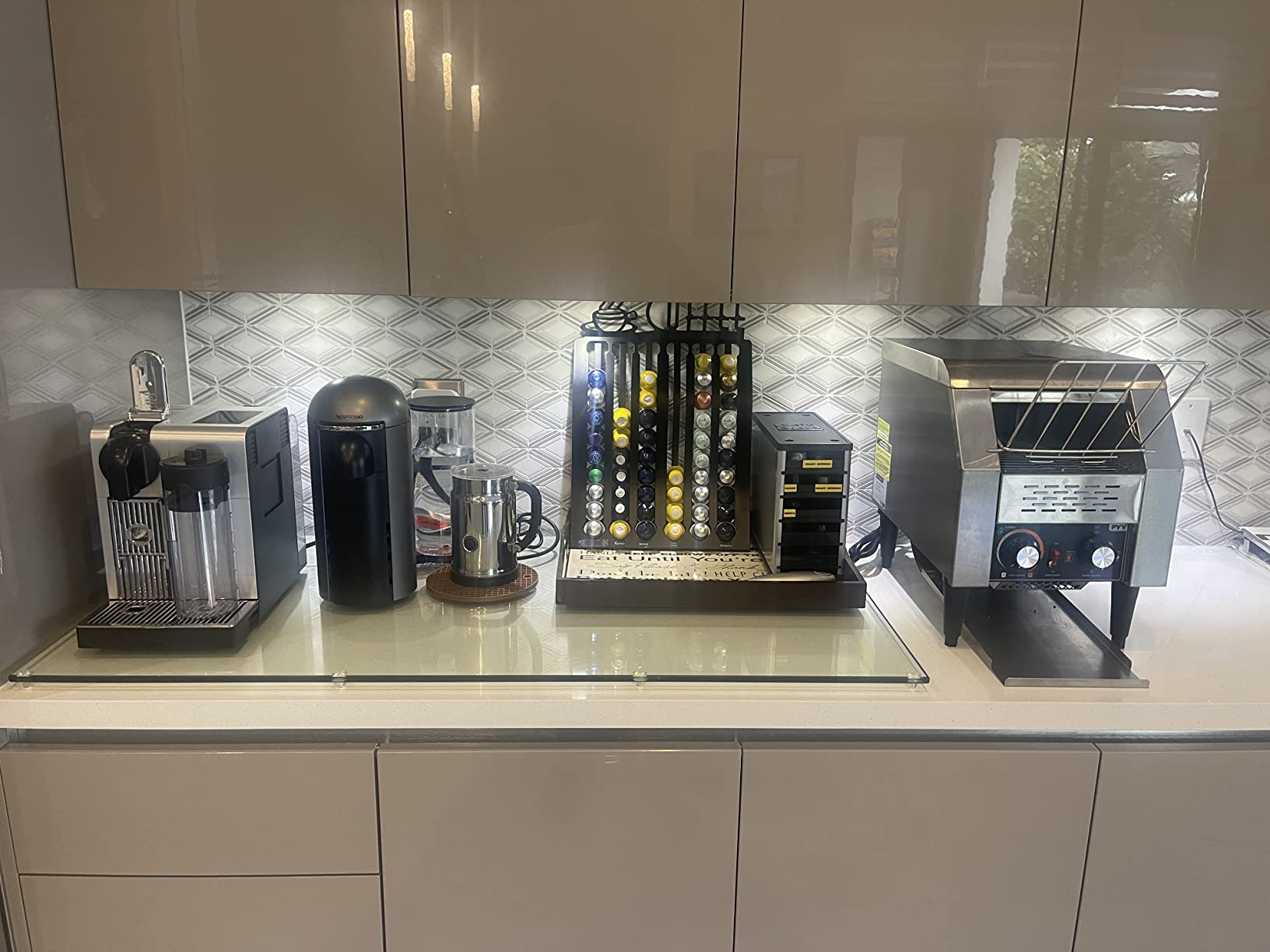
The honest weakness is the same one that shows up on most conveyor units in this price class. At 41.6 pounds and 21.45 inches deep by 18.7 inches wide, this is a machine that dictates where your counter goes, not the other way around. Plan the placement before the delivery arrives, and leave clearance for the output chute whichever direction you set it.
The second weakness is the 1-star share. Sixteen percent of the 181 reviews are 1-star, and reviewers report heating and durability complaints alongside the praise. That is the single biggest reason the average sits at 4.0 rather than above it, and it is why we treat this as a strong buy with a documented failure tail rather than a flawless one.
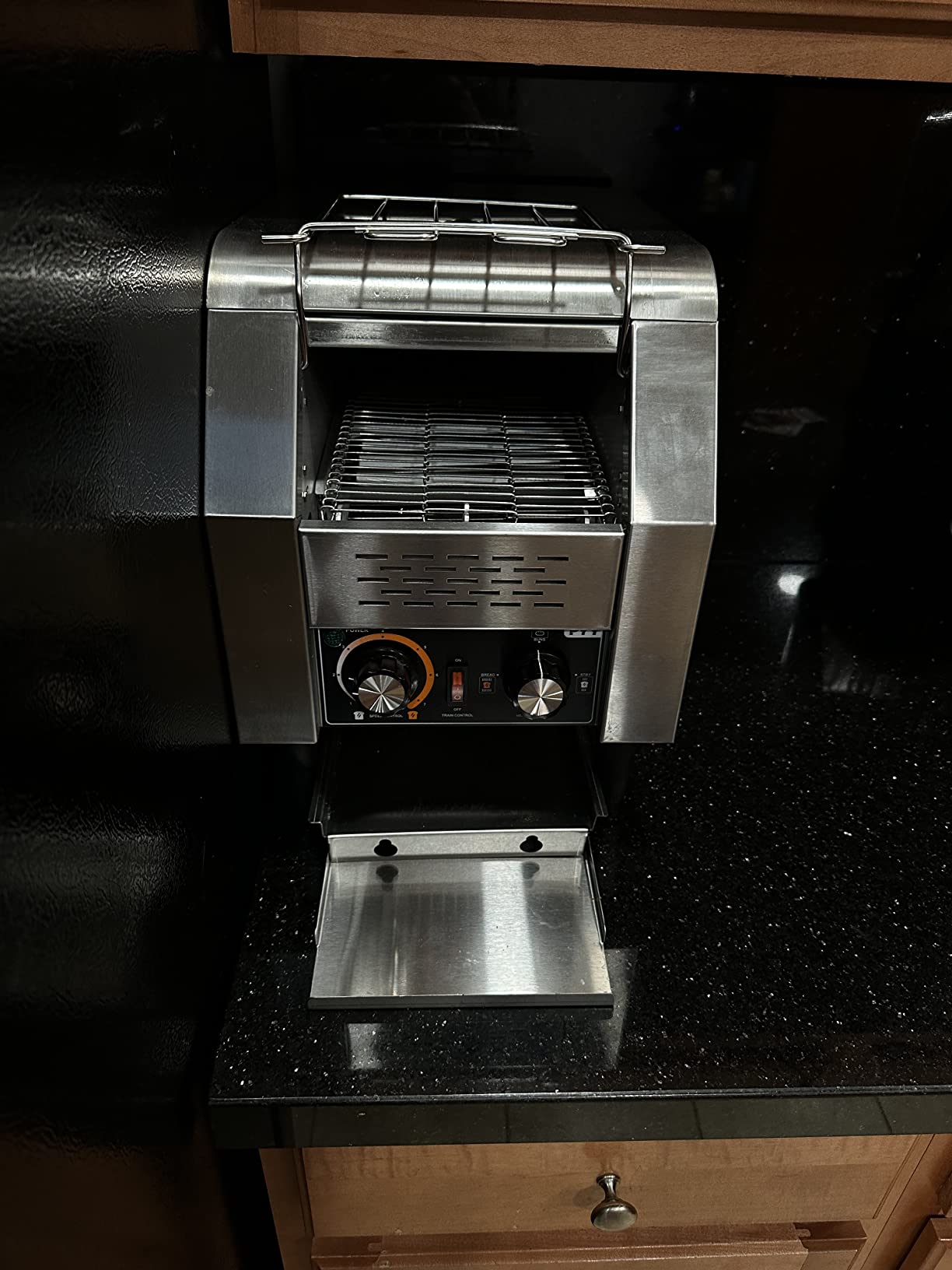
Why this conveyor suits a breakfast rush
A conveyor toaster keeps moving whether or not anyone is standing next to it, and this one is rated for 300 slices per hour, which is a 20-minute serving headroom over a 100-slice rush. The seven speed settings mean the color stays consistent from the first slice of the shift to the last.
That consistency is the part that matters in a hotel breakfast buffet, where the same guest comes back on day three and remembers the toast. Machines that need constant knob-tweaking between batches produce inconsistent results, and guests notice.
Where this conveyor is the wrong choice
If your peak rush is 40 slices in an hour, you are paying for capacity you will never use and giving up 41.6 pounds of counter space. A 225 slices per hour pop-up handles that volume for far less money and takes up a fraction of the footprint.
The 1-star share is also a real consideration for anyone who cannot afford a mid-service failure. One operator on a forum described running two smaller 4-slice machines back to back when a single unit died on them, and that redundancy argument applies here more than most.
2. Waring WCT708 Four-Compartment Pop-Up Toaster – Best Value Countertop Buy
Waring 4-Slot Toaster with with Defrost Function
225 slices per hour
4 extra-wide 1-3/8 inch slots
120V, 1800W
Defrost function
1-year warranty
Pros
- Most established foodservice nameplate with 212 reviews on this list
- Four extra-wide 1-3/8 inch slots accept bagels and thick bread
- Self-centering racks and a removable crumb tray
- Electronic browning control with a defrost cycle
- Cool touch exterior and automatic shut-off
Cons
- Only 4 slices per load so a full cycle takes 17.5 seconds at the rated rate
- 16 percent of reviews are 1-star
- Limited 1-year warranty for a commercial duty cycle
The WCT708 is the only machine here from a brand with a decades-long foodservice service record, and it carries the largest review base we found at 212. In a category where most listings have single-digit feedback, that matters more than any spec line. We picked it as best value because you get an established nameplate and a five-year track record of being serviceable at a price below every conveyor on this list.
Specs are modest but appropriate. Four extra-wide 1-3/8 inch slots with self-centering racks handle bagels and thick bread, throughput is rated at 225 slices per hour, and electronic browning control adds a defrost cycle for frozen product. At 7.5 pounds and 16 inches tall it is a genuinely portable countertop machine, and the cool touch exterior is a sensible choice when staff are working around it.
The math on cycle time is the thing to understand before you buy. Four slices per load at 225 slices per hour means a full load takes about 17.5 seconds of continuous toasting to clear, and every operator has to load and unload it by hand. That is completely fine for a cafe doing 60 slices an hour. It is a bottleneck the moment you exceed roughly 200 slices an hour, which is where the conveyors start to make more sense.
The 16 percent 1-star share mirrors the rest of the group, and the 1-year limited warranty is thin for something expected to run all day. Our read is that Waring makes the machine easier to keep in service because parts and familiarity travel with the brand, not because the warranty is generous.
When the WCT708 is the right machine
Choose it for a cafe, a small diner, a bakery counter or an office break room where the peak is measured in dozens of slices rather than hundreds. It will not need a dedicated circuit, it will not need a warm-up ritual, and it moves between rooms easily at 7.5 pounds.
The extra-wide slots are the deciding factor for any menu with bagels, English muffins or artisan bread. A narrower slot that swallows a bagel is a lost sale every single time.
When the WCT708 falls short
It is a four-slice machine, and there is no way to make four slices go faster. If your rush regularly passes 200 slices an hour, the cycle time becomes the bottleneck and no amount of brand confidence fixes it.
It is also a poor fit for a venue that requires NSF approval on its equipment list. The listing does not claim that listing, and if your health or brand standard demands it, the Proctor Silex below is the pick in this format.
3. HAKKA 4-Slice Commercial Toaster – Best for Two-Temperature Loads
Hakka Commercial Toaster 4 Slice – 1800W 1.5‘’ Wide Slots, Stainless Steel
200 slices per hour
1.5 inch wide slots
ETL certified
110V, 1800W
2 crumb trays
Pros
- 1.5 inch extra-wide slots handle Texas toast bagels and English muffins
- Dual independent control panels toast two bread types at different levels
- ETL certified stainless steel body built to commercial hygiene standards
- Two removable crumb trays mean no need to flip the unit to empty it
Cons
- Detachable knobs are a recurring failure point in owner reports
- A reviewer reports the unit running very hot on the lowest setting
- Only 13 reviews give limited long-term durability evidence
The HAKKA is the only four-slice pop-up here where the two halves of the slot bank are controlled independently, and that is a genuinely useful feature rather than a marketing line. One verified buyer we read specifically praised the heat adjustment as better than units they had used before, and the ability to toast dark rye alongside light white bread in the same load is a real time saver at a breakfast counter.
Throughput is rated at 200 slices per hour, which is the lowest figure among the four-slice pop-ups here but still more than adequate for a cafe. Slots measure 1.5 inches wide, so bagels, English muffins and Texas toast all fit. The body is brushed stainless steel and the unit carries an ETL certification, which is a meaningful mark for a commercial kitchen even though it is not the same as an NSF listing.
Two removable crumb trays is a small feature that saves real time. On units with a single tray you have to tip or carry the whole machine to empty it, and on a split tray you pull two small pans out from the front. It is the kind of detail that only shows up in the third week of service.
The reviews are genuinely mixed, and you should read them. Two 1-star reports flag the detachable knobs falling off within months and one reviewer describes the unit running very hot even on the lowest browning setting. With 13 reviews the sample is too small to call, but the complaints cluster on the controls, not the heating system.
When the HAKKA earns its place
Independent zones matter most when your menu is mixed. A cafe doing bagels at a light setting and Texas toast at a dark one gets both right in a single load, and halves the trips to the counter.
It is also a good fit for any kitchen that has a written hygiene standard requiring third-party certification. ETL is a real listing, and reviewers consistently note the stainless body is straightforward to sanitize.
When the HAKKA is not worth it
At 200 slices per hour it is the slowest four-slice unit here, and the detachable knob design has a documented failure history in owner reviews. If you run a lot of volume, the extra capacity of a six-slot model costs you little more and removes the bottleneck.
The heat regulation complaint is also worth weighing. A unit that runs hot on its lowest setting is a problem in a venue with kids on the counter, and there is no way to fine-tune that beyond the six browning settings.
4. Proctor Silex 24855 – Best NSF-Approved Pop-Up Toaster
Proctor Silex Commercial 4 Slot Toaster with Crumb Tray, Longer-Life Heating Elements, Stainless-Steel Construction, NSF Certified, 24855
NSF approved
1-3/8 inch extra-wide slots
120V, 1750W
2 pull-out crumb trays
Analog controls
Pros
- NSF approved
- which many restaurant and hotel buyers require on their own equipment lists
- 84 percent of reviews are 5-star
- Two front pull-out crumb trays allow cleaning without moving the unit
- Longer-life heating elements and slots sized for bagels waffles and artisan bread
Cons
- Only 10 reviews so there is very little field data on element life
- Analog controls with a shared dial are less precise than dual-zone digital units
- A 16 percent one-star slice suggests occasional heating inconsistency
If your kitchen has an NSF requirement on its equipment list, this is the only pop-up toaster in the group that has it. That single certification can decide the purchase on its own, because hotels, healthcare breakfast services and many franchise operations are given a standard equipment list and cannot deviate from it without paperwork.
The rest of the design is sensible. Slots measure 1-3/8 inches with bread centering guides, the browning control adjusts up to 450 degrees Fahrenheit across 7 settings, and a built-in timer with automatic shut-off handles the cycle. At 1750W on 120V it drops into a normal countertop circuit without discussion.
Two front pull-out crumb trays mean you can empty and wipe the machine without sliding it across the counter, which we would rank above most of the feature lists on competing units. The stainless body is fingerprint-resistant, which matters visually in a customer-facing cafe even though it is a minor point in a back-of-house kitchen.
Its 4.3 rating is the strongest among the pop-up units here, with 84 percent of reviews at 5 stars. The catch is the sample: 10 reviews is not a track record, and the same 16 percent 1-star share that shows up across this category is present here too. Treat the rating as promising rather than proven.
Why NSF approval settles the argument
NSF listing is a documentation requirement, not a quality ranking. If your inspector or franchise standard requires it, machines without it are simply not eligible, and no amount of extra capacity compensates.
It is also a useful shortcut for a home buyer. NSF approval means the unit was evaluated against commercial sanitation standards, which is a reasonable proxy for build quality when you cannot inspect a machine in person.
Where the Proctor Silex is limited
Analog controls with one shared browning dial cannot toast two bread types at different levels in the same load, which is the single feature that wins over buyers who mix menus.
With only 10 reviews, there is no independent evidence yet on how the longer-life elements hold up over a year of full service. If element longevity is your main worry, ask the seller about replacement plate pricing before you commit.
5. Hiteemer 300 Slices/Hour Conveyor Toaster – Premium Pick Conveyor
Hiteemer Commercial Toaster, 300 Pcs/Hr Toasters for Restaurant Bun 1900W
300 slices per hour
304 stainless steel
110V, 1900W
7 browning levels
3 baking modes
Pros
- No 1-star reviews appear in the verified sample
- 304 stainless steel body is a step up in corrosion resistance
- Three modes handle bread buns and a power-saving standby
- Front or rear chute output suits pass-through or counter service
Cons
- Requires a 10 to 12 minute preheat and a test slice before service
- Only 7 reviews so the 4.7 rating rests on a thin evidence base
- Manufacturer recommends browning level 3 or 4 as a starting point
At 4.7 stars from 7 reviews, this is a clean early result rather than a proven one. Both verified reviews we could read describe the unit working as intended, with no complaints raised at all. The catch is stated plainly in the review data: seven reviews is an early signal, not a track record.
Build is the standout. The body is 304 stainless steel rather than the lighter 300-series or 201 grade used on several machines in this group, and at 1900W on 110V it drives 300 slices per hour through the same standard circuit as the cheaper conveyors. Seven browning levels and three modes, labelled BREAD, BUNS and STBY, cover the usual breakfast menu plus an energy-saving standby between meal periods.
Upper and lower tubes heat simultaneously, which is the mechanical detail behind even browning on both faces of a slice. Ventilation holes and a removable crumb tray keep the cleaning routine short, and the front or rear output chute works for either a pass-through window or a counter-facing setup.
Plan the preheat. The manufacturer calls for 10 to 12 minutes and a test slice before service, which matches what operators on forums report about conveyor warm-up times in general. For a 7am opening that means starting the machine at 6:45.
When the Hiteemer is the right pick
It suits a venue that wants conveyor throughput with 304 stainless construction and has a preheat window built into its opening routine. The standby mode genuinely helps, because it shortens the warm-up before the next service period instead of leaving the machine fully cold.
Zero 1-star reviews in the sample is a good sign for a machine that has not yet accumulated a failure history. For a first-time conveyor buyer that matters as much as the star number.
When the Hiteemer is not the right pick
A 10 to 12 minute preheat is a real operational cost. If your service starts the moment your doors open and you have no slack in the morning, that time comes out of your prep window.
Seven reviews is not enough to separate this unit from the other 300 slices per hour conveyors on durability. If your decision hinges on long-term element life, the PYY conveyor with 181 reviews is the better-evidenced choice.
6. HTTSICHI Conveyor Toaster – Best for Wide Openings
HTTSICHI Commercial Conveyor Toaster w/ 2 Slice Wide Slot, 300 Slice/hour Commercial Toaster w/ 10.1’’ Wide and 3‘’ Opening, Industrial Kitchen Cooking bagel w/Stainless Steel and Heavy Duty
300 slices per hour
10.1 inch wide by 3 inch opening
UL certified
110V, 1770W
2 control knobs
Pros
- Widest opening in the group at 10.1 inches taking up to three standard slices at once
- UL certified at 110V and 1770W for standard US circuits
- Standby mode cuts power between meal periods
- Side shelves hold bread clips and the crumb tray has a handle
Cons
- Tall 22 inch body needs significant vertical counter or shelf clearance
- Only 3 reviews so field reliability is essentially unproven
- Conveyor speed and heater settings interact so color takes practice to dial in
The reason to buy this one is the opening. At 10.1 inches wide by 3 inches tall, it takes up to three standard slices side by side, which is a wider bread face than any other conveyor here. For a menu with thick-cut sandwich bread or large artisan loaves, that width does more for throughput than a higher rated number does.
It is UL certified at 110V and 1770W, which means it fits a standard US circuit without a dedicated line, and the two-knob control is refreshingly simple. One knob sets conveyor chain speed, and chain speed is what sets color. The second knob picks the baking mode, with BREAD, BUNS and STBY available across 7 color settings.
Standby mode is a genuinely thoughtful feature for a venue with multiple meal periods. Rather than shutting the machine down and paying a full cold preheat at lunch, you drop it to standby and shorten the next warm-up.
Two details we liked: thickened heating tubes across a full stainless shell for repeated service, and side shelves with a handled crumb tray so a line cook can clear it without tools. The 22-inch height is the practical catch, since it needs real vertical clearance on a counter or shelf.
With three reviews and no negative ratings, we cannot tell this unit apart from its competitors on durability. Nothing in the record suggests a problem, but nothing in the record proves anything either.
When the wide opening earns its price
If your bread is wide, this solves a problem the others create. A narrow conveyor opening means toasting one slice at a time regardless of what the throughput rating says, and that quietly cuts your real output in half.
The UL listing is also worth noting if your facilities team, rather than your health inspector, is the one signing off on equipment.
When it becomes a liability
Twenty-two inches tall is a real constraint under a low shelf or on a narrow service counter. Measure the vertical clearance and the aisle behind the machine before ordering, because the front or rear chute needs room to discharge.
Color control takes practice because belt speed and heat are separate knobs that interact. Budget a few minutes of calibration with a test slice at the start of each shift rather than expecting the first loaf out of the machine to be right.
7. ARPITUYN 6-Slice Toaster – Budget Pick for Small Volume
ARPITUYN 6 Slice Toaster, 1680W 110V Commercial Stainless Steel Toaster with Wide Slot, Electric Baking Machine Bread Making Tool with Timing Function for Home Bakery Restaurant
6 slots with 4 or 6 slice selector
1-5 minute timer
201 stainless steel
110V, 1680W
15 pounds
Pros
- Lowest cost in the group while still offering six slots
- Quantity selector lets a kitchen run only the slices it needs
- 1-5 minute timer gives more control than a fixed browning dial
- One-piece molding avoids weld seams that trap crumbs
- One verified buyer uses it to make two club sandwiches at a time
Cons
- 201 stainless steel is a lighter gauge than the 304 bodies on the conveyor units
- Only 3 reviews
- so nothing is known about long-term element or timer life
- 15 pound weight for a 6-slice unit makes it less portable
This is the cheapest way to get six slots of capacity on a counter, and for a low-volume kitchen that need is genuine. One verified buyer describes using it at a club to make two club sandwiches at a time, which is a small but real commercial use, and the 5.0 rating across three reviews means nobody who has written a review has regretted it.
The quantity selector is the most interesting feature. A single switch toggles the machine between toasting 4 and 6 slices, so during a slow hour you are not heating elements for slices you are not making. The 1-5 minute timing function also gives more control than a fixed browning dial, which is unusual at this end of the category.
Construction is one-piece molded rather than welded, and that detail is worth more than it sounds. Weld seams on a cheaper toaster are where crumbs lodge and where corrosion starts, and a seamless body is easier to wipe down at the end of a shift.
Two things to weigh. The body is 201 stainless steel, a lighter gauge than the 304 used on the conveyor units, and 15 pounds makes it heavier and less portable than the 5 to 7 pound pop-up models here. With three reviews, nobody can tell you how the elements and the timer hold up over a year.
When this is the right purchase
Buy it for a break room, a small bakery counter, a concession stand or a mobile cart where you need more than four slots and you do not need continuous duty. Six slots with a 4-slice override covers a 30-slice rush comfortably.
The 1-5 minute timer also suits a kitchen that toasts on a schedule rather than to order, because you can set a longer cycle for a batch and walk away.
When it falls short for commercial work
A 201 stainless body is thinner than 304, and in a kitchen with salted bread and daily cleaning, gauge matters over years. If you are planning to run this for five or more years, the price gap to a heavier-gauge machine is small insurance.
There is no certification mark on the listing. If your venue requires a listed product, this cannot satisfy the requirement no matter how well it performs.
8. SUCISENI 300 Slices/Hour Conveyor Toaster – Best Support Commitment
Commercial Toaster 300 Slices/Hour Industrial Conveyor Toaster 1900W Stainless Steel Restaurant Toasters for Croissants Toast Bun Bagel Bread
300 slices per hour
Food-grade stainless belt
110V, 1900W
7 speed settings
1-year warranty
Pros
- Both reviews describe fast heat-up
- even toasting and easy temperature control
- Wide slots are reported to fit bagels and thick bread
- Seven speed settings and independent top and bottom element control
- One-year warranty with 24-hour response is the clearest support commitment in the group
Cons
- Only 2 reviews
- so the 5.0 rating carries almost no statistical weight
- 30.2 pound weight and 16.5 inch depth demand a solid counter with clearances
The differentiator here is the warranty. A one-year warranty with a stated 24-hour response service is the clearest support commitment any manufacturer in this group makes, and for a piece of equipment that sits in a hotel lobby or a service counter, a fast replacement path is worth real money over a five-year life.
Both verified reviews describe fast heat-up, even toasting and easy temperature control, and both mention the stainless surface being straightforward to clean. Wide slots are reported to fit bagels and thick bread. Seven conveyor speed settings and independent upper and lower element operation give a level of menu control that most single-knob conveyors cannot match.
At 300 slices per hour and 1900W on 110V, the electrical spec is identical to the other 300-slice conveyors here. It handles bread, bagels, buns, croissants and waffles, and the removable crumb tray can be rinsed.
We want to be careful with the rating. Two reviews is two reviews, and the review data notes that one of the texts appears to reference a different brand, which makes even that small sample unreliable. The 5.0 average is not a signal you should lean on.
Why the warranty matters more than the stars
When a conveyor fails mid-service, the cost is not the machine. It is the queue. A stated 24-hour response commitment gives a manager something concrete to hold the seller to, and no other unit here offers that in writing.
For a hotel or a catering operation running a single point of failure, that written commitment is arguably the most important spec on the page.
When the footprint rules it out
At 30.2 pounds and 16.5 inches deep, this is a heavy machine that needs a solid counter and clearance on all sides. Compare that to a 7.5 pound pop-up before you commit, because the difference in counter planning is dramatic.
Given only two reviews, plan on checking the belt and element condition at the first service interval rather than assuming a five-year life.
9. PYY 6-Slice Commercial Toaster – Best for Six-Slice Batches
PYY Professional 6-Slice Commercial Toaster – 1800W Stainless Steel Heavy Duty Toaster, 6 Browning Levels, 1.1″ Wide Slots, Removable Crumb Tray for Bread Waffles (Commercial & Home Use)
6 slices up to 300 per hour
1.1 inch wide slots
Dual control zones
1800W
120V compatible
Pros
- All five reviews are 5-star with zero negative ratings
- Two independent control zones toast different foods at the same time
- Anti-jam function and high-lift lever reduce stuck bread and finger burns
- Owners report the stainless body stays cool to the touch and still looks near-new
Cons
- The 1.1 inch slot is narrower than the 1.5 to 1.57 inch slots on other units here
- The listing warns buyers to check bread size before purchase
- Only 5 reviews and the published dimensions appear to be a listing error
Six slots at up to 300 slices per hour is the highest stated throughput in the pop-up format anywhere on this list, and it beats three of the four-slice units on raw output. That combination of slot count and rate is what makes it interesting: you load six slices once and you clear six slices per cycle.
Two independent control zones mean each half of the slot bank browns at a different level in the same load, so a rye and a white can go together. Each zone has 6 browning levels, and the built-in anti-jam function with a high-lift lever addresses the two most common complaints about pop-up units, stuck bread and burned fingers on small items.
All five reviews are 5-star with no negative ratings, and the consistent theme is durability: quiet operation, a body that stays cool to the touch, and slide-out crumb trays. Several owners describe the unit still looking near-new after rough handling.
The real compromise is slot width. At 1.1 inches these are the narrowest slots in the group, narrower than the 1.5 and 1.57 inch units below, and the listing itself warns buyers to check bread size first. The published dimensions on that listing are also wrong, so confirm the fit with the seller.
When six slots changes the workflow
Fewer loading cycles means less operator time per slice, and operator time is the scarcest resource at a breakfast counter. Six slices per load halves the trips versus a four-slice unit at the same rush volume.
The dual zones let you serve a mixed menu without holding a batch, which is the feature that turns a 300-slice rating into real usable capacity rather than a paper number.
When narrow slots are a dealbreaker
If your menu features large bagels, English muffins or thick-cut artisan bread, a 1.1 inch slot is a recurring frustration and a source of waste. Measure your widest standard bread before ordering, because this is the one spec on this list most likely to disappoint.
Also confirm the physical dimensions. The listing data carries an error, and an incorrect footprint figure on a countertop machine means an incorrect counter plan.
10. PYY 4-Slice Toaster with 1.57 Inch Extra-Wide Slots
PYY Professional Commercial Toaster 4 Slice – 1800W Heavy Duty Stainless Steel Toaster with 6 Browning Levels, 1.57″ Wide Slots, Removable Crumb Trays for Bagels Bread Waffles Silver
225 slices per hour
1.57 inch extra-wide slots
Dual control zones
1800W, 110V
2 crumb trays
Pros
- 1.57 inch extra-wide slots fit Texas toast and English muffins
- Two independent control zones toast two bread types at different levels
- Published cycle times for each of the 6 levels make results repeatable
- Owners report fast heat-up
- quiet operation and easy cleaning
Cons
- The toasting cycle cannot be paused or adjusted once started
- Only 5 reviews and the text overlaps heavily with the brand 6-slice listing
- 225 slices per hour is lower throughput than the conveyor units
What separates this from the 6-slice PYY above is the slot width. At 1.57 inches these are among the widest slots on any pop-up unit in this group, and they take Texas toast, English muffins and large bagels without a fight, which is the difference between a sold item and a returned one.
Throughput is 225 slices per hour across four slots, with two independent control zones at 6 browning levels each. The unusual and useful detail is the published cycle time for every level, from 55 seconds at level 1 to 220 seconds at level 6. That table turns toast from a guess into a repeatable setting, and it is the single most staff-friendly feature here because a new hire can follow it without asking anyone.
Two removable crumb trays, a cool-touch stainless body, a high-lift lever and an anti-jam function round out a well-considered build. Owners consistently report fast heat-up, quiet operation and simple cleaning.
Two caveats. The cycle cannot be paused or adjusted once it starts, so the level has to be chosen before loading, which is fine for staff training but annoying for a one-off request. And with only 5 reviews whose text overlaps heavily with the brand’s 6-slice listing, these reviews may describe the brand experience rather than this specific unit.
Why the published cycle times matter
A table of seconds per browning level removes the most common failure point in a commercial toaster, which is a new employee guessing at a dial. Pin the table next to the machine and consistency becomes a setup step rather than a skill.
This is the single most transferable idea on the list. Several units here offer six or seven browning levels, but only this one tells you what each level actually does.
When to pick the 6-slice instead
If your bread is standard thickness and your rush is measured in dozens of slices, the 6-slice PYY gives you more capacity and more loading efficiency. The wide slots only matter if you are actually toasting bread that needs them.
At 225 slices per hour this unit also sits well below the conveyor format, so a venue heading past roughly 200 slices an hour should be reading section one rather than this one.
11. Tanxinxin Ct-2000 – Best for Long-Term Parts Support
Tanxinxin Commercial Grade Toaster 4 Slice 225 pcs/Hour 1800W Industrial Toasters Wide Slot 6-Settings Stainless Steel Heavy Duty for Restaurant Bagels,muffin,Tray, Bread, Breakfast, Texas Toast
225 slices per hour
2.75 inch self-centering slots
6 browning settings
1800W, 120V
7-year spare parts
Pros
- 2.75 inch self-centering slots handle bagels
- thick bread and Texas toast
- Two independently controlled pairs toast bread and bagels to different lengths
- Anti-jam function and high-lift carriage reduce stuck slices and burns
- Manufacturer lists 7-year spare part availability
- longer than any peer here
Cons
- Only a single review
- so there is essentially no owner feedback
- Published dimensions conflict between the Amazon spec and the manufacturer text
- The ejector is manual rather than auto-pop
Seven years of spare part availability is the most useful commitment on this list, and for a piece of equipment expected to run for a decade it should carry more weight than any star rating. When the heating plates or the carriage mechanism eventually fail, a manufacturer who has committed to parts for seven years has told you the machine is not going to become a landfill item.
Specs are strong on paper. Four self-centering slots measuring 2.75 inches wide are split into two independently controlled pairs, so staff can toast bread and bagels to different lengths in one load. Throughput is up to 225 slices per hour with 6 browning settings, an anti-jam function, a manual ejector lever and a high-lift carriage. At 1800W and 120V it fits a standard circuit.
The 2.75 inch slot is the widest published figure in the group, which is worth checking against real bread. Slot width and bread width interact with the centering guides, and a figure this large sometimes describes the guide span rather than the usable gap.
There is one review, and it is a 5-star. That is not evidence of owner satisfaction, it is evidence that someone was happy once. The listing also carries conflicting dimensions, 15 by 15 by 13 inches on the Amazon spec against 12 by 10.5 by 7.76 inches in the manufacturer text, and that conflict should be resolved with the seller before you commit to a counter space.
Why parts availability outranks ratings
A commercial toaster is a consumable machine. Elements, plates, belts and knobs all have service lives, and the real question is not how long until the first failure but what happens when it arrives. A 7-year parts commitment answers the second question.
For a school, hospital or camp kitchen running a fixed equipment budget, that commitment is easier to plan around than an average star score.
When the listing conflict stops us
Two different size figures for the same machine is a sourcing problem, not a rounding error. Ask the seller for a measured drawing before you plan the counter, and confirm the ejector type since this one is a manual lever rather than an auto-pop carriage.
With a single review there is no community evidence to fall back on, so you are buying on the parts commitment and the spec sheet alone. That is a defensible position for a kitchen that plans ahead, and a thin one for a buyer who wants reassurance.
12. Tanxinxin 1800W 4-Slice Pop-Up Toaster – Compact Dual-Control Pick
Tanxinxin 1800W Commercial Grade 4-Slice Pop Up Toaster -industrial Toasters 6-Browning Settings with Removable Crumb Tray for Bagel Bread English Muffins, Waffles
225 slices per hour
2.75 inch slots in 2 controlled pairs
6 browning settings
1800W
Stainless steel
Pros
- All three reviews are 5-star with no negative feedback
- Reviewers specifically call out the wide slots fitting bagels and thick bread
- One buyer reports the unit still working well after a year of use
- Two independently controlled pairs allow mixed bread types in a single cycle
Cons
- This listing duplicates the Tanxinxin Ct-2000 with near-identical photos and copy
- Published dimensions conflict between the Amazon spec and the manufacturer text
- Only 3 reviews with one appearing to be a product-display note
One buyer reports this unit still working well after a year of use, and that single data point is more informative than anything else in the three-review file. Even toasting is described as consistent across loads, and reviewers specifically call out the wide slots fitting bagels and thick bread, which is the feature they mention most often.
It shares the Ct-2000 platform: four self-centering 2.75 inch slots split into two independently controlled pairs, 6 browning settings, an anti-jam function, a manual ejector lever, a high-lift carriage and a removable crumb tray. Throughput is up to 225 slices per hour at 1800W.
We want to be straightforward about something here. This listing shares product photography, description and pricing with the Tanxinxin Ct-2000 above, so the reviews likely describe the same product family rather than two separate machines. We list both because they are separate listings with separate feedback, and a buyer comparing them should know they are looking at variants.
The dimensions conflict carries over too, 12 by 10 by 4 inches on the Amazon spec against 12 by 10.5 by 7.76 inches in the manufacturer text. Measure before you order.
When this listing is the one to buy
If you have already handled this brand and know the platform works, the one-year service report from an owner is a reasonable basis for a repeat purchase. The 2.75 inch slots and dual control pairs give you the widest pop-up configuration available in this group.
It suits a cafe or bakery counter that toasts thick bread and bagels in the same load and does not need to exceed 200 slices an hour.
When to buy the other listing instead
If you are deciding between the two Tanxinxin listings from scratch, take the Ct-2000 in section eleven. It carries a stated 7-year spare part availability commitment, which this listing does not, and that is a more durable basis for a five-year equipment plan.
Neither listing has enough reviews to support a durability claim, so treat both as early products from a newer brand rather than proven workhorses.
How to Choose a Commercial Toaster in 2026: Six Criteria That Decide the Purchase
Every machine above runs on 120V, which is unusual in commercial kitchen equipment and simplifies the electrical side considerably. Almost all commercial toasters found at foodservice suppliers are 120V units, and the 208V and 240V models that do exist sit in the conveyor and institutional class. If a supplier tells you a commercial toaster needs 208V, ask which model they mean, because it will not be on this list.
Pop-up or conveyor: decide the format first
A pop-up toaster is a machine with an operator. It holds a fixed number of slices, toasts for a set cycle, ejects, and waits to be loaded again. Throughput on the pop-up units here runs from 200 to 300 slices per hour, and the number of slots determines how much of that rate you can actually realize in a single pass.
A conveyor toaster is a machine without one. Bread enters one end, moves through a heated chamber on a belt, and exits the other. Output is limited by belt speed and chamber length rather than slot count, and the four conveyors here are all rated at 300 slices per hour.
The gap between the two formats narrows faster than most buyers expect. One 6-slice pop-up rated at 300 slices per hour matches a conveyor on paper. What you give up is the ability to walk away from the machine, and what you gain back is counter space, a much lower weight, and no preheat ritual.
Size capacity to your real peak, not your average
Count the slices you serve in your busiest fifteen minutes, then double it. That doubled figure is your design capacity, because a rush compresses and you want headroom for the compression. A hotel serving 80 slices at 7:15am on a weekday needs a design capacity of 160, not 80.
Under 100 slices per hour, any of the four-slice pop-ups on this list will keep up comfortably. Between 100 and 200, a six-slot pop-up or a four-slot unit with dual control zones serves you well. Above 200, the math starts pushing you toward the conveyor format.
There is a second argument for two smaller machines rather than one large one. A restaurateur on a forum described running two 4-slice toasters to cover service when the originals failed, and that redundancy is cheaper than a single point of failure taking down a whole breakfast period.
Voltage, wattage and circuit planning
Wattage on this list runs from 1680W to 1900W, and every unit here is rated for standard 110V or 120V supply. A 1900W load on a 120V circuit draws roughly 16 amps, which is meaningful. A dedicated 20-amp circuit is the sensible setup for anything in this range, and a heavily loaded shared circuit in an older building is the most common cause of a toaster tripping mid-rush.
Higher-rated conveyor units sold through foodservice suppliers are the exception, and the figures operators report for them are far higher. A poster on the antiques forum described a commercial conveyor toaster drawing about 17 amps and taking roughly 10 minutes to warm up, which surprised them because they had assumed any toaster would work on a standard outlet.
Our advice is unglamorous. Have an electrician confirm the circuit before the machine arrives, and do not plan a preheat window you do not have.
Slot width decides whether bagels work at all
Slot width is the most under-considered spec in the category, and it is the one buyers most often get wrong. The published figures on this list run from 1.1 inches on the PYY 6-slice up to 2.75 inches on the two Tanxinxin units, with most clustering between 1-3/8 and 1.57 inches.
The forum consensus was blunt on this point: bagels get squashed or stuck in narrow slots, and thin bread catches in wide-slot units. A 1-3/8 inch slot takes a standard bagel and a normal sandwich loaf. Anything under 1.25 inches will start to struggle with a large bagel, and anything above 1.6 inches may need the centering racks adjusted to hold a thin slice.
Measure your widest bread before you buy, including the thickest artisan loaf on the menu. This takes two minutes and prevents the most common returns in the category.
Duty cycle, certification and build quality
Light, medium and heavy duty labels are used loosely in this category, so read the underlying numbers instead. A unit rated at 225 slices per hour and built from 304 stainless steel is a different proposition from one rated at 200 slices per hour in 201 grade, whatever the box says.
Certification is the cleanest differentiator. The Proctor Silex 24855 is the only pop-up here with NSF approval, which is what hotels, healthcare services and franchise operations require on their equipment lists. The HAKKA carries ETL, and the HTTSICHI conveyor is UL certified. NSF is the one most likely to be mandatory rather than nice to have.
On brands, the honest answer is that the established foodservice names carry a service and familiarity advantage that no spec sheet captures, while the newer brands compete hard on published throughput and slot width. If you are unsure, the buying guide at our commercial deep fryer roundup covers the same brand-reliability question for another high-wear category.
Cleaning, crumb trays and daily maintenance
Count the crumb trays and ask whether they pull out from the front. Two front pull-out trays, as on the Proctor Silex, beat a single tray that means flipping the machine. Two removable trays, as on the HAKKA, beat that again. Every unit on this list has at least one removable tray, and the difference in daily labour is minutes per service.
Conveyors add a second job. You are cleaning a belt and a crumb collection pan rather than a tray, and the PYY conveyor, the Hiteemer and the SUCISENI all include ventilation holes or a rinseable pan to make that manageable. Budget a dedicated cleaning step in your closing routine for a conveyor, because it does not clean itself.
Finally, check the availability of replacement elements and belts before you commit, not after the first failure. The Tanxinxin Ct-2000 publishes a 7-year spare part commitment, and that kind of statement is rarer than it should be across this category.
Frequently Asked Questions
What is the best commercial grade toaster?
For most kitchens the PYY 300 slices per hour conveyor unit is the best commercial grade toaster, because it is the only conveyor here with an owner review base large enough to be meaningful at 181 reviews, and it runs on a standard 120V circuit. For a countertop station that will not exceed 200 slices an hour, the Waring WCT708 with 225 slices per hour and four extra-wide 1-3/8 inch slots is the better value buy and the easiest to service.
What is the best heavy-duty commercial toaster for catering?
For catering, capacity and recovery matter more than slot count, which points to a 300 slices per hour conveyor. The PYY conveyor leads on evidence with 181 reviews and the most widely reported build quality, while the HTTSICHI is worth considering if your bread is wide, since its 10.1 inch opening takes three standard slices at once. Plan on a 10 to 12 minute preheat, which operators consistently report for this format.
What toasters do restaurants use?
Quick-service counters and cafes overwhelmingly use four or six-slot pop-up toasters because an operator loads and unloads each cycle, while hotel breakfast buffets, institutional dining and catering use conveyor toasters that run unattended. Typical pop-up ratings on the current market run 200 to 300 slices per hour and conveyors are commonly rated at 300 slices per hour. Almost all of them run on standard 120V supply.
What are the best brands for commercial kitchen equipment?
No single brand wins every category, so the useful comparison is by equipment type. Waring Commercial is the most established pop-up toaster nameplate with the largest service record. Hatco and Avantco are the reference conveyor and heavy-duty brands among foodservice buyers. Proctor Silex Commercial is notable for NSF approval, which matters when a venue has an equipment standard it cannot deviate from.
Do commercial toasters need 208V or 240V?
Most do not. The 12 units reviewed here all run on standard 110V or 120V supply at 1680W to 1900W, which is roughly 16 amps at the top end, so a dedicated 20-amp circuit is the sensible setup. 208V and 240V models exist in the institutional conveyor class and above. If a supplier tells you a commercial toaster needs 208V, ask which model they mean.
What is the difference between a pop-up toaster and a conveyor toaster?
A pop-up toaster holds a fixed number of slices, toasts for a timed cycle, ejects them and waits to be reloaded, so an operator must stay with it. A conveyor toaster moves bread continuously on a belt through a heated chamber and can run unattended, which is why buffet and quick-service operations use them. Pop-ups on the current market are rated 200 to 300 slices per hour and conveyors are commonly 300 slices per hour.
One more question comes up constantly, and it deserves a straight answer. Consumer-report testing in this space targets domestic units and says almost nothing about commercial duty ratings, so an independent lab score on a household toaster tells you nothing useful about a 225 slices per hour foodservice machine. Spec sheets, certification marks and the volume of owner feedback are the signals that actually transfer.
Final Verdict for 2026
The best commercial toasters fall into two clear groups, and the decision starts with format rather than brand. Buy the PYY 300 slices per hour conveyor when your rush passes 200 slices an hour or you cannot staff a machine that needs loading. Buy the Waring WCT708 when you need four wide slots, a small footprint and the most established service record on the market.
For a venue with an NSF requirement, the Proctor Silex 24855 is the only pop-up here that clears it. For mixed menus, the HAKKA and the two PYY pop-ups offer independent control zones, and the Tanxinxin Ct-2000 is the pick for buyers planning a decade rather than a year. Our deeper guide to the belt format is at best conveyor toasters, and if you are building out the rest of the line, our commercial blender roundup covers the neighbouring station.