
Most disappointing commercial dishwasher purchases are not brand failures. They are sizing mistakes and electrical mistakes, made by operators who counted covers per hour instead of racks per hour and never checked what their panel could actually deliver. Get those two things right and the machine choice gets much easier.
That is how our team approached this roundup. We compared ten of the best commercial dishwashers available now, weighing rated throughput against real-world review history, sanitizing method, water draw, electrical demand, warranty length and physical footprint. We read the specs and the complaints, and we paid close attention to who is actually standing behind the machine when the booster element goes.
This guide covers the full range: undercounter units for cafes and food trucks, door-type hoods for mid-volume kitchens, a conveyor for institutional-scale dish rooms, and a dedicated glasswasher for bars. Updated for 2026, it also explains how to size a machine, what high-temp versus low-temp sanitizing really means, and which brands have a service network worth relying on.
Table of Contents
Top 3 Picks for Best Commercial Dishwashers in 2026

RIOXC H50-ST 40 RPH Undercounter
- 40 racks per hour
- ETL and CSA certified
- 3-year all-parts warranty

RIOXC MAX-70DS 60 RPH Door-Type
- 60 racks per hour
- 194F sanitizing rinse
- Zoppas heating element

Hobart LXEH-2 32 RPH Undercounter
- 0.74 gallons per rack
- 32 racks per hour
- Built-in booster heater
Best Commercial Dishwashers at a Glance (September 2026)
| Product | Specifications | Action |
|---|---|---|
| RIOXC H50-ST 40 RPH Undercounter |
|
Check Latest Price |
| RIOXC MAX-70DS 60 RPH Door-Type |
|
Check Latest Price |
| Hobart LXEH-2 32 RPH Undercounter |
|
Check Latest Price |
 Lamber DSP3 Glasswasher Lamber DSP3 Glasswasher |
|
Check Latest Price |
 Elite Kitchen Supply H50-S1 30 RPH Elite Kitchen Supply H50-S1 30 RPH |
|
Check Latest Price |
 Jackson DishStar HT 24 RPH Jackson DishStar HT 24 RPH |
|
Check Latest Price |
 CMA EST-44H Conveyor CMA EST-44H Conveyor |
|
Check Latest Price |
 Cooler Depot H50-S1 NSF Certified Cooler Depot H50-S1 NSF Certified |
|
Check Latest Price |
 Omcan CD-GR-0500 Compact Omcan CD-GR-0500 Compact |
|
Check Latest Price |
 GRFIT Cover-Type Floor-Standing GRFIT Cover-Type Floor-Standing |
|
Check Latest Price |
The Four Types of Commercial Dishwashers
Every machine in this roundup falls into one of four families, and the type decides the price, the floor space and the electrical work far more than the brand does. Here is the short version.
Undercounter (pass-through or straight-through): Best for cafes, food trucks, bars and small kitchens; roughly 20 to 40 racks per hour; slides under a counter, needs a dedicated 208-240V circuit.
Door-type / hood-type (single rack): Best for full-service restaurants and fast-casual kitchens doing 100 to 250 covers; roughly 35 to 70 racks per hour; taller body, the hood lifts for loading, usually three-phase power.
Conveyor / flight-type: Best for hotels, hospitals, university dining and banquet halls; 150 racks per hour and well beyond; belt or flight carries racks continuously, needs floor space and utility lines.
Glasswasher: Best for bars, coffee shops and tasting rooms; 20 to 40 racks per hour of stemware; uses a small basket and short cycles to protect delicate glass.
If you are equipping a home kitchen rather than a licensed one, start with our portable dishwasher reviews instead. For any commercial operation washing more than roughly 50 covers at peak, a household machine is the wrong tool. Residential units are generally not permitted in commercial kitchens and their warranties do not survive commercial use.
High-Temp vs Low-Temp Sanitizing: Which Method Do You Need?
High-temp machines use heat as the sanitizer. They heat a recirculating wash tank and deliver a final rinse at 180F or above, which brings the dish surface to about 160F and kills bacteria in roughly ten seconds. No chemicals touch the ware, so glasses come out without a chemical taste or a film, and there is no dispenser to refill.
Low-temp machines run a cooler wash and rinse, then rely on a metered chemical such as chlorine or quats added during the final rinse to sanitize. They cost less to install because the electrical demand is lower, but you buy consumables forever and you have to watch the sight glass to confirm dosing.
Our rule of thumb after reading owner complaints: choose high-temp if you have the electrical service and you serve cocktails or wine, because chemical residue is a real complaint from bartenders. Choose low-temp if your panel cannot carry a 240V load and you want the cheapest path to a legally compliant dish pit.
1. RIOXC H50-ST: Best Undercounter High-Temp Pick for Backs of Houses and Food Trucks
RIOXC Commercial Dishwasher, High-Temp Undercounter Dishwasher, 40 Racks/Hr, 208-240V, Stainless Steel, CSA & ETL Certified for Restaurant, Bar & Café
40 racks per hour
208-240V single or three phase
158 lb stainless steel
3-year all-parts warranty
Pros
- ETL Listed and CSA Certified for North American health-code compliance
- Zoppas booster element reaches sanitizing rinse temperature
- Compact 24 inch wide footprint suits tight dish pits
- Three wash cycles with digital temperature gauges
- Three-year warranty on all parts
Cons
- Needs a 208-240V supply and the correct single- or three-phase hookup
- Only three wash cycle options to choose from
- Only 11 published customer reviews
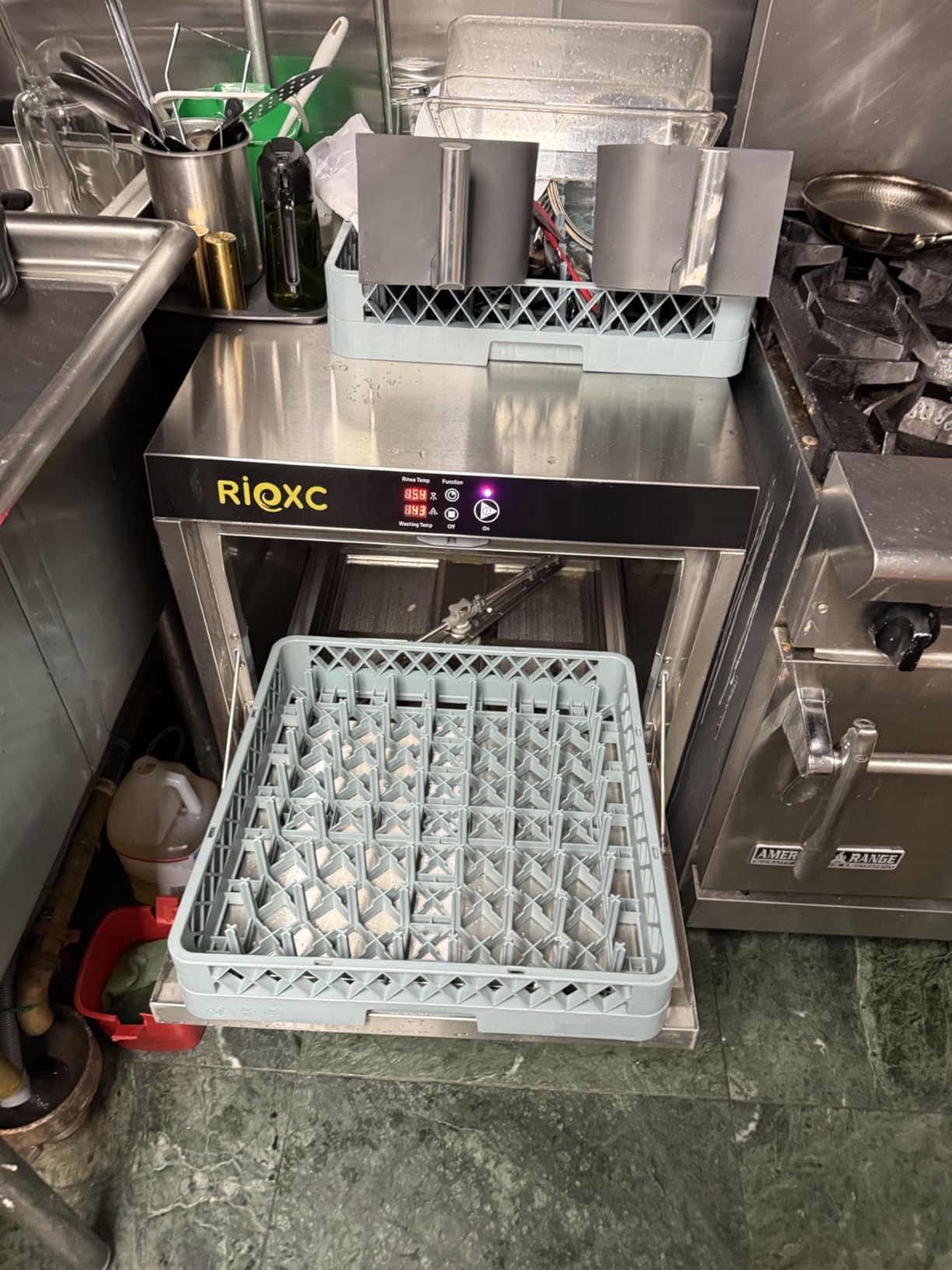
This is the machine we kept coming back to while building the list. At 40 racks per hour in a body just under 24 inches wide, it is an unusual combination of throughput and footprint, and that combination is what actually fits behind a small cafe line or inside a food truck.
It runs three cycles at 85, 115 and 175 seconds, has an automatic detergent dispenser, and pulls 0.22 gpm of water. At 45 dB it is one of the quieter machines here, which matters when the dish pit is next to a seating area.
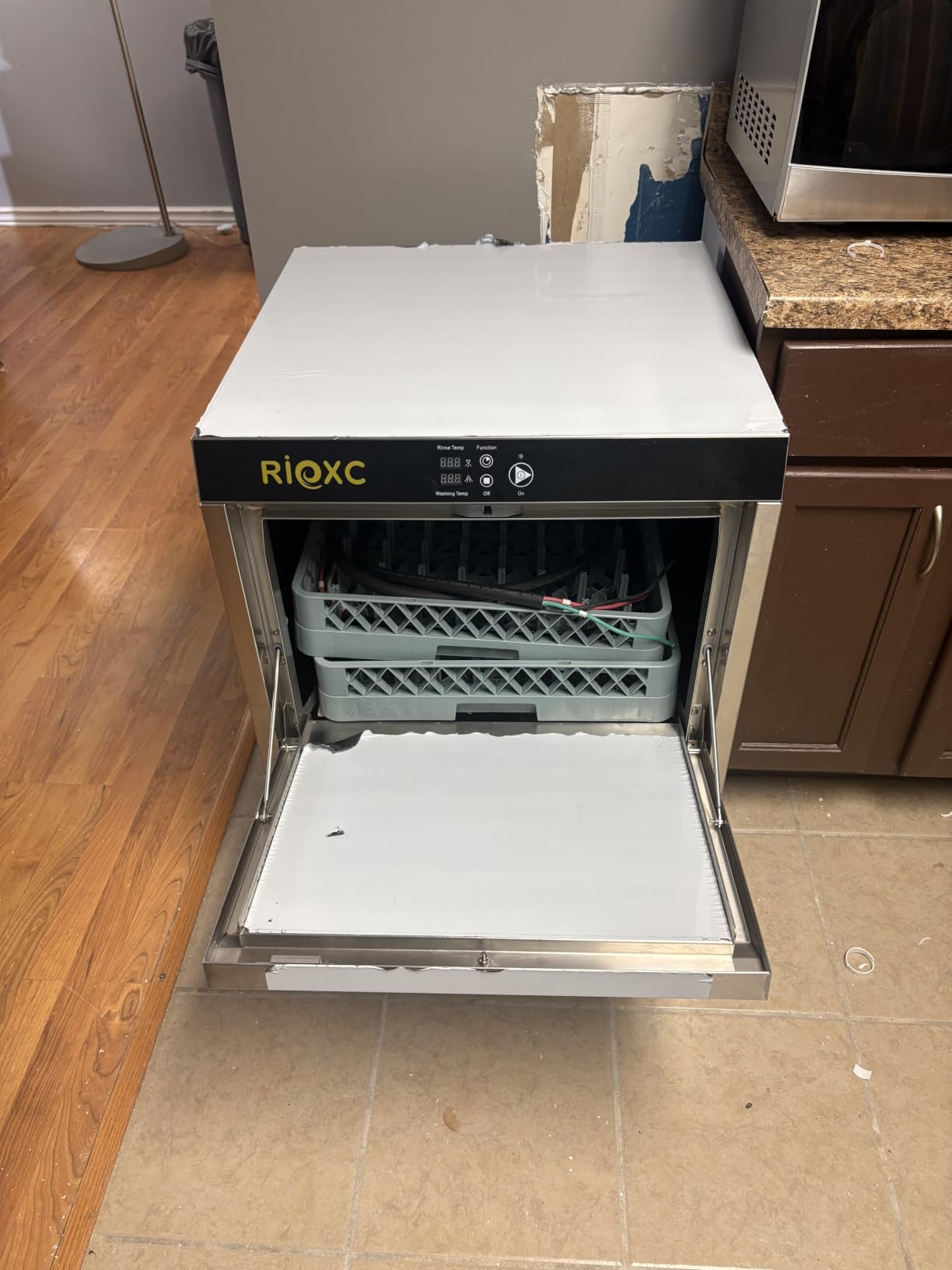
The owner photos on this listing are worth a look before you order, because on a stainless machine the visible tells are the weld finish along the cabinet seams and the evenness of the chamber walls. A machine that ships with dented corners or a warped door gasket is a machine that was dropped, and that shows up two years later as a leak.
Its 4.4 rating across 11 reviews is one of the two largest review bases in this roundup, and 85 percent of that feedback is five-star. That is a thin sample, but it is a real sample, and it beats a page of unrated dealer listings.
Who the H50-ST fits
Buy this one if you run a cafe, a bar with a back-of-house line, or a food truck and you need real throughput without a floor drain excavation. The 4.8 gallon capacity and 12 inch usable chamber height take a standard full-size rack with plates standing up.
It is also the safest high-temp choice for a small operation that has never owned commercial warewashing equipment, because a three-year all-parts warranty is longer than any other unit in this roundup.
Who should pass on the H50-ST
Skip it if your electrical service is 120V. This machine is 208-240V and accepts single-phase or three-phase, so a panel upgrade may be the largest line item in the whole project.
Also pass if you wash heavily burnt bakeware every night and need a long soak cycle. Three options is thin, and a dedicated pot washer or a floor-type hood machine will outlast it for that workload.
2. RIOXC MAX-70DS: Best High-Volume Door-Type Pick
RIOXC Commercial Dishwasher, 60Rack/H High-Temperature Door-Type Dishwasher
60 racks per hour
194F sanitizing rinse
287 lb freestanding body
3-year parts warranty
Pros
- Handles up to 60 racks per hour
- Final rinse reaches 194F using a Zoppas heating element
- Push-button controls that staff learn quickly
- ETL Listed and CSA Certified
Cons
- 208-240V three-phase electrical requirement
- Large 287 lb body with a 59 inch closed height
- Only four customer reviews to judge by
Sixty racks per hour puts it near the top of this roundup, and the 194F final rinse has real headroom over the 180F sanitizing threshold. For a lunch-only spot doing 200 covers, that gap is the difference between a dish pit that keeps up and one that backs up.
It is a freestanding door-type hood machine, 28.54 inches deep, 32.28 inches wide and 59.06 inches tall with the hood closed, opening to 76.16 inches. The hood lifts to pass racks through the top, which is how the extra height earns its keep on sheet pans.
All four published reviews are five-star, citing fast heat-up, simple controls and stainless construction. Four reviews is not a reliability record, so we would not build a service plan on it alone.
Who the MAX-70DS fits
This suits full-service restaurants and fast-casual kitchens in the 100 to 250 cover range that need more than an undercounter can deliver. Three cycles at 60, 90 and 120 seconds let you match the cycle to the load instead of running one setting all night.
It is also a good fit for a shared dish room where a bar and a kitchen feed the same machine, because the fast 60 second cycle handles glassware without a separate glasswasher.
Who should pass on the MAX-70DS
Pass if you have a tight dish pit. At 32 inches wide and 59 inches tall, it needs a dedicated bay and a three-phase feed, and it is not a machine you can drop under an existing counter.
Pass if your operation is seasonal or under about 80 covers. A conveyor would serve you better per rack, and this machine leaves money on the table.
3. Hobart LXEH-2: Best Water-Efficient Pick for Small Kitchens
Hobart LXEH-2 Undercounter Dishwasher – High Temp Sanitizing Unit
0.74 gallons per rack
32 racks per hour
109-second cycle
Built-in booster heater
Pros
- 0.74 gallons of water per rack
- 32 racks per hour on a 109-second cycle
- Built-in booster heater and automatic pumped drain
- Automatic wash and rinse cycle reduces training
Cons
- Requires both 120V and 208/240V connections
- Only a single quick-wash cycle option
- Only two published customer reviews
Hobart is the name operators ask for first, and the LXEH-2 is the reason that instinct is usually right. It washes 32 racks per hour on a 109-second cycle and draws 0.74 gallons of water per rack, a figure that puts it among the leanest machines in this roundup.
Water is the quietest cost driver in warewashing, and per-rack draw compounds across a year of service. A 0.74 gallon rinse volume per standard rack is lean for a high-temp machine, and the manual pumped drain means you do not need a floor drain sunk into the slab, which is often the single most expensive part of a small-kitchen install.
Our team rates it highly for a different reason: the part. Hobart has a national parts channel, so a failed drain solenoid or a worn door gasket does not turn into a dead machine while a technician hunts for the component.
Who the LXEH-2 fits
It is a strong match for a small cafe or bakery that washes a modest volume but cares about its water bill and its floor plan. A 17 inch door opening takes a full-size rack comfortably.
For anyone who has burned by a dealer-only brand, the automatic wash and rinse cycle means fewer operator mistakes. It is harder to misuse than a unit with a menu of modes, which matters most on a part-time hire working a weekend double.
Who should pass on the LXEH-2
Skip it if you need a long heavy-soil cycle. There is a single quick-wash program, so a kitchen washing cast iron and sheet pans at volume needs a door-type hood machine instead.
Also weigh the fact that only two reviews are published, both at four stars. That is enough to confirm it works, not enough to project a ten-year lifespan.
4. Lamber DSP3: Best Glasswasher for Bars and Tasting Rooms
Eurodib DSP3 Lamber High Temperature Rack Undercounter Commercial Glass Washer, 30 Racks/Hr, Stainless Steel, 16″ x 16″ Rack Size, 208-240v, 15A, Silver
16 x 16 inch glass basket
2-minute cycles
20 x 18 x 31 inches
88 lb
Pros
- Dedicated 16 x 16 inch basket sized to protect stemware
- Stainless wash and rinse arms with temperature boosters
- Thermocontrol plus wash and rinse thermometers
- Removable control panel eases maintenance
Cons
- 3.2 average rating shows split results on washing and drying
- 33 percent of ratings are one-star
- One year parts and labor is the shortest warranty here
A bar does not have a dish problem, it has a glass problem. Mixing stemware into a general dish rack is how you chip rims and cloud crystal, and a dedicated glasswasher is the correct answer for a cocktail lounge, a tasting room or a coffee bar.
The DSP3 uses a 16 x 16 inch basket, stainless wash and rinse arms with high-temperature boosters, and 2-minute cycles with a detergent pump and rinse aid dispenser. A thermocontrol device with wash and rinse thermometers holds temperature steady, which is what prevents etching and spotting on lead crystal.
Here is where we have to be direct with you. Its 3.2 average across 11 reviews splits hard, with 42 percent five-star and 33 percent one-star. That pattern, not the number itself, is the real signal: some operators get excellent results and some do not, and drying is the usual flashpoint.
Who the DSP3 fits
It suits a bar that washes mostly stemware and small cocktail plates, and it undercuts the cost of running glasses through a full dishwasher with dish detergent. The 88 lb body and 20 x 18 inch footprint also make it installable where a full machine will not go.
The removable control panel is a genuine serviceability win. A bar operator can rinse nozzles and clean the arm without pulling a technician for a routine descale.
Who should pass on the DSP3
Pass if you serve a high volume of stemmed glassware. Two-minute cycles and a single basket will not carry a busy hotel bar, and the split ratings suggest drying complaints scale with volume.
Pass if you are buying on warranty length alone. One year parts and labor is short, and the 12 gallon tank figure published for this unit is larger than the wash tanks of the dishwashers in this list.
5. Elite Kitchen Supply H50-S1: Best Budget Undercounter Pick
3 or 1-phase Commercial Undercounter Dishwasher, 208-240V, Need electrician to install, High temperature, 30 Racks/Hour, ETL
30 racks per hour
0.66 gallons per cycle
140F wash and 180F rinse
208-240V
Pros
- Thirty racks per hour on 120
- 150 and 180 second cycles
- Digital displays for 140F wash and 180F rinse temperatures
- Double-skin body and door cut heat and steam loss
- Rotating stainless wash arms with wide-angle fan nozzles
Cons
- 208-240V conversion must be handled by an electrician
- 70 dB is the loudest operating figure in this roundup
- One verified buyer reported poor build quality and return friction
If you are opening a small kitchen on a fixed budget, this is the machine to look at first. Thirty racks per hour is enough for a small cafe doing 60 to 80 covers, and it drinks 0.66 gallons per cycle.
The double-skin body and door are a sensible design choice on a machine that will sit in an unconditioned dish pit, and the digital displays for 140F wash and 180F rinse temperatures let an operator confirm sanitizing conditions at a glance rather than trusting a light.
Its 3.1 rating across 2 reviews is the weakest review base in this group, and the split is stark at roughly half five-star and half one-star. The negative review cites build quality and difficulty getting a return, which is the risk profile you accept at the entry end of this category.
Who the H50-S1 fits
It works for a coffee shop, juice bar or bakery that washes cups, bowls and small plates and needs a legally compliant machine without a large electrical upgrade. The 12-inch clearance height suits a standard counter.
Because it can be converted from three-phase to single-phase by an electrician, it is one of the more flexible units in this roundup for buildings with limited service capacity.
Who should pass on the H50-S1
Pass if noise matters. At 70 dB it is the loudest unit here, and in a small room with hard surfaces that becomes a real complaint from staff and neighbours.
Pass if you cannot tolerate a 1-year all-parts warranty and a thin support channel. Build quality is the first thing to check on arrival, before the machine is plumbed in.
6. Jackson DishStar HT: Best for Heavily Soiled Ware and Pots
Jackson WWS DISHSTAR HT Dishwasher, Undercounter (24) Racks/Hour, High Temp with Booster 208v/60/1-ph
24 racks per hour
High-temp with booster
208V single-phase
Stainless basket and rack
Pros
- Rated for heavily soiled dishware
- pots
- pans and bakeware
- Stainless steel basket and rack construction
- Touch controls with five settings plus sanitize and normal cycles
- Delay start and sound reduction system
Cons
- No customer reviews are published for this listing
- 1.1 gallons per cycle is higher than several units here
- 24 racks per hour is modest for a mid-volume kitchen
Jackson built the DishStar for the kitchen that runs a stockpot through the machine at close. The manufacturer rates it for heavily soiled commercial dishware, pots, pans and bakeware, and the stainless basket and rack are the right materials for that abuse.
Touch controls with five settings, including dedicated sanitize and normal cycles, give an operator more control than the three-cycle machines in this roundup. The sound reduction system and delay start are thoughtful touches for an installation next to a dining room.
We are flagging the gap plainly: there are no published customer reviews for this listing, so its performance rests entirely on the manufacturer specification. That is not a disqualifier, but you should treat it as unverified and ask a dealer for a service history on a demo unit.
Who the DishStar HT fits
It suits a casual dining kitchen or a bakery that washes sheet pans and mixing bowls alongside plates, and where a cheap plastic-rack machine would deform within a year.
Because it is a 208V single-phase high-temp unit, it fits buildings that cannot easily take a three-phase feed, which rules out a surprising number of older restaurant spaces.
Who should pass on the DishStar HT
Pass if throughput is your binding constraint. Twenty-four racks per hour is fine at 80 covers and inadequate at 200, where the queue will visibly stack up during a rush.
Pass if you need published owner feedback to make a decision. Without reviews, your only diligence is a service-network conversation, so buy it from a dealer who will put it in writing.
7. CMA EST-44H: Best Conveyor Dishwasher for Institutional Volume
CMA Dishmachines EST-44H/L-R, 243 Racks/Hr, Conveyor Dishwasher |High Temp |Left to Right
243 racks per hour
High-temperature sanitizing
662 lb freestanding
220 volts
Pros
- 243 racks per hour
- Conveyor format suits continuous dish flow in a large dish room
- High-temperature sanitizing design
- Touch control interface
Cons
- 662 lb unit needs dedicated floor space and utility lines
- One of the largest machines we reviewed
At 243 racks per hour, this is the machine for a kitchen that has outgrown anything with a door. A university dining hall, hospital cafeteria, hotel banquet kitchen or large commissary can put a hundred racks through it before lunch service starts and still be processing through the afternoon.
The conveyor format means racks are loaded on one end and unloaded on the other with no lifting and no standing still, so labour hours per rack fall as volume rises. It is a 220 volt high-temperature unit with touch controls, and dishes travel in a single flow direction through the wash and rinse stages.
At 662 pounds it is a permanent fixture, not an appliance. It needs a floor area, a dedicated drain, adequate incoming water pressure and an electrician, and a machine of this class is well outside the range of an independent restaurant.
Who the EST-44H fits
It fits institutional operations with a dedicated dish room, a trained warewashing staff and a service contract in place. Nothing else justifies a conveyor, because the machine rewards volume with lower labour cost per rack.
If your current setup already backs up during a single banquet event, this is the correct ceiling. You have outgrown door-type throughput.
Who should pass on the EST-44H
Pass for any operation under roughly 250 covers. You will never approach 243 racks per hour, and you will be paying for capacity you leave idle.
Pass if you have no local service capability. A 662 pound conveyor with a failed pump or a misaligned flight is a full dish-room outage, and you need a technician who can reach you during service.
8. Cooler Depot H50-S1: Best NSF-Certified Compact Unit
Commercial Dishwasher undercounter high temperature, NSF Certified, 220v, 1or3 phase H50-S1
NSF certified
30 racks per hour
0.66 gallon rinse volume
160 lb
Pros
- NSF certified for commercial food use
- 0.66 gallon rinse volume per cycle
- Double-skin body and door
- Rotating stainless wash and rinse arms with wide-angle nozzles
Cons
- Only one published review and it is a two-star fault report
- Plastic wash rack is less durable than stainless racks
- Booster is 2.5 kW so electrical service matters
The thing that separates this listing from the generic stainless boxes is the NSF certification. That stamp is what a health inspector looks for, and if you are opening a licensed food operation it should be non-negotiable in your search.
On paper the rest is solid too: 30 racks per hour, a 0.66 gallon rinse volume per cycle, a double-skin body and door, and rotating stainless wash and rinse arms with wide-angle fan nozzles. Chemical dispensers, fill hose, drain hose, cavity drain and a pumped rinse system are all included, which is generous for the class.
The single published review is a two-star report describing a fault that needed a paid technician visit, with the seller reimbursing. One review is not a pattern, but it is the only evidence here, and it points at service cost rather than wash performance.
Who the H50-S1 fits
It fits a small licensed kitchen that must document sanitation and needs the NSF listing on file. At 160 pounds and 24 x 25 x 32 inches it fits a standard undercounter bay.
The included dispensers and hoses also suit an operator fitting out a second site, because the parts bill for a basic install is already covered by the box.
Who should pass on the H50-S1
Pass if you run a hard volume of ware. The plastic wash rack is the first component to fail on a busy line, and racks are cheap insurance against a mid-service failure.
Pass if you cannot get a local technician. With one review on record and a 1-year parts and labor warranty, this needs a dealer relationship more than any other unit in the roundup.
9. Omcan CD-GR-0500: Best Compact Unit for Light Commercial Work
Omcan Undercounter High Temp Dishwasher CD-GR-0500
28, 19 or 14 racks per hour
121 lb
24 inch wide
208-240V single-phase
Pros
- Three wash programs at 28
- 19 or 14 racks per hour
- Upper and lower wash and rinse arms
- Minimum 165F cycle temperature with a 6L booster tank
- Compact 24 inch footprint at 121 lb
Cons
- Rated for light commercial use rather than heavy volume
- Certified electrician required and wiring not included
- No customer reviews are published for this listing
At 121 pounds and just over 23 inches deep, the CD-GR-0500 is the lightest full-size undercounter in this roundup and the easiest to move into an awkward spot. It is built in Greece with a 1-year parts and labor warranty, and Omcan is an established foodservice equipment brand rather than a marketplace-only seller.
The spec sheet is the most complete in this roundup. You get three programs at 28, 19 or 14 racks per hour, wash cycles of 103, 163 and 223 seconds, a 6 litre booster tank, a 35 litre wash tank, flow pressure of 20 psi plus or minus 5, and a minimum cycle temperature of 165F.
That transparency is worth something. We can tell you exactly what it does before you buy, and the answer is: it is a light-duty machine that handles everyday dishware and glassware in a small operation without pushing a 3.6 kW draw through an old panel.
Who the CD-GR-0500 fits
It fits a small cafe, a bakery front counter, an office pantry with a permit, or a pop-up and mobile kitchen where weight and width are the deciding factors. The 88 lb Lamber glasswasher is the only lighter unit in this roundup.
If you are still deciding between a residential unit and something commercial, this is a realistic bridge: properly commercial, compact, and cheap to run per rack.
Who should pass on the CD-GR-0500
Pass if you exceed about 60 covers a day. The fastest program is 28 racks per hour, and the manufacturer explicitly rates it for light commercial use rather than heavy-volume kitchens.
Pass if you want a turnkey install. A certified electrician is required and the plug and wiring are not included, so budget for that separately before you compare it to other units.
10. GRFIT Cover-Type Floor-Standing: Best for Large Hotel and Canteen Dish Rooms
GRFIT Commercial Fully Automatic Dishwasher Cover-Type Cleaning Large Hotel Restaurant Canteen Floor-Standing Dishwasher (Color : A)
Floor-standing cover type
Removable triple filter screen
Ceramic, glass and steel ware
Suitable for hotels and canteens
Pros
- Full cover-type door design built for a large dish room
- Triple filter screen catches debris before it clogs lines
- Removable filter simplifies routine cleaning
- Handles ceramic
- glass and stainless tableware
Cons
- Published spec sheet is thin with no throughput or electrical data
- No customer reviews are published
- Listed weight and package dimensions appear inconsistent
This is the specialist pick for a dish room that handles bulk tableware. The full cover-type door and floor-standing format suit a hotel, restaurant, canteen, dormitory or office where ceramic bowls and stainless serving vessels come back in volume rather than one plate at a time.
The triple filter screen is the part we like. Food debris is filtered before it reaches the drain line, and the filter removes for cleaning, which is exactly the maintenance task that gets skipped in institutional kitchens until a drain solenoid fails.
We are not going to oversell this one. The published spec sheet has no racks-per-hour figure, no temperature data and no electrical requirements, and the listed weight and package dimensions do not match a floor-standing machine. Treat it as a conversation with the vendor, not a spec-sheet purchase.
Who the GRFIT fits
It fits a large dish room where the volume of bulk ware makes a conveyor impractical and a floor-standing cover machine is the traditional answer. The removable filter is a genuine advantage in a staffed-institution environment.
Two colour variants are offered, which is a minor but real advantage for a hotel group standardising across properties.
Who should pass on the GRFIT
Pass if you need to compare throughput or electrical draw on paper. You cannot, and in a category where a missing spec is often a missing capability, that is disqualifying for a tight installation.
Pass if you need a warranty you can hold someone to. No published reviews and no clear service terms mean the only real diligence is a written dealer commitment.
How Many Racks Per Hour Do You Need?
Size on racks per hour, never on covers per hour. A standard rack holds about 20 mixed pieces, and a three-hour peak service is the window you are actually planning for. Divide peak covers by 20, then divide that by 3, then add a 25 to 30 percent buffer for large parties and late rushes.
So a 120-cover peak service needs about 2 racks per hour at steady state, which sounds trivial until a wedding party lands 300 plates at once. The buffer is what buys you that event. We would size that kitchen for 30 racks per hour, which is why the 30-rack machines in this roundup exist at all.
Use this as your floor: 60 peak covers needs roughly 20 racks per hour, 120 covers needs 30 to 40, 200 to 250 covers needs 40 to 70, and anything institutional or banquet-driven should be quoted for a conveyor. Under 50 covers, an undercounter is genuinely enough.
Our team has seen more failed dish pits than we would like to admit, and nearly every one was undersized rather than underbought. A machine that backs up costs you labour in a queue, and that cost dwarfs the gap between two models.
Reliability, Service Networks and Brands to Think Twice About
Service network beats brand prestige, every time. A machine from an established name with a national parts channel will be back in service in a day; a machine from a marketplace-only seller may sit idle for two weeks waiting for a component, and that outage lands in the middle of your service.
Ask a dealer three questions before you sign: who honours the warranty, manufacturer or dealer, where is the nearest technician, and what is the parts turnaround. Get the answers in writing. Forum threads on appliance repair boards are full of owners who bought an expensive machine and then found warranty service effectively unavailable or absurdly priced, and that regret is the single most common theme we found.
On star ratings, be careful. Commercial SKUs on big-box sites routinely show very low scores, and those scores often reflect shipping damage or an installation problem rather than the machine itself. What to watch instead is the shape of the feedback: a 3.2 average where 42 percent of reviews are five-star and 33 percent are one-star is more informative than a 4.4 built on eleven reviews.
Watch for the common failure modes so you can catch them early. A failed booster heater element, a spray arm blocked by scale, a worn door gasket that leaks and steals your heat, and a dead drain solenoid account for the majority of service calls we saw discussed. All four are preventive-maintenance targets, not random failures.
One more thing worth saying directly: a residential machine with commercial trim is not a commercial machine. Equipment forums are consistent on this point, and health codes generally agree. A residential unit in a licensed kitchen can be a violation and a voided warranty in the same afternoon.
Installation and Utility Requirements Before You Buy
Check the electrical service before you choose the model, not after. Most undercounter and door-type units in this roundup run on 208-240V, and several accept either single-phase or three-phase, which an electrician can convert. Older restaurant buildings frequently need a panel upgrade before the machine can even be uncrated.
Water supply and pressure come next. The Omcan spec sheet calls for 20 psi plus or minus 5 and a hot water requirement of 0.5 gallons per minute at 120F, which is a useful reference for sizing your incoming line. Most units need a dedicated hot water feed rather than a tap off the general supply.
Drainage is where surprises hide. Machines with a pumped drain, like the Hobart LXEH-2, can run to a standard drain line. Models without one need a floor drain sunk into the slab, which is a concrete-cutting job in a leased building.
Finally, measure the hood and the door swing before delivery. The MAX-70DS is 59 inches tall closed and 76 inches with the hood open, and a conveyor needs clear floor space plus service access on more than one side.
Maintenance Schedule That Keeps a Machine Alive
Every day: check the wash and rinse temperature gauges before you open, and confirm the sanitizing condition. Wipe the door gasket, clear the spray arm holes, and empty and rinse the filter. Ninety seconds a day prevents most callbacks.
Every week: run a descale solution through the wash tank if you are in a hard-water area, and clean the chemical dispenser lines. Check the drain hose for grease buildup and confirm the pump is moving water freely.
Every month: inspect the heater element and the wiring terminals for corrosion, and test the door gasket by closing it on a sheet of paper and pulling. If the paper slides out with no resistance, the seal is done.
Every year: have a technician service the booster heater and calibrate the thermometers, and deep-descale the tank. In hard water, this is the single highest-return maintenance spend you can make, because scale on a heating element is what kills heaters early.
Frequently Asked Questions
What brand of dishwasher is the most reliable?
Reliability tracks the service network more than the badge. Hobart, Jackson, CMA and Meiko are the brands most operators trust because parts and technicians are easy to find in most regions. In our roundup the Hobart LXEH-2 stands out for a 0.74 gallon per rack water draw and a pumped drain that avoids a floor drain, while the RIOXC H50-ST carries a three-year all-parts warranty. Confirm with a dealer who the warranty is honoured by before you buy.
What brand of dishwasher should you stay away from?
Rather than naming a brand to avoid, we would tell you what to check. Marketplace-only sellers with no local technician are the biggest risk, because a failed booster heater or drain solenoid becomes a multi-week outage. Also be cautious with any machine rated for residential use in a licensed kitchen, and with any listing whose published weight and dimensions do not match the described machine.
What is the average lifespan of a commercial dishwasher?
Industry guidance puts a well-maintained commercial dishwasher at roughly 10 to 15 years, while neglected units often fail between 5 and 10. The deciding factors are water hardness, how often you descale the wash tank, and whether the booster heater elements are serviced annually. Machines with a three-year parts warranty like the RIOXC units tend to stay in service longer because failures get fixed rather than worked around.
What are the recommended temperatures for commercial dishwashers?
High-temperature machines are designed to deliver a final rinse at 180F or above, which puts the surface of the dish at about 160F and kills bacteria in around ten seconds. Wash tanks typically hold near 140F, and units such as the Elite Kitchen Supply H50-S1 display both figures digitally. Low-temperature machines rinse much cooler and sanitize with a metered chemical instead.
What is the difference between a low temperature and high temperature commercial dishwasher?
A high-temperature machine uses heat alone, running a wash tank near 140F and a sanitizing rinse at 180F or above with no chemicals. A low-temperature machine runs a cooler cycle and adds a measured chlorine or quat solution during the final rinse. High-temp costs more to install because of the electrical load but costs nothing to consume and leaves no chemical taste on glassware, while low-temp needs a lower-power service and ongoing chemical costs.
How much does it cost to run a dishwasher for one hour?
Running cost is driven by water per rack and electrical draw. A machine using 0.66 to 0.74 gallons per rack at 30 racks per hour moves roughly 20 to 22 gallons an hour, and combined with a 2.5 to 3.6 kW load plus heat, the utility cost for a full hour of continuous operation lands in the low single-digit dollars. The bigger lever is gallons per rack, which is why the Hobart LXEH-2 is our water-efficiency pick.
The Verdict: Best Commercial Dishwashers by Kitchen Type
Our Editor’s Choice is the RIOXC H50-ST. It delivers 40 racks per hour in a 24 inch wide undercounter body, it is ETL Listed and CSA Certified, and it carries a three-year all-parts warranty, which makes it the most complete small-kitchen package in this roundup.
Go door-type with the RIOXC MAX-70DS if you exceed 100 covers and need 60 racks per hour. Go Hobart LXEH-2 if water cost and parts support matter more than raw speed. The Lamber DSP3 is the right dedicated answer for a bar, and the CMA EST-44H is the only choice once a dish room is genuinely institutional.
Before any of those, check your electrical panel and your floor space. Sizing correctly and then buying a mid-range machine beats buying the biggest one and discovering the install will not fit. If you are still equipping the rest of the line, our guides to the best commercial deep fryers and best commercial blenders cover the other two anchors of a small kitchen, and our countertop dishwasher reviews are worth a look only if you are not opening a licensed food operation.