
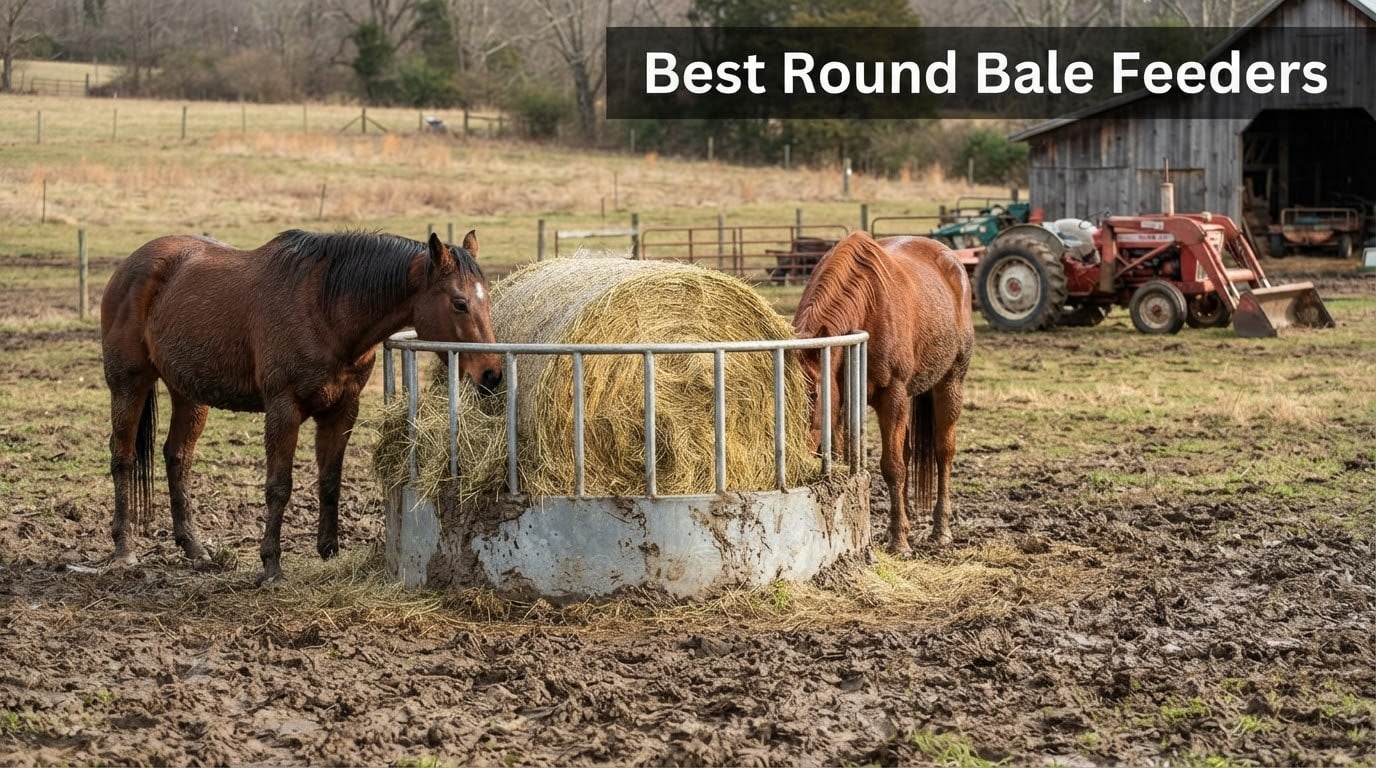
A round bale feeder is any device that holds a round hay bale off the ground so animals pull hay through openings instead of trampling it into mud. The best round bale feeders in 2026 fall into two very different camps: heavy ring, cradle and panel feeders built for cattle, and mesh hay nets that keep a whole bale intact for horses, goats and smaller herds. Which camp you belong in depends less on price than on who is eating and whether the bale ever leaves the ground.
That distinction matters more than most catalog pages admit. A ring feeder surrounds a loose bale, so hay still gets dragged out, walked over and rained on. A net encloses the bale completely, which is why owners running a half dozen horses often report that a single bale stretches for weeks instead of days. The trade is handling: nets are lighter to move but must be pulled over a full bale, while steel feeders are heavy and awkward and stay put once positioned.
The waste numbers justify the effort. University of Kentucky Extension reports that round bale feeders with solid sheeting on the bottom cut hay losses by 15 to 20 percent, and the Minnesota State Cattlemen’s Association notes that limiting cattle to 8-12 hours of feeder access in a 24-hour window brings waste down to roughly 10 percent. Nets push the savings further because the bale face stays in one piece. If your hay is going to deer and other wildlife rather than cattle, our guide to the 8 Best Game Feeders covers that side instead.
We compared 10 round bale hay nets on the things that actually decide whether one survives a season: hole size, strand construction, bale fit, closure method and what owners report after months of daily use. The rankings below follow, then a buying guide covers the structural feeders, herd sizing, safety and the feeding habits that cut waste more than any feeder design.
Table of Contents
Top 3 Round Bale Feeders of 2026
Texas Haynet Round Bale Hay Net
- UV-resistant nylon mesh
- 1.75 inch holes
- Fits 4x6-6x6 round bales
- Available in 1 and 2 packs

TONGMO 5×5 Round Bale Hay Net
- 2 inch slow-feed holes
- Knotless soft mesh
- 5x5x5 ft sizing
- 4x4 ft also offered

The Texas Haynet takes the top slot because it has the deepest owner history in the group, a wide bale fit range and a hole size that suits both pasture and stalled horses. The TONGMO scores highest on average rating, which tells you the mesh is soft and consistent, and its 2 inch holes make it the easier net for a group that needs to finish bales faster.
The Aoneky is the value pick: 4mm knotless nylon rated to 2200 lb, a tight 1.5 inch opening and a cinch cord in the box. Its rectangular shape is awkward on a round bale, but the material quality at this level is rare.
All 10 Best Round Bale Feeders Side by Side (September 2026)
| Product | Specifications | Action |
|---|---|---|
| Texas Haynet Round Bale Hay Net |
|
Check Latest Price |
| Aoneky Bale Hay Net |
|
Check Latest Price |
| TONGMO 5×5 Round Bale Hay Net |
|
Check Latest Price |
 NETYSAY 2 Inch Hole Hay Net NETYSAY 2 Inch Hole Hay Net |
|
Check Latest Price |
 Bloomoak Large Round Bale Hay Net Bloomoak Large Round Bale Hay Net |
|
Check Latest Price |
 kingump 1.5 Inch Slow Feeder Hay Net kingump 1.5 Inch Slow Feeder Hay Net |
|
Check Latest Price |
 MIYABALA 5×5 Knotless Hay Net MIYABALA 5×5 Knotless Hay Net |
|
Check Latest Price |
 Dayimado Large Round Bale Hay Net Dayimado Large Round Bale Hay Net |
|
Check Latest Price |
 Toofrito 12-Strand Round Bale Hay Net Toofrito 12-Strand Round Bale Hay Net |
|
Check Latest Price |
 Novellaire 1.75 Inch Hay Net Novellaire 1.75 Inch Hay Net |
|
Check Latest Price |
Hole size is the first column worth reading, because it sets feeding speed more than any other feature. Everything else in this table is construction detail that decides how long the net lasts once horses get their teeth and hooves on it.
1. Texas Haynet Round Bale Hay Net – Best Overall Round Bale Feeder
Texas Haynet – Round Bale Hay Net Slow Feed – Durable Round Bale Feeder for Horses – American Made UV Resistant Nylon Net – Fits Round Bales 4×6-6×6 or Square Bales 3x3x8-4x4x8 with 1.75″ Holes
UV resistant nylon mesh
1.75 inch holes
Fits 4x6-6x6 round bales
9.95 pounds
Pros
- Constructed in America from UV-resistant nylon mesh
- Makes hay last 2-3 times longer
- 1.75 inch holes suit stalled and pastured horses
- Fits square bales as well as round
- 223 reviews at a 4.3 average
Cons
- Knotted mesh is rougher on gums and teeth
- Priced above most nets in the group
- Sizing runs out below very large bales
This is the net we kept coming back to while comparing the group, largely because 223 owners have already run it through real seasons. It is a knotted nylon mesh, not a knotless one, which is the single biggest reason we did not make it the top pick for stalled horses with tender mouths. Everything else about it is measured and sensible.
The 1.75 inch opening sits in the sweet spot for most operations. It is slow enough to stretch a bale across a group of horses without frustrating them, and open enough that a horse does not have to work at it. Owners consistently report the bale lasting two to three times longer than loose-fed.
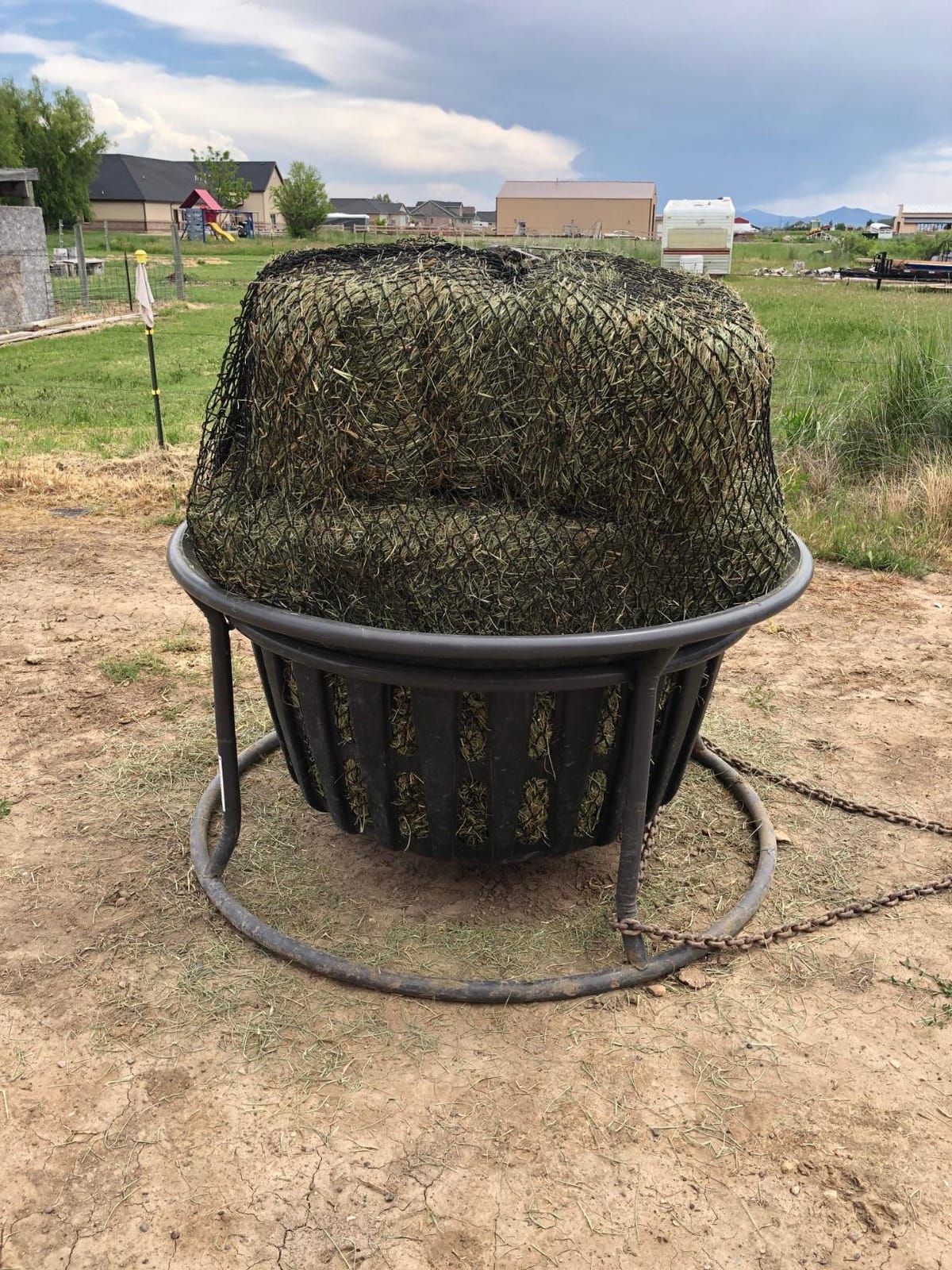
The fit range is the real differentiator. It handles round bales from 4×6 up to 6×6 and square bales from 3x3x8 to 4x4x8, so one net covers a mixed yard where some bales come off a different baler. At 9.95 pounds it is the heaviest net here, which is noticeable on a wet 5×6 roll but also a fair signal of how much material is in the mesh.
Two sizes are offered, a single net and a two pack. If you run two feeding stations, a two pack is the easier buy because you end up with matching closure habits on both, and owners report the mesh washes and holds up for reuse across multiple bales.
What to check before you buy it
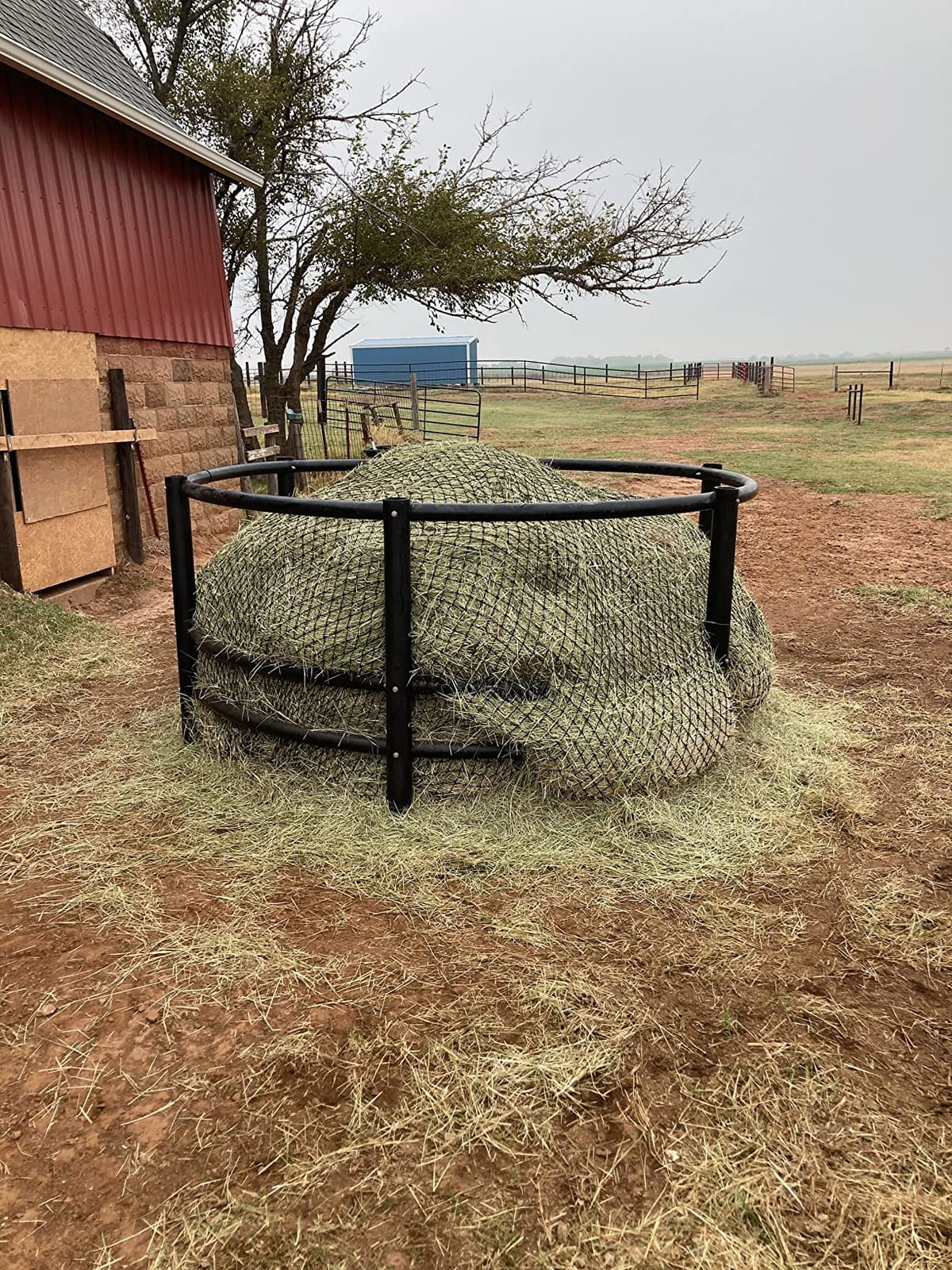
Decide honestly whether your horses are stalled or turned out. This net’s knotted construction is a bigger issue for a horse in a stall who chews at the fabric for hours than for a pastured horse who eats and walks away.
Also confirm your bale width. The listed range starts at 4×6 wide bales, so if your producer rolls 4×4 or 4×5 bales you will want one of the smaller nets further down this list instead.
Where it falls short
It costs more per net than most of the group, and that gap widens if you need several. Buyers who need four feeding points should compare the mid-range options first.
The mesh is knotted, which can feel abrasive on gums, and one recurring note is that it is not the largest option for the biggest rolls. If your hay is always 5×6 or wider, the 6×6 nets handle it more comfortably.
2. Aoneky Bale Hay Net – Best Value Round Bale Feeder
Aoneky Bale Hay Net -Average Feed Haynet for Horses
4mm knotless nylon
1.5 inch openings
2200 lb load bearing
20 ft cinch cord included
Pros
- Knotless mesh is gentle on teeth
- 2200 lb load bearing rating
- 1.5 inch holes are the tightest here
- Cinch cord included
- Works for horses and small ruminants
Cons
- Rectangular shape is awkward on a round bale
- Cord has to be rethreaded for every bale
- Loosens as the bale shrinks down
The Aoneky is the spec-sheet surprise of this list. Owners looking at strand diameter and load rating would assume a much higher price point, and reviewers repeatedly call out that the netting resists tearing, stays soft and pliable, and stretches a bale out to two and a half weeks for a group.
Because it is knotless, it is also the most comfortable option here on gums and teeth. For a horse that is hard on its mouth, or one with an existing dental issue, that is worth more than a few extra dollars.
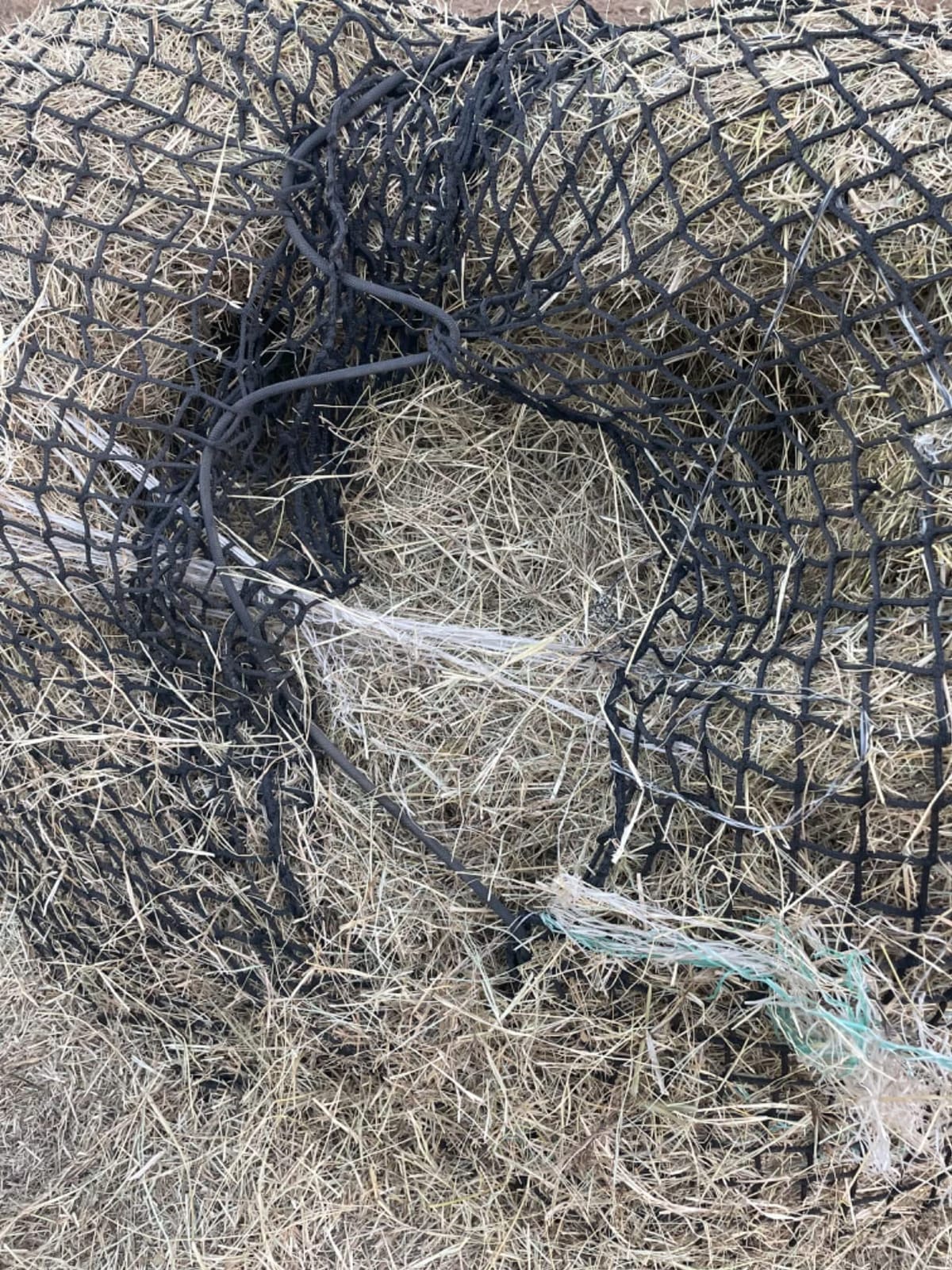
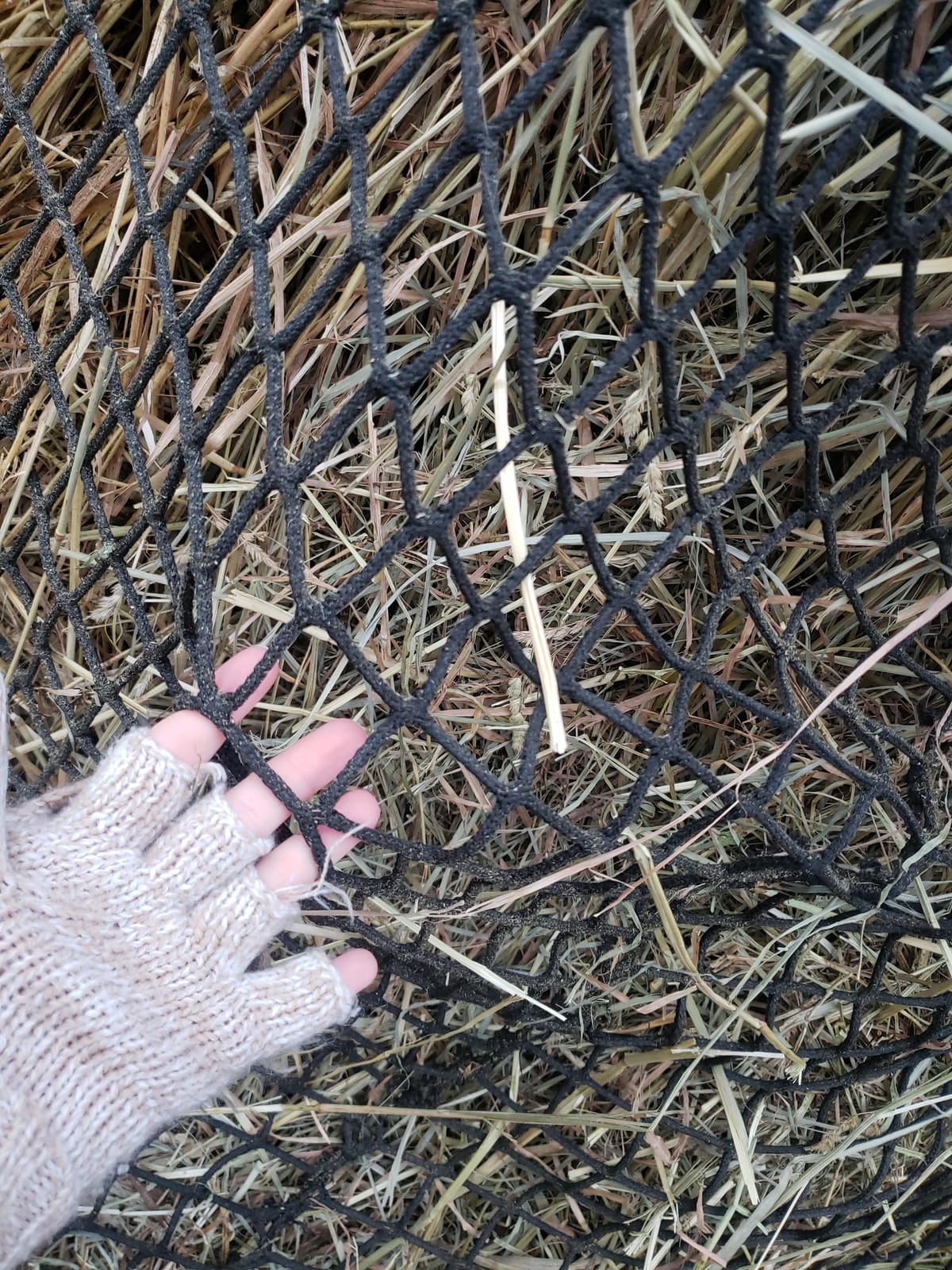
The 1.5 inch opening is the tightest in the group and gives the biggest slowdown. That is excellent for easy keepers and for slowing a greedy mare, but owners warn it can be too restrictive for larger horses, who may work at it rather than eat cleanly.
It handles round bales from 4×4 through 5×5 and square bales from 3x3x8 to 3x4x8. A 5×5 ft and a 6×6 ft version are both offered, so check which one you are ordering rather than assuming the size on the photo.
What to check before you buy it
The closure is the thing to practice before you rely on it. The cinch cord is separate and has to be threaded around the edge for every new bale, and owners report the cord is often shorter than the job needs. Buy a longer length of cord with it.
Fitting a rectangular net over a round bale is genuinely awkward. If you are feeding one or two horses, that is a five-minute annoyance. If you are doing ten bales a week, the effort adds up fast.
Where it falls short
Unthreading and rethreading for each bale is the most common complaint in the reviews, and nets of this type tend to loosen as the bale shrinks. Expect to re-tighten as the round goes down.
At 1.5 inch holes, this is not the net for a group of large horses that needs to move through hay quickly. It is built to make a bale last, not to finish one.
3. TONGMO 5×5 Round Bale Hay Net – Highest Rated
TONGMO 5×5 ft Round Bale Hay Net for Horses & Livestock – Slow Feeder Hay Nets with 2 inches Hole
2 inch slow-feed holes
Knotless soft mesh
5x5x5 ft sizing
4.94 pounds
Pros
- Highest average rating of the group at 4.4
- 2 inch holes suit most herd groups
- Knotless mesh is easy on gums and teeth
- Lightest net here at under 5 pounds
- 4x4 and 5x5 ft versions
Cons
- Supplied tie rope will not hold a knot
- Difficult to fit and cinch on a full bale
- UV exposure degrades the net in roughly 9-10 months
The TONGMO earned the highest average rating of any net we compared, at 4.4 across 129 reviews, and the consistency of the feedback is unusual. Owners report it lasting a season or more with no holes while several horses use it around the clock, and multiple buyers describe it as better value than pricier branded nets.
Two inch holes put it in the middle of the range. That is fast enough to keep a group of horses or a mixed herd moving while still cutting waste noticeably compared with loose feeding. For an easy keeper you would pair it with a smaller mesh instead.
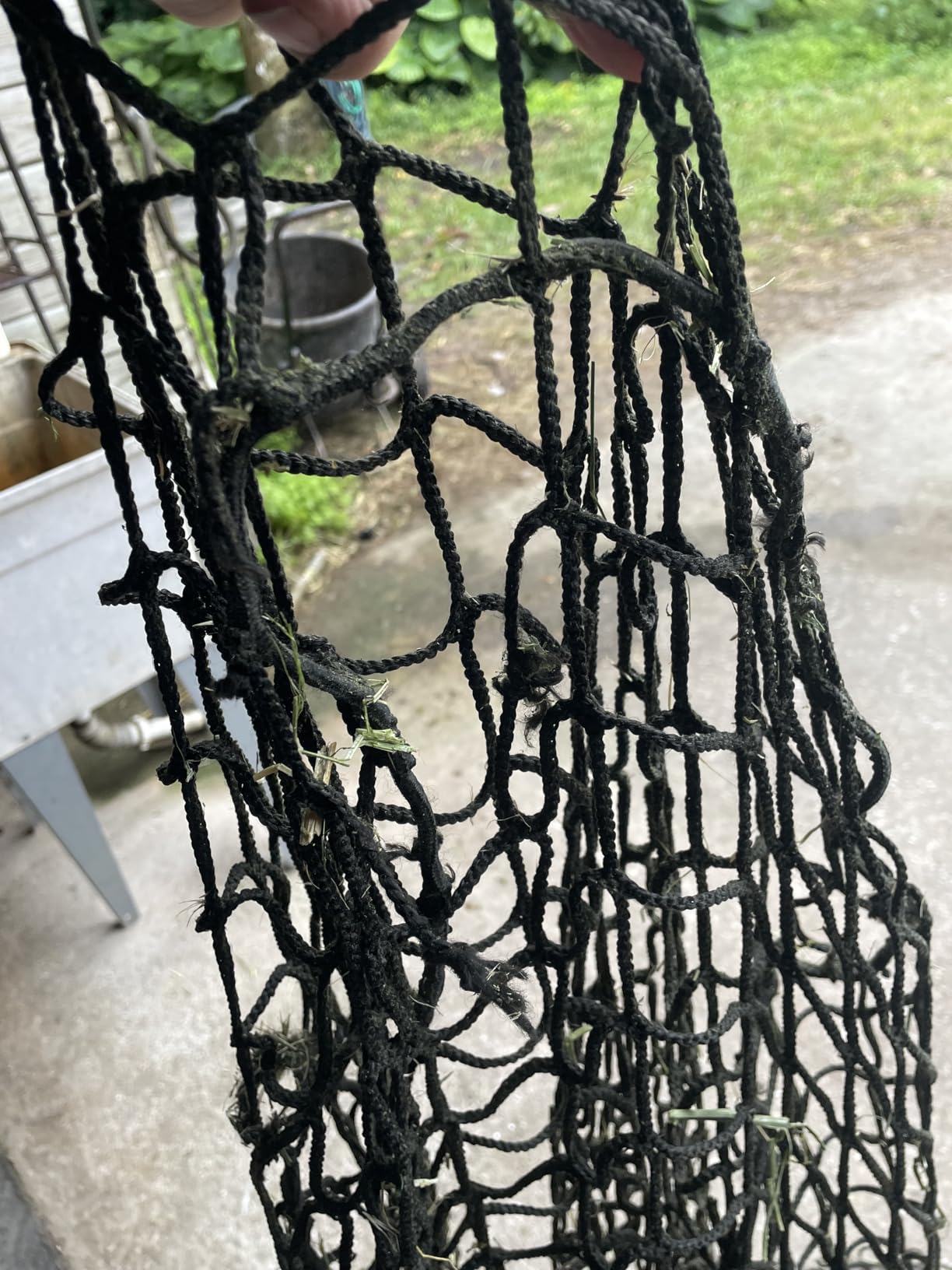
At 4.94 pounds it is the lightest net here, which matters if you are moving bales by hand or dragging the net out to a paddock in wet conditions. The knotless weave is described as soft on gums and kind to natural tooth wear, and that claim shows up repeatedly in owner comments.
Owners also report the slow-feed effect helping with digestive issues, which tracks with the same mechanism people use netted hay for. Feeding is spread out, intake is steadier, and less hay ends up on the ground.
What to check before you buy it
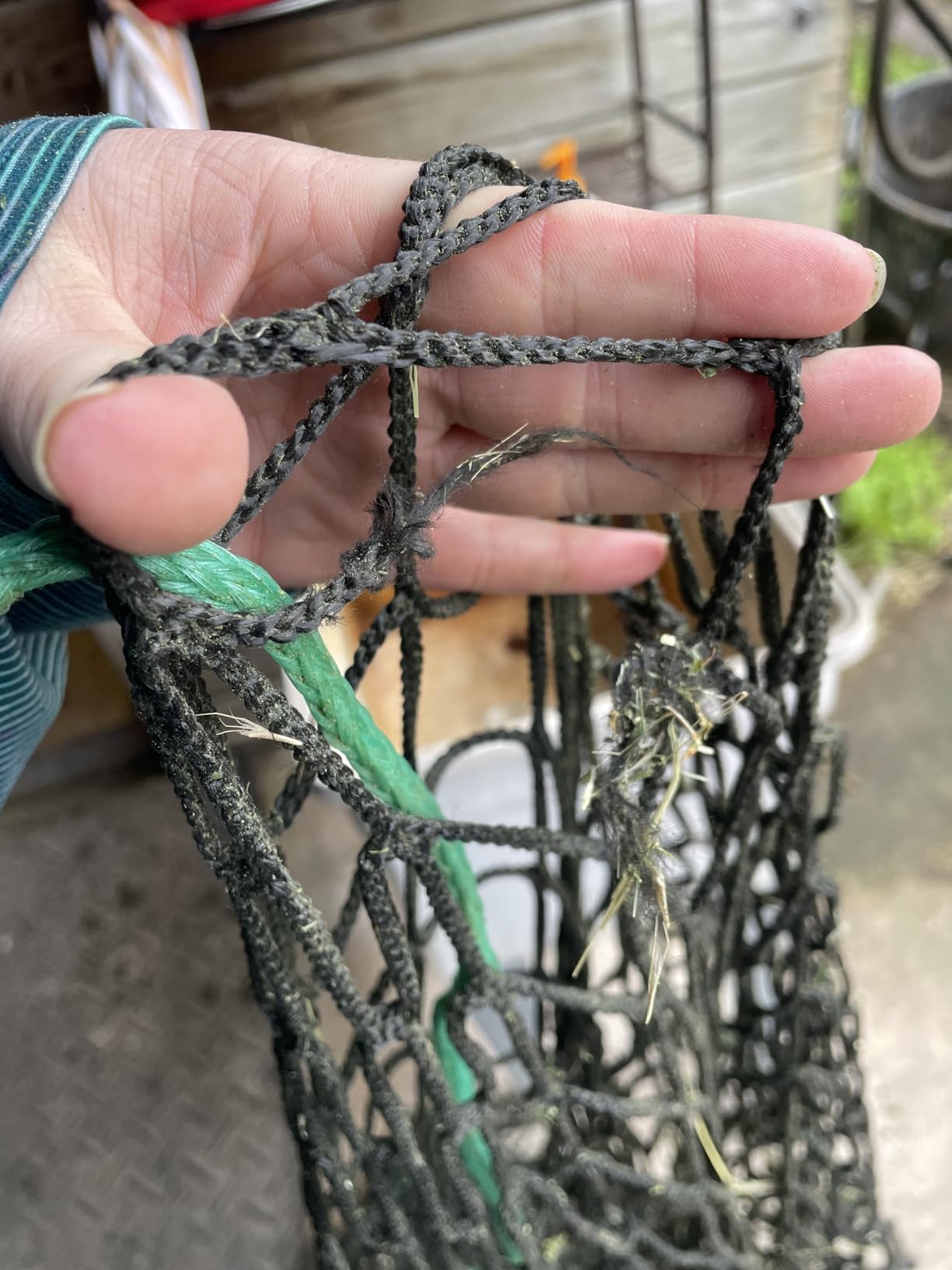
Replace the tie rope before the first use. It is the single most repeated complaint in the reviews, and almost every owner who swapped it out reported a better result immediately.
Plan for the effort of fitting. Owners say it is hard to get on and cinch on a full bale, and the simplest method is to lay the net flat on the ground and roll the bale on top.
Where it falls short
UV exposure degrades the material in roughly nine to ten months, so budget for a yearly replacement rather than treating it as a permanent feeder. Some horses also chew through it after extended daily use.
One reviewer reported failure within a day at the smaller 4×4 size, which is worth knowing if you are ordering that variant. Check the net before you leave the yard with a new bale on it.
4. NETYSAY 2 Inch Hole Round Bale Hay Net – Best for First-Time Owners
NETYSAY 5×5 ft Round Bale Hay Net for Horses – 2 Inch Hole Slow Feeder – 4×4 and 6×6 Sizes Also Available – Knotless Mesh Design – Easy to Put On Over Bales – Built for Everyday Horse Feeding
2 inch slow-feed holes
Knotless mesh
Drawstring closure
6.55 pounds
Pros
- Wide opening makes it easy to fit over a full bale
- Drawstring keeps the net in place
- Available in 4x4 and 6x6 ft sizes
- Consistent construction since launch
Cons
- Any net wears faster with aggressive chewers
- Best used inside a ring or enclosed feeder
- Needs daily inspection for wear
If you have never used a net before, the detail that decides whether you keep using one is the opening. The NETYSAY is built around a wide opening with a secure drawstring, and buyers single out how easily it goes over a full-size bale. That removes the learning curve that trips people up on tighter nets.
It is a 2 inch hole knotless weave, and the listed guidance is to pair it with a hay ring or enclosed feeder to limit hoof contact, plus a daily look at the mesh. That is honest advice rather than marketing, and we would follow it in a pasture with shod horses.
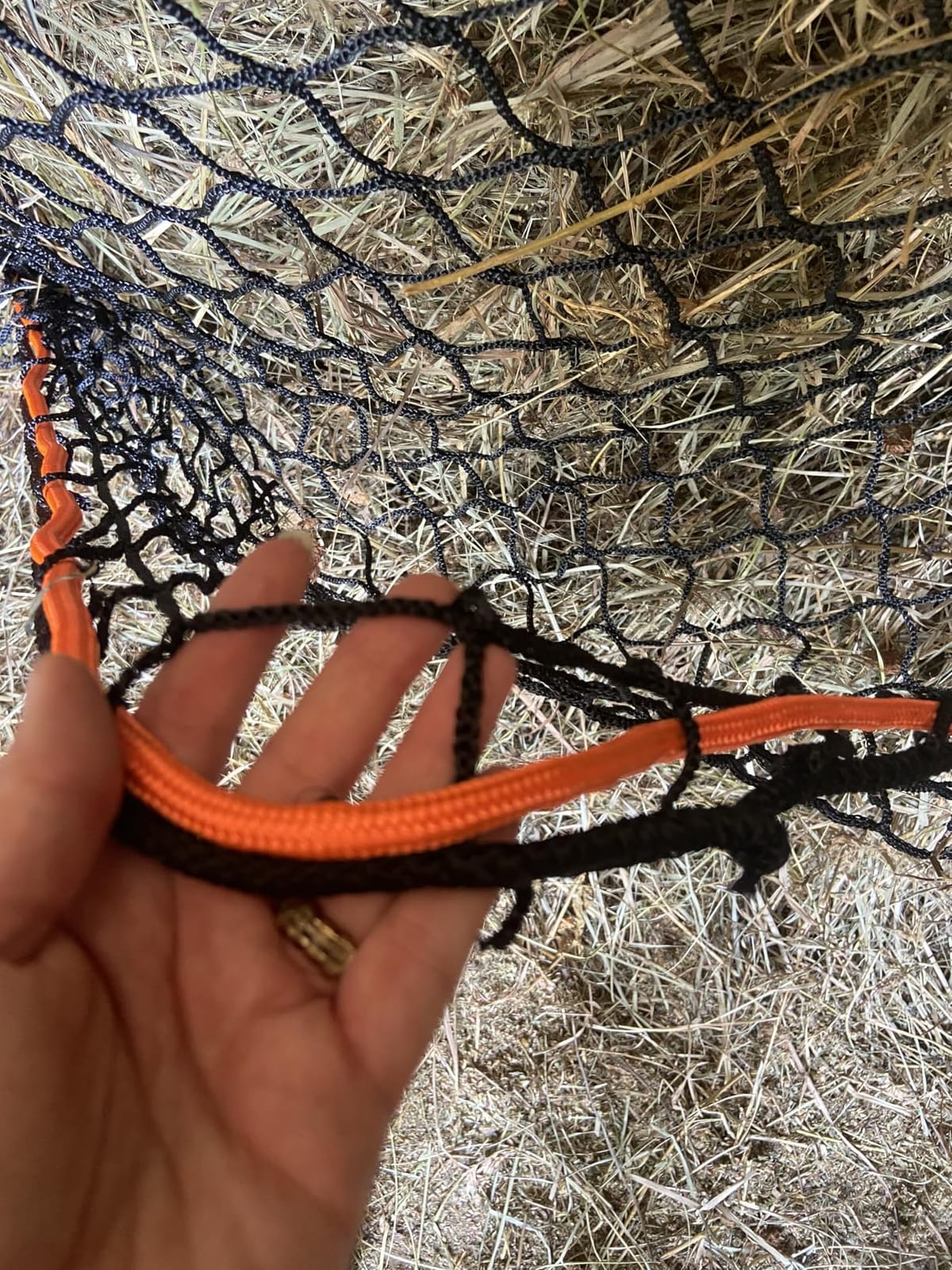
Owners point to two things: noticeably less hay loss, and a knotless weave that stays comfortable on a horse’s mouth through regular outdoor use. The drawstring holds position during feeding rather than working loose, which is a small detail that saves constant re-adjusting.
Three sizes are offered at 2 inch holes, 4×4 ft, 5×5 ft and 6×6 ft. Having the larger version available matters for anyone rolling 5×6 or 6×6 bales, since a 5×5 net stretched over a bigger roll tends to sit poorly at the top.
What to check before you buy it
Match the size to your bale rather than to your horse. The 4×4, 5×5 and 6×6 versions are the same mesh with different footprints, and picking the right one is what makes the closure sit flat.
Set up a fixed feeding spot. Because the design assumes use inside a ring or enclosed feeder, a loose net in the middle of a muddy field will pick up damage faster than it should.
Where it falls short
No net holds up to a horse that chews, pulls or paws aggressively, and this one is no exception. The wear rate depends far more on the animal in front of it than on the brand name.
At 2 inch holes it does very little to slow an easy keeper down. If your problem is one horse finishing a whole bale in a day, this is the wrong tool.
5. Bloomoak Large Round Bale Hay Net – Best for Big Rolls
Bloomoak Large Round Bale Hay Net for Horses, 5 * 5 Feet Knotless Design Slow Feed Hay Net Feeder for Livestocks, with 1.5″ Hole/2.5″ Hole (1.5″ Hole for Slow Feed)
UV-resistant PE
Up to 2200 lbs tension
1.5 or 2.5 inch holes
Self-locking ties
Pros
- Stretches over 700 lb alfalfa bales
- Very low hay loss reported
- Self-locking ties cut hoof entanglement risk
- Available in 1.5 and 2.5 inch holes
Cons
- Durability is mixed with holes forming inside 6 months
- Top opening will not cinch fully closed
- 1.5 inch holes can catch the heads of goats and donkeys
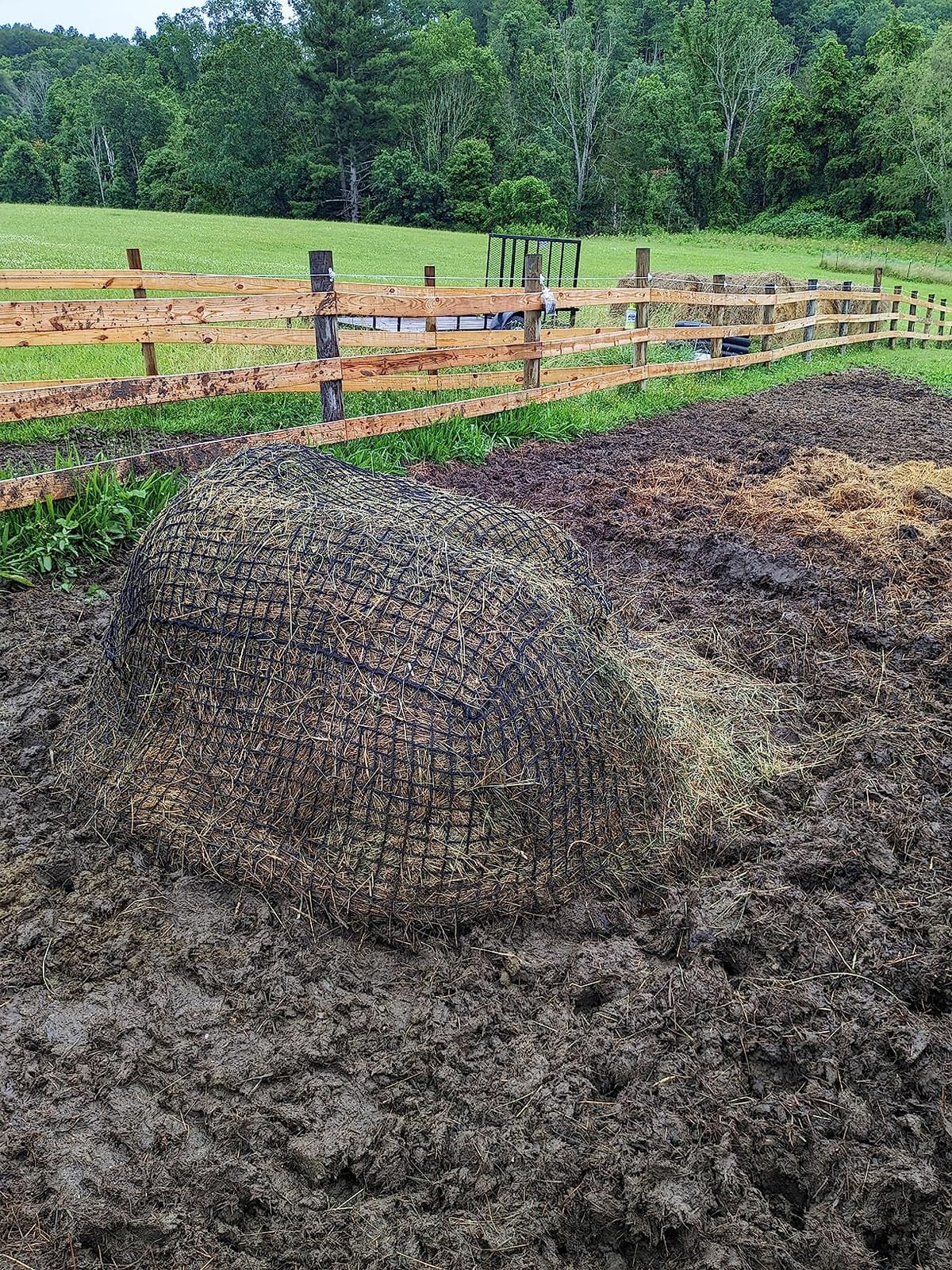
This is the net to look at if your hay comes off as heavy alfalfa rolls rather than grass bales. Owners report it fitting 5×5 bales perfectly and stretching over 700 lb alfalfa bales, which is a load most of the nets here are not tested for.
The waste reduction is the standout. Buyers report a third or more of the bale no longer wasted, and several say the net paid for itself in saved hay within months. The 1.5 inch version is the slow-feed option, and a 2.5 inch version is offered for animals that need to move faster.
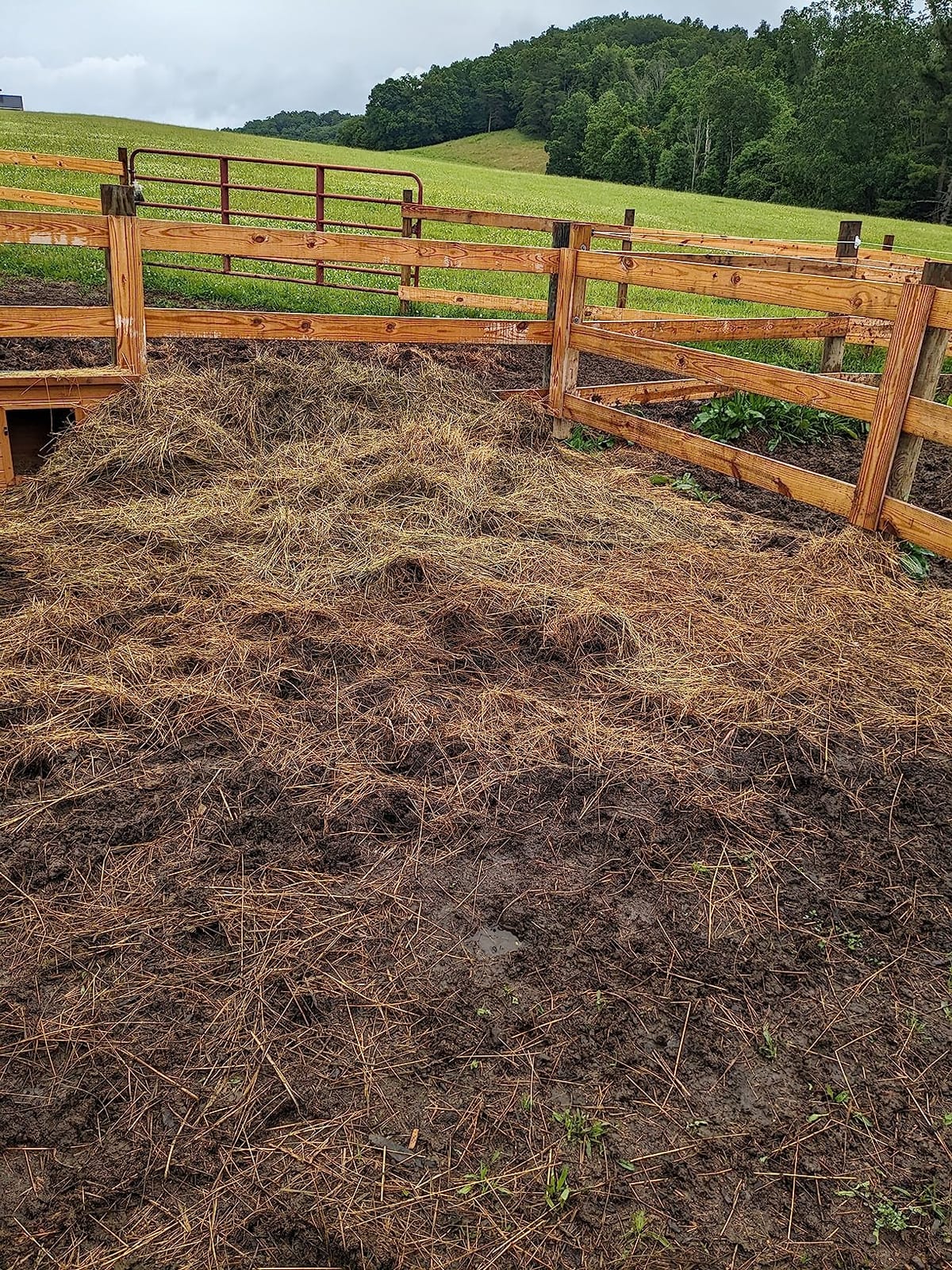
Construction is UV-resistant PE rated to 2200 lbs of tension, with a knotless smooth design that protects teeth and resists fraying. The bright green drawstring is easy to find in grass or mud, and the included self-locking ties reduce the chance of a hoof catching a loose end.
It fits 5x5x5 ft round bales and 3x4x8 ft square bales. That square bale compatibility is useful if you buy from a supplier who rolls large squares part of the year.
What to check before you buy it
Test the top closure on a full bale before you rely on it. Owners report that the top opening does not cinch fully closed, which leaves a gap a determined horse can reach through and pull hay from.
Check the bale weight. Heavy alfalfa rolls stress the mesh far more than light grass bales, and if your rolls run 700 lb or more, look for the strongest strand construction on the list rather than the cheapest.
Where it falls short
Durability is the dividing line in the reviews. Some owners have no issues at all, while others report large holes forming within about six months, so treat this as a seasonal purchase rather than a permanent one.
The 1.5 inch version is not suitable for goats or donkeys, who get their heads caught in the mesh. That warning is specific and worth repeating if you run a small-ruminant pasture alongside the horses.
6. kingump 1.5 Inch Slow Feeder Hay Net – Best for Mixed Herds
kingump 5×5 ft Round Bale Hay Net for Horses & Goats, 1.5″ Holes Slow Feeder Hay Nets with Hay Net Repair Tool
1.5 inch slow-feed holes
Knotless smooth mesh
Repair tool included
8.47 pounds
Pros
- Holds up to horses and goats in the same pasture
- 1.5 inch holes slow intake without frustrating the herd
- Includes repair tool and spare cord and zip ties
- Closure stays tight over time
Cons
- Closing rope is not pre-installed and has no instructions
- Bulky to handle alone and heavier when wet
- Strong enough that a shod horse can catch a shoe
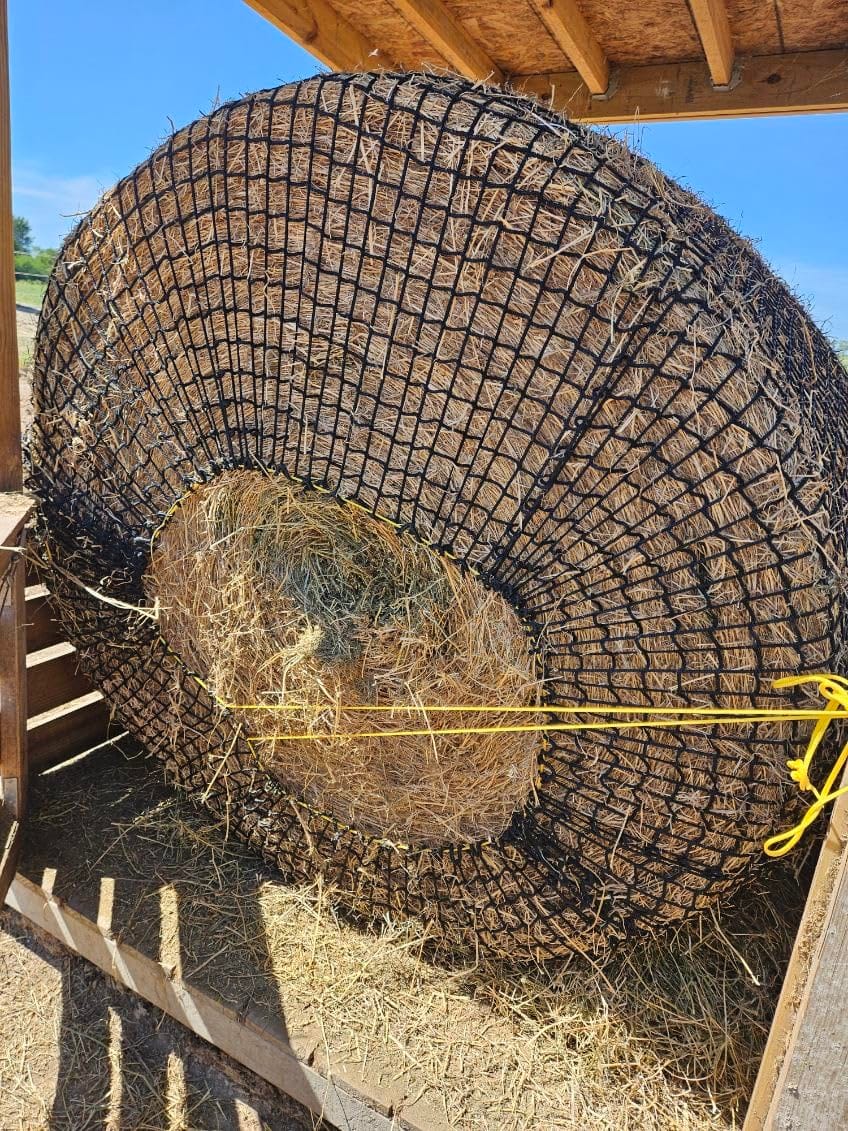
Mixed herds are where a lot of feeders fail, because cattle tear the hay out and horses tear the net. The kingump is one of the few here that owners specifically report working for horses and goats together, with thick mesh that holds up to both without tearing.
The 1.5 inch holes slow the herd enough to cut waste without leaving animals frustrated, and owners say the closure stays tight and does not slip over time. Several note it holds up for about a year with daily use.
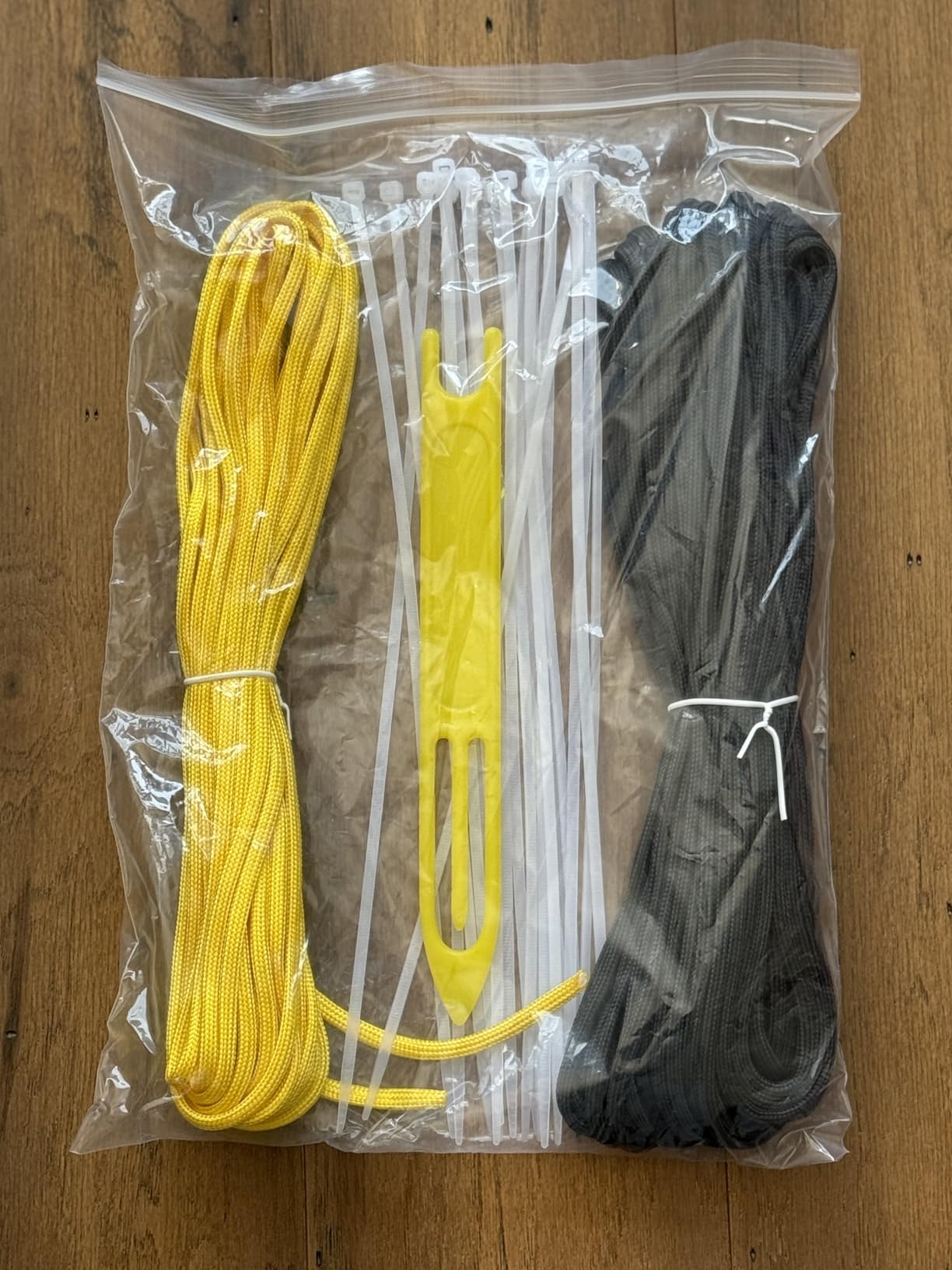
The accessory bundle is better than most. You get repair string, zip ties and a repair tool in the box, which matters more than it sounds once a net has been through a wet winter and one puncture turns into a hole.
It measures 5x5x5 ft and is built from high-strength material with weather resistance for outdoor or barn use. A 2.6×2.6 ft version is also offered if you are feeding smaller bales.
What to check before you buy it
Budget time for the first setup. There is no rope pre-installed at the opening, and it has to be threaded through by hand with no instructions in the box. Watch how someone does it once and it goes quickly after that.
Check whether your animals are shod. Reviewers report the mesh is strong enough that a shod horse can catch a shoe in it, which needs daily attention in a turnout paddock.
Where it falls short
At 8.47 pounds it is one of the heavier nets here, and owners call it bulky to handle alone and heavier in wet weather. Wet mesh on a 5×5 roll is a two-person job on a bad day.
Some horses learn to open holes in it over time. Inspect before each new bale rather than assuming the previous check still holds.
7. MIYABALA 5×5 Knotless Round Bale Hay Net – Best Repair Kit
MIYABALA 5×5 Ft Knotless Round Bale Hay Net for Horses, Livestock Feeder
1.5 inch slow-feed holes
Knotless reinforced seams
Free repair kit
7.63 pounds
Pros
- Reinforced seams and knotless netting
- Withstands pawing from a mare
- Works on round and large square bales
- Free repair kit and material in the box
Cons
- Supplied pull cord is slippery and hard to tie
- Unevenly woven through the net edge with gaps
- One report of netting breaking after two uses
The MIYABALA’s strength is construction detail that most listings skip. Owners describe reinforced seams, knotless netting and enough durability to survive pawing, mud and repeated moving, and the build quality is the consistent theme in the reviews.
Waste reduction is the other repeated theme. Buyers report less trampled hay and better weight control for easy keepers over many months, which is the outcome you are paying for with any net.
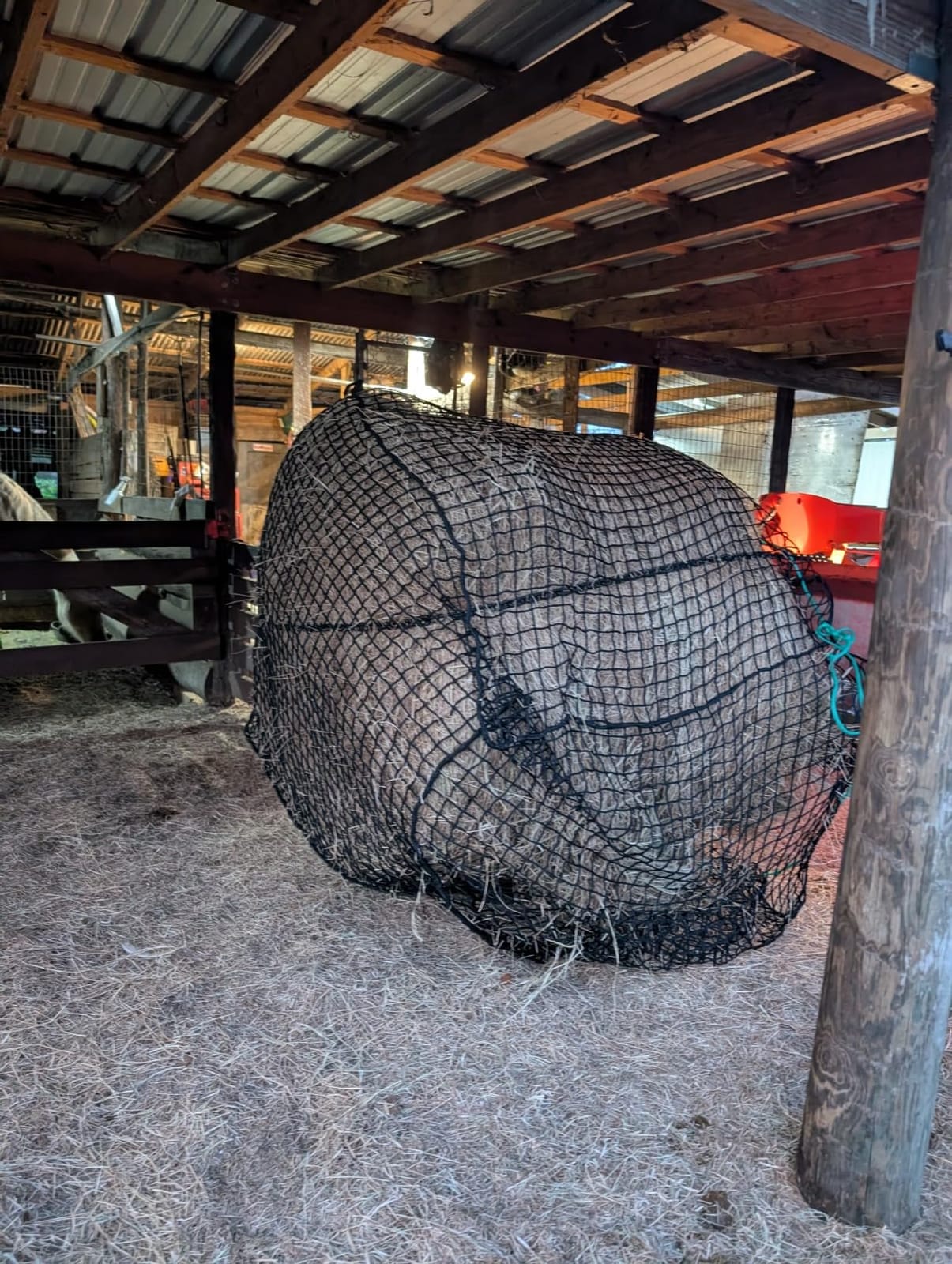
It works on both round and large square bales, which makes it a good pick if your hay delivery is not consistent in format. The 5×5 ft size with 1.5 inch holes suits a slow feed for a stalled horse or a small group.
A free repair kit with repair material is included, and that turns out to matter more than it should. Nets live or die by a single torn seam, and having twine and a needle on hand saves a ruined bale.
What to check before you buy it
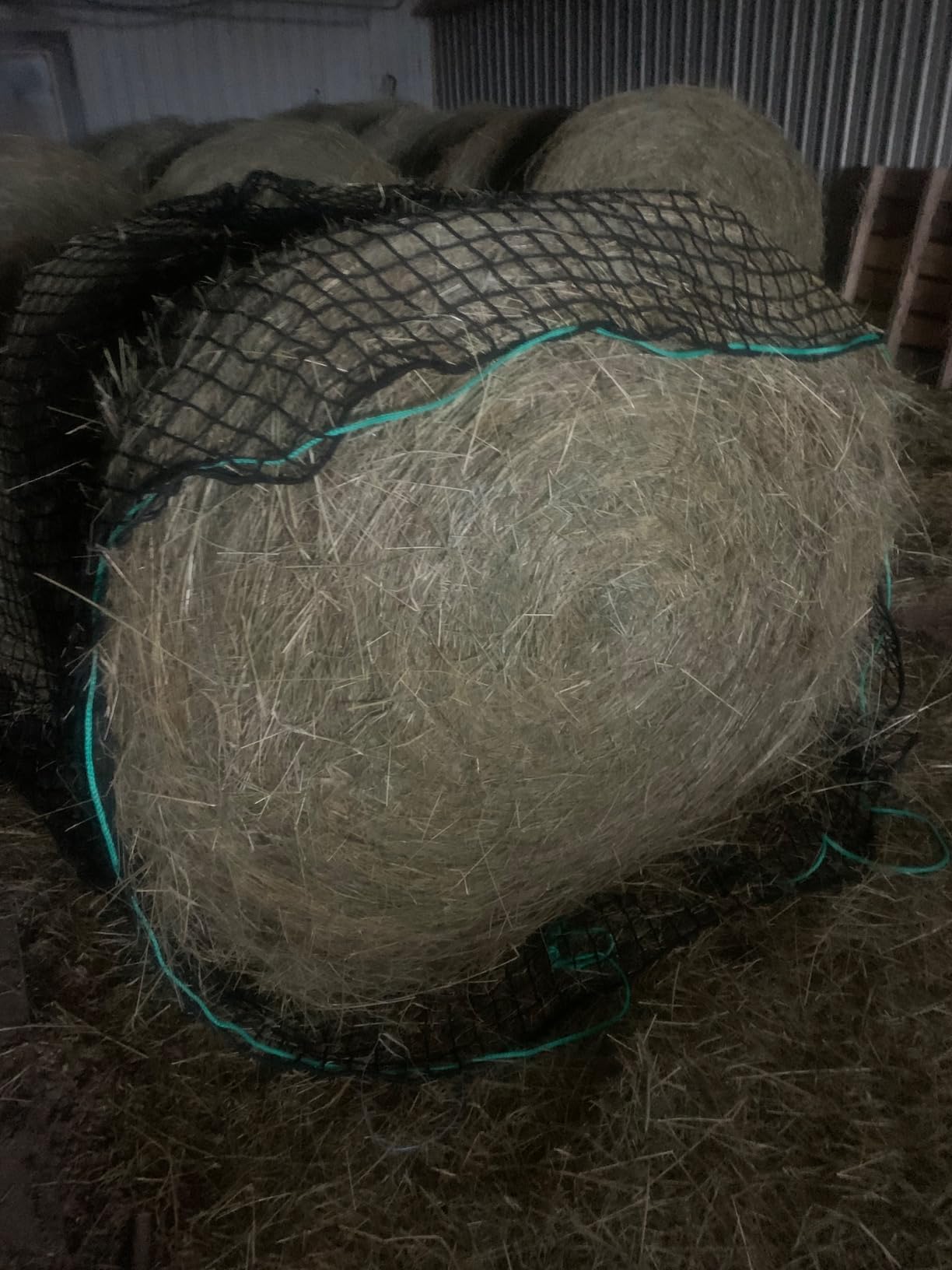
Replace the pull cord. Reviewers find the supplied cord slippery plastic that is hard to tie tightly and unevenly woven through the net edge, leaving large gaps, and many swap in a cotton-style rope instead.
Give yourself two hands for the closure. It can be tight and hard to pull together at the back of the bale, which is a common complaint with any net that cinches at the far side.
Where it falls short
Durability reports are not all positive. One reviewer reports the netting breaking in two spots after only two uses, so inspect the mesh on the first few bales before you leave it out full time.
At 1.5 inch holes it is a slow feed by design. If you need a group of hard keepers to move through a bale quickly, look at a 2 inch net instead.
8. Dayimado Large Round Bale Hay Net – Best Accessory Kit
Dayimado Large Round Bale Hay Net, 6×6 Ft Sturdy Hay Net Slow Feed for Horses, Fits Round Bales 5×5-6×6 or Square Bales 3x3x8-4x4x8 with 1.5″ Holes
4mm nylon rope,2200 lb breaking strength
1.5 inch holes
6x6 ft round size
Repair kit included
Pros
- Most complete accessory kit of any net here
- Round shape is easier to fit than flat nets
- Fits full rolls and 500 lb half blocks
- Comparable quality to expensive name brands
Cons
- Durability varies
- with some reporting large holes within days
- Hard to put on bales
- Does not last as long as pricier alternatives
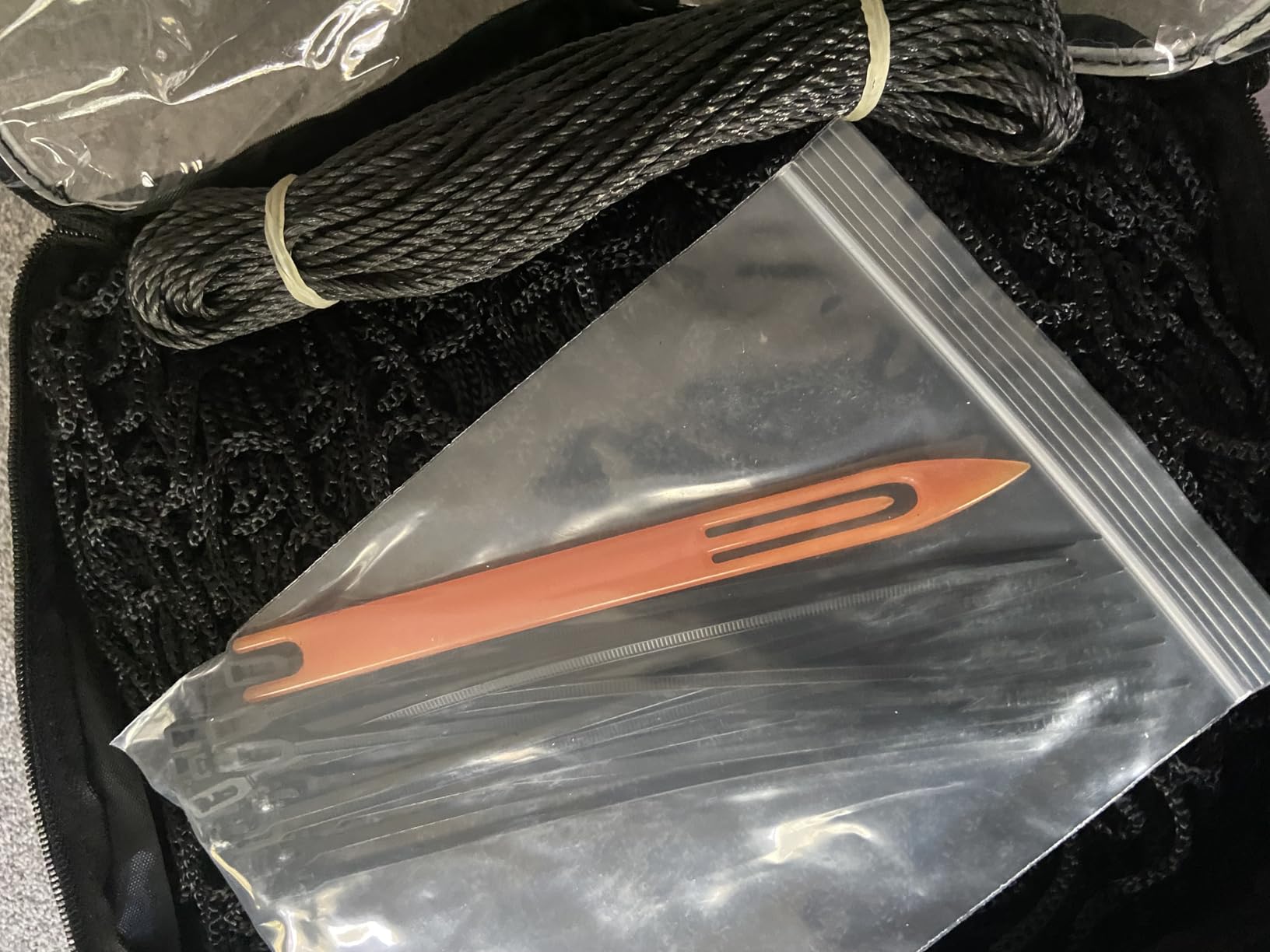
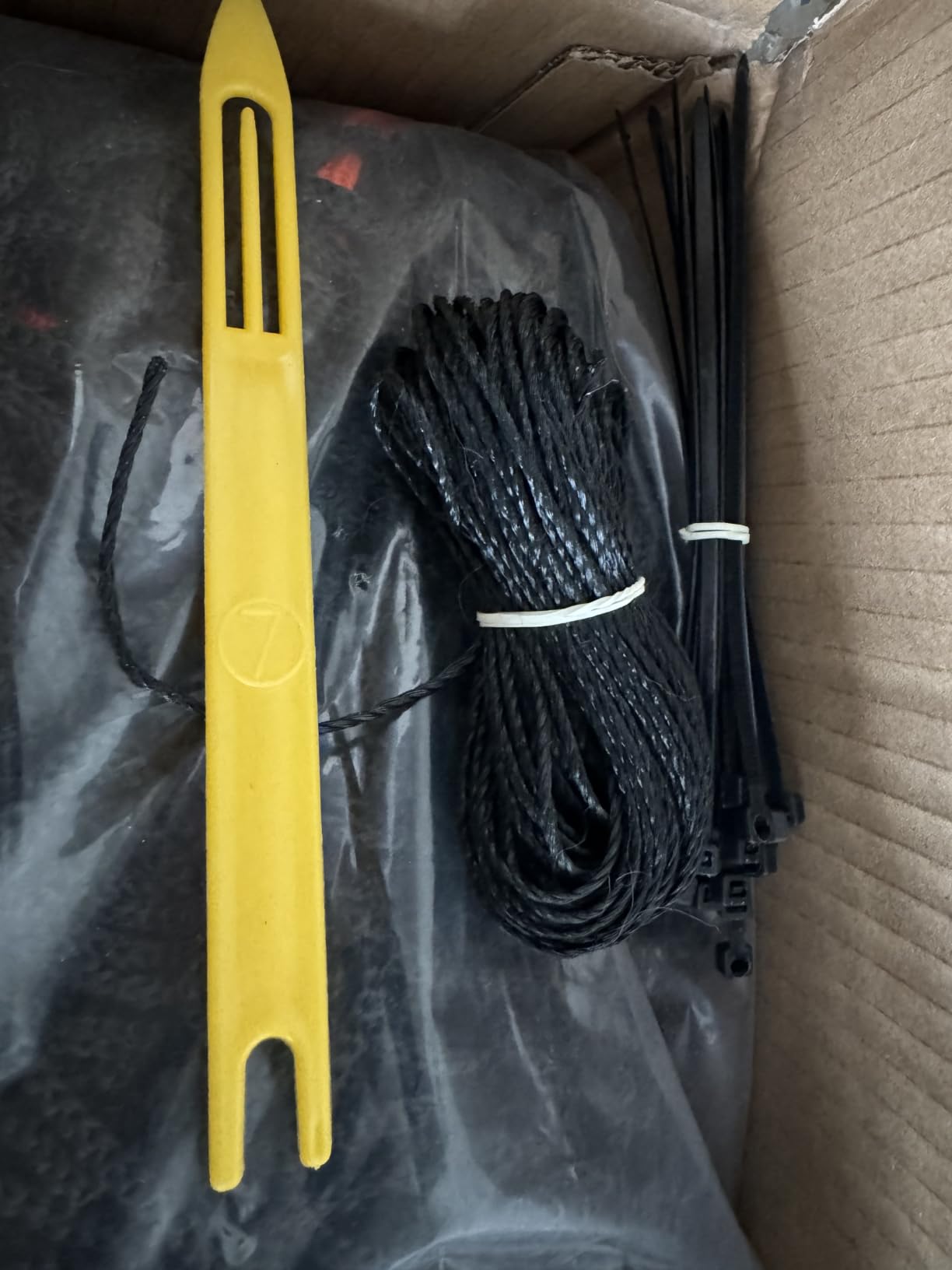
The Dayimado solves a problem most listings ignore: what you do when a net tears in a field at dusk. You get 20 string ties, a 30 ft cinch cord, 66 ft of repair twine and a netting needle shuttle in the box, and no other net here carries a kit anywhere close to that complete.
Owners also like the round shape, which is genuinely easier to slip over a roll than a rectangular net, and several report the material matches pricier name brands. It fits full rolls and 500 lb half blocks, tightening as the bale loosens.
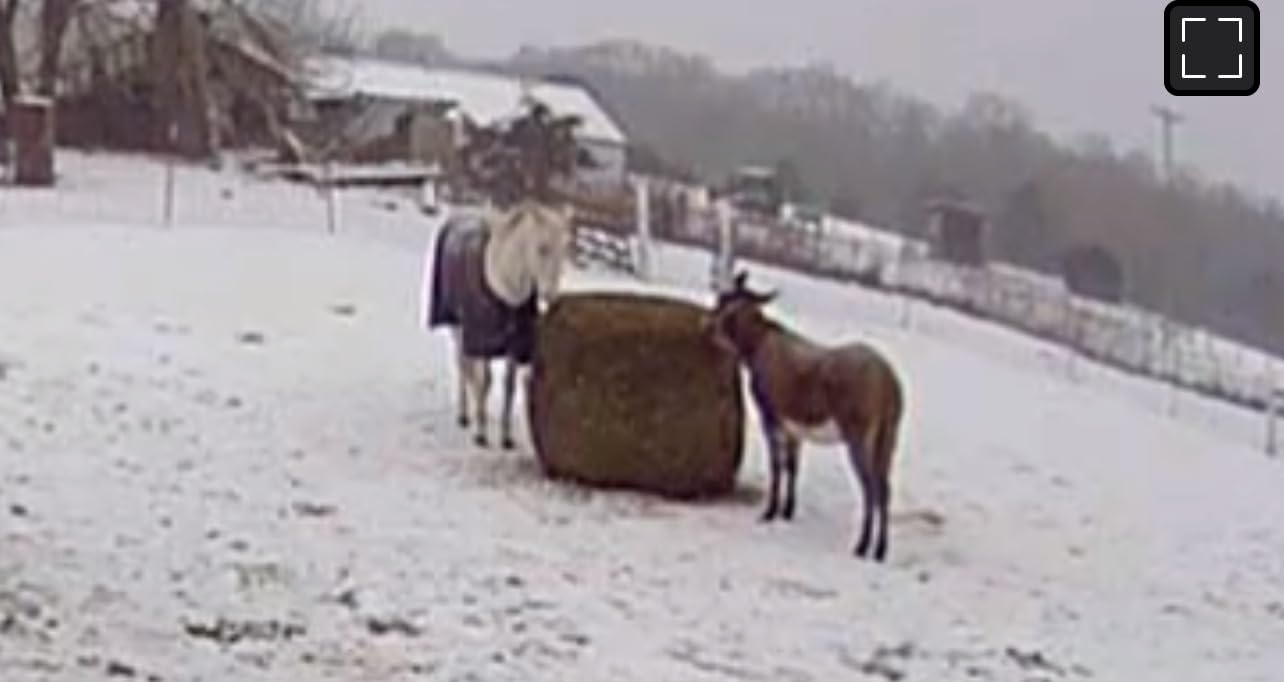
The rope is 4mm diameter nylon with a listed breaking strength of 2200 lb, and 1.5 inch knotless holes that are gentle on mouth and teeth while slowing intake. At 6×6 ft it covers round bales from 5×5 up to 6×6, plus square bales from 3x3x8 to 4x4x8.
One owner reports horses could not rip or bite through it in two months of use, which is a good result for a net at this level. That is the best case; the reviews also contain the opposite experience.
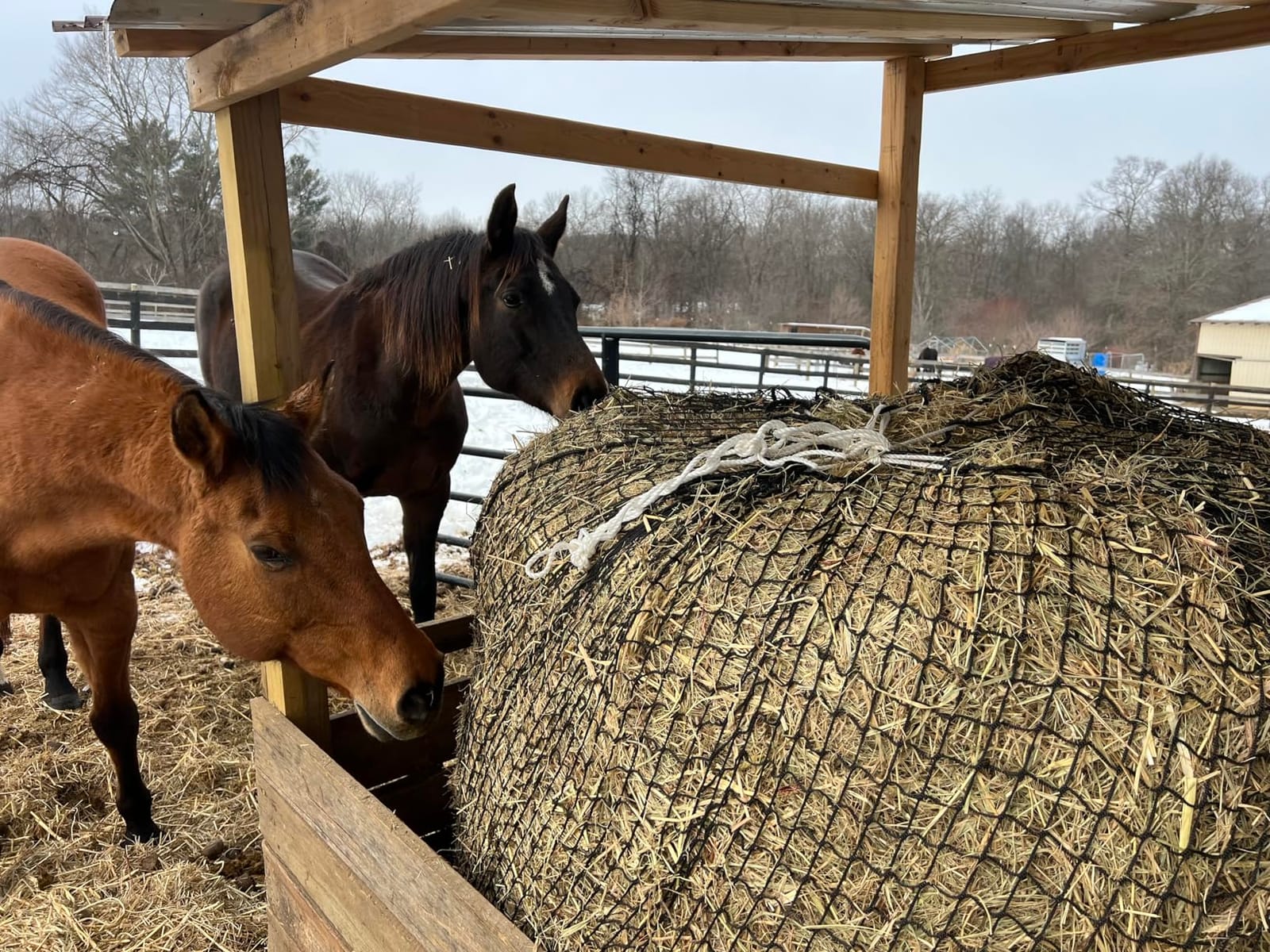
What to check before you buy it
Fitting technique matters more than strength here. Owners report it is hard to put on bales, and the method that works best is to lay the net out and roll the bale on, which takes a loader or a second person.
Match the size to your roll. This is the 6×6 ft version, so a 5×5 bale fits inside it with slack at the top that you will need to gather.
Where it falls short
Durability is inconsistent. Some reviewers report large holes within three days and others that the nets did not last, so value varies a lot from bale to bale.
It does not last as long as higher-priced alternatives for some users. If you are feeding several horses year round, the annual replacement cycle is worth comparing against a heavier strand net.
9. Toofrito 12-Strand Round Bale Hay Net – Best for Tractor Loading
Toofrito 6 * 6ft Completely Upgraded Bolded Round Bale Hay Net for Horses&Livestock, Large Heavy Duty Round Bale Hay Net, 12-Strand Knotless Slow Feeder Hay Net with 2.2inches Holes
12-strand woven polyester
2.2 inch holes
6 ft diameter
Knotless weave
Pros
- Noticeably thicker strands than competing nets
- Soft polyester is easy on gums and teeth
- Stretches around a bale no matter the baler setting
- Includes shuttle rope and cable ties
Cons
- The 6 ft net may not fully close around a 5 ft bale
- Strand is softer than firmer twine
- 2.2 inch holes are generous for a strict slow feed
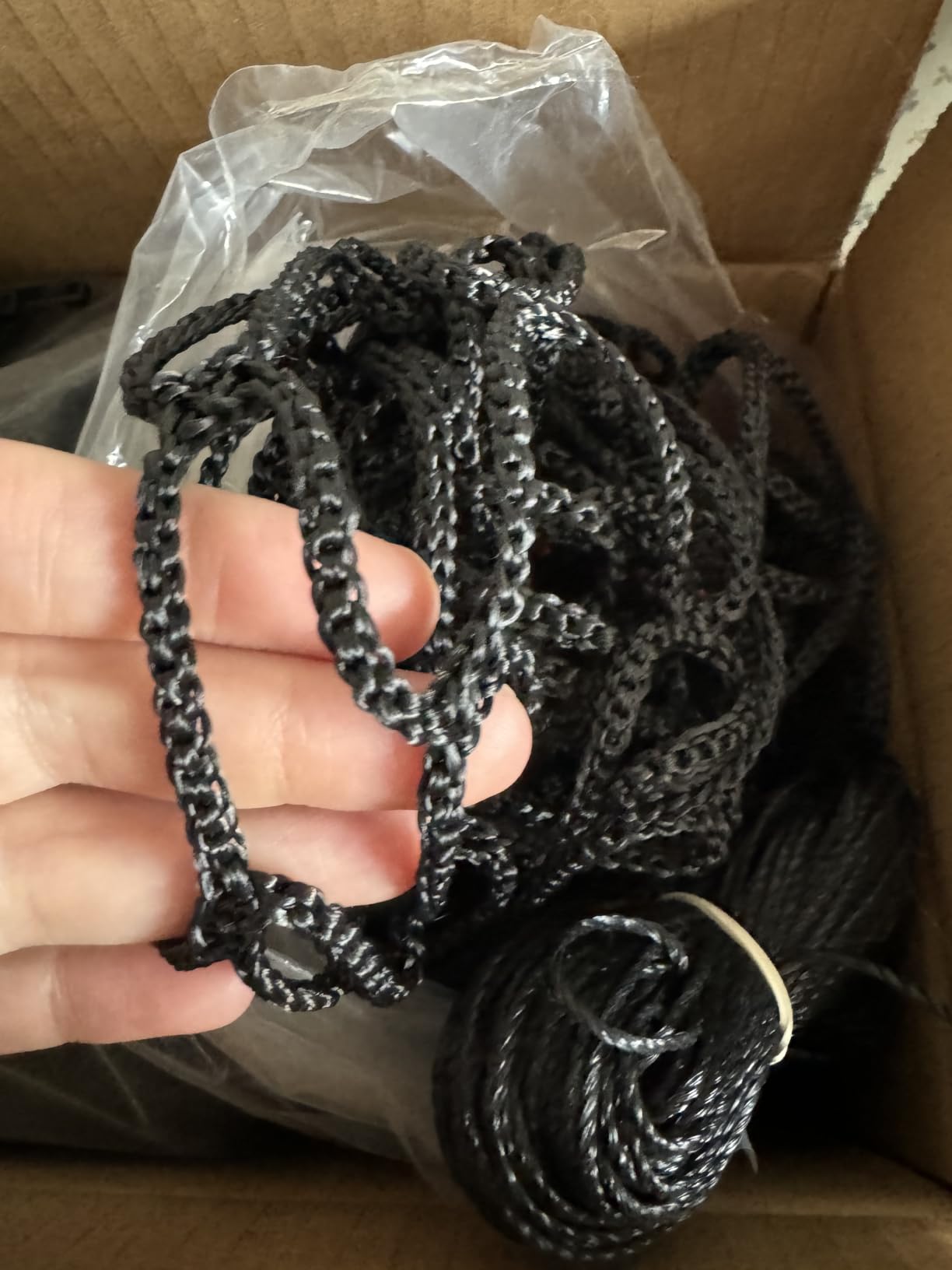
The Toofrito is woven from 12 thick polyester filaments, which reviewers consistently describe as noticeably heavier than the strand on cheaper nets. The soft hand is a specific benefit for horses that already have knot-related gum sores, since there are no knots to catch on.
Its other strength is fit. Owners say it is very stretchy and works around a bale no matter how the baler is set, which solves a real problem when bale density and shape vary between loads.
The loading method is the clever part. Reviewers recommend laying the net on the ground and rolling the bale on top with a tractor, which turns a wrestling match into a two-minute job and is the reason this one earns its spot here.
At 2.2 inch holes it is the most open net in the group. That supports natural-speed eating and keeps the feeding area cleaner, but it is too generous if you are trying to slow down an easy keeper or stretch a single bale across a group.
What to check before you buy it
Measure your bale. The net is listed at 6 ft diameter, and some reviewers report it will not fully close around a 5 ft round bale, so the slack at the top is a real concern rather than a nitpick.
Confirm you have loader access or a helper. The tractor method needs a machine, and without one the fitting is genuinely awkward.
Where it falls short
The softer strand raises durability questions in sun and weather, and one reviewer suspects it will not last as long as firmer twine. Two inch plus holes also do very little slow feeding.
It is not tough enough for goats, which damage it too frequently. Keep it in the horse pasture and use something stiffer for the small-ruminant paddock.
10. Novellaire 1.75 Inch Round Bale Hay Net – Best for Hoof Safety
Round Bale Hay Net for Horses-5x5ft Size, Nylon Net with 1.75 Inch Holes
1.75 inch slow-feed holes
4mm woven nylon
5x5x5 ft sizing
6.17 pounds
Pros
- Stays anchored to the bottom of the bale
- 1.75 inch holes block smaller hooves as the bale flattens
- Durable when washed and reused
- Includes needle and repair kit
Cons
- Durability is inconsistent with some holes within days
- Thin enough that hay can be pulled through and wasted
- No instructions in the box
The Novellaire solves a specific problem: keeping the net engaged with the bottom of the bale. Owners report it stays in place down to the last of the hay, so even a greedy mare cannot cheat her way around it, and the 1.75 inch holes stop smaller hooves getting in as the bale flattens.
That hoof detail is why it earns its place on a list where most nets are 2 inches or wider. If you have a young horse, a pony or a shod animal in the same group, hole size is a safety decision before it is a feeding one.
Construction is 4mm thickened, tightly woven nylon rope with a knotting process for strength, and it measures 5x5x5 ft for 4×5 and 5×5 round bales. Owners report it washes and holds up for reuse across multiple bales, and it comes with a large needle, spare rope and a repair kit.
One detail worth respecting is the manufacturer’s own note: if you tie the net up rather than laying it over the bale, the effective bale size drops sharply. Layout matters more with this design than with a net that cinches tightly.
What to check before you buy it
Set the net on the ground with the largest surface area flat and roll the bale on. The listing is explicit that keeping maximum contact with the ground is what prevents a horse reaching the hay directly.
Buy it alongside a thicker model if your horse is known for pulling hay through mesh. Reviewers who report wasted hay are usually describing exactly that behavior.
Where it falls short
Durability splits the reviews. Some owners report no holes after months with a group of horses, while others say it fell apart after a single bale or that horses opened holes within two days.
There are no instructions in the box and the included zip ties and string are unexplained, and reviewers call the net thin enough that hay can be pulled through and wasted.
How to Choose a Round Bale Feeder in 2026
Match the net to the bale you actually buy
Bale notation trips up a lot of first-time buyers. A 4×4 bale is 4 feet wide and 4 feet tall, a 5×6 is 5 feet wide and 6 feet across, and a net described as 5x5x5 ft is built around that footprint. Buy the net for the bale your producer actually rolls, not the one you saw in a photo.
Check two things: the widest roll you will ever put on the net, and the narrowest. Some nets stretch to cover a bigger bale but then will not cinch flat at the top, and that gap is where hay gets wasted. The 6×6 options on the list are there specifically for 5×5 and 5×6 rolls.
Hole size decides the feeding rate
Every hole size on this list is between 1.5 and 2.5 inches, and that single number has a bigger effect on how long a bale lasts than the brand or the material. A 1.5 inch net stretches a bale the longest and suits easy keepers and stalled horses. A 2 inch net balances waste control with the pace a group of horses needs. A 2.2 or 2.5 inch net mostly keeps hay off the ground rather than slowing anyone down.
Match the mesh to the animal rather than the animal to the mesh. A 1.5 inch net is excellent for a horse and a poor idea for goats and donkeys, who get their heads caught in tight mesh.
Ring feeder or net: the structural decision
If your hay is going to cattle, most operations still use a steel or polyethylene ring because it holds several bales, survives being hit with a loader, and needs no daily inspection. A CattleToday poster running eight Century poly feeders reports they held up for 15 years and are easy to move, while another owner in that same thread feeds big squares in a round feeder and says a hay saver ring on the bottom cuts waste way more than a bare ring.
Style choice inside the steel category matters more than most buyers expect. Another poster on CattleToday recommends poly rings after seeing a cow die with her head hung in a cradle-style feeder, and warns that cone feeders are not for everyone because a mushroomed baleage that collapses can take an animal with it. That is why we weight ring and net designs here and flag cradle and cone styles in the safety section below.
What actually cuts waste is feeding discipline
The honest finding from growers is that feeder design matters less than habit. A CattleToday poster puts it plainly: a lot of waste comes from the type of hay, how you store it and how often you feed it, and the fix is to wait until the current bale is mostly cleaned up before putting the next one out. Another adds that feeding through a manger or a feed gate produces close to zero waste for a larger herd.
Extension research backs the habit up. Solid bottom sheeting reduces hay losses by 15 to 20 percent, and an 8-12 hour access window per day brings waste to about 10 percent. Both are free compared with a new feeder, so change the routine before you change the equipment.
Ground conditions and moving a feeder
Where the feeder sits decides how long it lasts. Steel that sits in mud and manure year round corrodes from the bottom ring outward, and a poster on the Red Power forum recommends Sioux Steel specifically on the condition that you do not leave it in mud. Poly handles wet ground better but can be punctured by a sharp edge, and nets need to be moved and re-inspected as the bale shrinks.
For mobility, loop legs beat flat skids in soft ground because they sink less, skids are stronger on rock, and a three-point hitch feeder is the right answer if you already own a loader and rotate paddocks. If you move bales with a loader, buy the net that fits over a bale you can roll onto it rather than one that has to be stretched by hand.
Goats and sheep need a different setup
Goats destroy feeders. One CattleToday poster says simply putting a bale in the goat pen leads to tons of waste, and several of the nets on this list carry explicit warnings about small heads caught in tight mesh. Goats and sheep do better with a raised, slatted feeder or a heavy-duty panel feeder than with a horse net.
Where hay is shared with wildlife rather than cattle, a different category of feeder applies altogether, and our pick of the 8 Best Automatic Deer Feeders covers that side of the yard. The same applies to anything smaller than a deer that is competing for the pile, where our review of the 8 Best Squirrel-Proof Bird Feeders covers keeping feed off the ground where smaller animals can reach it.
Feeder Safety: Head Traps, Mushroomed Bales and Mud
No vendor page in this category mentions accidents, which is why this section exists. The documented mechanism behind a head trap is simple: a cow reaches into a gap, the gap closes around the head or neck under pressure, and the animal cannot back out. Open cradle-style designs are the worst case, and the CattleToday thread contains a report of a cow dying with her head hung in one.
There is a second failure mode that nobody warns you about. A poster on CattleToday reports losing an animal when a mushroomed baleage collapsed on its neck inside a cone feeder, which is a direct warning against cone feeders if you handle wet bales. Wet baleage that has gone unstable can also shift without warning, so keep livestock out of the drop zone when you open one up.
With nets, the risks are different and easier to manage. Hooves can get caught in mesh, particularly with shod horses, so check daily, keep the net off bare rock edges, and place it inside a ring or enclosed feeder where possible. Never place a net where a horse can reach hay without going through the mesh.
Frequently Asked Questions
What are the best round bale feeders for cattle?
For cattle, a galvanized or polyethylene ring feeder with a solid or skirted bottom is the standard choice because it holds multiple bales, survives loader contact and needs no daily inspection. Add a hay saver ring on the bottom to cut waste. University of Kentucky Extension reports solid bottom sheeting reduces hay losses by 15 to 20 percent. Skip open cradle designs, where a cow’s head can get trapped.
What is a good slow feeder for round bales?
A knotless mesh hay net is the standard slow feeder for round bales. Hole size sets the pace: 1.5 inch stretches a bale the longest and suits easy keepers, while 2 inches balances waste control with the speed a group of horses needs. Pair the net with a ring or enclosed feeder so hooves cannot reach hay without going through the mesh, and inspect it daily.
What is the best round bale hay feeder for horses?
For horses, a knotless net in the 1.5 to 1.75 inch hole range is the safest and slowest option, and a ring or enclosed feeder around it protects the mesh from hooves. Knotted mesh is tougher but rougher on gums. Horses should never reach loose hay around the net, since that undoes the waste saving and lets them pull hay off the ground.
How long will a round bale of hay last one cow?
Loose-fed, a 1,000 lb round bale can be stripped in a few days by a group of cattle. Inside a ring feeder with a solid or skirted bottom it commonly stretches to a week or more, and netted hay stretches far longer again. The Minnesota State Cattlemen’s Association reports that limiting cattle to 8 to 12 hours of feeder access in a 24-hour window brings waste down to roughly 10 percent.
How many cows will one round bale feed a day?
It depends on bale weight, hay quality and how much waste you accept. As a working rule, a 1,000 lb round bale feeding 20 mature cows for a full day leaves very little margin, while 12 to 15 head will finish it comfortably. Adding cattle to a feeder does not reduce total waste, it just means more animals competing at the same hay face, so more feeding points is usually the better answer.
Do round bale hay nets work?
Yes, for horses and small herds they work very well. A net keeps the whole bale intact, holds it off the ground and slows intake, and owners regularly report a bale lasting two to three times longer than loose-fed. The trade is handling, since the net has to fit over a full bale, and a net in a field without a ring can be punctured by hooves, so daily inspection matters.
Our Final Verdict on the Best Round Bale Feeders in 2026
If you only buy one, take the Texas Haynet. It has the longest owner history in the group, the widest bale fit range and a 1.75 inch opening that works both in a stall and in a pasture. If you rate a higher average score higher than longevity, the TONGMO at 4.4 is the pick, and it is the easier net to fit on a full bale.
For cattle, none of these nets is the right answer. Buy a galvanized or poly ring feeder with a solid or skirted bottom, avoid open cradle designs, and control waste with an 8 to 12 hour access window rather than with equipment alone. For horses, buy a knotless net sized to your bale, pair it with a ring, and replace the supplied closure cord on day one.
The best round bale feeders are the ones matched to your bale, your animal and your ground, and matched to the feeding habit you are actually willing to keep. Measure first, buy second, and check the mesh daily.