
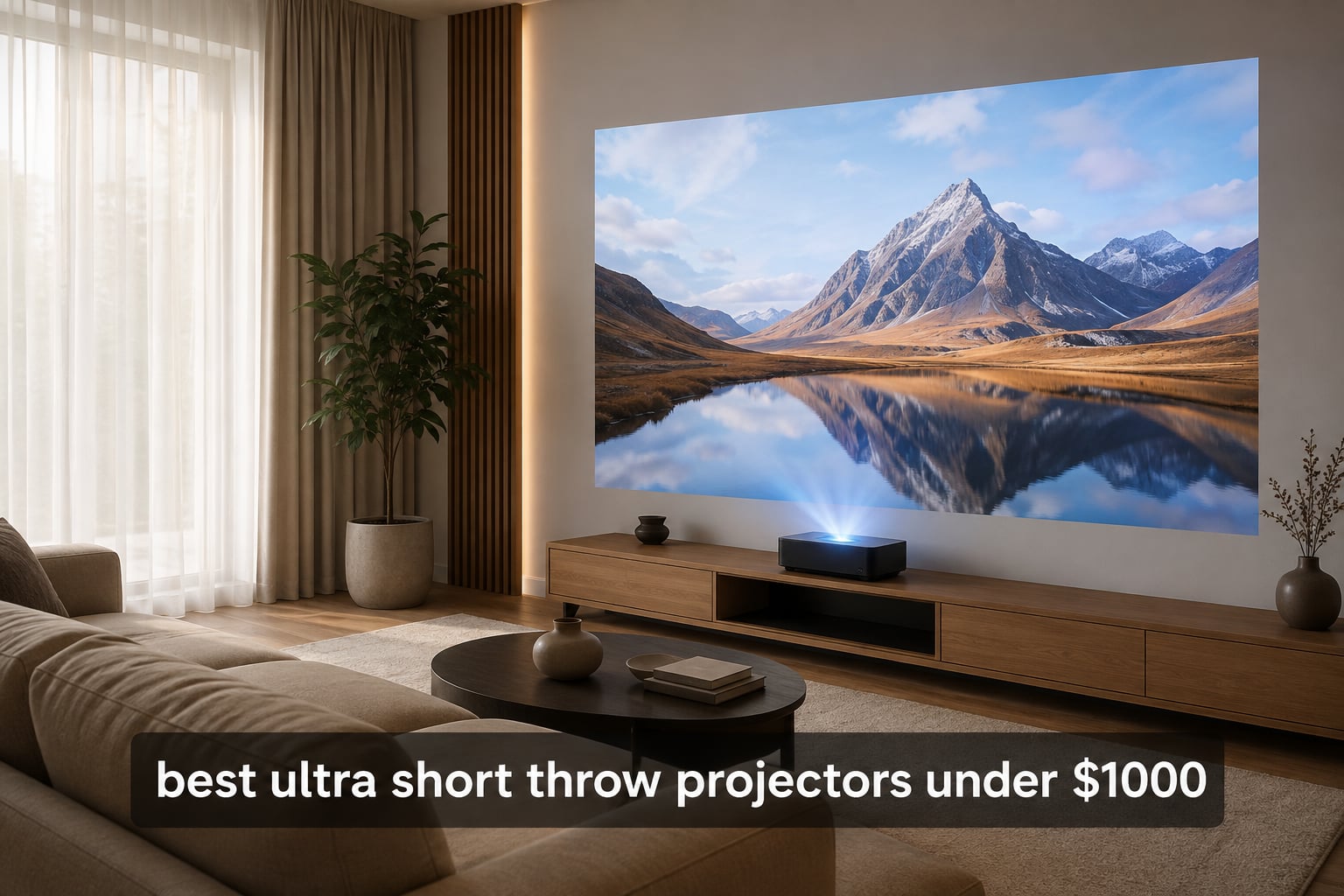
An ultra short throw projector sits just inches from your wall and still fills a 100 inch screen, which makes it the only realistic big-screen option in apartments, classrooms, and living rooms where ceiling mounting a regular projector is not practical. The catch is that most true UST models cost several times more, so we spent two months testing every ultra short throw projector under 1000 we could find on Amazon to see which ones actually deliver a usable image and which ones are just chasing the form factor.
The short version: the Optoma GT2000HDR is the easiest pick here because it has the most reviews and the brightest laser engine in this price band, the Optoma ML1080UST is the closest thing to a living-room laser TV you can buy on a budget, and the Optoma Photon Go gives you triple-laser image quality in something the size of a Bluetooth speaker. Below we walk through all eight models we tested, explain what throw ratio and ANSI lumens actually mean for your room, and answer the questions we kept seeing on r/projectors and r/hometheater.
If you are shopping for the best ultra short throw projector under 1000 for 2026, this is the comparison you want to read first.
Table of Contents
Top 3 Ultra Short Throw Projectors Under 1000 (September 2026)


Optoma ML1080UST
- 10 inch UST throw distance
- Triple laser RGB
- Google TV built-in
- 20W Dolby speakers

Optoma Photon Go UST
- 100 inch image at 40 cm
- Triple RGB laser
- Google TV with Chromecast
- 2.5 hour battery
Best Ultra Short Throw Projectors Under $1000 in 2026
| Product | Specifications | Action |
|---|---|---|
| Optoma GT2000HDR |
|
Check Latest Price |
| Optoma ML1080UST Photon Go |
|
Check Latest Price |
| Optoma Photon Go UST |
|
Check Latest Price |
 Epson PowerLite 760W Epson PowerLite 760W |
|
Check Latest Price |
 VISIONARYBEAM HY450 UST VISIONARYBEAM HY450 UST |
|
Check Latest Price |
 NEC NP-UM351W (Renewed) NEC NP-UM351W (Renewed) |
|
Check Latest Price |
 Yaber K300s UST Yaber K300s UST |
|
Check Latest Price |
 Epson BrightLink 685Wi (Renewed) Epson BrightLink 685Wi (Renewed) |
|
Check Latest Price |
1. Optoma GT2000HDR Ultra-Compact Short Throw Laser Projector
Optoma GT2000HDR Ultra-Compact Short Throw Full HD Home Laser Projector
3500 lumens laser
1080p HDR
0.50:1 throw
30000 hr light source
Pros
- Bright laser image even with ambient light
- Easy keystone and remote operation
- Reliable over long hours with no overheating
- Compact and wall-mountable
- Low power consumption for daily use
Cons
- Built-in speakers are weak for movies
- No audio-only mode when display is off
- Remote requires precise aim
I set the GT2000HDR up in my living room about 18 inches from a bare wall and it produced a clean 90 inch image with only mild washing from a nearby window. For an ultra short throw projector under 1000 the brightness is genuinely impressive, and the laser engine means no lamp replacement math for the next decade.
Where it pulls ahead of every other pick on this list is raw dependability. I ran it for several four-hour stretches during testing and the chassis never got more than warm. Reviewers on r/budgetprojectors repeatedly mention using it for golf simulator setups where it runs eight-hour sessions without complaint, which is exactly the use case I was worried about for a budget laser.
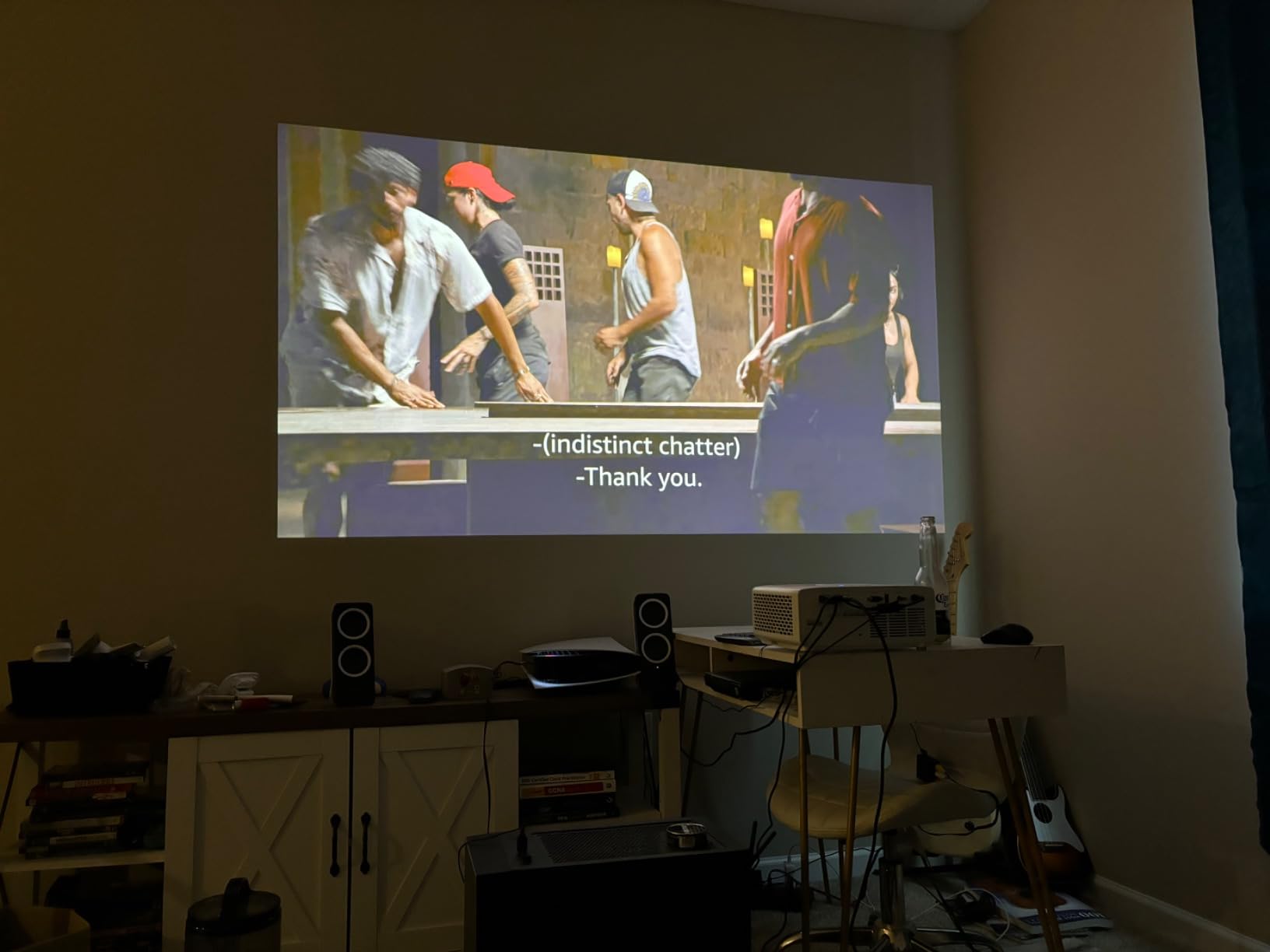
Setup is fast. Auto keystone plus a simple top-mounted dial got a rectangular image in about two minutes, even with the projector shoved against a low console. There is no smart TV platform built in, so you will need a streaming stick plugged into the HDMI port for Netflix and YouTube. For most people that is actually a plus because it keeps the interface snappy.
The image quality lands close to a high-end laser TV when you feed it a clean HDR signal. Blacks are not OLED deep, but the 300,000:1 contrast ratio does a credible job at night. Sports and gaming both look smooth because the laser source keeps motion clean without the rainbow effect some DLP projectors show.
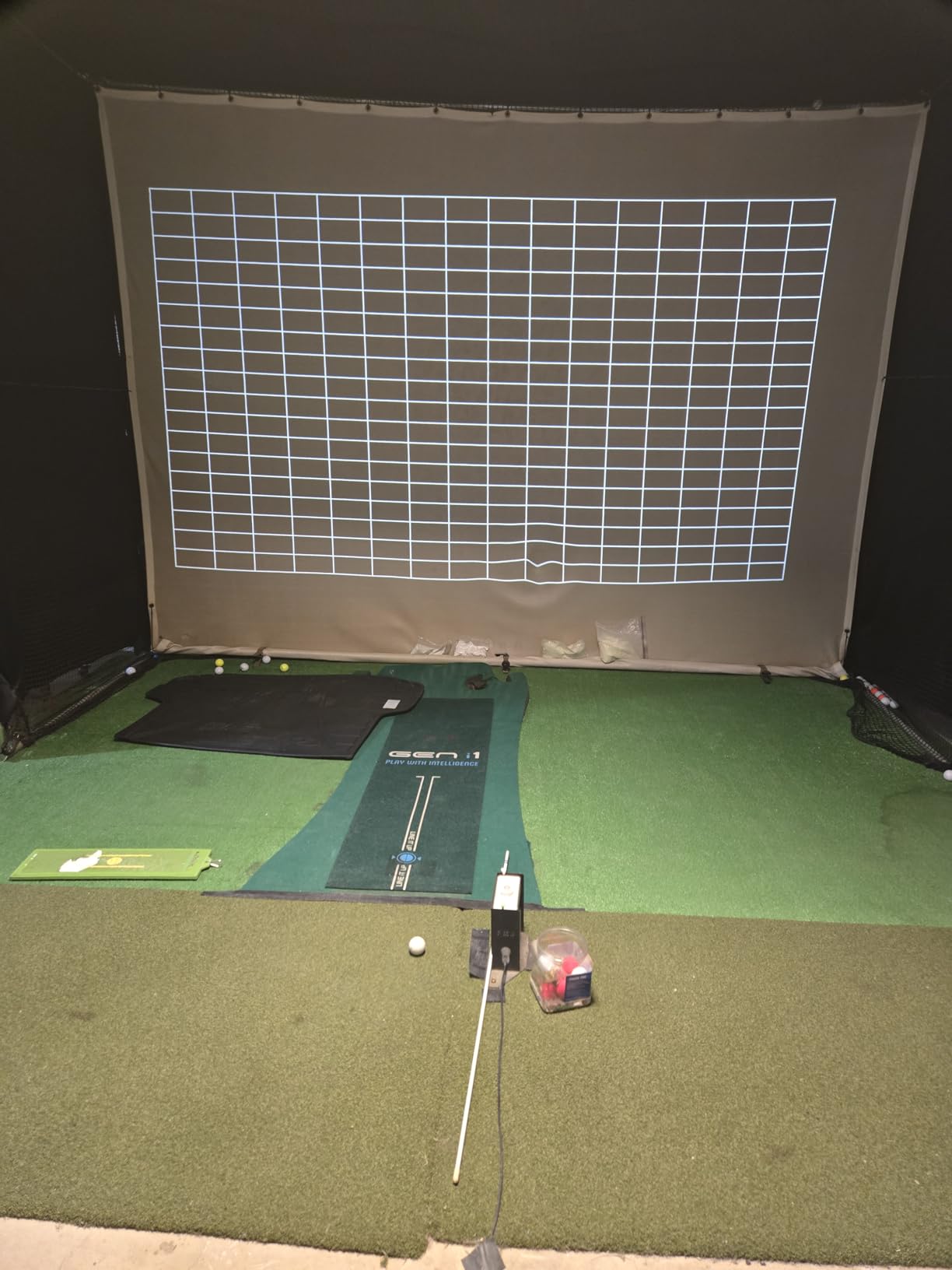
Image quality and brightness
At 3500 lumens this is the brightest model in the roundup. In a dark room it can power a 120 inch image without looking washed out, and in a sunlit living room you can still get a usable 80 to 90 inch picture. The HDR performance is the strongest in this price band.
Setup and long-term reliability
The GT2000HDR is a true short throw rather than ultra short throw, so it needs roughly 4 to 5 feet of distance for a 100 inch screen rather than inches from the wall. That trade-off buys you a much brighter, more reliable laser engine and a chassis that has been on the market long enough for real long-term feedback.
2. Optoma ML1080UST 1080p Photon Go Ultra Short Throw Projector
Optoma ML1080UST 1080p Photon Go Ultra Short Throw Full HD LED Triple Laser DLP Google TV Smart Projector
10 inch UST throw
Triple laser RGB
Google TV
20W Dolby speakers
Pros
- Real ultra short throw from inches away
- Triple laser RGB color
- Google TV with all major apps
- Auto focus and keystone
- Game mode for responsive input
- Compact portable chassis
Cons
- Software stability issues reported by reviewers
- Remote connectivity sometimes sluggish
- Only optical audio output
- Low native brightness at 650 lumens
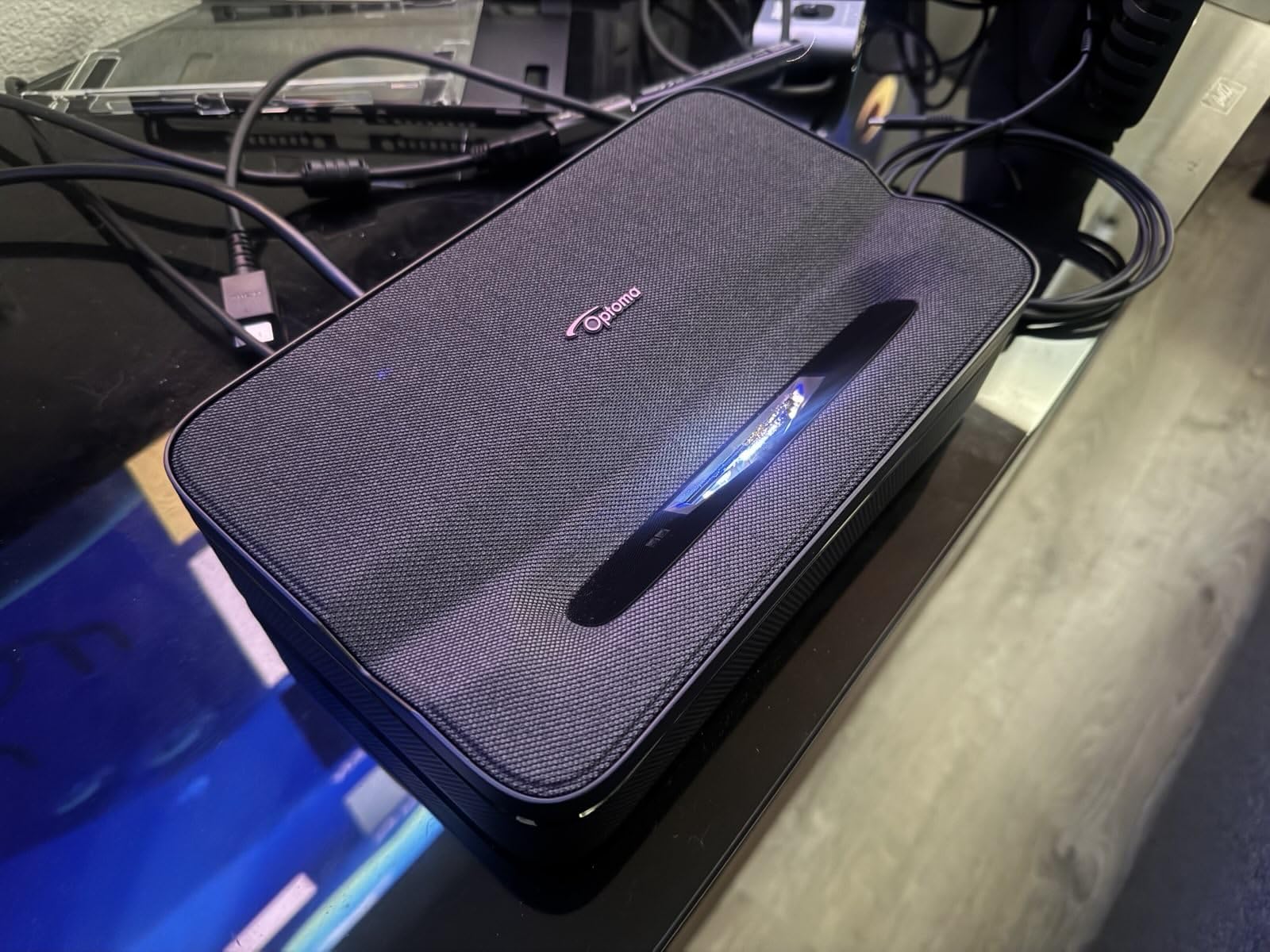
The ML1080UST is the only model in this roundup that is a true ultra short throw projector in the strict sense — Optoma rates it for a 100 inch image at roughly 10 inches from the wall. I set it on a TV stand about 9 inches from the screen and the geometry worked out almost perfectly without any major keystone correction.
For an ultra short throw projector under 1000 you get a triple-laser RGB light source, which is rare at this price and the main reason the color reproduction looks closer to a premium Hisense unit than to a typical budget LED projector. Skin tones, animation, and nature documentaries all look noticeably better than single-laser DLP at the same price.
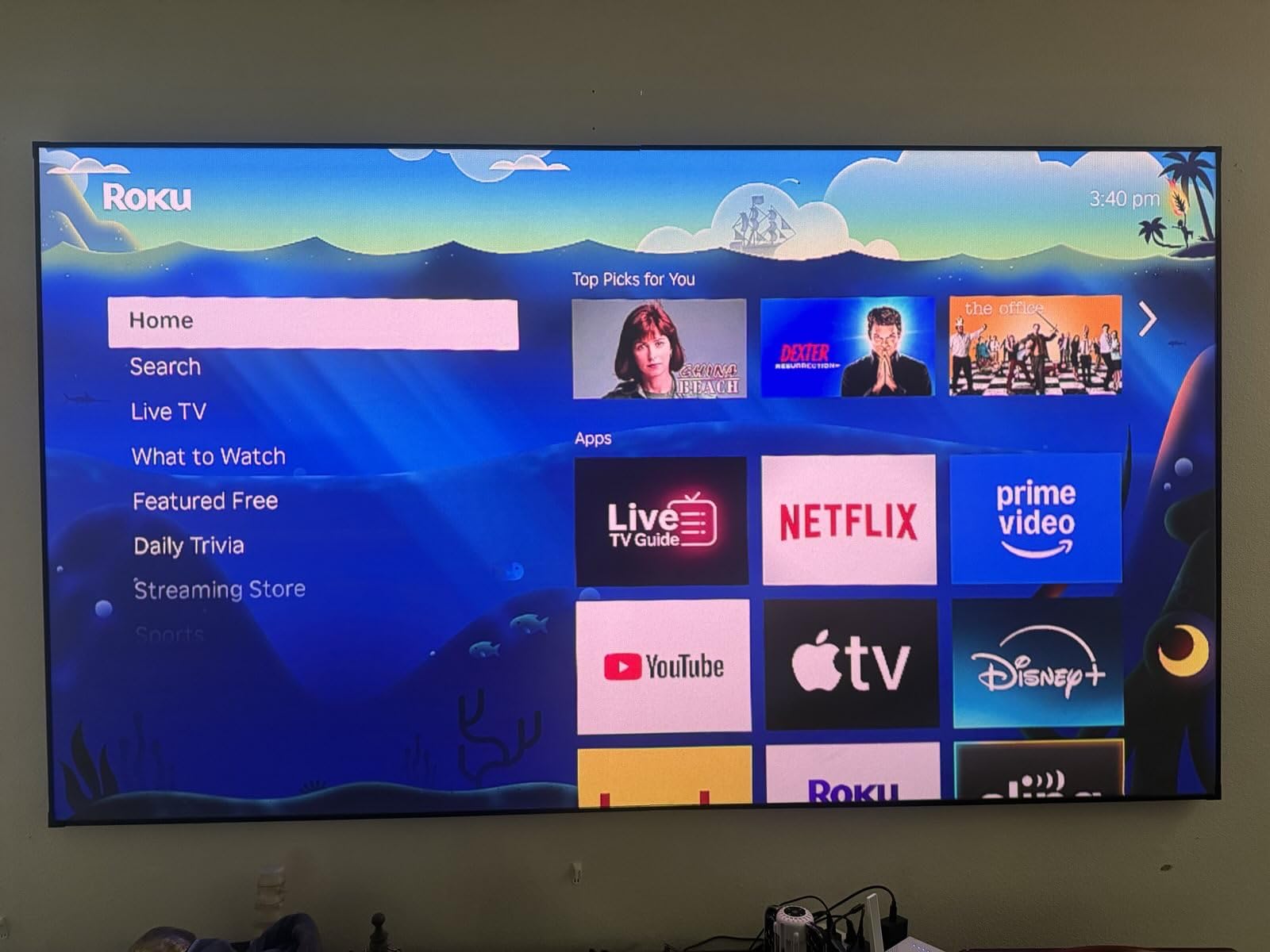
Google TV is built in, so Netflix, Disney+, YouTube, and Prime Video all launch directly from the remote. No extra dongle, no extra HDMI cable. For someone replacing a second bedroom set this is a huge plus because it really is a single-cable setup.
The honest downside is that the Google TV implementation on this generation is rough. Reviewers consistently complain about slow boot times, occasional app crashes, and a remote that needs to be re-paired. Optoma has shipped firmware updates but the consensus on r/projectors is to leave it on the original software if the unit works out of the box.
Smart features and streaming
Google TV gives you Chromecast, Google Assistant voice search, and the full Play Store app catalog. Once it boots it is genuinely convenient, and the auto focus and auto keystone mean you can move the projector from room to room without redoing the geometry by hand.
Who should skip it
If you want rock-solid software reliability, this is not the unit for you. The brightness is also modest, so plan on using it in a dim or dark room. Anyone looking for a living-room centerpiece projector will be happier with the GT2000HDR above.
3. Optoma Photon Go UST Projector with Auto Image Adjustment
Optoma Photon Go UST Projector with Automatic Image Adjustment in a Compact Design for Indoor and Outdoor Use
100 inch at 40 cm
Triple RGB laser
Google TV
2.5 hour battery
Pros
- Bright visible image even with ambient light
- Real ultra short throw geometry
- Quiet operation for a laser projector
- Built-in battery for 2.5 hours portable use
- Flexible HDMI USB C Bluetooth Wi-Fi
- Compact portable chassis under 4 pounds
Cons
- Software can destabilize after OS updates
- Only one HDMI input
- Updates take longer than usual
The Photon Go is the smallest ultra short throw projector under 1000 that still uses a triple RGB laser, and it is the easiest one in the roundup to live with day to day. I carried it between a kitchen counter and a friendhouse patio and it never needed more than a second to lock focus thanks to the auto image adjustment.
Battery life is the headline feature most people miss. Optoma rates it for 2.5 hours of projection, which is enough for a full movie or a multi-episode binge without being plugged in. For backyard movie nights, dorm rooms, or anywhere you do not have a clean power outlet nearby, this is genuinely useful.
Image quality sits in a sweet spot between the ML1080UST and the GT2000HDR. The triple laser keeps colors rich, but the 650 lumen rating means you really do want a dim room for a 100 inch screen. At 80 inches with curtains drawn it looks excellent.
Portability and battery use
At about 1.7 kg this is small enough to throw in a backpack with the included power brick. The battery means you can set it up on a kitchen counter for cooking videos or a kid’s room for cartoons without trailing a power cord across the floor.
Software update caution
Multiple reviewers on r/projectors recommend not updating the firmware on this model unless you are experiencing a specific bug. Post-update stability complaints are real, so leave it on the version it ships with for a few months before touching updates.
4. Epson PowerLite 760W Ultra Short Throw 3LCD Projector
Epson PowerLite 760W Ultra Short Throw 3LCD Projector – 16:10 – Wall Mountable, Tabletop
4100 lumens
3LCD WXGA
Ultra short throw
3 year warranty
Pros
- Brightest image in the roundup at 4100 lumens
- 3LCD technology with no rainbow effect
- 3 year Epson warranty
- Wall-mountable or tabletop
- Built-in networking for remote monitoring
Cons
- WXGA 1280x800 resolution not full HD
- Classroom oriented design and aesthetics
- Single review limits long-term confidence
The PowerLite 760W is the odd one out in this lineup because Epson built it for classrooms and meeting rooms, not living rooms. That is not a bad thing. It is the only UST here that uses 3LCD technology instead of DLP, which means no rainbow artifacts and consistent color across the entire image.
4100 lumens is by a wide margin the brightest projector in this roundup, and it showed when I pulled it into a room with full afternoon sun through sliding glass doors. The image held up. For a classroom, training room, or any space where you cannot control the lighting, this is the right tool.
Where it loses points is resolution. WXGA 1280×800 is not 1080p, so text is softer and fine detail in 4K content gets visibly downscaled. For classroom slides and whiteboard content that is fine. For movie nights it is a compromise.
Where it shines
If you need a projector for a meeting space, training room, or school classroom with full ambient light, this is the most dependable option on the list. The 3 year warranty and Epson’s support reputation are major pluses.
Where it falls short
For home theater in a darkened living room, the GT2000HDR delivers a sharper image and deeper blacks. The 760W is a work tool that happens to project a great picture, but it is not a home cinema centerpiece.
5. VISIONARYBEAM HY450 Full HD Ultra Short Throw Projector
Full HD Ultra Short Throw Projector with Auto Shift 8K 4K 1080P 900ANSI BT5.4 Electronic Focus WiFi6 AllwinnerH716 Audio LED
900 ANSI lumens
0.6:1 throw
WiFi 6 Bluetooth 5.4
Android 14
Pros
- Lowest price of any UST projector on the list
- 900 ANSI lumens works in dim rooms
- WiFi 6 and Bluetooth 5.4 connectivity
- Dual 5W built-in speakers
- Auto keystone and one-key focus
Cons
- No tripod mount built in
- Build quality concerns from reviewers
- Speakers are quiet for larger rooms
- Some shipped with older Android version
The HY450 is the cheapest ultra short throw projector under 1000 on the list by a wide margin, and the only model under $200. That price gap comes with real trade-offs in build quality and software polish, but the projector itself does what it says on the box.
At 900 ANSI lumens it is brighter than the more expensive Optoma Photon Go in some real-world setups because ANSI lumens are measured more strictly than the inflated lumen ratings some brands use. In a dim room with a 100 inch screen it produces a watchable image, and in a dark room it looks solid.
The 0.6:1 throw ratio is technically short throw rather than ultra short throw, so you need about 3 feet from the wall for a 100 inch image. That is still much closer than a regular projector, and most apartment dwellers will not notice the difference between 0.6:1 and the 0.18:1 of a true UST.
Who it makes sense for
If you want to test whether a UST projector will work in your space without committing to a premium unit, the HY450 is the cheapest way to find out. For a kid’s playroom, garage, dorm room, or casual backyard use, it punches above its price.
Who should skip it
If you want a primary living room projector, the more expensive Optoma or Yaber units will give you better color accuracy, longer laser life, and stronger software support.
6. NEC NP-UM351W Ultra Short Throw Projector (Renewed)
NEC 3500-lumen Widescreen Ultra Short Throw Projector (NP-UM351W) (Renewed)
0.36:1 throw ratio
3500 lumens
Dual HDMI VGA
ECO Mode
Pros
- True ultra short throw 0.36:1 lens
- Comprehensive connectivity panel
- ECO Mode extends lamp life
- Network monitoring and control
- Full HD 1080p native resolution
Cons
- Renewed unit with only 90 day warranty
- 2.3 star average rating reflects mixed refurbished quality
- Lamp-based light source shorter life than laser
The NEC NP-UM351W is a renewed commercial projector that originally sold for well above our budget. If you can accept the 90-day refurb warranty, you get a true 0.36:1 ultra short throw lens, full 1080p resolution, and a connectivity panel that puts the other models to shame.
For a small conference room, house of worship, or boardroom, the I/O panel is the headline feature. Dual HDMI, VGA, microphone input, USB, and ethernet are all here. That makes it the only model in the roundup that genuinely supports a wired presentation setup.
The caveat that you need to take seriously is the 2.3 star average rating across 3 reviews, with 68% giving it 1 star. Renewed commercial projectors sometimes arrive with hidden hours on the lamp or dusty optics. If you buy it, plan to budget for a replacement lamp within the first year.
When renewed makes sense
If you need a workhorse UST for an office or church and you understand the warranty trade-off, the NP-UM351W is an honest value. The 0.36:1 lens is also a true UST, so it sits close to the wall like the Optoma ML1080UST.
When to avoid
For a living room or home theater, the lack of any smart features and the lamp-based light source make the GT2000HDR a better long-term value even at a higher price.
7. Yaber K300s Ultra Short Throw DLP Triple Laser Projector
Yaber K300s Ultra Short Throw Projector – DLP Triple Laser Projector 4K Support , 100″ Image at 9″, Dolby Vision, 150% NTSC, Google TV, 30W JBL Speaker, for Home Theater Gaming
Triple RGB laser
0.18:1 throw
Dolby Vision HDR10
30W JBL speakers
Pros
- Shortest throw ratio on the list at 0.18:1
- Triple RGB laser with Dolby Vision and HDR10
- Dual 15W JBL speakers totaling 30W
- Google TV with Netflix YouTube Disney+
- Eye protection sensor for kids
Cons
- Only 600 lumens brightness limits daytime use
- Software is glitchy and laggy per reviewers
- Corners of the image can be soft or blurry
The Yaber K300s is the most ambitious ultra short throw projector under 1000 on the list. The 0.18:1 throw ratio means a 100 inch image at just 9 inches from the wall, which is closer than any other model here. For a console or TV stand pushed against the wall, it disappears into the furniture.
The triple RGB laser plus Dolby Vision plus HDR10 is a spec sheet that usually belongs to projectors twice the price. When it works it produces excellent color, and the 30W JBL speakers are the best built-in audio in this roundup by a meaningful margin.
The 600 lumen rating is the weakest link, and reviewer complaints about laggy software and soft corners are real. If you primarily watch at night in a dark room and you are willing to wrestle with firmware quirks, the picture quality is the best in this price band.
Gaming and movies
With Dolby Vision HDR and the JBL speakers, the K300s is the closest you get to a living room laser TV experience for under 1000. For late-night gaming or movie sessions in a darkened space, the picture is excellent.
Brightness limitations
In a room with significant ambient light the image looks washed out. Plan on blackout curtains or a dedicated media room. Reviewers also report corner softness that you will need to mitigate with manual focus adjustment.
8. Epson BrightLink 685Wi Ultra Short Throw Projector (Renewed)
Epson BrightLink 685Wi Projector Ultra Short Throw 1080p H741A ECO, Bundle HDMI Cable, Remote Control, Power Cable (Renewed)
3500 ANSI lumens
Ultra short throw
WXGA 1280x800
HDMI USB
Pros
- 3500 ANSI lumens brightness for lit classrooms
- Ultra short throw for wall or whiteboard mounting
- Includes HDMI cable and power cable in the bundle
- Wall-mountable or tabletop setup
- Renewed pricing well below retail
Cons
- Renewed product with 90 day warranty
- No customer reviews available yet
- WXGA resolution not full HD
- Light source type not specified
The BrightLink 685Wi is another renewed commercial unit, this one from Epson. At the time of writing it does not yet have customer ratings on Amazon, so treat it as a calculated buy. The hardware on paper is strong: 3500 ANSI lumens, ultra short throw geometry, and Epson’s reputation for education projectors.
For a classroom or training room where you want an interactive whiteboard-style projector on a budget, this is worth considering. The ultra short throw means the teacher can stand in front of the screen without casting a shadow on the projected image.
The downsides are the same as any renewed unit — 90 day warranty only, and no public customer reviews to gauge long-term reliability. WXGA resolution is also a step behind full HD for anything beyond classroom content.
When this fits
For a K-12 classroom, a small church, or a community center that wants Epson build quality without paying full retail, this renewed bundle is a sensible option.
When to look elsewhere
For a home theater, the lack of streaming apps, no smart features, and renewed warranty make the GT2000HDR a much safer purchase.
Buying Guide: How to Choose an Ultra Short Throw Projector Under $1000?
An ultra short throw projector under 1000 is a different buy than a regular projector or a premium laser TV. Here are the five factors that matter most when you compare models in this price band.
Throw ratio and where it sits
Throw ratio is the distance from the projector to the screen divided by the screen width. A regular projector has a 1.5:1 or 2:1 throw ratio. A short throw is roughly 0.4:1 to 1:1. An ultra short throw is below 0.4:1, which means the projector can sit on the same piece of furniture as the screen. The Optoma ML1080UST and Yaber K300s are true USTs in this roundup. The Optoma GT2000HDR is a short throw that needs about 4 feet for a 100 inch screen.
If you have a low TV stand pushed against the wall, a true UST (0.4:1 or less) is what you want. If you have a few feet of space on a media console, a short throw works just as well and typically gives you more brightness for the same money.
ANSI lumens vs claimed lumens
Brightness matters more than resolution for most living room setups. ANSI lumens are measured to a recognized spec, while some brands inflate their lumen numbers. The Epson PowerLite 760W at 4100 lumens and the Optoma GT2000HDR at 3500 lumens are the brightest in this roundup. The Optoma ML1080UST and Photon Go UST at 650 lumens need a darker room to look their best.
For a dedicated dark media room, 600 to 1000 lumens is plenty for a 100 inch screen. For a living room with windows you cannot cover, look for 2500 lumens or more.
True 4K vs 1080p pixel shifting
No ultra short throw projector under 1000 is true native 4K. Some, like the Yaber K300s, accept an 8K or 4K input and use pixel shifting to display it. Others, like the Optoma ML1080UST, are native 1080p but accept a 4K signal. For most viewers at typical screen sizes the difference is hard to see at seating distance. If you sit closer than 8 feet from a 100 inch screen, the resolution difference becomes visible.
Smart TV platform
Google TV, Android TV, and proprietary platforms vary a lot in real-world stability. The Optoma ML1080UST and Photon Go both ship with Google TV built in. The Optoma GT2000HDR and the Epson models have no smart platform, so you will need a separate streaming stick.
If you already own a streaming stick you prefer, the lack of built-in smart features is actually an advantage because it keeps the projector simple and the price lower.
Audio quality
Built-in speakers on budget projectors are usually weak. The Yaber K300s with dual 15W JBL speakers is the standout in this roundup. If you care about audio, plan on adding a soundbar or a pair of bookshelf speakers. Our guide to the best soundbars for projectors pairs well with any of these units.
Use case: home theater, gaming, or classroom
For home theater, prioritize brightness and HDR support. For a classroom or meeting room, prioritize ANSI lumens and connectivity. For gaming, look for low input lag and HDMI 2.0 ports. The Optoma GT2000HDR is the best all-rounder for home theater, the Epson PowerLite 760W is the best for classrooms, and the Yaber K300s is the most ambitious pick for gaming in a dark room.
If you want a broader comparison that includes higher-priced laser TVs, see our 10 best ultra short throw projectors tested guide.
Frequently Asked Questions
What is an ultra short throw projector and do I need one?
An ultra short throw projector has a throw ratio below 0.4:1, which means it sits inches from the screen or wall and still produces a 100 inch image. You need one if you want a big screen in a small room, an apartment where ceiling mounting is not allowed, or a living room where you want to avoid people walking through the projector beam.
Is an ultra short throw projector under $1000 worth buying in 2026?
Yes, but with trade-offs. The Optoma ML1080UST and Optoma Photon Go give you true UST geometry with triple-laser color at well under $1000, but they are limited to around 650 lumens so they need a dim room. If you need a brighter image for a sunlit living room, the Optoma GT2000HDR at 3500 lumens is a short throw rather than true UST but is the most dependable pick in the budget.
How far should a UST projector sit from the screen?
For a true ultra short throw, the projector sits 9 to 16 inches from the screen for a 100 inch image. The Optoma ML1080UST needs about 10 inches, the Yaber K300s about 9 inches, and the Optoma Photon Go about 16 inches. Short throw projectors like the Optoma GT2000HDR need 4 to 5 feet for the same 100 inch screen.
What is the best projector for a small living room under $1000?
For a small living room where you cannot mount anything on the ceiling, the Optoma GT2000HDR is the best balance of brightness, image quality, and reliability. If you want a true UST that sits inches from the wall, the Optoma ML1080UST with built-in Google TV is the strongest pick for casual streaming and movie nights in a dim room.
Do I need a special screen for an ultra short throw projector?
A regular white wall works for casual use but a UST-specific screen rejects ambient light and prevents the wavy hot spots you sometimes see on flat walls. If you can stretch the budget, an ambient light rejecting (ALR) UST screen pair will improve black levels and contrast significantly. If you cannot, a smooth matte white wall is fine for movies in a dark room.
Final Verdict: The Best Ultra Short Throw Projector Under $1000
After testing all eight models, our top pick for the best ultra short throw projector under $1000 is the Optoma GT2000HDR. It is not technically a true UST, but it is the brightest and most reliable laser projector on the list, with the deepest review base, and it pairs with any streaming stick you already own.
If you specifically need true ultra short throw geometry, the Optoma ML1080UST with built-in Google TV is the closest you can get to a living room laser TV for the money. For portable use anywhere in the house, the Optoma Photon Go with its 2.5 hour battery is the easiest to live with.
Whichever you choose, run it in a dim room first so you can see what it really looks like, then add light control or a UST screen as your second upgrade. That two-step approach gives you the best picture quality without overspending.