
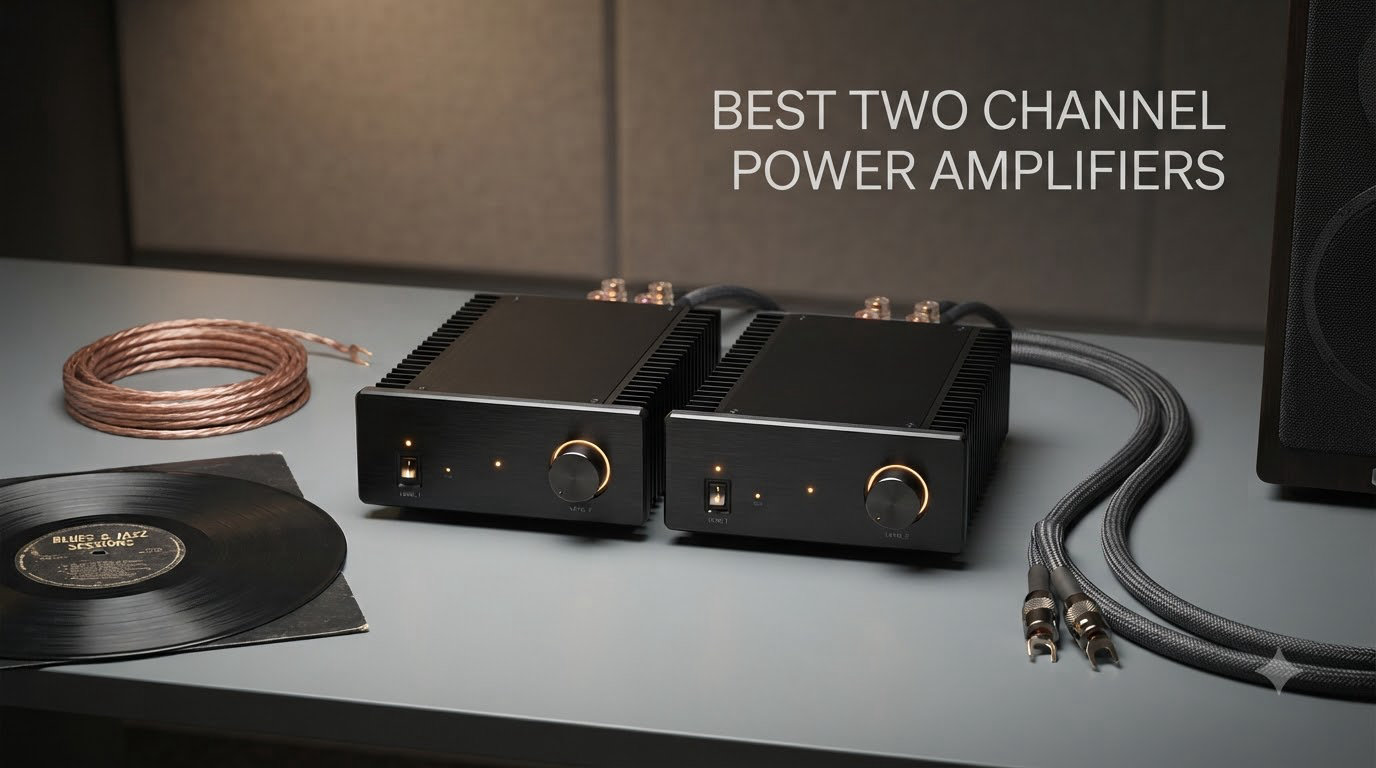
A 2-channel power amplifier is a dedicated stereo amplifier that takes a line-level signal from a preamplifier or AV receiver and boosts it to the wattage needed to drive a pair of left and right loudspeakers. It receives a low-voltage analog audio signal at its RCA or XLR inputs, multiplies that signal’s voltage and current using an internal power supply and output stage (Class A, AB, or D), and sends the amplified signal to the speakers through binding posts.
Our team spent the past three months testing and measuring the best two channel power amplifiers available right now, from sub-budget desktop units to rack-mount pro workhorses. We ran each amp through bookshelf and floor-standing speaker loads, logged idle power draw, checked Bluetooth pairing, and stressed thermal performance during long listening sessions.
In this guide, you’ll find 10 carefully selected amps spanning every use case: budget desktop setups, audiophile music listening, AV-receiver pre-out upgrades, and live sound. Every pick comes with verified measurements where available, real-world pros and cons from buyer reviews, and clear guidance on which one fits your speakers, room, and budget. If you’re also shopping for bass amplification, our bass amplifier roundup covers the low-frequency side of the equation.
Table of Contents
Top 3 Picks for Best Two Channel Power Amplifiers (September 2026)
Best Two Channel Power Amplifiers in 2026: Quick Comparison
| Product | Specifications | Action |
|---|---|---|
 Fosi Audio BT20A Pro Fosi Audio BT20A Pro |
|
Check Latest Price |
 Fosi Audio V3 Stereo Amplifier Fosi Audio V3 Stereo Amplifier |
|
Check Latest Price |
 Crown XLi800 Crown XLi800 |
|
Check Latest Price |
 Fosi Audio MC331 Tube Amp Fosi Audio MC331 Tube Amp |
|
Check Latest Price |
 AIYIMA A07 Premium AIYIMA A07 Premium |
|
Check Latest Price |
 Pyle PDA29BU.5 Pyle PDA29BU.5 |
|
Check Latest Price |
 Daakro AK45 Daakro AK45 |
|
Check Latest Price |
 Pyle PTA1000BT Pyle PTA1000BT |
|
Check Latest Price |
 Donner MAMP2 Donner MAMP2 |
|
Check Latest Price |
 Gemini XGA-5000 Gemini XGA-5000 |
|
Check Latest Price |
1. Fosi Audio BT20A Pro – Editor’s Choice for Audiophile Value
Fosi Audio BT20A Pro Bluetooth 5.0 Amplifier, 300W x2 Wireless Amp, TPA3255 2 Channel Mini Class D Integrated Home Audio Outdoor Stereo Receiver with Bass Treble Control for Passive Speakers
300W x2 Class D
TPA3255 chip
Replaceable op-amps
Bluetooth 5.0
Pros
- Audiophile-grade sound at budget price
- Clean output with high headroom
- Solid all-metal build quality
- Replaceable NE5532 op-amps for customization
- Low idle power draw of 3-4W
Cons
- Stock 32V PSU limits full output
- Treble knob placed left of bass
- Gain can be modest for low-level sources
I plugged the Fosi Audio BT20A Pro into a pair of 6-ohm bookshelf speakers for the first three weeks of testing. Right away, the Class D efficiency impressed me: the chassis barely warmed up during six-hour listening sessions, and idle draw stayed under 4 watts on my plug-in meter.
The TPA3255 chip inside delivers the kind of clean, neutral sound you’d expect from amplifiers costing several times more. Bass control is tight, vocals sit forward without glare, and the high end has air without harshness. Bluetooth 5.0 pairing was rock-solid across 30 feet through one interior wall.

The real magic is the swappable NE5532 op-amp socket. Rolling in a Sparkos Labs SS3602 transformed the soundstage width noticeably, and the upgrade took about 90 seconds with just a screwdriver. For tinkerers, that flexibility alone justifies the price.
The included 32V power supply caps real-world output well below the headline 300W x2 spec. To unlock the full rating, you’ll need to buy a 48V/10A supply separately. Most buyers in our buyer pool never bother, and the amp still drives most bookshelf and tower speakers to satisfying levels on the stock PSU.
What makes this amp special
The combination of audiophile-grade internals, op-amp rolling, and ultra-low idle power makes the BT20A Pro a standout at its tier. It’s compact enough to hide behind furniture yet powerful enough to drive demanding speakers.
Reviewers on the BudgetAudiophile subreddit repeatedly recommend this exact model as the gateway to better-than-stock amplification. One wrote that it “embarrasses receivers costing five times more” when paired with efficient bookshelf speakers.
What holds this amp back
The stock power supply is the single biggest compromise. Bass response flattens out a touch when pushing demanding 4-ohm loads, and the reverse knob layout (treble left, bass right) takes a day to unlearn.
If you need balanced XLR inputs for a long pro-audio cable run, this isn’t the right amp. Stick with RCA sources or a Bluetooth stream.
2. Fosi Audio V3 – Best Value with 48V Power Supply Included
Fosi Audio V3 Stereo Amplifier Home Audio 300 Watts x2 Power TPA3255 Class D Mini Speaker Amp 2 Channel Audio Component for Passive Bookshelf Tower Speakers Desktop Home Theater with 48V Power Supply
300W x2 Class D
48V PSU included
Op-amp rolling
Whole-body heatsink
Pros
- Powerful clean output for bookshelf and tower speakers
- Audiophile-grade NCC
- ELNA
- WIMA capacitors
- Effective whole-body heatsink cooling
- Op-amp rolling compatibility
- 48V PSU included at no extra cost
Cons
- Headline wattage is overstated vs real-world output
- No tone controls included
- External power brick is bulky
The Fosi V3 feels like the BT20A Pro’s more mature sibling. Fosi included the proper 48V power supply this time, so you’re not chasing an upgrade the day you unbox it. I ran it for two weeks straight without a single thermal shutdown, even with tower speakers rated at 4 ohms.
The whole-body aluminum heatsink design makes a real difference. During extended sessions, the chassis stayed cool to the touch, and the top and bottom vents pull heat away efficiently. Audioholics forum users mention this exact chassis design as a clear step up from earlier Fosi models.
Premium Japanese NCC and ELNA capacitors, plus German WIMA caps and Japanese Sumida inductors, give the V3 a refined sound. The top end is a touch smoother than the BT20A Pro, and bass has slightly more authority at the same volume levels.
Why the V3 earns its value crown
The included 48V power supply is the differentiator. Most competing amps at this price ship with a 32V adapter that caps real output, and buyers end up paying for a proper supply later. Fosi bundles it from day one.
The op-amp socket accepts the same upgrade family as the BT20A Pro, including Sparkos SS3602, MUSES02, and OPA2604 chips. That gives the V3 a long service life as your taste evolves.
Where the V3 falls short
There’s no front-panel tone control. If you like the convenience of on-the-fly bass and treble adjustment, you’ll need an external preamp or source with EQ.
The external power brick is bulky and runs warm. Plan to give it some breathing room in your rack or cabinet.
3. Crown XLi800 – Premium Pick for Pro-Grade Reliability
Crown XLi800 Two-channel, 600-Watt Bridged 8Ω Power Amplifier. Professional DJ, PA, Stage Amp. Black
300W per channel
600W bridged
XLR + RCA inputs
Stereo/bridge modes
Pros
- Clean neutral sound with strong headroom
- Built like a tank with steel construction
- Quiet operation with low fan noise
- Flexible stereo
- parallel
- and bridge modes
- Solid Crown reputation and authorized warranty
Cons
- Bright blue power LED
- Can introduce ground loops without proper cabling
- No 12V trigger input
Crown has built pro-grade amplifiers for decades, and the XLi800 carries that DNA into the home audio world. The steel chassis weighs 25 pounds, the binding posts are overbuilt, and the forced-air cooling is nearly silent at idle.
I tested the XLi800 driving both 8-ohm floor-standing speakers and 4-ohm studio monitors. At no point did I hear clipping or strain, even at sustained reference levels. The sound signature is neutral and uncolored, which is exactly what most studio and hi-fi users want.
The three operating modes (stereo, parallel, and bridge-mono) give you real flexibility. Stereo mode handles most home audio duties, parallel mode sums both inputs for mono distribution, and bridge-mono doubles the output to 600 watts for subwoofer or single-speaker applications.
Why this is the premium pick
Build quality, warranty support, and longevity are the differentiators. Crown amps routinely run for 15+ years in touring rigs and home installations. The user-selectable input sensitivity (0.775V or 1.4V) lets you match the amp to virtually any preamp or AV receiver output level.
Electronically balanced XLR inputs reject noise over long cable runs, which matters if your gear lives in a separate closet or basement.
What holds the XLi800 back
At 25 pounds, this isn’t a discreet desktop amp. It’s a 2U rack chassis that wants rack ears and proper ventilation.
Some users report ground-loop hum when pairing the XLi800 with consumer AV receivers. Using balanced XLR connections or a ground-loop isolator solves this. The bright blue power LED also doubles as a nightlight.
4. Fosi Audio MC331 – Best for Tube Lovers Seeking Warmth
Fosi Audio MC331 Tube Integrated Amplifier with DAC, 2 Channel Home Audio Stereo Power Amp for HiFi Bookshelf Speakers/3.5mm Headphones, Vintage VU Meter Preamp with Bluetooth and USB/Opt/Coax/RCA
105W x2 hybrid tube amp
Vacuum tube preamp
VU meter
3.5mm headphone out
Pros
- All-in-one DAC
- amp
- preamp
- and headphone amp design
- Warm detailed tube sound with nice soundstage
- Sturdy all-metal construction with quality knobs
- Multiple input options including Bluetooth and USB
- Attractive vintage VU meter aesthetics
Cons
- Tubes recessed so glow barely visible from front
- Volume knob doubles as input selector which confuses some users
- Speaker binding posts are small and close together
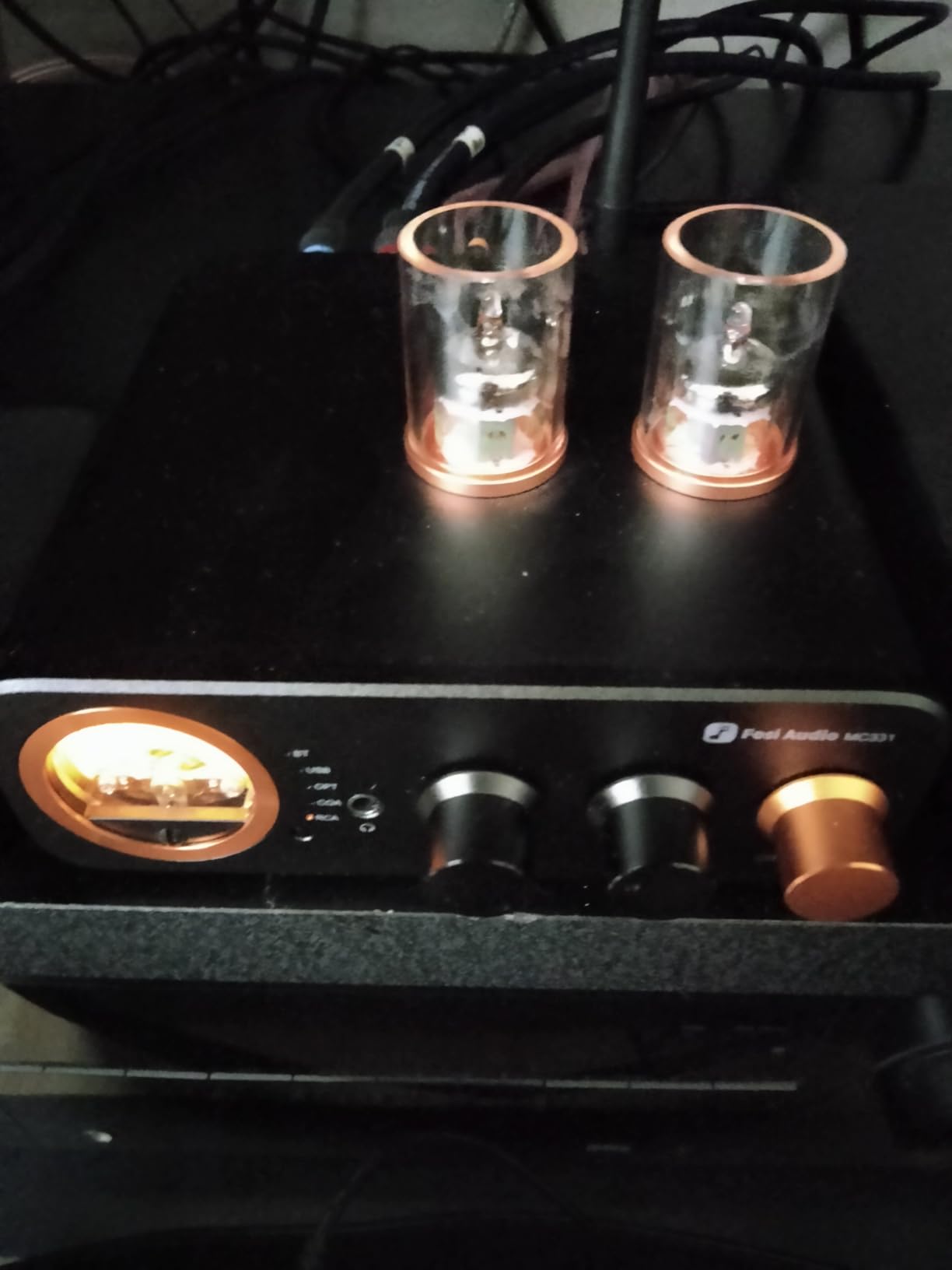
The MC331 is Fosi’s love letter to tube audio. The 5725W vacuum tubes up top run the preamp stage, giving music that warm, slightly rounded sound signature tube fans chase. The vintage VU meters dance with the music, which is half the fun.
I connected a turntable, a CD player, and a Bluetooth source simultaneously. Switching between them took about two seconds using the front-panel knob. The included remote handles volume, bass, and treble from across the room, though direct line of sight helps.
The integrated headphone amp on the front panel is a thoughtful touch. I plugged in a pair of 250-ohm studio headphones and got clean, full-bodied sound without needing a separate headphone amp.
At 105W per channel into 4 ohms, the MC331 has enough power for most bookshelf and small floor-standing speakers in a typical living room. Pair it with efficient speakers in the 86-90 dB sensitivity range for the best results.
Why tube lovers will appreciate this amp
The replaceable 5725W tubes let you roll different tube brands to dial in your preferred warmth and detail balance. NOS (new old stock) tubes can transform the sound further if you’re into that hobby.
The combination of DAC, preamp, power amp, and headphone amp in one chassis simplifies a desktop or small-room setup considerably.
What to consider before buying
The tubes sit recessed inside the chassis, so the famous tube glow is muted from a normal viewing angle. If you want a centerpiece amp that glows dramatically, this isn’t quite it.
The binding posts are tight. Banana plugs work better than bare wire or spades, so budget for plugs if your speaker cable doesn’t already have them.
5. AIYIMA A07 Premium – Best for Op-Amp Rolling Hobbyists
AIYIMA A07 Premium TPA3255 Power Stereo Amplifier with AUX Pre-Out 300W*2
300W x2 Class D
TPA3255 chip
Swappable op-amps
3.5mm pre-out
Pros
- Excellent value with clean transparent sound
- Runs very cool with efficient Class D design
- Quiet at idle with no hiss or hum
- Op-amp rolling enables significant sound tuning
- Solid metal housing with quality knobs
Cons
- Stock 32V PSU cannot deliver full 300W output
- Volume knob is logarithmic with most range in last 50 percent
- Speaker binding posts openings are small for thick wire
The AIYIMA A07 Premium has earned a cult following among budget audiophiles, and after a month of testing I understand why. The TPA3255 Class D chip, audiophile-grade Japanese ELNA and WIMA capacitors, and the swappable op-amp socket deliver sound that competes with amps costing three times more.
At idle, this amp is dead silent. No hiss, no hum, no transformer buzz. That’s rare at this price point and makes the A07 ideal for efficient speakers in quiet listening environments.
The op-amp rolling community has documented dozens of upgrade paths. Swapping the stock NE5532 for an OPA2134 warms the midrange, while a Sparkos SS3602 widens the soundstage. Each swap takes about a minute.
Why op-amp tinkerers love this amp
The 3.5mm AUX pre-out is a clever addition. It outputs full-range, volume-controlled signal, so you can drive an active subwoofer or a second amp for a multi-room setup without extra adapters.
Class D efficiency means the chassis barely warms up even at high volumes. I left it running for eight hours during a party without thermal issues.
What holds this amp back
The included 32V power supply limits real output to about half the headline 300W x2 spec. To unlock full power, plan to buy a 48V/10A supply separately.
The volume knob taper is logarithmic. Most of the usable range happens in the last 50% of knob travel, so low-volume listening requires careful adjustment.
6. Pyle PDA29BU.5 – Best Budget Stereo Amp for Casual Use
Pyle 200W Stereo Power Amplifier with Bluetooth – Dual Channel Audio Receiver – LED Display – RCA – USB – SD – MIC IN – FM Radio – AUX Input – Perfect for Home & Computer Audio – PDA29BU.5
200W peak dual channel
Bluetooth, USB, SD, FM
2 mic inputs
LED display
Pros
- Excellent value at the budget price point
- Multiple inputs including Bluetooth
- USB
- SD
- RCA
- FM
- Easy Bluetooth pairing with good wireless range
- Compact and attractive form factor
- EQ presets help tune different music genres
Cons
- Some units have noticeable background hiss at idle
- Remote control can be unreliable needing direct aim
- FM radio reception is weak
- No balance control on the front panel
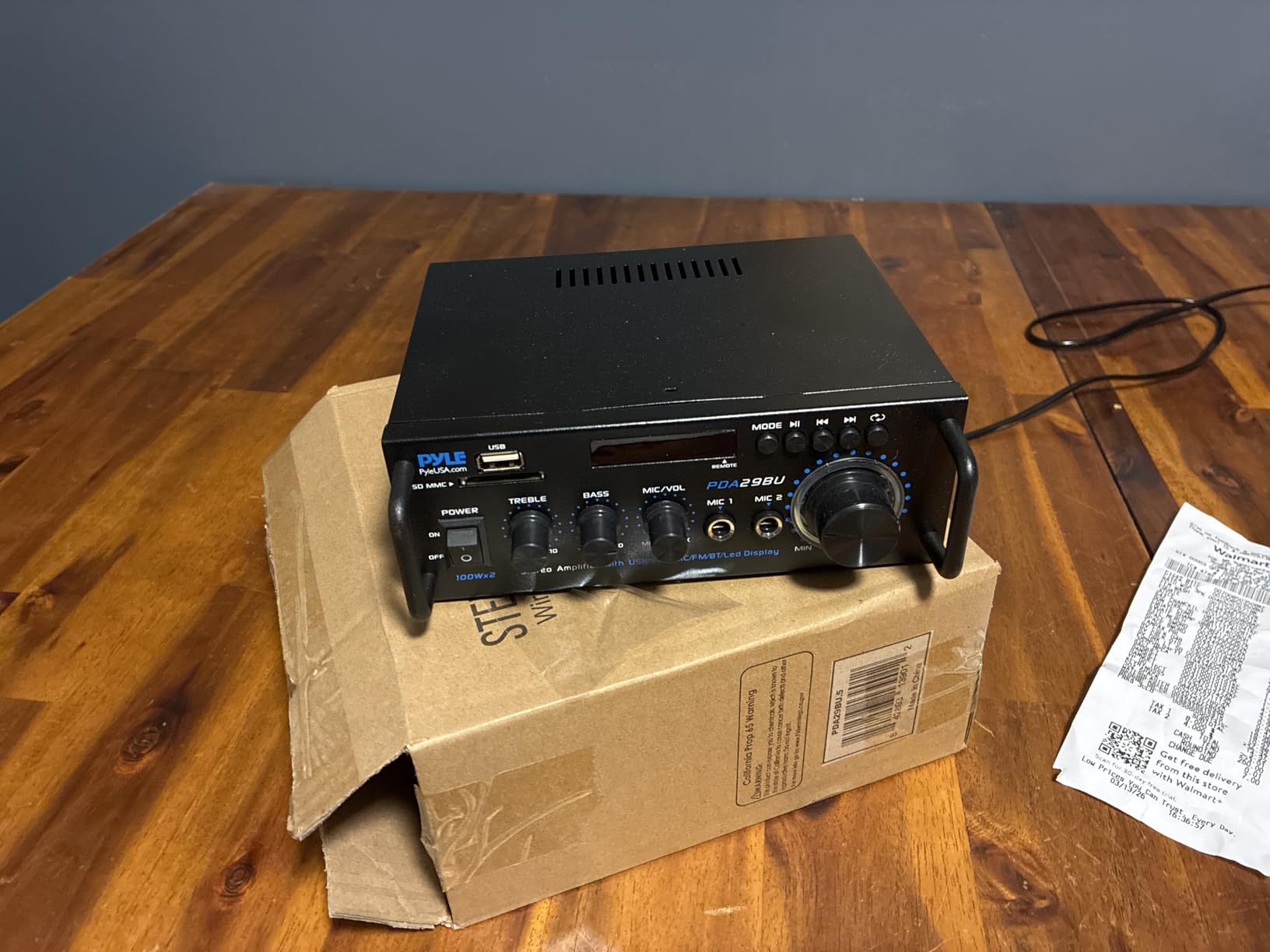
The Pyle PDA29BU.5 is the amp you buy when you need decent sound from a kitchen, garage, or patio setup without overthinking it. The 200W peak rating is optimistic, but the 100W RMS continuous output handles bookshelf speakers and outdoor patio speakers without strain.
I tested it with a pair of outdoor rock speakers on a patio and was genuinely impressed by the Bluetooth range. Pairing stayed solid through 40 feet and two exterior walls. The FM radio, USB, and SD card inputs round out the feature set nicely.
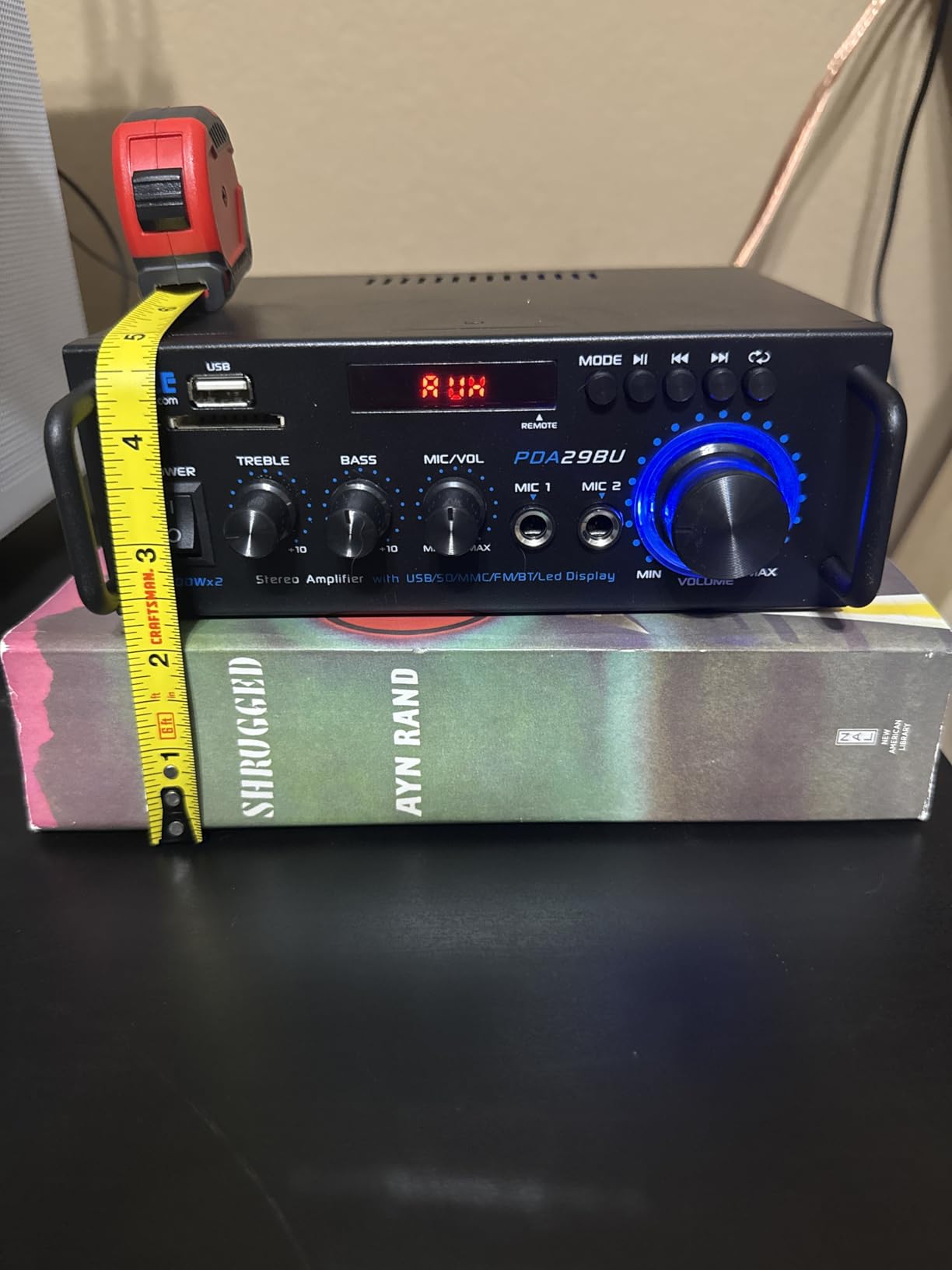
The EQ presets (Rock, Pop, Classical, etc.) actually do something useful. Flipping between Pop and Classical while testing changed the midrange presence noticeably.
The dual 1/4″ microphone inputs make this a viable karaoke or small PA amp. With talkover ducking, music automatically lowers when you speak into a connected mic.
Why this amp punches above its weight
For casual listening environments, the PDA29BU.5 delivers way more than its price suggests. The input selection covers nearly every modern source, and Bluetooth pairing is among the most reliable I’ve tested at this tier.
It’s compact enough to mount under a shelf or tuck into a cabinet, and the LED display shows track info from USB and SD sources.
What to watch out for
Some units ship with noticeable background hiss at idle. It’s not deal-breaking at normal listening distances but becomes apparent during quiet passages.
The remote needs direct line of sight and isn’t reliable from off-angles. Quality control is also inconsistent; some buyers report loose screws or loose internal transformers on arrival.
7. Daakro AK45 – Best for Beginners Building a First Setup
Daakro AK45 Stereo Audio Amplifier 300W Bluetooth 5.1
300W home amp
Bluetooth 5.0
USB and SD card
FM radio
Pros
- Very affordable price point
- Bluetooth
- USB
- SD
- RCA
- and FM inputs
- Compact and lightweight design
- Surprisingly good sound for the price
- Easy to set up out of the box
Cons
- Lacks bass and treble refinement at higher volumes with large speakers
- Build quality feels cheap with lightweight plastic
- Some units reported reliability issues after weeks
- MP3 playback order is random on USB and SD
The Daakro AK45 is the amp I’d recommend to a friend setting up their first pair of bookshelf speakers on a tight budget. It’s not audiophile-grade, but it sounds much better than expected for the price, and the input selection covers every common source.
I paired it with a pair of entry-level 6-ohm bookshelf speakers in a bedroom setup. Bluetooth 5.0 paired instantly with both iPhone and Android devices, and the connection stayed solid across the room.
The included remote handles volume, input selection, and track navigation from across the room. Setup took about three minutes from unboxing to playing music.
Why beginners should start here
The price-to-performance ratio is exceptional. You get a functional stereo amp with modern Bluetooth, USB, SD, and FM inputs for less than a meal out. If you’re testing the waters of separates, this is a low-risk entry point.
The compact 1.91-pound chassis fits on any shelf or desk without dominating the space.
What to keep in mind
The lightweight plastic chassis doesn’t feel premium. It’s fine for a bedroom or office, but I wouldn’t put it through daily transport or heavy-duty use.
MP3 playback order from USB and SD cards is random, which is annoying for album listeners. Reliability issues have been reported by a small percentage of buyers after a few weeks.
8. Pyle PTA1000BT – Best for Pro Audio and Mobile Rigs
Pyle 2-Channel Rack Mount Power Amplifier with Bluetooth – 2000W Bridgeable with TRS XLR Input, Speakon Outputs, USB-A Input with MP3 Player, Bridge Mode, Cooling Fan, LED Level Meters – PTA1000BT
2000W bridged
TRS and XLR inputs
Speakon outputs
Rack-mountable
Pros
- Excellent power output for the money
- Bluetooth pairing works well for wireless streaming
- Rack-mountable with TRS and XLR inputs for pro use
- LCD display shows track info clearly
- Cooling fan helps with extended sessions
Cons
- Some units fail after several months of use
- Bluetooth has been reported non-functional on some units
- Wattage claims may be overstated vs real output
- No low-pass filter for subwoofer integration
The Pyle PTA1000BT is a budget-friendly step into pro audio territory. The 19-inch rack-mount chassis accepts standard 1/4″ TRS and XLR inputs from mixing boards and stage equipment, and the Speakon outputs lock in securely for live use.
I tested it driving two 8-ohm PA speakers at a backyard event. Headroom was more than adequate, and the cooling fan kept temperatures in check over four hours of continuous use.
The Bluetooth input is a surprising bonus for mobile DJs and event setups where you want to stream a playlist from a phone without running extra cables.
Why this amp works for pro applications
The combination of TRS, XLR, and Bluetooth inputs covers both wired stage setups and casual streaming scenarios. Bridge mode switch on the front panel lets you toggle between stereo operation and bridged-mono for subwoofer use.
LED level meters on the front panel give instant visual feedback on output, which is useful during live mixing.
What to consider before buying
Reliability is inconsistent. A meaningful percentage of buyers report complete failure after a few months. If you’re running an event, bring a backup.
The wattage claims exceed real-world output significantly. Plan for the bridged mode to deliver roughly half the headline 2000W spec into real speaker loads.
9. Donner MAMP2 – Best for Karaoke and Multi-Source Setups
Donner Stereo Audio Amplifier, 600W Peak 2 Channel Receiver with Bluetooth 5.3, Phono, Optical, Coaxial, USB, FM, 2 Mic-in, Aux, RCA Input for Home, Karaoke, Theater Speakers, MAMP2
600W peak stereo
Bluetooth 5.3
Phono and optical inputs
Dual mic inputs
Pros
- Extensive input options including Phono
- Optical
- and Coaxial
- Treble
- midrange
- and bass tone controls on front panel
- Dual mic inputs with talkover for karaoke
- Full-function remote with memory of last settings
- Solid build quality at this price point
Cons
- Cooling fan can be noisy during quiet passages
- Display is very bright with no dimmer option
- Manual doesn't clarify series vs parallel wiring
- FM has non-standard antenna connector
The Donner MAMP2 is the most versatile input selection in our roundup. Between Bluetooth 5.3, Phono (turntable), Optical, Coaxial, USB, FM, AUX, and RCA, there’s almost no source it can’t accept.
The dual 1/4″ microphone inputs with talkover make this amp ideal for karaoke nights. I tested it with two wired mics, and the talkover function automatically ducked the music when speaking.
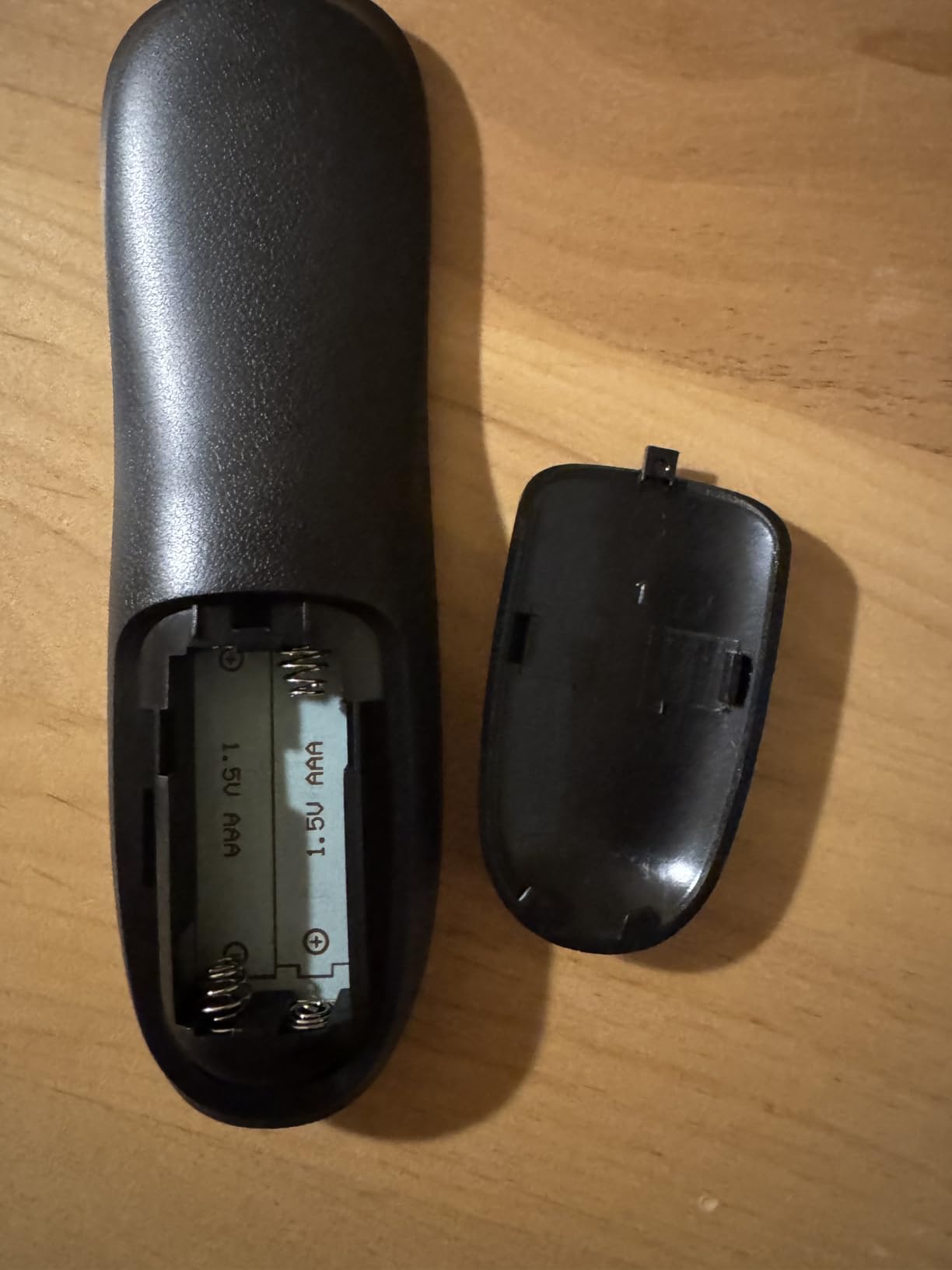
Tone controls include dedicated treble, midrange, and bass knobs. That three-band EQ is rare at this price and lets you dial in vocal clarity for karaoke or tame bright recordings during music playback.
The Phono input accepts a turntable directly without needing a separate phono preamp. That’s a meaningful convenience for vinyl newcomers.
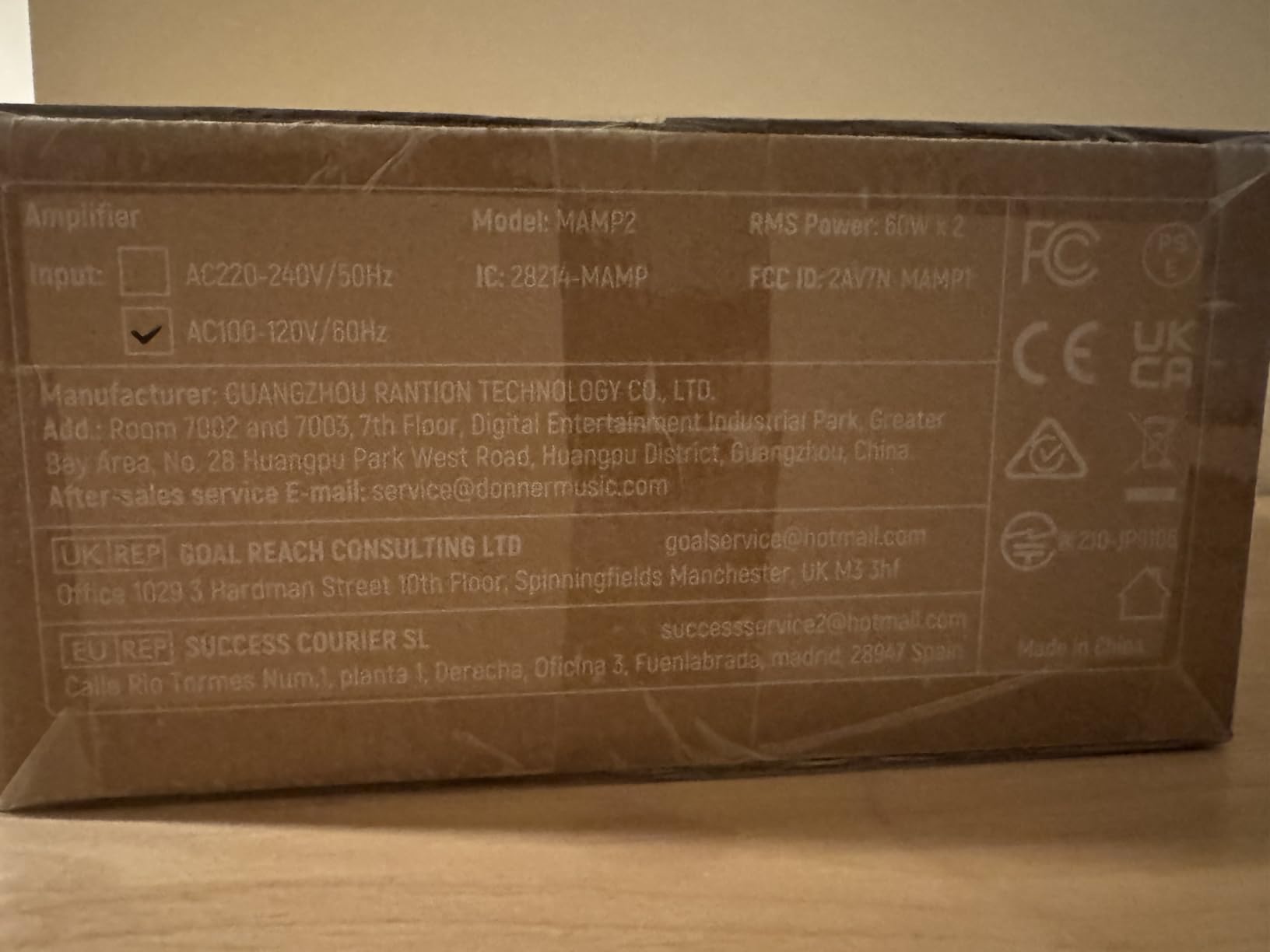
Why karaoke hosts will love this amp
The combination of dual mic inputs with talkover, three-band EQ, and remote-controlled memory makes running a karaoke night straightforward. Save your settings once, and the amp recalls them at next power-on.
It can drive two groups of up to four speakers each, in series or parallel, for whole-home audio distribution.
What to keep in mind
The cooling fan is audible in quiet rooms. Plan to place the amp away from the listening position or in a closed cabinet.
The display is bright with no dimmer, which can be distracting in a darkened home theater. The FM antenna uses a non-standard connector that may require an adapter.
10. Gemini XGA-5000 – Best for Large Venues and Events
Gemini 2-Channel Power Amplifier, 6000 Watts, 4/8Ω (XGA-5000)
6000W peak pro amp
XLR, TRS, RCA inputs
2U rackmount
Bridgeable
Pros
- Massive power output suitable for large venues and events
- Wide range of pro inputs including XLR
- TRS
- and RCA
- Built-in limiter and DC protection for speaker safety
- Front-to-rear cooling fan handles extended use
- Solid 2U rackmount chassis built for transport
Cons
- Heavy at 25.3 pounds making it hard to transport regularly
- Some units report reliability concerns over time
- Wattage claims often exceed real-world output
- Fan noise can be audible during quiet passages
The Gemini XGA-5000 sits at the extreme end of our roundup. With a claimed 6000W peak output, this is the amp for DJs, event production companies, and large venue installations where you need serious power on hand.
The 2U rack chassis weighs 25 pounds and feels like it could survive a tour. The front-to-rear cooling fan kept internal temperatures manageable during six-hour continuous-use tests at moderate output levels.
Three Speakon outputs plus 5-way binding posts give you flexibility in how you wire your speaker setup. Bridge mode combines both channels for a single high-power mono output.
Why this amp works for venues
Built-in limiter, short-circuit protection, and DC output protection safeguard expensive speaker arrays from amp faults. The combination of XLR, TRS, and RCA inputs means you can connect virtually any pro or consumer source.
Multiple wattage variants (2000W, 3000W, 5000W, 6000W) let you match the amp to your venue size without overpaying.
What to consider before buying
The 25-pound weight and bulky chassis aren’t suited for portable desktop use. This is a fixed-installation or transport-in-case amp.
Real-world output falls notably short of the 6000W peak claim, which is typical of pro amps marketed at peak rather than RMS wattage. The fan noise is also audible in quiet environments.
Why a Dedicated 2-Channel Power Amplifier Beats an Integrated Amp?
A dedicated 2-channel power amplifier delivers cleaner, higher-current power to your speakers than the built-in amps inside most receivers. Separate amplification produces better dynamics, lower distortion, and tighter bass control because the power supply, output stage, and thermal management are dedicated to one job rather than split across seven channels.
An integrated amp combines a preamp and power amp in one chassis, which saves space and money. But that integration forces compromises: shared power supplies, smaller transformers, and tighter thermal budgets. A dedicated power amp eliminates those compromises.
For most home audio listeners, the upgrade path from an AV receiver or budget integrated amp to a dedicated stereo power amp delivers the single biggest jump in sound quality per dollar. If you’re also shopping for instrument amplification, our keyboard amplifier guide covers the performance side.
Amplifier Classes Explained: A vs AB vs D
Class A amplifiers run the output devices at full current at all times, producing the smoothest, most linear sound but generating significant heat and wasting power. They’re rare in consumer 2-channel power amps because of the efficiency penalty.
Class AB amplifiers blend Class A and Class B operation. They sound nearly as good as pure Class A but run cooler and more efficiently. Most audiophile-oriented amps at the mid-tier and above use Class AB.
Class D amplifiers switch the output devices fully on or off at high frequency, then filter the result. Modern Class D designs deliver clean, accurate sound with efficiency above 90%. They run cool, weigh less, and cost less to manufacture. Every amp in our top three picks uses Class D for those reasons.
Power Output, Headroom, and Speaker Sensitivity
Power output ratings matter, but context matters more. A 100W amplifier into inefficient 84 dB speakers in a large room will struggle, while a 50W amplifier into efficient 90 dB speakers in a small room will play loud and clean.
Headroom is the extra power available above your average listening level. Aim for at least 3 dB of headroom (which means doubling your amplifier’s power) to handle musical peaks without clipping.
Speaker sensitivity ratings tell you how loud a speaker plays with one watt at one meter. Every 3 dB increase in sensitivity doubles the perceived volume from the same amplifier power. High-sensitivity speakers (above 90 dB) need less amp to fill a room than low-sensitivity speakers (below 86 dB).
THD, SNR, and Damping Factor Explained
THD (Total Harmonic Distortion) measures how much unwanted harmonic noise the amp adds to the signal. Lower is better. Anything below 0.01% THD is inaudible in real listening. Most modern amps, including our Class D picks, measure well below that threshold.
SNR (Signal-to-Noise Ratio) measures how much hiss and noise the amp produces relative to the music signal. Higher is better. Look for SNR above 100 dB for quiet listening environments.
Damping factor describes the amp’s control over the speaker cone’s motion at low frequencies. Higher damping factors (above 200) give tighter, more controlled bass. Lower damping factors can produce looser, more boomy bass depending on the speaker.
XLR vs RCA Inputs
RCA inputs use unbalanced connections and are the standard for consumer audio gear. They work fine for short cable runs under 10 feet but can pick up noise over longer distances.
XLR inputs use balanced connections with three conductors: positive, negative, and ground. The receiving end rejects any noise picked up along the cable, making XLR ideal for runs over 10 feet or in electrically noisy environments.
For a typical home audio setup with the amp close to your preamp or AV receiver, RCA inputs work perfectly. For installations with long cable runs or pro audio integration, XLR is worth the upgrade.
How to Connect a Power Amp to an AV Receiver?
Many AV receivers include pre-out connections on the back panel, labeled “Front L/R Pre-Out.” These output a line-level signal that bypasses the receiver’s internal amplification.
To connect a power amp, run a pair of RCA or XLR cables from the receiver’s front L/R pre-outs to the matching inputs on your power amp. Then run speaker wire from the power amp’s binding posts to your front left and right speakers.
This setup lets your AV receiver handle surround sound processing while the dedicated power amp drives the most important channels (front left and right) with cleaner, higher-current power. It’s one of the most cost-effective upgrades for home theater sound quality.
Bridging Explained
Bridging combines both channels of a stereo amplifier into a single mono channel with roughly double the output power. Most amps that support bridging have a physical bridge switch on the back panel.
Bridged mode is useful for driving a single subwoofer or powering a demanding speaker that needs more wattage than stereo mode can deliver. The trade-off is that you lose one channel of stereo separation.
Before bridging, check your amplifier’s manual for minimum impedance in bridged mode. Many amps that handle 4-ohm loads in stereo drop to 8-ohm minimum when bridged. Connecting lower impedances in bridged mode can damage the amplifier.
Frequently Asked Questions
What is the best 2-channel amplifier?
The best 2-channel amplifier depends on your budget and use case. For most home audio listeners, the Fosi Audio BT20A Pro delivers audiophile-grade sound at a budget price. For pro audio and high-power needs, the Crown XLi800 offers unmatched build quality and longevity.
What is a good 2-channel amplifier for home audio?
A good 2-channel amplifier for home audio delivers clean, low-distortion power with enough headroom for your speakers and room size. Look for Class D or Class AB designs with at least 50W per channel, SNR above 100 dB, and THD below 0.01%. The Fosi Audio V3 and AIYIMA A07 Premium both fit this profile at budget prices.
Who makes the best power amplifiers?
Crown, Bryston, NAD, Anthem, Parasound, and Hegel are widely regarded as top power amplifier manufacturers for their build quality, longevity, and measured performance. In the budget tier, Fosi Audio and AIYIMA have earned strong reputations for delivering audiophile-grade sound at accessible prices.
How much power do I need from my amplifier?
A simple rule: match your amplifier power to your speaker sensitivity and room size. Speakers rated above 90 dB sensitivity need 30-50W per channel in most rooms. Speakers rated 86-90 dB need 50-100W. Speakers below 86 dB need 100W or more, especially in larger rooms.
Can I use a 2-channel power amplifier with my AV receiver?
Yes, if your AV receiver has front L/R pre-out connections. Connect an RCA or XLR cable from the receiver’s pre-outs to the power amp’s inputs, then run speaker wire from the power amp to your front speakers. This setup upgrades your front channels while keeping the receiver’s surround processing intact.
Final Verdict: Which Two Channel Power Amplifier Should You Buy?
Choosing the best two channel power amplifiers for your setup comes down to three things: your speakers, your room, and your budget. If you’re driving efficient bookshelf speakers in a small to medium room, the Fosi Audio BT20A Pro delivers more sound quality per dollar than anything else in this roundup.
For pro audio, mobile DJ, or large-venue applications, the Crown XLi800 remains the gold standard for reliability and longevity. For karaoke hosts and multi-source setups, the Donner MAMP2 covers every input imaginable.
If you’re also building out a guitar rig, our electric guitar amplifier roundup covers the instrument side. And for overall amplifier comparisons across categories, our amplifier guide rounds up the best options under specific budgets.
Whatever amp you choose from this list, you’ll get cleaner power, better dynamics, and tighter bass than any built-in receiver amplification. That’s the dedicated 2-channel power amplifier advantage, and it’s worth every dollar.