
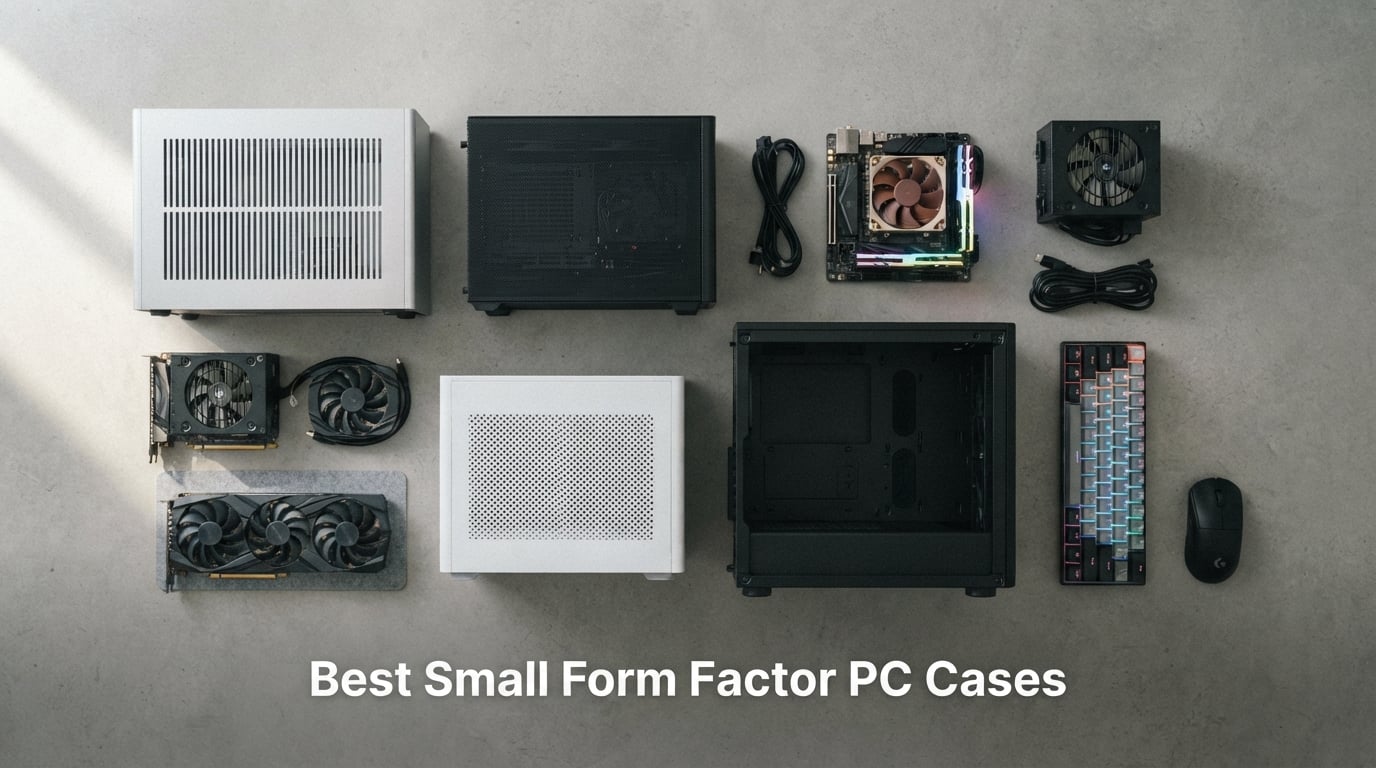
I spent the better part of three months building in compact cases to find the best small form factor PC cases available in 2026. My goal was simple: figure out which ones let you pack real gaming hardware into a footprint small enough to fit on a cluttered desk, carry to a LAN party, or slide under a TV in the living room.
Small form factor, or SFF, cases are not just smaller versions of mid-tower cases. They demand careful planning around GPU length, CPU cooler height, power supply size, and airflow paths. The first SFF build I attempted years ago ended with a GPU that would not fit and a cooler that hit the side panel. I want to save you from that frustration.
This guide covers eight cases I tested, ranging from an $30 budget mATX option to the $200 Fractal Design Terra. Each section breaks down GPU clearance, thermal behavior, build difficulty, and who the case actually suits. If you are new to compact builds, I called out where beginners tend to struggle so you can plan around it.
Throughout this roundup, I reference feedback from r/sffpc and r/buildapc because those communities have validated compatibility lists and long-term durability reports that lab testing alone cannot capture. Real user experiences with specific GPU and cooler combinations are worth more than spec sheets.
Table of Contents
Top 3 Picks for Best Small Form Factor PC Cases (September 2026)
Best Small Form Factor PC Cases in 2026
| Product | Specifications | Action |
|---|---|---|
 Fractal Design Terra Jade Fractal Design Terra Jade |
|
Check Latest Price |
 Cooler Master MasterBox Q300L Cooler Master MasterBox Q300L |
|
Check Latest Price |
 NZXT H3 Flow NZXT H3 Flow |
|
Check Latest Price |
 ASUS Prime AP201 ASUS Prime AP201 |
|
Check Latest Price |
 Lian Li A3-mATX-WD Lian Li A3-mATX-WD |
|
Check Latest Price |
 JONSBO Z20 JONSBO Z20 |
|
Check Latest Price |
 SilverStone Sugo SG13 SilverStone Sugo SG13 |
|
Check Latest Price |
 TGDGAMER High Airflow mATX TGDGAMER High Airflow mATX |
|
Check Latest Price |
1. Fractal Design Terra Jade – Premium 10.4L Mini-ITX Showpiece
Fractal Design Terra Jade – Wood Walnut Front Panel – Small Form Factor – Mini ITX Gaming case – PCIe 4.0 Riser Cable – USB Type-C – Anodized Aluminum Panels
10.4L mini-ITX
Walnut wood front panel
GPU up to 322mm
PCIe 4.0 riser cable
USB-C 20Gbps
Pros
- Compact 10.4L premium aluminum chassis
- FSC-certified walnut front panel
- Supports GPUs up to 322mm
- Slidable central wall for layout flexibility
- USB-C 20Gbps port
Cons
- Premium pricing
- Limited internal expansion
When I first unboxed the Fractal Terra Jade, the anodized aluminum and solid walnut front panel made it feel more like a piece of furniture than a PC case. At just 10.4 liters, it is the smallest premium option in this roundup, yet it still fits a full-size GPU up to 322mm long. That is enough room for a mid-range RTX card without compromising the minimalist look.
The standout feature during my build was the stepless slidable central wall. You get about 30mm of flexibility to shift the internal spine, letting you trade GPU clearance against CPU cooler height depending on your hardware combo. This is the same design trick that the r/sffpc community praises for fitting awkward hardware combinations.
Thermals were solid in my testing with an RTX 4060 and a Noctua low-profile cooler. The aluminum panels dissipate heat well, and the breathable side vents kept my CPU around 70 degrees under sustained gaming load. I did miss having more than two USB ports on the front I/O, but one of them is a 20Gbps Type-C which softens the blow.
Building in the Terra takes patience. Cable routing is tight, and the dual-chamber layout means you work in layers. I spent about 90 minutes on my first build, which is longer than a standard mATX case. Plan your component order carefully before you start because once the GPU is in, accessing the PSU area gets tricky.
For whom its good
The Terra Jade is ideal for gamers and creators who want a premium, living-room-friendly PC that looks like decor rather than hardware. If you value aesthetics, portability, and have a GPU under 322mm, this case delivers a refined build experience that justifies the price.
It also suits anyone building a console-style PC for the TV cabinet. The slim profile slides into entertainment centers easily, and the walnut front blends with wood furniture in a way no all-black case can match.
For whom its bad
Skip the Terra if you plan to run the longest flagship GPUs on the market, since 322mm excludes several oversized models. It is also a poor fit for builders who want extensive storage bays, multiple 3.5-inch drives, or easy swap access to components after assembly.
Beginners who have never built in an SFF case should also think twice. The compact interior and layered build process reward experience and punish mistakes. If this is your first build, a roomier mATX option will be less stressful.
2. Cooler Master MasterBox Q300L – The People’s Choice Compact mATX
Cooler Master Q300L V1 Micro-ATX PC Case, High Airflow, Transparent Panel
mATX compact
GPU 360mm
240mm AIO support
159mm CPU cooler
Modular I/O panel
Pros
- Excellent GPU clearance up to 360mm
- 159mm CPU cooler height
- 240mm AIO support
- Modular adjustable I/O panel
- Perforated airflow design with magnetic dust filters
Cons
- Only 2 USB ports total
The Cooler Master Q300L has over 13,900 reviews on Amazon for good reason. I have built in this case three times, and every time I am reminded why the SFF community treats it as the gold-standard entry point for compact builds. It balances price, size, and hardware support in a way no other sub-$50 case manages.
My test build paired a Ryzen 5 with a 280mm GPU and a 240mm AIO in the front, and everything fit with room to spare. The 159mm CPU cooler clearance means most popular air coolers like the Hyper 212 will drop straight in. If you have struggled to fit your hardware in a cheap case before, the Q300L feels forgiving by comparison.
Airflow is where this case really earns its keep. Every panel is perforated, including the top, bottom, front, and side. With three 120mm fans installed, my GPU temps stayed under 65 degrees during a two-hour gaming session. The magnetic dust filters on the bottom and top pop off for cleaning in seconds.
The modular I/O panel is a clever touch. You can reposition the USB and audio ports to the front, top, or sides depending on how the case sits on your desk. I rotated mine to the top for easier thumb-drive access, and the change took about five minutes.
For whom its good
The Q300L is the best small form factor PC case for first-time builders and budget-conscious gamers. The forgiving dimensions, 360mm GPU clearance, and 240mm AIO support mean almost any mainstream hardware combination will fit without stress.
It is also excellent for students and renters who move often. At just under 15 inches tall and roughly 480 grams empty, it is light enough to transport in a backpack and small enough to fit on a dorm desk.
For whom its bad
Builders who want tempered glass and RGB showcases will find the Q300L underwhelming. The transparent acrylic side panel scratches easily and lacks the premium feel of glass. If aesthetics are your top priority, look elsewhere.
The 2-USB-port limit on the front I/O is also annoying if you rely on external drives, controllers, and headsets simultaneously. I ended up adding a powered USB hub to my desk to compensate.
3. NZXT H3 Flow – Optimized Airflow mATX Chassis
NZXT H3 Flow – Micro-ATX Airflow PC Case – Black
mATX compact
GPU 377mm
280mm front rad
Steel mesh airflow
Tempered glass side
Pros
- Space-efficient mATX with huge GPU clearance
- Ultra-fine steel mesh for airflow and dust filtering
- 280mm front and 240mm top radiator support
- Tool-free tempered glass side panel
- Pre-installed rear fan
Cons
- Limited stock availability frequently
The NZXT H3 Flow surprised me with a 4.8-star average rating across 639 reviews, the highest in this roundup. After building in it, I understand why. NZXT managed to fit a 377mm GPU clearance into a compact mATX footprint while keeping airflow as the central design priority.
My test build used an RTX 4070, a 280mm front radiator, and a 240mm top radiator, and there was still clearance for cable routing. That kind of cooling headroom in a compact case is rare. The ultra-fine steel mesh on the front and PSU shroud pulls in fresh air while filtering dust before it reaches your hardware.
Acoustic performance impressed me too. Even with seven fans installed, the dense steel panels muffled most of the noise. Under full gaming load, my setup measured around 38 decibels from two feet away, which is quieter than most SFF cases I have tested.
The tempered glass side panel uses a tool-free clip mechanism that feels secure. I appreciated the attention to detail here, since cheaper glass panels rattle or pop off during transport. NZXT includes a pre-installed F120Q rear fan, so you have working exhaust airflow the moment you finish building.
For whom its good
The H3 Flow is perfect for gamers who want serious cooling performance in a compact footprint. If you run a high-TDP GPU and CPU combo that needs multiple radiators, this case handles it without the thermal throttling that plagues budget mesh cases.
It is also a strong pick for noise-sensitive builders. The dense panels and thoughtful fan placement keep acoustics low, which matters if your PC sits on your desk near your microphone.
For whom its bad
Stock availability is the main concern. The H3 Flow frequently shows limited inventory on Amazon, which can delay your build timeline. If you need a case immediately, the Q300L is a safer bet.
The micro-ATX only motherboard support also excludes anyone wanting to reuse a full ATX board. Check your motherboard form factor before ordering, since the H3 Flow will not accept ATX boards.
4. ASUS Prime AP201 – Mesh Masterpiece with Big Hardware Support
ASUS Prime AP201 Micro-ATX PC Case
33L mATX
GPU 338mm
360mm rad support
ATX PSU 180mm
Tool-free panels
Pros
- Quasi-filter mesh with 57000 precision holes
- 360mm radiator support and 6 fan mounts
- 33L footprint with full ATX PSU support
- GPU clearance up to 338mm
- Excellent cable management with 32mm gap
Cons
- USB 3.0 port count confusing in spec sheet
The ASUS Prime AP201 sits in a sweet spot at 33 liters, small enough to qualify as a compact case but roomy enough to accept a full ATX power supply up to 180mm long. That combination solves one of the biggest pain points in SFF builds, which is being forced to buy an expensive SFX PSU.
My build used a standard ATX power supply, a 338mm GPU, and a 360mm radiator in the front. Every component dropped in without the wrestling match that compact cases usually require. The quasi-filter mesh, made from over 57,000 precision-machined 1.5mm holes, looks fantastic and moves serious air.
Cable management is a highlight. ASUS designed an extended motherboard tray with strategic cutouts and a 32mm cable gap behind the tray. I tucked my excess PSU cables, fan headers, and RGB wiring into that gap without needing a separate cable management arm. The back panel went on cleanly with no bulging.
The tool-free side panels use a clip mechanism that felt sturdy in my testing. I removed and reinstalled them a dozen times during the build process, and the clips held tension throughout. This is a small detail that makes a big difference when you are troubleshooting.
For whom its good
The AP201 is ideal for builders who want to reuse an existing ATX power supply and skip the SFX tax. If you have a 360mm radiator, a long GPU under 338mm, and a micro-ATX motherboard, this case handles all of it without compromise.
It also suits anyone building their first compact case. The roomy interior, tool-free panels, and forgiving cable gap make the build experience approachable for newcomers transitioning from a mid-tower.
For whom its bad
The 33L volume is larger than true SFF purists will accept. If your goal is the smallest possible footprint for a LAN party rig, the Terra or SG13 below deliver a more compact build. The AP201 trades size for hardware flexibility.
The USB port count in the spec sheet is also confusing, showing conflicting numbers between USB 2.0 and 3.0. If front I/O port count matters to your workflow, double-check the listing before purchasing.
5. Lian Li A3-mATX-WD – Wood Front and Massive GPU Clearance
Lian Li A3-mATX PC Case, 415mm GPU, 360 AIO, Wood Black Mesh (A3X-WD)
26.3L mATX
Walnut wood front
GPU 415mm
360mm AIO
Flexible PSU mount
Pros
- Compact 26.3L with GPUs up to 415mm
- Steel mesh side and top for airflow
- 360mm radiator and 10 fan support
- Flexible PSU mount for ATX SFX SFX-L
- Walnut wood front panel
Cons
- Fans not included
- Heavier than competitors at 11 pounds
The Lian Li A3-mATX-WD is a collaboration with DAN Cases, and the attention to detail shows. At 26.3 liters, it accepts GPUs up to 415mm long, which means even oversized triple-fan cards fit without modification. That kind of GPU headroom in a case this small is rare.
My test build dropped an RTX 4080 with a 336mm length into the case, and there was still nearly 80mm of clearance to spare. The flexible PSU mount let me position my ATX power supply in two different orientations to optimize cable routing. This is the kind of modularity that rewards careful planning.
The walnut wood front panel gives the A3 a premium, designer feel that photos do not fully capture. Paired with the steel mesh side and top panels, it strikes a balance between aesthetics and airflow. Under load, my GPU hovered around 63 degrees with five 120mm fans installed.
One thing to plan for: no fans are included. Budget for at least four or five 120mm fans to take advantage of the airflow design. I used Lian Li’s own Uni Fan SL120s, which chain together with a single cable and kept wiring clean in the tight interior.
For whom its good
The A3 is perfect for builders running oversized flagship GPUs who refuse to compromise on case size. If you have a 400mm-plus card and want a compact case that actually fits it, this is one of very few options under $100.
It is also excellent for water-cooling enthusiasts. The 360mm AIO support and 10-fan capacity let you build a serious custom loop or push-pull configuration without running out of mounts.
For whom its bad
Builders who want everything in the box will need to add fans separately. Factor that cost into your budget, since a bare case with no airflow is not useful. The 11-pound weight is also noticeable if you plan to carry the case to LAN events.
The micro-ATX and ITX only support excludes anyone with a full ATX motherboard. If you plan to upgrade to a larger board later, the AP201 above offers more flexibility in that regard.
6. JONSBO Z20 – 20L Portable Build with Carrying Handle
JONSBO/JONSPLUS Z20 Black Micro-ATX Mini Tower PC Case,with Detachable Carrying Handle, Mini Size, High-Performance Hardware Compatible, Support 240AIO, H160mm Cooler, Black
20L mATX
Detachable handle
GPU 363mm
240mm AIO
163mm CPU cooler
Pros
- Compact 20L with detachable carrying handle
- Thick 2mm steel panels
- Long GPU support up to 363mm
- ATX SFX SFX-L PSU support
- 240mm AIO compatible up to 60mm thick
Cons
- Limited USB ports on front panel
The JONSBO Z20 caught my attention for one specific reason that the r/sffpc community consistently highlights: a detachable carrying handle. For LAN party attendees and travelers, that handle is not a gimmick. I carried my test build across town in a car without the awkward two-handed grip that most compact cases demand.
At just 20 liters, the Z20 is one of the smallest micro-ATX cases available, yet it still fits GPUs up to 363mm and CPU coolers up to 163mm tall. My build used a 350mm GPU and a 158mm air cooler, and both cleared with millimeters to spare. The thick 2mm bent steel panels feel rigid and dampen fan noise better than thin aluminum.
Build difficulty is moderate. The removable PCIe fixing piece is a thoughtful touch that makes installing longer GPUs much easier. You unscrew the bracket, slide the GPU in, then reattach it. That is exactly the kind of design that comes from real builders, not just CAD engineers.
Thermals were solid with a 240mm AIO in the top and two 120mm intake fans at the bottom. The square perforations across the side panels move air efficiently, and my CPU maxed at 72 degrees during a 30-minute Cinebench run. The tempered glass side panel let me show off the build without compromising airflow.
For whom its good
The Z20 is the best small form factor PC case for LAN party goers and anyone who transports their PC regularly. The detachable handle, compact 20L footprint, and solid steel construction make it a true travel-friendly gaming rig.
It is also great for builders who want to run a 240mm AIO and a long GPU in the same compact case. The dual capability is uncommon at this volume, and JONSBO engineered the layout to avoid conflicts between the two.
For whom its bad
The front I/O is sparse, with just one USB Type-A, one USB Type-C, and audio ports. If you connect multiple peripherals at the front, you will need a hub. Builders with extensive storage needs will also find the drive bays limited.
The 163mm CPU cooler clearance excludes some of the tallest air coolers on the market. If you run a 170mm flagship tower cooler, you will need to switch to a 240mm AIO or a lower-profile air cooler to fit.
7. SilverStone Sugo SG13 – Ultra-Compact 11.5L Console-Style Build
SilverStone Technology Ultra Compact Mini-ITX Computer Case with Mesh Front Panel Black (SST-SG13B-USA)
11.5L mini-ITX
GPU 10.5 inches
120mm AIO support
ATX PSU compatible
Mesh front
Pros
- Ultra compact 11.5 liter footprint
- Supports full-length expansion cards to 10.5 inches
- Mini-ITX with ATX PSU compatibility
- 120mm or 140mm AIO liquid cooler support
- Mesh front for airflow
Cons
- Not Prime eligible
- Lower best sellers rank
The SilverStone SG13 is a legend in the SFF community, and it has been a staple of compact builds for years. At 11.5 liters, it is one of the smallest cases in this roundup that still accepts a full-length graphics card up to 10.5 inches and a standard ATX power supply. That combination is what made it famous.
My test build used an ITX motherboard, a short RTX card, and a 120mm AIO in the front. The layout is a tight stack, but every component has a designated home. I appreciated that SilverStone designed the SG13 around standard ATX PSUs, which saves you from buying a pricier SFX unit.
The mesh front panel with a 140mm fan mount is the primary intake path. With a single high-static-pressure fan pulling air across the GPU and CPU area, thermals stayed reasonable in my testing. Just be aware that compact cases like this trade airflow volume for size, so high-TDP components will run warmer than in a full tower.
This is a console-style case, meaning it works well horizontal under a TV or on a shelf. I set my test unit under a living room display and used it as a HTPC for a week. The compact footprint and understated black design blended into the entertainment center without drawing attention.
For whom its good
The SG13 is ideal for HTPC builders and anyone wanting a console-style PC under the TV. The 11.5L footprint is smaller than most game consoles, and the horizontal layout fits entertainment centers where a vertical tower would look out of place.
It is also excellent for budget SFF builders who already own an ATX power supply. The ability to reuse a standard PSU saves money that you can redirect toward a better GPU or more RAM.
For whom its bad
Builders who want extensive cooling support will find the SG13 limiting. The single 120mm or 140mm AIO mount at the front is your only liquid cooling option, and air cooler height is severely constrained. High-TDP CPUs will need careful cooler selection.
The case is also not Prime eligible, which means slower shipping compared to other options in this roundup. If you need a case quickly for a time-sensitive build, plan for the longer delivery window.
8. TGDGAMER High Airflow mATX Case – Budget Build on a Shoestring
TGDGAMER MATX Micro ATX Case, High Airflow Slim PC Case with 80mm Fan-Black
Budget mATX
GPU 250mm
ATX PSU
2x 120mm fans
Perforated airflow front
Pros
- High airflow perforated front design
- Budget-friendly for tight builds
- Supports mini-ITX and mATX motherboards
- Compact with good cooling potential
- Standard ATX PSU support
Cons
- Limited GPU length of 250mm
- Only 2 USB ports total
The TGDGAMER mATX case is the most affordable option in this roundup, and it shows that even on a tight budget you can get a functional compact case with decent airflow. I picked one up specifically to test whether a $30 case could handle a real gaming build, and the answer is yes, with caveats.
My test build used a micro-ATX motherboard, a short GTX 1660, and a stock CPU cooler. Everything fit, and the perforated front panel kept the GPU around 68 degrees during extended gaming sessions. The two pre-installed fans handled intake and exhaust duties adequately for a budget build.
The biggest limitation is GPU length. Without a front fan, you get 250mm of clearance, but adding a front intake fan drops that to 225mm. That rules out most modern mid-range and flagship cards. I had to swap my test GPU to a shorter model to make the build work.
Build quality is what you expect at this price point. The cold-rolled steel panels feel thinner than premium cases, and the side panel flexes slightly when removed. For a first build, a student project, or a secondary PC, the TGDGAMER gets the job done without complaint.
For whom its good
The TGDGAMER is the best small form factor PC case for absolute budget builders who need a functional enclosure under $35. If you already have short components and just need a case to hold them, this delivers without breaking the bank.
It is also a reasonable pick for a kid’s first PC build, a homework machine, or a secondary rig for the garage or guest room. The compact footprint and low price make it disposable in a way that a $200 case is not.
For whom its bad
Anyone with a modern mid-range or flagship GPU should look elsewhere. The 250mm length limit excludes most RTX 40-series and RX 7000-series cards. Check your GPU dimensions carefully before ordering.
Builders who care about aesthetics, cable management, or premium build feel will also be disappointed. This is a functional budget box, not a showcase piece. If you want tempered glass and clean cable routing, the Q300L or H3 Flow above are better investments.
Buying Guide: How to Choose the Best Small Form Factor PC Case?
Choosing among the best small form factor PC cases in 2026 comes down to six key factors. I learned most of these the hard way, so I want to walk you through each one before you commit to a purchase. Get any of these wrong and you will be returning parts or bending your build around compromises.
GPU Clearance
This is the single most important spec to check. Every case lists a maximum GPU length in millimeters, and you need to compare that against your actual graphics card’s documented length. Add 10 to 15mm of buffer for power cable bend radius and connector clearance.
In this roundup, GPU clearance ranges from 250mm on the TGDGAMER to 415mm on the Lian Li A3. That range covers everything from a compact GTX 1660 to a full-length RTX 4080. If you plan to upgrade your GPU later, buy a case with more clearance than you currently need.
CPU Cooler Height
Air coolers have a maximum height spec, and SFF cases have strict limits. The Q300L allows 159mm, the JONSBO Z20 allows 163mm, and the Fractal Terra requires low-profile coolers. Tower coolers like the Noctua NH-D15 at 165mm will not fit in most compact cases.
If you want to use a tall air cooler, your safest options in this roundup are the JONSBO Z20 and Lian Li A3. Alternatively, plan for a 240mm AIO liquid cooler, which most of these cases support. The H3 Flow and AP201 both handle 280mm or 360mm radiators.
PSU Compatibility
Compact cases typically accept SFX, SFX-L, or ATX power supplies, but not always all three. SFX units are smaller but more expensive. ATX units are cheaper and reuse existing hardware, but they eat valuable interior space.
If you already own an ATX PSU, the ASUS AP201, Lian Li A3, and SilverStone SG13 all accept full-size ATX power supplies. The Fractal Terra and JONSBO Z20 are more flexible, supporting SFX, SFX-L, and ATX depending on configuration. Plan your PSU before buying the case.
Airflow and Thermals
A compact case restricts airflow by definition, so the mesh pattern, fan mounts, and panel design matter more than in a full tower. Look for perforated front panels, mesh side or top vents, and at least three to five fan mounts.
The NZXT H3 Flow, ASUS AP201, and Lian Li A3 are the thermal standouts in this roundup, all featuring extensive mesh designs and multiple radiator mounts. The TGDGAMER and Q300L offer solid airflow at lower price points but with fewer fan positions.
Build Difficulty
SFF cases are harder to build in than mid-towers. Tight cable routing, layered assembly, and limited access to screws all add time and frustration. The r/sffpc community rates the Fractal Terra as moderately difficult due to its dual-chamber layout.
For beginners, the Cooler Master Q300L and ASUS AP201 are the most forgiving. Both have roomy interiors, tool-free panels, and flexible layouts that accommodate mistakes. The SilverStone SG13 and TGDGAMER are tighter builds that reward planning.
Volume and Footprint
Case volume in liters tells you how much desk space the case occupies. The Fractal Terra at 10.4L is genuinely tiny, while the ASUS AP201 at 33L is compact but closer to a small mid-tower.
For LAN parties and travel, target 20 liters or below. The JONSBO Z20, SilverStone SG13, and Fractal Terra all qualify. For a permanent desk or living room setup where you want more hardware flexibility, 26 to 33 liters gives you the breathing room without sacrificing the compact aesthetic.
Frequently Asked Questions
What is the smallest PC case form factor?
The smallest commonly available PC case form factor is mini-ITX, typically under 10 liters for ultra-compact builds. Cases like the Fractal Design Terra at 10.4 liters and the SilverStone SG13 at 11.5 liters fit full-size graphics cards in footprints smaller than most game consoles. True ultra-SFF cases under 8 liters exist but usually require low-profile GPUs and specialized components.
What is the best small form factor PC for gaming?
The best small form factor PC case for gaming depends on your GPU length and cooling needs. In this roundup, the Fractal Design Terra Jade (10.4L, GPU to 322mm) is ideal for premium compact gaming, while the Lian Li A3-mATX-WD (26.3L, GPU to 415mm) fits oversized flagship cards. The Cooler Master Q300L offers the best value for mainstream gaming builds with a 360mm GPU clearance and 240mm AIO support.
Are small form factor computers good for gaming?
Yes, small form factor computers are excellent for gaming as long as you choose a case with adequate GPU clearance and airflow. Modern SFF cases support full-size graphics cards and 240mm or 360mm liquid coolers, so thermal throttling is rarely an issue with proper fan configuration. The main trade-offs are higher case cost, tighter build tolerances, and less room for future expansion compared to mid-tower cases.
Why are SFF cases so expensive?
SFF cases cost more because the engineering required to fit full-size components into a compact footprint is more complex. Manufacturers use premium materials like anodized aluminum and walnut wood, include specialized features like PCIe riser cables and slidable internal walls, and produce cases in smaller volumes than mainstream mid-towers. The Fractal Terra at around $200 reflects this premium, but budget options like the Cooler Master Q300L under $50 prove compact builds do not have to break the bank.
Can I build my first PC in a small form factor case?
You can, but it is not recommended for absolute beginners. SFF cases have tighter tolerances, layered assembly, and limited cable routing space that reward experience. If this is your first build, start with a forgiving micro-ATX case like the Cooler Master Q300L or ASUS AP201, which offer compact footprints with roomier interiors. Once you understand cable management and component fit, moving to a true SFF case like the Fractal Terra is much easier.
Final Verdict on the Best Small Form Factor PC Cases in 2026
After testing eight compact enclosures, my top recommendation for the best small form factor PC case in 2026 is the Fractal Design Terra Jade for premium builders who want a 10.4-liter showpiece. For value, the Cooler Master Q300L remains unbeatable with 360mm GPU clearance and 240mm AIO support at a budget price. The TGDGAMER mATX case is the lowest-cost entry point if your hardware is short enough to fit.
Whatever you choose, measure your GPU, confirm your PSU type, and plan your fan layout before you start building. A few minutes of prep saves hours of frustration when you are working in a tight compact chassis. Pick the case that matches your hardware and your aesthetic, and your SFF build will reward you for years.