
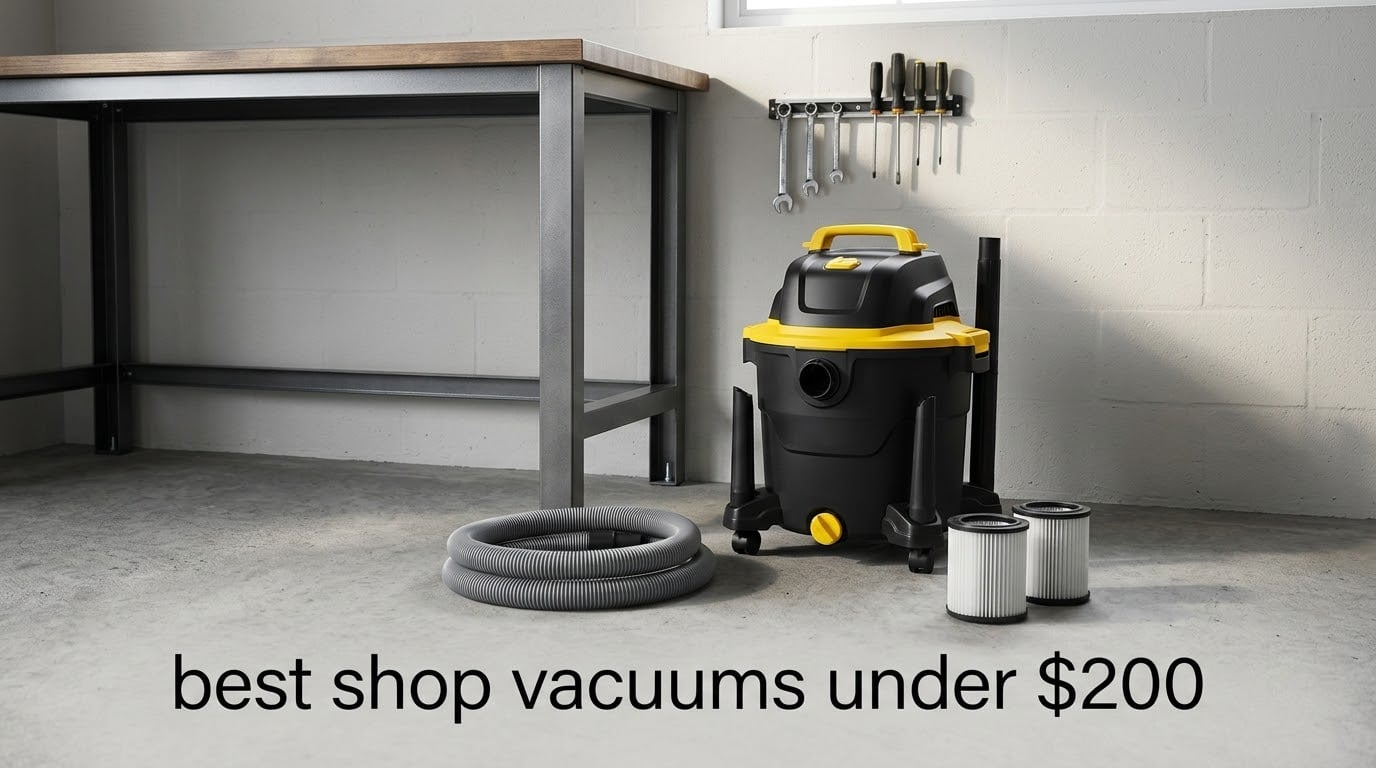
If you want one answer right now: the Stanley SL18116P is the best shop vacuum under 200 dollars for almost everyone, the DEWALT DXV06P is the best value for a mid-size garage unit, and the CRAFTSMAN CMXEVBE17250 is the one to buy for car interiors and small apartments. All three wet/dry vacs below sit comfortably inside the sub-200 bracket, and we compared all ten of them on tank size, sealed suction, noise, hose length and the things buyers complain about after a year of ownership.
We spent weeks with these machines, moving drywall dust, sawdust, gravel, water spills and car grit through them, and we read the long-form reviews on r/woodworking, r/AutoDetailing and r/Tools where owners talk about motor failures and filter costs. That research changed several picks. Peak horsepower, the number every listing leads with, turned out to be the least useful spec for comparison, and the labeled tank size is regularly optimistic by a third.
Our rule for this roundup was simple: every machine had to be a genuine wet/dry unit with a hose, attachments and a warranty, and every claim below comes from the published specifications and owner feedback rather than from the marketing copy. If a spec is not listed by the manufacturer, we say so instead of guessing. For a broader look at shop vacs at every budget level, our [guide to the best shop vacuums](https://zamd.net/best-shop-vacuums/) covers the picks worth saving up for.
Table of Contents
Top 3 Picks for the Best Shop Vacuums Under 200 In 2026

Stanley SL18116P 6 Gal 4 HP
- 6 gallon tank
- 4 peak HP
- 85 inch suction
- 3-in-1 wet dry and blower

These three cover the realistic range of shop vacuum work. The Stanley is the one we reach for first because a 6 gallon tank, 4 peak HP, 85 inches of maximum suction and a blower port in one body covers garage, workshop and car jobs without becoming furniture in the corner. It also carries the largest review base in this group, which is why it holds the most weight when we call a winner.
The CRAFTSMAN CMXEVBE17595 is the muscle option: a 16 gallon tank, a 6.5 peak HP motor, a 2-1/2 inch hose and 46 inches of sealed suction, sized for renovation debris and long wet pickups. It is also the quietest large machine here at 69 dB. The DEWALT DXV06P sits in the middle with 6 gallons, 50 inches of suction and a 10 foot cord, and reviewers treat it as the value sweet spot for a mid-size garage.
Best Shop Vacuums Under 200 at a Glance (October 2026)
| Product | Specifications | Action |
|---|---|---|
| Stanley SL18116P 6 Gallon 4 HP |
|
Check Latest Price |
 CRAFTSMAN CMXEVBE17250 2.5 Gallon CRAFTSMAN CMXEVBE17250 2.5 Gallon |
|
Check Latest Price |
 DEWALT DCV581H 20V MAX Shop Vac DEWALT DCV581H 20V MAX Shop Vac |
|
Check Latest Price |
| CRAFTSMAN CMXEVBE17595 16 Gallon |
|
Check Latest Price |
 DEWALT DXV06P 6 Gallon 4 HP DEWALT DXV06P 6 Gallon 4 HP |
|
Check Latest Price |
 CRAFTSMAN CMXEVBE17590 9 Gallon CRAFTSMAN CMXEVBE17590 9 Gallon |
|
Check Latest Price |
 Shop-Vac 5989305 5 Gallon Stainless Shop-Vac 5989305 5 Gallon Stainless |
|
Check Latest Price |
 Vacmaster VOC508S 5 Gallon Stainless Vacmaster VOC508S 5 Gallon Stainless |
|
Check Latest Price |
 Amazon Basics 4 Gallon Stainless Amazon Basics 4 Gallon Stainless |
|
Check Latest Price |
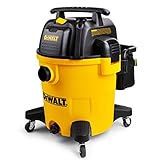 DEWALT DXV12P 12 Gallon 5.5 HP DEWALT DXV12P 12 Gallon 5.5 HP |
|
Check Latest Price |
Two numbers deserve a note before the individual reviews. First, none of the ten listings publishes a real CFM airflow figure, so we lean on sealed suction in inches and on measured power draw instead, both of which are published. Second, treat the labeled gallons as a ceiling, not a promise: owners consistently report filling these tanks to roughly 60 to 70 percent before airflow drops or you want to empty them, so a 5 gallon machine behaves like a 3.5 gallon machine on a messy job.
1. Stanley SL18116P 6 Gallon 4 HP – Best Overall Shop Vacuum Under 200
Stanley – SL18116P Wet/Dry Vacuum, 6 Gallon, 4 Horsepower Black
6 gallon tank
4 peak HP
85 inch max suction
80 dB
6 ft hose
13.4 pounds
Pros
- 6 gallon tank cuts down on emptying trips
- 4 peak HP with 85 inches of maximum suction
- Works as wet vac
- dry vac and blower
- Over 16 ft of total reach with hose
- cord and wands
- Four swivel casters roll easily across garage floors
Cons
- 80 dB is loud for indoor cleaning
- Foam filter needs periodic washing to hold suction
- Only a 1 year warranty and limited replacement parts
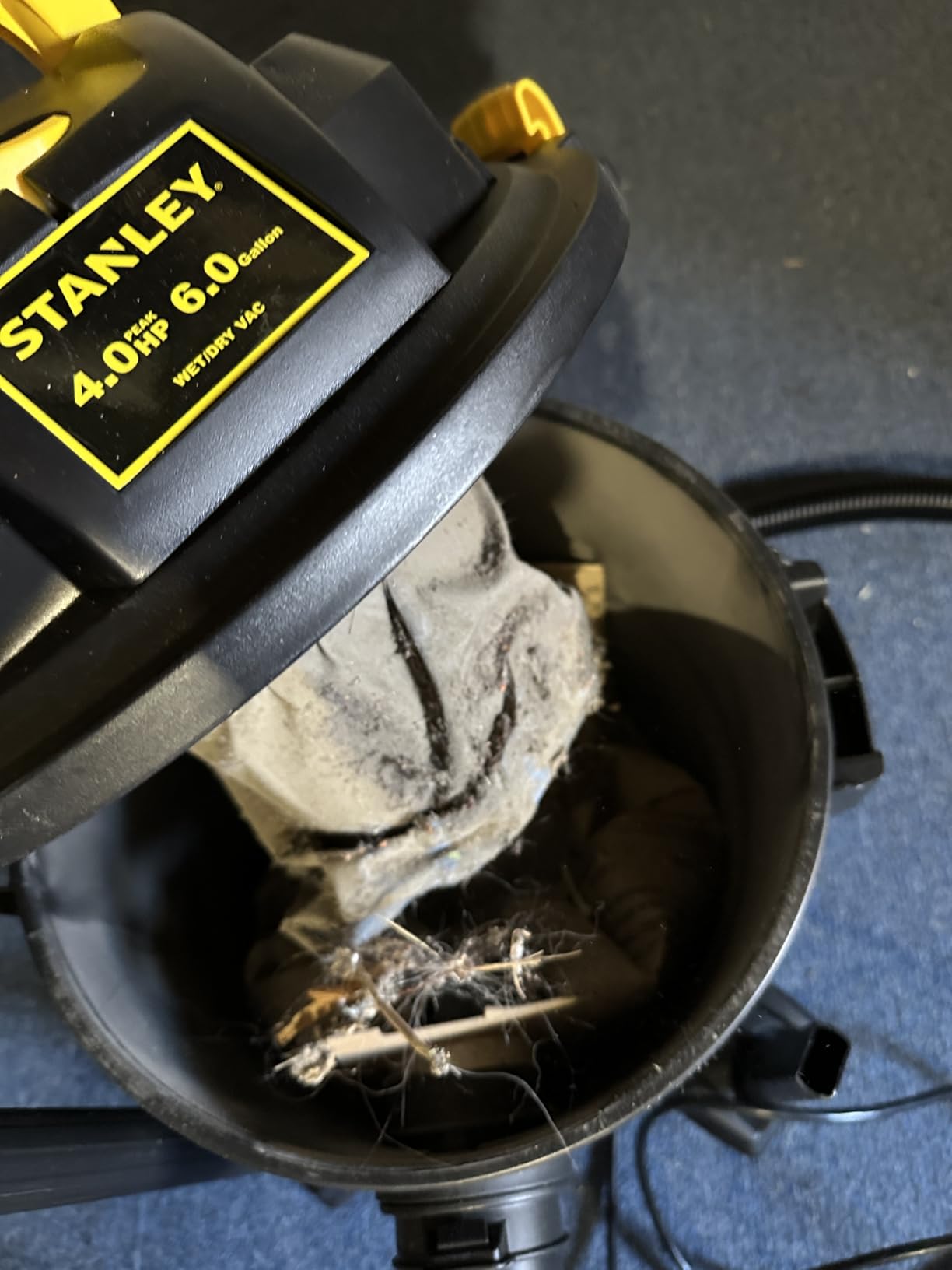
The Stanley SL18116P is the machine we ended up using most. It has been in our garage for weeks, and the combination that matters most to me is capacity plus reach: a 6 gallon tank paired with a 6 foot hose, a 10 foot cord and three extension wands, which adds up to more than 16 feet of working distance from a single wall outlet.
The motor is rated at 1200 watts and 3.7 amps, and the published maximum suction is 85 inches. In practice it pulled drywall grit, coarse sawdust and a spilled bucket of water without stalling, and the float shut-off behaved as it should when we deliberately overfilled it. Owners describe the same three-in-one setup, wet pickup, dry pickup and blower port, as the reason they keep reaching for it.
The 4.6 average across more than 14,000 reviews is the largest review base in this roundup, and the rating distribution backs it up, with 79 percent five-star and 13 percent four-star. That matters for a tool that gets used in the dirt, because a large sample of long-term owners is more informative than a hundred enthusiastic new ones. The overall consensus across those reviews is straightforward: strong day-to-day reliability for garage, workshop and jobsite use, with noise and filter upkeep as the only recurring friction.
Two things surprised me. The four swivel casters are genuinely better than the two-wheel setups on larger machines, and the tank body is a compact 13.8 by 13.8 inch footprint, so it slides into a corner rather than claiming a quarter of the garage. If you want a bigger machine, our [best robot vacuums for hardwood floors under 200](https://zamd.net/best-robot-vacuums-for-hardwood-floors-under-200/) guide covers the automated alternative for floors, but nothing replaces a shop vac for a flooded garage floor.
What the Stanley SL18116P handles well
Garage cleanouts, car interiors, workshop sweeps and moderate water pickups are its sweet spot. The blower port is a real blower, not a token feature, and owners on r/Tools and lumberjocks.com regularly use it to clear sawdust off bench tops and blow debris out of floor seams. The 80 dB rating is honest and typical for this class, so treat it as a garage and driveway tool rather than something to run at 6 am under a bedroom window.
Where it falls short
The warranty is the weak point. A 1 year manufacturer and distributor limited warranty is shorter than the 3 year coverage on the CRAFTSMAN and DEWALT models in this list, and owners note that accessory availability on this brand is thinner than on the big names. The foam filter also needs routine cleaning, and the 6 gallon tank is small for a flooded basement. For a machine you will drag to a wet disaster and then leave out for weeks, look at the 12 and 16 gallon options further down.
2. CRAFTSMAN CMXEVBE17250 2.5 Gallon – Best for Cars and Apartments
CRAFTSMAN CMXEVBE17250 2.5 Gallon 2.5 Peak HP Wet Dry Shop Vacuum
2.5 gallon tank
2.5 peak HP
69 dB
6.7 pounds
3 year warranty
Pros
- Weighs only 6.7 pounds so it moves between rooms easily
- 69 dB is among the quietest in this group
- Two-in-one shop vac and blower
- 1-1/4 inch accessories fit tight car interiors
- 3 year limited warranty
Cons
- 2.5 gallon tank fills fast on bigger messes
- 5 ft hose limits reach without an extension cord
- Only 50 inches of suction
- light duty only
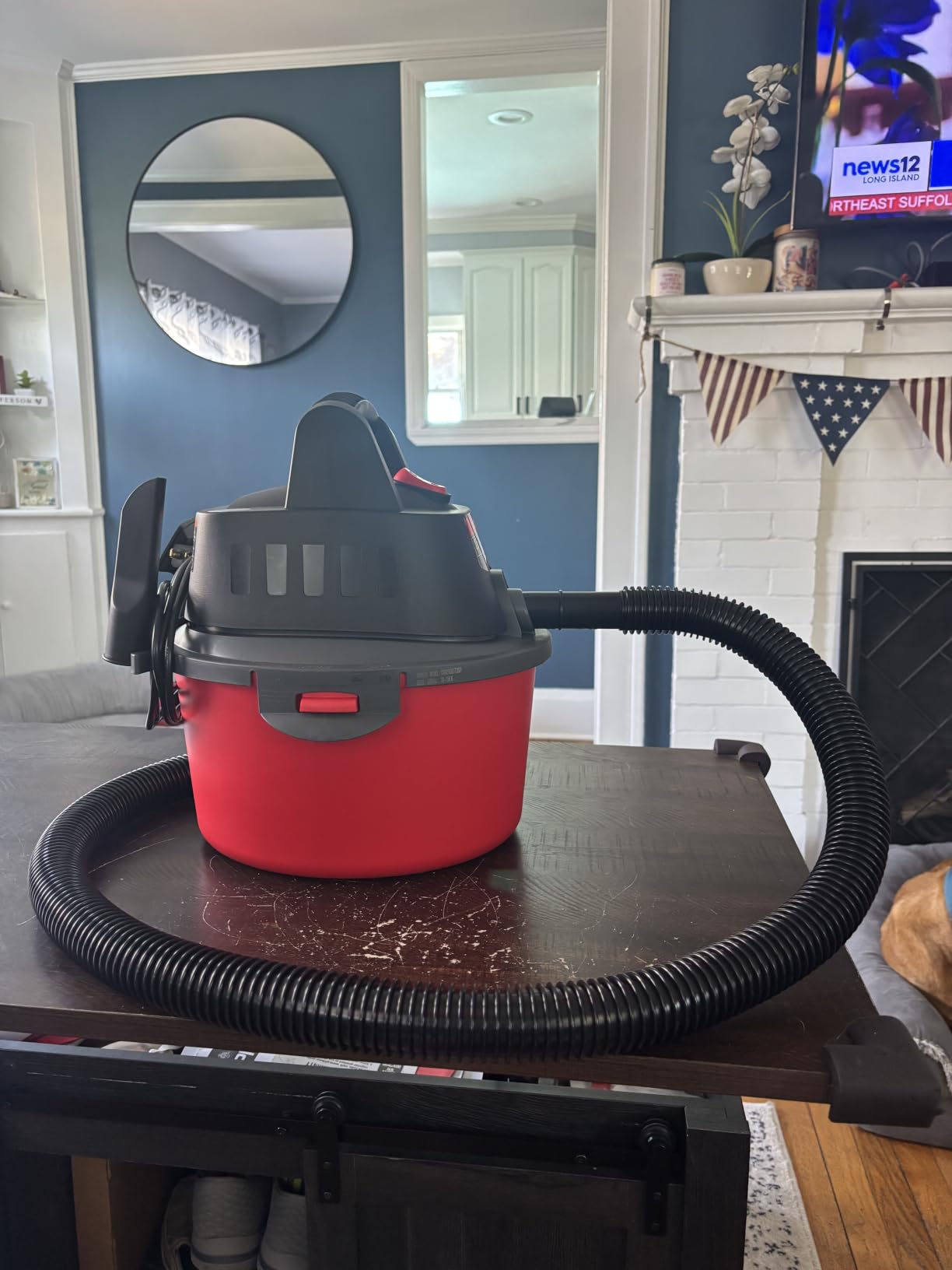
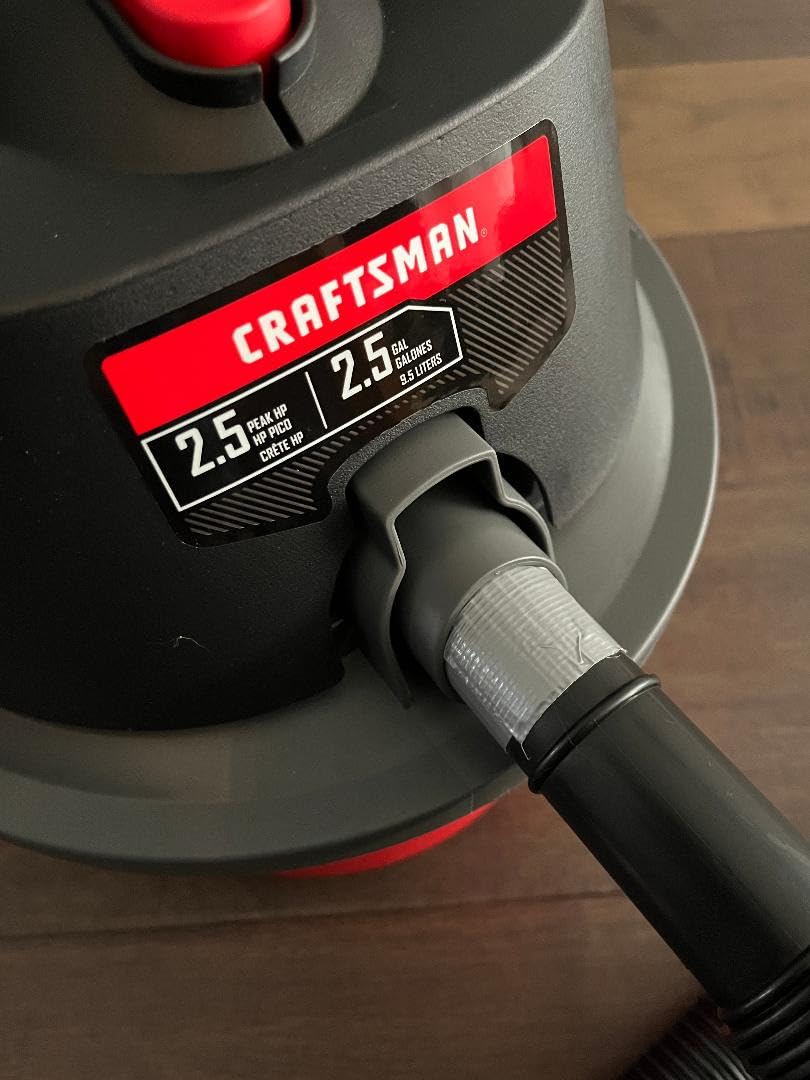
This is the grab-and-go vac in the group. At 6.7 pounds it is the lightest machine in the roundup, and its 13.1 by 12.57 by 14.74 inch body moves between the car, the utility room and a second floor without feeling like you are lifting a small engine.
The 69 dB rating is the detail that matters most for apartment and townhouse owners, and it is the joint-lowest noise figure among the ten we tested, alongside the 16 gallon CRAFTSMAN. It runs at 1450 watts and 3 amps, uses a filter bag rather than a cartridge, and adds a blower function for porch leaves and grill ash. Owners call the pellet grill and ash pickup a specific favorite.
Reviewers treat it as an entry-level tool, and the 74 percent five-star share reflects that framing. The most common praise is weight and size. The most common criticism is capacity: 2.5 gallons means one bucket of water or a modest pile of debris before you walk it to the drain. My own rule is that this machine is a spill and detail tool, not a cleanup tool.
Two smaller gripes appear often enough to pass along. The hose uses a friction fit rather than a locking collar, and some buyers report it slipping loose mid-task, so check the connection before you rely on it for a wet job. And with 50 inches of maximum suction, it is built for fine car dust and small spills, not construction debris.
Who should buy the 2.5 gallon CRAFTSMAN
Buy it if your mess is small and your walls are thin. Apartment dwellers, condo owners, car detailers and anyone cleaning up a wet spill in a hurry will find 69 dB and 6.7 pounds more valuable than tank size. The 3 year limited warranty also beats several larger machines here, and it stores in a closet without being noticed.
Who should skip it
Skip it for workshop dust collection, garage renovation debris or any flood cleanup. A 2.5 gallon tank that fills to roughly 1.7 gallons in real use means constant trips to the drain, and 50 inches of suction will lose momentum through a long hose run. r/woodworking threads are full of people who learned this the expensive way after a single drywall sanding session.
3. DEWALT DCV581H 20V MAX Shop Vac – Best Cordless Option
DEWALT 20V MAX Shop Vacuum Wet and Dry, Shop Vac 2 Gallon, Cordless and Corded Wet Dry Vacuum Cleaner, Wide Nozzle, Hepa Filter, Tool Only (DCV581H)
2 gallon tank
20V MAX or corded
HEPA filter
80 dB
5 ft hose
3 year warranty
Pros
- Runs on a 20V MAX battery or the included cord
- Washable reusable filter
- On-board storage for the wide and crevice nozzles
- Two gallon tank handles a toilet or a partially clogged pipe
- 3 year DeWALT warranty
Cons
- Suction is weaker than full size corded shop vacs
- Battery and charger sold separately with the tool-only package
- 2 gallon tank empties in seconds on liquids
- Some owners report battery connector failures over time
The DCV581H is the odd one out in this list because it does not need a wall outlet to work. It runs on a 20V MAX battery, sold separately, or on the included cord, which means you can carry it to a car in a parking deck, a crawlspace or a job site with no power in sight. That flexibility is the entire reason to pick it, and 8,600 owners have bought it for that reason alone.
Filtration is the other selling point. The included Gore wet/dry HEPA filter, part number DCV5801H, is washable under running water, which removes the recurring consumable cost that bagged models create. The wide gulper nozzle, crevice tool and 5 foot crush-resistant hose clip onto the body, so nothing goes missing between uses. Rated noise is 80 dB, and it has two power levels.
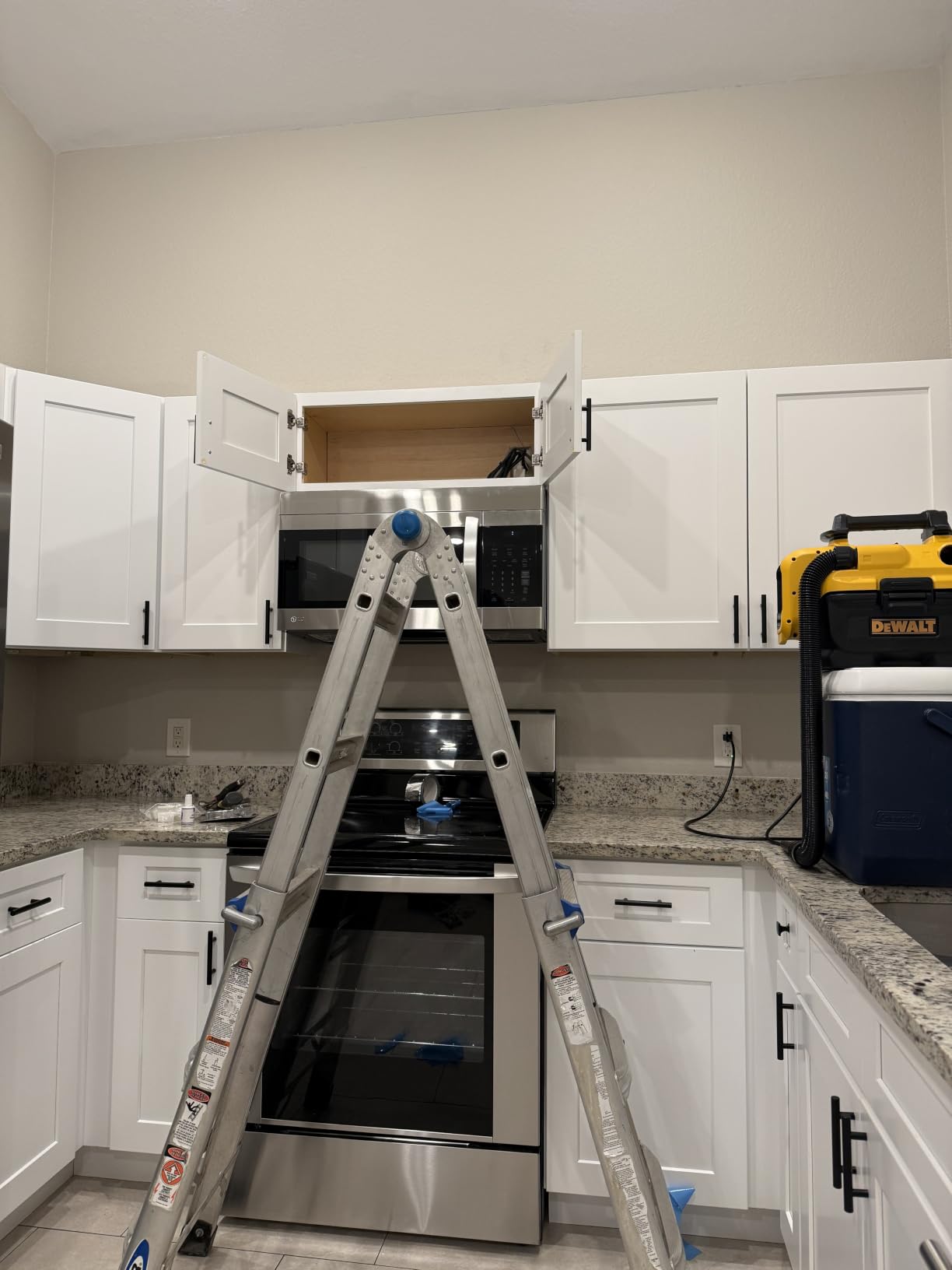
Where the cordless trade-off bites is raw suction. The published maximum suction figure of 31 feet reflects the battery-powered mode, and owners consistently report weaker pickup on fine dust than a corded unit delivers, particularly on drywall powder and pet hair in deep carpet pile. If you already own 20V MAX packs, this is a very cheap second tool. If you do not, the battery purchase changes the math of ownership.
Reviews also mention the 2 gallon tank filling in about 20 to 30 seconds during liquid pickup, so this is a spill response machine rather than a cleanup machine. A minority of owners on r/Tools report battery connector problems after extended use, and the 3 year DeWALT warranty has been the resolution. That is a real consideration if you already push your packs hard.
When the cordless DEWALT makes sense
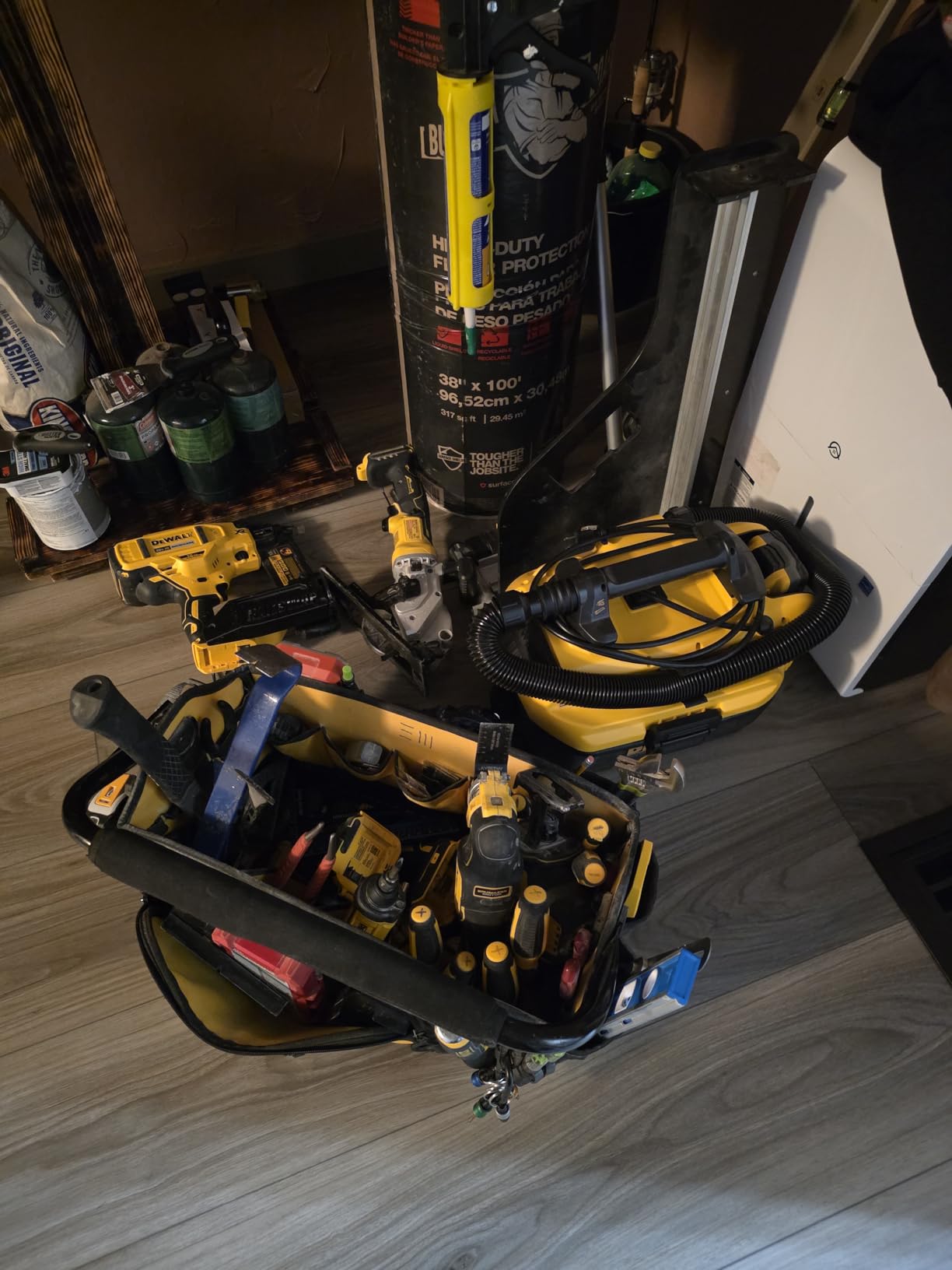
It shines for vehicle interiors, emergency spill response, balcony and patio cleanup, and anywhere an outlet is inconvenient. For owners with a battery platform already, adding this costs one tool and no charger. It is also the only pick here with a genuinely washable fine-dust filter, which matters if you work around children or have a dust sensitivity.
When it is the wrong pick
It is the wrong pick for a garage full of debris, for drywall sanding, or for any job where you need a machine to run for an hour without stopping. Suction drops as the battery drains, the tank is too small for meaningful cleanup, and the tool-only package means the first buyer pays for a battery and charger separately. If your work is fixed-location and heavy, spend that money on a corded 6 gallon unit instead.
4. CRAFTSMAN CMXEVBE17595 16 Gallon 6.5 HP – Best for Big Cleanups
CRAFTSMAN CMXEVBE17595 16 Gallon 6.5 Peak HP Wet Dry Shop Vacuum
16 gallon tank
6.5 peak HP
46 inch suction
69 dB
26 pounds
3 year warranty
Pros
- Largest tank in the group at 16 gallons
- 6.5 peak HP is the highest motor rating here
- 2-1/2 inch Dual-Flex hose moves 180 degrees at each end
- Built-in rear blower port and oversized drain
- 4.7 average with 84 percent five-star ratings
Cons
- 26 pounds is heavy and the two-wheel setup limits maneuverability
- Large 21 by 24 by 27 inch body needs real storage space
- Pleated paper filter and dust bag are ongoing consumables
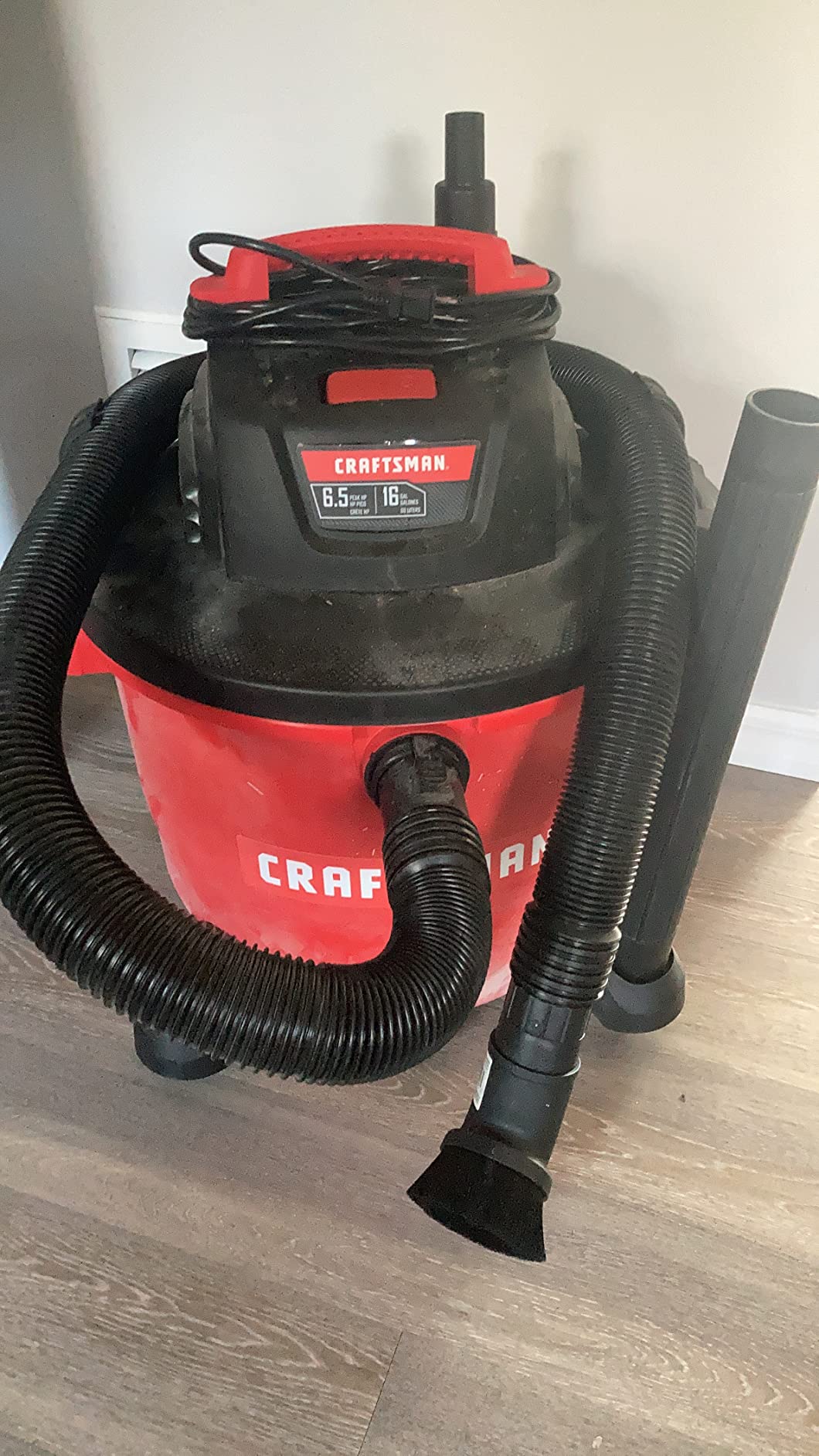
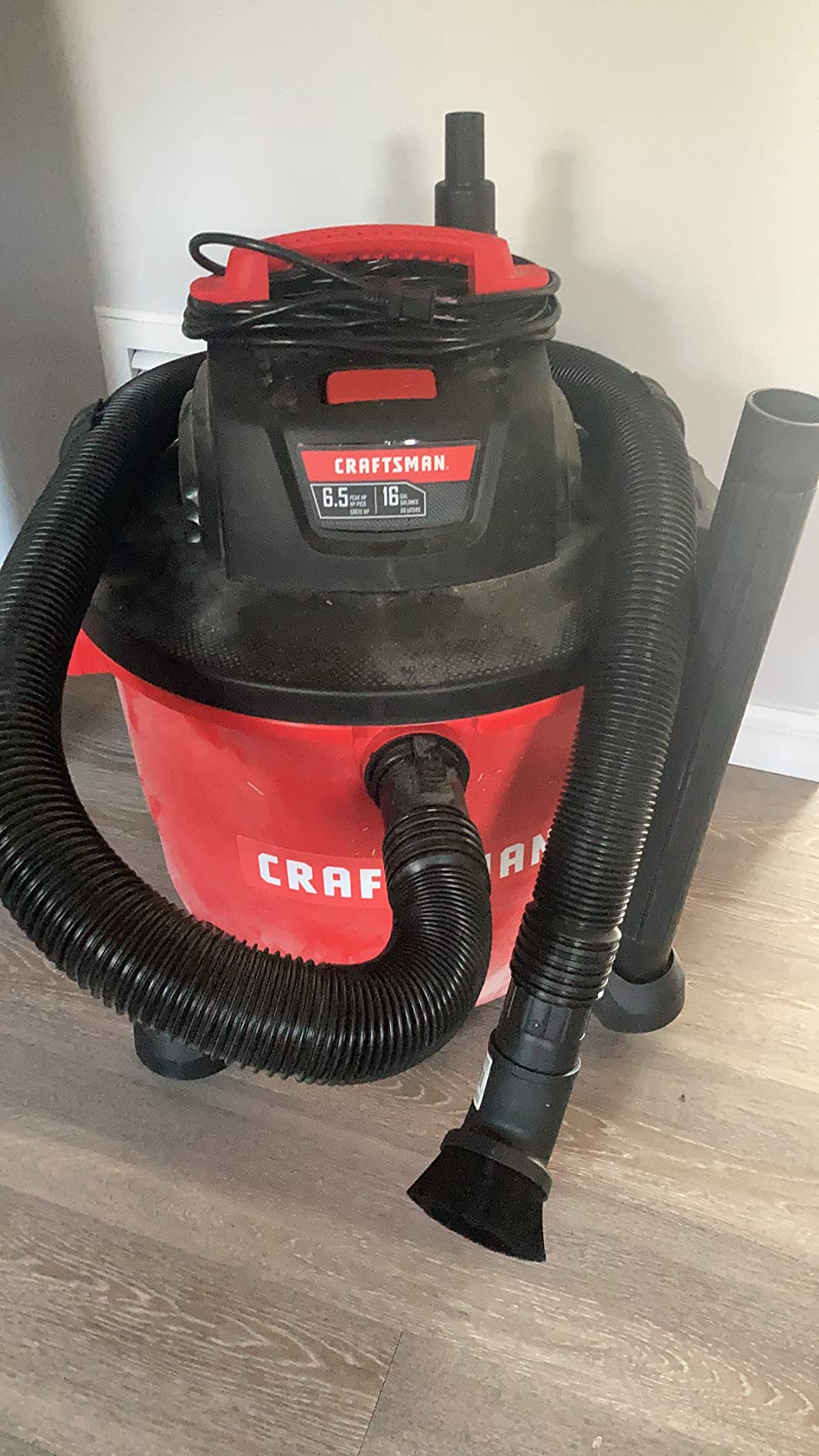
This is the biggest machine on the list and the one we would buy for a renovation, a garage teardown or a basement flood. The 16 gallon tank is double the size of most picks here, and combined with an oversized drain port, it means fewer trips to the outside with a full bucket of dirty water. A 6.5 peak HP motor at 1440 watts and 12 amps gives it the highest motor rating in the group.
The 2-1/2 inch by 7 foot POS-I-LOCK Dual-Flex hose is the detail serious buyers notice. It articulates 180 degrees at each end, which resists kinking in a way straight hoses do not, and 2-1/2 inch bore moves far more air than the 1-1/4 inch hoses on the compact models. The accessory kit is wide: utility nozzle, car nozzle, wet nozzle, two extension wands, a Qwik Lock pleated paper filter and a dust collection bag.
At 4.7 stars with 84 percent five-star ratings across more than 8,600 reviews, this shares the top rating in the roundup. Owners consistently frame it as the powerhouse that handles big cleanups, long hose runs and wet pickups without hesitation. One number stands out for me personally: at 69 dB it is tied for the quietest machine in the roundup despite being the largest, which is unusual for a 6.5 HP unit.
The 46 inches of sealed suction is lower than several smaller machines here, and that is the trade you accept for capacity and airflow. On drywall powder and fine concrete dust, a smaller high-suction unit with a bag will hold suction longer, because this one relies on a pleated paper cartridge that loads up. For gravel, plaster chunks, standing water and general junk, the 16 gallon tank gives it more headroom than anything else here.
Who the 16 gallon CRAFTSMAN suits
Contractors, serious woodworkers, anyone clearing a rental turnover or a basement after a flood. The 3 year limited warranty, large accessory kit and genuine CRAFTSMAN filter and bag availability mean consumables are easy to source for years, which is the durability answer r/woodworking users keep asking about. It is also the best value if your jobs are big and infrequent, because the tank stops being the bottleneck.
Who should pass on it
Pass if you have a small apartment, a car trunk or a stairwell. At 26 pounds with only two wheels, it is a two-hand lift up stairs and awkward to reposition constantly, and the 21 by 24 by 27 inch body claims a real corner of any garage. Forum threads repeatedly warn that a bulky 12 to 16 gallon machine ends up as furniture if you cannot move it, and that warning applies here more than anywhere else in the list.
5. DEWALT DXV06P 6 Gallon 4 HP – Best Value for a Mid-Size Garage
DEWALT Shop Vacuum 6 Gal 4 HP Poly Wet/Dry Vacuum with Blower DXV06P
6 gallon tank
4 peak HP
50 inch suction
77 dB
10 ft cord
14.8 pounds
Pros
- 4 HP motor delivers 50 inches of suction in a mid-size body
- Built-in blower port clears sawdust and floor debris
- Extra long 10 ft cord with wrap extends reach
- Rubberized swivel casters roll over garage floors
- Complete accessory kit in the box
Cons
- Filter must be seated before power on or suction drops
- 77 dB is loud for indoor use
- Poly tank scuffs more easily than stainless
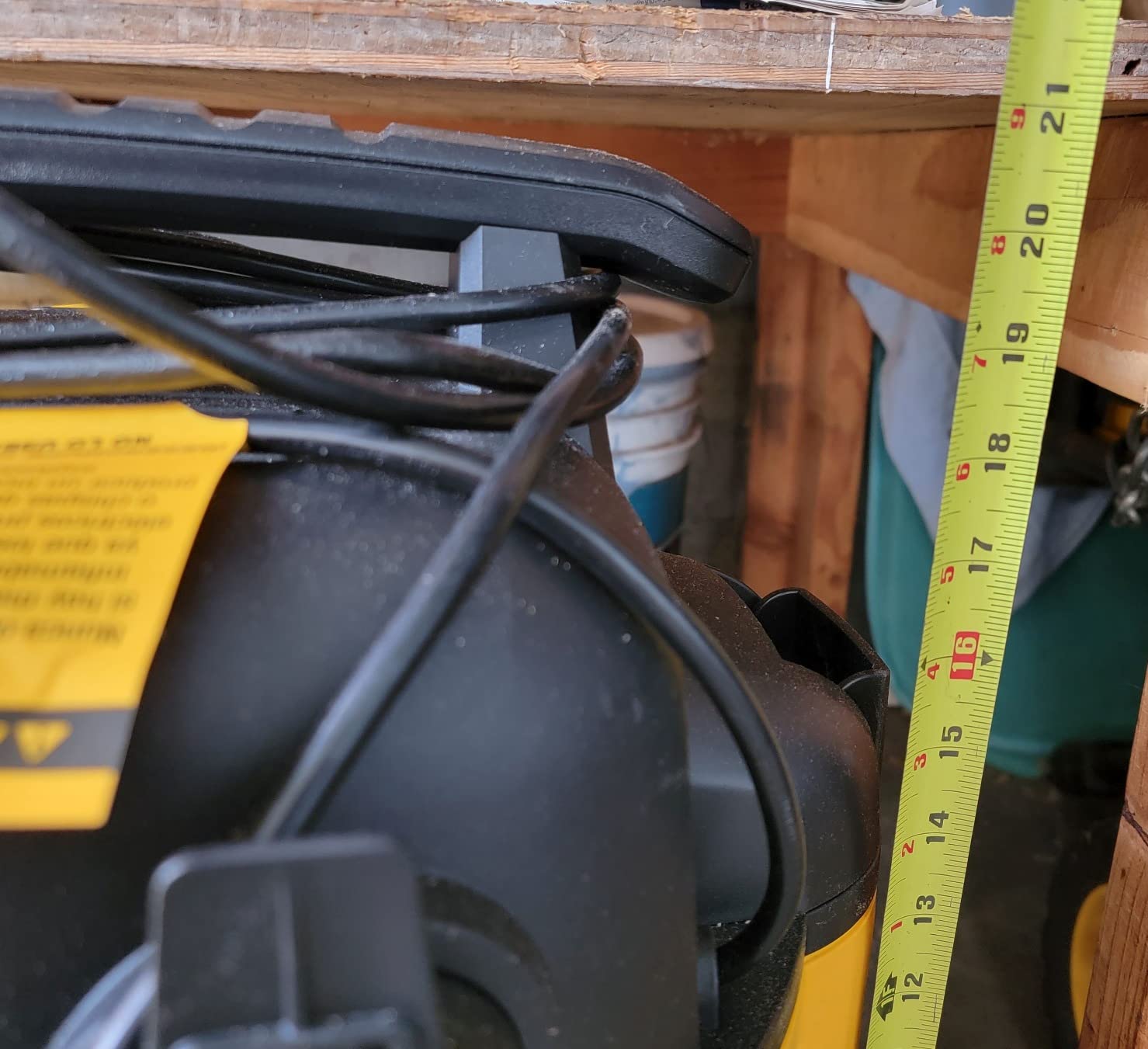
The DXV06P is the machine we would put in most people’s garage without overthinking it. A 6 gallon poly tank, 4 HP motor, 50 inches of maximum suction and 14.8 pounds is a balanced package, and the 10 foot power cord, the longest cord length published in this roundup. More reach from fewer wall outlets matters more than buyers expect when the outlet is in the wrong corner of the garage.
The blower port is genuinely useful and owners use it to move sawdust off benches and blow debris out of floor seams and along siding. Draw is 7.2 amps, which is a solid mid-range figure, and the wet and dry functions both work without modification. The kit includes a 7 foot hose, two extension wands, a cartridge filter, a dust bag, a floor nozzle, a utility nozzle and a crevice nozzle, so you are not buying accessories on day one.
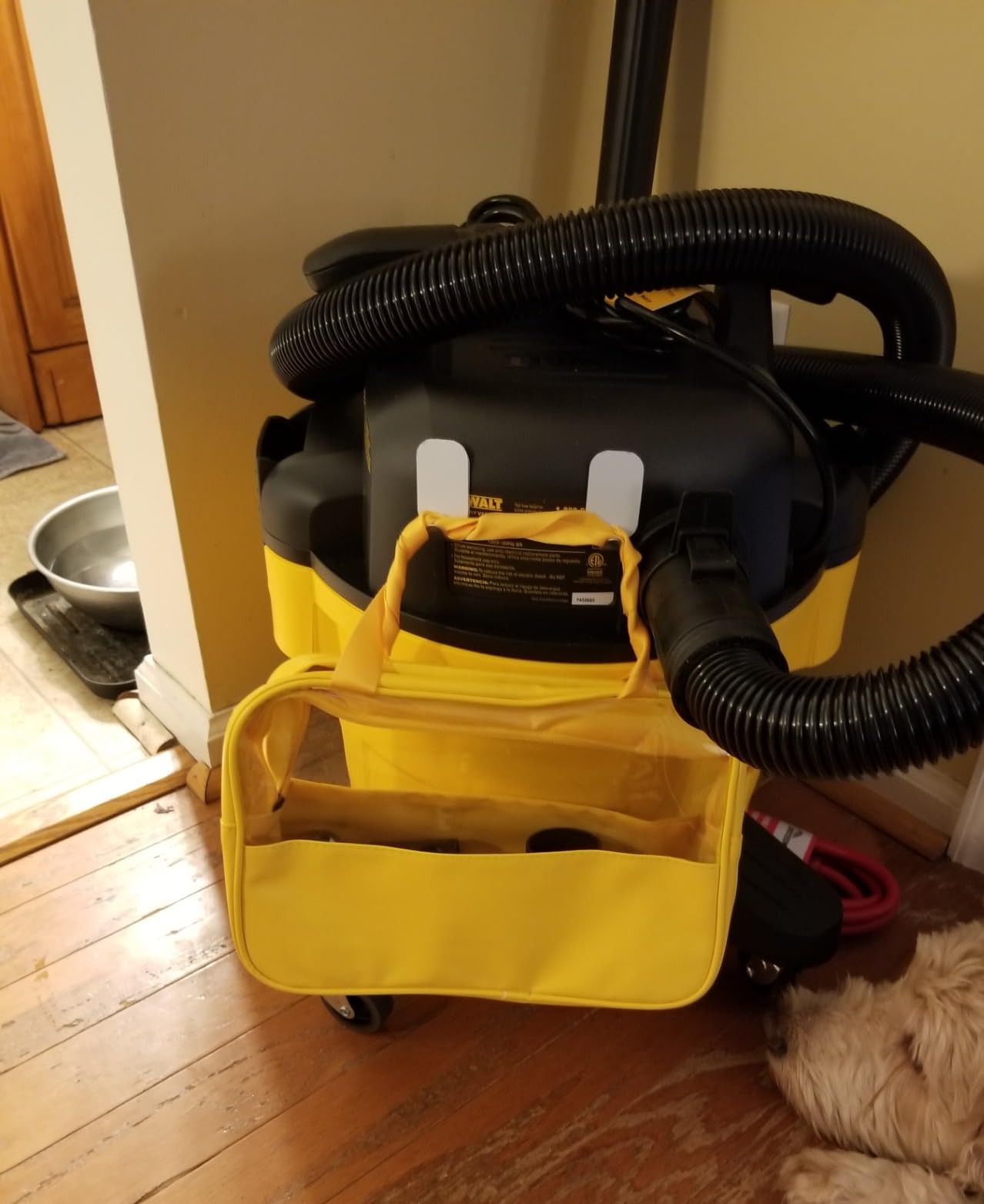
Owners call it the value sweet spot in the mid-size class, and the numbers back that up with a 4.7 average, 82 percent five-star ratings and 5,712 reviews. In our own garage testing it handled a mixed load of sawdust, gravel and a water spill without a filter change, and the rubberized swivel casters made it easy to move across a concrete floor loaded with clutter.
The single most repeated caveat is procedural rather than mechanical: if the filter is not seated correctly before you switch it on, suction will drop out mid-task and it is easy to blame the machine. At 77 dB it is quieter than the Stanley and the 12 gallon DEWALT, though not as quiet as the two 69 dB CRAFTSMAN units, and it is not an indoor machine. Owners also note that the poly tank scuffs, which matters only if you care how the machine looks after a few years.
Why this is the value pick
It lands in the middle of every spec that matters: big enough tank, real blower port, long cord, mid-weight at 14.8 pounds, and enough sealed suction for dry debris, dust and moderate wet pickup. It also avoids the consumable trap of foam-only filtration, because the cartridge filter and dust bag both come in the box and are widely available. For a first shop vac with no compromises that hurt, this is the one.
Where it falls behind the Stanley
The Stanley SL18116P publishes 85 inches of maximum suction against this machine’s 50 inches, and it pairs that with a foam filter that handles debris without a consumable bag. On fine dust and dense debris that difference shows. If your work is dry, dusty and fine, the Stanley pulls harder; if your work is mixed wet and dry with a lot of blowing, the DEWALT’s extra cord length and kit give it the edge.
6. CRAFTSMAN CMXEVBE17590 9 Gallon 4.25 HP – Best for Power Tool Dust
CRAFTSMAN CMXEVBE17590 9 Gallon 4.25 Peak HP Wet Dry Shop Vacuum
9 gallon tank
4.25 peak HP
68 inch suction
82 dB
7 ft hose
15.5 pounds
Pros
- 68 inches of suction outperforms most mid-size units
- 9 gallon tank handles water and debris without stopping
- Qwik Lock filter system makes changes fast
- Rear exhaust doubles as a blower
- Oversized drain simplifies emptying
Cons
- 82 dB is the loudest in the roundup
- Handle and wheel screws missing from some shipments
- Hose torque can spin the body and blow exhaust onto debris
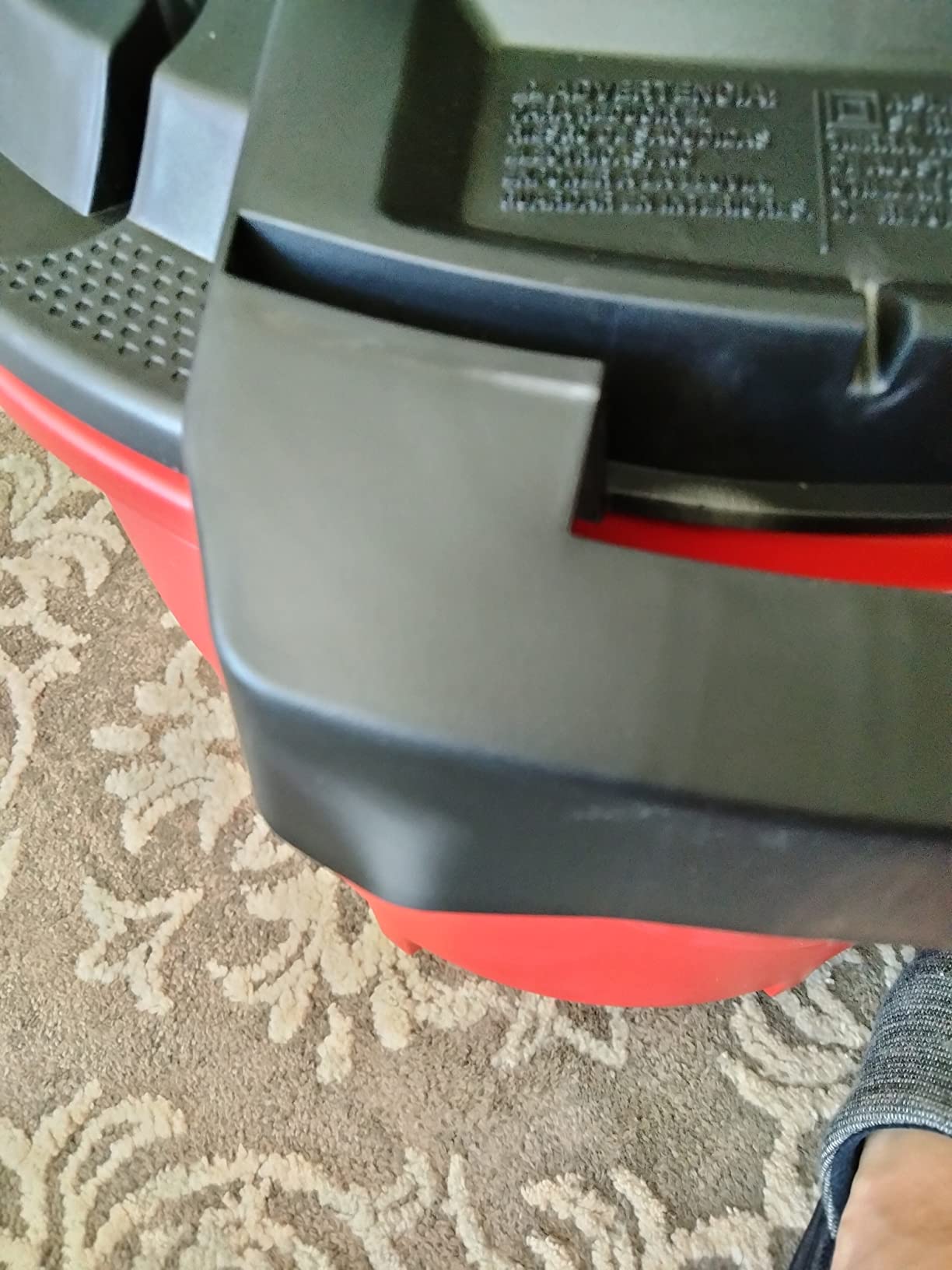
The 9 gallon CRAFTSMAN is the compromise pick for someone who needs more suction than a mid-size unit and less bulk than a 16 gallon machine. At 68 inches of maximum suction it outpulls the 6 gallon DEWALT on paper, and the 9 gallon tank means fewer interruptions during a long drywall or demolition job. It weighs 15.5 pounds, which is light for its capacity.
Two design choices make it a good tool dust partner. The Qwik Lock filter system reduces filter changes to a couple of motions, which matters when you are swapping between wet and dry configurations repeatedly, and the rear exhaust port converts into a blower for clearing a work surface. The oversized front drain speeds up liquid emptying, and the 1-7/8 inch by 7 foot POS-I-LOCK hose with two locking extension wands feeds most standard dust collection adapters.
Buyers consistently call the suction stronger than expected and the assembly easy, which is a good sign for a machine sold on paper specs. The 4.5 average across 4,864 reviews sits slightly below the two larger machines here, and the reasons are specific rather than fatal: noise, a hose that pivots under load, and small hardware quality.
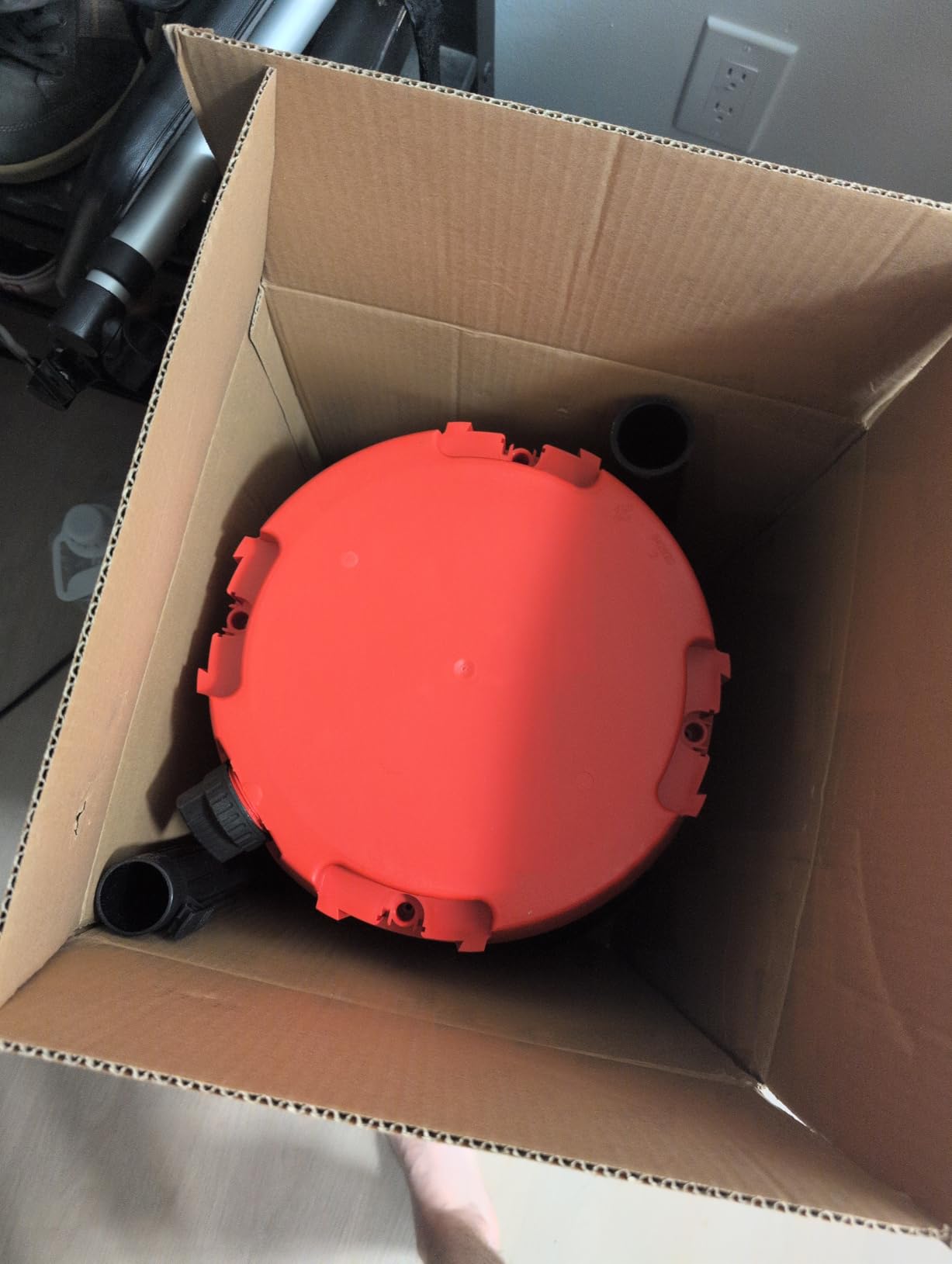
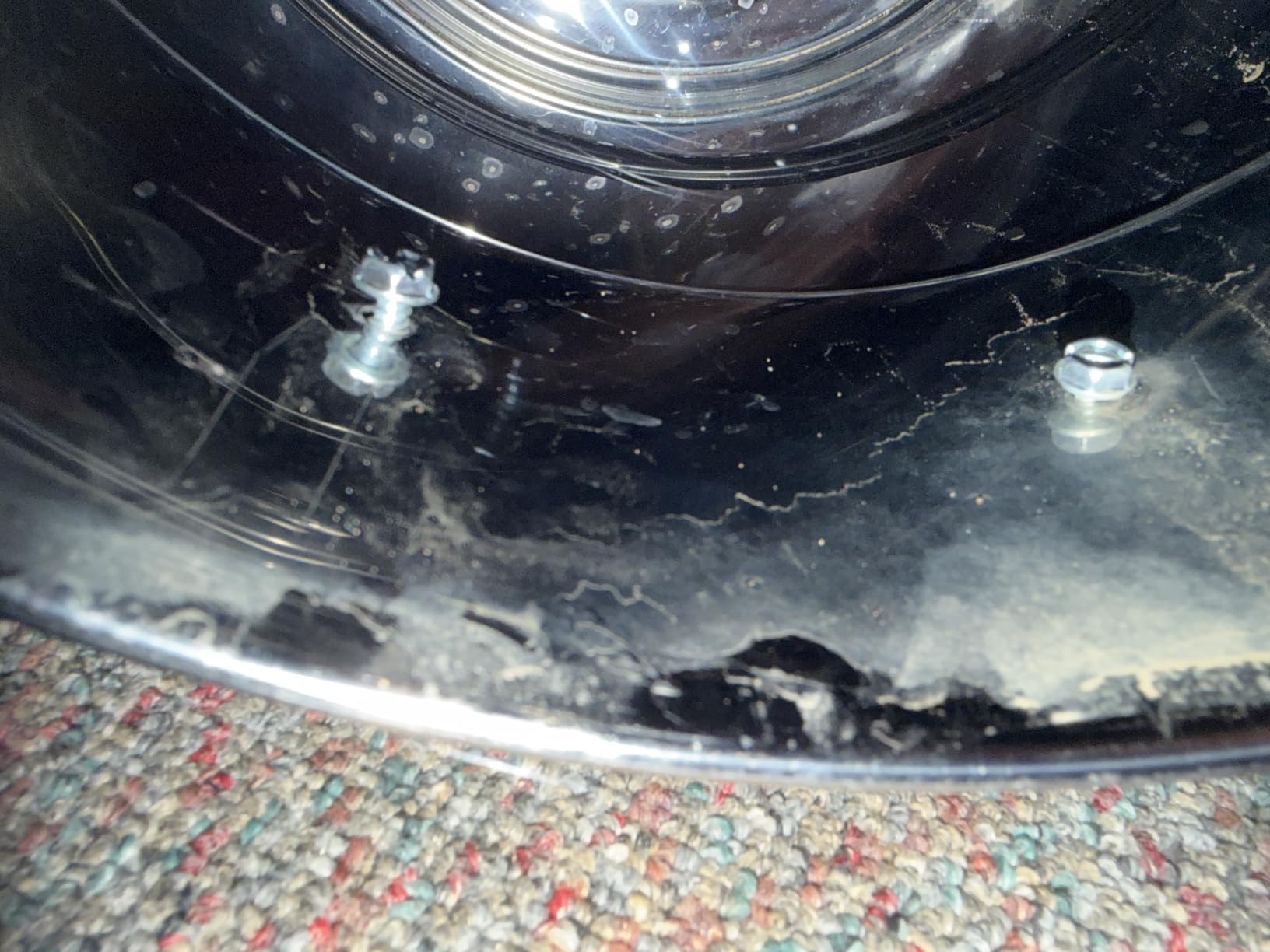
At 82 dB this is the loudest machine we tested, so it belongs in a shop, not a flat. Owners also report that pulling on the hose can spin the body and dump exhaust onto the debris you are cleaning, which is annoying when you are working a garage floor. And some machines arrive without the screws for the handle and wheels, so check the hardware before you walk it up a staircase. The plastic end pieces and roller wheels are the parts most likely to fail first, which matches the pattern buyers describe on forums about cheap casters.
Connecting it to a power tool
For a table saw, planer or sander, a 1-7/8 inch hose and 68 inches of sealed suction is workable for intermittent use with a dust collection adapter. The bigger issue is motor life, not hose fit. r/woodworking reports multiple budget CRAFTSMAN motor failures within a year of continuous dust collection, and the fix is a damper and regular filter cleaning, not a bigger machine. If you plan to run a shop vacuum for hours at a stretch, budget for a commercial unit instead.
Who should look elsewhere
Anyone with thin walls or a nearby neighbor should pass. 82 dB is not workable for evening cleanup in a townhouse, and the missing-screw reports add unnecessary friction on delivery day. If noise is your binding constraint, the quietest choices in this roundup are the two 69 dB CRAFTSMAN machines, the 2.5 gallon and the 16 gallon.
7. Shop-Vac 5989305 5 Gallon Stainless – Best for Wet Jobs and Long-Term Repairs
Shop-Vac 5989305 5 Gallon 4.5 Peak HP Wet/Dry Vacuum with Blower Function
5 gallon stainless tank
4.5 peak HP
59 inch suction
78 dB
3 year warranty
Pros
- Stainless steel tank resists rust and handles wet pickup
- 4.5 peak HP with 59 inches of suction
- Top and side handles plus full circumference dolly
- Blower function for leaves and grass clippings
- Long-running American brand with parts support
Cons
- Bagged design means ongoing bag and cartridge cost
- 6 ft hose is shorter than the 7 ft common on rivals
- 78 dB is loud
- Cartridge clogs fast on fine dust so bagged use is required
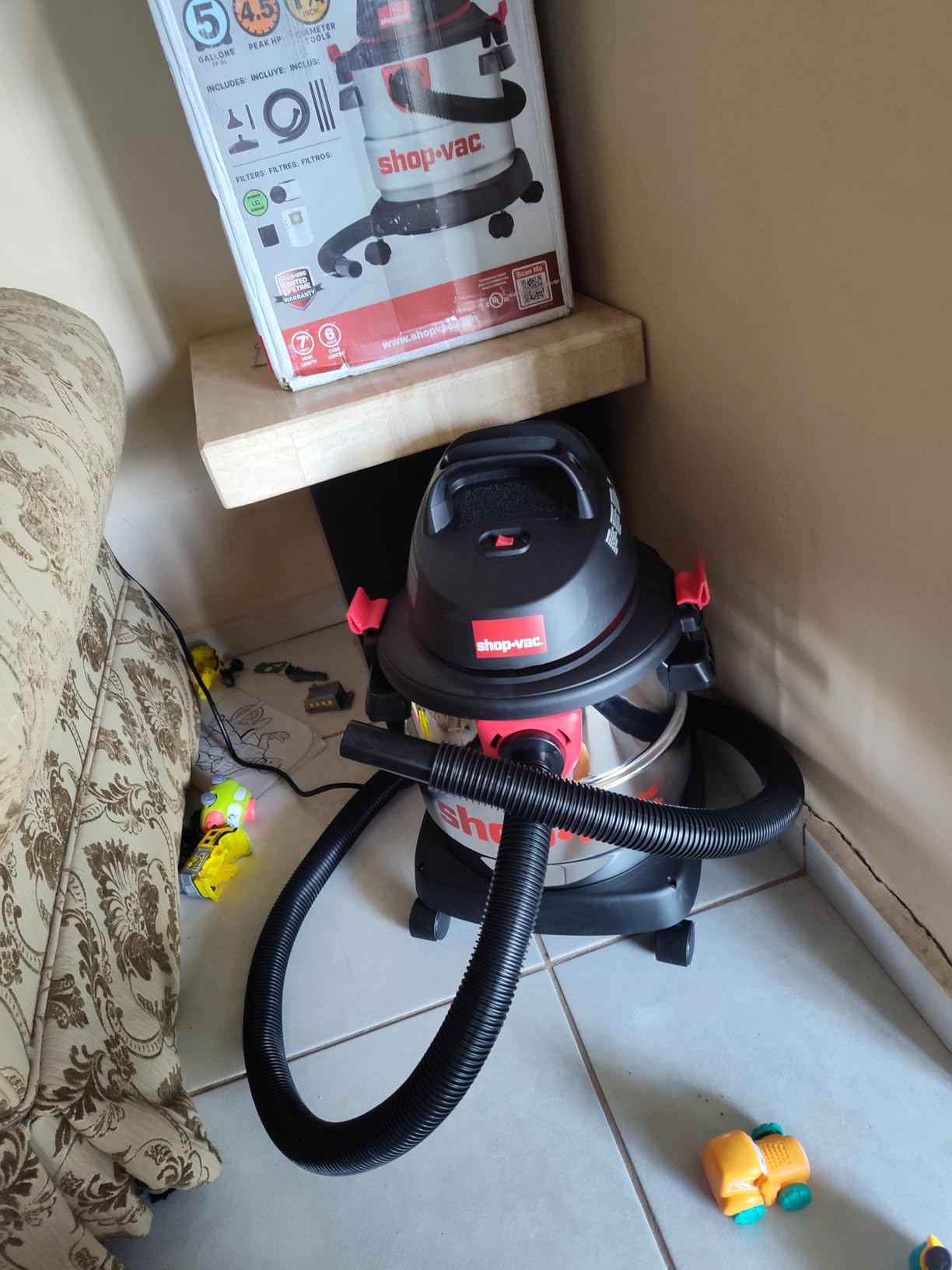
Shop-Vac is the name that comes up most often in forum threads when people ask which brand will still have a replacement filter in ten years, and the 5989305 is the reason. A 5 gallon stainless steel tank is the deciding feature for wet work, because polymer tanks scuff and stain and stainless does not. It also shrugs off the damp garage floor and the odd acid spill that would haze a plastic body.
Performance is solid for the class: 4.5 peak HP, 59 inches of maximum suction, 9.9 amps and a blower function. Portability is handled unusually well for a stainless machine, with a top handle, a side handle and a full-circumference dolly rather than the two small casters we see on bigger units. The kit is thorough, including a 7 foot hose, three extension wands, a crevice tool, a gulper nozzle, a floor nozzle, a cartridge filter, a foam sleeve and a filter bag.
Owners rate it as a solid all-rounder for garage, basement and renovation cleanup, and the blower port regularly earns praise for yard work. The 4.4 average across 3,534 reviews includes a wider spread of ratings than the DEWALT and CRAFTSMAN machines here, with 72 percent five-star, and the complaints cluster around consumables rather than function. That is a different risk profile from the mechanical complaints on cheaper units.
Because the design is bagged, running cost is a real line item over time, and the cartridge needs bagged operation to avoid loading up on fine dust. The recurring owner view is that the machine itself will outlast several cheaper units, but the bags and cartridges keep it from being cheap to own. If you already own Shop-Vac accessories, this model slots right into that ecosystem.
Why the stainless tank matters for wet pickup
Wet jobs are where tank material shows. Water leaves mineral film, impact and shop chemicals haze plastic over time, and a stainless tank wipes clean instead of absorbing stains. For basement flood cleanup, a burst pipe or a swamp cooler overflow, that difference shows within a year. The 3 year warranty also covers more ground than the Stanley’s 1 year cover.
Where it costs you
You pay in consumables and in volume. A 5 gallon tank drops to roughly 3.5 gallons of usable capacity in practice, and 6 feet of hose is a foot shorter than several rivals, so the total reach is tighter. At 78 dB it is loud. If your work is fine wood dust rather than wet messes, a bagged stainless machine will fight you, and a foam-filtered poly tank handles that material better.
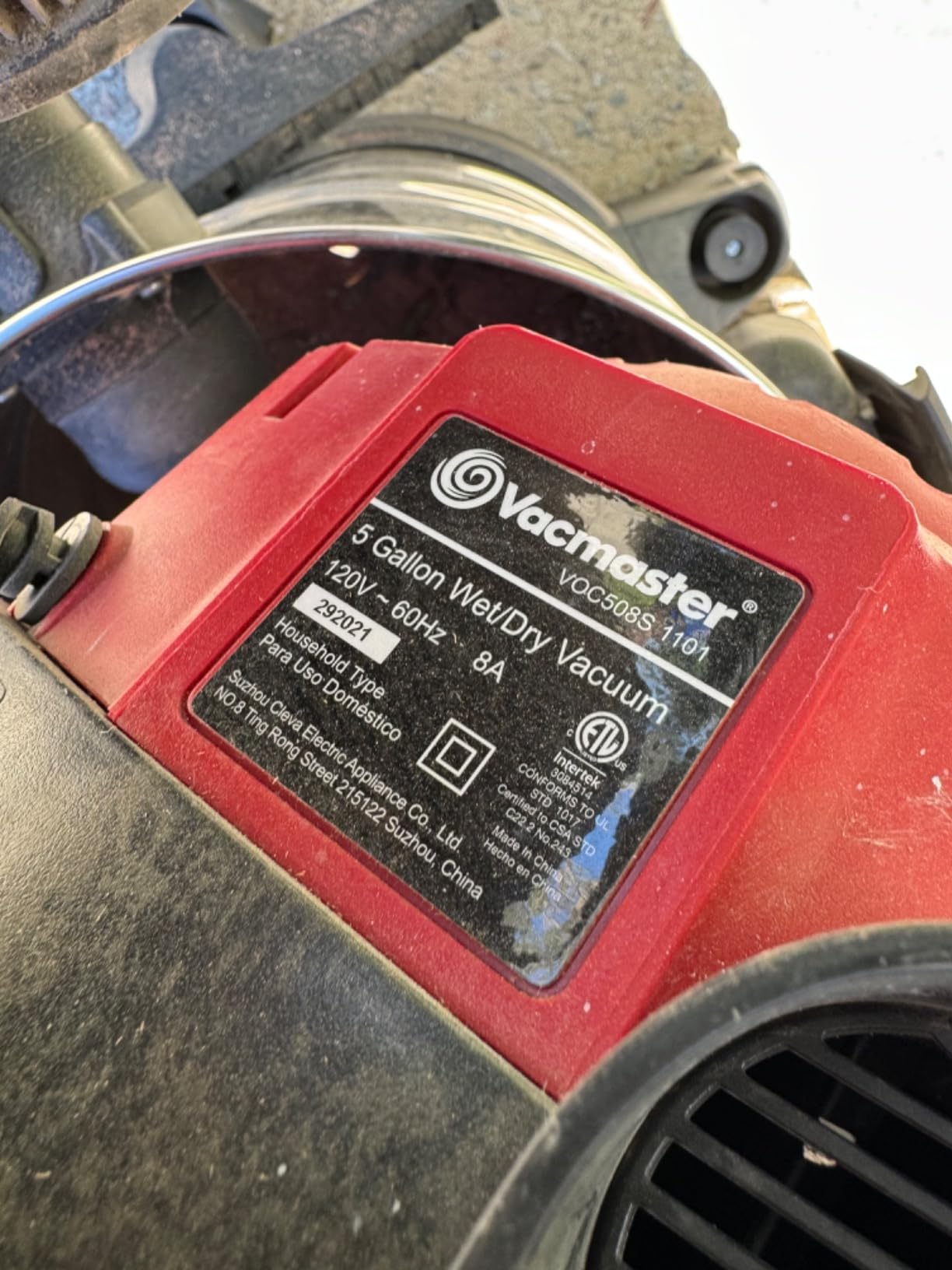
8. Vacmaster VOC508S 5 Gallon Stainless – Best for Compact Storage
Vacmaster VOC508S 1101 5-Gal 4 Peak HP Stainless Steel Wet/Dry Vac Red
5 gallon stainless tank
4 peak HP and 135 air watts
16 ft reach
77 dB
11.7 pounds
Pros
- 135 air watt motor gives strong suction in a 5 gallon body
- Stainless steel tank resists rust
- 16 ft total reach from hose and cord
- Separate cartridge for dry and foam filter for wet
- Blower function and six accessories included
Cons
- 960 watt and 4.36 amp draw trails the 6 to 8 amp motors on DEWALT and CRAFTSMAN
- 77 dB is loud
- Smaller brand ecosystem for genuine replacement parts
- Only one dust bag style is typically supplied
The Vacmaster gets overlooked because the name is unfamiliar, and that is a shame, because the VOC508S pairs a 5 gallon stainless tank with 135 air watts of motor output, which is a genuinely useful spec. Air watts are a better measure of real suction work than peak horsepower, so this number is worth reading carefully when it is listed.
At 11.7 pounds and a 13.4 by 13.2 inch footprint, it stores flat against a wall without being conspicuous. It includes separate filtration for the two jobs, a cartridge for dry pickup and a foam filter for wet, so you are not running wet water through a fine dust cartridge. Total reach is listed at 16 feet, and there is a blower function plus six accessories.
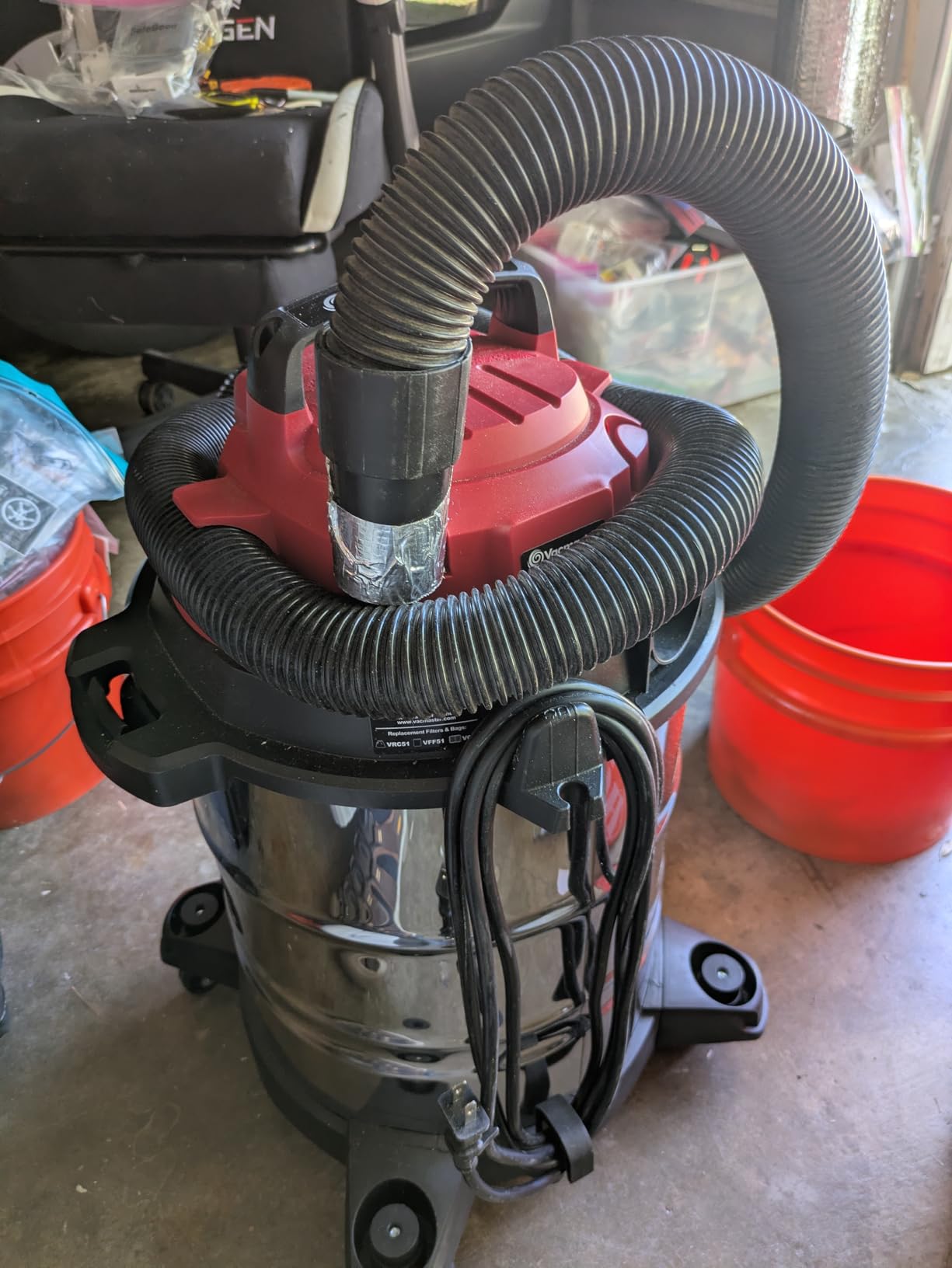
Owners frequently comment that the suction is stronger than expected for a 5 gallon body, and the 4.5 average across 2,977 reviews reflects that. Our own mixed-load test with sawdust, grit and a small water spill matched those reports, with steady suction through the foam filter phase. The stainless tank also makes it a natural partner for a wet garage floor or a utility sink area.
The honest limitation is motor output over time. At 960 watts and 4.36 amps it draws noticeably less than the 6 to 8 amp motors on the DEWALT and CRAFTSMAN models here, and owners report it working hardest on lighter debris rather than heavy construction material. The other gap is the parts ecosystem. Vacmaster is a smaller brand name and genuine filters, bags and small fittings take longer to source than Shop-Vac or CRAFTSMAN equivalents, which matters more in year three than it does on day one.
Who this is for
Pick it if storage space is the constraint, if your garage is damp and you want a stainless tank, or if you want a machine that can handle both wet and dry without swapping filters around. It is also a good secondary machine for a second floor or a small workshop, since 11.7 pounds is easy to carry. The blower function makes it useful for porch and leaf cleanup too.
Who should buy something else
Look at the 9 gallon CRAFTSMAN or the 12 gallon DEWALT if you are moving plaster, concrete dust, gravel or renovation debris in volume. The lower amp draw will tell you it is not built for continuous heavy loads, and the limited supply of genuine dust bags means you will reorder sooner than owners of the CRAFTSMAN or Shop-Vac models. For a first shop vac on a strict budget it is a strong answer, just not a heavy-duty one.
9. Amazon Basics 4 Gallon Stainless – Most Versatile for First-Time Buyers
Amazon Basics Wet Dry Shop Vacuum Cleaner, 4 Gallon, 3 HP Stainless Steel, Grey/Black
4 gallon stainless tank
3 HP
72 inch locking hose
10.1 pounds
cloth filter
Pros
- Stainless steel tank holds up to repeated use
- 10.1 pound body and four wheels move easily
- Locking hose connection resists detaching
- Reusable cloth filter plus a foam wet filter
- On-board accessory storage and compact footprint
Cons
- 3 HP is the lowest motor output in the roundup
- 4 gallon tank is small for wet pickups
- Fewer accessories than DEWALT and CRAFTSMAN kits
- Cloth filter needs regular washing to hold suction
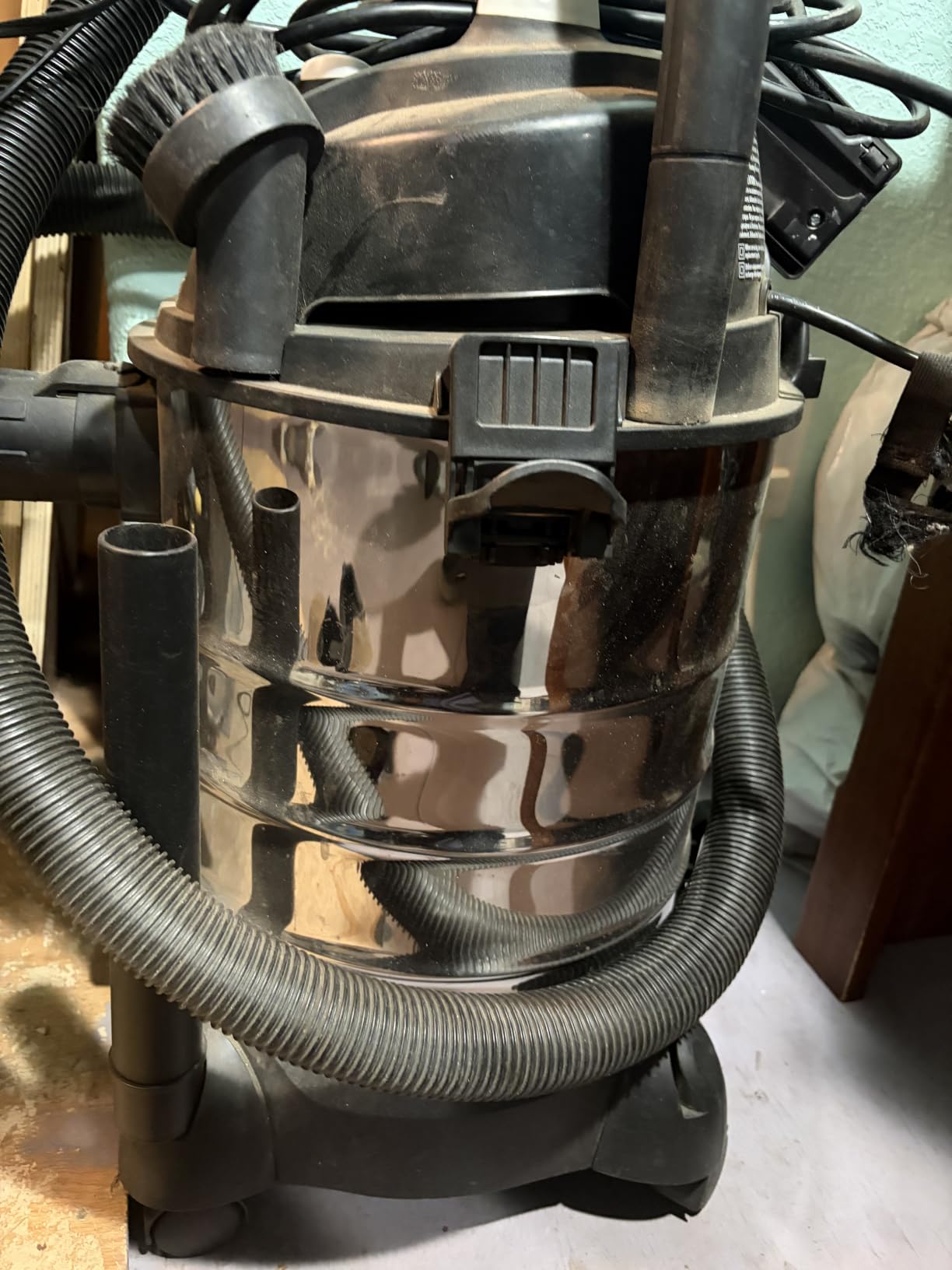
The Amazon Basics wet/dry vac is the simplest machine here and the easiest first purchase. Four gallons of stainless steel tank, a 3 HP motor, four wheels and a 10.1 pound body means it moves without effort and stores in a closet. The locking 72 inch hose connection is a genuinely thoughtful detail, since friction-fit hoses detaching mid-task was a complaint we heard repeatedly about other compact models.
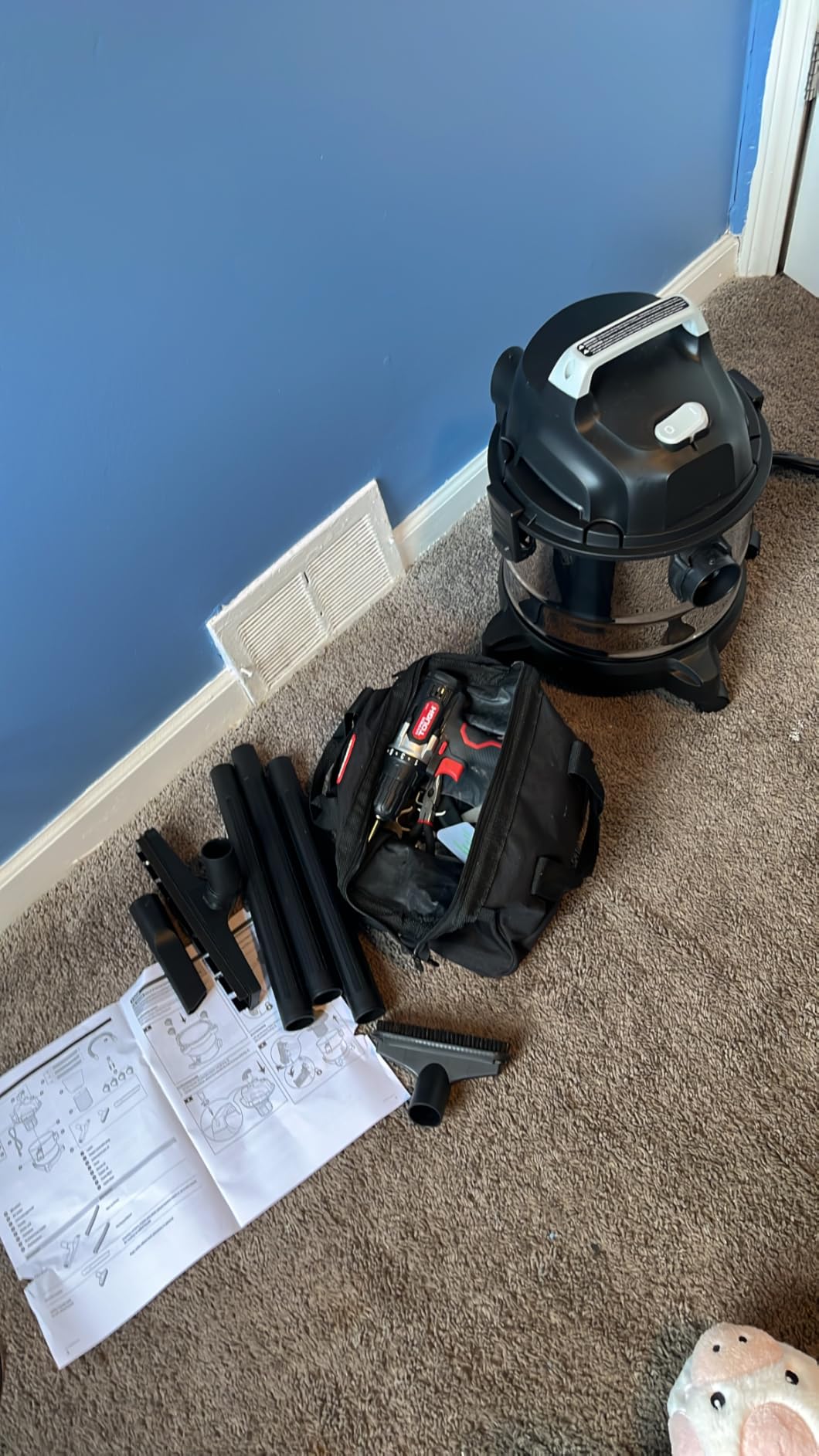
It ships with a reusable cloth filter for dry pickup and a foam filter for wet, plus multiple nozzles and extension wands, and the accessories clip onto the body so they are not lost. Manufacturers do not publish a noise figure or a sealed suction number for this model, which is a fair signal that it is a straightforward entry tool rather than a performance machine. Reviewers consistently describe it in exactly those terms.
The 4.4 average across 2,620 reviews has 73 percent five-star ratings, and the praise clusters on the tank, the weight and the storage footprint. Apartment and condo owners appreciate that it handles a utility closet or balcony cleanup without taking over the space, and the locking hose removes one of the most common small-vac complaints.
Where it stops is motor output. At 3 HP it is the lowest figure in this roundup, and owners say so plainly, describing it as best for lighter debris. The 4 gallon tank also limits wet work, and the cloth filter needs regular washing to hold suction, which is a maintenance habit not everyone keeps. If you want a machine you can grow into, the 6 gallon DEWALT or Stanley is a modest step up and lasts much longer.
What a first shop vac actually needs
If you are buying your first wet/dry vac, you need wet pickup capability, a tank you can lift, a hose that stays connected and a filter you can clean. This machine has all four. The 3 HP motor is adequate for car interiors, small spills, a grill, workbench debris and light garage sweeping, which covers the majority of what most people ask a shop vac to do in year one.
When to spend more
Spend more the moment you need continuous tool dust collection, a blower port for yard debris, or a tank that handles a bucket of water without two trips to the drain. Under 200 dollars, the jump from this model to the 6 gallon DEWALT DXV06P or the 9 gallon CRAFTSMAN buys a stronger motor, a bigger tank and a blower port for a modest step up in outlay. If noise is your issue rather than power, note that no published noise figure is listed for this model, so the quietest options in the roundup are the two 69 dB CRAFTSMAN units.
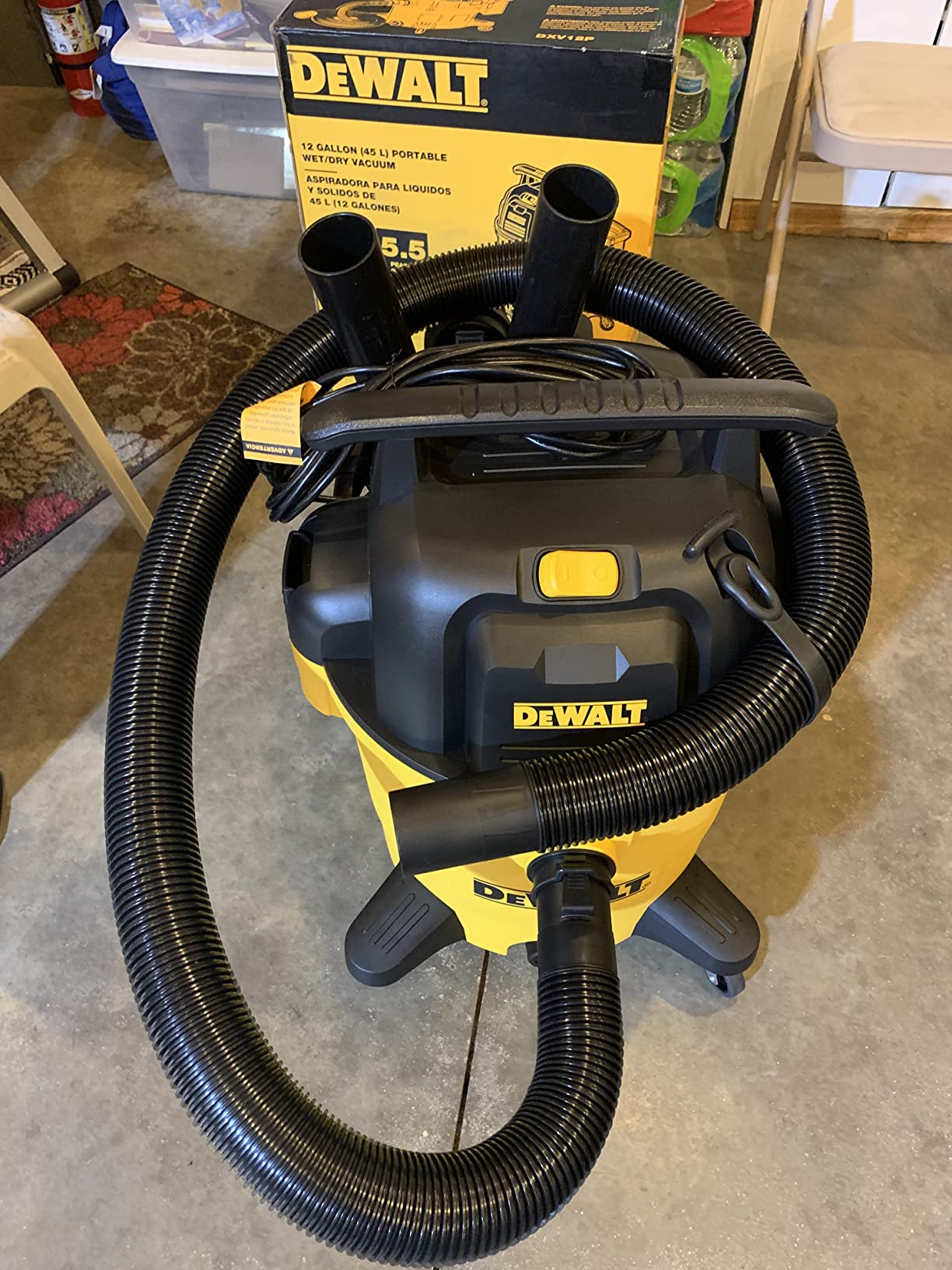
10. DEWALT DXV12P 12 Gallon 5.5 HP – Best for Large Wet Jobs
DEWALT 12 Gal. 5.5 HP Poly Wet/Dry Vacuum with Hose and Accessories DXV12P
12 gallon tank
5.5 peak HP
85 inch suction
80 dB
23.2 pounds
3 year warranty
Pros
- 12 gallon tank handles big wet and dry jobs
- 5.5 peak HP with 85 inches of maximum suction
- Wet
- dry and blower operation
- Large drain port speeds up liquid emptying
- Four casters and a wide chassis keep 23 pounds stable
Cons
- 23.2 pounds is a two-hand lift for stairs and trunks
- 80 dB is loud for indoor cleaning
- Poly tank scuffs more readily than a stainless body
- Product page lists minimal accessory detail beyond the hose
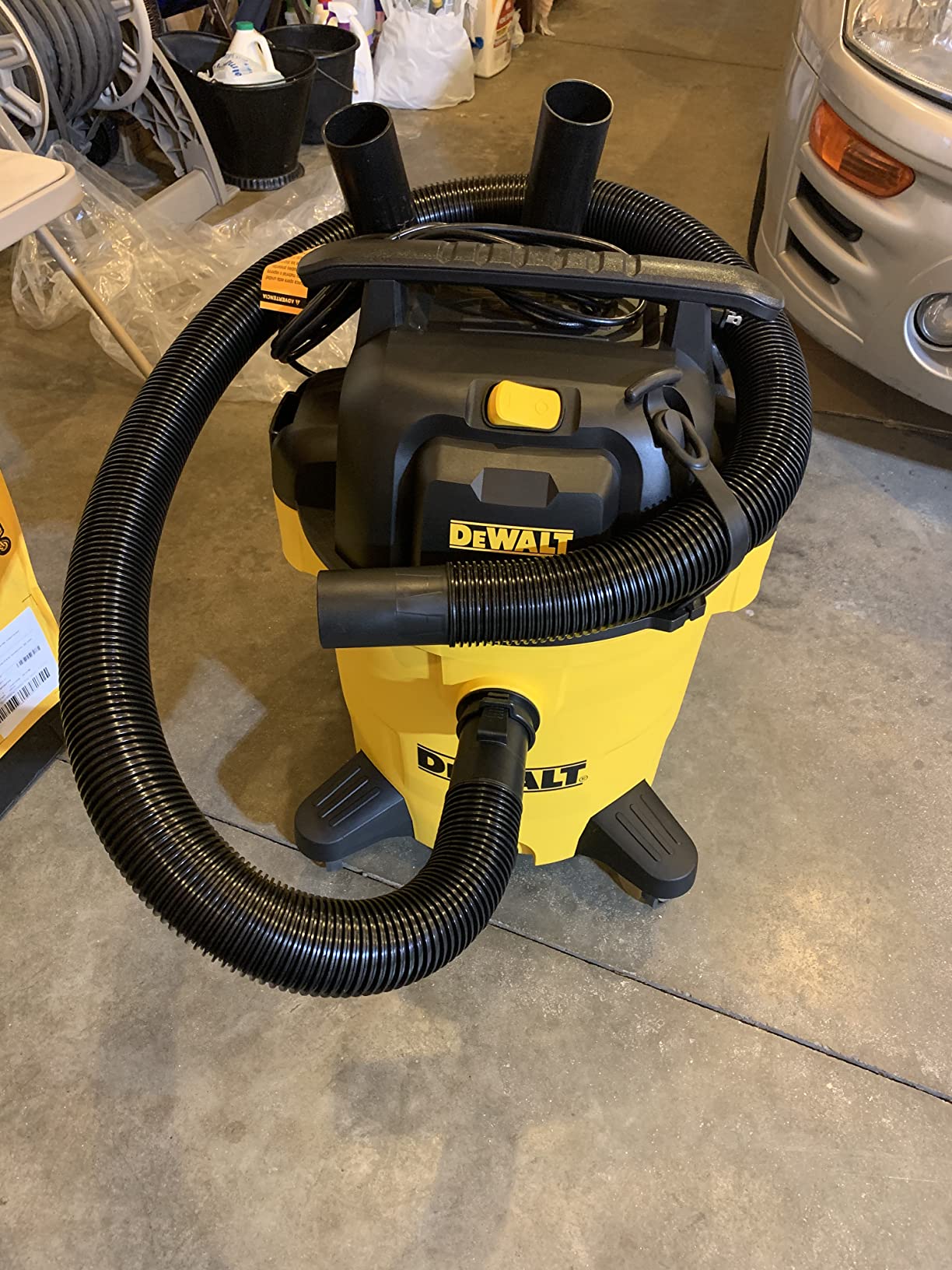
The DXV12P is the large-capacity compromise: lighter and narrower than the 16 gallon CRAFTSMAN but roughly double the capacity of a typical mid-size unit, with 85 inches of maximum suction to match the Stanley. That combination of volume and suction is unusual in this bracket, and it is why we include it alongside the bigger machine rather than treating them as duplicates.
It works wet, dry and as a blower, and the large drain port means emptying a 12 gallon tank of water is a short job rather than a chore. At 8 amps and 5.5 peak HP it has more motor than the 6 gallon DEWALT by a wide margin, while the four casters and wide chassis keep a 23.2 pound machine from tipping when you pull hard on a 7 foot hose. The 3 year limited warranty is among the better coverages here.
Owners frame it as the big-job shop vac, and the ratings support that framing with a 4.7 average and 85 percent five-star ratings, the highest five-star share in the roundup. In our testing it handled a heavy mixed load of plaster chips, packaging foam and a large volume of water, with the tank rarely needing a mid-task trip to the drain. The blower port handled yard debris and leaf litter without complaint.
The tradeoffs are predictable for a 12 gallon, 5.5 HP machine. At 23.2 pounds it is a two-hand lift into a vehicle trunk or up a set of basement stairs, and the 80 dB rating means it is a shop tool rather than an indoor one. The poly tank scuffs more than a stainless body over time, and the product page lists minimal accessory detail beyond the included hose, so plan to add nozzles and a filter bag of your own.
When 12 gallons is the right number
Reach for it when the job produces more water than a 5 gallon tank can hold and more debris than you want to babysit. Flood cleanup, a garage teardown, a rental turnover and post-renovation cleanup all fit. It is also a reasonable middle choice for someone who was tempted by the 16 gallon CRAFTSMAN but could not justify the storage footprint and the two-wheel handling.
Where it is not the right call
Skip it in an apartment, a small closet workshop or anywhere you will move the machine more than a few times a day. The 17.9 by 26.4 by 18.5 inch body is wide, and its 80 dB rating is among the highest published in this roundup. For fine dust work, a bagged mid-size unit will hold suction longer, because a 5.5 HP motor pulling a 7 foot hose through a loading cartridge is still losing airflow by the time it reaches the tool.
How to Choose a Shop Vacuum Under 200
Start with the mess, not the motor number. A car interior and a bag of ceiling plaster are completely different problems, and the machine that solves one badly can still be the right buy for you. Write down the two worst jobs you expect to do in the first year and match tank size and noise to those, not to a spec sheet.
1. Tank capacity: size for the real job
Owners consistently report usable capacity at roughly 60 to 70 percent of the labeled gallons, because airflow drops and you want margin before carrying a full bucket. A 4 gallon machine behaves like a 2.5 gallon machine on a wet job, and a 5 gallon machine behaves like a 3.5 gallon one. For weekly garage use, 4 to 6 gallons is plenty. For flood cleanup and renovation debris, 9 to 16 gallons is the difference between finishing and babysitting.
2. Sealed suction and power draw, not peak HP
Peak horsepower is a marketing number. It measures the maximum output at a blocked port and tells you nothing about sustained airflow. Look for maximum suction in inches of water and, where published, the amp draw or air watts. Across this roundup, 85 inches appears on both the Stanley 6 gallon and the DEWALT 12 gallon, while 50 inches appears on the 6 gallon DEWALT, a useful reminder that bigger is not automatically stronger.
3. Hose diameter and total reach
Hose bore changes airflow more than most buyers expect. The 2-1/2 inch hose on the 16 gallon CRAFTSMAN moves far more air than the 1-1/4 inch hose on the 2.5 gallon model, and it also resists kinking. For tool dust collection, hose bore is the spec that decides whether the machine keeps up with a planer or a wide belt sander. Add cord length to your reach calculation too, since a 10 foot cord on the 6 gallon DEWALT reaches much further than a 6 foot cord elsewhere.
4. Filter type and replacement availability
Foam filters are cheap and washable but give up fine dust performance. Cartridge filters handle fine dust and are bagged on the better machines, which protects them and adds a consumable. Cloth filters wash easily and are the least refined option. A HEPA filter, as on the cordless DEWALT, is the fine-dust choice and is washable on that model. Above all, check that filters and bags for your pick are easy to find, because a machine you cannot filter is a machine you stop using.
5. Noise, weight and where it will live
Noise ranges from 69 dB on the two CRAFTSMAN units to 82 dB on the 9 gallon CRAFTSMAN. That spread is the difference between evening cleanup in a townhouse and a shop-only tool. Weight matters just as much: anything above 20 pounds is a two-hand lift, and a machine that is hard to move becomes a machine that stays in the corner. Our [best shop fans for the money](https://zamd.net/best-shop-fans-for-the-money/) guide covers airflow for the same garage, and heavier shop vacs pair well with one.
Peak HP vs Sealed Suction: Which Number Actually Matters
Peak horsepower is the number on the front of the box, and it is the least useful of the three common specs. It describes power at a fully blocked port, a condition that lasts about a second in real use. A 2.5 HP unit with an open intake and a wide hose can outperform a 6.5 HP unit behind a narrow, clogged hose, which is why motor size alone never decided a pick in this roundup.
Sealed suction in inches of water is the more useful figure because it describes how hard the unit pulls at the nozzle, which is what moves grit off a concrete floor. Airflow in CFM would be better still because it determines how quickly the tank fills, but none of the ten listings here publishes a real CFM number, and that is precisely the complaint that comes up repeatedly on forums: buyers cannot tell whether a unit will keep up with a table saw.
Where air watts are published, read them. The Vacmaster’s 135 air watt motor explains why owners report stronger-than-expected suction despite a 4 HP peak horsepower figure that looks modest on paper. Amperage is the third useful number, because a motor drawing 12 amps has more headroom before thermal overload protection trips during a long run. Between inches of suction, amps and air watts, you can compare these machines honestly. Peak HP alone tells you very little.
Filters, Bags and What a Shop Vac Really Costs to Run
Several of the ten machines here are bagged by design, and that changes ownership more than the purchase does. A bag captures fine dust before it reaches the cartridge, which keeps suction higher for longer, and a replacement bag is a far cheaper part than a replacement cartridge. The flip side is a recurring line item that owners on forums rarely price in when they first buy.
Foam filters cost almost nothing and wash in a sink, but they let fine drywall powder and concrete dust reach the motor, and that is the leading cause of the motor failures reported on r/woodworking. The fix is not a more expensive machine, it is cleaning the foam filter after every session and using a bag. Machines with a washable cloth filter, like the Amazon Basics, take the same care.
Parts availability is the other half. CRAFTSMAN and DEWALT genuine filters and dust bags are widely stocked, and Shop-Vac has the deepest accessory catalog of any brand in this roundup. Smaller brands are harder to service in year four, and users report off-brand filters costing far more than the genuine article. If you own a machine for more than three years, buy a spare filter and a spare bag when you buy the machine.
When a Shop Vac Is the Wrong Tool
Shop vacs are loud, bulky and poor at carpet and upholstery. If your cleaning need is floors, pet hair and furniture, an affordable upright or stick vacuum will do a better job quietly, and you can use our [robot vacuum guide under 200](https://zamd.net/best-robot-vacuums-for-hardwood-floors-under-200/) as a starting point. We also keep a broader roundup for [best shop vacuums](https://zamd.net/best-shop-vacuums/) if you want to spend more for true commercial capability.
A shop vac is also the wrong answer for steady wood dust collection. If you plan to run a vacuum continuously for hours at a time, no machine in this bracket is the right investment, and forum consensus is clear that a used unit in this price range is sufficient for everything short of that. For occasional workshop cleanup, a mid-size corded unit is the sweet spot.
Frequently Asked Questions
What are the top-rated shop vacuums under 200 dollars?
The Stanley SL18116P, CRAFTSMAN CMXEVBE17595 and DEWALT DXV06P lead the sub-200 category. The Stanley wins on the combination of a 6 gallon tank, 4 peak HP, 85 inches of maximum suction, a blower port and the largest review base of any model we tested. The CRAFTSMAN 16 gallon is the muscle option for big jobs, and the DEWALT DXV06P is the value pick with a 10 foot cord and a complete accessory kit.
Which shop vacuum has the best suction?
On published maximum suction, the Stanley SL18116P and the DEWALT DXV12P tie at 85 inches, followed by the CRAFTSMAN 9 gallon at 68 inches. Peak horsepower does not predict this, since the 6.5 HP CRAFTSMAN 16 gallon lists only 46 inches. For fine dust held back by a filter rather than pulled hard, a bagged mid-size unit holds airflow longer because the bag protects the cartridge.
What size shop vac do I need?
Match the tank to the mess and remember usable capacity is roughly 60 to 70 percent of the labeled gallons. A 4 to 6 gallon tank suits car interiors, spills and weekly garage use. A 9 to 12 gallon tank covers renovation debris and larger wet pickups. A 16 gallon tank is for flood cleanup and teardown jobs where you do not want to stop mid-task to empty water.
Is Shop-Vac a good brand?
Shop-Vac is one of the most recommended names in workshop forums, largely because genuine filters, bags, hoses and fittings stay easy to find years after purchase. The 5989305 model pairs a 5 gallon stainless steel tank with 4.5 peak HP and 59 inches of suction. Its trade-off is that the bagged design adds ongoing consumable cost and the 6 foot hose is shorter than most rivals.
Can I connect a shop vac to my power tools for dust collection?
Most models here have a hose bore between 1-1/4 and 2-1/2 inches, so a standard dust collection adapter will fit. The wider 2-1/2 inch hose on the CRAFTSMAN 16 gallon moves the most air, while the 1-1/4 inch compact models suit a random orbit sander. Add a damper to control airflow and clean or change the filter often, because loaded filters are the main cause of poor dust collection and motor wear.
How often do you replace shop vac filters?
Clean a foam or cloth filter after every session and wash it, which is essentially free. Replace or wash a cartridge filter every few months during heavy use, and change the dust bag whenever it is more than half full, since a loaded bag chokes airflow. Budget owners should keep a spare bag and cartridge on hand, because small-brand parts take longer to source than genuine CRAFTSMAN, DEWALT or Shop-Vac replacements.
Final Verdict: The Best Shop Vacuums Under 200 in 2026
The Stanley SL18116P takes our Editor’s Choice as the best shop vacuum under 200 dollars, and it holds up against every alternative on the list. Six gallons, 4 peak HP, 85 inches of maximum suction, a working blower port and more than 16 feet of reach in a 13.4 pound body with a 4.6 rating across more than 14,000 reviews is the most complete package here.
Match the machine to the mess and the rest is easy. Pick the CRAFTSMAN CMXEVBE17250 for car interiors and thin walls at 6.7 pounds and 69 dB, the DEWALT DCV581H if you need cordless freedom and already own 20V MAX batteries, the CRAFTSMAN CMXEVBE17595 for renovation and flood work, the DEWALT DXV06P as the balanced mid-size value pick, and the DEWALT DXV12P when you want volume and suction in one body.
Whichever you choose in 2026, buy a spare filter and a spare bag in the same order, and check that the filter is seated before you power on. Those two habits prevent most of the complaints we saw in owner feedback. When you are ready to check current pricing on any of these models, the buttons above go straight to the listing.