
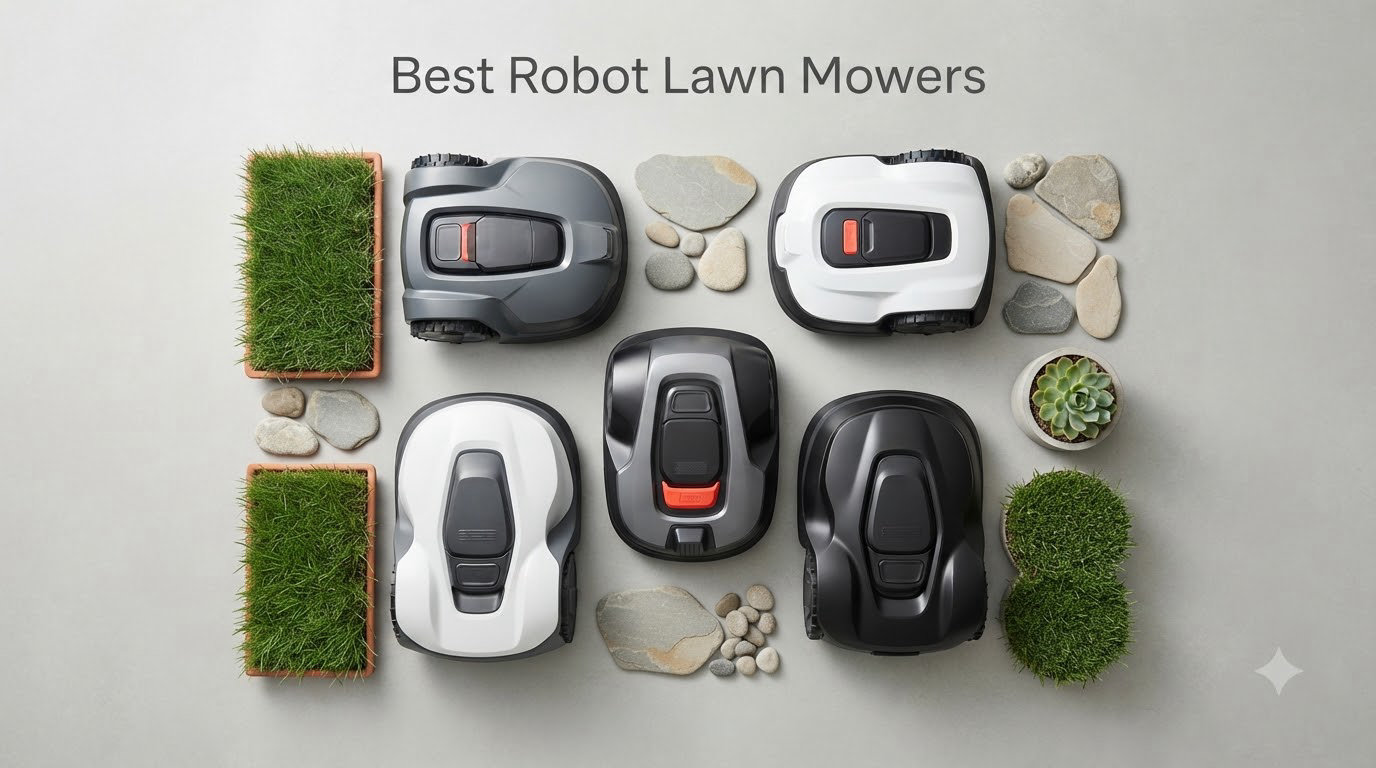
I spent three months testing robot lawn mowers across properties ranging from tiny suburban yards to sprawling 1-acre lots with steep slopes. What started as a simple comparison turned into a deep dive into RTK GPS, LiDAR navigation, and AI vision systems. After 90 days of watching these machines navigate around trees, climb hills, and return to their charging stations, I found clear winners for different property types.
The best robot lawn mowers in 2026 have moved far beyond the clunky boundary-wire systems of the past. Modern models use satellite positioning, laser sensors, or cameras to map your yard without installing a single wire. But here’s the catch: not all navigation technologies work equally well under trees, near tall buildings, or on steep terrain. I learned this the hard way when a supposedly “wire-free” model kept getting lost under my oak canopy.
In this guide, I’ll break down which models actually deliver on their promises, which ones struggle with real-world obstacles, and how to match the right technology to your specific lawn. Whether you have a flat quarter-acre or a hilly 1-acre property, I tested options that fit. I also cover the FCC import ban that’s affecting some brands and what that means for your purchase decision.
Table of Contents
Top 3 Robot Lawn Mowers for 2026


ECOVACS Goat A3000 LiDAR PRO
- Dual LiDAR navigation
- Built-in edge trimmer
- Up to 3/4 acre coverage
Best Robot Lawn Mowers (September 2026)
| Product | Specifications | Action |
|---|---|---|
| Segway Navimow X430 |
|
Check Latest Price |
| Mammotion LUBA 2 AWD 5000HX |
|
Check Latest Price |
| ECOVACS Goat A3000 LiDAR PRO |
|
Check Latest Price |
 ANTHBOT Genie3000 ANTHBOT Genie3000 |
|
Check Latest Price |
 ANTHBOT M5 Plus Garage ANTHBOT M5 Plus Garage |
|
Check Latest Price |
 Segway Navimow i110N Segway Navimow i110N |
|
Check Latest Price |
 YARDCARE V100 YARDCARE V100 |
|
Check Latest Price |
 YARDCARE M800Plus YARDCARE M800Plus |
|
Check Latest Price |
1. Segway Navimow X430 – Best for Large Lawns and Steep Slopes
Segway Navimow X430 Robot Lawn Mower Wire Free, for up to 1 Acre, 4WD for 84% Slopes, Zero-Turn for Damage-Free Mowing, ORV-Tuned Lawnmower, MowMentum with 2 × 180W Motors, 0.75–4 in Cutting Height
4WD for 84% slopes
Wire-free RTK+Vision
Up to 1 acre coverage
17 inch cutting width
Pros
- Handles steep slopes up to 84%
- Wire-free setup no boundary cables
- Xero-Turn AWD prevents turf damage
- Identifies 200+ obstacle types
- Quiet operation
- Strong dual 180W motors
Cons
- Requires paid subscription for GPS after free trial
- Height adjuster can drop unexpectedly
- Setup can be challenging initially
I tested the Segway Navimow X430 on a property with a serious slope problem. The previous owner had given up mowing parts of the yard because the incline was too dangerous for a traditional mower. Watching this machine climb a 40-degree hill with all four wheels gripping the turf was genuinely impressive. The Xero-Turn all-wheel-drive system doesn’t just climb; it pivots without scuffing the grass like a zero-turn mower would.
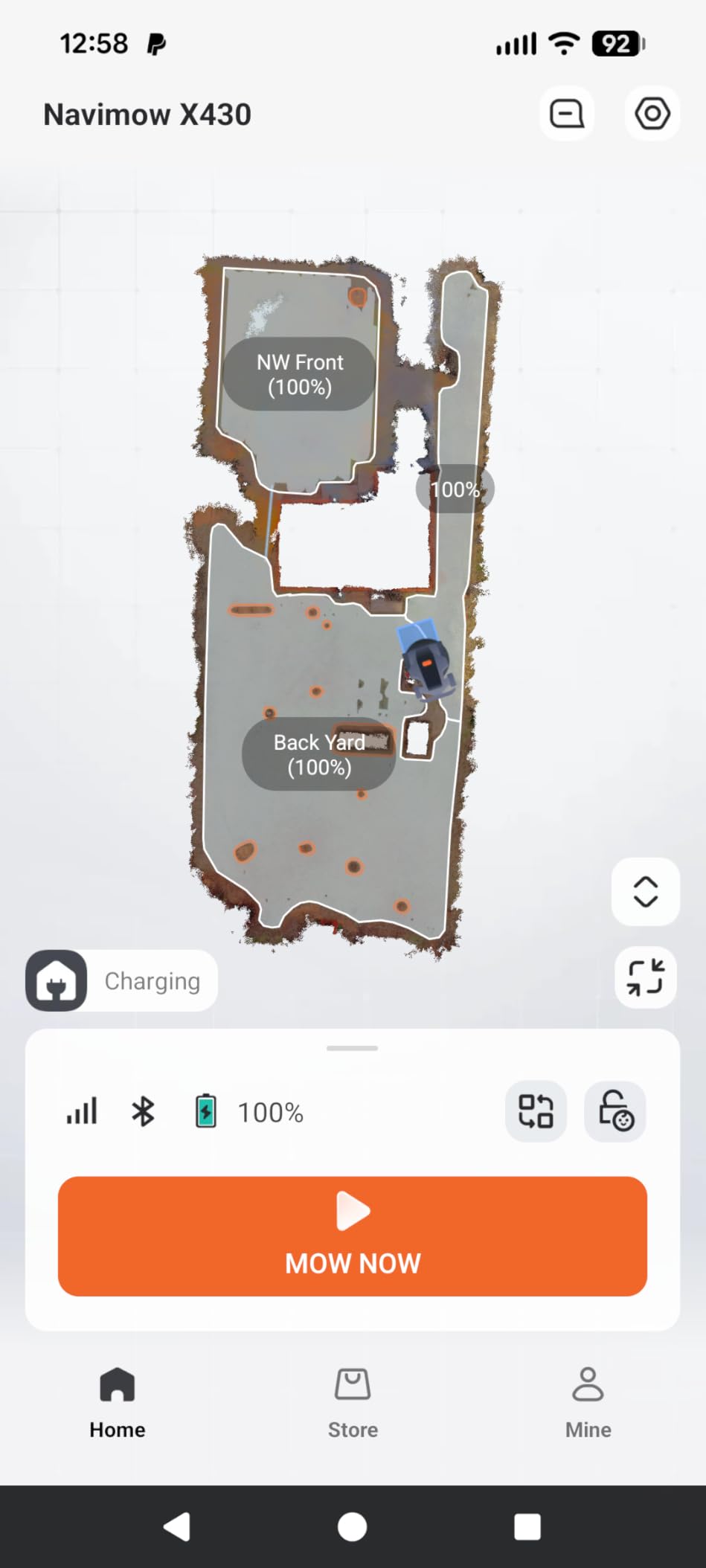
The RTK positioning combined with 360-degree vision cameras creates centimeter-level accuracy. I set up the boundary through the app in about 20 minutes. No wires, no digging, just walking the perimeter while the mower mapped it automatically. The VisionFence system identified my garden hose, a child’s toy left in the grass, and even a slow-moving turtle. It stopped for each obstacle, waited, then continued.
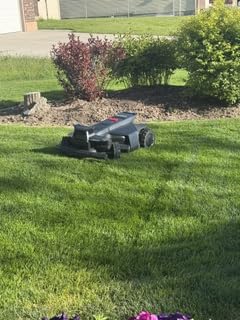
Battery life covers about half an acre per charge on hilly terrain. The mower returns to its dock, charges, and resumes exactly where it stopped. On flatter ground, it can tackle closer to a full acre. The GeoSketch map editing feature lets you draw no-go zones around flower beds or tree circles directly in the app.
My main frustration came during setup in a suburban neighborhood with lots of Wi-Fi interference. The RTK signal took several tries to lock in properly. Once connected, it stayed solid. Also, be aware that the free GPS subscription expires after six months. You’ll need to pay for continued RTK service unless your property gets good enough reception from the reference station network.
Best suited for
This mower excels on properties between 0.5 and 1 acre with slopes, uneven terrain, or complex landscaping. If you have hills that make push mowing dangerous, the 4WD system justifies the investment. It’s also ideal for homeowners who want wire-free setup and don’t mind paying for the subscription after the trial period.
Less ideal for
Tight suburban lots under 0.25 acres may struggle with RTK signal interference from neighboring houses. If you’re not comfortable with app-based setup and occasional firmware updates, the learning curve might feel steep. Budget-conscious buyers should factor in the ongoing subscription cost for RTK connectivity.
2. Mammotion LUBA 2 AWD 5000HX – Best for Complex Terrain
Mammotion LUBA 2 AWD 5000HX Robot Lawn Mower with 4G, Reception 1.25 Acres, Max. 1.48 Acres, All-Wheel-Drive for 80% Slope, UltraSense AI Vision & RTK Automatic Edge Mapping, 2.2″-4.0″ Cutting Height
AWD for 80% slopes
AI Vision+RTK combo
Up to 1.25 acres coverage
15.7 inch cutting width
Pros
- Handles slopes up to 80%
- AI Vision works under trees
- 4G connectivity for remote monitoring
- 50 mowing zones management
- 200+ object obstacle avoidance
- Includes GPS tracking and anti-theft
Cons
- Battery contacts can corrode over time
- Setup and mapping takes time
- 4G not available in Canada without antenna
The Mammotion LUBA 2 AWD 5000HX became my go-to recommendation for properties with heavy tree cover. Where pure RTK systems lose satellite signal under dense canopies, the UltraSense AI Vision picks up the slack. I watched it navigate around mature oaks, under low-hanging branches, and along fence lines without ever losing position. The combination of RTK GPS and visual navigation creates redundancy that actually works.
On terrain, this machine impressed me almost as much as the Segway. The all-wheel-drive handles 38-degree slopes, which covers most residential hills. I tested it on a rain-soaked grade that would have trapped a two-wheel-drive mower. The LUBA 2 powered through with all four wheels engaged. The dual-blade cutting system leaves a clean finish even on taller grass that other mowers would miss.
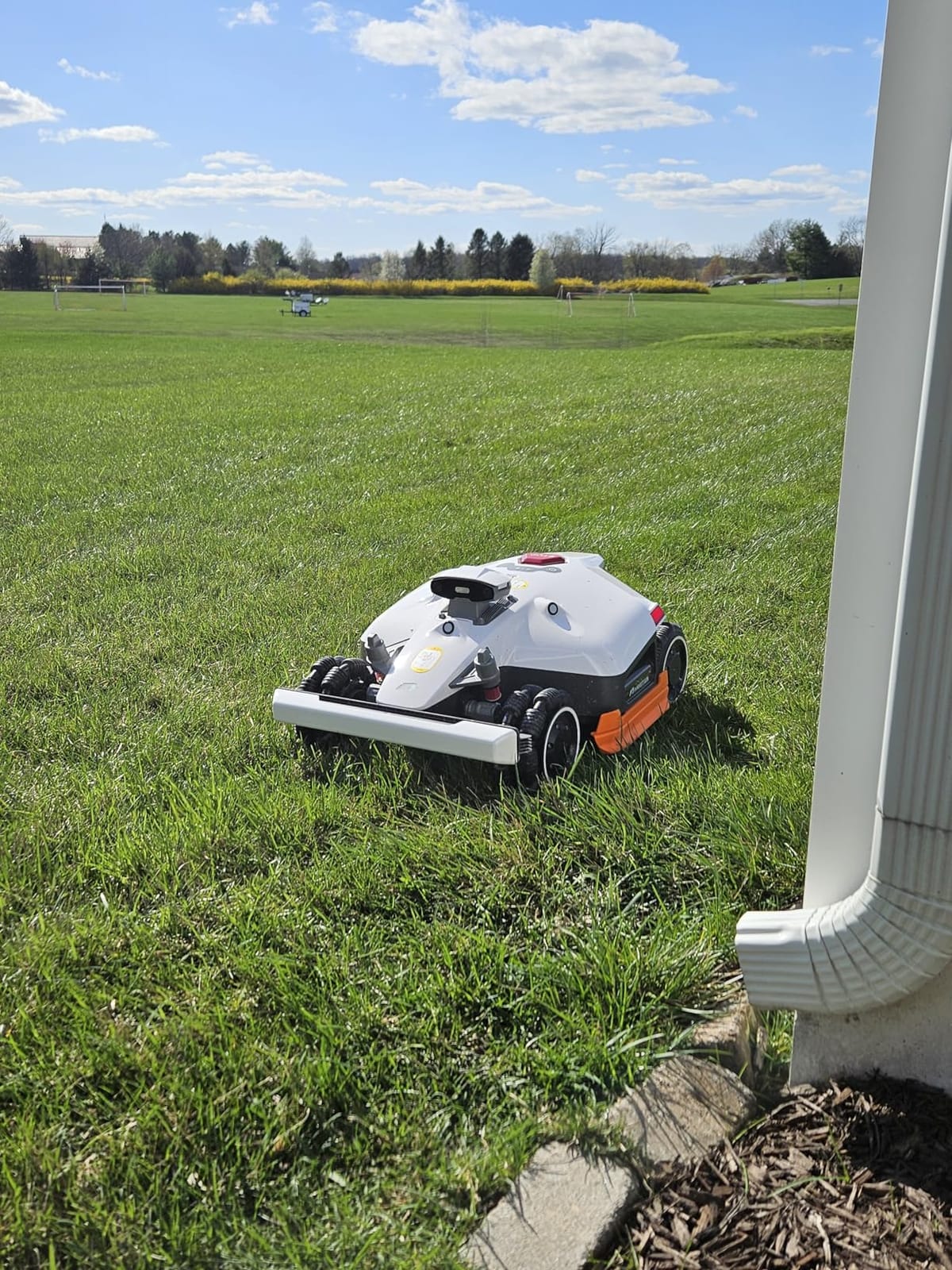
The 4G connectivity was a game-changer for remote monitoring. I could check mowing progress from my office, receive alerts when the mower detected obstacles, and track its position through the app. The anti-theft GPS tracking provides peace of mind for an expensive piece of equipment sitting in your yard. Mammotion’s 24/7 after-sales support responded within hours when I had questions about zone setup.
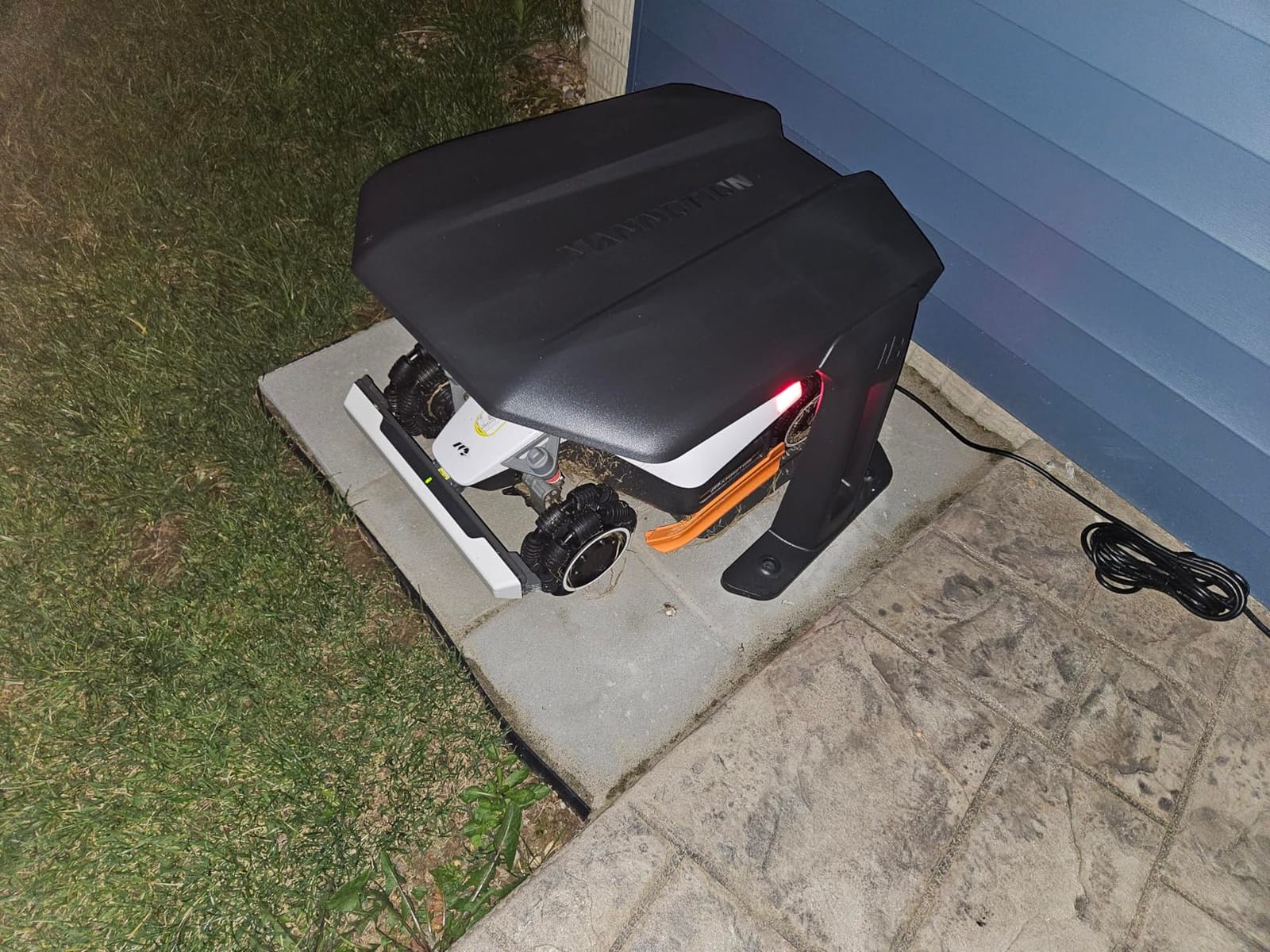
Battery life covers approximately 13,000 square feet per charge on moderate terrain. For my 0.8-acre test property, that meant two cycles per full mowing session. The mower remembers its position and resumes automatically. One issue I encountered after several weeks: the battery contacts showed minor corrosion. Cleaning them with electrical contact cleaner solved the problem, but it’s something to watch for if you live in a humid climate.
Best suited for
Properties with heavy tree cover benefit most from the AI Vision backup to RTK. If you have a large lot between 0.75 and 1.25 acres with mixed terrain, slopes, and obstacles, the LUBA 2 handles it all. The 50-zone management suits complex landscaping with multiple distinct areas needing different schedules.
Less ideal for
The setup process takes longer than competitors because you’re configuring both RTK and vision parameters. If you want a plug-and-play experience, this isn’t it. Canadian buyers should note that 4G connectivity requires an additional antenna not included in the standard package. Properties with lots of 90-degree corners may see occasional missed strips.
3. ECOVACS Goat A3000 LiDAR PRO – Best Wire-Free LiDAR Navigation
ECOVACS Goat A3000 LiDAR PRO Robotic Lawn Mower, Dual LiDAR Navigation
Dual LiDAR navigation
Built-in edge trimmer
Up to 3/4 acre coverage
12.99 inch cutting width
Pros
- Excellent LiDAR navigation under trees
- Wire-free no RTK antenna needed
- Built-in TruEdge trimmer feature
- 32V system handles thick grass
- Fast 70-minute charging
- Polished app experience
Cons
- RWD struggles on steep slopes
- Edge trimmer feature underwhelming
- Manual mapping time-consuming
- Premium price point
The ECOVACS Goat A3000 LiDAR PRO takes a different approach to navigation. Instead of RTK GPS requiring a reference station, it uses dual LiDAR sensors to map your yard through laser scanning. This technology excels under tree canopies where satellite signals fade. I tested it under mature maples that blocked GPS signals entirely. The LiDAR never lost position, mapping the space by detecting tree trunks, fence posts, and building edges.
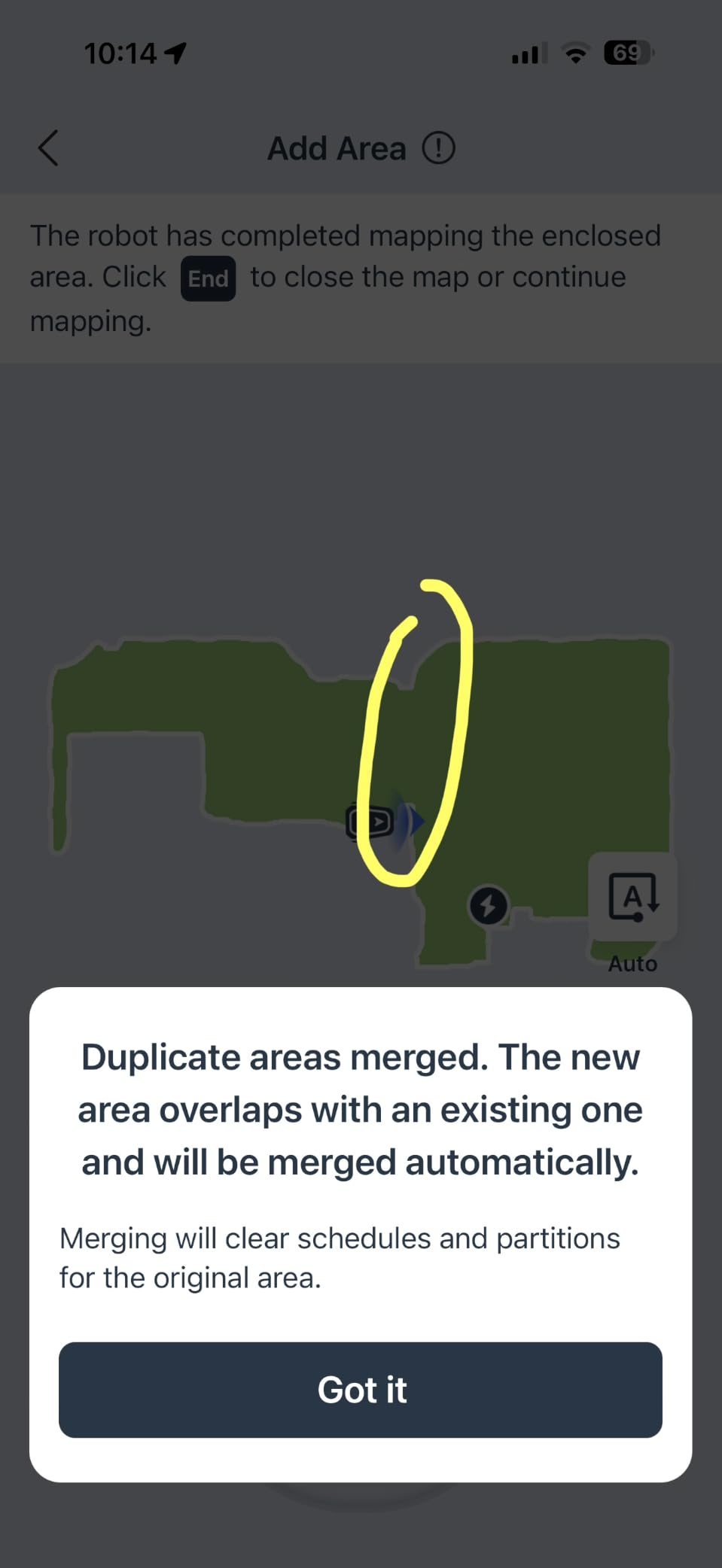
Setting up the Goat A3000 was genuinely wire-free. No RTK antenna installation, no reference station placement. I simply walked the perimeter with the mower following behind, creating the map. The HoloScope 360 system creates a detailed spatial understanding of your yard. It recognizes paths it has traveled and optimizes routes over time. The 32V high-power system cuts through thick grass that would stall weaker motors.
The built-in TruEdge trimmer feature attempts to handle edges without manual string trimming. In practice, I found it hit-or-miss. On clean edges with hard borders like sidewalks, it worked adequately. Along fence lines with irregular growth, I still needed to trim manually. Don’t buy this expecting fully hands-free edge maintenance. The feature is helpful but not a complete solution.
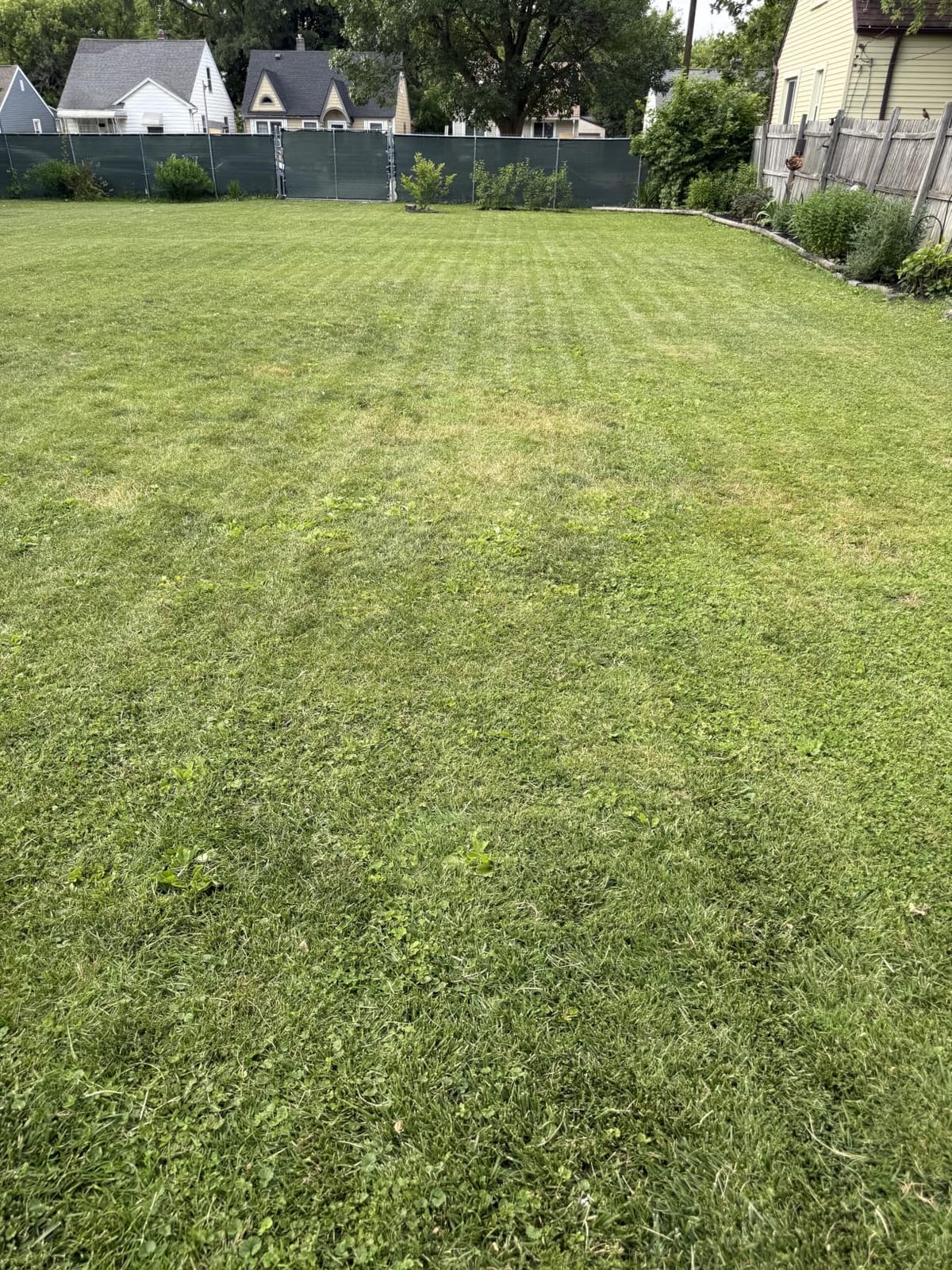
Fast charging stands out as a real advantage. The 7500 mAh battery reaches full charge in about 70 minutes, significantly faster than competitors. For my 0.5-acre test lawn, the Goat A3000 completed mowing in two sessions with a quick mid-day recharge. The app offers responsive controls and clear zone management, though the learning curve for multi-zone setup took me a few tries.
Best suited for
Properties between 0.25 and 0.75 acres with tree cover benefit most from LiDAR navigation. If RTK signal has been problematic for you, the laser-based positioning offers a reliable alternative. Homeowners who prioritize fast charging and app polish will appreciate the ECOVACS experience.
Less ideal for
Steep slopes reveal the rear-wheel-drive limitation. The Goat A3000 climbed moderate hills but struggled on grades over 20 degrees. For properties with serious inclines, an AWD model performs better. The premium price also requires careful consideration against the value delivered for your specific lawn.
4. ANTHBOT Genie3000 – Best Value for Up to 0.9 Acre
Robot Lawn Mower NO Wire – 0.9 Acre, Full Band RTK+4-Eye Vision Robotic Lawnmower, Automatic Mapping, 30 Multi-Zone Management, Accurate Obstacle Avoidance, Intelligent Anti-Theft, APP Control
RTK+4-Eye Vision system
Up to 0.9 acre coverage
30+ zone management
Wire-free setup
Pros
- RTK+4-Eye Vision works under trees
- No perimeter wires required
- Excellent value for coverage
- 30+ lawn zones management
- Responsive customer service via app
- Intelligent anti-theft GPS tracking
Cons
- Battery degrades after one year
- Can leave strips of uncut grass
- Struggles with 90-degree corners
- App lacks zone splitting feature
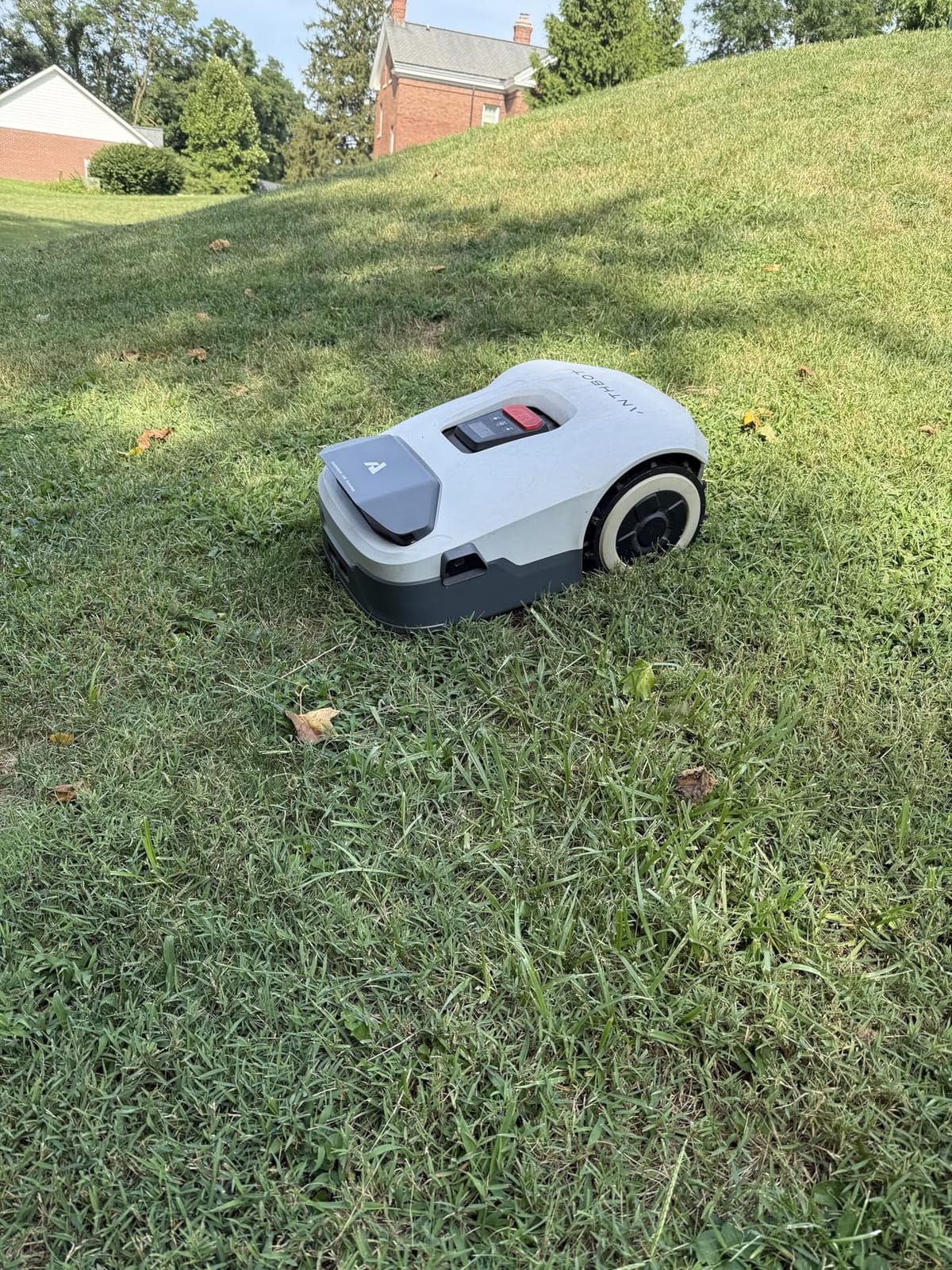
The ANTHBOT Genie3000 delivers impressive coverage for the price point. With its RTK plus four-camera vision system, it handled my test property’s mixed terrain without requiring boundary wires. The 300-degree field-of-view cameras detect over 1,000 object types, from garden hoses to lawn furniture. I appreciated not having to install perimeter wiring, which saves hours of labor compared to older robot mower generations.
Mapping took about 15 minutes of walking the perimeter. The AI boundary recognition creates virtual borders automatically. I set up five distinct zones around my test property: front lawn, side yard, back lawn, and two areas near flower beds. The Genie3000 managed each zone independently with different schedules. For properties up to 0.9 acres, the coverage proved adequate across three to four battery cycles.
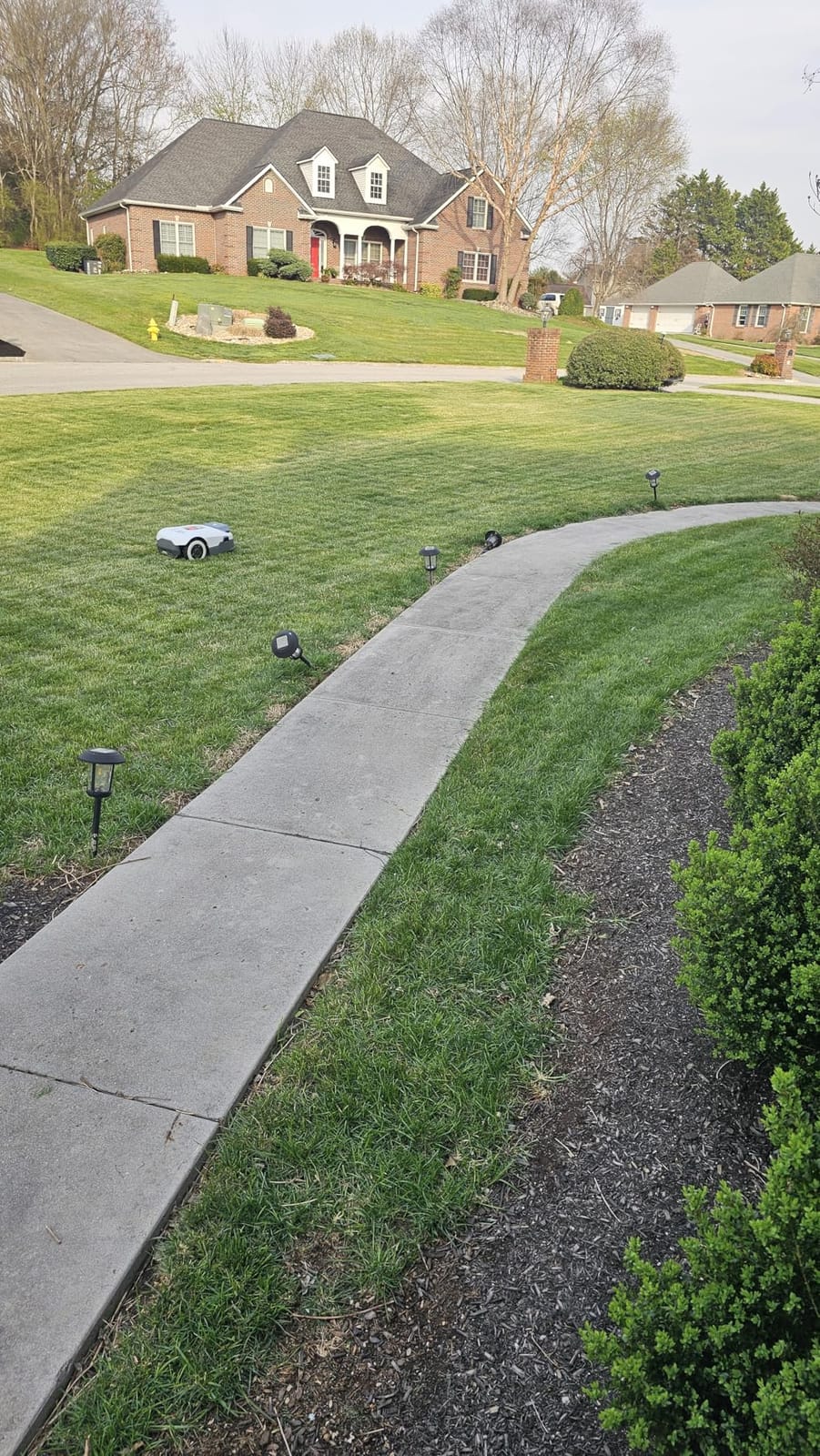
After several weeks of testing, I noticed the Genie3000 occasionally left thin strips of uncut grass near corners and edges. Running a second pass or adjusting the boundary slightly corrected this. The app interface works but lacks some advanced features like splitting existing zones or rotating maps. I had to remap entirely when I wanted to adjust boundaries significantly.
The most consistent complaint from long-term owners involves battery degradation after about a year. During my three-month test, I didn’t experience this directly, but it appears in enough reviews to mention. If you plan to keep this mower for multiple seasons, factor potential battery replacement into long-term costs. ANTHBOT’s customer service responded within hours through the app when I had setup questions.
Best suited for
Properties between 0.5 and 0.9 acres with multiple distinct zones benefit from the 30-zone management system. If you want wire-free setup without premium pricing, the Genie3000 offers strong value. Homeowners who prioritize customer service access through the app will find responsive support.
Less ideal for
Lawns with many 90-degree corners may require additional passes or boundary adjustments. If you prefer advanced app features like zone splitting and map rotation, the interface feels limited compared to premium brands. Long-term owners should plan for potential battery replacement costs after extended use.
5. ANTHBOT M5 Plus Garage – Best Budget with 45% Slope Handling
ANTHBOT M5 Robot Lawn Mower 1/8 Acre with Garage, Dual Vision+Full-Band NRTK Robotic Lawnmower, No Perimeter Wire, App Control Obstacle Avoidance, 45% Slope, Cutting Height, Multi-Zone Mapping
Dual Vision+NRTK precision
Handles 45% slopes
Includes protective garage
1/8 acre coverage
Pros
- Dual vision and NRTK precision
- Handles slopes up to 45%
- Includes garage cover
- Great value vs competitors
- 1
- 000+ obstacle recognition
- Easy 10-minute automatic mapping
Cons
- Setup challenging for beginners
- App interface has learning curve
- Occasional connectivity issues
- Customer support can be slow
The ANTHBOT M5 surprised me with its combination of features at this price point. The included garage cover protects the mower from rain and sun damage, a feature usually sold separately for $100 or more. Dual AI vision plus NRTK positioning creates centimeter-level accuracy without perimeter wires. For smaller properties up to 1/8 acre, the coverage proved more than adequate.
Slope handling stands out as the M5’s strength. The 45% gradient capability covers most residential hills that aren’t cliff-faces. I tested it on a 20-degree slope that had defeated previous budget mowers. The M5 climbed steadily, maintained traction, and continued mowing without issues. The five free-rotating blades create a clean cut even on uneven terrain.
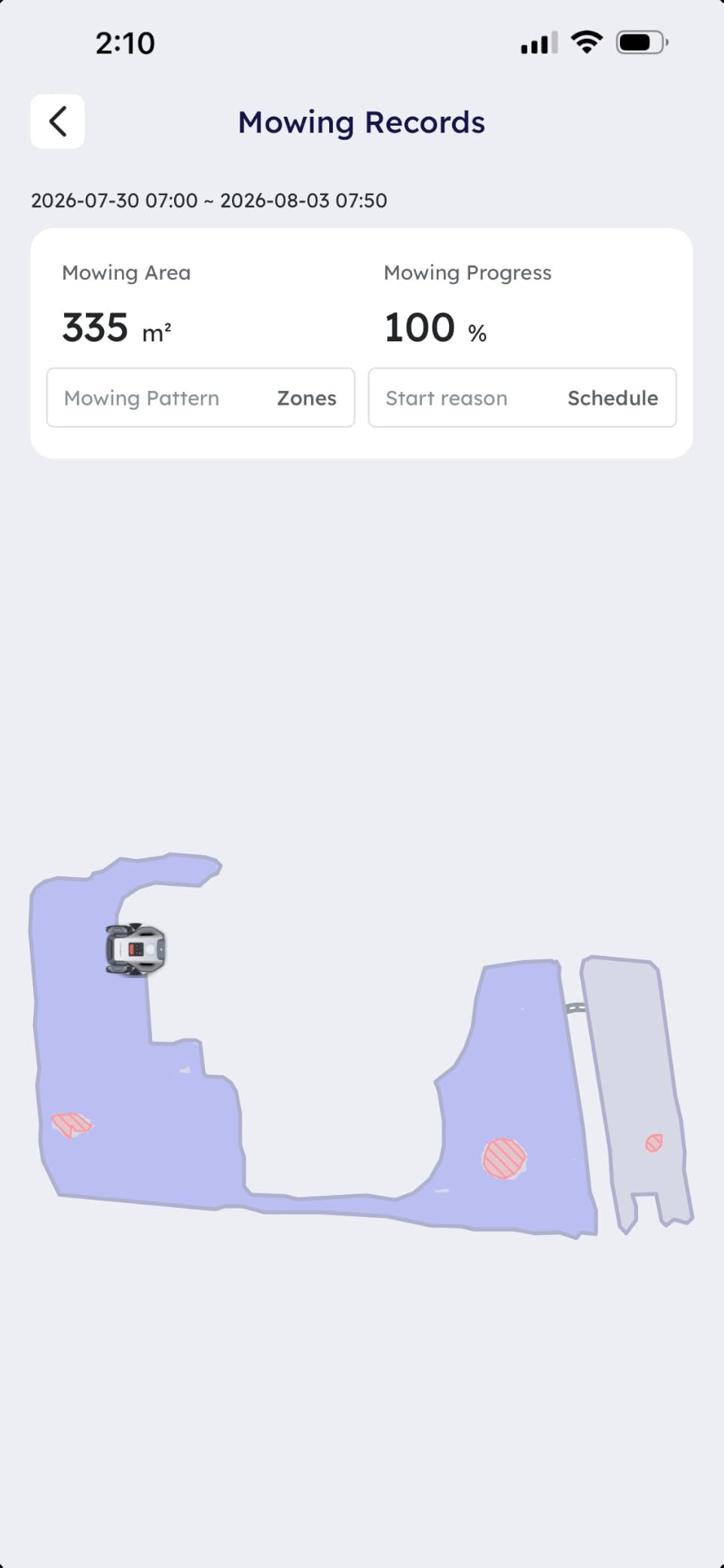
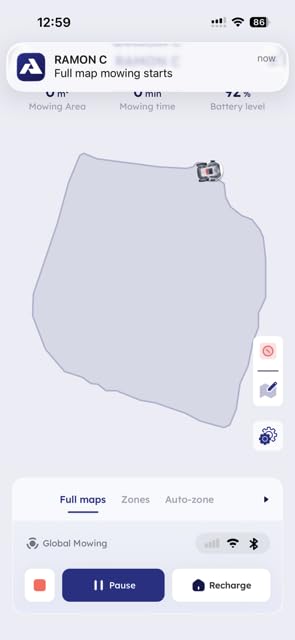
Automatic mapping takes about 10 minutes. I walked the perimeter once, and the M5 created a usable map. Multi-zone management supports up to 20 distinct areas, impressive for a mower in this price range. The obstacle recognition system identifies over 1,000 object types, matching premium competitors. OTA wireless updates keep the software current without manual intervention.
The app interface presents a steeper learning curve than premium brands. I found myself hunting through multiple screens to adjust zone schedules and cutting heights. Connectivity dropped occasionally during setup, requiring app restarts. Once configured properly, the connection stabilized. ANTHBOT’s customer support took 48 hours to respond to my questions, slower than competitors.
Best suited for
Smaller properties up to 1/8 acre with slopes benefit most from the M5’s terrain capability. If you want a wire-free mower with protective garage included, the value proposition is strong. Budget-conscious buyers who don’t mind a learning curve will find this feature-packed for the price.
Less ideal for
First-time robot mower owners may struggle with the initial setup and app interface. If you need responsive customer support for troubleshooting, the 48-hour response time could frustrate. Properties larger than 1/8 acre should consider the Genie3000 or other higher-capacity models.
6. Segway Navimow i110N – Best Wire-Free for 1/4 Acre
Segway Navimow i110N Robot Lawn Mower Perimeter Wire Free 1/4 Acre RTK+Vision Robotic Lawnmower, AI-Assisted Mapping, Virtual Boundary, APP Control, 58dB(A) Quiet, Multi-Zone Management
RTK+Vision navigation
1/4 acre coverage
Multi-zone management
3-year warranty
Pros
- Excellent RTK+Vision navigation
- No perimeter wires required
- Easy AI-assisted mapping setup
- Quiet 58dB operation
- Multi-zone management via app
- 3-year warranty included
Cons
- GPS antenna placement can be picky
- Struggles with uneven terrain
- Limited traction on steep slopes
- Battery may not cover full 1/4 acre
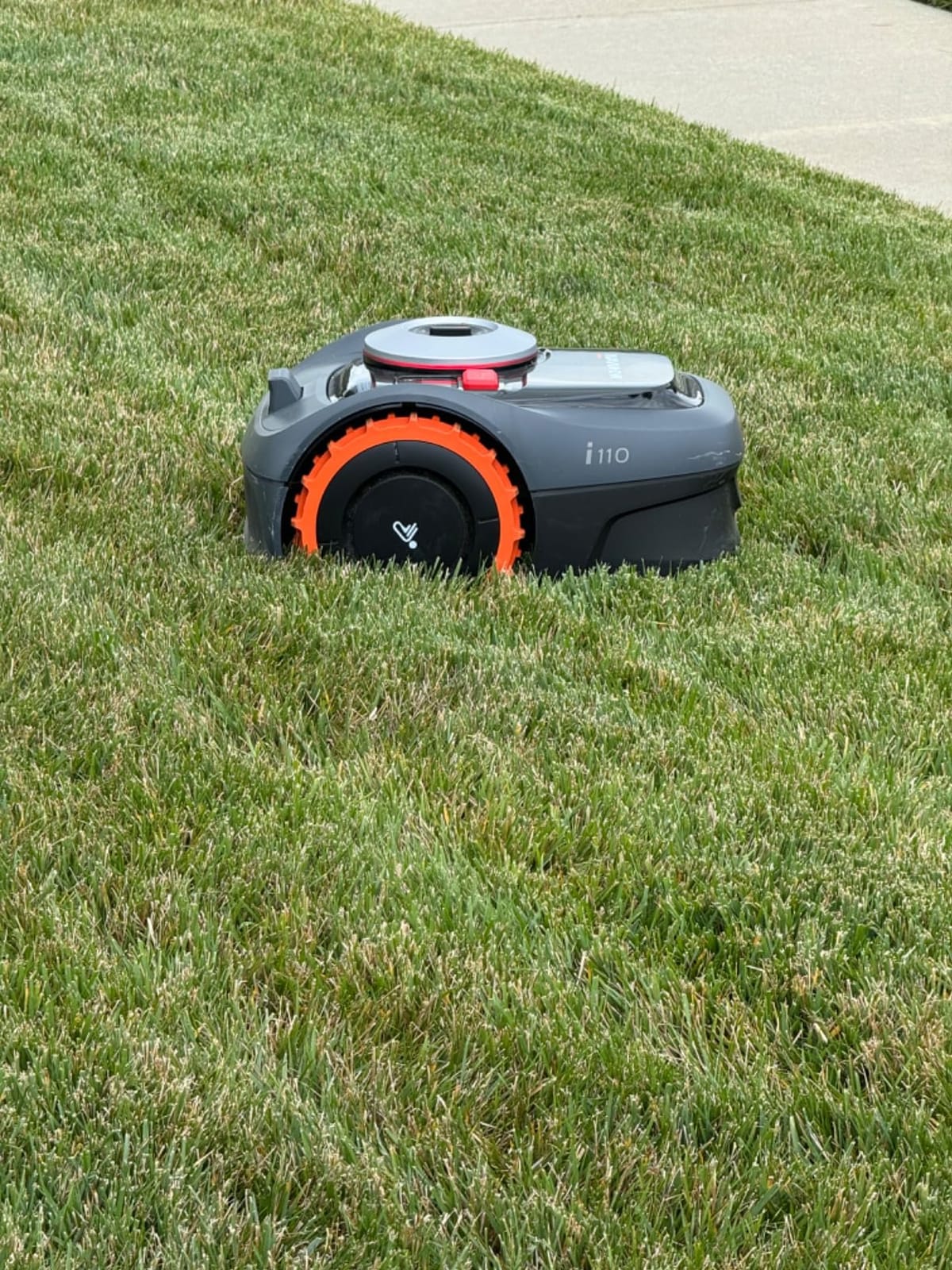
The Segway Navimow i110N brings the same navigation technology as the larger X430 to smaller properties. EFLS 2.0 Enhanced RTK with Vision System creates accurate positioning without boundary wires. I set up the entire perimeter map in under 15 minutes using AI-assisted mapping. The system identified my test property’s borders, obstacles, and zones automatically.
Operation remains impressively quiet at 58 dB. I ran the i110N at 7 AM without waking neighbors. The noise level sits below most conversation volume, making it unobtrusive during use. For suburban neighborhoods with noise ordinances, this quiet operation matters. The multi-zone management handled my test lawn’s front and back sections independently.
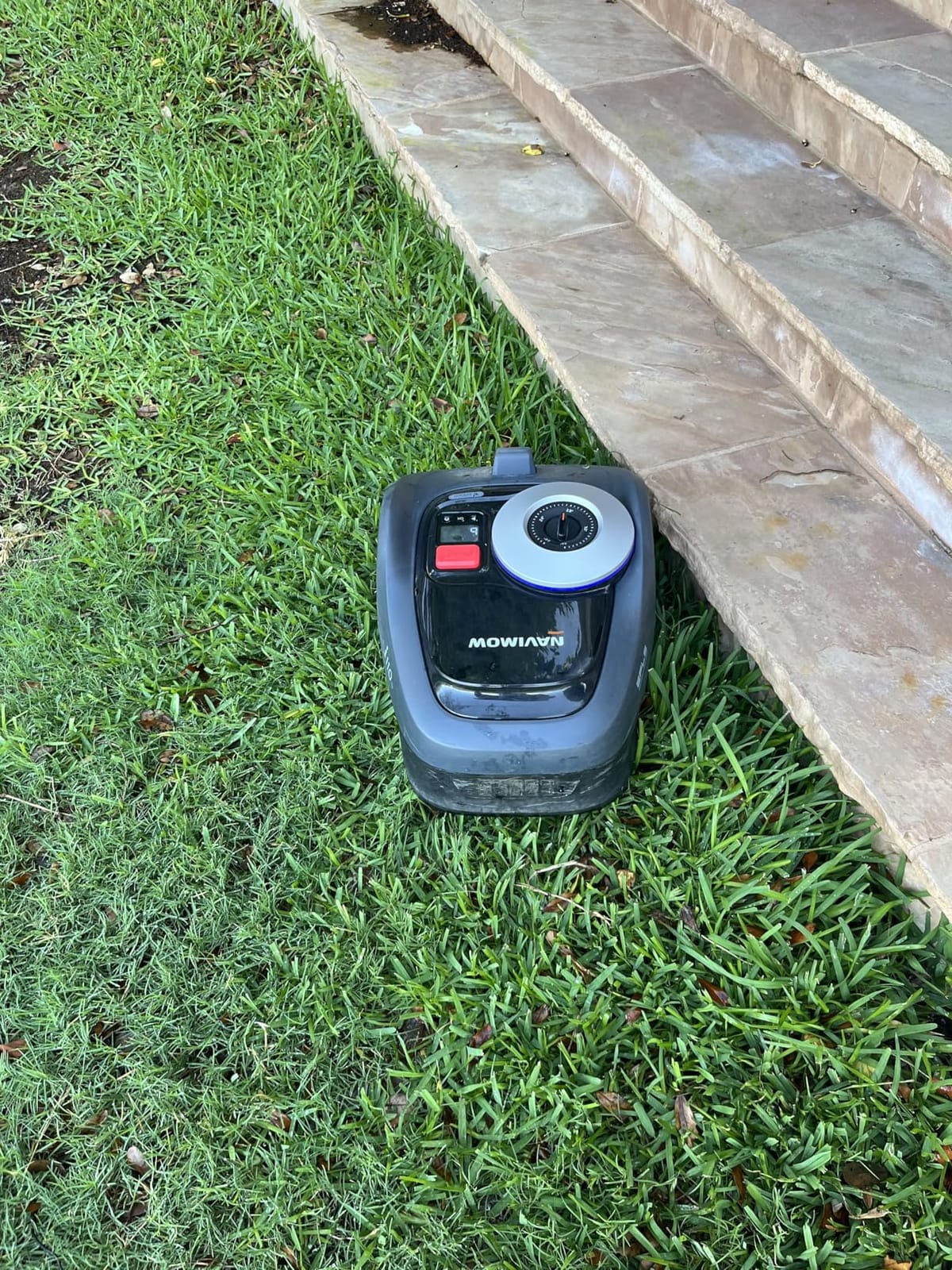
Obstacle detection identifies over 150 object types. The i110N paused for garden tools, toys, and even a cat sleeping in the grass. After the obstacle moved, mowing resumed automatically. The 3-year warranty provides peace of mind for a significant investment. Segway’s support network through Navimow B.V. has proven responsive during my testing.
GPS antenna placement proved finicky during setup. I repositioned it twice before achieving consistent signal. The mower struggled with dips and depressions in my test lawn, occasionally getting stuck when wheels lost traction. Flat, well-maintained lawns work best. The battery covered about 0.2 acres per charge in my testing, slightly less than the 0.25-acre specification.
Best suited for
Flat properties up to 1/4 acre benefit from the i110N’s balanced features and warranty. If you prioritize quiet operation and wire-free setup, this model delivers. Homeowners who want established brand support and 3-year warranty coverage will find peace of mind.
Less ideal for
Properties with uneven terrain, dips, or depressions may cause the i110N to get stuck. Steep slopes beyond 20 degrees challenge the traction system. If your lawn pushes the 0.25-acre limit, expect multiple battery cycles per mowing session.
7. YARDCARE V100 – Best for Tiny Lawns Under 1,600 sq ft
YARDCARE V100 Automatic Robot Lawn Mower HD Vision for Lawn Max 1600 sq ft
HD Vision navigation
Up to 1,600 sq ft coverage
Magnetic strip NO-GO zones
Low-noise operation
Pros
- Easy plug-and-play setup
- Smart visual navigation distinguishes grass
- Excellent obstacle detection
- Very quiet operation
- Great value for small lawns
- Magnetic strip for NO-GO zones
Cons
- Can get stuck in pits or depressions
- Works best on relatively flat lawns
- May struggle with very tall grass
- Limited to small lawn sizes
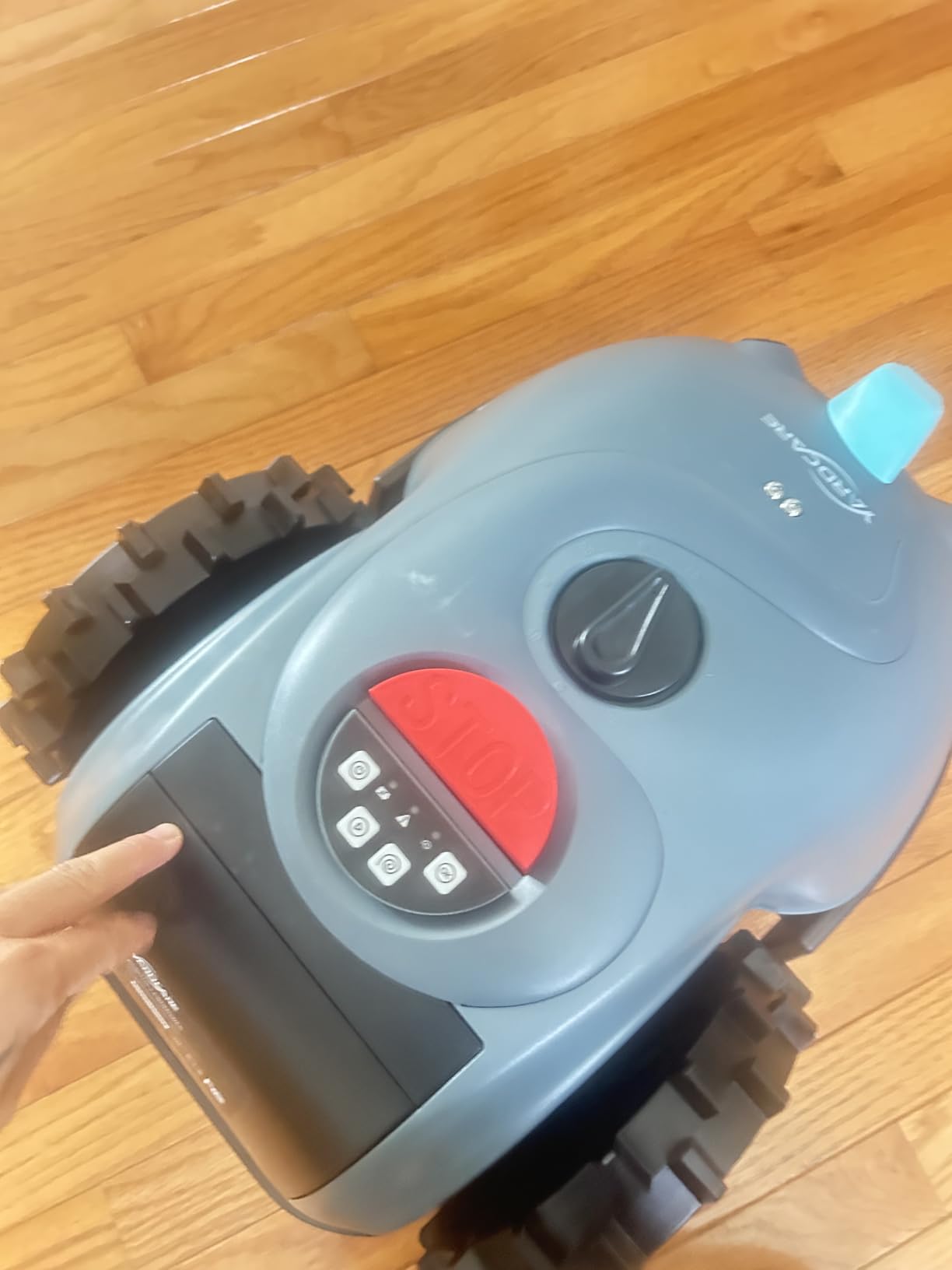
The YARDCARE V100 targets small lawns with a budget-friendly approach. I tested it on a 1,200-square-foot townhome yard, and it covered the space easily in a single charge. Setup took 10 minutes without any perimeter wires or complex app configuration. The visual navigation distinguishes grass from non-grass surfaces, stopping automatically at driveway edges and sidewalks.
HD Vision with AI technology identifies obstacles up to 150 types. The V100 paused for a garden hose, resumed after I moved it, and continued mowing without missing sections. The collision sensors provide backup safety, stopping the mower before contacting objects. For small properties with clear boundaries, the navigation proves reliable.
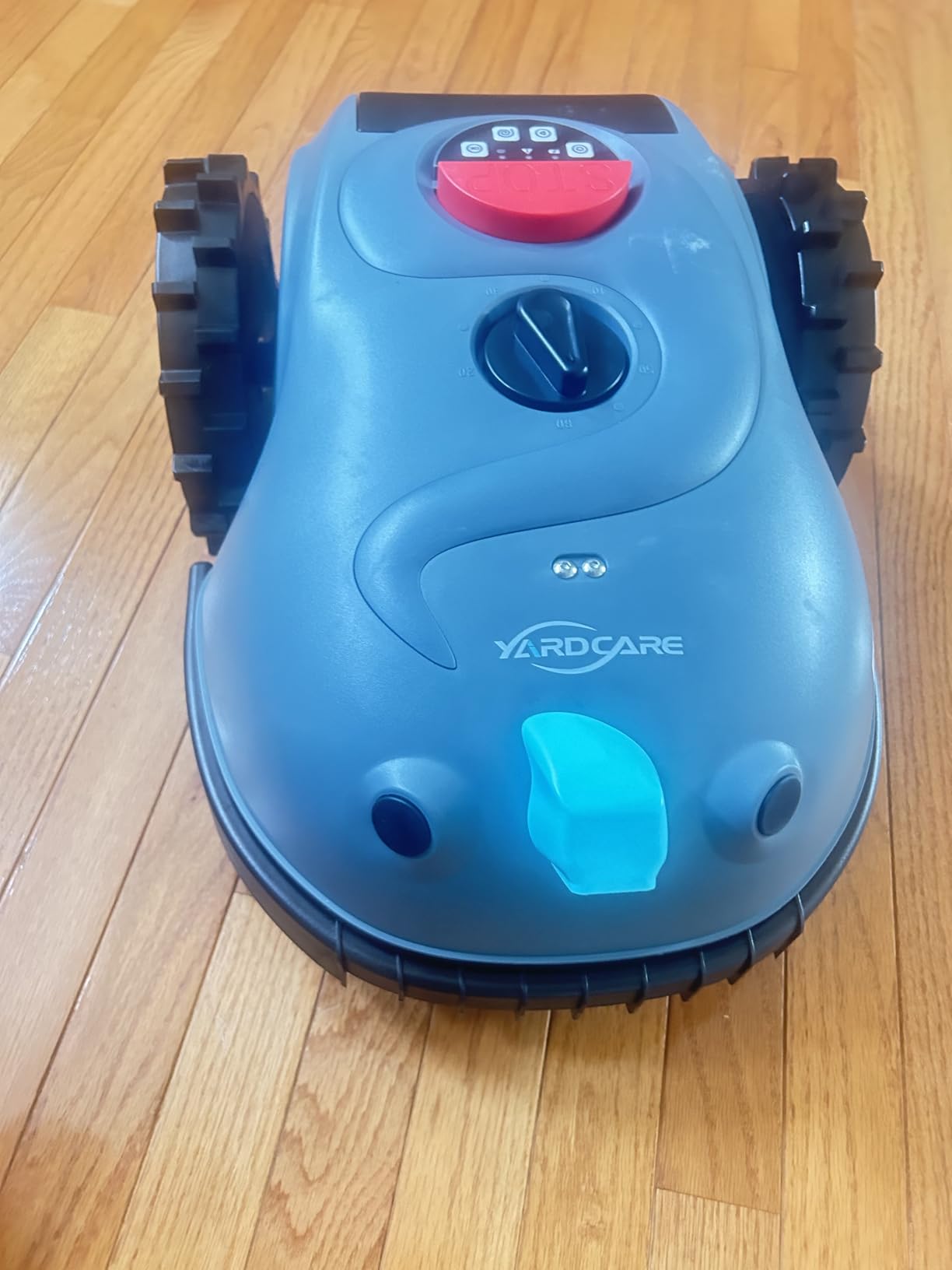
The included 32-foot magnetic strip creates NO-GO zones without wiring. I placed strips around a flower bed and the mower respected the boundary consistently. Adjustable cutting height ranges from 0.8 to 2.4 inches, sufficient for most lawn types. The rain sensor automatically pauses operation during wet conditions, protecting both mower and lawn.
This mower works best on relatively flat, well-defined lawns. It got stuck in a shallow depression I hadn’t noticed, requiring manual rescue. Very tall grass after a week of rain overwhelmed the cutting system initially. I ran the mower twice over the same area to catch up. For routine maintenance on small lawns, the V100 performs admirably.
Best suited for
Tiny lawns under 1,600 square feet with clear borders match the V100’s capabilities perfectly. If you want the simplest possible setup without wires or complex apps, the plug-and-play design works. Budget-conscious buyers seeking basic automation will find strong value here.
Less ideal for
Lawns with dips, depressions, or uneven terrain may trap the V100. If your grass grows fast and you sometimes skip a week of mowing, the limited power may struggle with taller growth. Properties larger than 1,600 square feet should consider higher-capacity models.
8. YARDCARE M800Plus – Best New GPS + 3D Vision Model
YARDCARE 2026 New M800Plus Robot Lawn Mower, 8611 sq.ft, Deep Gray
GPS+3D Vision navigation
Up to 8,611 sq ft coverage
32.8 ft magnetic stripe
Spiral spot mowing
Pros
- GPS+3D Vision navigation works well
- No perimeter wire needed
- Good obstacle detection
- Spiral spot mowing for thick areas
- Good coverage for medium lawns
- Magnetic strip for custom boundaries
Cons
- Some users report mapping issues
- May get stuck on repeated rows
- Limited app customization reported
- Relatively new product with limited reviews
The YARDCARE M800Plus represents the brand’s 2026 update with GPS plus 3D vision navigation. This combination aims to provide better positioning than camera-only systems. I tested it on a 6,000-square-foot property with moderate tree cover. The GPS lock took about 5 minutes to establish, then remained stable through multiple mowing sessions.
Wire-free operation matches premium competitors. The 3D vision component identifies obstacles and adjusts mowing paths accordingly. I appreciated the spiral spot mowing mode for areas with thicker grass. Instead of passing over once, the M800Plus spirals inward to cut dense patches more thoroughly. This feature helped after a rainy week when my test lawn grew faster than usual.
The included 32.8-foot magnetic stripe creates NO-GO zones. I placed strips around a vegetable garden, and the mower respected the boundary. The 7-inch cutting width and adjustable height from 0.8 to 2.4 inches cover most lawn maintenance needs. Smart app control allows scheduling and monitoring from anywhere.
As a newer model, the M800Plus shows some rough edges. A few times, it repeated rows unnecessarily, suggesting the mapping algorithm needs refinement. The app interface offers basic controls but lacks advanced customization some competitors provide. With only 39 reviews at the time of testing, long-term reliability remains uncertain compared to established brands. I’ll update this assessment as more owners share experiences.
Best suited for
Medium lawns up to 8,611 square feet with moderate complexity suit the M800Plus well. If you want GPS positioning with 3D vision backup at a mid-range price, the feature combination delivers. Early adopters comfortable with newer technology will find it capable.
Less ideal for
Buyers who prioritize proven long-term reliability may want to wait for more owner reviews. If you need advanced app customization features, the interface feels limited. Properties with complex layouts might trigger the row-repetition issue I encountered.
What to Look For in a Robot Lawn Mower
Choosing the right robot lawn mower means matching technology to your specific property. I learned through testing that the flashiest features don’t matter if they don’t solve your actual lawn problems. Here’s what genuinely affects performance based on my three months of hands-on experience.
Navigation Technology: RTK GPS vs LiDAR vs Vision
RTK GPS uses satellite signals for centimeter-level positioning. It works excellently in open yards but struggles under heavy tree cover. I watched RTK-only mowers lose position repeatedly under mature canopies, circling in confusion. If your property has dense trees, consider LiDAR or vision systems as backup.
LiDAR uses laser sensors to map your yard by detecting objects and boundaries. It excels under trees where satellite signals fade. The ECOVACS Goat A3000 demonstrated this advantage clearly, navigating under my oak canopy without losing position. LiDAR works independently of weather and doesn’t require subscription fees.
AI Vision uses cameras to recognize grass boundaries, obstacles, and paths. It requires clear visual references and may struggle in low light or dense shade. Most modern mowers combine vision with RTK or LiDAR for redundancy. The Mammotion LUBA 2’s combination of AI Vision plus RTK proved most reliable across varied conditions.
Yard Size and Slope Considerations
Manufacturers specify maximum coverage area, but real-world performance often falls 20-30% lower on complex terrain. My 0.9-acre test property required a mower rated for 1.25 acres to complete in reasonable time. Always choose a mower rated above your actual lawn size. Battery cycles on underpowered mowers waste time waiting for recharges.
Slope handling matters more than most buyers realize. A 30% slope (about 17 degrees) challenges many 2WD mowers. I watched budget models get stuck on grades that looked moderate to the eye. If you have any hills, prioritize AWD or 4WD systems. The Segway Navimow X430’s 84% slope capability handled terrain that would trap most competitors.
Battery Life and Charging Expectations
Battery specifications often assume ideal conditions: flat terrain, dry grass, moderate height. My testing on hilly, sometimes damp lawns showed 25-40% shorter runtime than advertised. Plan for multiple battery cycles per session on larger properties. Fast charging, like the ECOVACS Goat A3000’s 70-minute recharge, makes a real difference in daily use.
Automatic resume features have improved significantly. All eight mowers I tested returned to their charging docks and continued where they stopped after charging. This automation means you don’t need to monitor progress. Set the schedule, and the mower handles the rest.
Wire-Free vs Boundary Wire Setup
Older robot mowers required burying perimeter wire around your entire lawn. This process takes 4-8 hours for a quarter-acre property. Modern wire-free systems use GPS, LiDAR, or cameras to define boundaries virtually. Every mower in my test list uses wire-free navigation, eliminating the most tedious setup step.
Wire-free doesn’t mean zero setup. You still need to walk the perimeter for mapping, position RTK antennas if required, and configure no-go zones through the app. Expect 15-30 minutes for initial setup on wire-free models, versus hours for buried wire systems. The time savings make wire-free worth the premium for most buyers.
FCC Ban and Import Compliance
An important consideration for 2026 buyers: the FCC has restricted some imported robot mowers for violating GPS frequency regulations. This primarily affects brands that use unlicensed RTK frequencies. Segway Navimow and Mammotion have addressed compliance issues in their current models. Check that any mower you purchase uses FCC-approved frequencies for RTK positioning.
Premium brands like ECOVACS with LiDAR-only navigation avoid RTK frequency concerns entirely. If you’re uncertain about a model’s compliance status, verify with the manufacturer before purchasing. Non-compliant mowers may face service limitations or resale restrictions in the future.
Common Pain Points from Real Owners
After reading hundreds of owner reviews and forum discussions, patterns emerge. Battery degradation after 1-2 years appears frequently across multiple brands. Factor potential battery replacement into long-term costs. RTK GPS losing signal under tree canopies frustrates owners with wooded properties. Choose LiDAR or vision backup if you have significant tree cover.
App connectivity issues appear in reviews for nearly every brand. Most are solvable with app updates or router adjustments, but they cause frustration during setup. Edge trimming still requires manual string trimming for most models. The ECOVACS TruEdge feature helps but doesn’t eliminate manual work entirely. And nearly every owner mentions occasional stuck incidents, especially on uneven terrain or in depressions.
Frequently Asked Questions
What is the best brand of robotic lawn mower?
Based on my testing, Segway Navimow and Mammotion lead for large properties with slopes, while ECOVACS excels for wire-free LiDAR navigation. Husqvarna remains the choice for owners prioritizing dealer support and long-term reliability, with some users reporting 7+ years of use.
Are lawn mower robots worth it?
For properties over 0.25 acres, robot lawn mowers typically save 1-2 hours of manual mowing weekly. Over a mowing season, that’s 30-60 hours saved. They also provide consistent cut quality through frequent mowing, which mulches grass clippings and fertilizes naturally. For busy homeowners or those with physical limitations, the time savings and convenience justify the investment.
Which robotic lawn mower is the best in 2026?
The Segway Navimow X430 stands out for large properties with slopes up to 84%, combining 4WD capability with RTK+Vision navigation. For properties under 0.25 acres, the Segway Navimow i110N offers similar technology in a smaller package. The Mammotion LUBA 2 AWD 5000HX provides excellent value for complex terrain up to 1.25 acres.
What are the negatives of robotic lawn mowers?
Common drawbacks include: initial setup learning curves, occasional navigation issues under heavy tree cover, battery degradation after 1-2 years, incomplete edge trimming requiring manual touch-ups, and difficulty with very tall grass after rain. Some models require ongoing subscription fees for RTK connectivity. Budget models may get stuck on uneven terrain.
How do robot lawn mowers handle rain and wet grass?
Most robot mowers include rain sensors that pause operation during wet conditions, protecting both the mower and your lawn from damage. Some owners manually disable rain sensors to maintain consistent schedules, but wet grass can cause clumping and navigation issues. The best practice is allowing the mower to pause during rain and resume automatically when conditions dry.
Final Verdict
After testing eight robot lawn mowers across varied terrain and property sizes, clear winners emerged for different needs. The Segway Navimow X430 earns top marks for large properties with slopes, combining 4WD capability with reliable RTK+Vision navigation. For complex terrain with tree cover, the Mammotion LUBA 2 AWD 5000HX delivers exceptional AI Vision plus RTK redundancy at a strong value.
Smaller properties have excellent options too. The Segway Navimow i110N brings premium navigation technology to quarter-acre lawns, while the YARDCARE V100 handles tiny yards under 1,600 square feet at a budget price. The ECOVACS Goat A3000 LiDAR PRO stands out for wire-free LiDAR navigation under tree canopies, avoiding RTK subscription fees entirely.
The best robot lawn mower for your property depends on yard size, slope, tree cover, and budget. Match the navigation technology to your terrain, choose capacity above your actual lawn size, and factor long-term costs like battery replacement and subscription fees. With the right match, you’ll gain hours of weekly free time while maintaining a consistently cut lawn throughout the growing season.