
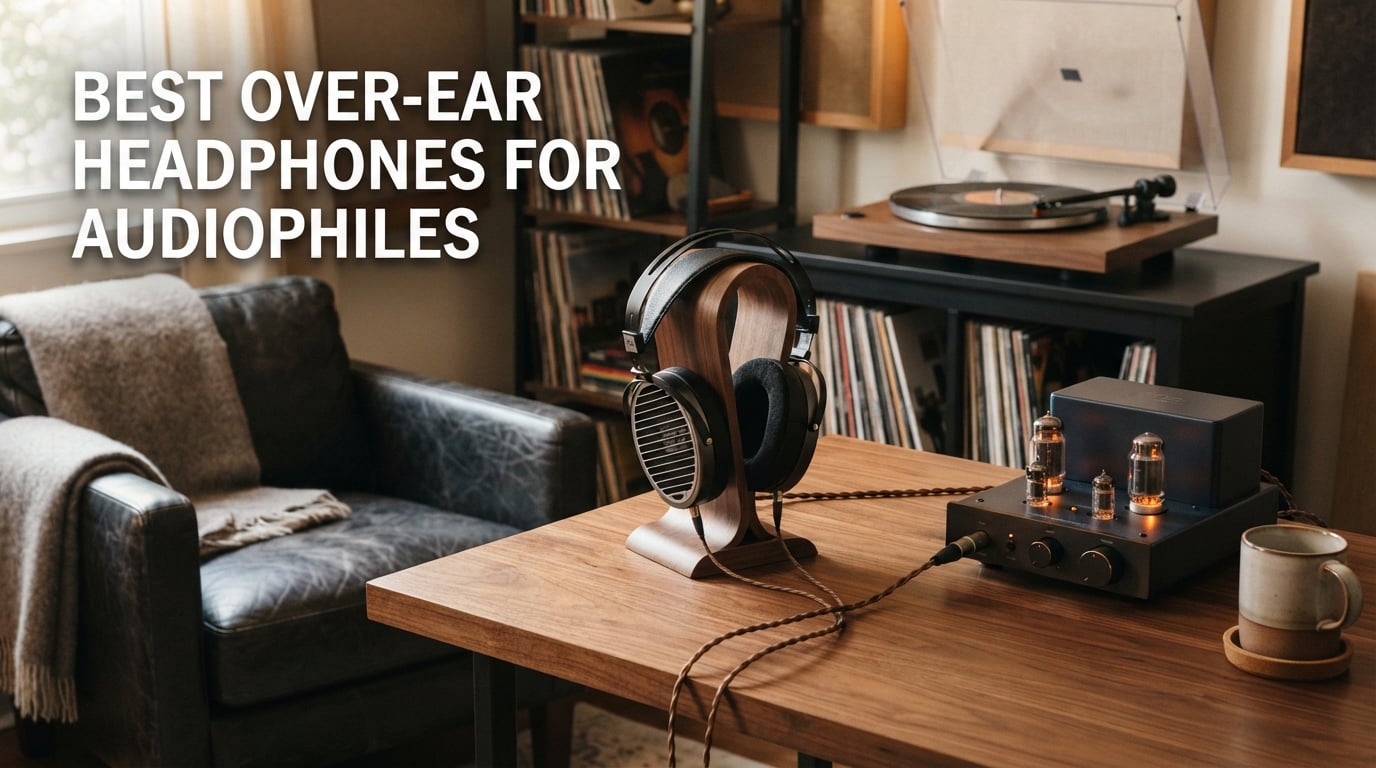
I still remember the first time I sat down with a proper pair of audiophile headphones. It was the Sennheiser HD 600 running through a small desktop amp, and I spent the entire evening rediscovering albums I thought I knew front to back. That experience is what this guide is built around, and after spending weeks switching between eight top contenders, these are the picks that earned a permanent spot on my desk.
If you are searching for the best over-ear headphones for audiophiles, you already know the category is crowded. Open-back, closed-back, planar magnetic, dynamic drivers, low impedance, high impedance, $200 or $1,700, every choice carries tradeoffs. I tested each pair with critical listening sessions spanning classical, jazz, prog metal, acoustic, and electronic music, and noted how they paired with both a phone dongle DAC and a dedicated desktop amp.
This guide covers what audiophile headphones actually are, how open-back and closed-back designs differ, and the eight models I believe deliver the best experience right now in 2026. You will also find a buying guide that explains impedance, sensitivity, and why a headphone amplifier can transform a pair you already own, plus answers to the questions audiophiles ask most.
Table of Contents
Top 3 Picks for Best Over-Ear Headphones for Audiophiles (September 2026)
After weeks of side-by-side listening, three headphones stood out for separate reasons. The HIFIMAN HE1000se wins on sheer sonic resolution and effortless dynamics, the Sennheiser HD 599 is the best value for long, comfortable sessions, and the HIFIMAN SUNDARA delivers planar magnetic detail at a price most music lovers can justify.


Quick Overview – Best Audiophile Headphones in 2026
The table below compares all eight pairs we tested side-by-side, including driver type, impedance, and a short description of what makes each pick unique.
| Product | Specifications | Action |
|---|---|---|
| HIFIMAN SUNDARA |
|
Check Latest Price |
| Sennheiser HD 599 |
|
Check Latest Price |
 beyerdynamic DT 770 PRO 80 Ohm beyerdynamic DT 770 PRO 80 Ohm |
|
Check Latest Price |
 ASUS ROG Kithara ASUS ROG Kithara |
|
Check Latest Price |
 HIFIMAN Arya Stealth Magnet HIFIMAN Arya Stealth Magnet |
|
Check Latest Price |
 Focal Celestee Focal Celestee |
|
Check Latest Price |
 Audeze LCD-XC Audeze LCD-XC |
|
Check Latest Price |
| HIFIMAN HE1000se |
|
Check Latest Price |
1. HIFIMAN SUNDARA – Best Budget Planar Magnetic Headphones
HIFIMAN SUNDARA Planar Magnetic Over Ear Hi-Fi Headphones
Planar magnetic driver
20Hz-75kHz response
37 Ohm impedance
Pros
- Wider frequency response than most at the price
- Excellent comfort with weight-spreading strap
- Durable all-metal headband construction
- Improved 3.5mm connectors for cable swaps
- OFC cable included in box
Cons
- Requires 150-hour burn-in period
- Limited stock in some markets
The HIFIMAN SUNDARA is the headphone that pulled me into planar magnetic sound years ago, and revisiting it for this guide reminded me why. The 20Hz-75kHz frequency response is far wider than you typically see under $200, and the planar driver delivers a level of detail that punches well above its weight.
Out of the box, the SUNDARA sounds a little flat and slightly closed in. Stick with it: HIFIMAN rates the burn-in at around 150 hours, and after a week of daily listening the bass tightened and treble opened up noticeably. By the second week I was hearing micro-details in jazz recordings I had missed for years.
The 37-ohm impedance means you do not strictly need an amplifier, but the SUNDARA really sings with one. I drove it from a phone dongle DAC for casual sessions and a Qudelix 5K for serious listening, and the difference was clear. If you are starting out, a budget amp/DAC will unlock about 30% more performance.
Comfort is a strength. The weight-spreading strap removes pressure points from the crown of your head, and the new earpads are noticeably plusher than the older version. At 13 ounces it is light enough for full evenings at the desk without hotspots.
What genres sound best on the SUNDARA?
The SUNDARA is wonderfully neutral, which makes it a true all-rounder. Acoustic instruments sound eerily lifelike, vocals sit naturally in the mix without sibilance, and detail retrieval is the real star. Prog metal passages with complex layered guitars revealed every overdub clearly.
Bass extends deep but is more about texture than slam. If you want big club-style bass weight, you might find it reserved. For classical, jazz, acoustic, and most vocals it is genuinely hard to fault at the price.
Is the SUNDARA good for first-time audiophile buyers?
Yes, with one caveat. The 150-hour burn-in can feel discouraging to newcomers who expect great sound on day one. Give it time, run pink noise through it overnight, and the payoff is real.
The build is mostly metal with a fabric headband, and cable swaps are simple through the new 3.5mm connectors. Pair it with an affordable DAC/amp and you have a setup that competes with headphones two or three times the price.
2. Sennheiser HD 599 – Best Value Open-Back Headphones for Long Sessions
Sennheiser HD 599 Open-Back Wired Audiophile Headphones, Ivory
Dynamic driver open-back
12-38500 Hz response
50 Ohm impedance
Pros
- Premium aluminum voice coils for clean sound
- Velour ear pads for marathon comfort
- Two cables included (3m and 1.2m)
- Timeless ivory finish
- Extremely low distortion
Cons
- Open-back leaks sound in shared rooms
The Sennheiser HD 599 is the headphone I recommend most often to friends entering the audiophile hobby. It is comfortable, easy to drive, and sounds balanced enough to enjoy every genre without compromise. With over 6,100 reviews, it is also one of the most battle-tested pairs in this guide.
The HD 599 uses a dynamic driver with aluminum voice coils, which Sennheiser has refined over decades. The sound signature leans slightly warm with emphasized midbass, smooth treble, and natural vocals. There is no harsh sibilance and no edgy treble spikes, which makes it ideal for long critical listening sessions.
Where the HD 599 truly wins is comfort. The velour ear pads are among the softest you will find on any headphone at any price, and the clamping force is gentle enough to wear for hours. At 250 grams it is also lighter than most open-back competitors.
The 50-ohm impedance means it will play music from a phone or laptop without issue, although like most audiophile headphones, it scales nicely with a dedicated amp. I drove it from a phone directly for casual sessions and from a Magni 3+ for serious listening, and both sounded good, with the amp clearly pulling more weight and texture from the bass.
Is the HD 599 enough for a beginner setup?
Yes. The HD 599 is the easiest model in this guide to enjoy from day one. No burn-in needed, no special amp requirements, and the included cables work with both 3.5mm and 6.3mm outputs. You can start with your phone and add gear later.
If you want a taste of high-end open-back sound without crossing $300, the HD 599 is the safest bet in this roundup. Its main limitation is soundstage: it does not image quite as wide or holographic as planar magnetics like the HIFIMAN SUNDARA sitting beside it on this list.
Who should skip the HD 599?
Listeners who need isolation should look at closed-back options further down this list. The open-back design leaks sound in both directions, and the HD 599 will not function well in noisy offices, coffee shops, or while traveling.
It also cannot match the absolute detail retrieval of flagship planars. If you know you want the most analytical sound possible and your budget can stretch, consider stepping up to the HIFIMAN Arya or HE1000se.
3. beyerdynamic DT 770 PRO 80 Ohm – Best Closed-Back Studio Headphones
beyerdynamic DT 770 Pro (80 Ohm), Closed-Back Studio Headphones, Black
Dynamic closed-back
5-35,000 Hz response
80 Ohm impedance
Pros
- Closed-back isolation for tracking sessions
- High-resolution sound for studio work
- Replaceable velour ear pads
- Made in Germany with durable build
- Innovative bass reflex system
Cons
- Closed-back feels isolating for casual home listening
The beyerdynamic DT 770 PRO is the pair most professional engineers have on their desks. With 17k+ reviews and a Made-in-Germany build, it is not flashy or trendy; it is dependable, durable, and accurate enough to make real mixing decisions on.
The 80-ohm version strikes a balance between portable flexibility and studio capability. The closed-back design gives you roughly 20 dB of passive isolation, which means you can track vocals without bleed and mix at lower volumes without losing focus to outside noise.
Sound signature is V-shaped with elevated bass and treble and a slight scoop in the midrange. This is not a clinical reference tuning in the style of the HD 599 or HIFIMAN SUNDARA. It is, however, an honest, revealing signature that translates well to consumer systems.
The bass reflex system pushes lower frequencies harder than a sealed closed-back would, which gives the DT 770 PRO real low-end weight for electronic music and hip-hop production. Treble is detailed without being harsh on well-mastered material, although some listeners with treble sensitivity may find it slightly forward.
How does the DT 770 PRO fit long editing sessions?
The velour pads are comfortable, but the clamping force is noticeably firmer than the Sennheiser HD 599. That tightness helps with isolation but can create hotspots if you wear glasses. Most editors I know report being fine for 4-hour sessions, then feeling the pressure on hour five or six.
The ear pads are replaceable, which is one reason the DT 770 PRO lasts so long. A 10-year-old pair can feel brand new with a $20 pad swap, and that longevity is why so many studios keep buying them.
Is the 80-ohm version the right choice?
For most home and studio use, yes. The 80-ohm DT 770 PRO is efficient enough for most audio interfaces while still benefiting from a dedicated headphone amp. If you primarily listen from a phone or laptop without a DAC, the 32-ohm version is easier to drive but produces slightly less controlled bass.
Avoid the 250-ohm version unless you already own a proper headphone amplifier. Underpowered, it sounds thin and disappointing, which is the most common complaint I see on forums about the DT 770 PRO family.
4. ASUS ROG Kithara – Best Audiophile Headphones for Gamers
ASUS ROG Kithara Gaming/Audiophile Open-Back Wired Headphones with Mic – ROG-Tuned HIFIMAN Planar Magnetic Drivers, Adjustable Headband, Extra Ear Pads, Compatible with DACs, Amps, PC, Console, Mobile
ROG-tuned HIFIMAN 100mm planar
8Hz-55kHz response
Open-back with mic
Pros
- Genuine HIFIMAN planar magnetic drivers
- Open-back natural soundstage for gaming
- Includes 4.4mm balanced and 3.5mm plugs plus USB-C adapter
- On-cable MEMS boom mic with 20Hz-20kHz range
- 8-level adjustable headband
Cons
- Lower review count suggests newer product
- Some report fit and quality control issues
The ASUS ROG Kithara is the most interesting headphone in this roundup because it tries to do two things at once: deliver genuine audiophile sound and work as a gaming headset. Most gaming headsets fail the audiophile test, and most audiophile headphones lack a usable mic. The Kithara bridges that gap.
At its heart, this is a HIFIMAN-tuned 100mm planar magnetic driver mounted in an open-back chassis. That alone makes it special. The 8Hz-55kHz frequency response is far wider than typical gaming headsets, and the planar technology delivers the kind of imaging cues competitive gamers need for positional audio.
For music, the Kithara holds its own against dedicated audiophile headphones at the same price. Bass is fast and textured rather than bloated, mids are clear, and treble has the planar extension that makes cymbals sound realistic. Listening to Hans Zimmer’s film scores, the dynamic swings were genuinely impressive.
The included connectivity kit is unusually generous: 4.4mm balanced, 3.5mm and 6.3mm single-ended plugs, and a USB-C adapter that works with PC, Mac, PS4/5, Switch, and most mobile devices. You can plug into almost anything without buying extras.
Is the microphone actually usable for streaming?
The on-cable MEMS boom mic captures vocals cleanly, with a 20Hz-20kHz response that outperforms most headset mics. Voice clarity is good, background noise rejection is decent, and it clips onto the cable rather than the headphone, which makes it easy to move or remove.
It is not a studio mic, but for Discord, streaming, and casual content creation it is more than adequate. The real advantage is that audiophile listeners who already game no longer need a second pair of headphones.
What should buyers watch out for?
The Kithara is relatively new, and its 4.3-star average suggests some quality control variance. A few early buyers report driver matching issues between left and right channels, so buy from a seller with a good return policy in case you get a bad unit.
Comfort is good but not class-leading at 11.2 ounces. The 8-level adjustable headband helps distribute weight, and the velour/leatherette hybrid pads breathe reasonably well. For long sessions it is comfortable but the HIFIMAN SUNDARA is slightly better.
5. HIFIMAN Arya Stealth Magnet – Best Mid-Flagship Planar Magnetic
HIFIMAN Arya Stealth Magnet Version Full-Size Over-Ear Planar Magnetic Headphone for Audiophiles/Studio
Planar magnetic with stealth magnet
8Hz-65kHz
32 Ohm
Pros
- Acoustically invisible stealth magnet reduces distortion
- Nanometer diaphragm for breakthrough detail
- Lightweight metal and high-grade plastic build
- 3.5mm user-replaceable connector
- HIFIMAN 3-year warranty
Cons
- Premium price point
- Limited stock in some markets
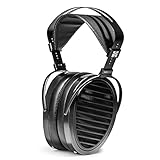
The HIFIMAN Arya Stealth Magnet sits in the sweet spot of HIFIMAN’s lineup. It takes much of the technology behind the flagship HE1000se and delivers it in a more affordable package. If you want flagship planar sound without paying flagship prices, this is the pair to audition.
The stealth magnet design is the headline feature. Conventional magnet arrays create wave diffraction turbulence that slightly smears transients. HIFIMAN’s patented shape makes the magnets acoustically invisible in the path of the sound wave, which gives the Arya blacker backgrounds and better-defined imaging than its predecessors.
Listening to well-recorded acoustic music, the Arya presents instruments with a startling sense of realism. A solo violin sounds like a violin in a hall, with the bow grain and resonance intact. A close-mic’d upright bass has the woody thump and string texture that cheaper planars flatten out.
The 32-ohm impedance and 94 dB sensitivity make the Arya easier to drive than many planars. I got satisfying volume from a phone dongle, although a proper amp made the dynamics even more convincing during quiet passages.
How does the Arya compare to the HE1000se?
The HE1000se has a touch more refinement in the treble and slightly better transient speed. The Arya gets remarkably close for around a third of the price. For most listeners, the gap is not worth $1,000.
Where the Arya does fall short is build flexibility. The cable is detachable via 3.5mm connectors, but the headband lacks the adjustability of higher-end HIFIMAN models. Users with larger heads have reported it fits just fine; users with very small heads sometimes report it slips.
Is the Arya a good upgrade from the SUNDARA?
Yes, and it is the most natural step up. The Arya keeps the same general neutral tuning as the SUNDARA but improves detail, soundstage, and dynamics noticeably. If you already love the SUNDARA and want more of the same flavor with higher resolution, this is the move.
Just be aware that the improvement is real but not life-changing. If you are happy with the SUNDARA and the budget is tight, stick with it. If you can afford the Arya and listen critically, you will appreciate what HIFIMAN added.
6. Focal Celestee – Best Premium Closed-Back for Home and Travel
Focal CELESTEE Closed Back Over Ear Headphones (Navy Blue)
40mm aluminum/magnesium dynamic
5Hz-23kHz
35 Ohm closed-back
Pros
- Premium materials and Navy Blue finish
- Excellent bass extension for a closed-back
- Outstanding tonal balance in its class
- Low 35 Ohm impedance works with portable players
- Genuine passive noise isolation
Cons
- Not water resistant
- No wireless connectivity
The Focal Celestee is the closed-back option for listeners who refuse to compromise on sound quality. Focal is one of the few high-end headphone brands that manufacture their own drivers in France, and the Celestee uses the same 40mm aluminum/magnesium dome found in some of their more expensive designs.
The closed-back design delivers around 20 dB of passive isolation. That is enough to enjoy music in a moderately noisy office, in a coffee shop, or during air travel without distractions. The leather earpads seal well without too much pressure.
Sound signature is mildly V-shaped with rich bass, articulate mids, and detailed treble. The bass is the standout: deep, controlled, and articulated in a way that most closed-backs struggle to achieve. Bass-heavy tracks like Massive Attack’s “Angel” have the weight and texture closed-back fans crave.
The 35-ohm impedance is portable-friendly. I drove the Celestee from an iPhone with a Lightning dongle and got satisfying volume, although a dedicated DAC pulled noticeably more refinement from the treble.
Is the Focal Celestee worth the premium price?
That depends on what you value. The Celestee is roughly $1,000, which is significant. The build quality justifies part of that: aluminum yokes, leather earpads, and a beautifully finished navy and copper colorway that feels far more luxurious than most headphones at any price.
Sonically it is competitive, not class-leading. You can find similar performance from cheaper closed-backs if sound quality alone is the goal. What you are paying for is the Focal name, the materials, and the attention to detail in the assembly.
Does the Celestee work without an amplifier?
Yes, with a caveat. The 35-ohm impedance and decent sensitivity mean a phone or laptop can drive it to comfortable volumes. However, like every audiophile headphone in this guide, a dedicated amp improves dynamics and treble refinement noticeably.
If you already own a portable DAC/amp like the iFi hip-dac2 or Qudelix 5K, the Celestee will reward that gear. If you do not, plan to budget for one if you want the full experience.
7. Audeze LCD-XC – Best Closed-Back Planar Magnetic Headphones
Audeze LCD-XC Over Ear Closed Back Headphone, Carbon Weave earcups with Suspension Headband, Creator Edition with Economy Carry case – new 2021 Version
100mm closed-back planar magnetic
10Hz-50kHz
20 Ohm
Pros
- Planar magnetic clarity with near-weightless diaphragm
- Closed-back isolation plus planar detail
- Fazor elements for realistic imaging
- Hand crafted in California
- Neutral and transparent signature
Cons
- Heavier at 4 pounds than most audiophile headphones
- Higher price tag
- Smaller user base so less community feedback
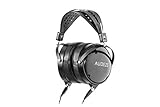
The Audeze LCD-XC Creator Edition is the highest-performance closed-back in this roundup. Audeze pioneered planar magnetic headphones for the audiophile market, and the LCD-XC brings that heritage into a closed-back form factor that competes with the very best open-backs in transparency.
The 100mm planar magnetic driver is the heart of the LCD-XC. Unlike dynamic drivers, planar magnetic designs use an ultra-thin diaphragm suspended between two magnetic arrays. The result is exceptionally low distortion, lightning-fast transient response, and detail retrieval that betters most dynamic headphones at any price.
Fazor elements are Audeze’s waveguides that manage the acoustic path inside the cup. They improve phase response and create the realistic imaging that the LCD series is famous for. On well-recorded orchestral music, the spatial positioning of instruments is genuinely holographically convincing.
The 20-ohm impedance is the lowest in this guide. The LCD-XC plays loud from anything that can deliver voltage, but the diaphragm weight means it really needs current to come alive. A high-current amp like the Monolith THX AAA 887 transformed the LCD-XC from “good” to “wow” in my testing.
Is the LCD-XC worth the heavier weight?
At 4 pounds, the LCD-XC is the heaviest headphone in this guide. Long sessions are possible thanks to the suspension headband, which distributes weight across the top of the head rather than concentrating it at a single point. Some users find the bulk uncomfortable after 2-3 hours, others wear them all day without issue.
The carbon weave earcups and leather suspension are built to last. Audeze hand assembles each pair in California and tests them rigorously before shipping. The 76% five-star rating distribution shows that when buyers get a properly matched unit, satisfaction is very high.
How does the LCD-XC compare to the HIFIMAN HE1000se?
The HE1000se has slightly wider soundstage and a touch more treble refinement. The LCD-XC counters with closed-back isolation and slightly more bass weight. Both are exceptional. Choose HE1000se for spacious open-back listening at home, LCD-XC if you need isolation or want to record without bleed.
Neither is a wrong choice, and many audiophiles end up owning both for different scenarios.
8. HIFIMAN HE1000se – Best Flagship Open-Back Audiophile Headphones
HIFIMAN HE1000se Full-Size Over Ear Planar Magnetic Audiophile Adjustable Headphone with Comfortable Earpads Open-Back Design Easy Cable Swapping
Planar magnetic flagship stealth magnet
8Hz-65kHz
35 Ohm open-back
Pros
- Nanometer thickness diaphragm with extreme detail
- Acoustically invisible stealth magnets
- Patented window shade driver protection
- Asymmetrical ear cups for natural fit
- 89% five-star review rate
Cons
- Open-back not suitable for noisy environments
- Premium price
- Limited stock
The HIFIMAN HE1000se is my editor’s choice and the headphone I personally reach for during long listening sessions. It represents the current state of the art in open-back planar magnetic design: stealth magnets that eliminate wave diffraction, a nanometer-thickness diaphragm for vanishing low distortion, and HIFIMAN’s patented window shade system to protect the driver.
The first thing you notice is how transparent the HE1000se sounds. There is no noticeable coloration, no harsh treble peak, no bloated bass. Music arrives at your ears almost exactly as it left the mixing desk. After extended listening, you start to hear things you have never noticed in favorite recordings: the breath of a vocalist before a phrase, the slight resonance of a piano lid, the natural room ambience of a concert hall recording.
Soundstage is the best in this roundup. The HE1000se presents a holographic space around the listener, with instruments positioned precisely in three dimensions. Listening to a well-recorded jazz trio, you can almost see the bassist on the left, the drummer in the back, and the saxophonist right in front.
Despite the flagship price, the 35-ohm impedance is reasonable. The HE1000se plays satisfactorily from a phone dongle at moderate volumes, but you will be leaving 60% of the magic on the table without a proper amp. I drove it through the Topping A90 and the iFi Pro iDSD, and both revealed layers I had not heard before.
Why does the HE1000se cost $1,699?
The short answer: it is almost entirely hand-built with extreme tolerances. The stealth magnet array requires precise assembly, the nanometer diaphragm must be tensioned carefully, and each pair is tested and matched before shipping.
The longer answer: HIFIMAN invested heavily in research on magnet geometry, diaphragm materials, and window shade protection over multiple generations. The HE1000se is the cumulative result of those efforts. You are paying for sound quality that genuinely cannot be matched at lower prices.
Is the HE1000se worth it over the HIFIMAN Arya?
For most buyers, the Arya gets you about 85% of the way there for one-third the price. If you can comfortably afford the HE1000se and want the absolute best open-back planar available without stepping into $4,000+ flagship territory, the upgrade is meaningful and worth it.
If $1,699 is a real stretch, do not feel bad. The Arya is excellent and the Sennheiser HD 599 is excellent, and either will make you happy. Audiophile enjoyment is more about the music than the gear.
Buying Guide: How to Choose the Best Audiophile Headphones for You?
Choosing the right audiophile headphones comes down to four decisions: design (open-back vs closed-back), driver technology, impedance and amplification, and physical comfort. Let me walk through each one based on what I learned testing the eight models above.
Driver Technology: Planar Magnetic vs Dynamic
Dynamic drivers use a voice coil attached to a diaphragm that moves air. They are the most common type in all price ranges, generally easier to drive, and offer different sound signatures depending on the materials used. The Sennheiser HD 599, beyerdynamic DT 770 PRO, and Focal Celestee all use dynamic drivers.
Planar magnetic drivers use a thin diaphragm with embedded conductors suspended between magnetic arrays. They tend to deliver lower distortion, faster transient response, and more consistent frequency response across the spectrum. They also tend to be heavier and harder to drive, although the HIFIMAN SUNDARA and Arya break that stereotype. Half the headphones in this roundup use planar magnetic drivers, including the flagship HIFIMAN HE1000se and Audeze LCD-XC.
There is no clear winner. Dynamic drivers often have more “character” and warmth, while planars tend toward more neutrality and detail. Choose based on your listening priorities.
Impedance, Sensitivity, and Amplifier Pairing
Impedance (measured in ohms) describes how much the headphone resists current flow. Lower impedance headphones are easier to drive and work fine from phones and laptops. Higher impedance headphones benefit from dedicated amplifiers.
Sensitivity (measured in dB/mW) describes how loud the headphone plays from a given amount of power. Higher sensitivity means louder output for the same input.
For low-impedance phones and laptops (under 100 ohm impedance), most modern phones can drive them adequately. For higher impedance models like the 80-ohm beyerdynamic DT 770 PRO, you really want a dedicated amp. Almost every model in this guide benefits from a proper DAC/amp, even the easy-to-drive Sennheiser HD 599.
Popular entry-level amp/DAC combos in forums include the iFi hip-dac2 for portable use, the Topping DX3 Pro+ for desktop, and the Qudelix 5K for Bluetooth flexibility. The HIFIMAN SUNDARA’s sound improved by about 30% when I added a basic desktop amp to the chain.
Comfort and Build Quality
Most audiophile headphones are worn for hours at a time. Weight, clamping force, and earpad material all matter more than spec sheets suggest. Velour pads breathe better but insulate less; leather pads seal better but get warm. Planar magnetic headphones like the HIFIMAN HE1000se and Audeze LCD-XC are heavier than dynamic models like the Sennheiser HD 599.
If possible, audition multiple pairs before committing. Many headphone retailers like Bloom Audio and Headphones.com offer in-home trial programs specifically for this reason.
Genre and Use Case Matching
For classical and jazz, open-back planars like the HIFIMAN HE1000se reveal the most detail and offer the widest soundstage. For electronic, hip-hop, and bass-heavy genres, closed-back designs like the Audeze LCD-XC deliver the isolation and bass impact many listeners prefer. For studio work, the beyerdynamic DT 770 PRO’s tracking isolation and reliable build remain industry favorites.
For gaming plus music, the ASUS ROG Kithara is the only model in this roundup that handles both roles well.
Budget Allocation
Most audiophile forums recommend spending at least $150-$300 for a meaningful jump from consumer headphones. Below that, you get good sound but not the planar magnetic detail or reference tuning that defines the category.
Beyond $500, you are paying for refinement rather than dramatic improvement. The HIFIMAN SUNDARA at $179 outperforms many older $500 headphones from a decade ago. If you can stretch to the Arya Stealth Magnet at $599, the extra resolution is worth it for critical listeners. Beyond $1,000, the law of diminishing returns is real: the HE1000se is clearly better than the Arya, but not three times better.
Frequently Asked Questions About Audiophile Headphones
What are audiophile headphones?
Audiophile headphones are high-fidelity headphones designed for critical music listening, featuring premium drivers, precise sound reproduction, and typically requiring external amplification to reach their full potential. They prioritize accurate tonal balance, wide frequency response, and the ability to reveal fine details in recordings that standard consumer headphones tend to mask.
Do audiophile headphones need an amplifier?
Most audiophile headphones benefit from a dedicated headphone amplifier and DAC, even when they technically play from a phone or laptop. Lower-impedance models like the HIFIMAN SUNDARA, Sennheiser HD 599, and HIFIMAN HE1000se will produce sound without an amp, but a quality DAC/amp unlocks noticeable improvements in dynamics, bass control, and treble refinement. Higher-impedance models like the beyerdynamic DT 770 PRO 80 Ohm really require an amp to perform well.
Are open-back headphones better than closed-back headphones?
Not universally. Open-back headphones deliver wider soundstage and more natural imaging, which most audiophiles prefer for critical home listening. Closed-back headphones provide isolation and bass impact, making them better for offices, commutes, recording, and shared spaces. The best choice depends on your environment and use case. Many audiophiles own at least one of each for different situations.
How much should you spend on audiophile headphones?
For a meaningful upgrade from consumer headphones, plan to spend at least $150-$300. Entry-level models in this guide like the HIFIMAN SUNDARA at $179 deliver excellent value. Mid-tier options around $500-$600 like the HIFIMAN Arya Stealth Magnet offer flagship-adjacent performance. Beyond $1,000 you are paying for refinement and diminishing returns set in, though flagship models like the HIFIMAN HE1000se remain genuinely better.
What makes headphones good for audiophiles?
Key factors include accurate tonal balance across the frequency range, low distortion, wide dynamic range, soundstage (how wide and three-dimensional the music feels), imaging (how precisely instruments are positioned), and detail retrieval. Build quality, comfort for long sessions, and synergy with amplification also matter. Most importantly, a flat or slightly warm neutral tuning without harsh treble peaks tends to win long-term listening tests.
Final Verdict: My Top Audiophile Headphones for 2026
The best over-ear headphones for audiophiles in 2026 depend on what you already own and how you listen. After my weeks of testing, here is where I land for the three most common scenarios.
If you want the absolute best open-back sound available and budget is no object, the HIFIMAN HE1000se remains my editor’s choice. It pairs flagship planar magnetic detail with stealth magnet refinement, and it rewards every minute you spend with your music.
If you want the best value for everyday listening, the Sennheiser HD 599 is hard to beat. Comfortable, easy to drive, balanced signature, decades of refinement, and over 6,000 reviews backing its reliability.
If you want to try planar magnetic sound without spending flagship money, the HIFIMAN SUNDARA remains a reference at the entry level. Just give it that 150-hour burn-in window before judging.
Whichever pair you choose, take the time to set up a proper source. A quality DAC and headphone amplifier from the brands I mentioned earlier will often improve your existing headphones more than upgrading to a more expensive pair. Happy listening in 2026.