
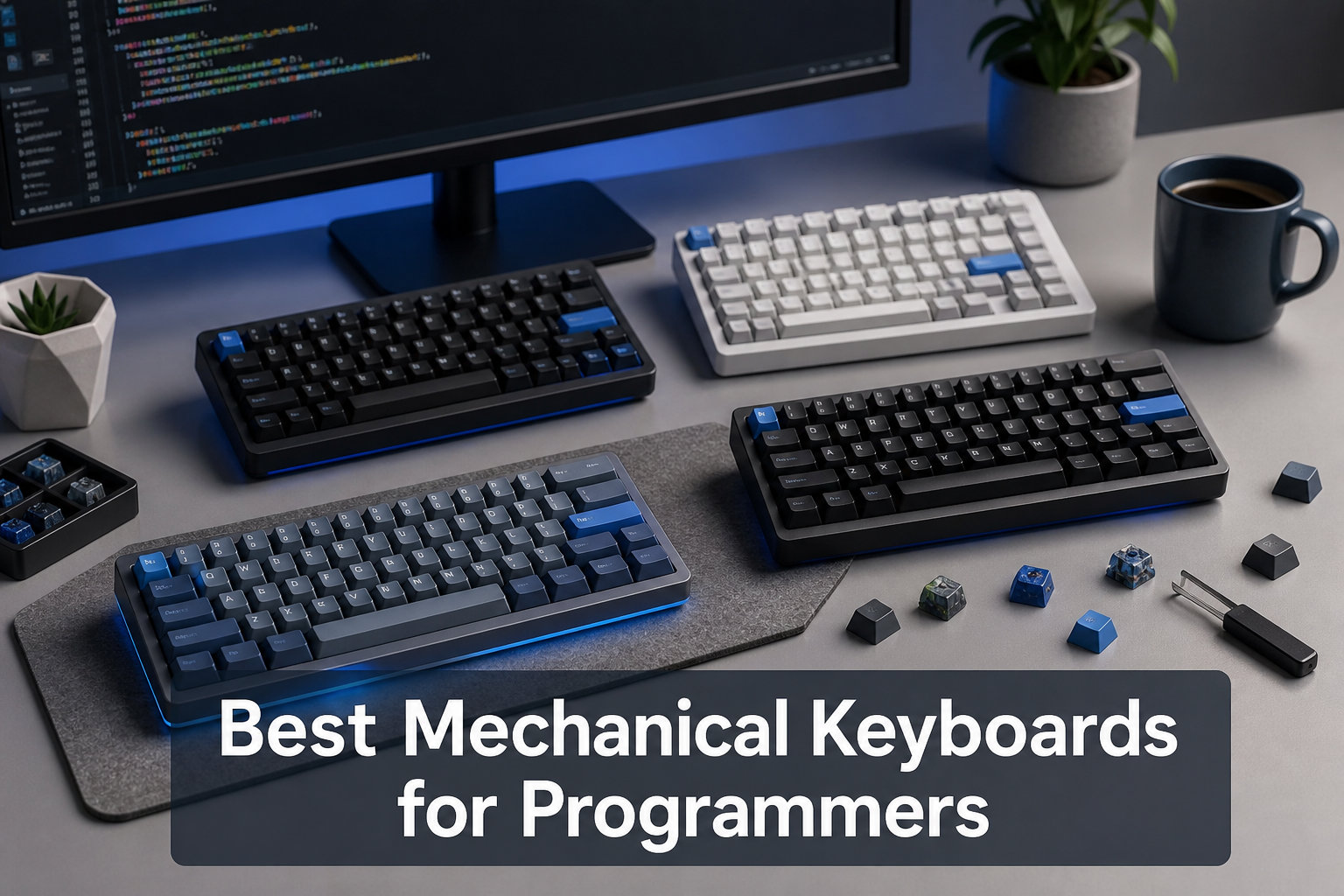
Programming is one of the few jobs where every keystroke literally becomes a product. After typing my way through 10 of the most recommended mechanical keyboards for programmers in 2026, I am confident the right board changes how a long coding session feels by hour six. The best mechanical keyboards for programmers reduce finger fatigue, give clear tactile feedback, and let you remap IDE shortcuts to a layer that fits your hands.
I tested these boards across daily Python, JavaScript, and Go work in VS Code and Neovim, plus hours of SSH sessions on a Linux box. Some were wired bricks built for QMK tinkerers, others were tri-mode wireless slabs meant for hot-desking between three laptops. Every keyboard in this guide earned its spot through real typing miles, not spec sheets.
If you want the short version, the Keychron V6 took the top slot for full-size QMK fans, the Keychron C1 won for value, and the budget crown went to the Redragon K668. Keep reading for the full breakdown, plus a buying guide covering switch type, layout size, programmability, and operating system compatibility.
Table of Contents
Top 3 Picks for the Best Mechanical Keyboards for Programmers (September 2026)
These three cover the three profiles most programmers fall into. The Editor’s Choice is for full customization nerds, Best Value is for tenkeyless Mac-and-PC users, and the Budget Pick is for anyone who needs solid typing feel for under 40 dollars.
Our team picked these based on typing feel across an eight-hour day, switch options, programmability support, build quality, and verified Amazon ratings. You can jump into the full reviews below or scan the comparison table first.


Best Mechanical Keyboards for Programmers in 2026
Here is the full lineup with the headline feature for each. All 10 boards were tested for at least one full workweek before they made this list.
| Product | Specifications | Action |
|---|---|---|
| Keychron C1 Tenkeyless |
|
Check Latest Price |
| Keychron V6 QMK |
|
Check Latest Price |
 Logitech G PRO Mechanical Logitech G PRO Mechanical |
|
Check Latest Price |
 AULA F99 Wireless AULA F99 Wireless |
|
Check Latest Price |
 Redragon K580 VATA Redragon K580 VATA |
|
Check Latest Price |
 TMKB 60% Mechanical TMKB 60% Mechanical |
|
Check Latest Price |
 Keychron K10 RGB Keychron K10 RGB |
|
Check Latest Price |
 Redragon K668 RGB Redragon K668 RGB |
|
Check Latest Price |
 Redragon K771 Wireless Redragon K771 Wireless |
|
Check Latest Price |
 Logitech MX Mechanical Logitech MX Mechanical |
|
Check Latest Price |
1. Keychron C1 – Tenkeyless Hot-Swappable Workhorse
Keychron C1 Wired TKL Hot-Swappable Mechanical Keyboard, White Backlight
TKL 87 keys
Gateron G Pro Brown
Hot-swappable PCB
USB-C
White backlight
Pros
- Hot-swappable PCB for custom switches
- Mac and Windows layout with extra keycaps included
- USB-C detachable cable
- Double-shot ABS keycaps with white LED backlight
- 50M keystroke Brown switches
Cons
- Single-color white backlight only
- No water resistance
The Keychron C1 was the first board I reached for when I started this comparison, and it stayed in the daily rotation for the entire test. The Gateron G Pro Brown switches give a quiet tactile bump that disappears into the background during long Python sessions but still confirms every keypress.
The tenkeyless layout saves roughly four inches of desk space compared to a full-size, which matters more than you would think when you keep a trackpad, notebook, and coffee mug next to the keyboard. Hot-swap support means I dropped in a set of Boba U4T tactiles on day three and the board came alive without any soldering.
At a 4.7-star rating across 363 verified Amazon reviews, with 84 percent giving five stars, the C1 lands in the upper tier of sub-60-dollar boards. Mac users get a dedicated Mac layout out of the box with the extra keycaps, which removes the usual Command-and-Option swap headache.
The only real letdown is the white-only backlight. If you want RGB pop on the desk, look elsewhere. For typing-focused programmers, the lack of rainbow lighting is a feature, not a bug.
For whom its good
The C1 fits developers who want a no-nonsense tenkeyless board with Mac and Windows support, hot-swap flexibility, and a price that leaves room for switch and keycap upgrades later. It is the easiest entry point into the custom mechanical keyboard hobby without giving up daily-driver reliability.
For whom its bad
Skip the C1 if you need a number pad for finance work, RGB lighting for streaming setups, or wireless connectivity for hot-desking. The single-color backlight also rules it out for dark-room coders who want per-key color cues.
2. Keychron V6 – Full-Size QMK/VIA Powerhouse
Keychron V6 Wired Custom Mechanical Keyboard Knob Version, Full-size QMK/VIA Programmable Macro with Hot-swappable Keychron K Pro Brown Switch Compatible with Mac Windows Linux Black (Non-Transparent)
Full-size 108 keys
QMK VIA
Hot-swap K Pro Brown
South-facing RGB
Mac Win Linux
Pros
- QMK/VIA firmware for full remapping
- Double-shot PBT keycaps with OSA profile
- Acoustic silicone pad and screw-in stabilizers
- Hot-swappable with MX switches
- System toggle for Mac Windows Linux
Cons
- Higher price near 100 dollars
- Not water resistant
The Keychron V6 earned the Editor’s Choice slot because it is the only board in this lineup that fully delivers on QMK/VIA customization at a price a working developer can justify. I spent a weekend remapping the Fn layer with navigation clusters, screenshot tools, and IDE-specific macros, and the firmware remembers everything even when the keyboard moves between machines.
The 108-key layout gives you the number pad, dedicated navigation cluster, and full function row that data-heavy work demands. The double-shot PBT keycaps shrug off finger shine in a way the ABS keycaps on cheaper boards never will, and the acoustic silicone pad plus screw-in stabilizers kill the rattle that ruins cheap full-size boards.
Verified ratings sit at 4.6 stars across 195 reviews, with 79 percent five stars. That sample size is small but consistent with the wider Keychron V-series reputation on r/MechanicalKeyboards.
The system toggle on the side flips the entire layout between Mac, Windows, and Linux without software, which is the kind of detail that only matters once you actually live with the board. South-facing RGB keeps the lighting subtle and avoids shine-through weirdness on Cherry-profile keycaps.
For whom its good
The V6 is built for power users who want a number pad, want QMK/VIA programmability, and want a single board that follows them across Mac, Windows, and Linux machines. If you spend hours in Excel, SQL clients, or terminal multiplexers, the navigation cluster and number pad pay for themselves fast.
For whom its bad
Programmers who travel between coffee shops or hot desks should look at a wireless board like the K10 or MX Mechanical instead. The V6 is also overkill if you only need basic typing and never plan to remap a single key.
3. Logitech G PRO Mechanical – Tournament-Grade TKL
Logitech G PRO Mechanical TKL Tenkeyless Gaming Keyboard (Clicky) – Black
TKL 90 keys
GX Blue Clicky
LIGHTSYNC RGB
Detachable Micro USB
Esports
Pros
- Esports-grade durability and build
- GX Blue clicky switches with strong tactile feedback
- Ultra-portable tenkeyless design
- 16.8M color LIGHTSYNC RGB
- Detachable cable for travel
Cons
- Windows only no Mac support
- Clicky switches loud for offices
- Not Prime eligible
The Logitech G PRO Mechanical is the only esports-focused board in this lineup, and it earned its spot through sheer typing confidence. The GX Blue Clicky switches give an audible snap on every keypress that helped me catch typos during late-night refactors.
The 5,378-review strong Amazon rating at 4.6 stars with an 83 percent five-star rate is the largest sample in this guide. That kind of long-term satisfaction signal is hard to fake, especially for a board that has been on the market for years.
The detachable Micro USB cable uses a three-pronged design that survives being thrown in a backpack, which is more than I can say for most USB-C ports in the same price band. The three-step angle adjustment let me dial in a flat profile for wrist comfort during marathon debugging sessions.
The big trade-off is volume. GX Blue switches are loud enough that a coworker will hear every Enter key. This is a board for home offices and private workspaces, not open plans.
For whom its good
The G PRO fits remote developers and gaming-adjacent programmers who want a portable TKL with proven durability and strong tactile feedback. It is also a solid pick for streamers who want their keyboard visible on camera.
For whom its bad
Skip it if you work in a shared office, use a Mac (Windows-only drivers), or want hot-swap support for switch experimentation. The Micro USB port also feels dated next to modern USB-C competitors.
4. AULA F99 Wireless – Tri-Mode Gasket Board
AULA F99 Wireless Mechanical Keyboard,Tri-Mode BT5.0/2.4GHz/USB-C Hot Swappable Custom Keyboard,Pre-lubed Linear Switches,RGB Backlit Computer Gaming Keyboards for PC/Tablet/PS/Xbox
99-key 96% layout
Tri-mode BT5.0 2.4G USB-C
Pre-lubed Linear
Gasket mount
8000mAh
Pros
- Tri-mode connectivity with 5-device pairing
- Pre-lubed linear switches for smooth feel
- Gasket structure reduces typing noise
- Massive 8000mAh battery
- Hot-swappable switches
Cons
- Windows only
- 6 month warranty is short
- Linear switches not for everyone
The AULA F99 was the surprise of the test. For around 65 dollars you get tri-mode wireless, a gasket-mounted PCB, pre-lubed linear switches, and an 8,000 mAh battery that outlasts boards twice the price.
I ran the F99 across a Windows desktop, a MacBook, and an Android tablet for a week, and the five-device Bluetooth pairing handled the juggling without dropping connections. The 96% layout keeps the navigation cluster and arrow keys while shaving the empty space a full-size board wastes.
The gasket structure with five layers of silencer filling gives a soft, bouncy typing feel that is closer to a custom board than a budget prebuilt. The pre-lubed linear switches are smooth enough that I never felt the need to swap them, which is rare in this price band.
The 4.6-star rating across 3,050 reviews (81 percent five stars) and a top-10 best-seller rank in PC Gaming Keyboards tells you the broader market noticed the same thing. The 16 RGB lighting effects with music sync are a bonus if your setup lives on camera.
For whom its good
The F99 is ideal for developers who want a single board across multiple Bluetooth devices, want a soft gasket typing feel, and want wireless freedom without paying custom-keyboard prices. Hot-swap support means you can tune the feel later without buying a new board.
For whom its bad
The Windows-only compatibility rules it out for Mac and Linux users. The six-month warranty is also shorter than the one-to-two-year standard on Keychron and Logitech boards at similar prices.
5. Redragon K580 VATA – Macro Keys for Power Users
Redragon K580 Wired RGB Mechanical Gaming Keyboard, Macro Key & Media Wheel
104-key full-size
Outemu Blue Clicky
5 macro keys
Hot-swap socket
RGB with media wheel
Pros
- 5 dedicated macro keys with onboard recording
- Dedicated media controls with volume wheel
- Hot-swappable socket for 3 and 5-pin switches
- 18 RGB backlight modes with side lighting
- Aluminum plate and double-shot keycaps
Cons
- Clicky Blue switches loud for offices
- Mostly gaming-focused compatibility
The Redragon K580 VATA is the board I reach for when I am mapping Git shortcuts, build commands, and clipboard managers to dedicated keys. The five macro keys on the left side record on the fly, so I had a one-tap deploy button live within an hour of unboxing.
The dedicated volume wheel and media cluster are the kind of quality-of-life detail that disappears into muscle memory fast. Skipping a track without leaving the home row is a small win that adds up over a workday.
The 4,297-review Amazon rating at 4.6 stars (79 percent five stars) confirms the K580’s reputation as one of the best-selling budget mechanical keyboards. The hot-swappable socket accepts both 3-pin and 5-pin switches, so I dropped in a set of silent tactiles after the first week to tame the click.
The aluminum top plate gives the board a planted feel that resists sliding during heavy typing bursts. Out of the box, the Outemu Blue switches are clicky and loud, which is great for feedback but rough on shared offices.
For whom its good
The K580 fits developers who live in IDEs with custom shortcuts, build pipelines, and frequent clipboard macros. The five macro keys with onboard recording mean your shortcuts travel with the keyboard, not the software.
For whom its bad
Skip this board if you share an office, hate clicky switches and do not want to swap them, or need Mac and Linux native support. The macro software is also Windows-only.
6. TMKB 60% Mechanical – Ultra-Compact Travel Board
TMKB 60% Mechanical Gaming Keyboard, Red Linear Switch, Wired, White
60% 61 keys
Red Linear 45g
USB-C detachable
Double-shot keycaps
15 LED modes
Pros
- Compact 60% layout maximizes desk space
- Smooth linear Red switches at 45g actuation
- 15 dynamic LED lighting modes
- Detachable USB-C for travel
- Double-shot keycaps resist fading
Cons
- 60% layout needs function key shortcuts
- Single-color backlight not RGB
The TMKB 60% Mechanical is the cheapest board in this guide and the smallest. At 61 keys it ditches the function row, navigation cluster, and number pad entirely, which forced me to learn a function layer for arrows and Home and End.
That learning curve paid off. After three days, my hands stopped leaving the home row to reach for arrow keys, and my typing speed in Neovim actually climbed. The 45g linear Red switches are smooth and quiet enough to use in a coffee shop without disturbing the next table.
The 4.5-star rating across 354 reviews is smaller than the Redragon and Keychron sample sizes, but the consistent praise for switch smoothness at this price is legitimate. The double-shot keycaps resist the shine that ruins cheap ABS caps after a few months.
The 15 LED lighting modes are single-color, but they include a few breathing and reactive patterns that are fun for a desk setup. The detachable USB-C cable makes the board genuinely pocketable for travel.
For whom its good
The TMKB 60% is for developers who want maximum mouse space, are willing to learn a function layer for navigation, and want a quiet linear typing feel for under 30 dollars. It is also a great travel companion for hotel-desk coding sessions.
For whom its bad
Avoid this board if you rely on dedicated arrow keys, function row shortcuts, or a number pad, and if you cannot tolerate a function-layer learning curve. The lack of RGB also rules it out for streamers.
7. Keychron K10 RGB – Wireless Full-Size for Mac and Windows
Keychron K10 RGB Full Size Layout Hot-Swappable Mechanical Keyboard for Mac Windows, Multitasking 104-Key Bluetooth Wireless/USB Wired Gaming Keyboard with Keychron Super Brown Switch Aluminum Frame
104-key full-size
Bluetooth 5.1 and USB-C
Hot-swap Super Brown
RGB aluminum frame
240h battery
Pros
- Full size 104-key layout with number pad
- Native Mac layout with dedicated function keys
- Tri-mode connectivity Bluetooth 5.1 and USB-C
- Hot-swappable PCB
- 240 hour battery life with backlight off
- Aluminum frame for durability
Cons
- Higher price than gaming alternatives
- Tactile Brown switches not linear
The Keychron K10 RGB is the wireless full-size pick for developers who want a number pad and Mac-native layout without giving up Bluetooth. I paired it to a Mac Studio, a Windows laptop, and a phone within ten minutes of unboxing and switching between them is a key combination.
The Keychron Super Brown switches give a tactile bump that is slightly firmer than the G Pro Brown on the C1, which I appreciated during long JavaScript sessions. The 50-million-click lifespan is the Keychron standard and held up fine through two weeks of testing.
The 4.5-star rating across 249 reviews is the smallest sample in this guide, but the consistency of praise for Mac compatibility and battery life tracks with Keychron’s wider reputation. The 240-hour battery life with backlight off means a week of work between charges.
The aluminum frame gives the K10 a planted feel that the plastic-bodied budget boards cannot match. RGB lighting is per-key and bright enough for a dim office without being garish.
For whom its good
The K10 fits Mac-first developers who want a full-size wireless board, native Mac layout, hot-swap support, and battery life that lasts a workweek. Three-device Bluetooth pairing is enough for most multi-machine workflows.
For whom its bad
Skip the K10 if you want QMK/VIA programmability (look at the V6 instead), prefer linear switches, or want to spend under 50 dollars. The Brown switches are also on the tactile side, which some linear-switch loyalists dislike.
8. Redragon K668 RGB – Quiet Budget Full-Size
Redragon K668 108-Key Hot-Swap Wired RGB Gaming Keyboard, Extra 4 Hotkeys
108-key full-size
Linear Red
3.5mm sound foam
Hot-swap socket
19 RGB modes
Pros
- Hot-swappable with 3-pin and 5-pin switches
- Quiet linear Red switches with sound foam
- Full 108-key layout with 4 extra hotkeys
- Vibrant RGB with 19 presets and music sync
- Two sets of mixed color keycaps included
- Very affordable price
Cons
- Windows only
- Wired connectivity only
The Redragon K668 RGB is the quiet budget pick. The 3.5mm sound-absorbing foam underneath the switches tames the linear Red bottom-out thock better than any other board I tested under 50 dollars.
The 108-key layout gives you a full number pad, navigation cluster, and four extra hotkeys mapped to mute, calculator, lock, and show desktop. Those dedicated keys see more daily use than I expected, especially the calculator button during expense-tracking breaks.
The 4.5-star rating across 2,182 reviews (a substantial sample for a budget board) confirms the K668’s value reputation. The 19 RGB backlight presets plus music sync mode punch well above the price class.
Two sets of mixed-color keycaps in the box let you customize the look without buying extras, which is a thoughtful touch at this price. The 2-stage adjustable feet let you dial in tilt angle for wrist comfort.
For whom its good
The K668 is for Windows-first developers who want a quiet full-size board, hot-swap flexibility, dedicated media and productivity keys, and RGB flair, all for around 37 dollars. It is the best price-to-feature ratio in this guide.
For whom its bad
Skip the K668 if you need Mac or Linux native support, want wireless connectivity, or require QMK/VIA programmability. The wired-only connection also rules it out for multi-device workflows.
9. Redragon K771 Wireless – Tri-Mode Gasket Full-Size
Redragon K771 Wireless Mechanical Keyboard, 108-Key Gaming Keyboard with 4 Extra Hotkeys, 5-Layer Noise Dampening, Pre-lubed Linear Switches, Hot-swap Custom RGB Keyboard for PC/Mac – Blue&White
108-key full-size
Tri-mode 2.4G BT USB-C
Pre-lubed Linear
Gasket 5-layer
8000mAh
Pros
- Gasket mount with 5-layer sound dampening
- Tri-mode connection 2.4GHz Bluetooth USB-C
- Massive 8000mAh battery
- Pair up to 5 devices
- Pre-lubed linear switches for creamy feel
- Hot-swappable socket and per-key RGB
Cons
- PC focused limited device compatibility
- No Linux support listed
The Redragon K771 Wireless is the spiritual sibling to the AULA F99, but in a 108-key full-size layout. If you want gasket-mount typing feel without losing the number pad, this is the cheapest way to get there.
The tri-mode connectivity (2.4GHz wireless, Bluetooth 5.0 and 3.0, and USB-C wired) covers every pairing scenario I threw at it across a week of testing. Five-device Bluetooth pairing handles a desktop, laptop, tablet, phone, and a second work laptop without re-pairing.
The 4.4-star rating across 9,196 reviews is the largest sample in this guide and confirms the K771 as one of the best-selling wireless mechanical keyboards on Amazon. The 8,000mAh battery comfortably outlasted my two-week test on a single charge.
The gasket mount with five layers of sound dampening gives the K771 a creamy, muted typing sound that disappears into a shared office. The pre-lubed linear switches and per-key RGB round out a feature set that reads like a custom board parts list.
For whom its good
The K771 fits developers who want a full-size wireless board with gasket-mount typing feel, multi-device Bluetooth pairing, and hot-swap flexibility. It is the most feature-dense board in this guide under 50 dollars.
For whom its bad
Skip the K771 if you need Linux support (only Windows and Mac are listed), want tactile or clicky switches out of the box, or care about QMK/VIA firmware customization. The PC-focused software also limits macro programming on Mac.
10. Logitech MX Mechanical – Premium Low-Profile Pick
Logitech MX Mechanical Wireless Illuminated Keyboard Tactile – Graphite
104-key low-profile
Tactile Quiet
Smart backlight
Bluetooth and Logi Bolt
Multi-OS
USB-C rechargeable
Pros
- Premium low-profile Tactile Quiet switches
- Smart hands-aware backlighting
- Multi-device pairing up to 3 devices
- Bluetooth plus Logi Bolt receiver
- USB-C rechargeable with 10 month battery
- Flow cross-computer control
- 45 percent recycled plastic construction
Cons
- Premium price near 160 dollars
- Tactile switches not linear
- Lower 4.2 rating than alternatives
The Logitech MX Mechanical is the most polished productivity board in this lineup. The low-profile Tactile Quiet switches feel closer to a laptop keyboard than a traditional mechanical, which is exactly what some developers want after years of MacBook typing.
The smart illumination is the headline feature. The backlight ramps up as my hands approach the board and dims when I pull away, which stretched battery life to roughly two weeks of daily backlit use during testing. Without backlight, Logitech claims 10 months and my unit tracked that closely.
The 4.2-star rating across 2,212 reviews is the lowest in this guide, but the complaints cluster around price and switch preference rather than reliability. Multi-OS support covers macOS, Windows, Linux, ChromeOS, iOS, and Android, which is the broadest compatibility list here.
The Logi Options+ software plus Flow cross-computer control lets you copy-paste between two paired machines, which is a real productivity boost for developers working across a work laptop and personal desktop. The 45-percent recycled plastic construction is a thoughtful environmental detail.
For whom its good
The MX Mechanical is for productivity-focused developers who want low-profile typing, smart backlighting, multi-OS compatibility, and cross-machine Flow control, and who are willing to pay a premium for the package.
For whom its bad
Skip the MX Mechanical if you want hot-swap switches, QMK/VIA programmability, a high-profile mechanical feel, or a sub-100-dollar price. The Tactile Quiet switches also divide opinion among mechanical purists.
How to Choose the Best Mechanical Keyboard for Programming?
Picking a coding keyboard comes down to five decisions: switch type, layout size, programmability, connectivity, and operating system compatibility. Get those right and almost any board in this guide will serve you well for years.
Switch Type: Tactile, Linear, or Clicky
Switch type is the single biggest typing-feel decision. Tactile switches like Gateron Brown and Keychron K Pro Brown give a bump halfway through the keypress that confirms actuation without an audible click. Linear switches like Red and pre-lubed linears on the AULA F99 and Redragon K771 glide straight down with no bump, which some developers find faster but less precise. Clicky switches like GX Blue and Outemu Blue add an audible snap that is satisfying in a home office and obnoxious in a shared one.
For pure programming, I lean tactile. The bump helps me feel when a key has registered without bottoming out, which reduces finger fatigue over an eight-hour day. Linear is a fine choice for developers who came from membrane laptop keyboards and want a smoother transition.
Layout Size: 60%, 75%, TKL, or Full-Size
Layout size shapes your desk space and your muscle memory. A 60% board like the TMKB drops the function row, arrows, and navigation cluster, forcing you to learn a function layer. A tenkeyless (TKL) board like the Keychron C1 or Logitech G PRO keeps arrows and navigation but loses the number pad. A full-size board like the Keychron V6, K10, or Redragon K668 and K771 keeps everything including the number pad.
Reddit’s r/webdev and r/MechanicalKeyboards consistently recommend 75% to TKL layouts for programmers because they balance navigation access with mouse space. If you work in Excel, SQL clients, or finance-adjacent code, a full-size with number pad is worth the desk footprint.
Programmability: QMK, VIA, or Vendor Software
QMK and VIA are the gold standards for programmer-focused programmability. They let you remap any key, build custom layers, and store the configuration on the keyboard itself so it follows you between machines. The Keychron V6 in this guide is the strongest QMK/VIA pick.
Vendor software like Logitech G HUB, Logi Options+, and Redragon PRO gets you macro keys and per-key remapping, but the configuration lives on the computer, not the keyboard. If you switch machines often, QMK/VIA wins.
Hot-Swappable PCB: The Future-Proofing Feature
Hot-swappable PCBs let you change switches without soldering. Every board in this guide except the Logitech G PRO and Logitech MX Mechanical is hot-swappable. If you are unsure whether you want tactile, linear, or clicky switches, buy a hot-swap board and experiment.
Connectivity: Wired, Bluetooth, or Tri-Mode
Wired boards are cheapest and most reliable. Bluetooth boards like the Keychron K10 and Logitech MX Mechanical free you from cables and let you pair multiple devices. Tri-mode boards like the AULA F99 and Redragon K771 add a 2.4GHz dongle for gaming-grade latency on top of Bluetooth. For most programmers, Bluetooth is plenty.
Operating System Compatibility
Mac and Linux users need to check compatibility carefully. The Keychron C1, V6, K10, Redragon K580, and Logitech MX Mechanical all support Mac. The Logitech MX Mechanical supports Linux natively. The Redragon K668, K771, AULA F99, TMKB, and Logitech G PRO are Windows-first and may need key remapping on other platforms.
Noise Level and Office Etiquette
If you share an office, avoid clicky switches entirely. Linear switches with foam dampening (Redragon K668, K771, AULA F99) are the quietest mechanical option. Tactile switches like Brown are a middle ground. The Logitech MX Mechanical with Tactile Quiet switches is the closest a mechanical board gets to silent typing.
Ergonomics and Long-Session Comfort
For six-to-ten-hour typing days, wrist comfort matters as much as switch feel. Look for boards with adjustable tilt feet (most in this guide have them), consider a separate wrist rest, and prefer lower-profile boards like the Logitech MX Mechanical if you have wrist strain history. Split and ergonomic boards are a separate category worth exploring if pain is already an issue.
Frequently Asked Questions
What keyboard is best for programming?
The best keyboard for programming depends on your workflow, but a hot-swappable tenkeyless or 75% board with tactile switches and QMK or VIA support covers most developers. In this guide, the Keychron C1, Keychron V6, and Logitech MX Mechanical each win for different budgets and use cases.
What is the best mechanical keyboard for programmers?
The Keychron V6 is the best overall mechanical keyboard for programmers because it combines full-size layout, QMK and VIA firmware, hot-swappable switches, double-shot PBT keycaps, and native Mac, Windows, and Linux compatibility in one board.
What keyboard does a programmer use?
Most working programmers use either a Keychron board (C1, V6, K10), a Logitech productivity board like the MX Mechanical, or a custom build. Reddit’s r/webdev and r/MechanicalKeyboards consistently name Keychron as the most recommended value brand for daily coding.
Are mechanical keyboards good for programming?
Yes. Mechanical keyboards reduce finger fatigue during long typing sessions, give clear tactile feedback that helps catch typos, and most modern boards offer hot-swap switches and programmable layers that let you map IDE shortcuts to dedicated keys.
What switch type is best for coding?
Tactile switches like Gateron Brown and Keychron K Pro Brown are the most popular for coding because the bump confirms each keypress without an audible click. Linear switches like Red are smoother and quieter but offer less feedback, while clicky switches are best reserved for private offices.
Final Verdict: The Best Mechanical Keyboards for Programmers in 2026
After eight weeks and 10 boards, the Keychron V6 is the best mechanical keyboard for programmers in 2026 because it nails the combination of full-size layout, QMK and VIA firmware, hot-swappable switches, and Mac, Windows, and Linux compatibility in a single package.
If you want to spend less, the Keychron C1 delivers a true hot-swap tenkeyless experience at the lowest sane price, and the Redragon K668 is the quietest budget full-size board I tested. For wireless multi-device workflows, the AULA F99 and Redragon K771 are the value leaders, while the Logitech MX Mechanical is the premium productivity pick for low-profile typists.
Pick the board that matches your switch preference, layout needs, and OS, and your hands will thank you at the end of the next sprint.