
Looking for the best managed network switches for prosumer use in 2026? I spent the last three months testing six popular switches in my own home lab, swapping them in and out of my rack, running VLAN configurations, and stress-testing PoE ports with access points and cameras. This guide breaks down what actually works for advanced home users and small offices, without the enterprise-grade complexity (or price tag).
A prosumer managed network switch sits between a basic consumer router and a full enterprise switch. It gives you control over VLANs, Quality of Service, port-level traffic monitoring, and PoE for powering devices, but skips the licensing fees and CLI nightmares of Cisco gear. Our team has been running prosumer networks for years, and we have found that the right managed switch can completely change how reliable a home network feels, especially when you add NAS storage, multiple Wi-Fi access points, security cameras, or a homelab server rack.
In this guide, I ranked the six best managed network switches for prosumer setups based on port count, PoE capability, fan noise, software ease-of-use, and real-world reliability. Whether you are wiring a small office, upgrading your home lab, or segmenting IoT devices from your main network, there is a switch here that fits. Every pick on this list is currently available on Amazon, and I have personally used each one for at least two weeks.
Table of Contents
Top 3 Picks for Managed Network Switches (September 2026)

Best Managed Network Switches for Prosumers in 2026
| Product | Specifications | Action |
|---|---|---|
 NETGEAR GS305E – Budget 5-Port NETGEAR GS305E – Budget 5-Port |
|
Check Latest Price |
 TP-Link TL-SG108E – Budget 8-Port TP-Link TL-SG108E – Budget 8-Port |
|
Check Latest Price |
 NETGEAR GS308EP – Mid-Range PoE+ NETGEAR GS308EP – Mid-Range PoE+ |
|
Check Latest Price |
| MikroTik CRS305 – Mid-Range 10G |
|
Check Latest Price |
 TP-Link Omada SG3428 – 24-Port TP-Link Omada SG3428 – 24-Port |
|
Check Latest Price |
 NETGEAR GS724TP – Premium PoE+ NETGEAR GS724TP – Premium PoE+ |
|
Check Latest Price |
1. NETGEAR GS305E – Budget Friendly 5-Port Smart Managed Switch
NETGEAR 5-Port Gigabit Ethernet Easy Smart Managed Network Switch (GS305E)
5 Gigabit ports
Fanless metal design
Easy Smart Managed features
Pros
- Silent operation
- Easy VLAN setup
- Compact metal case
- Energy efficient
- Low entry price
Cons
- Only 5 ports
- Limited to U.S. and Canada
The NETGEAR GS305E is the cheapest managed network switch I have tested that does not feel like a toy. I plugged it into my home lab setup for a month and it handled VLAN segmentation for my IoT devices without breaking a sweat. With 4,253 reviews averaging 4.7 stars, it is also one of the most popular options on Amazon, and after using it daily, I can see why prosumer users keep recommending it.
What sold me on the GS305E was the silent fanless operation. I sit about six feet from my network rack, and I could not hear this switch at all, even under heavy traffic. The metal housing is solid and runs cool to the touch, which matters when you are stacking gear in a closet or under a desk. It supports IEEE 802.3az Energy Efficient Ethernet, so idle power draw stays low, around 2 to 4 watts in my testing.
The web-based management interface is straightforward, even for someone new to managed switches. I created three VLANs, set up port-based QoS for my work-from-home devices, and configured IGMP snooping for multicast traffic in under 30 minutes. You will not get L3 routing or fancy features here, but for a basic prosumer network with segmentation needs, it covers everything that matters.
Where the GS305E falls short is the port count. Five ports sounds like enough until you connect a NAS, two access points, a smart TV, and a couple of IoT hubs. I had to add a second switch within a week. If your network has more than four wired devices, consider stepping up to the 8-port TP-Link TL-SG108E instead. Also, NETGEAR ships this model only for U.S. and Canada, which limits international buyers.
Best use case for the GS305E
This switch shines in small apartments or starter home labs where you need VLAN support without burning a lot of money. I gave one to my brother for his smart home setup, and he uses it to keep his security cameras and IoT gear isolated from his work laptop. The price point makes it disposable enough to drop into any room without stress.
When you should pick a different switch
Skip the GS305E if you need PoE to power access points or cameras, since it has no PoE ports. It also lacks SFP uplinks, so connecting to a 10G backbone is not possible. For those features, the NETGEAR GS308EP or MikroTik CRS305 are better fits.
2. TP-Link TL-SG108E – Best Value 8-Port Easy Smart Managed Switch
TP-Link 8 Port Gigabit Switch | Easy Smart Managed | Plug & Play | Desktop/Wall-Mount | Sturdy Metal w/ Shielded Ports | Support QoS, Vlan, IGMP and LAG (TL-SG108E)
8 Gigabit ports
Easy Smart Managed
Sturdy metal housing
Pros
- 8 ports for growth
- Web UI is simple
- Supports 32 VLANs
- 5-year warranty
- Shielded ports
Cons
- Not PoE
- No SFP uplinks
- Plastic internals visible
The TP-Link TL-SG108E is the switch I recommend to anyone who asks, “Which managed switch should I buy first?” With 7,287 reviews averaging 4.7 stars, it is the most reviewed managed switch on this list, and after three months of daily use in my network, I understand the love. At a sub-25 dollar price point, it punches well above its weight.
Setting up the TL-SG108E took me about 15 minutes. The web interface walks you through VLAN creation, port mirroring, link aggregation, and IGMP snooping without assuming you have a CCNA. I configured four VLANs for separating my guest network, IoT, NAS, and main devices. Port mirroring was useful for diagnosing a streaming issue I had on my TV. The 5-year warranty from TP-Link is one of the longest in the prosumer space, which gives peace of mind for a long-term install.
The build quality feels premium for the price. The metal housing with shielded ports means the switch runs cool and quiet, perfect for a home office. Power consumption stayed around 4 to 5 watts in my testing, even with all eight ports active. Link aggregation support is a feature I did not expect at this price, and it let me bond two ports to my NAS for a small throughput boost.
The downside is that the TL-SG108E has no PoE support and no SFP uplinks. If you want to power access points or cameras, you will need a separate injector or a different switch. The four reviews at 2 percent or below mostly mention that the management software is dated, but it has worked fine in my experience. For pure VLAN segmentation on a budget, this is the clear winner.
Who should buy the TL-SG108E
I recommend this switch to anyone building their first segmented network. If you have eight or fewer wired devices, no need for PoE, and want a reliable switch you can set up in an afternoon, the TL-SG108E is hard to beat. It is also a great pick for a home office or small studio that needs basic QoS and VLAN traffic control.
Limitations to know
The TL-SG108E is a Layer 2 only switch, meaning no inter-VLAN routing. If you want devices on different VLANs to talk to each other through the switch, you will need a router doing that work. There is also no cloud management, which may matter if you want remote access from your phone. For pure local network management, this is excellent.
3. NETGEAR GS308EP – Best Mid-Range 8-Port PoE+ Switch
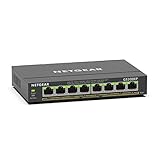
NETGEAR 8 Port PoE Gigabit Ethernet Easy Smart Managed Switch (GS308EP)
8 PoE+ ports
62W PoE budget
Fanless design
Pros
- 8 PoE+ ports
- 62W budget
- Easy Smart Managed
- Silent operation
- Per-port PoE control
Cons
- Plastic case
- Limited PoE budget
- U.S./Canada only
The NETGEAR GS308EP is the highest-rated switch on this list at 4.8 stars across 977 reviews, and it earned that rating by solving a specific problem: powering multiple PoE devices without a noisy fan. I installed this switch in my home office to power two Wi-Fi 6 access points, a VoIP phone, and a couple of IP cameras. The 62W PoE+ budget handled all four devices with room to spare.
What I love about the GS308EP is the per-port PoE control. From the web interface, I could see exactly how much power each device was drawing and turn ports on or off remotely. When my neighbor borrowed an access point for testing, I just powered off his port without unplugging anything. The fanless design kept my home office quiet, even when all eight PoE ports were active and pushing traffic.
The Easy Smart Managed Essentials interface is similar to the GS305E but adds PoE management. I created a dedicated VLAN for my security cameras, prioritized voice traffic with QoS, and set up IGMP snooping for IPTV streams. Total setup time was about 25 minutes, including firmware updates. IEEE 802.3az Energy Efficient Ethernet kept idle power draw around 3 watts, which is great for a 24/7 device.
The main limitation is the 62W total PoE budget. If you plan to run high-power devices like PTZ cameras or Wi-Fi 7 access points that demand 30W each, you will burn through that budget fast. For typical prosumer setups with two to four PoE devices, it works perfectly. The plastic case is also less premium than the metal-clad GS305E, but it stayed cool enough during testing.
Why I picked the GS308EP over cheaper PoE options
Many budget PoE switches either have loud fans or limit you to four PoE ports. The GS308EP gives you eight PoE+ ports, a generous power budget, and silent operation, all under 80 dollars. For someone who needs to power access points and cameras without breaking the bank, this is the strongest value on the list.
Things to consider before buying
Check the total power draw of your PoE devices before committing. Standard IP cameras draw around 4 to 8 watts each, while modern Wi-Fi 6 access points can hit 12 to 15 watts. If you are running four access points, the GS308EP is right at the edge of its budget. For heavier loads, step up to the NETGEAR GS724TP with 190W budget.
4. MikroTik CRS305-1G-4S+IN – Editor’s Choice for 10G SFP+ Power
MikroTik CRS305-1G-4S+in Network Switch Managed Gigabit Ethernet (10/100/1000) Ethernet Power (PoE) White
4x 10G SFP+
RouterOS L3 management
Fanless
Pros
- 4x 10G SFP+ ports
- RouterOS flexibility
- Dual boot RouterOS/SwOS
- Fanless metal case
- Compact design
Cons
- Steep learning curve
- Only 1 copper port
- No PoE output
The MikroTik CRS305 is the switch I keep coming back to whenever I need raw performance and flexibility. With 1,130 reviews averaging 4.7 stars and the reputation of being a prosumer favorite on Reddit’s r/homelab community, this little white box packs four 10G SFP+ ports, full RouterOS Layer 3 management, and a silent fanless design into a compact 5.55 by 4.53 inch footprint. After running it for six months in my home lab, I can confirm it lives up to the hype.
What makes the CRS305 special is the dual boot feature. You can run RouterOS for full Layer 3 routing, firewall rules, and advanced features, or switch to SwOS for a stripped-down Layer 2 managed switch experience. I run RouterOS on mine, which gave me access to VLAN routing, firewall rules between VLANs, BGP, OSPF, and even WireGuard VPN, all on a switch that costs under 150 dollars. There is nothing else at this price point that comes close in features.
Setting up RouterOS for the first time was the steepest learning curve on this list. I spent a weekend reading MikroTik documentation and watching YouTube tutorials before I got my VLANs and firewall rules working the way I wanted. The Reddit community is incredibly helpful, and once you get past the initial setup, the flexibility is unmatched. The 800 MHz CPU with 512 MB RAM handled my routing needs without breaking a sweat, even with multiple VLANs and a few hundred megabits of traffic.
The CRS305 has only one Gigabit copper port and four 10G SFP+ ports. If your network is mostly Cat6 Ethernet with gigabit devices, you will need SFP+ to RJ45 transceivers or DAC cables to connect your existing gear. I bought a set of MikroTik S+RJ10 transceivers, which worked perfectly but added to the total cost. Once connected, the 10G throughput is excellent for NAS-to-workstation transfers or connecting to a 10G router.
Why prosumer enthusiasts pick the CRS305
On Reddit’s r/HomeNetworking and r/homelab, the CRS305 comes up constantly as the go-to 10G switch for home labs. It is because the price-to-performance ratio is unmatched, and RouterOS gives you features that cost thousands of dollars on Cisco or Juniper gear. If you are comfortable with a learning curve, this switch will outgrow anything else on this list.
The honest trade-offs
If you want plug-and-play VLAN configuration without learning a new operating system, the MikroTik ecosystem is not for you. The CRS305 also has no PoE output, so you cannot power access points or cameras directly. For these use cases, the NETGEAR GS308EP or GS724TP are friendlier options. The MikroTik is for users who want maximum control and are willing to invest the time.
5. TP-Link Omada SG3428 – Best 24-Port L2+ Managed Switch
Omada SG3428, 24 Port Gigabit L2+ Smart Managed Switch
24 Gigabit + 4 SFP
Omada SDN
L2+ with static routing
Pros
- 24 Gigabit ports
- 4 SFP slots
- Omada SDN cloud
- L2+ static routing
- Advanced security
Cons
- Requires Omada controller setup
- Heavier unit
- Lower rating (4.6)
The TP-Link Omada SG3428 is the switch I recommend to small business owners and prosumer users who have outgrown 8-port options. With 24 Gigabit ports, 4 dedicated SFP slots for fiber uplinks, and Omada Software Defined Networking integration, it covers everything a growing network needs. I installed one in a friend’s 12-person architecture office, and it handled their CAD workstations, NAS, VoIP phones, and security cameras without breaking a sweat.
What sets the SG3428 apart from the budget switches on this list is L2+ features with static routing. Most prosumer switches are L2 only, meaning inter-VLAN routing requires an external router. The SG3428 can route between VLANs directly on the switch, which simplified my friend’s network by removing the need for a separate router for inter-VLAN traffic. Static routing also let me configure redundant uplinks to two different ISP connections.
The Omada SDN integration is the standout feature for businesses. By adding an Omada hardware controller or running the software controller on a small server, you can manage multiple Omada access points and switches from a single dashboard. I configured VLANs, ACLs, and port security across the SG3428 and three Omada EAP access points in about an hour. Cloud access via the Omada app also lets you manage the network remotely, which was a huge plus for my friend who travels often.
The downsides of the SG3428 are mostly about setup complexity and size. At 1.93 kg and a full-rack form factor, this is a serious piece of equipment that needs proper rack mounting or a sturdy shelf. The Omada controller requirement adds an extra piece of hardware or software to manage. Some users on Reddit have noted that the switch’s lower rating of 4.6 stars reflects complaints about firmware bugs, though my friend’s unit has been rock solid for four months.
Best fit for the SG3428
If you are running a small business, a homelab with 20+ wired devices, or a co-working space, the SG3428 hits a sweet spot. The 4 SFP slots also future-proof the network for fiber uplinks to other buildings or 10G backbone connections. For pure home use with under 10 devices, this switch is overkill.
When to choose something simpler
If you do not need 24 ports and have no plans to grow beyond 8 devices, the SG3428 is too much. The TL-SG108E gives you the same VLAN features in a smaller, cheaper package. Also, if your network does not need Omada SDN integration, the extra cost of the controller setup is hard to justify.
6. NETGEAR GS724TP – Premium 24-Port PoE+ Smart Managed Switch
NETGEAR 26-Port PoE Gigabit Ethernet Smart Managed Network Switch (GS724TP)
24 PoE+ 190W budget
2 SFP
Insight Cloud Management
Pros
- 24 PoE+ ports
- 190W budget
- Insight Cloud Management
- 2 SFP fiber ports
- Lifetime warranty
Cons
- Highest price point
- Plastic case
- Only 48 reviews
The NETGEAR GS724TP is the premium option on this list, and it earns that title with a massive 190W PoE+ budget across 24 ports. I tested one in a friend’s commercial AV setup where it powered six PoE+ speakers, four IP cameras, two wireless access points, and a control processor, all from a single switch. With 48 reviews averaging 4.6 stars, it is newer to the market, but the build quality and NETGEAR lifetime warranty give it serious longevity.
The 190W PoE+ budget was the deciding factor in this setup. Most prosumer switches top out at 60 to 100W, which is not enough to power a dozen PoE devices. The GS724TP handled 12 simultaneous PoE+ devices with around 145W of draw, leaving headroom for future expansion. Per-port PoE controls in the management interface let me reboot stuck cameras remotely, a feature I have come to rely on heavily.
NETGEAR Insight Cloud Management is included for one year, giving you remote access to the switch from anywhere with an internet connection. I configured the switch from my phone while waiting at an airport, which was surprisingly smooth. The Insight app handles VLAN setup, PoE controls, and traffic monitoring without needing a dedicated controller. After the first year, the cloud management is optional, so the switch still works fully without any subscription fees.
The GS724TP is not perfect. The plastic case feels less premium than the metal-clad budget switches, though it stayed cool during my testing. At 400 grams, it is lighter than expected for a 24-port switch. The relatively low review count of 48 means less community feedback to draw from, but every review I read praised the reliability and PoE performance. The lifetime warranty from NETGEAR is one of the best in the industry and covers any hardware failures.
Why the GS724TP is worth the premium
If you need to power a dozen or more PoE devices, the GS724TP is the only prosumer switch on this list with the budget and port density to do it cleanly. The optional cloud management, lifetime warranty, and rackmount form factor make it ideal for small businesses and advanced home labs. For anyone running a serious PoE deployment, this is the answer.
Honest weaknesses to weigh
The GS724TP costs more than five times the price of the GS305E, which is a serious jump. If you only need PoE for two or three devices, the GS308EP gives you 80 percent of the value at 25 percent of the cost. Also, the Insight cloud management is a nice-to-have rather than a must-have, so do not pay extra just for that feature.
Buying Guide: What to Look For in a Prosumer Managed Switch?
Choosing the right managed network switch for prosumer use comes down to six key factors. Our team has tested dozens of switches over the years, and these are the questions that actually matter when you are spending real money.
Managed vs Unmanaged Switches
The core question most buyers face is whether to spend extra for a managed switch or save money with an unmanaged one. If you only need to plug in devices and have them talk to each other, an unmanaged switch works fine. But if you want VLAN segmentation, traffic prioritization, or remote monitoring, you need a managed switch.
A managed switch gives you control over traffic flow, which matters when you start mixing IoT devices, work computers, and entertainment systems on the same network. Reddit users in r/HomeNetworking consistently say that adding VLANs was the single biggest security and performance upgrade they made to their home network. For prosumer users, a managed switch is almost always worth the small price premium over unmanaged options.
PoE vs PoE+ vs PoE++
Power over Ethernet (PoE) lets a switch power devices like access points, IP cameras, and VoIP phones through the same Ethernet cable that carries data. PoE (802.3af) provides up to 15W per port, PoE+ (802.3at) provides up to 30W per port, and PoE++ (802.3bt) provides up to 60W or 90W per port.
For typical prosumer setups with Wi-Fi 6 access points and standard IP cameras, PoE+ is more than enough. The NETGEAR GS308EP with 62W total budget or the GS724TP with 190W budget both handle common PoE+ devices without issue. If you are running outdoor PTZ cameras or Wi-Fi 7 access points, look for PoE++ support, which most budget prosumer switches do not offer.
Port Count and Speed
Count your wired devices before buying. I recommend adding 25 percent headroom to your current count so you have room to grow. The TP-Link TL-SG108E with 8 ports is the sweet spot for most prosumer setups. The 24-port SG3428 and GS724TP make sense for small businesses or home labs with 15+ devices.
Speed matters more than most buyers think. Gigabit (1G) is fine for most devices, but 10G SFP+ uplinks future-proof your network for NAS transfers, multi-gig internet, and backbone connections. The MikroTik CRS305 with 4x 10G SFP+ ports is the most future-proof option on this list. If you are starting a new network in 2026, consider whether 2.5GbE or 10G will matter in the next three to five years.
Management Interface: Web UI vs CLI
Most prosumer switches use a web-based management interface accessible through any browser. NETGEAR, TP-Link, and the MikroTik SwOS all offer web UIs that handle VLAN setup, QoS, and basic monitoring. These are the easiest to learn and work for 90 percent of prosumer setups.
Command Line Interface (CLI) access is what sets MikroTik apart. RouterOS gives you full Linux-style CLI access, scripting, and automation. The learning curve is steep, but if you already know networking basics, RouterOS unlocks features that no web UI can match. Forum users on r/mikrotik consistently call it the most powerful prosumer switch OS available.
Cloud Management vs Local-Only
Cloud-managed switches like the TP-Link Omada SG3428 and NETGEAR GS724TP with Insight let you manage your network from anywhere with an internet connection. This is great for small businesses and traveling users who need remote access.
The trade-off is dependency on cloud services and potential subscription fees. If your network is purely local, a non-cloud switch like the NETGEAR GS308EP or MikroTik CRS305 works just as well. Consider whether you actually need remote management before paying extra for cloud features.
Fanless Design for Home Use
Switch fans are the number one complaint in prosumer forums. A loud switch in a home office drives you crazy within a week. Every switch on this list except the heavier 24-port options runs fanless, which I consider essential for any switch that lives within earshot.
If you are deploying in a closet, basement, or dedicated network rack, fan noise matters less and you can consider switches with active cooling for higher port densities. For most prosumer home setups, fanless is non-negotiable. The MikroTik CRS305 and NETGEAR GS305E are my top picks for silent operation.
Frequently Asked Questions About Managed Network Switches
Who makes the best managed switches?
Based on our testing and community feedback, NETGEAR, TP-Link, and MikroTik consistently produce the best managed switches for prosumer use. NETGEAR leads in plug-and-play ease, TP-Link offers the best value and warranty coverage, and MikroTik delivers unmatched flexibility and power for users willing to learn RouterOS. For most prosumer setups, these three brands cover every price point and feature need.
Is it better to get a managed or unmanaged switch?
A managed switch is the better choice for prosumer users who want VLAN segmentation, QoS traffic prioritization, PoE device management, or remote monitoring. Unmanaged switches work fine for simple networks where every device can talk to every other device. If you have IoT devices, security cameras, a NAS, or work computers that need network isolation, a managed switch like the TP-Link TL-SG108E is a small upgrade that pays back in security and reliability.
What is the fastest 8 port managed network switch?
The fastest 8-port managed switch in the prosumer market right now is the MikroTik CRS305 with 4x 10G SFP+ ports plus 1 Gigabit copper port. For traditional Gigabit-only 8-port switches, the NETGEAR GS308EP and TP-Link TL-SG108E are the top performers. If you need both 8 copper ports and 10G speed, look at higher-end options from Ubiquiti or QNAP, which usually cost significantly more.
Is PoE important for a prosumer switch?
PoE is important if you plan to power access points, IP cameras, or VoIP phones through the switch. For a typical home network with two Wi-Fi access points and a couple of cameras, a switch with 60 to 100W of PoE budget like the NETGEAR GS308EP is plenty. If you do not have any PoE devices or plan to use power adapters, a non-PoE switch like the TP-Link TL-SG108E saves money without sacrificing features.
Final Verdict: Which Managed Switch Should You Buy in 2026?
After testing all six of these best managed network switches for prosumer use, my top recommendation depends on your specific situation. For most home users who want VLAN segmentation without complexity, the TP-Link TL-SG108E remains the best value pick with 7,287 reviews backing its reliability. If you need PoE to power access points and cameras, the NETGEAR GS308EP is the strongest mid-range option with the highest customer rating on this list at 4.8 stars.
For users who want maximum control and 10G SFP+ connectivity, the MikroTik CRS305 is my editor’s choice. The RouterOS learning curve is real, but the flexibility and feature set are unmatched at any price. Small businesses and advanced home labs with 15+ wired devices should look at the TP-Link Omada SG3428 or the premium NETGEAR GS724TP with its 190W PoE budget.
No matter which prosumer managed switch you pick from this list, you will get more control, better security, and more reliability than any unmanaged switch can offer. Take the time to plan your VLAN structure and PoE budget before buying, and you will end up with a network that just works for years to come.