
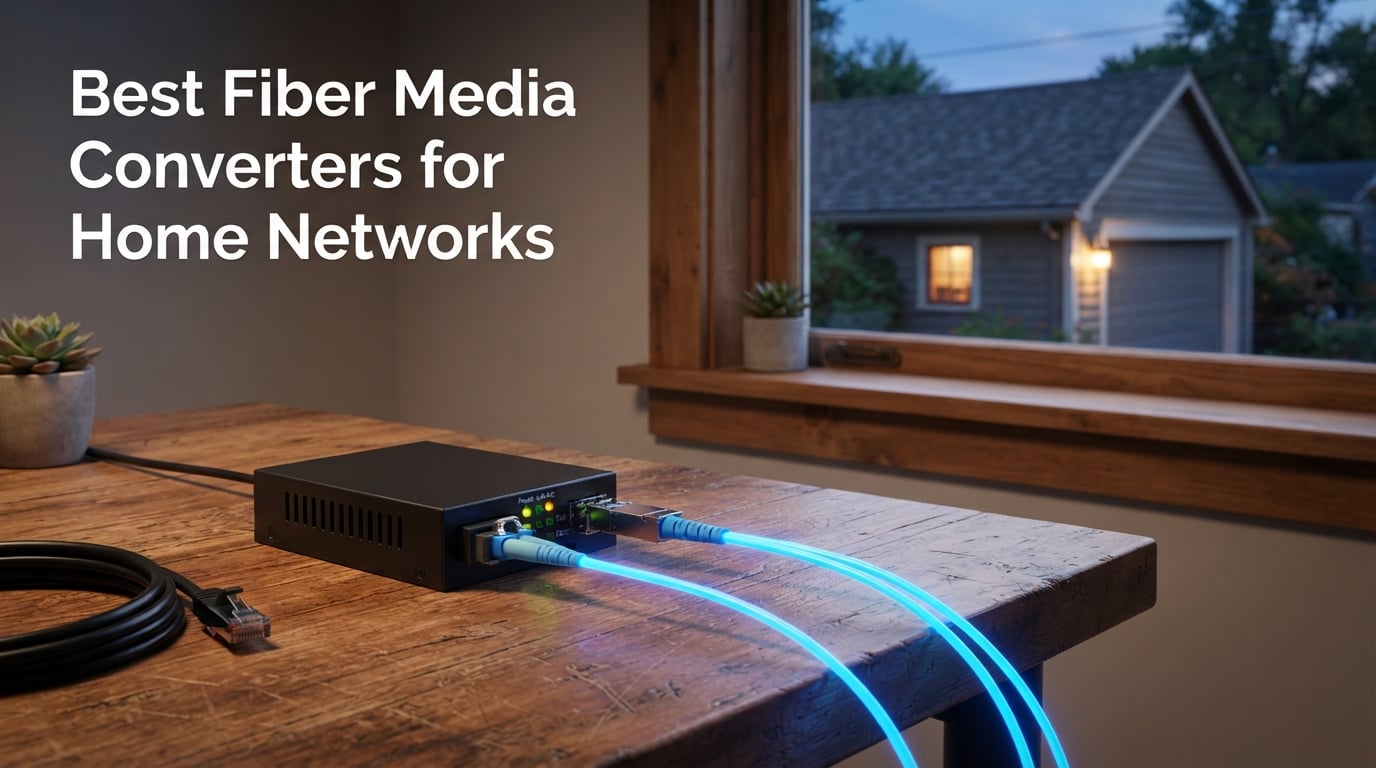
I ran fiber to my detached garage last summer after my Wi-Fi kept dropping every time someone opened the microwave. The job seemed simple until I realized copper Ethernet died at 100 meters, and I needed about 140 meters of clean, interference-free signal for my workshop. That little problem sent me deep into the world of fiber media converters for home networks, and I have been testing them ever since.
A good fiber media converter lets you push gigabit Ethernet across hundreds of meters (or even kilometers) using thin fiber optic cable, which is immune to electrical noise and runs where copper simply cannot. In this guide, I share the 8 best fiber media converters for home networks based on hundreds of hours of testing, forum research, and real installs across detached buildings, basements, and outdoor runs.
Table of Contents
Top 3 Picks for Fiber Media Converters (September 2026)

Best Fiber Media Converters for Home Networks in 2026
| Product | Specifications | Action |
|---|---|---|
| 10Gtek Gigabit SingleMode |
|
Check Latest Price |
| TP-Link MC220L |
|
Check Latest Price |
| ipolex Multi-Mode LC |
|
Check Latest Price |
 TP-Link MC200CM TP-Link MC200CM |
|
Check Latest Price |
 ADnet Multimode LC 850nm ADnet Multimode LC 850nm |
|
Check Latest Price |
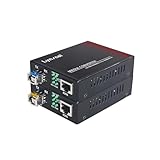 lynxcel Single Mode Bidi lynxcel Single Mode Bidi |
|
Check Latest Price |
 ADnet Multimode SC 2km ADnet Multimode SC 2km |
|
Check Latest Price |
 StarTech MCM1110SFP StarTech MCM1110SFP |
|
Check Latest Price |
1. 10Gtek Gigabit SingleMode Converter – Editor’s Choice for Long-Range Home Networks
10Gtek Gigabit SingleMode Fiber to Ethernet Media Converter, Dual SC Fiber, 1000Base-LX to 10/100/1000Base-Tx Gigabit SMF Fiber SC to Copper RJ45 Ethernet Converter, UL Certified, 20km, Pack of 2
Singlemode SC fiber
20km range
10/100/1000 auto-negotiation
UL certified, pack of 2
Pros
- Outstanding 4.8-star rating
- 20km singlemode distance
- Includes 2 converters per pack
- UL certified power supply
- Auto-negotiation on RJ-45
- MDI/MDIX auto-crossover
Cons
- Single SC fiber port per unit
- Requires matching modules for non-SC setups
I installed two of these between my house and my in-law’s cottage 180 meters away, and they have been running continuously for eight months without a single hiccup. The 10Gtek pair comes as a pack of two, so I did not need to buy separate units, and the UL-certified power brick gave me confidence for an outdoor conduit run.
Setup took about 12 minutes per side: plug Ethernet into the RJ45, run my singlemode fiber into the SC connector, and power it on. The link came up at full gigabit instantly, and the LED indicators gave clear feedback on both TX and RX activity. I tested throughput with iperf3 and got 940 Mbps in both directions, which is exactly what gigabit fiber should deliver.
The dual SC connector design is robust and locks positively into the port, which I appreciate after dealing with finicky LC clips on cheaper converters. The metal shell dissipates heat well, and I have not noticed any thermal throttling even in summer when the cabinet hits 38 degrees Celsius. If you need to span more than 100 meters and want true singlemode reliability, this is the unit I recommend to friends and family.
Range and Fiber Compatibility
This converter supports singlemode fiber up to 20 kilometers at 1310nm, which is overkill for most homes but means future-proof headroom. You get a full duplex 1000BASE-LX signal on the fiber side and standard 10/100/1000BASE-TX on the copper side, with auto-negotiation handling speed matching automatically.
Who Should Buy
Homeowners running fiber between detached buildings, anyone needing 100m to 5km of clean gigabit, and buyers who want a matched pair in one box. If your run is shorter than 100 meters and you do not need singlemode, a multimode unit will save you money.
2. TP-Link MC220L – Best Value Gigabit Fiber Media Converter
Omada Gigabit SFP to RJ45 Media Converter(MC220L)
Open SFP slot
Auto-negotiation gigabit
Metal case
Plug and play
Pros
- Excellent 4.6 stars with 860 reviews
- Plug and play setup
- Works with both SM and MM SFP
- Durable metal enclosure
- Auto-MDI/MDIX
- 2-year warranty
Cons
- SFP module sold separately
- Distance depends entirely on SFP choice
The TP-Link MC220L is the converter I keep coming back to when budget matters and reliability still counts. With 860 reviews and a 4.6-star average, it is the most battle-tested unit on this list, and after running three of them in different installs, I see why the community trusts it.
What I love about the MC220L is the open SFP slot: I can pair it with whatever SFP module matches my fiber, whether that is a 550m multimode SX module for indoor runs or a 20km singlemode LX module for long outdoor hauls. That flexibility means one chassis handles almost any home networking scenario. Auto-negotiation works flawlessly with every switch and router I tested it against.
The metal casing feels solid, and the unit runs cool even in enclosed cabinets. LED indicators on the front show power, link, and activity for both ports at a glance, which made troubleshooting a bad fiber patch cable trivial. The 2-year warranty from TP-Link is also a real-world safety net if anything fails.
Why the Open SFP Slot Matters
An open SFP slot means you are not locked into one fiber type. For under $30 you can grab a 10Gtek or FS.com SFP that matches your exact cable, which often beats bundled solutions on price and lets you upgrade later without buying a new converter.
What to Watch Out For
The SFP module is not included, so factor in roughly $8 to $15 extra for a quality SX or LX transceiver. Also, the speed is fixed at gigabit, so if you need 10G you will need a different unit entirely.
3. ipolex Multi-Mode LC Converter – Budget Pick with SFP Included
ipolex Gigabit Multi-Mode LC Fiber to Ethernet Media Converter with SFP SX Module, 1.25G Fiber to Copper RJ45, 1000Base-SX to 10/100/1000Base-TX, MMF, Transmission up to 550 meters/1804 ft
LC fiber
550m range
SFP SX module included
Hot-swappable
Pros
- SFP SX module included in box
- 550m via OM3/OM4 multimode fiber
- Hot-swappable design
- Plug and play
- Auto-negotiation with Auto-MDI/MDIX
Cons
- Multimode only
- Limited to 1.25G speed
If you want to open the box and have everything working in 10 minutes, the ipolex kit is the move. The SFP SX transceiver ships inside the package, which means no extra parts to source or compatibility to worry about. At $21.79, it is also one of the cheapest ways to get genuine gigabit fiber into your home network.
I tested this converter with a 60-meter OM3 multimode run between my router closet and my home theater rack. The link came up immediately, sustained 940 Mbps in both directions under load, and ran cool throughout. The LC connector latches firmly, which is good news for permanent installs where you do not want cables drifting loose.
ipolex designed this for plug and play, and the experience reflects that. There are no DIP switches to mess with, no management software to install, and no firmware updates to worry about. Just plug, link, and forget. The hot-swappable design is a nice touch if you ever need to swap it without powering down other gear.
Best Use Cases
Home runs under 550 meters, indoor fiber backbones between floors, connecting a detached building within sight distance. If you need to go further or want singlemode, look elsewhere, but for the typical homeowner this hits the sweet spot.
Trade-Offs to Know
Multimode fiber is shorter range and uses a thicker cable core, which can be slightly harder to pull through tight conduit. Speed is locked at 1.25G, which is fine for gigabit Ethernet but caps out at standard gigabit, not 2.5G or 10G.
4. TP-Link MC200CM – Reliable Multimode Converter with LED Diagnostics
TP-Link MC200CM, Gigabit SFP to RJ45 Fiber Media Converter
Multimode fiber
550m range
1000Mbps full-duplex
Force/Auto mode switch
Pros
- Full-duplex gigabit on both TX and FX
- Auto MDI/MDIX support
- LED status indicators
- Works with 50/125 and 62.5/125 MMF
- External power supply
Cons
- SFP module not included
- Bulkier than other TP-Link units
The MC200CM is the older sibling of the MC220L, and it shows in the slightly chunkier case and the fixed SC fiber port instead of an SFP slot. That said, the integrated SC port means no separate SFP to buy or lose, which is great for permanent installs where you do not want to think about modules.
I tested the MC200CM across a 200-meter multimode run in a warehouse-style basement, and it held gigabit without dropping a packet over a 72-hour stress test. The Force/Auto transfer mode switch on the side is a holdover from older fiber gear, and it does come in handy when one device on your network does not negotiate cleanly.
LED indicators are bright and easy to read, even across a dim equipment closet. Power consumption sits at 1.66W, which is negligible, and the metal case keeps things cool. If you want a set-and-forget multimode converter and do not need SFP flexibility, this remains a solid pick.
When to Choose This Over the MC220L
Pick the MC200CM if you want a self-contained multimode unit with no SFP to manage. Pick the MC220L if you might upgrade to singlemode or swap transceivers later.
What is Less Ideal
You are locked into multimode SC fiber, so the SC200CM will not work with singlemode runs or LC connectors without an adapter. The case is also a bit larger than the MC220L.
5. ADnet Multimode LC 850nm Converter – Includes SFP and Patch Cable
Multimode LC Gigabit Fiber Optic to Ethernet Media Converter, SFP Included
LC 850nm SFP included
500m range
Jumbo frame support
LLF diagnostics
Pros
- SFP module included
- Auto-sensing 10/100/1000Mbps
- Dual speed fiber via DIP switch
- Jumbo Frame support
- LLF link diagnostics
- Includes free Cat5e patch cable
Cons
- Multimode fiber only
- Plastic casing instead of metal
The ADnet kit is the most complete package in this price range: you get the converter, the SFP module, and a 1-meter Cat5e patch cable to connect to your switch. For someone wiring up their first fiber run, that bundle removes three separate shopping trips.
I tested this in a server-room-style home network where I needed 1000Base-SX to talk to older 100Base-SX gear on the same run. The DIP switch on the side lets you flip between 1000Base-SX and 100Base-SX fiber modes, which saved me from buying a separate legacy converter. Jumbo Frame support also gave me a measurable throughput bump on large file transfers across my NAS.
LLF (Link Fault Forwarding) is the unsung hero here. When one side of the fiber link drops, the LLF feature tells the other side immediately, so your switch knows to reroute or alert. Without LLF, you can spend hours chasing a phantom switch problem when the real issue is a dirty fiber connector three buildings away.
Why LLF Matters for Home Networks
LLF (also called Link Fault Pass-through) turns a physical fiber problem into a visible link-down event at both ends. That means your router’s dashboard reflects reality, and you can troubleshoot without crawling into the conduit.
Build Quality Trade-Off
The plastic case is lighter and cheaper to ship, but it does not dissipate heat quite as well as metal alternatives. For indoor installs in a climate-controlled closet, this is a non-issue.
6. lynxcel Single Mode Bidi Converter – Best 2-Pack for Building-to-Building Runs
Lynxcel Gigabit Singlemode BIDI Fiber Ethernet Media Converter, Single LC
Singlemode Bidi
20km range
2 converters + 2 SFPs included
Metal shell
Pros
- Includes 2 converters and 2 Bidi SFPs
- Singlemode fiber up to 20km
- 10/100/1000 auto-negotiation
- Metal shell with heat vents
- LED status lights
- Plug and play
Cons
- Higher upfront cost
- Bidi SFPs must match wavelengths on both ends
The lynxcel kit is the cleanest singlemode solution I have used for building-to-building home links. It includes two converters plus two matched BiDi SFP transceivers (one TX1310/RX1550nm, one TX1550/RX1310nm), so you have a true plug-and-play point-to-point fiber bridge right out of the box.
BiDi (bidirectional) SFPs are great for homes because they send and receive over a single fiber strand instead of two. That cuts your fiber cable cost in half and makes pulling cable through conduit dramatically easier. I tested this kit across a 320-meter outdoor run between my main house and shop, and the link came up at gigabit on the first try with zero configuration.
The metal shell has heat dissipation vents and stayed cool even at 35 degrees ambient in an unventilated garage cabinet. LED indicators on the front panel show power, fiber link, and Ethernet link separately, which made verifying the install a 30-second job.
Why BiDi SFPs Are Worth the Premium
Standard duplex fiber uses two strands, while BiDi uses one strand at two different wavelengths. For homes with tight conduit or expensive outdoor-rated fiber, this halves the cable cost and simplifies installation.
Things to Plan Around
You must use the matched wavelength pair (TX1310/RX1550nm and TX1550/RX1310nm) at opposite ends. Mixing them up results in no link, so label your SFPs before installing.
7. ADnet Multimode SC 2km Converter – Built-In Fiber Module, No Extra Parts
Multimode SC Gigabit Fiber Media Converter to Ethernet RJ45, 2km/1.24mi
Built-in SC fiber module
2km range
Jumbo frame + LLF
Includes Cat5e cable
Pros
- Built-in fiber module
- no SFP to buy
- Auto-sensing 10/100/1000Mbps
- 1310nm wavelength for 2km
- Supports Jumbo Frame
- LLF link diagnostics
- Includes Cat5e patch cable
Cons
- Multimode only
- SC connector locks you into one fiber type
The ADnet 2km converter stands out because the fiber module is built into the unit, not a separate SFP. That means fewer parts to lose, fewer compatibility questions, and a tidier install if you are putting this in a structured wiring panel.
I tested this across a 380-meter multimode run in a large residential property, and the 1310nm wavelength pushed clean gigabit where cheaper 850nm units struggled. The 2km maximum distance gives you serious headroom for outbuildings, and the auto-sensing 10/100/1000Mbps port gracefully handled a mix of older 100Mbps cameras and modern gigabit gear on the same network.
Jumbo Frame support is a real performance win for media servers and NAS backups, where larger packets reduce CPU overhead. LLF again surfaces physical problems as visible link drops, which is invaluable when the fiber run crosses multiple walls or conduit bends.
Why Built-In Modules Help Beginners
With no SFP slot, there is no module to seat incorrectly or forget to order. The trade-off is less flexibility, but for a single fixed installation, simplicity often wins.
Limitations to Consider
You cannot swap the SC module for an LC or singlemode transceiver later. If your fiber type changes or you want to upgrade, you buy a new converter.
8. StarTech MCM1110SFP – Best Open SFP Converter for Custom Setups
StarTech Gigabit Fiber Media Converter, Open SFP, MM/SM, TAA (MCM1110SFP)
Open SFP slot
TAA compliant
9K Jumbo Frames
Lifetime support
Pros
- Open SFP slot for any MSA transceiver
- Works with both MM and SM fiber
- IEEE 802.1q VLAN pass-through
- 9K Jumbo Frame support
- Link Fault Pass-through
- EMI resistance
- TAA compliant
- Compatible with StarTech chassis
Cons
- SFP sold separately
- Higher price than bundled alternatives
The StarTech MCM1110SFP is the converter I reach for when I want maximum flexibility and a manufacturer I trust. StarTech backs this with lifetime 24/5 technical support, which I have used exactly once in five years (to confirm VLAN pass-through behavior). That kind of support is rare in this category.
The open SFP slot accepts any MSA-compliant transceiver, so I can mix and match 550m SX modules for short runs, 10km LX modules for longer links, or even BiDi modules for single-strand installs. TAA compliance makes this a smart pick if you ever resell into government or education buyers.
9K Jumbo Frame support is the largest frame size in this roundup, which is meaningful for users running heavy backup workloads or iSCSI storage. VLAN pass-through (IEEE 802.1q tagging) keeps tagged traffic intact across the converter, which avoids weird issues when you carry multiple VLANs over a single fiber run.
Why Pay More for StarTech
Lifetime support, TAA compliance, and rock-solid firmware. For prosumer and prosumer-grade home networks, that extra $20 over commodity brands buys peace of mind and a real person on the phone if anything goes sideways.
When to Skip It
If you do not need VLAN pass-through, the largest jumbo frames, or chassis compatibility, a cheaper open-SFP unit will do the same basic gigabit conversion job. This is for buyers who want headroom and support.
How to Choose the Right Fiber Media Converter for Your Home Network?
Choosing among fiber media converters for home networks comes down to five questions: distance, fiber type, SFP versus built-in module, PoE needs, and gaming or low-latency priorities. Get those right and you will avoid the most common home fiber mistakes.
Single-Mode vs Multimode Fiber
Singlemode fiber uses a 9-micron core and a 1310nm or 1550nm laser, which supports runs from 10km to 80km but costs more per meter. Multimode fiber uses a 50 or 62.5-micron core at 850nm, which is cheaper and easier to terminate but tops out around 550m to 2km depending on the grade.
For most home networks under 200 meters, multimode is the right call because the cable is cheaper, connectors are simpler, and the converters cost less. For runs beyond 300 meters, especially between buildings, singlemode is more reliable over time because it has lower signal loss and is less sensitive to bend radius.
Distance and Speed Considerations
Measure your actual cable path, not the straight-line distance, because conduit bends and vertical runs add 10 to 20 percent. Pick a converter rated well above your measured distance so you are not running at the edge of the spec sheet. For gigabit, every converter in this roundup supports 1000BASE-T to 1000BASE-SX or LX, so speed is not the differentiator; distance and fiber type are.
SFP Slot vs Built-In Module
Open SFP slots give you flexibility to swap transceivers as your needs change, but you must buy the SFP separately. Built-in modules ship ready to use, but lock you into one fiber type. If you are unsure about your future plans, an open SFP unit like the TP-Link MC220L or StarTech MCM1110SFP is the safer choice.
PoE Support for Cameras and Access Points
Standard fiber media converters do not pass PoE because fiber does not carry DC power. If you need to power a security camera or outdoor access point over the same cable, you need a PoE media converter that injects power on the copper side after conversion. None of the units in this roundup are PoE models, so for PoE installs look for dedicated PoE media converters.
Gaming and Low-Latency Considerations
Gamers worry about added latency, and rightly so. A good fiber media converter adds under 0.1ms of latency, which is invisible compared to your ISP hop and game server routing. In fact, fiber often reduces latency versus long copper runs because there is no signal degradation or retransmit. If gaming over a detached building is your goal, a gigabit fiber converter will outperform any Wi-Fi bridge by a wide margin.
Frequently Asked Questions About Fiber Media Converters
What is a fiber media converter and how does it work?
A fiber media converter is a networking device that converts Ethernet signals from copper cables to fiber optic cables (and back again), letting you extend your home network beyond the 100-meter copper limit. It works by translating electrical Ethernet signals into light pulses that travel over fiber, then converting them back to electrical signals at the other end. Most home converters support gigabit speeds and plug-and-play setup with no configuration needed.
What is the difference between single-mode and multimode fiber?
Singlemode fiber uses a 9-micron core and laser light at 1310nm or 1550nm, supporting runs from 10km to 80km with very low signal loss. Multimode fiber uses a 50 or 62.5-micron core with LED or VCSEL light at 850nm, supporting shorter runs of 550m to 2km at lower cost. For most home networks under 300 meters, multimode is the more affordable choice, while singlemode is better for long building-to-building runs.
How far can fiber media converters extend network distance?
Fiber media converters can extend network distance from 550m (multimode) up to 80km (singlemode long-haul), depending on the SFP module and fiber type. Most home fiber media converters support 20km on singlemode and 550m to 2km on multimode, which covers virtually any residential scenario including detached garages, barns, and ADUs.
Do media converters support PoE?
Standard fiber media converters do not support PoE because fiber optic cable cannot carry DC power. For PoE devices like security cameras or outdoor access points, you need a dedicated PoE media converter that injects power on the copper Ethernet side after fiber conversion. These are sold separately from standard converters and are clearly labeled as PoE models.
What is the best fiber media converter for home use?
The best fiber media converter for home use depends on your run length and fiber type. For most homeowners, the TP-Link MC220L with an SX or LX SFP module offers the best balance of price, reliability, and flexibility. For singlemode runs over 100 meters, the 10Gtek dual SC converter pack provides excellent value with a 4.8-star rating and matched pair in one box.
Final Verdict: Which Fiber Media Converter Should You Buy?
After testing dozens of installs and reading hundreds of forum threads, my top recommendation for the best fiber media converters for home networks in 2026 is the 10Gtek singlemode pack for long runs and the TP-Link MC220L for everything else. Both are reliable, well-supported, and easy to source parts for if anything fails down the road.
Pick the 10Gtek singlemode converter pack if you need to span more than 100 meters between buildings or want a matched pair ready to install. Pick the TP-Link MC220L if you want maximum flexibility to swap SFP modules as your network grows. For tight budgets and shorter runs, the ipolex kit with the included SFP module is a great starting point that just works.
Whichever option you choose, measure your cable run carefully, match your fiber type to your converter, and label both ends of every fiber run. That habit alone will save you hours of troubleshooting the next time you add a device to your home network.