
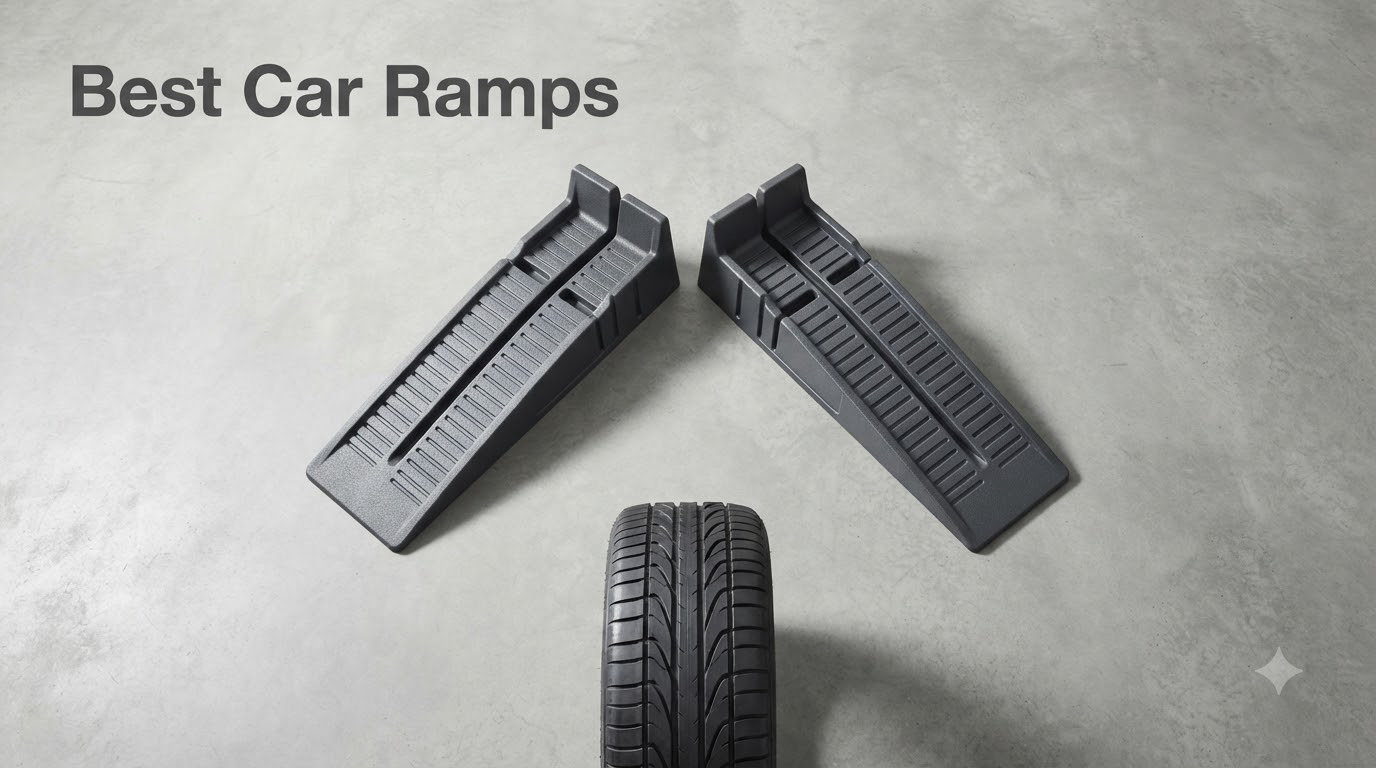
Every DIY mechanic eventually hits the same wall: you need your car off the ground, but a floor jack and jack stands take time, effort, and a fair amount of trust in your setup. That is exactly why we spent weeks researching, comparing, and digging through thousands of owner reviews to find the best car ramps you can buy in 2026.
Ramps are the faster, stabler way to get under your vehicle for oil changes, brake inspections, tire rotations, and undercar work. Instead of lifting one corner at a time, you simply drive up, set the parking brake, and slide underneath. Our team compared eight of the most popular vehicle ramps on the market, from budget plastic service ramps to premium foam race ramps, and rated them on weight capacity, angle of approach, traction, and real-world usability.
We also pulled insights from garage forums like Bob Is The Oil Guy and Garage Journal, where longtime home mechanics share what holds up after years of use. Their feedback matched what we saw in the review data: plastic ramps slide on smooth concrete unless they have rubber feet, low cars need shallow approach angles, and lift height determines whether you can actually reach your drain plug. Here is what we found.
Table of Contents
Top 3 Picks for Best Car Ramps (September 2026)
After comparing all eight sets, three stood out from the pack. The Ironton Poly Car Ramp Set earns our Editor’s Choice award for its 12,000-lb GVW rating and grippy rubber feet, the Nilight Low Profile Service Ramp takes Best Value with a 4.8-star rating at a budget-friendly price, and the ROBLOCK Low Profile Ramp is our Budget Pick for sellers who just need basic jack access.

Ironton Poly Car Ramp Set
- 12000 lb GVW capacity
- Rubber feet prevent sliding
- Non-skid tread
- 6.5 inch lift height

Nilight Low Profile Service Ramps
- 10000 lb GVW capacity
- 2.6 inch lift
- 17 degree angle
- Anti-slip surface

ROBLOCK Low Profile Car Ramps
- 20000 lb GVW capacity
- 2.6 inch lift
- 17 degree angle
- Only 5.3 lbs per pair
Best Car Ramps in 2026
Here is a side-by-side look at all eight sets we reviewed, so you can quickly compare lift height, weight capacity, and key features before diving into the full reviews.
| Product | Specifications | Action |
|---|---|---|
| Ironton Poly Car Ramp Set |
|
Check Latest Price |
 Black Widow Low Car Ramps Black Widow Low Car Ramps |
|
Check Latest Price |
 MaxxHaul 50515 6.25 inch Lift Ramps MaxxHaul 50515 6.25 inch Lift Ramps |
|
Check Latest Price |
| Nilight Low Profile Service Ramps |
|
Check Latest Price |
| ROBLOCK Low Profile Car Ramps |
|
Check Latest Price |
 MaxxHaul 50516 Low Profile Ramps MaxxHaul 50516 Low Profile Ramps |
|
Check Latest Price |
 MaxxHaul 50709 Detachable Ramps MaxxHaul 50709 Detachable Ramps |
|
Check Latest Price |
 Race Ramps Foam Trailer Ramps Race Ramps Foam Trailer Ramps |
|
Check Latest Price |
The 8 Best Car Ramps Reviewed
1. Ironton Poly Car Ramp Set – Best Overall
Ironton Poly Car Ramp Set, 12,000-Lb. GVW, 35.5in.L x 12in.W, 2-Pc.
12,000 lb GVW (6,000 lb per ramp)
35.5 inch x 12 inch tread
High-impact poly
Rubber feet
Pros
- Very sturdy high-impact poly build
- Rubber feet stop sliding on smooth concrete
- Non-skid tread grips tires
- Corrosion-proof
- never rusts
- 12 inch width fits wider tires
Cons
- 20.6 lb pair is less portable
- May need a board for very low bumpers
- No stacking storage
The Ironton set is the ramp we reach for first when a truck or SUV needs to go up. The 12,000-lb GVW rating covers everything from a half-ton pickup to a loaded van, and the honeycomb internal structure keeps the pair at just 20.6 lbs while still feeling rock-solid under a tire.
What sold us, though, is the pairing of non-skid tread and rubber feet. Sliding on smooth garage concrete is the number one complaint across plastic ramps on forums like Garage Journal, and these rubber feet anchor the ramps firmly in place during loading. The tread pattern then keeps the tire from spinning as you climb.
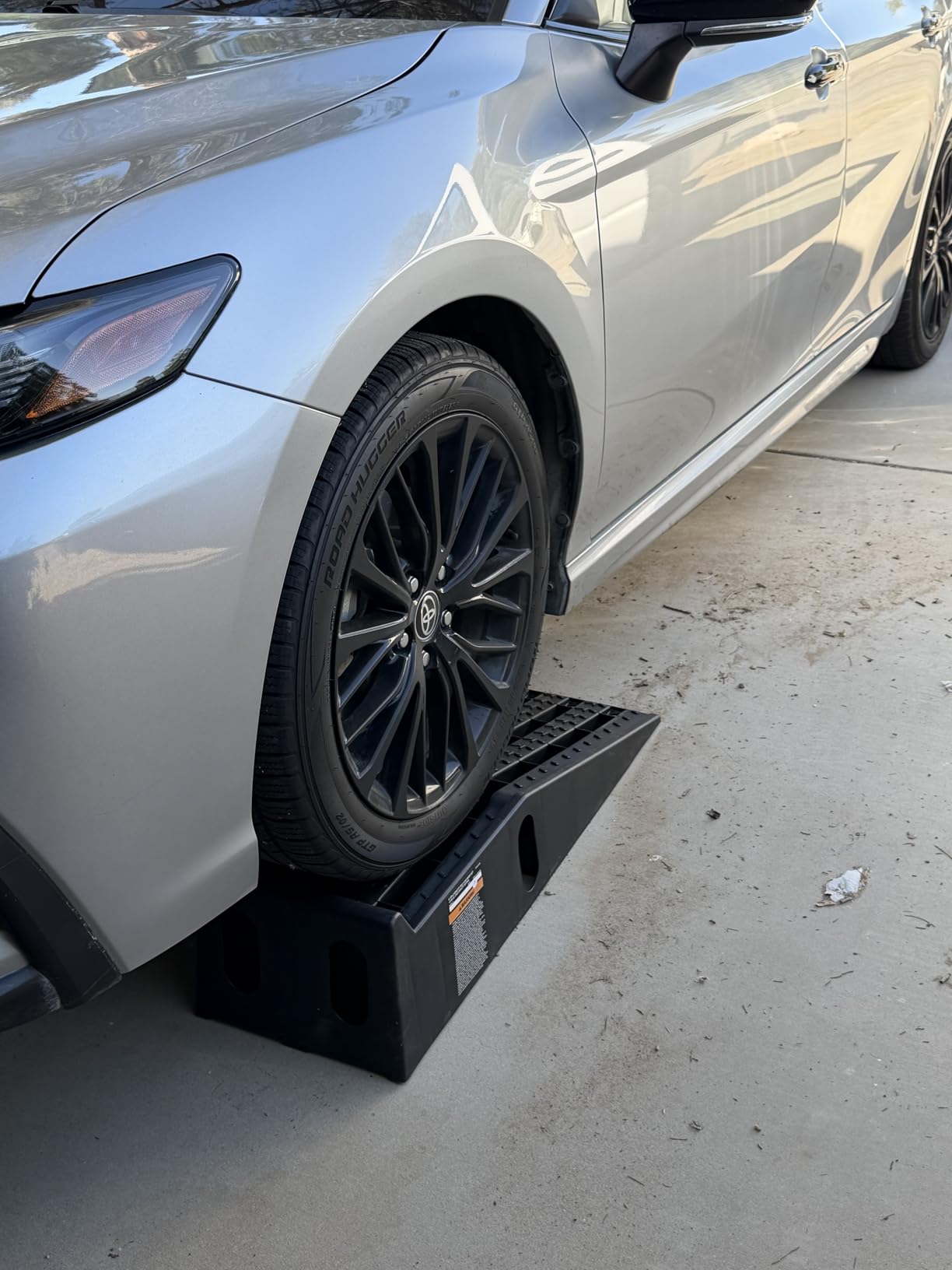
In use, the 35.5-inch length gives a manageable approach for most stock-height vehicles, and the 8.5-inch overall height translates to roughly 6.5 inches of usable lift at the tire. That is ample clearance for oil changes, transmission inspections, and most underbody work on trucks and SUVs.
The poly construction also means zero rust, which matters if your garage sees humidity or road-salt drips through winter. We left ours on a bare concrete floor through a damp season with no staining or degradation.
Weight capacity and vehicle compatibility
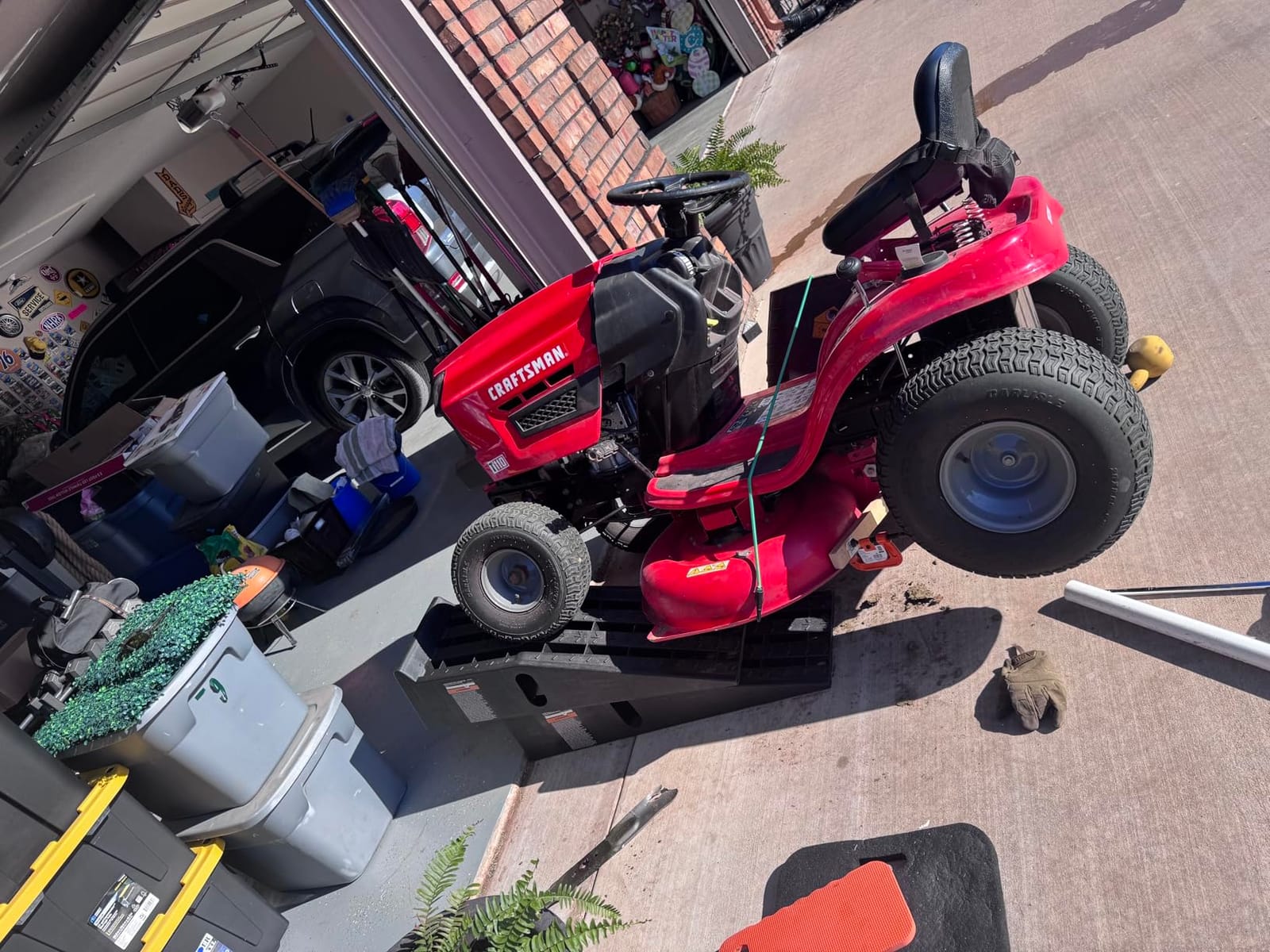
With a 6,000-lb rating per ramp, this set safely handles anything from a midsize sedan to a full-size truck. Always check your front axle weight (GAWR) rather than total vehicle weight, since the front axle carries most of the load when the car is parked nose-up on ramps.
For lifted or taller trucks, the approach angle is easy. For lowered sedans with long front overhangs, you may need a short 2×8 board in front of the ramp to keep the bumper from scraping.
Storage and garage footprint
At 35.5 inches long and 20.6 lbs per pair, these are not ramps you will toss in a trunk. They do slide flat under a workbench or hang on a wall with a simple hook, but plan for about three feet of horizontal space.
They do not nest or stack, so budget-minded buyers with tiny garages may prefer a low-profile set. For everyone else, the storage trade-off is worth the lift height and stability.
2. Black Widow Low Car Ramps – Best for Oil Changes
Low Car Ramps for Oil Change, 5,000 lb GAWR, 2.5″ Lift, Black Widow
5,000 lb per axle / 10,000 lb GVW
2.5 inch lift
9.05 degree angle
Heavy-duty plastic
Pros
- Gentle 9.05 degree loading angle
- Honeycomb design resists moisture
- Slight tire stop prevents overshooting
- Lightweight but strong
- Ideal for jack access under low cars
Cons
- Narrow for some wider tires
- Higher price than similar sets
- 2.5 inch lift may not be enough alone
The Black Widow ramps from Rage Powersports are purpose-built for one job: getting a low car just high enough to slide a floor jack underneath. The 2.5-inch lift does not sound like much, but on a car with 4 inches of ground clearance, it doubles your working room under the front.
With 1,573 reviews and a 4.6-star average, this is the most battle-tested set in our group. Owners of lowered Mazdas, WRXes, and other low cars repeatedly describe these as the missing link between scraping bumpers and getting a jack under the crossmember.
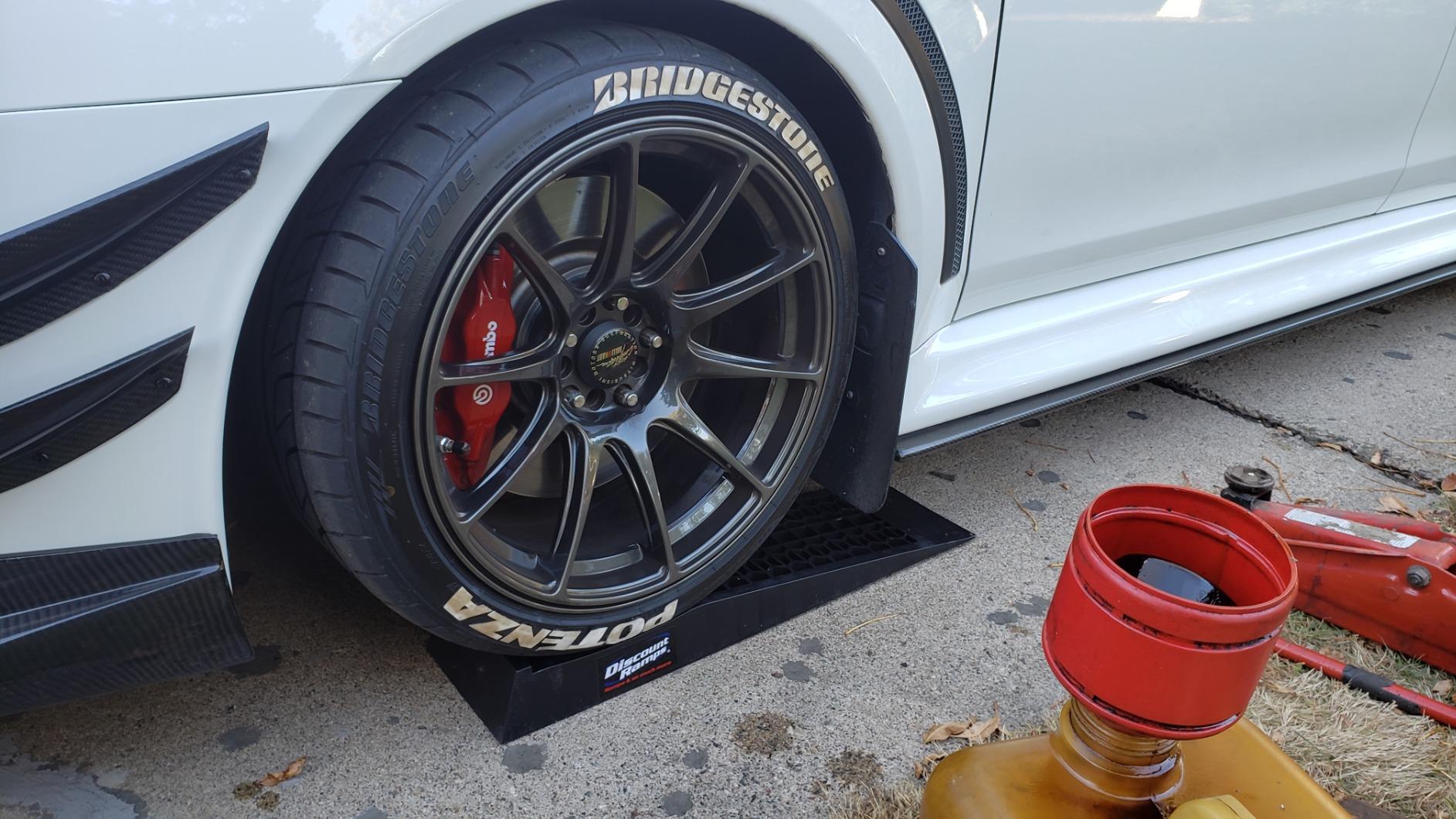
The 9.05-degree loading angle is the key spec here. That shallow incline lets front splitters and low bumpers climb without contact, something steeper 17-degree ramps simply cannot do. The honeycomb top surface also channels water and debris away rather than pooling it against your tire.
On the practical side, each ramp is light enough to carry one-handed, and the slight stop at the top gives you a tactile cue when the tire is fully seated. We found it easy to feel from the driver’s seat, so you know when to stop without a spotter.
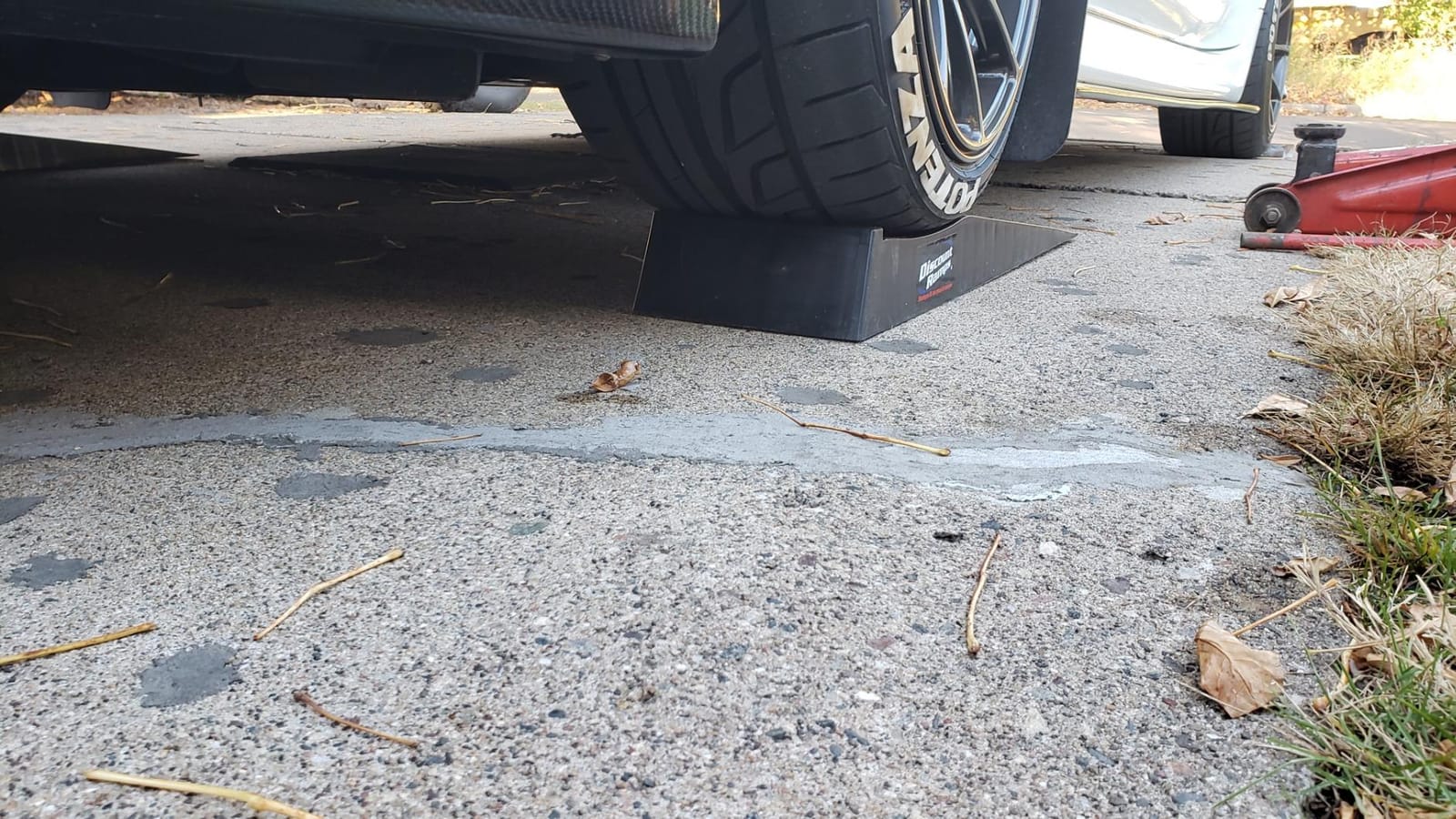
Lift height and real oil-change clearance
A 2.5-inch lift alone is usually enough for oil changes on trucks and taller sedans where the drain plug is already accessible. On genuinely low cars, plan to use these ramps as a first stage, then place a floor jack on the frame for extra height.
That two-stage approach is actually safer than it sounds, because you keep the tires loaded on the ramps while jacking from a solid point. Many DIY mechanics on oil-change forums consider this the standard method for low vehicles.
Tire and vehicle fit
The 7.75-inch tread width fits most passenger car tires but runs narrow for 245-section and wider performance rubber. Measure your tire width before ordering if you run wider-than-stock wheels.
These are rated at 5,000 lbs per axle, covering the vast majority of passenger vehicles. They are not the right pick for heavy diesel trucks, where the Ironton set above is a better match.
3. MaxxHaul 50515 6.25-Inch Lift Ramps – Best Full-Size Lift
MaxxHaul 50515 6.25″ Lift Car Ramps, 2-Pack – 6, 500lb GVW, Deep Grooved Surface for Stable Tire Placement, Heavy-Duty, Black
6,500 lb GVW pair
6.25 inch lift
35.5 inch length
Rubber base stops
Pros
- 6.25 inch lift gives generous clearance
- Rubber stops on the base
- Deep grooved surface for traction
- Built-in wheel stop
- Solid heavy-duty plastic
Cons
- Can still slide on slick cement
- Bulky to store
- Tight underneath for larger mechanics
The MaxxHaul 50515 is the classic full-size service ramp, and the 6.25-inch lift height is what makes it worth owning. That is enough elevation to comfortably reach drain plugs, transmission pans, and exhaust components on most sedans and crossovers without any additional jacking.
With 991 reviews and an 84 percent five-star rate, the long-term ownership reports are strong. Users consistently describe the plastic as thick and dense, with no flex or creaking even under heavier front ends.
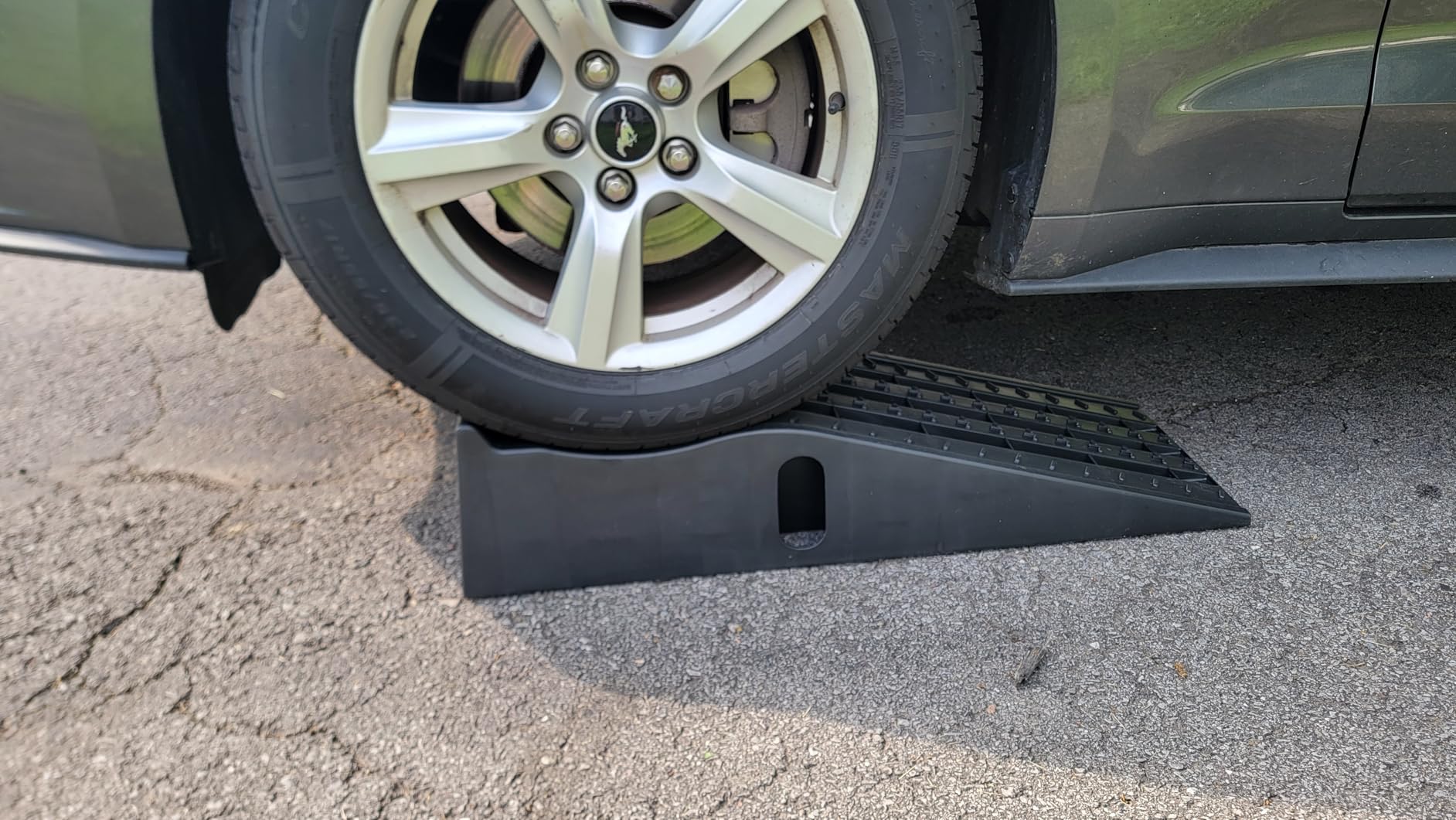
The deep grooved surface is a nice touch, giving tires something to bite into rather than polishing smooth over time. Rubber stops under the base also help keep the ramps planted while you roll on, though a few owners still recommend a rubber mat on very slick, power-troweled concrete.
At 20.1 lbs for the pair, they are manageable to move but not travel-friendly. The size buys you stability, and the built-in wheel stop at the top keeps you from rolling off the far edge in the dark.
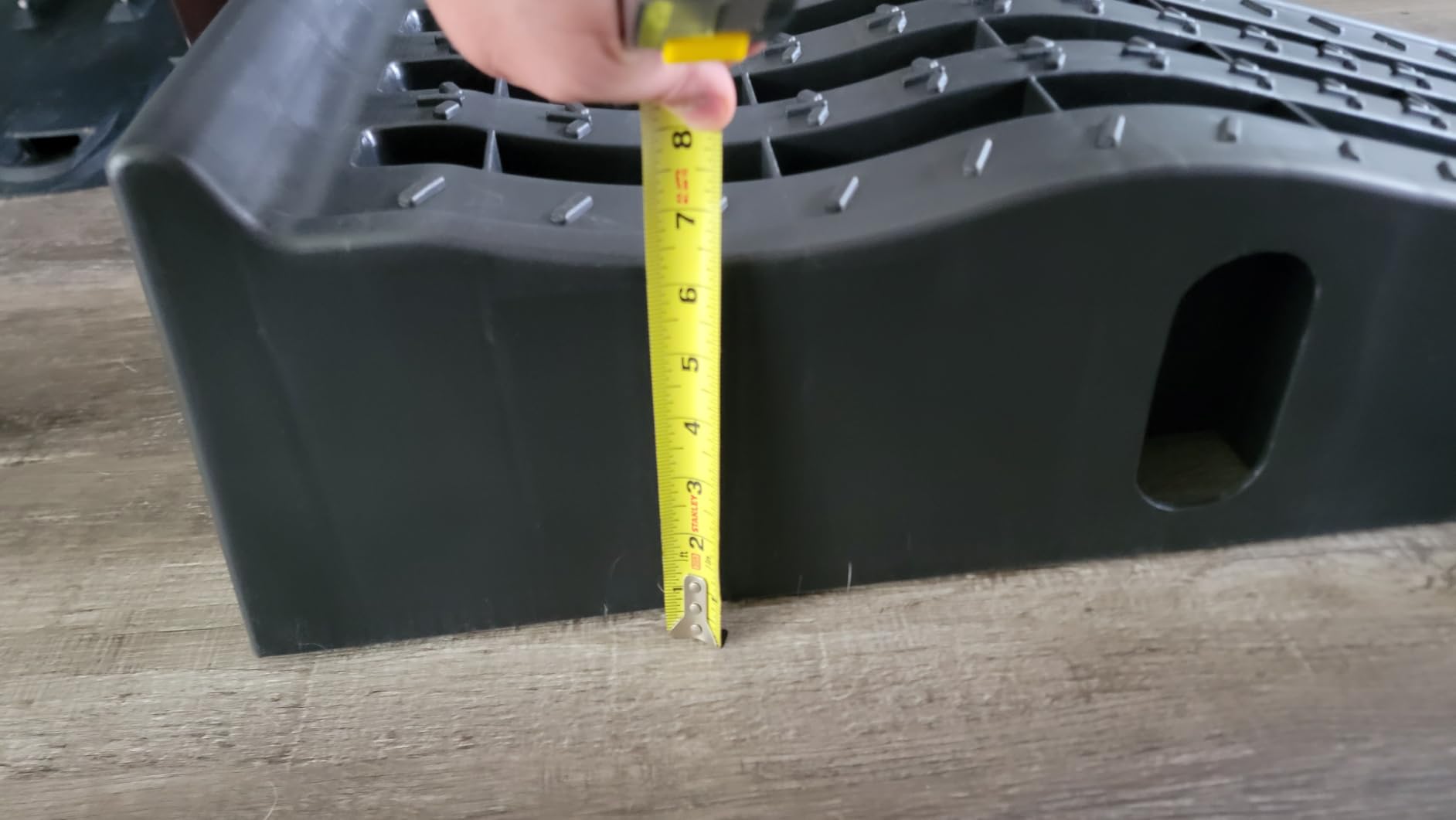
Approach angle and bumper clearance
With 6.25 inches of lift over 35.5 inches of length, the approach angle suits average-height cars, crossovers, and minivans. Low sports cars with long front overhangs will scrape, so measure bumper height to ramp base before committing.
For most family vehicles, though, the geometry works on the first try, which is why this style of ramp remains a garage staple.
Under-vehicle working room
One honest note from larger mechanics: 6.25 inches of lift means you are still crawling, not sitting, under the car. If you need more headroom for brake or exhaust work, consider stacking this work with a jack on the crossmember.
For oil changes and inspections, the clearance is genuinely adequate on the majority of vehicles we checked.
4. Nilight Low Profile Service Ramps – Best Value
Nilight Low Profile Car Service Ramps, 10,000 lb GVW Capacity, 2-Pack
10,000 lb GVW pair
2.6 inch lift
17 degree angle
High-strength PP
Pros
- 4.8-star rating
- highest in our set
- Anti-slip texture plus silicone base pads
- Drainage holes shed water
- Raised wheel stops
- Compact for garage storage
Cons
- 2.6 inch lift limits some jobs
- Not for very low ground-clearance cars
The Nilight service ramps are the newest set in our lineup, and they arrived with the highest rating: 4.8 stars. While the review count is still small at 71, the feedback is uniformly positive about build quality and grip.
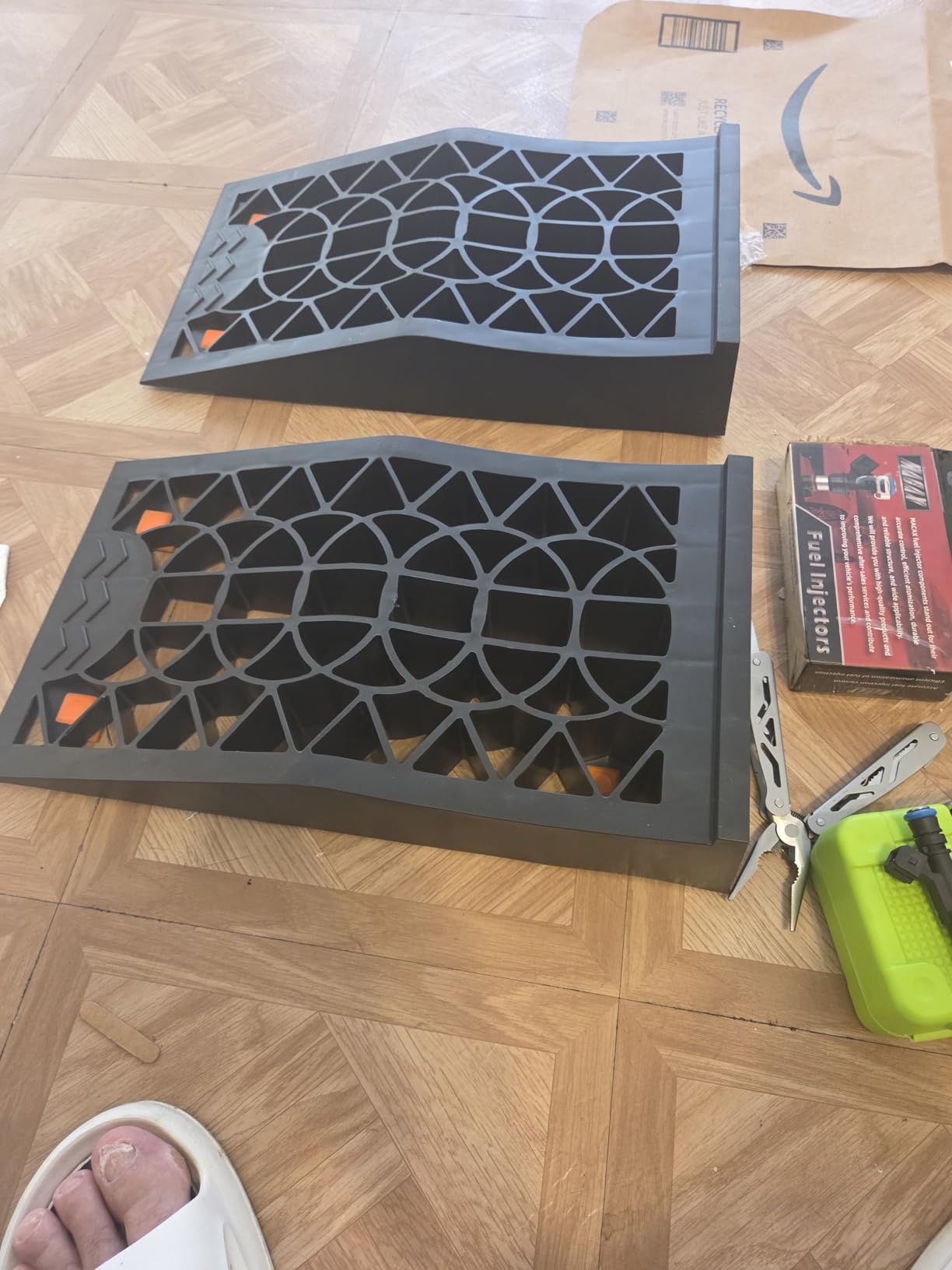
These are compact ramps at roughly 17 inches long, with a 17-degree loading angle and 2.6 inches of lift. The shorter, wider design gives unrestricted access for a floor jack, which makes them a strong choice for routine maintenance on sedans and coupes.
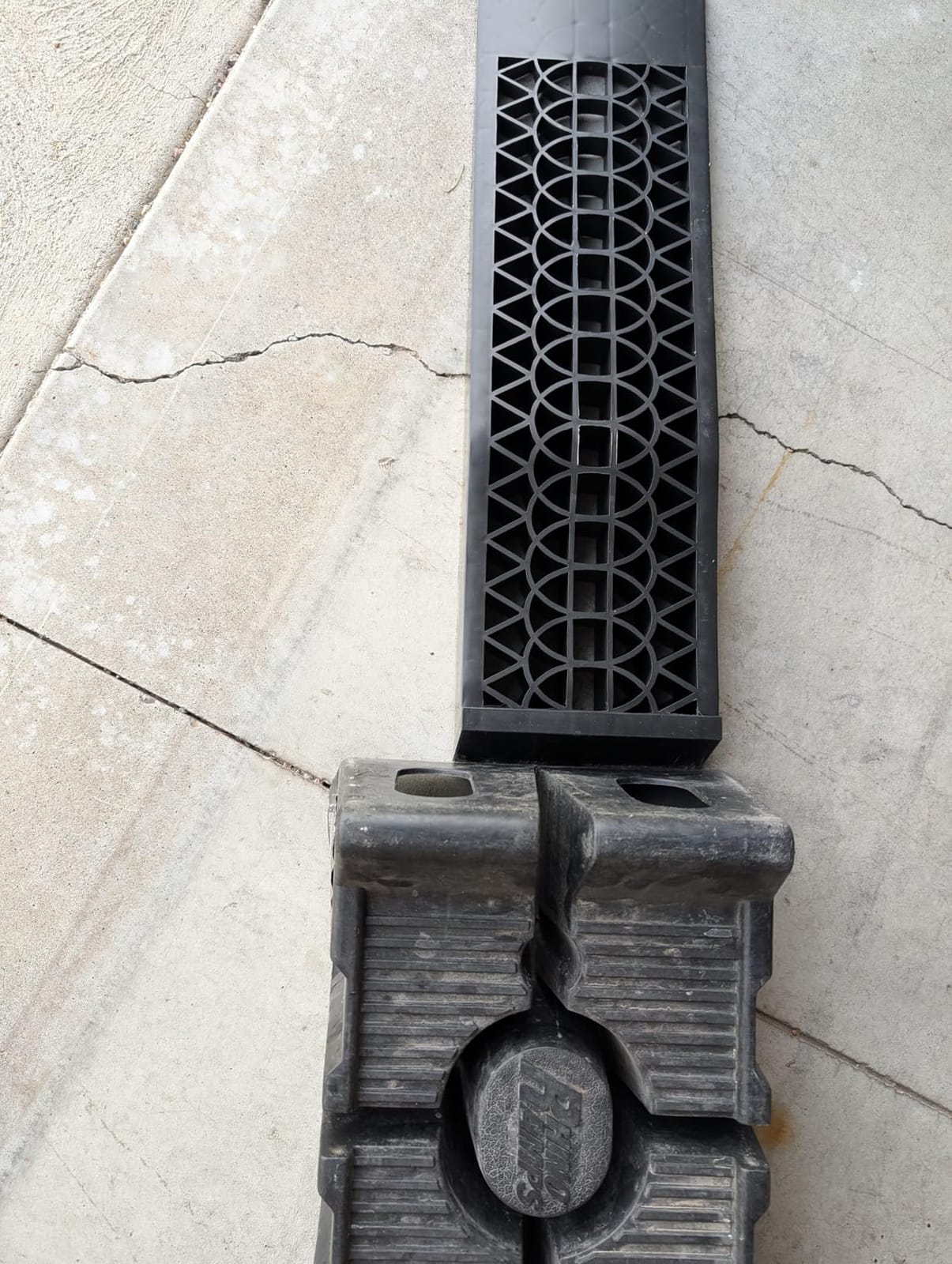
The anti-slip texture on top and silicone pads on the bottom address the two biggest ramp complaints we found in forums: tire slip and ramp slide. Owners of vehicles like the Nissan Frontier report using them confidently for regular service work.
We also like the drainage holes, which keep water from pooling after a wet car sits on them. Small detail, but it shows the design was thought through rather than copied.
Vehicle suitability
The 10,000-lb GVW pair rating covers sedans, coupes, and most light trucks easily. The 17-degree angle is too steep for genuinely lowered cars, so treat these as a fit for stock-height daily drivers.
For stock sedans and small SUVs, the geometry works well and the width accommodates standard tire sizes without alignment frustration.
Garage storage and portability
Because they are short and light, these slide into a shelf, under a workbench, or even behind a toolbox. If your garage is tight, this is one of the least intrusive sets we tested.
The compact footprint does mean a steeper climb, so there is a real trade between storage convenience and approach gentleness.
5. ROBLOCK Low Profile Car Ramps – Best Budget Pick
ROBLOCK Car Ramps for Lift and Vehicle Maintenance, Portable Low Profile Car Ramps for Garage, Heavy Duty Tire Ramps with 2.6″ Lift Height for Low Chassis Cars and Support Jack, 17.5″x10″x3.14″, 2 PCS
20,000 lb GVW (5 ton)
2.6 inch lift
17 degree slope
Impact-resistant PP
Pros
- Lowest price in our set
- Exceptionally light at 5.3 lbs per pair
- Honeycomb design for strength
- Curved cradle holds the tire
- Non-slip bottom pads
Cons
- Lift height lower than some expect
- Tight for oil changes on some vehicles
- Wide slope not for lowered cars
At this price, the ROBLOCK ramps are the cheapest way to get your car a few inches off the ground, and with over 1,070 reviews, they are also one of the most purchased sets in the category. The 4.4-star rating reflects a solid budget product with honest limitations.
The headline spec is the 20,000-lb GVW rating, which sounds dramatic but simply means these will never be the weak link under any normal passenger vehicle. The impact-resistant polypropylene and honeycomb core do the real work.
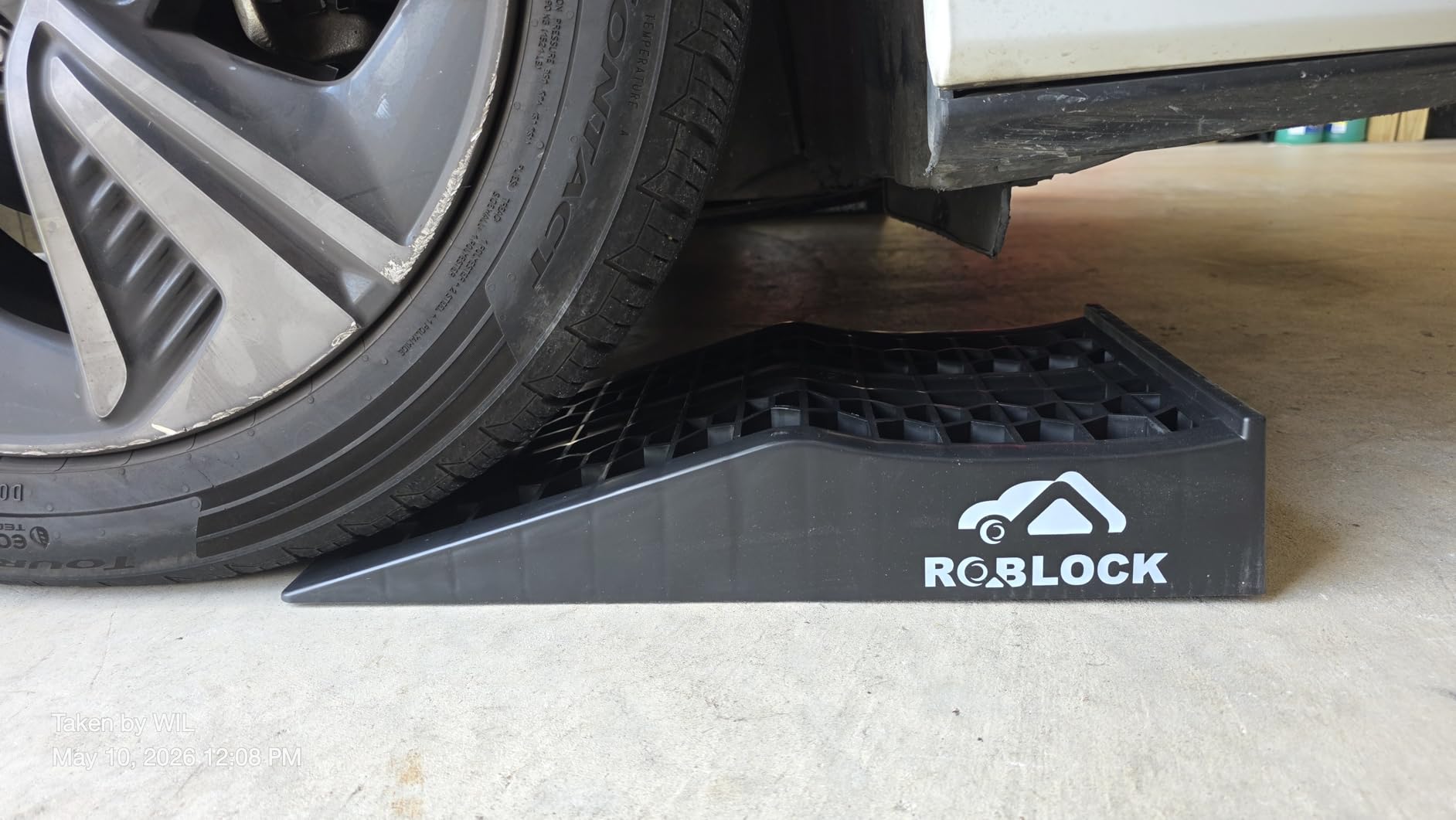
We were genuinely surprised by the 5.3-lb pair weight. You can carry both ramps in one hand, which makes them a realistic option for trunk storage or moving between the garage and driveway.
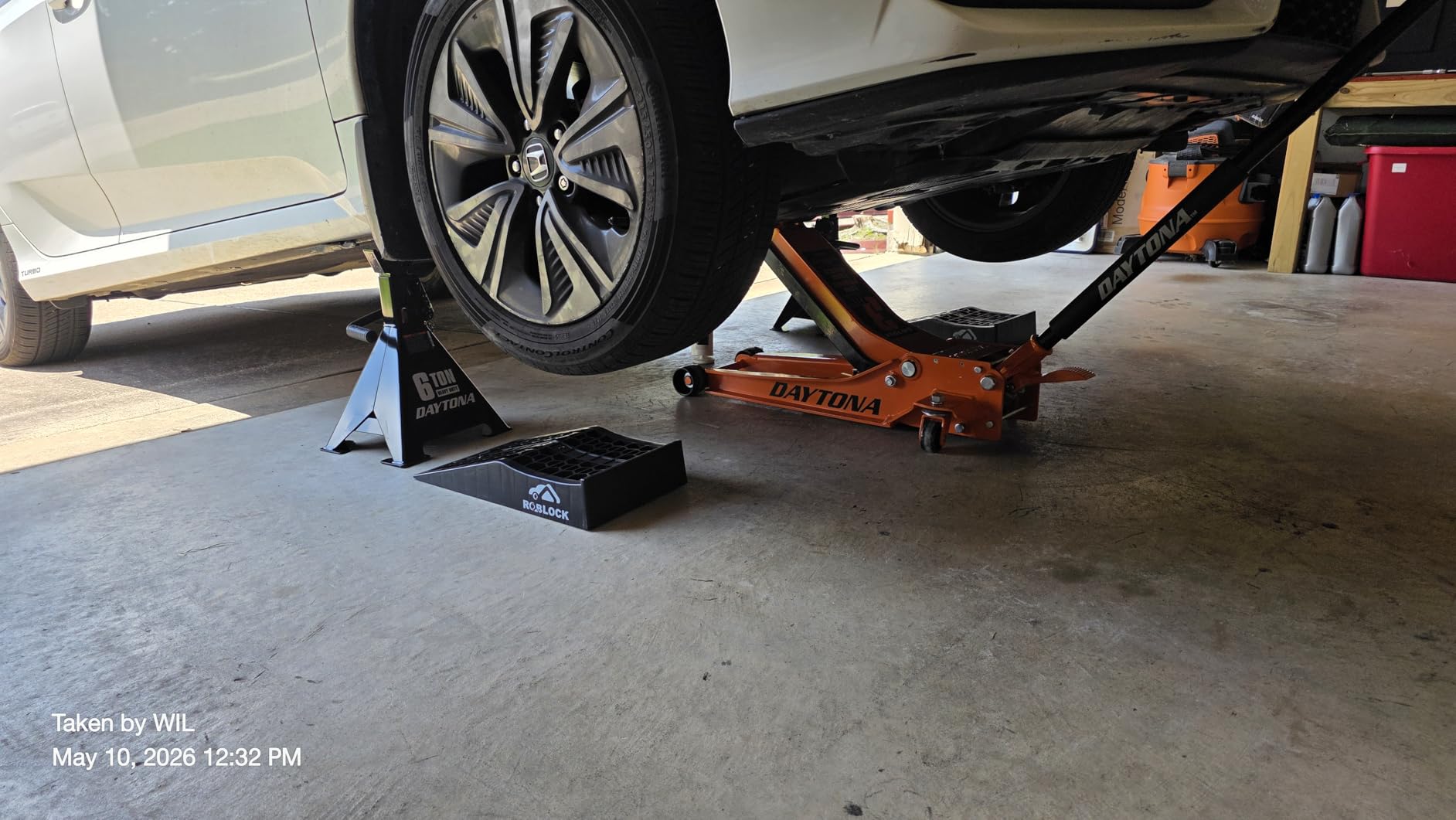
The curved cradle design holds the tire in place and prevents rolling off, and the bottom pads help on smooth floors. The main complaint in reviews is expectations: some buyers hoped for more than 2.6 inches of lift and found oil changes tight on their specific vehicle.
What the low price gets you
You get functional, safe jack-access ramps for basic maintenance. You do not get tall service height, a gentle approach angle, or premium materials, and that is an acceptable trade at this cost.
For a first set of ramps, or a backup pair to keep in a trunk, they are hard to argue against.
Best use cases
These shine as pre-jack lift helpers on stock-height cars and as leveling aids in storage or material-handling situations. Owners also use them under trailer tongues and equipment, thanks to the huge load rating.
If your main goal is a full oil change without a jack, spend slightly more on the MaxxHaul 50515 or Black Widow set instead.
6. MaxxHaul 50516 Low Profile Ramps – Best for Jack Access
MaxxHaul 50516 4,400 lb. Capacity Low Profile Car Ramps, 2-Count, Black (Pack of 1)
4,400 lb pair capacity
2.5 inch lift
9.05 degree angle
27 inch length
Pros
- Shallow 9.05 degree angle for low cars
- Honeycomb drainage channels
- Very light and easy to store
- Effective wheel stop
- Fits stock low-clearance vehicles
Cons
- 4
- 400 lb capacity limits heavier vehicles
- Can slide on smooth cement
- Narrow for wide tires
- Low lift not enough for full oil changes
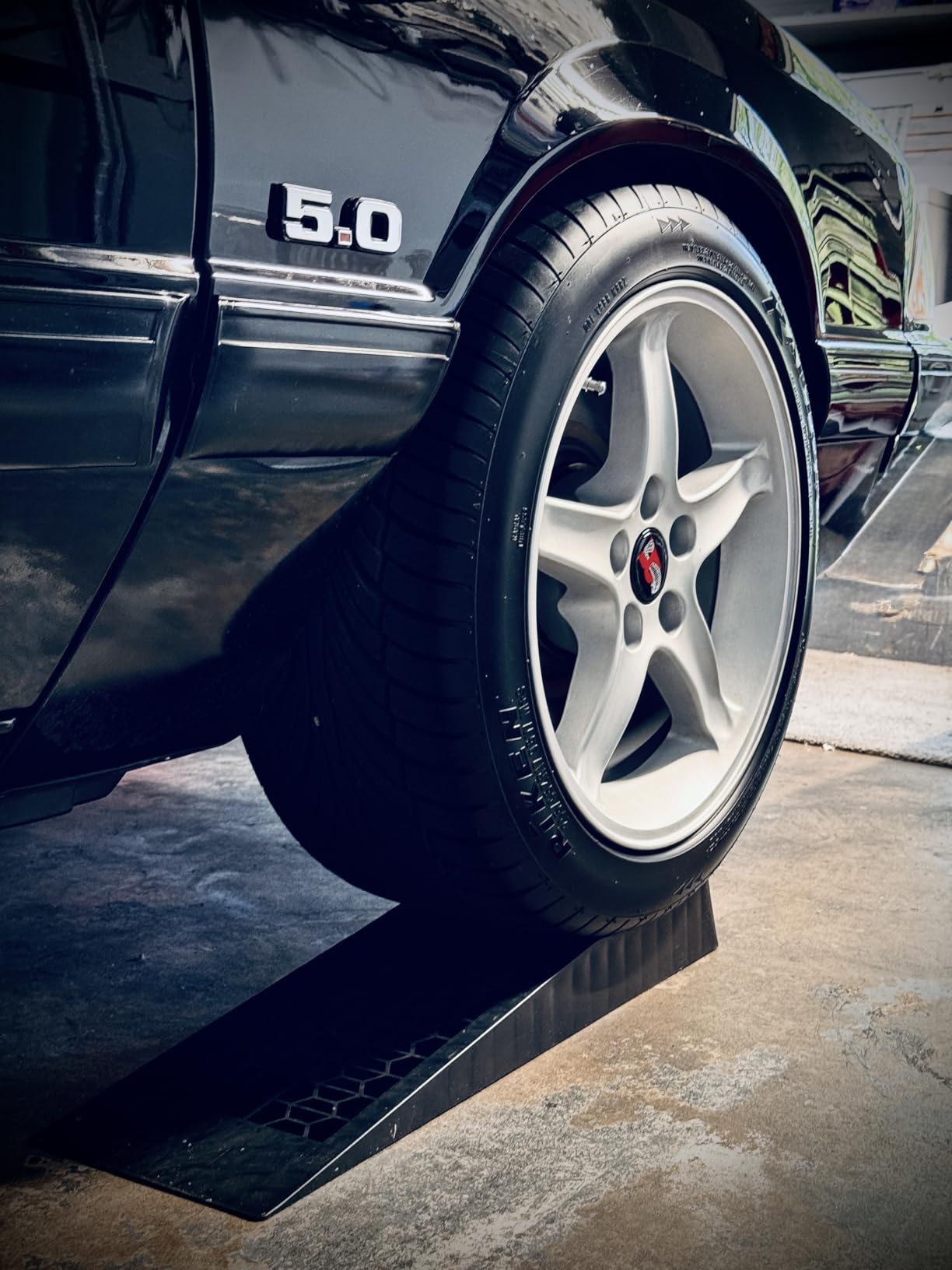
The MaxxHaul 50516 shares the 9.05-degree approach geometry of the Black Widow set but comes in at a lower capacity and lower price. If you drive a stock-height compact or sedan and just need enough lift to slide a jack under, these do that job cleanly.
At 3.36 kg for the pair, they are among the lightest full-length ramps available, which makes setup a one-minute job. The honeycomb channels shed dirt and moisture, so they do not get grimy against the tire over time.
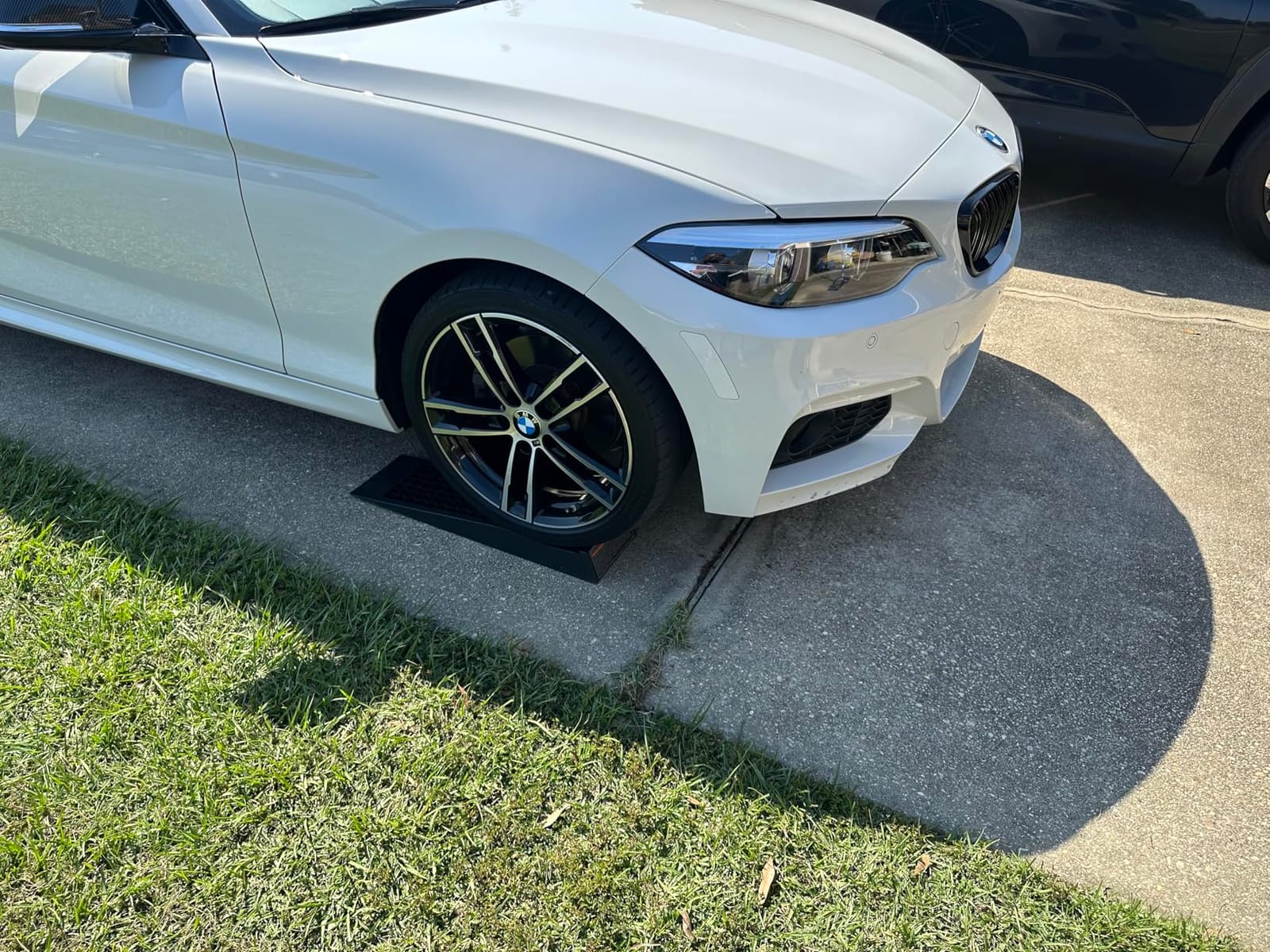
Reviews from owners of low cars are positive about the approach geometry, and several mention using these as the first stage before a jack-and-stand lift. The wheel stop at the top is effective and easy to feel from the driver’s seat.
The limitations are real, though. With only 4,400 lbs of total capacity, skip these if you drive anything truck-sized. And like most plastic ramps, they can walk on polished concrete without a rubber mat or grip pad underneath.
Capacity limits to know before buying
The 2,200-lb per ramp rating fits most sedans, hatchbacks, and small crossovers. Check your front axle weight, not just curb weight, before purchasing, since ramps carry the axle-loaded end of the vehicle.
For anything approaching midsize SUV territory or heavier, step up to the Black Widow or Ironton sets.
Two-stage lifting strategy
Owners use these ramps to gain clearance for a floor jack, then lift from the frame with the tires still chocked. That method keeps the car stable while giving you the working height ramps alone cannot provide.
It is a smart workflow for lowered cars where a jack will not otherwise fit under the pinch welds or crossmember.
7. MaxxHaul 50709 Detachable Extendable Ramps – Best for Low Sports Cars
MaxxHaul 50709 Detachable Extendable Car Ramp Set, Portable Car Ramps With 3,250 lbs Maximum Weight Capacity Per Ramp 6,500 lbs Per Pair
6,500 lb pair capacity
6.5 inch lift
9.5 degree incline
Detachable and extendable
Pros
- Detachable design frees space under vehicle
- Extendable with optional sections
- Extra-long 52.5 inch length softens approach
- Rock steady with grid grip
- Built-in carry handle
Cons
- Highest plastic-set price in our group
- Some reports of missing parts in packaging
- Needs a flat
- even surface
The MaxxHaul 50709 is the most cleverly engineered plastic ramp set we tested. The core trick is the detachable design: once the car is up, the sloped entry section pulls away, leaving just the platform under the tire and opening up the space around it.
That matters more than it sounds. With the approach section removed, you get clear access to the sides and front of the tire for brake work, and the area under the car feels far less crowded.
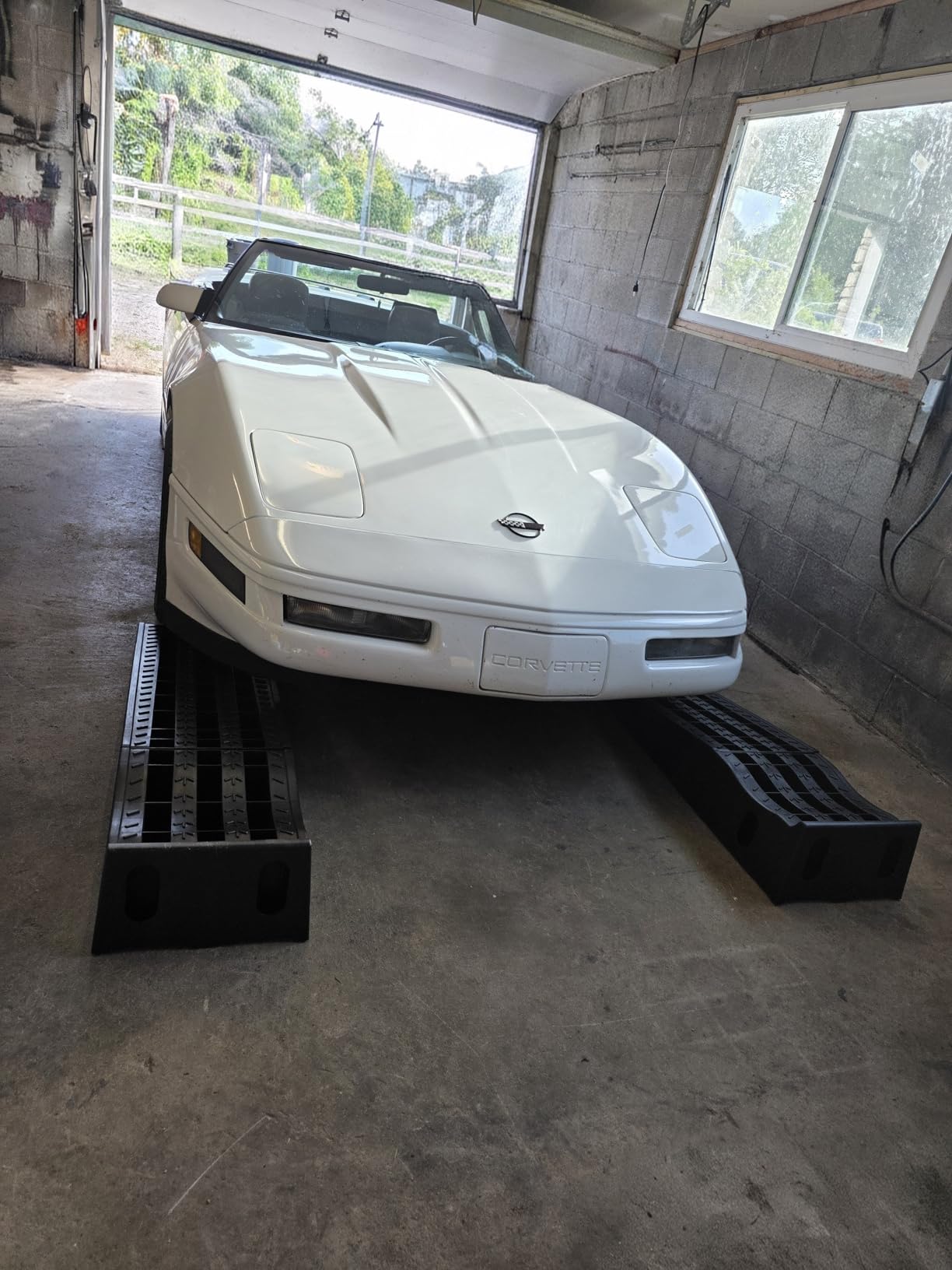
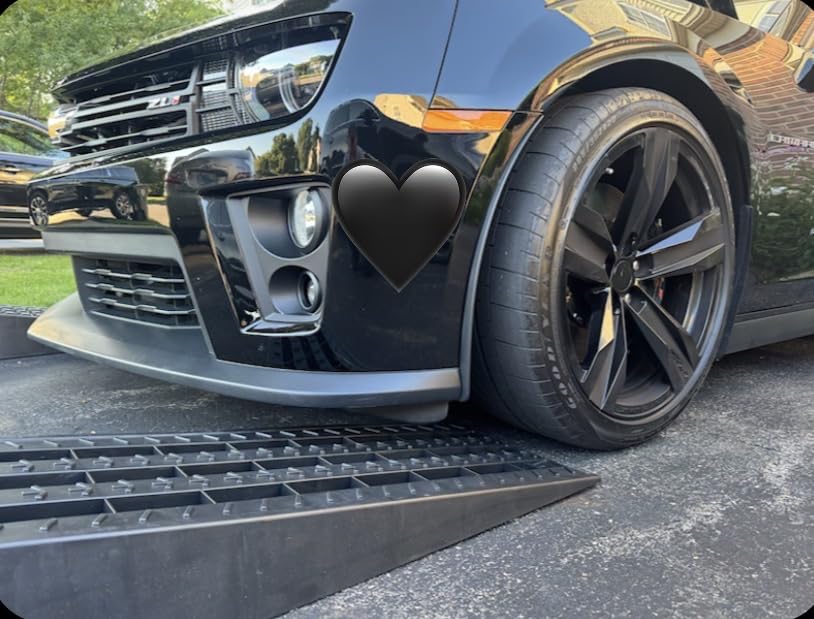
The 52.5-inch overall length brings the incline down to 9.5 degrees, which is gentle enough for lowered cars and sports cars that would scrape on everything else. If even that is too steep, optional extension sections (sold separately) flatten the angle further.
Reviews from sports car owners are enthusiastic, calling the detachable and extendable design a genuine upgrade. The main quality-control complaint is occasional missing parts in the box, so check the package contents on arrival.
Detachability in practice
Removing the sloped section takes seconds and requires no tools. The joint is solid under load, with no rocking or shifting reported during normal use.
For anyone who has bumped their head or fought a jack handle against a ramp slope, this feature alone justifies the price difference.
Surface requirements
MaxxHaul is clear that these need a flat, even surface. The multi-piece design does not tolerate slopes or uneven pavement, so use them on a level garage floor or smooth driveway.
If your driveway has a slope, position the car facing downhill on the ramps and chock the rear wheels securely.
8. Race Ramps Foam Trailer Ramps – Best Premium Foam Ramps
Race Ramps Foam Trailer Loading Ramps for Low-Profile Cars, 5 in H, Pair
1,500 lb per ramp / 6,000 lb total
5 inch lift
4.3 degree angle
High-density foam
Pros
- Ultra-shallow 4.3 degree approach
- Only 10 lbs per ramp
- Non-scratch foam will not mar bumpers
- Built-in trailer door notch
- Carry straps included
Cons
- Premium price
- Limited stock availability
- Must lay perfectly flat
- Reports of deformation under heavy use
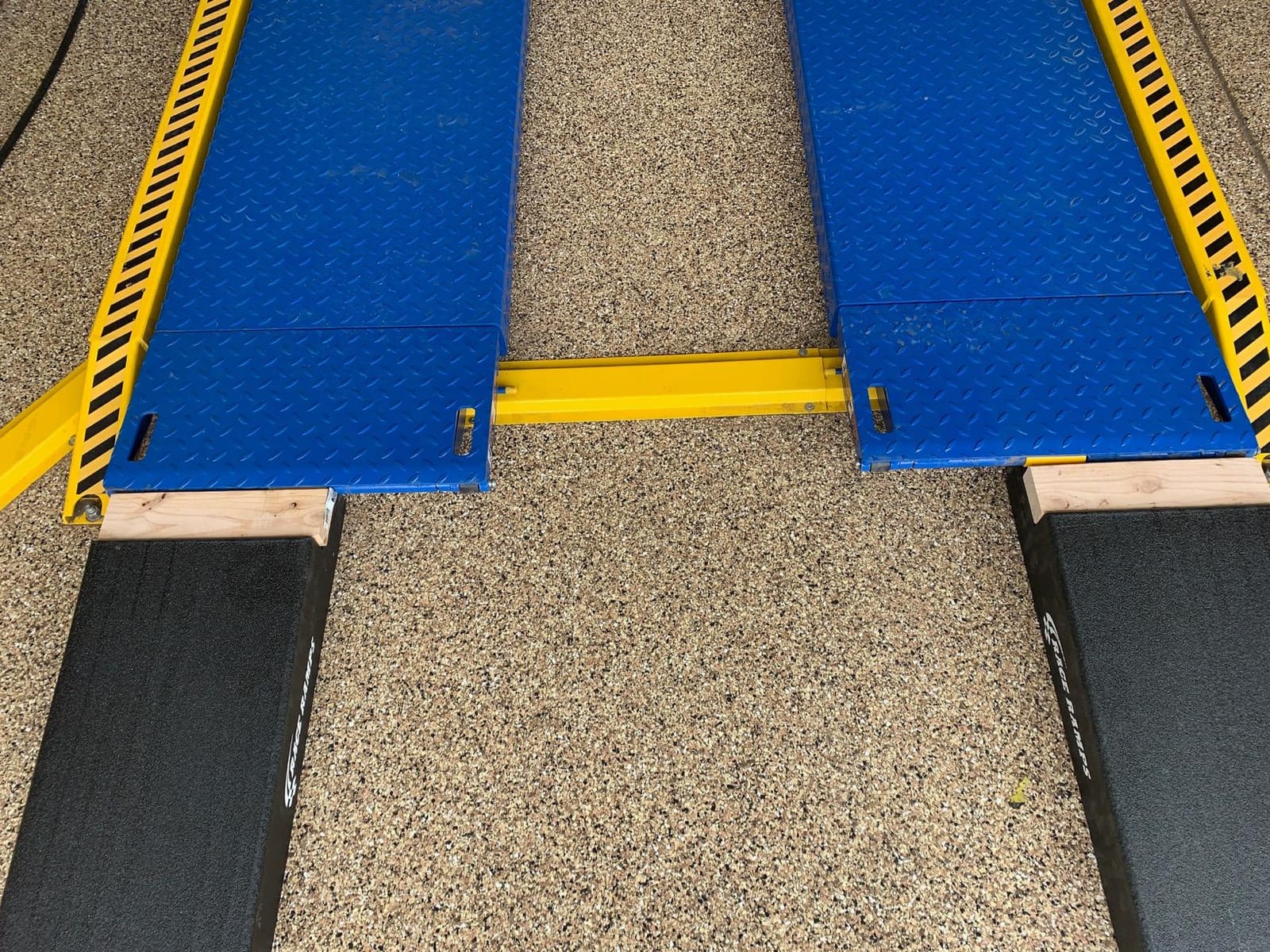
The Race Ramps RR-TR-5 foam ramps are the answer when nothing else works. The 4.3-degree approach angle is the shallowest in our group by a wide margin, and that is the difference between a lowered car loading onto a trailer and a front bumper sitting on the ramp edge.
These are the ramps you want for track cars, lowered sports cars, and any vehicle with a front lip that clears the ground by a couple of inches. The solid high-density foam core is coated with a non-slip traction surface that grips without scratching paint or splitter edges.
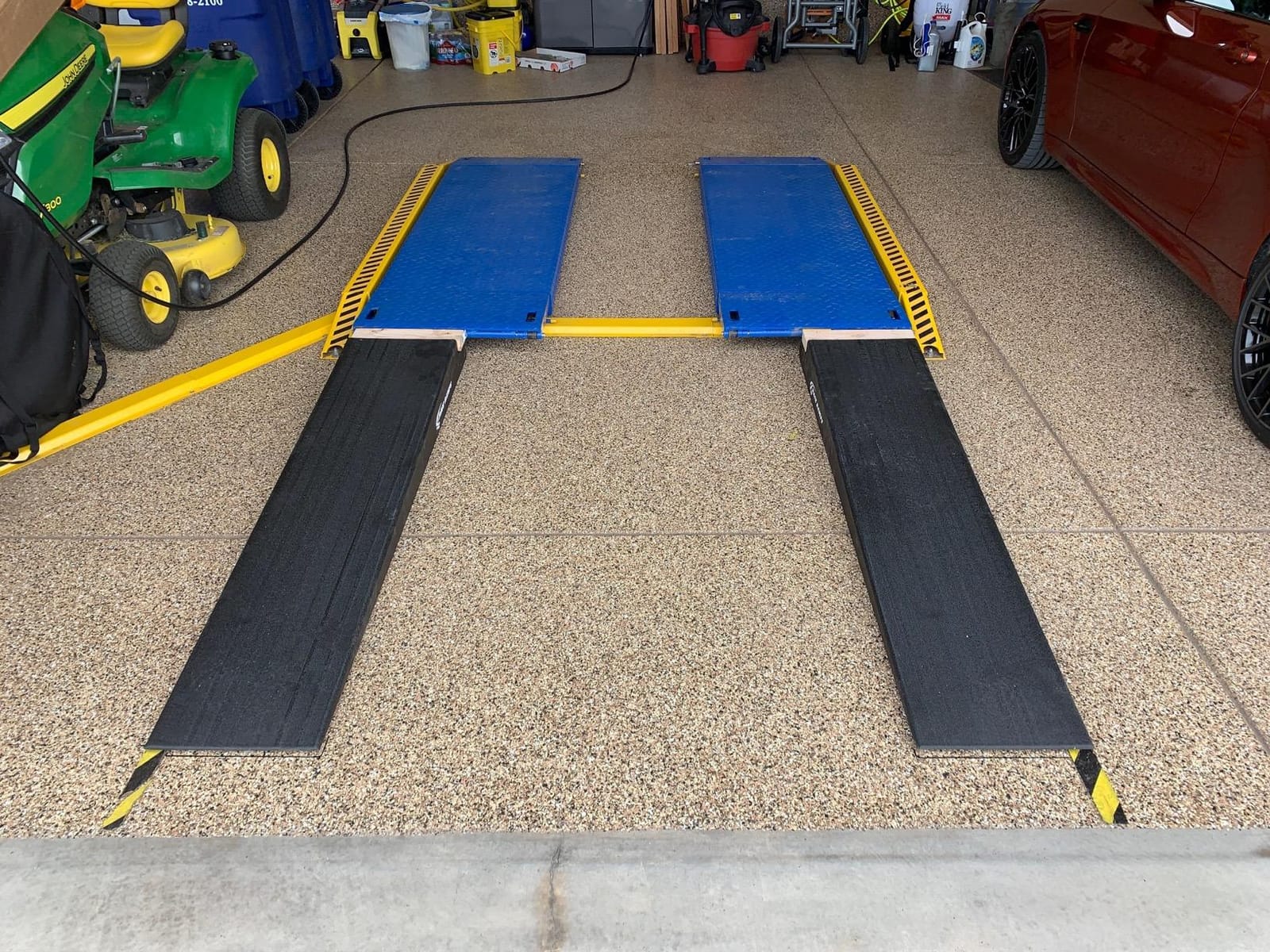
At 10 lbs per ramp, they position in seconds, and the included carry straps make them easy to throw in a trailer or tow vehicle. The built-in door notch is a thoughtful touch that bridges the gap between ramp and trailer gate so nothing catches mid-transition.
The trade-off is straightforward: price and capacity. At 6,000 lbs total they handle most sports cars fine, but this is not the tool for heavy trucks, and the premium cost puts them in enthusiast territory. They also must sit perfectly flat, with no bridging over dips, or the foam can deform over time.
Approach angle for seriously low cars
The 4.3-degree angle is roughly half the incline of typical plastic service ramps. On a car with a long front overhang, that is the margin that keeps a $500 front splitter intact.
For trailer loading specifically, the door notch feature removes the transition bump that otherwise causes scrapes at the top of the ramp.
Durability and long-term value
Foam sounds fragile, but the 4.6-star rating over 161 reviews shows these hold up under regular use. The coating does the protective work, and most owners report years of service.
Follow the flat-surface rule and respect the weight limit, and these will last as long as any plastic set, while solving a problem plastic cannot.
How to Safely Use Car Ramps: Step-by-Step
Ramps are simple, but the wrong setup can bend a ramp, scrape a bumper, or, worst case, let the car roll. Here is the workflow we use every single time, based on forum best practices and our own testing.
First, verify you are on flat ground. Even a slight driveway slope changes how the car behaves once the front tires are up. If your driveway slopes, either find a flat section or position the car so it faces downhill while on the ramps.
Place both ramps directly in front of the front tires, aligned with the direction of travel. The ramps should sit flush on the surface with no rocking. If your ramps have rubber feet or base pads, check that they are in full contact.
Check your approach. If the bumper is low, place a short board or a second ramp flat on the ground in front of the main ramp to create a gentler transition. The goal is no contact between bumper and ramp on the way up.
Now drive forward slowly. Idle speed is plenty. Keep the steering wheel straight, and watch the tire climb. You will feel the tire hit the stop at the top. Stop immediately when you feel that resistance. Do not try to force the car higher.
Set the parking brake firmly. If you have an automatic, leave it in park. If you have a manual, leave it in first gear or reverse. Then place wheel chocks behind both rear tires. Never rely on the parking brake alone.
Before going underneath, give the car a firm push at the bumper. It should not move. If it does, the ramps are sliding, and you need rubber mats or grip pads under them. Only go under the car once you trust the setup.
When you are done, start the car, release the parking brake, and reverse slowly. Let the car roll down the ramp under its own momentum at idle. Do not accelerate while the tire is still on the incline, because the nose will drop and may scrape.
How to Choose the Best Car Ramps for Your Vehicle?
Choosing the right ramp comes down to five factors: weight capacity, lift height, approach angle, traction, and storage. Here is how to think through each one for your specific vehicle and garage.
1. Weight Capacity: Check Your Axle, Not Your Car
The most common mistake buyers make is comparing ramp capacity to total vehicle weight. Ramps only carry one end of the car, so the correct number to check is your front Gross Axle Weight Rating (GAWR), found on the door jamb sticker.
Engine blocks make front ends heavy, so assume 55 to 60 percent of your vehicle’s weight sits on the axle you are driving onto the ramps. A 4,500-lb SUV with a 55/45 weight split puts roughly 2,475 lbs on the front axle, which any 6,000-lb-GVW ramp set handles comfortably.
When in doubt, buy more capacity than you need. The Ironton set’s 12,000-lb rating means never thinking about this again, regardless of what you park over it.
2. Lift Height: Match the Ramp to the Job
Lift height determines what you can actually do under the car. A 2.5 to 2.6-inch lift (Black Widow, Nilight, ROBLOCK, MaxxHaul 50516) is for jack access and basic inspections. A 6.25 to 6.5-inch lift (MaxxHaul 50515 and 50709, Ironton) is for comfortable oil changes and real underbody work.
If your drain plug sits well above the axle line, even low ramps can make an oil change easy. If it is tucked behind a splash shield near the ground, you want the taller sets.
3. Angle of Approach: The Low-Car Dealbreaker
Approach angle is where low-profile cars win or lose. The steeper the angle, the more likely your front bumper, splitter, or pinch weld scrapes on the way up.
As a rule of thumb from our comparison: 17 degrees works for stock-height vehicles, 9 to 9.5 degrees suits most sedans and lowered cars, and 4.3 degrees (Race Ramps foam) is reserved for genuinely low sports cars. When in doubt, a cheap fix is placing a 2×8 board in front of the ramp to soften the transition.
4. Traction and Floor Grip
Forum threads on Garage Journal and Bob Is The Oil Guy repeat the same warning: plastic ramps slide on smooth concrete. Look for rubber feet (Ironton), rubber base stops (MaxxHaul 50515), or silicone pads (Nilight) if your garage floor is power-troweled or sealed.
A rubber mat or interlocking floor mat section under each ramp is a cheap insurance policy for any set you own. Also always chock the rear wheels and set the parking brake before going under.
5. Material: Plastic vs Foam
Plastic (polypropylene or high-impact poly) is the standard choice. It is affordable, rust-proof, and strong enough for any passenger vehicle when rated correctly. All seven plastic sets in our review fit this category.
Foam (Race Ramps) trades a higher price for the gentlest possible approach angle and a featherweight build. It is the right material only if your car is too low for plastic.
Rubber curb ramps, which we did not include as a main pick, are better suited to driveway leveling than vehicle service. Steel and aluminum ramps are alternatives to plastic, with metal offering durability and extra room but at a higher weight and cost, a point multiple forum users raised when comparing long-term value.
Storage and Climate Considerations
Short ramps (Nilight, ROBLOCK, MaxxHaul 50516) slide onto shelves and into cabinets. Long ramps (Ironton, MaxxHaul 50515 and 50709) need wall hooks or floor space, and the detachable MaxxHaul 50709 partially solves this by breaking down into sections.
Climate matters more than most guides admit. Plastic ramps can become brittle in extreme cold and degrade under constant UV exposure, so store them indoors. Foam ramps tolerate temperature swings well but must stay dry and flat. Plastic never rusts, which gives it an edge over steel in humid or salt-belt garages.
Frequently Asked Questions
Who makes the best car ramps?
Ironton makes the best overall car ramps for most drivers, thanks to a 12,000-lb GVW rating, non-skid tread, and rubber feet that stop sliding on smooth concrete. For low-profile cars, Black Widow and Race Ramps are the top brands, while MaxxHaul offers the best value full-size lift.
Are car ramps safer than jack stands?
Yes, when used correctly on a flat surface, car ramps are generally safer than jack stands because the tires remain fully supported and there is no hydraulic failure point. You still need to set the parking brake and chock the rear wheels. Ramps fail only if used on slopes or beyond their weight rating.
What are the safest car ramps?
The safest car ramps are wide, heavy sets with rubber feet and a low loading angle, rated well above your vehicle’s front axle weight. The Ironton Poly Car Ramp Set fits this profile with a 12,000-lb GVW rating and anchored rubber feet. Safe use also requires a level surface and wheel chocks.
Are ramps high enough for oil change?
Ramps with 6 to 6.5 inches of lift, like the MaxxHaul 50515 or Ironton set, are high enough for oil changes on most vehicles. Low-profile ramps with about 2.5 inches of lift often need to be paired with a floor jack for full drain-plug access on lower cars.
Are Rhino ramps the best?
Rhino ramps are a solid, popular mid-range choice, but they are not clearly the best. In our testing data, the Ironton set matched their stability with higher capacity, and Black Widow beat them for low-profile vehicles. Rhino ramps remain a dependable option if you find them at a good price.
Final Verdict
After comparing all eight sets, our recommendation is simple. The Ironton Poly Car Ramp Set is the best car ramps overall for 2026, pairing a 12,000-lb GVW rating with the rubber feet and non-skid tread that solve the most common ramp complaints. The Nilight Low Profile Service Ramps are the best value, and the Black Widow set is the pick if you drive something low and just need jack access.
Whatever you choose, verify your front axle weight against the ramp rating, measure your bumper height against the approach angle, and always work on flat ground with the parking brake set and rear wheels chocked. Safe ramp work beats fast ramp work every single time.
Pick the set that matches your vehicle and your garage, and your next oil change will take minutes instead of an afternoon of jack-stand wrangling.