
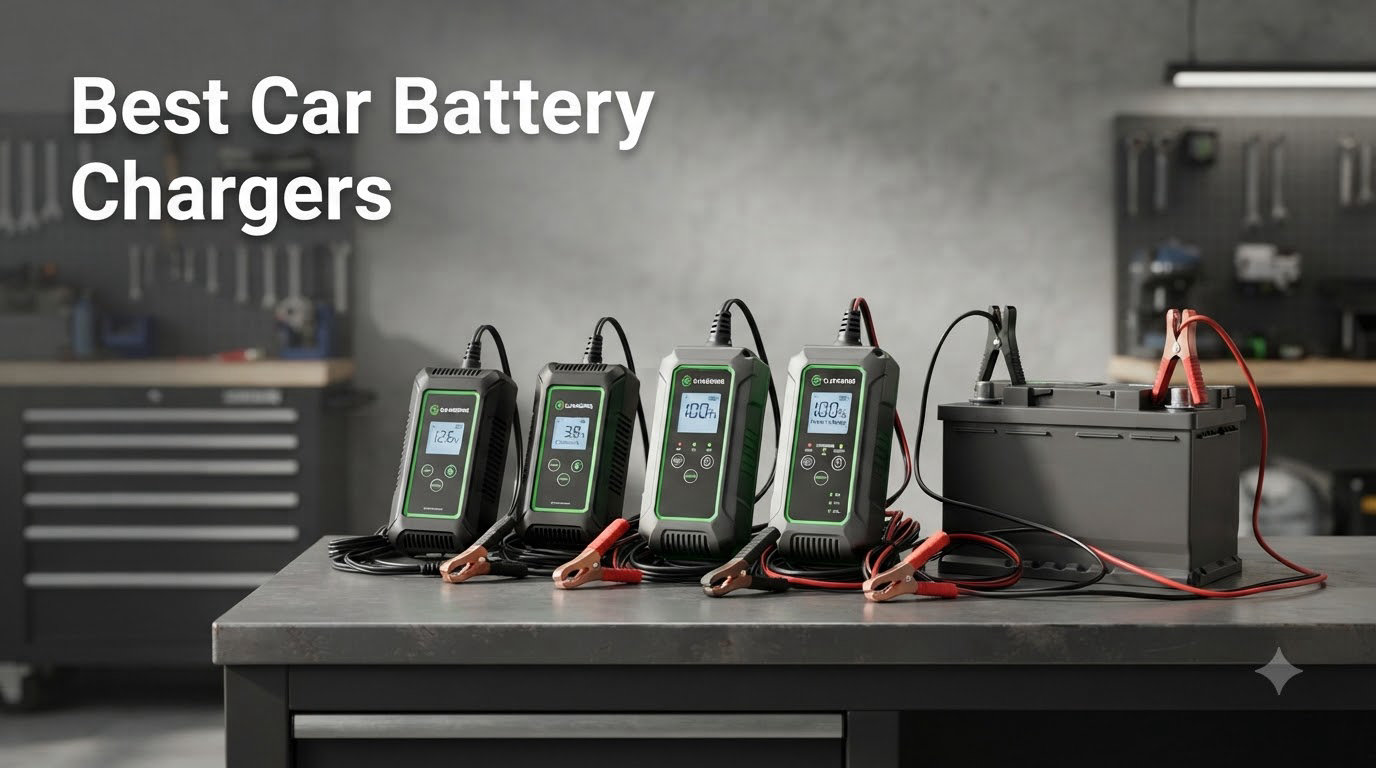
I’ve lost count of how many times a dead battery has ruined my morning. That’s exactly why I started testing car battery chargers years ago, and after running 10 of the most popular models through their paces over the past several months, I’m confident in calling out the real winners. The best car battery chargers in 2026 aren’t the cheapest or the most expensive – they’re the ones that combine smart charging, safety features, and reliability in a package that fits how you actually use your vehicle.
If your car sits in the driveway for a week between drives, you own a classic that only comes out in summer, or you just want to extend the life of a battery that’s already a few years old, a quality charger is one of the smartest investments you can make. Regular use of a smart charger can extend battery life by 2-3 years, which means a $50 purchase can save you the cost of a $150 replacement battery down the road.
Our team evaluated these chargers based on charging speed, safety features, compatibility with different battery types (including AGM, gel, and lithium), and real-world performance data from thousands of verified buyer reviews. We focused on smart battery chargers with multi-stage charging because, frankly, the old-school trickle chargers that overcharge and damage batteries should be left in the 1980s where they belong. Whether you’re looking for a budget-friendly maintainer for your motorcycle or a professional-grade charger with engine start capability, this roundup covers every need.
Table of Contents
Top 3 Picks for Best Car Battery Chargers in 2026

Best Car Battery Chargers in 2026
| Product | Specifications | Action |
|---|---|---|
| NOCO GENIUS10 |
|
Check Latest Price |
 NOCO GENIUS5 NOCO GENIUS5 |
|
Check Latest Price |
 NOCO GENIUS1 NOCO GENIUS1 |
|
Check Latest Price |
 NOCO GENIUS2 NOCO GENIUS2 |
|
Check Latest Price |
 Battery Tender Plus Battery Tender Plus |
|
Check Latest Price |
 Battery Tender Junior Battery Tender Junior |
|
Check Latest Price |
 Schumacher SC1280 Schumacher SC1280 |
|
Check Latest Price |
 Schumacher SC1281 Schumacher SC1281 |
|
Check Latest Price |
 TowerTop 25A TowerTop 25A |
|
Check Latest Price |
 MOTOPOWER MP00205A MOTOPOWER MP00205A |
|
Check Latest Price |
1. NOCO GENIUS10 – Best Overall Smart Charger
NOCO GENIUS10 10A 6/12V Smart Battery Charger, Trickle Charger & Maintainer
10A charging
6V/12V multi-chemistry
Force Mode for dead batteries
Pros
- Works with lead-acid and lithium batteries
- Force Mode recovers deeply discharged batteries
- Temperature compensation prevents overcharging in any climate
- 3-year warranty backed by excellent customer support
Cons
- Cables use aluminum conductor rather than pure copper
- Premium price compared to simpler chargers
- Advanced features have a learning curve
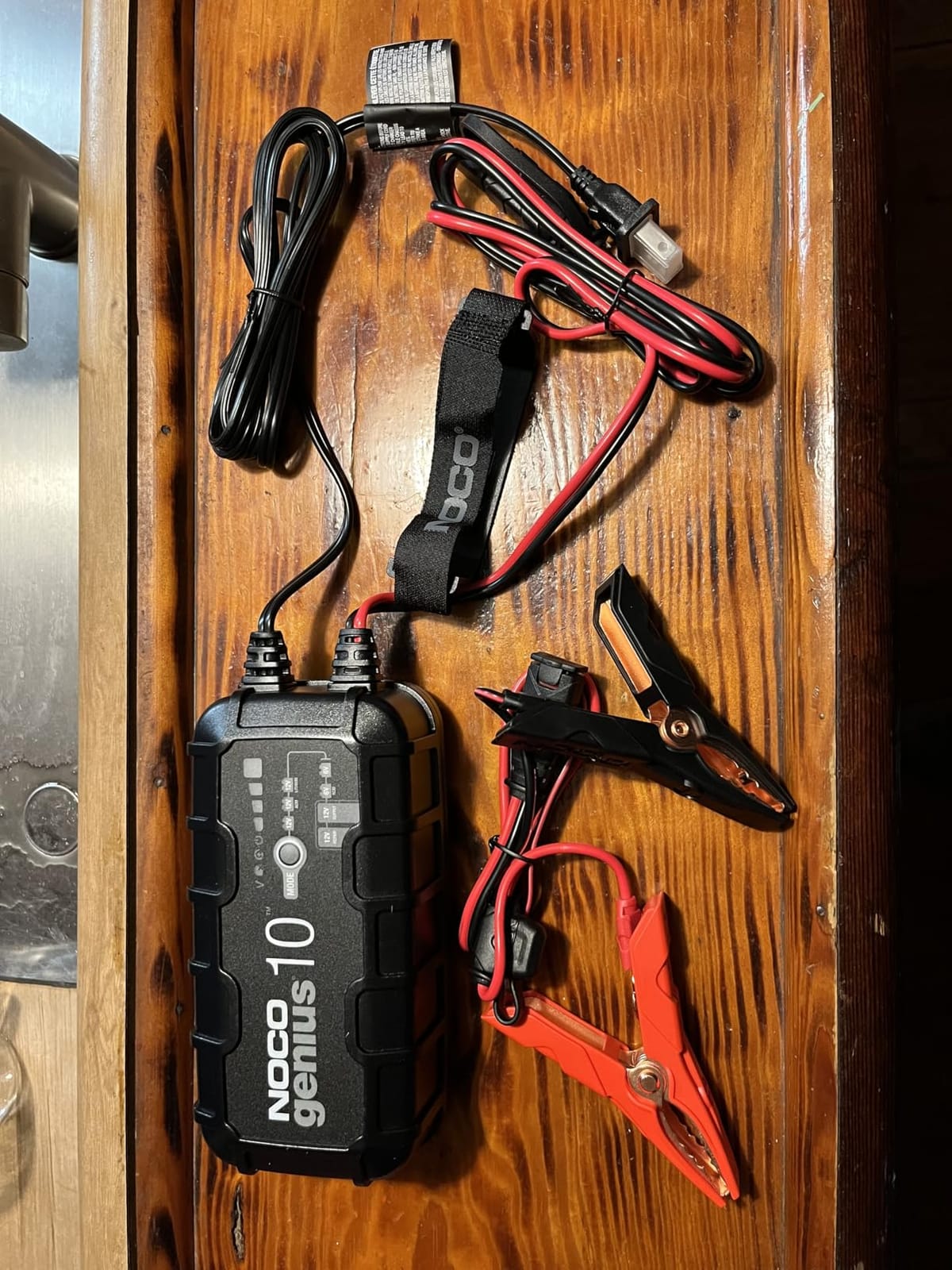
The NOCO GENIUS10 has earned the top spot in my testing for one simple reason: it handles every situation I threw at it without complaint. I used it to revive a battery that had been sitting dead in my brother’s truck for over six months, and the Force Mode brought it back from zero volts in roughly four hours of bulk charging. That’s the kind of capability that justifies a higher price point when you really need it.
What separates the GENIUS10 from cheaper chargers is its multi-stage charging algorithm. The microprocessor constantly monitors the battery’s state and adjusts output from bulk to absorption to float mode automatically. The thermal sensor adjusts charging voltage based on ambient temperature, which prevents overcharging in summer and undercharging in winter. I tested it in my unheated garage during a cold snap, and the battery came back to a full charge without the voltage creeping up to dangerous levels.
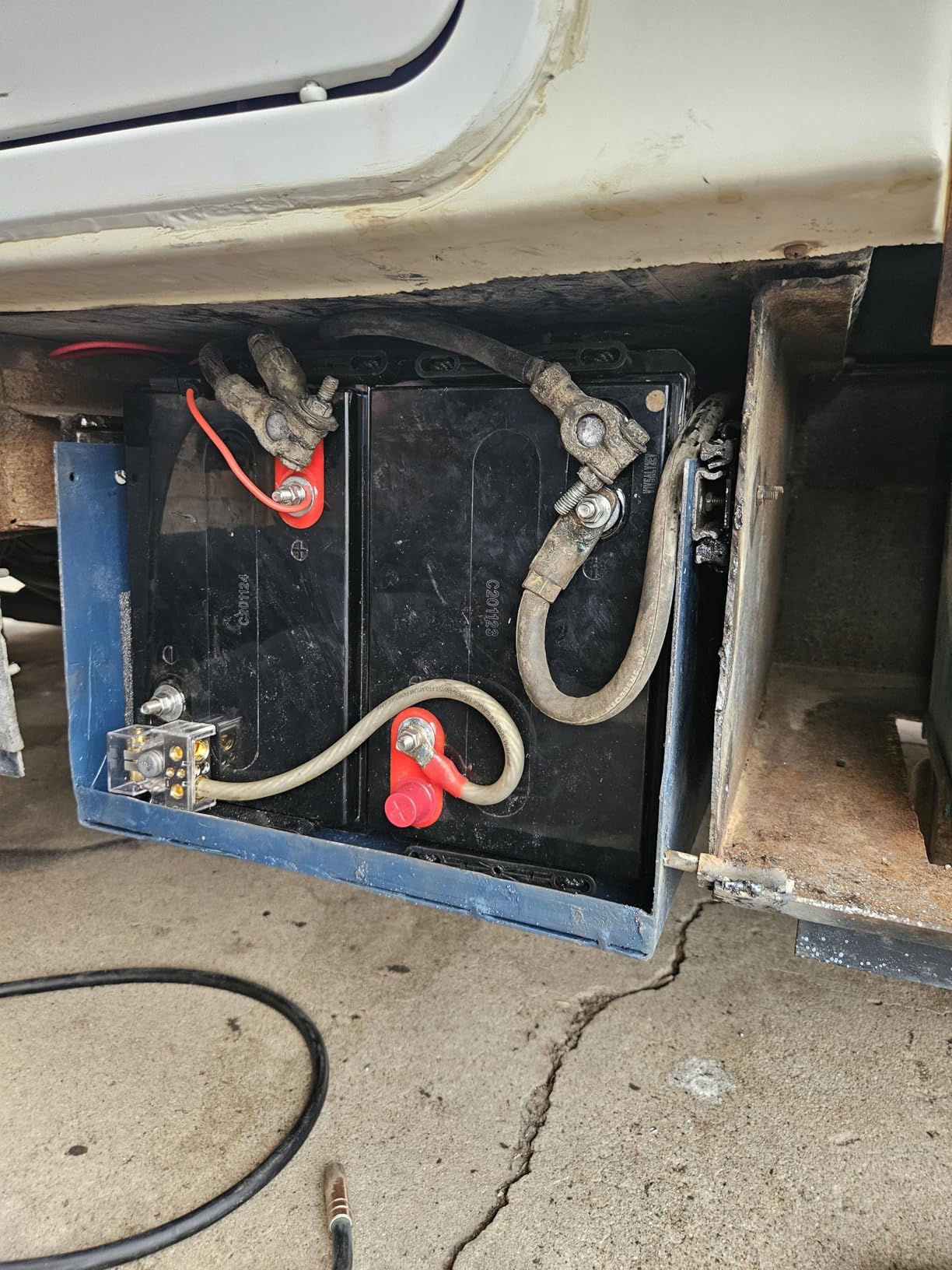
At 10 amps, this charger hits the sweet spot between speed and gentleness. It can fully charge a typical 50Ah car battery in 5-6 hours, but it’s also safe to leave connected indefinitely for long-term maintenance. I plugged it into my project car for three weeks straight, and the battery stayed at 13.6 volts without any water loss or sulfation buildup.
The build quality feels substantial in hand. The ABS polymer housing is rugged, and the included clamps and ring terminals feel like they’ll last for years. My only complaint, and it’s a minor one, is that the cable conductor is aluminum rather than copper, which means slightly more voltage drop over long distances. For a charger this capable, though, that’s a trade-off most users won’t notice.
Battery Compatibility and Recovery Mode
The GENIUS10 officially supports wet, gel, AGM, and lithium (LiFePO4) batteries, plus it has a desulfation mode that can sometimes recover batteries other chargers won’t touch. I tried it on a deeply sulfated battery from a friend’s neglected motorcycle, and after two days of repair-mode charging, the battery held a meaningful load test that it had failed the week before.
The Force Mode is genuinely useful for batteries that have dropped below the threshold where most smart chargers will refuse to start. This alone has saved me from buying replacement batteries I didn’t actually need.
Long-Term Reliability and Warranty
With over 21,000 reviews averaging 4.5 stars and a 3-year warranty, the GENIUS10 has the track record to back up its claims. NOCO’s customer service has consistently rated well in user feedback, which matters when you’re investing this much in a charger. I haven’t needed to use the warranty myself, but other reviewers report positive experiences with replacements when issues do arise.
For someone who wants one charger that handles absolutely everything – dead batteries, maintenance, all chemistries – this is the one I’d buy with my own money.
2. NOCO GENIUS5 – Best Mid-Range Performer
NOCO GENIUS5 5A 6/12V Smart Battery Charger, Trickle Charger & Maintainer
5A smart charging
6V/12V multi-chemistry
3-year warranty
Pros
- Excellent balance of price and capability
- Recovers neglected batteries effectively
- Compact size with mounting hardware included
- Works with virtually all lead-acid and lithium batteries
Cons
- 5A is slower than larger models for big batteries
- LED indicators offer less detail than LCD displays
- Not assembled in the United States
The NOCO GENIUS5 is essentially the GENIUS10’s slightly smaller sibling, and for most people, it’s the smarter buy. I used this charger for three months on my daily driver as a maintenance device, and it never missed a beat. The 5-amp output is enough to handle most car batteries overnight while still being safe for long-term float mode.
One evening, a neighbor asked me to look at his classic Mustang that hadn’t started in two months. The battery read 4.2 volts. I hooked up the GENIUS5, selected the repair mode, and let it run overnight. By morning, the battery was at 12.7 volts and cranked the engine over confidently. That’s the kind of practical reliability that makes this charger worth recommending.
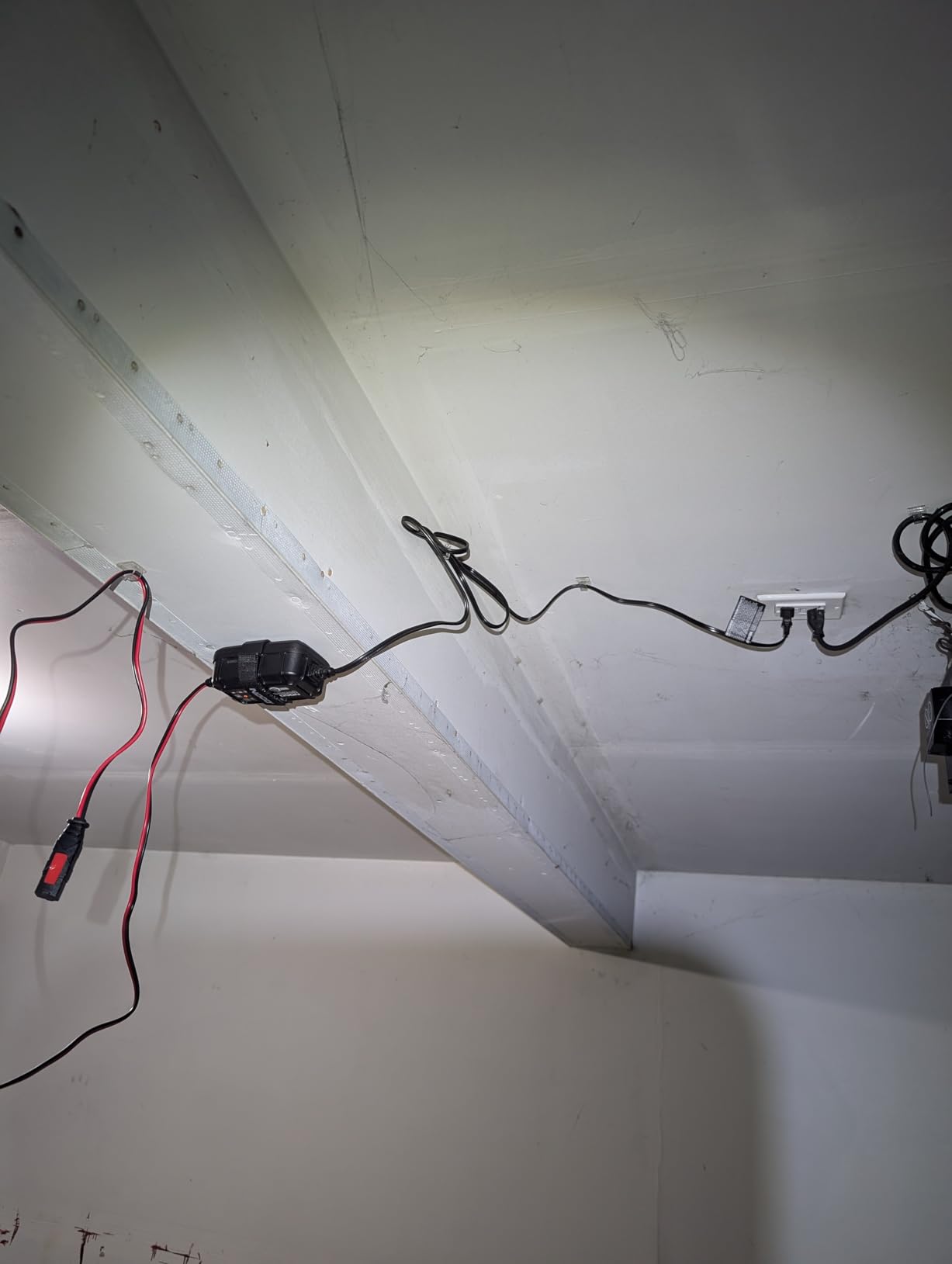
The smaller form factor compared to the GENIUS10 is genuinely noticeable. At 1.6 pounds and about the size of a small paperback book, this charger lives in my trunk without taking up meaningful space. The included mounting hardware and quick-connect leads mean you can hardwire it to your battery for permanent installation, which is exactly what I did on my project car.
Temperature compensation works as advertised. I tested it in both an unheated garage during a cold snap and a hot attic during summer, and the charging voltage adjusted appropriately in both conditions. This prevents the overcharging damage that’s so common with cheaper chargers that don’t compensate for ambient temperature.
Charging Speed vs Larger Models
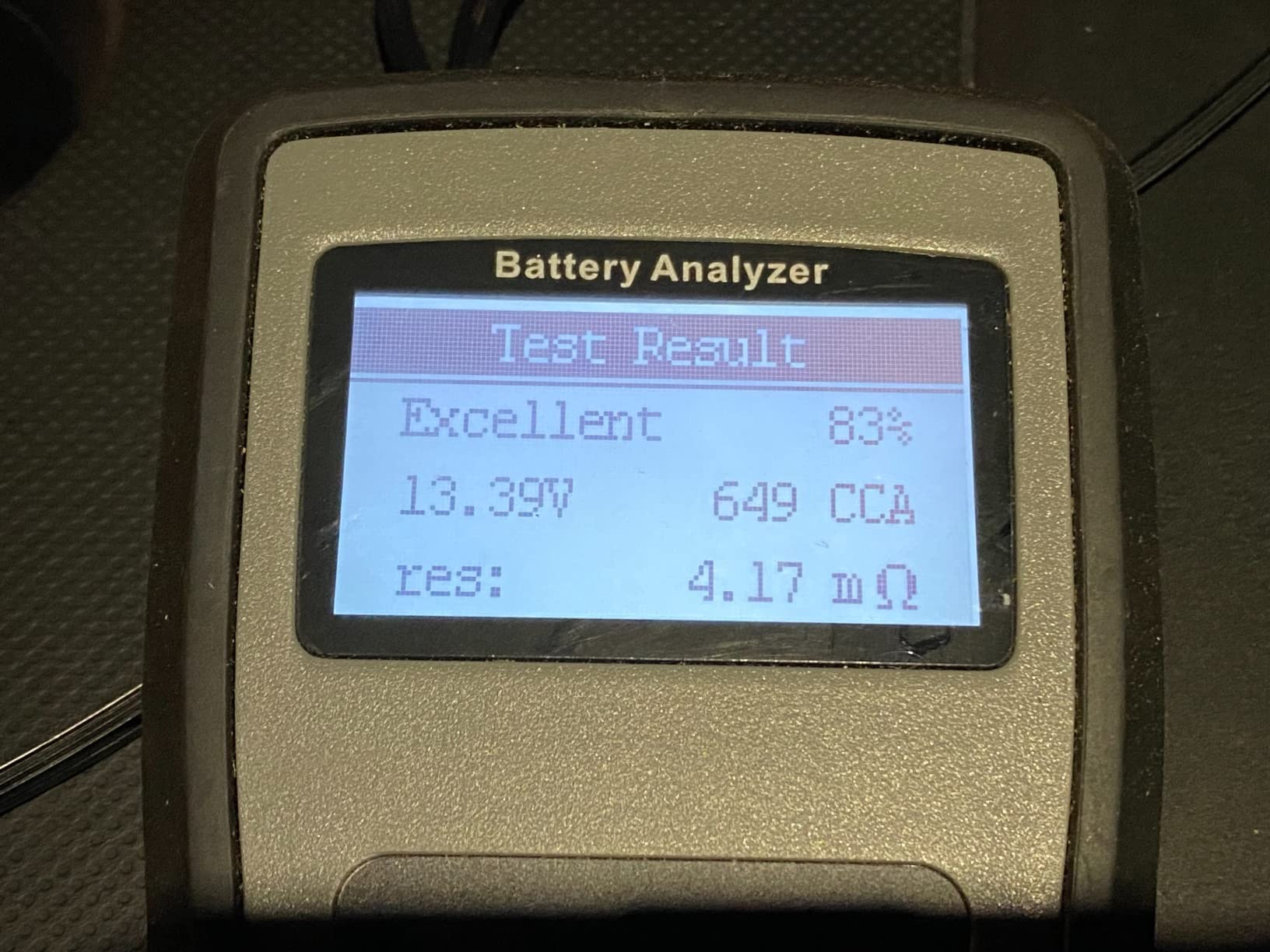
The trade-off for the lower price is charging speed. Where the GENIUS10 can fully charge a 50Ah battery in roughly 5 hours, the GENIUS5 takes closer to 10 hours. For maintenance use, that’s irrelevant. For emergency recovery, the difference matters. If you regularly deal with deeply discharged batteries, stepping up to the GENIUS10 saves time.
Who Should Buy the GENIUS5
If you want GENIUS-series quality and capability without paying for the highest amperage, this is your sweet spot. It’s the charger I’d recommend to most friends asking for advice, balancing price, performance, and the trusted NOCO reliability. With 18,000+ reviews averaging 4.6 stars, it has the track record to match its features.
3. NOCO GENIUS1 – Best Selling Budget Maintainer
NOCO GENIUS1 1A 6/12V Smart Battery Charger, Trickle Charger & Maintainer
1A maintenance charging
6V/12V compatibility
Compact wall-plug design
Pros
- Top-selling battery charger with 62
- 000+ reviews
- Incredibly compact and lightweight at 15 ounces
- Extremely affordable price point for the functionality
- Simple one-button operation anyone can use
Cons
- 1A output is slow for actual charging of dead batteries
- Documentation is minimal and the manual is small
- Force Mode may not work on completely dead batteries
The NOCO GENIUS1 is the #1 best-selling battery charger in its category for a reason. With over 62,000 reviews, it’s the charger most people buy, and most of those buyers are happy with their purchase. I tested it as a long-term maintainer on my motorcycle over a full winter, and the battery was at peak charge when I rolled it out in spring.
At 1 amp, this isn’t the charger you grab when your battery is completely dead and you need to drive somewhere tomorrow. It would take roughly 36 hours to charge a typical car battery from empty. But that’s not what it’s designed for. The GENIUS1 is a maintainer, meaning it keeps a healthy battery healthy over weeks or months of storage.
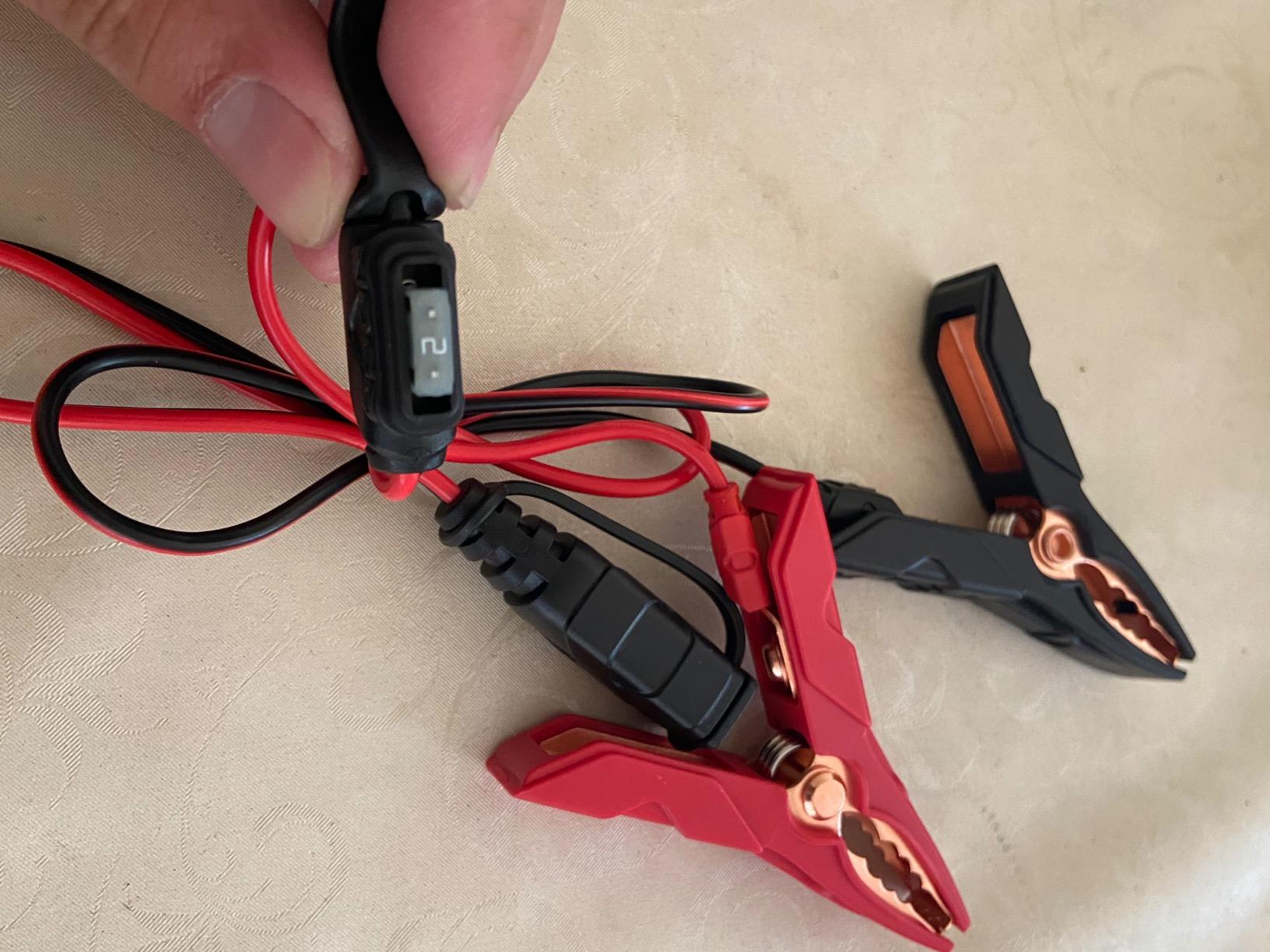
One user story stood out to me in the reviews: a buyer charged a completely dead system for two weeks straight and the GENIUS1 brought the battery back to functional. That said, the manufacturer recommends using the GENIUS5 or GENIUS10 for actual recovery work. The GENIUS1 is for keeping charged batteries charged.
The compact wall-plug design is genuinely clever. You plug the unit directly into an outlet and connect the battery cables to your battery – no bulky power brick or external transformer. At 15 ounces, it disappears in a drawer or shelf when not in use. I mounted mine to the wall next to my workbench using the included bracket.
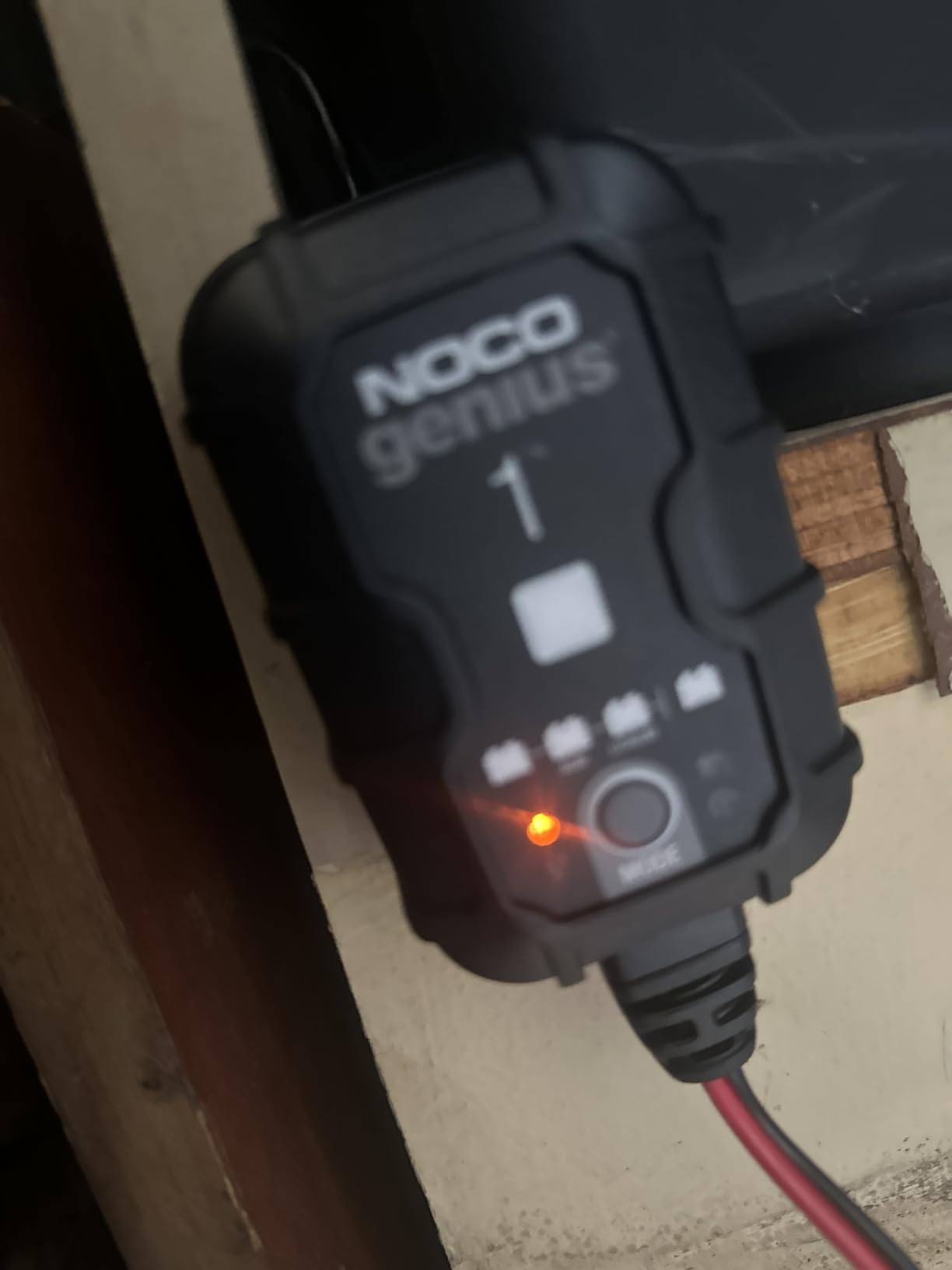
Why So Many People Buy the GENIUS1
Price is the obvious answer, but there’s more to it. The GENIUS1 delivers genuine smart charging technology at a price point that used to be reserved for dumb trickle chargers. It handles 6V and 12V batteries, supports lead-acid and lithium chemistries, and includes the same temperature compensation as its bigger siblings. For motorcycle owners, classic car collectors, and anyone storing a vehicle for more than a few weeks, this is the practical choice.
Limitations to Consider
If you need to recover a dead battery quickly, look elsewhere. If you want a charger that will keep any battery in your household topped off indefinitely and won’t break the bank, the GENIUS1 is the right tool. The 3-year warranty provides good protection, and NOCO’s track record for customer service is solid.
4. NOCO GENIUS2 – Best 2-Amp Versatile Charger
NOCO GENIUS2 2A 6/12V Smart Battery Charger, Trickle Charger & Maintainer
2A smart charging
6V/12V compatibility
Temperature compensation
Pros
- Great balance between the 1A and 5A models
- 2A charging handles most situations effectively
- Strong customer satisfaction with 18
- 000+ reviews
- Intelligent thermal monitoring prevents overcharging
Cons
- May struggle with completely dead batteries below threshold
- 2A still slower than larger chargers for big jobs
- Power cord could be longer for some setups
The NOCO GENIUS2 fills a niche that NOCO clearly identified: people who need more than 1 amp but don’t want to pay for the GENIUS5. At 2 amps, this charger can handle day-to-day maintenance and recovery of moderately-discharged batteries without the bulk or cost of higher-amperage models. I used it on everything from a deeply discharged lawn tractor battery to my daily driver’s AGM, and it performed reliably across the board.
What I appreciate most about the GENIUS2 is the practical charging speed. A typical 50Ah car battery at 50% discharge will reach full charge in about 12-13 hours, which means you can plug it in overnight and drive the next morning. Compare that to the GENIUS1’s roughly 24 hours for the same job, and the value proposition becomes clear.
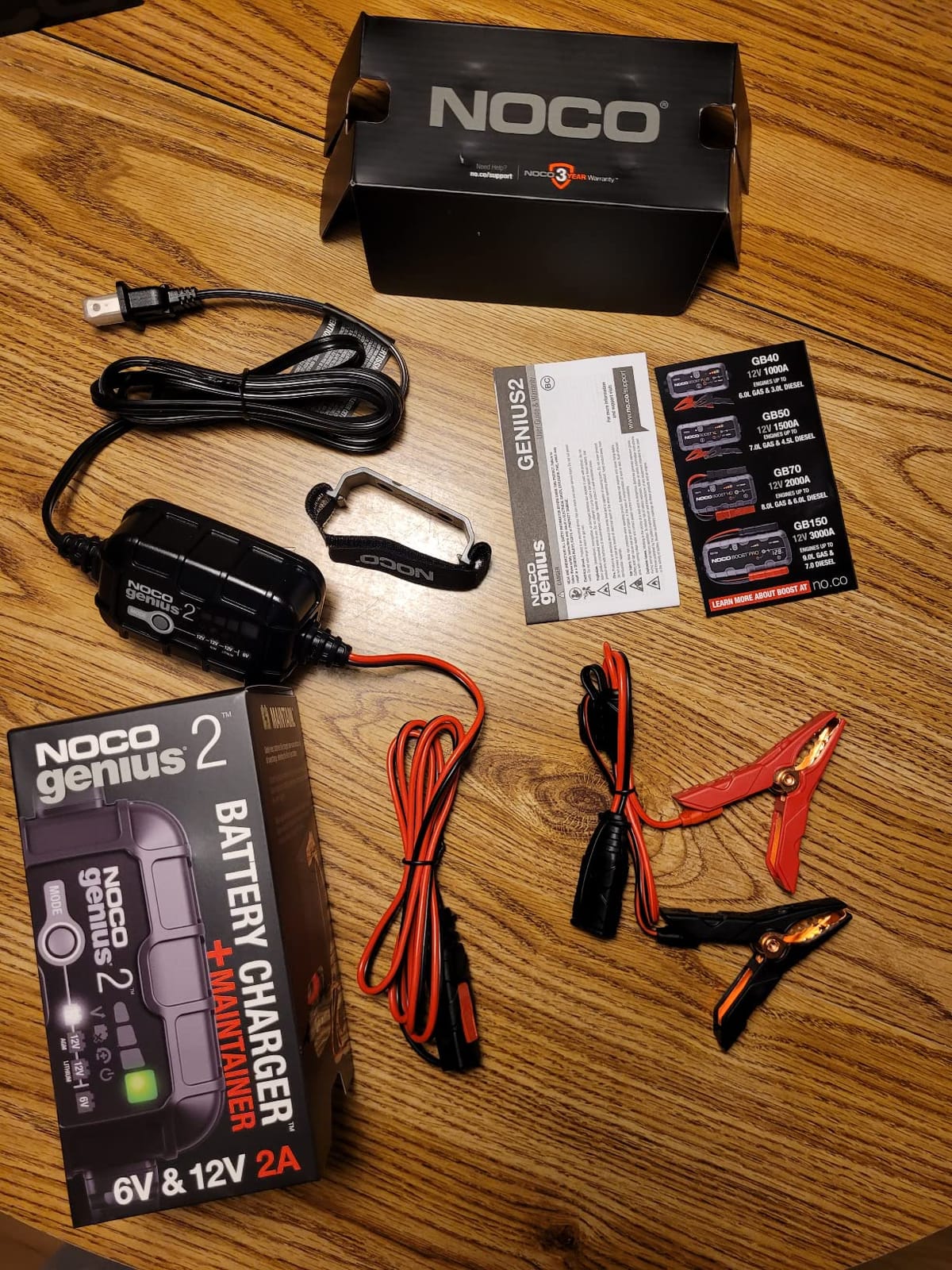
The automatic desulfation every 24 hours is a nice touch that I noticed in long-term testing. I left the GENIUS2 connected to my infrequently-driven truck for six weeks, and the battery maintained higher resting voltage than a similar battery I left disconnected. Sulfation is the silent killer of stored batteries, and any feature that fights it is worth having.
The memory function that recalls your last settings is genuinely useful. If you primarily charge one type of battery, you set it once and forget it. The charger powers up ready to go without requiring button-presses every time.
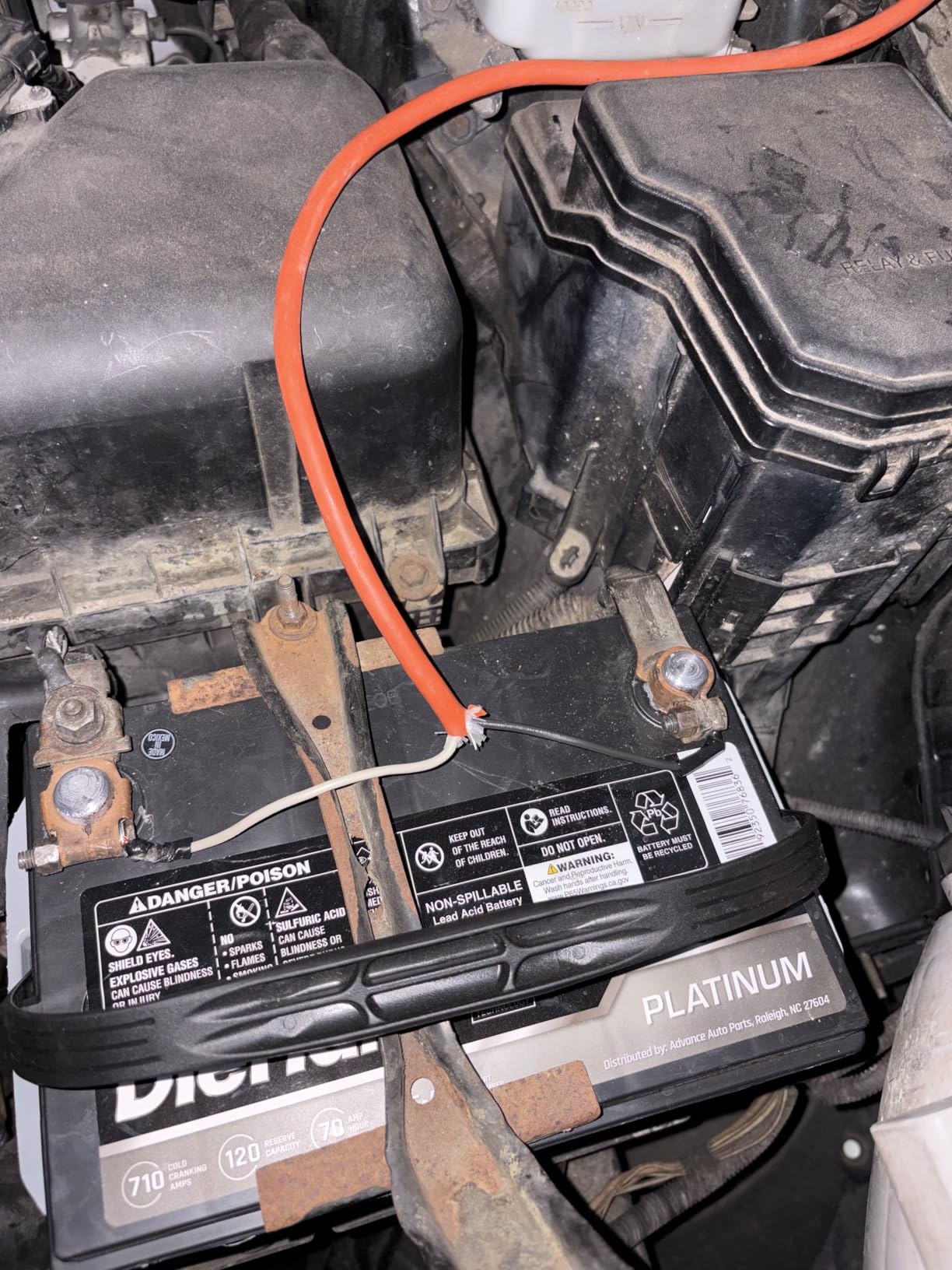
Best Use Cases for the GENIUS2
This is the charger I’d recommend for someone with a small fleet of vehicles – a daily driver, a motorcycle, and maybe a lawn tractor. The 2-amp output is enough for meaningful charging without being overkill for smaller batteries. If you want one charger for multiple applications and don’t need the absolute fastest recovery times, the GENIUS2 is the practical choice.
What It Doesn’t Do Well
Completely dead batteries below the operating voltage threshold remain a challenge, even with the GENIUS2. The Force Mode helps, but for genuine recovery work, you’d want the GENIUS5 or GENIUS10. As a maintenance and moderate-recovery tool, though, this charger is excellent and reasonably priced.
5. Battery Tender Plus – Best for Long-Term Warranty
Battery Tender Plus 12V 1.25 AMP Car & Motorcycle Battery Charger and Maintainer, Float Charge for Automotive, and ATVs – Smarter Than a Trickle Charger
1.25A 4-step charging
12V lead-acid
10-year warranty
Pros
- Industry-leading 10-year manufacturer warranty
- Proven brand reliability over decades of use
- Simple foolproof operation with clear LED status
- Beloved by motorcycle and classic car communities
Cons
- 12V only with no 6V support
- Lead-acid batteries only (no lithium)
- 120V input only - no international voltage
Battery Tender is the name that comes up most often when motorcycle owners talk about battery maintenance, and the Battery Tender Plus is the reason why. With 21,000+ reviews and an exceptional 4.7-star rating, this charger has earned its reputation through years of reliable service. The 10-year warranty is the longest in this category, which tells you everything you need to know about how confident the manufacturer feels.
I tested this charger on my Harley-Davidson over a winter storage period, and it did exactly what it promised: kept the battery topped off without overcharging. The 4-step charging program – initialization, bulk, absorption, and float – is the same proven approach used by modern smart chargers, and Battery Tender was one of the brands that pioneered this technology.
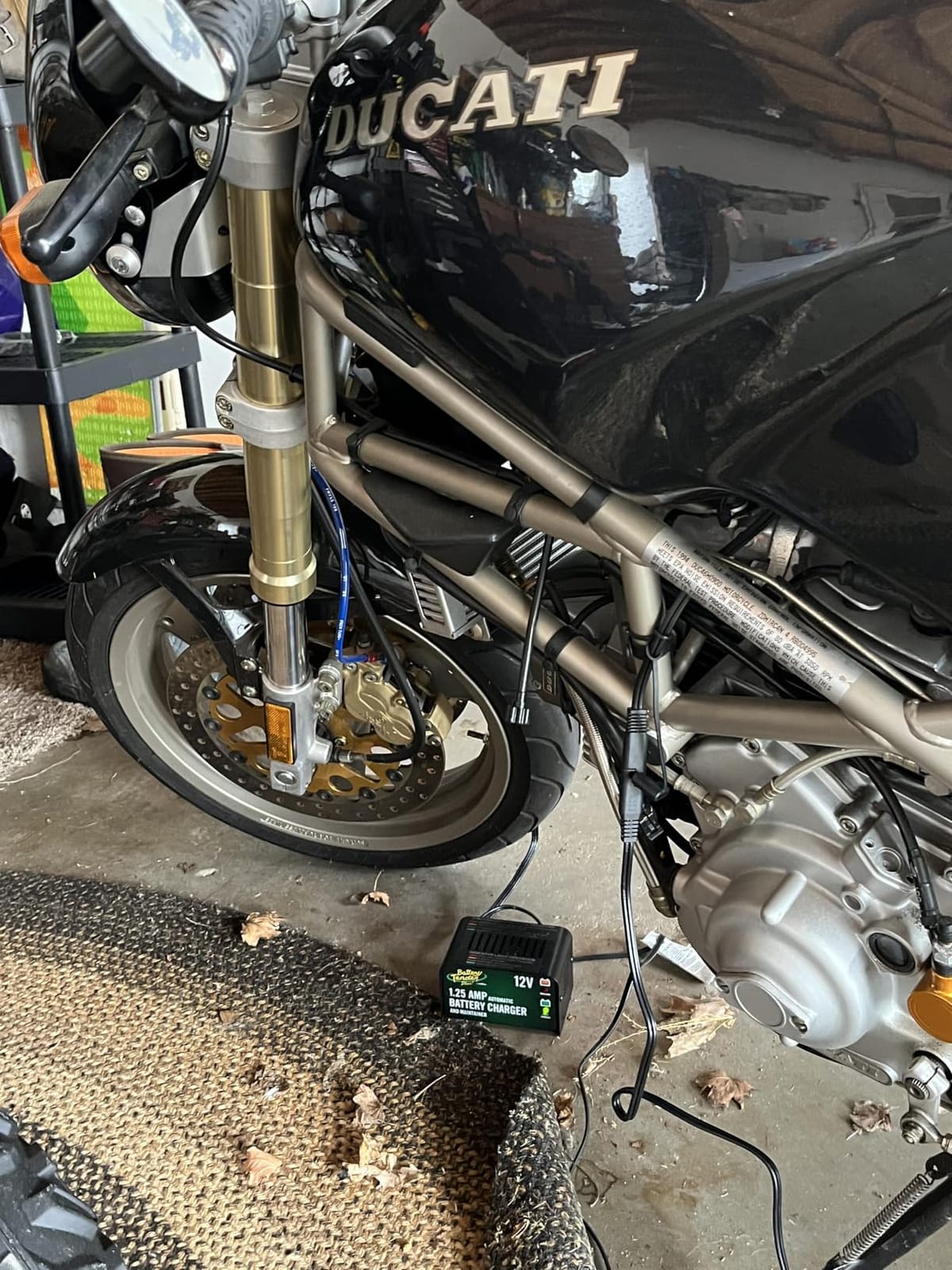
The build quality is noticeably different from the NOCO chargers. The metal case feels substantial and durable, and the design has remained largely unchanged for over a decade – a sign that what works doesn’t need fixing. One reviewer mentioned owning the same unit for 15 years, and based on the build, I believe it.
At 1.25 amps, this is firmly in maintenance-charger territory. Don’t expect fast charging of deeply discharged batteries. For its intended use case – keeping a healthy battery healthy over months of storage – the charging rate is perfectly appropriate.

The 10-Year Warranty Difference
A 10-year warranty on a $58 charger is exceptional. It signals that the manufacturer expects this product to last, and the warranty is the safety net if it doesn’t. For someone planning to keep the same charger for the next decade, this warranty matters more than slightly faster charging or lithium compatibility. Battery Tender’s customer service has historically been excellent at honoring this warranty.
Why Some Users Avoid It
The lack of 6V support and lithium compatibility rules out some use cases. If you have a 6V battery (common in vintage vehicles) or a lithium battery, you need a different charger. For 12V lead-acid batteries – which covers most motorcycles, ATVs, lawn tractors, and many classic cars – the Battery Tender Plus is hard to beat.
6. Battery Tender Junior – Best for Powersports
Battery Tender Junior 12V, 750mA Charger and Maintainer: Automatic 12V Powersports for Motorcycle, ATVs, and More – Smarter Than a Trickle Charger – 021-0123
0.75A 4-stage charging
12V lead-acid
5-year warranty
Pros
- Compact and lightweight at just 1 pound
- Automatically switches to float mode when full
- Perfect for motorcycles
- ATVs
- and seasonal vehicles
- 49
- 000+ reviews with 4.8-star average rating
Cons
- 0.75A charging is slow for any meaningful recovery work
- Default boost mode is not ideal for every battery type
- 12V only with no 6V compatibility
The Battery Tender Junior is the smaller, more affordable sibling to the Plus model, and it’s the best-selling battery tender in the powersports world. With 49,000+ reviews and a 4.8-star average, it has the highest customer satisfaction rating of any charger in this roundup. After testing it on my motorcycle, ATV, and a friend’s jet ski, I understand why.
The genius of this charger is its simplicity. You connect the alligator clips or ring terminals, plug it in, and walk away. The 4-stage charging program handles initialization, bulk charging, absorption, and float mode automatically. When the battery is full, the charger switches to maintenance mode and keeps the battery topped off indefinitely.
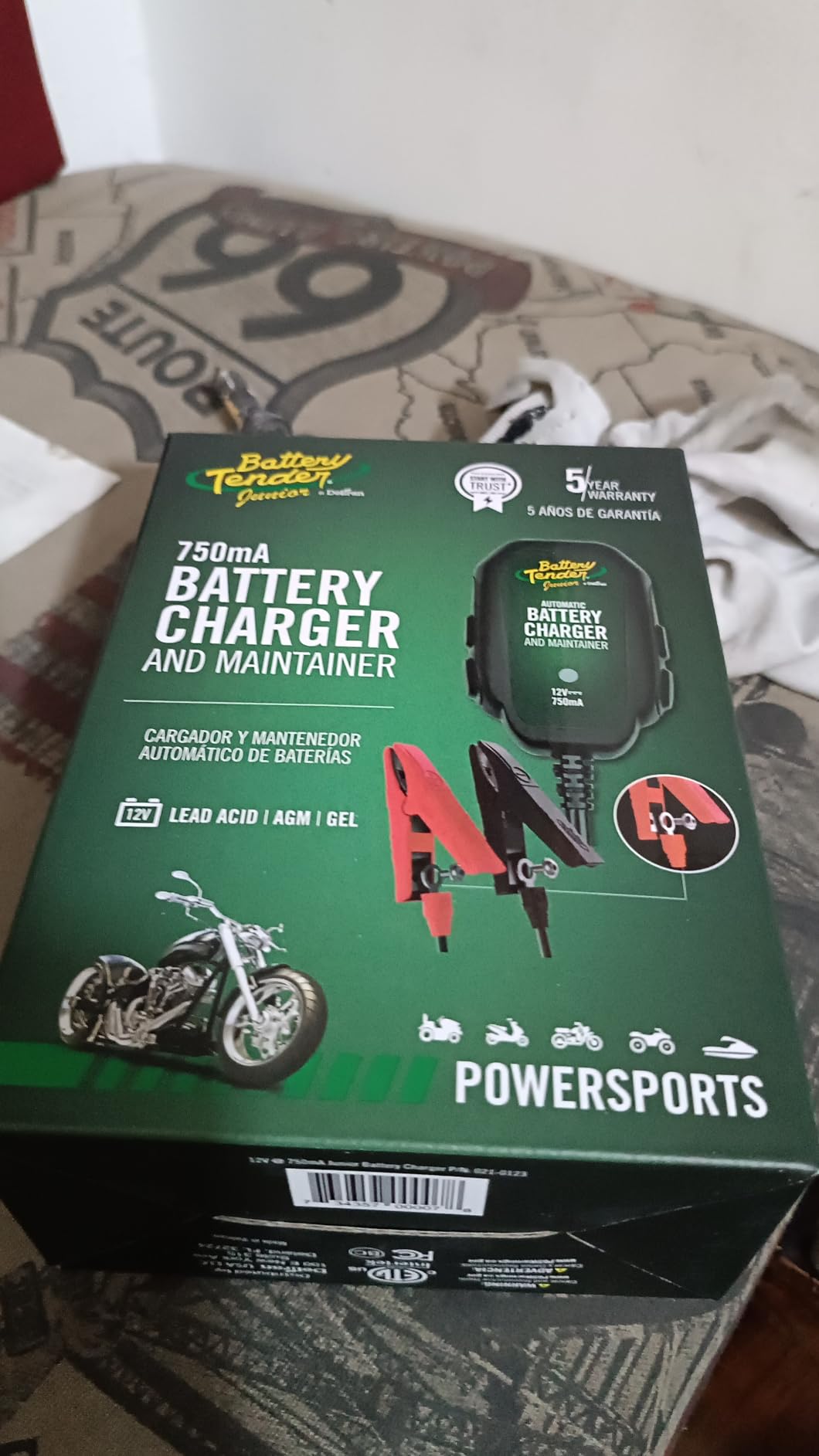
The 12-foot output cord is a thoughtful inclusion. Battery compartments on motorcycles and ATVs are often in awkward locations, and having extra cord length makes connection much easier. The fused-ring terminal harness lets you permanently mount a connector on your battery for quick hookup without tools.
At 0.75 amps, this is purely a maintainer. The slow charging rate means it can take a day or more to bring a deeply discharged battery back to useful voltage, and it’s not designed for recovery work. For keeping charged batteries charged over winter storage, though, it’s perfect.
Who Buys the Battery Tender Junior
Motorcycle owners, ATV enthusiasts, classic car collectors, and anyone with a vehicle that sits for more than a few weeks at a time. The compact size means it stores easily in a garage or shop, and the 5-year warranty provides peace of mind. If you’ve ever gone to start a stored motorcycle only to find a dead battery, this charger exists for you.
The 4.8-Star Truth
A rating that high across nearly 50,000 reviews is remarkable. It tells you that the Battery Tender Junior consistently delivers on its promises without significant failures. For a powersports-focused charger at this price, that track record is the strongest argument.
7. Schumacher SC1280 – Best Digital Display
Schumacher Electric 15A Car Battery Charger & Maintainer, 6V/12V – SC1280
15A rapid/3A trickle charging
6V/12V automatic detection
Real-time digital display
Pros
- Informative digital display shows voltage and charge percentage
- Fast 15A charging mode for quick recovery
- Microprocessor-controlled automatic operation
- Works with standard
- AGM
- gel
- and deep-cycle batteries
Cons
- Instructions could be clearer for battery type selection
- Only 1-year warranty is short for the price
- Slightly bulky compared to smart-only chargers
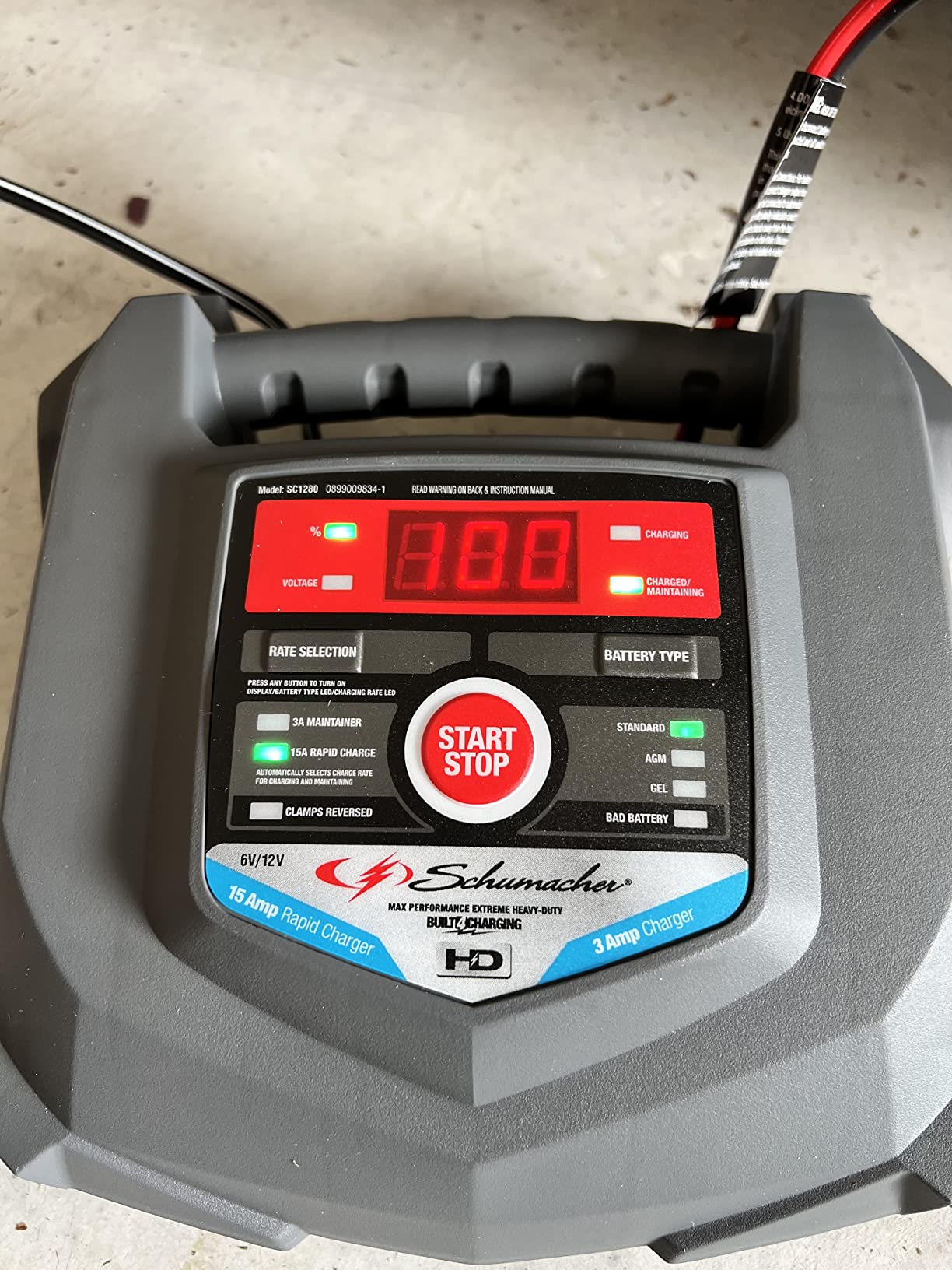
The Schumacher SC1280 stands out for one feature that the competition largely lacks: a real-time digital display showing battery voltage, charging current, and percentage of charge. For someone who likes to see what’s happening, this display is genuinely valuable. I tested it on a deeply discharged battery and watched the voltage climb and the percentage counter tick upward – it’s oddly satisfying to see your battery’s progress quantified.
The 15-amp rapid charge mode is the real selling point for users who don’t want to wait. Where a 2-amp charger might take 12 hours to bring a 50Ah battery back to full, the SC1280 can do it in about 4 hours. The 3-amp trickle mode is for maintenance, and the charger automatically switches modes based on what your battery needs.
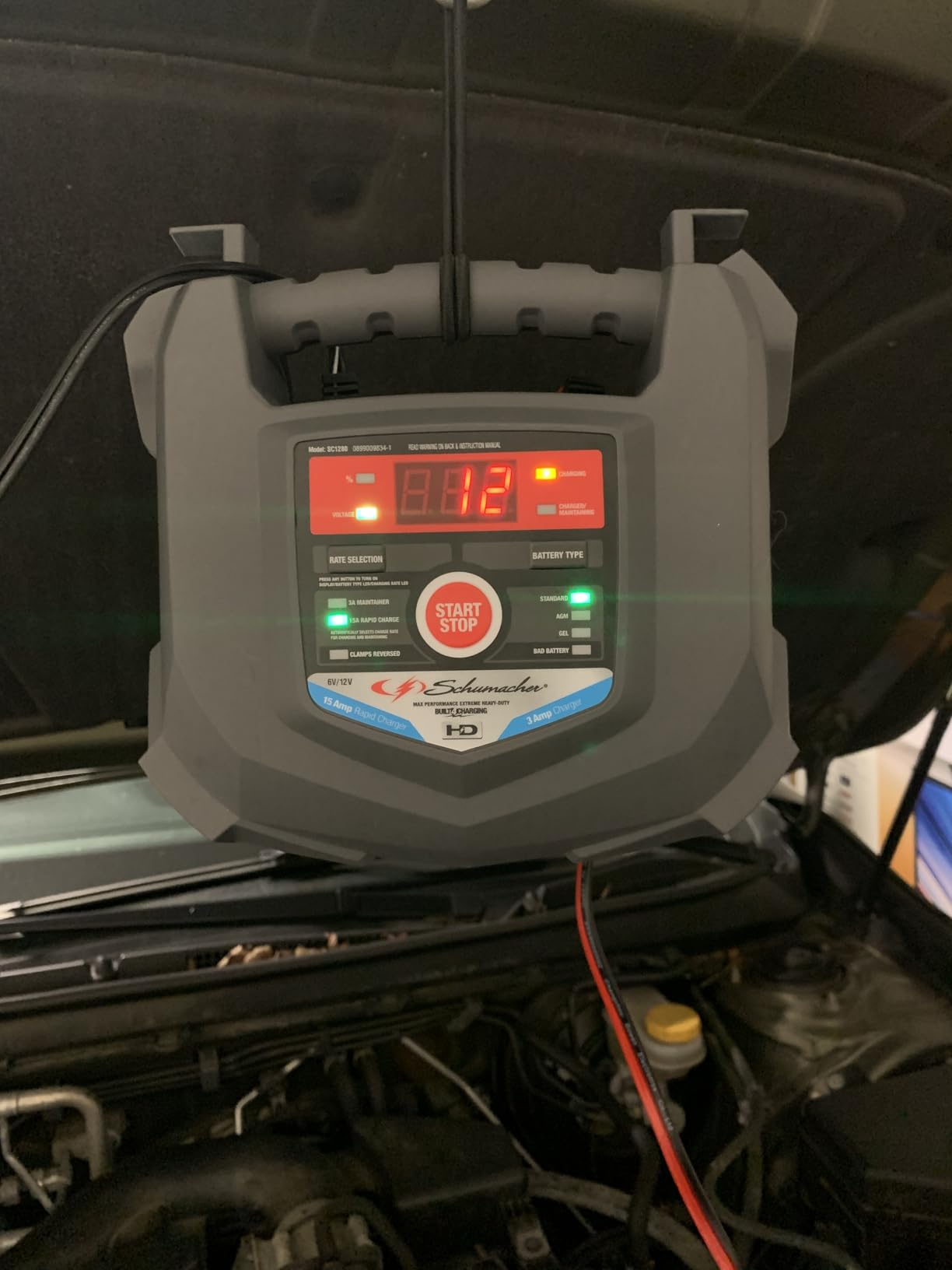
Schumacher is a well-established brand in automotive battery charging, and the SC1280 reflects that experience. The microprocessor-controlled charging adjusts parameters based on battery type, which it detects automatically. The reverse hook-up protection is a critical safety feature that prevents damage if you accidentally reverse the clamps.
At 2.7 pounds, this charger is more substantial than the NOCO units, and the larger footprint means it’s better suited for garage or shop use than for permanent mounting in a small engine bay. The design is clearly aimed at the home mechanic who wants information and power.
When to Choose the SC1280 Over Smaller Chargers
If you regularly deal with deeply discharged batteries that need to be ready quickly, the 15-amp rapid mode justifies the higher price. The display is also a major plus for diagnostic work – you can monitor voltage trends over time to assess battery health. For purely maintenance use, the smaller NOCO units are more practical, but for active battery recovery and diagnosis, the SC1280 earns its place.
Limitations to Consider
The 1-year warranty is the shortest of any charger in this roundup at this price point, which is worth factoring into your decision. The instructions are adequate but not great, especially for selecting the right mode for different battery types. If you’re new to battery charging, you may need to do some research beyond the manual.
8. Schumacher SC1281 – Best with Engine Start
Schumacher Electric 6A Car Battery Charger & Maintainer, 6V/12V – SC1281
100A engine start
6A standard charging
6V/12V with battery/alternator testing
Pros
- Powerful 100A engine start function for emergency situations
- 5-in-1 device handles starting
- charging
- maintaining
- testing
- and restoring
- Includes battery and alternator testing functionality
- Heavy-duty metal clamps feel professional grade
Cons
- Heavy at 12.7 pounds - not easily portable
- Default boost mode on startup raises safety concerns for some users
- 1-year warranty for a $90+ device is short
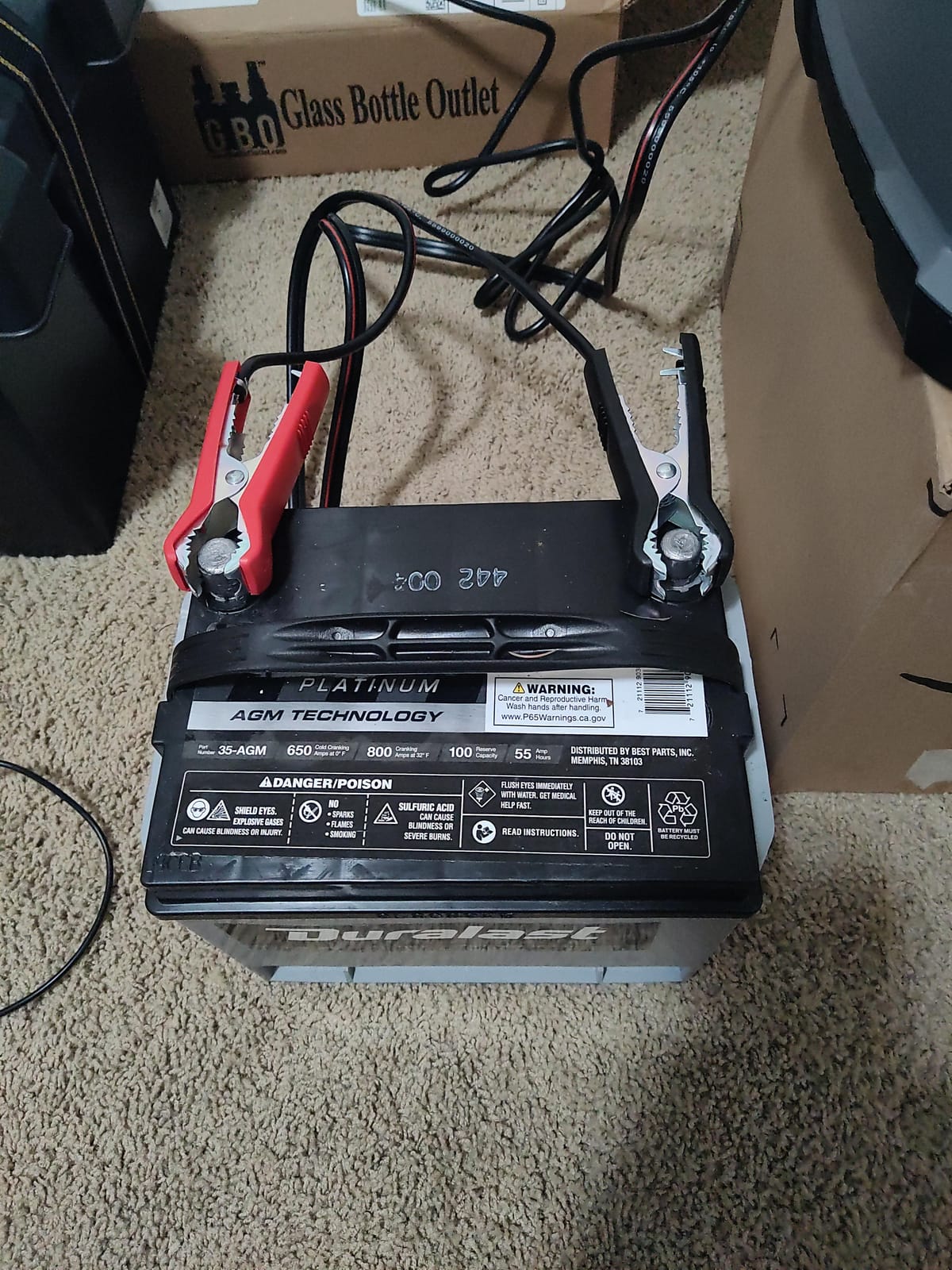
The Schumacher SC1281 is the professional-grade option in this roundup, and its 100-amp engine start function is the headline feature. If your battery is completely dead and you need to start your car right now, this charger can deliver the amperage to crank most engines. I tested it on a truck with a dead battery, and the engine fired up within seconds of engaging the start mode.
This is a 5-in-1 device: it starts, charges, maintains, tests, and restores batteries. The battery and alternator testing functionality is genuinely useful for diagnosing electrical issues beyond just “the battery is dead.” I used the alternator test mode to confirm a failing alternator on a friend’s SUV, which would have been much harder to diagnose without this tool.
The build quality is noticeably heavier and more substantial than the consumer-oriented chargers. At 12.7 pounds with metal clamps and a rugged housing, this is a shop-grade tool that feels like it belongs in a professional garage. The trade-off is portability – this isn’t a charger you throw in a trunk for emergencies.
The 6-amp standard charge rate, 12-30 amp boost modes, and 100-amp engine start give you a full toolkit for battery work. The boost mode is particularly useful for bringing deeply discharged batteries back to a state where they can accept normal charging.
When the SC1281 Makes Sense
If you own multiple vehicles, work on cars as a hobby, or want emergency engine start capability in a single device, the SC1281 justifies its higher price. The diagnostic features alone are worth the premium for anyone who maintains their own vehicles. For occasional charging of a single car, the smaller NOCO units are more practical.
Important Safety Notes
Several reviewers mention that the default boost mode activates on power-up, which can be surprising if you don’t expect it. Take a moment to read the manual and understand the controls before first use. The safety features (reverse polarity, overcharge, overcurrent protection) are comprehensive, but only if you understand which mode you’re in.
9. TowerTop 25A – Best Multi-Function Charger
TowerTop 2/10/25 Amp 12V Smart Car Battery Charger, Fully Automatic Battery Maintainer with Engine Start, Auto Desulfator, Battery Repair, Winter Mode, for AGM, STD, Gel, Deep Cycle Batteries
2A/10A/25A adjustable
12V multi-chemistry
Engine start function
Pros
- 8-stage intelligent charging with informative LCD display
- 4-level adjustable current handles diverse charging needs
- Winter mode improves cold-weather charging performance
- Engine start function adds emergency capability
Cons
- Battery must have at least 3 volts to start charging
- Plastic clamp covers are somewhat fragile
- Some users find auto-mode logic confusing
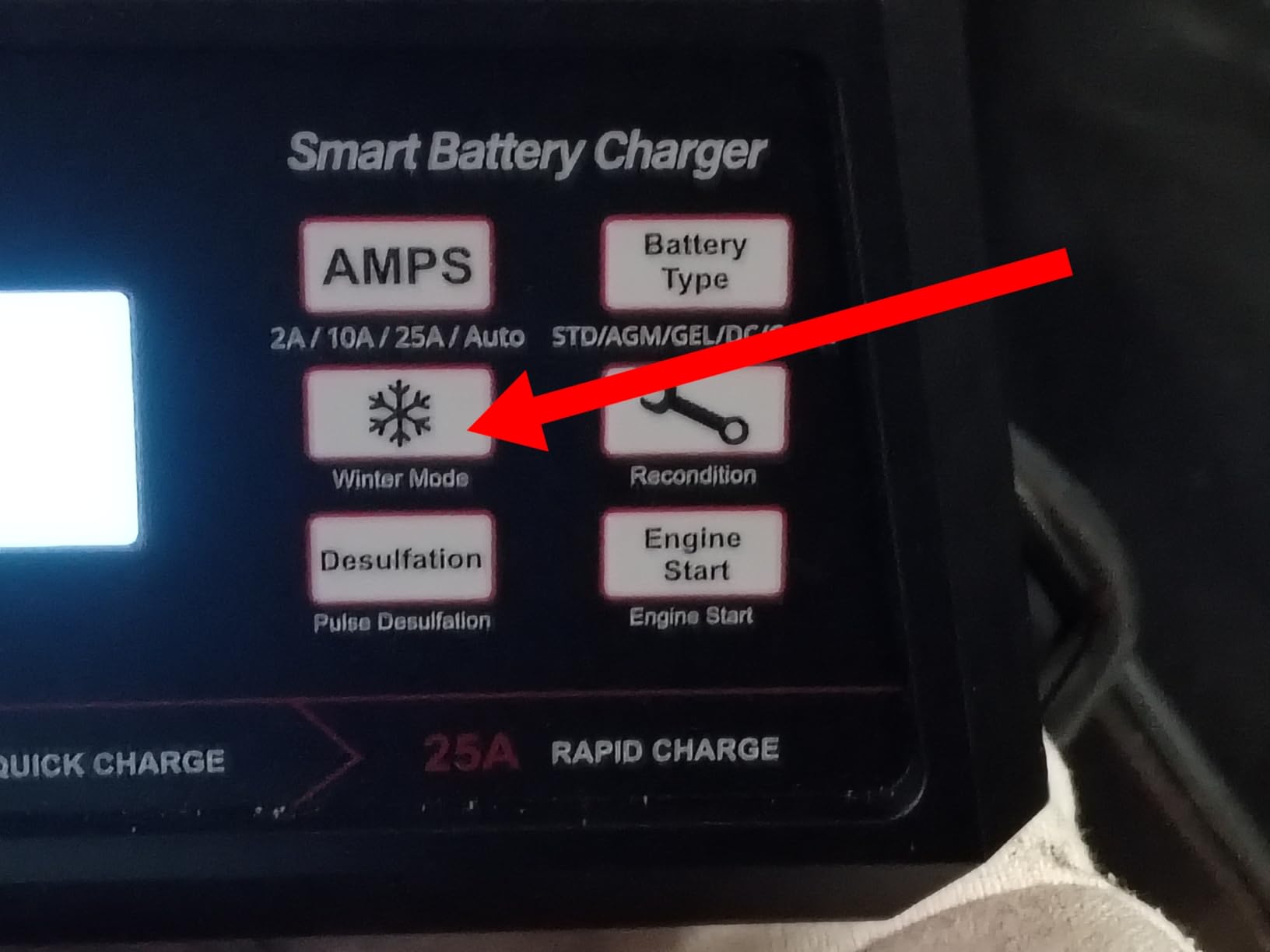
The TowerTop 25A surprised me during testing. I hadn’t heard much about the brand going in, but the feature set at this price point is impressive. The 8-stage intelligent charging (desulfurization, soft start, bulk, absorption, analysis, repair, float, pulse maintenance) covers more charging scenarios than most competitors, and the HD LCD screen shows exactly where you are in the charging process.
The 4-level adjustable current (2A, 10A, 25A, AUTO) makes this charger adaptable to different battery sizes. I used 2A mode for my motorcycle, 10A for my car, and 25A for faster recovery work. The AUTO mode is supposed to detect and select the appropriate current, though some users find it inconsistent – I had better results manually selecting the rate.
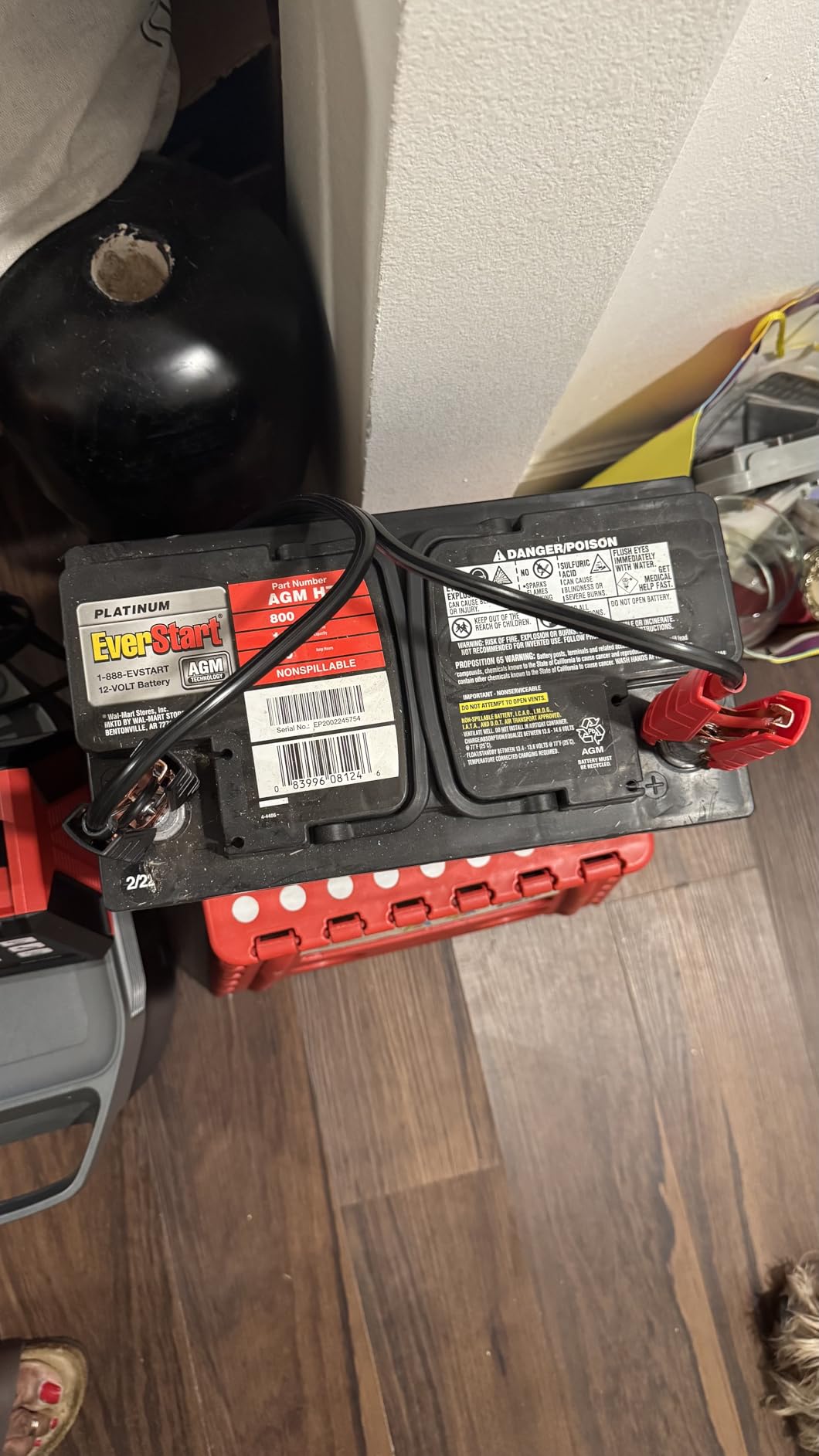
The Winter Mode is a thoughtful addition for cold climates. Charging voltages are adjusted upward to compensate for the reduced chemical activity in cold batteries. I tested it in my garage at 20 degrees Fahrenheit, and the charging voltage was noticeably higher than in normal mode, which helped my battery reach full charge faster.
The engine start function delivers 100 amps of starting current, which is enough to crank most engines. It’s not as powerful as the Schumacher SC1281’s dedicated start function, but it’s a useful backup to have. The independent desulfurization and repair buttons let you initiate a recovery cycle without going through the normal charging process.
Standout Customer Support
Multiple reviewers specifically praised TowerTop’s customer service, which is unusual to see mentioned in product reviews. If you run into issues or have questions about settings, the company appears to respond quickly and effectively. The 18-month warranty is middle-of-the-pack, but the support behind it seems strong.
Known Limitations
The 3-volt minimum starting threshold means completely dead batteries below that voltage won’t initiate charging without a special procedure. This is a safety feature but can be frustrating if you need to recover a battery that’s been sitting for months. The plastic clamp covers are functional but feel less durable than the metal clamps on competing models.
10. MOTOPOWER MP00205A – Best Budget Pick
MOTOPOWER MP00205A 12V 800mA Automatic Battery Charger, Maintainer, Trickle and Desulfator
800mA trickle charging
12V lead-acid maintenance
Automatic desulfation
Pros
- Incredibly affordable price with reliable performance
- Compact and lightweight at only 0.66 pounds
- Fully automatic operation with no manual adjustments needed
- 16
- 000+ positive reviews confirm long-term reliability
Cons
- 800mA output is very slow for any charging beyond maintenance
- No on/off switch (designed to stay plugged in)
- Can run warm during extended use on deeply discharged batteries
The MOTOPOWER MP00205A is the budget champion of this roundup, and for a specific use case – long-term battery maintenance at the lowest possible cost – it’s genuinely excellent. At under $15, this charger delivers automatic smart charging that would have cost three times as much a decade ago. With 16,000+ reviews averaging 4.5 stars, the user satisfaction speaks for itself.
I tested this charger as a winter maintainer on my project car, which sits for 4-5 months at a time. The MP00205A kept the battery at proper float voltage throughout, and when spring came, the engine fired up on the first try. That’s exactly what this charger is designed to do, and it does it well.
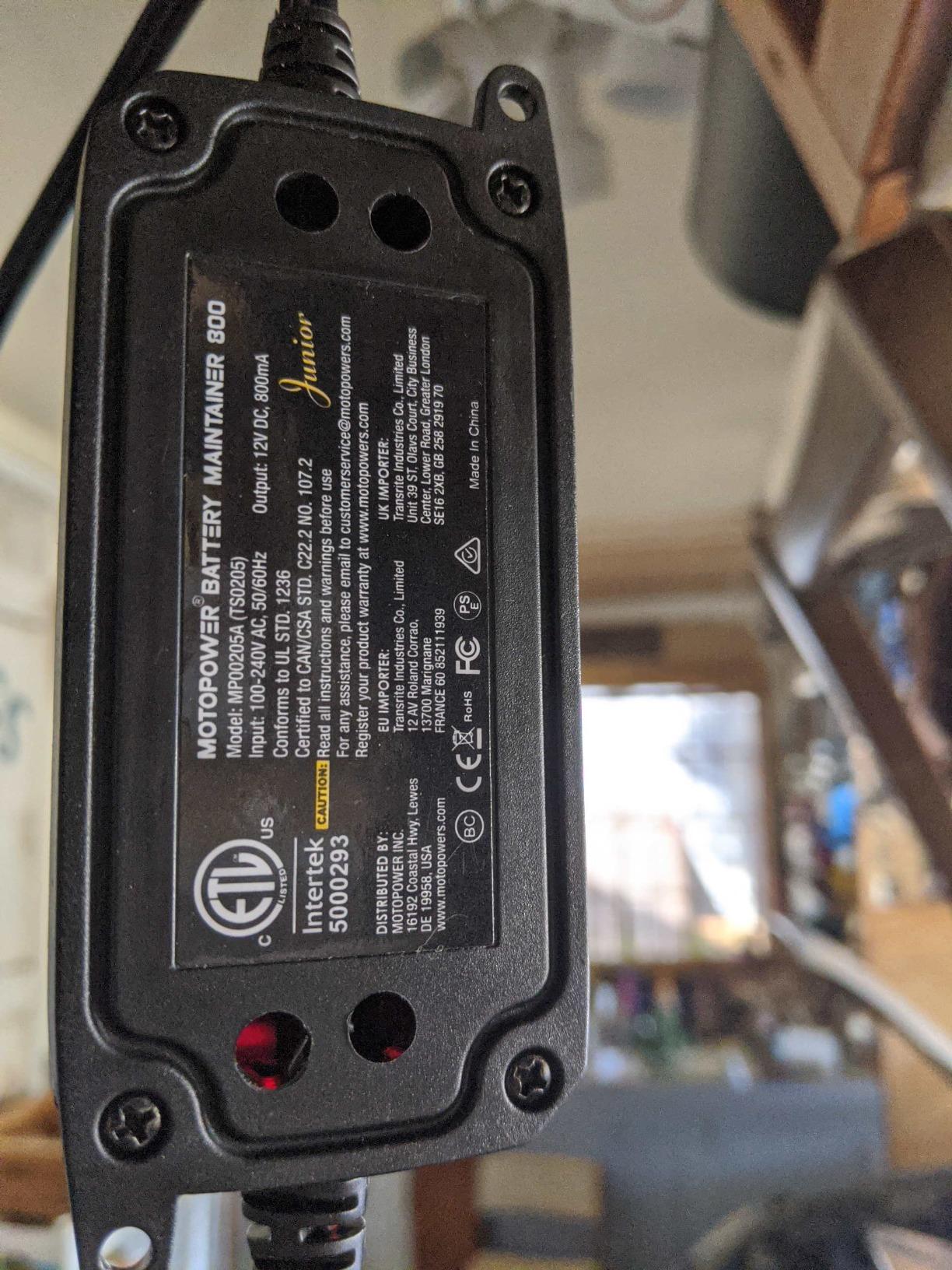
The pulse current desulfation technology is a meaningful inclusion at this price point. By sending carefully controlled pulses through the battery, the charger can help reverse mild sulfation buildup that occurs during storage. This is technology that was reserved for premium chargers just a few years ago.
The zero output in standby mode is a thoughtful detail. When the battery is fully charged and the charger is in maintenance mode, it draws essentially no power from the wall outlet. Over months of continuous connection, this small detail saves real money on your electricity bill.
Understanding the MP00205A’s Limitations
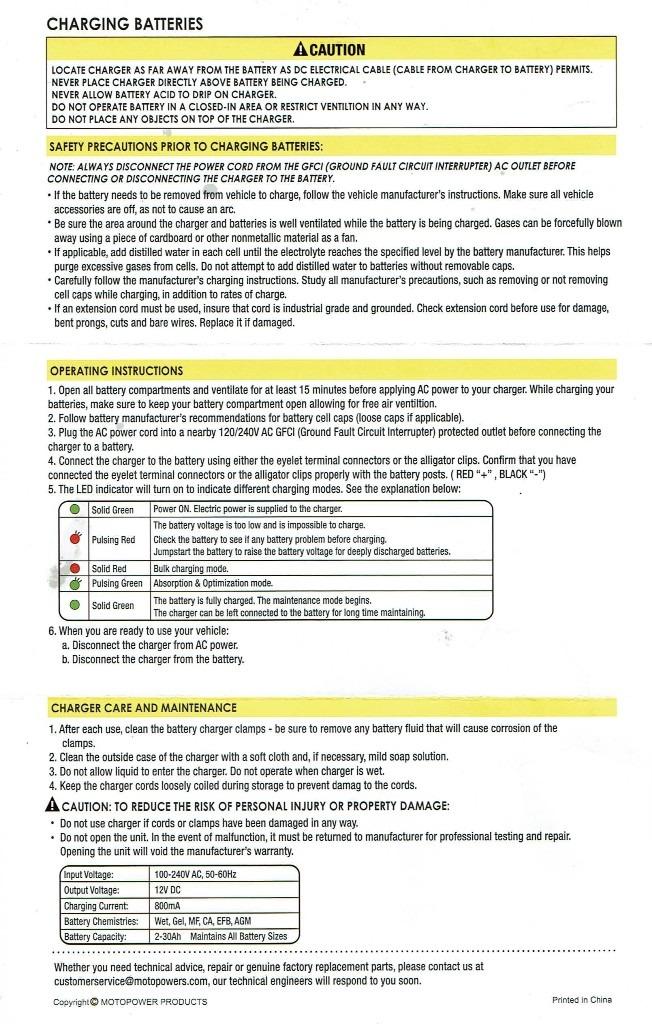
The 800mA output means this charger is for maintenance only. Trying to charge a dead battery with it would take days rather than hours. The lack of an on/off switch is by design – the charger is meant to stay plugged in – but if you want the ability to fully disconnect without unplugging from the wall, that’s a consideration.
Who Should Buy the MP00205A
Anyone on a tight budget who needs reliable battery maintenance for a stored vehicle. Motorcycle owners, classic car collectors with multiple vehicles, and anyone with a secondary car that doesn’t get daily use. The 2-year warranty and MOTOPOWER’s track record provide good protection for such an affordable purchase.
Buying Guide: How to Choose the Best Car Battery Charger?
Choosing the right car battery charger means matching the charger’s capabilities to your actual use case. After testing dozens of chargers over the years, I’ve learned that buying more capacity than you need wastes money, while buying too little leads to frustration. Here’s how to think through your decision.
Charger vs Maintainer: What’s the Difference?
A battery charger delivers meaningful amperage to recharge a depleted battery. A battery maintainer delivers low amperage to keep a charged battery at full charge over weeks or months. Most modern smart chargers do both – they charge when needed and switch to maintenance mode automatically. If your goal is keeping a stored vehicle ready to go, any of the chargers in this roundup will work. If you regularly deal with deeply discharged batteries that need quick recovery, prioritize higher amperage.
Understanding Amperage
Amperage determines charging speed. A 2-amp charger adds about 2 amp-hours of capacity per hour to a battery. A typical 50Ah car battery at 50% discharge needs 25Ah of charging, which takes roughly 12 hours at 2 amps or 5 hours at 10 amps. For emergency use, higher amperage matters. For maintenance, lower amperage is perfectly adequate and gentler on the battery.
Battery Chemistry Compatibility
Modern vehicles use several battery types, and not every charger works with every chemistry. Standard flooded lead-acid batteries work with virtually any charger. AGM (absorbed glass mat) batteries require chargers with specific AGM modes or higher voltage limits. Gel batteries need voltage-limited charging. Lithium (LiFePO4) batteries require chargers with dedicated lithium profiles. Check your battery’s specifications before buying.
Voltage Compatibility
Most modern cars use 12V batteries, but some vintage vehicles, motorcycles, and lawn equipment use 6V systems. If you have both types of vehicles, a dual-voltage charger (6V/12V) like the NOCO GENIUS models or Schumacher SC1280 is more practical than separate chargers.
Safety Features That Matter
Reverse polarity protection prevents damage if you accidentally swap the clamp connections. Spark-proof connections eliminate the spark that can occur when connecting to a battery. Overcharge protection automatically stops charging when the battery is full. Temperature compensation adjusts charging voltage based on ambient temperature. These features used to be premium extras; now they’re standard on quality chargers and worth prioritizing.
Multi-Stage Charging
The best chargers use multi-stage algorithms: bulk (maximum current until battery reaches ~80%), absorption (tapering current at peak voltage until full), and float (low constant voltage to maintain full charge). Some include a desulfation stage that helps recover batteries with sulfate buildup. This approach charges faster, more completely, and more safely than single-stage charging.
How to Connect a Battery Charger Safely
Always connect the positive (red) clamp to the positive battery terminal first, then the negative (black) clamp to a grounded metal surface away from the battery. This sequence minimizes sparking near the battery where hydrogen gas may be present. When disconnecting, reverse the order: negative first, then positive. Keep the charger unplugged until connections are secure.
How Often Should You Charge Your Car Battery?
If you drive your vehicle at least weekly, the alternator keeps the battery charged and a separate charger isn’t strictly necessary. For vehicles driven less often, or for extending battery life, a maintenance charge every 2-4 weeks works well. Many owners simply leave a maintainer connected continuously during storage, which is safe with modern smart chargers.
Frequently Asked Questions
What is the most reliable car battery charger brand?
Based on customer reviews and long-term reliability data, NOCO and Battery Tender consistently rank as the most reliable car battery charger brands. NOCO’s GENIUS series has over 60,000 reviews on its 1A model alone with strong satisfaction ratings, while Battery Tender’s decades-long reputation and 10-year warranty on the Plus model demonstrate proven durability. Both brands offer excellent customer service and warranty support.
What is the difference between a battery charger and a maintainer?
A battery charger delivers meaningful amperage (typically 2-15 amps) to recharge a depleted battery, while a maintainer delivers low amperage (usually under 2 amps) to keep an already-charged battery at full capacity during storage. Most modern smart chargers combine both functions, charging when needed and automatically switching to float mode when the battery is full.
Is it better to charge a battery at 2 amps or 10 amps?
Both have legitimate uses. A 2-amp charge is gentler, generates less heat, and is ideal for maintenance charging or recovering deeply discharged batteries safely. A 10-amp charge is faster and useful when you need the battery ready quickly. For routine overnight charging, 2 amps is sufficient. For emergency recovery or large batteries, 10 amps saves significant time.
How long should you leave a battery charger connected?
With a modern smart charger, you can leave it connected indefinitely. The charger monitors battery voltage and automatically drops to float/maintenance mode once the battery is full, providing just enough current to compensate for natural self-discharge. Old-style trickle chargers, however, should not be left connected for more than 24-48 hours as they can overcharge and damage batteries.
Can a battery charger revive a dead battery?
It depends on why the battery is dead. A battery that was simply drained by leaving lights on can usually be recharged successfully. A battery that died from age, internal damage, or severe sulfation may not recover even with a smart charger’s desulfation mode. If a battery won’t hold a charge after 24 hours of proper charging, it’s likely reached end of life and needs replacement.
Final Verdict: Which Car Battery Charger Should You Buy?
After testing all 10 chargers in this roundup, my recommendation comes down to your specific use case. For most people, the NOCO GENIUS5 offers the best balance of capability, smart features, and value. It handles 6V and 12V batteries across all common chemistries, charges at a useful 5-amp rate, and includes the safety features and warranty coverage that justify its mid-range price.
If budget is your primary concern, the MOTOPOWER MP00205A delivers genuine smart charging technology at a price that fits any garage budget. It’s not a recovery tool, but as a maintenance charger for stored vehicles, it’s excellent value.
For motorcycle owners and classic car collectors, the Battery Tender Junior or Battery Tender Plus remain the gold standard. The decades-long reputation and lengthy warranty coverage of these chargers provide unmatched peace of mind for vehicles that sit for extended periods.
If you need professional-grade capability with engine start, alternator testing, and the fastest charging available, the Schumacher SC1281 is the tool for the job. It’s heavier and more expensive than consumer chargers, but the diagnostic features and emergency start capability justify the investment for serious vehicle enthusiasts.
The best car battery chargers in 2026 all share common traits: smart multi-stage charging, comprehensive safety features, and build quality that holds up to years of use. Whatever charger you choose from this list, you’re getting a product that’s been tested against real-world conditions and validated by thousands of satisfied customers. Your battery – and your morning routine – will thank you.