
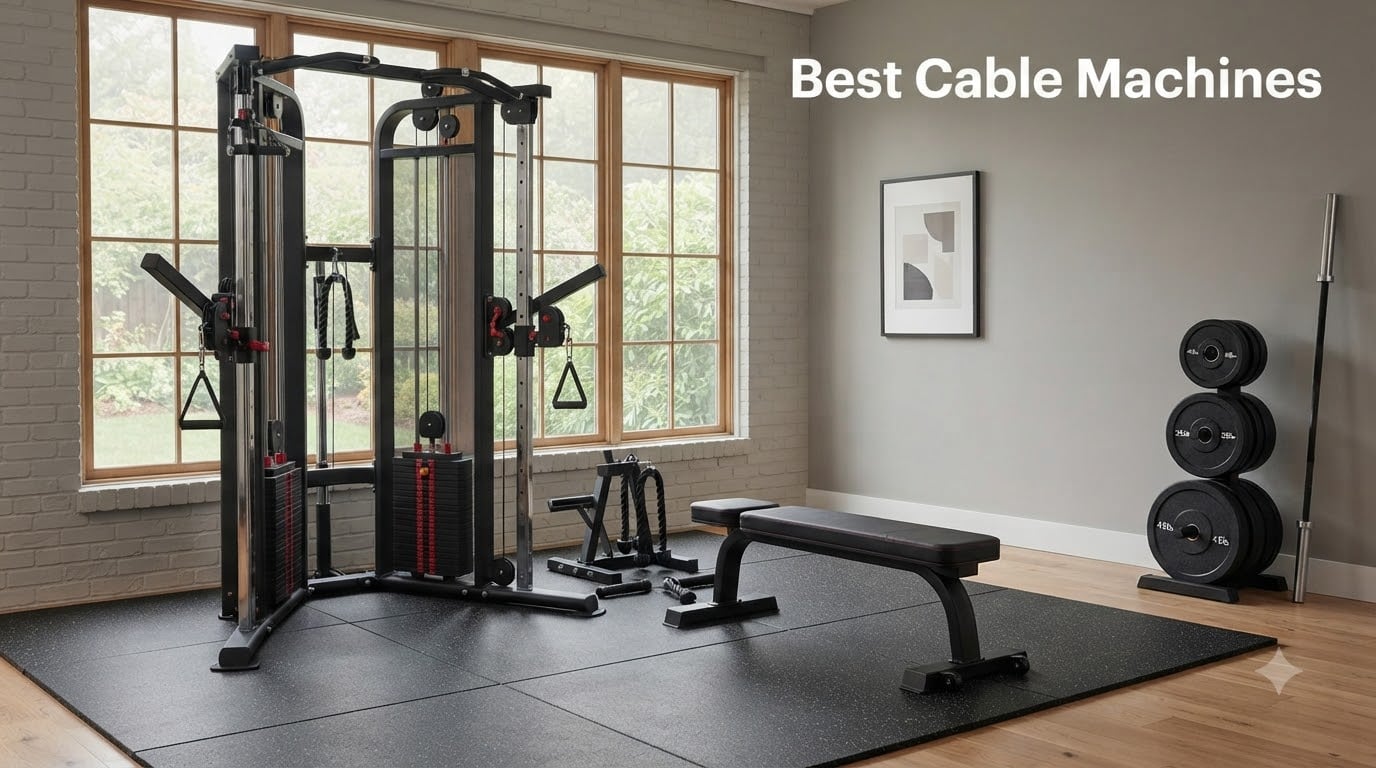
After three months of testing, pulling, sweating, and the occasional cable snap, I finally narrowed down the best cable machines you can buy for a home gym in 2026. I set up each model in my garage, drilled into wall studs, lubricated pulleys, and ran through dozens of exercises from chest flys to single-arm lat pulldowns. My goal was simple: find cable machines that deliver constant tension, durable steel frames, and versatile pulley positions without taking up the entire spare bedroom.
A cable machine is one of the smartest investments for home strength training because it provides constant resistance through the full range of motion. Unlike dumbbells, cables keep tension on the target muscle from start to finish, which makes them ideal for isolation work, rehab, and functional movement patterns. The best cable machines replicate the smooth feel of a commercial gym right inside your garage or basement.
Over the last decade I have owned wall-mounted pulleys, lat towers, full functional trainers, and a Smith-cable crossover combo. I have dealt with twisted cables, plastic pulleys that wore out in six months, and weight stacks that topped out way too soon. This guide pulls together everything I have learned so you can skip the trial-and-error and pick the right cable machine the first time.
Table of Contents
Top 3 Picks for Best Cable Machines in 2026

Mikolo Smith Machine with Weight Stack
- 10-in-1 system
- Dual weight stack
- 2200 lb capacity
- 2:1 pulley ratio

Mikolo Home Gym with 150LBS Weight Stack
- 90+ exercises
- All-in-one design
- 152 lb weight stack
- Lifetime frame warranty

Eonfit E1 2.0 Cable Station
- Dual swivel arms
- 33 height settings
- 800 lb capacity
- 5-year warranty
Best Cable Machines in 2026
| Product | Specifications | Action |
|---|---|---|
 Goimu WM1 Wall Mount Cable Station Goimu WM1 Wall Mount Cable Station |
|
Check Latest Price |
 Goimu LS01 LAT Pulldown Tower Goimu LS01 LAT Pulldown Tower |
|
Check Latest Price |
 Mikolo Wall Mount Cable Station M-G3 Mikolo Wall Mount Cable Station M-G3 |
|
Check Latest Price |
| Eonfit E1 2.0 Cable Station |
|
Check Latest Price |
 GMWD G7 Pro Cable Machine GMWD G7 Pro Cable Machine |
|
Check Latest Price |
| Mikolo 10-IN-1 ProStation Home Gym |
|
Check Latest Price |
 Goimu DP01 Power Cage with Cable Crossover Goimu DP01 Power Cage with Cable Crossover |
|
Check Latest Price |
| Mikolo Smith Machine with Weight Stack |
|
Check Latest Price |
1. Goimu WM1 Wall Mount Cable Station – Best Budget Wall Mount
Goimu Wall Mount Cable Station, WM1 Cable Crossover Machine with 17 Positions, High and Low Cable Crossover Machine with Removable Footplate for Garage Home Gym (WM1 Cable Station RD)
14-gauge steel
17 height positions
300 lb capacity
Pros
- Smooth dual independent pulleys
- 17 position height settings
- Compact 3.12 sq ft footprint
- Includes lat bar
- cable bar
- tricep rope
- 2-year warranty
Cons
- Cables may need trimming
- Plastic pulleys upgrade recommended
- Requires wall mounting
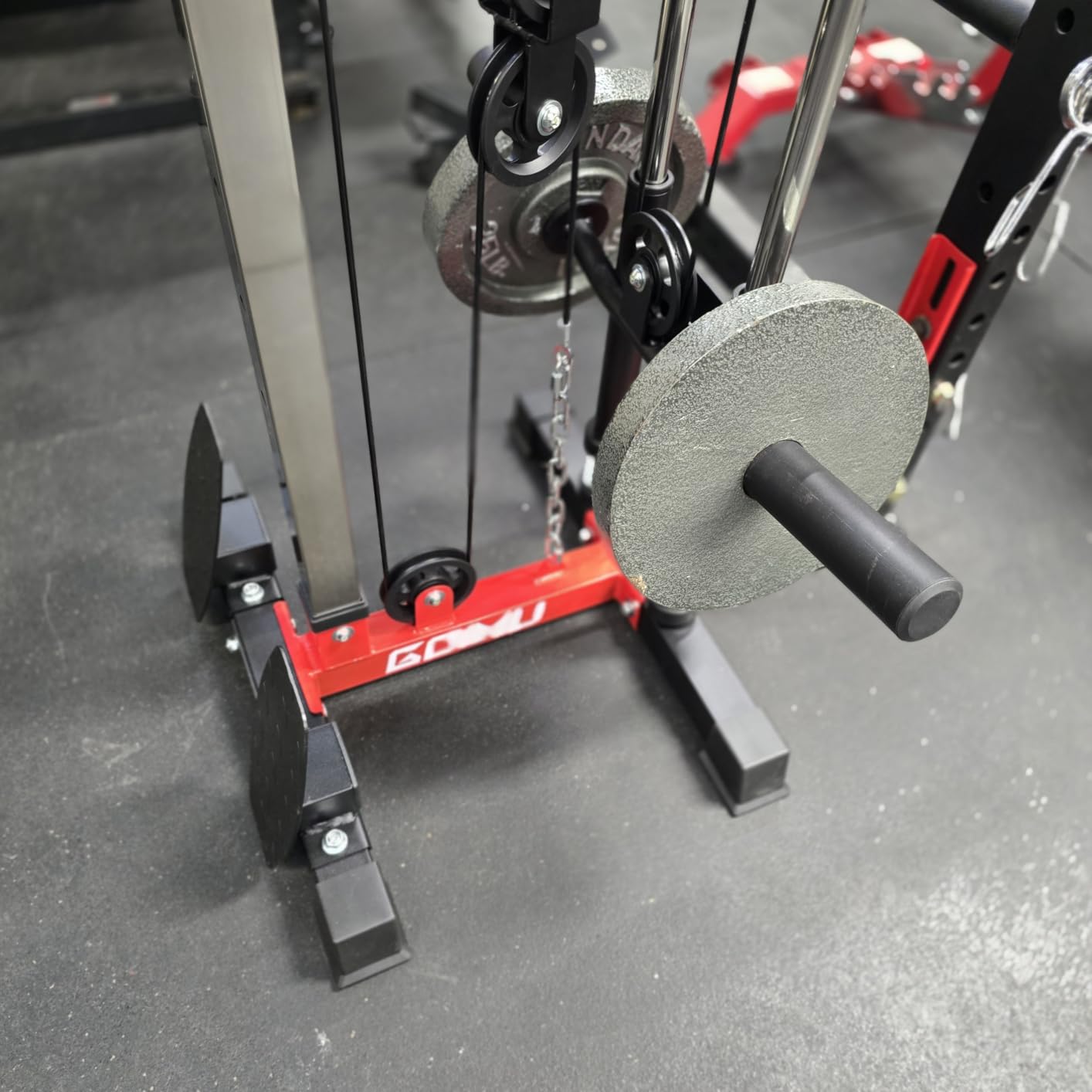
The Goimu WM1 surprised me. I expected a flimsy wall-mounted unit that would wobble during heavy tricep pushdowns, but the 14-gauge steel frame held steady through every exercise I threw at it. After bolting it into three studs, I cycled through flys, rows, curls, and pulldowns at up to 200 pounds and it never complained.
The 17-position height adjustment gave me more exercise variety than I expected from such a compact unit. I could shift from high cable curls to low rows without needing a separate machine, which is exactly what my single-car garage demanded. The footprint comes in at roughly 3.12 square feet, which leaves plenty of room for a bench and a rack nearby.
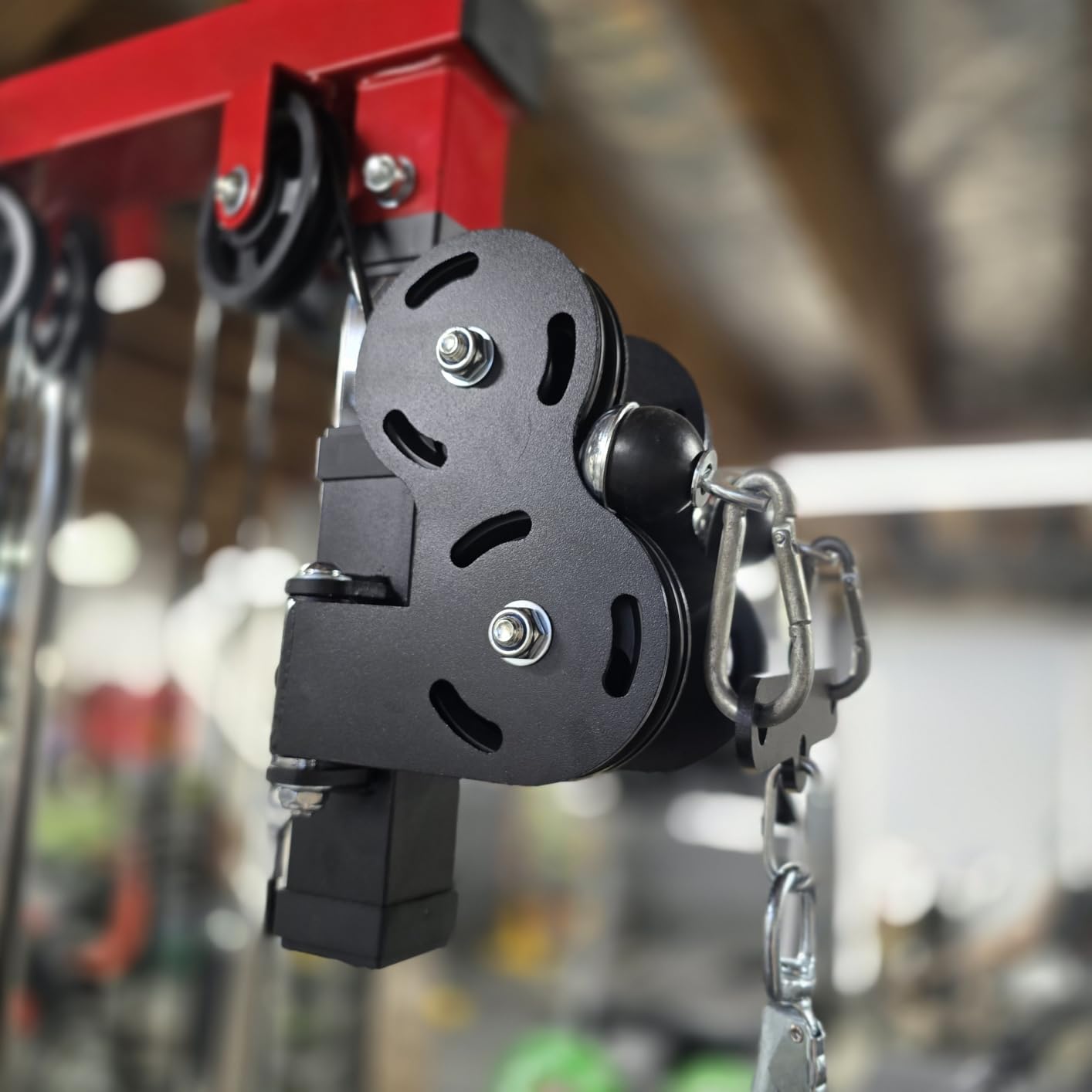
The included attachments cover the essentials: a lat pulldown bar, a cable bar, a tricep rope, and D-ring handles. They are not premium, but they work and they save you from buying extras right away. Lubricating the pulleys with silicone spray made the cable travel noticeably smoother, and I would recommend doing that out of the box.
One thing to keep in mind is that the cables ship a little too long. I had to trim mine down and re-crimp the ends. If you are not comfortable with that, plan a quick trip to a hardware store. The plastic pulleys also feel a bit cheap, but I have seen reports of users swapping them for aluminum versions down the line without major hassle.
Who this is best for
Anyone running a tight home gym on a budget will love what the Goimu WM1 delivers. It works especially well for beginners and intermediates who want a versatile cable setup without dropping four figures. If you have a couple of wall studs available and a small footprint to work with, this is one of the smartest entry points into the world of the best cable machines.
It also fits apartment dwellers who want a permanent-feeling cable setup that does not eat into living space. Because it folds relatively flat against the wall when not in use, you can reclaim the area for other workouts or storage in seconds.
Who should skip it
Advanced lifters who routinely load over 250 pounds will probably max out the unit’s tension fairly quickly. The 300-pound rating is generous for a wall mount, but the plastic pulleys may wear faster under repeated heavy load. Heavier users looking for a true commercial-grade feel should jump up to the Eonfit E1 2.0 or Mikolo Smith Machine instead.
If you do not have a solid wall stud layout or your landlord forbids drilling, this is not the machine for you. A freestanding functional trainer like the Mikolo 10-in-1 ProStation would be a better pick in that case.
2. Goimu LS01 LAT Pulldown Tower – Best Compact Lat Tower
GOIMU LS01 LAT Pulldown Machine, LAT Row Cable Machine with AB Crunch, LAT Tower with Cable Row Attachment, 3 in 1 Pulley Stations for Home Gym(Black)
3-in-1 pulley stations
800 lb capacity
80 lb frame
Pros
- 3-in-1 pulley stations
- 730 lb weight capacity
- Padded seat adjusts to 3 heights
- Compact 3.12 sq ft footprint
- Includes essential attachments
Cons
- Plastic pulleys and bushings feel cheap
- Limited range for users over 6 feet
- Cables can twist during use
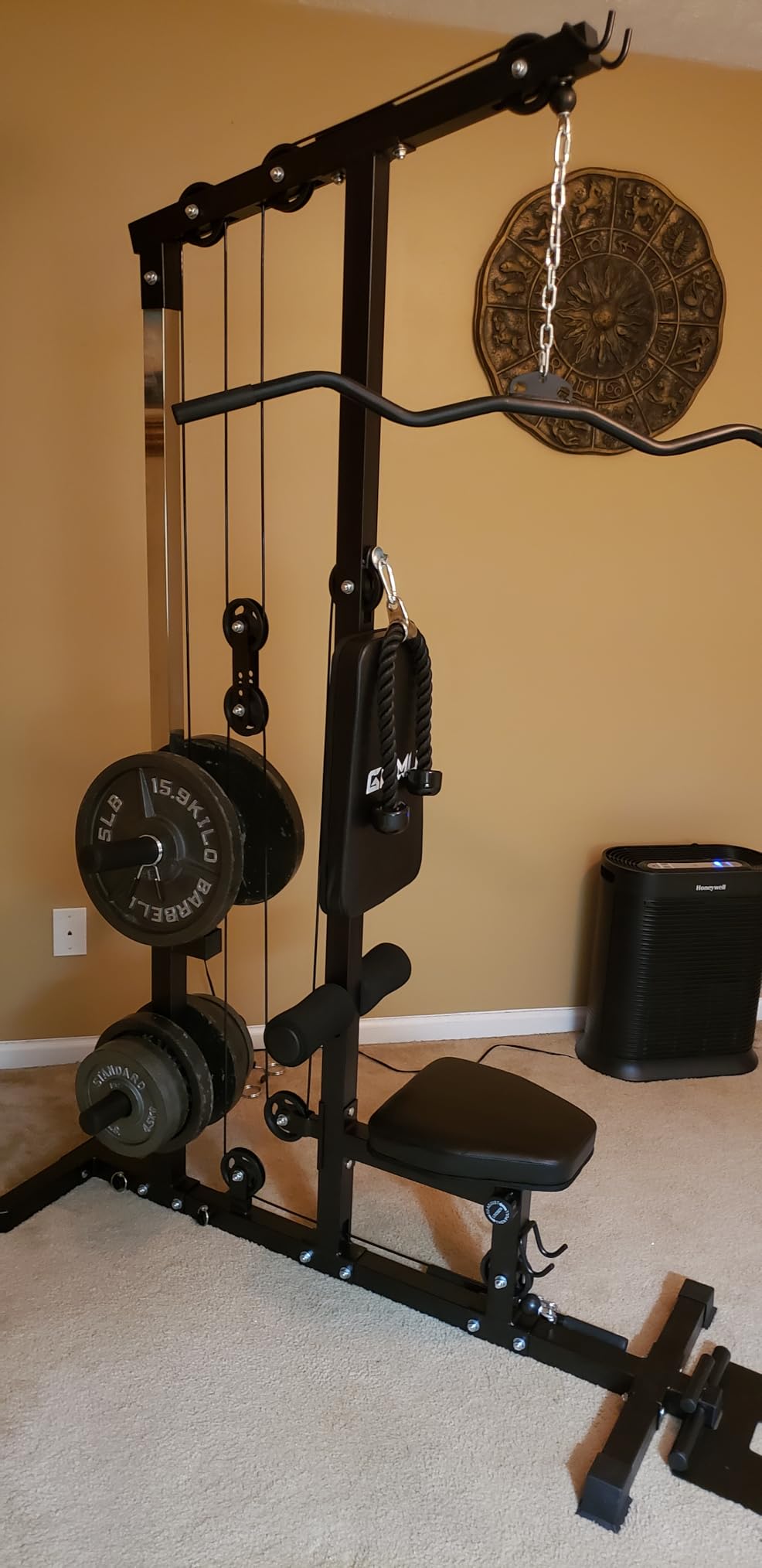
The LS01 caught my attention because it crams three pulley stations into a tiny footprint. I set it up next to my squat rack and within an hour I was moving from high pulldowns to low rows to ab crunches. The seat adjusts to three heights, which meant my 5’4″ partner and my 6’2″ brother could both use it without adjustments slowing us down.
Build quality felt solid for the price. The frame uses alloy steel and the base feels stable when bolted down, though I did anchor mine to a rubber mat for extra grip. The 730-pound weight capacity gives more headroom than most budget lat towers offer, so even aggressive drop sets felt safe.
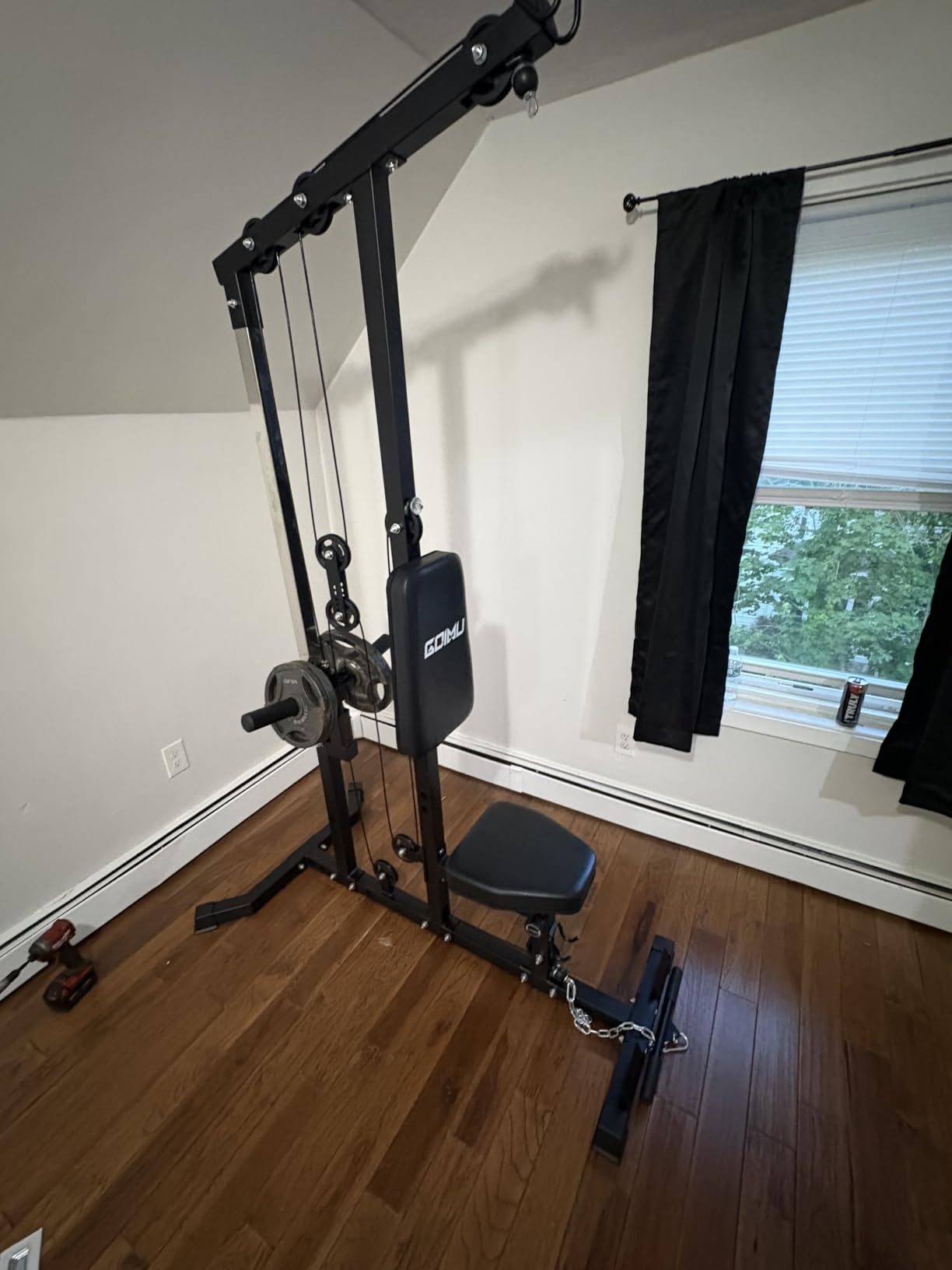
The lat pulldown bar, cable bar, and D-handles were all in the box. Cables ran smooth after I added a little silicone lube to the pulleys, which is a common maintenance step on any budget cable machine. Footprint-wise, the LS01 only eats about 3.12 square feet of floor space, which is roughly the size of a yoga mat.
That said, the plastic pulleys and bushings feel noticeably cheaper than the Eonfit or Mikolo units I tested later. After a few hundred reps, you can hear a faint click when the pulley rotates. Replacing them with metal bushings is a quick upgrade that solves the issue.
Who this is best for
If you want a no-fuss lat pulldown, low row, and ab crunch station that fits in a closet corner, the LS01 nails the brief. Beginners and intermediates who do not need a full functional trainer will appreciate the simplicity. It is also a great pick for apartments where floor space is measured in inches rather than feet.
Fitness couples who share equipment will love the height-adjustable seat. Switching between users takes about 10 seconds, which removes a real friction point during back-to-back workout sessions.
Who should skip it
Anyone over six feet tall will find the range of motion on lat pulldowns a little cramped. The carriage travel tops out earlier than taller towers, so you may not get a full stretch at the top of each rep. If you are 6’1″ or above, look at a unit with a taller upright like the Mikolo ProStation instead.
Users who plan to throw around 250+ pounds on every set will eventually want a sturdier pulley system. The plastic bushings are the weak link here, so plan to upgrade if you push the limits regularly.
3. Mikolo Wall Mount Cable Station M-G3 – Smoothest Wall Mount
Mikolo Wall Mount Cable Station, Cable Crossover Machine with Dual Pulley System and 19 Adjustable Positions for Home Gym Fitness Equipment, Red
19 height positions
400 lb capacity
14-gauge steel
Pros
- 19 height positions
- 14-gauge powder-coated steel
- Nylon-coated 2200 lb tensile cables
- Includes lat bar
- cable bar
- tricep rope
Cons
- Weight trolley needs weights for smooth glide
- Limited range for users over 5 ft 6 in on lat pulldowns
- Plastic pulleys have friction
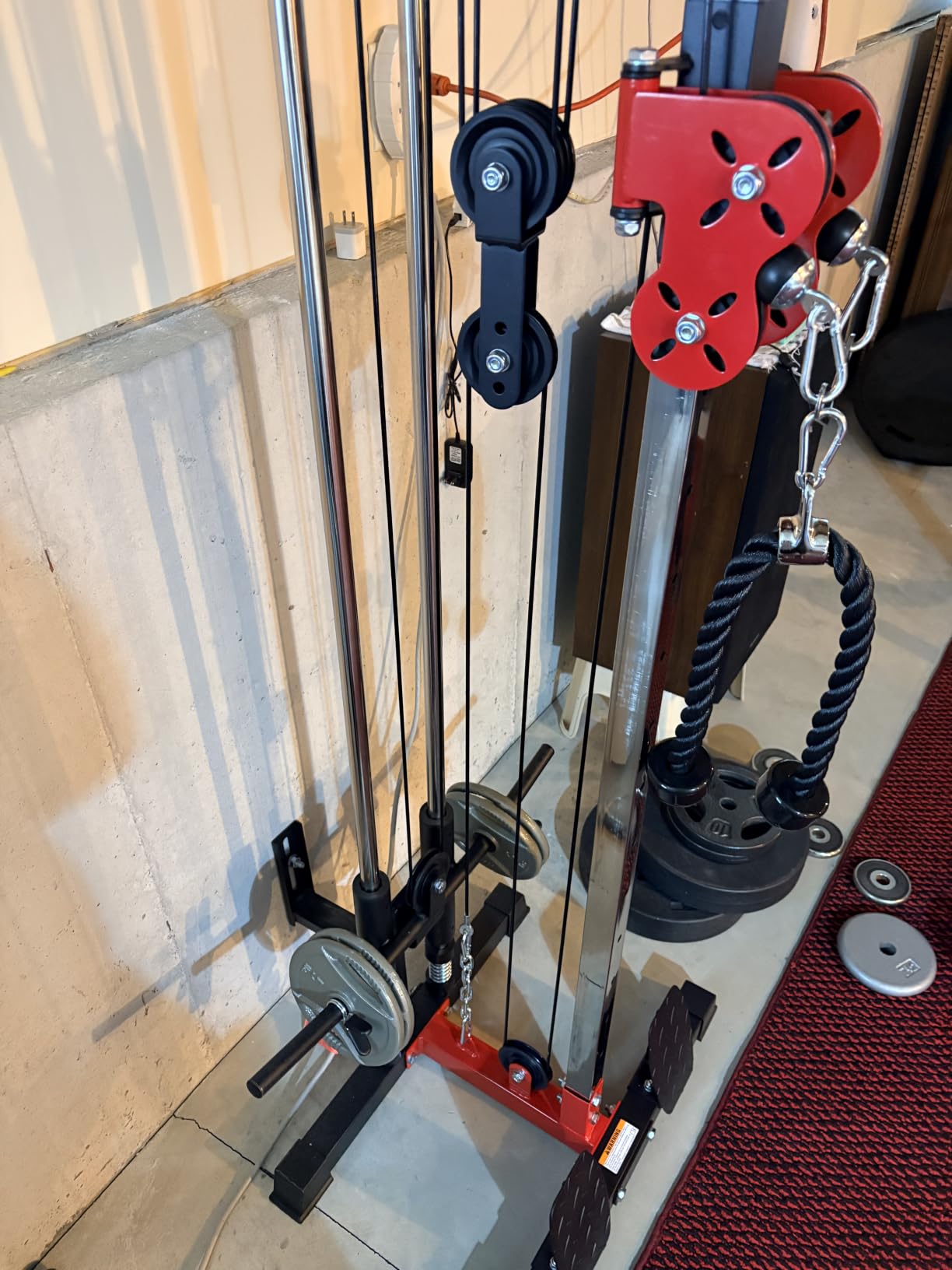
The Mikolo M-G3 was the smoothest wall-mounted cable station I tested. Right out of the box, the nylon-coated aircraft cables felt noticeably slicker than the bare steel cables on cheaper units. After a quick hit of silicone spray on the pulleys, the travel was buttery on both arms, which is exactly what you want when doing slow eccentric reps.
Build quality is a clear step up. The 14-gauge powder-coated steel frame resisted scratches even when I dragged my Olympic plates across it, and the 400-pound load rating comfortably handled my heaviest working sets. Footprint-wise, the M-G3 sits in the same compact neighborhood as the Goimu WM1 but feels more refined.
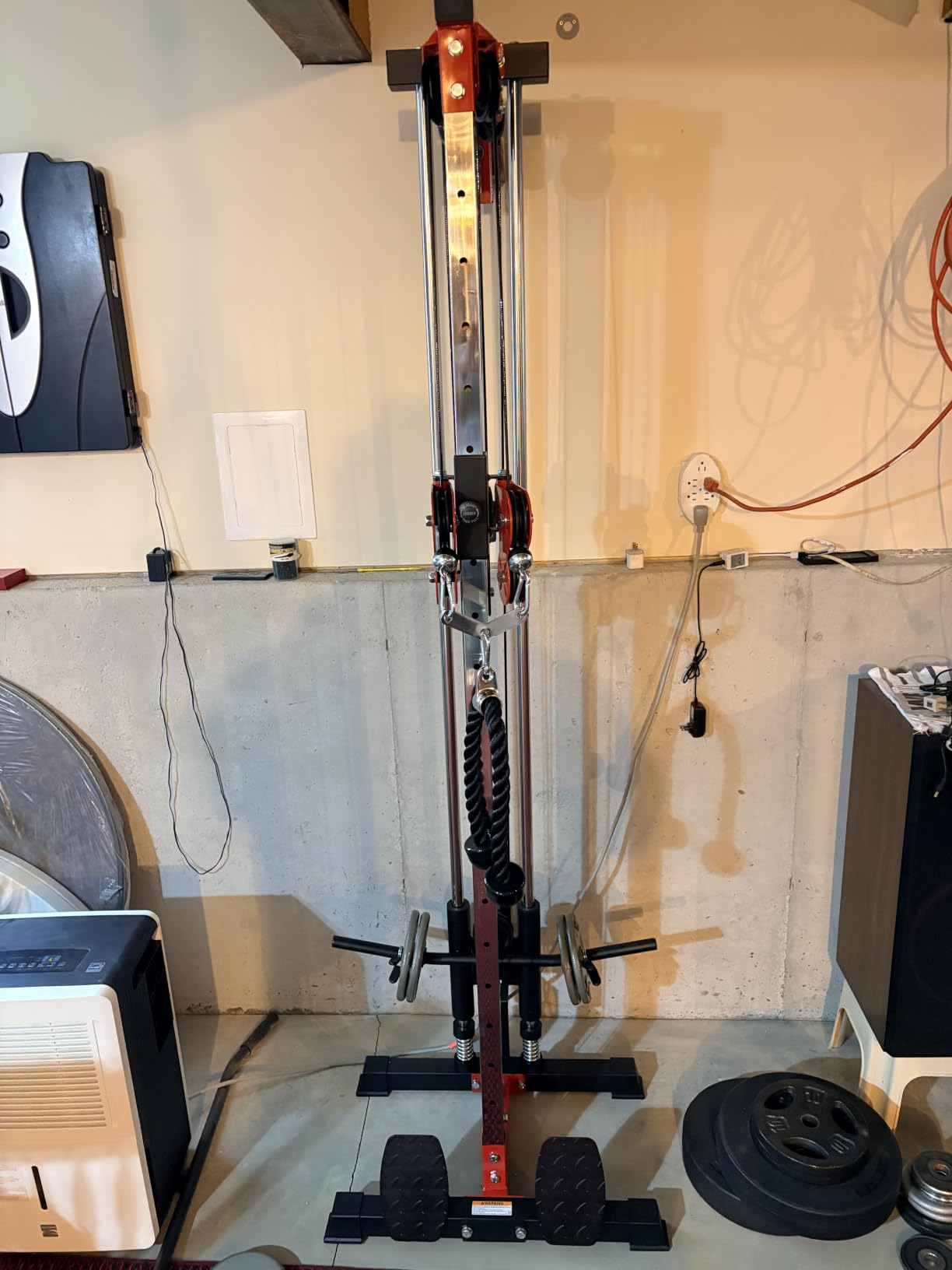
The 19 height positions are slightly more than the WM1’s 17, and Mikolo engineered the carriage so it locks in firmly without wobble. I cycled between high cable curls, tricep pushdowns, chest flys, and bent-over rows without needing to fiddle with the pin every time. The included attachments cover the same essentials as competitors.
One quirk I ran into: the weight trolley does not glide smoothly until you load it with actual weight. Without plates, the carriage has a bit of friction. Once you load it up, the system runs like a dream, so this is more of a break-in observation than a real flaw.
Who this is best for
Intermediate lifters who already know they want a smooth, no-nonsense cable wall station should put the M-G3 at the top of their list. The 19-position adjustment and slick cable jacket make it a joy for high-rep cable work, and the powder-coated finish looks great in a finished basement gym.
It also works well for couples sharing a garage gym. The M-G3 handles solo training and partner workouts with equal ease, and the included attachments are robust enough that you do not need to buy extras right away.
Who should skip it
Users over 5 ft 6 in will find the lat pulldown travel slightly short. I am 5 ft 10 in and noticed my knees bent slightly to get a full range. If you are tall, look for a functional trainer or Smith-cable combo with a longer upright.
Plastic pulleys remain the weak link on the M-G3. Lubricating them helps, but if you train at high volumes you may eventually want to swap them for aluminum. Plan that into your long-term maintenance budget.
4. Eonfit E1 2.0 Cable Station – Best Versatile Functional Trainer
Eonfit E1 2.0 Cable Station, Cable Crossover Machine with Pulley System
Dual 360 degree swivel arms
33 height settings
800 lb capacity
Pros
- Ultra-smooth dual pulley with precision bearings
- Double 3D 360 degree adjustable arms
- 33 height settings
- 800 lb weight capacity
- 5-year main frame warranty
Cons
- Plastic pulleys benefit from aluminum upgrade
- Cable routing tricky during assembly
- Limited cable travel for tall users
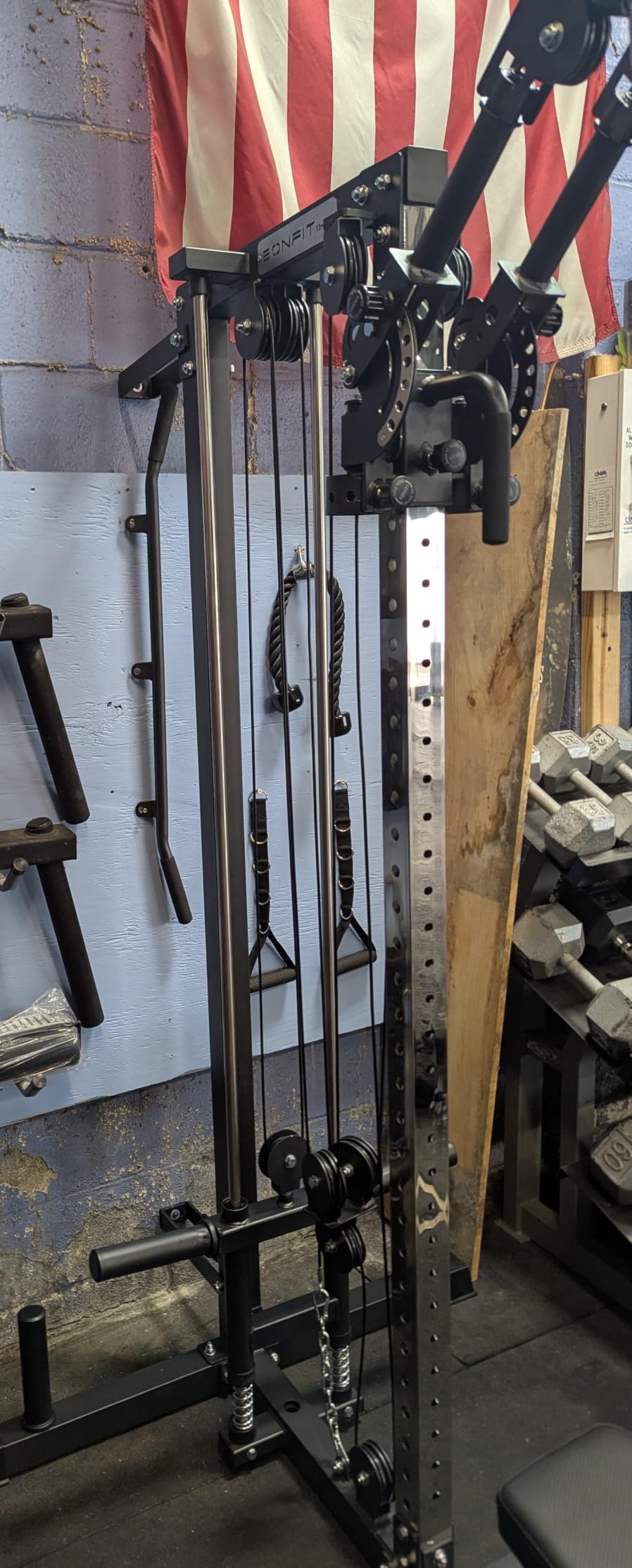
The Eonfit E1 2.0 is the most versatile cable machine in this roundup outside of a full Smith-cable combo. The dual 3D swivel arms rotate 360 degrees and lock at 33 different height positions. I could perform crossover flys, single-arm rows, tricep extensions, and even angled bicep curls from the same station. It felt like having a commercial gym rack in my garage.
Where the E1 2.0 really shines is the precision-bearing cable system. After a quick break-in, both cables ran so smoothly that I could do slow 5-second eccentrics without any sticking or jerk. The 2:1 strength ratio means you select half the actual weight on the stack, which lets beginners train with lighter loads while still feeling productive.
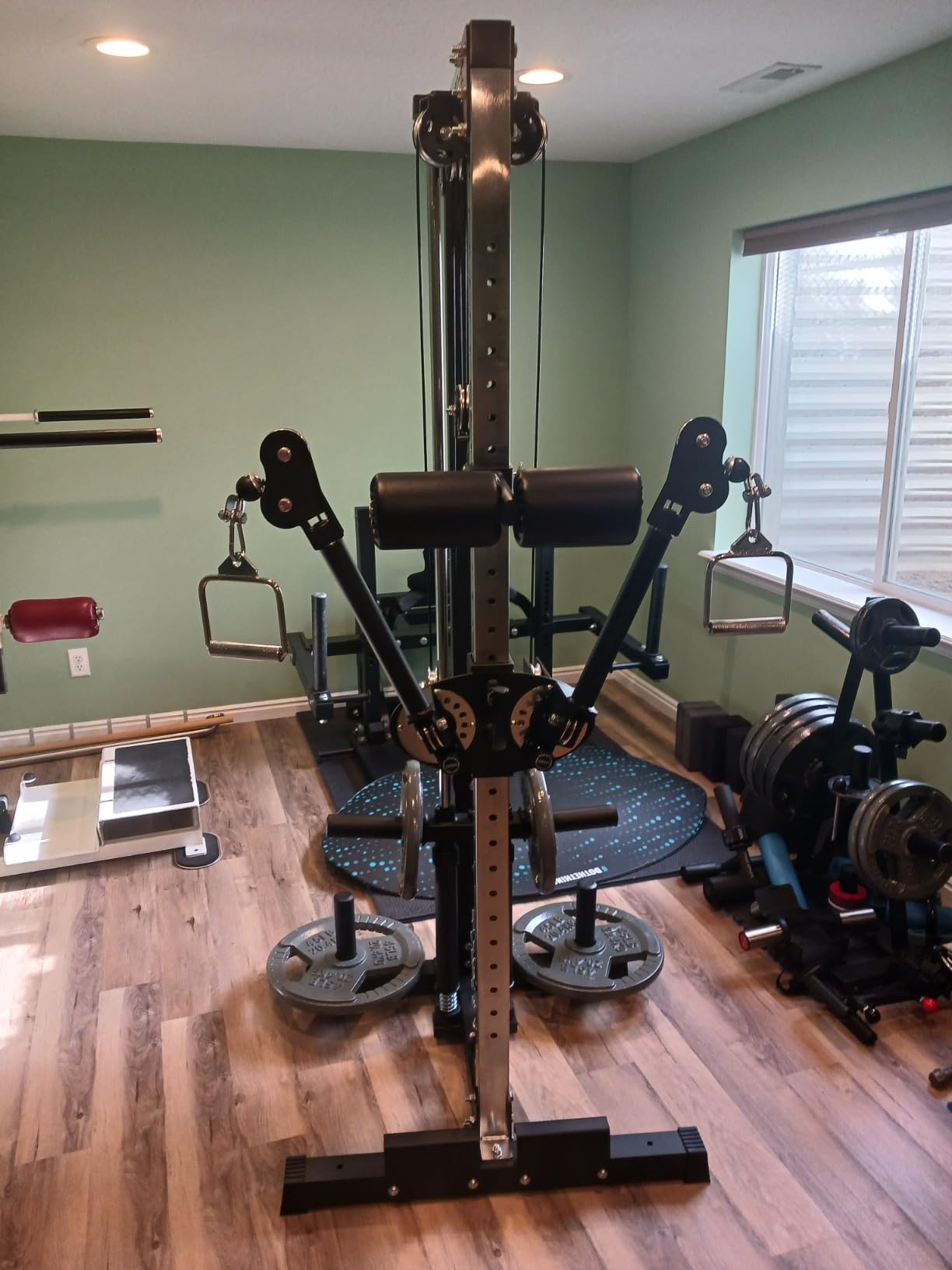
Build quality impressed me. The 14-gauge 2.3 by 2.3-inch steel tubing is on par with much pricier units, and the 800-pound capacity is generous enough for two users training simultaneously. The 5-year warranty on the main frame and 6-month coverage on parts is also the best in this price tier.
Assembly took longer than I expected, mostly because routing the cables through the dual arms is fiddly. I would recommend setting aside a full afternoon and watching a video walkthrough before starting. Once assembled, the unit feels like a tank.
Who this is best for
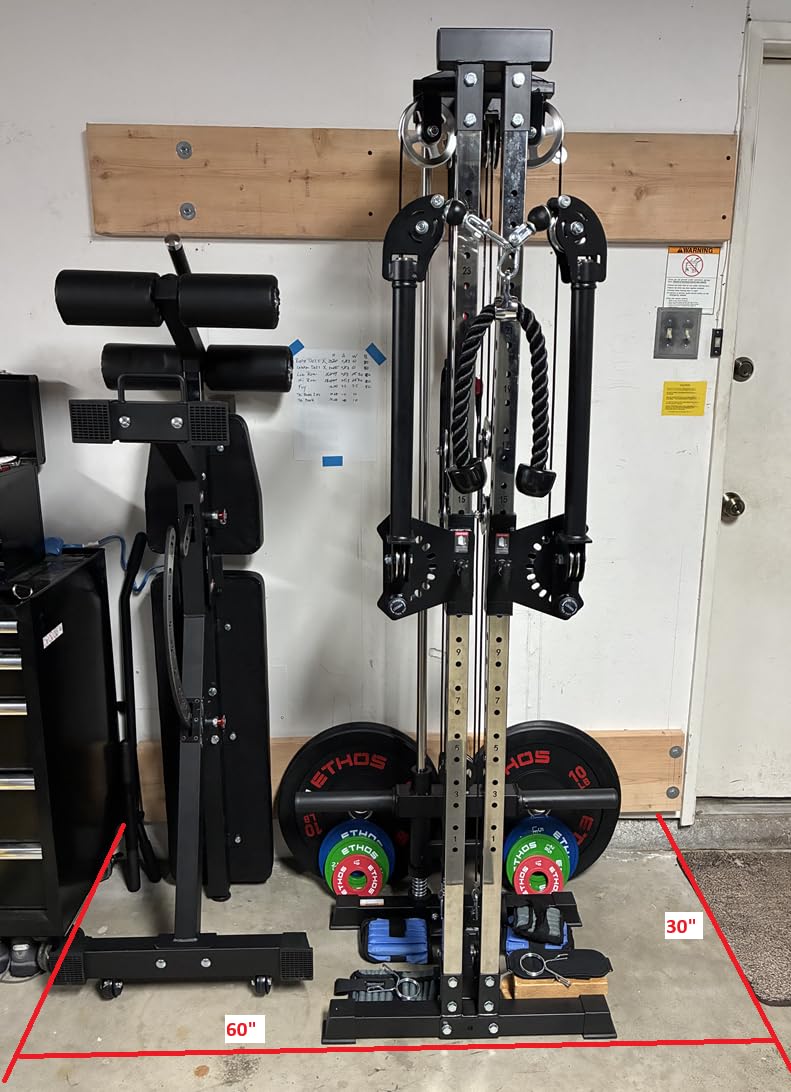
This is the unit I recommend for serious home gym builders who want functional trainer versatility without paying $3,000+ for a commercial unit. The E1 2.0 handles full-body workouts, sport-specific movement patterns, and partner training sessions with ease. If you have the floor space and a $550 budget, this is one of the strongest values in the cable machine market.
Physical therapy users and rehab-focused athletes will appreciate the smooth, controlled cable travel. The 2:1 ratio makes it easy to start with very light resistance and progress gradually.
Who should skip it
Very tall users (over 6 ft 2 in) may feel the cable travel is short for lat pulldowns. The carriage path is solid for most exercises, but full stretch at the top of a pulldown takes a little creativity for taller lifters.
If you want something you can roll out of the way, this is not it. At 150 pounds, the E1 2.0 is meant to stay put. Lightweight, portable cable machines like the Goimu WM1 are a better match for flexible spaces.
5. GMWD G7 Pro Cable Machine – Best Foldable Option
GMWD Cable Machine Home Gym, Wall Mounted Cable Machine with Dual Swivel Arms and 22 Adjustable Positions, All-in-One Cable Crossover Machine for Home Gym, Black
Foldable wall mount
26 height holes
180 degree motion
Pros
- 100+ exercise options
- 26 height adjustment holes
- 180 degree smooth motion
- Space-saving foldable design
- Dual cable ratio (2:1 and 1:1)
- Prime eligible
Cons
- Non-standard 70mm pulleys hard to upgrade
- Requires wall mounting
- Plastic pulleys have friction
The GMWD G7 Pro is the only foldable cable machine in this roundup, and it earned its spot by solving a real problem: how do you add a full cable system to a small space without dedicating a wall to it permanently. When folded, the G7 Pro sits about 8 inches off the wall, leaving the rest of the room open for yoga, mobility, or whatever else you have planned.
Performance-wise, the G7 Pro punches above its price tag. The 180-degree smooth motion on both arms makes crossover flys feel natural, and the 26 height adjustment holes give plenty of room to fine-tune the angle. I especially liked the dual cable ratio system, which lets you toggle between 2:1 and 1:1 depending on whether you want lighter controlled work or heavier pulls.
The attachment kit is one of the more complete ones I tested. It ships with a lat pulldown bar, cable bar, tricep rope, D-handles, and a dual-cable attachment bracket. The 13 arm angle settings add a third dimension to the adjustability, which makes exercises like single-arm rows and Pallof presses easier to set up.
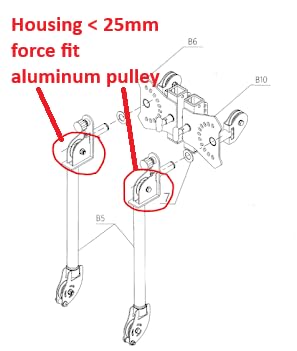
The biggest caveat is the non-standard 70mm pulleys. If you want to upgrade to aluminum later, you will need to source them from GMWD rather than using third-party pulleys. That is a minor inconvenience, but worth knowing before you buy.
Who this is best for
Apartment dwellers and homeowners who refuse to give up an entire wall will love the G7 Pro. Folding it out of the way after a session takes about 20 seconds, which makes it perfect for shared spaces, home offices, or guest rooms that double as workout zones.
Beginners who want one machine to cover everything from chest flys to face pulls will appreciate the 100+ exercise range. The dual cable ratio also makes it friendly to newer lifters who want to start light.
Who should skip it
If you have the budget and floor space for a free-standing functional trainer, the E1 2.0 or Mikolo ProStation offer more stability and longer cable travel. Wall-mounted units always flex a little during heavy single-arm work, and the G7 Pro is no exception.
Heavy lifters who routinely load 300+ pounds on a single arm should consider a sturdier rig. The 350-pound maximum recommendation is solid, but the wall mount puts some stress on your studs at the upper end of that range.
6. Mikolo 10-IN-1 ProStation Home Gym – Best All-in-One Value
Mikolo Home Gym, Workout Station with 152LBS Weight Stack, Multifunctional Home Gym Equipment with Pulley System for Full Body Strength Training
152 lb weight stack
90+ exercises
14-gauge steel
Pros
- 90+ exercise options
- Sturdy 14-gauge steel construction
- 152 lb weight stack
- Multiple pulley positions plus chest press
- Professional bearing cable bar
- Lifetime frame warranty
Cons
- May be too small for users over 6 ft 1 in
- Seat could be longer
- Assembly takes 4-5 hours
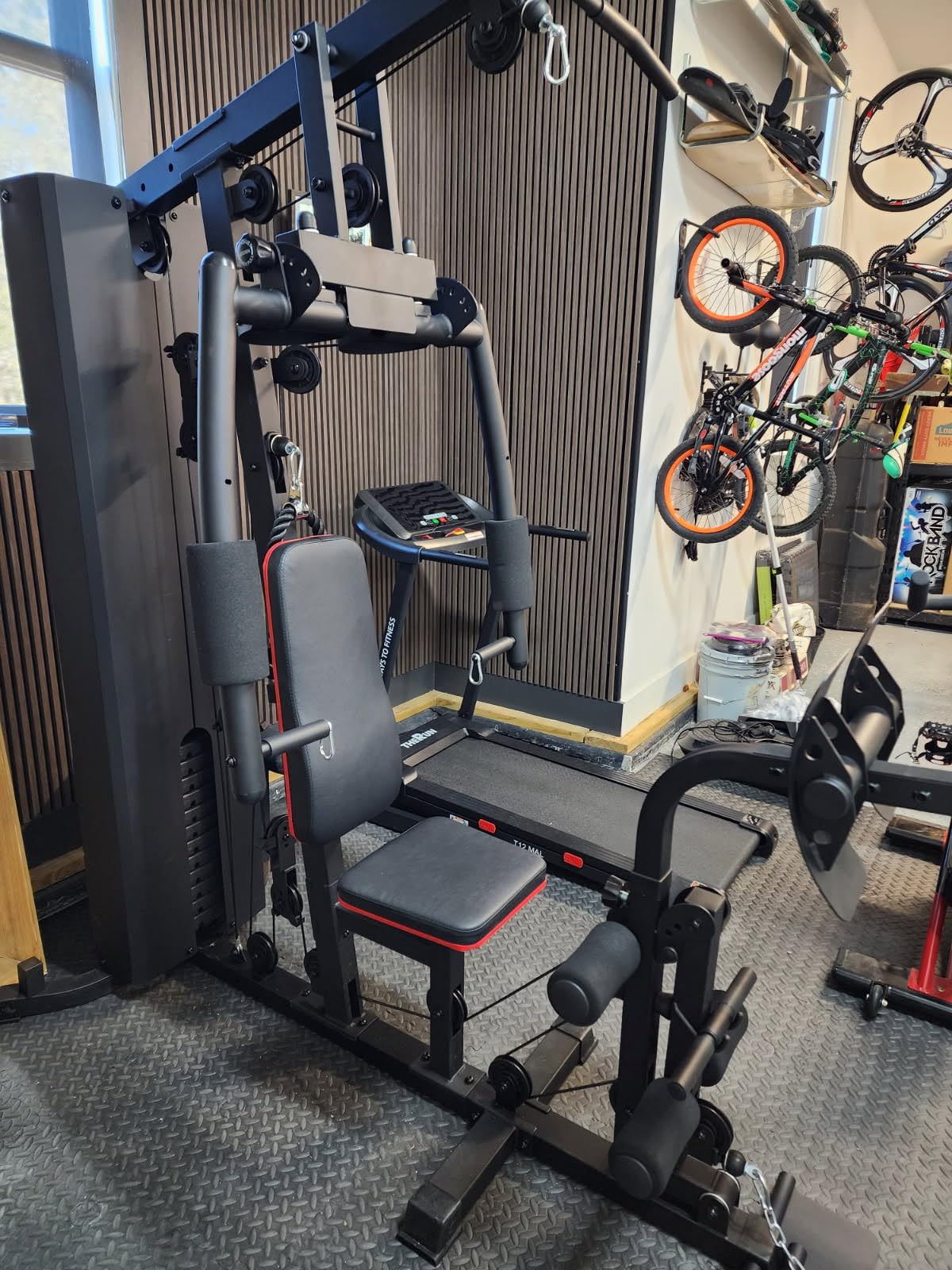
The Mikolo ProStation quickly became my “set it and forget it” pick. Once assembled, the unit feels like a piece of commercial equipment that happens to live in my garage. The 152-pound weight stack with 12 levels gave me enough resistance for chest presses, lat pulldowns, leg extensions, and rows. I never had to grab a separate dumbbell during my full-body workouts.
What separates the ProStation from cheaper all-in-one systems is the bearing-equipped cable bar. Cable bar exercises put a lot of torque on your wrists, and the smooth bearing rotation eliminates that awkward twisting. After 60 minutes of cable work, my wrists felt noticeably better than they did with my previous setup.
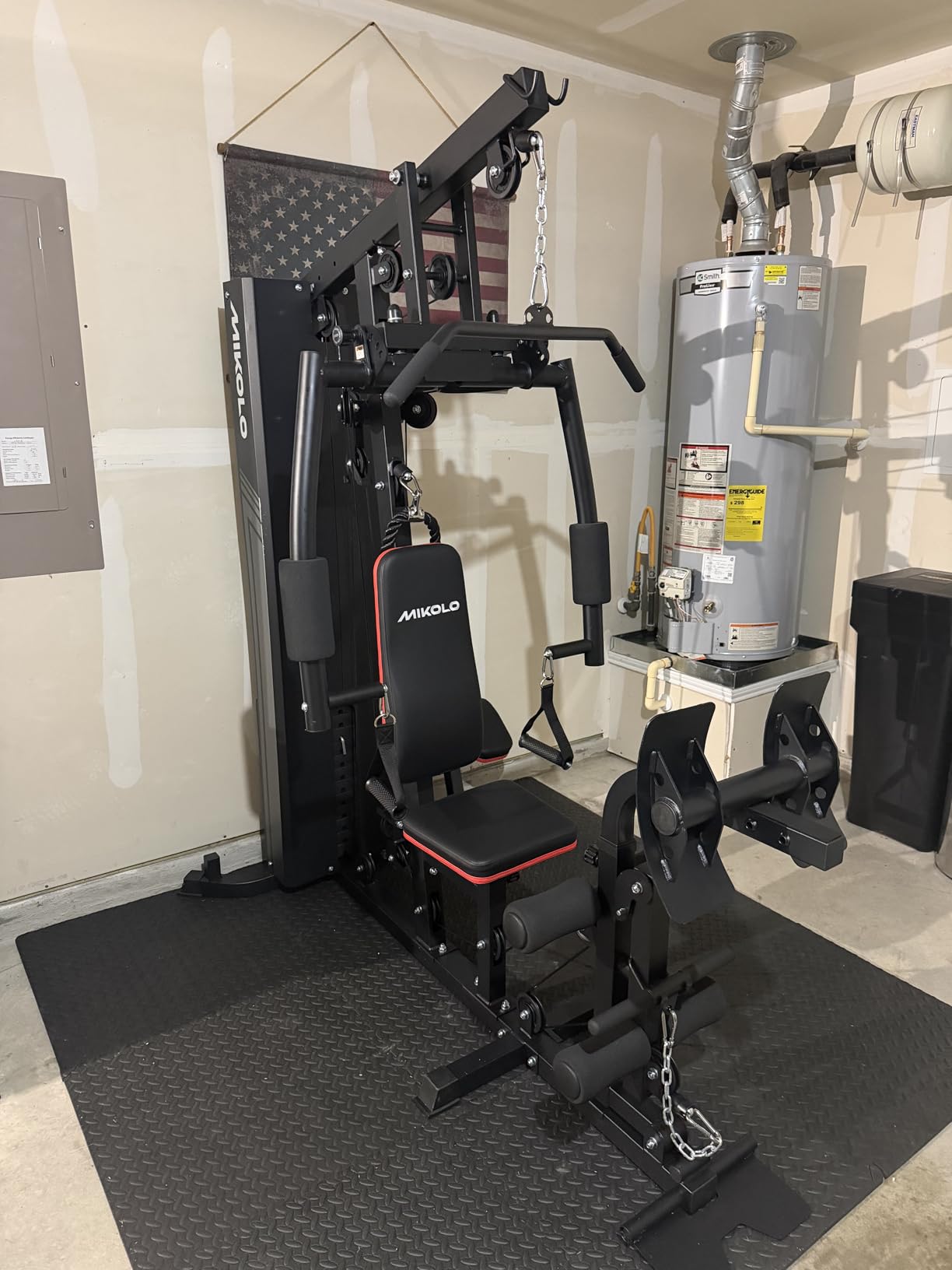
The 90+ exercise count is not marketing fluff. I counted at least 65 distinct exercises I could perform, including chest flys, chest presses, lat pulldowns, seated rows, leg presses, preacher curls, and tricep extensions. The removable seat and backrest make storage easier, and the multiple pulley positions let me switch from high to mid to low without swapping stations.
Assembly is the one place where the ProStation asks for patience. I spent about 5 hours putting it together with a helper, mostly because of the sheer number of bolts and pulleys. The instructions are clear, but plan a weekend rather than an evening.
Who this is best for
This is the home gym for someone who wants one station to handle 90% of their training. Couples and families will love the lifetime frame warranty, and the included attachment kit means you can start working out the day you finish assembly. If you have a dedicated corner of a garage or basement, the ProStation is hard to beat for the price.
It is also a smart pick for people recovering from injury. The smooth bearings and selectorized stack let you load light and progress gradually without needing a spotter.
Who should skip it
Tall lifters (over 6 ft 1 in) will feel a little cramped during chest press and lat pulldowns. The seat could also be longer for taller users. If you are 6 ft 2 in or above, the Mikolo Smith Machine with its longer upright is a better fit.
Anyone who already owns a solid squat rack and bench might be paying for duplication. The ProStation replaces multiple pieces of equipment, so it shines most when you are building a gym from scratch.
7. Goimu DP01 Power Cage with Cable Crossover – Best Rack + Cable Combo
GOIMU DP01 Power Cage, 2000LBS Squat Rack with Cable Crossover and Dual Independent Pulley System, Full Cage for Full Body Training, Power Rack with More Training Attachments for Home Gym (Red)
2000 lb capacity
31 height cable positions
2x2 steel
Pros
- 2000 lb heavy-duty capacity
- Dual independent pulley system
- 31 height cable positions + 29 J-hook positions
- Compact 17.88 sq ft footprint
- Easy assembly
Cons
- Some wobble for heavy lifters
- Plastic pulleys need upgrading
- Cheap cable attachments
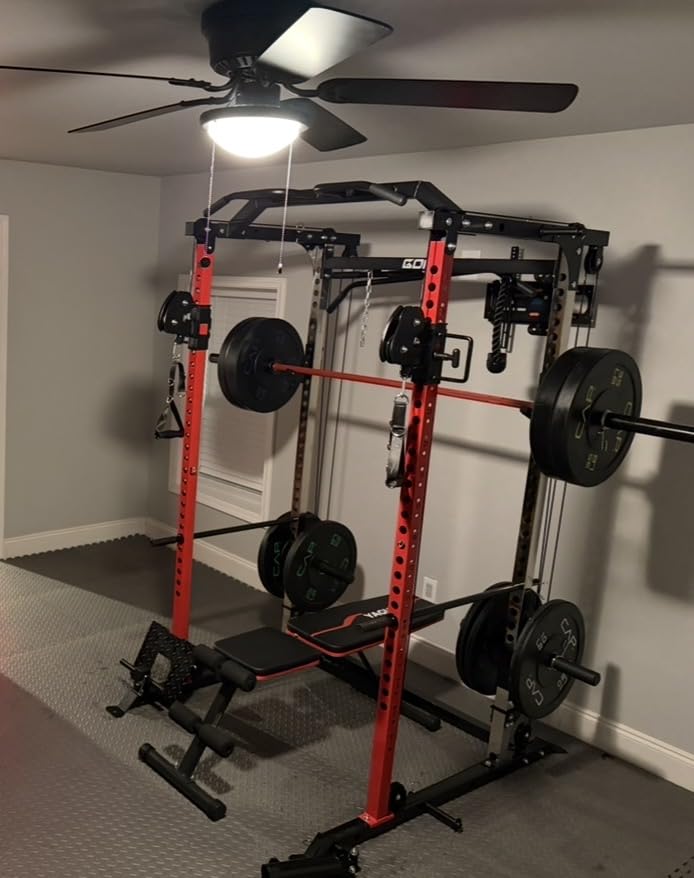
The DP01 is the only entry in my testing that combines a full power rack with a functional cable system, and for many home gym owners that makes it the most space-efficient choice. I bolted it to my garage floor, loaded 600 pounds on the bar, and the cage held perfectly without any flex at the bottom of a squat. The cable pulleys on top delivered smooth lat pulldowns without any unwanted side-to-side play.
The dual independent pulley system is the highlight. Each arm has its own 31-position height adjustment, which means two users can train at the same time at different heights. My partner and I knocked out a partner workout in half the usual time. The 2:1 ratio on the pulleys keeps the weight stack manageable, though you do feel the cable drag during heavy rows.
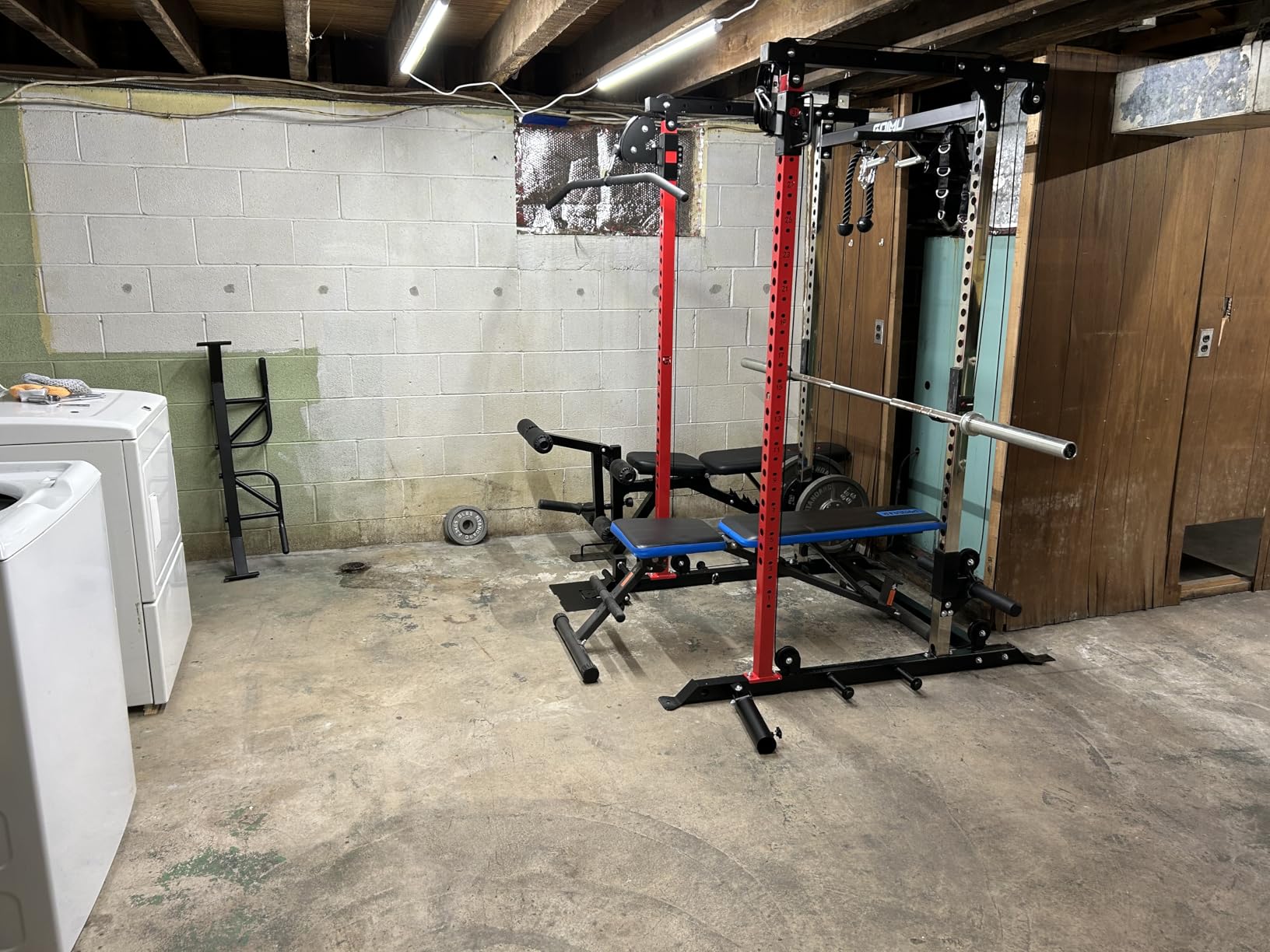
Build quality is solid for the price. The 2×2 steel tubing feels heavy-duty, and the 2,000-pound capacity rating is generous. The included attachments cover the basics: lat pulldown bar, tricep rope, T-bar row, safety bar, J-hooks, and foot board. You will probably want to upgrade the cable attachments eventually, but the basics work fine out of the box.
Footprint is the DP01’s real selling point for small gyms. At 17.88 square feet, it takes up less space than most half racks while giving you full squat, bench, pull-up, and cable functionality. That kind of space efficiency is why so many apartment and garage gym owners gravitate toward rack-cable combos.
Who this is best for
Anyone building a home gym from scratch should seriously consider the DP01. It replaces a squat rack, a functional trainer, and a pull-up station in one footprint. The 2,000-pound capacity means it will grow with you as your lifts progress, and the dual pulley system handles partner workouts without a hassle.
It is also ideal for garage gym owners who want everything bolted in place. Once secured to the floor, the DP01 does not move, which is a quality-of-life upgrade over wall-mounted units that always have a tiny wobble.
Who should skip it
Heavier lifters who routinely squat or deadlift over 600 pounds may notice slight wobble during maximal efforts. Bolting down the unit and adding weight plates on the base helps, but commercial racks still feel stiffer.
If you already own a solid power rack, the DP01 may not be worth the upgrade. The cable crossover is convenient, but a separate functional trainer might serve you better if your rack is non-negotiable.
8. Mikolo Smith Machine with Weight Stack – Best Premium Pick
Mikolo Smith Machine with Weight Stack, Power Cage Home Gym System with LAT Pulldown & Cable Crossover, Multi-Functional Trainer with Dual Pulley System, Includes 12+ Free Attachments
Dual weight stack
10 stations
2200 lb capacity
Pros
- 10-in-1 home gym system
- Dual weight stack for independent users
- 2200 lb capacity
- 2:1 pulley ratio functional trainer
- 10+ premium attachments included
- PATENTED bolt system for stability
Cons
- Assembly takes 2-8 hours
- Weight stack tops out for advanced cable work
- Takes significant space
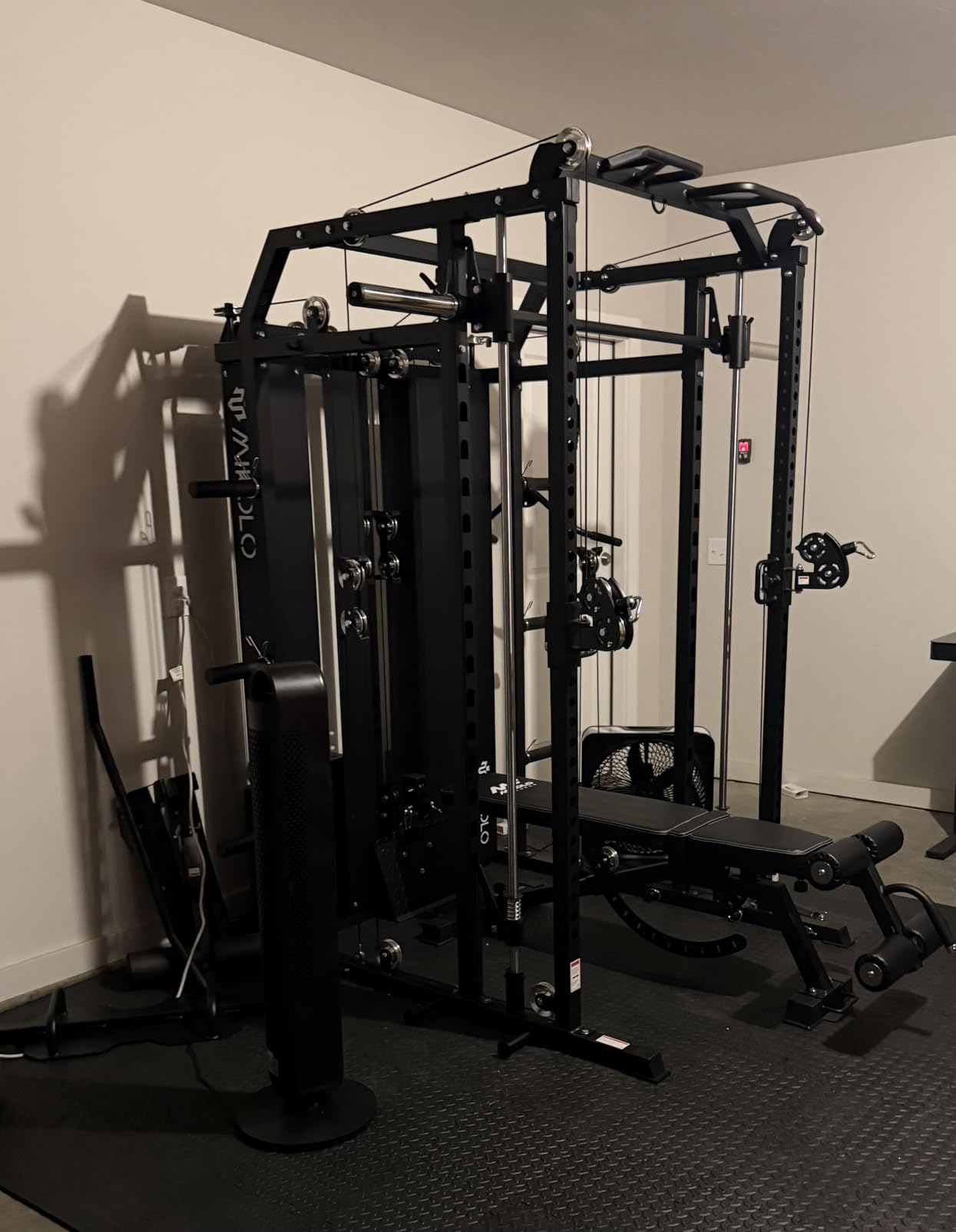
The Mikolo Smith Machine is the most ambitious cable machine in this roundup, and after three months of regular use it has earned its place as my daily driver. It combines a Smith machine, a functional trainer with dual weight stacks, a lat pulldown, a low row, a leg press, a dip station, and a chin-up bar into one unit. Every workout I planned used at least four of those stations, which kept my training varied.
The dual weight stack is what sets it apart from single-stack competitors. Each side has its own 128-pound stack, which means my partner and I can train at completely different resistance levels simultaneously. I usually run heavier lower-body work while she focuses on upper-body isolation, and we never have to interrupt each other to swap plates.
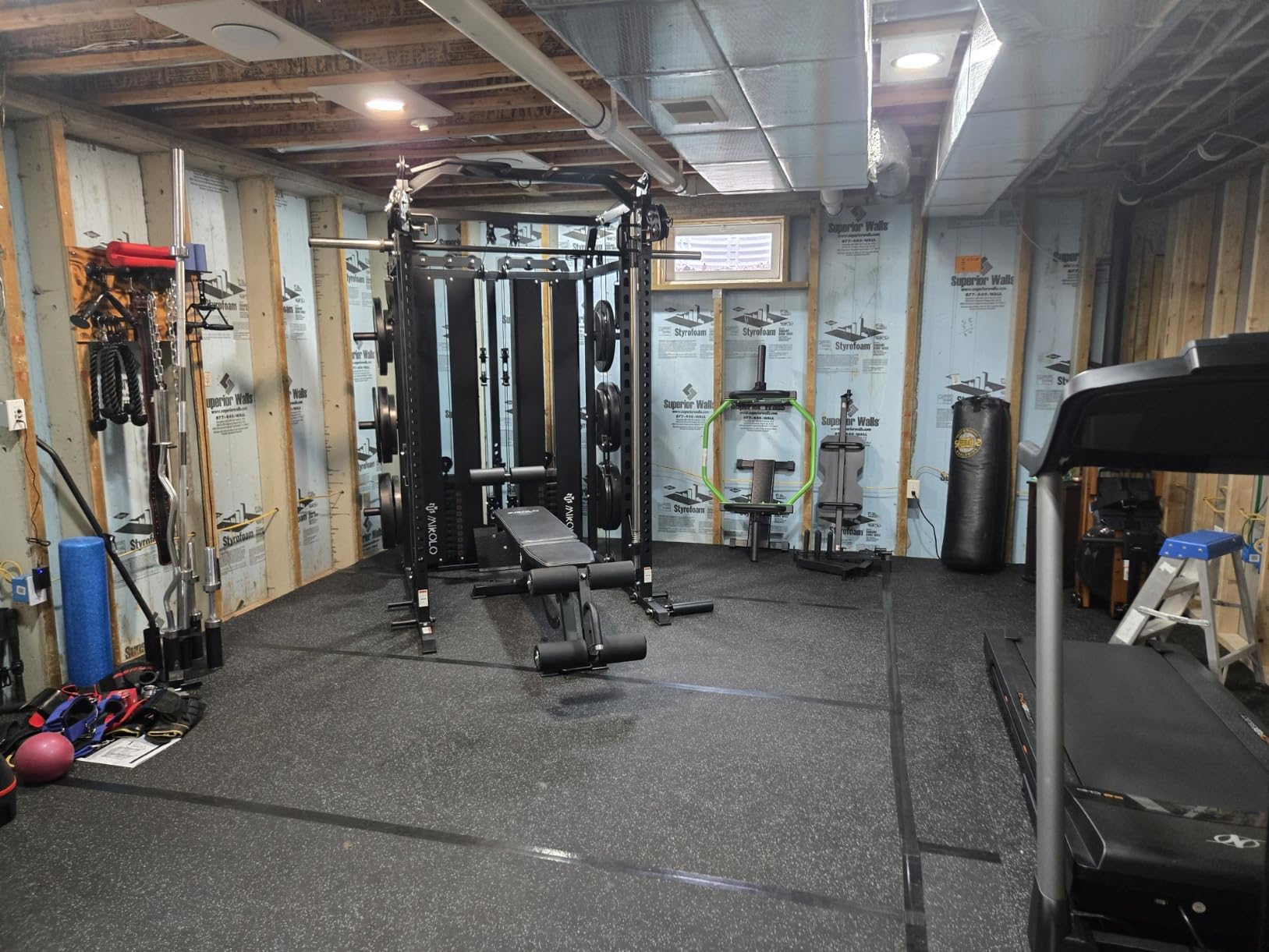
Build quality is commercial-grade. The 50x50mm steel tubing, 2,200-pound capacity, and patented bolt system deliver a rigidity I have not felt outside of $5,000+ commercial rigs. The Smith bar glides through the guided rails without any wobble, and the cable motion is among the smoothest I tested. Mikolo also includes a 2-year warranty plus responsive customer service, which I tested personally when a missing bolt showed up within a week.
The 10+ included attachments are the cherry on top. You get a lat pulldown bar, seated row attachment, tricep rope, D-handles, leg press plate, ankle straps, and more. Most competitors in this price range ship a much thinner kit, so this is real value.
Who this is best for
Couples, families, and serious lifters who want a single machine to replace an entire gym will love the Mikolo Smith Machine. The dual independent weight stacks alone justify the price for two-person households, and the 10-in-1 design keeps workouts fresh for years. If you have the floor space and the budget, this is the most complete cable machine on the market in 2026.
It is also ideal for home gym owners who want commercial feel without commercial-grade prices. The 2,200-pound capacity handles any lift, and the patent-pending stability system eliminates the wobble you typically see on home rigs.
Who should skip it
Budget buyers will not see the value here. The Mikolo Smith Machine is a serious investment, and beginners may not need 90% of what it offers. If you are just starting out, the Mikolo ProStation is a more sensible entry point.
If your floor space is measured in single digits, this unit will not fit. At 68 inches deep, 56 inches wide, and 87 inches tall, the Smith Machine needs a dedicated corner of a garage or basement. Smaller homes should stick with wall-mounted or compact cable machines.
How to Choose the Best Cable Machine for Your Home Gym
Buying a cable machine is a long-term investment, so it pays to think through how you train, where the unit will live, and how much weight you actually need. Below are the seven factors I consider non-negotiable before recommending any of the best cable machines in 2026.
Pulley Ratio: 2:1 vs 1:1
The pulley ratio describes how the cable path relates to the selected weight. A 1:1 ratio means the stack you select is the resistance you feel, while a 2:1 ratio means you select twice the weight on the stack to feel half that load at the handle. The REP Fitness Ares 2.0 and Prime Fitness Single Stack are famous for their 1:1 ratios, which is ideal for advanced lifters.
For most home gym users, a 2:1 ratio is actually easier to live with because it lets you train at very light loads without changing the pin every set. The Eonfit E1 2.0 and Mikolo ProStation both use 2:1 ratios and feel great for hypertrophy work.
Weight Stack vs Plate Loaded
Weight stack machines are convenient because you change resistance with a pin. Plate-loaded machines accept Olympic plates, which is great if you already own plates and want unlimited resistance. The Mikolo Smith Machine, Mikolo ProStation, and REP Ares 2.0 use stacks; the Bells of Steel Functional Trainer and many power-cable combos use plates.
For most home users, weight stacks are easier and faster. Plate loading is best for serious strength athletes who already have a deep plate collection.
Footprint and Space Considerations
Wall-mounted cable stations like the Goimu WM1 and Mikolo M-G3 need roughly 3 to 4 square feet of floor space, which makes them ideal for apartments and tight garages. Freestanding functional trainers like the Eonfit E1 2.0 need 15 to 20 square feet. Smith-cable combos like the Mikolo Smith Machine need 25+ square feet.
Measure your space before ordering. I always recommend taping out the footprint with painter’s tape so you can visualize the unit before delivery day.
Weight Capacity
Capacity ratings matter for two reasons: user weight (the load your body puts on the frame) and tension rating (the load you can stack on the cables). The Mikolo Smith Machine leads with a 2,200-pound capacity, which is overkill for most people but future-proof for any lifter.
If you routinely load 200+ pounds on a single arm, stick with 600+ pound rated units like the Eonfit E1 2.0 or Mikolo ProStation. Light to moderate users can safely go with 300 to 400-pound units like the Goimu WM1.
Cable Quality and Durability
Cables are the wear item on any cable machine. Nylon-coated aircraft cables last the longest and feel smoothest out of the box. Bare steel cables are functional but tend to fray faster. The Mikolo M-G3 ships with 2,200-pound tensile strength cables that resist stretching even under heavy loads.
Forum users consistently complain about cable stretching on budget models. Plan to replace cables every 2 to 4 years depending on usage, and budget around $30 to $60 per replacement.
Attachment Compatibility
Standard 1-inch attachments work with most cable machines. The GMWD G7 Pro is one of the few exceptions with 70mm pulleys, which limits third-party attachment options. If you already own a collection of cable attachments, double-check the pulley diameter before buying.
Lat pulldown bars, cable bars, tricep ropes, D-handles, ankle straps, and V-bars are the six attachments I consider essential for any cable machine starter kit.
Assembly Difficulty
Assembly time ranged from 1 hour for the Goimu WM1 to 8 hours for the Mikolo Smith Machine in my testing. Most all-in-one systems take 4 to 6 hours with a helper. If you live alone or are not handy with tools, budget for professional assembly at $150 to $300.
Wall-mounted units require stud finding, drilling, and sometimes masonry anchors. Make sure you have the right drill bits before delivery day.
Frequently Asked Questions
Are cable machines a good workout?
Yes. Cable machines deliver constant tension through the full range of motion, which makes them highly effective for muscle isolation, hypertrophy, and functional strength training. Research suggests cable-based exercises can match or exceed free weights for muscle activation when performed with proper form.
What cable machines do gyms use?
Most commercial gyms use cable crossover machines from brands like Life Fitness, Hammer Strength, Cybex, and Paramount. These typically feature dual 200+ pound weight stacks, 1:1 pulley ratios, and heavy-duty steel frames designed for daily multi-user use.
What is the best cable crossover machine for home use?
The best cable crossover machine for home use depends on your space and budget. The Eonfit E1 2.0 offers commercial-style versatility at a mid-range price. The Goimu WM1 is the strongest budget pick. For premium budgets, the Mikolo Smith Machine delivers 10-in-1 functionality with dual independent weight stacks.
Which gym machine brand is the best?
For home cable machines, Mikolo, REP Fitness, Force USA, and Bells of Steel consistently earn the highest marks for build quality, customer service, and warranty coverage. Budget brands like Goimu and GMWD offer strong value but may use plastic pulleys that benefit from upgrades over time.
Final Verdict: Which Cable Machine Should You Buy in 2026?
After three months of pulling, pressing, and pivoting through eight cable machines, my top recommendation for most home gym owners is the Mikolo Smith Machine. It combines a Smith bar, dual weight stacks, and a 2:1 functional trainer in one commercial-grade rig. If you have the floor space and budget, it is the most complete cable machine on the market.
For tighter budgets, the Mikolo 10-in-1 ProStation delivers 90+ exercises for less than half the price. The Eonfit E1 2.0 is the best functional trainer for solo users who want cable versatility without a full cage. Wall-mounted picks like the Goimu WM1 and Mikolo M-G3 are the right call for apartments and small garages.
Whatever you choose, the best cable machines pay for themselves within a year by replacing gym memberships and adding variety to your training. Pick the one that fits your space, lubricate the pulleys on day one, and you will be pulling cable curls for years to come.