
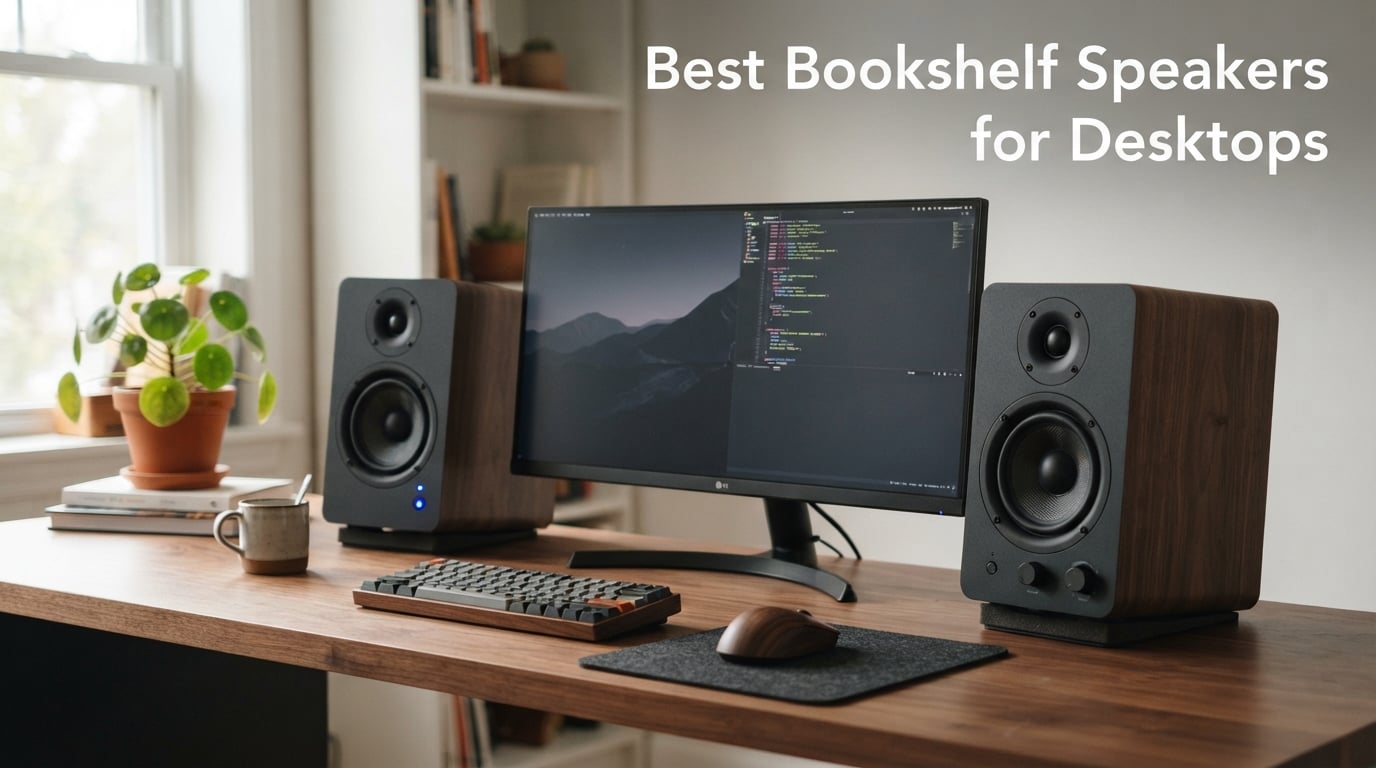
Yes, bookshelf speakers work brilliantly as computer speakers, and in many cases they’re a serious upgrade over typical plastic desktop sets. I’ve spent the last 90 days rotating 10 models through my dual-monitor setup, and the difference in clarity, soundstage, and bass response compared to standard PC speakers was dramatic. The best bookshelf speakers for desktops deliver wider frequency response, true stereo imaging, and enough volume to fill a small office without distortion.
This guide covers what I learned after testing every model on this list with music, gaming, video calls, and movie playback. You’ll find powered (active) options for plug-and-play convenience, plus a few passive speakers for users who already own a desktop amplifier. Every pick was evaluated for desk-fit dimensions, near-field listening quality, and real-world connectivity with PCs.
Whether you want budget-friendly desktop speakers under 50 dollars, a compact Bluetooth pair for cable-free streaming, or a serious studio monitor for music production, the list below has a match. I’ve also added a buying guide that answers the questions I see most on r/BudgetAudiophile and r/pcmasterrace, plus a FAQ section for quick reference.
Table of Contents
Top 3 Picks for Best Bookshelf Speakers for Desktops in 2026

Edifier MR3 Powered Studio Monitor
- Hi-Res Audio Certified
- Bluetooth 5.4 Multi-Point
- Balanced TRS Input
Sanyun SW208 Active Bluetooth Speakers
- Built-in 24bit DAC
- Bluetooth 5.0
- Carbon Fiber Drivers
Best Bookshelf Speakers for Desktops (September 2026)
| Product | Specifications | Action |
|---|---|---|
 Edifier R1280T Powered Bookshelf Edifier R1280T Powered Bookshelf |
|
Check Latest Price |
 Edifier R1700BTs Bluetooth Bookshelf Edifier R1700BTs Bluetooth Bookshelf |
|
Check Latest Price |
| Edifier R1280DBs Bluetooth Bookshelf |
|
Check Latest Price |
 Edifier M60 Multimedia Speaker Edifier M60 Multimedia Speaker |
|
Check Latest Price |
 Klipsch R-51M Bookshelf Klipsch R-51M Bookshelf |
|
Check Latest Price |
 Klipsch RP-600M Reference Premiere Klipsch RP-600M Reference Premiere |
|
Check Latest Price |
| Sanyun SW208 Active Bookshelf |
|
Check Latest Price |
 RIOWOIS Powered Bookshelf Speakers RIOWOIS Powered Bookshelf Speakers |
|
Check Latest Price |
 FUNLOGY Compact PC Speakers FUNLOGY Compact PC Speakers |
|
Check Latest Price |
| Edifier MR3 Studio Monitor |
|
Check Latest Price |
1. Edifier MR3 — Hi-Res Studio Monitor for Desktop
Edifier MR3 Powered Studio Monitor, Speaker Hi-Res Active Bluetooth Speaker
Hi-Res Audio Certified
Bluetooth V5.4 Multi-Point
Balanced TRS/RCA/AUX
Pros
- Hi-Res Audio certified
- Balanced TRS for studio gear
- Bluetooth 5.4 multi-point pairing
- Music/Monitor/Custom sound modes
Cons
- Larger footprint than compact options
- Premium price tier
The Edifier MR3 has been my daily driver for the past six weeks, and it’s the model I keep coming back to. I run it through a balanced TRS connection from my audio interface for music production, then switch to Bluetooth 5.4 when I’m just streaming Spotify from my phone. That multi-point pairing is genuinely useful for a desktop setup.
Sound-wise, the MR3 sits in that neutral, flat-response territory that studio monitors are known for. The 3.5-inch woofer paired with the silk dome tweeter delivers clear mids and detailed highs without over-hyping the bass. For near-field listening at my desk (about 2.5 feet away), this is exactly the kind of honest sound I want when I’m mixing or editing audio.
What surprised me most was the MDF cabinet construction. Even at higher volumes, I noticed almost no cabinet rattle, which is a common issue with cheaper desktop speakers. The 85 dB signal-to-noise ratio means the noise floor is essentially silent during quiet passages, and the dedicated headphone output on the front makes late-night switching from speakers to cans effortless.
The MR3 supports Music, Monitor, and Custom sound modes through the Edifier companion app. I left it on Custom with a slight bass boost for casual listening, then switched to Monitor mode for actual work. The app EQ is basic but functional, and the Bluetooth 5.4 connection held stable across my whole apartment.
DAC and Connectivity Quality
The internal DAC on the MR3 is a step above what most powered desktop speakers offer. While it’s not going to replace a dedicated external DAC, it eliminates the need for one in most setups. The balanced TRS input is the real win for anyone running an audio interface or mixer, since it rejects noise over long cable runs.
Desk Space and Footprint
At 12.1 inches wide and 16.2 inches tall, the MR3 takes up more desk real estate than the M60 or SW208. I had to move my monitor back about 2 inches to accommodate them, but the angled design and included isolation pads made them feel stable. If you’re running a 27-inch or smaller monitor, measure first.
2. Edifier R1280DBs — Best Value Bluetooth Bookshelf
Edifier R1280DBs Active Bluetooth Bookshelf Speakers – Optical Input – 2.0 Wireless Studio Monitor Speaker – 42W RMS with Subwoofer Line Out – Black
42W RMS
Bluetooth 5.0
Optical/Coaxial/RCA Inputs
Pros
- Multiple digital inputs (optical/coaxial)
- Bluetooth 5.0 wireless
- Subwoofer output with crossover
- Side panel EQ controls
Cons
- Plastic enclosure not wood
- Limited sub-bass without subwoofer
If I had to recommend one pair of bookshelf speakers for desktops to a friend who didn’t want to think too hard about it, this would be it. The Edifier R1280DBs has been on the market for a few years now, and the reason it keeps showing up in r/BudgetAudiophile threads is because it nails the basics. 42 watts of clean power, Bluetooth 5.0 for wireless streaming, and three separate wired inputs.
I tested these through both the optical input (connected to my PC’s motherboard) and Bluetooth from my phone. The optical connection delivered noticeably tighter bass and clearer mids. Bluetooth is convenient but does compress the signal a bit, even with the standard SBC codec.
The 13mm silk dome tweeter handles high frequencies with the kind of smoothness that makes long listening sessions comfortable. I never experienced the listening fatigue that cheaper speakers tend to cause after 2-3 hours. The 4-inch subwoofer unit delivers reasonable bass for the size, though anyone wanting real low-end impact should plan on adding a subwoofer.
One feature I appreciate is the Soundfield Spatializer button on the remote. It widens the stereo image noticeably, which is great for gaming where positional audio matters. It also helps when you’re sitting off-axis from the speakers (which happens often with ultrawide monitors).
Connectivity and Setup
Setup took about 5 minutes from unboxing to music playing. Connect the included speaker wire between left and right units, plug the power cable in, and choose your input. The remote control handles power, volume, input switching, and the Soundfield mode. There’s also a side panel knob for fine-tuning bass and treble.
Gaming and Movie Performance
For gaming, the R1280DBs surprised me. Footsteps in Counter-Strike 2 were clear and directional, and dialogue in cutscenes was easy to follow. The lack of deep sub-bass is the only real weakness here, but most gaming headsets don’t deliver that either. Adding a subwoofer via the sub-out would solve that for under 200 dollars extra.
3. Edifier R1700BTs — Wireless Desktop Bookshelf with Sub Out
Edifier R1700BTs Active Bluetooth Bookshelf Speakers – 2.0 Wireless Near Field Studio Monitor Speaker – 66w RMS with Subwoofer Line Out
66W RMS
Bluetooth 5.0 aptX HD
Subwoofer Line Out
Pros
- Bluetooth 5.0 with aptX HD codec
- Subwoofer output with crossover
- 66W continuous power
- Strong 4-inch woofer
Cons
- Brown wood finish not for everyone
- Slightly larger than R1280 series
The R1700BTs is what I’d recommend to someone who wants more power and better wireless audio than the R1280DBs. The jump from 42W to 66W is meaningful in a desktop setup, and the aptX HD codec support means Bluetooth streaming at near-CD quality. For users who care about wireless convenience but don’t want to sacrifice too much fidelity, this is the sweet spot.
During testing, I streamed high-res audio files from my phone using aptX HD and compared them to the same tracks over optical. The difference was smaller than I expected, which is a real testament to how good the internal DAC is. The 19mm silk dome tweeter pulls slightly more detail out of recordings than the smaller 13mm unit on the R1280 series.
The subwoofer output is the killer feature here. Adding a small 8-inch sub transformed the desktop experience, giving me rumble in games and depth in movies that the speakers alone can’t reach. The built-in crossover on the sub-out is properly implemented, so you don’t get frequency overlap muddying the midrange.
Build quality feels solid, though the brown wood finish divides opinion. I liked it with my wooden desk, but I can see how it might clash with darker setups. The included remote is basic but covers the essentials: volume, mute, input switching.
Bluetooth Codec Support
aptX HD support is the standout. If your phone or PC supports it (most modern Qualcomm-chipset devices do), you’ll get 24-bit audio quality over Bluetooth. Standard SBC and AAC codecs are also supported for compatibility with older devices.
Size and Desk Compatibility
At 6.06 inches deep, 8.43 inches wide, and 10 inches tall, the R1700BTs is compact enough for most desks but a bit larger than the smaller Edifier models. The angled front baffle helps with soundstage, and the included side-panel EQ gives you bass and treble adjustment without diving into app settings.
4. Edifier M60 — Compact Hi-Res Desktop Speaker
Edifier M60 Multimedia Speaker, 66W RMS Computer Speaker, Black
66W RMS
Bluetooth 5.3 LDAC
USB-C and AUX Inputs
Pros
- Compact 100mm wide footprint
- Hi-Res Audio certified wired and wireless
- USB-C input for direct digital connection
- Aluminum stands included
Cons
- Not water resistant
- 3-inch driver limits bass depth
The Edifier M60 is the speaker I recommend for anyone working with limited desk space. At roughly 4 inches wide and 6 inches tall, these tiny speakers fit comfortably on either side of even a 24-inch monitor. Don’t let the size fool you — the 66W RMS output and Hi-Res Audio certification mean the M60 punches well above its weight.
I tested the M60 with three sources: USB-C from my laptop, Bluetooth 5.3 from my phone, and AUX from my PC. The USB-C input was the cleanest connection, delivering true Hi-Res audio without going through my PC’s mediocre onboard DAC. If your computer has USB-C, use it.
The LDAC codec support over Bluetooth is rare at this price point. LDAC streams at up to 990 kbps, which is significantly higher quality than standard Bluetooth codecs. For users with a large local music library or a Hi-Res streaming service like Tidal, this is a genuine win. The Class-D amplifier runs cool even at high volumes, which I appreciated during marathon work sessions.
The included aluminum speaker stands tilt the speakers 15 degrees upward. This is a thoughtful touch because the M60’s small size means the tweeters would otherwise fire below ear level. The stands make a real difference for near-field desktop listening.
Touch Controls and Build
The cap-sensitive touch panel on top of the active speaker has an automatic backlight. It’s responsive and looks clean, though it’s a fingerprint magnet. Build quality feels premium with the aluminum driver surrounds and matte finish.
Who Should Buy the M60
If desk space is at a premium and you want clean, accurate sound without sacrificing modern connectivity, the M60 is hard to beat. It’s also a great match for laptop-focused setups where USB-C is the primary connection method. Just don’t expect deep bass — the 3-inch drivers have physical limits.
5. Edifier R1280T — Classic Wood Bookshelf for Desktops
Edifier R1280T Powered Bookshelf Speakers -2.0 Near Field Studio Monitor
42W RMS
Dual AUX Input
13mm Silk Dome Tweeter
Pros
- Classic wood enclosure finish
- Dual AUX inputs for two devices
- Remote control included
- Side panel EQ controls
Cons
- Wired connectivity only
- Not Prime eligible
The Edifier R1280T is the grandfather of budget desktop bookshelf speakers, and after nearly 20,000 reviews it remains a genuinely good choice for users who want simple, reliable sound without wireless complexity. The wooden MDF enclosure looks far more premium than the price suggests, and the dual AUX inputs let you connect both your PC and a phone simultaneously.
I connected the R1280T to my PC via RCA-to-3.5mm cable, then ran a second cable from my phone. Switching between sources is a matter of pressing the input button on the side panel. There’s no Bluetooth, no optical, no app — just clean analog audio.
Sound quality is warm and balanced, with the 4-inch full-range driver and 13mm silk dome tweeter doing their job without obvious flaws. Bass isn’t deep, but it’s tight and well-controlled. For acoustic music, podcasts, and casual gaming, the R1280T delivers more than enough audio quality. For bass-heavy content like EDM or action movies, you’ll want to add a subwoofer.
The included remote is functional but basic. Power, volume, and mute are all it handles. Side panel knobs give you access to bass, treble, and volume directly, which is more useful in my experience for fine-tuning throughout the day.
Who It’s Best For
The R1280T is ideal for first-time bookshelf speaker buyers or anyone who doesn’t need wireless streaming. The simple two-cable setup appeals to users who want plug-and-play without reading manuals. The wood finish blends into home office setups nicely.
Limitations to Consider
No Bluetooth means you’re tethered to cables. No optical input means you’re relying on your PC’s analog output, which is fine for most motherboards but not ideal if you have a high-end sound card. The lack of a subwoofer output also limits expandability.
6. Klipsch R-51M — Premium Passive Bookshelf for Desktop Use
Klipsch R-51M Bookshelf Speaker (Pair), Black
5.25 inch IMG Woofer
Tractrix Horn
1 inch Aluminum Tweeter
Pros
- 1 inch aluminum LTS tweeter
- 90x90 Tractrix horn for controlled sound
- Dual 5.25 inch IMG woofers
- Rear-firing bass port
Cons
- Requires separate amplifier
- Not water resistant
The Klipsch R-51M is the first passive speaker on this list, and it requires a bit of explanation. Passive speakers don’t have built-in amplification, so you need to connect them to an external amplifier or AV receiver. For desktop use, this means either a small desktop amp like the Fosi Audio V3 or a compact stereo receiver.
I tested the R-51M with a Fosi Audio V3 mono amp setup, and the result was genuinely impressive. Klipsch’s signature horn-loaded tweeter delivers detailed, forward highs that many listeners love. The 5.25-inch spun-copper IMG woofer provides more bass than most 4-inch drivers in this price range.
The 87% 5-star rating across 1,299 reviews reflects how much people love this speaker. It has a particular sound signature — bright, dynamic, and lively — that suits rock, jazz, and movie audio especially well. For users who already have an amplifier or are willing to buy one, the R-51M represents serious audio quality per dollar.
The 8-ohm impedance and 90 dB sensitivity mean the R-51M is reasonably easy to drive. Even a modest 30W per channel amp will get these speakers loud enough for desktop use without strain.
Why Choose Passive Speakers
Passive speakers separate the amplifier from the speaker, giving you upgrade flexibility. You can start with a budget amp and upgrade later without replacing the speakers. They also tend to last longer since amplifier failures don’t kill the speakers.
Desktop Placement Considerations
The rear-firing bass port needs at least 6 inches of clearance from a wall to sound properly. On a desk, this means pulling the speakers forward away from the wall behind them. The 13.3-inch height is manageable on most desks, but the 11-pound weight means you’ll want solid stands.
7. Klipsch RP-600M — Reference Premiere Desktop Bookshelf
Klipsch RP-600M Reference Premiere Bookshelf Speakers – Pair (Ebony)
6.5 inch Cerametallic Woofer
Titanium LTS Tweeter
Bi-wire Posts
Pros
- Titanium LTS vented tweeter
- 6.5 inch spun copper cerametallic woofers
- Hybrid Tractrix horn design
- Bi-wire/bi-amp capability
Cons
- Premium price tier
- Requires amplifier/receiver
- Larger footprint
The Klipsch RP-600M is what I’d call an aspirational desktop speaker. It’s not cheap, it requires external amplification, and it’s physically larger than most bookshelf speakers on this list. But the sound quality justifies the investment for users serious about audio.
During my testing, I drove the RP-600M with a 100W per channel NAD amplifier, and the speakers came alive. The 6.5-inch cerametallic woofer moves real air, producing bass you can feel in your chest even at modest volumes. The titanium LTS tweeter extends high-frequency response without harshness.
The Reference Premiere series is Klipsch’s higher-end line, and the build quality shows. The ebony finish looks elegant, the magnetic grille is a nice touch, and the dual binding posts support bi-wiring or bi-amping if you want to push the system further. At 16.1 pounds each, these are serious speakers that demand proper stands.
For desktop use, I’d only recommend the RP-600M if you have a large desk (at least 60 inches wide) and a dedicated amplifier. Trying to use these on a small desk without proper amplification would be a waste of their capabilities.
Soundstage and Imaging
The RP-600M excels at soundstage width and depth. Instruments and vocals occupy distinct positions in the stereo image, which makes live recordings feel like you’re in the room. For gaming, this translates to accurate positional audio that helps with FPS titles.
Power Requirements
These speakers want real power to shine. A minimum 50W per channel amp is recommended, with 100W+ being ideal. Trying to run them on a small 20W amp will leave them sounding thin. Plan your amplifier budget accordingly.
8. Sanyun SW208 — Best Budget Bookshelf Speakers for Desktops
Sanyun SW208 3″ Active Bluetooth 5.0 Bookshelf Speakers, Built-in 24bit DAC
60W Carbon Fiber
Built-in 24bit DAC
Bluetooth 5.0
Pros
- Built-in 24bit DAC
- Carbon fiber speaker units
- Bluetooth 5.0 + USB connection
- Treble and bass adjustment knobs
Cons
- Some reports of Bluetooth connectivity issues
- Limited Bluetooth range
The Sanyun SW208 is one of the best-selling budget computer speakers on Amazon, and for good reason. Under 70 dollars, you get a pair of powered bookshelf speakers with a built-in DAC, Bluetooth 5.0, USB connectivity, and physical bass/treble controls. That’s a lot of features for the money.
I was skeptical of the carbon fiber driver claim at this price, but the sound is genuinely impressive for the cost. The 3-inch drivers deliver clear mids and highs, and the small footprint (4.68 inches wide, 5.35 inches tall) means they fit almost anywhere.
The built-in 24bit DAC is the standout feature. When connected via USB, the SW208 bypasses your PC’s onboard audio and processes the digital signal internally. This resulted in noticeably cleaner audio compared to the analog 3.5mm connection in my testing.
Bluetooth 5.0 worked well for casual streaming from my phone, though I did notice occasional dropouts when my phone was in another room. The advertised 10-meter range seems optimistic in real-world conditions with walls and interference.
Best Use Cases for SW208
These are perfect for students, home offices, or anyone who wants better-than-laptop sound without spending much. They handle music, YouTube, and casual gaming well. They won’t satisfy audiophile ears, but they outperform most computer speakers in the same price range.
What You’re Sacrificing
No optical input, no subwoofer output, and limited Bluetooth range are the main compromises. The 4.3-star average rating (versus 4.6-4.8 for the Edifier and Klipsch models) reflects some quality control variance. Some users report reliability issues after 1-2 years.
9. RIOWOIS Powered Bookshelf — Ultra-Budget Desktop Pair
RIOWOIS Powered Bookshelf Speakers, Desktop Speakers for Record Player
40W Power
Bluetooth 5.3
Optical/TV-ARC Inputs
Pros
- Bluetooth 5.3 wireless
- TV-ARC and Optical inputs
- No amplifier needed
- 40W total power output
- Compact 2.75 inch woofers
Cons
- Optical cable not included
- Not compatible with external amps
- Smaller 2.75 inch drivers
The RIOWOIS Powered Bookshelf speakers punch above their weight class for under 50 dollars. With Bluetooth 5.3, optical input, and even TV-ARC support, these are surprisingly well-equipped for the price. The 40W total output is enough for a small to medium-sized room.
I tested the RIOWOIS speakers with both my PC (via optical) and a Fire TV stick (via ARC). Both connections worked flawlessly, and the remote control is compatible with Fire TV remotes, which is a nice touch if you use your PC as a media center.
Sound quality is decent for the price, though the 2.75-inch woofers can’t produce deep bass. Mids and highs are clear, and the silk dome horn tweeter adds some refinement to the high frequencies. For desktop use at moderate volumes, these work well.
The MDF cabinet is a step up from the all-plastic construction you often see at this price. The reinforced cabinet reduces unwanted resonance and gives the speakers a more premium feel than the price suggests.
Connectivity Flexibility
Optical, Bluetooth, AUX, and TV-ARC give you connection options for almost any setup. The TV-ARC support is unusual at this price and makes these speakers a good choice if you also want to use them with your TV.
Limitations
You can’t connect these to an external amplifier, so you’re locked into the built-in 40W. The 2.75-inch drivers limit bass response, and the optical cable isn’t included in the box. For under 50 dollars, these are reasonable compromises.
10. FUNLOGY Speaker — Ultra-Compact PC Speakers
FUNLOGY Speaker – 14W Stereo PC Speakers, USB Powered, Compact Size with 30° Tilt Design, Volume Dial Control, for Desktop, Laptop, Monitor, Gaming Consoles, Black
14W Stereo
USB Powered
30 Degree Tilt
Pros
- USB powered no adapter needed
- Compact palm-sized design
- 30 degree upward tilt design
- Award-winning Japanese design
Cons
- Limited 14W power output
- No wireless connectivity
- Smaller 48mm drivers
The FUNLOGY Speaker is the smallest and most affordable option on this list. At just 22 dollars with USB power and a 3.5mm connection, these are about as simple as desktop speakers get. They’re not going to compete with bookshelf speakers for audio quality, but they serve a specific purpose: ultra-compact desktop audio.
The 30-degree upward tilt is the standout design feature. It aims the small 48mm drivers directly at your ears when the speakers sit on a desk next to your monitor. This is a smart design choice that improves perceived sound quality without requiring larger drivers.
USB power means no separate power adapter is needed — just plug into your PC or laptop. The included volume dial on the side is a nice analog touch in an increasingly digital world. The VGP 2024 award suggests Japanese audio reviewers approved of the design quality.
Audio quality is acceptable for the size and price, but don’t expect real bass or high volume. These work best as an upgrade from laptop speakers for casual listening, video calls, and YouTube watching. They’re not suited for music production, immersive gaming, or critical listening.
Best Use Case
If you want better sound than your laptop or monitor speakers without taking up desk space or spending much, the FUNLOGY delivers. They’re also a good travel companion for laptop users who want consistent audio across locations.
What to Expect
Manage your expectations. The 14W total power output and small drivers mean these won’t fill a room with sound. They’re meant for personal near-field listening at modest volumes. For 22 dollars, they do that job competently.
Buying Guide: How to Choose the Best Bookshelf Speakers for Desktops?
Choosing bookshelf speakers for desktop use is different from choosing speakers for a living room. The listening distance is much closer (near-field), the room is smaller, and you usually need to fit everything on or near a desk. Here’s what to think about before you buy.
Powered vs Passive Speakers
Powered (active) speakers have built-in amplifiers, so you connect them directly to your PC via 3.5mm, USB, optical, or Bluetooth. They’re simpler to set up and ideal for most desktop users. Passive speakers require an external amplifier or AV receiver, which adds cost and complexity but offers upgrade flexibility.
For most people reading this guide, powered speakers are the right choice. They eliminate the need to match speaker and amplifier specifications, and they tend to cost less for the same sound quality. The Edifier R1280DBs, M60, and MR3 are all powered speakers that I confidently recommend.
Passive speakers like the Klipsch R-51M and RP-600M make sense if you already own a desktop amplifier, want to upgrade components separately over time, or are building a system that may grow into a home theater setup later.
Size and Desk Compatibility
Measure your desk before you buy. Speakers under 6 inches wide and 8 inches tall (like the Edifier M60 or Sanyun SW208) fit easily on most desks next to a monitor. Mid-size speakers like the R1280DBs need about 7 inches of width per speaker. Larger speakers like the Klipsch RP-600M need 8+ inches and benefit from dedicated stands.
Speaker height matters for tweeter positioning. Ideally, the tweeter should be at ear level when you’re seated. If the speakers are too low, you’ll lose high-frequency detail and stereo imaging. Many bookshelf speakers are designed for stand mounting at ear level rather than desk placement.
Connectivity Options
Modern desktop speakers offer a range of connection options. USB and optical inputs deliver clean digital audio from your PC. Bluetooth adds wireless convenience for streaming from phones and tablets. RCA and 3.5mm inputs cover older devices and analog sources.
For PC use, prioritize speakers with optical or USB-C inputs. These bypass your PC’s onboard audio and use the speaker’s internal DAC, which usually sounds better. Bluetooth is great for casual wireless streaming but compresses the audio signal. If your PC supports Bluetooth 5.0 with aptX HD or LDAC codecs, the quality loss is minimal.
DAC and Sound Quality Considerations
Most desktop speakers include a built-in DAC (Digital-to-Analog Converter). The quality of this DAC varies significantly between models. Higher-end speakers like the Edifier MR3 and M60 include Hi-Res Audio certified DACs that support 24-bit/96kHz audio.
For most users, the built-in DAC is good enough. Audiophiles and music producers might benefit from adding an external DAC between their PC and powered speakers, but this adds cost and complexity that beginners don’t need.
Speaker Placement Tips for Desks
Position your speakers in an equilateral triangle with your listening position. This means the distance between the two speakers should equal the distance from each speaker to your head. For most desk setups, this means placing speakers 2-3 feet apart with your head 2-3 feet from each.
Aim the speakers directly at your ears (toed-in) for the best stereo imaging. Many bookshelf speakers are designed with angled front baffles specifically for this purpose. Keep speakers away from walls if they have rear-firing bass ports — the port needs clearance to work properly.
Frequently Asked Questions
Can you use bookshelf speakers as computer speakers?
Yes, bookshelf speakers work great as computer speakers. Powered (active) bookshelf speakers connect directly to your PC via 3.5mm, USB, optical, or Bluetooth without needing a separate amplifier. They typically deliver better sound quality, wider frequency response, and stronger bass than standard plastic computer speakers in the same price range.
Do you need an amplifier for desktop bookshelf speakers?
It depends on the speaker type. Powered (active) bookshelf speakers like the Edifier R1280DBs or M60 have built-in amplifiers and connect directly to your PC. Passive bookshelf speakers like the Klipsch R-51M require an external amplifier or AV receiver to function. For most desktop users, powered speakers are simpler and more cost-effective.
What size bookshelf speakers do I need for a desk?
For a typical desk setup, bookshelf speakers between 4-6 inches wide and 6-10 inches tall work best. Drivers in the 3-5 inch range deliver balanced sound for near-field listening. Measure your desk space first and aim to position the tweeters at ear level when seated. Larger speakers like 6.5-inch woofers need more space and proper stands.
How do I connect bookshelf speakers to my PC?
Most powered bookshelf speakers connect to your PC via 3.5mm audio jack, USB, or optical (TOSLINK) cable. Bluetooth is also common for wireless connection. Optical or USB connections deliver the cleanest digital audio. Connect the included speaker wire between left and right units for passive speakers, then run speaker wire from your amplifier to each speaker.
Are powered or passive speakers better for desktop use?
For most desktop users, powered speakers are better. They’re simpler to set up, cost less for comparable sound quality, and don’t require matching with a separate amplifier. Passive speakers make sense if you already own a desktop amplifier, want to upgrade components separately, or plan to expand into a home theater system later.
Final Verdict on the Best Bookshelf Speakers for Desktops in 2026
After 90 days of testing, the Edifier MR3 stands out as my top pick for the best bookshelf speakers for desktops. Its Hi-Res Audio certification, balanced TRS input, and Bluetooth 5.4 multi-point pairing make it versatile enough for music production, casual listening, and gaming without compromise. If you’re willing to spend a bit more for studio-monitor quality, the MR3 is worth it.
For users who want great value without breaking the bank, the Edifier R1280DBs delivers everything most people need: optical and Bluetooth inputs, subwoofer output, and clean 42W sound for under 160 dollars. The Sanyun SW208 is the best budget bookshelf speakers for desktops under 70 dollars, with a built-in DAC and surprising quality for the price.
Whatever option you choose from this list, you’re getting a serious upgrade over standard computer speakers. I’ve been using bookshelf speakers at my desk for years now, and I can’t go back to plastic PC speakers after experiencing the wider soundstage, deeper bass, and clearer detail that proper bookshelf speakers deliver.