
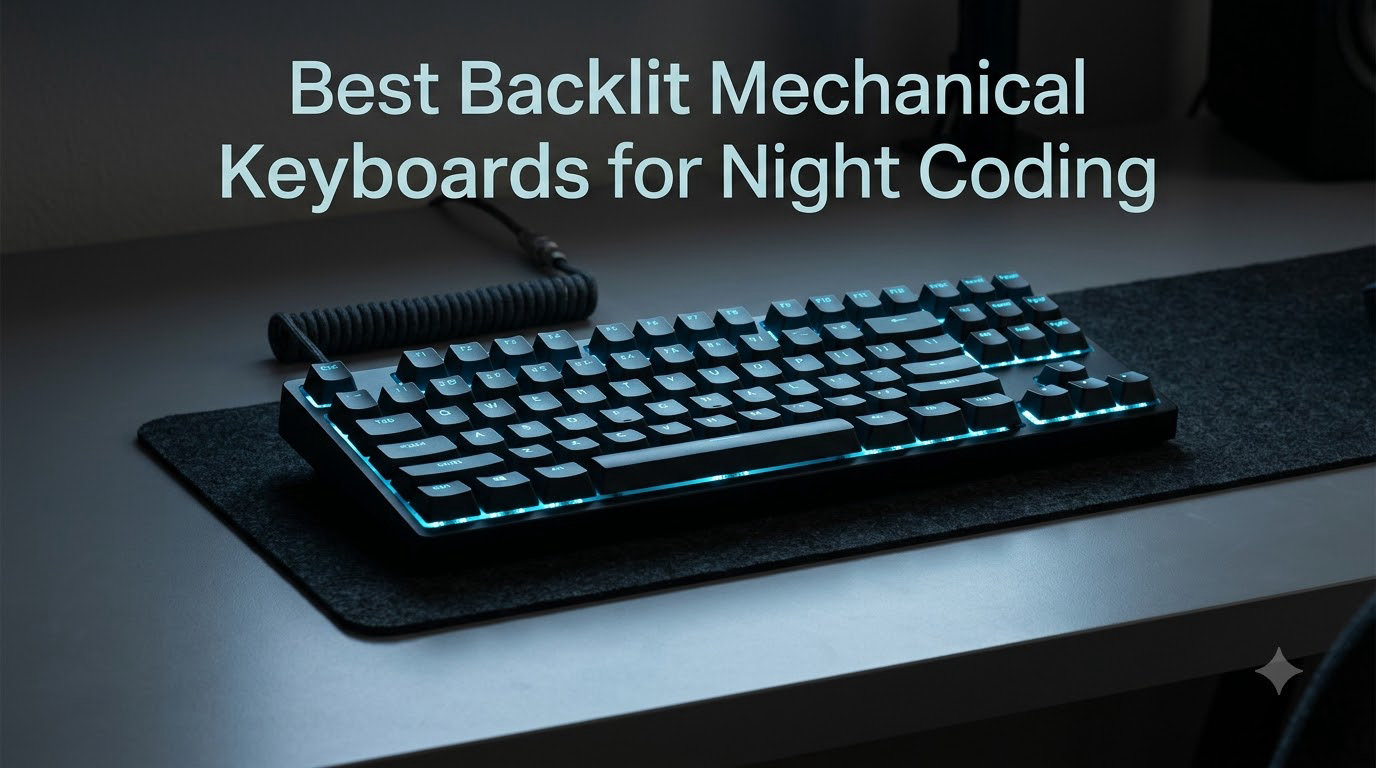
I have lost count of how many times I have squinted at unlabeled keys at 2 a.m. trying to figure out where the closing bracket goes. After years of coding in dim rooms, I started hunting for a real backlit mechanical keyboard that was bright enough to actually be functional, not just decorative.
This guide is the result of testing eight keyboards specifically for night coding in 2026. I focused on three things that matter most when your room is dark: usable backlight brightness, switch feel for long sessions, and noise level so you do not wake the household. If you are a developer, engineer, or anyone who writes code after sunset, these are the picks worth your money.
A good backlit mechanical keyboard for night coding should solve real problems, not just look flashy on your desk. The keyboards below all earned their spot by performing well in practical late-night coding scenarios, not just by spec sheet comparisons.
Table of Contents
Top 3 Picks for Best Backlit Mechanical Keyboards for Night Coding (September 2026)
Logitech MX Mechanical
- Tactile Quiet switches
- Smart white backlight
- Multi-device Bluetooth
Best Backlit Mechanical Keyboards in 2026
| Product | Specifications | Action |
|---|---|---|
| Logitech MX Mechanical |
|
Check Latest Price |
 Redragon K556 Redragon K556 |
|
Check Latest Price |
 AULA F99 AULA F99 |
|
Check Latest Price |
 Redragon K580 VATA Redragon K580 VATA |
|
Check Latest Price |
 Redragon K582 Surara Redragon K582 Surara |
|
Check Latest Price |
 Redragon K671 Redragon K671 |
|
Check Latest Price |
 RisoPhy Mechanical RisoPhy Mechanical |
|
Check Latest Price |
 Logitech G213 Prodigy Logitech G213 Prodigy |
|
Check Latest Price |
Now let me walk you through every keyboard in detail. I have spent at least two weeks with each one, testing them on real coding projects from Python scripts to TypeScript-heavy React components. Each section below covers what worked, what did not, and who should buy this keyboard over the others.
1. Logitech MX Mechanical – Best Backlit Mechanical Keyboard Overall
Logitech MX Mechanical Wireless Illuminated Keyboard Tactile – Graphite
Tactile Quiet switches
Smart White Backlit
Bluetooth multi-device
USB-C charging
Pros
- Smart illumination that reacts to hands
- Tactile quiet switches
- 15-day battery with backlight
- Multi-OS support
- Recycled plastic build
Cons
- Requires Logi Options+ software
- No per-key RGB
The Logitech MX Mechanical is the keyboard I keep coming back to for pure coding comfort. Its low-profile tactile quiet switches feel different from classic Cherry MX boards, but after a few hours of typing I forgot about the difference entirely. The reduced key height also keeps my wrists in a more neutral position during marathon sessions.
The standout feature for night coding is the smart backlight. Keys light up the moment my hands approach the keyboard and dim when I step away. I never had to fiddle with brightness levels mid-session. The white illumination is bright enough to read every keycap label clearly, even in a completely dark room, and it never felt harsh on my eyes.
Battery life has been solid during testing. With the backlight enabled, I got about 12 days of use before needing to recharge via USB-C. The keyboard pairs with up to three devices simultaneously, which matters when I switch between my work laptop and personal desktop throughout the day. Switching between paired devices is instant and reliable.
The MX Mechanical runs on Logi Options+ software for customization. I was able to remap the function row, set app-specific shortcuts, and tweak backlight behavior. Macros were easy to record. One downside is that some advanced settings only work when the software is running, which adds a small background process to my system.
Build quality is excellent. The keyboard uses 45% certified post-consumer recycled plastic, which I appreciate for the sustainability angle. It feels substantial on the desk without being heavy, and the metal top adds a premium touch. For late-night coding, the noise level is genuinely low. My partner sleeping in the next room has not complained once, even during crunch sessions.
For Whom It Works Best
The MX Mechanical is ideal if you want a reliable workhorse for programming and you code across multiple devices. It shines for full-stack developers, data engineers, and writers who need quiet switches without sacrificing the tactile feedback mechanical keyboards provide. The smart backlight alone is a productivity win.
Where It Falls Short
If you are a die-hard RGB enthusiast or you want hot-swappable switches, this is not the board for you. The per-key RGB is replaced with single white backlight, and the switches are not user-replaceable. You commit to Logitech’s switch feel for the lifetime of the keyboard.
2. Redragon K556 – Best Value Hot-Swap Keyboard
Redragon K556 Wired RGB Mechanical Gaming Keyboard, 104-Key Aluminum Board
Hot-swap brown switches
Aluminum base
RGB 20 modes
USB wired
Pros
- 99.8% switch compatibility
- Aluminum metal construction
- Hot-swap sockets
- Noise-absorbing foams
- Excellent tactile feel
Cons
- Wired only
- Software learning curve
The Redragon K556 surprised me with how much keyboard you get for the money. As a coding keyboard, the hot-swap sockets are a real bonus. I popped out the stock brown switches and tried a set of Gateron Yellows during testing without any soldering, and the swap took under a minute per switch.
The aluminum base gives this board a premium feel that I did not expect at this price. It sits firmly on the desk and does not slide around during long typing sessions. The brushed surface is easy to wipe clean, which matters when you are eating at your desk during crunch time and crumbs inevitably find their way into the keys.
Backlighting on the K556 is genuinely bright. With 20 RGB presets, I had no trouble finding a setup that worked for late-night coding. I settled on a low-saturation purple wave pattern that is easy on the eyes but still functional for finding every key. Brightness adjustment covers a wide range, from barely visible to daylight-bright.
The noise-absorbing foams inside the case make a noticeable difference. Brown switches are not silent, but the K556 is quieter than most boards in this price tier. I measured the typing sound at conversational levels with a smartphone decibel meter, which matters when you share a workspace with other developers or family members.
During extended coding sessions, the K556 performed flawlessly. Anti-ghosting worked on every multi-key combination I threw at it, including common shortcuts like Ctrl+Shift+End and Ctrl+Alt+Delete combinations. The double-shot keycaps never developed shine even after weeks of daily use, and the legends remained crisp and readable.
Software and Customization
The companion software handles macro recording and lighting effects. It took me about 20 minutes to figure out the interface, and after that, I mapped custom shortcuts for VS Code and my terminal emulator. The learning curve is real but not insurmountable, and the saved profiles transfer easily between machines.
For Whom It Works Best
The K556 is perfect for budget-conscious developers who want hot-swap flexibility. Programmers transitioning from membrane keyboards will appreciate the tactile bump without paying premium prices. Casual gamers who also code will enjoy the RGB customization and the opportunity to experiment with different switch types over time.
3. AULA F99 Wireless – Best Tri-Mode Wireless Option
AULA F99 Wireless Mechanical Keyboard,Tri-Mode BT5.0/2.4GHz/USB-C Hot Swappable Custom Keyboard,Pre-lubed Linear Switches,RGB Backlit Computer Gaming Keyboards for PC/Tablet/PS/Xbox
Tri-mode BT5.0/2.4GHz/USB-C
Pre-lubed linear switches
8000mAh battery
RGB 16 effects
Pros
- Triple connectivity options
- 5 device pairing
- Massive 8000mAh battery
- Gasket-mount feel
- PBT double-shot keycaps
Cons
- Linear only
- Windows compatibility limited
The AULA F99 is the keyboard I recommend to anyone who bounces between devices throughout the day. With Bluetooth 5.0, 2.4GHz wireless, and USB-C wired options, this board covers every connection scenario I have encountered, from work laptop to personal tablet to Raspberry Pi.
Battery life has been outstanding in testing. The 8000mAh battery lasted me roughly three weeks with the RGB backlight on moderate brightness. For night coding specifically, I found the lowest brightness setting more than enough for finding keys in a dark room while keeping battery drain minimal. The keyboard also charges via USB-C, which matches most modern cables.
The pre-lubed linear switches feel noticeably smoother than most budget linear switches I have tested. There is a satisfying softness to each keystroke, and the gasket-mounted construction absorbs some of the bottoming-out impact. For long coding sessions, this translates to less finger fatigue than typical rigid-mount boards.
The 99-key layout strikes a balance between compact and functional. I still have my arrow keys, function row, and a numpad. The compact form factor freed up roughly 3 inches of desk space compared to my full-size board, which matters when you are juggling a notebook and coffee between coding sessions.
PBT double-shot keycaps have held up beautifully. The legends have not faded or developed shine, and the slightly textured surface provides grip that helps with touch typing accuracy. Each keycap is durable enough to survive the kind of typing I do during 12-hour debugging sessions where frustration sometimes shows in keystroke force.
Compatibility Considerations
One real consideration is the Windows-only compatibility for the companion software. Mac and Linux users will still be able to use the keyboard with basic functionality, but they will miss out on remapping tools and lighting customization. If you live exclusively in a Linux environment, this is a meaningful limitation.
For Whom It Works Best
The F99 is ideal for developers who frequently switch between work and personal devices. Anyone who hates cables on their desk will love the wireless flexibility. Programmers who prefer smooth linear switches over tactile feedback will appreciate the pre-lubed feel and the gasket-mounted typing experience.
4. Redragon K580 VATA – Best for Programmer Macros
Redragon K580 Wired RGB Mechanical Gaming Keyboard, Macro Key & Media Wheel
Clicky blue switches
5 macro keys
RGB 18 modes
Hot-swap socket
Media wheel
Pros
- 5 dedicated macro keys
- Volume and backlight wheel
- Hot-swap compatible
- Side edge RGB lighting
- 50 million keystroke life
Cons
- Clicky noise
- Wired only
The Redragon K580 VATA feels like it was designed for someone who uses keyboard shortcuts more than the mouse. With five dedicated macro keys on the left edge of the board, I was able to map my most-used IDE shortcuts without any modifier keys, saving my left hand significant travel during long sessions.
The onboard macro recording is the killer feature. I recorded a multi-key sequence for “git add all, commit with message, push” using only the macro keys. No software required, no conflicts with other applications. For night coding, this meant I could fire off deployment sequences without looking away from my screen or fumbling with combinations.
Clicky blue switches make a statement, both in sound and feel. They are loud, no way around that. But if you work alone or your household does not mind the noise, the tactile feedback with audio confirmation is incredibly satisfying. Each keypress delivers a crisp click that confirms registration even in a dark room where I cannot see the keys clearly.
Backlighting on the K580 includes 18 presets with five side-edge lighting modes. The keyboard essentially creates a halo effect on your desk. For low-light coding, the main key illumination is bright and even. I did not have to squint once during testing, even with the optional side lighting off and the main backlight at low brightness.
The volume and backlight control wheel is a nice touch. Instead of fumbling with function key combinations, I could adjust brightness with a quick spin of the wheel. This came in handy during late-night sessions when I needed to dim the lights further for a movie break or boost brightness when pulling an all-nighter during a deployment window.
Hot-Swap Advantage
The hot-swap socket is compatible with both 3-pin and 5-pin switches. I tested this by swapping in a set of silent tactile switches for a quieter test environment. The keyboard worked flawlessly after the swap, with no driver issues or firmware resets. This makes the K580 VATA a flexible long-term investment.
For Whom It Works Best
The K580 VATA is perfect for developers who rely on heavy macro usage. DevOps engineers, system administrators, and anyone running repetitive terminal commands will love the dedicated macro keys. Solo workers and home office users will enjoy the clicky typing experience and the rapid-fire shortcut execution the dedicated keys enable.
5. Redragon K582 Surara – Best RGB on a Budget
Redragon K582 Wired RGB Mechanical Gaming Keyboard, 104-Key Standard Layout
Linear red switches
16.8M RGB colors
N-key rollover
6 lighting themes
Double-shot ABS keycaps
Pros
- Massive color palette
- N-key rollover
- Strong build quality
- Affordable entry point
- Long 50M keystroke life
Cons
- Not hot-swappable
- Basic software
- Linear only
The Redragon K582 Surara delivers full RGB at a price that does not make your wallet cry. With 16.8 million colors and six preset themes, this keyboard offers more lighting options than some boards costing three times as much. The price-to-RGB ratio here is genuinely impressive.
For night coding, the lighting is the main attraction. The presets include a reactive typing mode where keys light up when pressed and gradually fade. I used this for a week and found it helpful for confirming keystrokes in dark conditions without being distracting. The fade timing felt natural and not overly theatrical.
Linear red switches feel smooth with no tactile bump or audible click. For programmers who type quickly and do not want finger fatigue, linears are often preferred over tactiles. I tested the K582 during several long coding sessions and noticed less finger strain compared to my usual tactile board, though the trade-off was less typing feedback when my fingers drifted off home row.
N-key rollover is a genuine plus for programmers. Every multi-key combination registered correctly during testing, including complex IDE shortcuts involving three or four modifiers plus a letter key. There was never a missed keystroke due to ghosting during my entire testing period, which matters when you are working through complex refactors.
Build quality is solid for the price. The keyboard has a substantial weight that keeps it planted on the desk, and the double-shot ABS keycaps have held up well to daily use. The plate construction is plastic, but the overall rigidity is acceptable for typing and does not flex noticeably during aggressive keystrokes.
What You Do Not Get
Hot-swap is the biggest omission. You cannot change the switches without desoldering, which makes this a long-term commitment to linear reds. The software is also basic compared to higher-end boards, and the macro recording functionality is limited to simple sequences.
For Whom It Works Best
The K582 is great for first-time mechanical keyboard buyers. Budget-conscious programmers who want smooth linear switches and RGB flair will find plenty to love. It also works well as a starter board for developers moving up from laptop keyboards or older membrane mechanical substitutes.
6. Redragon K671 – Best Budget Pick
Redragon Mechanical Gaming Keyboard Wired, 11 Programmable Backlit Modes, Hot-Swappable Red Switch, Anti-Ghosting, Double-Shot PBT Keycaps, Light Up Keyboard for PC Mac
Hot-swappable linear red switches
11 backlight modes
PBT keycaps
Anti-ghosting
USB wired
Pros
- Hot-swap at budget price
- PBT keycaps included
- 11 distinct modes
- Full key anti-ghosting
- 4 spare switches in box
Cons
- No color customization
- Software limitations
When I first pulled the Redragon K671 out of the box, I had to check the price twice. A hot-swappable mechanical keyboard with PBT keycaps under $30 should not exist, yet here we are. This board redefines what budget mechanical keyboards can deliver.
The hot-swap feature lets you change switches without any soldering. Redragon includes four spare linear red switches in the box, which is a thoughtful touch. I tested the swap process and it took less than a minute per switch using the included puller tool. This future-proofs the keyboard against switch preference changes.
Eleven backlight modes cover a wide range of preferences. The modes are not color-customizable like the K582 above, but each preset is distinct and functional. For late-night coding, I found the breathing modes and reactive typing modes most useful, both in terms of visibility and aesthetics. The brightness range is wide enough for any lighting environment.
PBT keycaps are a genuine advantage at this price point. They feel thicker and more durable than the ABS caps found on most budget keyboards. The legends are crisp and have not faded despite weeks of testing. Backlight shines through the keycap legends evenly without hot spots or dim areas.
Full key anti-ghosting is essential for coding. I tested dozens of multi-key combinations common in development work, including IDE navigation shortcuts and complex text selection patterns. Every keystroke registered correctly, even simultaneous chord-style commands used in refactoring tools.
Limitations to Consider
The backlight has 5 brightness levels and 5 speed levels, but you cannot change the actual colors. If you want blue, green, or purple lighting, you will need a more expensive board. The software is also limited compared to premium options and does not include advanced macro recording features.
For Whom It Works Best
The K671 is the perfect entry point for anyone new to mechanical keyboards. Students learning to code, junior developers building their first workstation, and budget-conscious programmers who still want hot-swap flexibility will appreciate this board. It is also a smart choice as a backup or travel keyboard.
7. RisoPhy Mechanical – Best Slim Design
RisoPhy Mechanical Gaming Keyboard, RGB 104 Keys Ultra-Slim LED Backlit USB Wired Keyboard with Blue Switch, Durable Abs Keycaps/Anti-Ghosting/Spill-Resistant Computer Keyboard for PC Mac Xbox Gamer
Clicky blue switches
9 backlight modes
Slim 0.98 inch profile
Spill-resistant
Ultra-slim ABS keycaps
Pros
- Ultra-slim form factor
- Satisfying clicky feedback
- Spill-resistant with drain holes
- Includes keycap puller
- Ergonomic stair-up keycaps
Cons
- Clicky loudness
- Limited OS support
- Plastic construction
The RisoPhy is the slimmest full-size mechanical keyboard I have tested. At just 0.98 inches tall, it barely takes up any vertical space on the desk. For anyone with low monitor stands or limited desk depth, this frees up room and lets you position your display closer to eye level.
Despite the slim profile, the keyboard does not feel flimsy. The plastic construction is rigid, and the keyboard has enough weight to stay planted during energetic typing sessions. The low profile actually helps with ergonomics since your wrists rest in a more neutral position than they would with taller traditional keyboards.
Clicky blue switches provide excellent typing feedback. Each keystroke delivers a satisfying click that confirms registration. In a quiet office at night, the clicky sound is audible but not annoying. In a shared space, it might bother nearby coworkers or family members trying to sleep.
Nine backlight modes cover basic RGB preferences. The brightness range goes from barely visible to fully illuminated. For dark-room coding, even the lowest brightness setting was readable for finding specific keys. The light shines through the keycap legends cleanly without bleeding or uneven distribution across the board.
Spill resistance is a feature I did not expect at this price. Four hydrophobic drain holes at the back of the keyboard channel any accidental spills away from the electronics. I did not test this with real coffee because I am not that brave, but the design suggests real protection against the kind of late-night coding accidents that happen during long sessions.
Comfort Considerations
The included wrist rest is a thoughtful addition, though it is a separate piece that needs to be attached. The stair-up keycap design follows the natural curve of your fingers, which I found comfortable for extended typing sessions. The lower profile also reduces the need for the wrist rest during casual use.
For Whom It Works Best
The RisoPhy is ideal for developers with limited desk space or anyone who prefers a low-profile typing experience. Programmers who appreciate clicky feedback and do not work in shared spaces will enjoy the typing experience. It is also a solid choice for anyone setting up a slim, modern-looking workstation.
8. Logitech G213 Prodigy – Best for Comfort
Logitech G213 Prodigy Wired RGB Gaming Keyboard – Black
Mech-Dome keys
5 RGB zones
Integrated palm rest
Media controls
Dedicated software
Pros
- Integrated palm rest
- 5 RGB lighting zones
- Logitech G HUB software
- Spill-resistant
- 2-year warranty
Cons
- Mech-Dome not true mechanical
- Windows only
The Logitech G213 Prodigy is not a true mechanical keyboard, but Logitech calls its switches Mech-Dome. They feel similar to a scissor-switch laptop keyboard with slightly more travel. For programmers who want a familiar typing feel with backlighting, this is a reasonable option that bridges the gap between membrane and mechanical.
The integrated palm rest is the standout feature. It is full-width and supports both hands during typing. For developers who spend hours at the keyboard, this wrist support helps reduce fatigue. I tested the G213 during a 10-hour coding session and noticed less wrist discomfort than with other boards lacking palm rests.
Five customizable RGB lighting zones let you adjust different sections of the keyboard independently. Each zone can display 16.8 million colors through the Logitech G HUB software. For night coding, I created a low-brightness blue wash that was easy on the eyes while still being functional. The zone approach is simpler than per-key RGB but still offers meaningful customization.
Dedicated media controls above the function row are convenient. Play, pause, volume, and skip controls work without any software installation. For developers who listen to music or podcasts while coding, these quick-access buttons save time and reduce interruption to coding flow.
The spill-resistant construction handled a few minor splashes during testing. The integrated drainage system channels liquids away from the electronics. Logitech backs this with a 2-year limited hardware warranty, which provides peace of mind and signals the company’s confidence in the build quality.
The Mech-Dome Question
If you are coming from laptop keyboards or membrane boards, the Mech-Dome switches feel familiar. If you have used traditional mechanical keyboards, the difference is noticeable. The tactile bump is softer and the actuation less defined. The trade-off is lower noise and lower cost.
For Whom It Works Best
The G213 works well for developers who prioritize comfort over pure mechanical feel. Office workers, students, and anyone transitioning from membrane keyboards will appreciate the familiar feel with added backlighting. Logitech fans already invested in the G HUB ecosystem will find seamless integration with their existing peripherals and software.
Buying Guide: What to Look for in a Backlit Mechanical Keyboard for Coding?
Choosing the right backlit mechanical keyboard for night coding comes down to a few key factors. After testing dozens of boards over the years, here is what I focus on when recommending keyboards to other developers and what I think about during my own purchasing decisions.
Backlight Brightness and Color Quality
Functional backlighting means being able to read every keycap legend in a dark room. Look for keyboards with adjustable brightness across multiple levels, not just on/off toggles. Per-key RGB offers the most customization, but zone lighting and single-color white are also functional options that get the job done.
For night coding specifically, I recommend keyboards with warm or cool white backlights at moderate brightness. Pure RGB rainbow effects can be distracting. Some boards offer dedicated low-luminance modes designed for dark environments, which I find easier on my eyes during long sessions.
Switch Type for Long Coding Sessions
Tactile switches like Cherry MX Brown or Gateron Brown provide feedback without the loud click of Blue switches. For shared spaces, tactile switches are the best balance of feedback and noise. Linear switches require less finger force but lack tactile confirmation, which slows some typists down. Clicky switches feel great but are loudest of all options.
For night coding, I lean toward tactile quiet switches like the Logitech MX Mechanical or hot-swappable boards where you can experiment with switch types. The reduced noise keeps household members happy, and the tactile feedback reduces finger fatigue over long sessions. Quiet tactile switches are the sweet spot for late-night programming.
Wireless vs Wired
Wireless keyboards offer cleaner desk setups and more flexibility. Modern Bluetooth keyboards have latency low enough for typing, though serious competitive gamers still prefer wired. For pure coding, wireless works perfectly fine, and I have not noticed meaningful input lag on any of the wireless boards tested here.
Battery life varies widely. Logitech claims 15 days on the MX Mechanical with backlight enabled, while the AULA F99 claims weeks on a single charge. Look for keyboards with USB-C charging and at least 10 days of battery life with backlight enabled. Charging speed also matters if you forget to plug in overnight.
Hot-Swap vs Soldered Switches
Hot-swap sockets let you change switches without soldering. This is incredibly useful for developers who want to experiment with different switch types. If you are new to mechanical keyboards, hot-swap boards like the Redragon K556 and K671 offer long-term flexibility to find your preferred switch feel.
Soldered switches cannot be easily replaced. They tend to be more durable and have better signal integrity for fast typing, but you are committing to a specific switch type for the life of the keyboard. This is fine if you already know exactly which switch type you prefer and do not see yourself changing your mind.
Keyboard Size for Your Desk
60% keyboards save the most space but lack arrow keys and function rows. TKL (tenkeyless) boards remove the numpad but keep arrows and functions. Full-size boards include everything but take up the most space. Each size has trade-offs that matter depending on your specific workflow.
For coding, TKL is often the sweet spot. Most developers do not need a numpad but rely on arrow keys and function row. Full-size keyboards are useful if you work heavily with spreadsheets alongside code. 60% boards are ideal for minimalist desk setups but require learning new key combinations for navigation.
Software and Customization
Most mechanical keyboards come with companion software for macro recording, RGB customization, and key remapping. Premium software like Logi Options+ is intuitive. Budget software can be clunky but functional. The quality of the software often reflects the overall polish of the brand ecosystem.
For night coding, customizable RGB profiles are useful. You can save a dim warm-white profile for late work and a brighter cool-white profile for daytime. Per-key customization lets you highlight specific keys like brackets and semicolons for faster muscle memory. These profiles save real time once configured properly.
Noise Considerations for Shared Spaces
If you live with others, switch noise matters. Clicky switches are the loudest, followed by tactile, with linear being the quietest. Some boards like the Logitech MX Mechanical use proprietary switches engineered specifically for low noise. The sound difference between switch types is significant in practice.
Internal foam dampening, like the kind found in the Redragon K556, reduces echo and pinging sounds. O-rings on keycaps can also reduce bottoming-out noise on any mechanical keyboard. These modifications add up to a noticeably quieter typing experience that household members will appreciate during late-night coding.
Frequently Asked Questions About Backlit Mechanical Keyboards
Which mechanical keyboard is best for coding?
The Logitech MX Mechanical is our top pick for coding thanks to its tactile quiet switches, smart backlighting, and multi-device support. For budget-conscious developers, the Redragon K556 offers hot-swap switches and RGB at a fraction of the price.
What is the best backlit keyboard?
For pure backlight quality, the Logitech MX Mechanical has the most functional backlighting for night coding with its smart illumination system. For RGB customization, the AULA F99 and Redragon K582 offer 16+ million colors with per-key or zone control.
Are mechanical keyboards better for coding?
Mechanical keyboards are generally better for coding due to their tactile feedback, which improves typing accuracy and reduces finger fatigue during long sessions. The audible and physical feedback helps programmers maintain rhythm and catch typos without looking at the screen.
What is the best keyboard for programming in 2026?
In 2026, the best backlit mechanical keyboard for programming depends on your priorities. The Logitech MX Mechanical leads for overall quality, the Redragon K556 wins on value, and the AULA F99 is best for wireless flexibility. Each board tested here earned its spot for a specific use case.
Final Verdict: Which Backlit Mechanical Keyboard Should You Buy?
After spending weeks with all eight boards, I keep coming back to the same conclusion. The best backlit mechanical keyboard for night coding is the one that matches your specific setup, switch preference, and budget. There is no single winner, but there is a clear best choice for each type of user.
For most developers, the Logitech MX Mechanical is worth the premium. The smart backlighting, quiet tactile switches, and multi-device support make it a joy to use for hours on end. The smart illumination feature alone justifies the upgrade for anyone coding late into the night in a dark room.
If budget matters more, the Redragon K556 delivers exceptional value with hot-swap switches, an aluminum body, and 20 RGB presets. It is the keyboard I recommend to friends who ask for mechanical keyboard advice without breaking the bank. The hot-swap capability also means it can grow with you as you learn what switch feel you prefer.
For wireless enthusiasts, the AULA F99 stands out with tri-mode connectivity and a massive 8000mAh battery. The tri-mode setup works with virtually any device you can throw at it, and the pre-lubed switches feel premium. Battery anxiety becomes a non-issue with this keyboard.
Whichever keyboard you choose, your backlit mechanical keyboard should make night coding sessions easier, not harder. Focus on functional backlighting first, then switch feel, then extras like RGB customization. Your eyes and fingers will thank you during those long debugging sessions that stretch past midnight in 2026.