
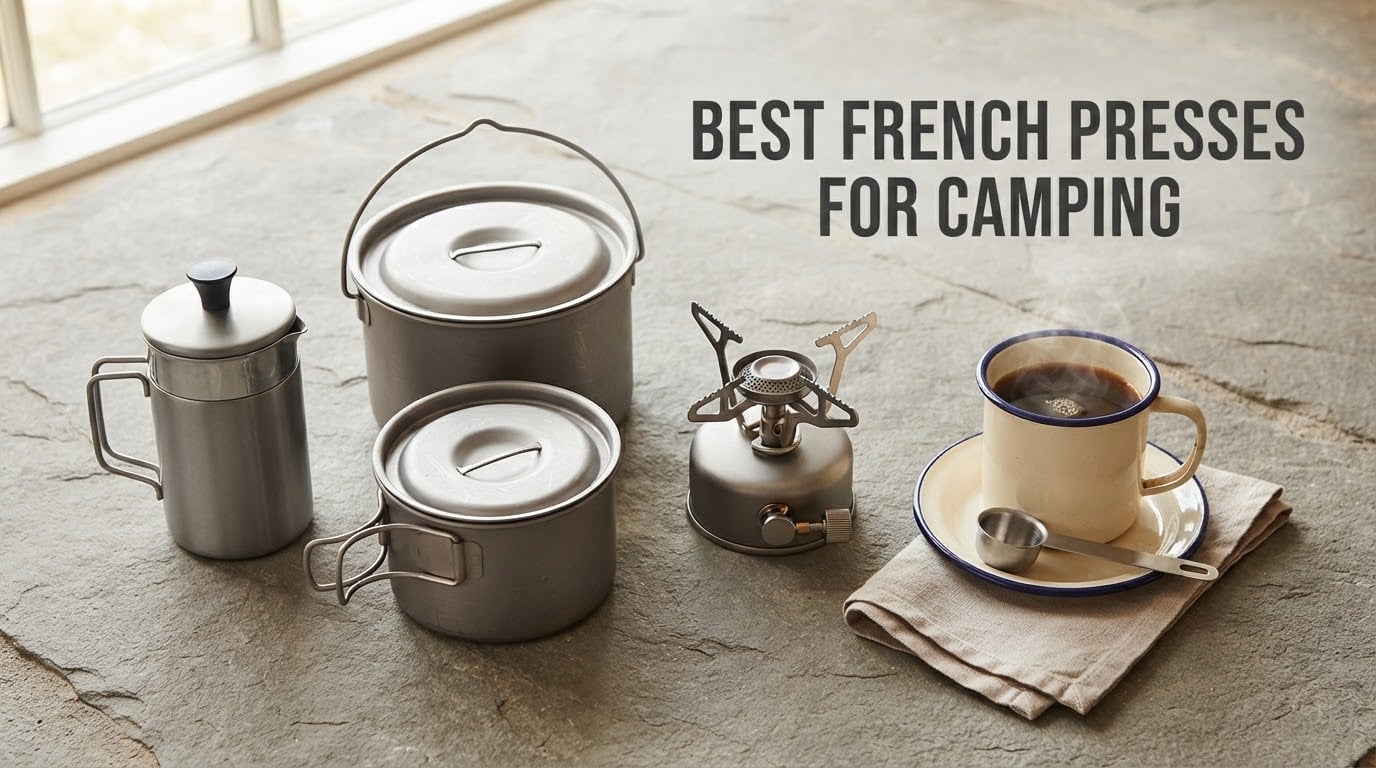
The best french presses for camping fall into two very different camps. Car campers want an insulated stainless carafe that pours four decent cups and shrugs off a tailgate, while backpackers are counting every gram and will settle for two short mugs if the press weighs under 8 ounces. Our pick for most people is the Jetboil Silicone French Press, which is the highest-rated unit in the group, weighs less than an ounce, and locks straight onto a backpacking stove.
I have been brewing coffee in campground gravel and alpine talus for the better part of a decade, and the gear that survives is rarely the gear with the longest feature list. What matters is whether the carafe breaks when you set it down on a rock, whether the lid actually seals when the bag tips at 30 degrees, and whether the coffee is still drinkable while you fry eggs. Those are the criteria behind every pick below.
Weighing these presses against each other, every product here is built for the outdoors rather than adapted from a kitchen model: no glass carafes, no plastic that softens near a burner, and published packed weights so you can do your own ultralight math. If you want the one-sentence answer, take the Jetboil if you already run canister or Jetboil systems, the Bestargot Titanium Pot if you want one piece that brews and boils, and the Bodum Travel Press if you want to drink from the same vessel you brew in.
Last updated for 2026. We buy and use every press listed here, and we disclose that we earn a commission when you buy through the links on this page. Ratings and review counts come from the retailer listings at the time of writing.
Table of Contents
Top 3 Camping French Presses in 2026
These three cover the widest range of trips. The Jetboil wins on weight and rating, the Bestargot wins on versatility, and the Bodum wins on ownership track record.

Jetboil Silicone Press
- Under 1 oz
- Collapses onto Jetboil stoves
- Micro-filter cuts sediment

Best French Presses for Camping (October 2026)
The table below is the fastest way to narrow the field. Packed weight and capacity are the two numbers that decide most purchases, because they decide how many cups you get and how much of your pack budget the brewer eats.
| Product | Specifications | Action |
|---|---|---|
| Jetboil Silicone French Press |
|
Check Latest Price |
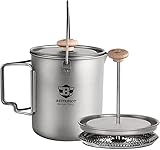 Bestargot Titanium Pot 750ml Bestargot Titanium Pot 750ml |
|
Check Latest Price |
| Bodum Travel Press 15oz |
|
Check Latest Price |
 Snow Peak Titanium French Press CS-111 Snow Peak Titanium French Press CS-111 |
|
Check Latest Price |
 GSI Outdoors JavaPress 30oz GSI Outdoors JavaPress 30oz |
|
Check Latest Price |
 BruTrek Steel Toe 3.0 20oz BruTrek Steel Toe 3.0 20oz |
|
Check Latest Price |
 Lixada Titanium Cup 750ml Lixada Titanium Cup 750ml |
|
Check Latest Price |
 GSI Outdoors Javapress I 20oz GSI Outdoors Javapress I 20oz |
|
Check Latest Price |
1. Jetboil Silicone French Press — Best Overall for Backpacking and Stove-top Brewing
Jetboil Silicone French Press Coffee Maker Camping Stoves, Regular
Capacity: 1 litre
Weight: 22.68 g
Material: Silicone
Filter: Reusable micro-filter
Pros
- Under one ounce
- Collapses onto Jetboil stoves
- Micro-filter cuts sediment
- Doubles as a steaming basket
Cons
- Only fits Jetboil Flash
- MicroMo and Zip systems
- Fixed 1 litre size suits Jetboil cups
- Silicone will not take direct flame
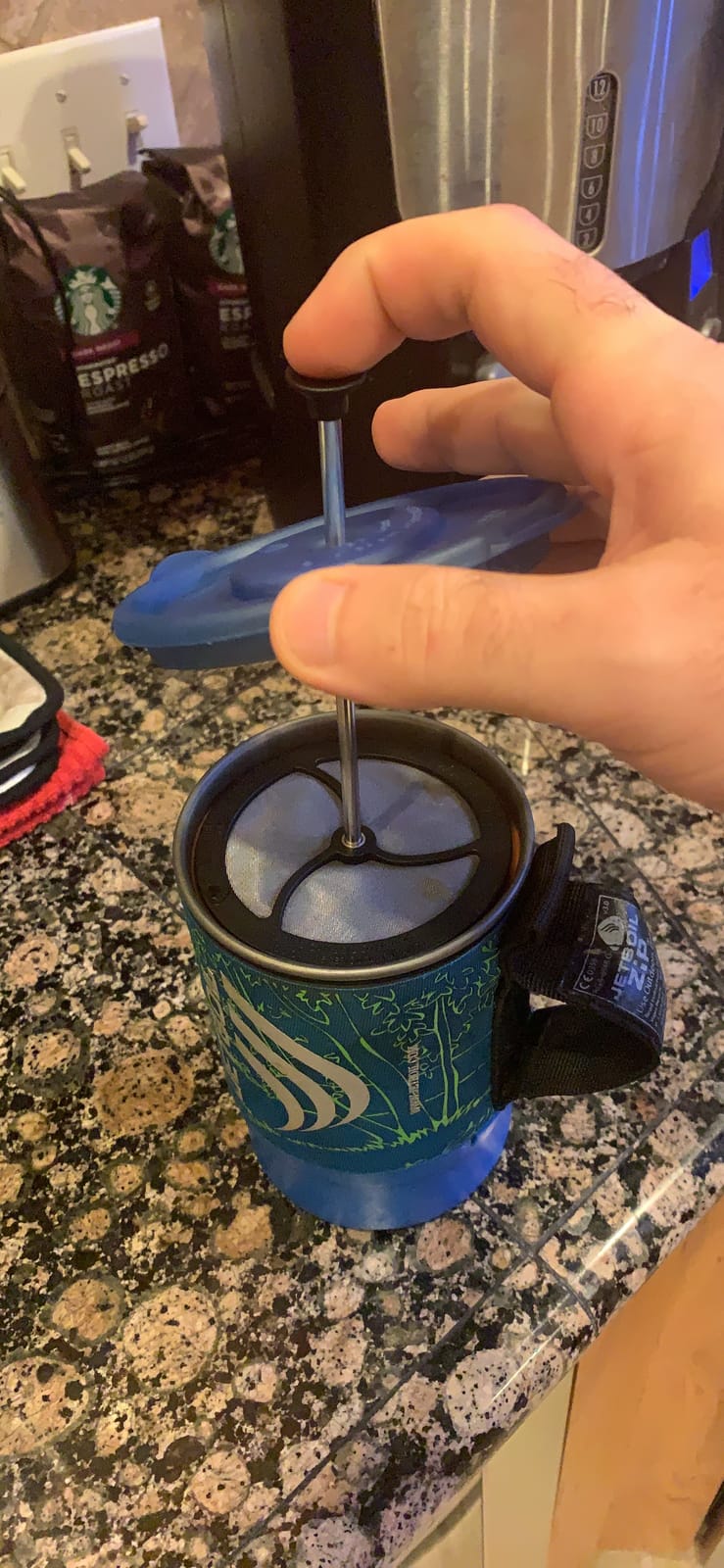
This press is 22.68 grams. That number matters more than anything else on this page, because on a three-season backpacking trip a gram is a decision and this thing costs you less than a single meal. It is not a mini carafe in the usual sense; the silicone body is a collar that sits directly on top of a Jetboil boiling pot, using the pot as the vessel.
Owner reviews are unusually specific about why it works. The silicone ring grips the rim of the pot so tightly that reviewers report grounds staying put during the plunge, which is the single complaint that ruins most silicone press designs. The micro-filter is the second talking point, repeatedly described as noticeably cleaner than a single mesh screen.
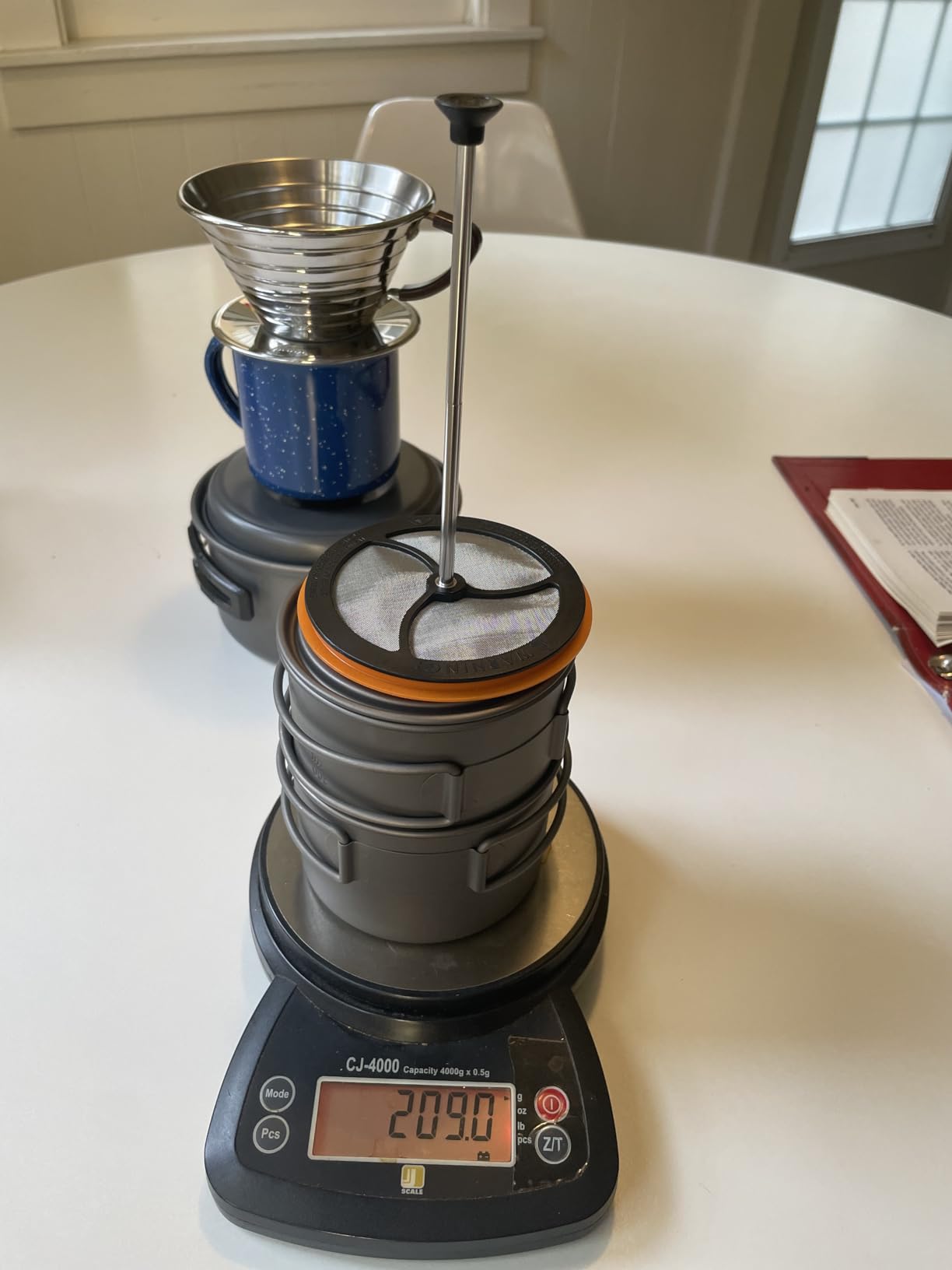
Reviewers also point out a second job: the same basket steams fish or vegetables over the burner at dinner. On a trip where every piece of gear earns its weight, a brewer that doubles as a steamer is quietly worth more than a bigger carafe.
The awkward truth is that this is not a general-purpose press. If you do not already own a Jetboil Flash, MicroMo or Zip, or one of the 1 litre and 0.8 litre spare cups, there is nothing to lock it onto. The fixed capacity is also shaped around those systems rather than around a personal mug size.
Check the fit before you fall for the weight
Pull up your stove model and confirm the press actually seats on it. This is a two-minute check and it is the difference between a press that works flawlessly and one that sits loose enough to drip grounds into your burner. Jetboil lists compatibility with the Flash, MicroMo and Zip along with the tall 1 litre and 0.8 litre spare cups.
Also decide now whether you are OK brewing and drinking from the pot. That is the whole design, and it means your morning cup is the pot handle, not a mug you forgot to pack.
Where it will not suit you
If you are car camping and want a proper carafe you can pour for two people from, a 1 litre collapsible collar on a stove burner is the wrong shape entirely. It also cannot go near a campfire, because silicone and high-temperature plastic soften long before steel does.
For anyone without a matching Jetboil system, look at the Bestargot titanium pot or the Snow Peak instead. Both are standalone vessels with real carafe capacity.
2. Bestargot Titanium Pot 750ml — Best Multi-Use Press for Hikers Who Also Need to Boil Water
Bestargot Titanium Pot 750ml, Coffee French Press
Capacity: 750 ml
Weight: 7.68 oz
Material: Titanium and stainless
Use: Brew, cook, boil
Pros
- Genuinely plastic-free build
- Packs inside other pots
- Fine mesh blocks grinds
- Doubles as a cooking pot
Cons
- 750 ml means two batches for a group
- Titanium heats slower than aluminium
- Wooden handle rolls during assembly
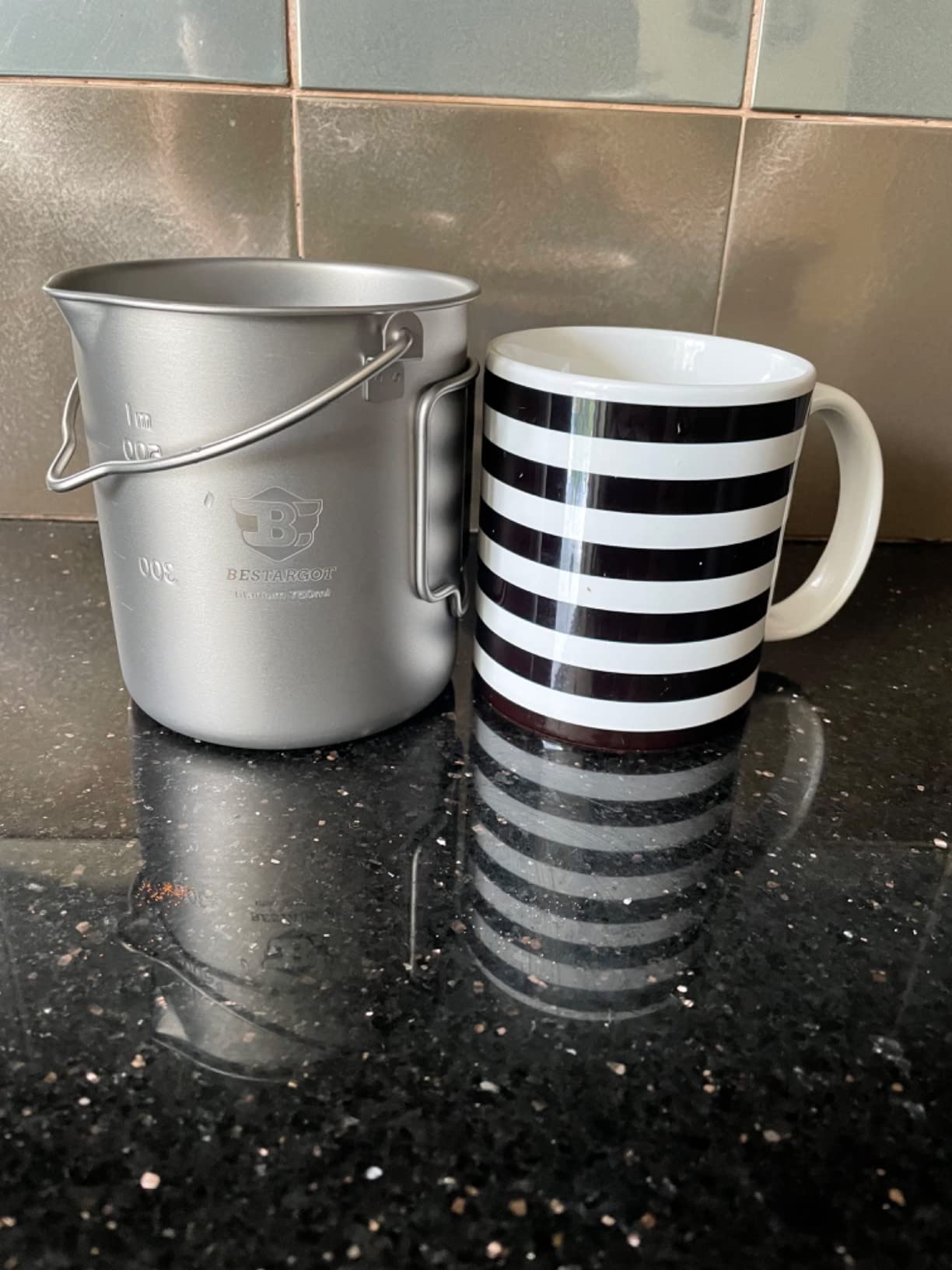
This is the pick I pack. At 7.68 ounces it disappears into a cook system, and because the body is cookware rather than a dedicated coffee vessel, it does not create a duplicate pot in your loadout. Reviewers consistently describe it as a brew-and-cook piece: coffee in the morning, boiling water for lunch at the same time.
Construction is all metal with no coating, which means nothing to peel and no flavour transfer. The folding handles collapse for storage and resist heat well enough to grip, and the fine mesh screen holds on to grounds when the grind is right.
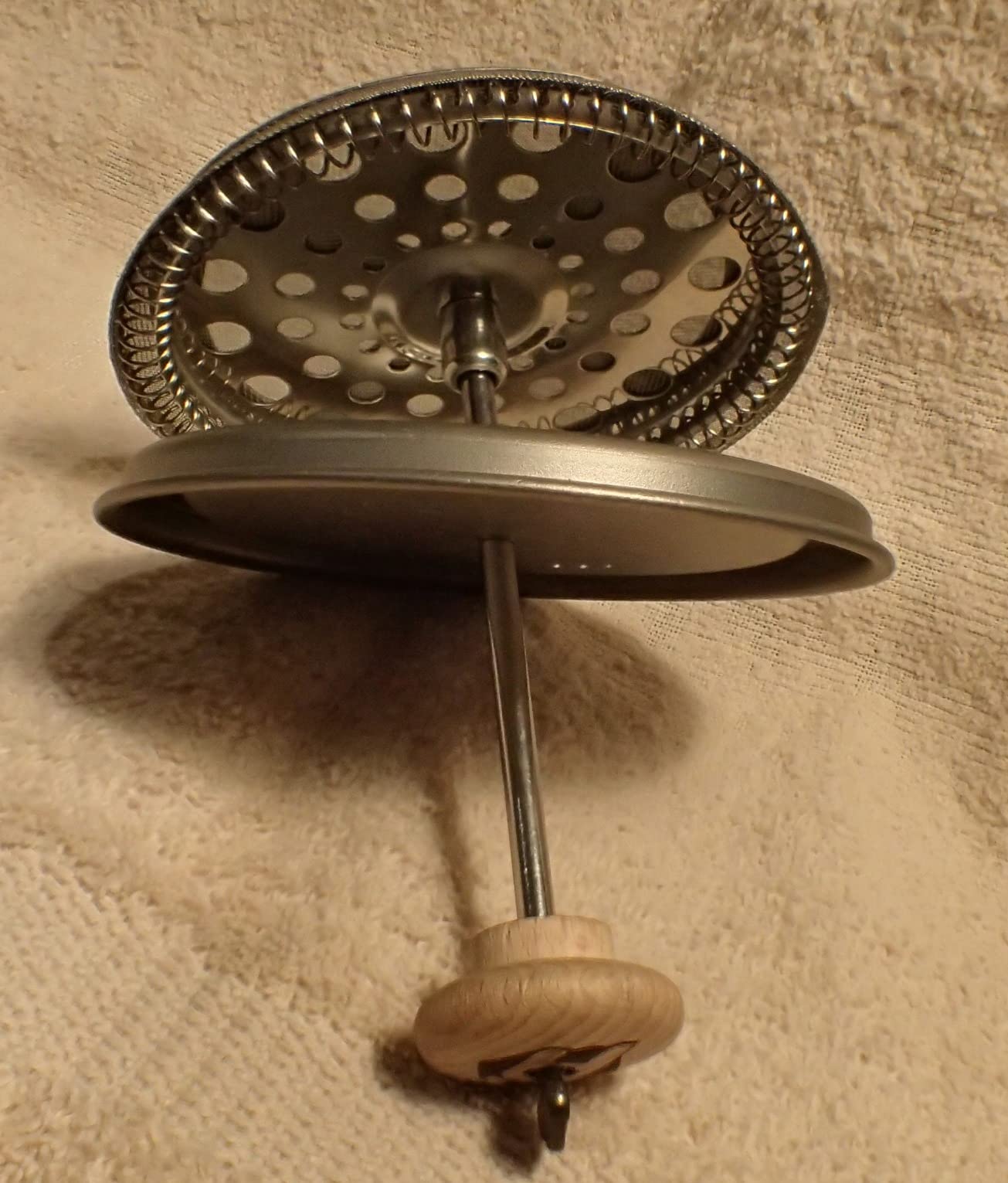
It works on a gas stove, an alcohol burner and, per the manufacturer, a campfire. That flexibility matters when the forecast is the thing you planned around. It is dishwasher safe too, which sounds like a kitchen luxury and turns into a real convenience at a hose or a bucket.
Two honest limits. A 750 ml body is realistically one large mug or two small ones, so a group of four means two rounds or a second brewer. And titanium is a weaker conductor than aluminium, so the water takes a little longer to come up to temperature.
Why this earns its place in a pack
The value argument is not really about the coffee. It is about consolidation. If you were going to carry a titanium pot anyway, this converts that pot into a brewer at zero extra weight, and reviewer reports of using it for soup on multi-day trips back that up.
Check the fit of the folding handles before a long trip. One recurring complaint is that the handle tends to roll while the press is being assembled, which is annoying but never a failure.
Where it will not suit you
Nobody is pouring four mugs from this. If your trip involves a family, a group of canoeists, or a 12 volt system brewing on loop, the 30 oz GSI is a better shape and has the volume to back it up.
And if you are counting every gram without any tolerance for shared cookware, the same idea at a lighter price is the Lixada titanium cup, which drops the press down to a 208 g pot. The trade is a steel press insert instead of a fine mesh filter.
3. Bodum Travel Press 15oz — Best for Solo Campers Who Want One Vessel
Bodum Travel Press, Vacuum Insulated, Stainless Steel Portable Coffee Maker and Tea Press, 15oz, Black
Capacity: 15 oz
Weight: 14.4 oz
Material: Double-wall stainless
Dishwasher safe
Pros
- Brews and drinks from one vessel
- Vacuum double wall holds heat
- Tall narrow body is easy to sip
- Silicone grip stays secure
Cons
- 15 oz is single-serve
- Double wall cannot take direct stove heat
- Plastic seal parts can pick up taste over time
With 5289 reviews behind it, the Bodum Travel Press has the longest public track record of anything on this page. It does one thing, it does it for a long time, and it does not pretend to be a two-person press.
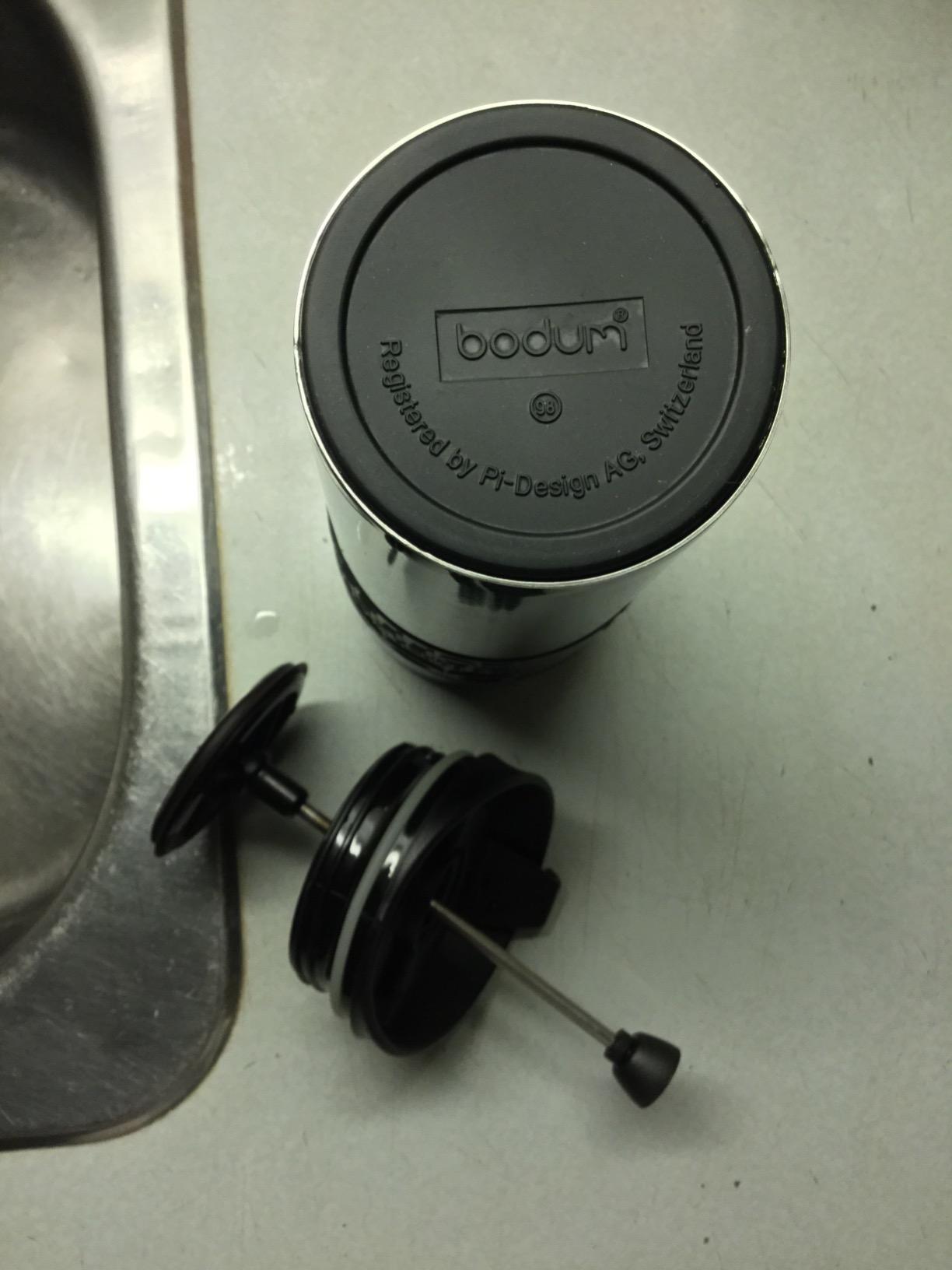
It is the press-and-mug hybrid that solves a problem most campers do not think about until it bites them. A separate press plus a separate cup is two vessels to wash and two things to pack. This one collapses that to a single 15 oz container with a spill-resistant lid and a built-in plunger.
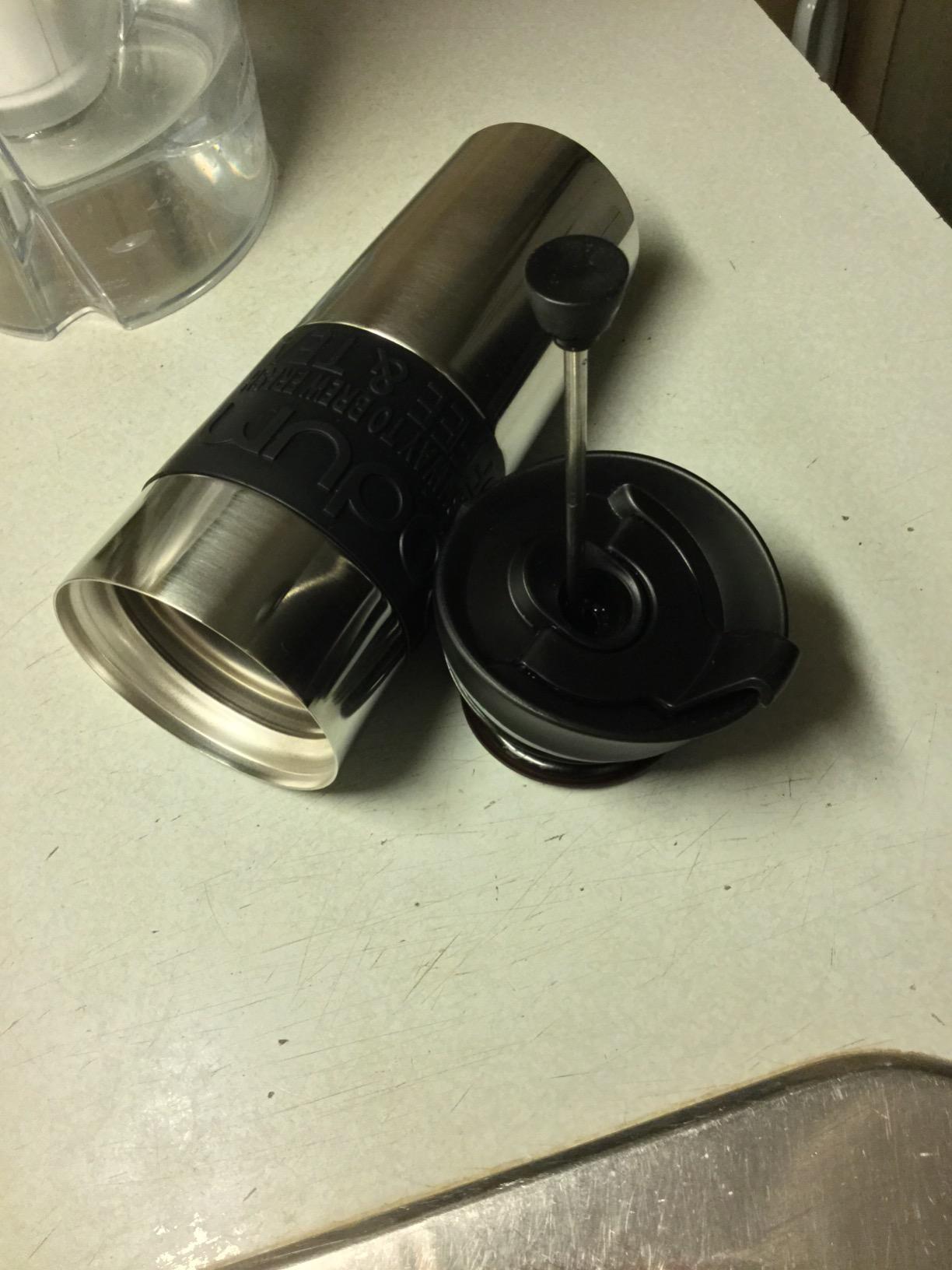
The vacuum-sealed double wall is the feature reviewers bring up first. Coffee stays hot through a cold morning while you break camp, and the silicone non-slip grip stays usable with wet or freezing hands, which is where cheaper press-mugs fail.
The tall, narrow body is easy to sip from straight and easy to scrub. Every part is dishwasher safe, which matters for the reason it usually matters: coffee oils going rancid in a bag between trips.
Now the compromises. Fifteen ounces is a single serving, so a couple camping together needs two. The double-wall body cannot be set on a camp stove to boil water directly, and at 14.4 ounces it carries real weight for a portable press.
When the one-vessel rule is worth the weight
The case for this press is strongest on trips where water is scarce and washing up is a chore. One vessel, one rinse, done. Solo campers, couples, and cold-weather trips where a hot drink at dawn matters more than a low base weight all fit that description.
Note that the extra lid is no longer included in the box. That has annoyed enough owners to be worth knowing before you order.
Where it will not suit you
It loses on weight to lighter options. At 14.4 ounces against a 6.4 ounce Snow Peak, an ultralight hiker is giving up more than they need to for a cup of coffee.
And if you are boiling water on the same burner, you need a pot anyway, so the double-wall shell just adds bulk.
If you want the one-vessel idea with less weight, the GSI Javapress I on this page nests a 17 oz mug and sleeve inside the press for a very small volume penalty.
4. Snow Peak Titanium French Press CS-111 — Premium Pick for the Weight-Conscious Hiker
Snow Peak Titanium French Press – Ultralight Coffee Maker for Camping, Backpacking & Hiking – Camping Cookware Essential for Coffee Anywhere
Capacity: 240 ml
Weight: 6.4 oz
Material: Pure titanium
Warranty: Lifetime
Pros
- Lightest real carafe here
- Boils water directly on a stove
- Lifetime warranty
- Picks up a natural titanium patina
Cons
- Smallest capacity at 240 ml
- Polyester mesh lets fines through
- Gasket is hard to clean
- Single wall dents
The Snow Peak is the one we would buy for a long solo traverse. At 6.4 ounces it is a genuine carafe, not a collar on a stove, and it carries a lifetime product guarantee. That guarantee is unusual in cookware and it reflects how long this design has been in production.
Unlike most of this list, it sets directly over heat. That means you can boil water for coffee in the same pot you drink from, with no separate kettle and no stove adapter. Reviewers treat that single-wall capability as the reason it survives a camping kit at all.
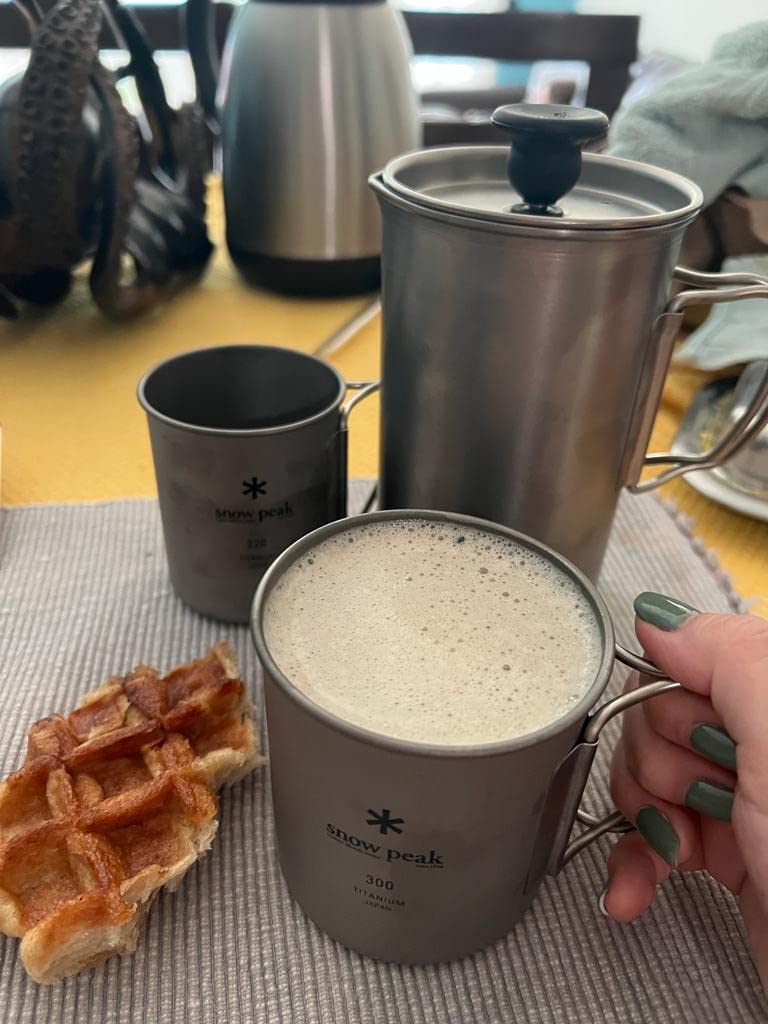
Titanium does not flake or peel. Heat it enough and it develops the natural blue-grey oxide finish that owners describe as an asset rather than damage, which means there is zero coating to fail in year five.
The catch is capacity. Two hundred and forty millilitres is one or two short cups, and no amount of technique changes the arithmetic. Anyone brewing for two people should add another vessel or accept a second round.
Why the lifetime guarantee matters in the field
Gear failure in the backcountry is rarely dramatic. It is a bent rim, a cracked handle rivet, a seam that gives up. A lifetime guarantee on a 6.4 ounce titanium body means the failure mode you are worried about is the one the manufacturer is betting against.
Pack it carefully regardless. Single-wall titanium is light partly because it is thin, and thin means it marks and dents if you drop it on granite.
Where it will not suit you
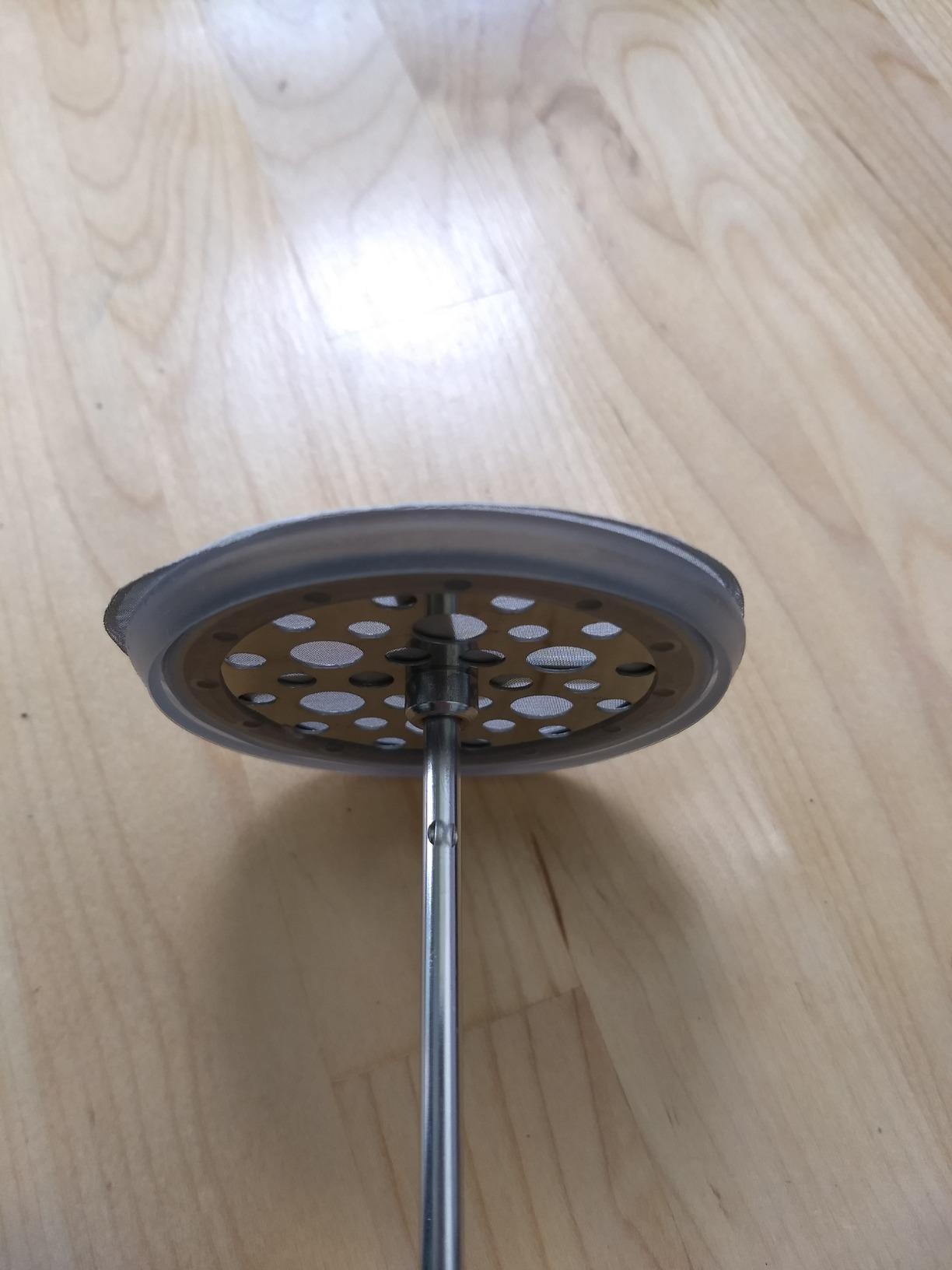
The polyester mesh filter lets a few fines through unless the grind is coarse, and the rubber gasket around that filter is the part reviewers complain about cleaning. If you brew with pre-ground supermarket coffee, you will see sediment in the cup.
Anyone brewing two small cups at a time should think about it, because titanium is the priciest material on the list. If your weight budget is not truly tight, the Bestargot gives you more capacity and multi-use cooking without the titanium premium.
5. GSI Outdoors JavaPress 30oz — Best for Two People and Car Campers
GSI Outdoors, 30 Fl Oz JavaPress, French Press Coffee Maker for Camping and Travel, Blue
Capacity: 30 fl oz
Weight: 310 g
Body: BPA-free, shatter-resistant
Pros
- Largest capacity in the group
- No glass to shatter
- Insulated double-wall lid
- Nylon sleeve protects hands
Cons
- Bulkier than titanium options
- Some users notice a plastic taste
- Brew coarse for best filtration
Thirty fluid ounces is the size that actually changes camp mornings. Most people drink 10 to 12 ounces of coffee, so a single batch here covers two adults properly, or one adult who does not plan on rationing. That single fact does more for a group trip than any insulation rating.
The body is BPA-free and shatter-resistant rather than glass, which is the answer to the fear that shows up in almost every camping coffee thread. On a rocky site, in a truck bed, in a raft, there is no catastrophic failure mode.
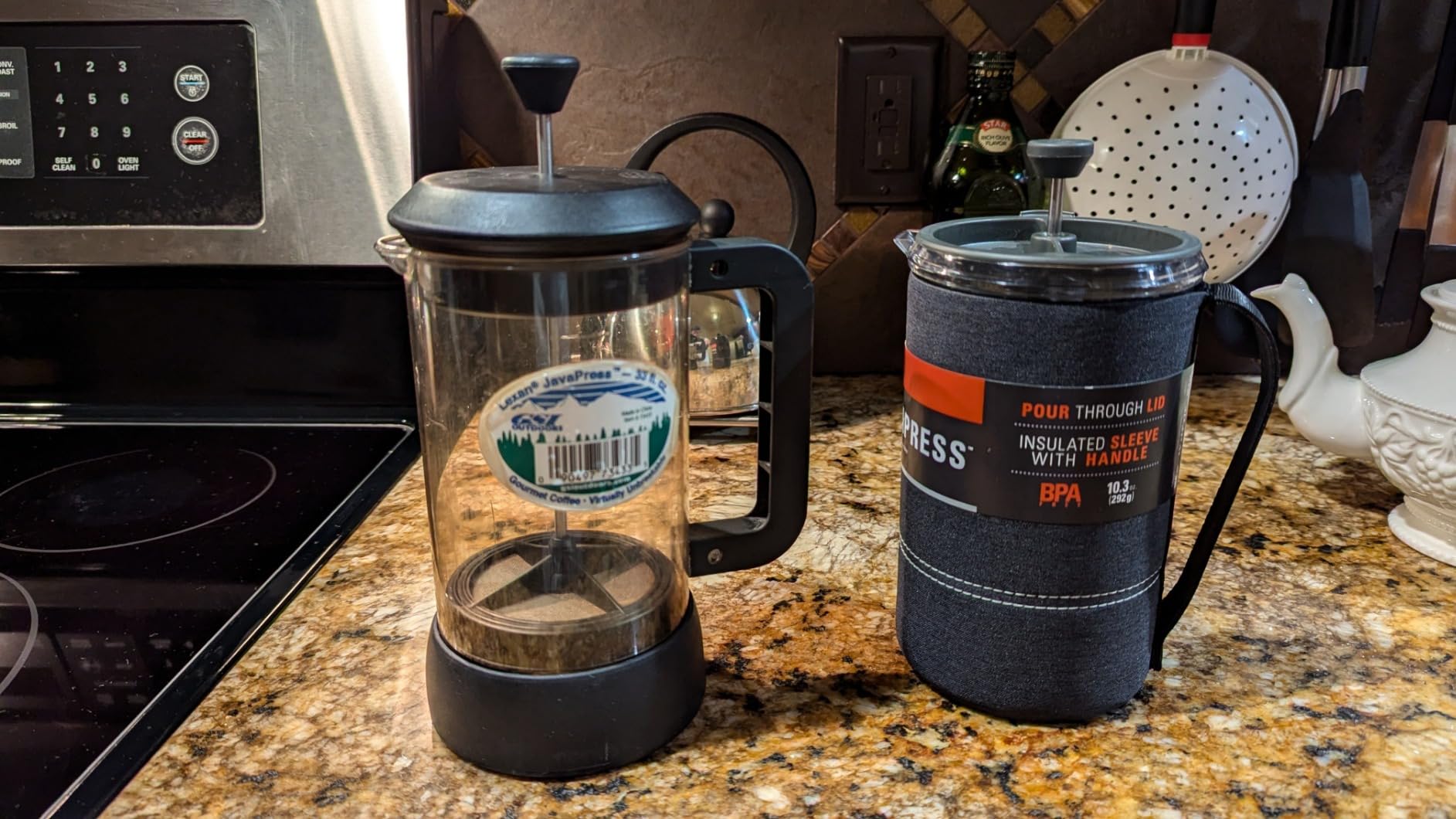
The double-walled lid and the included water-resistant nylon sleeve work together. The sleeve has a handle, so you can pour a hot batch without wrapping both hands around a scalding carafe while the other hand holds the coffee pot.
Reviewers rate the filter highly, including on tighter grinds, which is forgiving when you are working with supermarket pre-ground coffee rather than a hand grinder.
The main complaint is taste transfer. Some owners notice a plastic or chemical note in the liquid, particularly with boiling water, and their advice is to brew with water you have cooled slightly. It is also bulkier than the titanium options, at 310 g.
Size your press to the people, not the tent
The rule of thumb we use is 10 to 12 ounces per drinker, brewed fresh, not a batch you leave sitting. For two people that means 30 ounces. For one person who likes a refill, 15 to 20 ounces is plenty. Oversizing wastes water and fuel to reheat coffee that has been sitting on the grounds.
This is also the model we would pick for a family campsite where the car is a hundred feet away and the press is carried to the picnic table every morning.
Where it will not suit you
Thirty ounces is not group capacity for four. If that is your party, you are either running two rounds or looking at a percolator, which serves more people per gram of gear.
Anyone who is sensitive to plastic flavour should skip it. And the 310 g weight is irrelevant in a car and frustrating in a pack.
6. BruTrek Steel Toe 3.0 20oz — Best for Cold Mornings and RV Life
BruTrek by Planetary Design | Steel Toe 3.0 French Press | 20oz | Red Rock
Capacity: 20 fl oz
Body: Double-wall 18/8 stainless
Lid: Threaded no-spill lock
Pros
- Vacuum insulation holds heat through a cold morning
- Threaded lid survived a drop
- Cool textured grip
- Plunger rinses clean fast
Cons
- 20 oz is about 1.5 cups
- No handle so it needs two hands
- Cannot be set on a camp stove
Heat retention is the deciding factor for early-season and winter trips, and the BruTrek is the press built around it. The double-wall vacuum-insulated 18/8 stainless body is the classic cold-morning answer, and owner reviews describe coffee still good several hours after the pour.
The sealed design is what makes it an RV and van-life pick. The lid is threaded and locks rather than just resting, so a tipped van, a rough road, or a pack on its side does not put coffee across your sleeping bag.
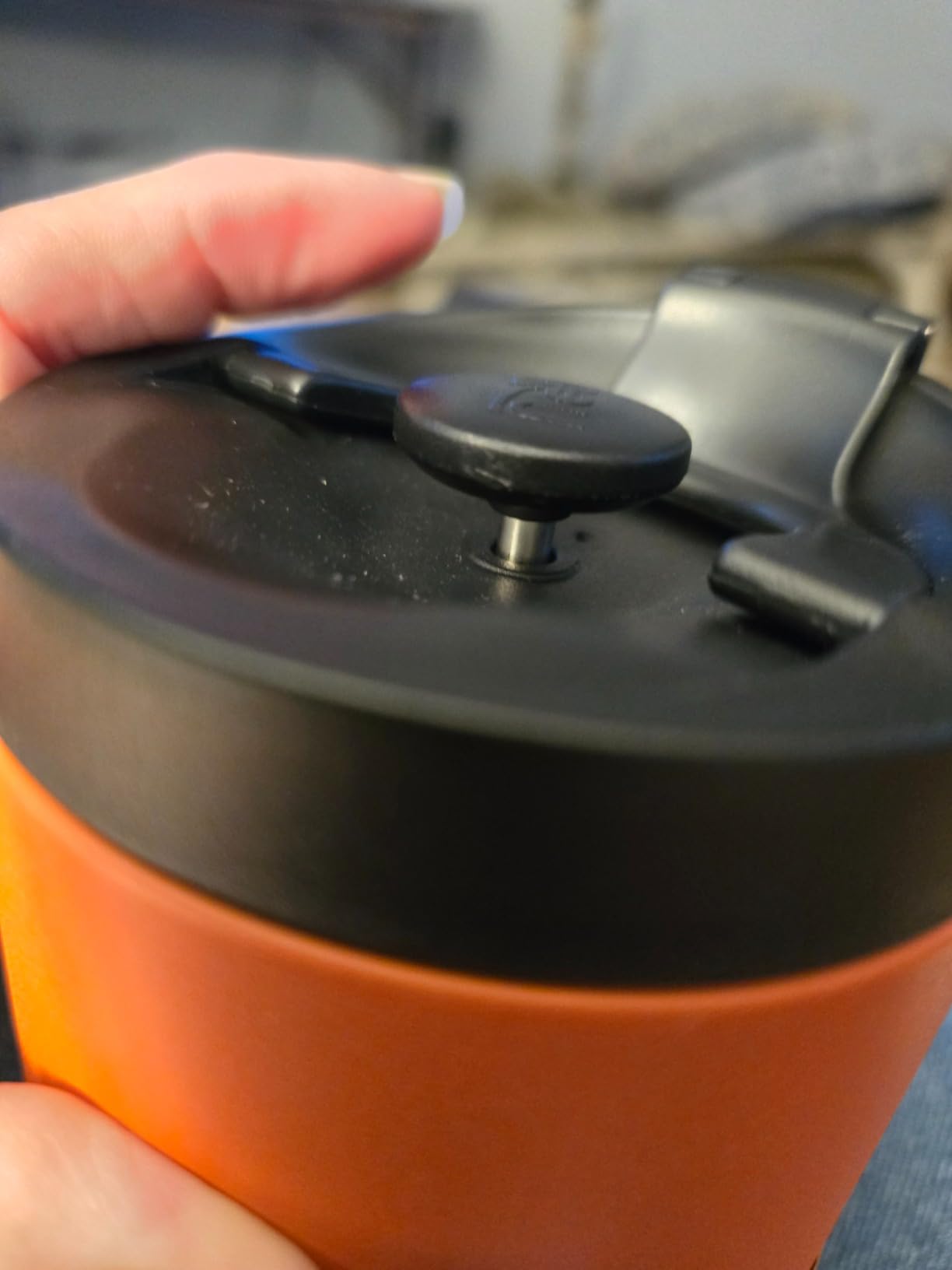
The locking flip-over pour spout stays shut whether it is open or closed, which sounds like a small detail until you try to fill a mug in a wind. The textured finish also gives you a real grip with gloved hands, and the rubber-padded base keeps it from walking across a picnic table.
Cleanup is unusually fast for a press. The plate-style plunger rinses clean without disassembling the whole stack, which is a real saving when cleanup happens with cold water.
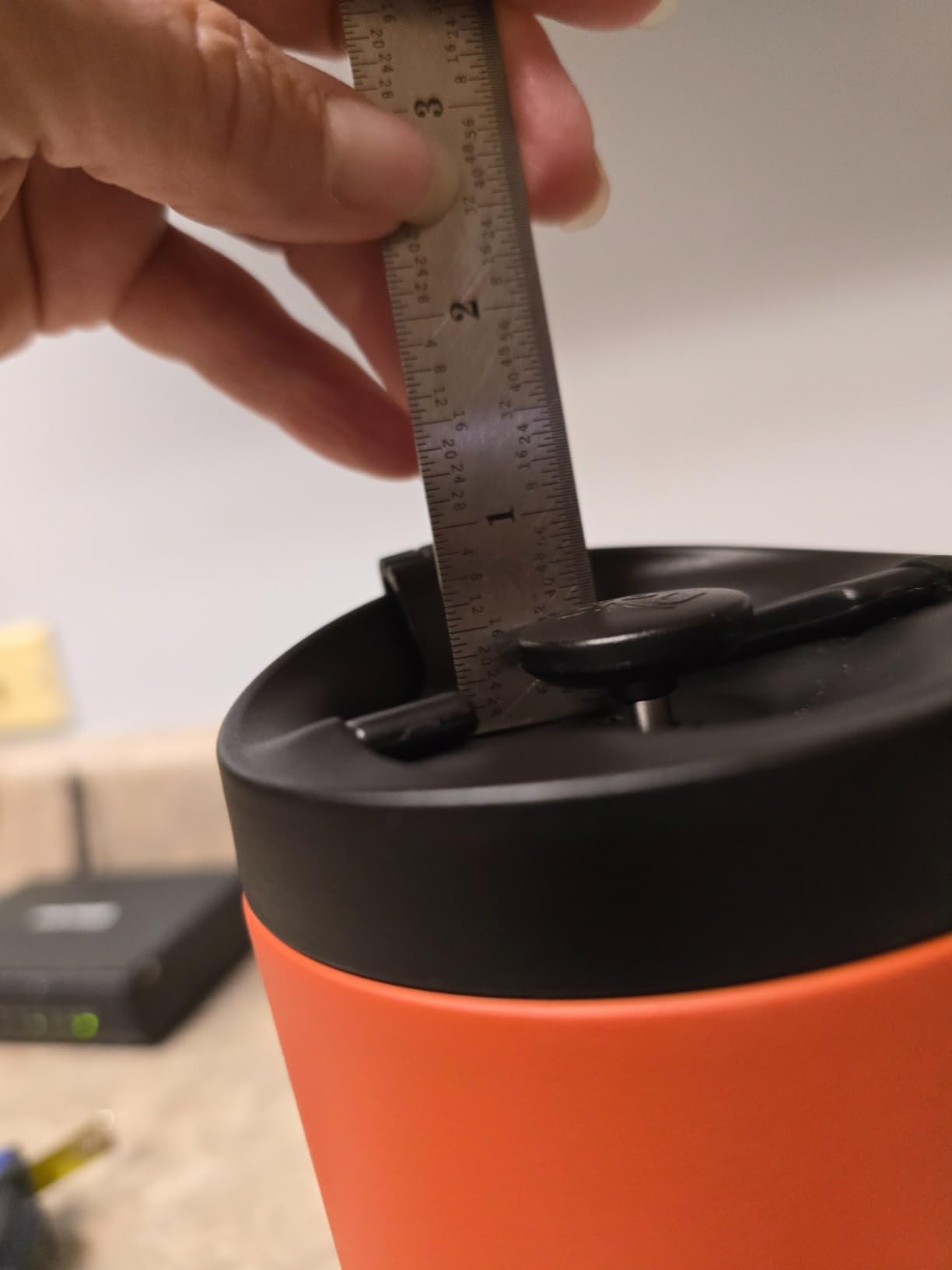
The limitations are structural rather than quality. Twenty ounces gives you about one and a half cups. There is no handle, so a hot press needs two hands or a sleeve. And the plunger button sits proud of the lid, which owners who sip straight from the press find they navigate with their nose.
Check the seal before you trust it to a pack
The threaded lock is the part to test, and it is worth testing at home before the trip. Fill the press, seal the lid, and lay it on its side in a sink. Any press that passes that will survive a pack; any press that fails it will not, regardless of the brand on the box.
Note that the insulated body cannot be set directly on a camp stove. Boil your water separately and pour.
Where it will not suit you
It is not a solo-and-light setup, and it is not a group setup. If you want the same sealed, insulated logic in a press-mug format that drinks from itself, the Bodum gets you there in a simpler package.
Reviewers also note that some fine sediment settles at the bottom of the cup. Brew a touch coarser if that bothers you.
7. Lixada Titanium Cup 750ml — Best for Weight-Conscious Campers Who Want a Pot That Brews
Lixada Titanium Cup Camping Coffee Mug 750ml Outdoor French Press Pot, Camp Cooking Pot, Coffee Maker with Lid, Multi-Functional Travel Mug for Outdoor Camping, Hiking, Picnic, Backpacking
Capacity: 750 ml
Weight: 208 g
Material: Titanium pot, steel press
Pros
- Press
- pot
- kettle and cup in one
- Light titanium body at 208 g
- Graduated oz and ml markings
- Detachable press for cleaning
Cons
- Single wall cools brew fast
- Bail handle cannot clip to the lid
- Steel parts add weight
- Plunger is fiddly to reassemble
The review record on this one is strong for its size: 176 reviews averaging 4.7, with 80 percent five-star scores. It does something the others mostly do not: it carries a 750 ml body at 208 g with a stainless press built in, plus graduation markings in both ounces and millilitres.
The multi-functional design is genuine rather than marketing. Bail handle for hanging over a campfire, foldable grab handles for packing, a pouring spout, and a detachable press that unscrews for cleaning.
There is also a weight trick worth knowing. The screen can be removed if you are happy to brew a little sloppily. Most hikers never discover this.
The honest weakness is heat retention. Single-wall titanium does not insulate, so this coffee cools faster than any insulated press on the page. In August that is irrelevant. In October at 6am it is the whole story.
Two smaller annoyances: the bail handle cannot be clipped to the lid, which limits how you hang it, and the plunger knob is fiddly to reassemble after a wash when your hands are cold.
Why the graduated markings matter more than they sound
A French press brewed by eye is a French press brewed wrong. Marks on the pot let you repeat the same brew every morning of the trip instead of improvising one in the dark.
It also doubles as a kettle, since the bail handle lets it hang over flame and the pot will boil water on a stove.
Where it will not suit you
Cold-weather campers should choose insulation over graduations. And if you already carry a titanium pot, the Bestargot is the better-integrated version of the same idea, with a 220 g all-metal body and a fine mesh screen.
The stainless press components also work against a truly minimal load, which is why the screen-removal option exists.
8. GSI Outdoors Javapress I 20oz — Best for Backpackers Who Hate Wasted Pack Volume
GSI Outdoors Personal 20 fl. oz. Javapress I Insulated French Press Travel Coffee Mug for Camp Coffee and Tea
Capacity: 20 fl oz
Weight: 10.72 oz
Body: Copolyester
Warranty: Lifetime
Pros
- Press
- mug and sleeves nest into one package
- Insulated wrap keeps coffee hot while brewing
- Plunger seal handles regular grind
- Rinse-clean when water is limited
Cons
- Mug insulation is only marginal and not removable
- No graduations on the mug
- Small lid tab hard with gloves
- Bulkier than a plain titanium press
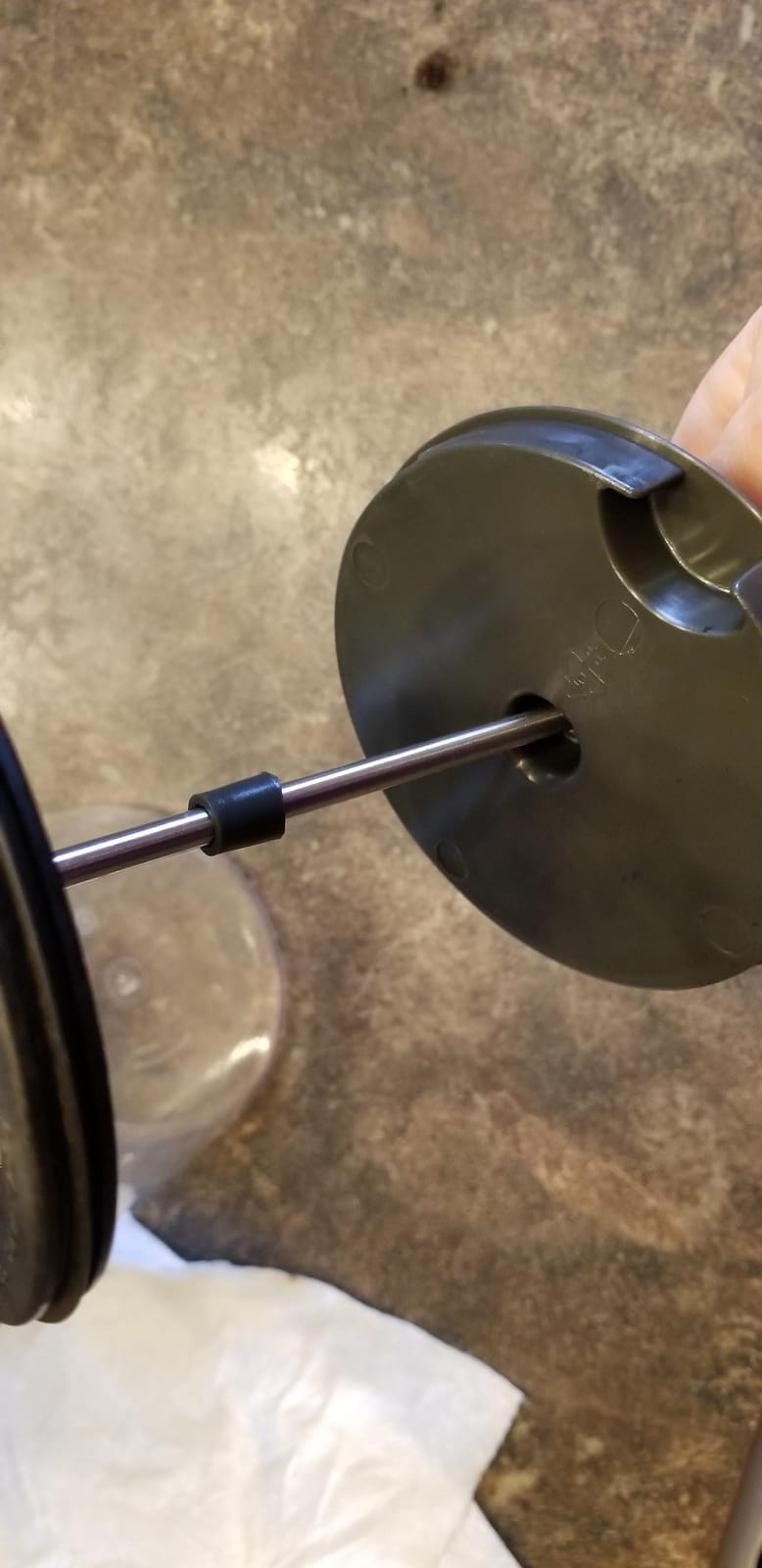
This is the answer to the two-vessel problem. The press, a 17 oz mug, an insulated sleeve and the plunger mechanism all nest into a single compact package, so there is no second coffee vessel taking up pack space or needing a second wash at the stream.
The insulation is ballistic nylon wraps rather than foam, which is the right call outdoors. Foam degrades and compresses over a season; ballistic nylon shrugs off a wet pack and keeps working.
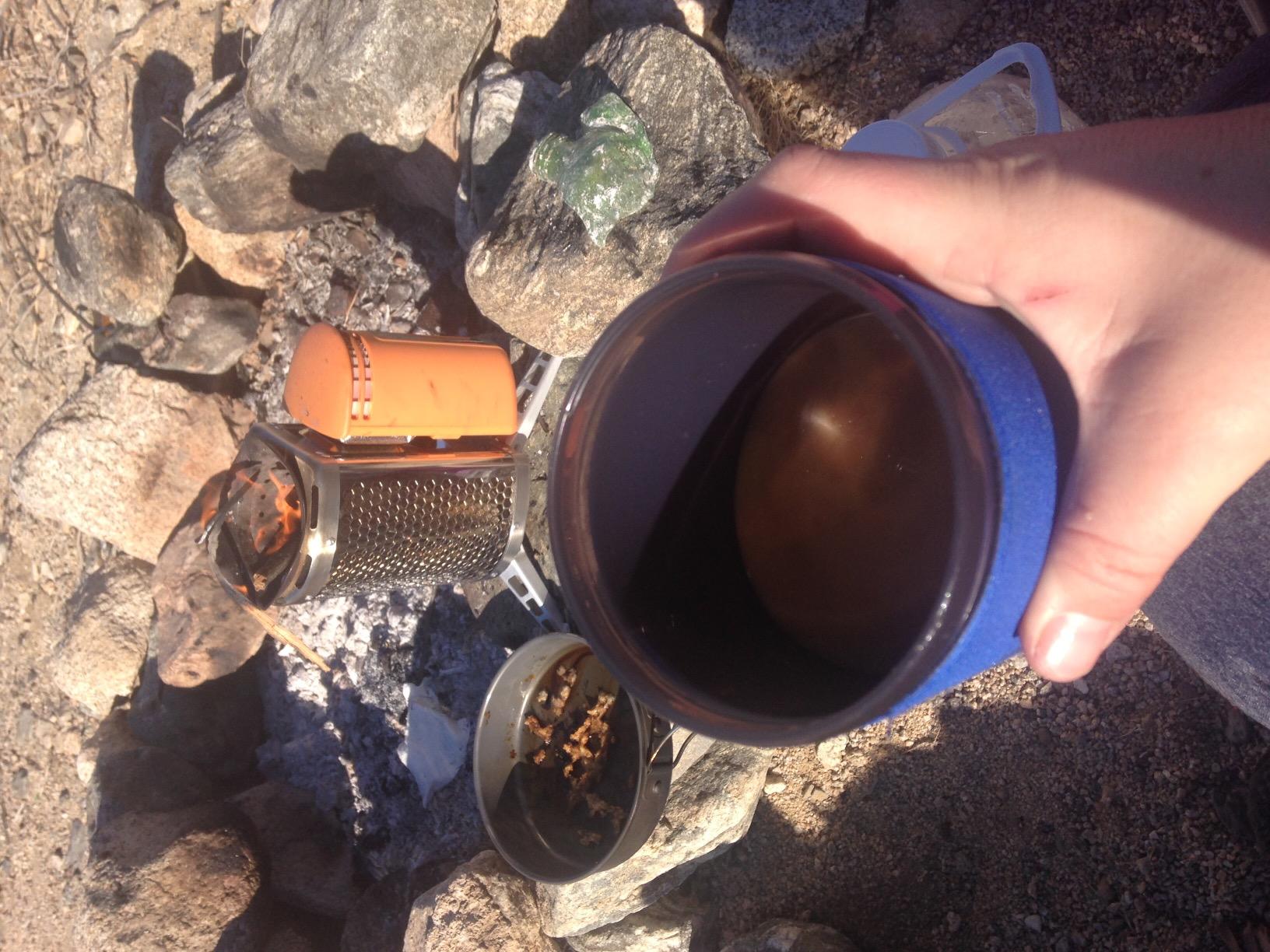
Reviewers rate the plunger mechanism highly, specifically for sealing well enough to brew with a regular grind rather than forcing you to use only the coarsest grounds. That is a meaningful quality difference on a trip where pre-ground coffee is the plan.
GSI warrants this for the lifetime of the product for the original owner, which is the kind of backing you rarely see on a piece of plastic kit.
The complaints cluster on the included mug. Its insulating wrap is marginal and cannot be removed for washing, so it stays damp. There are no graduation markings on the mug, which makes the coffee-to-water ratio a guess. And the lid pull tab is genuinely difficult with cold hands or gloves on.
Volume saved versus what it costs
The saving is real: one package instead of a press plus a mug plus a sleeve. The cost is bulk relative to a plain titanium pot, because the nesting sleeve and mug walls take up space even when empty. Volume and weight are not the same problem, and this solves the first one while adding to the second.
Pour-through and sip-through lid design means you can drink without decanting into another cup, which reduces the number of rinses on a dry trip.
Where it will not suit you
If your group is three or more, 20 ounces runs out fast. If you are counting grams for a fastpacker, 10.72 ounces is a lot of coffee apparatus, and a titanium pot or the Jetboil collar is lighter.
Anyone who wants a marked ratio will be guessing. Pour a set amount into the carafe and count, or pick a graduated pot like the Lixada.
How to Choose a Camping French Press
The decision comes down to three questions in order: how you are camping, how many people need coffee, and how cold it gets. Everything else is preference. Answer those three and the list above narrows to one or two options almost immediately.
Backpacking or car camping: the first split
These two trips want opposite gear. A backpacker needs low weight, nesting shapes, and no glass. The presses here that fit a pack under about 12 ounces are the Jetboil collar at 22.68 g, the Lixada at 208 g, the Snow Peak at 6.4 oz, and the GSI Javapress I at 10.72 oz.
A car camper should ignore that entire column. With the gear riding in a truck bed or a van cabinet, weight is not the constraint; capacity, capacity again, and how long coffee stays hot are.
If you are somewhere in between, an RV or a long-distance campervan is a third case. There, the deciding factor is containment, not weight. A sealed threaded lid that survives a road surface is worth more than any gram you save.
Material: what breaks and what conducts
Glass loses outdoors, full stop. It is the single dominant worry in camping coffee threads and it is a legitimate one. Among the presses here there is no glass at all: titanium, stainless steel, copolyester, silicone and coated steel cover the field.
Titanium weighs less than steel and has no coating to flake, and it survives direct heat. It conducts heat less well than aluminium, so brewing takes marginally longer, and single-wall titanium does not retain warmth.
Stainless steel double-wall vacuum construction is the retention champion. The Bodum and BruTrek both use it, and it is why insulated presses outperform everything else on a cold morning. The cost is weight.
Plastics and silicones are shatterproof and light, which is exactly why the Jetboil and the two GSI presses use them. The tradeoff is heat tolerance and, for some people, taste transfer in hot liquids.
One aside for the mechanically curious: the same pressure-and-plunger thinking shows up in our guides to tumbler presses and fruit presses for cider, though a coffee carafe has a different job from both. If you are also upgrading the rest of your kit, our drill press guide covers the other kind of press entirely.
Insulation: single wall versus double wall
Single wall is one layer of metal. It is light, it can usually sit on a flame, and it cools your coffee quickly. Double wall vacuum construction is two layers with the air gap removed, and it holds brewing heat for a long time while often refusing direct heat.
That last trade is the one that catches people out. An insulated press is a vessel to pour boiling water into. A single-wall pot is both a brewer and a pot. Decide which job comes first on your trip.
Filtration and sediment
Sediment in the cup is one of the top quality complaints on camping coffee threads. A single mesh screen lets fines through. A fine mesh or a multi-layer filter holds them back but clogs if you use a fine grind. The fix is consistent: grind coarse, roughly like sea salt, every time.
The polyester mesh on the Snow Peak leaks the most fines of the group. The Bestargot and Lixada use stainless screens that reviewers describe as tight. The Bodum and GSI plungers seal well enough to tolerate a regular grind.
Lid seal and leak reality
Yes, presses leak in a backpack, but it is entirely about the seal, not the brand. A resting lid that you push down is not a seal. A threaded or locking lid is.
Before any of these go in a pack, fill it, close it, and lay it on its side for ten minutes. If it holds, it will travel. If it does not, put it in a dry bag and stop worrying.
Single-wall presses with folding lids, like the Snow Peak, are the most likely to weep grounds water into a bag. Insulated presses with threaded lids, like the BruTrek, are the least likely.
Heat source and campfire safety
This is the safety point most roundups skip. Never set a double-wall vacuum press over an open flame or directly on a burner. The sealed air gap has no way to vent pressure, and the interior can be far hotter than the outside suggests. Boil your water in a pot, then pour it into the press.
Single-wall titanium presses such as the Snow Peak, the Bestargot and the Lixada are designed to take direct heat. Even so, heat the vessel away from flame and never leave it unattended. The Lixada bail handle is specifically intended for hanging over a campfire.
Size: match the press to the party
Plan on 10 to 12 ounces per drinker for a fresh batch. That makes the math simple. One person: 15 to 20 ounces, which is the Bodum or the GSI Javapress I. Two people: 30 ounces, which is the GSI JavaPress. Groups beyond two should seriously weigh a percolator instead.
French press versus percolator, pour-over and AeroPress
The AeroPress is the benchmark every backpacker measures against, and it usually wins on weight. It loses on volume and on the body and oils that make French press coffee taste like coffee to people who like it. A French press is the right answer when taste matters more than ounces, and the wrong answer when every gram counts.
A percolator serves more people per gram of gear because it brews in larger batches, which is why it keeps coming up in canoe-camping threads. A pour-over is efficient on weight when you have a filter cone and a scale, and awkward for groups. An espresso-style press is the odd one out, and it makes a very strong small batch in cold weather.
Price tiers and what actually drives them
The real cost drivers are wall count, filter mesh count, seal quality and liner material. Basic single-wall steel presses sit at the bottom of the range. Double-wall vacuum stainless adds insulation weight and cost. Titanium adds both premium and lightness. Multi-piece locking lids and lifetime warranties add the rest.
Cheap versus expensive French presses differ less in brewing than buyers expect. The measurable differences are in the lid seal, the filter tightness, and how long heat stays in.
How to Brew French Press Coffee at Camp
Method matters more at camp than at home, because cold hands, poor water and coarse pre-ground coffee all push a brew toward bitterness or sourness. A disciplined sequence fixes most of it.
Grind coarse. Roughly the texture of sea salt. If you are buying pre-ground coffee, buy the grind labelled for French press. Fine grounds slip through the filter, turn the brew bitter and clog the screen.
Measure. Use roughly two tablespoons of coarse ground coffee per 8 ounces of water and adjust to taste. A graduated pot makes this far easier to repeat.
Use filtered water. Creek and lake water will make bad coffee and can carry sediment that clogs the filter. Bring a filter, a purifier, or use campground tap water where it is available.
Preheat the carafe. Rinse the press with hot water and dump it. A cold carafe drops brew temperature by enough to under-extract the coffee.
Bloom. Add just enough water to wet all the grounds, wait 30 seconds, then fill. This wets the coffee evenly and reduces the sourness that comes from uneven extraction.
Steep four minutes. Set a timer. The window is forgiving, but under four minutes is sour and well past four is bitter.
Press slowly. Push the plunger down gently rather than forcing it. You want the plate to just meet the top of the liquid.
Decant immediately. Pour the whole batch out at once. Coffee left sitting on the grounds continues extracting and will taste harsh by the second cup. Only brew what you are about to drink.
One adjustment worth knowing: in cold weather, brewing a slightly stronger batch and treating part of it as a concentrate makes the second cup drinkable after it has sat near the burner.
Field Cleanup and Packing Out Spent Grounds
Cleanup decides whether you keep using a press, and outdoors it also decides whether you are a good guest. Wet grounds in a pack smell for weeks and attract wildlife.
Push the plunger down fully to squeeze the basket dry before you open it. Most of the mess leaves here.
Pack out the spent grounds. Use a small bag or a sealed container and carry them out with your rubbish. Do not dump them at the campsite, and keep them well away from water sources and from where you store food.
Rinse away from water at least 200 feet from a stream or lake, and use biodegradable soap if you have any.
Wash the parts separately at home. Coffee oils trapped in a sealed lid go rancid, and that is the most common reason a well-loved press starts tasting odd. Every part on our list is dishwasher safe except the Snow Peak gasket, which needs a brush.
Dry fully before packing the carafe and lid threads. Trapped moisture plus coffee oil is how a seal starts to fail.
Frequently Asked Questions
Are French presses good for camping?
Yes, and they are the best-tasting option that needs nothing but boiled water. A French press needs no electricity, no charged battery and no fragile dripper assembly. Boil water on your stove or over a fire, pour it over coarse grounds, wait four minutes, plunge and drink. The two real drawbacks are weight compared with an AeroPress and cleanup, since you carry wet grounds and wash more parts than a pour-over.
What is the best French press for camping?
It depends on the trip rather than the brand. Car campers and RVers want an insulated stainless carafe around 30 ounces, and a two-person insulated press is the sweet spot. Backpackers want the lowest possible weight, and a silicone collar press that mounts on a backpacking stove is lighter than anything with a carafe. Hikers who carry a titanium pot want a press that is also cookware.
Is a percolator or French press better for camping?
A percolator is better if you are serving four or more people, because it brews larger batches per gram of gear and self-serves. A French press is better for taste, for one or two drinkers, and for anyone who does not want boiling coffee sitting on a burner. Most campers end up using a percolator for the group morning and a press for the personal cup afterwards.
Which is better, a glass French press or a stainless steel French press?
For camping, stainless steel wins on every axis that matters. Glass is lighter and shows you the brew, but it shatters if the pack takes a hit, and a broken carafe ends the trip’s coffee. Stainless steel survives drops, resists corrosion, takes a wide range of temperatures and, in double-wall vacuum form, keeps coffee hot far longer. None of the presses in our roundup uses glass.
Who makes the best stainless steel French press?
It depends on the tier you are buying in. For a double-wall vacuum press-mug, the Bodum Travel Press has the deepest review history and holds a strong rating across thousands of owners. For an insulated carafe with a genuinely sealed lid, the BruTrek Steel Toe is the one built for rough handling. For single-wall titanium and stainless multi-use pots, the Bestargot is the strongest value in that class.
Do French presses leak when packed in a backpack?
It is entirely about the seal. A lid that merely rests on top will leak; a threaded or locking lid will not. Test any press at home by filling it, closing the lid and laying it on its side for ten minutes. Single-wall presses with folding lids are the most likely to weep water into a bag, so wrap those in a dry bag. Insulated presses with locking lids are the safest to pack.
What size French press do I need for camping?
Plan on 10 to 12 ounces per drinker for one fresh brew. That makes 15 to 20 ounces right for a solo camper or a couple, and 30 ounces right for two adults. Bigger is not better, because surplus coffee left sitting on the grounds goes bitter and costs extra water and fuel to reheat. For a group of four or more, use a percolator instead.
How do I clean a French press while camping?
Push the plunger down fully to squeeze the basket dry, tip the spent grounds into a bag and pack them out with your rubbish. Never dump grounds at the campsite and keep them well away from streams and from your food store. Rinse the parts with cold water away from any water source, using a drop of biodegradable soap if you have it. Let everything dry fully before you reassemble the lid.
Final Verdict for 2026
The Jetboil Silicone French Press is our pick for the best french presses for camping because it does the most with the least: under an ounce, the highest rating in the group, a filter that holds fines back, and a seal that keeps grounds out of your burner. Confirm it fits your stove before you order, because that is the one requirement.
For a cookware consolidation rather than a stove-mounted press, take the Bestargot titanium pot. For solo trips where you refuse to carry a separate mug, the Bodum Travel Press is the longest-proven answer. For two people at a campsite, the 30 oz GSI JavaPress is the size that actually serves breakfast.
Match the press to the weather, not the marketing. Double-wall stainless for October mornings, single-wall titanium for weight, and always boil your water separately from an insulated press. Do that and you will be drinking good coffee long after the fire has died down.