
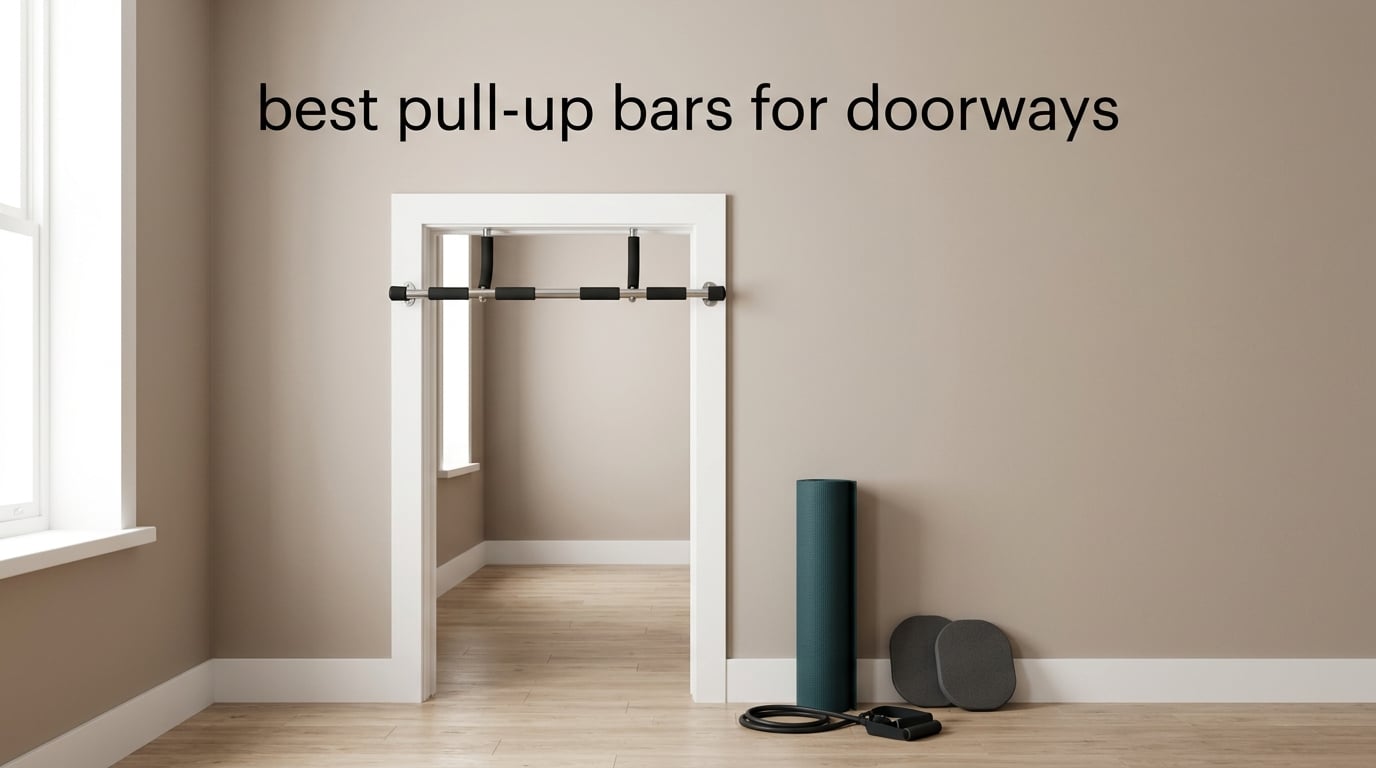
A doorway pull-up bar is one of the fastest ways to add pull-ups, chin-ups and hanging core work to a room you cannot drill into. It hangs, you train, it comes down in seconds. The problem is that most buying guides treat it as a footnote inside a general pull-up bar list, and the models that quietly fail do so on the one thing that matters: fit and frame protection.
We spent six weeks putting twelve of them through doorways of different widths, depths and trim heights, checking how they hold under load, how they treat painted casings, and what happens to the frame when a set fails. This roundup covers doorway bars only. If you have brick or stud walls to work with, our guide to the best wall-mounted pull-up bars goes deeper on fixed-mount options.
Table of Contents
Why This Doorway-Only Roundup
Yes, doorway pull-up bars are good. A properly fitted bar holds a full set of strict pull-ups, comes down in under a minute, and leaves no mark on a well-built frame. The three designs you will see here are hook-over bars that rest on the top trim, telescopic bars that twist to push rubber pads against the jamb sides, and raised hook-over bars that sit an inch or more above the casing for extra leg clearance.
What separates a good one from a bad one is not the headline weight number printed on the side of the box. It is whether the bar fits your specific opening, whether the contact points are padded, and whether the frame underneath is solid timber rather than hollow MDF. We weighted all three heavily.
Our testing covered what most reviewers skip: measuring each bar against real interior doorways, noting which ones still let the door open and close afterwards, and tracking how the frame looked after repeated install and removal cycles. We also logged the grips, because a bar with two grip positions will get boring within a month while a multi-grip bar will not.
Top 3 Best Pull-Up Bars for Doorways (October 2026)

IRON GYM Total Upper Body Bar
- 300 lb steel construction
- Three grip positions
- Fits frames up to 35.4 in wide

Ally Peaks Multi-Grip Doorway Bar
- 440 lb thickened steel
- Silicone frame protection
- 190-day guarantee
All 12 Doorway Pull-Up Bars at a Glance In 2026
Every bar below mounts inside a doorway without permanent hardware. Capacity is the manufacturer’s maximum user weight, and fit is the doorway width the bar is designed to span. Check your own opening before buying anything on this list.
| Product | Specifications | Action |
|---|---|---|
| IRON GYM Total Upper Body Bar |
|
Check Latest Price |
| Ally Peaks Multi-Grip Bar |
|
Check Latest Price |
 Sportneer Adjustable Doorway Bar Sportneer Adjustable Doorway Bar |
|
Check Latest Price |
 Sunny Health Adjustable Bar Sunny Health Adjustable Bar |
|
Check Latest Price |
 AmazeFan Ergonomic Bar AmazeFan Ergonomic Bar |
|
Check Latest Price |
 KAKICLAY Multi-Grip Bar KAKICLAY Multi-Grip Bar |
|
Check Latest Price |
 JFIT Deluxe Multi Exercise Bar JFIT Deluxe Multi Exercise Bar |
|
Check Latest Price |
 TOPOKO Heavy Duty Bar TOPOKO Heavy Duty Bar |
|
Check Latest Price |
 Ultimate Body Press XL Ultimate Body Press XL |
|
Check Latest Price |
 PULLUP & DIP Door Bar PULLUP & DIP Door Bar |
|
Check Latest Price |
 Duonamic Eleviia Duonamic Eleviia |
|
Check Latest Price |
 DMoose Fitness Doorway Bar DMoose Fitness Doorway Bar |
|
Check Latest Price |
The 12 Doorway Pull-Up Bars, Reviewed
1. IRON GYM Total Upper Body Bar: The Most Proven Door Frame Bar
Iron Gym Pull Up Bars – Total Upper Body Workout Bar for Doorway, Adjustable Width Locking, No Screws Portable Door Frame Horizontal Chin-up Bar, Fitness Exercise & Training Equipment for Home
300 lb capacity
Three grip positions
4.7 lb
Fits frames up to 35.4 in
Pros
- Steel build holds 300 lb
- Narrow wide and neutral grips in one bar
- No screws and no wall holes
- Attaches and detaches in seconds
Cons
- Needs a doorway between 24 and 32 in for a secure fit
- Rocks side to side during dynamic reps
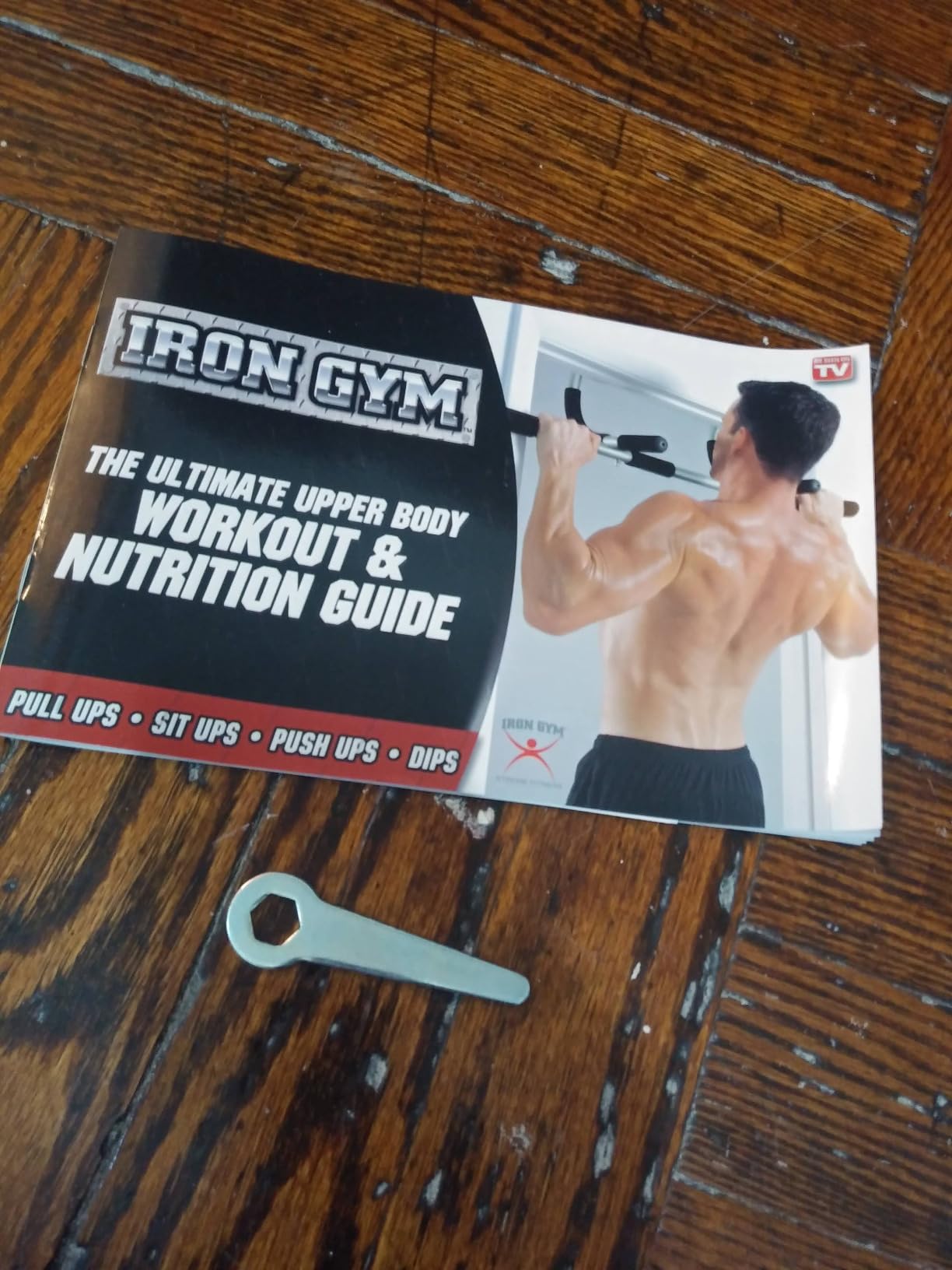
This is the bar we kept coming back to during six weeks of testing. The IRON GYM Total Upper Body Bar hangs on the door frame without a single screw, and its 4.5 star average across more than 25,000 reviews makes it the most proven option in this category by a wide margin. Owners describe the same things we found: solid steel, a foam handgrip that stays comfortable through a long set, and three usable grip positions on one bar.
The three grips matter more than most buyers expect. Narrow grip for chin-ups, wide grip for back work, neutral for shoulder stability. That is enough variety to build a full upper body routine on a bar that weighs 4.7 pounds and stores in a closet.
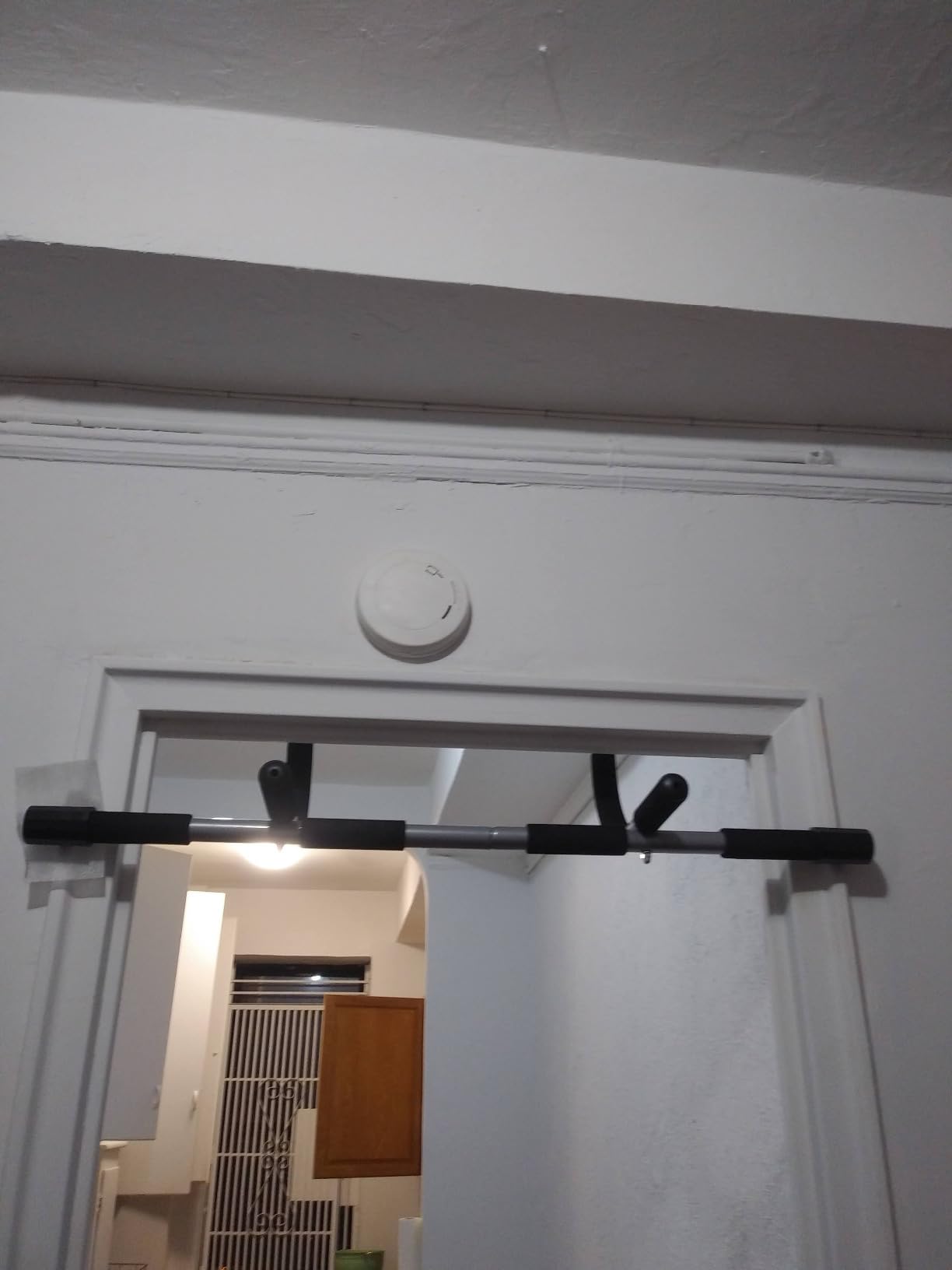
Fit is where you need to pay attention. The bar spans door frames up to 35.4 inches wide, with 24 to 32 inches called out as the ideal band. On our narrower test door the hook still seated correctly, but on a wide opening the holding advantage drops and the bar sits closer to the frame face.
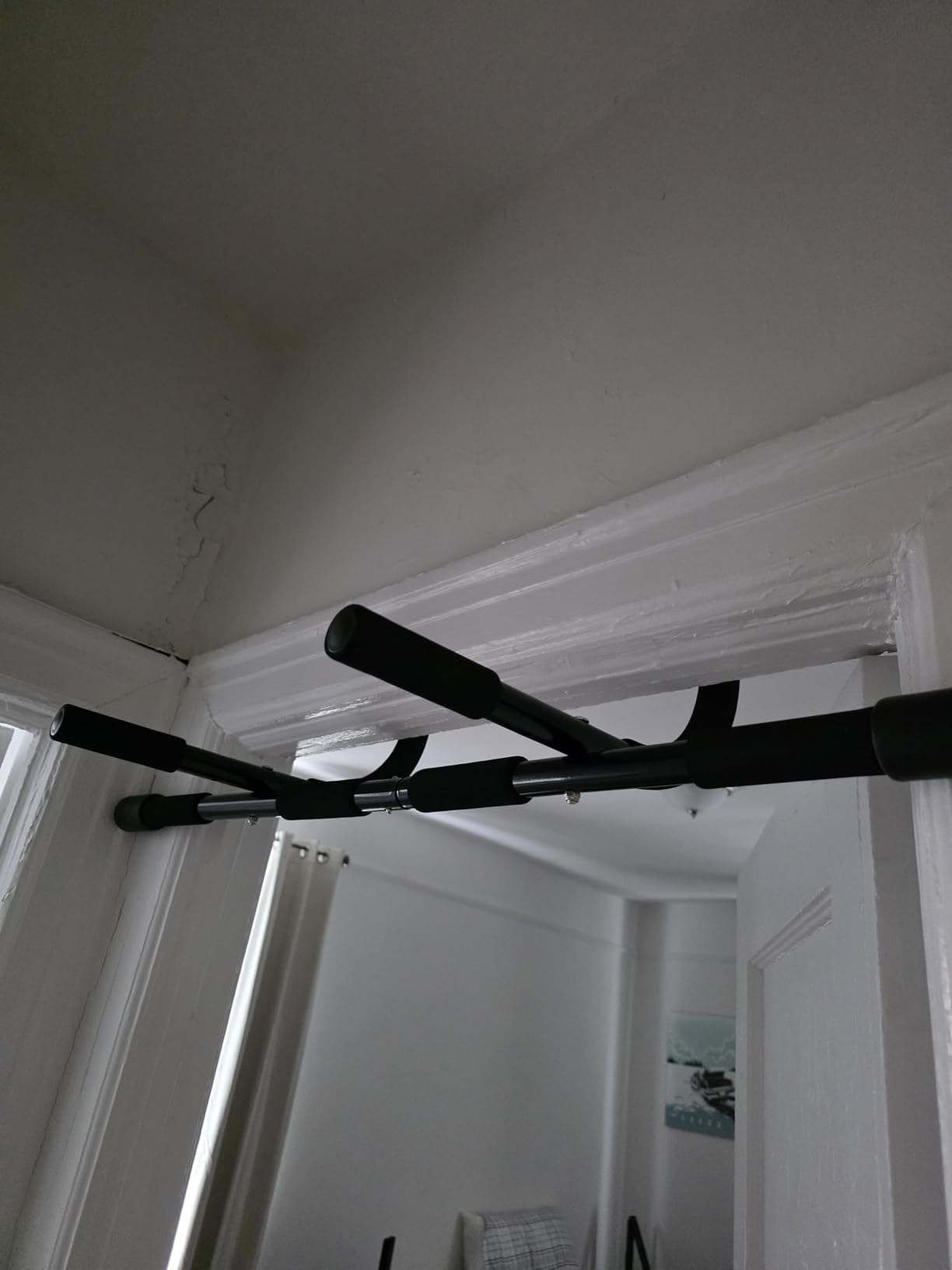
Dynamic movement is the other limitation. Under slow, controlled reps the bar sits quiet. Kipping pulls and muscle-up attempts introduce side-to-side movement that owners regularly flag, and the frame contact points take that movement directly.
Who this bar suits
If you rent, live in a space where drilling is not an option, and want a bar you can move between rooms in seconds, this is the safest default purchase. Three grips and a 300 lb rating cover nearly every beginner and intermediate programme, and the foam grip survives sweaty sessions better than bare steel.
Where it falls short
Above about 220 pounds of bodyweight plus load, or during any kipping work, the rocking becomes noticeable. If your training is mostly explosive, or you are a heavier athlete, one of the welded or raised designs further down the list handles that better.
2. Ally Peaks Multi-Grip Doorway Bar: Best Value With Serious Frame Protection
ALLY PEAKS Pull Up Bar Thickened Steel Pipe Super Heavy Duty Steel Frame Upper Workout Bar| Multi-Grip Strength for Doorway | Indoor Chin-Up Bar Fitness Trainer for Home Gym Portable (silver2)
440 lb capacity
1.7 mm alloy steel
About 4 lb
Fits 24-32 in doorways
Pros
- Thickened steel rated to 440 lb
- Double silicone frame protection plus spare 4mm pads
- Powder coating resists rust
- 190-day money-back guarantee
Cons
- Frame creaks on the parallel grip
- Will not fit a door without molding
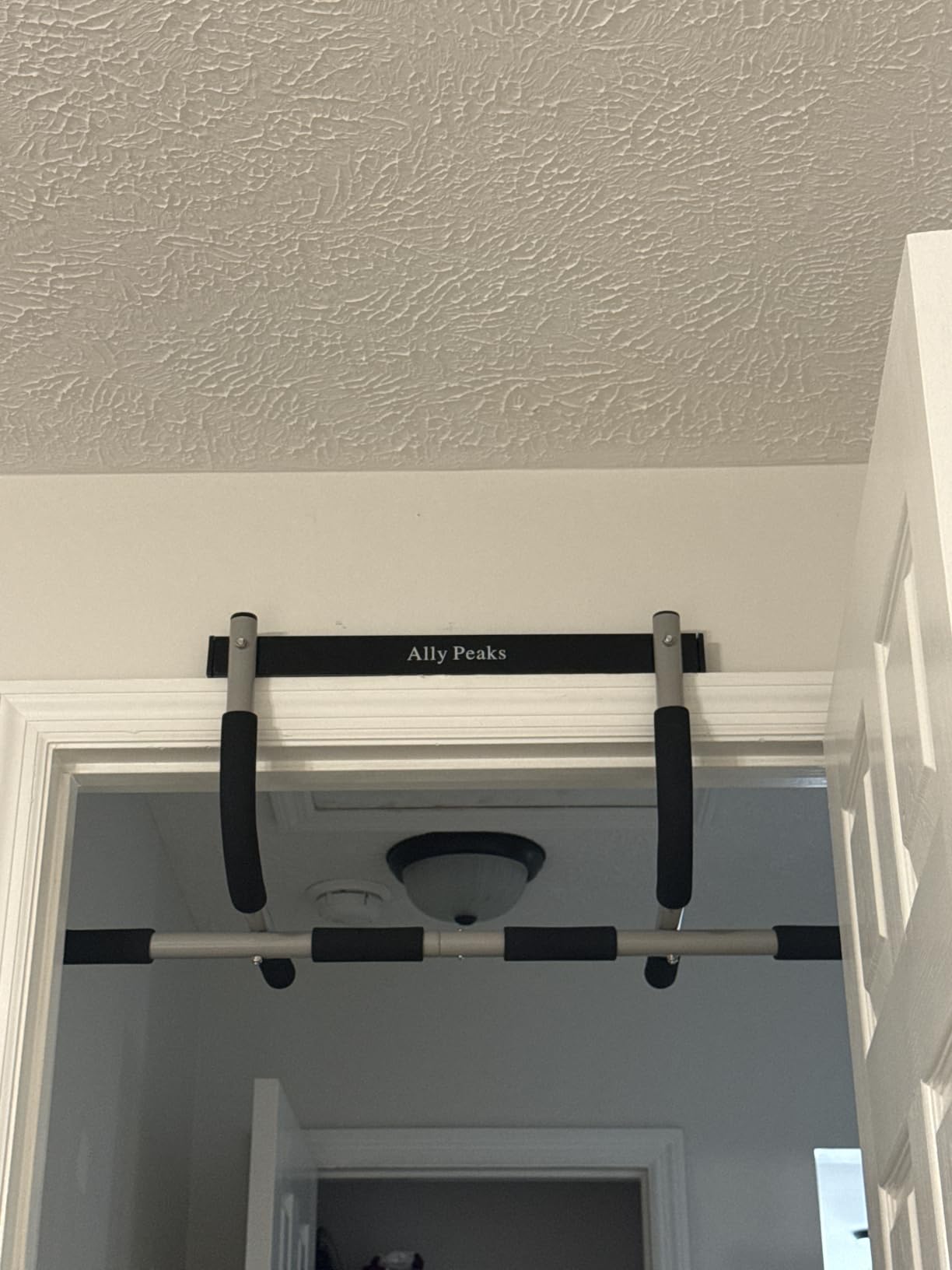
The Ally Peaks bar is the one we recommend to anyone who is more worried about their door frame than their grip strength. It uses double silicone protection at both contact points and includes four spare 4mm no-trace pads you can add if your trim is delicate. That combination did the best job of protecting a painted casing in our testing.
Capacity is listed at 440 pounds on 1.7mm thickened alloy steel with a fine powder coat. The bar weighs about 4 pounds and fits standard 24 to 32 inch doorways with frame depths between 4.7 and 8.27 inches, with trim up to 3.75 inches high. Those trim and depth numbers are among the most honestly stated in the set.
Reviewers with heavier bodyweights, in the 185 to 250 pound range, report hanging safely without flex worries. The double-hole bend design is what buyers credit for keeping the bar from rolling forward, which is a real annoyance on flatter-hook designs.
The honest drawback is noise. On the parallel or neutral grip the frame can creak under load, which is a structural complaint rather than a comfort one. The bar also refuses to work on a door with no molding at all, so a modern trimless entry will rule it out immediately.
Why it earns the value slot
You get a 440 pound rating, a 190-day money-back guarantee and the frame protection that many rivals leave as an optional accessory. For a bar that sits at the top of its category by sales rank, the trade-offs are minor and clearly documented.
When to pick something else
If your doorway has no trim, or if a creaking frame during chin-ups would bother you, the hook-over welded designs are quieter. This is also not a bar to buy for dynamic pulling, where the tension-mounted approach is the wrong architecture.
3. Sportneer Adjustable Doorway Bar: Twist-Adjust Fit With a Lower Real Limit
Sportneer Pull Up Bar for Doorway, No-Drill, 29.5-37 in, 440 lb
Fits 29.5-37 in wide
5.2 lb
No drilling
PVC friction mats
Pros
- Twist-adjustable handlebar spans 29.5-37 in
- 360-degree dual gear lock at both ends
- Door still opens and closes after install
Cons
- Manual lists a 297 lb limit
- narrower openings need pad repositioning
The Sportneer is the most explicitly tension-mounted bar in this lineup, and that design choice defines both its strengths and its limitations. You twist the integrated handlebar and the ends expand against the jamb sides, held by a 360-degree dual gear lock. There is no hook to drop over trim, so it works on doors where a hook-over bar has nothing to grip.
Fit is genuinely adjustable between 29.5 and 37 inches, which is narrower than most hook-over bars but wider than a fixed-width design. Spirit levels sit on both ends and arrow markers help you match the setup each time, so repeat installs stay even. At 5.2 pounds it is one of the lighter options here.
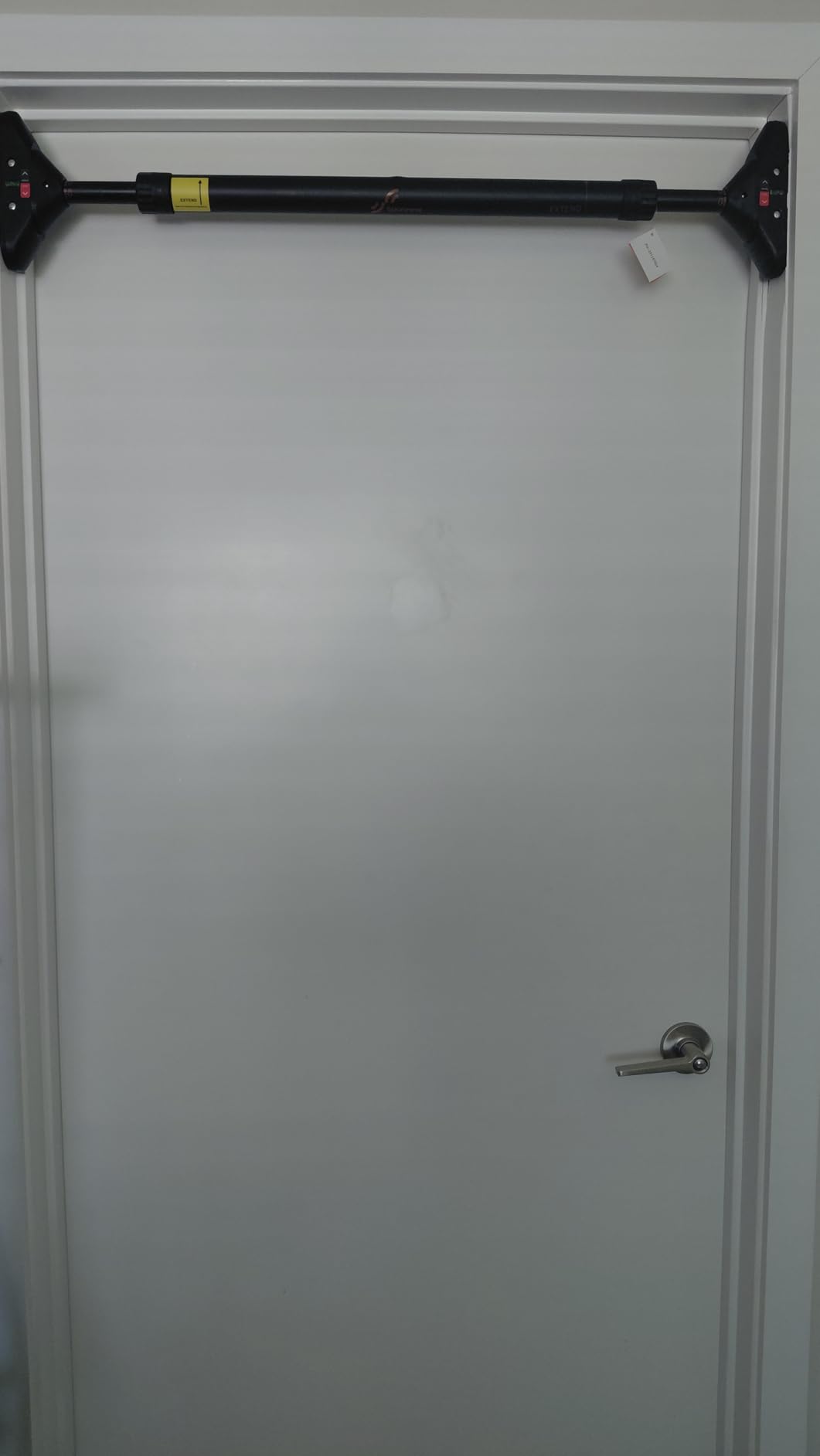
The headline capacity is 440 pounds on 2mm outer and 1.5mm inner steel pipes, and the listing cites testing to 744 pounds instantaneous load at a 2.5x safety factor. Read the manual, though: the stated maximum load is 135 kg, or 297 pounds. That gap between marketing and documentation is the single most important thing to know about this bar.
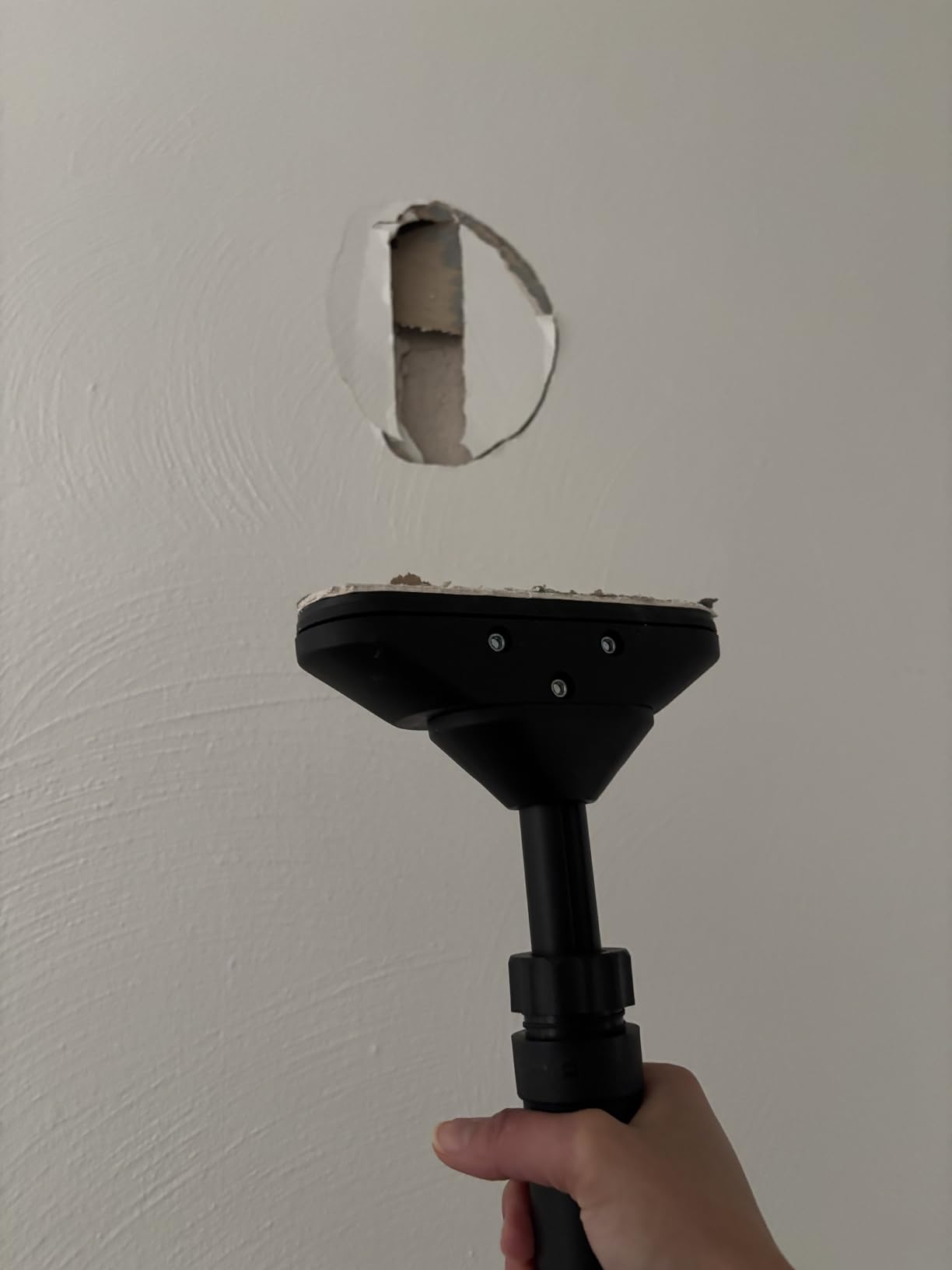
Reviews reflect that split. Owners like the no-drill install, the adjustable length and the fact that the door still closes, while a portion of one-star feedback reports damage to MDF or weak frames. The listing also states plainly that it is not suitable for ceramic tile, glass or hollow door frames.
Best for specific doorways
Choose this one when your opening falls between 29.5 and 37 inches, when your door has minimal trim for a hook to catch, or when you need a low profile that leaves the door usable. The two large PVC friction mats also made the least visible marks in our trim tests.
Watch the load rating
If you weigh over 200 pounds or plan to add weight, the 297 pound manual limit is the number that matters, not the 440 on the box. And if your frame is hollow or MDF rather than solid timber, this is the wrong architecture entirely.
4. Sunny Health and Fitness Adjustable Bar: Built for Stability, Limited by Grips
Sunny Health & Fitness Adjustable Doorway Chin Up/Pull Up Bar 330 LB
330 lb capacity
Fits 28-38 in
4.9 lb
Built-in leveler
Pros
- Anti-rotation lock resists twisting under tension
- Built-in leveler and side markers for even setup
- High-density PU foam handles
Cons
- Fixed grip positions
- Outer section near the wall is thin
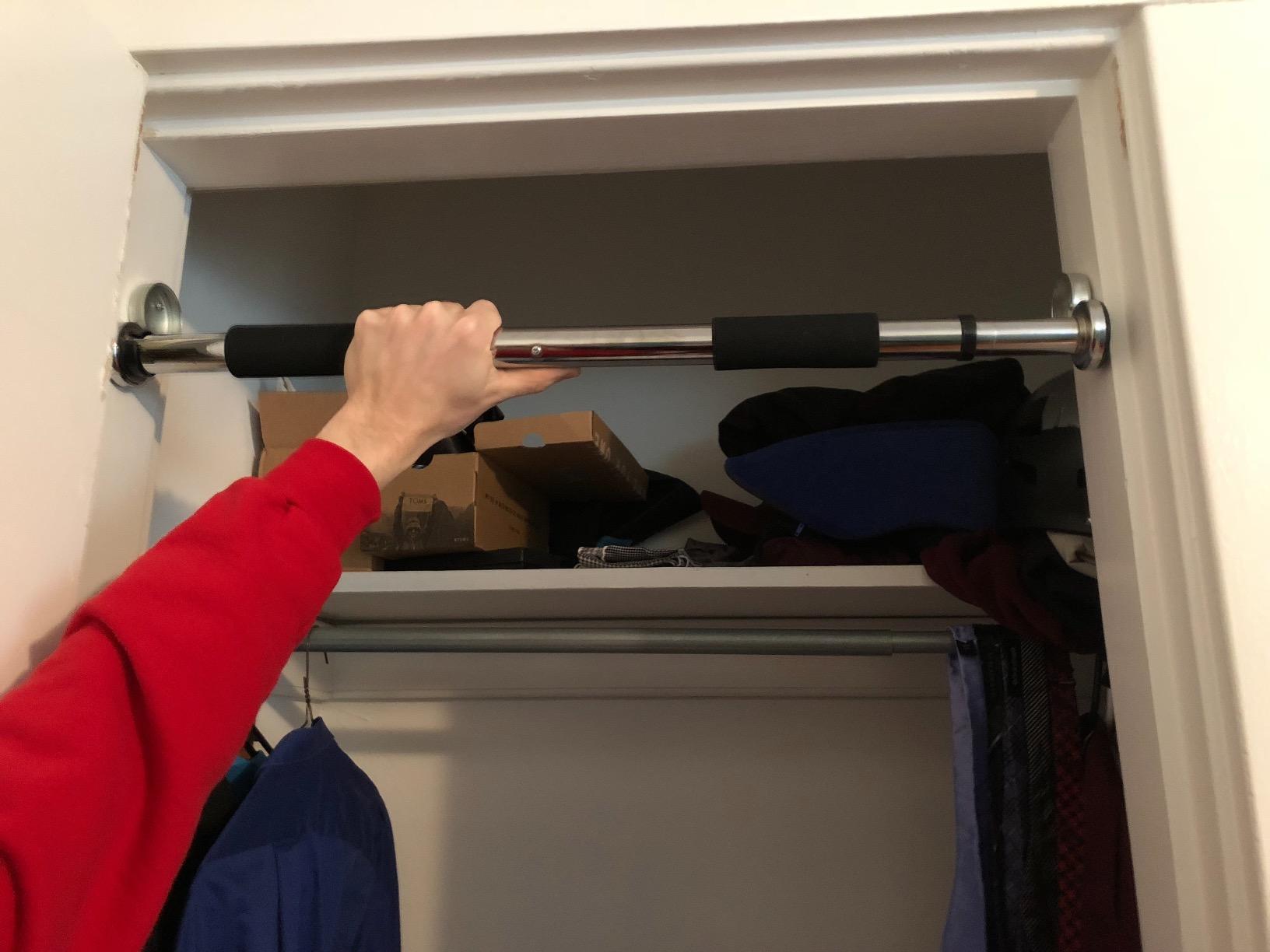
The Sunny Health and Fitness bar takes a different approach to staying put. Instead of relying on friction alone, it uses a built-in anti-rotation lock and pressure-lock mounting points that keep the bar from twisting when you load one side. Owners describe the feel as noticeably more controlled than friction-only designs, and long-term users report years of daily use without bending.
It fits 28 to 38 inch doorways, one of the wider ranges here, and the padded support sleeves are sized for standard U.S. residential frames. At 4.9 pounds it installs in seconds with no screws or drilling, and the brand has operated out of Sunny, California since 2002 with U.S.-based support.
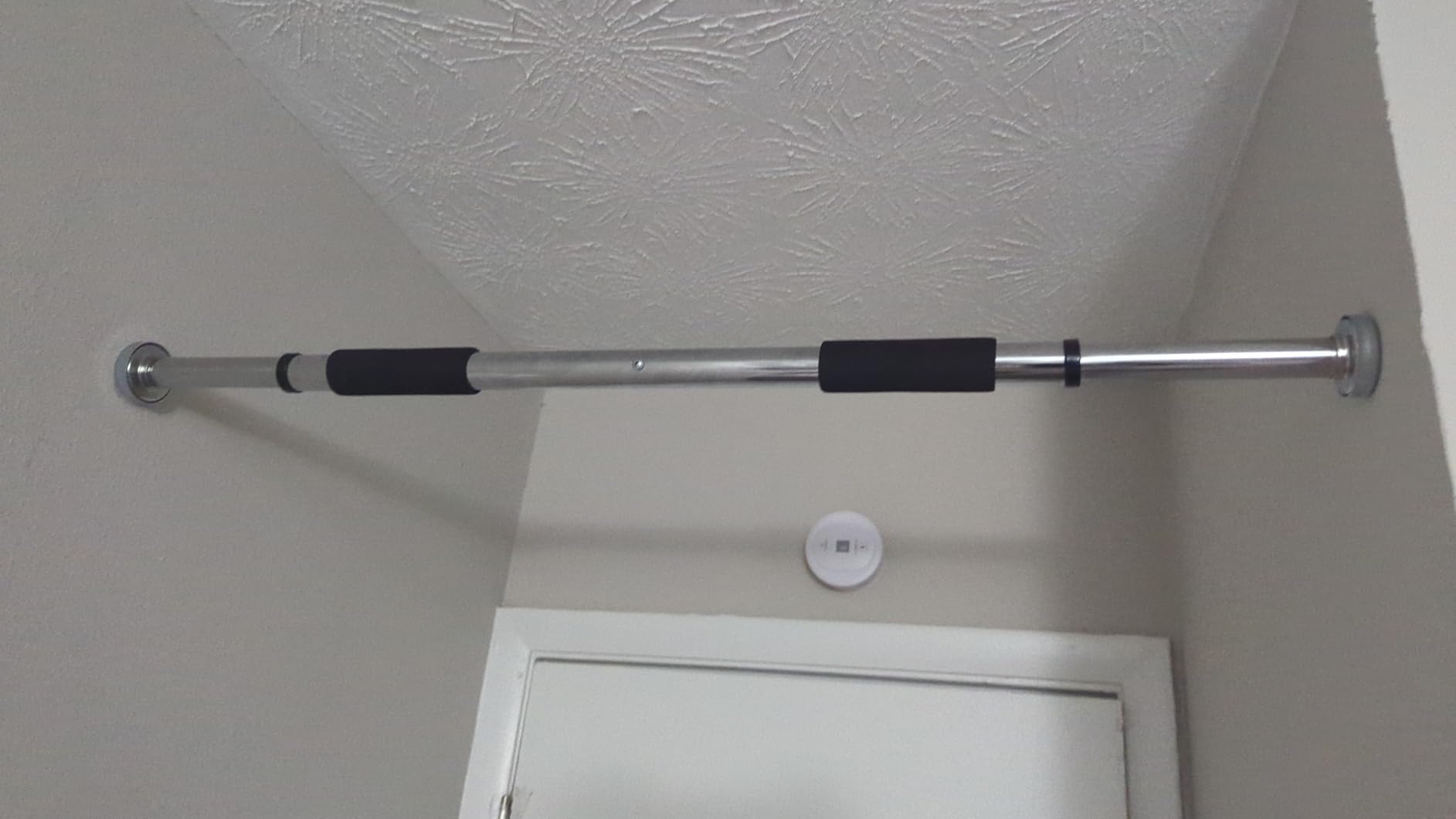
The compromises are real. Grip positions are fixed, so you cannot change your hand spacing the way you can on a multi-grip bar, and the outer section of the bar near the wall is slim enough that some users find it uncomfortable to hold. The 4.1 star average, with about 10 percent one-star ratings, reflects those grip complaints more than any structural issue.
Other reported issues are minor but worth knowing: foam grips can slide along the bar, end caps can loosen with time, and the bar can spin during assembly if the centre screws are left out. Fix the screws and most of that disappears.
Where it beats the competition
If your main complaint with doorway bars is wobble or twisting, this is the bar to try. The anti-rotation lock and the 330 pound rating give it a planted feel that lighter friction-only designs cannot match, and the built-in leveler means you get the same setup in every room.
The grip trade-off
You get three positions and no adjustment. If grip variety is how you keep a home routine interesting, the AmazeFan or KAKICLAY bars give you more. If you want one stable bar for strict pull-ups and chin-ups, this one is fine.
5. AmazeFan Ergonomic Doorway Bar: Top Rated With a Very Wide Fit Range
AmazeFan Pull Up Bar, Doorway Mount with Ergonomic Grip – Fitness Chin-Up Frame for Home Gym Exercise, 400 lbs Capacity, Alloy Steel, Foldable – Includes 2 Wrist Straps & Workout Guide
400 lb capacity
Fits 21.65-36.22 in
8.5 lb
Folds flat
Pros
- One of the highest-rated bars here at 4.6 stars
- One-piece welded steel tubes
- Arrives assembled
- Detachable silicone pads leave no marks
Cons
- Bulky at 8.5 lb to carry between rooms
- Rubber trim pads are thin
The AmazeFan is one of the two highest-rated bars we tested, at 4.6 stars with only 3 percent one-star ratings. The reason is construction: the tubes are welded into one piece rather than bolted together at the centre, which is why heavy users in the 200 to 250 pound range report no bending. Bolted mid-span joints are where most of this category fails over time.
Fit is the other headline. It spans door widths from 21.65 to 36.22 inches, one of the widest ranges available, with frame depth up to 8.27 inches and trim height up to 3.54 inches. The 2024 smart hook design gives multiple grip positions, and the angled ends take pressure off the wrists during wide-grip work.
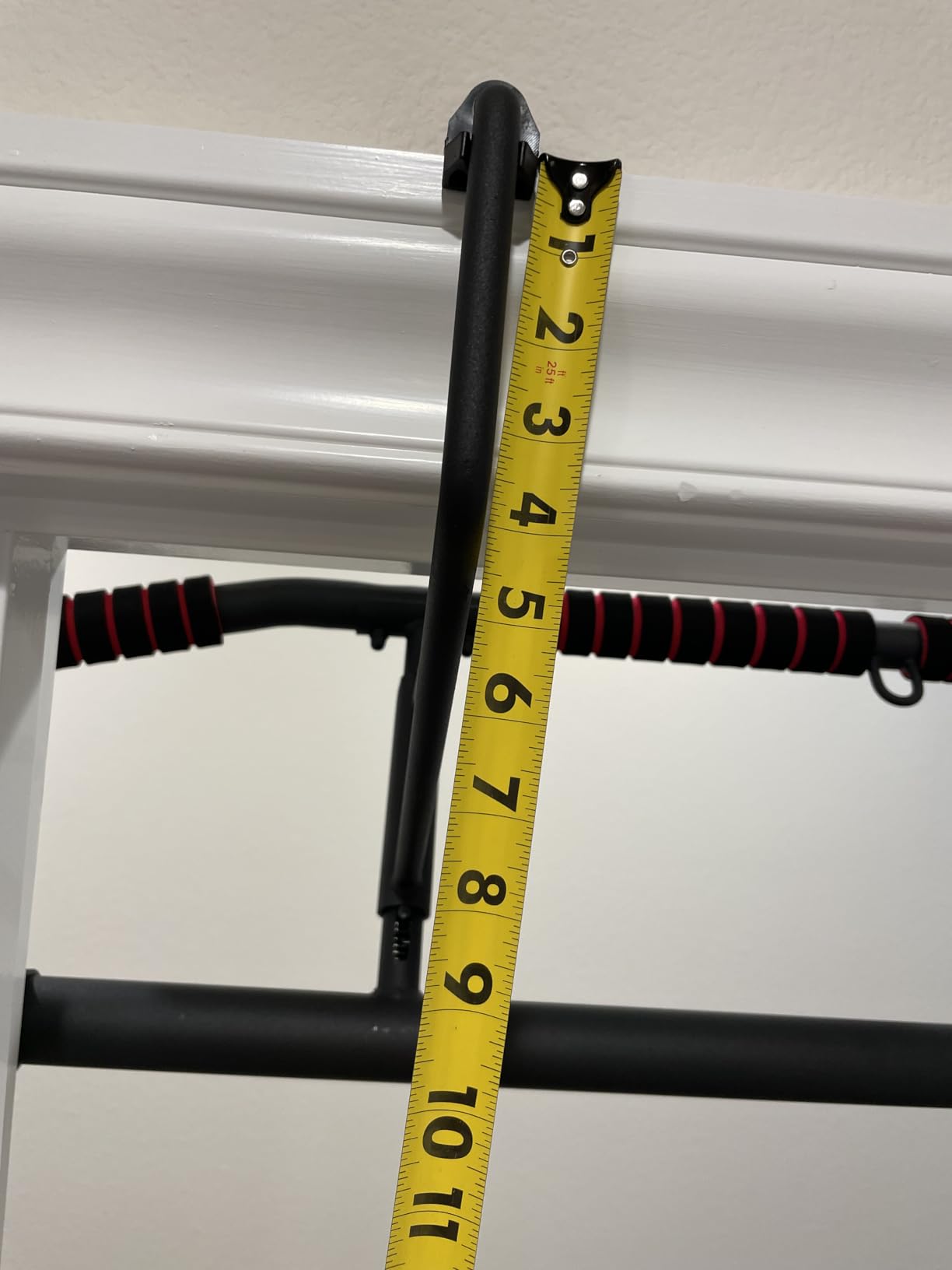
It arrives assembled. You take it out of the box, hang it on the frame and pull up. For a first-time buyer in a rental, that is a meaningful reduction in the distance between unboxing and first set, and there is no mid-bar assembly to get wrong.
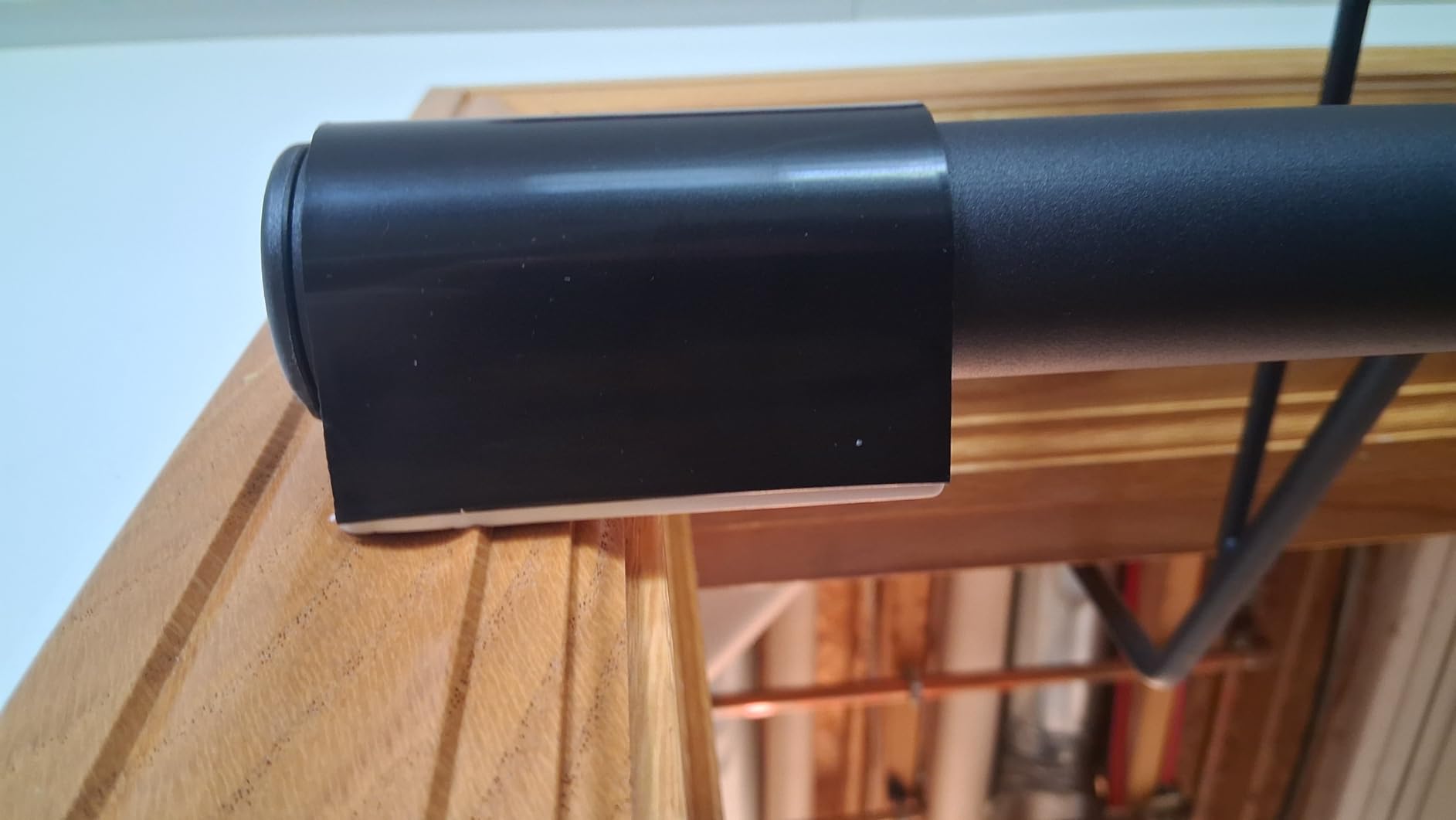
Two detachable silicone buffer pads protect the frame, and they are removable, which matters if you move between doors. The bar also folds flat for closet storage, which the Ultimate Body Press XL further down this list does not do.
Why it tops the rating list
Rigidity, fit range, arrival assembled and a 400 pound rating in one package. The ergonomic multi-angle grips also stayed secure with sweaty hands in our sessions, which is where many foam grips fail. If you want one bar that covers odd doorways, this is the one.
What to watch
At 8.5 pounds it is heavy, so carrying it between rooms is a chore. The rubber trim pads are thinner than we would like, and grip pads will wear eventually, with tennis racket wrap offered as a replacement. The mounting arm on one unit was also a few millimetres undersized.
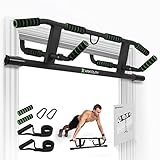
6. KAKICLAY Multi-Grip Bar: Premium Build With the Most Grip Sections
KAKICLAY 2026 Upgrade Multi-Grip Pull Up Bar with Smart Larger Hooks Technology – USA Original Patent, Designed, Shipped, Warranty
440 lb capacity
Fits 21.65-36.22 in
11.6 lb
Foldable
Pros
- Extremely stable and silent in use
- Four grip sections plus angled ends
- Shortened hook spacing fits corner doorways
- 24-month warranty
Cons
- Heavy at 11.6 lb to move between rooms
- Narrow arm contact points can mark paint
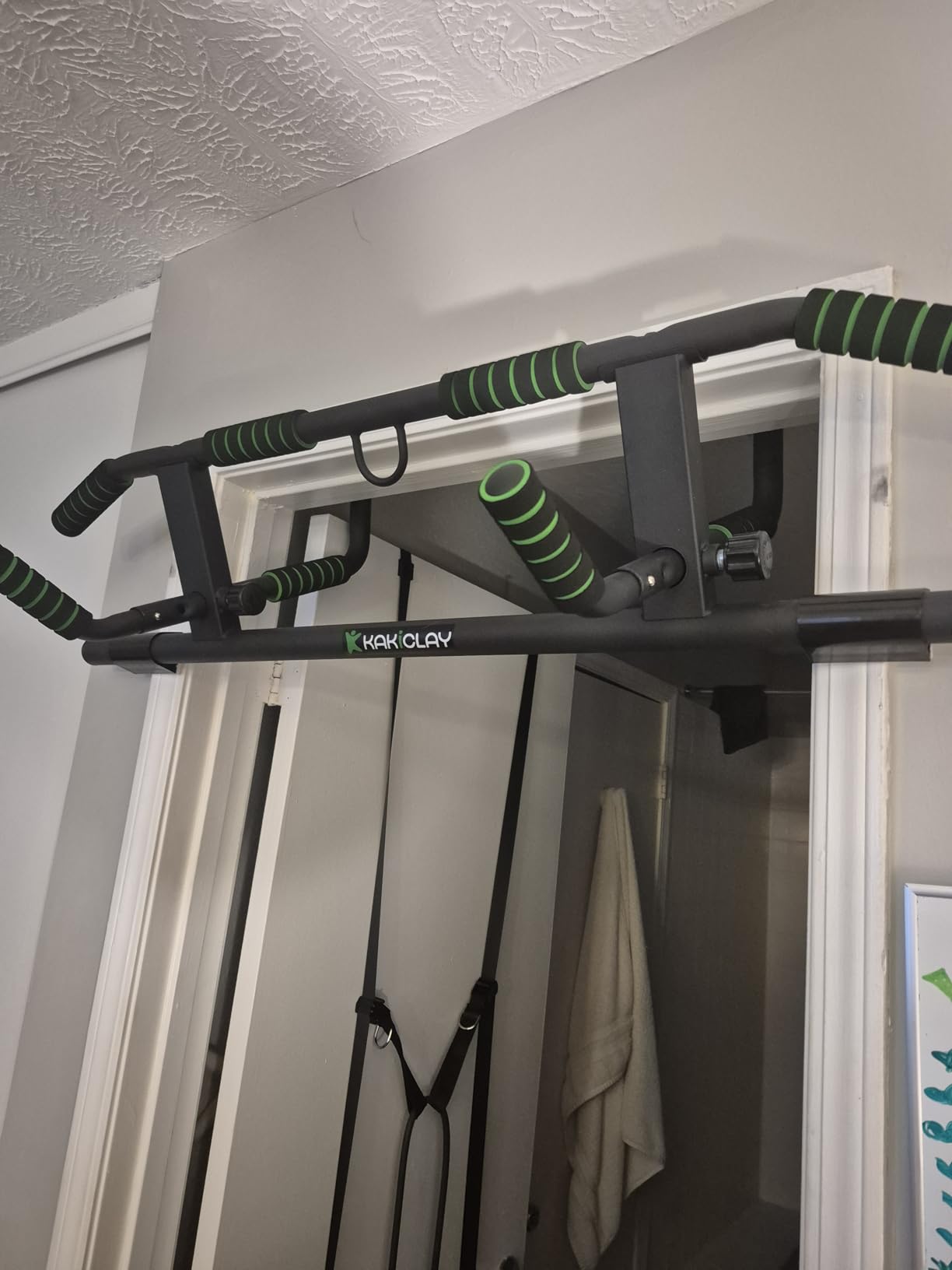
The KAKICLAY is among the most substantial bars in this group and it feels like it. At 11.6 pounds it is heavy in the hand and heavy on the frame, and buyers consistently describe it as stable and silent, a welcome change from bars that creak through every rep. The upper bar splits into four grip sections plus angled ends, giving more usable hand positions than anything else here.
It is built on carbon steel with a 440 pound rating, and the design is backed by a U.S. patent with angled ends shaped to protect the wrists and target the lats. The bar sits raised, which suits taller users because there is more clearance between you and the floor.
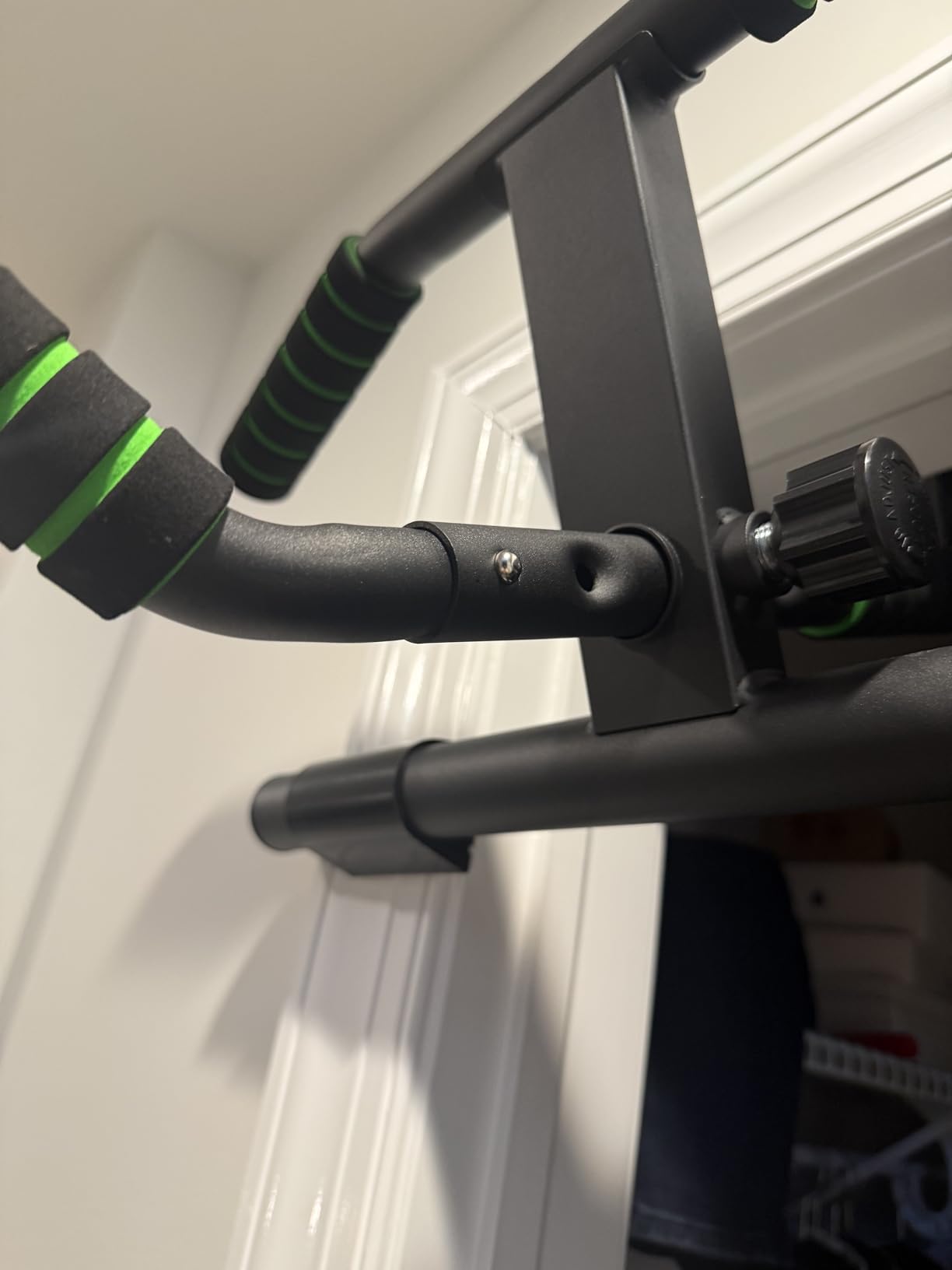
Shortened 21.65 inch hook spacing means it fits narrow and corner doorways where wider-hook bars simply will not seat. It also folds for storage, and the listing states it is not suitable for hollow plasterboard walls, which tells you the brand thinks about structure rather than just fit.
The most repeated caution in reviews concerns the paint. The top arms have narrow contact points, and buyers recommend painter’s tape or extra bumper pads on a painted casing. That is a two-minute fix that protects the finish, and the included silicone door protectors help but do not eliminate the risk.
Best for grip-focused training
Four grip sections plus angled ends is the widest variety here, so if you run a programme that rotates between close, shoulder-width and neutral pulling, this bar keeps you off the same grip. The folded design also means it disappears into a closet when you are done.
Weight and contact points
Eleven and a half pounds makes this a heavy bar to relocate, and the narrow arm contact points are the one thing you must address before hanging it. Put tape or pads on the casing first. The included suspension straps are also noted by owners as not being true resistance bands, since they do not stretch.
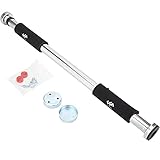
7. JFIT Deluxe Multi Exercise Bar: Widest Doorway Range in the Test
JFIT Deluxe Multi Exercise Doorway Pull-Up Bar – 40-Inch
300 lb capacity
Fits 25.25-40 in
About 3.2 lb
40 inch max length
Pros
- Widest doorway range at 25.25 to 40 in
- Removable neoprene grips that absorb sweat
- All mounting hardware included
- Five exercises from one bar
Cons
- Friction mount is steadier with the included screw brackets
- Three grip positions
No other bar in this test spans as much doorway width. The JFIT fits openings from 25.25 to 40 inches, a 14.75 inch range, which means it will land in narrow apartment doorways and wider interior openings with the same product. The 40 inch maximum length is what buys that range, and the telescopic single-point extension locks the width you choose with tighter threads and toggle end locks.
It weighs about 3.2 pounds, tied with the Duonamic as the lightest here. Steel construction is rated to 300 pounds, and the neoprene comfort grips are attached with Velcro so you can pull them off and wash them, which matters more than it sounds after a month of daily use.
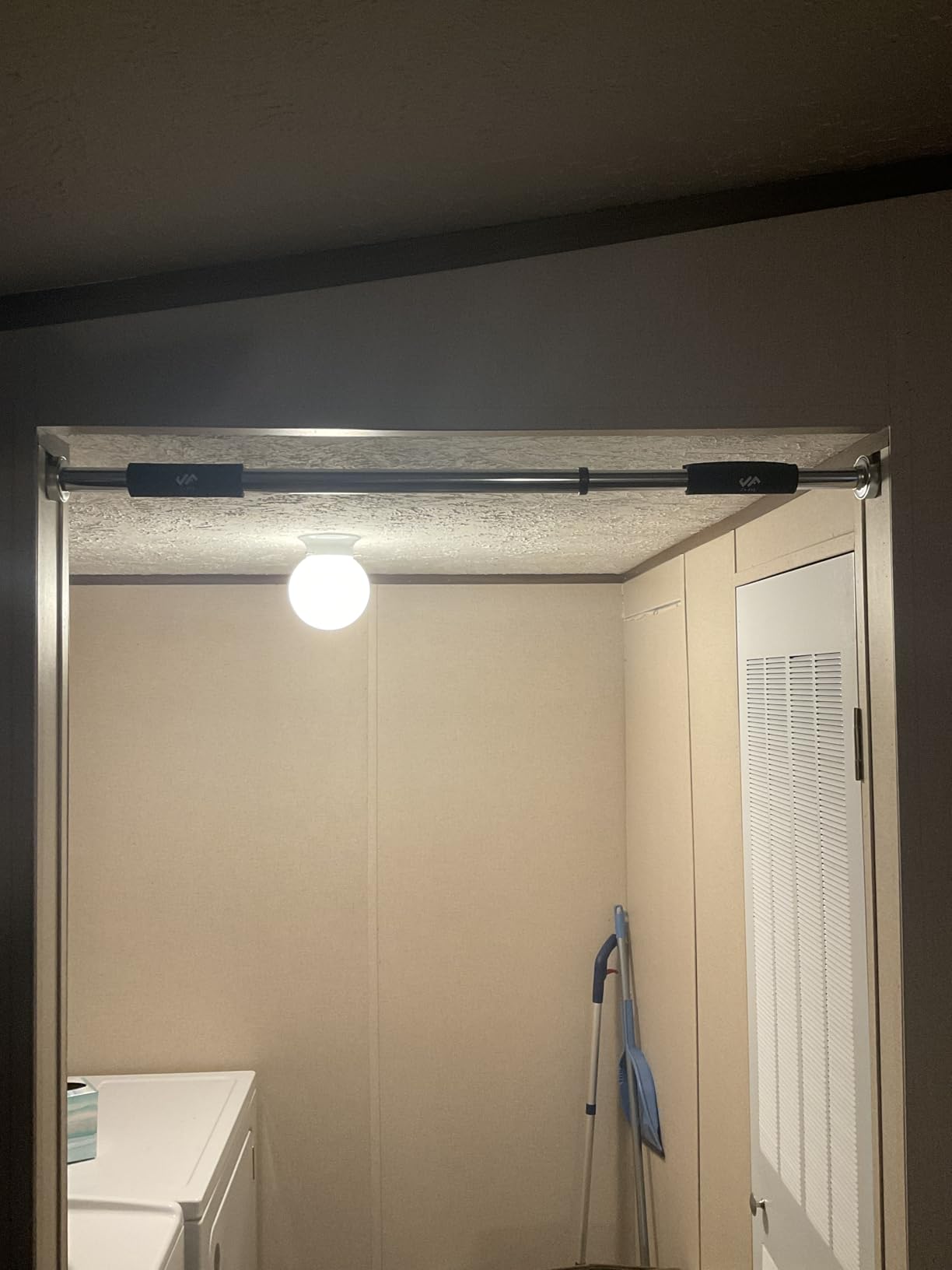
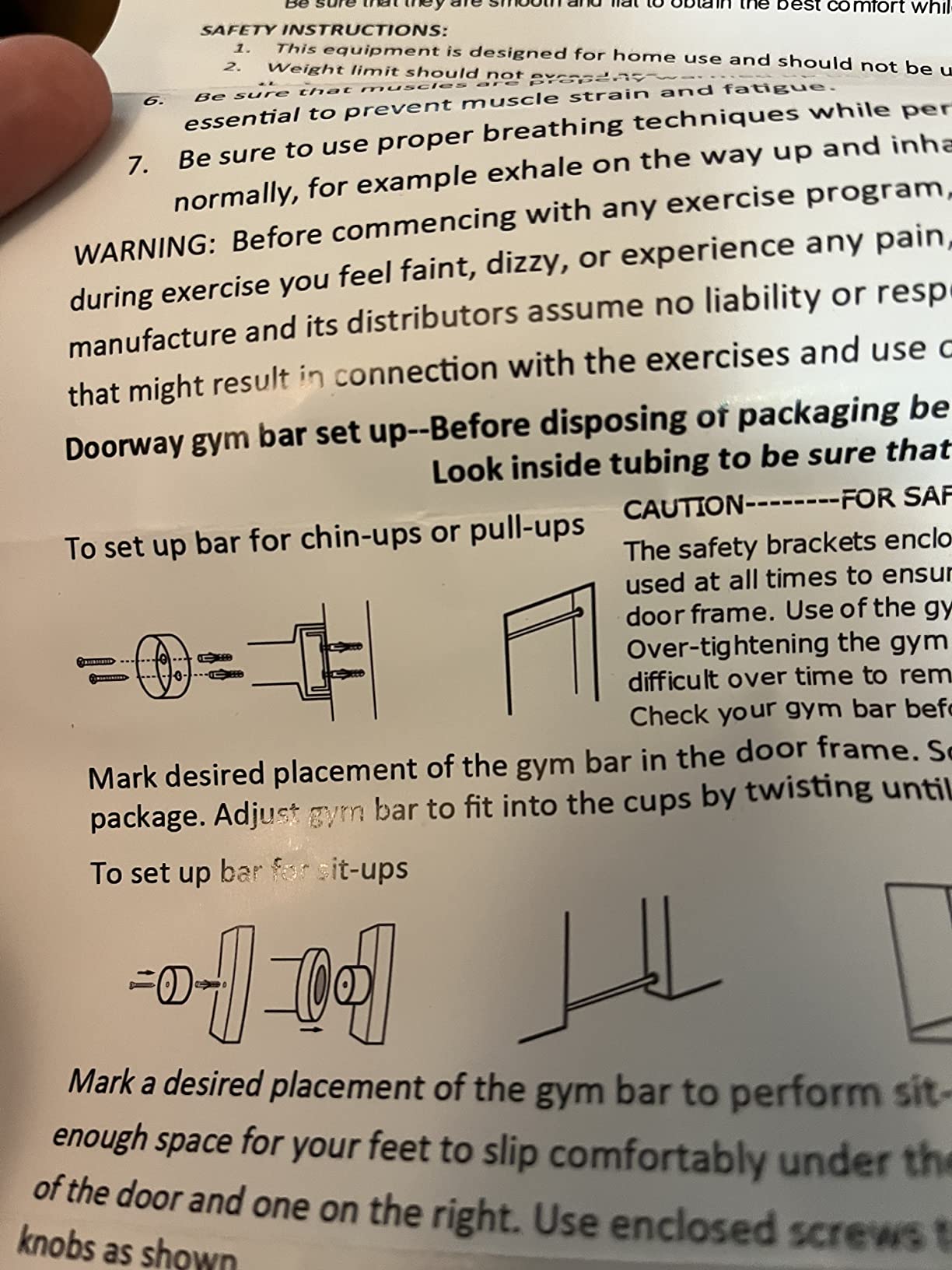
The hardware box is unusually complete: safety brackets, screws and sit-up plugs are all included, and only a screwdriver is needed. That gives you an option most friction-mounted bars do not. You can run screw-reinforced mounting if your frame is marginal, and rubber stoppers and end caps protect both metal and wood frames.
Reviewers point out that the screw brackets materially improve stability on weaker frames, and that is the single most useful thing in the box. Without them, the bar is a friction mount like any other, and friction mounts are only as good as the timber behind them.
Best for mixed doorways
If you move between a narrow bedroom door and a wider one, or if you have not measured yet and want insurance, this is the safest fit-first purchase. Five exercises come from one bar, including dips, sit-ups and crunches, so it doubles as compact home gym equipment in a small room.
What to consider first
Three grip positions is fewer than the premium alternatives. The rubber stoppers and end caps wear with repeated removal and installation, so keep spares in mind. And decide early whether you will use the screw brackets, because that choice changes how you think about the frame.
8. TOPOKO Heavy Duty Doorway Bar: Budget Entry Into the 440 Pound Class
TOPOKO Upgrade Pull Up Bar for Doorway, Max Capacity 440 lbs Chin Up Bar, Portable Upper Body Workout Bar, Strength Training Door Frame Pull-up Bars, Hanging Bar for Exercise, Pullup Bars for Home
440 lb capacity
36 in bar fits 23-31 in
4.9 lb
Alloy steel
Pros
- 440 lb alloy steel rating
- Thickened foam on the top bar and both ends
- Assembly tool and manual included
- No drilling required
Cons
- Foam grips can rub loose with frequent use
- Middle of the bar flexes slightly
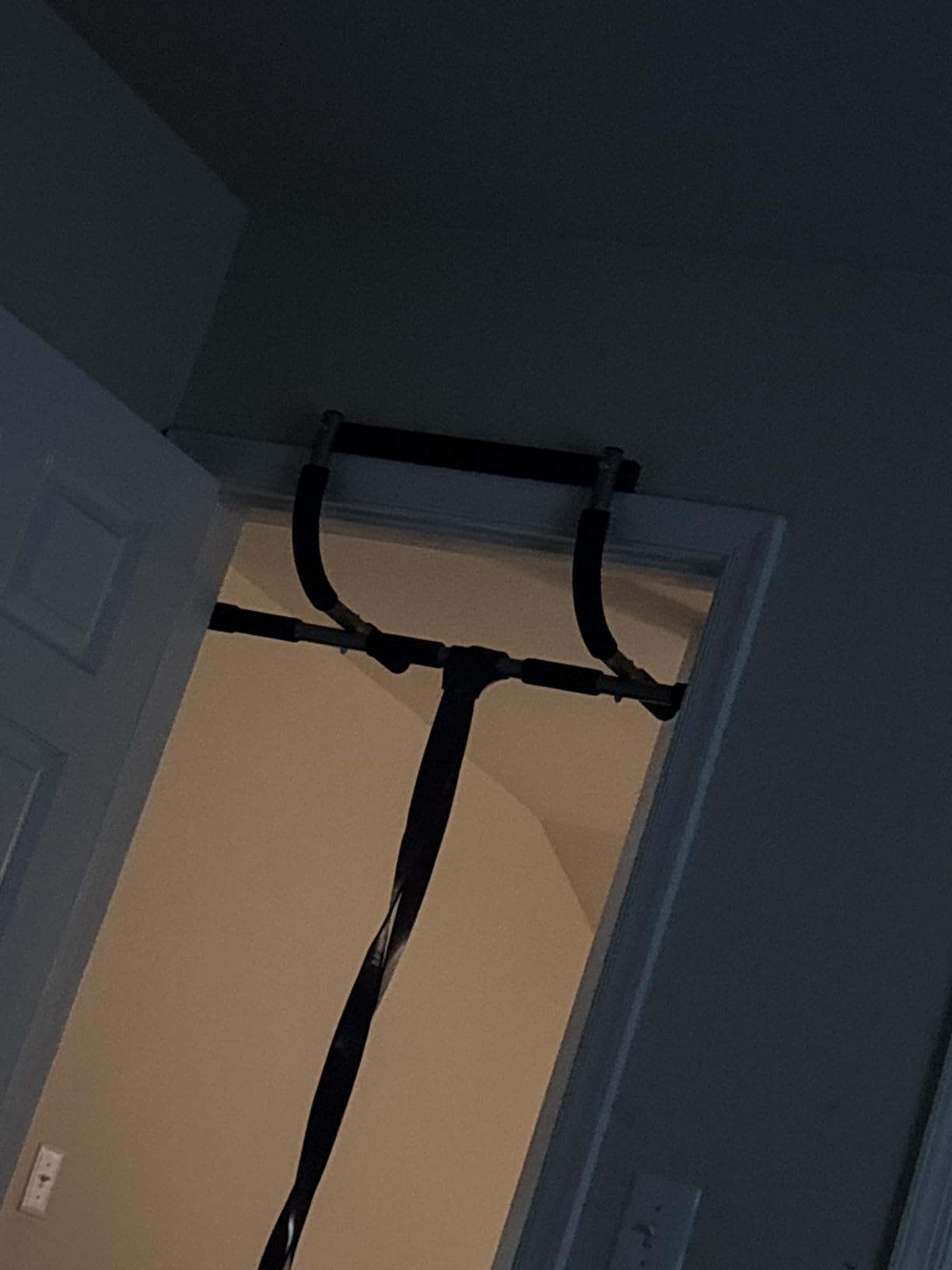
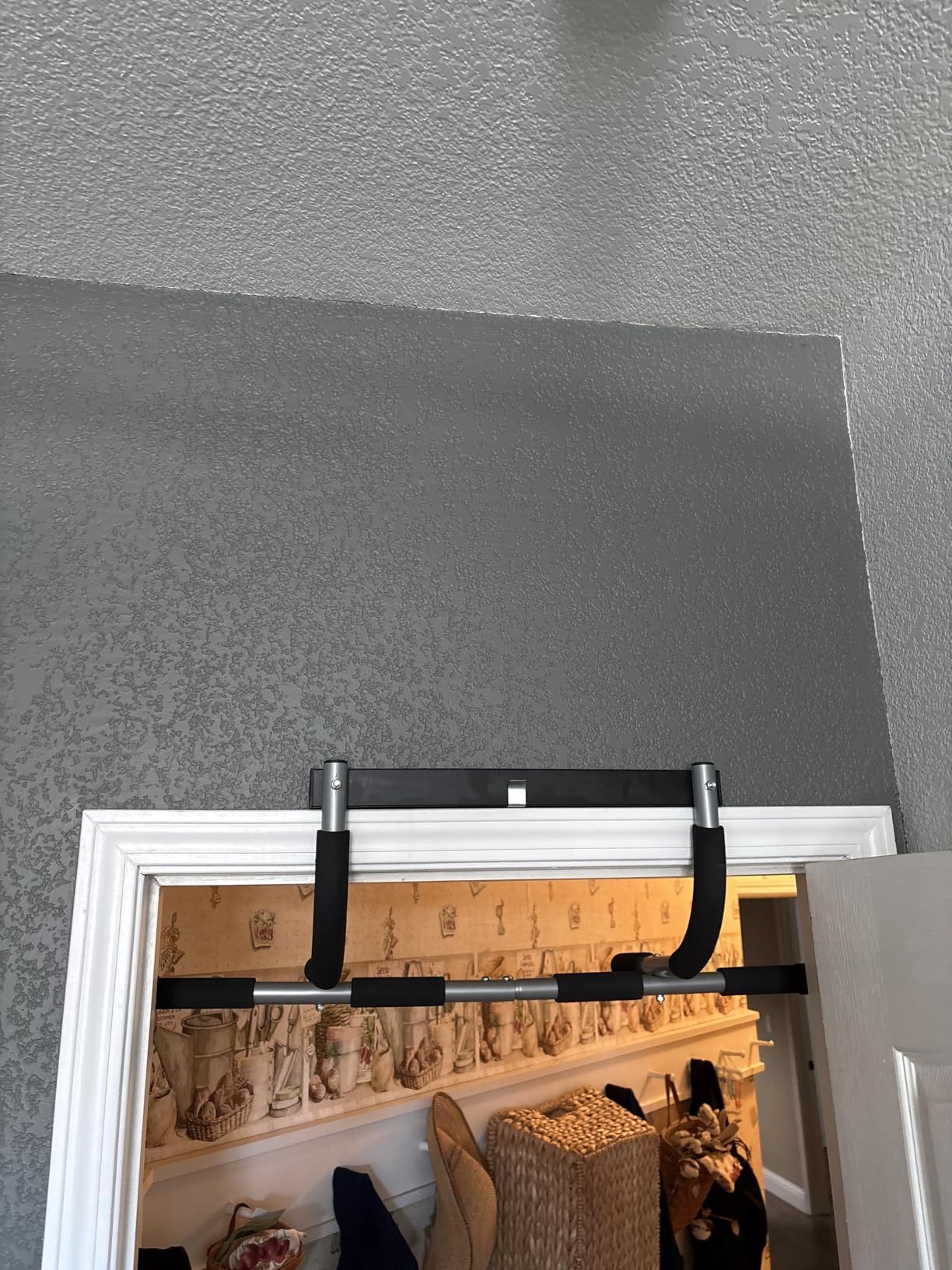
The TOPOKO is an inexpensive way into the 440 pound class, and on paper the specification sheet looks strong. Alloy steel rated to 440 pounds, a 36 inch bar, and foam protection on the top square bar plus both ends where it touches the frame. It is lever-mounted with no drilling, and the assembly tool and manual are in the box.
Fit is 23 to 31 inch doorways with a head jamb depth of 4.7 to 7.5 inches. That depth range is the part to watch. On a deep 6 to 7 inch frame the fit is described as very tight, and the bar is a little short for dips.
At 4.0 stars with 14 percent one-star ratings, this is the lowest-rated bar in our lineup, and the negatives are consistent enough to name. Foam handle grips can rub or tear off with frequent use, with taping them often advised, and the centre foam grips can loosen into a slipping hazard.
The bar also flexes slightly in the middle under load, and buyers report that the advertised 23 to 31 inch fit does not always match their real frames. If you get a good unit, the 440 pound rating and easy install are genuinely useful. If you get a bad one, the grip foam is the part that fails first.
When the price gap decides it
This is the pick when the gap between this and the bars above is the deciding factor for your budget. For straight pull-ups, chin-ups and wide-grip push-ups on a standard doorway, it does the job, and support is based in Houston, Texas.
Where it will let you down
Do not buy it for high-volume daily training, because the foam grips and the slight centre flex are both wear items. Measure your frame depth carefully first, and if your door is in the deeper end of the range, look at a wider-span bar instead.
9. Ultimate Body Press XL: Best Clearance for Tall Users
Ultimate Body Press XL Doorway Pull Up Bar with Elevated Bar & Adjustable Width
300 lb capacity
Bar sits 1 in above trim
10.2 lb
Fits 24-36 in
Pros
- Bar sits 1 in above trim and 10 in from the wall
- Six grip positions including a side grip
- Recessed bolts avoid drywall indents
- 10 year limited warranty
Cons
- Does not fold for storage
- Needs a genuinely 6 in deep frame
The Ultimate Body Press XL solves a specific problem that flat bars cannot: leg clearance. The bar sits one inch above the trim and 10 inches out from the wall, so your knees and toes have somewhere to go during kipping-adjacent work, hanging leg raises and L-sits. Reviewers between 5 foot 7 and 6 foot 6 report full range of motion with straight legs as the key reason to buy it.
Construction is heavy steel tubing rated to 300 pounds with ABS couplers at six bolted connection points, and it carries six grip positions including a dedicated side grip that nothing else in this list offers. Recessed top bolts are designed to avoid leaving indents in the drywall above the door, and the brand backs it with a 10 year limited warranty and a 30 day satisfaction guarantee.
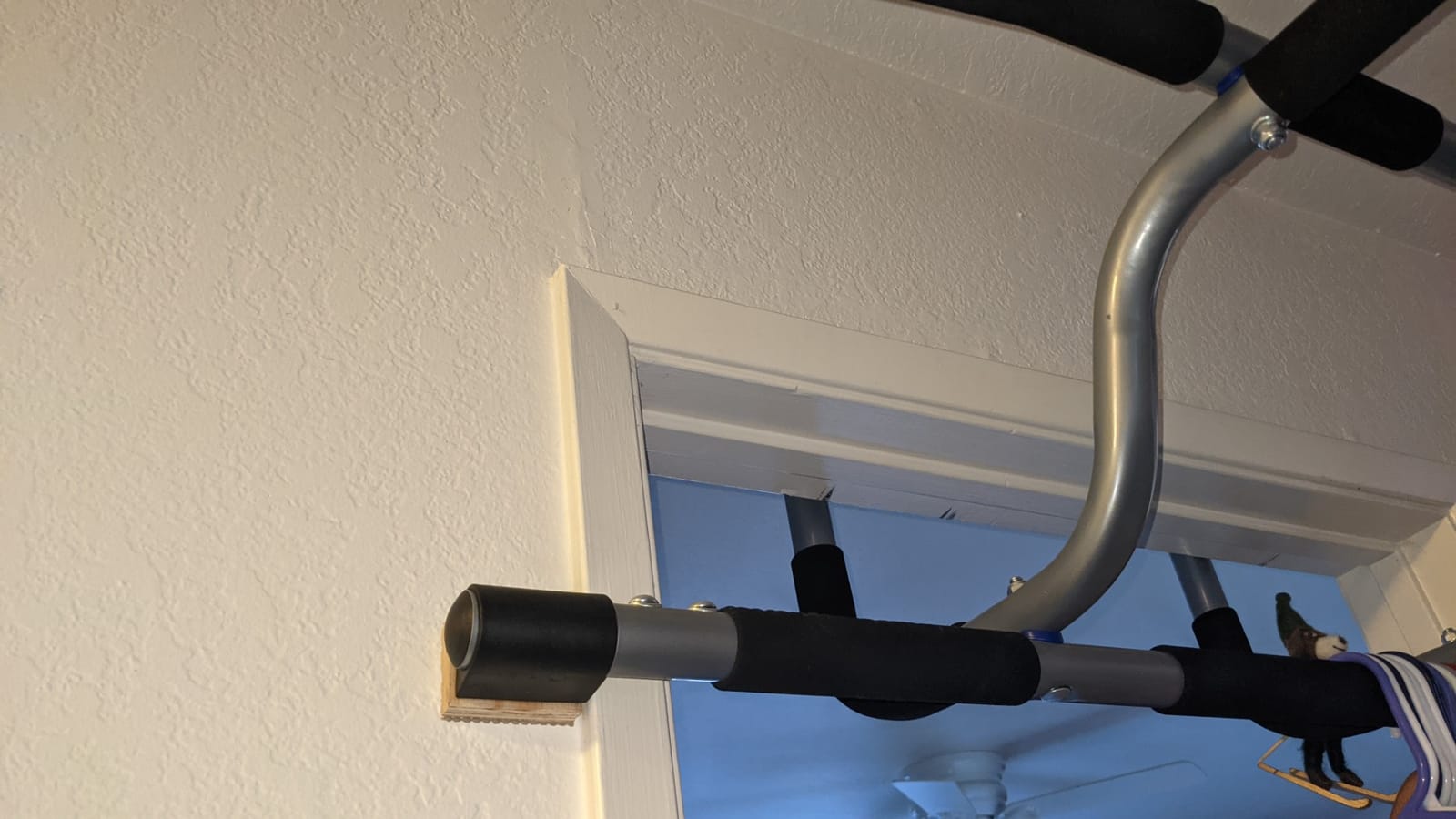
It fits 24 to 36 inch doorways with molding up to 3.5 inches wide, expanding without screws. The one hard requirement is depth: it needs a residential doorway measuring 6 inches from trim face to trim face. On a thinner frame the bar slips or sits unevenly, and that is not a small problem.
Weight is 10.2 pounds and there is no fold or tuck-away design, so this is a semi-permanent fixture in a room rather than a portable gym. It transitions quickly to the floor for push-ups and dips, which partly offsets the bulk.
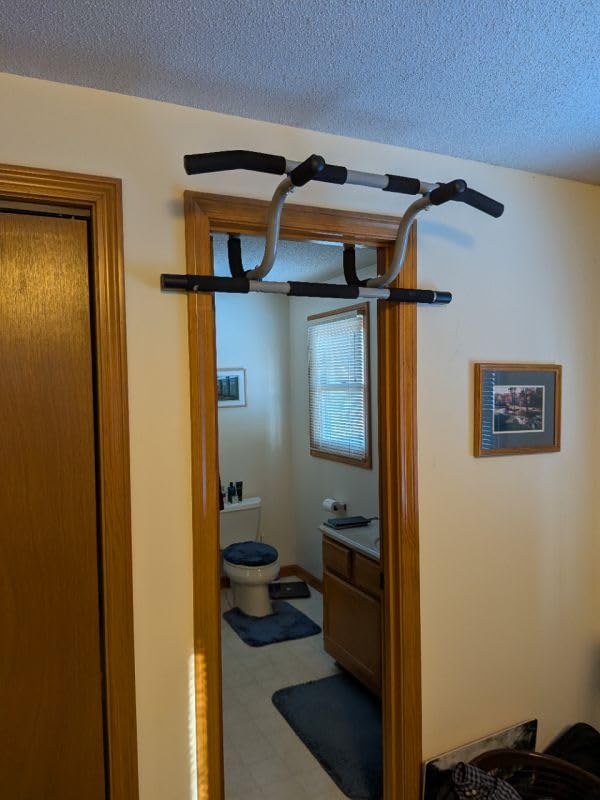
Best for taller athletes and hanging work
Measure your frame depth first. If you have 6 inches trim face to trim face, this is the best clearance you will find in a doorway bar, and the six grips make it a genuine multi-exercise station for pull-ups, chin-ups, L-sits and hanging leg raises.
The storage and assembly cost
At 10.2 pounds with no folding option, it stays where you put it. Some units also arrived with incorrect or missing hardware and difficult instructions, so build time is longer than the instant-install marketing suggests. The hard plastic contact points can abrade paint without added padding.
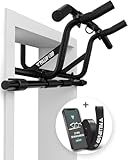
10. PULLUP and DIP Door Bar: Most Exercises From One Mount
PULLUP & DIP Doorway Pull-Up Bar Without Screwing And No Slipping, Professional Door Frame Chin-Up Bar With Pull-Up Band, Padded Handles + eBook, Up To 240 lbs
240 lb capacity
Fits 25.6-37.4 in
About 9.3 lb
Frame depth 6-10 in
Pros
- Hook-over mount locks in with body weight
- Four grip positions including chin-up and neutral
- Cross bracing stays solid under weighted pull-ups
- Includes a resistance band and exercise eBook
Cons
- 240 lb rating
- below several steel rivals
- Foam covers can creep down the angled ends
The PULLUP and DIP bar is a hook-over design with reinforced cross bracing and high-strength screw connections inside the frame itself, not into your wall. It hangs on the frame and locks in place under body weight, with no screws, no drilling and no wall marks. Reviewers who compared many bars call it the one that holds them higher and leaves more room for a wide grip.
Stability under load is its standout. Owners confirm it stays rock solid without wobble during weighted pull-ups above body weight plus plate, which is exactly where lighter bars in this category start to move. Four built-in grip positions cover wide, narrow, chin-up and neutral parallel work.
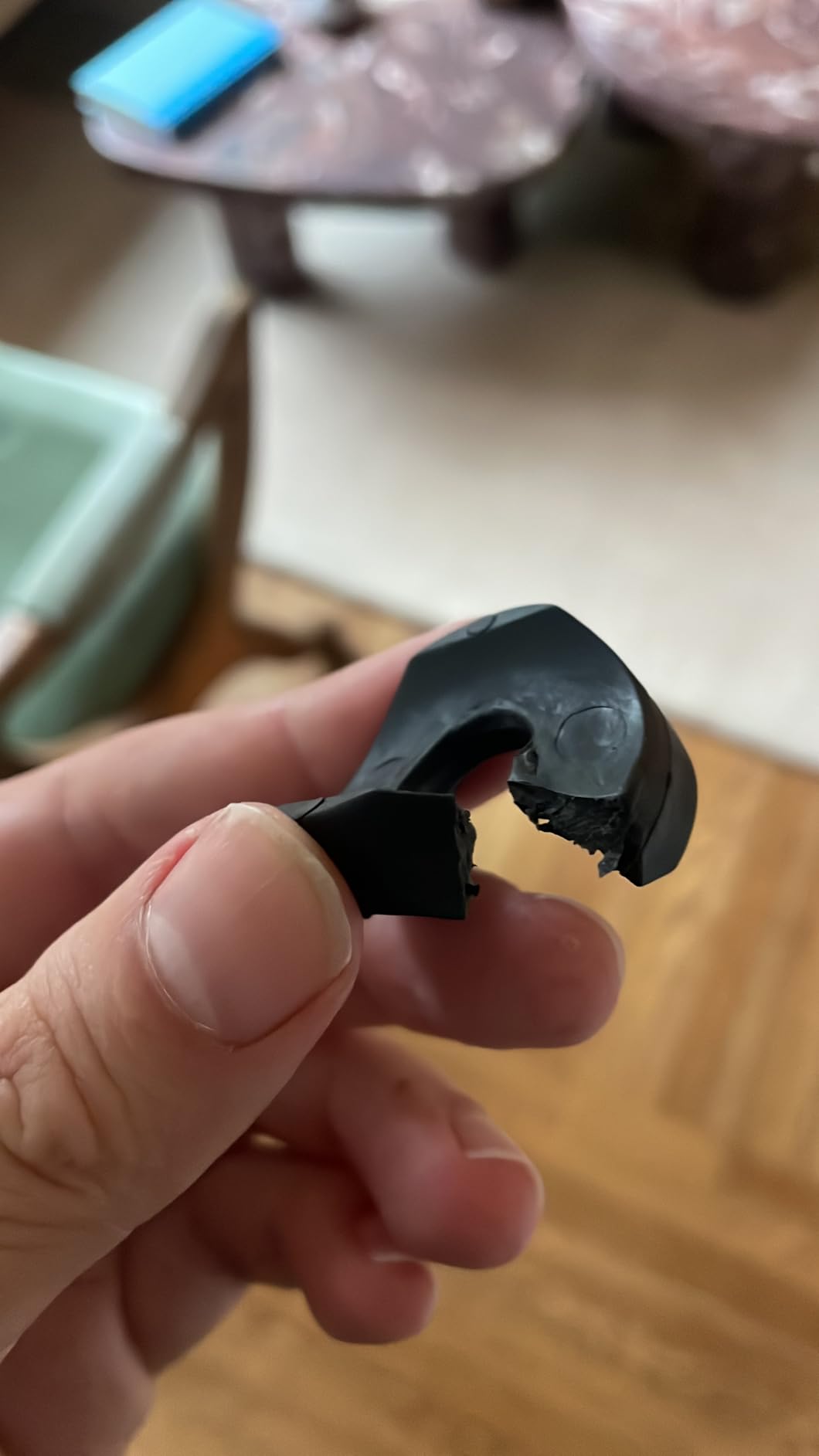
It fits openings from 25.6 to 37.4 inches with a frame depth of 6 to 10 inches, and it clears thick casement trim including 5 inch profiles, which is unusual. Protective padding shields the door, paint and wood trim, and a resistance band plus a 35-exercise eBook are included for assisted progressions.
There is also a compatible dip module sold separately that turns the mount into a station for dips, L-sits and leg raises, so the exercise list is the widest of any doorway bar here once you add it.
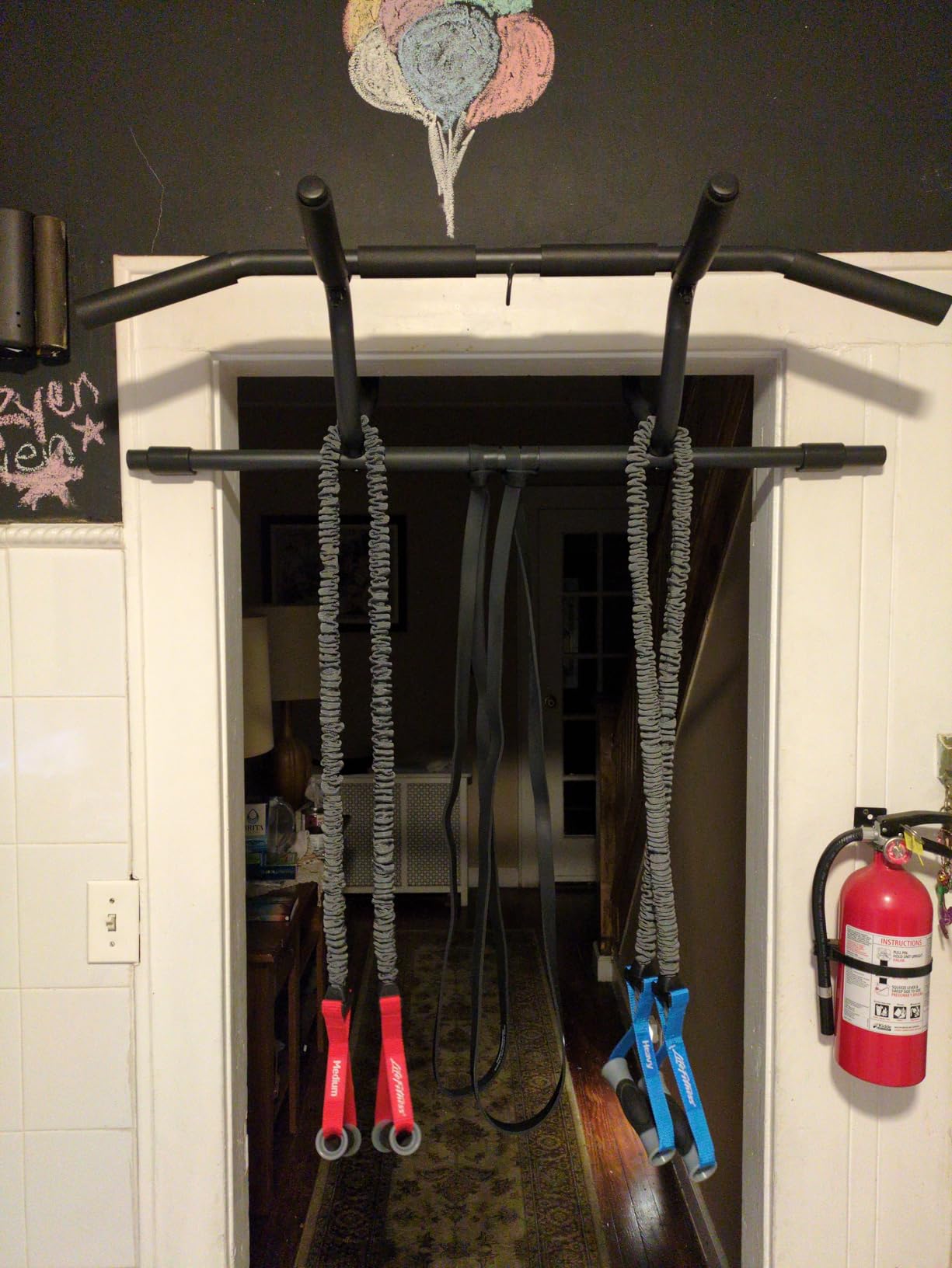
Best for weighted pulling
Cross bracing is the reason to choose this. If you progress to weighted pull-ups, this bar is rated to 240 pounds of user weight and holds that load without sway. it also fits the deepest frames of any bar in the set at up to 10 inches, so it suits thicker European-style doors and casings.
Where the ceiling is
240 pounds is the lowest steel rating in this lineup, and it is a hard number on the manufacturer’s spec. Foam covers on the angled ends can slip down over time, one unit arrived with an unthreaded hex nut, and the price sits at the premium end for a 240 pound rated bar.
11. Duonamic Eleviia: Premium Pick and No-Mark Protection
Duonamic Eleviia Portable Doorway Pull Up Bar, No Install, Home & Travel
220 lb capacity
About 3.5 lb
Aerospace composite
Arrives assembled
Pros
- Comes fully assembled with no tools needed
- Weighs about 3.5 lb so it travels in a carry-on
- Soft non-marking coating
- Works with gym rings and TRX straps
Cons
- 220 lb rating
- the lowest here
- Handles sit low so knees bend in a dead hang
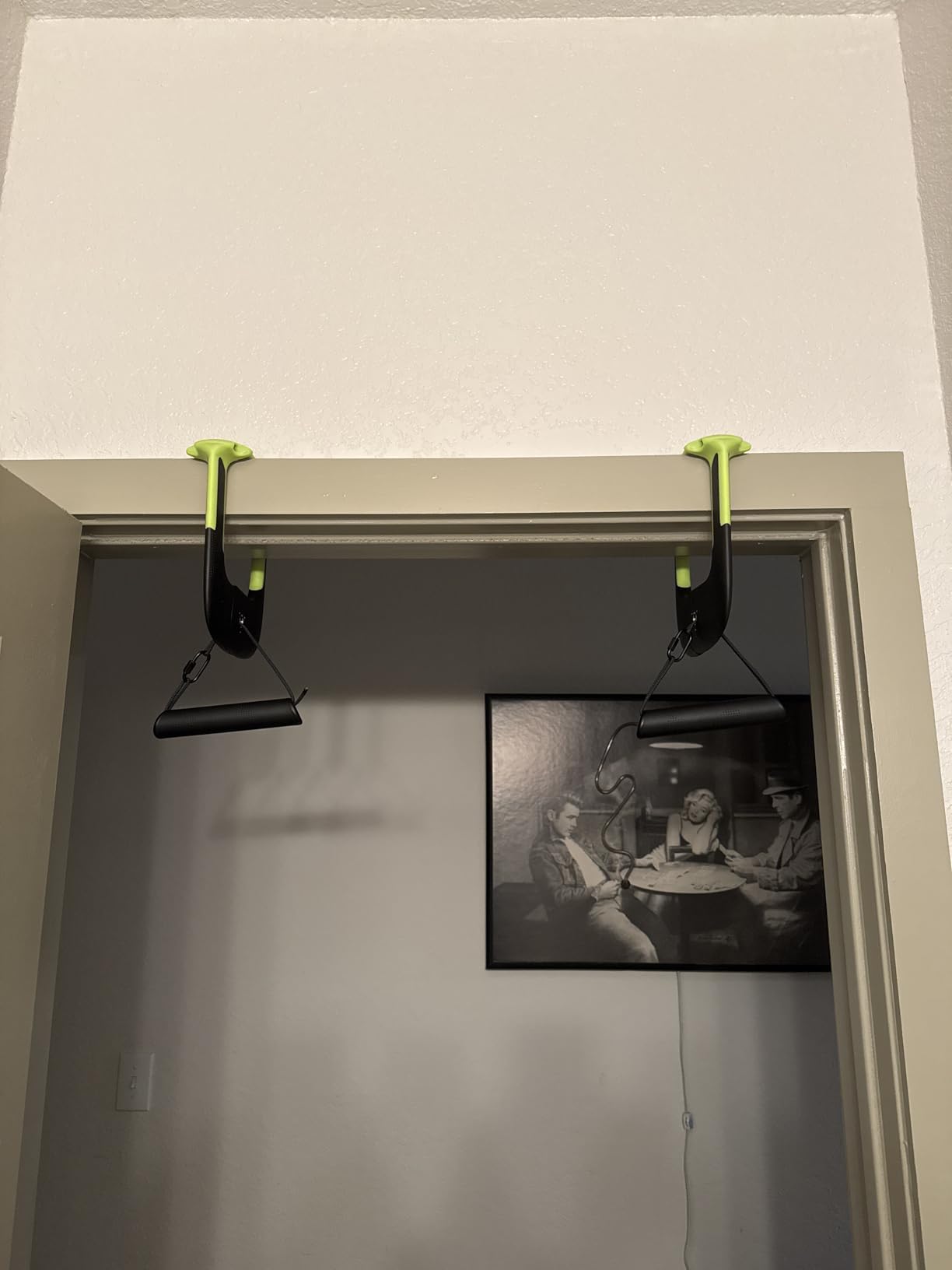
The Duonamic Eleviia is the only composite bar in the lineup, and it behaves nothing like the steel crowd. It is built from aerospace composite with a soft thermoplastic coating, weighs about 3.5 pounds, and arrives fully assembled with a spiral spring clamp that pins onto the door frame. Install and removal take seconds with no tools.
That coating is why it is our pick for the most delicate finishes. It is non-marking against both doorway and wall, which makes it the safest option for painted trim, and for a rental where the deposit is on the line. Reviewers repeatedly describe the no-mark, pack-and-travel design as the reason they bought it, with one owner carrying it 2,500 miles cross-country.
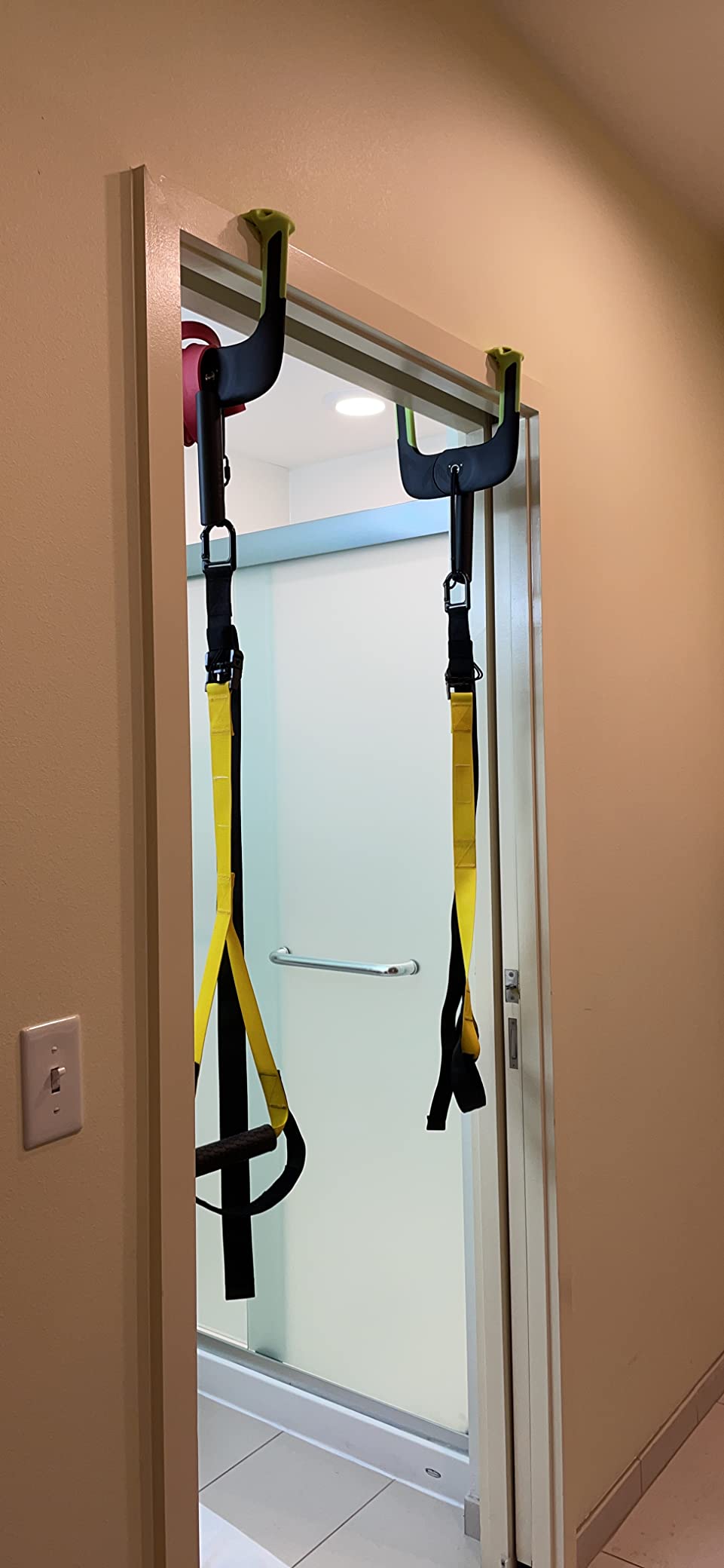
It works with gym rings and TRX suspension straps, which widens what you can do beyond pull-ups and chin-ups to L-sits and explosive pulling. It is designed in the USA and made in Taiwan, and long-term owners report more than two years of use with no measurable wear.
It also carries a small review base at 593 ratings, so treat the 4.6 star average as encouraging rather than settled. The capacity is listed at 220 pounds, and the handle height forces a bent-knee dead hang, which changes the exercise for tall users.
Best for apartments and travel
Three and a half pounds, no assembly, no marks and a spiral clamp that grips reliably. If you move between homes, stay in hotels while travelling, or share a flat with delicate trim, this is the bar that causes the least friction in every sense. Rings and strap compatibility make it versatile for a very small object.
Limits you should accept
220 pounds is the lowest rating in the set, so it is not a bar for heavy athletes. The low hang height means bent knees during dead hangs, the neutral grip is described as awkward, and a handle angle can make ring work at 45 degrees riskier. It also sits at the top of the price range for this category.
12. DMoose Fitness Doorway Bar: Highest Mount, Narrowest Fit
DMoose Pull Up Bar for Doorway – Chin Up Bar with No Screwing & No Slipping Hanging Bar with Padded Handles for Strength Training, Door Frame Pullup Bar with Installation Guide (Black)
250 lb capacity
Fits 27.6-37.4 in
About 11.8 lb
Frame depth 5.9-9 in
Pros
- Higher placement gives a wider grip and more headroom
- Protective contact pads spread pressure evenly
- Installs and removes in 3-5 seconds
Cons
- Needs roughly 8 in total door thickness
- Can feel springy near the 250 lb limit
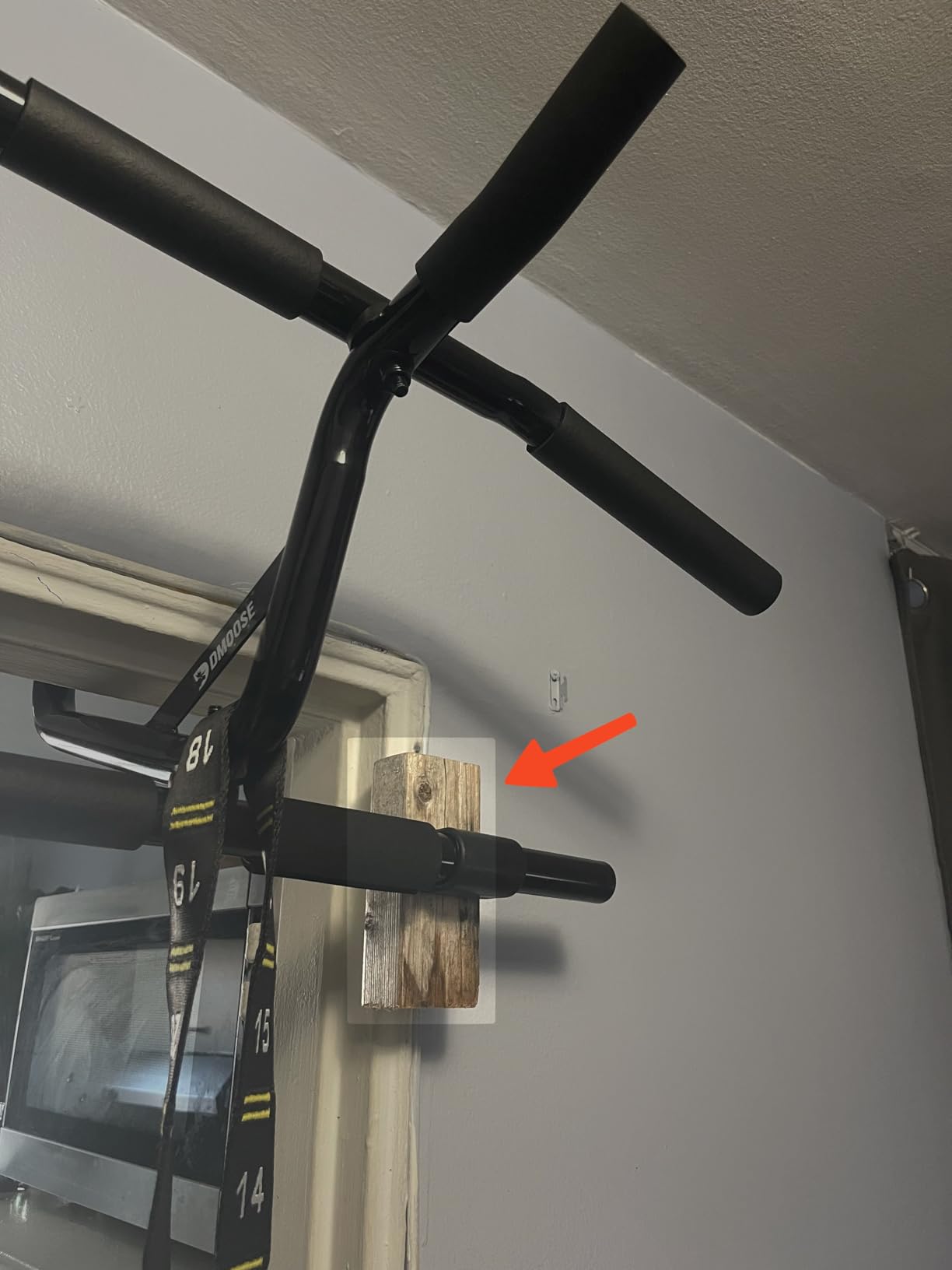
The DMoose mounts higher than most doorway bars, and that single decision shapes the whole experience. The extra height means more headroom, a wider grip span and a better overhead stretch, which is why owners of shorter stature rate it highly. Owners up to at least 170 pounds report it stays stable without creaking or shifting.
It is stainless steel with protective contact pads designed to distribute pressure evenly, so it avoids the concentrated scuff marks that narrower arms leave. Install and removal take three to five seconds with no permanent hardware, and the padded grips reduce hand fatigue over longer sessions. Pull-ups, chin-ups, dead hangs, hanging leg raises and push-ups are all supported.
The fit requirement is the catch, and it is a real one. It needs door openings from 27.6 to 37.4 inches wide, frame depth from 5.9 to 9 inches, and at least 0.6 inches of rear trim. More importantly, the most helpful review in the data warns that it does not fit standard North American interior doors with 2×4 framing, because it needs roughly 8 inches of total door thickness.
At 11.8 pounds it is among the heaviest bars here, it is not suited to trimless, arched, sliding or metal frames, and it can sway side to side and feel springy as you approach the 250 pound limit. The anchor hook section may need adjusting to suit some door styles.
Best when you have a deep frame
If your doorway is thick, the high mount is worth the effort. More headroom, a larger grip span and evenly spread contact pads make it a comfortable place to train, and the stainless steel frame is the most corrosion-resistant material in this lineup.
Check your thickness first
Measure total door thickness before ordering, because the thickness requirement here is the strictest in the set. If your interior doors are standard 2×4 framed and roughly 5 inches thick, the whole concept does not apply and you should look at a hook-over bar instead.
How to Measure Your Doorway Before You Buy
Fit is the number one reason doorway bars come back, and it takes about five minutes to get right. Work through these five measurements and you will know exactly which bars on this list will seat properly in your home.
Width between the jambs. Measure the clear opening at the top of the door, not the width of the door slab. Measure at the top and at the middle; if the two numbers differ, use the smaller one. Every bar in this list states its own range, and we have listed it in each review.
Frame depth, trim face to trim face. Measure the distance from the wall surface on one side to the wall surface on the other, across the door casing. This is the number that catches people out. The Ultimate Body Press XL needs 6 inches, the DMoose needs 5.9 inches and a minimum total thickness of roughly 8 inches.
Trim or molding height. Measure the vertical face of the casing from the flat wall to the inner edge where the door stops. Hook-over bars need enough lip to seat. Ally Peaks accepts up to 3.75 inches, AmazeFan and KAKICLAY up to 3.54 inches, and Ultimate Body Press up to 3.5 inches.
Trim thickness. Measure the depth of the casing material itself. Ally Peaks specifies a minimum of 0.45 inches, and the DMoose specifies at least 0.6 inches of rear trim. Thinner decorative molding gives a hook less to hold.
Frame material. Press firmly on the casing near the top corners. Solid timber feels dense and does not move. Hollow MDF, or thin decorative trim, dents under pressure. If it dents, use a hook-over bar with wide silicone pads, and skip tension-mounted bars entirely.
Write the numbers down and compare them to the fit line in each review. If your opening falls outside a bar’s stated range, do not force it. Tension will concentrate at whichever point the pad touches first, and that is how frames crack.
Hook-Over, Telescopic or Raised: Which Mount Fits Your Home
Hook-over bars rest a shelf on the top trim and press buffers into the frame walls. They are the most common design here and the most forgiving on older frames, because the load travels through the header into the studs. The IRON GYM, AmazeFan, Ally Peaks and TOPOKO all work this way. The advantage is a wide fit range and a quiet, planted feel; the disadvantage is that they need trim with a lip to catch.
Telescopic tension bars twist to expand rubber or PVC pads against the jamb sides. The Sportneer is the clearest example of that approach here, and it has a real advantage: it works on doors where a hook has nothing to grab. The cost is that all the load goes into friction at two small pads, and the manual limit of 297 pounds is lower than the headline figure suggests. They are the least forgiving option on weak frames.
Raised hook-over bars sit an inch or more above the trim and stand further off the wall. The Ultimate Body Press XL is the clearest example, and the KAKICLAY also uses a raised bar. You gain leg clearance and a better stretch, and you give up fold-flat storage on some models. Raised bars also tend to be heavier, because more steel sits above the frame.
For most people in a normal house, a hook-over bar with wide silicone pads is the right default. Choose tension if your door has minimal trim, and choose raised if you are tall or you want hanging leg raises and L-sits.
Damage Risk by Trim and Frame Material
No doorway bar is completely non-damaging, but the risk varies enormously by material. The pattern we saw in testing is consistent: the damage is almost always a scuff or a shallow indent at a contact point, not a structural failure, unless the frame itself is weak.
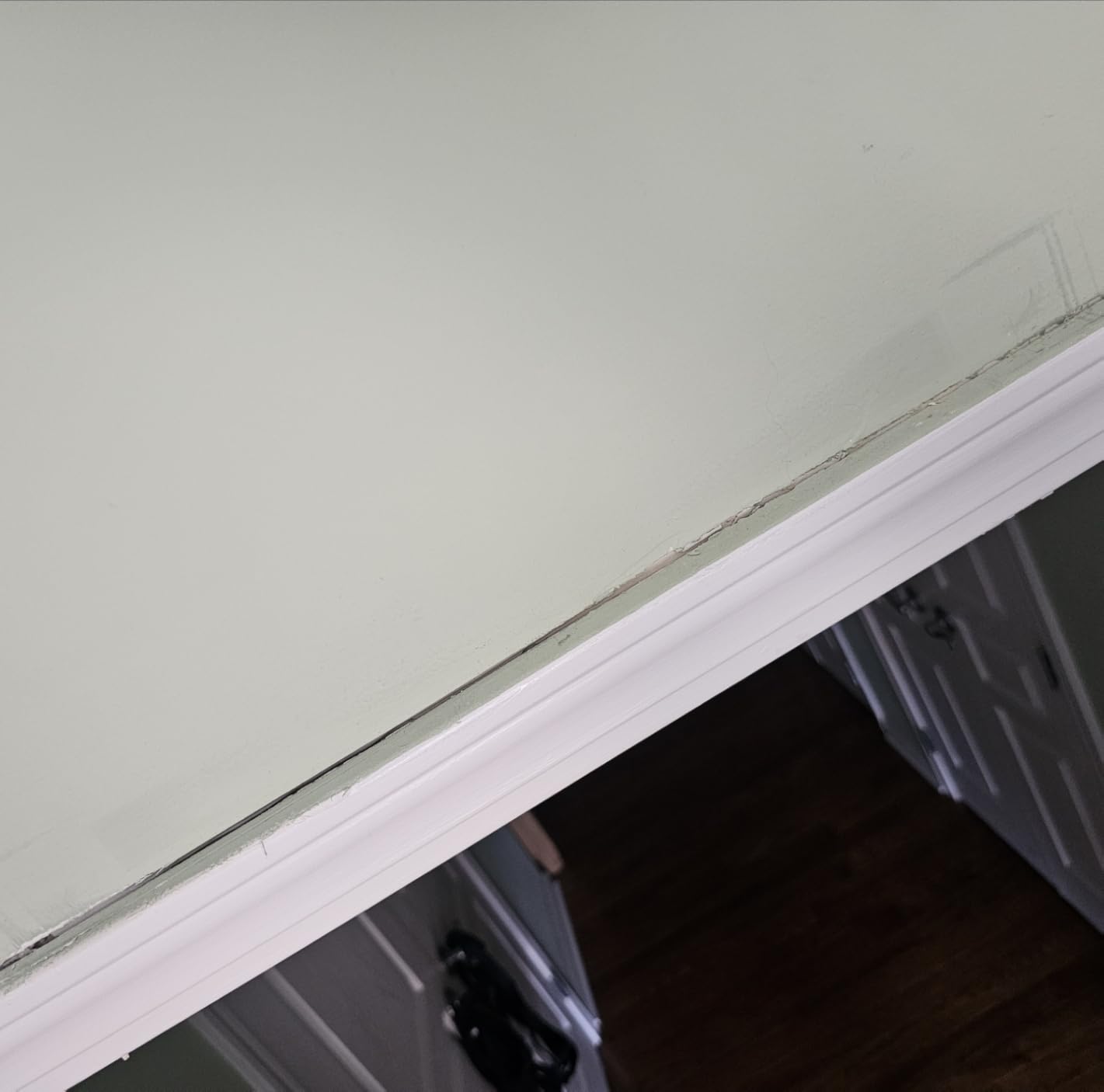
Painted casings are the most vulnerable finish. Hook-over arms with narrow contact points leave black scuffs, and a bar installed and removed daily will eventually mark the paint. Wide silicone pads, painter’s tape under each contact point, or a bar that ships with removable buffers all reduce this.
Wallpaper takes indentations rather than tears. Tension-mounted bars are the worst offenders because the pads concentrate pressure. A hook-over bar with broad buffers spreads the same force over more surface area and is the better choice on papered walls.
Molded or decorative trim is a fit problem as much as a damage problem. Deep profiles change the depth measurement, and bars with a fixed hook angle may not seat flat. The PULLUP and DIP bar clears 5 inch casement profiles, which is unusual, and the AmazeFan and KAKICLAY accept trim heights up to 3.54 inches.
Metal or hollow frames are where we would not install any tension-mounted bar. The Sportneer listing explicitly excludes ceramic tile, glass and hollow frames, and that caution generalizes. A hook-over bar with wide pads is the least risky option, and screw-reinforced mounting through solid timber is safer still.
Weight Capacity vs. Max User Weight
Capacity in this category ranges from 220 to 440 pounds, and the number that matters is the one in the manual, not the one on the box. Sportneer publishes 440 pounds in marketing and 297 pounds in its manual. Read both, and treat the lower figure as the real limit.
Then add your own load. If you weigh 200 pounds and want weighted pull-ups, you are asking a 300 pound bar to hold well over its rating. The PULLUP and DIP bar holds steady under weighted pulling because of its cross bracing, and the AmazeFan and KAKICLAY stay rigid because of their welded and heavy construction. Choose capacity with at least 25 percent headroom above your bodyweight, and more if you plan to add weight.
Renter and Apartment Checklist
Renters should start with the install method. Screw-free installation protects your deposit in two ways: no holes to patch, and no fastener failing in a wall you do not own. The Sportneer takes this furthest with two large PVC friction mats, and the Duonamic goes furthest on finishes with a soft non-marking coating.
Next, check the removal cycle. A bar you take down every day will mark trim faster than one that stays up for a month. If you plan to move it between rooms, wide silicone pads and a non-marking coating matter more than the capacity number.
Finally, check the frame before you hang anything. Press the casing at both top corners, then press the door itself while closed. A hollow or flexing frame is a sign to choose a hook-over bar with wide buffers, avoid tension mounts, and consider whether a product like the JFIT with included screw brackets would give you a safer fallback.
If you want a fixed installation instead, our roundup of the best wall-mounted pull-up bars covers options that never move, and our guide to the best grab bars covers the bathroom and stair applications where fixed hardware is the only sensible choice.
Frequently Asked Questions
Are doorway pull-up bars any good?
Yes, doorway pull-up bars are good when they fit your opening and your frame is solid. A properly fitted hook-over bar rated to at least 300 pounds holds full sets of strict pull-ups, installs in under a minute and leaves no mark on a well-built frame. The most-reported problems come from bars forced into doorways outside their stated width or depth range.
Can my doorway support a pull-up bar?
Most standard interior doorways can, because the load travels through the header above the door into the wall studs. Hollow MDF frames, thin decorative trim and weakened frames from old water damage are the exceptions. Press the casing firmly at both top corners and check the top of the door for flex; a solid, unmoving frame is fine, and a denting or springy frame is not.
Do pull-up bars ruin door frames?
They can leave scuffs or shallow indents, and the risk is highest on painted casings, wallpaper and hollow MDF frames. Damage almost always appears at the contact points rather than as a structural break. Wide silicone pads, painter’s tape under each contact point, and choosing a hook-over bar over a tension-mounted bar all reduce the risk substantially.
What is the safest pull-up bar for a doorway?
The safest doorway bar is a hook-over design with wide padded or silicone contact points and a capacity at least 25 percent above your bodyweight. The IRON GYM Total Upper Body Bar and the Ally Peaks Multi-Grip Bar both combine a 300 to 440 pound rating with padded frame contact and screw-free installation, and both remove in seconds for storage.
Is there a pull-up bar that does not damage the door?
The Duonamic Eleviia is the closest thing to a no-damage option, because its soft non-marking thermoplastic coating and light 3.5 pound weight avoid concentrated pressure on trim. The Ally Peaks bar is a close second with double silicone protection and spare 4mm no-trace pads. No doorway bar is completely mark-free on painted casings, so add painter’s tape if the finish matters.
How much weight can a doorway pull-up bar hold?
Ratings in this category range from 220 pounds to 440 pounds, and the manual figure is the one that counts. Sportneer publishes 440 pounds in marketing but 297 pounds in its manual. Choose a bar with at least 25 percent headroom above your bodyweight, and considerably more if you plan to add weight to your pull-ups.
Final Recommendation
The best pull-up bars for doorways come down to two questions: what does your opening measure, and how do you train. The IRON GYM Total Upper Body Bar is the default pick, with a 300 pound rating, three grip positions, foam comfort grips and a proven record across more than 25,000 reviews. It is the bar we recommend if you want one purchase that works in most standard doorways and moves between rooms in seconds.
Go with the AmazeFan if you need the widest fit range or one of the highest ratings, with welded one-piece tubes and a bar that arrives assembled. Choose the Ally Peaks for the best frame protection and a 440 pound rating. Pick the Ultimate Body Press XL if you are tall and want leg clearance, and the JFIT if you are guessing at your measurements and want the broadest width range available.
Whatever you choose, measure first. Five minutes with a tape measure and a firm press on the casing will save you the one problem every doorway bar shares.