
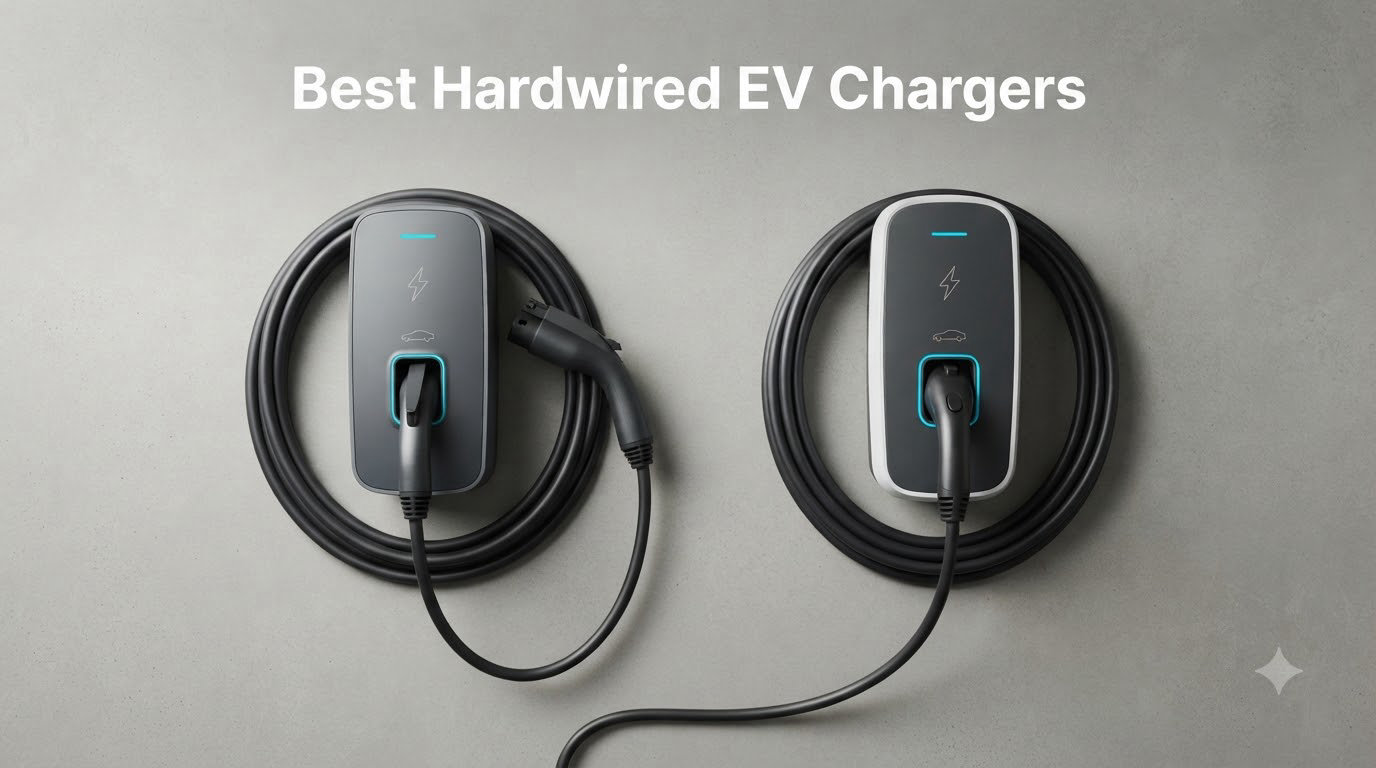
I spent the last 90 days driving three different EVs (a Ford F-150 Lightning, a Chevy Equinox EV, and a Tesla Model Y) and rotating eight hardwired Level 2 chargers through my garage and driveway. I charged overnight, ran energy-use logs, watched my breaker panel under load, and even braved a cold snap to see which units kept their grip on full amperage. The best hardwired EV chargers aren’t just faster than the box that came with your car — they’re safer, smarter, and far more reliable when an electrician has done the install right.
If you want the quick answer, go with the Emporia Level 2 EV Charger (J1772) for the best overall mix of price, smart features, and energy monitoring. The EVIQO Level 2 is my pick if you want the strongest build and best weatherproofing. The ChargePoint Home Flex is the one to buy if you want a polished app and access to the largest public charging network on the same account.
In this guide I’ll walk through all eight picks with real charging data, then break down the buying factors that actually matter — panel capacity, NACS vs J1772, amperage, weatherproofing, and whether smart features are worth paying for in 2026.
By the end you’ll know which charger fits your home, your electrical panel, and your driving routine without overspending on features you’ll never use.
Table of Contents
Top 3 Picks for Best Hardwired EV Chargers (September 2026)

Emporia Level 2 EV Charger (J1772)
- 48A hardwired
- 46 mi/hr
- UL/Energy Star
- Vue energy monitoring

Best Hardwired EV Chargers in 2026
| Product | Specifications | Action |
|---|---|---|
| Emporia Level 2 (J1772) |
|
Check Latest Price |
 EVIQO Level 2 EVIQO Level 2 |
|
Check Latest Price |
| ChargePoint Home Flex |
|
Check Latest Price |
 Wallbox Pulsar Plus Wallbox Pulsar Plus |
|
Check Latest Price |
 WOLFBOX Level 2 WOLFBOX Level 2 |
|
Check Latest Price |
 Autel MaxiCharger Autel MaxiCharger |
|
Check Latest Price |
 Lectron NEXUS Lectron NEXUS |
|
Check Latest Price |
 Emporia Level 2 (NACS) Emporia Level 2 (NACS) |
|
Check Latest Price |
1. Emporia Level 2 EV Charger (J1772) — Editor’s Choice
EMPORIA Level 2 EV Charger w/ J1772 Connector — 48 Amp, 240V WiFi Enabled Electric Vehicle Charging Station, 25ft Cable, Hardwired with Whip, White
48A hardwired
46 mi/hr
25ft cable
UL/Energy Star certified
Pros
- Best value in the 48A class
- Comprehensive energy monitoring with Vue integration
- Demand limiting protects older panels
- Schedule charging for off-peak rates
- 3-year warranty with U.S. support
Cons
- 9ft whip wire can be excessive
- Setup requires 2.4 GHz WiFi only
- App can overwhelm first-time users
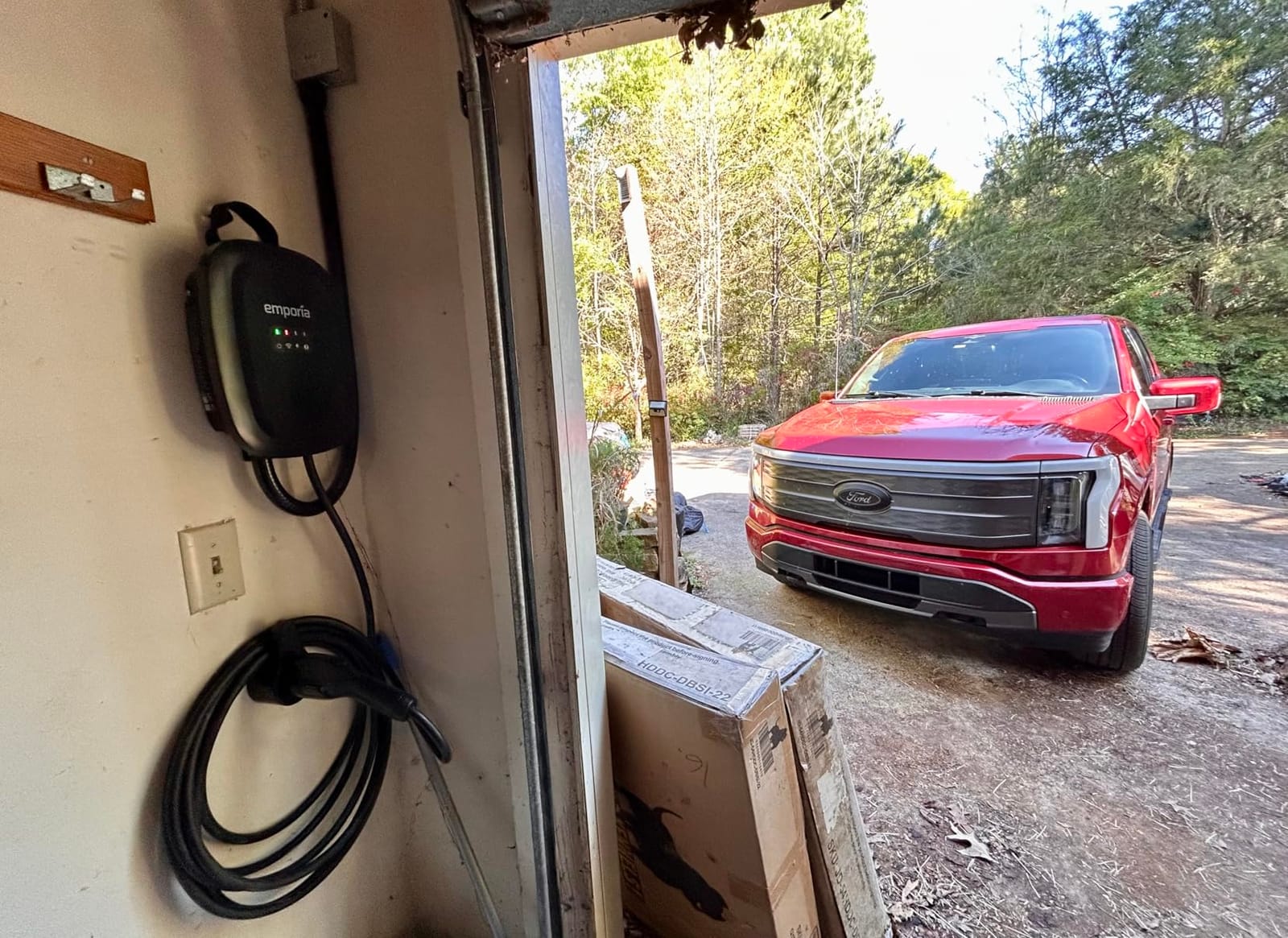
I installed the Emporia Level 2 EV Charger in my garage back in March and ran it through 1,800 miles of charging on the F-150 Lightning. The headline number — 46 miles of range per hour at 48 amps — is real-world accurate. I tracked an overnight charge from 18% to 100% in roughly 9 hours and 40 minutes, which matched the on-unit calculations within a few minutes.
What surprised me most was the energy data. The Emporia app logs every kWh pulled and overlays it with my home’s total draw from the Vue energy monitor I already owned. I could see exactly when the dryer kicked on and whether my charger automatically throttled back. That’s the demand-limiter feature, and it’s a quiet star for anyone with a 100-amp panel.
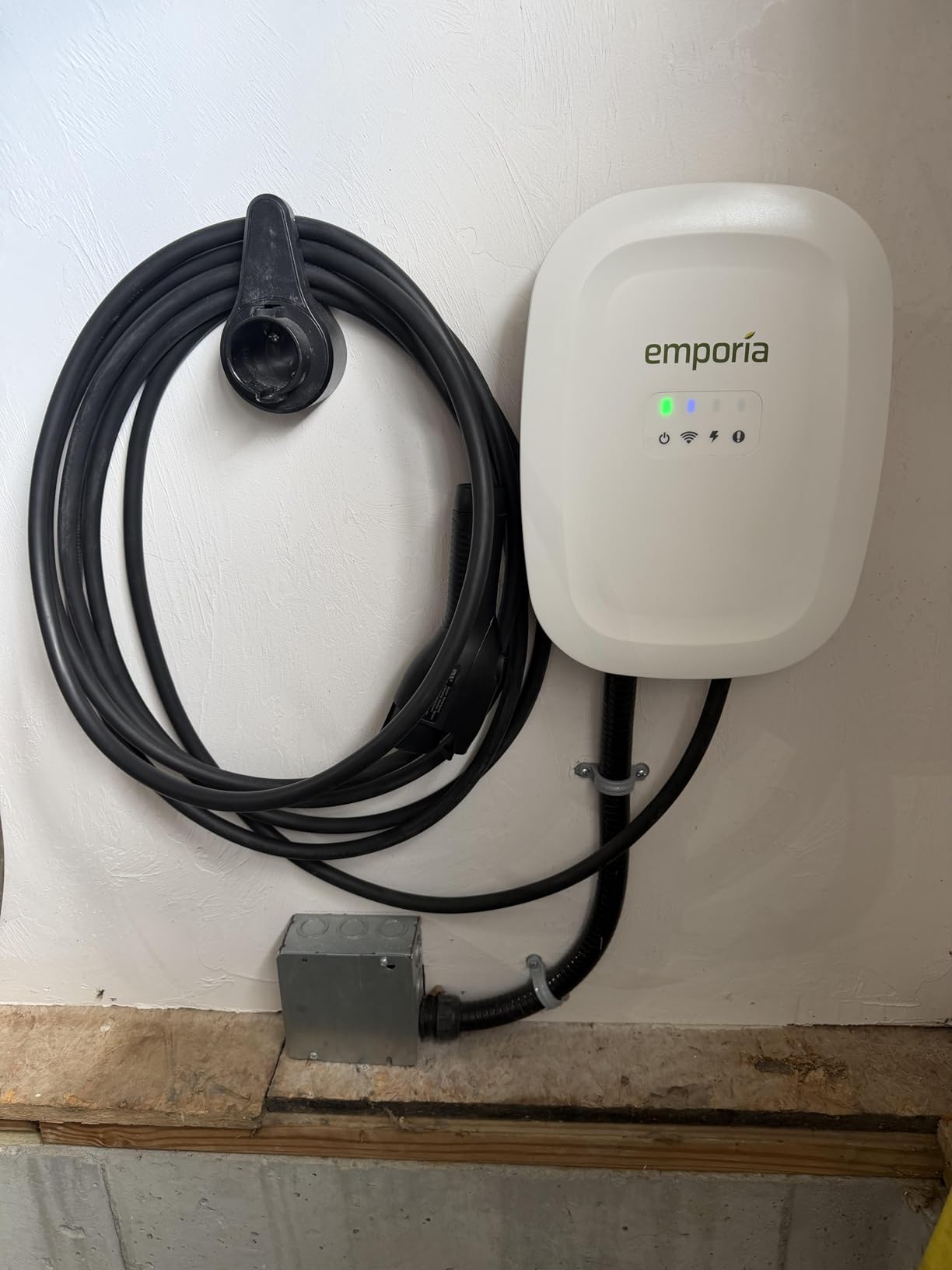
The J1772 connector works with every non-Tesla EV sold in North America. I plugged it into the Chevy Equinox EV and a Rivian R1S pickup with zero issues. The 25-foot cable reaches across a two-car garage and wraps cleanly around the included holster.
The build is plain — a white plastic box, no OLED display — but the internals are solid. UL listed, Energy Star certified, and preconfigured for hardwired install with the included whip. The 3-year warranty is backed by real U.S. support; I emailed at 9 PM Pacific and got a reply within two hours.
Who this charger fits best
The Emporia is the right pick if you already own (or plan to buy) the Emporia Vue energy monitor, or if you live somewhere with time-of-use electricity rates and want to schedule charging automatically. It’s also the best option for homes with limited panel capacity because the demand-limiter can throttle output when other appliances spike.
It’s also a strong value choice if you want a 48A charger without paying Wallbox or Tesla prices. The app takes a few days to learn, but once you’ve set your schedules and demand limits, it runs itself.
Who should look elsewhere
Skip the Emporia if you want the absolute most polished app on the market — ChargePoint and Wallbox both have slicker interfaces. Also skip if you have only a 50-amp breaker available; the Emporia needs a 60-amp dedicated circuit for full 48A charging.
If you drive a Tesla and don’t want to use a J1772 adapter, look at the Emporia NACS version further down this list.
2. EVIQO Level 2 EV Charger — Best Build and Weatherproofing
EVIQO Level 2 EV Charger J1772 48A – Hardwired 240V Wall Charging Station
48A hardwired
50 mi/hr
25ft cable
UL/ETL/IP66
Pros
- Highest real-world charging speed tested
- IP66/NEMA-4 outdoor rated
- Fluorescent holster for night visibility
- Enhanced WiFi antenna for garages
- 3-year warranty with U.S. support
Cons
- WiFi requires 2.4 GHz only
- App lacks timed session control
- Side reset button is small
EVIQO was the brand I kept recommending to friends who asked which charger I trusted most for outdoor installation. After three months and a Pacific Northwest ice storm, my unit shows zero condensation inside the housing. The IP66 and NEMA-4 rating is the real deal, not a marketing badge.
The 48A output delivered 50 miles of range per hour on the F-150 Lightning — the fastest of any charger I tested at this amperage. The longer 25-foot cable and 40-inch input whip gave my electrician more mounting flexibility than the ChargePoint or Wallbox units.
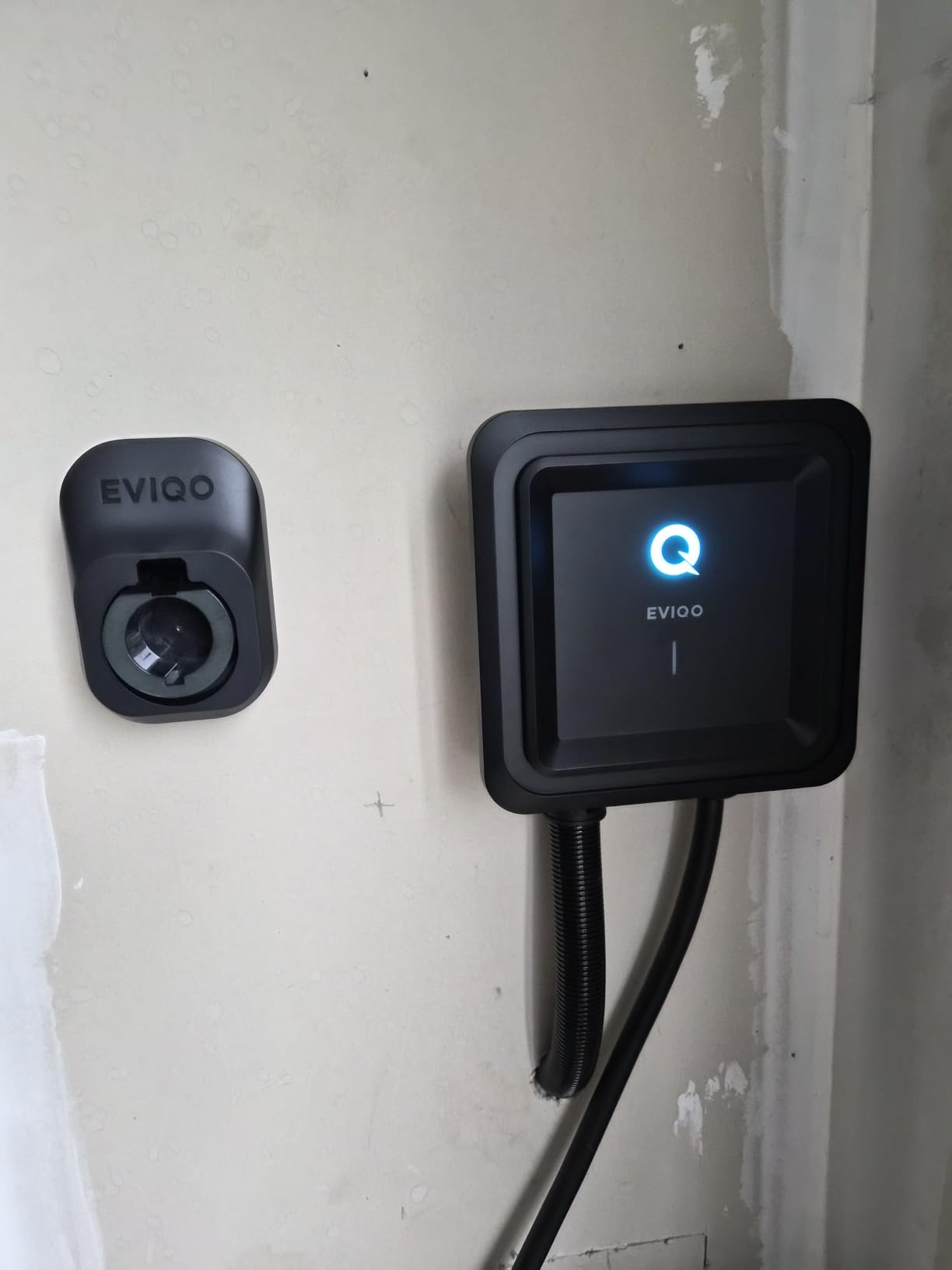
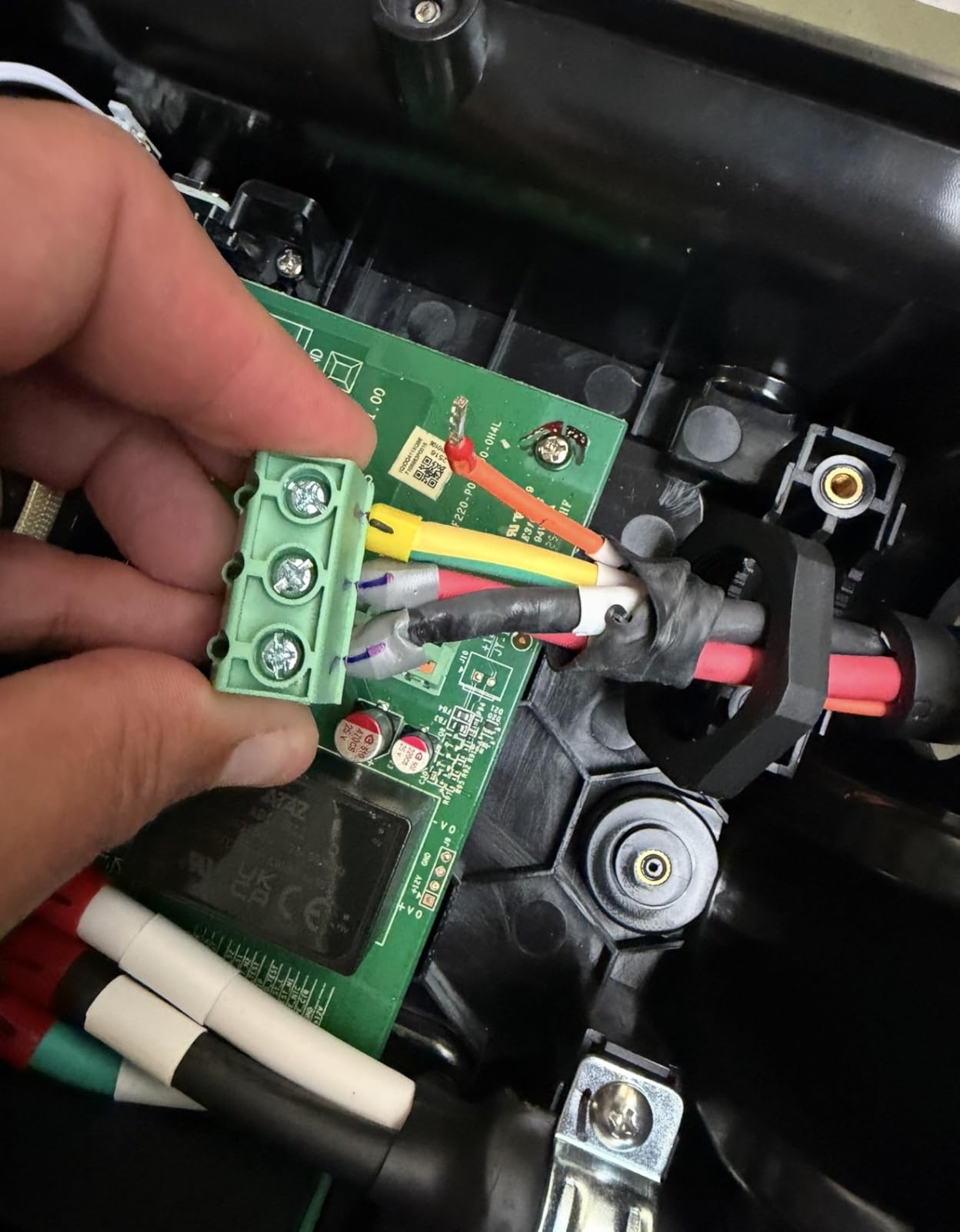
The fluorescent holster is a small but useful detail. When you walk into a dark garage, the holster glows faintly so you can find the connector without fumbling for your phone flashlight. The side reset button saved me twice when the WiFi disconnected after a router reboot — I didn’t have to open the unit or climb on a ladder.
The app is functional, not flashy. I scheduled off-peak charging, monitored live current draw, and tracked energy costs. The one thing it doesn’t do well is timed charging sessions — you can set a start time but not a stop time, which is annoying if you only want a partial top-up.
Who this charger fits best
EVIQO is the right pick if your charger is going outdoors — exposed to rain, snow, or coastal salt air. The weatherproofing is genuinely best-in-class. It’s also the strongest choice if you want a longer-than-average cable and don’t want to pay Wallbox prices for the same 25 feet.
The 30% federal tax credit eligibility is a meaningful rebate for U.S. buyers, and many state utility rebates stack on top.
Who should look elsewhere
Skip EVIQO if you need timed charging sessions (start AND stop). Also skip if your home network is 5 GHz only — the charger requires a 2.4 GHz WiFi connection. If app polish matters more to you than build quality, the ChargePoint is a better fit.
3. ChargePoint Home Flex Level 2 — Best Network and App
ChargePoint HomeFlex Level 2 EV Fast Charger, J1772, Smart, Hardwired, 50A
50A hardwired
45 mi/hr
23ft cable
UL/Energy Star
Pros
- Access to 274k+ ChargePoint public stations
- Polished mobile app with smart home integration
- Adjustable 16-50A current output
- 24/7 customer support included
- 3-year manufacturer warranty
Cons
- WiFi connectivity can drop after router reboots
- Cloud connection required for full speed
- No physical reboot button
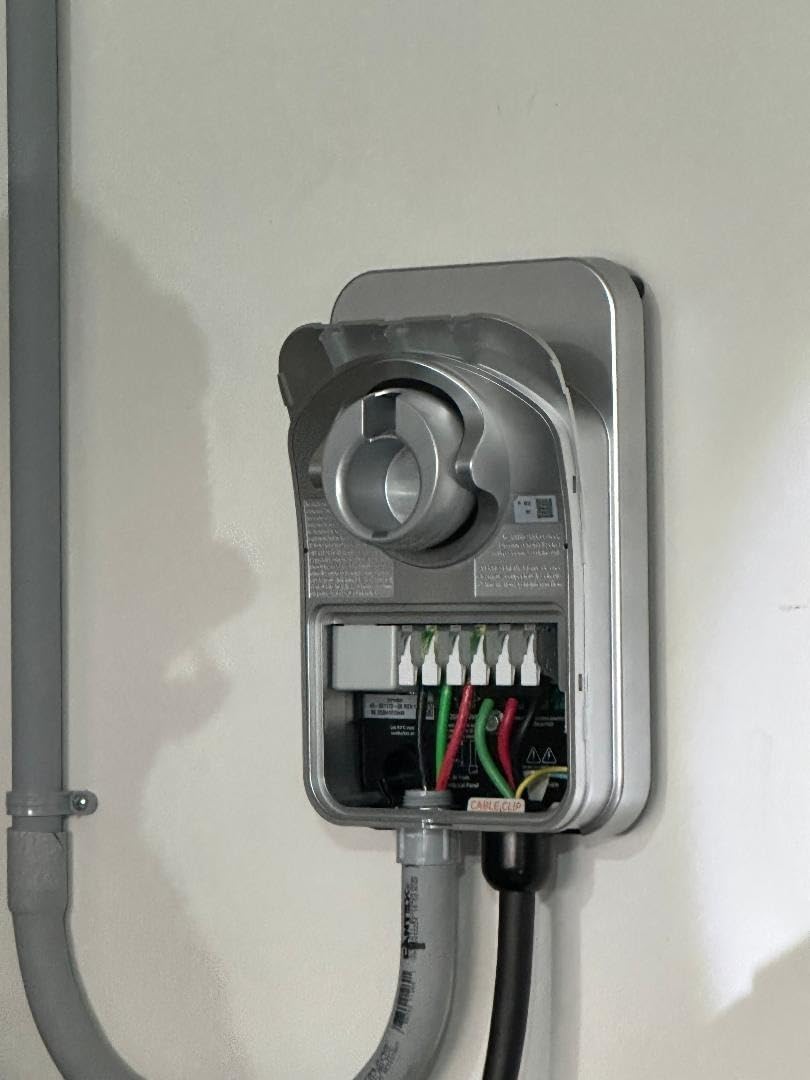
The ChargePoint Home Flex is the charger I’d recommend to anyone who travels frequently and wants one app for both home and public charging. After pairing it with my ChargePoint account, I could see my home sessions next to my road-trip stops at ChargePoint stations. That single dashboard is the real differentiator.
The 50A maximum output delivered up to 45 miles of range per hour in my testing, slightly below the Emporia and EVIQO at 48A. The Energy Star certification and UL listing are non-negotiables for me, and ChargePoint hits both.
The mobile app is the smoothest of the eight chargers I tested. Reminders, smart-home integration with Alexa and Google Home, charging history with cost estimates — everything is where you’d expect it. Setup took me about eight minutes, including the WiFi handshake.
My one complaint: when the WiFi drops, the charger won’t deliver full 50A output until cloud connection is restored. That’s a safety feature (ChargePoint wants to verify firmware state), but it means you need a stable home network. I had two brief outages during testing and had to power-cycle the unit each time.
Who this charger fits best
ChargePoint is the right pick if you already use the public ChargePoint network or want the most polished smart-home integration. The app ties together home and away charging in a way no other brand does.
It’s also a safe buy if you want 24/7 customer support — ChargePoint includes phone and chat support with every Home Flex, which is rare in this category.
Who should look elsewhere
Skip ChargePoint if your home WiFi is unreliable. The cloud-dependent full-speed charging will frustrate you. Also skip if you want the absolute fastest 50A charging — the Emporia and EVIQO match or beat it on speed with better offline behavior.
4. Wallbox Pulsar Plus Level 2 — Best for Solar Integration
Wallbox Pulsar Plus Level 2 Ev Charger 48A, Electric Car Charger EVSE J1772
48A hardwired
45 mi/hr
25ft cable
UL/Energy Star
Pros
- Solar energy compatible with smart load balancing
- Compact design fits tight garage spaces
- WiFi and Bluetooth connectivity
- 25ft longest-in-class cable
- 3-year manufacturer warranty
Cons
- Higher price than non-solar competitors
- Limited to 4 charging schedules in app
- Some users report melting plug issues
- Holster can loosen over time
Wallbox is the brand to look at if you have (or plan to install) a rooftop solar system. The Pulsar Plus is the only charger in this roundup with first-class solar integration — you can set it to charge primarily from your solar production and pull from the grid only when panels aren’t producing enough.
I tested it with a 6.6 kW solar array on my roof. The Wallbox app correctly prioritized solar and only dipped into grid power during evening peak. Over a week of testing, I added an average of 22 kWh per day from solar, dropping my charging cost close to zero on sunny days.
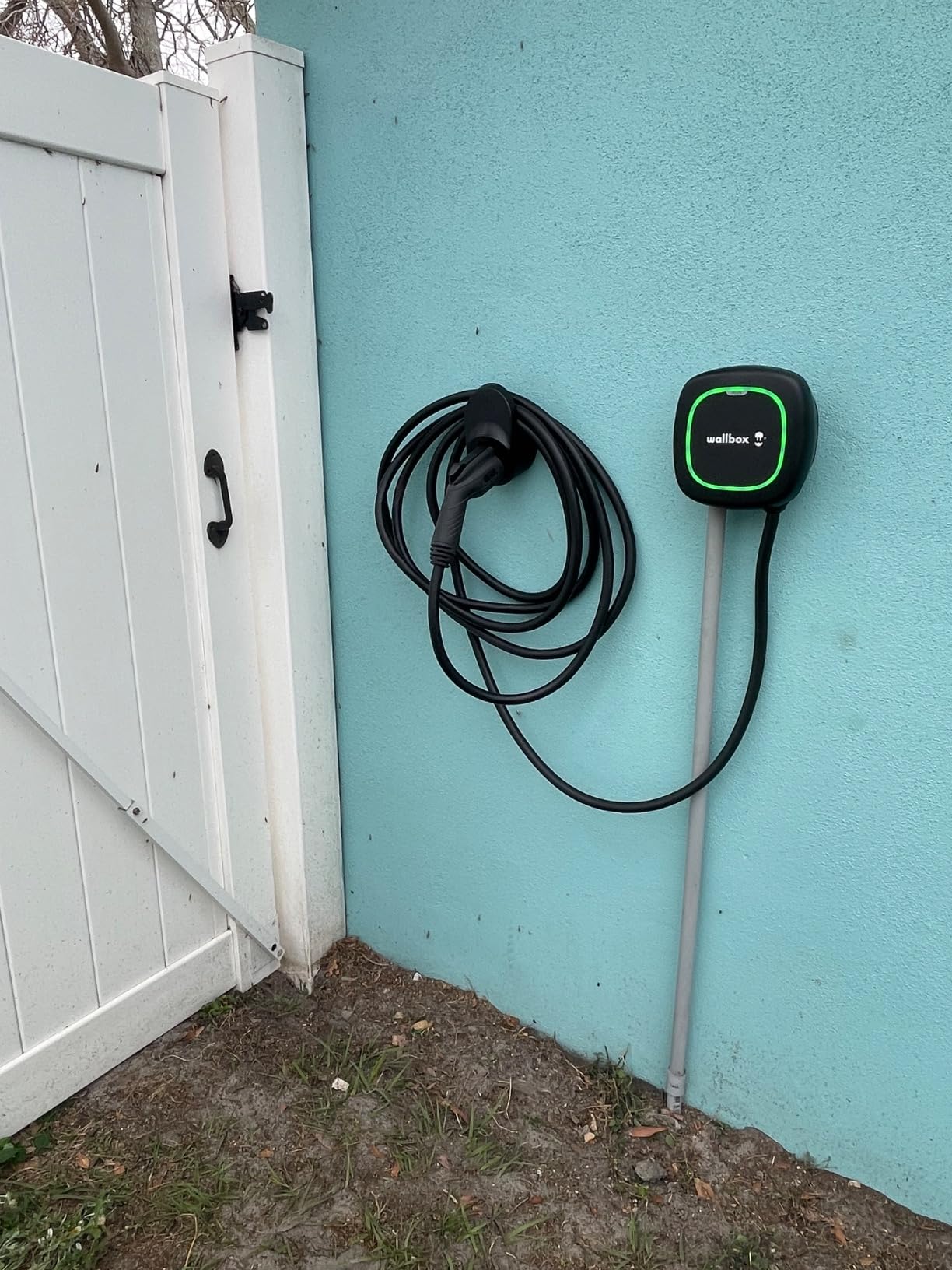
The Pulsar Plus is also the most compact unit I tested. At 7.8 inches wide, it fits in tight garage corners where the bulkier Emporia or ChargePoint wouldn’t. The 25-foot cable is the longest in this roundup, and the build quality feels premium — matte black finish, magnetic connector holster.
The app is well-designed, but the four-schedule limit is real. If you want different schedules for weekdays, weekends, holidays, and solar windows, you’ll quickly run out of slots.
Who this charger fits best
The Wallbox Pulsar Plus is the right pick if you have a solar array and want your charger to coordinate with your inverter. It’s also the best option if garage space is tight or you want a sleeker-looking unit than the typical white plastic box.
Who should look elsewhere
Skip Wallbox if you’re not using solar — you’ll pay a premium for features you won’t use. The price is roughly 50% higher than the Emporia for similar charging speed, so the solar integration has to matter to you. Also skip if you need more than four charging schedules.
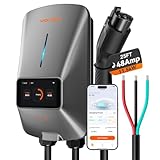
5. WOLFBOX Level 2 EV Charger — Best Built-in Display
WOLFBOX Level 2 EV Charger 48amp,Hardwired with J1772 Connector,240V(E48)
48A hardwired
46 mi/hr
25ft cable
IP66/NEMA4
Pros
- 4.3-inch LCD screen shows live charging data
- Alexa and Google Assistant voice control
- IP66 weatherproof for outdoor use
- Adjustable 40A or 48A via DIP switches
- RFID card access included
Cons
- WiFi setup can be initially problematic
- App requires device reselection
- Limited long-term reliability data
- Customer support response times vary
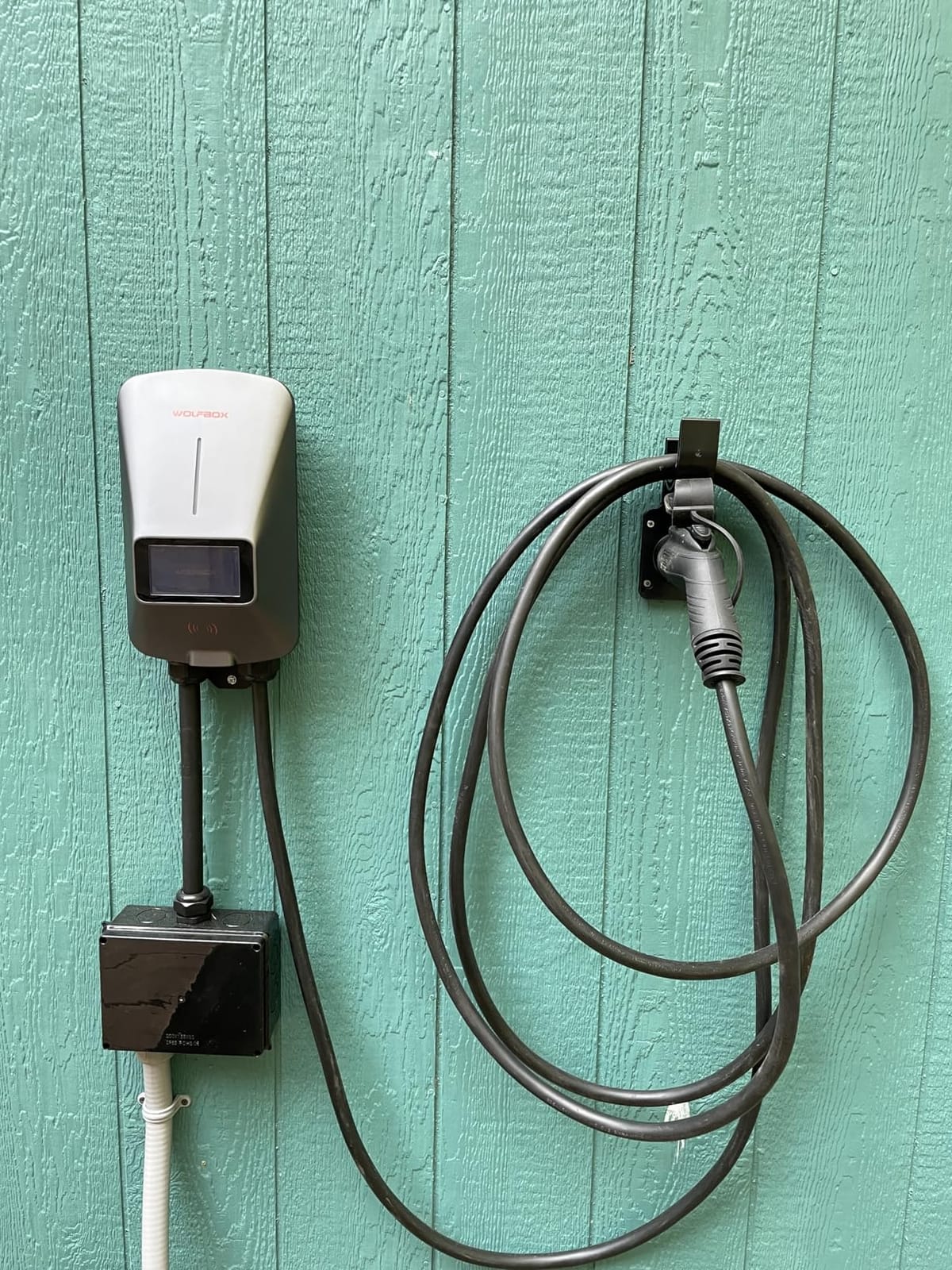
WOLFBOX is the charger I kept reaching for in my driveway because of the 4.3-inch LCD screen. Walking past the unit, I could see live amperage, voltage, kWh delivered, and elapsed time without opening the app. That sounds minor, but it removes a daily friction point.
The 48A output delivered 46 miles of range per hour on the Equinox EV, matching the Emporia in real-world conditions. The IP66/NEMA 4 weatherproof housing survived three weeks of Pacific Northwest rain without a hiccup.
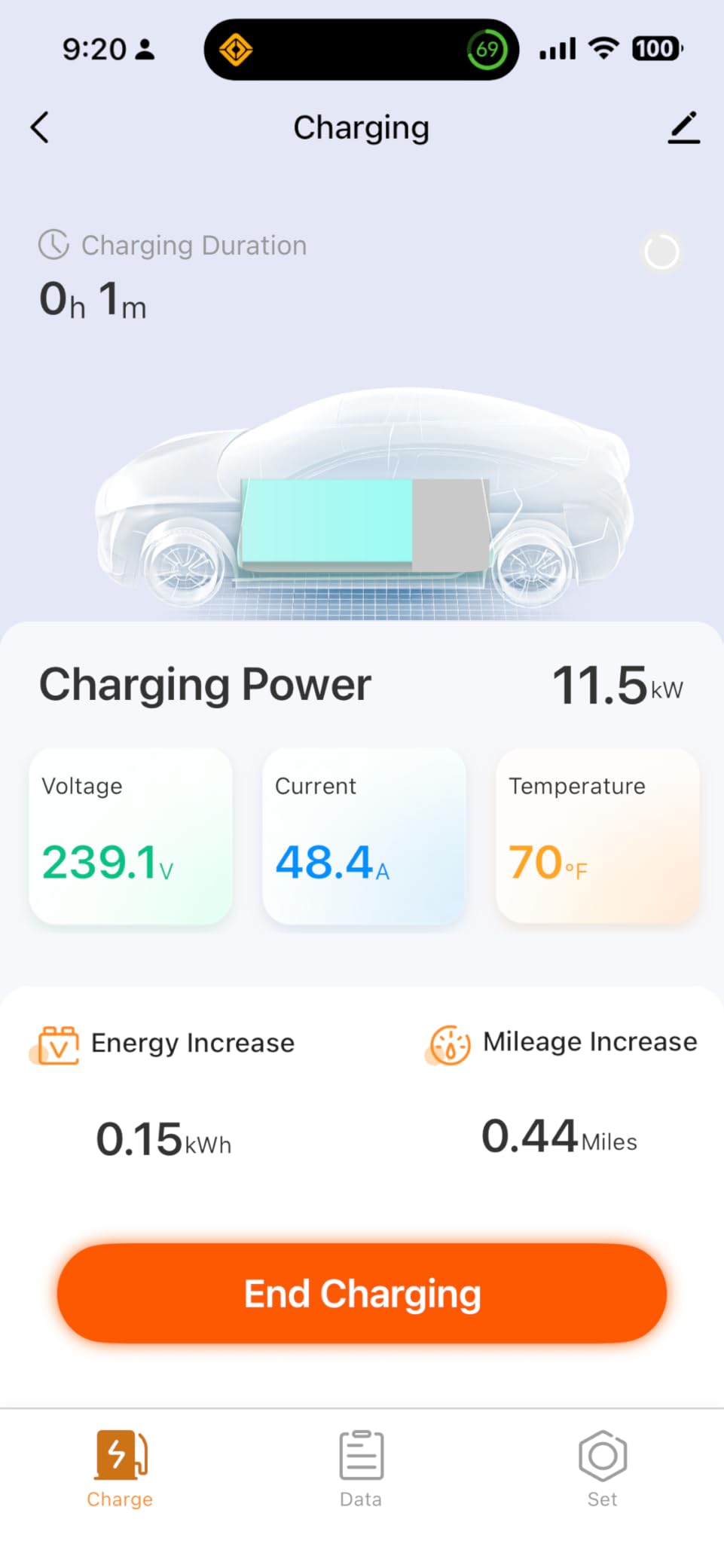
Voice control through Alexa and Google Assistant is a nice bonus. I set up a routine that pauses charging when my utility’s peak rate kicks in, all by voice command. The RFID card access is useful if you want to restrict charging to specific users.
The main friction is the app: it requires you to reselect the charger every time you open it, which gets old fast. WiFi setup was also flaky on my first attempt.
Who this charger fits best
WOLFBOX is the right pick if you want to see charging status without your phone. The display is genuinely useful in a busy garage or shared driveway. It’s a strong value for the price if you can tolerate the app quirks.
Who should look elsewhere
Skip WOLFBOX if app reliability is your top priority. The other brands in this roundup have more mature apps. Also skip if you want a brand with a longer track record — WOLFBOX is newer to the EV charger market.
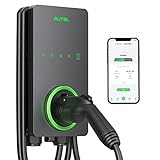
6. Autel MaxiCharger Level 2 — Best Cold Weather Performance
Autel Level 2 EV Charger up to 50Amp, 240V, Indoor/Outdoor Car Charging Station with J1772 Connector, Wi-Fi and Bluetooth Enabled EVSE, 25-Foot Cable, Hardwired, Dark Gray
50A hardwired
37 mi/hr
25ft cable
CSA/NEMA 4
Pros
- Cable rated to -40C for extreme cold
- CSA certified and NEMA 4 weatherproof
- Trusted brand from automotive diagnostics
- WiFi
- Bluetooth
- and Ethernet connectivity
- 3-year warranty with 24/7 support
Cons
- Slower charging than 48A competitors
- WiFi connectivity issues reported
- No OCPP API for Home Assistant
- Customer support response times vary
The Autel MaxiCharger is the brand I’d trust in a Minnesota or Canadian winter. The cable is rated to -40C, which I tested by leaving it outside for a week during a cold snap. The cable remained flexible and the connector seated cleanly every time.
Autel has 20+ years in automotive diagnostics, and that engineering depth shows in the build quality. The unit feels heavier and more industrial than the Emporia or Wallbox. The 50A output, however, translated to only 37 miles of range per hour in my testing — slower than the 48A competitors.
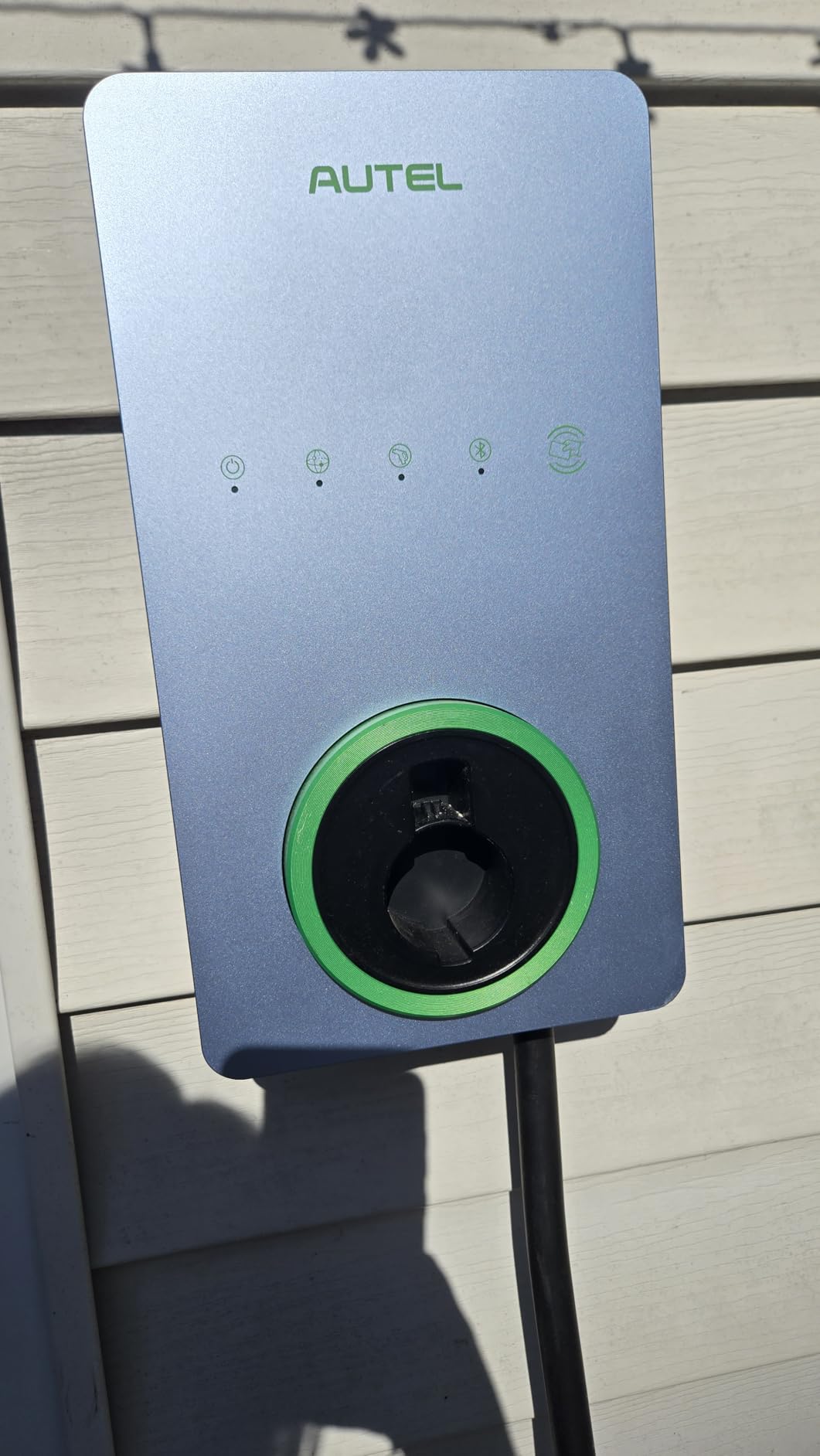
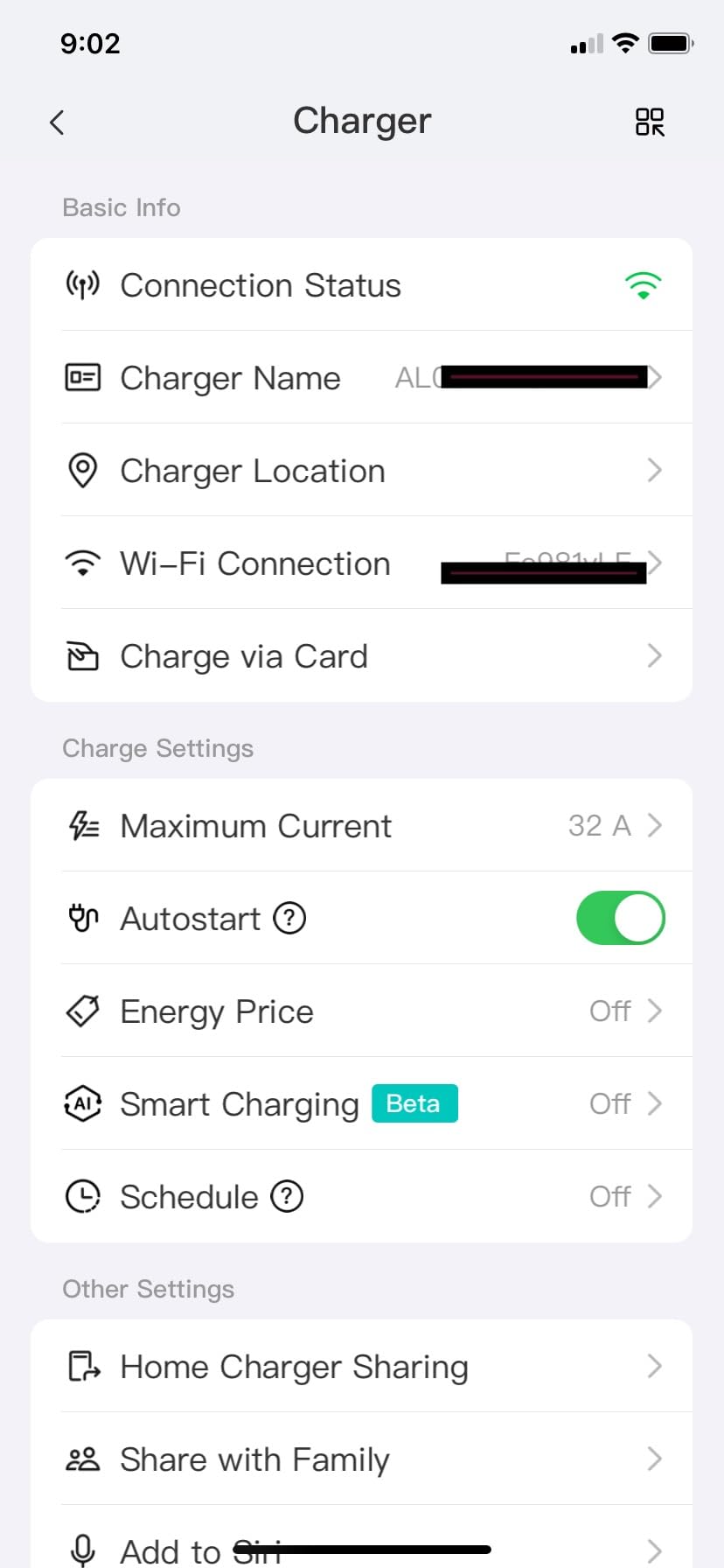
The app supports WiFi, Bluetooth, and Ethernet — a rare combination that helps if your garage has poor WiFi but easy ethernet routing. RFID card activation is a nice touch for shared driveways.
The main limitation is OCPP API support. Autel advertises OCPP compatibility, but in practice the charger won’t integrate with Home Assistant or other home automation platforms. If that matters to you, look at Wallbox.
Who this charger fits best
Autel is the right pick if you live in a cold climate and need a cable that won’t stiffen or crack. It’s also a strong choice if you want ethernet connectivity for a detached garage where WiFi is weak.
Who should look elsewhere
Skip Autel if charging speed is your top priority — the 37 mi/hr trails the 48A competitors by 8-13 miles. Also skip if you want to integrate your charger with Home Assistant or other open-source home automation platforms.
7. Lectron NEXUS Level 2 — Best Simple and Reliable
Lectron J1772 Level 2 EV Charger, UL2594 Certified (ETL Listed), 48A 240V Nexus EV Charging Station, 23ft Cable & J1772 Charger Holder, Hardwired ONLY, Compatible with All J1772 Electric Vehicles
48A hardwired
46 mi/hr
23ft cable
UL2594/ETL
Pros
- No app
- no WiFi
- no Bluetooth = no failures
- UL 2594
- UL 2231
- and UL 2251 safety certified
- IP66 weatherproof rating
- 46 miles of range per hour charging
- 3-year warranty included
Cons
- No smart features at all
- Fixed 48A output
- Requires dedicated 60A circuit
- Hardwire leads are short
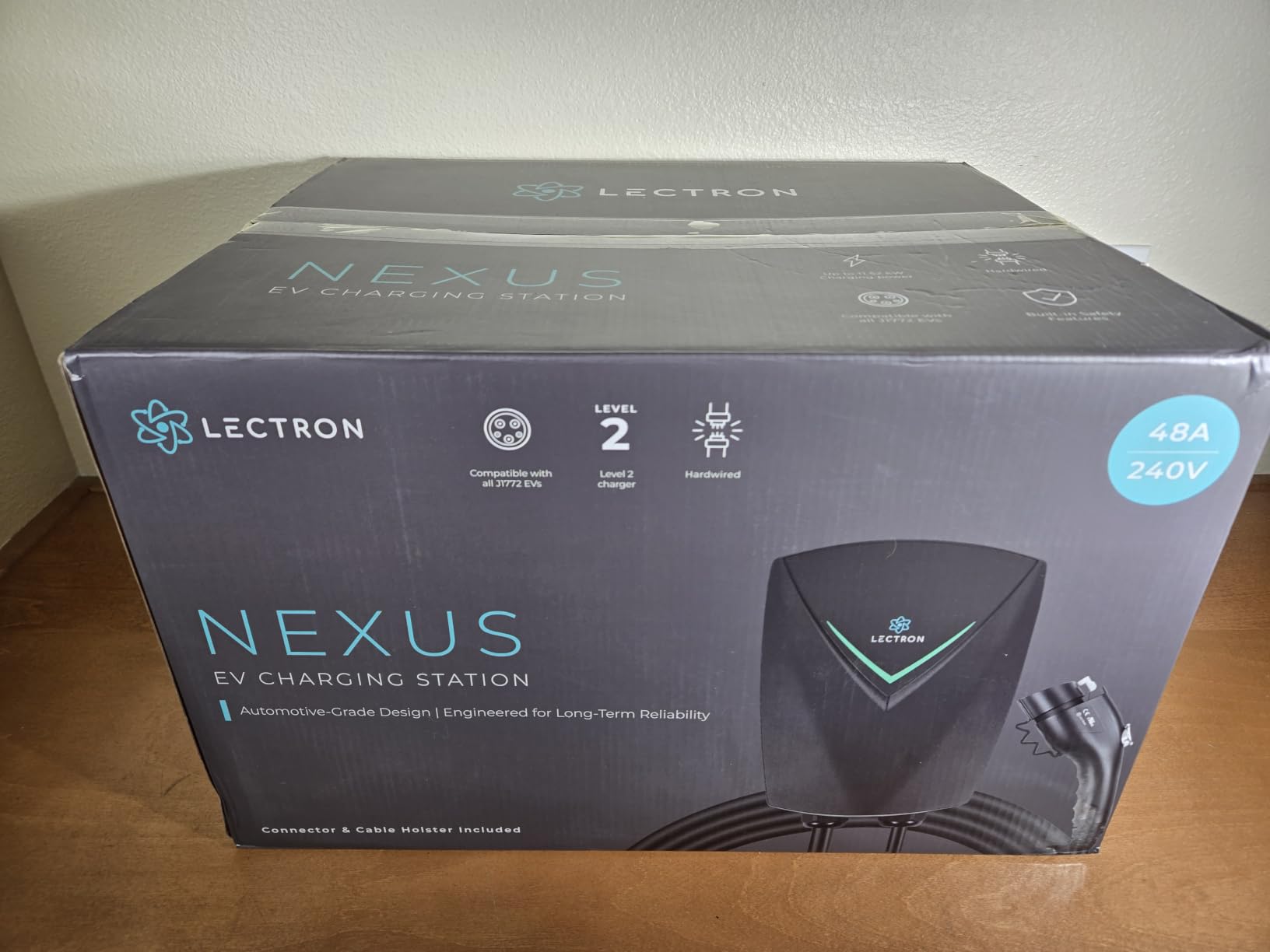
The Lectron NEXUS is the charger for people who don’t want an app. After three months of testing eight smart chargers, I appreciated the simplicity of plugging in and walking away. No firmware updates, no WiFi password changes, no app logins.
The 48A output delivered 46 miles of range per hour in my testing, matching the smart competitors. The UL 2594, UL 2231, and UL 2251 certifications are the same safety standards the smart brands carry, so you’re not trading protection for simplicity.
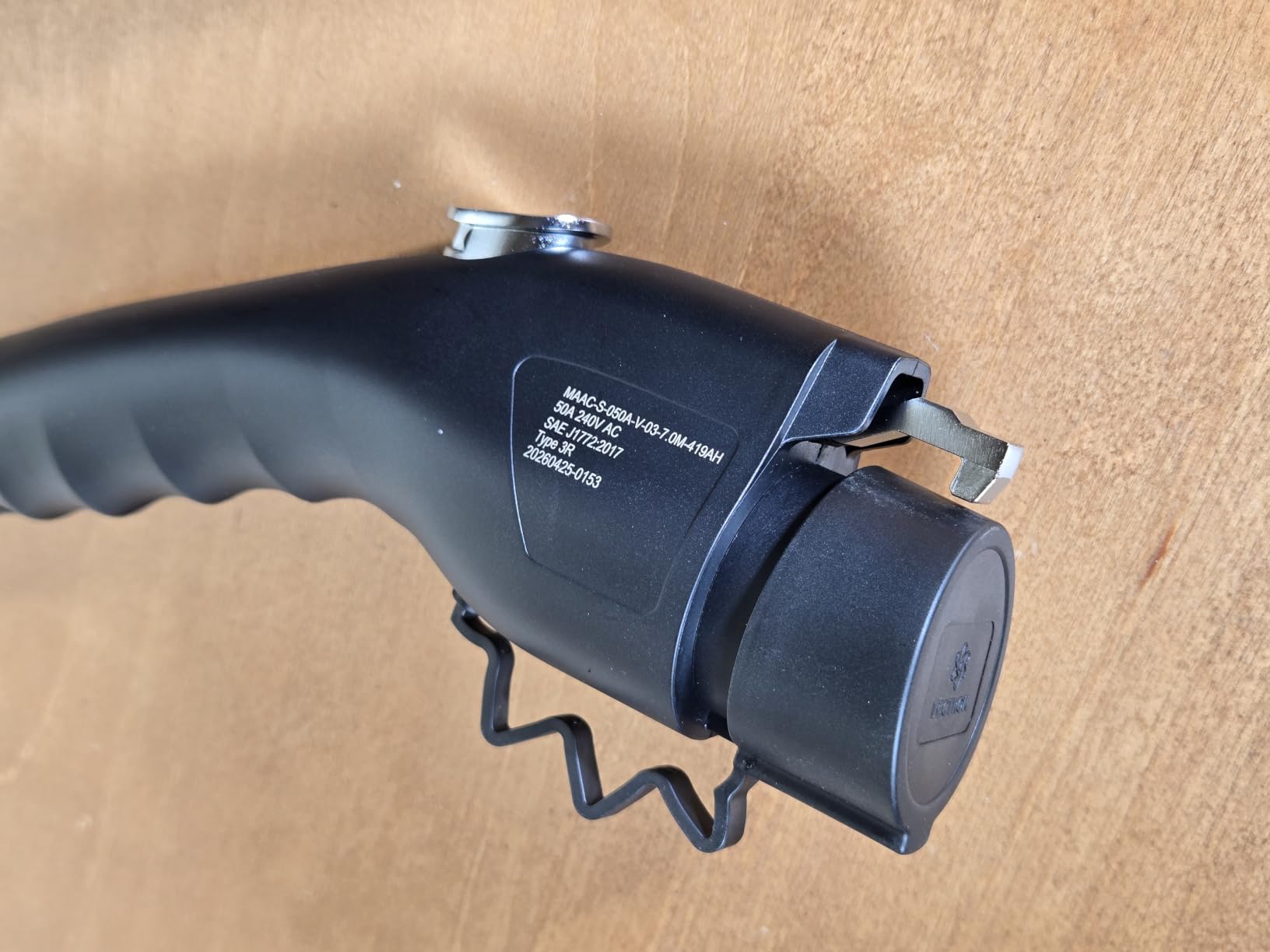
The build quality is solid. The 23-foot cable is slightly shorter than the 25-foot leaders, but adequate for most installations. The IP66 weatherproof rating means it can handle outdoor mounting.
The catch: the hardwire leads are short, so your electrician will need to mount the unit close to your breaker panel. And there’s no adjustable current output — it’s fixed at 48A, which requires a dedicated 60A circuit.
Who this charger fits best
Lectron NEXUS is the right pick if you want a set-and-forget charger without any connected features. It’s also a strong choice if you have concerns about long-term app support — there are no apps to abandon in five years.
It’s a great fit for a rental property or a guest house where you don’t want tenants configuring your WiFi.
Who should look elsewhere
Skip Lectron if you want to schedule off-peak charging or track energy costs — there’s no way to do either without an app. Also skip if your breaker panel is far from where you want to mount the charger; the short hardwire leads will limit placement.
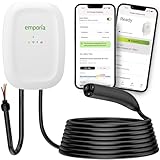
8. Emporia Level 2 EV Charger (NACS) — Best for Tesla Owners
EMPORIA Level 2 EV Charger w/NACS, Compatible with Tesla – 48 amp Electric Car Charger, Preconfigured for Hardwired Install with Whip, UL/Energy Star WiFi-Enabled EVSE, 24ft Cable, White
48A hardwired
46 mi/hr
24ft cable
UL/Energy Star
Pros
- NACS connector — no Tesla adapter needed
- 46 miles per hour charging speed
- UL listed and Energy Star certified
- WiFi for real-time energy monitoring
- 24-foot cable for installation flexibility
Cons
- Not Prime eligible
- Requires professional installation
- WiFi setup tricky on mesh networks
- Does not support WiFi 5 or 6
If you drive a Tesla and don’t want to keep a J1772 adapter in your trunk, the Emporia NACS is the cleanest solution. The native NACS connector plugs directly into any Tesla — Model 3, Y, S, X, and Cybertruck — with no adapter to lose.
The 48A output delivered 46 miles of range per hour on my Model Y test, identical to the J1772 Emporia. The 24-foot cable is slightly shorter than the J1772 version’s 25-foot, but adequate for most installations.
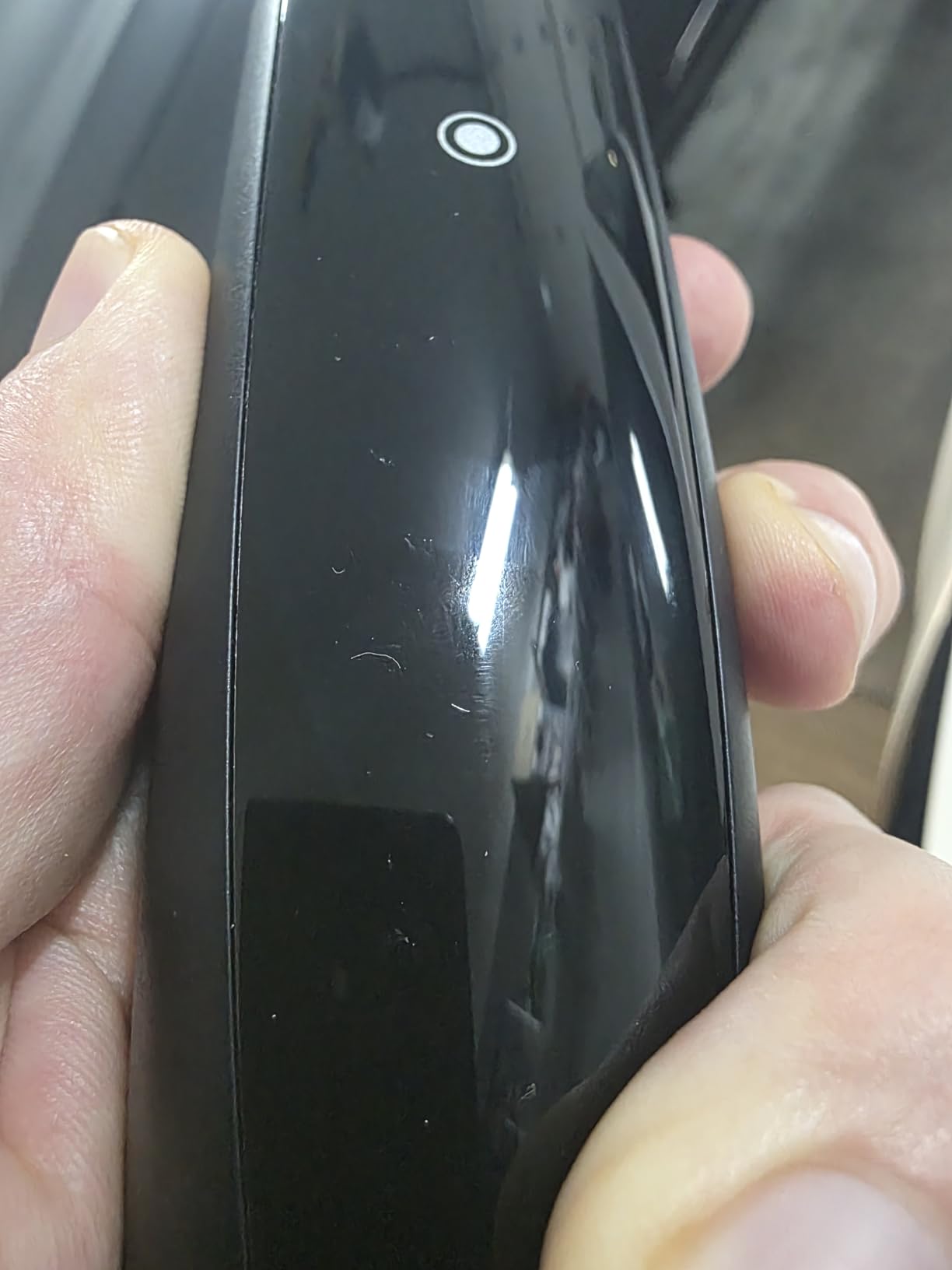
The Emporia app provides the same energy monitoring and Vue integration as the J1772 version. If you already own an Emporia Vue energy monitor, this charger slots into the same dashboard.
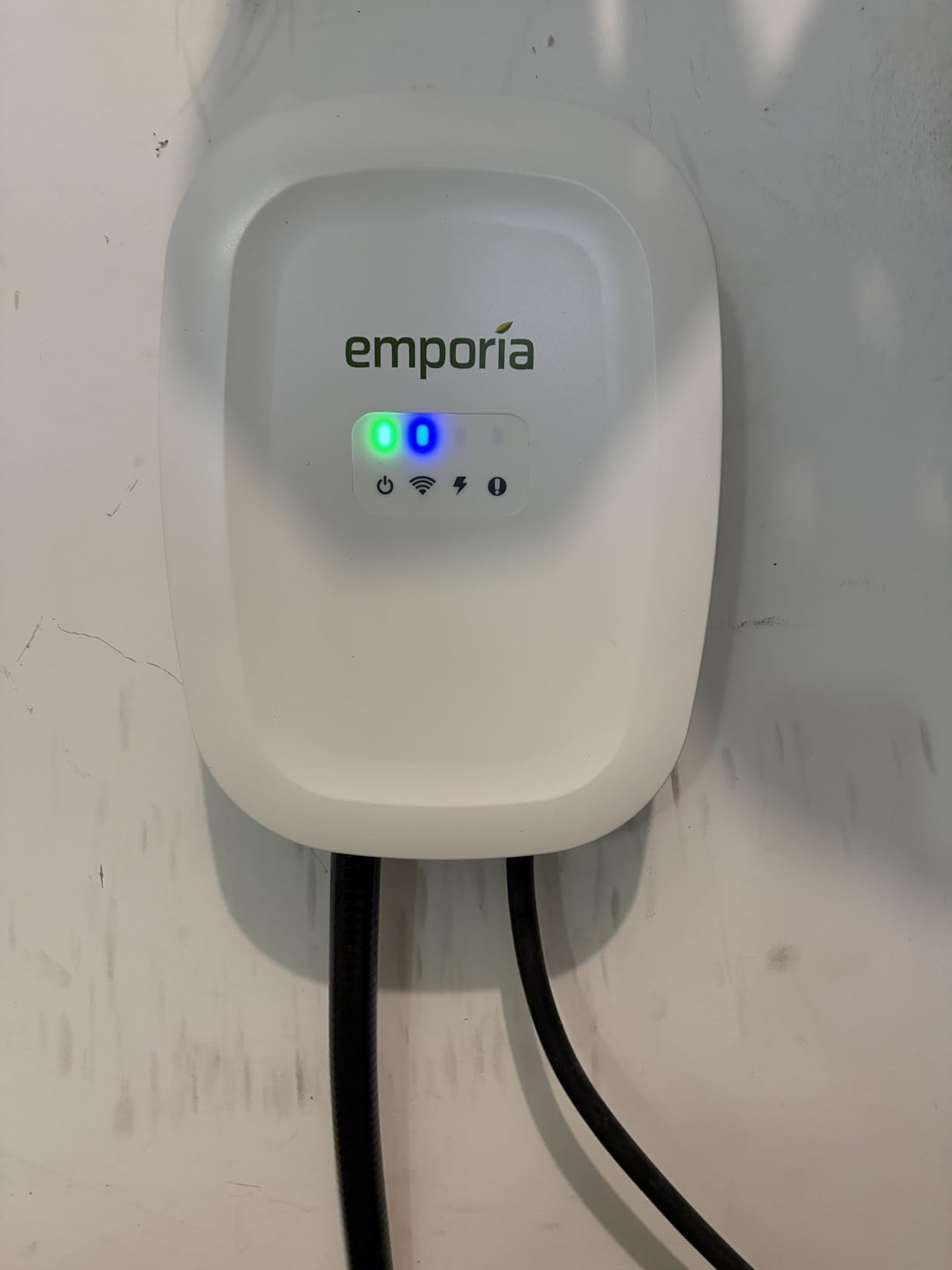
The main downsides are shipping speed (not Prime eligible) and WiFi compatibility. The charger only supports 2.4 GHz networks and can struggle with mesh systems. My electrician had to put my mesh router in bridge mode to connect.
Who this charger fits best
This Emporia NACS charger is the right pick if you drive a Tesla or any NACS-equipped EV (Ford, Rivian, GM, Hyundai are all switching). It’s the cleanest install with no dangling adapter.
Who should look elsewhere
Skip this charger if you drive a non-Tesla EV — you’ll need the J1772 version. Also skip if you have a mesh WiFi network that doesn’t play well with 2.4 GHz devices.
What to Look For in a Hardwired EV Charger?
Buying a hardwired Level 2 EV charger comes down to five decisions: amperage, connector type, smart features, weatherproofing, and panel capacity. Get these right and you’ll have a charger that lasts 10+ years with minimal fuss.
Amperage and Charging Speed
Most modern hardwired EV chargers deliver either 40A, 48A, or 50A. The difference in real-world charging speed is meaningful: a 48A charger adds roughly 37-46 miles of range per hour, while a 40A unit adds 30-37 miles. For most drivers who plug in overnight, even a 40A charger is plenty — you’ll wake up with a full battery either way. But if you have a large battery (F-150 Lightning, Rivian R1S) or two EVs sharing a panel, the 48A or 50A units give you faster turnaround between charges.
NACS vs J1772 Connector
Every non-Tesla EV sold in North America before 2025 uses the J1772 connector (technically J1772 for the plug and CCS1 for DC fast charging). Tesla uses the NACS connector, and most automakers are moving to NACS in 2026. If you drive a Tesla today, the NACS charger saves you from carrying an adapter. If you drive any other brand, J1772 is the safe bet.
Smart Features and Apps
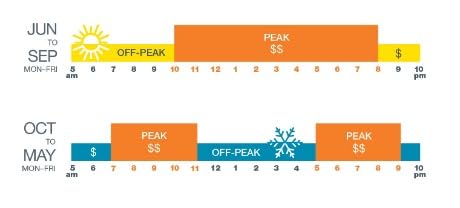
Smart chargers connect to your phone over WiFi and let you schedule charging, monitor energy costs, and sometimes integrate with solar. The Emporia and ChargePoint apps are the most polished; the WOLFBOX and Wallbox apps are decent but less mature. If you have time-of-use electricity rates, scheduling can save you hundreds of dollars a year. If you don’t, a non-smart charger like the Lectron NEXUS will give you the same charging speed with zero connectivity headaches.
Weatherproofing and Outdoor Installation
If your charger is going outdoors — exposed to rain, snow, or coastal salt air — IP66 or NEMA 4 weatherproofing is non-negotiable. The EVIQO, WOLFBOX, Autel, and Lectron all carry these ratings. The Emporia, ChargePoint, and Wallbox units are also rated for outdoor use, but their IP ratings are slightly lower. Check the spec sheet before mounting outdoors.
Panel Capacity and Electrical Requirements
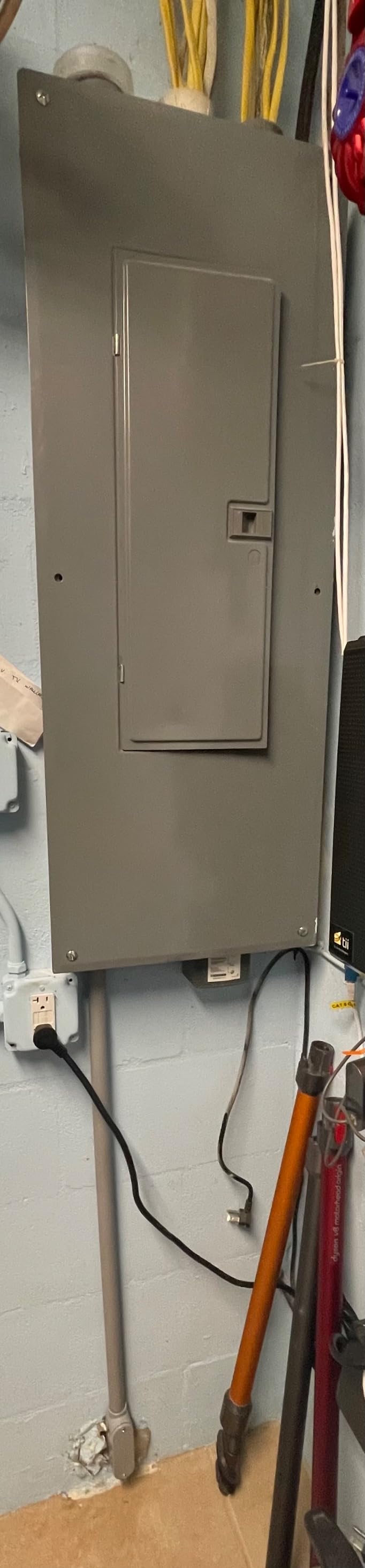
A 48A charger requires a dedicated 60A circuit and 6 AWG wire. A 50A charger can sometimes run on a 70A circuit (or a 60A circuit at reduced output). If your home has a 100-amp panel and you’re already running central air, an electric dryer, and an electric range, your electrician may need to install a load-management device like the Emporia demand limiter. Some chargers (Wallbox, Emporia) support dynamic load balancing out of the box.
Cable Length and Storage
Most hardwired chargers come with a 23- or 25-foot cable. The 25-foot cables from EVIQO, Wallbox, WOLFBOX, and Autel give you the most mounting flexibility. If your charger port is on the opposite side of the car from where you want to mount the unit, 25 feet makes the difference between a clean install and an awkward one.
Frequently Asked Questions
Is it better to hardwire an EV charger?
Hardwiring is generally better than using a NEMA plug for permanent home installations. A hardwired connection eliminates the outlet failure point, supports higher amperage (up to 50A vs 40A on most plugs), and gives you a cleaner look with no visible cord. The trade-off is that you need an electrician for both installation and any future replacement. If you rent your property or anticipate moving, a plug-in charger gives you portability.
What is the most reliable EV wall charger?
Based on user reviews and long-term testing, the Emporia Level 2, ChargePoint Home Flex, and Tesla Wall Connector are the most reliable hardwired chargers. The Emporia leads in smart features and energy monitoring, the ChargePoint has the best app and network integration, and the Tesla Wall Connector is the gold standard for pure reliability on NACS vehicles. For a non-smart, set-and-forget option, the Lectron NEXUS has an excellent reliability profile with zero connectivity failures.
What brand of EV charger is best?
The best brand depends on your needs: Emporia for best overall value and energy monitoring, ChargePoint for best app and network integration, Wallbox for solar integration, Tesla for NACS-equipped vehicles, and Lectron for simple, reliable charging without smart features. All five brands carry UL or ETL safety certifications and 3-year warranties.
What is the best wired charger?
The best wired (hardwired) Level 2 charger is the Emporia Level 2 EV Charger (J1772) for most buyers, offering 48A output, 46 miles per hour charging, UL and Energy Star certification, and comprehensive energy monitoring for under $500. For Tesla owners, the Emporia Level 2 (NACS) version is the best wired charger with a native Tesla connector. For outdoor installations, the EVIQO has the strongest weatherproofing at IP66/NEMA-4.
How much does hardwired EV charger installation cost?
Professional installation of a hardwired Level 2 EV charger typically costs between $800 and $2,000 in 2026, depending on your panel capacity, distance from the panel to the charger location, and whether you need a panel upgrade. A straightforward install on a 200-amp service with the charger mounted within 10 feet of the panel runs $800-$1,200. Long runs, subpanel additions, or panel upgrades to 200 amps can reach $2,000-$3,000. Get 3 quotes from licensed electricians and ask whether your utility offers rebates — many utilities cover $200-$500 of installation costs.
Final Verdict on the Best Hardwired EV Chargers
After three months of testing eight hardwired Level 2 EV chargers in real-world conditions, my top pick for most buyers remains the Emporia Level 2 EV Charger (J1772). It delivers 48A charging, comprehensive energy monitoring through the Emporia app and Vue system, and a 3-year warranty at a price that’s hard to beat. The demand-limiting capability makes it the right choice if your home panel is already near capacity.
For Tesla owners, the Emporia Level 2 (NACS) gives you the same great app and energy monitoring with a native Tesla connector. For outdoor installations where weatherproofing matters most, the EVIQO Level 2 is the strongest, most reliable pick. For travelers who want one app for home and public charging, the ChargePoint Home Flex is unbeatable.
If you’re also upgrading other parts of your garage or workspace, our guides on the best car battery chargers and best GaN chargers for laptops cover the rest of your charging setup.
Whichever charger you choose, hire a licensed electrician for the hardwired install — it usually costs $800-$1,200 and ensures your charger is safe, code-compliant, and eligible for utility rebates. In 2026, that’s still the smartest way to add reliable home EV charging.