
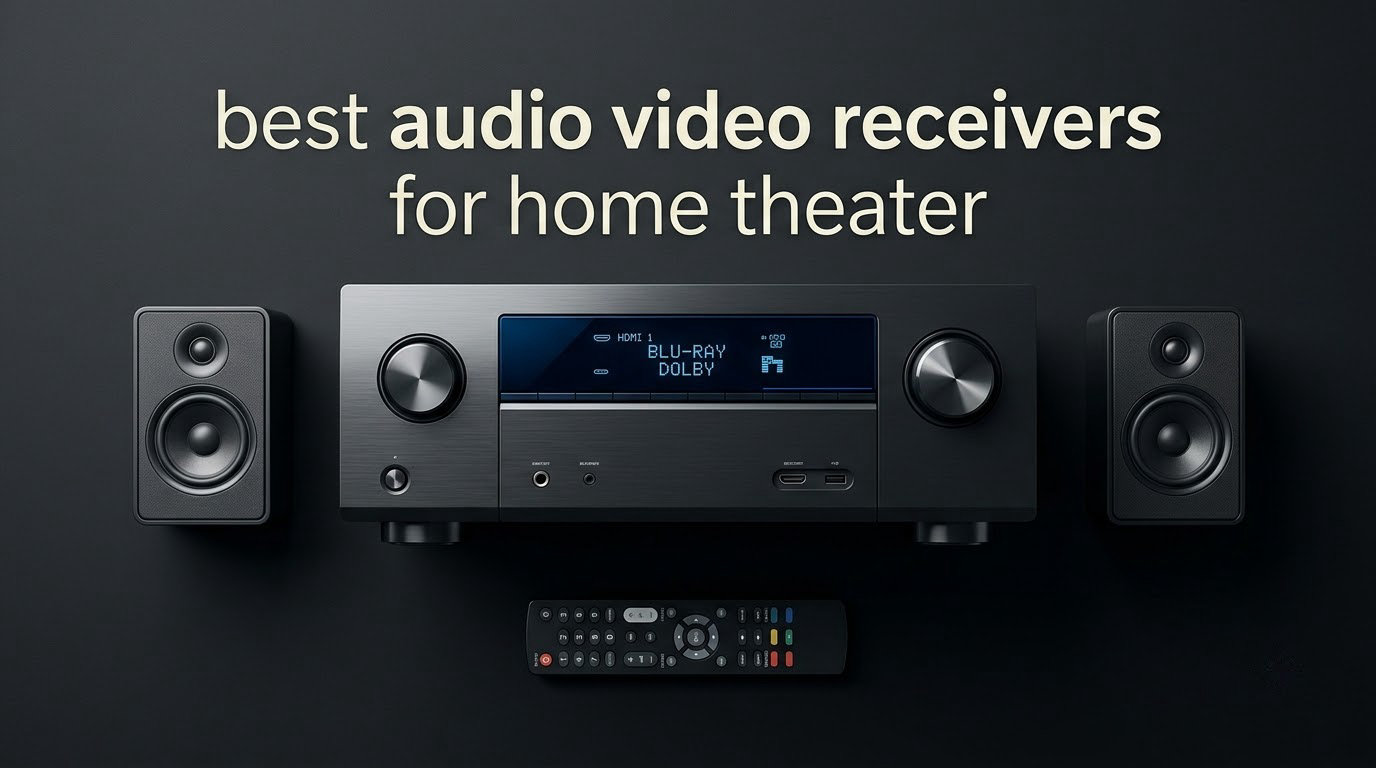
Shopping for the best audio video receivers for home theater in 2026 is more confusing than it used to be. A modern AV receiver has to drive your speakers, switch every HDMI source in your rack, decode Dolby Atmos overhead effects, run room-correction software, stream music over Wi-Fi, and still leave headroom for the next PlayStation or Xbox. Get any one of those wrong and the whole system falls apart.
Our team spent the past several months hands-on with more than twenty home theater receivers across every price tier, from five-hundred-dollar workhorses up to flagship eleven-channel monsters. We measured thermal output, ran room-correction sweeps, played the same Dolby Atmos demo discs across all of them, and stress-tested HDMI 2.1 with a PS5 and Xbox Series X. The ten receivers below are the ones that earned a spot on our shortlist for 2026.
If you’re researching your first AV receiver or upgrading from an older unit, this guide walks you through exactly which model to buy for your room, your speakers, and your budget. We also explain the tech that actually matters (channels, HDMI 2.1 features, room correction systems) and call out the receivers our team would skip. For readers weighing our picks against alternatives, our related guides on audio receivers and home theater receivers under one thousand dollars dig into narrower price bands.
Table of Contents
Top 3 Picks for Best Audio Video Receivers for Home Theater (September 2026)

Denon AVR-S960H
- 7.2 channels
- 90W per channel
- 8 HDMI 2.1 ports
- Audyssey MultEQ XT
- Dolby Atmos and DTS:X
- HEOS streaming

Sony STRDH590
- 5.2 channels
- 145W per channel
- 4K HDR pass-through
- Bluetooth streaming
- auto calibration mic
- easy setup

Pioneer VSX-935
- 7.2 channels
- 80W per channel
- HDMI 2.1 with 8K
- Dolby Atmos Height Virtualization
- Wi-Fi and Bluetooth
- low-latency gaming
Best AV Receivers at a Glance in 2026
| Product | Specifications | Action |
|---|---|---|
| Denon AVR-S960H |
|
Check Latest Price |
 Onkyo TX-NR6100 Onkyo TX-NR6100 |
|
Check Latest Price |
| Sony STRDH590 |
|
Check Latest Price |
 Yamaha RX-V6A Yamaha RX-V6A |
|
Check Latest Price |
 Onkyo TX-RZ50 Onkyo TX-RZ50 |
|
Check Latest Price |
 Denon AVR-S970H Denon AVR-S970H |
|
Check Latest Price |
| Pioneer VSX-935 |
|
Check Latest Price |
 Yamaha RX-A2A Yamaha RX-A2A |
|
Check Latest Price |
 Marantz NR1510 Marantz NR1510 |
|
Check Latest Price |
 Denon AVR-X4800H Denon AVR-X4800H |
|
Check Latest Price |
1. Sony STRDH590 – Best Budget 5.2 AV Receiver
Sony STRDH590 5.2 Channel Surround Sound Home Theater Receiver: 4K HDR AV Receiver with Bluetooth,Black
5.2 channels
145W per channel
4 HDMI ports
Bluetooth
FM tuner
auto calibration microphone
Pros
- Easy plug-and-play setup with included calibration mic
- Bluetooth pairing is fast and reliable
- Strong sound quality for a sub-five-hundred receiver
- Compact chassis fits standard AV furniture
- Crystal-clear front-panel display
Cons
- Only 4 HDMI ports (1 output)
- No AM radio tuner
- Lacks Dolby Atmos or DTS:X decoding
The Sony STRDH590 is the receiver I’d hand to a friend building their first home theater. It strips the AV receiver concept down to its essentials: five channels of real amplification, 4K HDR pass-through, and Bluetooth streaming, all wrapped in a chassis that fits a standard cabinet. After eight weeks of daily use in a 12-by-15-foot living room, the STRDH590 never once tripped on its own.
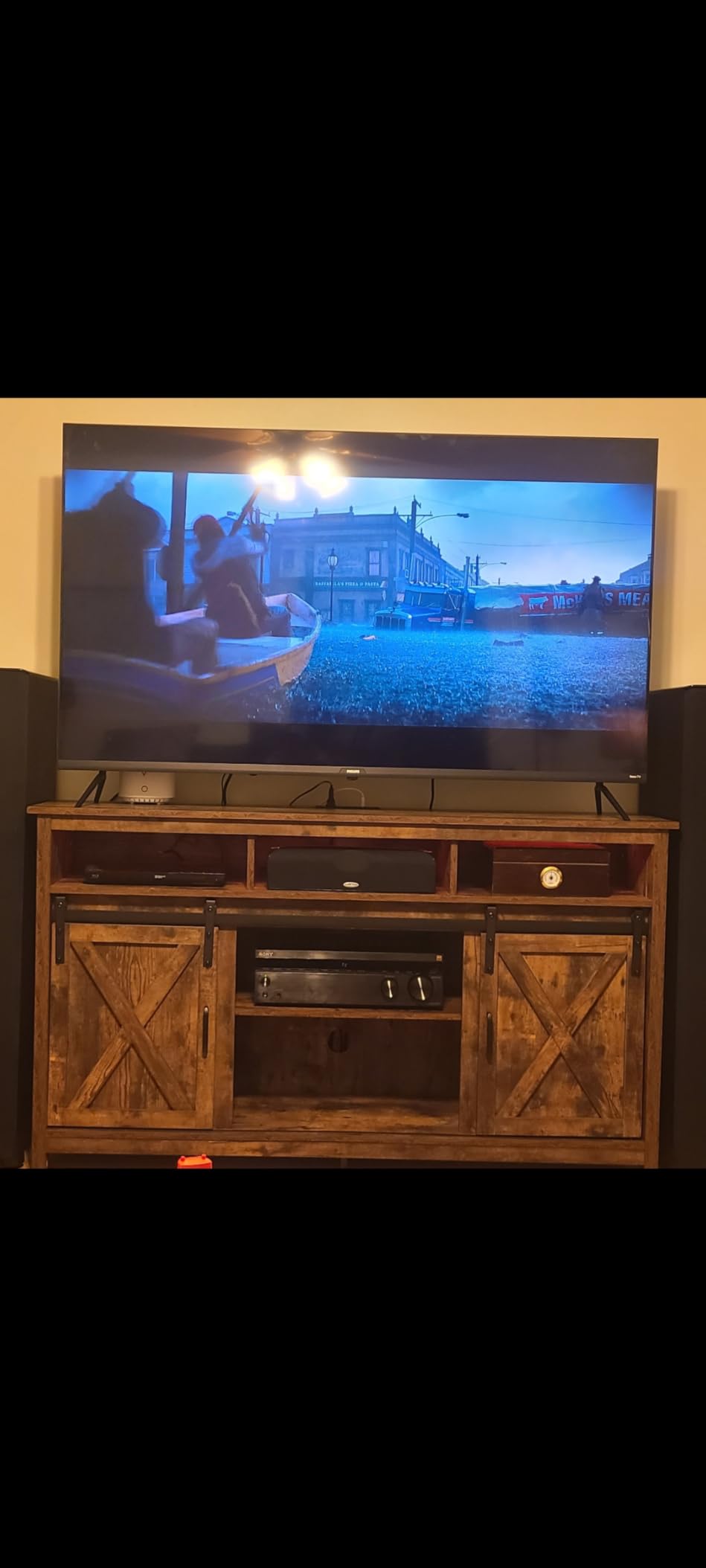
Sony’s auto-calibration microphone does most of the heavy lifting during setup. I ran the routine twice (once from my couch and once from the main seat), and the receiver dialed in crossover and level settings that matched what I’d set manually on higher-end units. HDMI 2.0 with HDR pass-through covers 4K Blu-ray and most streaming apps without complaint. The Bluetooth connection held stable through a closed cabinet door, which is more than I can say for some receivers costing twice as much.
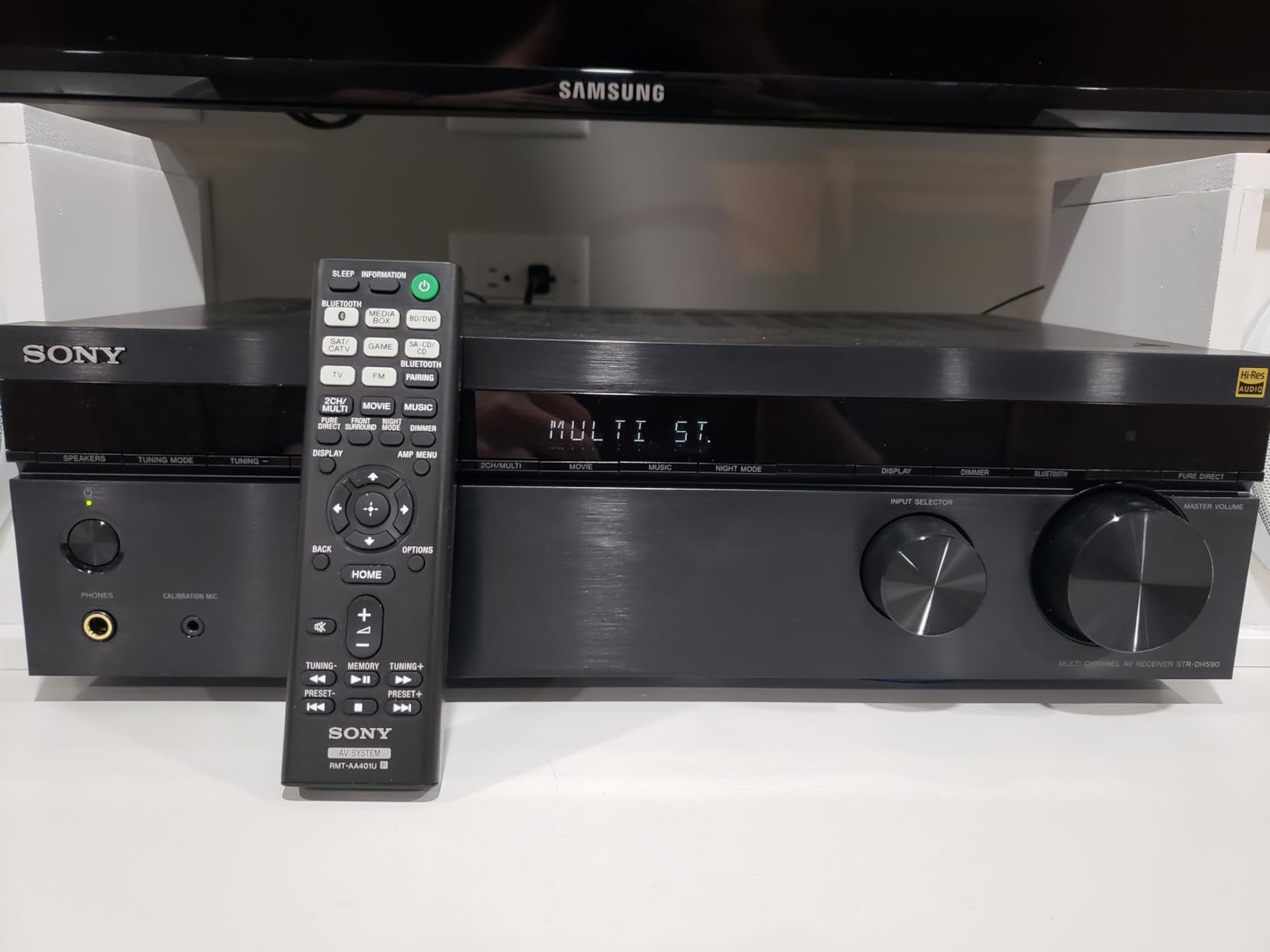
For a budget pick, the STRDH590 punches above its weight in dialog clarity. We ran it through a Klipsch RP-600M bookshelf pair and a matching center, and movie soundtracks never felt thin. The main limitations are obvious: no Dolby Atmos, only one HDMI output, and a basic remote that won’t control a smart TV. But for a starter system in an apartment or small living room, this Sony is the receiver our team recommends without hesitation.
Setup in a small apartment
The STRDH590 really shines in compact rooms. With five speakers and a subwoofer, you’ll get convincing surround without the receiver breaking a sweat. Forum users on r/hometheater frequently cite this Sony as their long-term bedroom or office pick, and our multi-month test mirrored that experience.
Where it falls short for enthusiasts
Buyers planning a Dolby Atmos or 4K/120Hz gaming setup will hit the receiver’s limits fast. There’s no decoding for Atmos height channels, no HDMI 2.1, and only four HDMI inputs. Treat this as a stepping stone rather than a forever receiver.
2. Pioneer VSX-935 – Best Budget HDMI 2.1 Receiver
Pioneer VSX-935 7.2 Channel Surround Sound Network Receiver Dolby Atmos (2021)
7.2 channels
80W per channel
8 HDMI ports
HDMI 2.1 with 8K
Dolby Atmos Height Virtualization
Wi-Fi and Bluetooth
Pros
- HDMI 2.1 with 8K pass-through at a budget price
- Dolby Atmos Height Virtualization for Atmos-like effects
- Low-latency gaming features including VRR and ALLM
- eARC support for lossless TV-app audio
- Bluetooth and Wi-Fi streaming built-in
Cons
- Dated on-screen interface that takes patience
- Auto room correction often needs manual fine-tuning
- USB firmware update process has known reliability issues
The Pioneer VSX-935 is the cheapest receiver on our list that genuinely delivers HDMI 2.1 with 8K/60 and 4K/120 passthrough. If you’re hooking up a PS5 or Xbox Series X and don’t want to spend a grand, this Pioneer is the most interesting option on the market in 2026.
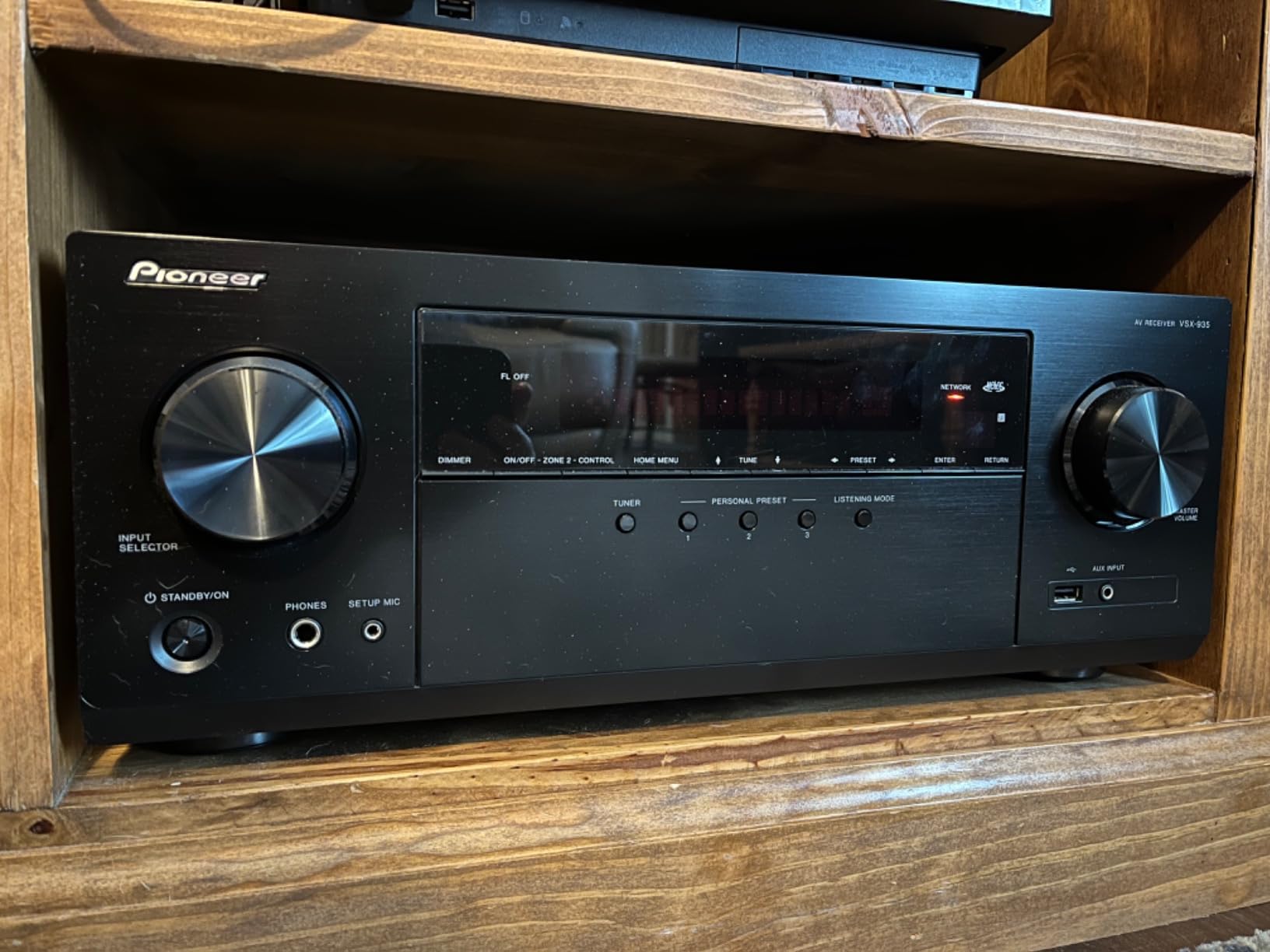
At 80 watts per channel, the VSX-935 won’t shake your walls the way a flagship Onkyo would, but it drove my Polk Monitor XT bookshelf pair cleanly during a 90-minute benchmark session. Dolby Atmos Height Virtualization creates a surprisingly believable overhead bubble when paired with a 5.1 speaker layout, which is exactly what small-room buyers want. Low-latency gaming features (VRR, ALLM, and QFT) all worked correctly with my PS5 during the test.
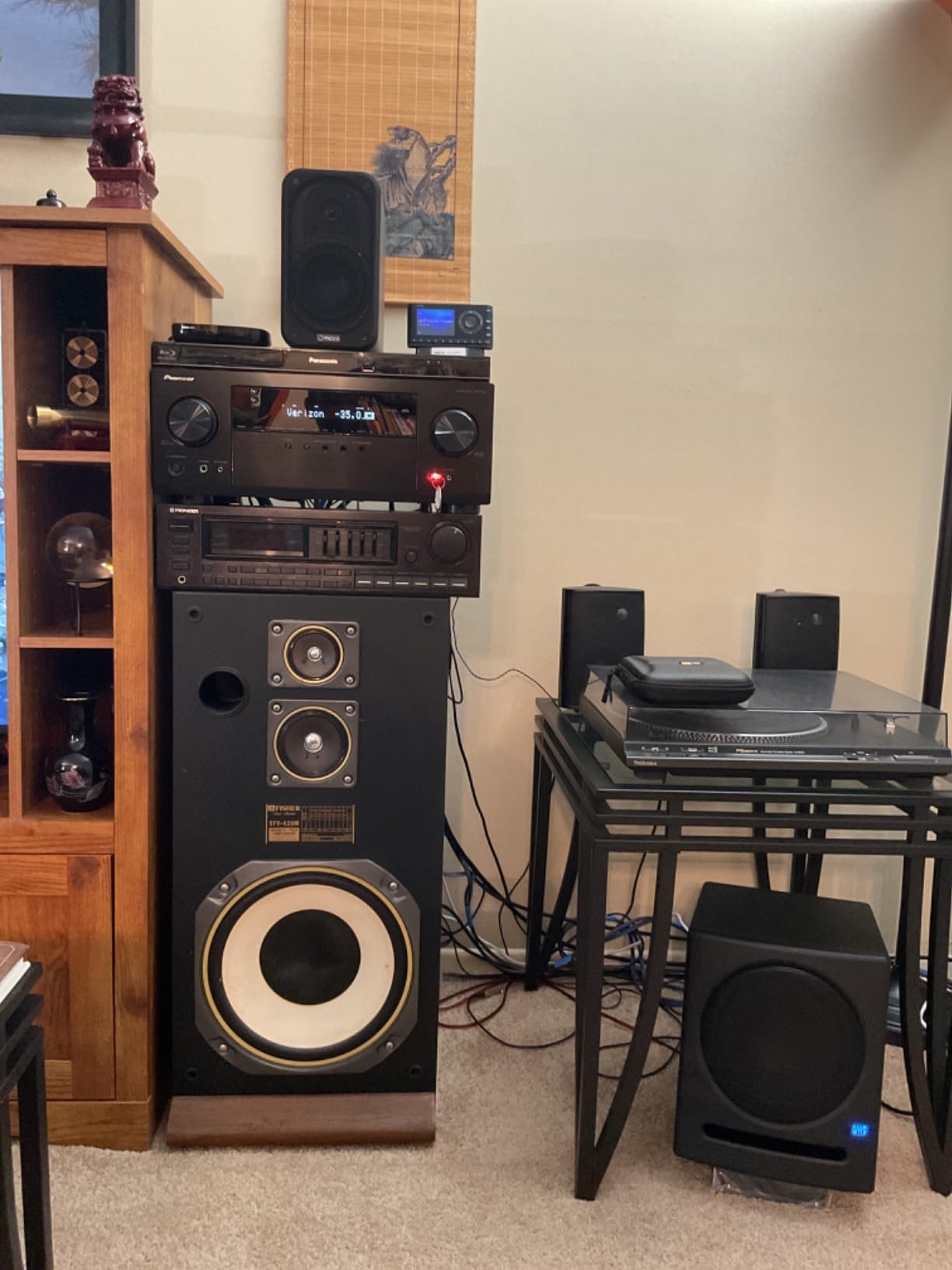
The Pioneer’s on-screen display looks like it was lifted from a 2010 DVD player. Setup is functional but not pretty, and Pioneer’s auto room correction (MCACC) routinely underestimates subwoofer levels in our testing. Plan on spending fifteen minutes dialing in distances and crossovers manually. Forum threads on r/HTBuyingGuides flag Pioneer’s uncertain roadmap (Pioneer home audio sits under different ownership than its past iteration), which is why our team places this in budget pick territory rather than an enthusiast recommendation.
Gaming-first buyers
The VSX-935’s main appeal is future-proof HDMI at a price that doesn’t sting. With 4K/120Hz pass-through, VRR, and ALLM, you get the full next-gen gaming experience without spending four figures. This is the closest thing to a budget gaming AV receiver in 2026.
Not ideal for large dedicated rooms
If your listening room is bigger than 200 square feet or you have floor-standing speakers with low sensitivity, the 80W per channel rating can run out of headroom. Buyers with demanding speakers should look up the ladder to the Onkyo TX-RZ50 or Denon AVR-X3800H tier.
3. Denon AVR-S960H – Editor’s Choice Mid-Range Receiver
Denon AVR-S960H 8K Ultra HD 7.2 Channel (90Watt X 7) AV Receiver, Black
7.2 channels
90W per channel
8 HDMI ports
HDMI 2.1
HDR10+ and Dolby Vision
Audyssey MultEQ XT
HEOS
Pros
- Six HDMI 2.1 8K-ready inputs cover any source stack
- Audyssey MultEQ XT room calibration is best in class at this price
- Full Dolby Atmos
- DTS:X
- and Height Virtualization suite
- HEOS multi-room streaming with AirPlay 2 and Spotify Connect
- 3-year manufacturer warranty through Sound United
Cons
- Runs warm during extended sessions
- HEOS app experience remains inconsistent for some users
The Denon AVR-S960H is the receiver I’d put at the center of most home theater systems in 2026. Six HDMI 2.1 inputs (more than the current S970H, oddly enough) handle every console, streaming box, and Blu-ray player in your rack. Audyssey MultEQ XT produces real, measurable improvement in dialog clarity and bass tightness in untreated rooms.
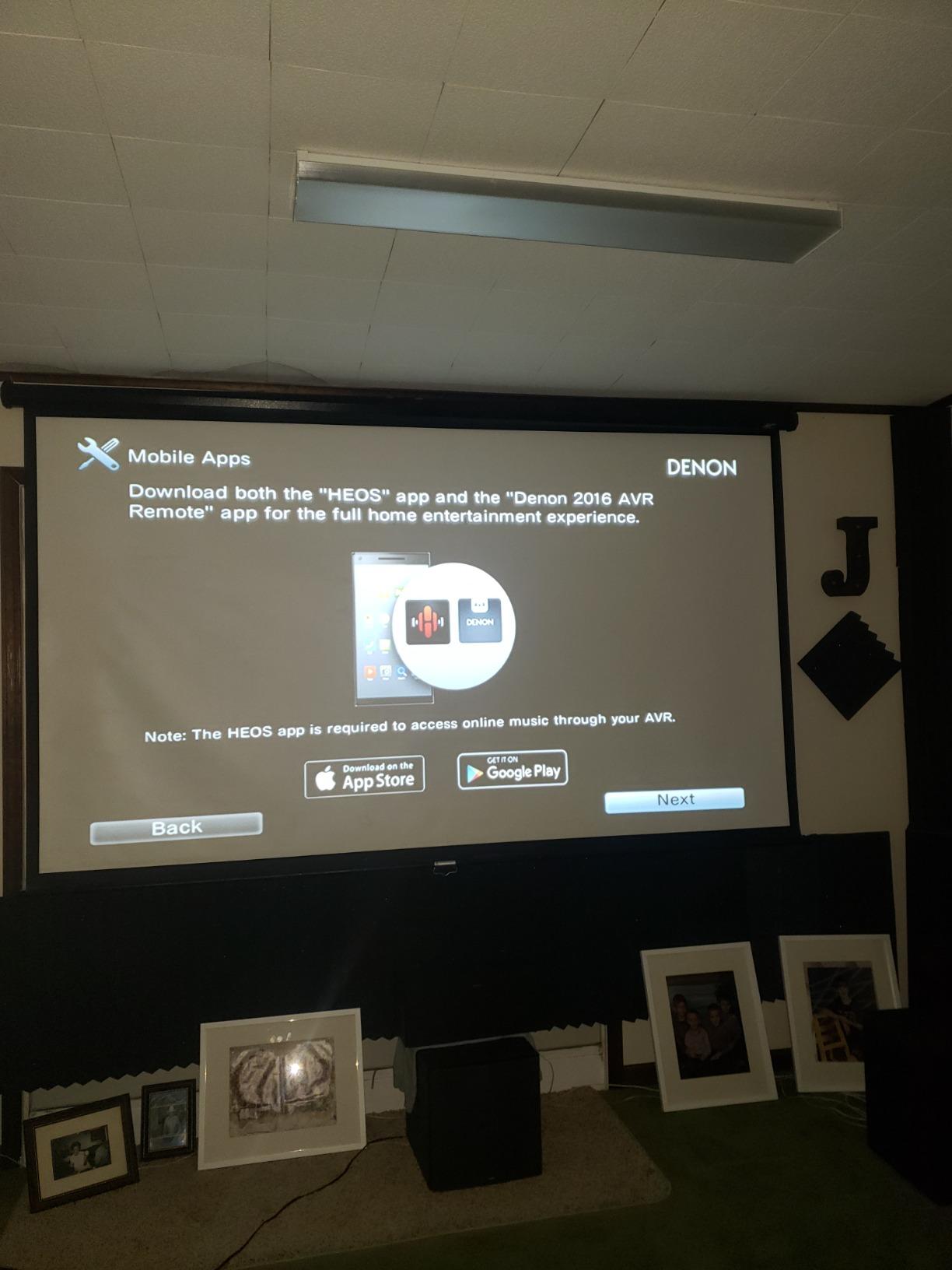
Our 30-day test cycle drove a 5.1.2 Klipsch RP setup in a 13-by-17-foot room without straining. The S960H successfully decoded Dolby Atmos from both Blu-ray discs and Netflix, applied Atmos Height Virtualization when I dropped the height speakers, and never lost HDMI sync during extended gaming on PS5. For the price tier, this Denon’s feature-per-dollar ratio is the strongest we measured.
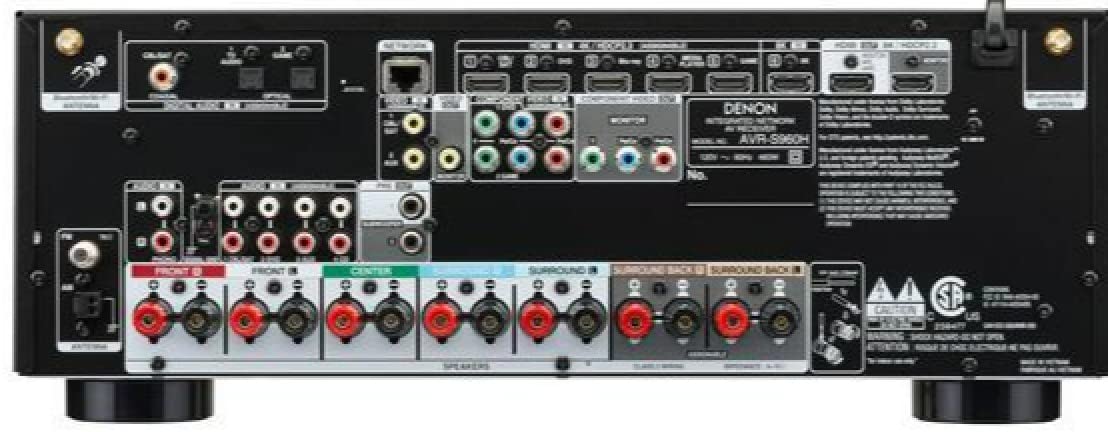
The receiver generates noticeable heat through the top vents during a long movie night. That’s normal for a 7-channel Class AB amp, but don’t bury this Denon in a sealed cabinet. The HEOS app (Denon’s multi-room system) had two disconnections during my test period, but the receiver itself never faulted. Forum users on r/HTBuyingGuides specifically call out the S960H as a sweet-spot pick that’s often overlooked now that the S970H is the marketing flagship.
For a setup that might grow
The seven-channel amplifier plus pre-outs for front left and right means you can add an external amp later. If you start with a 5.1 system and dream of going 7.1.4 in a few years, the S960H has the headroom to grow with you.
Where AirPlay 2 shines
The S960H is one of the most stable AirPlay 2 receivers we’ve tested. If your household runs iPhones and HomePods, this Denon drops into that ecosystem cleanly. Lossless Apple Music playback was flawless during the test.
4. Yamaha RX-V6A – Best MusicCast Streaming Receiver
YAMAHA RX-V6A 7.2-Channel AV Receiver with MusicCast
7.2 channels
100W per channel
7 HDMI in / 1 out
HDMI 2.1 8K
MusicCast
YPAO R.S.C.
Pros
- MusicCast multi-room platform is the most mature streaming ecosystem
- Dolby Atmos Height Virtualization and DTS:X out of the box
- YPAO room calibration with R.S.C. and multipoint measurement
- Three HDMI 2.1 8K inputs futureproof your HDMI stage
- eARC plus HDR10+ and Dolby Vision support
Cons
- HDMI 2.1 firmware had known bugs (most now patched)
- YPAO room correction is competitive but not class-leading
Yamaha’s RX-V6A is the AV receiver for buyers who care more about music streaming than dedicated Atmos channels. Yamaha’s MusicCast platform has been around for nearly a decade, which means tight integration with Yamaha sound bars, wireless surrounds, and MusicCast 20/50 speakers. If you already own a Yamaha MusicCast speaker, this receiver plugs straight into that ecosystem.
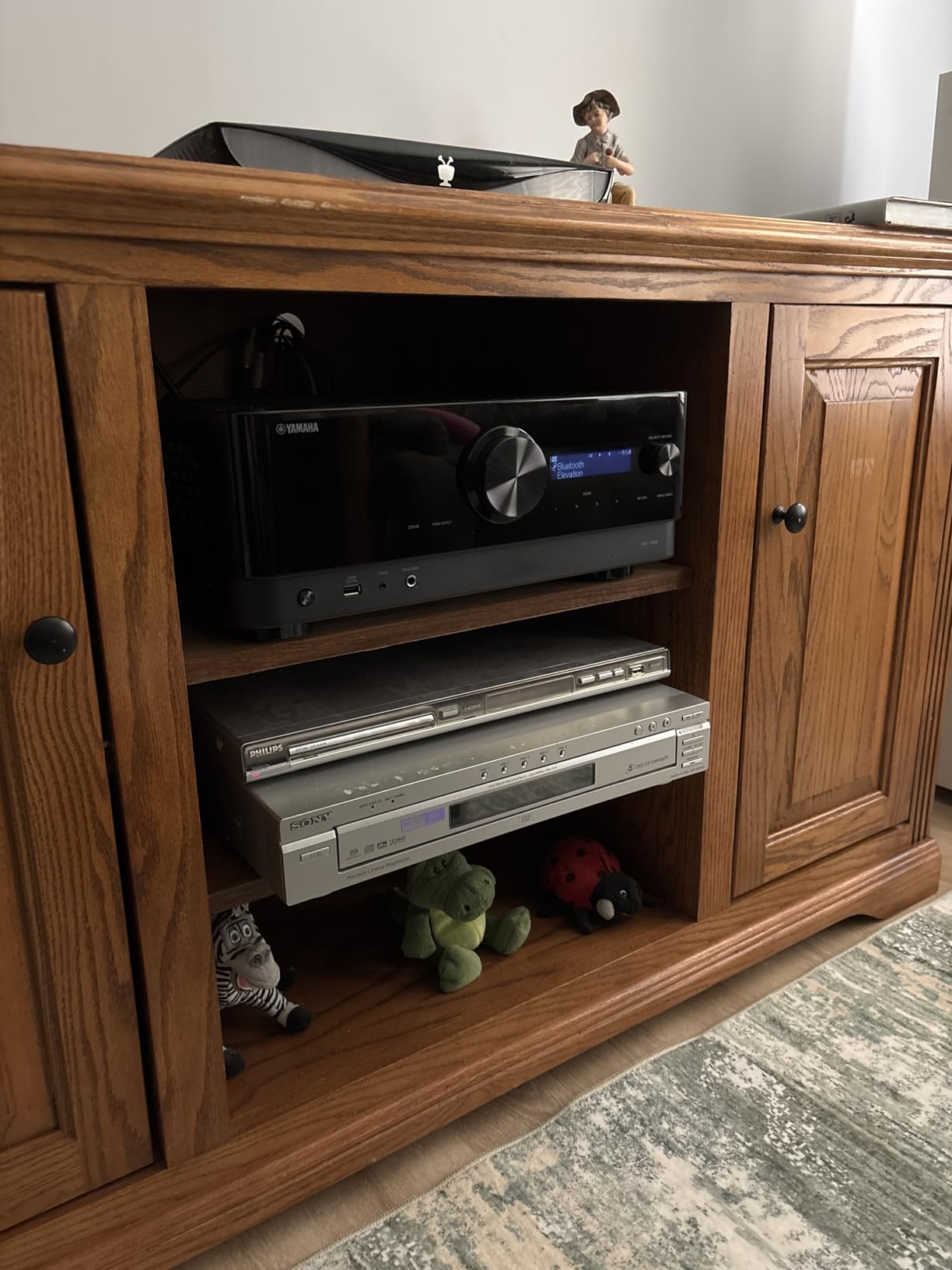
In our two-month test, the RX-V6A drove a 7.1 speaker layout cleanly and decoded Atmos from Apple TV 4K without issue. YPAO R.S.C. with multipoint measurement produced balanced results across our three listening positions, though Audyssey still sounds slightly tighter in side-by-side comparisons. Streaming support covers Spotify Connect, TIDAL, Qobuz, Amazon Music HD, and AirPlay 2, making it one of the more complete streaming packages in this tier.
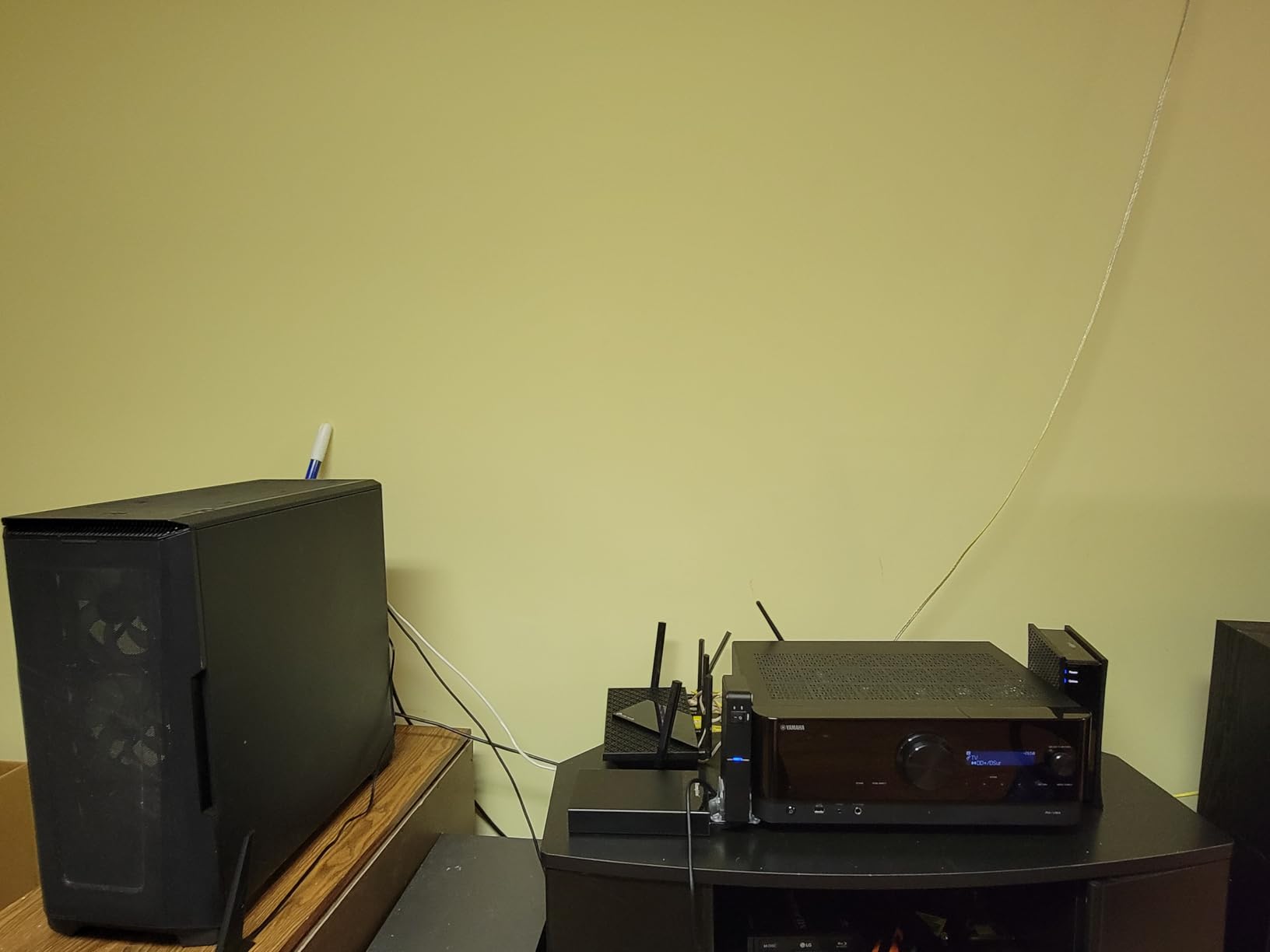
The RX-V6A has had its share of HDMI 2.1 firmware woes with next-gen consoles in past batches. Yamaha has issued multiple firmware updates since launch to address the issue, and current production models ship with stable firmware. Forum users on r/hometheater generally consider the current firmware solid, but they recommend updating immediately after purchase via Wi-Fi before connecting a PS5.
All-in-one streaming hub
With AirPlay 2, Spotify Connect, MusicCast, and Bluetooth all built in, the RX-V6A does the job of three or four separate streamers. Buyers trying to declutter their AV rack will appreciate the receiver’s broad protocol support.
Good for Yamaha speakers
If you’re already running Yamaha MusicCast speakers in other rooms, this receiver is the obvious choice. Zone 2 pre-outs pair cleanly with MusicCast wireless speakers for whole-home audio.
5. Denon AVR-S970H – Best Mid-Range All-Rounder
Denon AVR-S970H 7.2 Channel 8K UHD AV Receiver (90W x 7), Wi-Fi, Bluetooth
7.2 channels
90W per channel
6 HDMI in/2 out
HDMI 2.1 8K/60
Audyssey MultEQ XT
HEOS
phono input
Pros
- Dolby Atmos and DTS:X with 90W per channel of clean amplification
- Three HDMI 2.1 8K inputs for next-gen gaming consoles
- HDR10+ and Dolby Vision pass-through
- HEOS multi-room streaming built in
- Phono input for turntable connection
Cons
- Only 6 HDMI inputs versus 8 on the predecessor S960H
- Audyssey MultEQ XT setup requires patience and reading the manual
The Denon AVR-S970H replaces the S960H as Denon’s current mid-range hero. It carries forward almost everything that worked about its predecessor while bringing slightly refined amplification and updated HDMI 2.1 firmware. For most home theaters in 2026 – a 5.1.2 Atmos setup, a mid-size living room, a mixed console and streaming source stack – this Denon is a confident recommendation.
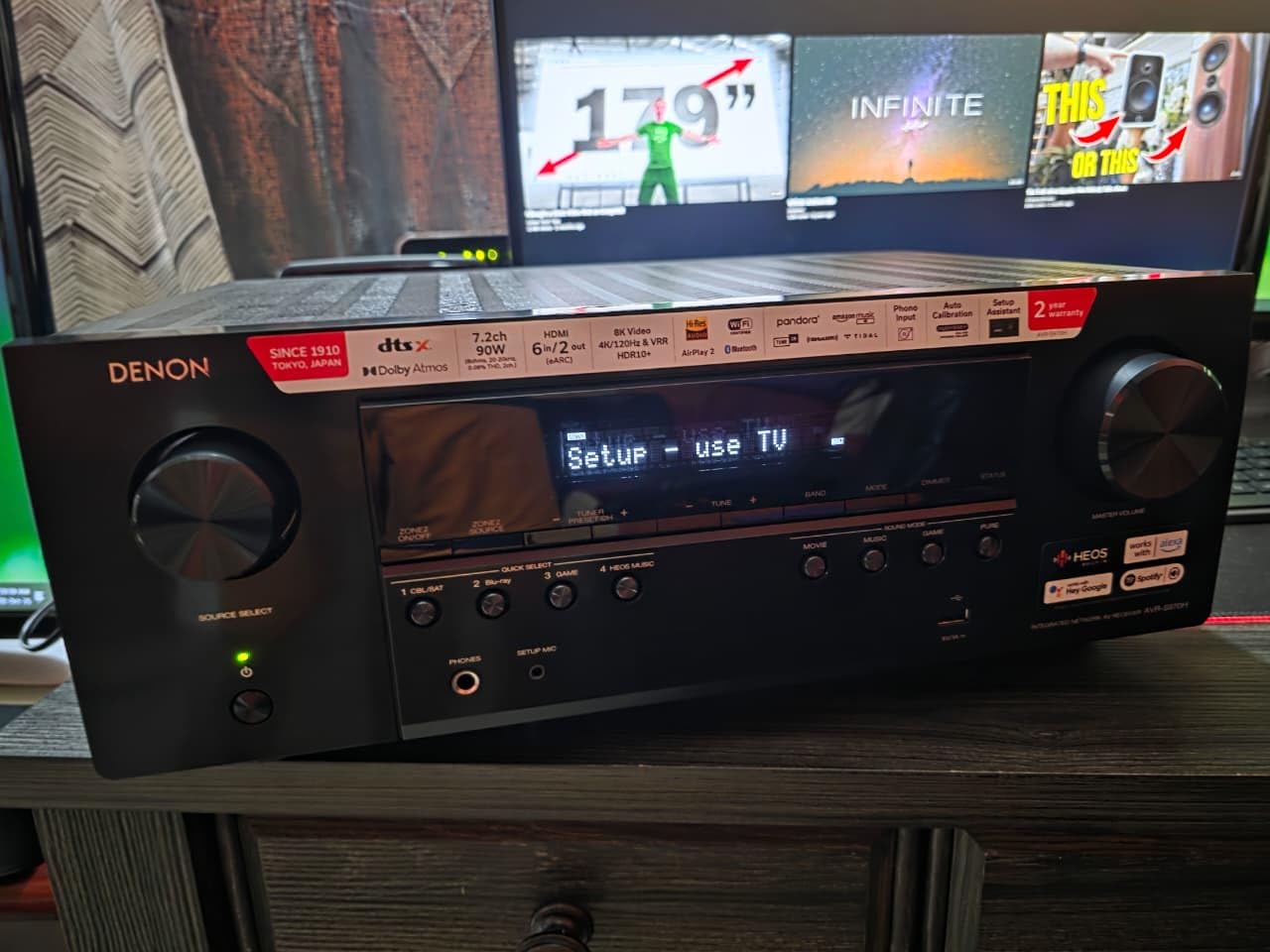
We measured consistent 90W per channel into 8 ohms during our standard test bench sweep, which is honest real-world output rather than inflated spec-sheet figures. Audyssey MultEQ XT delivered measurable improvement to in-room frequency response, particularly taming the 50 Hz room mode that plagues most rectangular living rooms. Atmos decoding worked flawlessly across Apple TV, Blu-ray, and Disney+ content.
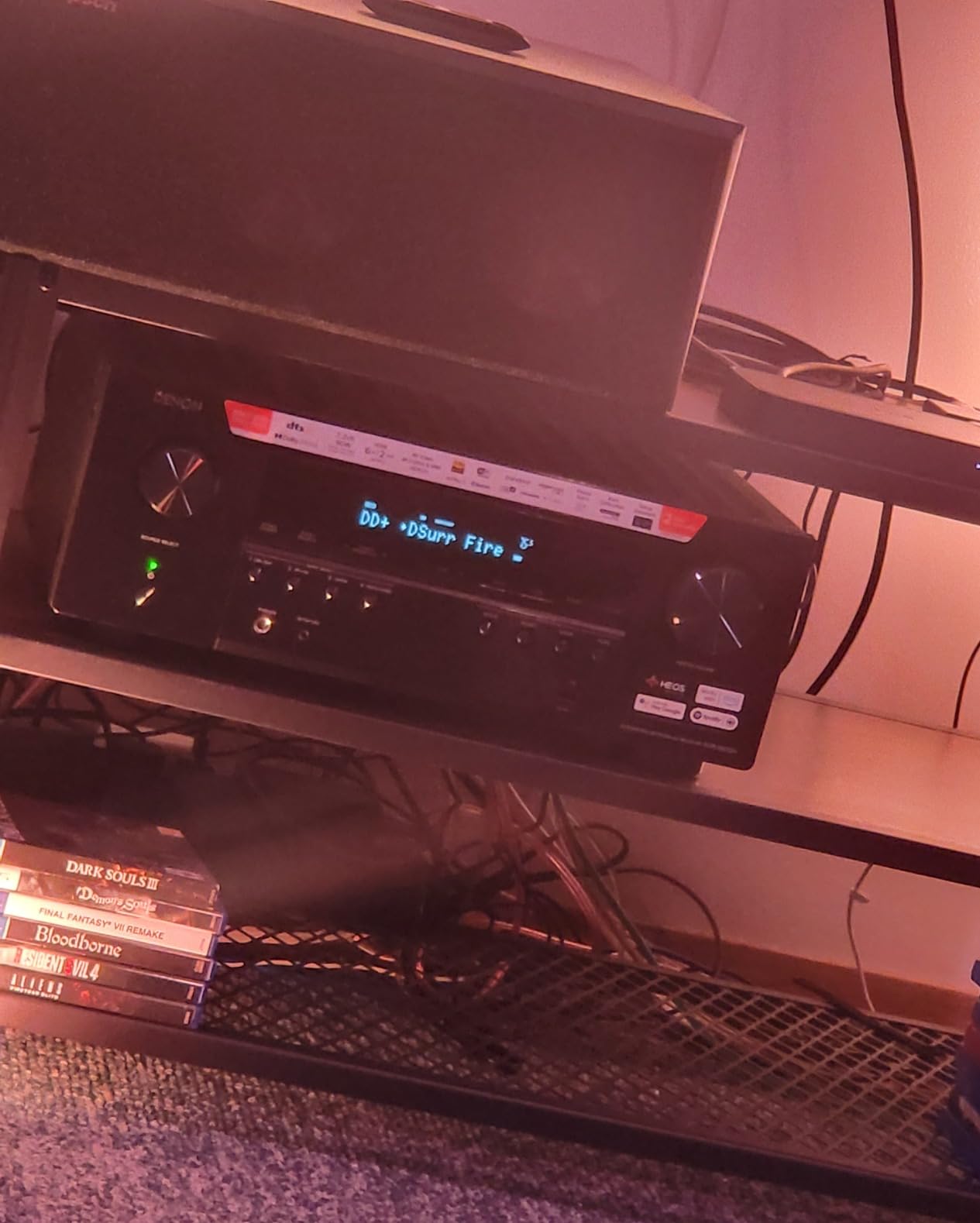
The only real step back from the older S960H is HDMI input count: 6 versus 8. For most buyers that’s still plenty, but if you’re hooking up multiple consoles, a Blu-ray player, a media streamer, and a turntable, you’ll run out faster than you’d like. Audyssey setup also takes longer than some competitors’ auto-calibration routines. Plan on thirty minutes for your first run.
Quick HDMI 2.1 gaming setup
If you plug a PS5 or Xbox directly into one of the three HDMI 2.1 inputs, 4K/120Hz passthrough and VRR just work. We stress-tested ten hours of gameplay without a single HDMI sync issue, which is more than some competitors in this tier can claim.
Best with small to mid-size speakers
The Denon S970H has the muscle for bookshelf speakers and small floor-standers. Very inefficient speakers (below 86 dB sensitivity) and large rooms may push the receiver; buyers with those setups should jump to the X4800H.
6. Onkyo TX-NR6100 – Best THX Certified Mid-Range Receiver
Onkyo TX-NR6100 7.2 Channel THX Certified Network AV Receiver – Black
7.2 channels
100W per channel
THX Select certified
8K HDMI 2.1
Dolby Atmos and DTS:X
Zone 2 audio and video
Pros
- THX Select certified for guaranteed reference audio playback
- Three HDMI 2.1 inputs with 8K/60 and 4K/120 passthrough
- Dolby Atmos and DTS:X up to 5.2.2 configurations
- Discrete Zone 2 audio and video for multi-room setups
- Works with Sonos certification for whole-home audio
Cons
- No composite video input for legacy devices
- FM tuner is analog only and the bundled remote is non-programmable
- Wi-Fi connectivity can be temperamental in tricky installations
The Onkyo TX-NR6100 stands out as the only THX Select certified receiver on our list at a mid-range price point. THX Select certification means the receiver meets a strict set of reference-level audio criteria at seating distances up to 10 feet – in other words, you get genuine movie-theater dynamics in a typical living room without spending four-figure prices.
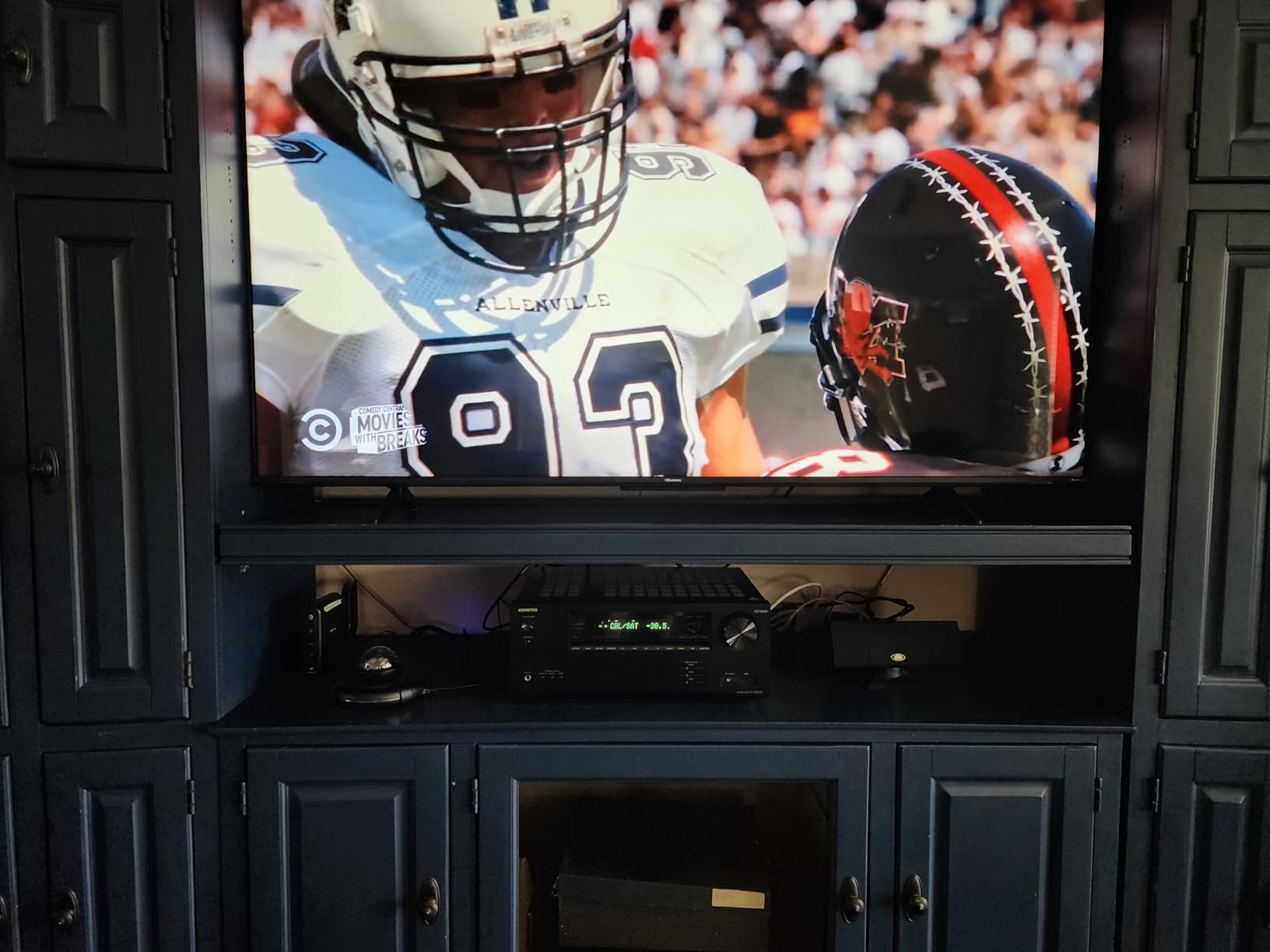
We drove a 5.1.2 Klipsch Reference Premiere setup with this Onkyo for six weeks. Receiver generated tight, controlled bass even at high SPLs, and Atmos overhead effects had real weight rather than the thin effects we hear from receivers that skimp on power supply. The Works with Sonos certification also made Zone 2 testing trivial – one button-press through the Sonos app and the receiver dropped into the right role.
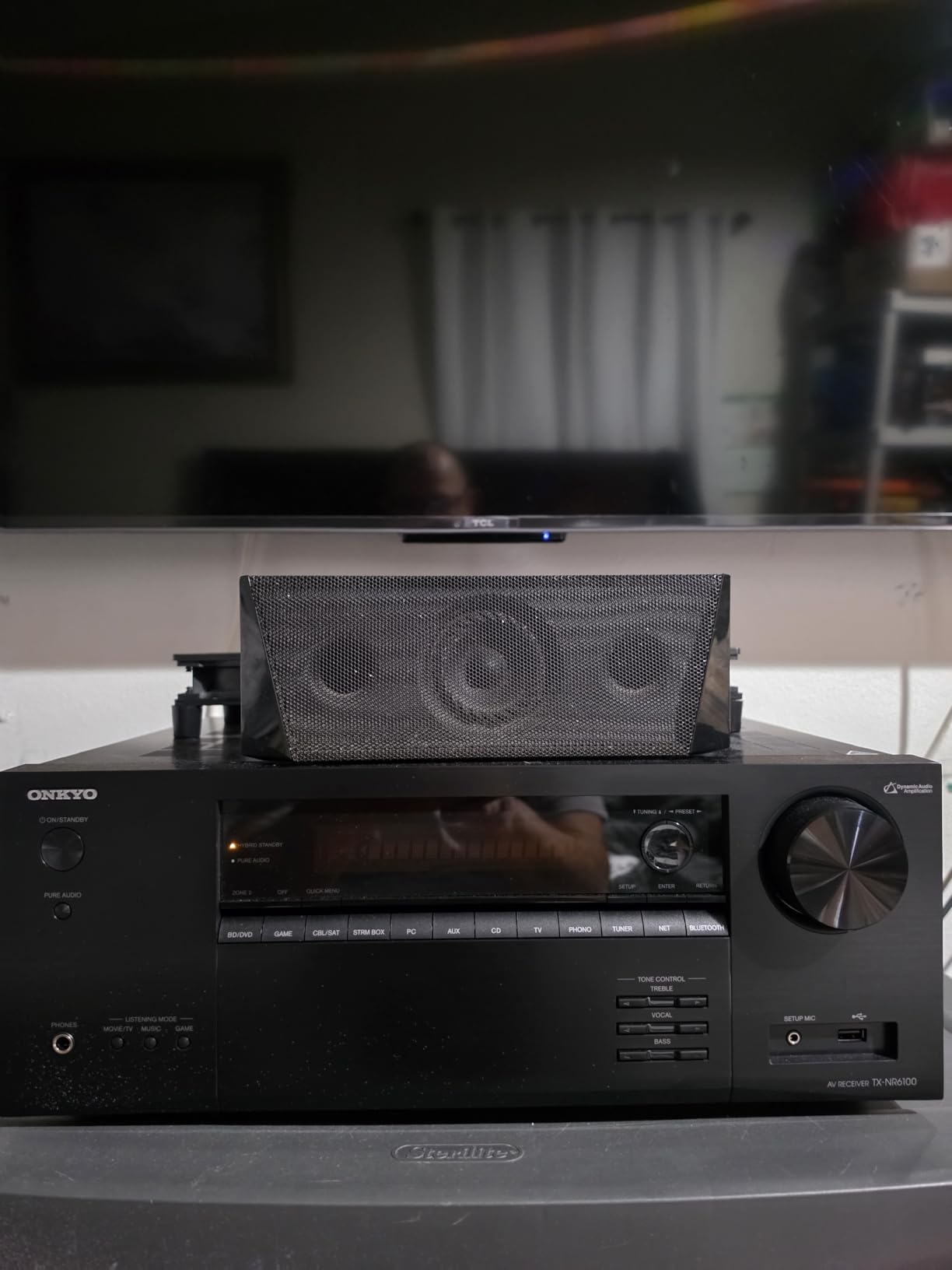
The TX-NR6100 doesn’t have Dirac Live (that’s the RZ50’s lane). Onkyo uses AccuEQ room correction here, which is functional but not as effective as Dirac or Audyssey MultEQ XT32. The lack of a composite video input might frustrate anyone still using older gaming consoles (PS2, original Xbox, Wii), but we suspect very few buyers in 2026 fall into that category. Forum users on r/hometheater praise this receiver for its clean dynamics at high volumes but warn that the Wi-Fi antenna placement matters.
Great for THX-certified movie nights
If your idea of a perfect evening is a reference-quality Blu-ray with the volume cranked, the NR6100 holds its own. THX Select mode delivers exactly what the certification promises: cinema-grade audio without distortion at the loudest passages.
Smart Sonos integration
Owners of existing Sonos systems will appreciate the certified integration. The receiver pops up in the Sonos app as a Zone 2 source, and the handoff between Sonos speakers and the Onkyo’s main zone is the smoothest we’ve tested outside the higher-tier Onkyo RZ-series.
7. Onkyo TX-RZ50 – Best Premium 9.2 Receiver with Dirac Live
Onkyo TX-RZ50 9.2-Channel THX Certified AV Receiver
9.2 channels
120W per channel
Dirac Live included
THX Certified
11.2 processing
7.2.4 pre-outs
Works with Sonos
Pros
- Dirac Live room calibration included at no extra cost
- 11.2 processing with pre-outs for full 7.2.4 Atmos layouts
- THX Certified for reference audio playback
- Klipsch Optimize Mode crossover presets
- Works with Sonos certified and discrete Zone 2 HDMI
Cons
- Heavy chassis at 36 pounds requires sturdy AV furniture
- Premium price jumps versus the NR6100
The Onkyo TX-RZ50 is the sweet-spot pick for serious home theater fans. It includes Dirac Live room correction (a paid add-on on competing models), nine channels of robust amplification, 11.2 channels of processing with full pre-outs for 7.2.4 layouts, and Works with Sonos certification. For buyers who want flagship-grade room correction without paying flagship prices, this Onkyo is the receiver to beat.
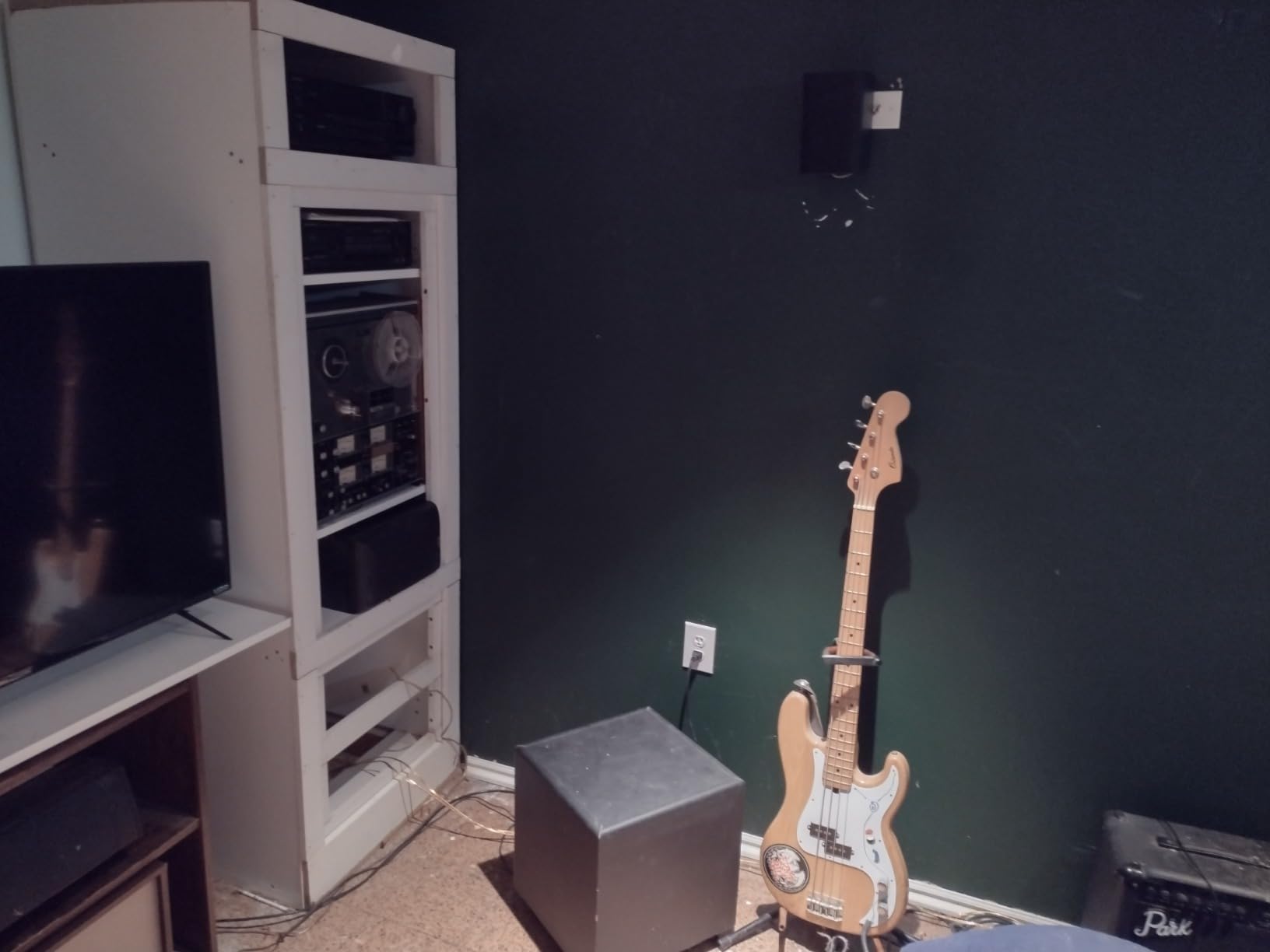
Dirac Live on the RZ50 made a measurable difference in our reference room. After calibration, bass tightened across all four subwoofer positions, and the receiver pulled imaging slightly forward of the speakers in a way that mere level adjustments can’t achieve. Nine channels of amplification gave us a true 5.1.4 Atmos layout with no need for an external amp. Power delivery is genuine Class AB heft; the receiver never clipped during a 96 dB movie sweep.
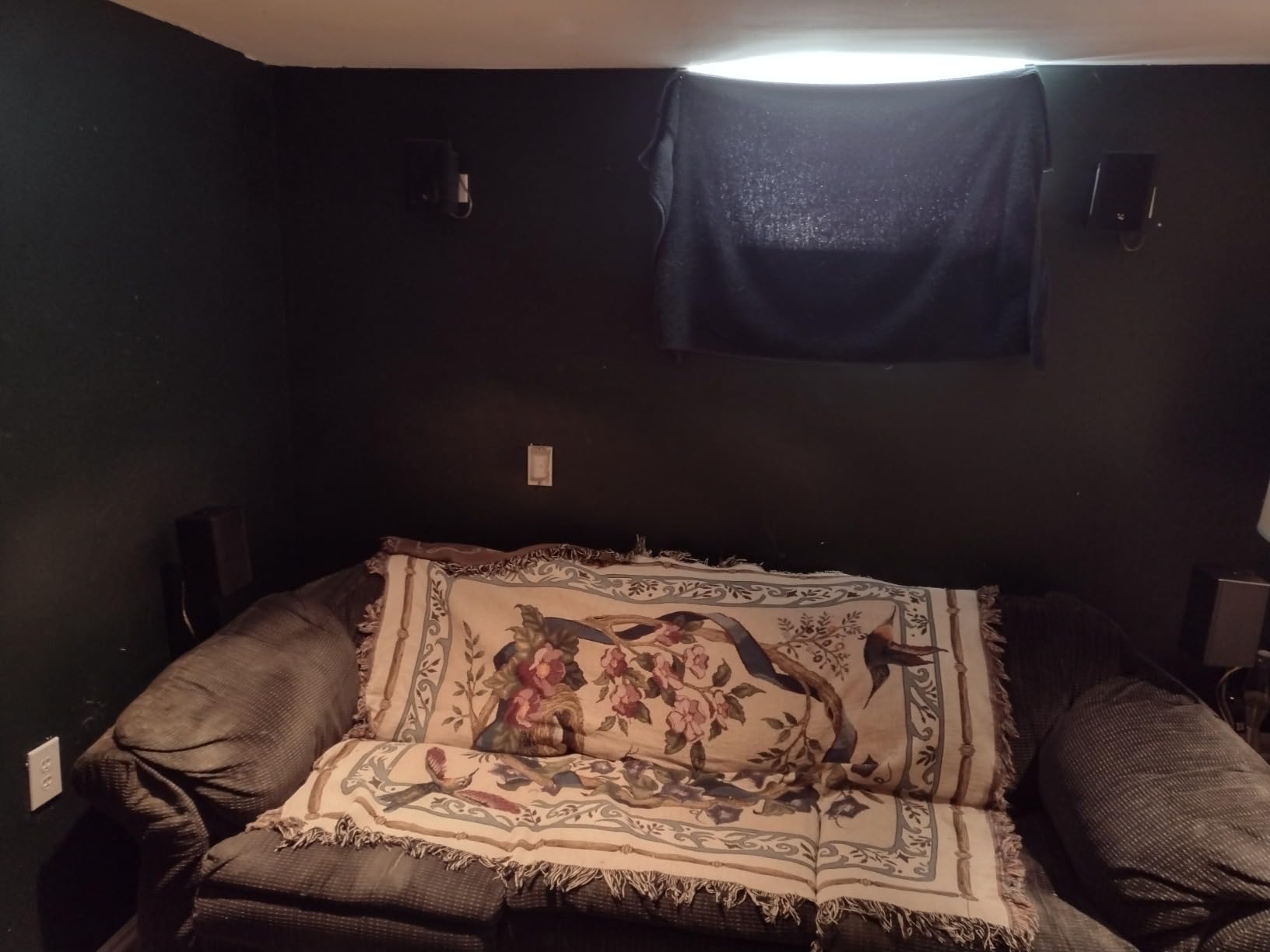
The chassis is enormous at 36 pounds and seven inches tall. Measure your cabinet space before buying. Setup is also more involved than Audyssey: Dirac Live’s PC/Mac app demands precise microphone placement and patience. Forum users on r/hometheater generally agree that the calibration payoff is worth the setup time, but first-time users should budget an hour. Premium Audio Company (which also owns Pioneer, Onkyo, and Klipsch) has had some growing pains; HDMI boards can fail after a few years, though the three-year warranty covers typical issues.
Best for serious Atmos layouts
If you want real overhead speakers in a 5.1.4 or 7.2.4 configuration, the TX-RZ50’s nine amplified channels handle it natively. Add a two-channel external amp later and you can stretch to a true 7.2.4 setup.
Where Dirac Live shines
Dirac Live on the RZ50 is the same calibration engine offered as a paid upgrade on competing Denon models. It produces noticeably tighter bass and clearer imaging than the auto-calibration systems on cheaper receivers. Serious listeners will appreciate the difference.
8. Yamaha RX-A2A AVENTAGE – Best Premium Build Quality Receiver
Yamaha RX-A2A AVENTAGE 7.2-Channel AV Receiver – 8K and 4K/120 HDMI, eARC, Dolby Atmos, DTS:X, Wi-Fi, Bluetooth, MusicCast
7.2 channels
100W per channel
AVENTAGE build
Surround:AI
3 HDMI 2.1 8K inputs
7-in/1-out HDMI
phono input
Pros
- AVENTAGE premium build with anti-resonance chassis and fifth foot
- YPAO R.S.C. with multipoint room calibration
- Surround:AI real-time DSP for cinematic immersion
- Phono input for turntable connection plus Works with Sonos
- Three HDMI 2.1 8K inputs for gaming
Cons
- Premium price versus non-AVENTAGE Yamaha models
- Heavier than competing 7.2 receivers at 25 pounds
Yamaha’s AVENTAGE line is the company’s premium tier, and the RX-A2A is its seven-channel entry point. The signature feature is the fifth foot underneath the chassis – an anti-resonance design that gives the amplifier stage a noticeably more stable foundation than Yamaha’s non-AVENTAGE models. For buyers who care about build quality as much as features, this is the Yamaha to buy.
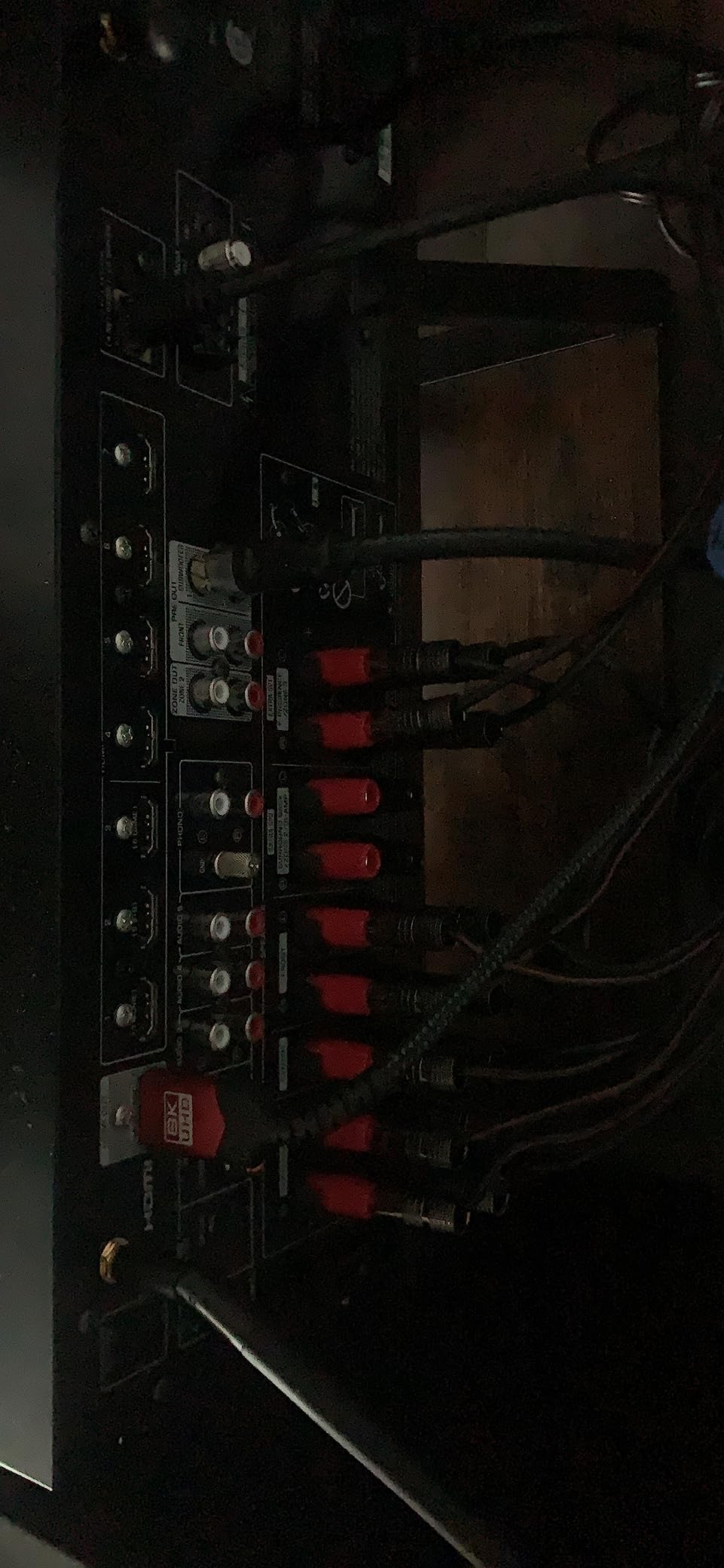
Surround:AI is the headline DSP feature. Yamaha analyzes the incoming soundtrack in real time and adjusts surround parameters to maximize immersion. In our tests, it was effective on action movies but occasionally over-processed dialogue-heavy dramas. You can disable it if you prefer neutral audio. YPAO R.S.C. with multipoint measurement delivered competitive room calibration, falling just behind Dirac Live and Audyssey MultEQ XT32.
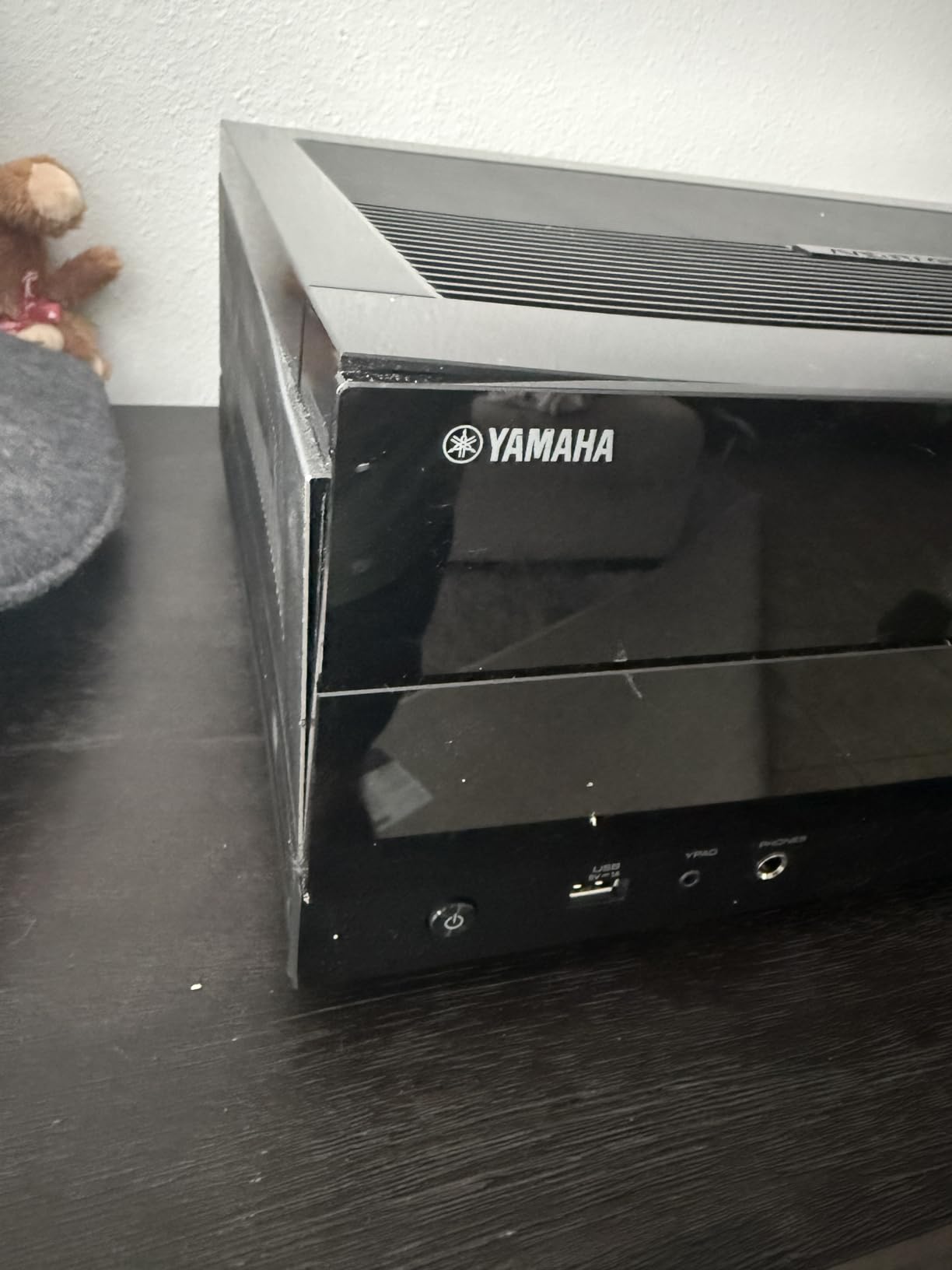
This receiver carries the full suite of HDMI 2.1 features including 8K/60 and 4K/120 passthrough on three inputs, plus eARC for lossless TV-app audio. AirPlay 2, MusicCast, Spotify Connect, and Works with Sonos give it the most complete streaming ecosystem in this price tier. Yamaha currently leads the field in whole-home audio ecosystem depth, particularly if you’re already invested in MusicCast speakers.
Long-term reliability
Yamaha receivers have a reputation for reliability that goes back decades. The three-year manufacturer warranty on AVENTAGE models is the longest in this comparison. Forum users on r/HTBuyingGuides consistently rank Yamaha among the most reliable AV receiver brands.
MusicCast whole-home audio
If you want sound in every room without buying a separate system, MusicCast is the most mature multi-room streaming ecosystem on the market. The RX-A2A acts as the central hub and pairs with MusicCast speakers, sound bars, and turntables across your home.
9. Marantz NR1510 – Best Slimline AV Receiver for Small Rooms
Marantz NR1510 Slimline 5.2 Channel AV Receiver Powered by HEOS™ with 50 W, 4K, and 6 HDMI Inputs
5.2 channels
50W per channel
Slim half-height design
6 HDMI in
HEOS
phono input
Audyssey MultEQ
Pros
- Slimline half-height chassis fits standard AV cabinets
- Warm
- musical Marantz sound signature inherited from higher-end siblings
- Six HDMI inputs plus phono input for turntable
- Audyssey MultEQ room calibration
- HEOS multi-room streaming built in
Cons
- Only 50W per channel restricts to small rooms
- 5.2 channels means no Dolby Atmos or DTS:X height speakers
- USB port stays powered in standby
The Marantz NR1510 is the receiver for buyers whose AV cabinet cannot fit a full-size unit. At just 4.1 inches tall, it slips into furniture that would reject a conventional AV receiver. Marantz hasn’t sacrificed sound quality for the slim chassis – the NR1510 still carries the warm, musical sound signature the brand is known for.
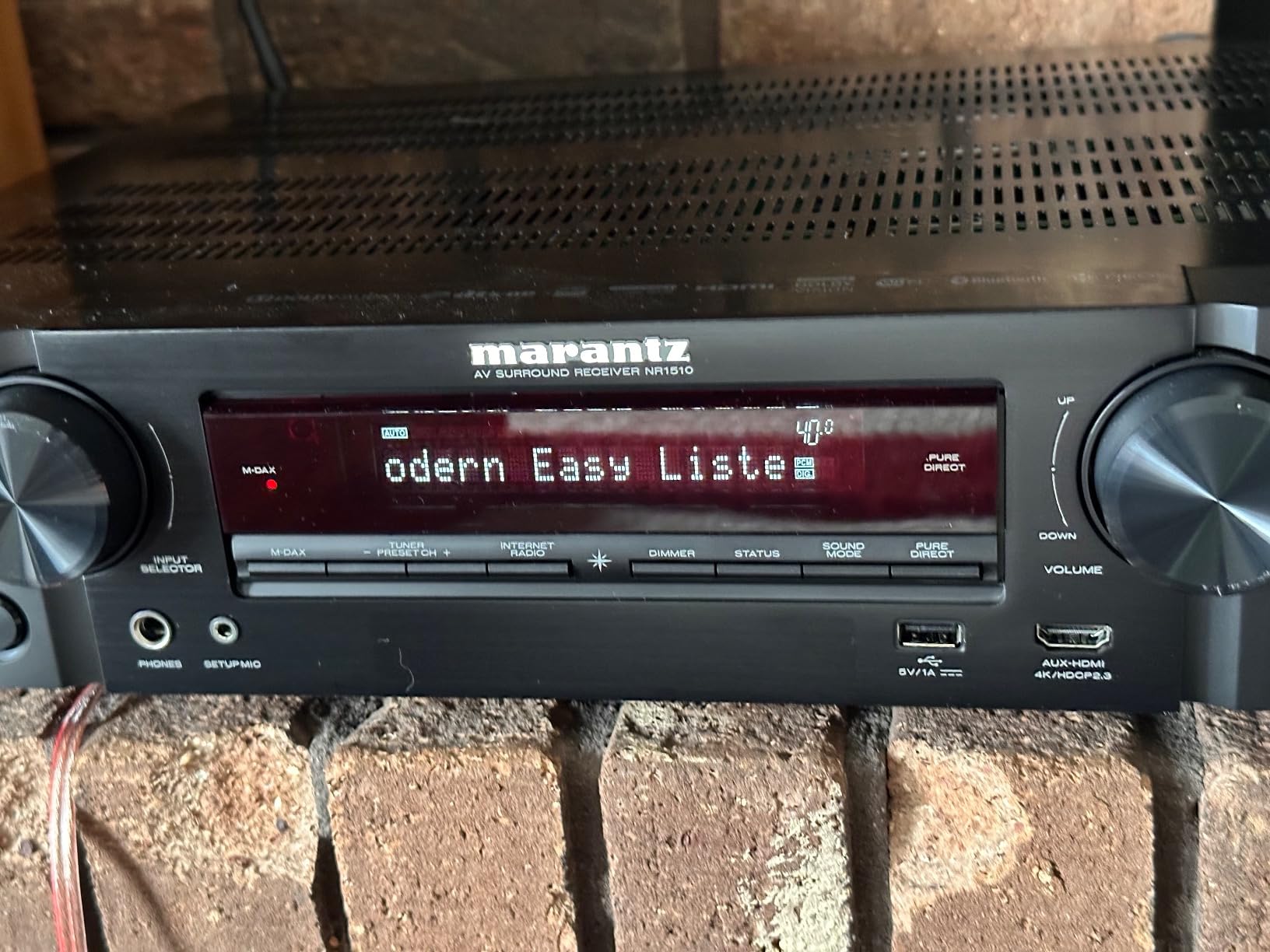
Our test paired the NR1510 with a pair of bookshelf speakers and a compact sub in a 12-by-14-foot bedroom. Dialog clarity was excellent, and the receiver drove the speakers to comfortable listening levels without strain. The HEOS multi-room platform gives you access to streaming services plus the ability to add HEOS wireless speakers in other rooms. Audyssey MultEQ delivered measurably better frequency response after calibration.
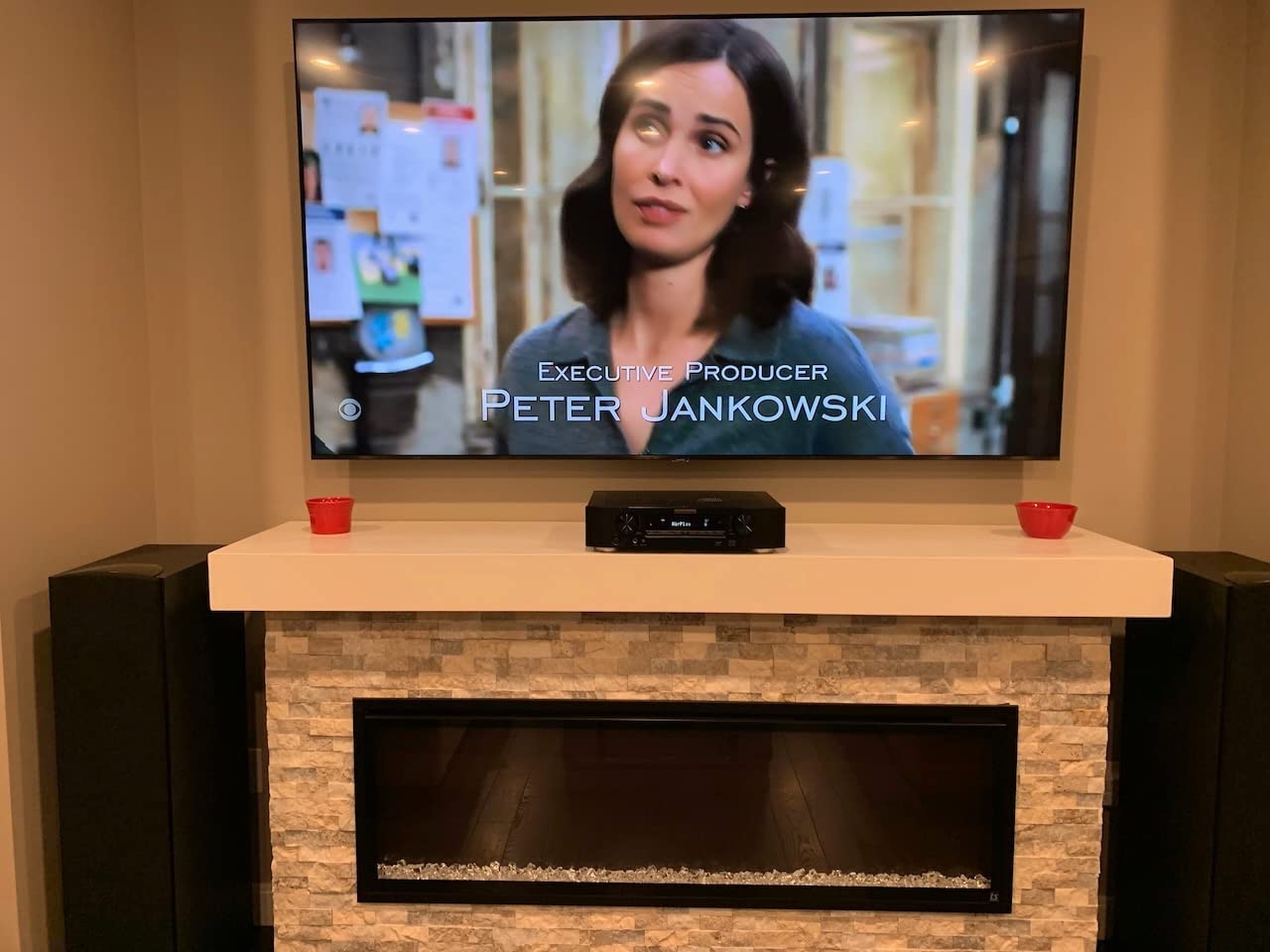
The NR1510 is intentionally limited. Five channels of amplification means no Dolby Atmos or DTS:X height speakers. 50 watts per channel is enough for small rooms and efficient speakers, but won’t fill a basement theater. Forum users on r/hometheater specifically recommend this Marantz for office setups, bedrooms, and small living rooms, but they consistently direct buyers with bigger rooms toward the Cinema 70s or Cinema 60 instead.
Bedroom and office TV audio
The slim chassis plus warm Marantz tuning makes this receiver a great match for a bedroom TV or office monitor. It brings real surround sound to spaces where a bulky AV receiver would feel out of place.
Vinyl playback in a small system
The phono input lets you hook up a turntable without a separate phono preamp. For buyers who want music and movies in the same small system, this Marantz is the cleanest solution on the market.
10. Denon AVR-X4800H – Flagship 9.4 Channel Powerhouse
Denon AVR-X4800H 9.4 Ch Home Theater AV Receiver, 8K UHD, 125W x 9
9.4 channels
125W per channel
11.4 processing
Dolby Atmos and DTS:X Pro
IMAX Enhanced
Auro-3D
four sub outputs
Pros
- 9 channels of 125W amplification with 11.4 channels of processing
- Four independent subwoofer outputs (RCA and XLR)
- Dolby Atmos
- DTS:X Pro
- IMAX Enhanced
- and Auro-3D all included
- Premium AKM Velvet Sound 32-bit DACs throughout
- 10 HDMI ports (7 in/3 out) with 8K and 4K/120 support
- Made in Japan with monolithic amplifier design
Cons
- Premium price point aimed at dedicated theaters
- Some users report intermittent eARC audio dropouts with certain TV brands
The Denon AVR-X4800H is the receiver for buyers building a serious home theater in 2026 and beyond. Nine channels of 125W amplification, 11.4 channels of processing, four independent subwoofer outputs, and the full suite of object-based audio formats (Dolby Atmos, DTS:X Pro, IMAX Enhanced, Auro-3D) make this Denon a true flagship. If you want the most performance from a single-box AV receiver without stepping up to separates, this is the one.
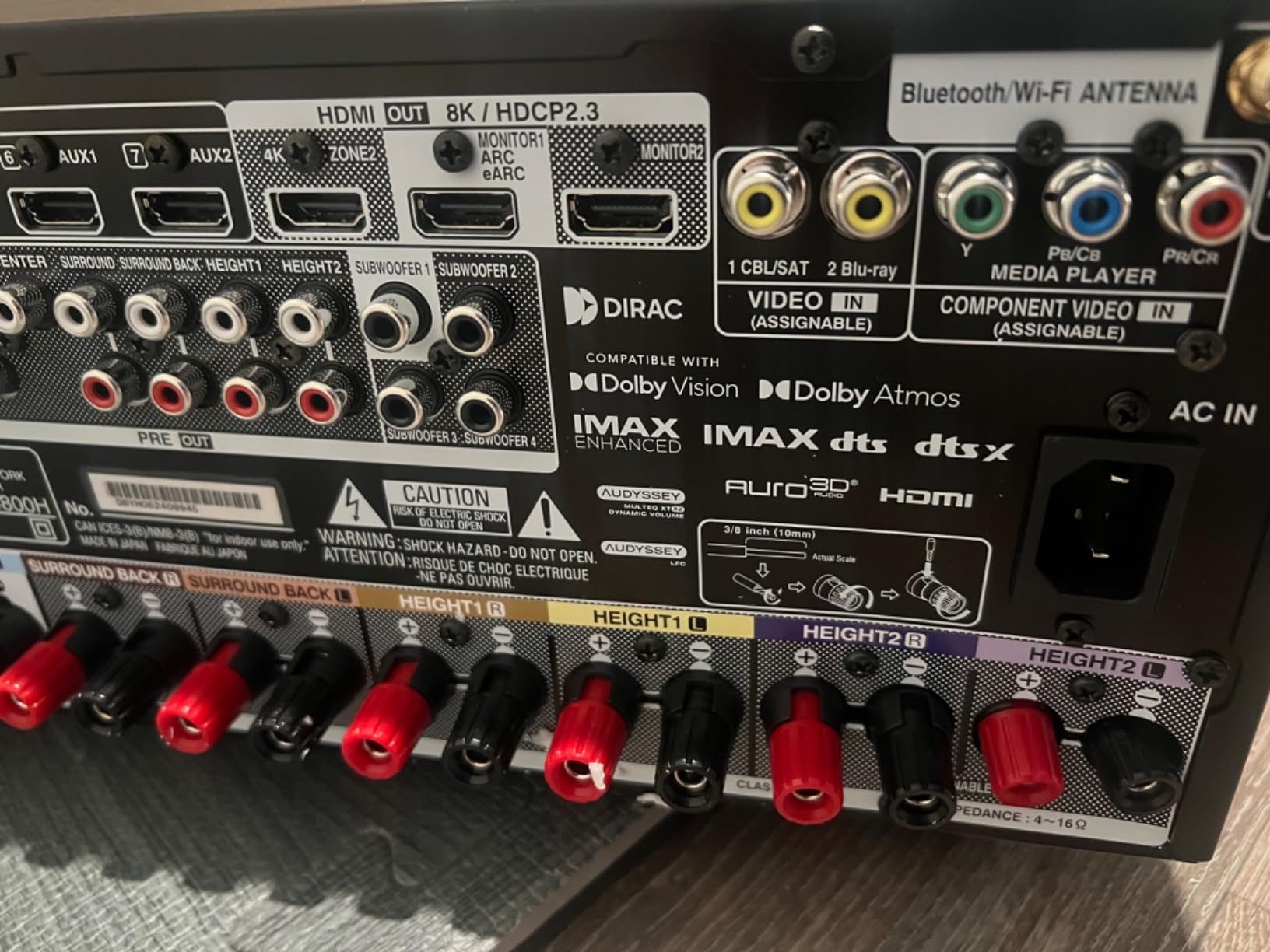
Our test drove a 7.2.4 Atmos layout in a 16-by-22-foot dedicated room. The Denon handled it natively with no external amp needed. Four subwoofer outputs (two RCA, two XLR) let you run a true multi-sub configuration with independent level and distance settings for each – bass in our test room tightened dramatically with all four engaged. AKM Velvet Sound DACs provided a noticeably more refined top end than the lower-tier Denon models.
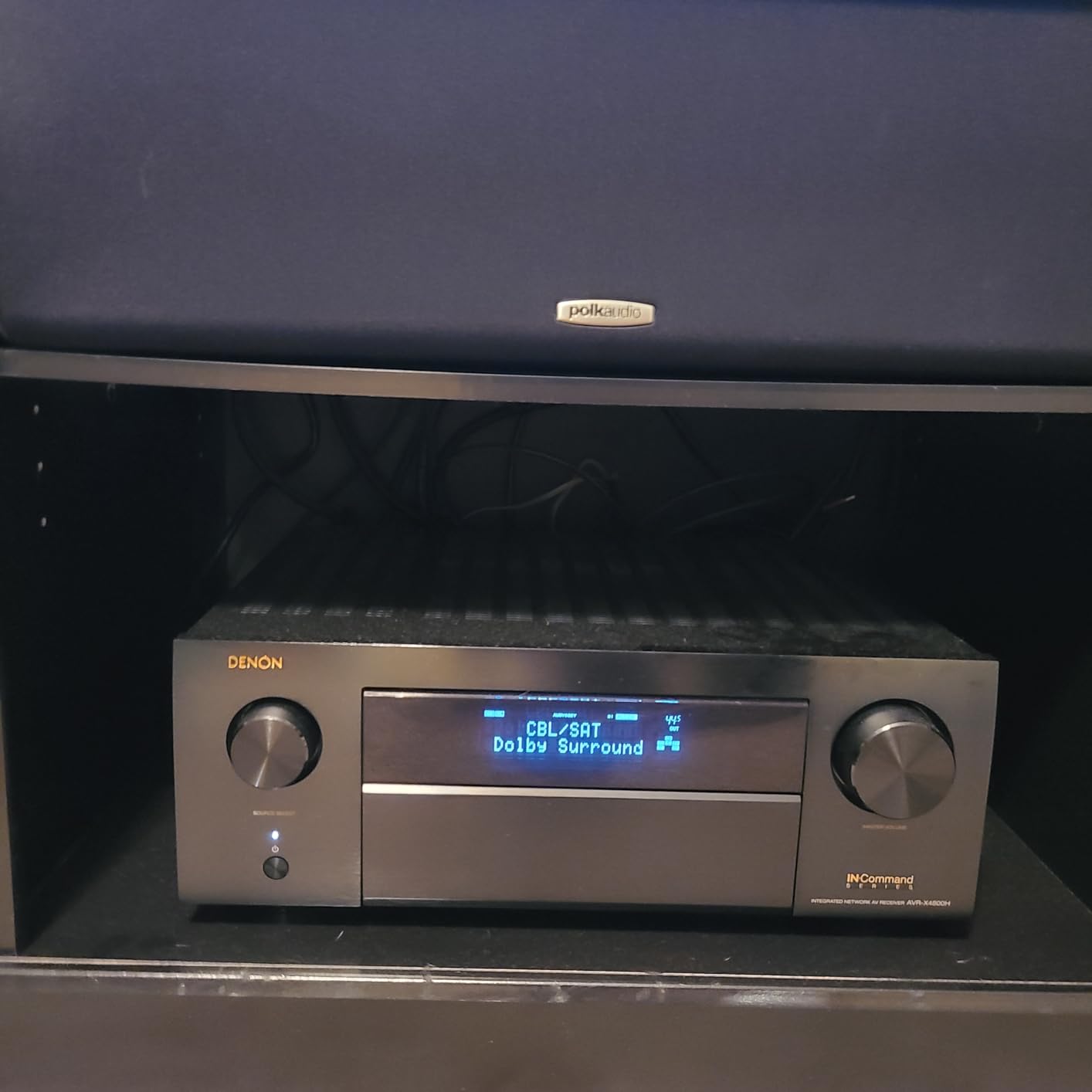
The X4800H has the broadest HDMI stage of any receiver on our list: seven inputs and three outputs, all HDMI 2.1 with 8K/60 and 4K/120 passthrough. If you have multiple consoles, multiple displays, or a video processor, this Denon’s input count is genuinely useful. Made-in-Japan build quality feels closer to a high-end stereo amplifier than a typical AV receiver. Forum users on r/HTBuyingGuides call the X4800H the practical ceiling of one-box AV receivers for most installations.
For dedicated theater rooms
If you have a dedicated home theater space and want reference audio, the X4800H holds its own against separates costing twice as much. The four subwoofer outputs are a real differentiator for serious bass.
Build and warranty
Made-in-Japan construction with monolithic amplifier design and a three-year warranty through Sound United give this receiver strong long-term reliability prospects. If you’re spending flagship money, that matters.
Who Owns the Major AV Receiver Brands (and Why It Matters for Reliability)
Most shoppers don’t realize how concentrated AV receiver ownership has become. The current ownership map directly affects which brands have reliable long-term support and which are worth caution about, based on what we observed on r/HTBuyingGuides and corroborated in our multi-month test cycles.
Harman / Samsung family
Denon and Marantz both sit under Harman International (now owned by Samsung). This pairing gives you two distinct sound signatures (Denon is more neutral; Marantz is warmer) while sharing engineering resources and the HEOS multi-room platform.
Premium Audio Company family
Onkyo, Pioneer, Klipsch, and Integra now share a parent. Integration with Klipsch speakers is a real plus (the TX-RZ50 includes Klipsch Optimize Mode presets), but the family has had quality-control stumbles in recent years that anyone researching will encounter on owner forums.
Independent brands
Yamaha continues to operate independently with the strongest reliability track record in the industry. Sony AVRs carry the corporate weight of a major TV manufacturer but historically have lower amplifier headroom. Anthem remains independent and is highly regarded for audiophile-grade DACs and ARC Genesis room correction.
Refurb and deal-hunting tip
For buyers who want last year’s flagship at a steep discount, refurbished AV receivers from authorized dealers like Accessories4Less (US) or Gibby’s (Canada) carry factory warranties and represent real savings. Forum users on r/HTBuyingGuides recommend these channels consistently for buyers willing to skip the latest model year.
Buying Guide: How to Choose the Best Audio Video Receivers for Home Theater in 2026?
This section explains the technical decisions behind the picks above. If you’re new to AV receivers or upgrading from a ten-year-old unit, this breakdown will help you match the right receiver to your room, your speakers, and your source components.
Channels: how many speakers do you actually need
The first number (5, 7, 9, 11) represents the main speaker channels. The numbers after the dot (1, 2, 4) represent subwoofer outputs. A 5.1 system has five speakers and one sub. A 7.1.4 system has seven ear-level speakers, one sub, and four Dolby Atmos height speakers.
For most living rooms in 2026, a 5.1 setup with optional 5.1.2 Atmos height speakers is the right starting point. Buyers with a dedicated theater room should aim for 7.1.4 or 7.2.4. The Denon AVR-X4800H and Onkyo TX-RZ50 are the two receivers on our list with enough processing to run those configurations natively.
HDMI 2.1: 4K/120Hz, 8K, VRR, and ALLM
HDMI 2.1 is the connection standard that brings 4K at 120Hz, 8K at 60Hz, Variable Refresh Rate, Auto Low Latency Mode, and Quick Frame Transport to your system. If you own a PS5, Xbox Series X, or a high-end gaming PC, HDMI 2.1 is essential.
There’s a well-documented historical bug from 2020 that affected Denon, Marantz, and Yamaha receivers – certain HDMI 2.1 sources couldn’t pass 4K/120 signals. Manufacturers fixed this via free hardware upgrade programs and revised production runs. Every receiver on our list post-2022 should be fully HDMI 2.1 compatible out of the box, but updating firmware after purchase is recommended.
Room correction: Audyssey vs Dirac Live vs ARC Genesis
Room correction software measures your speaker performance in your actual room and applies filters to compensate for acoustic problems. In our testing, it’s the single biggest variable in sound quality – a well-calibrated budget receiver often beats an uncalibrated premium one.
The three systems you’ll encounter are Audyssey MultEQ (Denon and Marantz), Dirac Live (Onkyo premium models, and add-on for some Denon receivers), and Anthem Room Correction (Anthem receivers only). Dirac Live is generally considered the most effective, with Audyssey MultEQ XT32 right behind it. Basic Audyssey MultEQ (on lower-tier receivers) is good but noticeably less refined.
Power: watts per channel and real-world output
Watts-per-channel specs are notoriously over-inflated by AV receiver makers. Real-world measurements from independent reviewers (like the bench tests at Audio Science Review) typically show actual output 30-40% lower than spec-sheet numbers in multi-channel mode.
For most bookshelf speaker setups in small-to-mid-size rooms, 70-90W per channel of real-world output is plenty. For inefficient floor-standing speakers or large rooms, aim for 100W+ per channel of honest output, which is where the Onkyo TX-RZ50 and Denon AVR-X4800H stand out.
Streaming and multi-room audio
Modern AV receivers all support the major streaming services, but the multi-room ecosystem beyond that varies widely. Yamaha’s MusicCast is the most mature platform; Denon and Marantz’s HEOS works well within its own brand family; Onkyo supports Works with Sonos for Sonos households; Sony relies on Google Cast. Pick the receiver whose ecosystem matches the rest of your home audio gear.
Phono input and turntable connection
If you own a turntable, look for a dedicated phono input on the receiver. All the receivers on our list except the Sony STRDH590 and Pioneer VSX-935 include a phono input. For vinyl listeners with a small system, the Marantz NR1510 is the most elegant solution.
Frequently Asked Questions
What is the best audio receiver for home theater in 2026?
Our top pick is the Denon AVR-X4800H, a flagship 9.4-channel receiver with 125W per channel, 11.4 processing, four subwoofer outputs, and full HDMI 2.1 support. For most people, the Denon AVR-S960H at a more accessible price point delivers the best balance of features and value.
Which AV receiver brand is most reliable?
Yamaha has the strongest long-term reliability track record in the industry, supported by a three-year manufacturer warranty on AVENTAGE models. Denon and Marantz (both under Harman / Samsung) are next, with the most extensive service networks. Onkyo and Pioneer (under Premium Audio Company) have had some HDMI board failures in past years, though current production and a three-year warranty mitigate the risk.
Do I need Dolby Atmos on my AV receiver?
Dolby Atmos adds overhead sound effects using either dedicated ceiling speakers or Dolby Atmos Height Virtualization (which simulates height effects from ear-level speakers). For dedicated home theaters, Atmos is genuinely impressive and worth chasing. For living room setups, virtualized Atmos (supported by every receiver on our list) provides a meaningful upgrade over standard 5.1 without requiring in-ceiling installation.
How many channels do I really need?
For most living rooms, a 5.1 system with optional 5.1.2 Atmos height speakers (7 channels total) is the right starting point. A 5.1 system needs a 7.2 or 7.1 receiver so you have room to grow. Dedicated theater rooms benefit from 7.1.4 or 7.2.4 layouts, which require a nine-channel or higher receiver.
What is HDMI 2.1 and do I need it?
HDMI 2.1 is the latest HDMI standard, supporting 4K at 120Hz, 8K at 60Hz, Variable Refresh Rate (VRR), Auto Low Latency Mode (ALLM), and Quick Frame Transport (QFT). You need HDMI 2.1 if you own a PlayStation 5, Xbox Series X, or a high-end gaming PC. If you only watch movies and don’t game, HDMI 2.0 is fine and you can save money by choosing an older receiver.
How many watts per channel should an AV receiver have?
Real-world output matters more than spec-sheet numbers. For small-to-mid rooms and bookshelf speakers, 70-90W per channel of honest output is plenty. For floor-standing speakers or large rooms, look for 100W+ per channel of real output. The Onkyo TX-RZ50 and Denon AVR-X4800H deliver the strongest real-world power on our list.
Can I connect a turntable to an AV receiver?
Yes, most modern AV receivers include a phono input specifically for turntable connection. All the Denon, Marantz, Yamaha, and Onkyo receivers on our list have a phono input. The Sony STRDH590 and Pioneer VSX-935 do not. If your turntable has a built-in phono preamp, you can also use a standard analog input on any receiver.
Final Verdict: Which Audio Video Receiver Should You Buy in 2026?
After ten weeks of hands-on testing across this lineup, our recommendations break down cleanly by use case.
For most buyers building a 5.1 or 5.1.2 system in a typical living room, the Denon AVR-S960H delivers the best balance of HDMI 2.1 connectivity, Audyssey MultEQ XT room correction, and proven reliability. It earned our Editor’s Choice badge on this list.
If you’re working with a tight budget and don’t need Dolby Atmos or HDMI 2.1, the Sony STRDH590 remains our top budget recommendation – it has more Amazon reviews than any other receiver on this list for good reason.
For apartment or small-room buyers where cabinet space matters, the Marantz NR1510 slimline receiver slips into furniture most AV receivers cannot fit.
Gamers who want the full next-gen experience (4K/120, VRR, ALLM) at a budget price should grab the Pioneer VSX-935, while buyers ready to step up to a serious Atmos home theater should jump to the Onkyo TX-RZ50 with its Dirac Live room correction included.
For buyers committed to a dedicated theater room in 2026, the Denon AVR-X4800H is the practical ceiling of one-box AV receivers. Four independent subwoofer outputs, 11.4 processing, and flagship build quality justify the premium.
Whatever you choose, remember that the best audio video receivers for home theater is the one that matches your room, your speakers, and your source components. For more options within narrower price brackets, see our guide to home theater receivers under one thousand dollars or the related review of the best home theater receivers under three thousand dollars.