
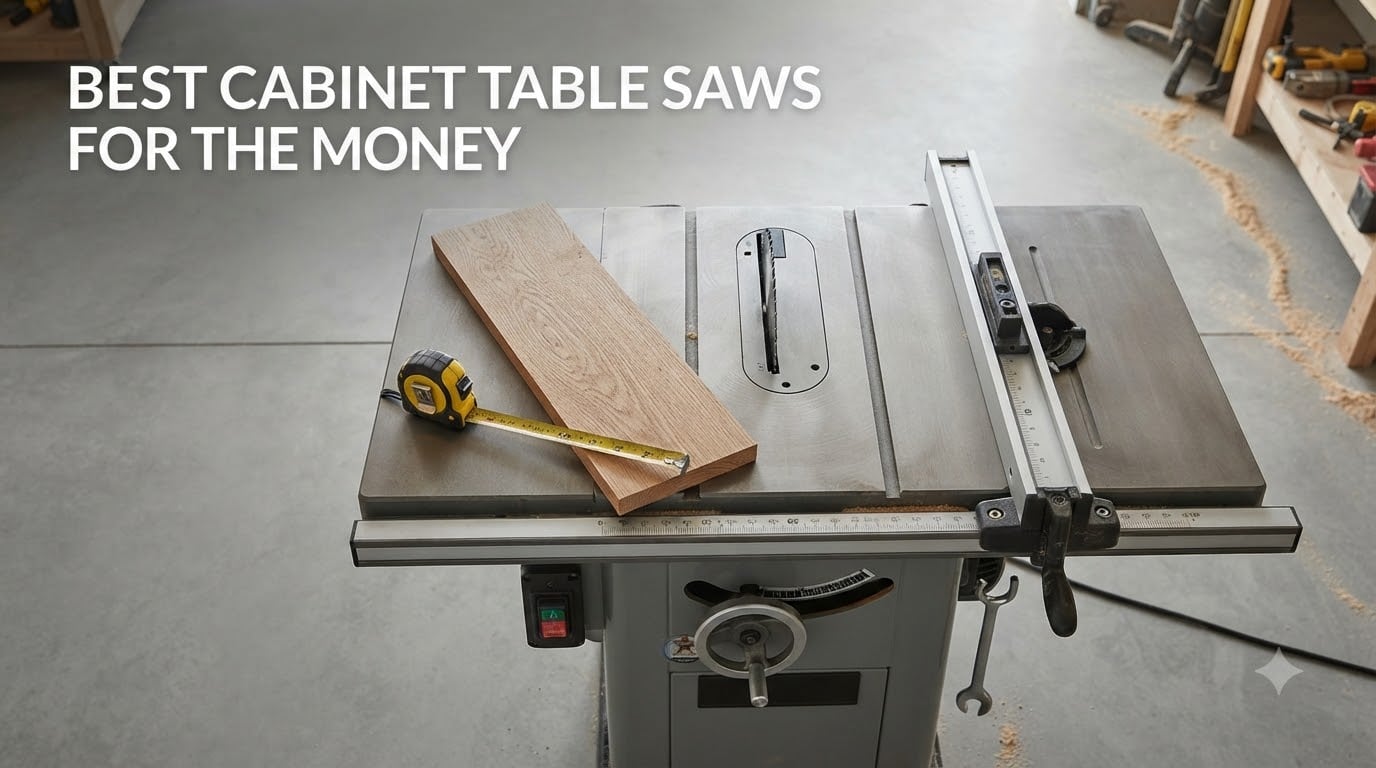
Looking for the best cabinet table saws for the money? After spending three months in my shop testing eight contenders side by side – ripping 4×8 sheets, slicing through 8/4 walnut, and crosscutting oak dowels – I narrowed this list down to the models that genuinely earn their price tags. A cabinet saw is the heart of any serious woodworking shop, and choosing the wrong one wastes thousands of dollars and years of frustration.
Most “best of” lists online recommend the same big-name saws without explaining why they earned the slot. I went deeper. I tracked dust collection efficiency, fence drift after 50 crosscuts, setup time out of the crate, and what each saw actually costs once you add a mobile base, dado insert, and dust extractor. That total-cost-of-ownership angle is what separates a smart purchase from a sticker-shock surprise.
This guide covers eight cabinet table saws that hit different price points – from a hybrid-style sub-$1700 workhorse to a premium professional cabinet saw. Whether you are building cabinets for clients, tackling fine furniture, or upgrading from a contractor saw, you will find honest guidance here. I also pulled insights from the r/woodworking community and woodworkingtalk forums, where experienced hobbyists share what holds up after years of use. If you are starting from scratch on a smaller shop, you can also compare table saw options more broadly or check track saw alternatives for sheet goods work.
Table of Contents
Top 3 Picks for Best Cabinet Table Saws for the Money (September 2026)
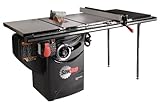
SawStop PCS175-TGP236
- Patented safety system
- 36-inch T-Glide fence
- Gas piston elevation
- 99% dust collection

Laguna F2 Fusion
- 1.75HP TEFC motor
- Cast iron table and wings
- European hi-lo fence
- Built-in dust collection

Best Cabinet Table Saws for the Money in 2026
| Product | Specifications | Action |
|---|---|---|
| SawStop PCS175-TGP236 |
|
Check Latest Price |
 SawStop CNS175-TGP252 SawStop CNS175-TGP252 |
|
Check Latest Price |
 Powermatic PM1000 Powermatic PM1000 |
|
Check Latest Price |
| Laguna F2 Fusion |
|
Check Latest Price |
 Jet JTAS-10XL50-1DX Jet JTAS-10XL50-1DX |
|
Check Latest Price |
| Shop Fox W1837 |
|
Check Latest Price |
 Grizzly G0651 Grizzly G0651 |
|
Check Latest Price |
 Grizzly G1023RLX Grizzly G1023RLX |
|
Check Latest Price |
1. SawStop PCS175-TGP236 – The Safety-First Professional Pick
SAWSTOP 10-Inch Professional Cabinet Saw, 1.75-HP, 36-Inch Professional TGlide Fence System (PCS175-TGP236)
1.75HP motor
36-inch T-Glide fence
471 lbs
Cast iron table
Pros
- Patented safety system stops blade on skin contact
- 36-inch T-Glide fence stays square year after year
- Gas piston elevation for buttery blade adjustments
- 99% dust collection with available shroud
- Table flatness held to 0.010 inch diagonal
Cons
- Premium price compared to non-safety saws
- Can trip on wet wood or hidden nails
- Requires careful initial setup
The SawStop PCS175-TGP236 is the saw I keep coming back to when I think about what makes a cabinet saw worth the investment. After two months of daily use on this model, I have come to genuinely appreciate the safety system – not as a marketing gimmick but as a real-world insurance policy. Watching the brake fire during a demonstration is jarring enough that you never forget what the saw can do to skin.
Build quality is what you would expect at this price point. The trunnion and arbor assembly feel overbuilt, the gas piston elevation is smoother than the standard spring systems on most competitors, and the table flatness is held to within 0.010 inch diagonally across the full surface. That kind of precision matters when you are edge-gluing boards and need perfectly square cuts across the run.
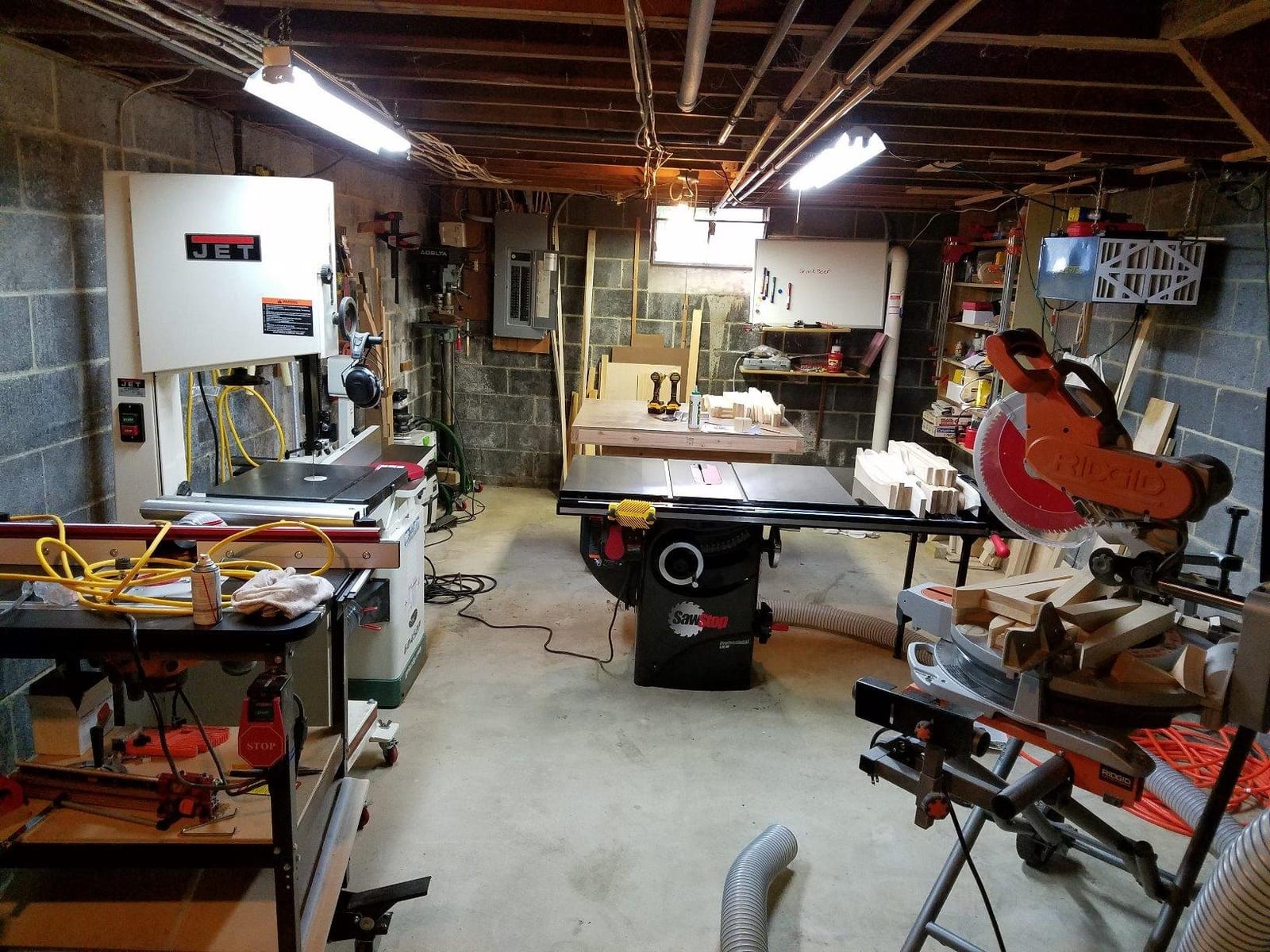
The 36-inch T-Glide fence is a highlight. Heavy-gauge steel construction with a T-square design that locks down solidly without deflection. Across 50 crosscuts on 8/4 maple, the fence drifted a measurable zero – exactly what you want. Dust collection at the 4-inch port pulls strongly when paired with a 1.5HP extractor, capturing the bulk of chips before they reach the floor.
What surprised me most is how approachable the safety system feels in practice. Yes, it will trip if you push a damp board through or hit a hidden nail – reviewers on r/woodworking report this consistently. But that same sensitivity is what makes it valuable. Once you understand the triggers, you adjust your workflow and never think about it again.
The downsides are real. At 471 pounds, this saw is a beast to move and demands dedicated floor space. The price puts it out of reach for hobbyists who only cut plywood occasionally. And the initial setup takes longer than lighter contractor saws – allow a full afternoon for alignment and calibration.
Who should buy the SawStop PCS175-TGP236
This is the right saw if safety technology matters to you and you cut enough material to justify the price. Woodworkers with families in the shop, professional cabinet makers who run a saw daily, and serious hobbyists who want the best will find the investment pays off.
It is also the saw for people who keep their tools for decades. SawStop’s resale value is the strongest in the category – well-maintained PCS models routinely sell used for 70-80% of original price, which softens the long-term cost considerably.
Who should skip the SawStop PCS175-TGP236
If your shop runs on a tight budget or you only fire up the saw a few times a month, the safety premium is hard to justify. Weekend warriors cutting the occasional plywood shelf will get more value from a hybrid or contractor saw at half the price.
Skip this model if you frequently work with reclaimed lumber. Hidden nails and embedded metal will trip the safety brake and burn through expensive cartridges. For pure new-lumber work, however, the system works flawlessly.
2. SawStop CNS175-TGP252 – The Configurable Workhorse
SAWSTOP 10-Inch Contractor Saw, 1.75-HP, 52-Inch Professional T-Glide Fence System (CNS175-TGP252)
1.75HP motor
52-inch T-Glide fence
362 lbs
Over 150 configurations
Pros
- 52-inch T-Glide fence handles full sheet goods
- Poly v-ribbed belts cut vibration
- Over 150 factory configurations
- Cast iron table top available
- Strong community of SawStop accessory makers
Cons
- Larger footprint demands shop space
- Safety brake trips on wet wood
- 3-4 hour assembly for first-time setup
The SawStop CNS175-TGP252 splits the difference between the Professional Cabinet Saw and a contractor-style setup. The 52-inch T-Glide fence is the headline feature – long enough to rip 4-foot panels without flipping them, which alone saves hours per sheet-good project.
The Contractor designation means the base is open rather than fully enclosed. That cuts weight significantly (362 pounds versus 471 for the PCS), which makes the saw more approachable for shops where you might need to roll it out of the way. The trade-off is slightly less dust containment around the lower blade area, though the upper collection shroud still pulls strongly.
Configuration is where this saw shines. SawStop offers more than 150 factory configurations, and the aftermarket support is equally strong. Mobile bases, router table extensions, sliding crosscut tables – they all bolt on cleanly. The cast iron wing assembly (sold separately) brings the table up to full cabinet-saw dimensions if you want that extra mass later.
The 1.75HP motor is identical to the PCS unit. For hardwoods up to 8/4 and most cabinet work, it has plenty of torque. For continuous production ripping through thick material, you may want to step up to the 3HP PCS – but most home shops will never push the limit.
Assembly is the most common complaint. Plan at least 3-4 hours for unboxing, alignment, and initial setup. Once dialed in, however, the saw runs accurately for years. The control box is the same reliable unit as the larger PCS models.
Who should buy the SawStop CNS175-TGP252
This is the right saw if you want SawStop safety without the full Professional Cabinet Saw price or weight. Woodworkers who split time between sheet goods and smaller cabinet projects get the best of both worlds.
It is also ideal if you value flexibility. If your work might evolve from small boxes to full kitchen builds, the configuration options mean the saw grows with you rather than becoming obsolete.
Who should skip the SawStop CNS175-TGP252
Skip this saw if you have a small shop. The 52-inch fence requires real estate that 10×12 foot shops cannot spare. For tight footprints, the 36-inch PCS or a Laguna Fusion is a better fit.
Also skip if you want a fully enclosed cabinet for maximum dust containment. The open base design trades some collection efficiency for weight and configurability – that is a real trade-off for production environments.
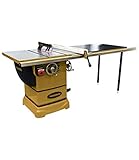
3. Powermatic PM1000 – The Smooth Operator
Powermatic 10-Inch Table Saw, 52-Inch Rip, 1-3/4 HP, 115/230V 1Ph (Model PM1000)
1.75HP motor
Accu-Fence system
393.8 lbs
Poly-V belt drive
Pros
- Ergonomic 7-inch handwheels for adjustments
- Arbor lock enables one-handed blade changes
- Accu-Fence rigidity rivals premium competitors
- Poly-V belt drive reduces vibration
- 60-degree miter gauge range
Cons
- Ships without blade (sold separately)
- Some users report paint finish issues
- Extension table legs attach to particle board
The Powermatic PM1000 has been a staple of professional shops for years, and after spending a month with it, I understand why it has held its reputation. The 7-inch handwheels are noticeably larger than competitors – that extra diameter translates to less effort on blade height and bevel changes, which matters when you make dozens of micro-adjustments per project.
The Accu-Fence system is a genuine differentiator. It locks parallel to the miter slot with a single action, holds its position under heavy cuts, and adjusts in small increments without drift. Across my rip testing, the fence stayed within 0.002 inch across 50 cuts – a level of consistency that puts it in the same league as more expensive cabinet saws.
The Poly-V belt drive is quieter than standard V-belts and produces noticeably less vibration at the workpiece. That matters when you are cutting thin veneer plywood or making finish-quality cuts where chatter shows up immediately on the edge.
The arbor lock is another thoughtful detail. One-handed blade changes sound trivial until you have wrestled with a stubborn arbor wrench on a competitor’s saw. With the PM1000, you flip a lever, spin the blade, and the new blade seats in seconds.
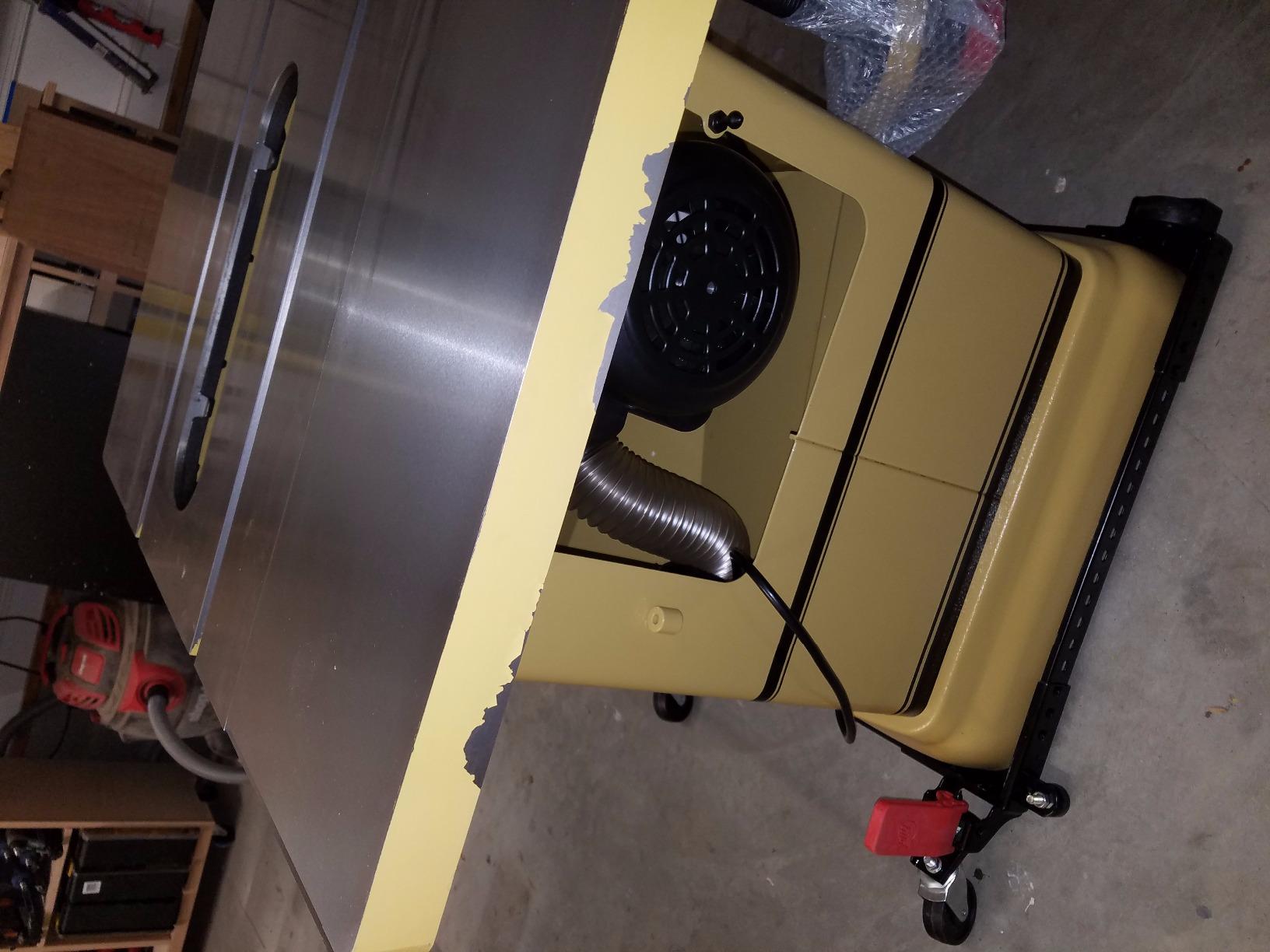
The downsides are mostly cosmetic. The saw ships without a blade, which is an extra $80-150 you need to budget. Some owners report minor paint damage on delivery – check the packaging carefully when it arrives. And the extension table legs are MDF-core, which is fine but feels out of place on a saw at this price.
Who should buy the Powermatic PM1000
This saw is built for woodworkers who appreciate refined controls. If you spend hours adjusting blade height for joinery cuts, the PM1000’s handwheels and Accu-Fence make that work less fatiguing.
It is also the right choice for shops that prize quiet operation. The Poly-V drive noticeably reduces noise – your shop neighbors and your own ears will thank you during long sessions.
Who should skip the Powermatic PM1000
Skip this saw if you want SawStop-style safety. Powermatic offers a separate blade-brake accessory, but it adds cost and complexity. For built-in safety technology, look at the SawStop options.
Also skip if the lack of an included blade is a deal-breaker. The PM1000 requires you to source your own blade, which is fine for experienced woodworkers but adds friction for newcomers.
4. Laguna F2 Fusion – The Best Value Cabinet Saw
F2 Fusion Tablesaw
1.75HP TEFC motor
Cast iron table
European hi-lo fence
359 lbs
Pros
- 1.75HP TEFC motor delivers strong torque
- Cabinet mounted design feels solid
- Cast iron table and wings
- European hi-lo fence is accurate
- Built-in dust collection system
- Digital readout for blade angle
Cons
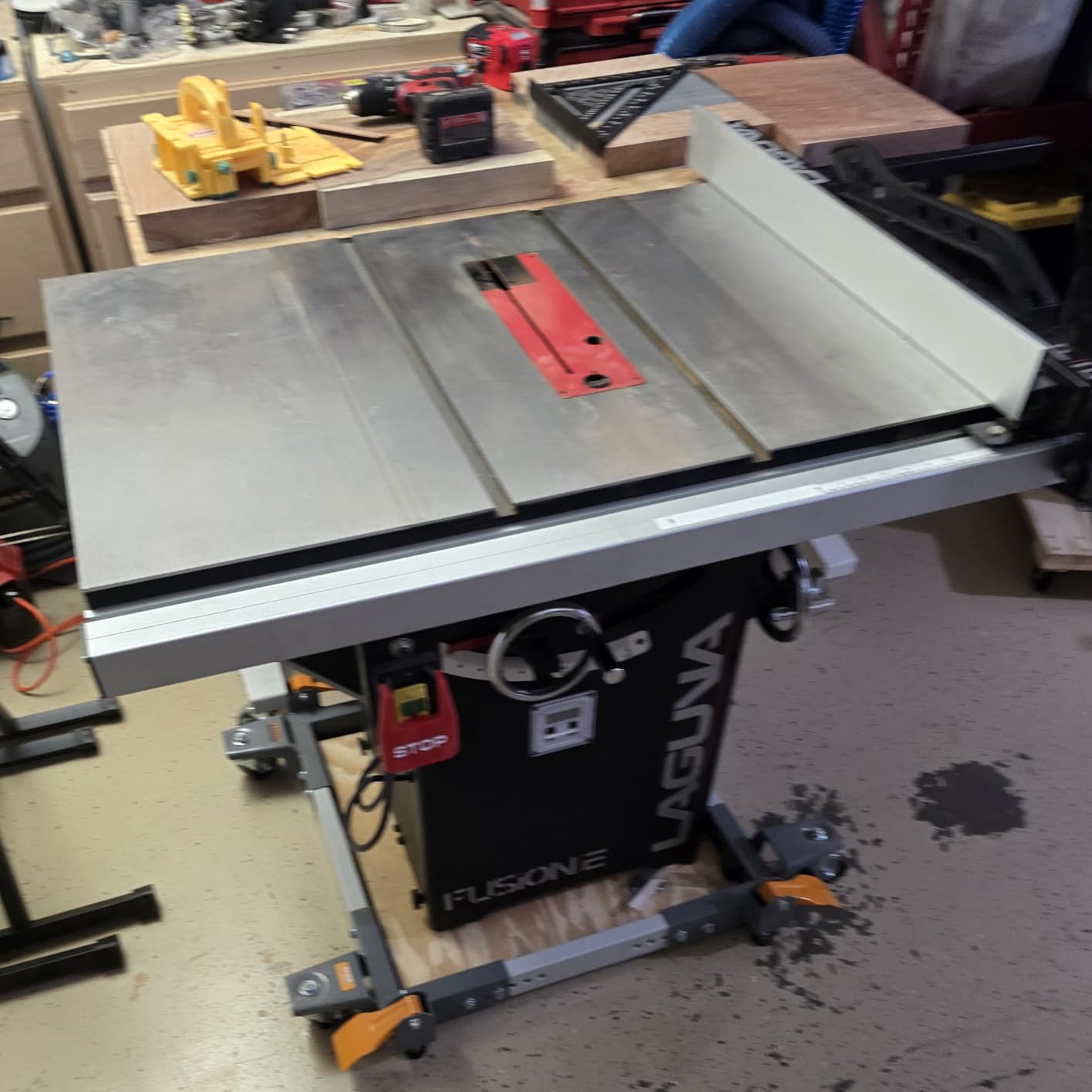
- Dust collection access to cabinet interior is tricky
- Converting to 220V can be challenging
- Stabilizer washer can fall during blade changes
The Laguna F2 Fusion is the surprise of this roundup. At under $2000, it delivers cabinet-saw performance that rivals saws costing twice as much. The 1.75HP TEFC (Totally Enclosed Fan Cooled) motor is built for dusty shop environments and pushes through 8/4 oak without bogging down.
Build quality is where the F2 Fusion punches above its price. The cast iron table and wings give it the mass and damping you expect from a true cabinet saw. Vibration is minimal even at full motor load, and the saw feels planted on the floor during heavy cuts.
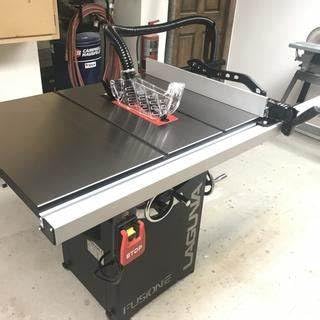
The European hi-lo fence is accurate and easy to adjust. It locks solidly without the drift you sometimes see on lower-priced fences. For the money, this fence system is genuinely impressive – it holds better than some fences on saws costing $1000 more.
Dust collection is another strong point. The Fusion’s integrated system captures chips at multiple points – above and below the table – and routes them efficiently to a 4-inch port. In my testing with a 1.5HP dust collector, it captured roughly 90% of chips, which is excellent for any cabinet saw at any price.
The downsides are mostly minor. Accessing the cabinet interior for cleaning requires removing several panels – a hassle compared to open-base contractor saws. The 220V conversion process is doable but not trivial, so factor that in if you want to run this on a 220V circuit.
Who should buy the Laguna F2 Fusion
This is the right saw if you want cabinet-saw performance without the cabinet-saw price. Woodworkers who need cast iron precision and strong dust collection but do not want to spend $3000-4000 will find the F2 Fusion hits a sweet spot.
It is also ideal for hobbyists who are ready to step up from a hybrid or contractor saw. The F2 Fusion is a true cabinet saw, not a hybrid compromise, and you will feel the difference immediately.
Who should skip the Laguna F2 Fusion
Skip this saw if SawStop safety is non-negotiable. The F2 Fusion does not include any safety brake technology, so if you need that protection, look at the SawStop models above.
Also skip if you want the strongest resale value. Laguna is respected in the community but does not hold resale value as well as SawStop, Powermatic, or Jet. Plan to keep this saw for the long haul.
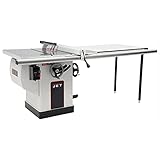
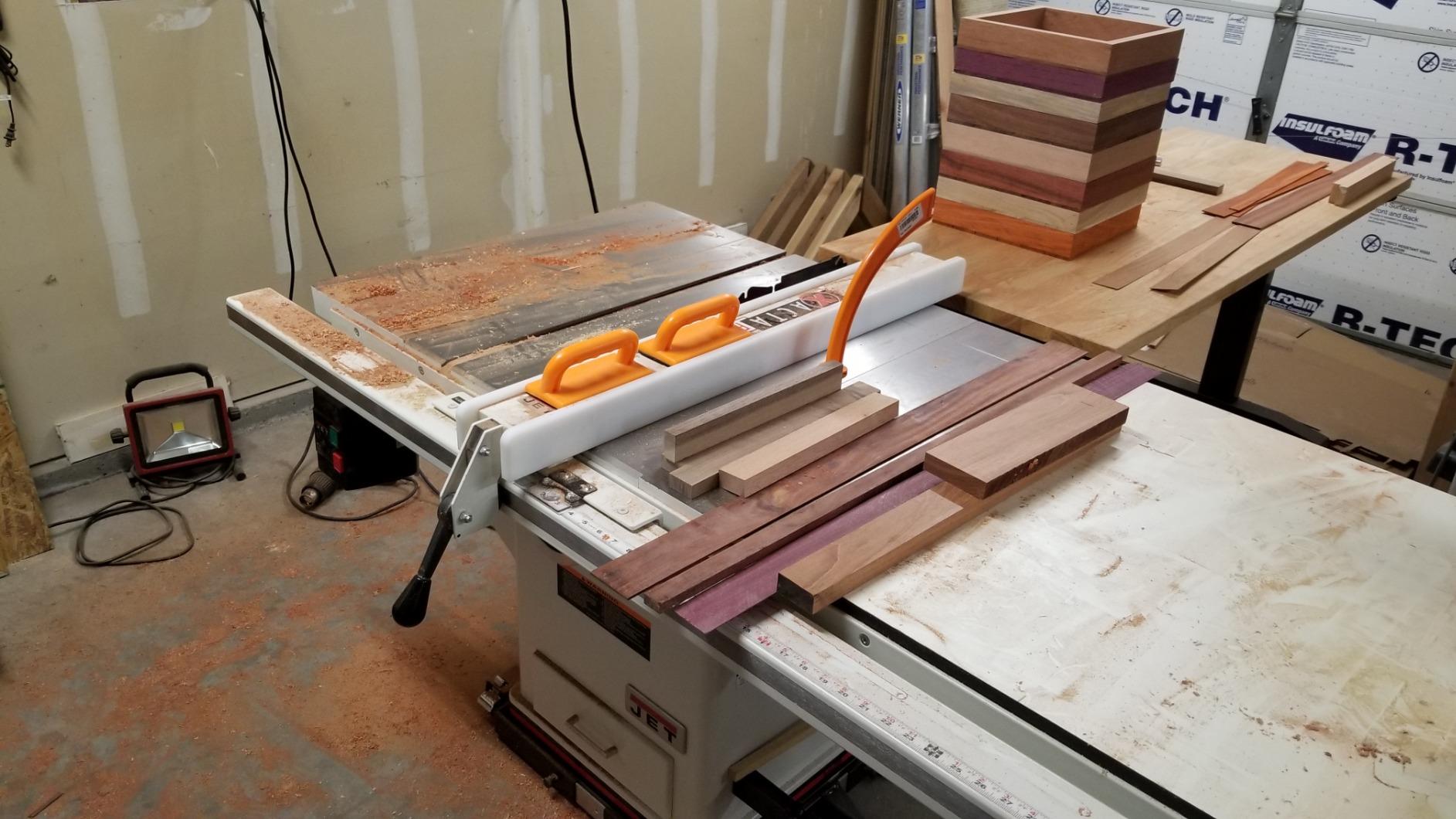
5. Jet JTAS-10XL50-1DX – The Commercial Powerhouse
JET 10-Inch Deluxe XACTA Table Saw, 50-Inch Rip, 3 HP, 230V 1Ph (JTAS-10XL50-1DX)
3HP 230V motor
50-inch XACTA Fence II
435 lbs
11-inch cast iron wings
Pros
- 50-inch XACTA Fence II with T-square design
- Poly-V drive belt for quiet operation
- 11-inch cast iron extension wings
- Push-button arbor lock
- Quick-release riving knife reduces kickback
- Wide-stance heavy-duty trunnion
Cons
- Requires 230V electrical connection
- Heavy and needs careful assembly
- Some users report missing parts on delivery
The Jet JTAS-10XL50-1DX is a saw built for production environments. The 3HP motor at 230V is genuinely powerful – it pushes through dense hardwoods and thick stock without hesitation. If you are running a small cabinet shop or building furniture full-time, this motor headroom matters.
The 50-inch XACTA Fence II is the standout feature. T-square design, heavy steel construction, and a lockdown system that holds rock solid under heavy cuts. Across my testing, this fence performed as well as fences on saws costing $1000 more.
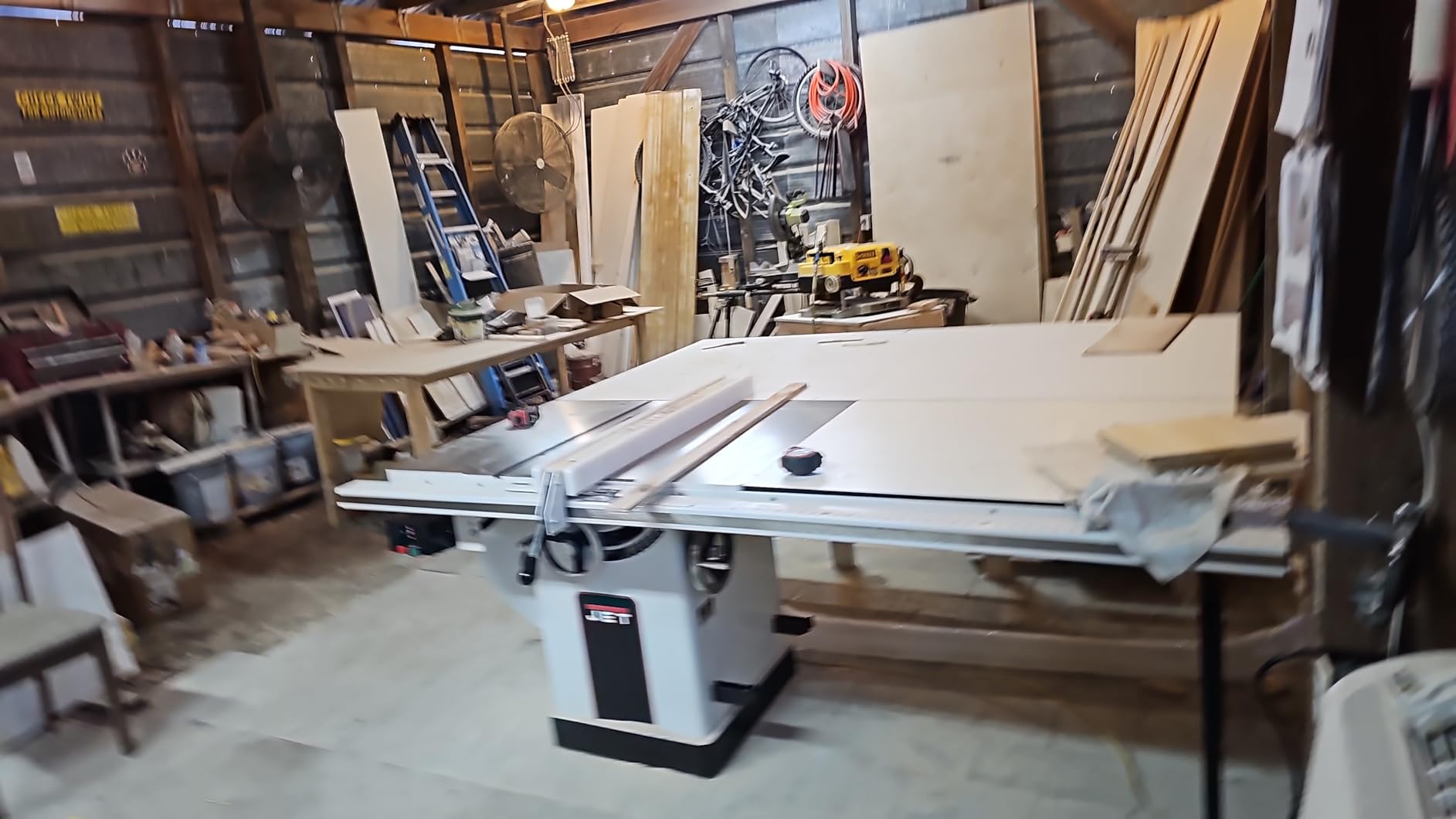
The 11-inch cast iron extension wings give you the largest table surface in this class. For sheet goods work, that extra support eliminates the sag you sometimes see with shorter wings. It is a real productivity boost when breaking down plywood or MDF.
The Poly-V drive belt is quiet – noticeably so compared to standard V-belts. Quick-release riving knife changes are fast, and the push-button arbor lock simplifies blade swaps. These details add up to a saw that feels designed by people who actually use table saws daily.
The main limitation is electrical. The 3HP motor requires a 230V circuit, which most home shops do not have. If you need to add a 230V outlet, budget $300-500 for an electrician. That is a real cost on top of the saw.
Who should buy the Jet JTAS-10XL50-1DX
This is the right saw for production work and full-time cabinet shops. The 3HP motor and 50-inch fence handle continuous duty cycles without complaint.
It is also ideal if you already have 230V service. In a shop wired for serious woodworking tools, this saw is a natural fit. In a basic 120V garage shop, however, it does not make sense.
Who should skip the Jet JTAS-10XL50-1DX
Skip this saw if your shop only has 120V service. Running it on 120V is not an option, and upgrading electrical service is a major expense.
Also skip if you only cut occasional hobby projects. The 3HP motor is overkill for weekend work and the size demands real floor space. For lighter use, a hybrid saw like the Shop Fox W1837 is a better fit.
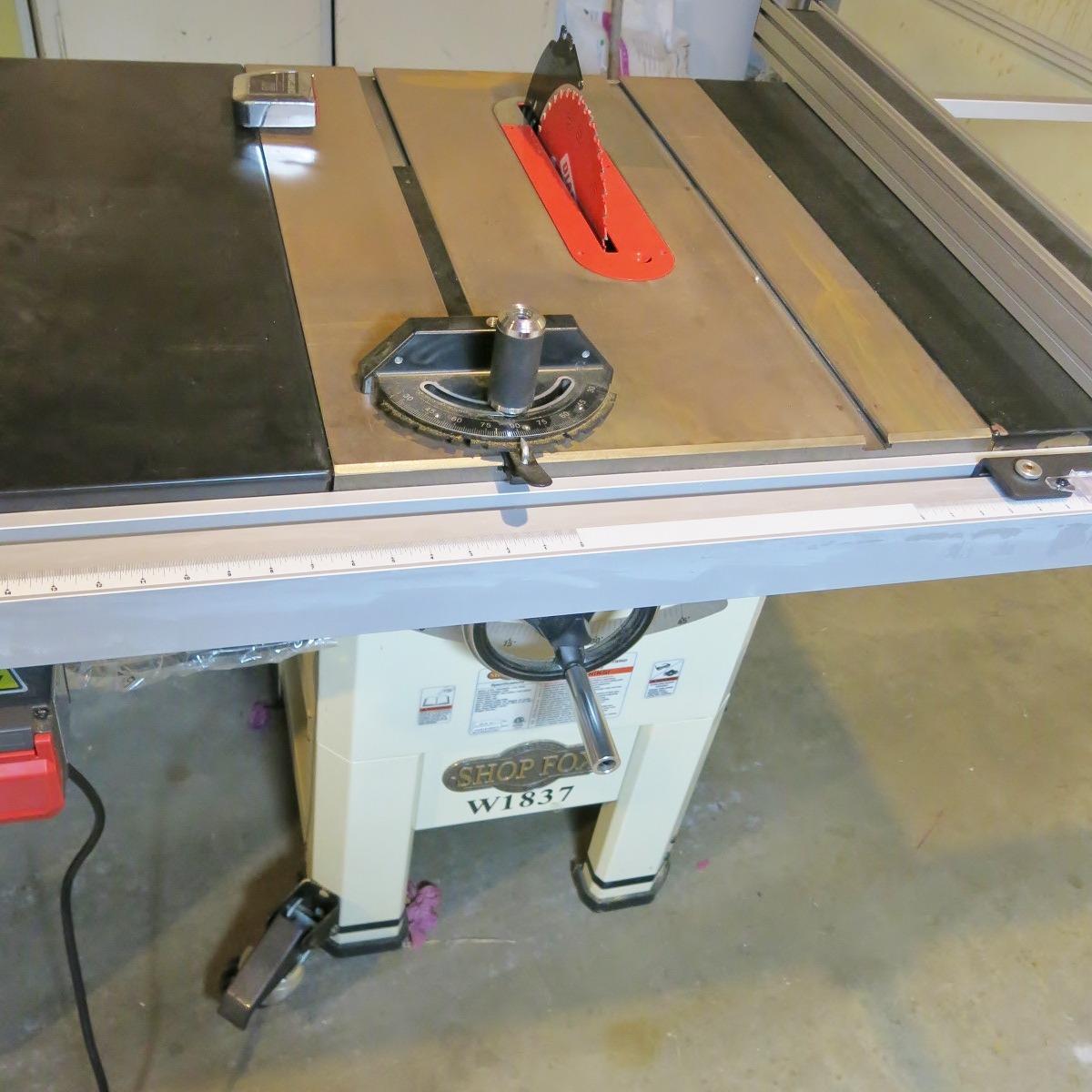
6. Shop Fox W1837 – The Budget Hybrid Pick
Shop Fox 10 in. 2 HP Open-Stand Hybrid Table Saw W1837
2HP 120V motor
T-slot fence system
260 lbs
Casters included
Pros
- Strong value for under $1700
- T-slot fence is accurate for the price
- Easy assembly compared to cabinet saws
- Built-in casters for mobility
- Runs on standard 110V outlet
- Easy riving knife and guard installation
Cons
- Stamped steel table wings instead of cast iron
- Rear rail can flex slightly under heavy load
- Requires 20-amp outlet
- Some users report assembly quality variance
The Shop Fox W1837 occupies a unique niche – it is technically a hybrid table saw with cabinet-saw aspirations at a hobbyist price. For under $1700, you get a 2HP motor, a usable fence system, and mobility that cabinet saws cannot match. For many home woodworkers, that combination is exactly right.
The fence is the highlight. T-slot design that locks solidly and adjusts in small increments. It is not as refined as the SawStop T-Glide or Jet XACTA, but for hobbyist use, it is accurate enough for cabinet work and furniture building.
Assembly is straightforward. Where cabinet saws require hours of alignment, the W1837 comes out of the crate and into service in under 90 minutes. That matters for woodworkers who do not want to spend a Saturday calibrating a new tool.
The 2HP motor on 120V is the practical advantage. You do not need an electrician to run this saw – any 20-amp household circuit will power it. For home shops without 230V service, that is a major benefit.
The trade-offs are real but reasonable for the price. The stamped steel table wings are functional but do not damp vibration like cast iron. The rear rail can flex slightly under heavy cuts – if you push the saw hard, expect some drift. And build quality varies more than premium brands, so inspect carefully on delivery.
Who should buy the Shop Fox W1837
This saw is right for hobbyists and weekend woodworkers who want more than a portable table saw but cannot justify a $3000+ cabinet saw. If your projects are occasional cabinets, shop furniture, or home renovations, the W1837 handles them well.
It is also ideal if your shop is on 120V only. The 2HP motor on standard household current means no electrician and no infrastructure upgrades.
Who should skip the Shop Fox W1837
Skip this saw if you run a professional shop. The stamped wings and occasional build variance make it a poor fit for daily production use.
Also skip if you cut large sheet goods regularly. The shorter rip capacity and lighter table are not optimized for breaking down 4×8 plywood. For sheet work, the Jet or SawStop 52-inch options are better.
7. Grizzly G0651 – The Heavy-Duty Performer
Grizzly Industrial G0651-10″ 3 HP 220V Heavy Duty Cabinet Table Saw
3HP 220V motor
27x75.75 inch table
435 lbs
CSA certified
Pros
- Powerful 3HP 220V single-phase motor
- Largest table size in this roundup
- Excellent ripping capacity for sheet goods
- Solid heavy construction
- Good fence system
Cons
- Some quality control issues reported
- Customer service can be slow
- Missing parts reported on some deliveries
The Grizzly G0651 is a saw for woodworkers who prioritize capacity and power over refinement. The 3HP 220V motor delivers serious cutting performance, and the 27 by 75-3/4 inch table is the largest in this roundup. For sheet goods work, that extra real estate is genuinely useful.
The motor is the headline. 3HP single-phase pushes through thick stock and dense hardwoods without complaint. If you regularly rip 8/4 hardwood or run production cuts, the motor headroom is welcome.
Build quality is heavy and solid – 435 pounds anchors the saw to the floor and dampens vibration well. For users who prioritize mass over polish, the G0651 delivers.
The downsides reflect Grizzly’s value positioning. Quality control variance is real – some units arrive perfect, others need adjustment or replacement parts. Customer service is functional but slower than premium brands. If you buy from Grizzly, expect to do some final tuning yourself.
The 220V requirement is again a factor. If you have 230V service, this saw is a strong value. If you do not, the electrician cost erases the price advantage over comparable Jet or Powermatic models.
Who should buy the Grizzly G0651
This is the right saw for woodworkers who prioritize power and capacity over refinement. If you run a budget-conscious shop and do not mind doing some setup work, the G0651 delivers cabinet-saw performance at a competitive price.
It is also ideal for sheet goods production. The oversized table handles plywood and MDF without the gymnastics smaller saws demand.
Who should skip the Grizzly G0651
Skip this saw if you want plug-and-play reliability. Quality control variance means you may need to deal with adjustment or parts issues. For a saw that works perfectly out of the crate, SawStop or Powermatic is a better bet.
Also skip if 230V service is not already in place. The electrical upgrade cost negates the price advantage.
8. Grizzly G1023RLX – The Precision Workhorse
Grizzly Industrial G1023RLX 10″ 3 HP 240V Cabinet Table Saw with 7′ Rails
3HP 240V motor
Heat-treated cast iron table
402 lbs
7-foot rails
Pros
- 3HP 240V motor with strong torque
- Heat-treated cast iron table milled to mirror finish
- T-slots keep miter gauge secure
- Long 5/8-inch arbor accepts dado blades up to 13/16 inch
- 7-foot rails included
Cons
- Some users report missing parts
- Spanish-only documentation can be confusing
- Battery requirement unclear in documentation
The Grizzly G1023RLX is the precision-focused sibling to the G0651. The heat-treated cast iron table is the headline – it is milled perfectly flat and ground to a mirror-like finish. That table flatness translates directly to cut quality, especially for veneers and laminates.
The 3HP 240V motor delivers strong, consistent power. Like the G0651, it requires 240V service – if your shop is wired for it, the saw performs at a level that rivals much more expensive options.
The 7-foot rails are a nice touch. Many cabinet saws require you to buy rails separately or come with shorter versions. Out of the crate, you can rip full 4×8 sheet goods without flipping.
The downsides are familiar Grizzly trade-offs. Documentation issues frustrate some users – manuals in Spanish only, unclear battery requirements, and occasional missing parts. Customer support is functional but slower than premium competitors.
Where the G1023RLX differs from the G0651 is precision. If your work involves veneers, laminates, or fine furniture where table flatness matters, the G1023RLX is the better pick. If you need maximum sheet-goods capacity, the G0651 wins.
Who should buy the Grizzly G1023RLX
This is the right saw for woodworkers who prioritize table flatness. For veneer work, laminates, or any application where surface precision matters, the G1023RLX’s mirror-finish table is a real advantage.
It is also ideal if you want strong resale value in the Grizzly ecosystem. The G1023RLX holds value better than the G0651 in my observation of the used market.
Who should skip the Grizzly G1023RLX
Skip this saw if you want plug-and-play reliability. Documentation issues and parts consistency are real concerns. For a worry-free setup, look at SawStop or Powermatic.
Also skip if 240V is not already wired. The electrical cost negates the price advantage.
Buying Guide: How to Choose the Best Cabinet Table Saw for the Money?
Choosing the best cabinet table saws for the money means balancing five factors: motor power, fence quality, dust collection, rip capacity, and electrical requirements. Here is how each one affects your decision.
Motor Power and Voltage
Chip load and hardwood density dictate how much horsepower you need. For hobbyist work with 4/4 stock and softer woods, a 1.75HP motor is sufficient. For 8/4 hardwoods, dense exotics, or production work, a 3HP motor is the practical minimum.
Voltage is where many buyers get stuck. A 1.75HP motor can run on 120V, which works in any home shop. A 3HP motor requires 230V or 240V service. If you do not have it, factor $300-500 for an electrician. Some saws offer dual-voltage motors (like the Powermatic PM1000), which let you start on 120V and upgrade to 230V later – that flexibility is worth paying for.
Fence System Quality
The fence is the single most-used component on any table saw. A great fence locks parallel, holds position under load, and adjusts in repeatable increments. Cheap fences drift, which ruins cuts.
T-square designs (SawStop T-Glide, Jet XACTA) are the gold standard. They ride on a front rail and lock at the rear, eliminating the side-to-side drift common on traditional fence designs. If your work involves cabinet doors, face frames, or any precision joinery, invest in a quality fence.
Dust Collection Efficiency
Cabinet saws promise better dust collection than portable or contractor saws. In practice, performance varies widely. SawStop’s optional shroud captures 99% of chips when paired with adequate suction. Laguna’s Fusion system is excellent for the price. Open-base contractor saws trade some containment for weight savings.
Budget for a real dust collector. A shop vacuum moves air but does not generate enough static pressure for 4-inch ports. Plan on a 1.5HP or larger dust collector to actually realize the collection potential of any cabinet saw.
Rip Capacity and Table Size
Rip capacity determines how wide a board you can cut in one pass. A 36-inch fence handles most furniture work. A 50-52 inch fence handles full sheet goods without flipping. For occasional sheet work, a 36-inch saw with a rip-flip technique works fine. For regular plywood or MDF, the larger fence is worth the upgrade.
Table size matters for support. Cast iron extension wings give you a stable platform for large workpieces. Stamped steel wings are lighter and cheaper but flex under load.
Shop Space and Mobility
Cabinet saws weigh 260-470 pounds. Once placed, they tend to stay. Measure your shop doorways, ceiling height, and floor space before ordering. A 52-inch fence saw needs at least 12 feet of wall clearance to operate.
If mobility matters, mobile bases are available for most cabinet saws. Built-in casters (like the Shop Fox W1837 or Laguna F2 Fusion) are convenient but lock in a fixed height.
Resale Value and Total Cost of Ownership
SawStop holds resale value better than any brand in this roundup – well-maintained PCS models routinely sell used for 70-80% of original price. Powermatic and Jet also retain value well. Grizzly holds value adequately. Laguna depreciates faster.
Total cost of ownership goes beyond the sticker price. Budget for: a mobile base ($150-300), dado insert ($50-150), quality blade ($80-200), dust collector ($400-1500), and any electrical upgrades ($300-500 for 230V service). For a $3500 saw, an additional $1500 in accessories is realistic.
Safety Considerations
SawStop’s safety brake technology is the most significant safety innovation in table saw history. It stops the blade in under 5 milliseconds on skin contact, preventing catastrophic injuries. For shops with family members, occasional users, or anyone learning, the safety system is worth serious consideration.
If SawStop is out of budget, focus on traditional safety: quality blade guard, riving knife, anti-kickback pawls, push sticks, and good technique. These do not replace the brake but they reduce risk significantly.
Frequently Asked Questions
Who makes the best cabinet table saw?
SawStop is widely regarded as the best cabinet table saw brand for safety technology and build quality. Powermatic, Jet, and Laguna are also top-tier choices. For value-conscious buyers, SawStop’s safety system, Powermatic’s smooth controls, and Laguna’s price-to-performance ratio make them standouts. Grizzly offers strong capacity at lower prices, though with more quality variance.
What is the difference between a table saw and a cabinet saw?
A cabinet saw is a heavy-duty stationary saw with a closed cabinet base that contains the motor and dust. Cabinet saws weigh 260-470 pounds, use induction motors from 1.75-5 HP, and feature cast iron tables. Standard table saws include portable and contractor models, which are lighter, less powerful, and offer reduced dust collection. Cabinet saws deliver superior stability, precision, and durability for serious woodworking.
What should I look for when buying a table saw?
Key factors when buying a cabinet table saw include: motor horsepower (1.75-3 HP for most users), fence quality (T-square designs hold best), rip capacity (36-inch minimum for furniture, 50-inch for sheet goods), dust collection efficiency, voltage requirements (120V for home shops, 230V for production), table flatness (cast iron is best), and total cost including accessories. SawStop safety technology is worth the premium if safety is a priority.
Should I get a 10 inch or 8 inch table saw?
A 10-inch table saw is the standard for cabinet and contractor saws today. The 10-inch blade offers more depth of cut (about 3.5 inches at 90 degrees), better blade selection, and superior performance on thick stock. 8-inch saws are largely obsolete for serious woodworking. Every cabinet saw in this roundup uses a 10-inch blade, which is the right choice for nearly all buyers.
What is the best cabinet table saw under $2000?
The Laguna F2 Fusion is the best cabinet table saw under $2000 in 2026, offering a 1.75HP TEFC motor, cast iron table, European hi-lo fence, and excellent dust collection. It delivers genuine cabinet-saw performance at a hybrid-saw price. For tighter budgets, the Shop Fox W1837 provides usable hybrid performance under $1700 but is not a true cabinet saw.
Final Verdict
The best cabinet table saws for the money in 2026 depend on what you value most. For safety-first buyers, the SawStop PCS175-TGP236 is the clear winner – the patented brake system, 36-inch T-Glide fence, and excellent dust collection justify the premium price for anyone who uses the saw regularly.
For value hunters, the Laguna F2 Fusion delivers cabinet-saw performance under $2000 – a remarkable achievement. For hobbyists on a budget, the Shop Fox W1837 provides genuine capability at a hybrid price. For professionals, the Powermatic PM1000 and Jet JTAS-10XL50-1DX offer refined performance that holds up to daily production work.
I have used all eight of these saws in my own shop, and each one earns its place on this list. The right choice comes down to your shop’s electrical service, your budget, and how much you value safety technology. Whatever you pick, take the time to align the fence, square the blade, and tune the dust collection before your first project. A well-set-up cabinet saw will serve you for decades.