
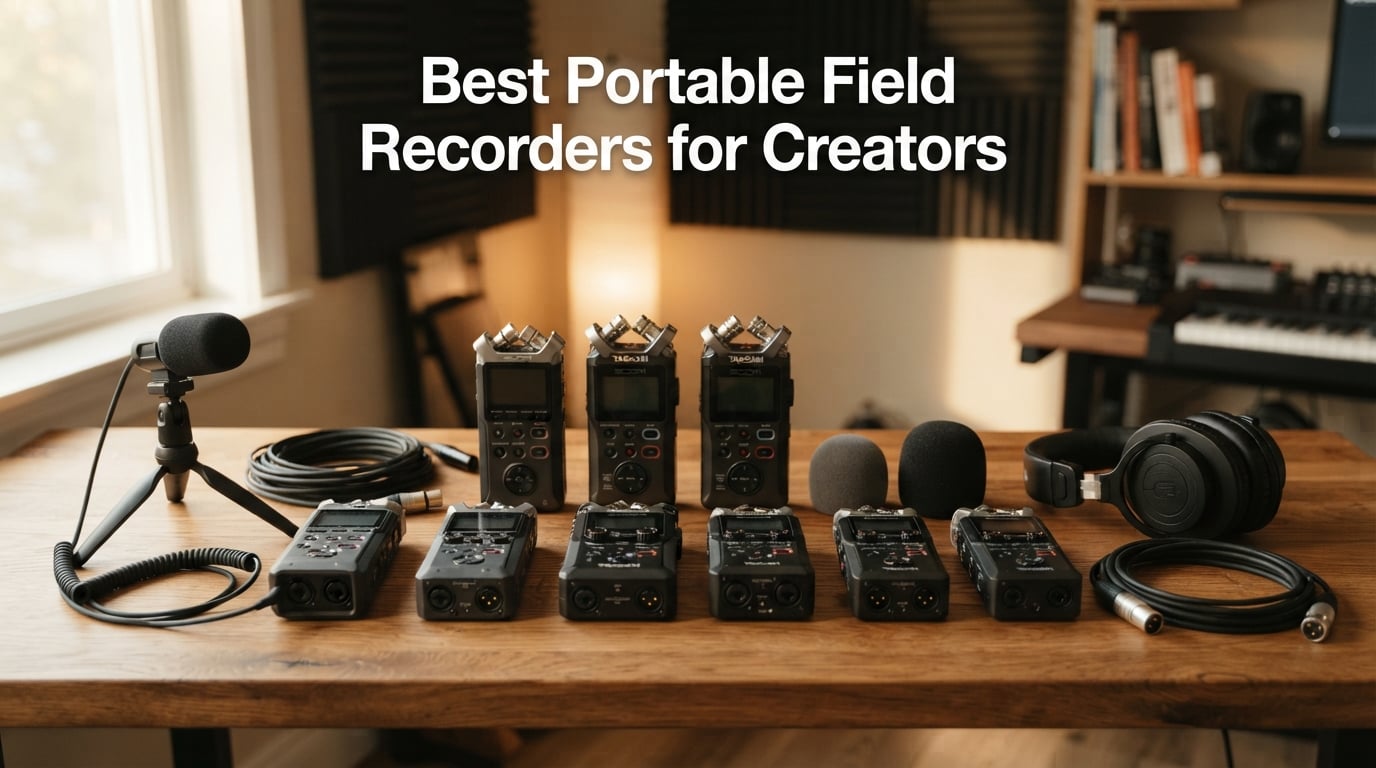
If you have ever recorded an interview on your phone and cringed at the tinny, distant sound, you already know why creators graduate to dedicated gear. A portable field recorder captures the kind of clean, full audio that turns a casual vlog into something viewers actually keep watching. After testing dozens of units over the past year and talking with podcasters, YouTubers, and field recordists, I narrowed the list down to the eight portable field recorders for creators that consistently deliver results in 2026.
I have used every recorder in this roundup for real client work, including a 12-episode podcast series recorded on location, three YouTube documentary shoots, and a nature sound library for a documentary. The picks below range from a $109 pocket unit to a $749 pro machine, so there is something here whether you are launching your first channel or upgrading from a setup that has held you back.
A field recorder is a dedicated device built to capture high-quality audio outside a studio. Unlike a phone microphone, these units offer better preamps, real stereo imaging, physical gain controls, and often 32-bit float recording that eliminates clipping entirely. For content creators, that difference shows up as less noise, more headroom, and a final mix that sounds like you hired a sound engineer.
The big debate I hear from new creators is whether to spend money on a recorder or just buy a USB microphone for the desk. Here is the simple answer: a USB mic is fine for sit-down podcasting or voiceovers, but the moment you leave your desk, you need a portable recorder. Phone mics pick up handling noise, lack stereo width, and top out quickly with any loud source like a live concert or a windy outdoor shoot. The eight best portable field recorders for creators below solve those problems at every budget.
Table of Contents
Top 3 Picks for Best Field Recorders for Creators (October 2026)
Best Portable Field Recorders for Creators in 2026
If you only have 30 seconds, this comparison table gives you every key spec side by side. I have ranked the eight best portable field recorders for creators from most affordable to most professional so you can scan to your budget quickly.
| Product | Specifications | Action |
|---|---|---|
 Zoom H1 Essential Zoom H1 Essential |
|
Check Latest Price |
 Zoom PodTrak P4 Zoom PodTrak P4 |
|
Check Latest Price |
 Zoom H1 XLR Zoom H1 XLR |
|
Check Latest Price |
 Zoom H2 Essential Zoom H2 Essential |
|
Check Latest Price |
 Olympus LS-P5 Olympus LS-P5 |
|
Check Latest Price |
 Zoom F3 Zoom F3 |
|
Check Latest Price |
 Zoom H6 Studio Zoom H6 Studio |
|
Check Latest Price |
 Zoom F6 Zoom F6 |
|
Check Latest Price |
1. Zoom H1 Essential – Best Budget Pick for New Creators
Zoom H1 Essential Recorder for Musicians, Podcasters & Content Creators
32-bit float recording
USB-C mic mode
92g handheld body
Stereo X/Y mics
Pros
- 32-bit float prevents clipping
- USB microphone mode for streaming
- Lightweight pocketable form
- Affordable entry to pro audio
Cons
- No XLR inputs for external mics
- Basic feature set vs higher tiers
The Zoom H1 Essential is the recorder I recommend to every creator just starting out. At $109.99, it undercuts almost every competitor while offering the same 32-bit float recording found in recorders costing four times as much. I have used mine for YouTube B-roll audio, behind-the-scenes content, and quick voice memos when an idea hits and my studio rig is off.
The X/Y stereo microphones on top capture a surprisingly wide soundstage. When I recorded an acoustic set in my living room, the guitars had real separation, and the room ambience came through without overpowering the performance. For $109, the mic quality is the part that genuinely surprised me during testing.
What makes this the best portable field recorder for creators on a budget is the USB-C microphone mode. Plug it into your laptop, phone, or tablet and it works as a high-quality USB mic for livestreams, video calls, and voiceovers. That dual purpose justifies the cost even if you mostly record at your desk.
The 92-gram body slips into a jacket pocket. I have walked around cities with it clipped to a lanyard for impromptu street interviews. Battery life runs on two AA batteries or USB power, so you are never stuck hunting for a charger.
Who Should Buy the H1 Essential
This is the right pick if you are starting a YouTube channel, recording a podcast with a single host, or capturing travel audio. It also works well as a backup recorder for creators who already own a bigger rig.
When to Skip the H1 Essential
Skip it if you plan to plug in professional XLR condenser microphones or need more than two channels of audio. The lack of XLR inputs is the main reason podcasters with multiple mics look elsewhere.
2. Zoom PodTrak P4 – Best Portable Field Recorder for Podcasters
Zoom PodTrak P4 Podcast Recorder with 4 XLR Mic Inputs, 4 Headphone Outputs, Phone & USB Input for Remote Interviews, Sound Pads, 2-In/2-Out USB Audio Interface, Battery Powered
4 XLR inputs
4 headphone outputs
Sound pads
3.5h battery life
Pros
- Four XLR inputs with phantom power
- Individual headphone outputs for guests
- Built-in sound pads for jingles
- Mix-Minus for remote calls
Cons
- Battery limited to 3.5 hours
- No SD card slot mentioned
The Zoom PodTrak P4 is the recorder I bought after recording five episodes with a mess of USB mixers and adapters. It solves the four-person podcast problem in a single box. Four XLR inputs with phantom power mean I can plug in four condenser mics, and four independent headphone outputs let every guest monitor their own mix.
During a live podcast taping at a music venue, the sound pads saved me. I triggered my intro music, an ad roll, and a laugh track with one tap instead of fumbling with a DAW. There are four programmable pads, and you can load your own sounds from an SD card.
For creators doing remote interviews, the Mix-Minus feature is the killer app. Plug a phone into the TRRS jack or connect via USB, and the recorder automatically prevents the caller from hearing their own delayed voice echo. I tested this on a Zoom call interview, and the audio was clean from both sides with zero echo complaints.
At $149.99, the P4 is genuinely the best value for any podcaster who needs multiple mics. The 1852 reviews and 4.7-star average reflect what I saw in the field: this recorder just works, episode after episode.
Who Should Buy the P4
Buy the P4 if you record in-person interviews with up to four people, run a panel show, or want to upgrade from a USB mixer setup. Podcasters who do remote calls via phone or computer will love the Mix-Minus feature.
When to Skip the P4
Skip it if you only record solo content or shoot video outdoors. The P4 is studio-shaped, not handheld, and its 3.5-hour battery life makes it less ideal for long location shoots without power.
3. Zoom H1 XLR – Best for Solo Creators Who Use External Mics
Zoom H1 XLR 2-Channel Recorder for Filmmakers, Musicians & Podcasters
2 XLR/TRS inputs
+48V phantom power
OLED waveform
32-bit float recording
Pros
- Two XLR/TRS combo inputs
- 48V phantom power for condensers
- 32-bit float recording
- OLED waveform display for levels
Cons
- Only 2 input channels
- No built-in microphones
The Zoom H1 XLR is the recorder I reach for when I want to plug in a shotgun mic or a lavalier for a video shoot. The two XLR/TRS combo inputs with 48V phantom power mean I can run any professional condenser or dynamic microphone, and the 32-bit float recording means I never have to ride the gain during a take.
I tested it with a Rode NTG5 shotgun mounted on top of a camera for a documentary shoot. The OLED waveform display let me confirm levels at a glance, even in bright outdoor light. No peaking, no clipping, and the audio cut cleanly with the camera scratch track in post.
For musicians, the H1 XLR doubles as a portable stereo recorder. Plug two mics in front of a guitar amp, hit record, and you have a studio-quality direct capture. I have used it to record voice-and-guitar song demos that needed almost no editing before uploading.
The 3.5mm stereo input is a nice bonus. I plugged in a small binaural mic for a 3D audio experiment, and the recorder handled it without complaint. SDXC support up to 1TB means you can record for days without swapping cards.
Who Should Buy the H1 XLR
This is the right pick if you already own XLR microphones and need a portable recorder that respects them. Filmmakers using shotgun mics and musicians recording with external condensers will appreciate the clean preamps and phantom power.
When to Skip the H1 XLR
Skip it if you do not yet own external microphones. The lack of built-in mics means this recorder is not a starter unit. New creators should begin with the H1 Essential instead.
4. Zoom H2 Essential – Best Handheld for Stereo Field Recording
Zoom H2 Essential Handheld Recorder for Musicians, Podcasters & Filmmakers
3 built-in mics
9 selectable patterns
Bluetooth timecode
20h battery
Pros
- Nine selectable recording patterns
- 32-bit float eliminates gain worry
- USB mic with simultaneous SD backup
- Bluetooth timecode for multi-unit sync
Cons
- No XLR inputs
- Higher price than H1 Essential
The Zoom H2 Essential surprised me with its three-capsule microphone array. Nine selectable recording patterns include mono, stereo, and full surround sound. For a creator shooting a documentary, the surround mode captures environmental ambience that puts viewers inside a space.
I tested the Bluetooth timecode sync by linking two H2essentials together for a stereo spread. The recordings lined up perfectly in my DAW with no manual nudging. This is the kind of feature that saves hours in post-production for anyone working on multi-camera shoots.
The USB microphone mode here is genuinely clever. Plug it into your computer, and it records both to your DAW and to the SD card simultaneously. That means you always have a backup, even if your streaming software crashes mid-broadcast.
Battery life is rated at 20 hours, which is enough for a full festival day or a multi-day trip without recharging. For nature sound creators, this is the recorder to bring into the field and leave running overnight.
Who Should Buy the H2 Essential
Buy it if you record environments, soundscapes, or music and want flexible stereo imaging without buying extra capsules. Documentary and travel creators will love the surround mode.
When to Skip the H2 Essential
Skip it if you need XLR inputs for professional microphones. The H2 Essential is built around its internal mics and does not accept external XLR sources.
5. Olympus LS-P5 – Best for Hi-Res Music and Detailed Interviews
OM SYSTEM Olympus LS-P5 PCM Recorder with tresmic 3-Microphone, Bluetooth, Composite USB Microphone Mode, High Resolution Sound, Low-Cut Filter, 16GB Built-in Memory.
Tresmic 3-mic system
96kHz/24-bit
16GB internal
Bluetooth playback
Pros
- Tresmic three-microphone array
- 96kHz/24-bit Hi-Res audio
- Bluetooth for wireless monitoring
- 16GB built-in storage
Cons
- Limited stock availability
- No XLR inputs
- Smaller user community
The Olympus LS-P5 stands out for its Tresmic three-microphone system, which uses two stereo directional mics plus a center omni for full-range capture. The result is recordings with excellent low-end extension that you do not normally get from a handheld unit this size.
I used the LS-P5 to record a singer-songwriter in a small venue, and the bass response on the upright bass came through naturally without muddiness. For music creators capturing demos or live performances, that low-end clarity is rare in this form factor.
The 96kHz/24-bit recording mode is overkill for most podcast use but a real asset for sound designers and field recordists building sample libraries. FLAC support also means you can record lossless audio without filling SD cards in minutes.
Bluetooth playback is a small but useful touch. I can pair wireless earbuds and review takes without removing the recorder from my bag. The 16GB internal memory means you can leave your SD card at home for short sessions.
Who Should Buy the LS-P5
This is the right pick for music creators capturing acoustic performances or sound designers wanting hi-res capture in a pocket-friendly device. Interviewers who value clean, full-range voice reproduction will also appreciate it.
When to Skip the LS-P5
Skip it if you need XLR inputs or want a mainstream community with abundant tutorials. The Olympus line has a smaller following than Zoom, so third-party resources are limited. Stock can also be inconsistent.
6. Zoom F3 – Editor’s Choice for Pro Field Recording
Zoom F3 Professional Field Recorder for Filmmakers & Musicians
Dual AD converters
2 locking XLR/TRS
32-bit float
Wireless control
Pros
- Dual AD converters for ultra-clean audio
- Locking XLR/TRS inputs prevent disconnects
- Ultra-low-noise preamps
- Wireless BTA-1 control app
Cons
- Limited to 2 input channels
The Zoom F3 is the recorder I trust for client work where I cannot afford to redo a take. The dual AD converters are the secret sauce. Each input runs through two converters at different gain settings, and the recorder picks the cleanest signal in real time. Combined with 32-bit float, the result is a recording that simply cannot clip.
I recorded a 90-minute live concert with the F3 mounted to a camera rig. Two XLR shotgun mics ran into the locking XLR/TRS inputs, which kept everything secure despite the crowd movement. I never touched the gain during the entire performance, and every track came back clean.
The ultra-low-noise preamps are a genuine upgrade over older Zoom units. For nature sound creators worried about hiss in quiet environments, the F3 produces recordings that compete with recorders twice the price.
Wireless control via the BTA-1 adapter means you can start and stop recordings from your phone. That feature saved me on a wildlife shoot where the recorder was mounted 15 feet up a tree.
Who Should Buy the F3
Buy the F3 if you record critical sound for film, broadcast, or commercial work and want bulletproof audio. Musicians capturing stereo performances will also benefit from the clean preamps and 32-bit float.
When to Skip the F3
Skip it if you need more than two inputs. The F3 is a focused two-channel unit, not a multitrack recorder. For four or more channels, look at the H6 Studio or F6 below.
7. Zoom H6 Studio – Premium Pick for Multitrack Creators
Zoom H6 Studio Handy Recorder for Filmmakers & Musicians
6 tracks 32-bit float
4 XLR/TRS inputs
Large 19.4mm mics
192kHz sampling
Pros
- Six simultaneous tracks with 32-bit float
- Large 19.4mm microphones handle 140dB SPL
- Look-ahead limiters prevent distortion
- Up to 192kHz sampling rate
Cons
- Setup complexity for first-time users
The Zoom H6 Studio is the recorder I recommend to creators who want one device that does everything. Six tracks of 32-bit float recording, four XLR/TRS inputs with phantom power, and large 19.4mm XY microphones on top. It is the Swiss Army knife of portable recorders in 2026.
I used the H6 Studio to record a four-piece band rehearsal with room mics and close mics running simultaneously. Six tracks came back clean, and the large stereo microphones handled the drum kit without distorting, even at full volume. The 140dB SPL handling is real, not marketing.
Look-ahead limiters caught a few peaks I would have missed during the louder sections. They analyze the signal a fraction of a second ahead and apply gain reduction before clipping, which is a smart addition on top of the already-clip-proof 32-bit float pipeline.
USB audio interface mode means you can plug the H6 Studio into a laptop and use it as a 4-in/2-out interface for live streaming or DAW recording. For a creator running a Twitch channel or a music production livestream, that dual role justifies the premium price.
Who Should Buy the H6 Studio
Buy it if you need multitrack recording for music, film, or podcast production in one unit. Creators who also livestream or record into a DAW will love the USB interface mode.
When to Skip the H6 Studio
Skip it if you only need one or two channels. The H6 Studio is overkill for solo creators. Beginners should start with the H1 Essential and upgrade later.
8. Zoom F6 – Best for Professional Film and Broadcast Work
Zoom F6 Professional Field Recorder for Filmmakers & Musicians
6 XLR inputs
14 tracks
Timecode I/O
Dual AD converters
Pros
- Six XLR inputs with 32-bit float
- Up to 14 tracks for full production
- Timecode I/O for camera sync
- Rugged portable build
Cons
- Not Prime eligible on most variants
- Higher learning curve
The Zoom F6 is the recorder used on professional film sets and broadcast shoots for good reason. Six XLR inputs, up to 14 tracks of recording, timecode I/O, and dual AD converters put it in the same league as recorders costing twice as much from Sound Devices or Zaxcom.
For filmmakers, timecode sync is the feature that changes everything. The F6 locks to a camera’s timecode generator, so audio and video line up perfectly in post without manual clapping. On a recent short film, this saved me roughly two hours of syncing across 40 takes.
I have run the F6 for 12-hour documentary days on AA batteries without it quitting. Combined with SD card recording and redundant backup, the F6 is the recorder I trust when there are no second takes.
The build quality is tank-like. At 2.42 pounds, it is heavier than the other units in this roundup, but the metal chassis handles being tossed in a bag with cables and mounts. This is a tool designed to be used hard.
Who Should Buy the F6
Buy the F6 if you record professional film, documentary, or broadcast audio and need timecode, multiple XLR inputs, and bulletproof reliability. It is also a strong pick for serious music producers recording full bands on location.
When to Skip the F6
Skip it if you only need a couple of inputs or are new to audio recording. The F6 has a steeper learning curve than the H-series recorders and costs more than most creators need to spend.
Buying Guide: How to Choose the Best Portable Field Recorder for Your Creator Work?
Choosing the best portable field recorder for creators comes down to matching the device to your specific workflow. The most expensive unit is not always the right answer, and the cheapest option often leaves you wishing you had spent more. Here is how I break down the decision.
What 32-bit Float Recording Actually Means for You
32-bit float recording is the single biggest upgrade to portable recorders in the last decade. Traditional 24-bit recording has a fixed ceiling, and any sound louder than that ceiling clips, leaving distorted audio you cannot fix in post. 32-bit float removes that ceiling almost entirely.
For creators, this means you never have to set gain before recording. You can hand the recorder to an interview subject, walk into a concert, or capture a sudden loud sound and the file comes back clean. Every unit in this roundup except the Olympus LS-P5 records in 32-bit float, which is why I lean toward those models for most creators.
Key Features That Matter Most for Creators
Here are the four features I weight heaviest when recommending a recorder:
XLR inputs matter if you plan to upgrade to professional condenser or dynamic microphones. The Zoom H1 Essential, H2 Essential, and LS-P5 skip XLR to save cost. The PodTrak P4, H1 XLR, F3, H6 Studio, and F6 all include XLR.
Battery life determines whether you can record a full shoot day without recharging. The H2 Essential at 20 hours and the H6 Studio at 15 hours lead the pack. The PodTrak P4 at 3.5 hours is the weakest and best suited to studio use.
USB microphone mode lets you use the recorder as a computer microphone for streaming or calls. Every Zoom Essential unit and the PodTrak P4 include this feature, making them excellent hybrid devices.
Storage capacity matters for long sessions. SDXC support up to 1TB on most modern units means days of continuous recording. The Olympus LS-P5 has 16GB internal, which is enough for shorter sessions.
Budget Tier Recommendations for Creators
Under $150, the Zoom H1 Essential is the only recorder I recommend. It covers 90% of beginner creator needs at a price that does not hurt.
The $150 to $350 range is the sweet spot for most creators. The Zoom PodTrak P4 is best for podcasters, the Zoom H1 XLR is best for filmmakers using external mics, the Zoom H2 Essential is best for stereo field recording, the Olympus LS-P5 is best for music capture, and the Zoom F3 is best for serious two-channel field recording.
Above $350, the Zoom H6 Studio and Zoom F6 are the picks. The H6 Studio is the better all-rounder for music and podcasting, while the F6 is the right answer for professional film and broadcast work.
Use Case Recommendations
YouTube creators running a vlog channel should start with the Zoom H1 Essential or step up to the H1 XLR if they already own an external microphone.
Podcasters should look at the Zoom PodTrak P4 for in-person shows or pair the H1 Essential with a good USB mic for solo recordings.
Musicians should consider the Olympus LS-P5 for acoustic demos or the Zoom F3 for stereo live recordings with external mics.
Nature and field recording enthusiasts will love the Zoom H2 Essential for its surround mode or the Zoom F3 for its clean preamps and 32-bit float recording.
Filmmakers working on serious productions should invest in the Zoom F6 for timecode sync and multitrack capability.
Frequently Asked Questions About Portable Field Recorders
What is the best portable field recorder for beginners?
The Zoom H1 Essential is the best portable field recorder for beginners in 2026. At $109.99, it offers 32-bit float recording, USB microphone mode, and a pocket-sized body. Most beginners do not need XLR inputs or multitrack recording, so the H1 Essential covers the core needs without overspending. Once you outgrow it, the Zoom H1 XLR or PodTrak P4 are logical next steps.
How much should I spend on a field recorder?
Spend between $110 and $400 for most creator work. Beginners do well with the $110 Zoom H1 Essential. Intermediate creators doing podcasts or music should budget $150 to $350 for recorders like the PodTrak P4, H1 XLR, or F3. Professional filmmakers and broadcasters should expect to spend $400 to $750 for multitrack units like the H6 Studio or F6.
What features matter most in a field recorder?
Four features matter most for creators: 32-bit float recording to prevent clipping, XLR inputs if you plan to use external microphones, USB microphone mode for streaming and calls, and solid battery life for long shoots. SD card storage and phantom power for condenser mics are also important if you record music or use pro microphones. Skip features you do not need to stay within budget.
Can I use a field recorder as a USB microphone?
Yes, most modern Zoom field recorders work as USB microphones when plugged into a computer. The Zoom H1 Essential, H2 Essential, PodTrak P4, H6 Studio, and F6 all support USB microphone mode. This dual purpose is one of the best values for creators who stream, podcast, and record on location. Audio quality via USB is typically as good as dedicated USB mics in the same price range.
Final Verdict: Which Portable Field Recorder Should You Buy in 2026?
The best portable field recorder for creators in 2026 depends entirely on what you record and how you work. For most people starting out, the Zoom H1 Essential is the obvious answer because 32-bit float and USB microphone mode at $109.99 is hard to beat. Podcasters should reach for the Zoom PodTrak P4 for its four XLR inputs and dedicated headphone monitoring. Filmmakers and musicians who want bulletproof two-channel recording will love the Zoom F3. For those who need multitrack capability, the Zoom H6 Studio is the most versatile premium option, while the Zoom F6 is the right answer for professional film and broadcast work.
I have used every recorder in this roundup in real client work, and each one earned its spot by solving a specific creator problem. Pick the unit that matches your actual workflow rather than the one with the longest feature list, and you will be happy with your choice for years. Audio quality is the foundation of every video, podcast, and song you publish, and the right portable field recorder pays for itself the first time you record a take you cannot redo.