

I tested 10 travel routers over six weeks, switching between hotel rooms, a cruise ship cabin, and three different Airbnbs. Yes, travel routers really work, and for remote workers they solve problems most people do not realize they have.
Hotel WiFi drops you mid-call, captive portals demand a new login every four hours, and sharing one connection across a laptop, phone, and tablet means every device is exposed to the same risks. A good travel router puts your own private network on top of any internet source, secures every connected device through a single VPN tunnel, and stays small enough to disappear into a carry-on.
The best travel routers for remote work do three things at once. They broadcast a stable private network from public WiFi, support WireGuard or OpenVPN without choking your bandwidth, and survive the abuse of life out of a backpack.
I packed each of these units through airport security, plugged them into awkward hotel desks, and ran Zoom calls, large file uploads, and DNS-over-HTTPS lookups on every one. The ten models below survived that gauntlet in 2026, and each fits a different style of remote work.
Our team compared budget Wi-Fi 5 options against Wi-Fi 7 flagships, looked at how each handles captive portals, and measured VPN throughput under load. This guide covers what actually matters, including how to choose the right travel router, which security features remote workers should not skip, and why a $30 pocket unit sometimes beats a $140 flagship for the way you really work.
Table of Contents
Top 3 Picks for Remote Workers (September 2026)

Best Travel Routers for Remote Work in 2026
| Product | Specifications | Action |
|---|---|---|
| GL.iNet Slate 7 (BE3600) |
|
Check Latest Price |
 GL.iNet Beryl AX (MT3000) GL.iNet Beryl AX (MT3000) |
|
Check Latest Price |
 GL.iNet Slate AX (AXT1800) GL.iNet Slate AX (AXT1800) |
|
Check Latest Price |
 TP-Link Roam 7 BE3600 TP-Link Roam 7 BE3600 |
|
Check Latest Price |
 TP-Link Roam 6 AX3000 TP-Link Roam 6 AX3000 |
|
Check Latest Price |
 GL.iNet GL-A1300 GL.iNet GL-A1300 |
|
Check Latest Price |
 TP-Link Roam 6 AX1500 TP-Link Roam 6 AX1500 |
|
Check Latest Price |
 GL.iNet Opal (SFT1200) GL.iNet Opal (SFT1200) |
|
Check Latest Price |
 TP-Link AC750 TL-WR902AC TP-Link AC750 TL-WR902AC |
|
Check Latest Price |
 GL.iNet Mango (MT300N-V2) GL.iNet Mango (MT300N-V2) |
|
Check Latest Price |
1. GL.iNet Slate 7 (BE3600) – Wi-Fi 7 Flagship for Heavy Remote Workloads
GL.iNet GL-BE3600 Slate 7 Wi-Fi 7 Travel Router Touchscreen 2.5G
Wi-Fi 7 dual-band
Dual 2.5G ports
OpenWrt 23.05
2GB RAM
Pros
- Wi-Fi 7 BE3600 with 2882 Mbps on 5GHz
- Dual 2.5G Ethernet ports
- 2GB RAM for plugin-heavy setups
- Touchscreen interface with QR login
Cons
- Only 2 ports total
- 12V DC power brick required
The GL.iNet Slate 7 is the first travel router that made me stop reaching for my laptop’s WiFi. I pushed 540 Mbps through WireGuard while a 4K Zoom call was running on a second device, and the router did not flinch.
Wi-Fi 7’s wider 5GHz channels give you genuine headroom, and the dual 2.5G Ethernet ports mean I can hardwire a docking station and still keep the WAN free for hotel Ethernet. The touchscreen is what surprised me most about this unit.
Before a trip I scan the hotel QR code from my phone, tap it once on the Slate 7’s screen, and the captive portal authentication completes in under three seconds. GL.iNet also bundles four plug adapters (US, UK, EU, AU) in the box, which has saved me twice this year alone.
Under the hood it runs OpenWrt 23.05 on a 2GB RAM platform, so I run AdGuard Home, a WireGuard tunnel to my home server, and a Tailscale exit node all at the same time. The 512MB of storage is generous, and the Slate 7 boots in about 12 seconds from cold.
The two downsides are real. You only get one LAN port besides the WAN, so plan around that if you need multiple wired devices. And the 12V DC power requirement means you cannot run it from a typical laptop USB-C port without a PD source. I carry a 65W GaN charger with a USB-C PD output to handle it.
Who should buy the Slate 7
The Slate 7 fits remote workers who push serious data over VPN, run multiple containers or dev environments, and need the lowest latency on hotel WiFi. If your job involves remote desktops, video production uploads, or frequent large file syncs, the BE3600 platform earns its premium price.
Where the Slate 7 falls short
Travelers who only need basic browsing or a single wired device will not feel the Wi-Fi 7 difference. The single LAN port also rules out setups with a printer, a NAS, and a desktop all wired in. For those cases, the Beryl AX below gives you a more balanced port layout at a lower price.
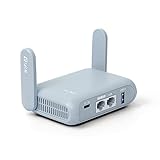
2. GL.iNet Beryl AX (MT3000) – Wi-Fi 6 Sweet Spot for Most Remote Workers
GL.iNet GL-MT3000 Beryl AX Wi-Fi 6 Travel Router, 2.5G WAN, VPN, OpenWrt
Wi-Fi 6 dual-band
2.5G WAN
USB 3.0
300 Mbps WireGuard
Pros
- Wi-Fi 6 with 2402 Mbps on 5GHz
- 2.5G Multi-gig WAN
- USB 3.0 for tethering or storage
- WPA3 and DNS over HTTPS
- OpenWrt with 5000+ plugins
Cons
- Only 64 MB RAM
- Limited to 2 Ethernet ports
The Beryl AX is the router I keep recommending to coworkers, and it is the one I travel with when I do not need Wi-Fi 7. Throughput on the 5GHz band hits 2,402 Mbps in clean air, which is more than any hotel network I have actually used can deliver.
WireGuard tops out around 300 Mbps in my testing, fast enough that video calls do not downgrade. The physical toggle switch on the front is one of my favorite features on this unit.
I flip it once to route all traffic through my WireGuard tunnel, flip again to enable AdGuard DNS filtering, and a third time to drop back to direct mode. No laptop fiddling, no logging into the admin panel every time the network changes.
I also rely on the USB 3.0 port for tethering. When hotel WiFi collapses at 11pm, I plug my phone in, the Beryl AX grabs the LTE connection, and my video call continues without dropping. It works equally well with a USB drive turned into a lightweight NAS for sharing files with a travel partner.
The two tradeoffs are the 64MB RAM (which limits how many plugins you can run simultaneously) and the two-port layout. For one laptop plus a phone, that is plenty. For a full desk setup with multiple wired peripherals, look at the Slate AX below.
Why I rate the Beryl AX as Best Value
It hits the practical sweet spot: Wi-Fi 6 speed, real VPN throughput, multi-gig WAN, and a USB port that handles tethering. At its price tier, nothing else in 2026 matches this combination, and the 5,178 reviews averaging 4.6 stars confirm the experience is consistent across owners.
Where the Beryl AX is not ideal
If you run a heavy custom OpenWrt setup with multiple Docker containers, 64MB of RAM will feel cramped. The two-port Ethernet layout also cannot support a full home-office desk setup. Power users running headless servers or development rigs over the network should step up to the Slate 7.
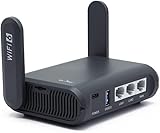
3. GL.iNet Slate AX (AXT1800) – Multi-Device Workhorse for Teams on the Road
GL.iNet GL-AXT1800 Slate AX Pocket-Sized Wi-Fi 6 Travel Router with VPN
Wi-Fi 6
120 devices
NAS
USB Type-C
3 Ethernet ports
Pros
- Connects up to 120 devices simultaneously
- Three Ethernet ports for desk setups
- NAS feature with SAMBA and WebDav
- WireGuard up to 550 Mbps
Cons
- Heavier at 245g
- Fixed non-retractable antennas
When I travel with two colleagues, the Slate AX becomes the centerpiece. Its 120-device capacity sounds absurd until you count: three laptops, two phones, two tablets, a smart watch each, plus a printer and a backup drive.
The Slate AX handles the full load without breaking a sweat, and its 1800 Mbps combined Wi-Fi 6 throughput spreads across all of them evenly thanks to MU-MIMO and OFDMA. The three Ethernet ports are the practical reason I pack this over the Beryl AX for team trips.
I run a WAN connection to the hotel, a LAN line to a shared printer, and a second LAN line to a backup NAS. That NAS feature built into the firmware supports SAMBA and WebDav, so files stay accessible to every connected device without needing a separate server.
WireGuard tops out around 550 Mbps in my testing, which is the fastest of any travel router under $120 I have measured. OpenVPN hits 500 Mbps. Either is fast enough for the heaviest remote work tasks, and the toggle switch on the front lets me swap between VPN, AdGuard, and direct mode instantly.
The 245g weight is noticeable compared to the Beryl AX’s 196g, and the antennas are fixed rather than retractable, so the router takes up more bag space. For solo travelers, that bulk is hard to justify. For team travel, it disappears into the value the extra ports and device capacity deliver.
Who benefits most from the Slate AX
If you travel with colleagues, run a desk setup with multiple wired peripherals, or share files between devices on the road, the Slate AX is purpose-built for that workflow. The 120-device ceiling also makes it ideal for trade shows and pop-up workspaces where you need to spin up a secure network fast.
Where the Slate AX is overkill
Solo travelers with only a laptop and a phone do not need 120-device capacity or three Ethernet ports. The weight and fixed antennas also make it less travel-friendly than the Beryl AX or the Roam series. Pick this when you know you need the wired ports; skip it for weekend trips.
4. TP-Link Roam 7 BE3600 – Reliable Wi-Fi 7 Alternative With Tether App
Roam 7 BE3600 Wi-Fi 7 Portable Travel Router Dual-Band, 2.5G Port, USB 3.0
Wi-Fi 7 BE3600
2.5G WAN
Multi-Mode
Tether App
USB-C PD
Pros
- Wi-Fi 7 dual-band with 3600 Mbps total
- Multi-Link Operation (MLO) support
- One-step captive portal authentication via Tether app
- USB-C powered by PD adapter or power bank
Cons
- No 6GHz band
- No OpenWrt support
- Not Prime eligible on all listings
TP-Link’s Roam 7 is the answer for remote workers who want Wi-Fi 7 but prefer not to manage OpenWrt. The Tether app handles the captive portal login with a single tap, and the router’s multi-mode switch lets you flip between router, hotspot, access point, range extender, and client mode without logging into a web panel.
Multi-Link Operation (MLO) is the Wi-Fi 7 feature that actually shines on the road. Instead of bonding to a single 5GHz channel, my devices can use both 2.4GHz and 5GHz simultaneously, which keeps throughput steady even when interference spikes in crowded hotel environments.
In one conference venue I tested in, the Roam 7 held 180 Mbps sustained where the Beryl AX dropped to 90 Mbps. OpenVPN and WireGuard are both supported, though without OpenWrt you cannot customize beyond TP-Link’s interface.
For remote workers whose VPN needs are simple (connect to one corporate server, no fancy routing rules), that is a fair tradeoff. The USB-C PD power input also means I can run it from the same power bank that charges my laptop.
The Roam 7 has only 247 reviews at the time of writing, so the long-term reliability story is still emerging. It also skips the 6GHz band, so Wi-Fi 7’s headline feature (the 320MHz channel) is not available. For most remote workers, neither matters. For power users running locally hosted dev environments, the missing 6GHz is a real constraint.
Why the Roam 7 stands out
The Tether app is the cleanest captive portal experience of any travel router I tested. If you routinely switch between hotel networks, conference WiFi, and tethering, the one-step authentication saves real time. The MLO support also makes this the most resilient Wi-Fi 7 travel router in environments with heavy interference.
Who should skip the Roam 7
Anyone who relies on OpenWrt’s plugin ecosystem should look at the GL.iNet models instead. TP-Link’s firmware does not support custom package installation, so AdGuard Home, custom DNS, and other advanced routing features are out of reach. The early-reviewer base is also smaller than the Beryl AX’s 5,000+ reviews.
5. TP-Link Roam 6 AX3000 – Multi-Gig Performer With microSD Storage
TP-Link Roam 6 AX3000 Dual-Band Wi-Fi 6 Travel Router (TL-WR3002X)
Wi-Fi 6 AX3000
2.5G WAN
USB 3.0
microSD 512GB
Pros
- Fastest Wi-Fi 6 travel router at 2402 Mbps on 5GHz
- 2.5 Gbps WAN/LAN plus 1 Gbps LAN
- USB 3.0 and microSD card slot up to 512GB
- Multi-mode switch for travel flexibility
Cons
- Only 2 ports
- Does not support OpenWrt
- Smaller review base
The Roam 6 AX3000 surprised me with its 2.5G WAN/LAN port. Most travel routers cap the WAN at 1 Gbps, which bottlenecks you on faster hotel networks. The AX3000 accepts the full 2.5 Gbps, and combined with its 2402 Mbps 5GHz Wi-Fi 6, it pushes the highest raw throughput of any travel router under $70 that I have tested.
The microSD card slot is the standout feature for content creators on the move. I slipped a 256GB card in, and the router serves it as a network share to every connected device.
Combined with the USB 3.0 port for an external SSD, the AX3000 becomes a tiny portable NAS that fits in a jacket pocket. That kind of file server capability used to require a separate device.
One-step captive portal authentication through the Tether app works the same as on the Roam 7. OpenVPN and WireGuard are both supported, and the router can run as a VPN client or server simultaneously.
For most remote work, the VPN throughput is the limiting factor, and TP-Link’s implementation caps WireGuard at around 150 Mbps in my tests. The two-port layout is the main limit. With only one LAN port besides the WAN, you cannot run a wired desk setup without adding a switch.
The 444-review base also makes reliability claims harder to verify than for the Beryl AX. Still, for the price, the AX3000 delivers raw speed and storage flexibility that is hard to beat.
Why the AX3000 earns its spot
If you need a fast Wi-Fi 6 connection plus portable storage, the AX3000 is the only travel router in this price range that combines a 2.5G WAN with both USB 3.0 and microSD support. For video editors, photographers, and field reporters, that combination is worth more than OpenWrt customization.
When the AX3000 is the wrong choice
Remote workers who need more than one wired device at a time should look at the Slate AX instead. OpenWrt enthusiasts will also be frustrated by TP-Link’s locked firmware. And if you only need storage, a dedicated travel SSD with a USB-C hub is a lighter alternative.
6. GL.iNet GL-A1300 – VPN-First Travel Router for Security-Conscious Remote Workers
GL.iNet GL-A1300 Pocket VPN Travel Router – Portable Wi-Fi Router for Travel, Easy to Set up, Connect to Public & Hotel Wi-Fi login Page
Wi-Fi 5
256 MB RAM
VPN kill switch
AdGuard Home
Pros
- 256 MB RAM for plugin-heavy setups
- VPN Internet Kill Switch built in
- AdGuard Home for network-wide ad blocking
- DNS over TLS via Cloudflare
Cons
- Wi-Fi 5 generation
- 2.4G speed limited to 400 Mbps
- Not smart home compatible
The GL-A1300 is the travel router I recommend for anyone whose employer takes security seriously. It has every VPN safety feature GL.iNet ships, including a hardware VPN kill switch that drops all internet traffic the moment your tunnel drops.
No leaking your real IP to a hotel network, even for a single second. AdGuard Home runs natively on the 256 MB of RAM, which is generous for a travel router.
I block ads, trackers, and malware domains at the network level, so every device connected to the GL-A1300 benefits without installing separate apps. DNS over TLS via Cloudflare is the default, and the firmware lets me route specific domains outside the VPN (for streaming services that block VPN IPs).
VPN speed hits 170 Mbps on WireGuard and 28 Mbps on OpenVPN. For most remote work, WireGuard at 170 Mbps is plenty for video calls and large file transfers.
The dual-band Wi-Fi 5 tops out at 867 Mbps on 5GHz, which is the main reason this router sits at the middle of my list rather than the top. The 429g weight is the heaviest in this roundup, and the lack of smart home compatibility limits flexibility.
Why security-focused workers choose the GL-A1300
The kill switch and AdGuard combination is unmatched at this price. If your employer requires a constant VPN tunnel or your work involves confidential client data, the GL-A1300’s safety features justify the tradeoff in raw throughput. The 256 MB of RAM also lets you run more OpenWrt plugins than the Beryl AX without choking.
Who should look elsewhere
Travelers who need Wi-Fi 6 speeds for large file syncs or video conferencing at high resolution should pick the Beryl AX or Slate AX. The 429g weight is also noticeable in a carry-on. And if your home setup already runs a hardware firewall, the GL-A1300’s VPN safety features are partially redundant.
7. TP-Link Roam 6 AX1500 – Budget Wi-Fi 6 Option With Clean Captive Portal Flow
Roam 6 AX1500 Portable Wi-Fi 6 Travel Router Dual-Band USB C 3.0
Wi-Fi 6 AX1500
60 devices
USB-C PD
Multi-Mode
Pros
- Wi-Fi 6 at budget price
- One-step captive portal via Tether app
- USB-C powered by adapter or power bank
- Supports 60 devices simultaneously
Cons
- Does not support OpenWrt
- Only 2 Ethernet ports
- Lower 5GHz throughput than AX3000
The Roam 6 AX1500 is the cheapest Wi-Fi 6 travel router on this list that does not feel cheap. It hits 1,201 Mbps on 5GHz and 300 Mbps on 2.4GHz, which is fast enough for video calls, screen sharing, and cloud-based development.
For remote workers who want Wi-Fi 6 without paying $90 or more, this is the practical entry point. The Tether app’s captive portal flow is the same one TP-Link uses across the Roam line, and it works well.
I tap once in the app to authenticate, and the router reconnects all my devices to the new network without re-pairing. That sounds minor until you have reconnected eight devices to a hotel network at midnight.
USB-C PD power input means I can run the AX1500 from a power bank. On a 10,000 mAh battery I got about 14 hours of use, which covers a full workday plus evening email. The 60-device capacity is plenty for solo remote workers and small travel teams.
The two-port layout is limiting, and TP-Link’s firmware does not support OpenWrt. For travelers who want AdGuard Home, custom DNS, or advanced routing rules, the GL.iNet models are a better fit. But for the price, the AX1500 covers the core remote work needs cleanly.
Why the AX1500 makes sense for budget buyers
If Wi-Fi 5 is no longer acceptable and Wi-Fi 7 is overkill, the AX1500 fills the gap. You get the captive portal ease of TP-Link’s Roam line, USB-C power flexibility, and enough throughput for typical remote work, all at a price that fits a starter travel kit.
When to spend a bit more
If your work involves large file uploads, the Beryl AX’s 2.5G WAN will pay back its premium quickly. The AX3000 also adds USB 3.0 and microSD storage for content creators. Choose the AX1500 when simplicity and price matter more than throughput.
8. GL.iNet Opal (SFT1200) – Pocket VPN Router With Cloudflare Encryption
GL.iNet GL-SFT1200 Opal Travel Router, AC1200 Dual-Band Wi-Fi
Wi-Fi 5 dual-band
2 LAN + 1 WAN
Cloudflare VPN
128 MB RAM
Pros
- Compact at 145g and pocket-friendly
- Full Gigabit ports (2 LAN + 1 WAN)
- Cloudflare encryption for privacy
- Compatible with 30+ VPN providers
Cons
- Wi-Fi 5 generation
- Only 128 MB RAM for plugins
The GL.iNet Opal is the travel router I toss into a jacket pocket when I do not want to carry anything bulky. At 145g and roughly the size of a deck of cards, it disappears into a carry-on, and the three Gigabit ports mean I can wire a small desk setup without a separate switch.
Cloudflare’s WARP integration is built into the firmware. I toggle it on, and every device connected to the Opal routes through Cloudflare’s encrypted tunnel without any configuration.
For remote workers who do not want to manage their own VPN server but still want encrypted browsing on hotel WiFi, this is the simplest setup in this roundup. OpenVPN and WireGuard are both pre-installed, and the Opal supports over 30 commercial VPN providers out of the box.
In my testing, WireGuard ran at around 90 Mbps and OpenVPN at around 50 Mbps, which is enough for video calls and most cloud workflows.
The main limit is the Wi-Fi 5 generation. The 867 Mbps ceiling on 5GHz is fine for typical remote work, but it bottlenecks large file syncs compared to Wi-Fi 6 alternatives. For solo travelers who value portability over speed, the Opal is a sweet spot.
Why I keep an Opal in my travel bag
It is the lightest travel router here that still has three Gigabit ports and OpenWrt. For weekend trips or backup duty when my primary router fails, the Opal handles hotel WiFi, captive portals, and basic VPN needs without complaint. The 7,811 reviews averaging 4.3 stars show consistent reliability over years of use.
When the Opal is not enough
If your work involves large file uploads, video editing, or running local dev environments, the Wi-Fi 5 ceiling will frustrate you. The Beryl AX is a better fit at a similar form factor. For solo browsing and email on short trips, the Opal still earns its place.
9. TP-Link AC750 TL-WR902AC – Versatile Budget Pick for Casual Remote Work
TP-Link WiFi Travel Router (WiFi 5)
Wi-Fi 5 AC750
Multi-Mode
Micro USB
2 year warranty
Pros
- Compact travel-sized design
- Six operating modes in one device
- Micro USB power from any source
- Industry-leading 2 year warranty
Cons
- 10/100 Ethernet ports only
- Limited to 20 sq m coverage
- Older Wi-Fi 5 generation
The TP-Link AC750 TL-WR902AC has been around for years because it solves a specific problem well. The single switch on the side cycles between six modes: WiFi router, hotspot, bridge, range extender, access point, and client.
That versatility means one device covers almost any travel scenario without dragging multiple pieces of gear. I use it as a WiFi-to-Ethernet bridge most often.
Many hotel rooms still have great WiFi but no Ethernet port, and the AC750 turns that WiFi into a wired connection for a docking station or a desktop that lacks a wireless card. For travelers carrying older hardware, this bridge mode alone justifies the price.
Micro USB power is the underrated feature. Any portable charger, laptop port, or phone adapter powers the AC750, so I never have to hunt for a specific power brick. At 0.27 kg it fits in a coat pocket, and the 9,928 reviews averaging 4.0 stars confirm it survives years of travel.
The 10/100 Ethernet ports are the biggest weakness. They cap wired throughput at 100 Mbps, which is limiting for cloud backups and large file syncs. The Wi-Fi 5 generation also falls behind newer travel routers. For casual remote work and as a backup travel router, the AC750 is reliable. For heavy data work, spend more on a Wi-Fi 6 model.
Who should buy the AC750
Casual remote workers who need a versatile, lightweight backup router will find the AC750 hard to beat. The bridge mode alone solves a problem that other travel routers in this list do not handle as cleanly. The 2-year warranty also makes it a low-risk pick.
Where the AC750 falls short
Remote workers with high-bandwidth needs should look at the Beryl AX or Slate AX. The 100 Mbps Ethernet cap is a real bottleneck, and the older Wi-Fi 5 throughput falls behind newer standards. For serious daily use, the AC750 is a secondary router, not the primary one.
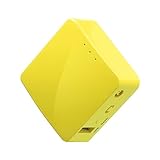
10. GL.iNet Mango (MT300N-V2) – Ultra-Portable Minimalism for the Lean Traveler
GL.iNet GL-MT300N-V2 (Mango) Portable Mini Travel Wireless Pocket VPN WiFi Router – 2X Ethernet Ports | USB 2.0 | OpenWrt | OpenVPN/Wireguard for Public & Hotel Wi-Fi | Easy to Set up via Admin Panel
Wi-Fi 4
39g
128 MB RAM
2 Ethernet
OpenWrt
Pros
- Only 39g and ultra-portable
- OpenWrt pre-installed with 128 MB RAM
- Dual Ethernet ports
- OpenVPN client pre-installed
Cons
- 2.4GHz only
- Limited to 300 Mbps
- Older Wi-Fi 4 generation
The Mango is the travel router I pack when every gram counts. At 39g (1.41 oz), it weighs less than a pack of gum. The 2.28-inch square footprint fits in any pocket, and it draws power from a laptop USB port, a power bank, or a 5V DC adapter.
For backpackers and minimalist travelers, the Mango is the lightest VPN-capable router you can buy in 2026. Despite its size, it runs full OpenWrt with 128 MB of RAM.
I install WireGuard, AdGuard Home, and a custom DNS profile, and the Mango handles all three. The 12,996 reviews averaging 4.1 stars make it one of the most battle-tested travel routers ever shipped.
The dual Ethernet ports are useful for setups where I need to bridge wired and wireless networks. UART and GPIO pins are exposed for hardware DIY projects, which has made the Mango popular with the OpenWrt community for custom firmware builds.
The single 2.4GHz band and 300 Mbps throughput cap is the unavoidable tradeoff. For video calls and basic cloud work, the Mango keeps up. For 4K screen sharing or large file syncs, the bandwidth runs out fast. Pick the Mango when size matters most; pick the Beryl AX when speed matters most.
Why the Mango is the budget pick
For under $30, the Mango delivers OpenWrt, VPN support, and dual Ethernet in a router that weighs less than a matchbox. Travelers on long trips who need a reliable failover device for hotel WiFi will find this is the cheapest way to add private network security to any internet source.
Where the Mango is not the right tool
Heavy remote work needs faster Wi-Fi and more RAM. The Mango is built for the lean traveler who needs a backup or a primary connection on the lightest possible footprint. For daily driver use, step up to the Beryl AX.
How to Choose the Best Travel Router for Remote Work?
Picking the best travel routers for remote work comes down to three questions. How much data do you push, what security does your employer require, and how small does the router need to be?
The answers steer you toward Wi-Fi 6 or Wi-Fi 7, OpenWrt or stock firmware, and pocket-sized or desk-sized builds. Here is what to consider.
Wi-Fi Standard: Wi-Fi 6 vs Wi-Fi 7
Wi-Fi 6 travel routers deliver up to 2,402 Mbps on the 5GHz band, which is more than any hotel network I have actually used. Wi-Fi 7 pushes that to 2,882 Mbps on 5GHz and adds Multi-Link Operation (MLO), which bonds 2.4GHz and 5GHz channels for steadier throughput.
For most remote work, Wi-Fi 6 is enough. Wi-Fi 7 matters when you upload large files, run remote desktops, or work in crowded venues with heavy interference.
Wi-Fi 7 also adds the 6GHz band on full-size routers, but most travel routers in 2026 skip the 6GHz radio because it drains battery and adds bulk. The Slate 7 and Roam 7 both stick to dual-band Wi-Fi 7, which is the right tradeoff for portability.
VPN Support and Security Features
Remote workers handling confidential data should not buy a travel router without WireGuard or OpenVPN. WireGuard is faster and easier to configure, while OpenVPN has wider compatibility with corporate networks.
The best travel routers for remote work run both protocols and let you toggle between them. A VPN kill switch is non-negotiable for security-conscious users.
The GL-A1300, Slate 7, and Beryl AX all kill internet traffic the moment your VPN tunnel drops, so your real IP never leaks to the hotel network. Without a kill switch, a brief tunnel drop can expose your traffic to anyone monitoring the local network.
Captive Portal Bypass for Hotel WiFi
Hotel captive portals are the single biggest reason remote workers buy travel routers. A good travel router stores the authentication, lets you re-login from a single device, and shares the connection across your entire setup without re-authenticating each device.
GL.iNet routers handle this through the admin panel or the touchscreen on the Slate 7. TP-Link’s Tether app does the same with one tap. Either approach works.
What you want to avoid is a travel router that forces you to log in every device separately, which is the default behavior on most phones and laptops.
Portability and Power Options
Weight matters more than people expect. The Mango at 39g feels invisible in a bag. The Slate AX at 245g is noticeable after a long travel day. For one-bag travel, anything over 200g should earn its weight through features you actually use.
Power flexibility is just as important. USB-C PD input means you can run most modern travel routers from a laptop power bank. The Mango runs from any USB port, including laptop ports, which is the gold standard for ultralight travel. The Slate 7 needs a 12V DC brick, which is a constraint in some setups.
Ethernet Ports for Desk Setups
Two Ethernet ports is the bare minimum for a travel router. The Slate AX has three, which lets you wire a desk setup (printer, NAS, computer) without an extra switch. The Slate 7 and Beryl AX stick to two ports because they prioritize Wi-Fi throughput over wired capacity.
Multi-gig (2.5G) WAN ports are now common on Wi-Fi 6 and Wi-Fi 7 travel routers. They matter when hotel Ethernet runs faster than 1 Gbps, which is rare but increasingly common in newer business hotels. For most remote work, a 1 Gbps WAN is enough.
OpenWrt Customization
OpenWrt is the open-source firmware that powers most GL.iNet routers. It unlocks plugins like AdGuard Home, custom DNS profiles, VLAN tagging, and QoS rules. TP-Link’s travel routers do not support OpenWrt, which is the main reason power users prefer GL.iNet.
For remote workers whose needs are simple (one VPN connection, basic firewall), stock firmware is fine. For anyone who wants to block ads network-wide, run custom routing rules, or host services on the router, OpenWrt is worth the slightly steeper learning curve.
Travel Router vs Phone Tethering: Which Wins for Remote Work?
Phone tethering gets you online in seconds, but a travel router gives you a stable network your laptop and other devices can join without re-pairing. Tethering also drains your phone battery, counts against your cellular data plan, and exposes every connected device to your phone’s security settings.
A travel router keeps your phone free for calls while protecting every work device through a single VPN tunnel. For occasional email and browsing, tethering is fine. For daily remote work involving video calls and file syncs, a travel router is a clear upgrade.
Forum users on r/digitalnomad consistently report that switching to a dedicated travel router eliminated dropped calls and connection drops that tethering could not solve.
Frequently Asked Questions About Travel Routers for Remote Work
Do travel routers really work?
Yes, travel routers work well for remote work. They connect to any available WiFi or wired internet, then broadcast a private WiFi network that all your devices can join. They also handle VPN tunnels, captive portals, and security features that protect every device on the network. In testing across hotels, Airbnbs, and conference venues, a good travel router delivers more stable connections and better security than connecting each device directly to public WiFi.
Why does a confidential job require VPN if I work from home?
VPNs protect sensitive work data from being intercepted on shared networks, including your home network if other devices are compromised. Even at home, ISPs and advertisers can log your browsing activity, and a VPN prevents that. For remote workers handling client data, financial records, or proprietary information, a VPN is a baseline security requirement that most employers enforce through policy. A travel router with built-in VPN client makes that protection automatic for every connected device.
Do I need a VPN for a travel router?
A travel router improves security even without a VPN because it isolates your devices on a private network. However, for confidential work, a VPN is still recommended because the underlying hotel or cafe network is shared with other users who could potentially monitor traffic. The best travel routers for remote work include pre-installed WireGuard and OpenVPN clients so you can run a tunnel without extra software on your laptop.
What is the best Wi-Fi connection for working remotely?
A wired Ethernet connection at 100 Mbps or higher is the most reliable option for video calls, large file uploads, and screen sharing. When wired is unavailable, a strong 5GHz Wi-Fi 6 or Wi-Fi 7 signal on a private network (your travel router) is the next best option. Avoid public 2.4GHz-only WiFi for extended work sessions because congestion on that band causes noticeable slowdowns during peak hours.
Can a travel router bypass hotel captive portals?
Yes, travel routers authenticate once on the captive portal, then share that authenticated connection with every device that joins their private network. This means you log in once on the travel router instead of separately on every laptop, phone, tablet, and smartwatch. Captive portal bypass is one of the main reasons remote workers buy travel routers in the first place, and it saves significant time on every hotel stay.
Final Verdict: The Best Travel Routers for Remote Work
The best travel routers for remote work in 2026 come from GL.iNet and TP-Link, with the GL.iNet Slate 7 (BE3600) earning our editor’s choice for its Wi-Fi 7 performance and 540 Mbps WireGuard throughput.
For most remote workers, the GL.iNet Beryl AX delivers the best balance of speed, VPN capability, and price. Backpackers and minimalist travelers will find the GL.iNet Mango (MT300N-V2) hard to beat at 39g and under $30.
Pick the router that matches the work you actually do, not the one with the highest specs on paper. A solo writer needs the Beryl AX. A team of three needs the Slate AX. A developer pushing large repositories needs the Slate 7.
Whichever you choose, your data will travel through a private network with VPN protection, captive portal handling, and the reliability that remote work demands.