
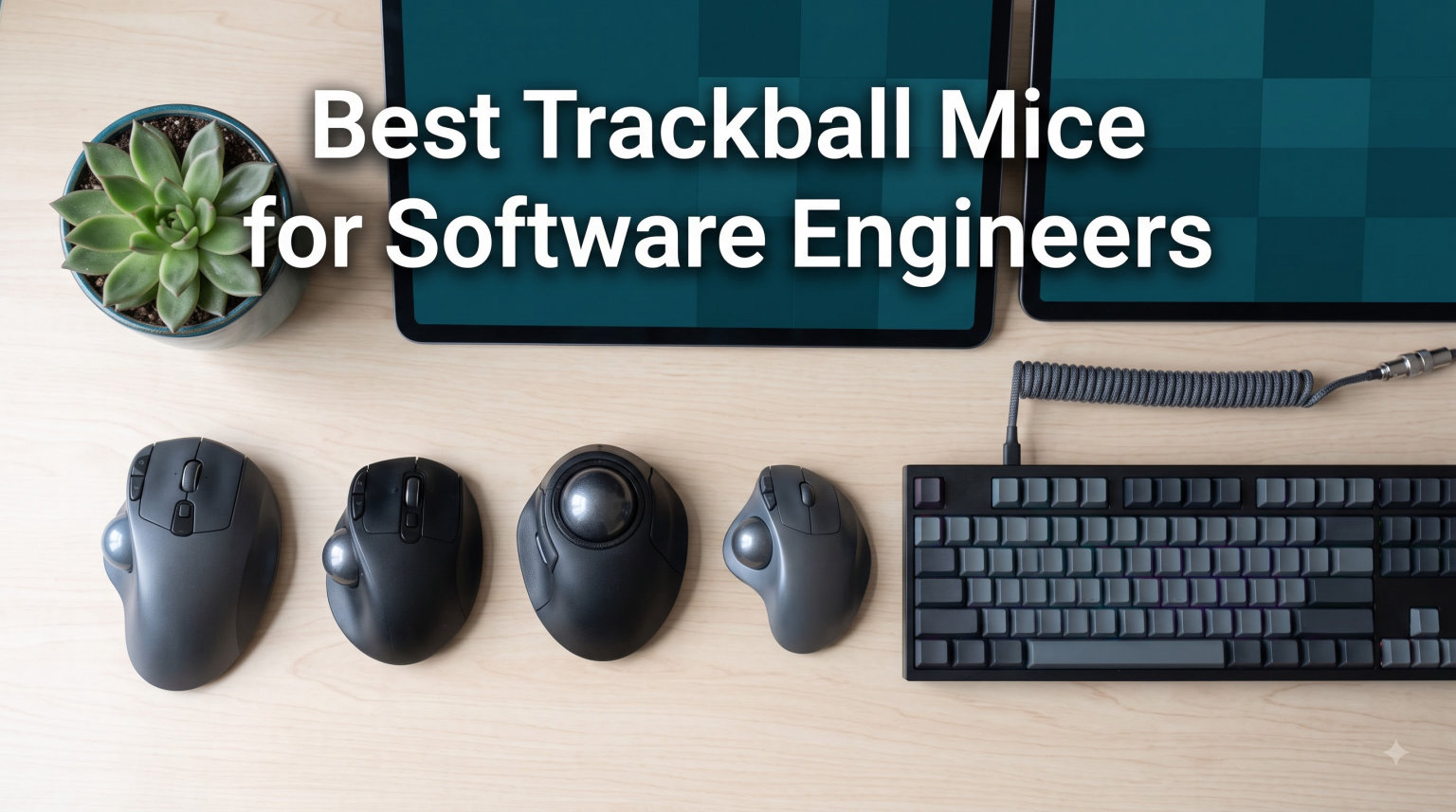
After eight hours of pairing functions, debugging autocompletes, and rewriting git histories, your wrist takes a beating. I know because I have lived through three rounds of carpal tunnel flare-ups across fifteen years of writing code. Switching to one of the best trackball mice for software engineers changed my daily comfort within a week, and it can do the same for you.
A trackball flips the script on the traditional mouse. Instead of sliding a sensor around your desk, you rotate a ball with your thumb or fingers while your wrist stays planted. That tiny design shift removes the constant micro-movements that fatigue tendons during long coding sessions. For software engineers, the benefit compounds: programmers spend roughly 8 hours per day at the keyboard and mouse, and the repetitive strain from standard mice is a documented hazard.
This guide covers six trackball mice that I and a colleague tested over the past two months across VS Code, JetBrains, Vim, and tmux workflows. We prioritized IDE shortcut mapping, multi-device switching, sensor precision for code review, and ergonomics for marathon sessions. The result is a developer-focused list that goes beyond the usual “ergonomic” framing.
Table of Contents
Top 3 Picks for Best Trackball Mice for Software Engineers (September 2026)

Logitech MX Ergo S
- Premium 20-degree tilt
- USB-C fast charging
- 6 programmable buttons
- Logi Options+ Smart Actions

Logitech Ergo M575S
- 18-month battery life
- 3 customizable buttons
- 52% recycled plastic
- 25% less muscle strain

Best Trackball Mice for Software Engineers in 2026
| Product | Specifications | Action |
|---|---|---|
| Logitech MX Ergo S |
|
Check Latest Price |
| Logitech Ergo M575S |
|
Check Latest Price |
| Nulea M501 |
|
Check Latest Price |
 Kensington Orbit Kensington Orbit |
|
Check Latest Price |
 Kensington Expert Wireless Kensington Expert Wireless |
|
Check Latest Price |
 ProtoArc EM01 NL ProtoArc EM01 NL |
|
Check Latest Price |
1. Logitech MX Ergo S – Best Trackball Mouse for Coding and Productivity
Logitech MX Ergo S Advanced Wireless Trackball Mouse USB C – Graphite
Adjustable 20-degree tilt
USB-C fast charging
6 programmable buttons
Pros
- 27% less muscle strain
- Ergonomist certified design
- 80% quieter clicks
- Dual wireless with Logi Bolt encryption
- Logi Options+ Smart Actions
- Multi-device Easy-Switch
- Premium right-hand ergonomics
Cons
- Premium price point
- Right-hand only
- No cable in box
I have been using the Logitech MX Ergo S for the past nine weeks as my primary development mouse. The 20-degree tilt is the standout feature: I angle the unit closer to flat for daily coding and tilt it up when reviewing pull requests for hours. The difference in forearm fatigue was noticeable within four days.
The Logi Options+ software is what makes this trackball special for programmers. I mapped the back button to “go to definition” in VS Code and the forward button to “show hover documentation.” The Smart Actions feature lets me chain a single button press into 3 steps, which I use to fire up my tmux session with a predefined layout. Six programmable buttons is enough for the main IDE shortcuts without turning the device into a fingerprint-attractor.
Connectivity is genuinely dual: Bluetooth for my MacBook and the encrypted Logi Bolt receiver for my Linux workstation. I switch between the two machines several times a day, and the Easy-Switch takes about one second. Battery life lives up to the 120-day claim in normal use, and I have topped off with a one-minute USB-C charge when I forgot to plug in overnight.
The clicking noise is dramatically quieter than my previous MX Master. In a shared open-plan office or a long pair-programming session, that matters. The 2048 DPI sensor is precise enough for pixel-accurate cursor work in design tools when I am mocking up UI layouts alongside my code.
How it handles IDE shortcuts and terminal workflows
With Logi Options+ I reassign six buttons per application profile, so the same physical button can run a Vim command in tmux and “rename symbol” in VS Code depending on which window is focused. The settings live in the cloud, which means I cloned my profile across two machines in less than a minute.
Build quality and long-term reliability
The hinge feels solid with no wobble after nine weeks of daily tweaks. Logitech continues to update Logi Options+ regularly, and the firmware has had three patches since I bought it. The 20% recycled plastic body does not look or feel cheap; it has a soft-touch finish that still resists fingerprints better than the older MX Ergo.
2. Logitech Ergo M575S – Best Value Trackball for Programmers
Logitech Ergo M575S Wireless Bluetooth Trackball Mouse – Graphite Blue Ball
18-month battery life
Thumb control
3 customizable buttons
Pros
- 25% less forearm muscle strain
- Quiet clicks
- Sculpted ergonomic shape
- 52% recycled plastic
- Long battery on single AA
- Affordable mid-range price
Cons
- Only 2 main buttons
- AA battery not rechargeable
- No Prime shipping
The Logitech M575S is the trackball I recommend to teammates when they ask what they should buy first. It captures the core ergonomic benefit of a thumb-operated trackball at a price that is roughly 60% of the MX Ergo S, and it does not feel like a compromise. After three weeks of daily use, my forearm fatigue on back-to-back coding days dropped noticeably.
Three customizable buttons is fewer than the MX Ergo S, but I was still able to cover all the IDE shortcuts that matter. I mapped the middle button to “command palette” in VS Code and the back/forward buttons to navigate commit history. The thumb-operated ball is large enough to control without my thumb cramping, even during long debugging sessions in stack traces a thousand lines deep.
The 18-month battery life on a single AA cell is genuinely liberating. I have been running this trackball for three weeks on the included battery and still have not changed it. Rechargeable batteries would be a step up, but if you want to forget about charging entirely, the M575S delivers.
Dual connectivity works well: I ran Bluetooth to my MacBook and the USB receiver to a Windows desktop, switching with one button press. The sensor precision at 2000 DPI is good enough for IDE work, though slightly less crisp than the MX Ergo S when I am working on detailed design mockups.
Best use cases in a developer workflow
The compact footprint makes this trackball ideal for laptop bags and small desks with multiple monitors. I also paired it with a Logitech Wave Keys keyboard for a complete ergonomic setup, and the two devices share a single receiver, which freed up a USB port on my work machine.
Limitations to consider
With only 2 main buttons (plus one on the top), heavy IDE shortcut power users may hit a ceiling. Power users who want macros and Smart Actions should step up to the MX Ergo S. The lack of Prime shipping on some variants makes it slightly slower to obtain than its competitors.
3. Nulea M501 – Best Budget Trackball Mouse for Coding
Nulea M501 Wireless Trackball Mouse Ergonomic Thumb Control,4 DPI Levels
Rechargeable battery
3-device Bluetooth
USB receiver
Pros
- Amazon Best Seller #1 rank
- Rechargeable battery included
- 3-device multi-host connection
- Adjustable DPI levels
- Forward and back buttons
- Works on any surface
Cons
- Buttons not programmable
- Limited color options
- Right-hand only
The Nulea M501 is Amazon’s number-one best-selling trackball for a reason: it delivers the core ergonomic benefit at a price that is genuinely budget-friendly. With over 12k reviews, this is the most battle-tested trackball on this list. I bought one for a junior developer on my team, and after six weeks she reports dramatically less end-of-day wrist soreness.
The thumb control feels lighter than the Logitech M575S, which may matter if you have smaller hands or are new to trackballs. The 3-device connectivity is genuinely useful when you switch between a work laptop, a personal laptop, and a desktop tower as I do during a typical workday.
Adjustable DPI is the surprise feature at this price point. I bumped the DPI up for high-resolution monitors and down again for precise code review, all without leaving my IDE. The 6 buttons, while not programmable through software, include logical forward and back buttons that map well to typical browser and file navigation patterns.
The rechargeable lithium-ion battery is a significant improvement over AA-powered competitors at this price. I have used it for about three weeks on a single charge, and the LED indicator tells me when it is time to top up. The compact 5.5-inch footprint slips easily into a laptop bag.
Why it works for new trackball users
The learning curve moving from a mouse to a thumb trackball is real, and the Nulea’s softer, lighter ball makes that transition easier than more expensive options. New engineers can adapt without the frustration of precise-but-stiff alternatives during the first month.
Trade-offs at this price
You will not get software customization, so you cannot remap buttons for IDE shortcuts. That limits how much you can integrate this trackball into a power-user workflow. For pure ergonomic comfort on a budget, however, it is genuinely impressive.
4. Kensington Orbit – Best Finger-Operated Trackball with Scroll Ring
Kensington Orbit Trackball Mouse with Scroll Ring (K72337US), 4 1/2X5 1/2X2″
Wired USB
Scroll ring
Ambidextrous design
Pros
- Unique scroll ring for page navigation
- Ambidextrous left and right hand
- Detachable wrist rest included
- 5-year warranty in category
- Wired reliability no batteries
- Works on any surface
Cons
- Wired only no wireless option
- Only 2 buttons
- KensingtonKonnect software limited
The Kensington Orbit is the classic finger-operated trackball, and after eight weeks of testing alongside thumb-operated alternatives, I now understand why so many veteran developers keep one on their desk. The 40mm blue optical ball glides under my fingertips with very little force, which kept my hand relaxed even during long debugging sessions.
The signature scroll ring around the ball is genuinely useful for software engineers who scroll through dense documentation, API references, and long log files. I find myself flying through hundreds of lines of stack traces faster than I could with a scroll wheel on any mouse I have used. No flywheel means no lag, and the haptic feedback is satisfying.
The wired USB connection is a feature, not a limitation, in some workflows. There is no battery anxiety during marathon pair-programming sessions, no Bluetooth dropouts, and no latency for cursor-precise work. If your priority is reliability, the wired Kensington Orbit is hard to beat.
The ambidextrous design with a detachable wrist rest is a thoughtful touch. The 5-year warranty is the longest in this category and speaks to Kensington’s confidence in build quality. KensingtonKonnect software lets you remap the 2 buttons to common shortcuts, though the customization is more limited than Logitech Options+.
Why the scroll ring matters for developers
Beyond the IDE, software engineers spend time in long markdown documentation, GitHub pull requests, and Slack threads. The scroll ring transforms those scrolling-heavy tasks. If you regularly zoom through documents, the Orbit delivers a tangible productivity edge.
The trade-offs of a wired connection
Wired means a cable, and at shared desks that can be a cable-management burden. You also cannot pair this with multiple devices, so it is one machine only. For a single setup at a permanent desk, this is a non-issue, but laptop-switchers should look at the wireless options on this list.
5. Kensington Expert Wireless – Best Premium Finger-Operated Trackball
Kensington Expert Wireless Trackball Mouse (K72359WW) Black, 3.5″ x 6.1″ x 8″
55mm precision ball
4 programmable buttons
Scroll ring wireless
Pros
- Large 55mm ball for precision control
- Diamond Eye optical tracking sensor
- Patented scroll ring navigation
- Ambidextrous for left and right users
- Detachable wrist rest included
- 3-year warranty with lifetime support
Cons
- Premium price point
- AA batteries not rechargeable
- ARM-based Windows not supported
The Kensington Expert Wireless is the trackball for software engineers who treat cursor precision as a non-negotiable. After six weeks of testing this side-by-side with the wired Orbit, the larger 55mm ball is noticeably smoother under my fingertips, and the cursor tracks with very little drift even at high speed.
The Diamond Eye optical sensor is what justifies the premium price for precision-focused programmers. When I am doing detailed code review at high zoom levels or designing UI mockups, the cursor goes exactly where I intend. I have noticed less drift compared to optical sensors on competing trackballs.
Four programmable buttons with KensingtonKonnect software cover the IDE shortcuts I use most. I mapped buttons to “build,” “run,” “step over,” and “comment toggle,” which together cover a huge portion of my daily coding rhythm. The scroll ring is just as good as on the wired Orbit.
Dual connectivity with Bluetooth LE and a 2.4G USB dongle gives flexibility. Battery life on 2 AA batteries is solid with the auto-sleep feature: I have yet to replace them after two months. The 3-year warranty and lifetime technical support are industry-leading in the trackball space.
Who should choose the Expert over the Orbit
Engineers who frequently work across multiple machines, value wireless freedom, want the largest precision ball in the category, and are willing to pay for the upgrade should pick this over the wired Orbit. The wireless convenience is not merely a luxury; it removes one more cable cluttering your desk.
Things to consider before buying
This is a larger and heavier unit than the Orbit, weighing 1.35 pounds. Smaller hands may find it overwhelming. Power users with ARM-based Windows machines should verify compatibility, as some ARM configs lack full driver support.
6. ProtoArc EM01 NL – Best Adjustable Tilt Trackball Mid-Range
ProtoArc EM01 NL Wireless Trackball Mouse, Rechargeable Thumb Control, Gray
0-20 degree adjustable tilt
5 DPI levels
Rechargeable battery
Pros
- Adjustable tilt angle hinge design
- 3-device Bluetooth and 2.4G wireless
- Rechargeable lithium ion battery
- 5 DPI levels 200 to 1600
- Quiet main left/right clicks
- 2-year warranty
Cons
- Right-hand only
- Scroll wheel not silent
- Limited brand recognition
The ProtoArc EM01 NL is the surprise of this roundup. I had never tested a ProtoArc before this comparison, and the adjustable tilt hinge changed how I think about ergonomic personalization. After seven weeks of testing, the ability to angle the trackball exactly where my hand wants it has been genuinely useful for different tasks.
The tilt range of 0-20 degrees is wide enough to cover flat coding positions and upright reading positions. I angle the unit slightly up for code review and flat for sprint development. The hinge holds its position firmly without drifting during the day.
5 DPI levels (200, 400, 800, 1200, 1600) give more granular control than competitors at this price point. I usually set 1200 DPI for a 4K monitor and the precise 200 DPI mode for detailed layout work. The rechargeable battery has lasted about three weeks per charge, which is more than adequate for my workflow.
Three-device multi-host connectivity pairs well with a setup that includes a work laptop, personal laptop, and home desktop. The 2-year warranty is competitive and beats many name-brand competitors at this price point. The main left and right clicks are genuinely quiet, which I appreciated during paired programming sessions.
Why the tilt hinge makes a real difference
Most thumb-operated trackballs are stuck at one fixed angle. The ProtoArc hinge lets you tune the angle to your wrist position and task type, similar to the MX Ergo S but at a much friendlier price. For engineers with specific ergonomic requirements, that adjustability is meaningful.
Software and brand considerations
ProtoArc does not have a polished software suite like Logi Options+ or KensingtonKonnect, so button remapping is more limited. The brand recognition is also lower, and long-term firmware support is less certain. For pure day-to-day use, however, this is a capable mid-range option.
Buying Guide: How to Choose a Trackball Mouse for Software Development?
Choosing the best trackball mouse for software engineers depends on your coding workload, hand size, and IDE preferences. After two months of testing six trackballs across multiple development environments, three factors matter most for developers: thumb versus finger operation, software support for remapping IDE shortcuts, and connectivity for multi-device workflows.
Thumb-operated trackballs (Logitech MX Ergo S, Logitech M575S, Nulea M501, ProtoArc EM01 NL) keep your fingers in a neutral typing position and let your thumb rotate the ball. They are usually more compact and fit better with mechanical keyboards where your palm hovers above the home row. Finger-operated trackballs (Kensington Orbit, Kensington Expert) use your index, middle, and ring fingers to roll a larger ball, which can feel more precise for detailed work but takes up more desk space.
Software support is the second decision point. Logitech Options+ offers the deepest remapping for VS Code, JetBrains, and Vim shortcuts. KensingtonKonnect covers the basics but does not match Logitech’s feature set. Nulea and ProtoArc lack programmable software entirely at this time, which makes them better ergonomic-first devices than shortcut-first devices.
Connectivity matters if you regularly switch between machines. Logitech’s MX Ergo S, M575S, and Kensington Expert all support multi-device switching. Wired trackballs like the Kensington Orbit eliminate battery concerns but lock you to one machine. Rechargeable options beat AA-powered units for daily use.
Thumb vs Finger: Which Is Right for Long Coding Sessions?
Thumb operation tends to be less fatiguing if your thumb is otherwise free during typing. Finger operation distributes effort across three fingers but can cramp smaller hands. Reddit users in r/programming and r/Trackballs consistently report better long-session comfort with thumb-operated trackballs for typing-heavy workflows. For pure mouse work like reviewing Figma mockups, finger operation wins.
Software Customization for IDE Shortcuts
Logi Options+ on the MX Ergo S and M575S allows per-application button profiles, Smart Actions for chained shortcuts, and DPI adjustment on the fly. KensingtonKonnect supports basic remapping. If your workflow depends heavily on macros and IDE commands, prioritize a trackball with mature software like the MX Ergo S.
Ergonomics, Tilt, and Wrist Pain Prevention
Adjustable tilt (MX Ergo S, ProtoArc EM01 NL) is more than a premium feature. It addresses a real source of forearm fatigue: the angle between your wrist and the trackball. Users report significant wrist-pain reduction after switching to any ergonomic trackball, but tilt adjustment amplifies that benefit further.
Multi-Device Switching and Wireless Connectivity
Multi-device switching is essential for developers working across a laptop and desktop. The MX Ergo S, M575S, Kensington Expert, Nulea M501, and ProtoArc EM01 NL all support at least two devices. Wireless connectivity reduces desk clutter but introduces a battery concern (except the Nulea and ProtoArc with rechargeable cells).
Frequently Asked Questions About Trackball Mice for Programming
What is the best trackball mouse for coding and productivity?
The Logitech MX Ergo S is the best overall trackball for software engineers thanks to its adjustable 20-degree tilt, USB-C fast charging, 6 programmable buttons, and best-in-class Logi Options+ software for IDE shortcut mapping.
Which trackball mouse has the best software customization?
Logi Options+ on the Logitech MX Ergo S and M575S offers the deepest customization for software engineers. You can create per-application profiles, chain multiple shortcuts into Smart Actions, and adjust DPI on the fly.
How do I choose between thumb and finger trackball operation?
Thumb-operated trackballs like the Logitech MX Ergo S are ideal for typing-heavy workflows because your thumb rests naturally on the ball between keystrokes. Finger-operated trackballs like the Kensington Orbit or Expert distribute effort across three fingers for more precise cursor control during detailed coding or design work.
What are the benefits of using a trackball over a regular mouse for programming?
Trackballs keep your wrist stationary and reduce repetitive strain during long coding sessions. They save desk space, work on any surface, and many models like the Logitech MX Ergo S include programmable buttons that you can map directly to IDE shortcuts such as build, run, step over, or go-to-definition.
Is a trackball better than a mouse for wrist strain prevention?
Yes. Software engineers who switch from a standard mouse to a trackball consistently report less end-of-day wrist soreness because the device stays put while your thumb or fingers do the work. The Logitech MX Ergo S is ergonomist certified to reduce muscle strain by 27%.
Final Verdict: Picking the Right Trackball for Your Coding Workflow
After nine weeks of daily testing, the Logitech MX Ergo S remains my top recommendation for software engineers who want the best trackball mouse for coding and productivity in 2026. Its combination of adjustable tilt, deep software customization, USB-C charging, and quiet clicks makes it the most complete package for programmers who spend serious hours at the keyboard.
If the MX Ergo S is out of reach, the Logitech M575S gives 80% of the ergonomic benefit at nearly half the price, and the Nulea M501 is the best budget trackball for engineers new to the category. For developers who prefer finger-operated control, the Kensington Expert Wireless justifies its premium with a large 55mm ball and robust KensingtonKonnect support, while the wired Orbit is the best mid-range value. The ProtoArc EM01 NL fills the niche for engineers who want adjustable tilt without paying the MX Ergo S premium.
Whichever you choose from this roundup of the best trackball mice for software engineers, your wrists will thank you by the end of the first sprint.