
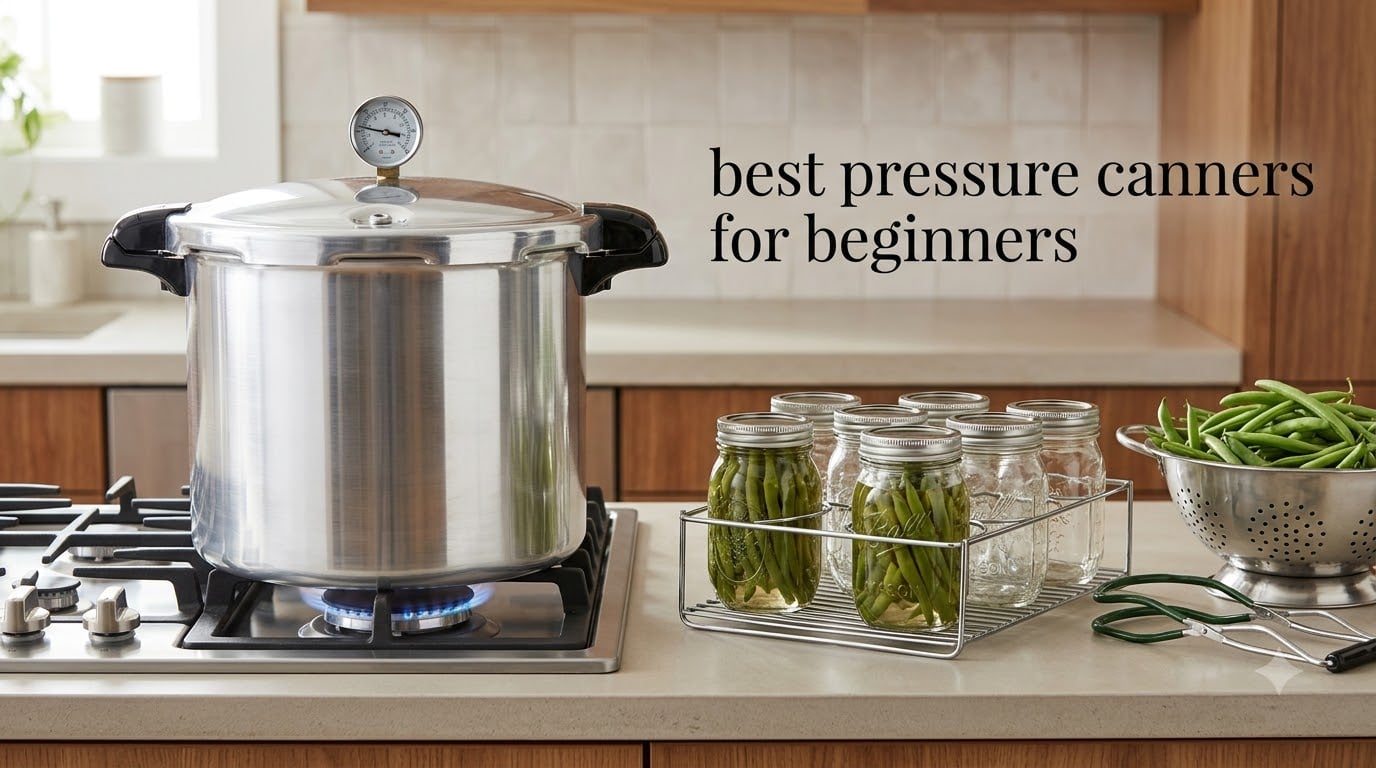
The first time I canned vegetables, I nearly lost a whole basket of green beans to my own impatience. I cut the heat early, pulled the jars sooner than the recipe said, and ended up with soft beans in a murky brine. Nothing dangerous happened, but I learned the same lesson thousands of first-time canners learn every season: a pressure canner is not a pot you watch, it is a vessel you read.
That is the whole promise of this guide. Below I break down the eight best pressure canners for beginners available right now, what each one actually does well, and the honest flaw in each that will decide it for you or against you. If you want the fastest path, take the Presto 01781 23-quart as your pick and read the first-batch walkthrough further down before you start.
Here is the short version of why this appliance exists at all. Water bath canning takes food to about 212 degrees Fahrenheit, the boiling point of water at sea level. Low-acid food — anything with a pH above 4.6, which includes green beans, corn, carrots, peas, soups, stock, meat and poultry — can carry spores of Clostridium botulinum. Those spores survive boiling indefinitely, and the toxin they produce is odorless, colorless and tasteless, which is exactly what makes it dangerous. A sealed pressure canner pushes steam pressure up until the water inside hits roughly 240 to 250 degrees, hot enough to destroy the spores. That is the only method the USDA considers safe for low-acid food, and it is the method every pick on this list is built for.
Two corrections before we go further, because both mistakes are extremely common.
First, a pressure cooker is not a pressure canner. Most multicookers have a “canning” button, and that button is there for the canning industry, not for your kitchen. A real canner must be tall enough to hold at least four quart jars upright on a rack, must have a locking lid with a vent pipe and a cover lock, and must carry a pressure regulator or dial. A canner also must not be filled more than two-thirds full of jars, and a household pressure cooker is neither tall enough nor shaped to allow that. If you want the honest background on that difference, our pressure cooker roundup covers the cooking side, and our water bath canner guide covers the acidic half of the pantry.
Second, nobody certifies canning equipment. Neither the USDA nor the National Center for Home Food Preservation approves, endorses or tests any brand of canner. What the NCHFP does is publish tested processing times for each food, and your job is to follow those times exactly in a vessel that can hold the required pressure. That is a small but important distinction, and we will come back to it.
Table of Contents
Top 3 Picks for Best Pressure Canners for Beginners (October 2026)

Presto 01781 23-Quart
- Dial gauge reads the full pressure range
- 26 half-pints 20 pints or 7 quarts per load
- 12-year limited warranty
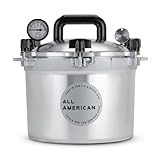
All American 1930 Model 910
- Gasket-free metal-to-metal seal
- Made in the USA with lifetime service support
- Holds about 7 pints or 4 quarts
T-fal 22-Quart
- Built-in weight with 3 PSI settings
- Two canning racks plus a step-by-step guide
- Holds 24 half-pints or 7 quarts
All 8 Pressure Canners Compared in 2026
| Product | Specifications | Action |
|---|---|---|
| Presto 01781 23-Quart Pressure Canner |
|
Check Latest Price |
| All American 1930 Model 910 Pressure Cooker/Canner |
|
Check Latest Price |
| T-fal 22-Quart Aluminum Pressure Canner |
|
Check Latest Price |
 Presto 02152 17-Quart Digital Pressure Canner Presto 02152 17-Quart Digital Pressure Canner |
|
Check Latest Price |
 Presto 01755 16-Quart Aluminum Pressure Canner Presto 01755 16-Quart Aluminum Pressure Canner |
|
Check Latest Price |
 NESCO NPC-9 9.5-Quart Smart Electric Pressure Canner NESCO NPC-9 9.5-Quart Smart Electric Pressure Canner |
|
Check Latest Price |
 Granite Ware 20-Quart Pressure Canner/Cooker/Steamer Granite Ware 20-Quart Pressure Canner/Cooker/Steamer |
|
Check Latest Price |
 WantJoin 23-Quart Aluminum Pressure Cooker/Canner WantJoin 23-Quart Aluminum Pressure Cooker/Canner |
|
Check Latest Price |
A note on the ordering before the individual reviews. The Presto 01781 leads because it pairs the highest volume of real owner feedback in this group with a genuine dial gauge and a 12-year warranty. The All American 1930 scores higher on stars but holds a noticeably smaller jar load, so it lands second. The T-fal takes third on capacity and included accessories. The rest are here because each solves a specific problem for a specific kitchen, not because they finished in a ranking.
1. Presto 01781 23-Quart Pressure Canner and Cooker: Best Overall for Beginners
Presto 01781 23-Quart Pressure Canner and Cooker
21.8 liter capacity
12 pounds empty
Dial gauge across the full pressure range
26 half-pints 20 pints or 7 quarts
Pros
- Dial gauge shows real pressure rather than inferring it from a weight
- Holds 26 half-pints 20 pints or 7 quarts in one run
- 76-page instruction and recipe book in the box
- 12-year limited warranty is the longest here
Cons
- Aluminum body rules out acidic foods like tomato and vinegar recipes
- Manual heat management takes attention until you learn the rhythm
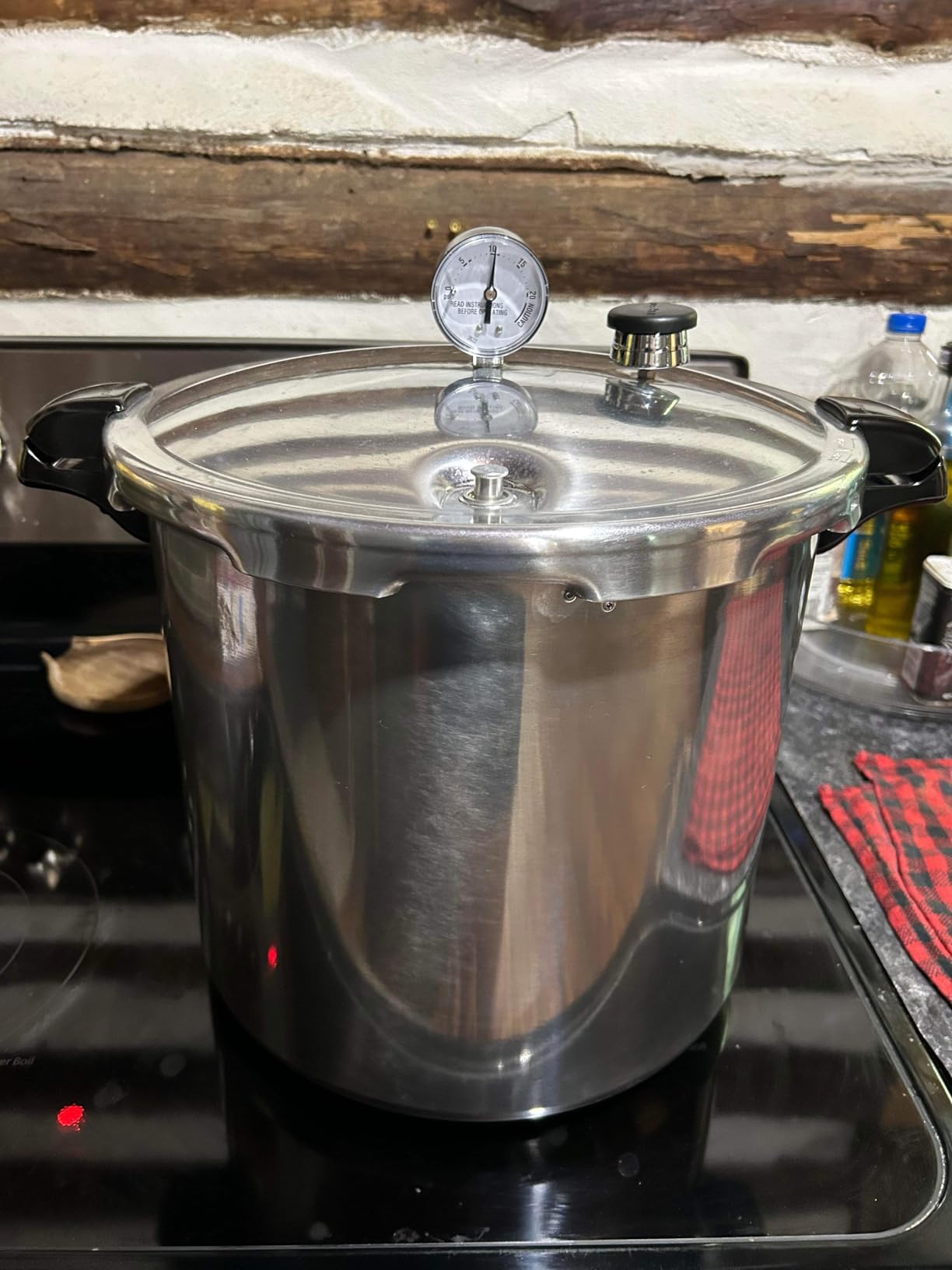
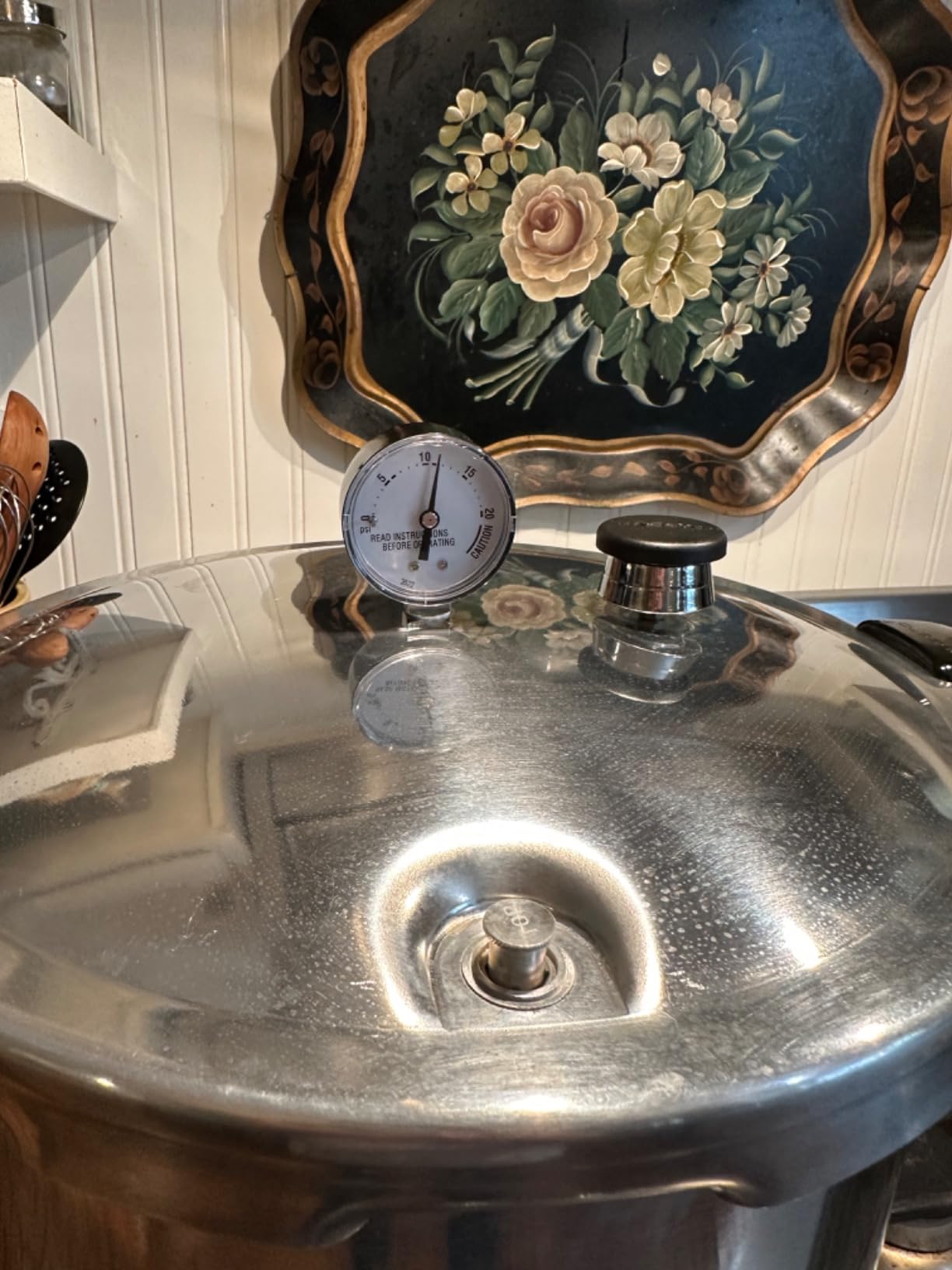
This is the canner most American canning kitchens actually own, and after spending time with all eight on this list it is the one I hand to a nervous beginner. It arrives with a canning rack, a 76-page instruction and recipe book, and a deluxe dial gauge that registers the complete range of processing pressures rather than a narrow band around one number. That gauge detail is what makes it altitude-capable without guesswork.
The batch math is the real reason to stretch to 23 quarts. A single load takes 26 half-pints, 20 pints or 7 quarts. For a beginner with a garden bed of green beans, that means one run instead of three, and one run means one pot of water to boil and one cooling period to supervise. Owners on r/Canning describe this model as the default recommendation for that exact reason, and the feedback volume behind it is enormous.
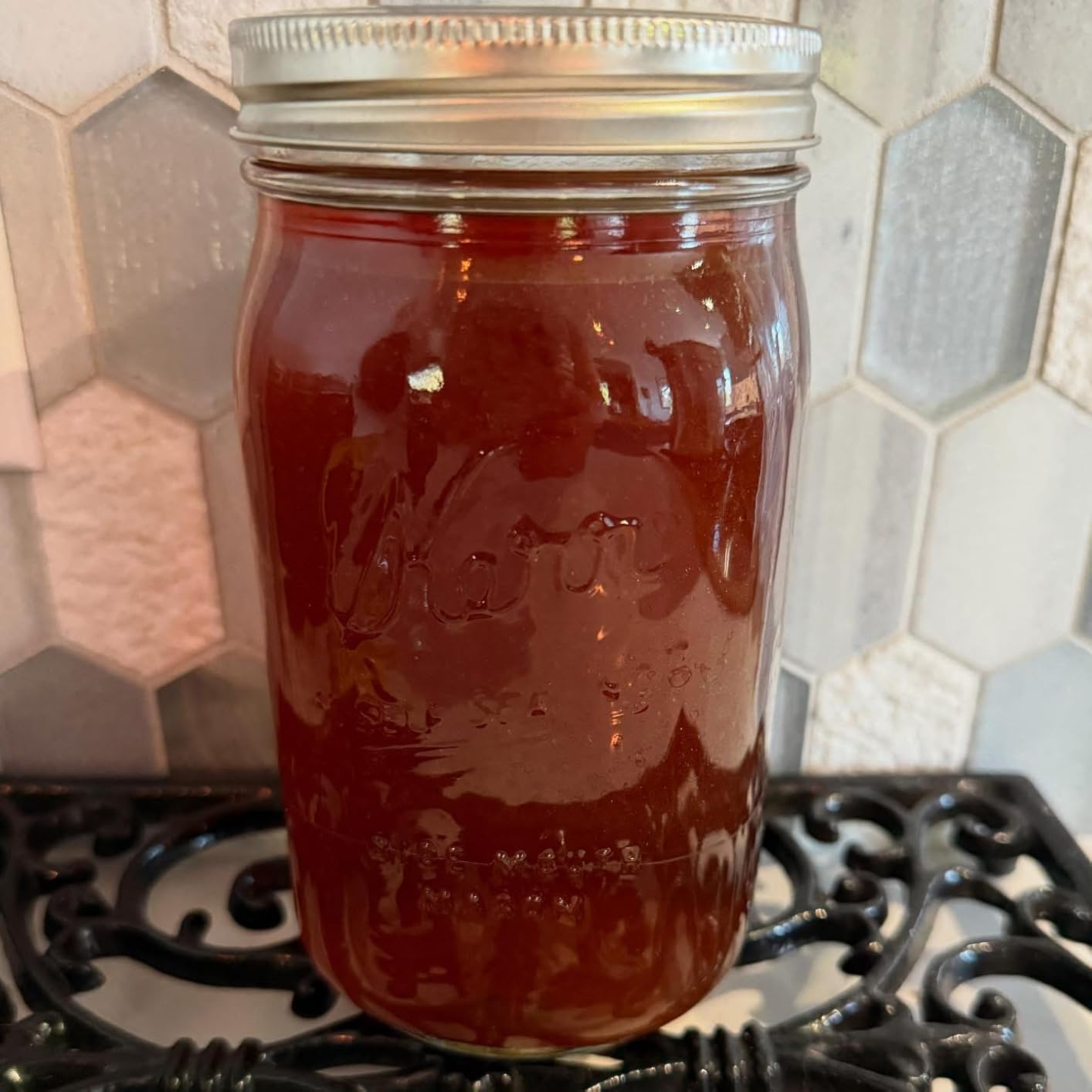
The honest flaw is heat management. Operation is manual, so the canner does not hold pressure by itself; you keep the dial at the processing pressure with the burner, and the gauge is your only proof you did it correctly. Owners who were intimidated by pressure canning tend to find this the hardest part of their first season, and the honest advice from long-time canners is to read the included book cover to cover before the first batch rather than working from a recipe page.
Two practical notes. The aluminum body means you keep tomato, vinegar and citrus recipes out of this pot; use your boiling water canner for those. And at 12 pounds empty, a full canner is a serious lift, so measure your range hood clearance and your sink depth before you commit.
Who this suits best
This suits a beginner who wants the most documented, most widely owned canner, and who plans to grow into a real garden harvest rather than put up three jars of jam a year. If you live above 1,000 feet, the full-range dial gauge is a genuine advantage over weighted models, because you read pressure rather than inferring it from the weight.
It also suits anyone who wants a second appliance-free pot. The 01781 doubles as a large-capacity pressure cooker, and the included book covers both jobs, so you are not buying a niche machine you use eight weeks a year.
Who should skip it
Skip it if canning acidic foods is your main goal, or if a rubber gasket is a deal breaker for you. The gasket is a consumable, it needs replacing every couple of years, and the metal-to-metal design on the All American below simply does not have one.
Skip it if your kitchen cannot handle 13.5 inches of height and 12 pounds of empty weight. Check the measurement before you order, not after.
2. All American 1930 Model 910: Best for Buying Once and Forgetting
All American 1930: 10.5qt Pressure Cooker/Canner (The 910) – Exclusive Metal-to-Metal Sealing System – Easy to Open & Close – Suitable for Gas, Electric, or Flat Top Stoves – Made in the USA
9.94 liter capacity
14.8 pounds empty
Metal-to-metal seal with six clamping wing nuts
About 7 pint or 4 quart jars
Pros
- No gasket to replace ever
- Highest star rating in this group at 4.9 across nearly 9800 reviews
- Made in the USA by Wisconsin Aluminum Foundry with lifetime service support
- Precision-machined regulator weight
Cons
- One of the heaviest canners here at 14.8 pounds and the highest cost
- Holds only about 7 pints or 4 quarts per batch
- Loaded canner must be set on the stove rather than carried
The All American is the canner people describe as built like a battleship, and it is the one most often reported to outlive its first owner and turn up working at estate sales. Owners consistently point to the same feature: a precision-machined metal-to-metal sealing system with positive clamping action, which means there is no rubber gasket anywhere in the pressure path. Nothing to replace, nothing to go hard and leak.
Here is the correction almost every review and forum thread gets wrong, including some experienced users. The All American has a dial on the lid, but that dial is an indicator, not the control. You operate this as a weighted-gauge canner. The weight on top sets the pressure, and the dial tells you roughly where you are. If you treat the dial as authoritative you will overcook your food, and if you have never used a weighted canner before, that is a genuinely harder first experience than the Presto above.
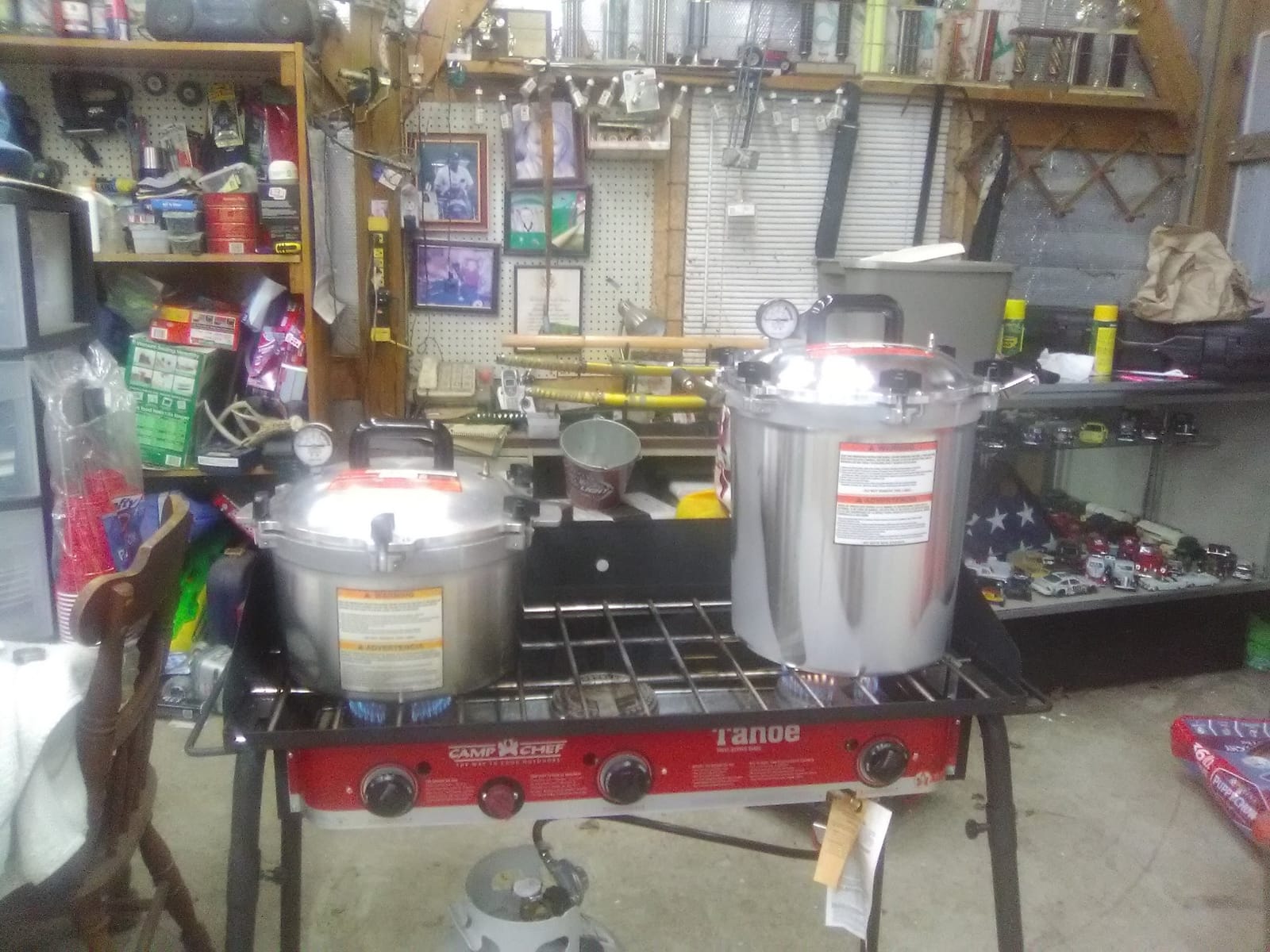
The honest flaw is capacity and handling together. Four quart jars or about seven pints is the smallest jar load among the stovetop canners here, and at 14.8 pounds empty the loaded pot is not portable. Owners who can handle it are unequivocal about quality, but beginners with back or joint problems consistently flag the weight as the thing that nearly stopped them.
Another wrinkle worth knowing before your first batch: the six wing nuts must be tightened evenly and deliberately, with the lid aligned before you start. Owners who rush the clamping report the seal blowing at around 10 PSI. A light coat of oil on the sealing rim, which the manufacturer’s own guidance suggests, helps the lid seat cleanly.
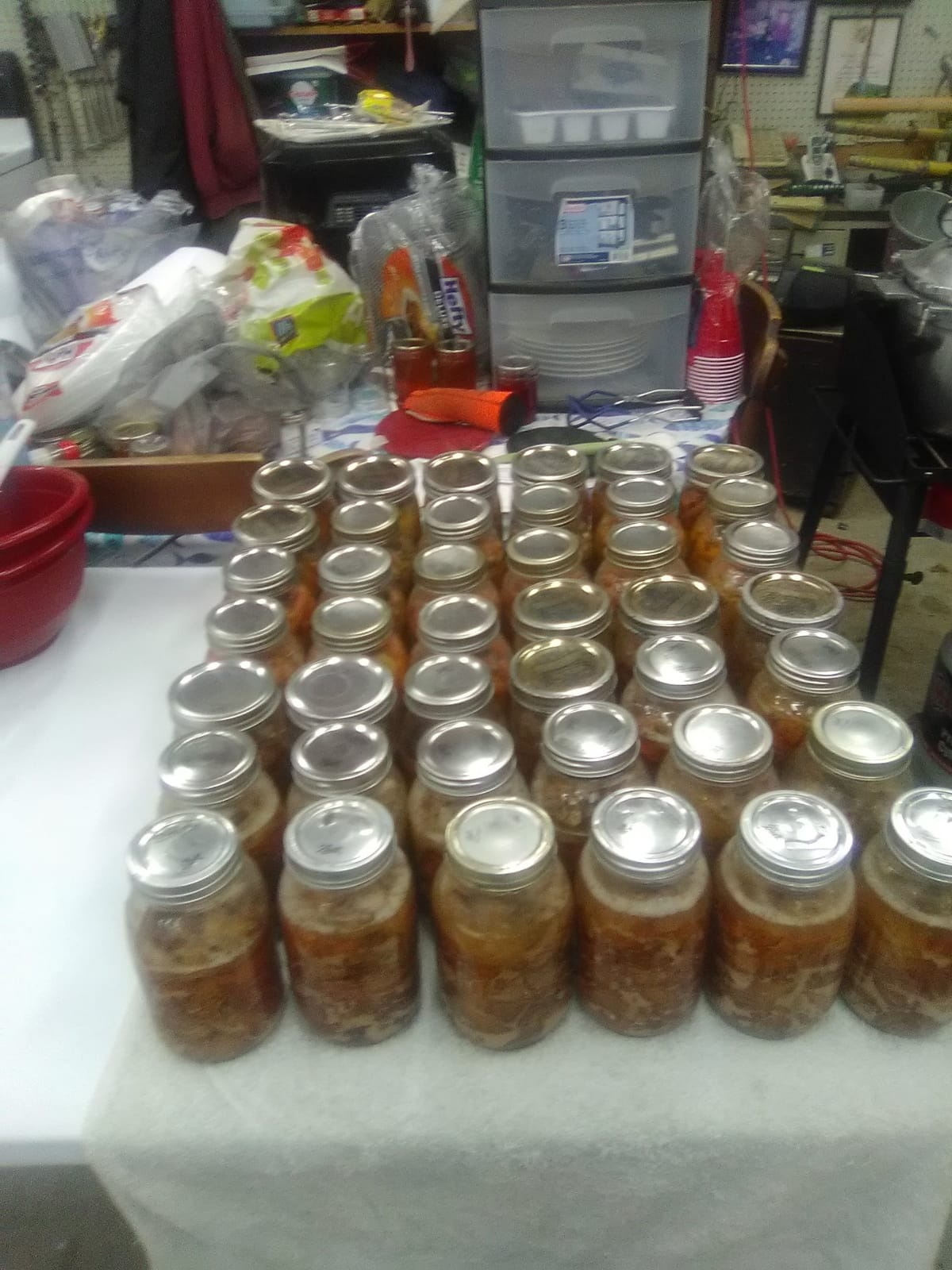
Who this suits best
This suits a beginner who has decided canning is a decade-long hobby and wants the version with no consumable parts. Owners describe the metal-to-metal seal as the reason their canner is still going, and several report buying a second one decades later rather than replacing anything.
It also suits anyone who can lift and hold 15 pounds of pot and who wants American manufacturing with lifetime service support behind it. Beginners who read the full manual first tend to get on with it well, because the operating logic does not change once you learn it.
Who should skip it
Skip it if you plan to can tomatoes, pickles or anything vinegar-based, because the aluminum reacts with acid. Skip it if you want the biggest possible batch in one run, because 4 quarts is the minimum qualifying load and no more.
Skip it if you are intimidated by manual weight-based pressure. The dial will not save you here. If you want a canner that visibly holds pressure and does not ask you to count jiggles, look at the Presto above instead.
3. T-fal 22-Quart Aluminum Pressure Canner: Best Value at Full Size
T-fal 22-Quart Aluminum Pressure Canner, 3 PSI Settings, Home Canning, Includes Racks & Canning Guide, Large Capacity, Pressure & Water Bath Canning for Vegetables, Meats, Seafood & Fruits, Silver
22 quart capacity
14.8 pounds empty
Adjustable weight at 5 10 and 15 PSI
24 half-pints or 7 quarts per batch
Pros
- Lowest cost among the 20-plus quart purpose-built canners here
- Three PSI settings built into the weight so there is nothing extra to buy
- Two canning racks and a step-by-step guide in the box
- Handles up to 24 half-pint or 16 wide-mouth pint jars
Cons
- Highest one-star share among the well-reviewed units at 9%
- Some buyers report gauges that do not read true pressure
- Printed manual has reportedly fallen apart
If you are not sure whether canning is going to become a habit, the T-fal is the sensible first purchase, and the logic is simple. It gives you a genuine 22-quart stovetop canner with 7 quarts of jar capacity, two canning racks so you can stack pints, and a complete step-by-step canning guide in the box. For a beginner, having the instructions physically in front of you matters more than most spec sheets suggest.
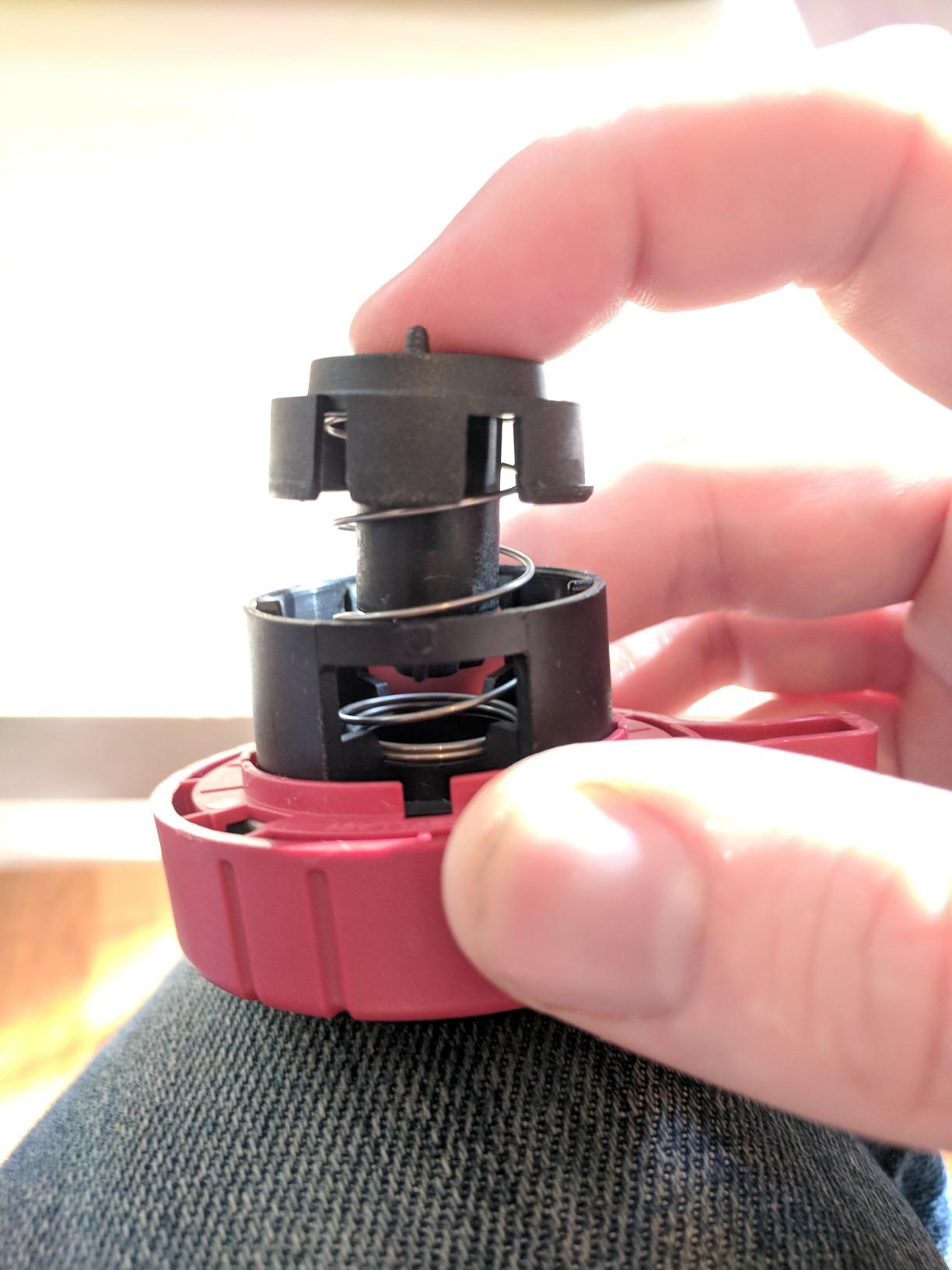
The built-in adjustable weight is the feature that separates it from cheaper generic pots. Three settings at 5, 10 and 15 PSI cover everything a home canner processes, and because the weight is integrated rather than a loose part, there is nothing extra to buy and nothing to lose down the drain of a sink. The locking lid, steam release valve and readable gauge are all straightforward.
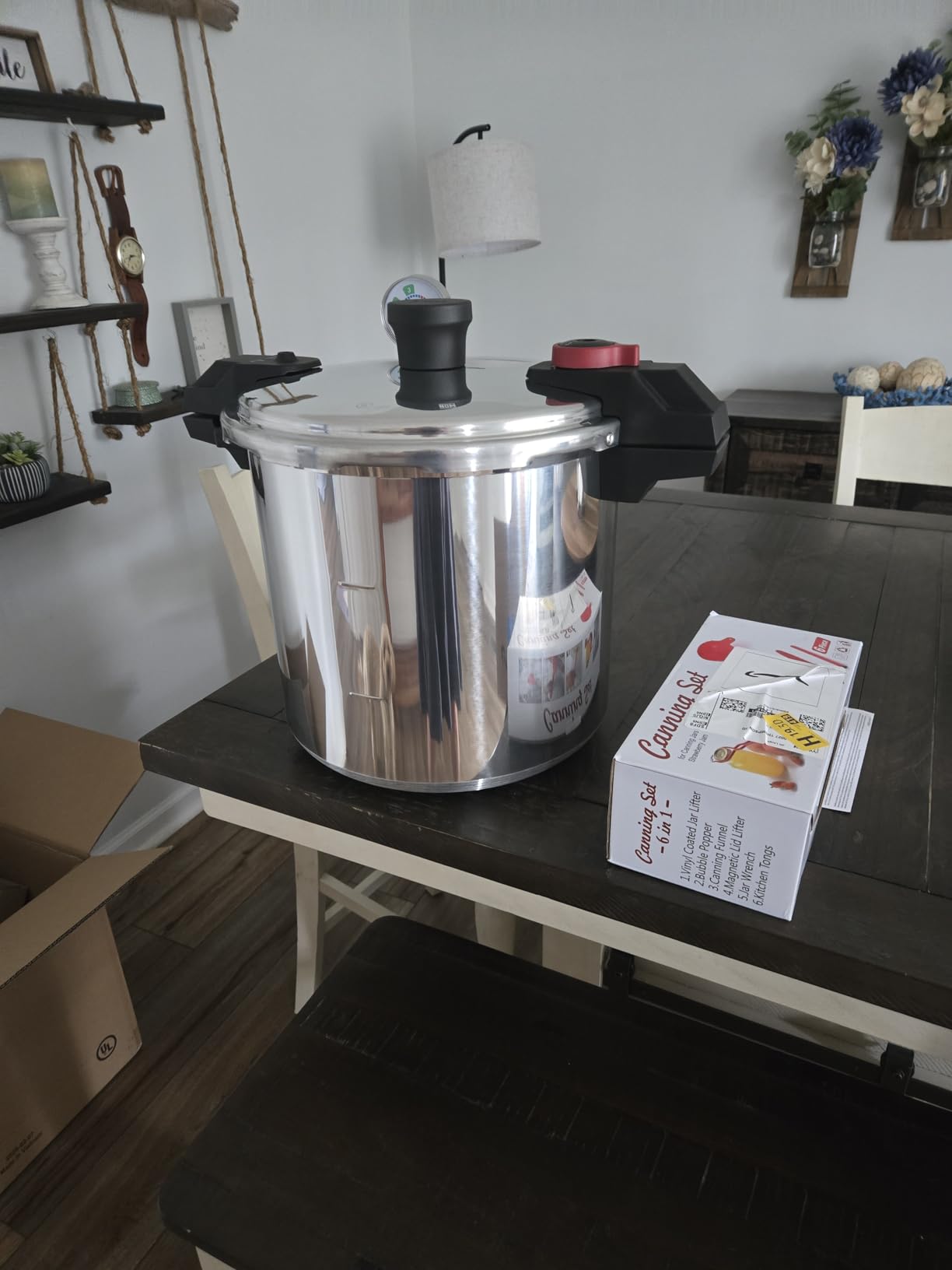
The honest flaw is build consistency, not design. At 4.4 stars with a 9 percent one-star share, this is the most polarizing unit in the group, and the critical reviews cluster around manufacturing variance: gauges that arrive dead or do not read true pressure, gaskets that failed early, and printed manuals that fell apart. Most owners describe it as easy and safe, and repeat use often converts buyers who had to take a replacement, but the odds of a first-run defect are higher here than anywhere else on the list.
At 16.26 inches tall and 14.8 pounds, it also needs a large burner and a deep sink. Measure both. And as with the other aluminum canners here, keep tomatoes and vinegar recipes out of it.
Who this suits best
This suits a beginner who wants a full-size canner without committing to a premium brand, and who is willing to check the gauge on arrival before the first real batch. Testing the unit with a batch of plain water and a couple of lids is the fastest way to find out whether your particular canner is sound.
It also suits anyone who wants pint jars. Two racks are included, which means you can process half-pints and wide-mouth pints without buying a second rack separately.
Who should skip it
Skip it if you have zero tolerance for the possibility of a defective gauge on a food-safety appliance. The NESCO below and the Presto 01781 have fewer complaints in that specific area.
Skip it if you want a long warranty. This carries a one-year warranty, which is the shortest in this group and stands in sharp contrast to the 12 years on the Presto 01781.
4. Presto 02152 17-Quart Digital Pressure Canner: Best for Hands-Off Canning
Presto 02152 17-Quart Digital Pressure Canner
17 quart capacity
24.3 pounds
Stainless steel chamber
1485 watts at 120 volts
Pros
- Fully programmable so there is no flame to manage and no kitchen heat
- Sensor holds the exact canning temperature automatically
- No altitude adjustments required anywhere in the country
- Stainless interior means no aluminum corrosion limits
Cons
- Among the most expensive options analyzed
- Heaviest canner here at 24.3 pounds
- 5 percent one-star share with reports of early digital control failures
This is the only pick here that removes the part beginners find hardest, which is babysitting heat. You select the canning method and processing time on the control knob, the LED display walks you through each step, and a built-in sensor maintains the temperature required for safe canning. Nothing jitters, nothing needs adjusting, and there is no flame in your kitchen on a hot afternoon.
The altitude story is the sleeper advantage. Because the unit controls temperature directly rather than relying on a gauge reading against a table of corrections, the manufacturer states that no adjustments are required for high-altitude canning. For a household above 1,000 feet that removes an entire category of error that every stovetop canner on this list carries.
The honest flaw is bulk. At 24.3 pounds and 18 inches tall, this is the heaviest and largest unit analyzed, and unlike the stovetop models it is not going anywhere once you plug it in, so it effectively claims a section of your counter permanently. The stainless chamber also means this is also your everyday cooking pot, which is a fair offset for anyone who already wants a large stock pot.
Second, the one-star share is 5 percent, the second highest among the well-rated canners, with reports concentrated in early units and the digital controls. At this price point, early reliability complaints are worth taking seriously, so keep the packaging and test the unit before a full season’s produce is waiting on it.
Who this suits best
This suits a beginner living in a hot climate, a small kitchen, or any household where a burner-free appliance matters. It also suits anyone above 1,000 feet who does not want to learn altitude correction tables before their first batch.
It suits a first-time canner with mobility limits too, because there is no lifting a pot of water and jars onto a burner. You load the chamber on your counter and press a button.
Who should skip it
Skip it if you want the biggest batch per run, because 17 quarts is a smaller jar load than the 22- and 23-quart stovetop canners. Skip it if you are unsure whether canning will stick, because it is the highest ticket on the list and the least forgiving of a hobby that ends.
Skip it if counter space is tight. Measure the footprint, not just the height.
5. Presto 01755 16-Quart Aluminum Pressure Canner: Best Mid-Size Pick
Presto 01755 16-Quart Aluminum Pressure Canner and Cooker
16 quart capacity
10.5 pounds empty
Works on regular and smooth-top ranges
Doubles as a large pressure cooker
Pros
- Tied for the lightest canner here at 10.5 pounds so it is easy to lift
- Works on regular and smooth-top ranges
- Proven Presto design with 4.7 stars across more than 4200 reviews
- Leaves budget room for racks and jars
Cons
- Only a one-year limited warranty against 12 years on the 23-quart model
- Listing detail is thin so you have to know what you want beforehand
- Aluminum rules out acidic foods
The 16-quart is the compromise model, and for a lot of beginners it is the right one. At 10.5 pounds empty it is the easiest large canner here to lift onto a burner, which matters more than buyers expect when the pot is full of water and glass. It also works on regular and smooth-top ranges, so it fits more kitchens than the induction-compatible picks.
Owners frequently recommend this size as a practical middle ground, large enough for useful batch sizes and noticeably lighter than the 22- and 23-quart models. It still qualifies as a canner rather than a large pressure cooker, which is the threshold that trips up beginners shopping by capacity alone.
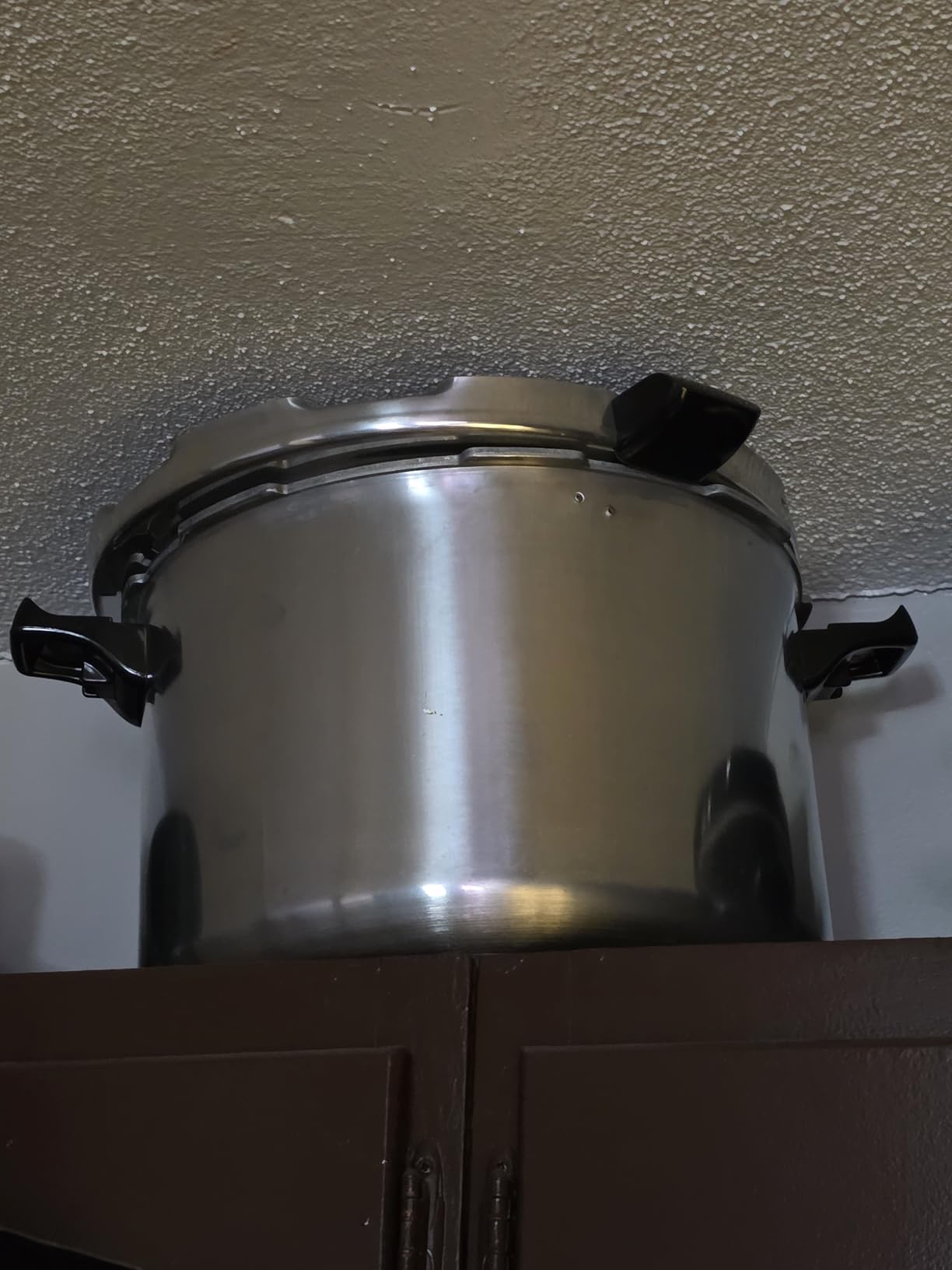
The honest flaw is the warranty. One year of limited coverage against the 12-year limited warranty on the 23-quart Presto is a large gap for a product from the same manufacturer, and it is the main reason this sits below the 01781 rather than beside it. The listing detail is also sparse, so you are buying on brand reputation rather than on a well-documented feature list.
Operation is manual, as with the other Presto stovetop models, and the aluminum body means the same rule applies: tomatoes, vinegar and citrus recipes go in a boiling water canner instead.
Who this suits best
This suits a beginner with back or joint concerns who still wants a genuine stovetop canner rather than an electric unit. It also suits a small kitchen with a shallow sink and a modest range hood, where 12 inches of height is a practical advantage over the taller models.
It suits anyone on a glass or smooth-top range who does not want to think about induction, since the manufacturer lists compatibility with both.
Who should skip it
Skip it if you want the longest warranty coverage available, because a year is thin for a food-safety appliance you plan to keep for years. Skip it if you expect a large garden harvest, since 16 quarts will not take a full week of picking in one run.
Skip it if you plan to can anything acidic.
6. NESCO NPC-9 9.5-Quart Smart Electric Pressure Canner: Best Electric Starter
NESCO NPC‑9 Smart Electric Pressure Canner and Cooker for Home Food Preservation, 9.5‑Quart Stainless Steel with Digital Controls
9.5 quart capacity
Stainless steel exterior
Standard and high-altitude limiting valves included
1000 watts at 120 volts
Pros
- Dedicated pressure canning mode plus slow cook steam and water bath modes
- No stove flame no outdoor burner and no kitchen heat
- Standard and high-altitude limiting valves ship in the box
- Removable inner pot with canning and steam racks
Cons
- Smallest capacity in the group at about 4 quarts or 5 pints
- Wide-mouth pint jars are reportedly hard to lift back out
- Wordy instructions give it a steeper learning curve than it looks
The dominant theme in the reviews for this unit is relief. Owners who were afraid of stovetop pressure canning describe the NPC-9 as the appliance that got them started, and several specifically mention growing up hearing stories about exploding cookers. A safety lock lid, an automatic float valve and a pressure regulation system address that fear directly, which is why this is the pick I point nervous beginners toward.
It is also genuinely multi-function. A dedicated pressure canning mode sits alongside slow cook, steam and water bath modes, so the same appliance handles low-acid vegetables, jams, stews and acidic fruit. The removable condensation catcher and nonstick inner pot make cleanup manageable, which matters more in practice than any spec sheet suggests.
The honest flaw is capacity, and it is a real one. At about 4 quarts or 5 pints per load, this is the smallest batch in the group, and it forces two or three runs for what should be a single session. That is exactly the complaint that shows up repeatedly in forum threads about small canners, where beginners assume smaller is easier and then find themselves boiling the same water three times.
Owners also report two friction points: wide-mouth pint jars are genuinely awkward to lift out of the chamber, and the instructions are wordy enough to deserve a slow read. You still wait for the unit to come up to pressure before you can walk away, and the alert beeps are startling in a quiet house.
Who this suits best
This suits a beginner who is genuinely afraid of stovetop pressure and wants every interlock the manufacturer can offer. It also suits anyone in a hot climate who would rather not run a burner indoors, or who wants to can without an outdoor propane setup.
It suits a household that wants one appliance for pressure canning, water bath canning and everyday cooking, and the included high-altitude limiting valves make it a legitimate option above 1,000 feet.
Who should skip it
Skip it if you plan to put up more than a few jars a week. Four quarts per load will exhaust anyone before the season ends.
Skip it if you need to can wide-mouth pints in volume, since loading and unloading them in this chamber is the most common owner complaint about the format. And skip it if you want a quart-jar canner, because the geometry does not cooperate.
7. Granite Ware 20-Quart Pressure Canner: Best Hard-Anodized Body
Granite Ware Pressure Canner/Cooker/Steamer, 20-Quart
20 quart capacity
10.5 pounds empty
Adjustable regulator at 5 10 and 15 PSI
Also steams and pressure cooks
Pros
- Hard-anodized body resists rust and staining better than plain aluminum
- Adjustable three-piece regulator at 5 10 and 15 PSI
- Tied for the lightest canner here at 10.5 pounds
- One vessel for canning cooking and steaming
Cons
- Second-lowest review volume here at just over 800 so less long-term feedback exists
- Weak category ranking suggests limited adoption
- Nonstick finish and aluminum rule out acidic foods
The Granite Ware earns its place on one specific material advantage. Its heavy-gauge hard-anodized aluminum body resists rust and staining, which is a real upgrade over the plain polished aluminum on several picks here. If you are going to run a canner through a full season of tomatoes, beans and stock, that finish ages better.
The adjustable three-piece pressure regulator, calibrated at 5, 10 and 15 PSI, gives the same pressure flexibility as the T-fal at a size that suits medium households. At 10.5 pounds empty it is tied for the lightest canner in the group, and the single vessel handles canning, pressure cooking and steaming.
The honest flaw is thin evidence. Just over 800 reviews is the second-smallest sample here, and the ranking in its category is weak compared with the Presto and All American models, which means fewer owners have hit a decade of use. You are buying on materials and design merit rather than on a deep body of long-term reports, and that is a fair trade only if you are comfortable accepting it.
Mechanically it is also the most manual unit in the set, with a mechanical knob and no automation or altitude compensation of any kind. Nonstick and aluminum together mean no acidic foods, and you will need to follow a published altitude table for any processing above 1,000 feet.
Who this suits best
This suits a beginner who wants a mid-size canner with the most corrosion-resistant body available and who does not mind reading an altitude table. It also suits anyone who wants one pot to do canning, pressure cooking and steaming without buying three appliances.
The light weight suits anyone with lifting concerns, since 10.5 pounds empty is tied for the lightest canner in this group.
Who should skip it
Skip it if you want the reassurance of a very large owner community, because the review base here is a fraction of the Presto 01781’s. Skip it if you want automation, since there is none at all.
Skip it if you plan to can tomatoes or anything vinegar-based, and skip it if you live far above 1,000 feet and do not want to manage correction tables.
8. WantJoin 23-Quart Aluminum Pressure Cooker/Canner: Best Induction Base on a Budget
Wantjoin Aluminum Pressure Cooker 23Qt Pressure Canner, Pressure Pot with Pressure Control for Home Kitchen or Restraurant, Commercial Pressure Cooker with Gauge
23 quart capacity
6.03 kg
Listed as gas and induction capable
Storage bag included
Pros
- Thickened composite base works on gas and induction
- 23-quart capacity at the lowest ticket in this group
- Six listed safety protections including a limiting valve and alarm valve
- Storage bag included which is unusual at this level
Cons
- Lowest rating here at 4.3 with a 9 percent one-star share
- Described as a commercial pressure cooker rather than a purpose-built canning vessel
- No canning instructions jar capacities or canning guide included
The single reason this unit is on the list is the base. A thickened composite bottom that the manufacturer lists for gas and induction solves the problem that sends most beginners back to the store. Almost every aluminum canner on this list is induction-incompatible, and buyers routinely discover that fact only after delivery.
Six listed safety protections are more than most budget units claim, including an automatic lock, a check valve, a pressure limiting valve, a safety valve, an alarm valve and an anti-blocking cover. The uncoated food-grade aluminum contact surface also means there is no coating to degrade, and a storage bag is included, which is genuinely unusual at this level.
The honest flaw is legitimacy. This is described as a commercial pressure cooker and steamer rather than a purpose-built canning vessel, and unlike every other product in this roundup it ships with no canning instructions, no jar capacity data and no canning guide. Most reviews here are about everyday pressure cooking rather than home canning, and the manufacturer has no established canning reputation or US service network.
It also carries the lowest rating in the group at 4.3 stars with a 9 percent one-star share, and the listing notes that acidic foods corrode the aluminum. For a food-safety appliance, buying without published tested guidance is a bigger compromise than it is for a cooking pot, and that is why this sits last despite the attractive spec sheet.
Who this suits best
This suits a beginner on an induction cooktop who cannot use any of the aluminum canners, and who wants 23 quarts of capacity. It also suits someone who mainly wants a large pressure cooker with a large pot and is treating canning as a secondary use.
At this level, the induction compatibility and the storage bag are the reasons to look at it at all.
Who should skip it
Skip it if canning is the reason you are shopping. No canning guide means you are relying on your own research for processing times on a food-safety task, and that is not a good trade.
Skip it if you want warranty backing from a company with a US service network, and skip it if you plan to can anything acidic.
Your First Batch: What Actually Happens on Day One
Before you touch produce, run a validation batch. This is the single most useful trick in the beginner canon, and it comes straight from r/Canning: process a batch of plain water with a couple of jars and lids to confirm that your specific canner holds pressure and that your lids seal. If something is wrong with the gauge, the gasket or the lid alignment, you find out with nothing wasted and no fridge space lost.
Once the canner is proven, a full batch runs in a predictable order.
Prepare the food according to a tested recipe from the National Center for Home Food Preservation. That means washing, trimming, blanching where directed, packing at the specified headspace, and wiping the rims. Headspace is not optional filler; too little headspace can cause a seal failure and too much is a real safety problem, because the extra air pressure that develops during processing can push product out of the jar and leave it under-processed.
Load the canning rack into the canner and set the jars on it. Then add 2 to 3 inches of hot water above the jars, which is what lets the pressure build and the contents heat through. Fill the canner no more than two-thirds with jars, or you will have no room for the water and no room for steam to circulate.
Lock the lid and bring the canner up to weight. On a dial-gauge canner you watch the needle settle into the processing range; on a weighted canner you wait for the weight to begin a steady jiggle and you keep it there. Either way, once the canner is at weight, you start the timer from your tested recipe and you do not shorten it. The processing time in the recipe assumes the canner reached pressure and assumes the heat distribution is right.
Turn the heat off at the end of the processing time and let the canner depressurize on its own. Do not force it, do not run cold water over the lid, and do not open the cover lock. Owners of the metal-to-metal models consistently advise allowing up to a full hour for complete depressurization, and running the process longer than the recipe says is always safer than running it short.
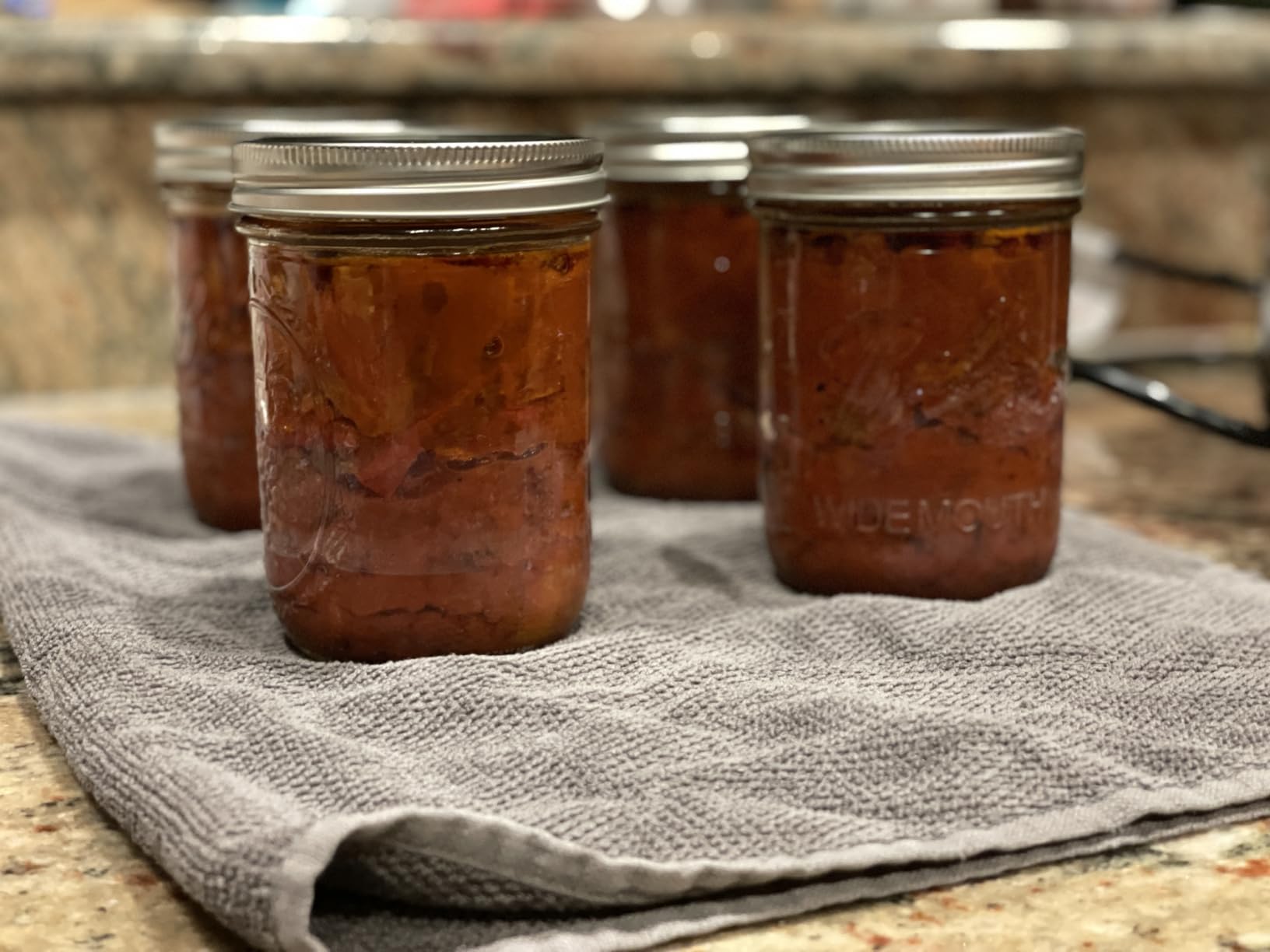
Cool the jars undisturbed for 12 to 24 hours on a towel or a folded cloth, away from drafts. Then check the seal by pressing the center of each flat lid. A lid that stays down with no flex means a good seal. A lid that pops or flexes means a failure, and that jar goes to the refrigerator and gets eaten first, never taste-tested to see if it is safe.
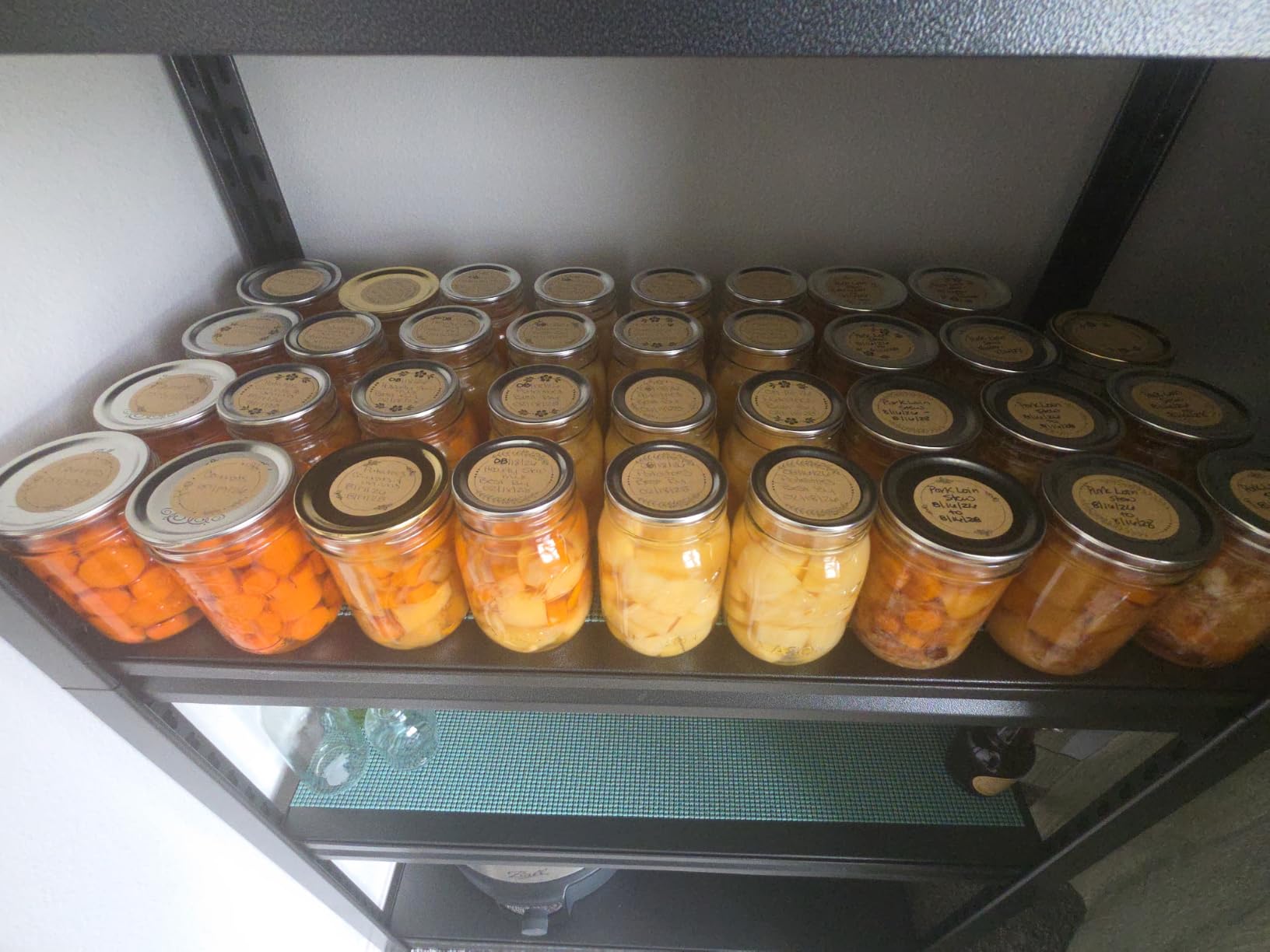
Store sealed jars in a cool, dark, dry place and label them with the contents and the date. Jars that did not seal go straight to the fridge, and jars with a broken seal that sat at room temperature get discarded rather than re-canned.
Pressure Canning Safety Rules That Are Not Negotiable
Botulism is the reason this guide spends more space on process than on product. Home-canned low-acid vegetables are a leading cause of botulism outbreaks in the United States, and the toxin cannot be seen, smelled or tasted. There is no shortcut and no way to detoxify food that was processed incorrectly, so treat the rules as absolute.
Use tested recipes. The NCHFP publishes processing times for every food, and those times are validated for a specific pressure, a specific jar size and a specific canner type. A time from a blog, a forum post or a YouTube video is not a tested recipe, regardless of how confident it sounds.
Adjust for altitude. Above 1,000 feet, water boils at a lower temperature, so processing times increase by specific increments published in the altitude tables. Every dial-gauge canner in this roundup makes this easier to handle because you read pressure directly, and the digital Presto and the NESCO both ship with or bake in high-altitude provisions.
Never taste food to test it. Not a spoonful, not a lick, not “just to check.” If you are unsure whether a jar processed correctly, discard it.
Do not can low-acid food in a water bath canner, and do not can in a pressure cooker or multicooker even when a canning setting is present. Neither USDA nor the NCHFP approves or certifies any canning equipment; they publish process times, and it is your responsibility to run those times in a vessel that holds the required pressure for the required duration.
And respect the vessel. A pressure canner that has been dropped, dented, or has a cover lock that does not engage is not a pressure canner anymore. If you are buying used, the next section is the checklist.
What Beginners Should Look For in a Pressure Canner
Beginners should pick a canner with at least four quart jars of capacity, a regulator you can understand, and a seal you can maintain. A weighted gauge with 5, 10 and 15 PSI settings is simpler to run; a dial gauge across the full pressure range is more precise and easier at altitude. A rubber gasket is a consumable you replace every few years; a metal-to-metal seal costs nothing over the life of the pot. Finally, check the base against your stove, because most aluminum canners will not work on induction and their weight can crack a glass cooktop.
Those three criteria are the whole filter, and they are worth applying in that order. Capacity decides whether canning is workable for you at all. Gauge type decides how much attention the process demands. Seal type decides what you will be buying in five years.
Two filters that catch people after purchase are worth mentioning here. Measure the height of your canner against your range hood and your overhead cabinet clearance before you commit, because a 16-inch canner under a low hood is a real problem. And if you own a glass or smooth-top range, weigh the pot empty and check what your range maker says about heavy cookware, because a loaded aluminum canner is far heavier than you will guess.
Dial Gauge vs Weighted Gauge: Which One Is Easier for a Beginner?
A weighted gauge canner controls pressure with a metal weight that sits on the vent pipe. You bring the canner to pressure until the weight jiggles steadily, then you keep it there with the burner. It is mechanically simple and hard to break, but it gives you no number, so you judge pressure by ear and by feel.
A dial gauge canner has a needle gauge on the lid and a regulator you set or a dial that reads true pressure. It gives you a number, which means you can follow altitude corrections and confirm the canner is where it should be. That feedback is why most experienced canners eventually move to dial, and why it is our recommendation for a first season.
One correction matters here because it trips up experienced users too. The All American has a dial on the lid, but that dial is an indicator. You still operate it as a weighted canner, using the precision-machined weight on top to set the pressure. Reading that dial as authoritative is the most common All American mistake we see described in owner reviews, and it is the reason the 1930 ranks second here despite the highest star rating in the group.
On which weight to use: a 5-pound weight is for lower-pressure processing, a 10-pound weight is the standard for most low-acid vegetables, and a 15-pound weight is for harder jobs and higher altitude. Above 1,000 feet the published tables tell you which weight to move up to and for how long, and you should follow them rather than guessing. Owners who add the three-piece adjustable regulator to a Presto report that the audible change in the jiggle is genuinely useful feedback, because you hear pressure rise and fall without looking.
Gasket vs Metal-to-Metal Seal: What the Gasket Actually Costs You
There is a pressure canner that does not require a gasket, and it is the All American, whose machined metal-to-metal sealing system with positive clamping action simply has no rubber in the pressure path. For a buyer who is anxious about consumable parts, that is the entire argument, and owners describe the gasket-free cover as easy to open and close compared with a rubber-sealed lid.
On the other side of that trade, a rubber gasket is not expensive and it is not a weakness if you maintain it. Presto and the other gasket models include a spare, replacement gaskets are widely available, and the practical rule is to replace a gasket every two to three years and any time it gets hard, cracked, swollen or flattened. The honest failure mode is not age, it is storing a spent gasket compressed in a box for a season and then installing it.
There is one All American-specific habit worth knowing from owner reports: a light coat of oil on the sealing rim helps the lid seat before you start tightening the six wing nuts, and taking time to align the lid before tightening matters. Owners who skip both steps report the seal blowing at around 10 PSI.
Stovetop Compatibility: Gas, Coils, Glass and Induction
You can use a pressure canner on an electric stove top, provided it is a coil or smooth-top unit the manufacturer approves. A flat glass or ceramic surface is not disqualifying, but the weight is the issue rather than the surface. Presto lists its 01755 and 01781 as working on regular and smooth-top ranges, and T-fal lists compatibility with gas and electric coil cooktops.
What you should not do is put a heavy loaded aluminum canner on a glass cooktop without checking your range maker’s guidance, because the concentrated load underneath a canner is exactly the scenario that cracks glass. A protective trivet rated well above your canner’s loaded weight, or a trivet rated for canning, resolves this and costs far less than a new range.
For induction, the list narrows sharply. Most aluminum canners simply will not work, and only the units with a ferromagnetic composite base qualify, which among the picks here means the WantJoin 23-quart. That is the frustration buyers describe most often: people only discover their canner is induction-incompatible after it arrives. Check your stove type first, and if you are on induction, read our electric pressure appliance guide for the countertop alternative.
Why Your Pressure Cooker Is Not a Canner
A pressure canner is not a pressure cooker with a canning button. The distinction is physical, not semantic, and it comes down to four requirements. A canner must hold at least four quart jars upright on a rack. It must have a locking lid with a vent pipe and a cover lock. It must carry a pressure regulator or dial that can be held at processing pressure. And it must leave room for the 2 to 3 inches of water under and around the jars, which means it must never be more than two-thirds full of glass.
A household pressure cooker fails the first test on geometry alone. It is wide and short, it is filled nearly to the top with food and liquid, and there is no room for the water column that makes pressure canning work. Manufacturers include canning modes on multicookers for commercial kitchens running standardized loads in vessels that meet these requirements, not for a home kitchen with a canner of beans.
That is why every pick in this roundup sits between roughly 10.5 and 24.3 pounds, is at least 11.75 inches tall, and specifies a jar count. The four-quart-jar minimum is the rule that separates a real canner from a large cooker, and it is the first thing to check on any listing that claims to do both.
Jar Sizes and What Actually Fits
Quart jars are what you buy when a listing says the canner is designed to hold quart jars, and half-pint and pint jars are what fill the rest of the space. The published figures make the comparison easy. The Presto 01781 holds 26 half-pints, 20 pints or 7 quarts. The T-fal holds 24 half-pints, 16 wide-mouth pints, 18 pints or 7 quarts. The All American 1930 holds about 7 pints or 4 quarts.
Yes, you can pressure can 8 oz jars. Those are half-pint jars, and they are the most space-efficient option: more jars per run, less water to boil, less processing time overall. The practical limit is your canning rack. Racks with wide spacing hold half-pints in a single layer, and the two-tier racks included with the T-fal and NESCO let you stack pints and get more per load.
Whichever jar you choose, the two containers in a matching set differ. Wide-mouth jars seal more reliably for beginners because the gasket has less to grab, at the cost of more weight. Standard mouth jars are lighter and cheaper. Either works, but pick one and be consistent, because processing times in tested recipes are written for a specific jar size.
Buying a Used or Vintage Pressure Canner
Used All Americans are extremely common, and they are frequently the better value, because the metal-to-metal design has nothing to wear out. A used canner is a reasonable purchase if you work through a checklist before you buy, and if you test the gauge before you trust it.
Check the gauge first, and get it tested rather than eyeballing it. Many county extension offices test pressure canner dials, usually at no charge, and that free verification is the single best reason to buy used rather than guess. If you cannot get it tested locally, do not can low-acid food in it.
Check the lid and cover lock for warping. Drop a canner on its rim and the sealing surface can deform subtly, and a warped lid will never hold pressure no matter how good the gauge is. Check that the overpressure safety plug is present and intact, since it is a genuine safety component and replacement parts for a vintage model can be hard to source. Check the vent pipe is clear and that the regulator weight matches the canner, and ask the model number so you can confirm parts availability before you commit.
Finally, weigh the honesty test. If a seller says a used canner is USDA approved, walk away. No canning equipment is approved or certified by the USDA or the NCHFP, and anyone who claims otherwise is selling you something, not informing you.
Accessories Every New Canner Needs on Day One
The canner is maybe half of what a first batch needs. Most models include a rack and a guide, but the rest of the kit is where beginners get stuck after the pot arrives, and the list is short.
You need canning jars, either standard mouth or wide mouth, in the size your canner is designed for. Wide mouth is the friendlier choice for a first batch. You need two-piece canning lids, and enough of them that you can process a full load plus a couple of test jars. You need a canning funnel with a bubble remover head, a jar lifter, and a clean towel for rim wiping and for setting hot jars on.
You also need a tested recipe source, and that is not optional. Get the NCHFP tested process times for each food you plan to can, and keep them somewhere you will actually read them before a batch rather than during one. Add a pair of heat-resistant gloves, a canning jar brush, and a second rack if you plan to stack pints.
Finally, add a small dial gauge tester or a plan to have your gauge tested at your county extension office each year. Gauge testing is the cheapest risk reduction available in this entire hobby, and skipping it is the one shortcut that has no defense.
Frequently Asked Questions
Is there a pressure canner that doesn’t require a gasket?
Yes. The All American uses a precision-machined metal-to-metal sealing system with positive clamping action, so there is no rubber gasket in the pressure path and nothing consumable to replace. Every other canner in this roundup, including all three Presto models, uses a rubber gasket that should be replaced every two to three years or any time it hardens, cracks or flattens.
What is the easiest canning system for beginners?
A stovetop canner with a dial gauge, at least 16 quarts and a jar capacity of 7 quarts. The dial gives you a number to read instead of a sound to judge, and 16 quarts means a full harvest fits in one run. The Presto 01781 23-quart is the version of that we recommend most often.
What is the difference between a dial gauge and a weighted gauge canner?
A weighted canner controls pressure with a metal weight on the vent pipe, and you hold it jiggle-steady with the burner. A dial gauge canner has a needle that reads actual pressure, so you can confirm where you are and apply altitude corrections. Note that the All American has a dial but is operated as a weighted canner, so its dial is an indicator only.
Can I use a pressure canner on an electric stove top?
Yes, on a coil or smooth-top unit the manufacturer approves. Presto lists the 01755 and 01781 for regular and smooth-top ranges, and T-fal lists gas and electric coil compatibility. The real caution is weight, not surface: a loaded aluminum canner is heavy, so use a trivet rated well above its loaded weight and check your range maker’s guidance on glass cooktops.
Is a pressure cooker safe for canning vegetables?
No. A household pressure cooker cannot hold four quart jars upright with 2 to 3 inches of water underneath, cannot be filled more than two-thirds with jars, and lacks the vent pipe and cover lock a canner requires. A canning setting on a multicooker is intended for commercial kitchens with standardized loads in vessels that meet canner requirements, not for home vegetable canning.
What is the best electric pressure canner for beginners?
The NESCO NPC-9 is the easiest for someone afraid of stovetop pressure, with a safety lock lid, automatic float valve, pressure regulation, and both standard and high-altitude limiting valves. The Presto 02152 17-quart digital canner goes further with a sensor that holds the exact canning temperature and needs no altitude adjustment, but it is the heaviest and most expensive unit analyzed.
What weight should I use on my pressure canner?
A 10-pound weight is the standard for most low-acid vegetables. A 5-pound weight is used for lower-pressure processing and a 15-pound weight for harder jobs and higher elevations. Follow the altitude tables above 1,000 feet, which specify which weight to move up to and for how long, rather than guessing. A three-piece adjustable regulator gives audible feedback as pressure rises and falls.
What happens if you leave too much headspace when pressure canning?
The air in the headspace expands during processing and can push food out of the jar, which can leave the contents under-processed and the seal compromised. That is why tested recipes specify headspace precisely rather than approximately. Too little headspace is also a problem, because contents can boil over and prevent a proper seal.
Do I have to test my pressure canner dial gauge?
Have it tested at least annually, and before you rely on a canner you bought used. Many county extension offices test pressure canner dials, usually at no charge. It is the cheapest risk reduction in the whole hobby, and a gauge that reads high or low changes your actual processing temperature without any visible sign.
Can you pressure can 8 oz jars?
Yes. Eight ounce jars are half-pint jars, and they are the most space-efficient option because more of them fit per run, which means less water to boil and less total processing time. The Presto 01781 holds 26 half-pints and the T-fal holds 24. Match the jar size in the tested recipe, because processing times are written for a specific jar size.
How do I adjust for altitude when pressure canning?
Above 1,000 feet water boils at a lower temperature, so you use the published altitude tables to increase pressure or processing time. A dial gauge canner makes this easier because you read pressure directly rather than inferring it. The Presto 02152 digital canner states that no adjustments are required, and the NESCO NPC-9 ships with standard and high-altitude limiting valves.
What foods can only be pressure canned?
Everything with a pH above 4.6, which includes green beans, corn, carrots, peas, asparagus, soups, stock, chili, all meats, poultry and seafood. Home-canned low-acid vegetables are a leading cause of botulism outbreaks because the spores survive boiling indefinitely and the toxin they produce has no color, odor or taste. Tomatoes and pickles belong in a boiling water canner, not a pressure canner.
Which Pressure Canner Should You Buy
Buy the Presto 01781 23-quart. It is the best pressure canner for a first-time canner because it combines a true dial gauge, 7 quarts of jar capacity, a 76-page manual in the box and a 12-year limited warranty, backed by the largest body of real owner feedback of anything in this roundup. If your budget is the deciding factor, the T-fal 22-quart gives you full size and two racks for less, and you should test its gauge with a water batch before you trust it.
Two other clear picks. If you have decided canning is a lifelong hobby and you would rather never buy a gasket again, the All American 1930 is the buy-once answer, with the tradeoff of 4 quarts per load and a 14.8 pound lift. If you are afraid of stovetop pressure, the NESCO NPC-9 removes that fear, though at about 4 quarts per load you will be running several batches.
Before any of them, do three things. Measure your range hood clearance, confirm whether your cooktop is induction, and get your dial gauge tested at your county extension office once a year. Then run a batch of water and a couple of lids to prove the canner before you trust it with a season’s produce. That habit, more than any brand, is what separates a confident canner from a nervous one. If you want the acidic half of the pantry handled properly, our water bath canner guide covers that side, and both methods together will keep you in beans, fruit and pickles through 2026 and well beyond it.