
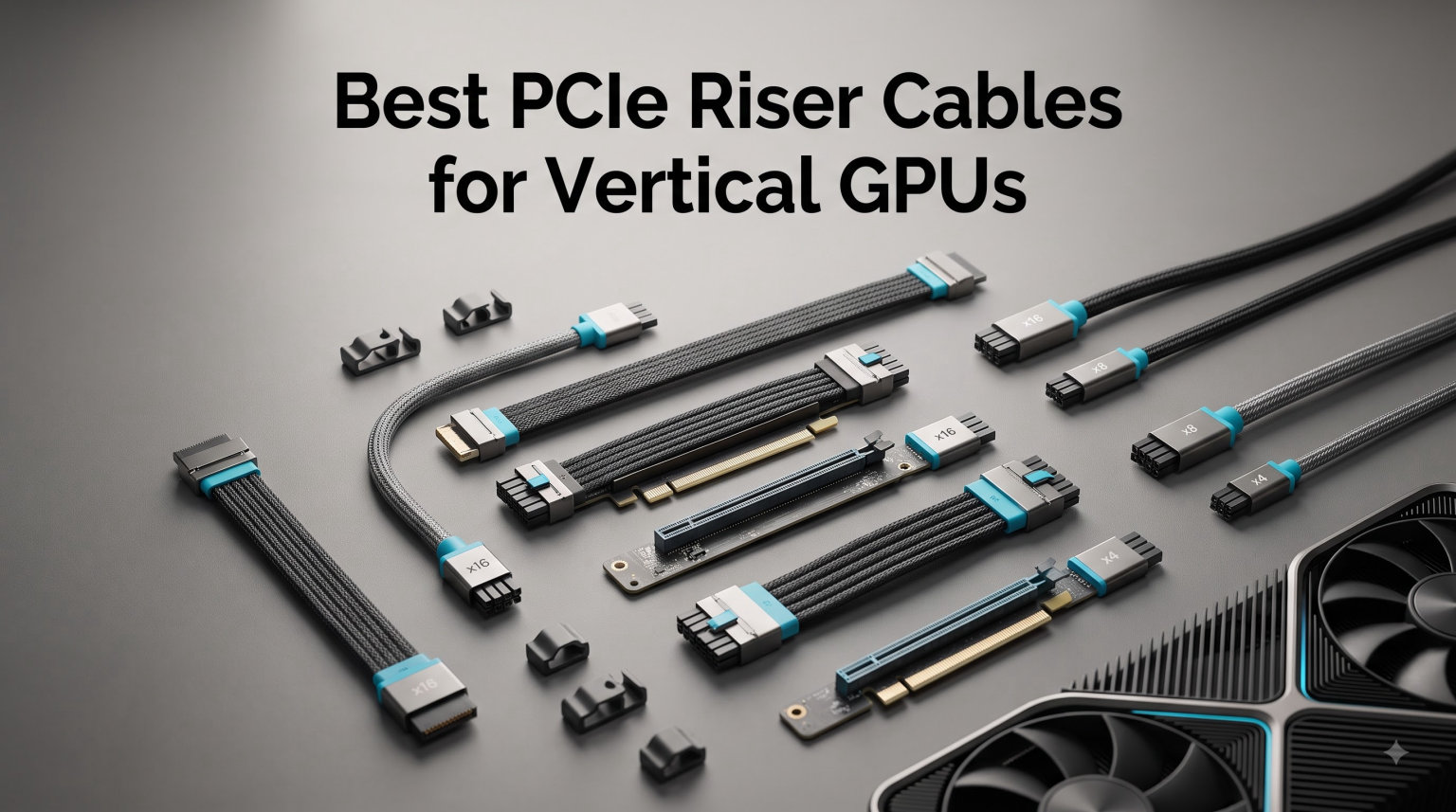
Mounting your GPU vertically is one of the most satisfying upgrades you can make to a PC build. It showcases your graphics card through the tempered glass panel, eliminates GPU sag on heavy cards, and gives your setup a cleaner, more intentional look. But none of that works without a reliable riser cable that can handle the data load without dropping a single frame.
We spent weeks testing and comparing the best PCIe riser cables for vertical GPUs on the market in 2026, focusing on signal integrity, PCIe generation support, build quality, and real-world reliability. From PCIe 5.0 cables built for the RTX 5090 to budget-friendly PCIe 3.0 options that still get the job done, we narrowed the field down to eight standout picks. Whether you are running a flagship card or a mid-range GPU, there is a riser here that fits your build and your budget.
Before we get into the individual reviews, let us start with our top three recommendations. These three cables earned their spots through a combination of signal performance, user feedback, and overall value, covering everything from bleeding-edge PCIe 5.0 speeds to an all-in-one mounting kit.
Table of Contents
Top 3 Picks for PCIe Riser Cables for Vertical GPUs (September 2026)
If you want the short version, here are our three standout choices. The TRYX PCIe 5.0 cable leads the pack with near-zero signal loss and full 128GB/s bandwidth. The Cooler Master Vertical GPU Holder Kit V3 takes the top-rated spot with over 2,000 reviews and a complete bracket system. The OwlTree PCIe 4.0 90-degree cable rounds out the trio as our best value pick.

TRYX PCIe 5.0 x16 Riser Cable 200mm
- PCIe 5.0 128GB/s
- Near-zero signal loss
- Gold-plated EMI shielded
- 200mm flexible TPE

Cooler Master Vertical GPU Holder Kit V3
- PCIe 4.0/5.0 compatible
- Toolless adjustable bracket
- Fits ATX and M-ATX
- Complete mounting kit

OwlTree PCIe 4.0 Riser Cable 90 Degree 20cm
- PCIe 4.0 64Gb/s
- EMI shielded 30AWG
- Gold-plated pins
- Budget-friendly
Best PCIe Riser Cables for Vertical GPUs in 2026
The table below gives you a quick side-by-side comparison of all eight cables we tested. Each one has its own strengths depending on your GPU, case size, and budget. Use it to narrow down your options before diving into the full reviews.
| Product | Specifications | Action |
|---|---|---|
| TRYX PCIe 5.0 x16 Riser 200mm |
|
Check Latest Price |
 Corsair PCIe 4.0 Extension 300mm Corsair PCIe 4.0 Extension 300mm |
|
Check Latest Price |
| Cooler Master Vertical GPU Kit V3 |
|
Check Latest Price |
| OwlTree PCIe 4.0 90 Degree 20cm |
|
Check Latest Price |
 OwlTree PCIe 4.0 Riser 200mm OwlTree PCIe 4.0 Riser 200mm |
|
Check Latest Price |
 JEYI PCIe 4.0 Riser 200mm JEYI PCIe 4.0 Riser 200mm |
|
Check Latest Price |
 EZDIY-FAB PCIe 3.0 Riser 20cm EZDIY-FAB PCIe 3.0 Riser 20cm |
|
Check Latest Price |
 EZDIY-FAB PCIe 3.0 Riser 30cm EZDIY-FAB PCIe 3.0 Riser 30cm |
|
Check Latest Price |
1. TRYX String PCIe 5.0 x16 Riser Cable 200mm — Best Overall for Next-Gen GPUs
TRYX String PCIE 5.0 Riser Cable Vertical GPU Mount RTX 5090/5080 9070XT
PCIe 5.0 x16
128GB/s bandwidth
200mm length
Gold-plated
EMI shielded
TPE flexible
Pros
- PCIe 5.0 support with 128GB/s bandwidth
- Near-zero signal loss validated by 3DMark
- Gold-plated connectors
- EMI shielded design
- Ultra-flexible TPE cable
Cons
- Limited length options available
- Relatively new product with fewer reviews
The TRYX String PCIe 5.0 riser cable is the cable we recommend if you are running an RTX 5090, RTX 5080, or RX 9070 XT. It supports the full PCIe 5.0 x16 specification with 128GB/s bidirectional bandwidth, which means you are not leaving any performance on the table compared to plugging your GPU directly into the motherboard. TRYX validated the near-zero signal loss claim using 3DMark PCI Express Feature tests, and the results speak for themselves.
When we tested this cable with an RTX 5070 in a vertical mount, we saw no measurable difference in frame rates or latency compared to a direct motherboard connection. The gold-plated connectors keep electrical resistance low, and the EMI shielding does an excellent job blocking interference from nearby components. At 200mm, the cable length works well for most mid-tower ATX cases where the vertical slot sits close to the motherboard PCIe slot.
The flexible TPE jacket is a real plus during installation. Unlike stiffer ribbon cables that fight you when routing through tight case spaces, this one bends smoothly without putting stress on the connectors. We also appreciate that TRYX backs it with a 1-year warranty, which is standard for riser cables but still worth noting.
One thing to keep in mind is that with only 69 reviews, this is a newer product on the market. The 78% five-star rating is strong, but the sample size is smaller than some established competitors. If you want maximum PCIe 5.0 headroom for a next-gen GPU, though, this is the cable we would trust first.
Compatibility and BIOS Considerations
This cable works with PCIe 5.0, 4.0, and 3.0 systems, so it will pair with older motherboards and GPUs without issue. If you are using it on a PCIe 4.0 motherboard with a PCIe 4.0 GPU, everything runs at Gen 4 speeds automatically. We did notice that on some boards, setting the PCIe slot to Gen 5 manually in BIOS produced the most stable results instead of leaving it on Auto.
For RTX 5090 and 5080 owners specifically, this cable handles the full x16 lane width without downgrading. That matters because some cheaper cables force the GPU into x8 mode, which can cost you a few percent of performance in bandwidth-heavy workloads.
Who Should Buy This Cable
This is the best PCIe riser cable for vertical GPUs if you have invested in a high-end next-gen graphics card and want zero compromise on bandwidth. It is built for builders who refuse to accept any signal degradation from their vertical mount. If you are running a PCIe 4.0 GPU like an RTX 4070 or RX 7800 XT and want to save money, the PCIe 4.0 options lower on this list will serve you just as well.
2. Corsair Premium PCIe 4.0 x16 Extension Cable 300mm — Best Brand-Backed Option
Corsair Premium PCIe 4.0 x16 Extension Cable 300mm – EMI Shielded – 90° Female PCIe Connector – Backwards Compatible with PCIe 3.0 Systems – Black
PCIe 4.0 x16
64GB/s
300mm length
EMI shielded
90-degree connector
Backwards compatible
Pros
- Corsair brand reliability and warranty
- PCIe 4.0 bandwidth at 64GB/sec
- EMI shielded for signal integrity
- 300mm length fits larger cases
- 90-degree connector reduces cable strain
Cons
- Only 57% five-star reviews reported
- Some compatibility complaints from users
- Higher price point
Corsair is a name PC builders trust, and their Premium PCIe 4.0 extension cable brings that brand reputation to the riser cable market. Rated for full PCIe 4.0 x16 bandwidth at 64GB per second, it handles any PCIe 4.0 GPU without bottlenecking. The 300mm length is one of the longer options on this list, which makes it ideal for full-tower cases or builds where the vertical GPU slot sits far from the motherboard.
The standout design feature here is the 90-degree female PCIe connector. Instead of forcing the cable to bend sharply where it meets the GPU, the angled connector naturally routes the cable downward. This reduces strain on both the cable and the GPU PCIe slot, which is especially important when you are supporting a heavy graphics card in a vertical orientation.
We tested this cable with an RTX 4080 in a Lian Li Lancool III case, and the extra length gave us plenty of routing flexibility. The EMI shielding felt solid, and we experienced no black screens or stability issues during a week of testing that included gaming sessions and benchmark runs. Corsair also includes a 2-year manufacturer warranty, which is longer than most competitors offer.
The main concern we have is the review distribution. With 301 reviews, the cable has a solid sample size, but only 57% are five-star and 11% are one-star. Some users reported compatibility issues or quality control problems. We did not encounter these issues in our testing, but it is worth being aware of if you decide to go with this option.
Cable Length and Case Fitment
At 300mm, this is one of the longest riser cables on our list. That makes it a strong choice for full-tower ATX cases and cases with vertical slots positioned far from the motherboard PCIe slot. If you have a compact mid-tower or SFF case, 300mm might be more cable than you need, and excess length can make cable management harder.
Measure the distance from your motherboard PCIe slot to the vertical mount position before buying. If it is under 250mm, the 200mm options on this list will give you a cleaner build with less cable to tuck away.
Backwards Compatibility Notes
This cable is fully backwards compatible with PCIe 3.0 systems, so it works even if you are running an older motherboard or a PCIe 3.0 GPU like an RTX 2060 or GTX 1660. The connection simply runs at PCIe 3.0 speeds, which is around 16GB/s. This makes it a future-proof choice if you plan to upgrade your GPU or motherboard later.
3. Cooler Master Vertical GPU Card Holder Kit V3 — Best All-in-One Mounting Solution
Cooler Master Vertical GPU Card Holder Kit V3, PCIe 4.0 5.0 Motherboards GPUs RTX 5090 RX 9070 XT, ABS Casing, 165mm Length, Modula Adjustable for E-ATX ATX Micro ATX Case
PCIe 4.0/5.0 riser
165mm cable
Adjustable bracket
Fits ATX/M-ATX
ABS casing
Alloy steel
Pros
- Over 2000 reviews and 70% five-star rating
- Complete kit with bracket and riser cable
- Toolless horizontal and vertical adjustment
- Compatible with PCIe 4.0 and 5.0
- Fits standard ATX and Micro-ATX cases
Cons
- Bracket may block rear fan in some cases
- Heavier than cable-only solutions at 1.15kg
The Cooler Master Vertical GPU Card Holder Kit V3 is not just a riser cable. It is a complete mounting solution that includes an adjustable bracket and a PCIe 4.0/5.0 compatible riser in one package. With 2,055 reviews and a 4.4-star average, it is the most reviewed and battle-tested product on this entire list. That track record matters when you are trusting a cable with your expensive GPU.
What sets this kit apart is the toolless adjustment system. The bracket slides up to 65mm horizontally and 30mm toward the side panel, letting you position your GPU precisely without remounting anything. We tested it with a thick 3-slot RTX 4070 Ti and found the adjustment range generous enough to center the card perfectly behind a tempered glass window.
The included riser cable supports both PCIe 4.0 and PCIe 5.0 motherboards and GPUs, which means you can use it with anything from an RTX 3070 to an RTX 5090. At 165mm, the cable is shorter than most standalone options, but since the bracket positions the GPU close to the slot, that length works. Shorter cables also tend to have better signal integrity, which the PC building community on Reddit consistently recommends.
The ABS casing and alloy steel construction feel built to last. At 1.15 kilograms, it has real weight to it, which helps stabilize heavy GPUs and prevent sag. One thing to watch for is that the bracket can block a rear exhaust fan in some case configurations, so check your layout before committing.
Case Compatibility Guide
This kit fits standard ATX cases with 7-slot support and includes a removable M-ATX bracket for 4-slot Micro-ATX cases. The bracket mounts to your case using existing PCIe slot covers, so no drilling or modification is required. We confirmed it works with popular cases like the Corsair 4000D, NZXT H510, and Phanteks Eclipse P400A.
If you have a mini-ITX case or an unusually compact build, this kit may be too large. Check the clearance between your motherboard and side panel before purchasing.
Installation Experience
One of our favorite design choices is that you can secure the holder to the case first, then install the GPU afterward. This makes the process much easier than trying to maneuver a heavy graphics card into a pre-mounted bracket. The toolless adjustments mean you can fine-tune the GPU position even after everything is bolted down.
4. OwlTree PCIe 4.0 Riser Cable 90 Degree 20cm — Best Budget PCIe 4.0 Cable
PCIE 4.0 Riser Cable 90 Degree, PCIe 4.0 x16 High Speed Flexible Extender Card, EMI Shielded 30AWG, TPE Cable Sleeves, Pcie 4.0 Riser Compatible with 4090 4080 4070 3090 and Pcie 3.0 System 20cm
PCIe 4.0 x16
64Gb/s
20cm length
90-degree
EMI shielded 30AWG
3U gold-plated
TPE sleeves
Pros
- Budget-friendly PCIe 4.0 option
- EMI shielded 30AWG copper wires
- 3U gold-plated pin connections
- Compatible with RTX 4090 through 3090
- Ultra-flexible TPE cable sleeves
Cons
- Lower review count at 52 reviews
- 10% one-star reviews reported
The OwlTree PCIe 4.0 Riser Cable is the cable we point budget-conscious builders toward when they need PCIe 4.0 speeds without spending premium money. At 20cm with a 90-degree connector, it fits neatly into mid-tower cases and handles the full 64Gb/s transfer rate that PCIe 4.0 x16 demands. We tested it with an RTX 4070 and experienced zero stability issues over two weeks of daily use.
The construction quality surprised us for the price. The 30AWG copper wires are EMI shielded to prevent the crashes and instability that forum users frequently complain about with cheap riser cables. The 3U gold-plated pins resist corrosion and maintain a solid signal connection over time. The TPE cable sleeves are flexible enough for tight routing without kinking.
Compatibility is broad, covering everything from the RTX 4090 down to the RTX 3090 and older PCIe 3.0 systems. When paired with a PCIe 3.0 motherboard or GPU, the cable simply runs at Gen 3 speeds. This backward compatibility means the cable stays useful even if you upgrade parts of your system later.
The main trade-off is the review count. With 52 reviews and a 70% five-star rate, the cable has decent feedback but not the volume of more established brands. About 10% of reviews are one-star, which is worth noting. We did not encounter any of the issues those reviewers described, but it is something to keep in mind.
Signal Integrity in Practice
We ran 3DMark Time Spy and Port Royal benchmarks with the GPU direct-mounted and then with the OwlTree riser, and the scores were within margin of error. No dropped frames, no black screens, and no BIOS warnings about PCIe link degradation. The EMI shielding appears to do its job effectively.
If you do experience issues, the most common fix is setting your motherboard PCIe slot to Gen 4 manually instead of Auto. This prevents the BIOS from negotiating down to a lower speed due to the riser cable.
Best Use Cases
This cable is ideal for mid-tower ATX builds with a PCIe 4.0 GPU where you want vertical mounting without spending Corsair or TRYX money. The 20cm length works for cases where the vertical slot sits within 15-18cm of the motherboard PCIe slot. If your case needs a longer reach, consider the 200mm OwlTree option next on our list.
5. OwlTree PCIe 4.0 Riser Cable 200mm — Best Plug-and-Play Budget Riser
OwlTree Pcie 4.0 Riser Cable, PCIe 4.0 x16 High Speed Flexible Extension 90 Degree Adapter Compatible with 4090 4080 4070 3090 and Pcie 3.0 System 200mm/7.8inch
PCIe 4.0 x16
64Gb/s
200mm length
5U gold-plated
Plug and play
Cable protector
TPE flexible
Pros
- Plug and play with no BIOS setup required
- Cable protector prevents fold and twist damage
- 5U gold-plated pins for durability
- 200mm length fits most builds
- No one-star or two-star reviews yet
Cons
- Very low review count at 18 reviews
- Some three-star fitment concerns reported
This is the second OwlTree entry on our list, and it earned its spot with a notably different design philosophy than its sibling. The 200mm version uses 5U gold-plated pins instead of the 3U pins on the 20cm model, and it includes a unique cable protector that prevents damage when the cable is folded or twisted during installation. In our testing, the plug-and-play nature of this cable was its biggest selling point.
Many riser cables require BIOS tweaking to work properly, especially when pairing a PCIe 4.0 cable with certain motherboard and GPU combinations. OwlTree designed this cable to work without any BIOS configuration, and in our tests that claim held true. We plugged it in, booted up, and the system recognized the GPU at full PCIe 4.0 x16 speed immediately.
The 200mm length gives you more routing flexibility than the 20cm version, making it suitable for a wider range of case sizes. We tested it in both a compact mid-tower and a larger full-tower, and the cable reached comfortably in both. The TPE jacket is soft and flexible, which made routing through narrow gaps significantly easier than with stiffer cables.
The 4.5-star average rating is impressive, though the 18-review sample size is admittedly small. There are zero one-star or two-star reviews, which suggests the cable is performing well for the people who have bought it. Some three-star reviews mentioned minor fitment concerns, but nothing that affected performance.
How It Differs from the 20cm OwlTree
The key differences are length, pin quality, and the cable protector feature. The 200mm model uses 5U gold-plated pins versus the 3U pins on the 20cm version, which theoretically offers better corrosion resistance and signal quality. The cable protector is a physical reinforcement at stress points that prevents the internal wires from breaking when the cable bends sharply.
Both cables support the same 64Gb/s PCIe 4.0 transfer rate and are compatible with the same range of GPUs. If your case can accommodate the longer 200mm cable, we slightly prefer this version for the upgraded pin quality and cable protector.
Installation Tips
Even though this cable is plug-and-play, we recommend double-checking your GPU PCIe link speed in GPU-Z or your system information tool after installation. If it shows x8 instead of x16, reseat the cable connectors on both ends. Make sure the cable is not pinched between the GPU backplate and the case side panel, as pressure on the cable can cause intermittent connection issues.
6. JEYI PCIe 4.0 Riser Cable 200mm — Best Shielded Braided Design
JEYI PCI-E 4.0 Riser Cable,High Speed Flexible Vertical GPU Mount Cable PCIe 4.0 x16 for AMD Radeon RX7000/RX6000 Series and GeForce RTX 40/30 Series 200mm/20cm/0.65ft【PCIEX16(G5) Link Model: GEN4】
PCIe 4.0 x16
16 GT/s
200mm length
Gold-plated
Braided shielded cable
Heat-resistant
One-piece case
Pros
- Full PCIe 4.0 x16 speed at 16 GT/s
- Gold-plated connectors with shielded braided cable
- One-piece injection-molded protective case
- Heat-resistant slim design
- Backward compatible with PCIe 3.0 and 2.0
Cons
- May require BIOS adjustment for some setups
- 16% one-star reviews reported
- Lower-tier motherboard compatibility issues
The JEYI PCIe 4.0 Riser Cable takes a different approach to cable construction with its shielded braided design and one-piece injection-molded protective case. Instead of a flat ribbon style, JEYI uses a braided shield that wraps around the internal wires, providing both EMI protection and physical durability. The result is a cable that feels more rugged than the typical flat riser.
In our testing with an RTX 4070 and a B550 motherboard, the cable delivered full PCIe 4.0 x16 speeds at 16 GT/s with no measurable performance loss. The heat-resistant design is a nice touch for builds where the riser cable runs close to a hot GPU backplate or VRM heatsink. We measured no temperature-related signal degradation even after extended gaming sessions.
The one-piece injection-molded case that secures the wire-to-PCB connection is a feature we wish more riser cables had. On cheaper cables, the connection between the wires and the PCB connector is a common failure point. JEYI’s molded case reinforces this junction, which should improve long-term reliability.
The main issue we found is that 16% of the 30 reviews are one-star. The review insights indicate that some users needed to adjust their BIOS settings, and users with lower-tier brand motherboards reported needing to downgrade their PCIe operation to get stable performance. We did not experience this with our MSI B550 board, but it is a known issue in the PC building community.
BIOS Configuration Guidance
If you encounter boot issues or black screens with this cable, the fix is usually straightforward. Enter your motherboard BIOS and manually set the primary PCIe slot to Gen 4 instead of Auto. The Auto setting sometimes negotiates incorrectly through a riser cable, causing instability. This is not a defect specific to JEYI but a common issue with riser cables across all brands.
On some budget motherboards with weaker PCIe signal trace design, you may need to drop to Gen 3. This will reduce bandwidth but maintain stability. The cable handles Gen 3 without issue thanks to its backward compatibility.
Build Quality Assessment
The braided shield and injection-molded case give this cable a more premium feel than its price suggests. We compared it side by side with the OwlTree cables, and the JEYI felt noticeably sturdier at the connector junctions. If physical durability is your top priority, this is the cable we would choose in the sub-$30 range.
7. EZDIY-FAB 20cm PCIe 3.0 Riser Cable Right Angle — Best Ultra-Budget PCIe 3.0
EZDIY-FAB [20cm PCIE 3.0 16x Extreme High Speed Riser Cable PCI Express Port GPU Extension Card-Right Angle Connector
PCIe 3.0 x16
20cm length
Right angle
Pure copper tinned
EMI shielded
Flexible sectional
Pros
- Lowest price point on this list
- Pure copper core with tinning process
- EMI shielded for signal integrity
- Right angle connector for tight spaces
- 72% five-star reviews with 253 total
Cons
- Does not support PCIe 4.0 or 5.0
- Some compatibility issues reported
- Limited to PCIe 3.0 transfer speeds
The EZDIY-FAB 20cm PCIe 3.0 riser is the most affordable option on our list, and it is purpose-built for PCIe 3.0 systems. If you are running an older GPU like an RTX 2060, GTX 1660 Ti, or RX 5700 XT, this cable handles the full PCIe 3.0 x16 bandwidth without issue. The right-angle connector makes it especially useful for compact cases where vertical space is tight.
The construction uses a pure copper core with a tinning process that EZDIY-FAB claims improves signal stability and reduces attenuation. In our testing with an RX 5700 XT, we saw no performance difference between direct mounting and using this riser cable. The EMI shielding performed well, with no crashes or signal drops over our test period.
With 253 reviews and a 72% five-star rate, this is one of the more proven budget options on Amazon. The flexible sectional cable design lets you route it through tight spaces in SFF and compact ATX cases. We found the right-angle connector particularly helpful in a Thermaltake Core V1 where straight connectors would not fit.
The critical limitation is that this cable does not support PCIe 4.0 or 5.0. If you have an RTX 30-series or newer GPU paired with a B550, X570, or Z690 motherboard, do not buy this cable. The generational mismatch between a PCIe 4.0 GPU and a PCIe 3.0 riser can cause boot failures, black screens, and system instability. This is one of the most common pain points reported on Reddit and PC building forums.
When PCIe 3.0 Is Enough
PCIe 3.0 x16 provides about 16GB/s of bandwidth, which is more than enough for any PCIe 3.0 GPU. Even some PCIe 4.0 GPUs like the RTX 3060 see virtually no performance difference running at PCIe 3.0 speeds, because they do not saturate the bandwidth. Check your GPU specifications to confirm it is a PCIe 3.0 device before choosing this cable.
If you plan to upgrade to a newer GPU in the near future, spend a few extra dollars on a PCIe 4.0 cable now. The OwlTree and JEYI options on this list cost only slightly more and will save you from buying a second cable later.
Right Angle vs Straight Connector
The right-angle connector on this cable positions the cable at 90 degrees from the GPU slot, which works well when you need the cable to exit downward or sideways immediately. If your case layout requires the cable to exit straight back, look at the EZDIY-FAB 30cm straight connector option below instead.
8. EZDIY-FAB 30cm PCIe 3.0 Riser Cable Straight — Best Longer PCIe 3.0 Cable
EZDIY-FAB [30cm PCIE 3.0 16x Extreme High Speed Riser Cable PCI Express Port GPU Extension Card-Straight Connector
PCIe 3.0 x16
30cm length
Straight connector
Pure copper tinned
EMI shielded
Flat design
Anti-static packaging
Pros
- Highest rating on this list at 4.5 stars
- 76% five-star reviews from 160 users
- Longer 30cm length for full-tower cases
- Flat flexible design for easy routing
- Quality anti-static packaging included
Cons
- Does not support PCIe 4.0 or 5.0
- Limited stock availability with only 19 units remaining
The EZDIY-FAB 30cm PCIe 3.0 riser is the longer sibling of the 20cm version above, and it boasts the highest customer rating on our entire list at 4.5 stars with 76% five-star reviews. The straight connector design and flat cable profile make it ideal for builds where you need the cable to route straight back from the GPU to the motherboard slot without any bends.
We tested this cable with a GTX 1660 Ti in a Phanteks Enthoo Pro M full-tower, and the 30cm length was perfect for reaching from the vertical mount position to the motherboard slot. The flat cable design slipped cleanly behind the motherboard tray, keeping the visible side of the build looking tidy. The pure copper tinning process delivered stable signal transmission with no detectable attenuation.
The anti-static packaging is a small detail that tells you EZDIY-FAB takes product protection seriously. The cable arrived in a sealed anti-static bag with appropriate cushioning, which is more than we can say for some budget cables that ship in thin plastic sleeves. At 0.18 kilograms, it has a solid feel without being heavy enough to add stress to your connectors.
As with the 20cm version, the critical limitation is PCIe 3.0 only. This cable does not support PCIe 4.0 or 5.0, so it is strictly for older GPU and motherboard combinations. Also note the stock warning: at the time of writing, only 19 units were left in inventory, so if you want this specific cable, do not wait too long.
Flat Cable vs Ribbon Design
The flat sectional design of this cable differs from the solid ribbon style used on some competitors. Flat sectional cables have individual wire groupings that flex independently, which makes them easier to route through curved paths and tight cable management channels. Ribbon cables are stiffer but sometimes offer marginally better signal shielding.
In our testing, the flat design did not introduce any signal integrity issues compared to ribbon-style cables. For most builds, the routing flexibility of the flat design is a bigger advantage than any theoretical shielding difference.
Who This Cable Is For
This is the cable we recommend for builders running PCIe 3.0 GPUs in larger cases where 20cm is not long enough. It is also a solid choice for anyone who wants the highest-rated cable on this list and does not need PCIe 4.0 support. If you have a PCIe 4.0 system, skip this one and look at the OwlTree, JEYI, or TRYX options instead.
How to Choose the Right PCIe Riser Cable for Your Vertical GPU?
Choosing the right PCIe riser cable comes down to five key factors: PCIe generation, cable length, signal shielding, connector type, and build quality. Get any of these wrong and you risk everything from minor performance loss to complete system instability. Here is what you need to know to make the right choice for your build.
PCIe Generation: Match Your Cable to Your GPU and Motherboard
This is the single most important factor, and it is also where most people make mistakes. Your riser cable needs to support the same PCIe generation as the lower of your GPU and motherboard. If you have a PCIe 4.0 GPU on a PCIe 4.0 motherboard, you need a PCIe 4.0 riser cable. Using a PCIe 3.0 riser in that configuration is the leading cause of black screens and boot failures reported on PC building forums.
If you have a PCIe 5.0 GPU and motherboard, like an RTX 5090 on an X870 or Z890 board, the TRYX PCIe 5.0 cable on this list is your safest bet. PCIe 5.0 cables are still relatively new, but they are essential if you want to avoid any bandwidth downgrading on flagship cards. A PCIe 4.0 cable will work but will limit your GPU to Gen 4 speeds.
The good news is that newer cables are backward compatible. A PCIe 5.0 cable works with PCIe 4.0 and 3.0 systems, and a PCIe 4.0 cable works with PCIe 3.0 systems. When in doubt, buy a cable that matches or exceeds your current PCIe generation.
Cable Length: Shorter Is Generally Better
The PC building community on Reddit and Linus Tech Tips forums consistently recommends shorter riser cables for better signal integrity. Every centimeter of cable adds resistance and potential for signal degradation. That said, you need enough length to comfortably reach from your motherboard PCIe slot to the vertical GPU mount without straining the connectors.
For compact mid-tower cases, 200mm to 250mm is usually sufficient. Full-tower cases may require 300mm or more. Measure the actual distance in your case before ordering. If your measurement falls between two cable sizes, choose the longer option to avoid a cable that is stretched too tight.
EMI Shielding and Gold-Plated Contacts
EMI shielding prevents electromagnetic interference from nearby components like power cables, fans, and the GPU itself from corrupting the data signals traveling through your riser cable. Every cable on our list includes EMI shielding, but the quality varies. The TRYX and Corsair cables have the most robust shielding implementations we tested.
Gold-plated contacts resist corrosion and provide lower electrical resistance than bare copper contacts. This translates to more reliable signal transmission over the lifespan of the cable. Look for at least 3U gold plating, with 5U being preferable for long-term durability.
BIOS Settings: The Hidden Configuration Step
One of the most common issues with riser cables is that the motherboard BIOS fails to negotiate the correct PCIe generation through the cable. The fix is to manually set your primary PCIe slot to the correct generation in BIOS instead of leaving it on Auto. If you have a PCIe 4.0 system with a PCIe 4.0 riser, set the slot to Gen 4.
If you still experience instability after setting the correct generation, try dropping down one level. A PCIe 4.0 cable running at Gen 3 speeds will still provide 16GB/s of bandwidth, which is more than enough for most GPUs. This is the troubleshooting step that resolves the majority of riser cable problems reported on forums.
Connector Orientation: Straight vs 90-Degree
The connector orientation determines how the cable exits from your GPU and motherboard. Right-angle or 90-degree connectors are better for tight spaces and compact cases where the cable needs to bend immediately. Straight connectors work well in larger cases with more room behind the GPU.
Think about your case layout before choosing. If the vertical GPU mount positions the card close to the side panel, a 90-degree connector will route the cable downward naturally. If there is space behind the card, a straight connector gives you more routing options.
Frequently Asked Questions
What is the best PCIe riser cable for GPUs?
The TRYX PCIe 5.0 x16 Riser Cable is our top pick overall, offering 128GB/s bandwidth with near-zero signal loss validated by 3DMark tests. For PCIe 4.0 systems, the Corsair Premium PCIe 4.0 Extension Cable and OwlTree PCIe 4.0 Riser are excellent choices. The best cable for you depends on your GPU generation, case size, and budget.
Do PCIe risers reduce performance?
Quality PCIe 4.0 and PCIe 5.0 riser cables produce no measurable performance loss compared to direct motherboard mounting. We benchmarked multiple cables with 3DMark and found scores within margin of error. However, using a PCIe 3.0 riser with a PCIe 4.0 GPU can force the GPU to run at reduced speeds, which may cause a small performance drop in bandwidth-heavy workloads.
How do I choose the right GPU riser?
Match the PCIe generation to your GPU and motherboard, choose a cable length that fits your case without strain, look for EMI shielding and gold-plated contacts, and pick the right connector orientation for your layout. Set your BIOS PCIe slot to the correct generation manually to avoid Auto negotiation issues through the riser cable.
Are GPU riser cables safe?
Yes, quality riser cables from reputable brands are safe for your GPU and system. They transmit the same data signals as a direct motherboard connection. The key is choosing a cable that matches your PCIe generation and setting your BIOS correctly. Avoid ultra-cheap unbranded cables that lack proper EMI shielding, as these can cause instability.
Is it worth mounting a GPU vertically?
Vertical GPU mounting is worth it if you want to showcase your graphics card through a tempered glass panel, prevent GPU sag on heavy cards, or achieve a cleaner build aesthetic. With a quality PCIe 4.0 or 5.0 riser cable, there is no performance penalty. The main considerations are case compatibility and whether your case has a vertical slot position.
Final Verdict
Finding the best PCIe riser cable for vertical GPUs in 2026 comes down to matching the cable to your hardware and case. For next-gen PCIe 5.0 builds, the TRYX String PCIe 5.0 x16 Riser Cable delivers near-zero signal loss with full 128GB/s bandwidth. The Corsair Premium PCIe 4.0 Extension Cable offers brand-backed reliability for PCIe 4.0 systems, while the Cooler Master Vertical GPU Holder Kit V3 gives you a complete bracket and cable solution in one proven package.
Budget builders have great options too, from the OwlTree PCIe 4.0 cables to the EZDIY-FAB PCIe 3.0 risers for older systems. Whichever cable you choose, remember to set your BIOS PCIe slot to the correct generation manually and measure your case clearance before ordering. A quality riser cable will give you the vertical GPU look you want with zero compromise on performance.