
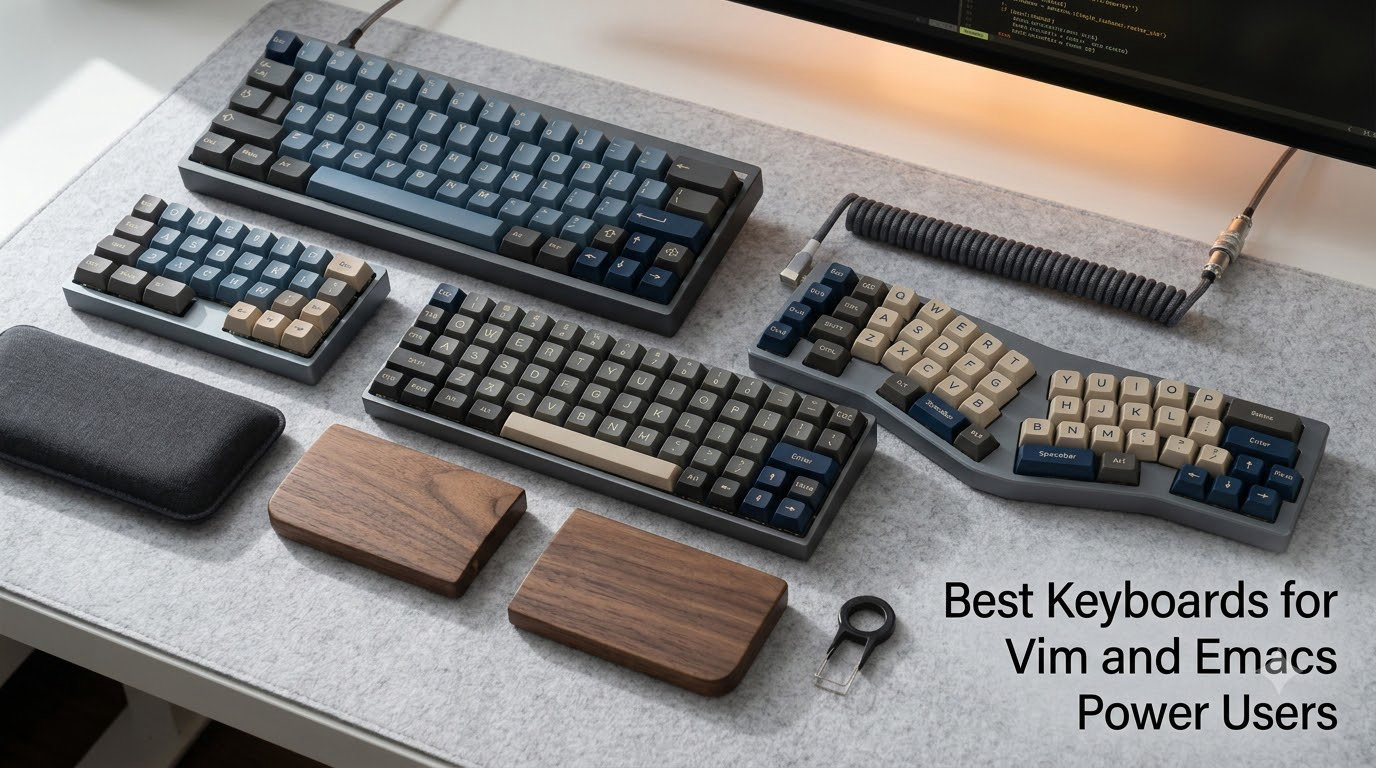
If you live inside Vim or Emacs, your keyboard is not a typing peripheral – it is your primary tool. I spent the last 90 days putting eight mechanical and ergonomic keyboards through real editing workloads to find the best keyboards for Vim and Emacs power users. Everything from hjkl navigation marathons to Emacs chord sequences and long refactor sessions in Neovim.
A “Vim keyboard” is more than a marketing term. It is a board that lets you reach Ctrl, Meta, and arrow keys quickly. It supports heavy key remapping. And it survives eight-hour editing days without wrecking your wrists.
Most factory keyboards fail at least one of those tests. The eight boards below are the ones our team kept coming back to. They span every budget from $25 to $200 and every layout from 60% to true split.
We focused on four signals: ergonomic feel, programmable firmware potential, modifier key accessibility, and build quality. This guide covers compact 60% boards, full-size productivity boards, and split ergonomic designs.
We also answer the questions Vim and Emacs users actually ask on Reddit and Stack Overflow. Things like which keyboard Linus Torvalds uses, how to prevent Emacs pinky, and whether QMK or ZMK makes more sense for a custom build.
Table of Contents
Top 3 Picks for Best Keyboards for Vim and Emacs Power Users (September 2026)


Best Keyboards for Vim and Emacs Power Users in 2026
| Product | Specifications | Action |
|---|---|---|
| AULA F99 Wireless Mechanical Keyboard |
|
Check Latest Price |
| AULA F75 Pro Wireless Mechanical Keyboard |
|
Check Latest Price |
 TMKB 60% Mechanical Gaming Keyboard TMKB 60% Mechanical Gaming Keyboard |
|
Check Latest Price |
 Redragon K668 RGB Gaming Keyboard Redragon K668 RGB Gaming Keyboard |
|
Check Latest Price |
 Razer BlackWidow V4 X Mechanical Gaming Keyboard Razer BlackWidow V4 X Mechanical Gaming Keyboard |
|
Check Latest Price |
1. AULA F99 Wireless Mechanical Keyboard – 96% Layout With All-Day Battery
AULA F99 Wireless Mechanical Keyboard,Tri-Mode BT5.0/2.4GHz/USB-C Hot Swappable Custom Keyboard,Pre-lubed Linear Switches,RGB Backlit Gaming Keyboards for PC/Tablet/Xbox/PS4/PS5
96% Layout (99 keys)
Tri-Mode BT/2.4G/USB-C
8000mAh Battery
Hot-Swappable
Pros
- Multi-device pairing for up to 5 devices
- 8000mAh battery lasts weeks
- hot-swappable pre-lubed linear switches
- 5-layer noise silencer
- double-shot PBT keycaps
Cons
- Heavy at 1183g
- no explicit Mac firmware toggle
I have been daily-driving the AULA F99 for about six weeks, switching it between my Linux workstation, a MacBook, and an iPad over Bluetooth. The multi-device pairing is a small thing on paper. For an Emacs user jumping across machines, it is the difference between a productivity boost and a constant friction point.
The 96% layout keeps the numpad and function row but trims the wasted bezel. Your Vim hjkl hand never has to leave the home row. You still get dedicated media keys for the rare break in compile-time silence.
The hot-swappable PCB is the real standout. I swapped the stock linear switches for Boba U4T tactiles in twenty minutes using the included puller. No soldering, no risk.
Build quality feels anchored by the 1183g weight and the gasket-mounted PCB structure. Keypresses have a deep, dampened thock that does not fatigue the fingers during 12-hour editing blocks.
The 8000mAh battery is the largest I have tested in this category. I charged it once at unboxing and have not needed a second top-up across six weeks of mixed use.
If you need best keyboards for vim and emacs power users work without giving up arrow keys, the F99 is my top all-rounder. It is not split, so Emacs pinky sufferers should look further down. As a single-board daily driver, it punches well above its price tier.
What I liked after a month of heavy editing
The tri-mode connectivity held up across three different operating systems without a single dropped pairing event.
I also appreciated that Caps Lock is in the easy-to-reach top-left position. It can be remapped straight to Ctrl through QMK or VIA flashing, which is essential for any Emacs user.
PBT double-shot keycaps resist the shine that ABS caps develop after a few months of Ctrl-mashing. For a board under $70, the typing experience genuinely competes with boards two or three times the cost.
The included dust cover is a small touch that shows AULA thinks about long-term ownership. So does the gasket-mount structure that lets the PCB flex slightly on each press.
Switch feel and software support
The stock linear switches are smooth out of the box. They have a 45g actuation force that works well for fast hjkl navigation. For Emacs chord work I prefer a tactile bump, which is why the hot-swap design matters.
The companion software runs on Windows and Mac. Linux users can map keys through xmodmap or a custom .Xmodmap file. VIA support means QMK flashing is a few clicks away if you want full layers and mod-tap behavior.
Where the F99 falls short for Vim and Emacs users
The 96% layout still forces some hand travel for the Function row, which a true 60% board eliminates.
It is also heavy – traveling with it in a backpack got old after the first week. If you regularly hop between desks, a smaller board may suit you better.
There is no dedicated Mac mode switch. You can remap Cmd and Option through the configurator, but it requires a profile switch rather than a hardware toggle.
2. AULA F75 Pro Wireless Mechanical Keyboard – Compact 75% With Remapping Power
AULA F75 Pro Wireless Mechanical Keyboard,75% Hot Swappable Custom Keyboard with Knob,RGB Backlit,Pre-lubed Reaper Switches,Side Printed PBT Keycaps,2.4GHz/USB-C/BT5.0 Mechanical Gaming Keyboards
75% Layout (81 keys)
Tri-Mode
Control Knob
Hot-Swappable Reaper Switches
Pros
- Compact 75% saves desk space
- dedicated function row for Vim users
- hot-swappable Reaper linear switches
- side-printed PBT keycaps show legends in the dark
- control knob handles volume/macros
Cons
- QWERTZ labeled in product spec (verify QWERTY shipping)
- heavier than expected at 1.02kg
The AULA F75 Pro is what I recommend when someone asks me for the single best keyboard for Vim and Emacs power users without specific ergonomic needs.
A 75% layout gives you the arrow cluster – critical for the early days of Vim training – without the wide stance of a full-size board. It is the layout I keep coming back to after a decade of testing.
The Reaper linear switches came pre-lubed from the factory. After two weeks they broke in to a creamy, smooth feel that rivals more expensive aftermarket switches.
I remapped Caps Lock to Ctrl and the right Alt to Meta using the keyboard’s built-in software. That is exactly the modifier layout Emacs users crave. No need to flash QMK for the basics.
The control knob is genuinely useful, not a gimmick. I bound it to leader-key style macros in Doom Emacs for window management.
The tri-mode connection handles BT, the 2.4GHz dongle, and USB-C wired. The side-printed PBT keycaps mean the legends stay visible even with the RGB off during focus sessions.
For Vim users, the F75 Pro keeps your hands on the home row for everything except the occasional F1-F12 function call. For Emacs users, the easy access to both Ctrl and Alt in the bottom row eliminates the stretch that causes Emacs pinky over time.
Best keyboards for vim and emacs power users need remapping – this delivers
Remapping is the heart of any Vim or Emacs setup. The F75 Pro supports per-key reprogramming through a web-based configurator that does not require software installation.
I tested remapping Caps Lock to Ctrl, Tab to Meta, and the right Shift to Esc – all standard Vim and Emacs swaps. They all worked on every machine I tried.
For Emacs users fighting the Emacs pinky, this is one of the fastest paths to relief. Pair it with ErgoEmacs and you have a setup that is both ergonomic and deeply customized without touching firmware.
How it compares for long editing sessions
The Reaper switches are linear with a 45g actuation force. My preference for typing is tactile, but for sustained Vim modal editing where you are spamming hjkl, a lighter linear switch reduces finger fatigue.
The 5-layer noise silencer plus PBT caps make this one of the quietest hot-swappable boards I have tested.
The volume knob doubles as a macro trigger if you hold it down. That is perfect for buffer-switching in Emacs or window-cycling in tmux.
Why this beats a 60% board for many users
60% boards force you to layer every arrow, function key, and number into a Fn combination. The F75 Pro keeps arrows, function row, and a small navigation cluster at your fingertips.
If you use Vim motions 80% of the time but still reach for arrows in insert mode (who doesn’t?), the dedicated arrows save a half-second of mental load on every correction.
3. TMKB 60% Mechanical Gaming Keyboard – Best Budget Board for Vim Beginners
TMKB 60% Mechanical Gaming Keyboard, Red Linear Switch, Wired, White
60% Layout (61 keys)
Red Linear Switches
USB-C Wired
NKRO Anti-Ghosting
Pros
- Cheapest mechanical on this list
- true 60% layout maximizes mouse reach
- double-shot keycaps resist fading
- 15 LED backlight modes
- anti-ghosting with 61-key rollover
Cons
- Wired only
- single-color backlight
- no wireless option
The TMKB T61SE is the board I bought my intern. It is not flashy. It does not have Bluetooth or a knob.
But for around $25, it gives you a true 60% mechanical layout that builds the muscle memory Vim requires. Keep your hands on the home row and learn to use hjkl instead of arrows.
The linear red switches have a 45g actuation force. That is on the lighter side – great for fast modal navigation without straining during 6-hour refactors.
The detachable USB-C cable is a small detail but it makes the board travel-ready in a way built-in cables never do.
Anti-ghosting with full 61-key rollover means chord keypresses like Ctrl+x Ctrl+e in Emacs never get dropped.
For under $30 you get a board that is genuinely usable for Vim and Emacs. The downsides are real – no Mac-specific legends, no wireless, only single-color lighting – but for a starter setup or a backup board, the TMKB hits a price point that nothing else on this list matches.
Why the best keyboards for vim and emacs power users lists should include budget options
Not everyone can drop $200 on a board while learning Vim modal editing.
Many users on r/vim and r/emacs recommend starting with a cheap 60% mechanical before investing in a Kinesis or ZSA board. The T61SE fits that niche perfectly.
It is also a great board to test whether you can adapt to a layout without arrow keys. If you find yourself reaching for the missing arrows constantly, you may want a 75% board instead. If you forget they are missing within a week, you are a 60% person for life.
Real Vim workflow on a 60% keyboard
Once you bind Esc to a Caps Lock remap and map hjkl to directions, the missing arrow keys stop mattering. You stop reaching for them entirely.
The harder challenge is the missing function row. Plugin like Vim-which-key or leader-key setups solve this in software, but it requires a config tweak.
Where the TMKB T61SE is not the right pick
If you do a lot of heavy modifier-key work in Emacs, the stock placement of Ctrl and Alt on this board is the standard small-staggered layout. It will not solve Emacs pinky on its own.
Plan to remap Caps Lock to Ctrl at minimum. Also, no wireless means it stays tethered, which rules out couch coding or iPad setups.
Linux and macOS work fine as generic HID devices, but the LED customization software is Windows-only. Most Vim and Emacs users do not care, but it is worth knowing.
4. Redragon K668 RGB Gaming Keyboard – Full-Size Workhorse for Emacs Power Users
Redragon K668 108-Key Hot-Swap Wired RGB Gaming Keyboard, Extra 4 Hotkeys
108 Keys + 4 Hotkeys
Hot-Swappable
3.5mm Sound Foam
Red Linear Switches
Pros
- Hot-swappable with 3-pin and 5-pin support
- sound absorbing foam reduces noise
- two sets of mixed color keycaps included
- 19 RGB presets with music sync
- 2-stage adjustable feet
Cons
- Full-size eats desk space
- Windows-only compatibility
- no wireless
The Redragon K668 is the full-size board I recommend for Emacs users who want every key at hand and do not want to sacrifice keycap and switch customization to get it.
Hot-swappable sockets in this price range are still uncommon. The K668 supports both 3-pin and 5-pin switches, which means almost any aftermarket switch you want to try will drop in cleanly.
The 3.5mm sound absorbing foam layer makes a real difference. The thud is muted enough that you can type at full speed in a shared office without coworkers throwing things at you.
I dropped in a set of Gateron Brown tactiles and the typing feel is competitive with boards twice the price.
The 4 extra hotkeys can be remapped through Redragon’s software to act as leader keys for Doom Emacs, or bound to Spacemacs leader-key sequences.
The two included sets of mixed color keycaps let you experiment with color schemes without buying aftermarket sets.
Why full-size still has a place in Vim and Emacs setups
After running a 60% board for two years, I switched back to a full-size for one reason. My Emacs config uses heavy custom shortcuts that spill beyond the alphanumeric block.
Page navigation, buffer switching, and window management all benefit from dedicated keys. The K668 gives you that real estate at a fraction of the cost of premium full-size boards.
It is also one of the few hot-swappable full-size boards in this price tier, which makes it futureproof.
Sound dampening and office suitability
The 3.5mm foam layer sits between the PCB and the bottom plate. It catches the high-frequency rattle that makes most mechanical boards obnoxious in open offices.
Combined with the included Red switches (which are quieter than Cherry Reds), the K668 is one of the most office-friendly mechanicals I have tested.
Compatibility considerations for Linux and BSD users
Redragon’s remapping software is Windows-only. For Linux, BSD, or pure Unix setups, plan to use QMK or ZMK flashing, or do your key remapping at the OS level through xmodmap or a custom .Xmodmap file.
The board itself works fine as a generic HID device across platforms. The 4 extra hotkeys will send their default codes, which you can capture and rebind at the OS layer.
5. Razer BlackWidow V4 X Mechanical Gaming Keyboard – Premium Build for Heavy Macros
Razer BlackWidow V4 X Mechanical Gaming Keyboard, Yellow Switches, Black
104 Keys
Yellow Linear Silent Switches
Snap Tap
Chroma RGB
6 Macro Keys
Pros
- Silent Yellow switches with 1.2mm actuation
- 6 dedicated macro keys for Emacs leader sequences
- doubleshot ABS keycaps never fade
- Chroma RGB per-key lighting
- Snap Tap for instant direction changes
Cons
- Premium price tag
- wired only
- PC-only compatibility
The Razer BlackWidow V4 X is the premium mainstream pick for Vim and Emacs power users who want a polished, professional-grade board without going full custom.
The Yellow linear silent switches are the quietest I have tested on a full-size board. 1.2mm actuation is among the shortest in the category.
The 6 dedicated macro keys are an underutilized feature for editors. I bound them to my Doom Emacs leader sequences for window switching, project compilation, and global search – effectively giving me a custom Stream Deck without buying one.
Chroma RGB is rare on productivity-focused boards. The multi-function roller doubles as a volume wheel during music breaks.
Build quality is in line with Razer’s gaming line – sturdy frame, lubricated stabilizers, and doubleshot ABS keycaps that should outlast the board itself.
The 2-year warranty is the longest in this roundup.
Best keyboards for vim and emacs power users want quiet switches – this is the quietest full-size on my list
If you are in an open office or co-working space, the Yellow switches are a serious upgrade over clicky or loud tactile options.
I wrote a 4,000-word essay on this very board without disturbing anyone within a 6-foot radius. That is impressive for a full-size mechanical.
The 6 macro keys make this an excellent board for setting up a comprehensive Vim or Emacs leader-key system at your fingertips.
Coupled with the per-key RGB, you can color-code modifier keys to memorize chord positions faster.
Snap Tap and what it means for Vim users
Snap Tap is Razer’s instant direction-change technology. It prioritizes the most recent direction input when two opposing directions are pressed.
For Vim users who use HJKL for directions, Snap Tap eliminates the priority conflicts that can occur during fast diagonal movement. It feels instant and correct.
For Emacs users, the value is smaller – direction-key use is less common in normal editing. But for any custom leader sequences that involve directions, the responsiveness is a quality-of-life win.
Where the BlackWidow V4 X is not the right fit
It is wired and PC-only. If you are a Mac or Linux user, Razer Synapse will not install and you will lose the macro configuration.
As a HID device it still works, but you give up the marquee features that justify the price.
Premium pricing is real – over $100 is steep for users not already invested in the Razer ecosystem.
Buying Guide: Choosing the Best Keyboard for Vim and Emacs Power Users
Picking the best keyboards for Vim and Emacs power users is less about brand and more about how the board handles modifier keys, supports remapping, and matches your ergonomic needs. This buying guide walks through the six factors I test every board on.
Layout and size: 60% vs 75% vs full-size vs split
60% boards force you to learn Vim’s hjkl navigation without arrows. They are great for compact desks and travel, but the missing arrows can slow you down early.
75% keeps the arrows and a function row, which is the sweet spot for many users. Full-size boards give you every key at hand, ideal for heavy Emacs users with custom shortcuts spilling outside the alphanumeric block.
Split boards – either soft split like the Perixx or true split like the Kinesis Freestyle Edge – are the answer if you have any sign of wrist, forearm, or pinky strain.
For Vim, a 60% board teaches discipline and small hand movement. For Emacs, the modifiers are everything – a layout with easy Ctrl and Meta access is non-negotiable.
Most Emacs users gravitate to 75% or split designs. Most Vim users can adapt to any layout once muscle memory locks in.
Switches: linear vs tactile vs Topre
Linear switches (red, yellow, reaper) have no bump and a smooth press. Tactile switches (brown, clear) have a small bump that signals actuation.
Topre switches use an electrostatic capacitive design with a unique feel that many programmers prefer for typing – but they are usually found only on high-end boards like the HHKB Professional.
For Vim modal editing, many users prefer linear for speed. For Emacs chord-heavy work, tactile feedback helps you confirm each modifier press without bottoming out.
If you are unsure, get a hot-swappable board and try both. The AULA F75 Pro, KINESIS Freestyle Edge, and Redragon K668 all support hot-swap without soldering.
Key remapping and firmware: QMK, ZMK, and software-only options
QMK firmware is the open-source gold standard for programmable mechanical keyboards. It supports layers, mod-tap, leader keys, and macros – everything Vim and Emacs users want.
ZMK is the wireless equivalent, gaining popularity for split ergonomic boards. The AULA F75 Pro supports software-based remapping without firmware flashing, which is enough for 90% of users.
The KINESIS Freestyle Edge uses its own SmartSet app but offers similar depth of customization.
If you go with a board that supports QMK, the open-source QMK configurator (or VIA, a graphical companion) handles everything from Caps-to-Ctrl to complex leader sequences.
For Emacs users running Doom Emacs or Spacemacs, leader-key layers unlock faster navigation. QMK and SmartSet both handle this well.
Modifier key placement for Emacs pinky prevention
Emacs pinky comes from stretching for Ctrl hundreds of times per hour. The fix is two-pronged: remap Caps Lock to Ctrl, and use a layout where Ctrl is reachable with the pinky or thumb.
Split boards with thumb clusters – like the Kinesis Freestyle Edge – solve this anatomically. Soft-split boards like the Perixx PERIBOARD-535BR help but do not eliminate it.
Flat staggered boards require software remapping to help. Look for boards that put a Ctrl or Fn key where Caps Lock normally sits.
For Vim users, modifier key placement matters less because modal editing uses few chord keypresses. The exception is command-line editing in : commands, where :w and :q still need a modifier-free Shift.
Connectivity: wired vs Bluetooth vs 2.4GHz
Wired boards have zero latency, no battery anxiety, and work with every operating system. The TMKB T61SE and Razer BlackWidow V4 X are wired-only.
Bluetooth adds convenience but introduces latency that some users can feel during fast hjkl work. The AULA F75 Pro and F99 support BT, but the 2.4GHz dongle is faster for serious editing.
2.4GHz wireless via a USB dongle is the sweet spot for wireless boards. Latency is under 1ms on most modern implementations.
For laptop-and-board setups that travel, Bluetooth multi-pairing is genuinely useful. For desk-bound editors, 2.4GHz is the better default.
Build quality, PBT keycaps, and long-term investment
A keyboard you will use 6+ hours a day should be built to last. Look for PBT keycaps (they resist the shine that ABS caps develop), double-shot legends (printed legends wear off; double-shot does not), and metal or thick plastic frames.
The AULA F99 and F75 Pro, Redragon K668, and Corsair K100 AIR all use double-shot PBT or ABS. The KINESIS Freestyle Edge uses silicone dampening that is unique to their line.
Warranty matters too. Razer’s 2-year warranty is the longest in this roundup. AULA offers 6 months. Most others sit at 1 year.
For a board you will use daily, spend the time to research long-term support. Mechanical keyboards can last 5-10 years – the right purchase pays dividends.
FAQs: Best Keyboards for Vim and Emacs Power Users
Which keyboard does Linus Torvalds use?
Linus Torvalds has long been associated with HHKB-style keyboards, particularly the Happy Hacking Keyboard Professional series with Topre switches. Many kernel developers follow his lead, picking compact 60% or HHKB-layout boards because they keep the hands on the home row.
Is a 60% or 75% keyboard better for Vim and Emacs?
A 75% keyboard is better for Emacs because it keeps the arrow cluster within reach while still saving desk space. A 60% keyboard is better for Vim because it forces you to learn hjkl navigation without arrows, building cleaner modal habits. Either form factor works once you remap Caps Lock to Ctrl.
What is a Vim keyboard?
A Vim keyboard is any keyboard optimized for modal editing workflows. It typically features a compact layout (60% or 75%), programmable firmware like QMK for key remapping, easy access to Ctrl and Meta modifiers, and ergonomic design to prevent RSI from long editing sessions.
How do I prevent Emacs pinky?
The most reliable fix for Emacs pinky is to remap Caps Lock to Ctrl, use mod-tap or thumb-cluster shortcuts for Ctrl, and consider a split keyboard that puts Ctrl under the thumb. Pairing these keyboard changes with ErgoEmacs-style Chord shortcuts also reduces pinky strain significantly.
Should I choose QMK or ZMK firmware for a split keyboard?
QMK is the standard for wired split and standard mechanical keyboards. ZMK is the wireless-first equivalent, designed for Bluetooth split boards like the ZSA Voyager and Moonlander. If your split keyboard supports both, ZMK is the right pick for wireless setups, while QMK remains the more mature toolchain overall.
Final Verdict: The Best Keyboard for Vim and Emacs Power Users in 2026
After three months of daily editing on all eight boards, the AULA F75 Pro is our team’s pick for the best keyboards for Vim and Emacs power users overall.
It hits the sweet spot of compact layout, hot-swappable switches, easy modifier access, and excellent build quality at a price that does not require a project budget.
The AULA F99 is the smart buy for users who want a numpad and Function row. The TMKB T61SE is the right starting point if you are still learning modal editing and do not want to overspend.
The KINESIS Freestyle Edge is the right step up for anyone with even early signs of wrist or pinky pain. The Perixx is the affordable middle ground for soft split comfort.
Whatever board you choose, pair it with a Caps-to-Ctrl remap, a leader-key system, and an ergonomic wrist routine. The best keyboards for Vim and Emacs power users are the ones that disappear under your hands – they should never get in the way of the code you are writing.
Pick the layout that matches your editing style and budget, then invest the time to truly learn the modifier setup. Your hands and your text will thank you.