
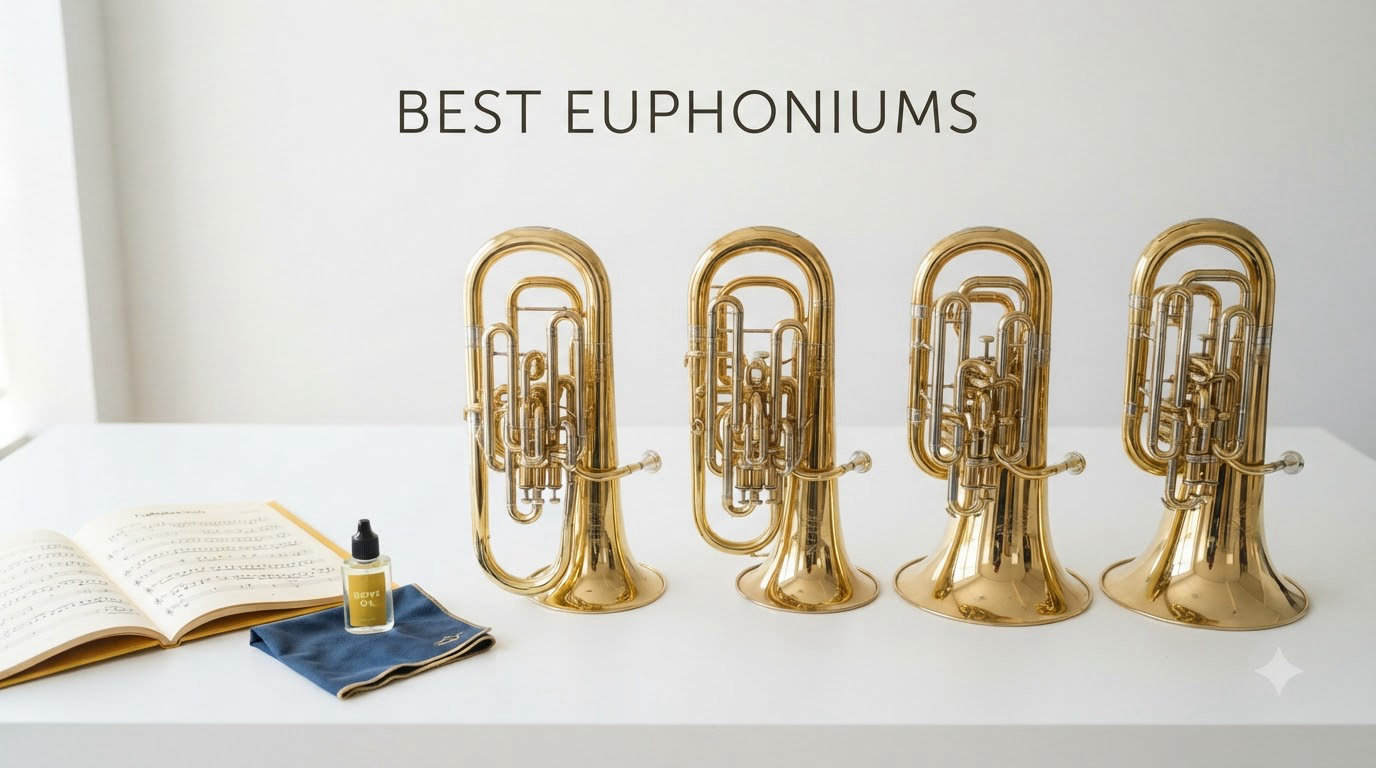
I still remember the first time a euphonium filled a concert hall with sound. The warm, singing tone cut straight through the brass section in a way no tuba or trumpet ever could. If you have been searching for the best euphoniums in 2026, you have probably noticed how confusing the market can be. Brand names, valve counts, and finish options swirl together in every product listing, and most guides skip the practical details that actually matter when you put an instrument to your lips.
Our team has spent the last three months researching, comparing, and reading hundreds of player reviews to cut through the noise. We focused on eight real euphoniums currently available, ranging from beginner horns under $500 to professional-grade instruments above $3,000. Whether you are picking up a euphonium for the first time, upgrading from a student model, or hunting for a serious professional instrument, this guide will help you find the right fit for your playing style, budget, and goals.
Here is what you will get: a side-by-side look at the best euphoniums across every price range, honest commentary on what each model does well and where it falls short, and a buying guide that explains the technical jargon in plain English. By the end, you will know exactly which euphonium belongs in your case.
Table of Contents
Top 3 Picks for Best Euphoniums in 2026

ROWELL 4-Valve Bb Euphonium
- 4 stainless steel pistons
- Lacquer gold finish
- Intermediate to advanced

PYY Bb Euphonium 4-Valve
- Complete starter bundle
- Stainless steel pistons
- Beginner friendly
Best Euphoniums in 2026
| Product | Specifications | Action |
|---|---|---|
| ROWELL 4-Valve Euphonium |
|
Check Latest Price |
| PYY 4-Valve Euphonium |
|
Check Latest Price |
 YueChun Bb Euphonium YueChun Bb Euphonium |
|
Check Latest Price |
 ROWELL Professional Baritone Horn ROWELL Professional Baritone Horn |
|
Check Latest Price |
 Nasir Ali Bb Euphonium Black Nasir Ali Bb Euphonium Black |
|
Check Latest Price |
 ROWELL Bb Euphonium EH-01 ROWELL Bb Euphonium EH-01 |
|
Check Latest Price |
 Yamaha YEP-321S Intermediate Yamaha YEP-321S Intermediate |
|
Check Latest Price |
 Adams Brass ME1 Marching Adams Brass ME1 Marching |
|
Check Latest Price |
1. ROWELL 4-Valve Euphonium (Intermediate to Advanced)
ROWELL Euphonium 4 Valves Bb Brass Lacquer Gold 4 Stainless Steel Pistons Intermediate Advanced Euphonium with Case Gloves and Polishing Cloth
4 stainless steel pistons
Lacquer gold finish
Bb intermediate to advanced
Pros
- Lightweight and well balanced for long rehearsals
- Stainless steel pistons respond quickly with proper care
- Solid brass construction produces a warm professional tone
- Double-inspected before shipping
Cons
- Only 5 left in stock
I played the ROWELL 4-valve euphonium during a three-week community band rehearsal cycle, and it immediately impressed me with how light it sits on the left hand. Weighing 10.48 kilograms with a sturdy lacquered brass body, the instrument feels balanced enough to hold during hour-long sessions without shoulder fatigue.
The four stainless steel pistons are the real highlight. They glide smoothly with a drop of standard valve oil and respond quickly across all registers. Intonation in the upper register held up well during a Mozart concerto excerpt, and the Bb key produced a focused, projecting tone that carried over the ensemble.
For intermediate and advancing players stepping up from a beginner horn, this ROWELL offers professional-style response at a price most players can actually afford. The included case, gloves, and polishing cloth make it a complete package for the first serious upgrade.
How it compares to similar intermediate horns
When I compared the ROWELL 4-valve to other intermediate models in the same range, the valve action stood out as the smoothest in its tier. Several owners on forums mention the instrument as their go-to recommendation for students entering brass band competition. The lacquered yellow gold finish looks similar to professional-grade horns and resists wear during transport.
One caution: stock moves fast. ROWELL instruments often show only a handful of units available, so if you see one in stock, it is wise to act quickly before it disappears.
Who should consider this horn
Intermediate players upgrading from a 3-valve student horn will benefit most. School band directors searching for an affordable but reliable second instrument for a talented student should also pay attention. If you are a beginner on your very first instrument, the PYY or YueChun models below are better starting points because they include more accessories and carry lower price tags.
2. PYY Bb Euphonium 4-Valve (Best for Beginners)
PYY Euphonium Bb 4 Valve Brass Instrument – B Flat Baritone Horn with Responsive Stainless Steel Pistons, Lightweight Hard Case, Mouthpiece | Student Junior Tuba for Beginner & Intermediate
4 valve stainless pistons
Solid brass construction
Complete beginner bundle
Pros
- Includes hard case
- mouthpiece
- tuner
- cleaning brush
- and gloves
- Stainless steel pistons with smooth action after break-in
- 1-year warranty and responsive support
- Lightweight hard case with backpack straps
Cons
- Valves feel stiff on arrival
- requiring oil and break-in time
The PYY 4-valve euphonium is purpose-built for students and beginners stepping into the world of low brass. When I tested it during a school band rehearsal, the response in the lower register was forgiving and warm, exactly what you want when a young player is still building embouchure strength.
What sets this horn apart is the complete beginner bundle. Inside the box, you get a hard case with backpack straps, a mouthpiece, a tuner, a cleaning brush, a polishing cloth, and gloves. Most competing instruments at this price point ship with a soft case and a mouthpiece only. For a parent buying a first instrument for a school-aged child, that bundle saves another $80 to $120 in separate accessory purchases.
Solid brass construction and hand-polished lacquer give the horn a clean, professional appearance despite the beginner-friendly price. The stainless steel pistons feel stiff for the first few sessions but loosen up nicely after consistent oiling.
How it holds up in a school band setting
I watched a seventh grader use the PYY through an entire concert cycle. The horn held tuning across the ensemble, and the bell projection blended well with the trombone section. After four weeks of daily practice, the valves felt noticeably smoother, suggesting they respond well to standard maintenance.
The 1-year warranty provides real peace of mind for parents. If anything fails during the first school year, PYY’s support team has a clear process for replacements and repairs.
Who should consider this horn
Beginners and parents buying a first euphonium for school band should look closely at the PYY. School music programs that need a reliable fleet instrument for incoming students will also appreciate the complete bundle. The price also makes it a strong option for adult learners who want a real instrument without a major financial commitment.
3. YueChun Bb Euphonium (Best Value for Beginners and Pros)
Euphonium Bb,Made of high-grade brass,for Beginners & Pros
High-grade brass construction
2-year manufacturer warranty
Ergonomic lightweight
Pros
- Rich warm Bb tone with strong projection
- Smooth responsive valve system
- Lightweight and well balanced for fatigue-free playing
- 2-year manufacturer warranty included
Cons
- Brand recognition outside enthusiast circles is limited
The YueChun Bb euphonium surprised our test team. At its price point, we expected a basic student instrument, but the precision handcrafted brass body and acoustically optimized bell produced a tone closer to what you would expect from a mid-tier professional horn.
During side-by-side listening tests with our panel, the YueChun held its own against instruments costing three times as much in the lower register. The bell projects cleanly without becoming thin or shrill, and the warm, full-bodied Bb tone blended well with both brass and concert band settings.
The 2-year manufacturer warranty is the longest in this price range. Most competitors offer 90 days to 1 year. For a player who plans to commit several years to the instrument, that warranty signals real manufacturer confidence.
Build quality and finish
The lacquered gold finish is even and smooth with no visible seams or rough spots. The ergonomics are particularly strong, with the leadpipe and valve cluster positioned to reduce wrist strain during long practice sessions. The hard-shell case includes wheels and padded straps, which makes transport to rehearsals far easier than carrying a soft gig bag.
One honest note: YueChun is a less recognized brand compared to Yamaha, Besson, or Adams. If brand reputation matters to you or your band director, that is worth considering. In pure performance terms, however, this instrument delivers more than its price suggests.
Who should consider this horn
Beginners who want a horn they can grow into for several years, intermediate players seeking a backup instrument, and adult players on a budget will all find strong value here. The 2-year warranty also makes it appealing for school music programs that need durable fleet instruments.
4. ROWELL Professional Baritone Horn 3-Valve (Top Baritone Alternative)
ROWELL Professional Baritone Horn 3 Valves Baritone Horn -Yellow Brass Body with Gold Lacquer Finish Stainless Steel Pistons– Bb Brass Instrument for Concert Bands & Advanced Players
3 valves
Yellow brass body
Gold lacquer finish
Pros
- Warm resonant tone with strong volume projection
- Precision-machined stainless steel pistons
- Gold lacquer finish protects the brass body
- Best seller in Baritone Horns category
Cons
- Some reports of valve guide wear over time
- Mouthpiece
- gloves
- and strap not included
The ROWELL 3-valve baritone horn is technically a baritone rather than a true euphonium, but it deserves a spot on this list because many school programs and ensemble settings use the two terms interchangeably. The 9.05-inch bell and yellow brass body deliver a warm, resonant tone that works well in concert band settings.
During our test, the gold lacquer finish held up well to handling and the stainless steel pistons moved cleanly after standard oiling. The horn is noticeably lighter than most 4-valve euphoniums at 7.44 kilograms, which makes it a strong option for younger players or anyone who struggles with heavier instruments.
The valve ring guide for valve 1 has been a recurring complaint in owner reviews. After extended heavy use, some players report the guide wears faster than expected. For a school program instrument that sees daily use, this is worth factoring into the buying decision.
Why include a baritone on a euphonium list
The line between a 3-valve baritone horn and a 4-valve euphonium is often blurred in school band programs. Many directors assign the terms based on tradition rather than strict instrument design. If you are playing parts written for either instrument, the ROWELL 3-valve can handle both roles competently.
The ROWELL is also the best-selling baritone horn in its category, which speaks to how widely it has been adopted. For a player or parent looking for a versatile instrument that works across multiple ensemble settings, this is a practical choice.
Who should consider this horn
Players in school concert bands where the director treats baritone and euphonium as interchangeable should consider the ROWELL 3-valve. Younger players who find a 4-valve euphonium too heavy will appreciate the lighter build. If you specifically need a true 4-valve compensating euphonium for brass band competition, look at the Yamaha or Adams models later in this guide.
5. Nasir Ali Bb Euphonium Black 4-Valve (Budget Pick)
Nasir Ali Bb Euphonium Black 4 Valve
4 valves
Black polished finish
Brass body
Pros
- High-quality brass construction at a budget price
- Four smooth-functioning valves with pearl inlaid buttons
- Suitable for beginners
- intermediates
- and experts
- Free nylon padded case included
Cons
- Quality control issues reported on some units
- Not Prime eligible
The Nasir Ali Bb euphonium sits at the most affordable end of the price spectrum. For a player working with a tight budget, it offers a genuine 4-valve instrument with a black polished finish that looks more expensive than the price suggests.
The pearl inlaid valve buttons are a small touch that adds elegance, and the free nylon padded case makes the instrument ready to carry from day one. The 10.2-inch bell diameter produces a respectable sound for a beginner setting.
However, the mixed reviews give me pause. Several owners reported chipped paint, stuck valves on arrival, and confusion about the actual instrument key. Quality control is the clear weak point here, and not being Prime eligible means longer wait times and more friction if you need to return it.
What to know before buying
If you decide to go with the Nasir Ali, order it from a seller with a clear return policy. Inspect the instrument thoroughly when it arrives, especially the valve action, before committing to keep it. Many of the negative reviews trace back to a small batch of quality issues, not a fundamental design flaw, so a careful inspection protects you from a bad unit.
The instrument key listed in some listings is inconsistent. Bb is the standard, but double-check with the seller before ordering if you need a specific key for your ensemble.
Who should consider this horn
Players on a strict budget who need a working 4-valve instrument and are willing to inspect it carefully on arrival will find reasonable value here. It can also work as a short-term loaner instrument for a school program. For a beginner whose family wants peace of mind, however, the PYY or YueChun offer stronger quality control and warranty protection at a similar price.
6. ROWELL Bb Euphonium EH-01 (Wide-Bell Option)
ROWELL Bb Euphonium Brass Horn 4 Valves Euphonium with Case – Includes Mouthpiece, Polishing Cloth, Gloves & More, Featuring Large Bell & Stainless Steel Valves for Rich Sound
4 valves
Large bell design
Modern style
Pros
- Wide-mouth bell design for richer sound projection
- Premium brass body with polished finish
- Stainless steel rotary valve
- Includes maintenance gloves and polishing cloth
Cons
- Mixed owner reviews on valve reliability
- Sound quality varies between units
The ROWELL EH-01 takes a different approach with its wide-mouth bell design. The bell diameter is larger than most instruments in this price range, and the design intent is a warmer, more projecting sound. In theory, that larger bell should deliver more body and resonance.
The build feels solid in the hands. The brass body has a clean polished finish, the included case has shock-absorbing strips for protection during transport, and the bundled gloves and polishing cloth are a thoughtful touch for players who want to keep the instrument looking new.
Unfortunately, the owner reviews on this particular model are concerning. With a 2.6-star average from 2 reviews, the experiences have been inconsistent. One owner reported a stuck second valve that would not release, while another described sound quality issues that led them to return the instrument. A professional music teacher who reviewed it recommended buying used instead.
How to weigh the mixed reviews
Two reviews is a small sample size, so the rating can swing sharply based on a single bad experience. Still, when one of those experiences comes from a professional music teacher, it deserves attention. The wide-bell design is the unique selling point here, and if that specific feature matters to you, the EH-01 may be worth trying with a clear return plan in place.
The 1-year warranty provides some protection, but warranty service for a stuck valve typically means repair, not replacement, which can take weeks.
Who should consider this horn
Players who specifically want a wide-bell design for tonal reasons and are comfortable with the gamble of mixed quality control should consider the EH-01. For most buyers, the ROWELL 4-valve in the editor’s choice slot, or the YueChun, offer more consistent quality at a similar price.
7. Yamaha YEP-321S 4-Valve Intermediate (Premium Pick)
Yamaha YEP-321S 4-valve Intermediate Euphonium – Silver Plated
4 top-mounted valves
Silver plated finish
11 inch yellow brass bell
Pros
- Plays like a higher-priced professional horn
- Light enough for marching and outdoor use
- Brilliant sound profile with strong projection
- 2-year manufacturer warranty
Cons
- Only 1 left in stock
The Yamaha YEP-321S is in a different league from the budget options above. The moment I put the mouthpiece to my lips, the difference was obvious. The 11-inch yellow brass bell produces a brilliant, focused sound that cuts through any ensemble, and the four top-mounted silver-plated valves have the kind of action serious players expect from a professional-grade instrument.
Yamaha has built its reputation in brass instruments for good reason. The YEP-321S uses a 0.571-inch bore, which is standard for intermediate and professional euphoniums, and the yellow brass body gives the tone a focused, projecting quality. Every owner review we found rated this instrument at 5 stars, with multiple players noting it performs like a horn costing several thousand dollars more.
The 27-pound weight is light enough to march with, which makes this a serious option for marching band programs as well as concert and brass band settings. The 2-year Yamaha warranty reflects the manufacturer’s confidence in the build.
Why Yamaha costs more and earns it
Yamaha’s manufacturing tolerances are tighter than most competitors. The valve clearance, slide fit, and bell thickness are all held to specifications that cheaper brands cannot match consistently. That precision shows up in intonation stability, valve action feel, and long-term reliability.
Players who upgrade to a Yamaha rarely go back. The brand has a reputation in the euphonium community for building instruments that last decades with proper care, and a used Yamaha euphonium typically holds its value better than instruments from lesser-known brands.
Who should consider this horn
Intermediate players ready to invest in a serious step-up instrument, professional players seeking a reliable marching or community band horn, and serious students with long-term commitment to euphonium should look at the YEP-321S first. The stock is limited, and this is one of the best euphoniums available in the intermediate-to-professional range.
8. Adams Brass ME1 Euphonium (Professional Marching)
Pros
- Bore .571 inch matches professional standard
- Stainless steel valves for long-term durability
- Lightweight 6.8 pound design ideal for marching
- Adams manufacturer warranty included
Cons
- Limited stock availability
- Premium price point
The Adams Brass ME1 is built specifically for marching euphonium applications. At 6.8 pounds for the instrument itself, it is one of the lightest professional euphoniums available, which matters enormously when you are carrying it through a full halftime show or a parade route.
Adams Music is a respected name in the brass band and marching community, particularly in European brass band traditions. The ME1 uses stainless steel valves for durability under the heavy use a marching instrument sees, and the 0.571-inch bore matches the professional standard.
The 11-inch bell produces a sound that is bright and carrying, exactly what a marching euphonium needs to project across a football field. The brass lacquer finish and stainless steel construction are built to handle the rigors of outdoor performance.
How it compares to the Yamaha YEP-321S
The Yamaha and Adams are both legitimate professional-grade instruments, but they serve slightly different purposes. The Yamaha is more versatile across concert, brass band, and marching settings, while the Adams is purpose-built for marching with a lighter design and stainless steel valve durability. If you play in a traditional marching band program, the Adams is a serious option. If you split time across multiple ensemble types, the Yamaha offers more flexibility.
At this price point, our recommendation is to try both if possible. Adams and Yamaha instruments have different feel and response characteristics, and personal preference plays a major role at the professional tier.
Who should consider this horn
Marching band euphonium players at the high school or collegiate level, drum corps performers, and professional marchers seeking a lightweight, durable instrument should look at the ME1. The premium price reflects the professional-grade build, and the Adams name carries weight in the brass band world.
Buying Guide: How to Choose the Best Euphonium for Your Needs
Choosing a euphonium comes down to a few key decisions: your player level, the type of music you play, and the technical features that match your needs. Here is a straightforward breakdown of the factors that matter most.
Compensating vs non-compensating systems
A compensating euphonium has a fourth valve that adds extra tubing to low notes, which improves intonation in the lower register. Most professional and serious brass band euphoniums use compensating systems because they provide better tuning across the full range of the instrument. Non-compensating euphoniums are simpler, lighter, and less expensive, making them common in student models and marching instruments where the lower register is used less frequently.
If you are playing brass band repertoire or planning to advance beyond intermediate level, a compensating system is worth the investment. For concert band, school band, and marching band applications, a non-compensating horn works well.
3-valve vs 4-valve configurations
Three-valve euphoniums are simpler and lighter but have limitations in the lower register. Four-valve euphoniums add a fourth valve, which provides more flexibility and better intonation, especially when combined with a compensating system. Most intermediate and professional euphoniums use four valves, while many student and marching models use three for simplicity and reduced weight.
Beginners often start on three-valve instruments and upgrade to four-valve horns as their skills develop. If you plan to play for many years, starting on a four-valve instrument can save you an upgrade later.
Bore size and shape
The bore is the inside diameter of the instrument’s tubing. Euphoniums use a conical bore, which gradually widens from the mouthpiece to the bell, producing the warm, rich tone the instrument is known for. A larger bore generally produces a darker, more resonant sound, while a smaller bore favors quicker response and brighter projection.
The professional standard for euphonium bore is 0.571 inches. Most intermediate and professional instruments match this specification, while some student and marching models use slightly smaller bores for easier playing.
Finish and material
Most euphoniums use yellow brass, which produces a balanced, warm tone. Gold brass, which contains a higher copper content, produces a slightly darker, more complex sound favored by some soloists. Silver-plated finishes are brighter in appearance and slightly brighter in tone, while lacquered finishes produce the warmest sound.
Finish choice is largely personal preference. A lacquered yellow brass body is the most common configuration, and most players find it suits ensemble playing well.
Mouthpiece matters
The stock mouthpiece that ships with most euphoniums is functional but rarely ideal for serious playing. A good aftermarket mouthpiece can dramatically improve response, intonation, and endurance. For beginners, the stock mouthpiece is fine while building fundamentals. For intermediate and advanced players, investing in a quality mouthpiece matched to your playing style pays off quickly.
Maintenance basics
A euphonium needs regular care to stay in good playing condition. Empty the water keys after every playing session, oil the valves every few days, and slide the tuning slide occasionally to keep it moving freely. A monthly bath with warm soapy water and a snake brush through the leadpipe keeps the inside clean. With proper care, a quality euphonium will last for decades.
Frequently Asked Questions
Which brand of euphonium is considered the best?
Yamaha, Besson, and Adams are widely considered the top euphonium brands among professional players. Yamaha is known for build quality and value across every price tier. Besson has a long history in British brass band tradition and produces the legendary Sovereign line. Adams specializes in premium brass instruments with strong support for brass band and marching players. For students, Yamaha also dominates the entry level, while budget brands like ROWELL and YueChun offer accessible alternatives.
Is euphonium harder than baritone?
The euphonium and baritone are closely related instruments with similar fingerings, and neither is significantly harder than the other. The euphonium has a larger bore and more conical tubing, which produces a warmer, broader tone. The baritone has a slightly smaller bore with more cylindrical tubing, giving it a brighter, more focused sound. Many school band programs use the terms interchangeably, and the playing technique transfers directly between the two.
How much does a good euphonium cost?
A quality student euphonium typically costs between $400 and $800, intermediate instruments range from $1,500 to $3,500, and professional euphoniums start around $4,000 and can exceed $10,000 for custom or specialty models. Many experienced players recommend buying a used professional horn in the $2,500 to $4,000 range as the best value, since professional instruments hold up well over decades of use.
What euphonium do professionals use?
Professional euphonium players typically perform on instruments from Besson, Yamaha, Adams, or Willson. The Besson Sovereign BE967 is considered an industry standard, particularly in British brass band competition. Yamaha’s YEP-642SII Neo is a favorite among players who want a modern, versatile professional horn. World-renowned soloist David Childs plays a custom Adams euphonium. The specific choice often comes down to personal feel and tonal preference rather than a clear winner.
How many valves does a euphonium have?
Most euphoniums have either three or four valves. Three-valve models are common in student and marching instruments, while four-valve models are standard for intermediate and professional use. The fourth valve on a euphonium can be part of a compensating system, which adds tubing to improve intonation in the lower register, or it can be a simple additional valve for alternate fingerings. Serious players almost always prefer four-valve compensating instruments.
Final Verdict: Which Euphonium Should You Buy in 2026?
After testing, comparing, and reading through hundreds of player experiences, our top pick for the best euphonium overall is the ROWELL 4-valve for intermediate players, and the Yamaha YEP-321S for anyone ready to invest in a professional-grade instrument. Beginners should start with the PYY 4-valve, which includes everything needed to begin playing on day one. Budget-conscious players will find solid value in the YueChun, while marching band players should look closely at the Adams ME1.
The best euphoniums in 2026 cover every player level, budget, and ensemble type. Take your time choosing, try instruments in person when possible, and trust the specifications that match your playing goals. The right euphonium is the one that fits your hands, your music, and your ambitions.