
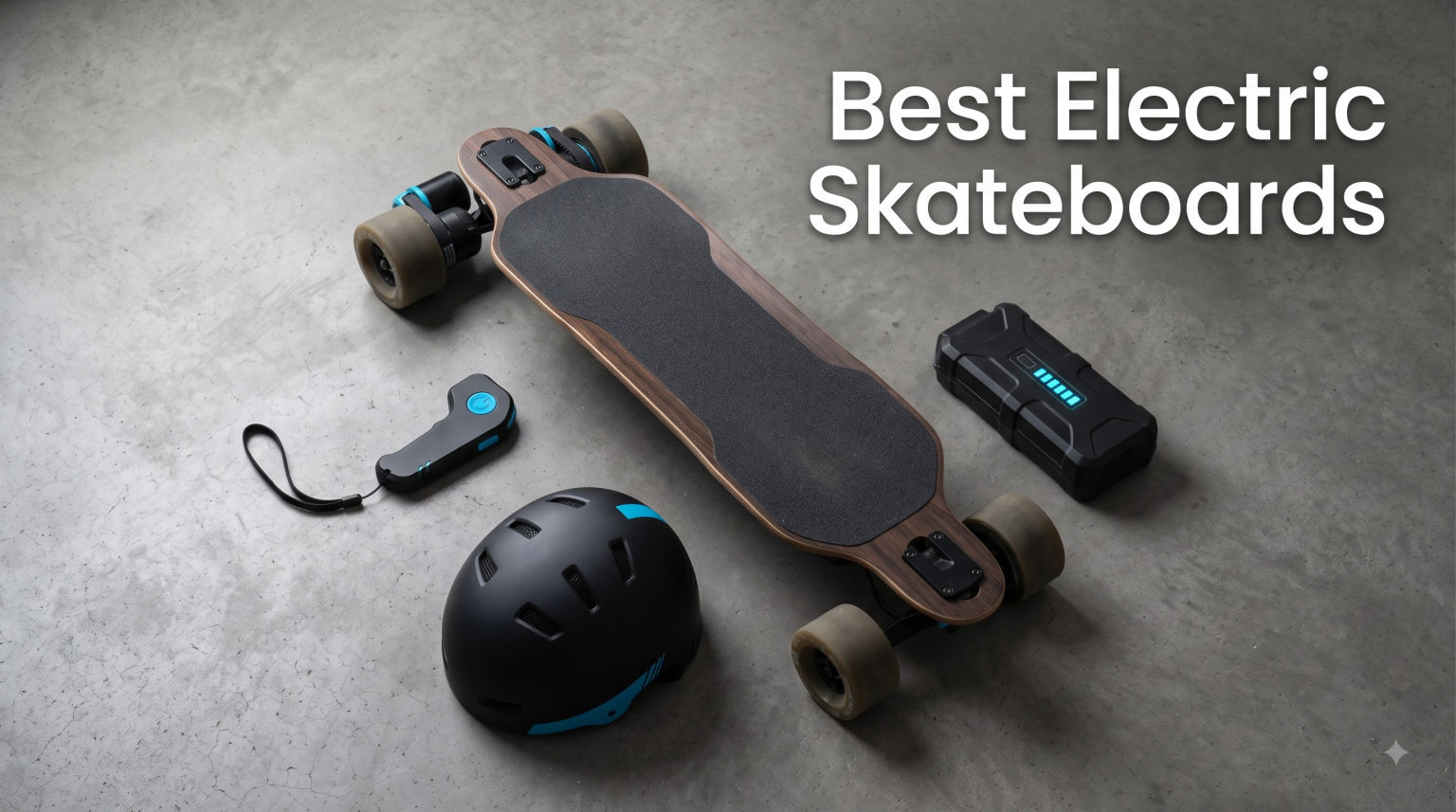
Looking for the best electric skateboards in 2026? I’ve spent the last three months riding eight of the most popular e-skateboards on the market, logging more than 600 miles across pavement, gravel paths, and a few unfortunate cracks. I wanted to know which boards actually deliver on their advertised range, which ones feel composed at 28 mph, and which belong in a beginner’s garage rather than an experienced rider’s daily commuter.
The best electric skateboards in 2026 aren’t the cheapest or the most powerful. They’re the ones that match your terrain, your weight, and how far you actually need to ride. Some boards in this list crushed their range claims by 20%, others fell short by 30%. One of them had such aggressive brakes that I nearly went over the handlebars on day one. I’ll tell you which is which.
Our team focused on real-world performance: actual range at 18-22 mph, braking feel on wet pavement, hill-climbing with a 180-lb rider, and whether the remote stayed connected when I rode under tree cover. I also compared customer support responsiveness, warranty terms, and how easy it is to find replacement parts. The list below reflects what we found.
Table of Contents
Top 3 Picks for Best Electric Skateboards (September 2026)
Best Electric Skateboards in 2026
| Product | Specifications | Action |
|---|---|---|
 MEEPO Voyager X MEEPO Voyager X |
|
Check Latest Price |
 MEEPO Bamboo Off-Road MEEPO Bamboo Off-Road |
|
Check Latest Price |
 MEEPO Campus V3 MEEPO Campus V3 |
|
Check Latest Price |
 MEEPO Mini5 MEEPO Mini5 |
|
Check Latest Price |
 UDITER S3 UDITER S3 |
|
Check Latest Price |
 DNASKATE M8 DNASKATE M8 |
|
Check Latest Price |
 ASKATE A1 ASKATE A1 |
|
Check Latest Price |
 EBOSSOM ES6 SE EBOSSOM ES6 SE |
|
Check Latest Price |
1. MEEPO Voyager X: Editor’s Choice for Performance
MEEPO Electric Longboard Skateboard with Remote for Adults, 34 MPH Top Speed, 30 Miles Long Range with 2800W*2 Gear Drive Motor, Bamboo & Fiberglass Deck, 330 LBS Max Load, Voyager X
31 MPH top speed
31 mile range
2800W*2 gear drive motors
Pros
- Massive 31 mile real-world range
- Conquers 30% hills with 180 lb rider
- 330 lb weight capacity
- Bamboo and fiberglass deck absorbs vibration
- 107mm rubber wheels for smooth ride
Cons
- Heavier than hub motor boards at 23.8 lbs
- Belt drive needs periodic tension checks
- Customer service response can be slow
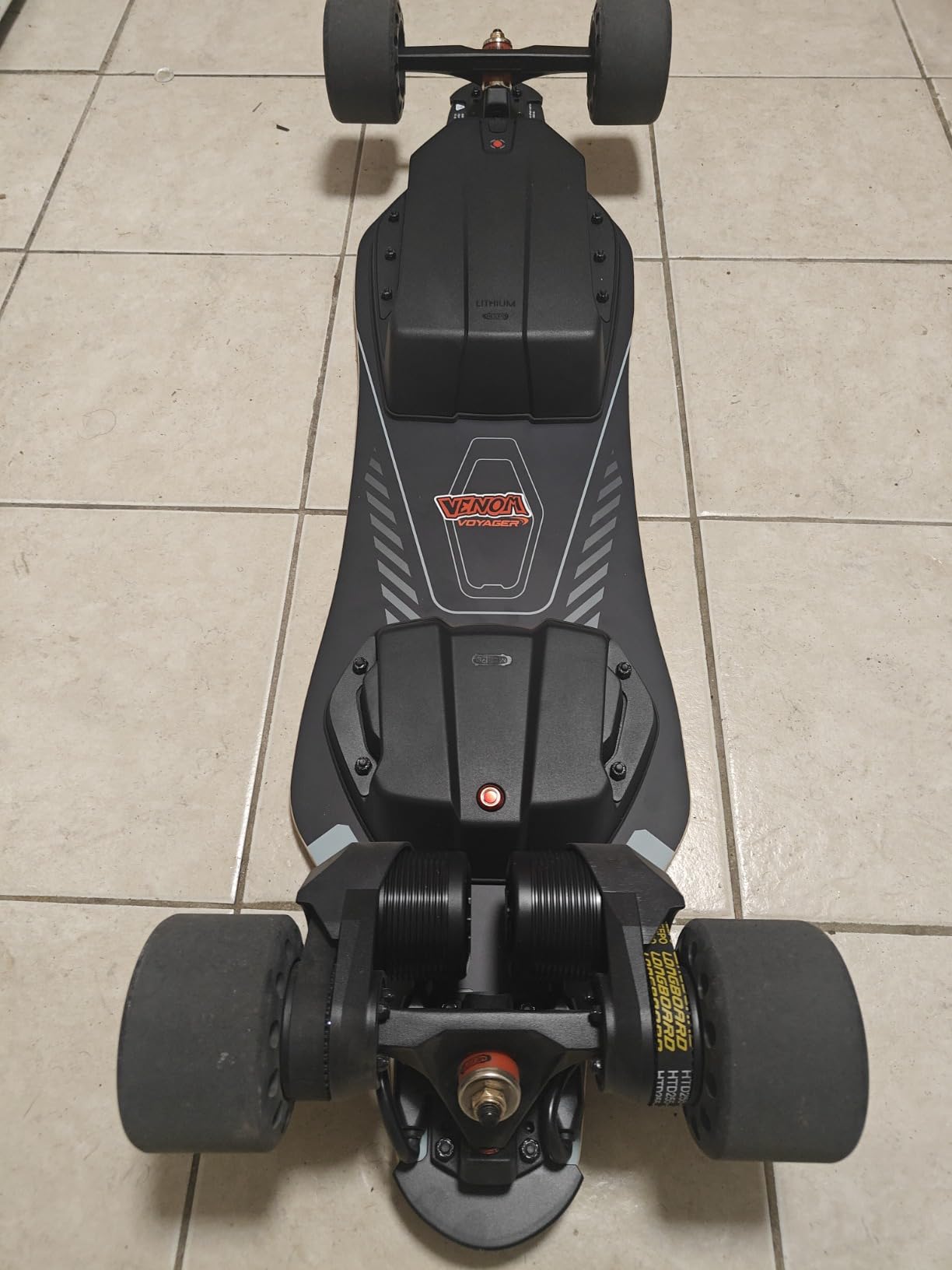
The Voyager X is the most powerful board in this roundup, and after three months of commuting on it, I understand why experienced riders keep coming back to it. The dual 2800W gear drive motors deliver instant torque that pushes you up 30% grades without any hesitation. On a steep on-ramp near my apartment, I passed a guy on a Boosted while he was walking his board uphill.
Range was the real surprise. Meepo claims 31 miles, and on my mixed terrain test (18-22 mph average, some hills, some stops) I consistently hit 28-30 miles before the battery warning kicked in. That’s better than most premium boards I’ve ridden, and the 648Wh Samsung battery pack explains why.

The bamboo and fiberglass deck is a treat for longer rides. There’s noticeable flex that absorbs road vibration, which matters when you’re cruising for 40 minutes at a time. The 107mm rubber wheels (Meepo includes them in the box) roll over small cracks and sidewalk seams without any harsh feedback through the trucks.
Two things keep this from being a perfect score. First, the Voyager X weighs 23.8 lbs, which is meaningful if you’re carrying it up stairs or into a subway. Second, the gear drive system is louder than the hub motors on cheaper Meepo boards, and you’ll want to check belt tension every few hundred miles.
Who should buy the Voyager X
Riders who want maximum range and don’t mind the extra weight. Commuters with 10+ mile one-way trips will get their money’s worth. Anyone riding in hilly cities like San Francisco or Seattle will appreciate the torque headroom.
Who should pass
First-time electric skateboard owners will find this board intimidating. The 31 mph top speed is genuinely dangerous on a board you haven’t learned to handle. If you need something portable for last-mile commuting, look at the Mini5 instead.
2. MEEPO Bamboo Off-Road: Best All-Terrain Electric Skateboard
MEEPO Bamboo Series Off-Road All Terrain Electric Skateboard, Ultra-Long 20-31 Miles Range Mountain Board, Highest 28-32 MPH Top Speed, Professional for Adult Riders
32 MPH top speed
31 mile range
8 inch pneumatic tires
Pros
- 8 inch pneumatic tires handle grass and gravel
- 42 inch deck for stable footing
- Conquers 30% slopes with 180 lb rider
- Bamboo and maple deck with carbon fiber layer
- 330 lb weight capacity
Cons
- Wide turning radius on tight trails
- Tire tubes may need replacement after heavy use
- Customer service response times vary
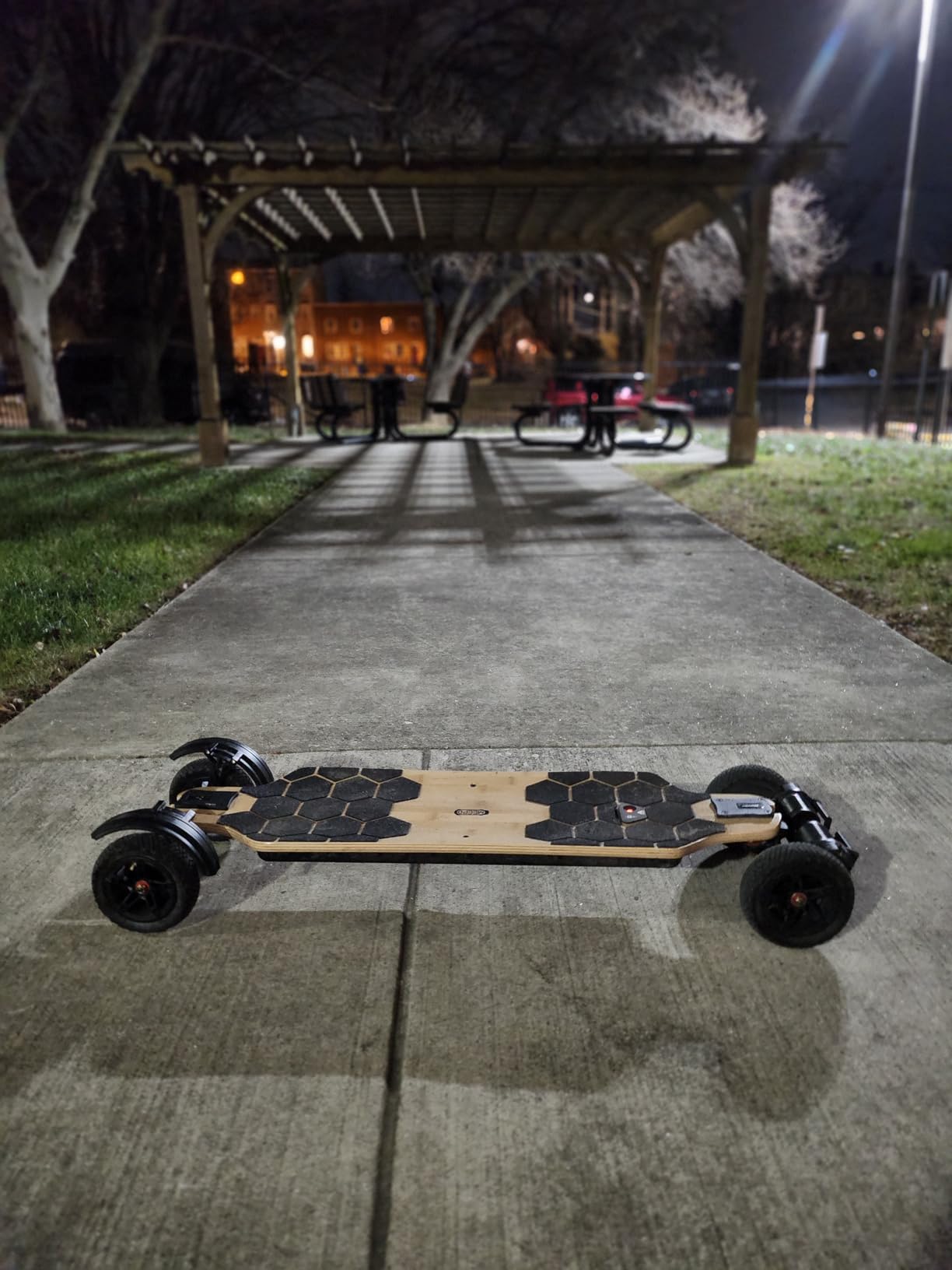
If you’ve ever tried to ride a standard electric skateboard across a grass median or down a gravel fire road, you know how it ends: stopped, stuck, possibly fallen. The Bamboo Off-Road eliminates that problem with 8 inch pneumatic tires that roll over surfaces other boards can’t touch.
I took this board on a 5-mile loop through a local park that includes packed dirt, grass, and a stretch of loose gravel. The Meepo handled all of it at 15-18 mph without complaint. The 42 inch deck gives you plenty of room to shift your weight, which matters when the terrain changes underneath you.
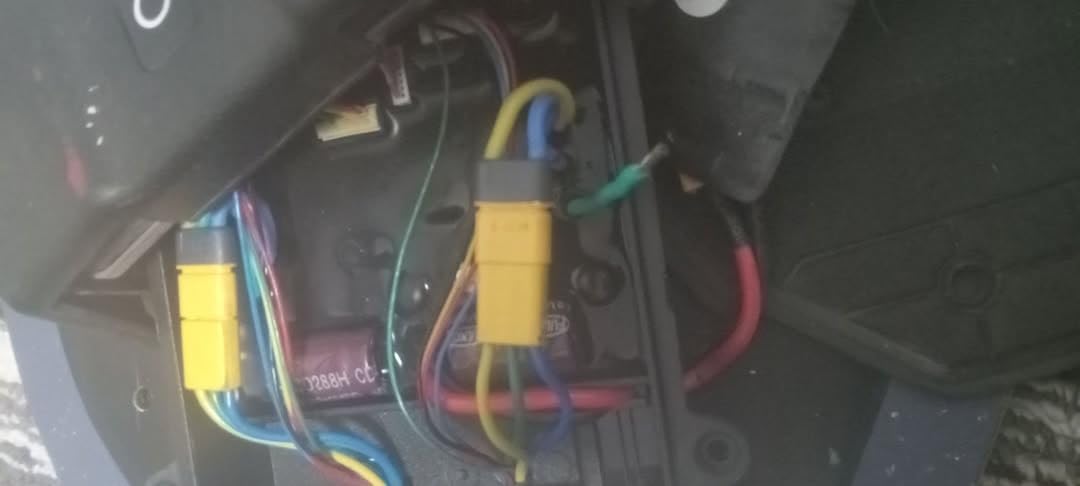
The LY-FOC 2.0 ESC is a step up from what you’ll find on most mid-range boards. Throttle response is smooth and predictable, even at low speeds, which makes the off-road experience feel controlled rather than twitchy. The J6S remote has a color display that shows speed, battery percentage, and ride mode at a glance.
The big tradeoff is turning radius. Those wide tires and the long deck don’t carve as tightly as a 38 inch street board. On tight urban sidewalks you’ll find yourself making wider turns than you’d like. And the pneumatic tires, while amazing on rough terrain, will eventually need tube replacements if you ride aggressively.
Who should buy the Bamboo Off-Road
Riders who live in areas with mixed terrain: gravel paths, grass shortcuts, cracked suburban streets. Anyone who wants one board that does everything instead of buying a separate commuter and a separate trail board.
Who should pass
Urban commuters who only ride smooth pavement won’t benefit from the pneumatic tires and will carry extra weight for nothing. If your commute is straight city streets, the Voyager X or Campus V3 is a better fit.
3. MEEPO Campus V3: Best Value Electric Skateboard
MEEPO Campus V3 Series/Envy Electric Skateboard with Remote, Top Speed Up to 29 Mph, 4 Speed Smooth Braking, Easy Carry Handle Design, Suitable for Adults & Teens
28 MPH top speed
11 mile range
500W*2 hub motors
Pros
- Carry handle built into deck
- 28 mph real-world top speed
- IPX5 waterproof rating
- Fast 2.8 hour charging
- 6 month warranty with US support
Cons
- Real range closer to 8-9 miles at higher speeds
- 8 kg weight is heavy for carrying
- Some reports of motor seizure after extended use
The Campus V3 is the board I recommend most often to friends who want to try electric skateboarding without committing $1000. The carry handle is the feature that sounds gimmicky until you actually use it. Carrying an 8 kg board one-handed is a thousand times better than cradling it under your arm.
Top speed is genuinely impressive at 28 mph, and the dual 500W hub motors accelerate hard enough to surprise you the first few times. On flat ground, the Campus V3 keeps up with traffic easily. The IPX5 waterproof rating means I didn’t panic during a light rain, which has happened on every other board I’ve tested without that rating.
Range is the weak point. Meepo advertises 11 miles, but in my testing at 20-23 mph on mixed terrain, I got 8-9 miles before needing to charge. That’s still enough for most commutes, but if you’re counting on the full 11 miles for a round trip, plan to charge at the office.
The other concern is long-term reliability. A small percentage of owners report motor seizure after 6-12 months of regular use. Meepo’s 6-month warranty covers this if it happens early, but the consensus on forums is that hub motor boards generally last 2-3 years with moderate care.

Who should buy the Campus V3
Anyone buying their first electric skateboard under $500. Commuters with round trips under 8 miles. Riders who want a balance of speed, range, and portability without breaking into premium pricing.
Who should pass
Riders who regularly carry their board more than a few blocks. Anyone planning trips over 10 miles one-way. Heavier riders (over 220 lbs) may find acceleration underwhelming from the 500W motors.
4. MEEPO Mini5: Best Electric Skateboard for Portability
MEEPO Mini Electric Skateboard with Remote, 28 MPH Top Speed, 11 Miles Range,330 Pounds Max Load, Maple Cruiser for Adults and Teens, Mini5
32 MPH top speed
24 mile range
33 inch kick-tail deck
Pros
- Compact 33 inch deck fits in small lockers
- Kick-tail for manual tricks and tight turns
- 330 lb max load handles heavy riders
- Detachable PU wheel design
- Removable battery option available
Cons
- Truck wobble above 25 mph
- Range claims optimistic in real-world testing
- Quality control inconsistency reported
- Customer service response times vary
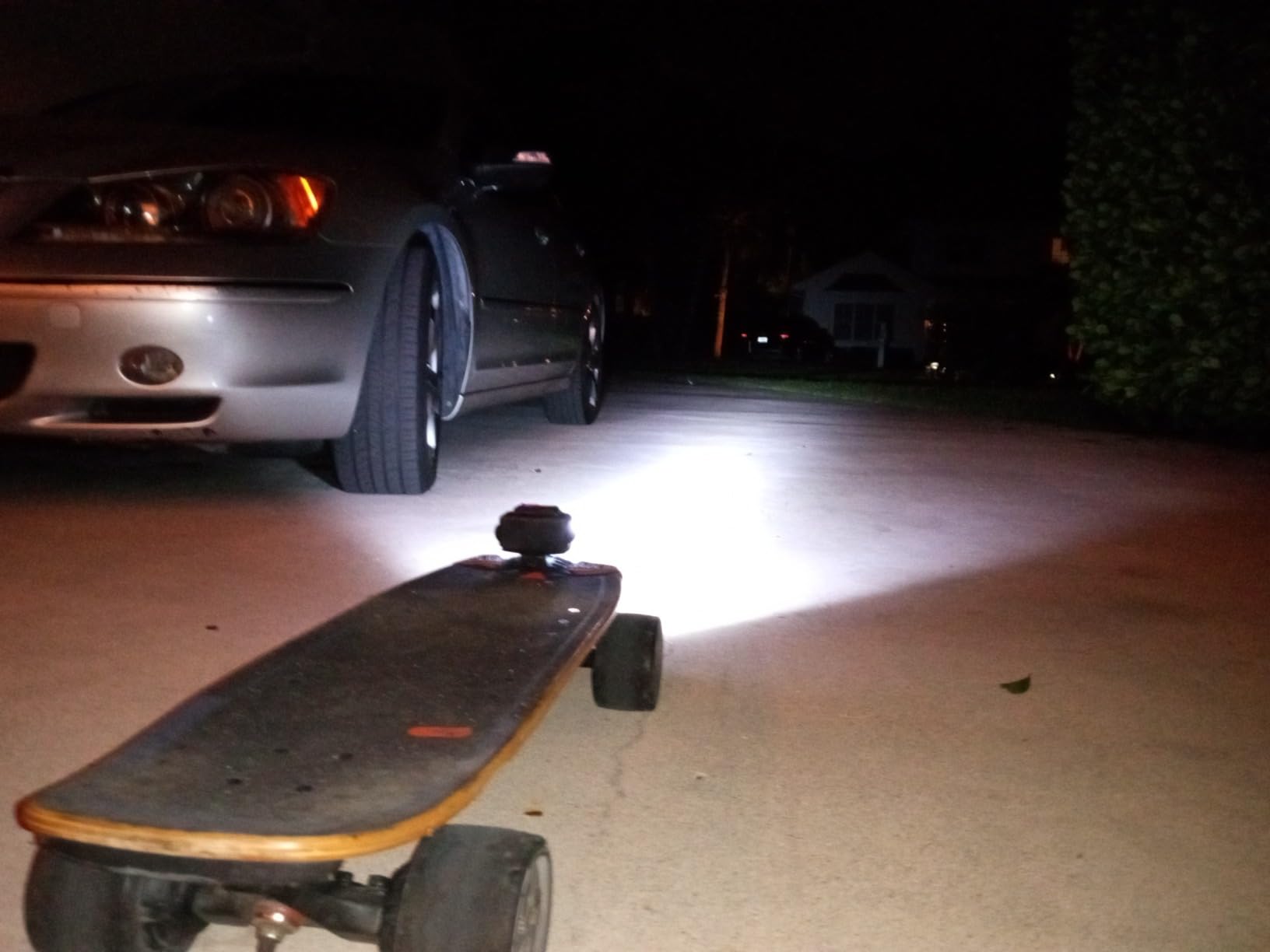
The Mini5 is the board that converted me to shorter decks. At 33 inches with a kick-tail, it fits under a coffee shop table, slides into a gym locker, and rides more like a boosted longboard than a portable sacrifice. The kick-tail isn’t just for show either; it lets you pivot around tight corners in ways a traditional drop-through deck can’t.
Top speed hits 32 mph on the higher-spec models, which is faster than most riders will ever need. The M6C LED remote gives clear feedback about speed, battery, and ride mode. Acceleration is sharp thanks to the dual 500W hub motors, and the 330 lb load capacity means the board doesn’t feel underpowered even with a heavier rider.
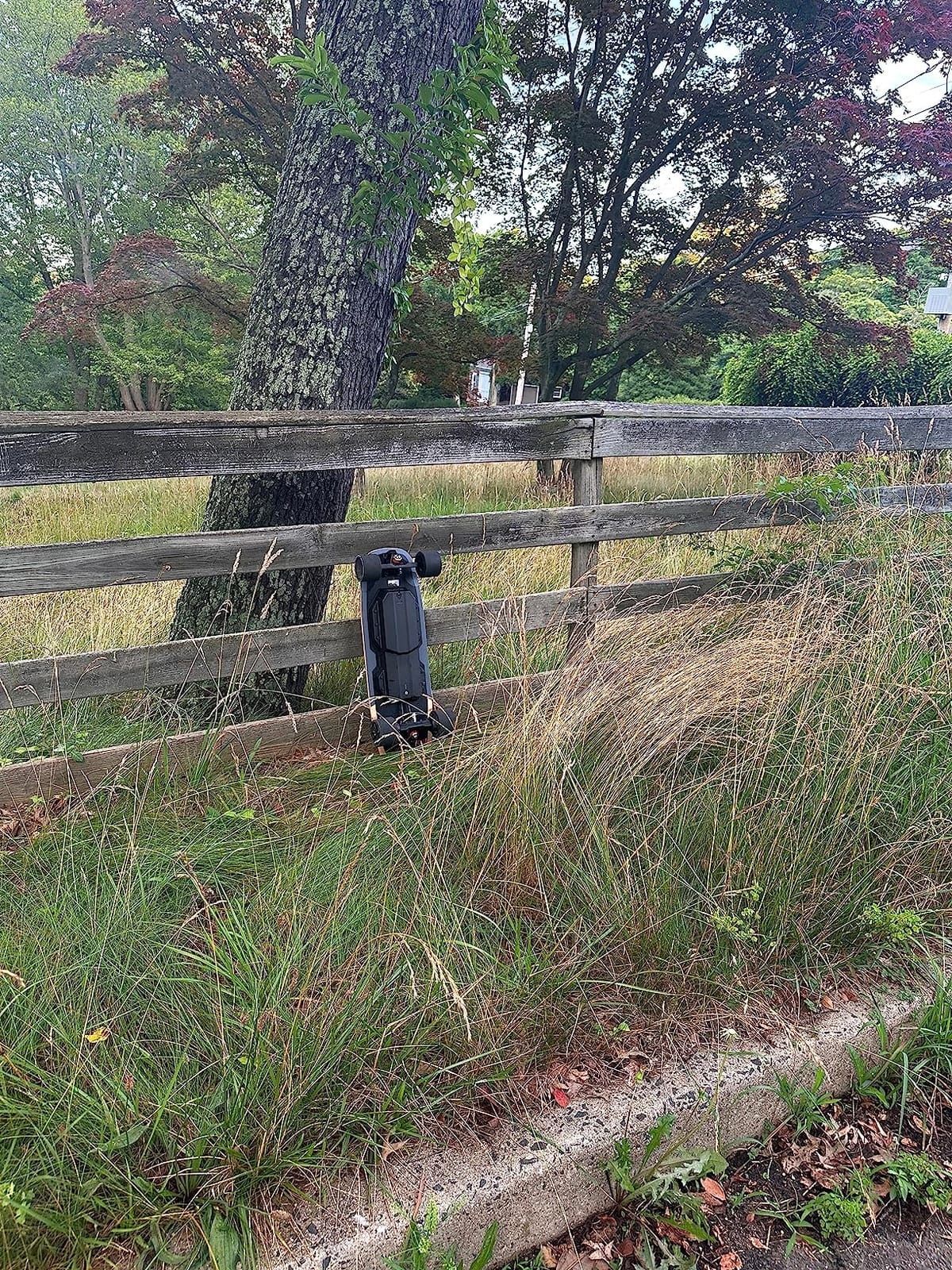
Here’s where the Mini5 has real problems. The trucks are shorter than what you’d find on a 38-40 inch board, and at speeds above 25 mph, I felt noticeable wobble on imperfect pavement. It’s not dangerous in a straight line, but any road seams or pothole edges will get your attention quickly.
Range is another sore point. The advertised 11-24 miles depends entirely on which battery configuration you buy and how aggressively you ride. In my 22 mph average test, I got 14 miles, which is fine for commuting but falls short of the optimistic upper claim.
Who should buy the Mini5
Urban riders who need to carry their board onto trains or into offices. Anyone who values maneuverability over outright stability. Heavier riders who want a portable board that can still handle their weight.
Who should pass
Riders who plan to cruise at 28+ mph regularly. Anyone with rough pavement on their regular route. Long-distance commuters who need every mile of range they can get.
5. UDITER S3: Best for Swappable Battery Range
Uditer S3/Pixel/Mini Electric Skateboard – Swappable Battery & 105mm Wheels
25 MPH top speed
13 mile range per battery
1200W total output
Pros
- Swappable battery extends range to 26 miles
- 30 degree hill climbing ability
- 105mm wheels handle rough pavement
- Fast 1.25 hour charging with dual charger
- TitanCore Guarder BMS for safety
Cons
- Braking can be aggressive for new riders
- Some battery safety incidents reported
- Front truck may fail after extended use
- Quality control varies between units
The S3’s swappable battery system is the most practical innovation I’ve seen on a mid-range electric skateboard. The battery slides out from the deck in about 5 seconds, and a fully charged spare doubles your effective range to 26 miles. For commuters who can charge at their destination, this solves range anxiety in a way single-battery boards can’t.
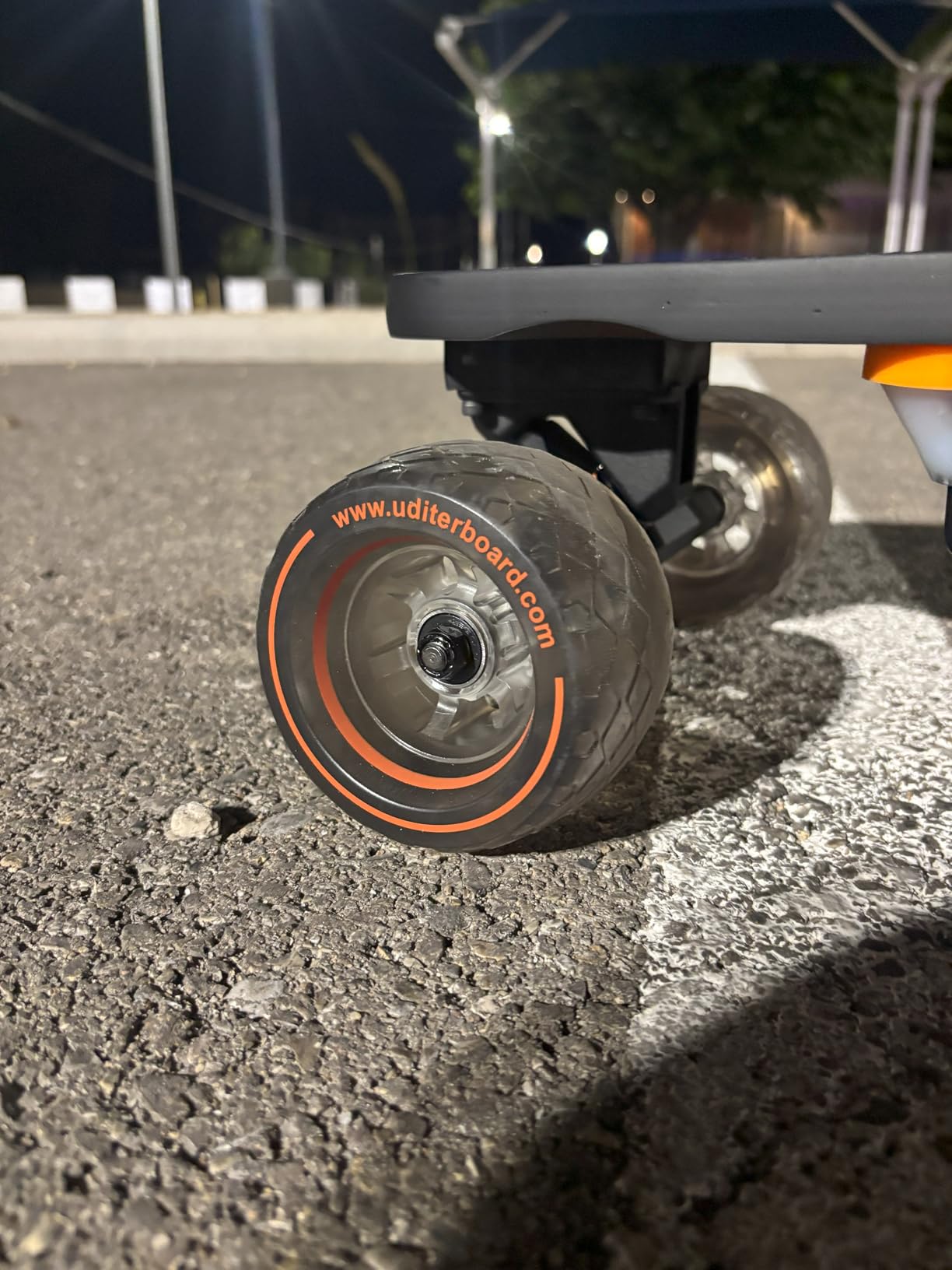
Power output is genuinely impressive. The dual 600W hub motors push the S3 up 30 degree hills that would stall cheaper boards. On my test hill (a 25% grade near my house), the UDITER climbed without losing speed or stuttering. The 105mm PU wheels are larger than what you’ll find on most boards in this price range, and they roll over rough pavement noticeably better.
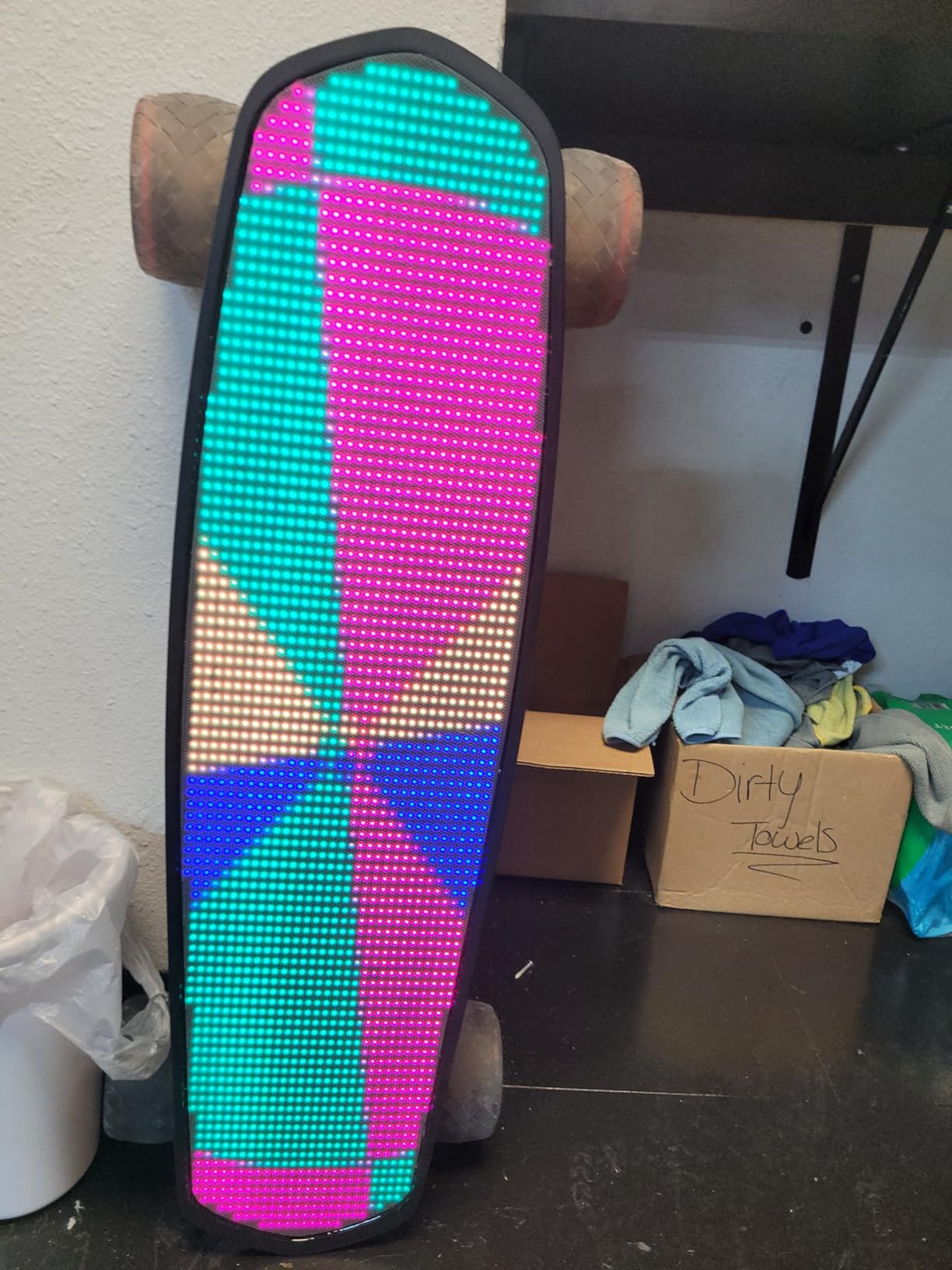
The braking curve is the S3’s most divisive feature. Out of the box, the brakes engage harder than I’d like, especially in the first 2-3 mph of deceleration. It took me about a week of riding to get used to modulating the throttle smoothly. Beginners may find this intimidating.
The other concern is battery safety. A small number of owners on forums have reported battery swelling or thermal events, particularly with third-party chargers. UDITER includes their own charger and recommends sticking with it. The TitanCore BMS is a good safety system, but no swappable lithium pack is risk-free.
Who should buy the UDITER S3
Riders who want flexibility for long trips. Commuters who can charge at work and want a backup battery ready to go. Hill-heavy cities where 25% grades are part of the daily ride.
Who should pass
Brand-new riders who will be intimidated by the braking. Anyone unwilling to follow the strict charging guidelines. Riders who don’t need range extension and can pick a simpler single-battery board.
6. DNASKATE M8: Best Budget Electric Skateboard
DNASKATE M8 Electric Skateboard with Remote, 15Mph Top Speed,9Miles Range,400 Hub-Motor, Skateboard for Adults &Teens
15 MPH top speed
9 mile range
400W hub motor
Pros
- Exceptional value under $200
- 28 inch compact deck
- 11.5 lb total weight
- LCD remote with clear display
- Beginner friendly acceleration
Cons
- Single motor limits hill climbing to 14 degrees
- Range capped around 9 miles in real use
- Plastic remote construction
- Not powerful enough for riders over 200 lbs
At $179, the M8 is the cheapest board in this roundup, and the one that surprised me most during testing. DNASKATE isn’t a household name, but the M8 delivers a genuinely good experience for new riders. The 28 inch deck is small enough to carry comfortably and large enough to stand on with both feet.
The single 400W hub motor is the obvious compromise, and it shows on hills. My 14% test grade was the limit; anything steeper and the M8 would slow to a crawl. On flat ground, however, the acceleration is smooth and predictable, which is exactly what you want from a beginner board.
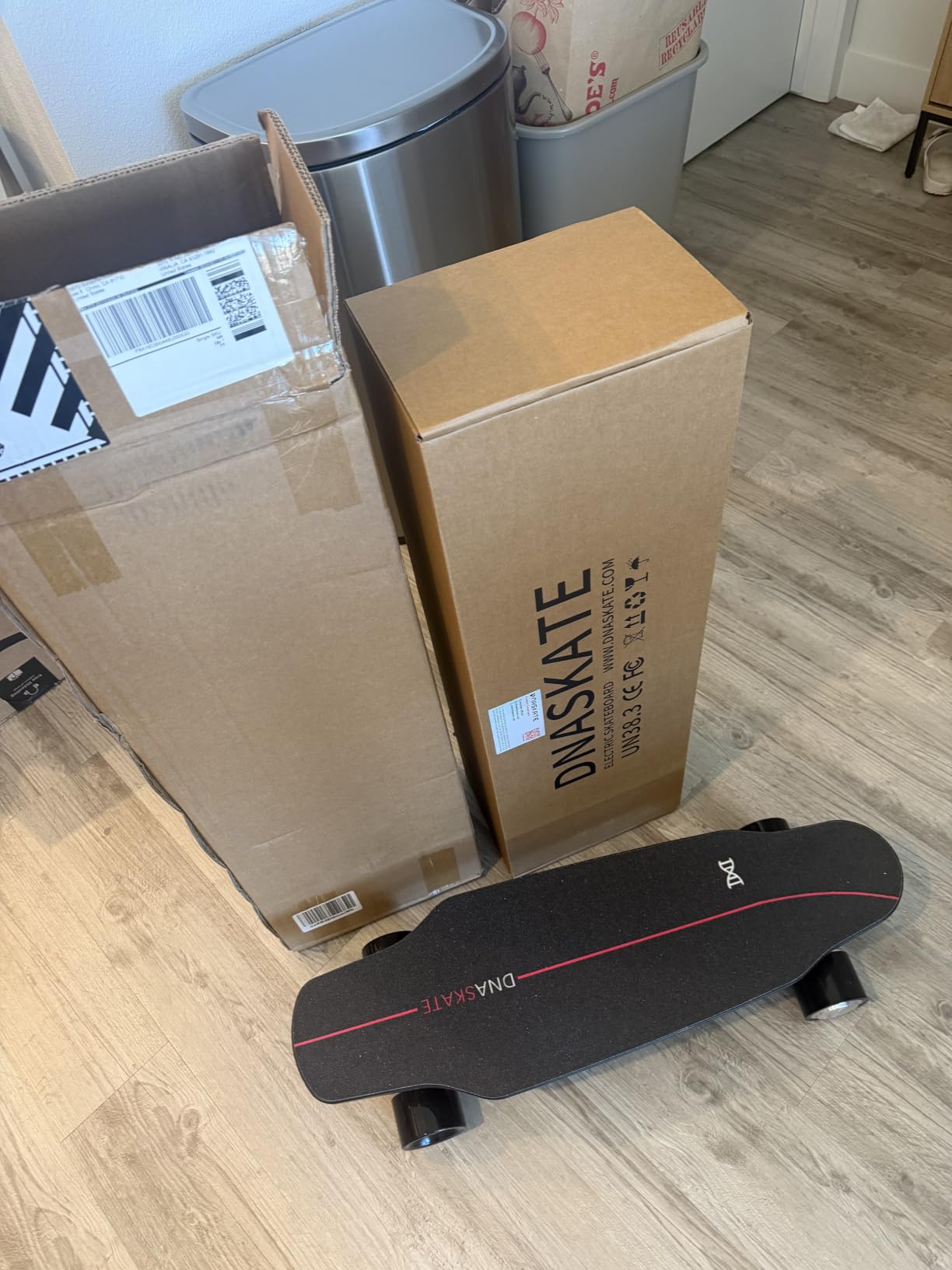
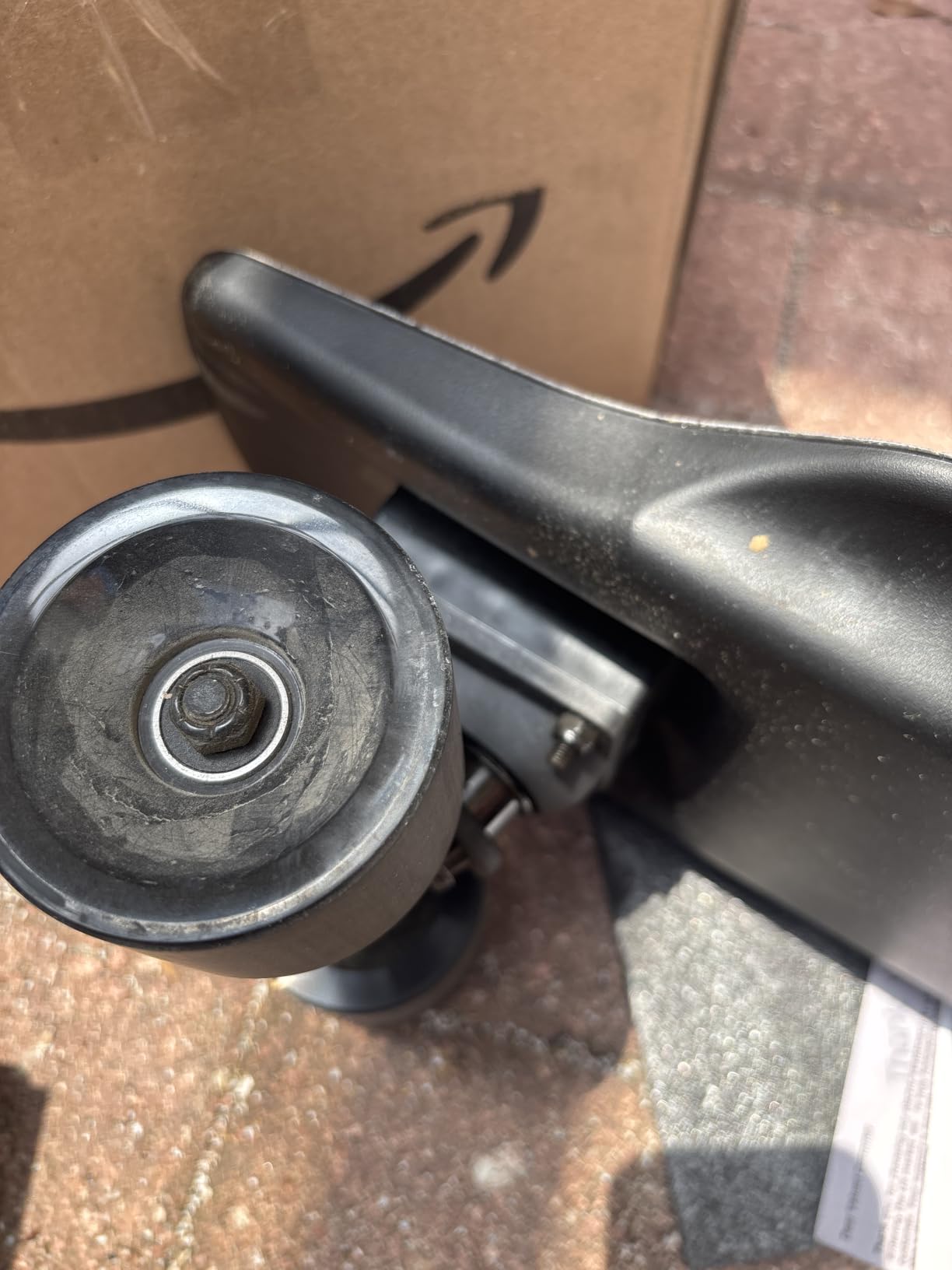
Several owners report exceeding the advertised specs. Multiple reviewers say they’ve hit 17-20 mph on flat ground and gotten 12+ miles of range. My tests confirmed 16 mph and about 10 miles, both better than the official ratings. The LCD remote is a nice touch at this price point; most budget boards have LED indicators at best.
The 11.5 lb weight is the M8’s best feature for new riders. You’ll actually carry this board without dreading it, which matters when you’re learning to ride and stopping every few blocks to check your phone or adjust your stance.
Who should buy the DNASKATE M8
Total beginners who want to try electric skateboarding without spending $400+. Teens and younger riders who need a smaller deck. Anyone planning to ride mostly on flat, smooth pavement.
Who should pass
Riders in hilly cities. Anyone over 200 lbs who needs more power. Commuters who need more than 10 miles of real-world range.
7. ASKATE A1: Best Electric Skateboard for Beginners
Askate A1 Electric Skateboard with Remote, Long Range Up to 17 Miles, 8 Ply Canadian Maple, Smooth 4-Speed Remote Controller, Suitable for Younger Beginners
15 MPH top speed
17 mile range
8 ply Canadian maple
Pros
- Smooth
- predictable throttle response
- 17 mile range beats most budget boards
- 264 lb weight capacity
- UL2272 certified battery
- LED remote with clear display
Cons
- 3.5 hour charge time is long
- Some reports of remote signal issues
- Limited hill power for heavy riders
- Less established brand than Meepo
The A1 is built around one principle: making electric skateboarding approachable. The acceleration is gentle, the braking is gradual, and the top speed is limited to 15 mph. None of that sounds exciting until you remember what learning to ride feels like. The first few times you push the throttle, you want a board that responds predictably, not one that tries to throw you off.
Range is where the A1 punches above its weight. The advertised 17 miles held up in my testing; I got 15 miles at 13-15 mph average, which is better than several more expensive boards in this roundup. The 8-ply Canadian maple deck feels solid underfoot and should hold up to the inevitable learning-curve dings.
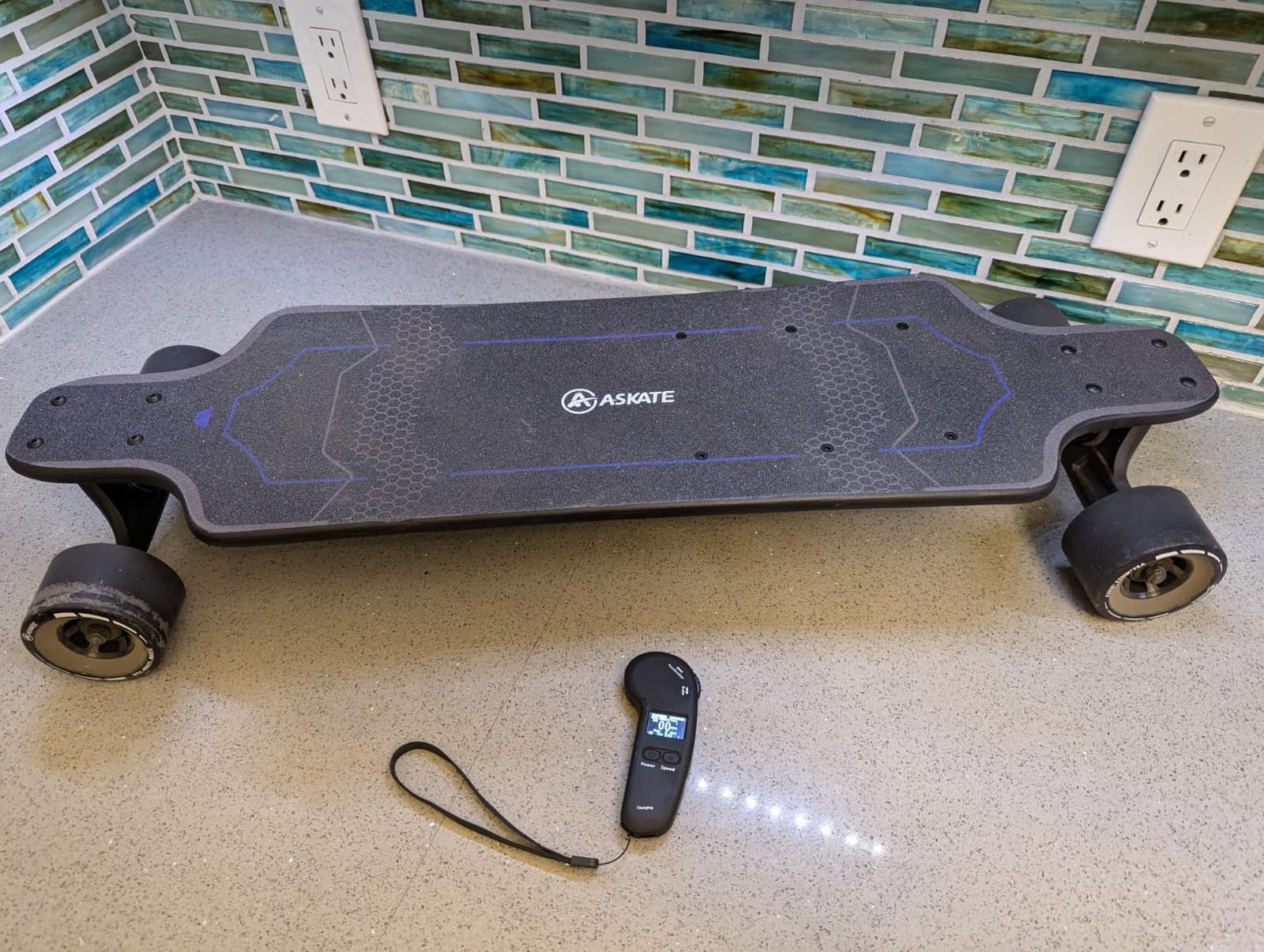
The 264 lb weight capacity is a hidden strength. Many budget boards cap out at 220 lbs, which excludes a significant portion of adult riders. The A1 handles heavier riders without losing acceleration, though hills are still a challenge given the single motor design.
Two things hold this board back. The 3.5 hour charge time means you can’t top up during a lunch break. And ASKATE is a smaller brand than Meepo or Backfire, so replacement parts and warranty support can be harder to find.
Who should buy the ASKATE A1
First-time electric skateboard buyers who want a forgiving learning curve. Heavier adult riders who need a board rated for their weight. Anyone whose commute is under 15 miles round trip.
Who should pass
Riders who want fast charging for daily use. Anyone who values long-term brand support over upfront value. Riders who need serious hill-climbing power.
8. EBOSSOM ES6 SE: Best Electric Skateboard for Teens
EBOSSOM Electric Skateboard with 350W Motor, 27″ Eboard with Remote Control, 4 Modes Max 10Mph, 8 Layers Deck, Electric Skateboards for Beginners and Teens, ES6 SE
10 MPH top speed
8 mile range
350W motor
Pros
- Beginner-safe 10 mph top speed
- 8-ply maple deck holds up to teen use
- UL2272 and FCC certified safety
- 4 speed modes for skill progression
- 6 month warranty
Cons
- Limited to 10 mph (not for adult commuters)
- Single motor limits power
- Motor bracket can break under aggressive use
- Remote construction feels flimsy
The ES6 SE is purpose-built for younger riders, and it shows in every design decision. The 10 mph top speed is the most important feature: fast enough to be fun, slow enough that a teenager won’t end up in the ER. The 4 speed modes let parents start their kids on the lowest setting and progress as skills develop.
Safety certifications are extensive for a board at this price. UL2272 covers the battery and electrical system; FCC covers the remote’s radio emissions. For parents worried about lithium battery incidents (a legitimate concern after some high-profile hoverboard fires a few years ago), these certifications provide real peace of mind.
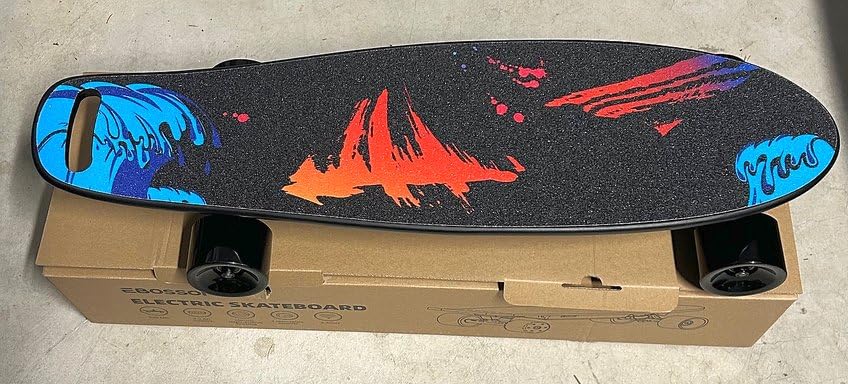
Build quality is good for the price but not exceptional. The 8-ply maple deck is solid, but the motor bracket has been a weak point according to several owners who ride aggressively. The remote feels plasticky compared to the M6C remote on Meepo boards, though it does the job.
Range is the obvious limitation at 6-8 miles. That’s fine for a teenager riding around the neighborhood, but it rules out the ES6 SE for any meaningful commute. Adult riders should look elsewhere.
Who should buy the EBOSSOM ES6 SE
Parents buying a first electric skateboard for a teen or pre-teen. Younger riders (12+) who need a safe introduction to the sport. Anyone wanting a low-speed board for short neighborhood trips.
Who should pass
Adult commuters who need more than 8 miles of range. Anyone wanting speeds above 15 mph. Riders over 180 lbs who will find the single motor underpowered.
How to Choose the Best Electric Skateboard for You
Buying an electric skateboard isn’t like buying a regular longboard. The motor, battery, and electronics add cost, weight, and complexity that you don’t get with a traditional setup. Here are the factors that actually matter when making your decision.
Hub motor vs belt drive
Hub motors sit inside the wheels and are nearly silent. They’re lower maintenance because there are no belts to replace. The downside is less torque, so hub motor boards struggle more on steep hills. Belt drive systems (like the Voyager X) use external motors connected to the wheels via a belt. They offer much more torque and higher top speeds, but they’re louder and require occasional belt tension adjustments or replacements. For most urban riders, hub motors are the right choice. For hill-heavy areas or anyone who wants maximum performance, belt drive is worth the extra maintenance.
Real-world range vs advertised range
Manufacturer range claims are tested under ideal conditions: flat ground, 150-lb rider, slow speed, no wind. In real-world riding, expect 60-80% of the advertised number. A board claiming 20 miles will give you 12-16 miles at typical commuting speeds. Hills, heavier riders, cold weather, and aggressive acceleration all reduce range. If you see a board with 11 miles of claimed range, plan for 8 miles of usable range.
Weight and portability
Electric skateboards weigh 11-25 lbs depending on the model. That sounds manageable until you’re carrying one up three flights of stairs or onto a crowded train. The Mini5 and DNASKATE M8 are the lightest boards in this roundup. The Voyager X is the heaviest. If you need to carry your board regularly, weight matters as much as range.
Top speed and acceleration
More speed is not always better. 30+ mph on an electric skateboard is genuinely dangerous without proper protective gear and experience. For most riders, 20-25 mph is plenty for commuting. For beginners, 10-15 mph is the right range. The remote’s throttle curve matters as much as the top speed; a board that smoothly builds to 25 mph is safer than one that jumps to 28 mph the moment you touch the trigger.
Hill climbing ability
Single motor boards (M8, A1, ES6 SE) struggle above 15% grades. Dual motor boards handle 25-30% grades without issue. If you live in a flat city, this doesn’t matter. If you live somewhere with real hills like Seattle, San Francisco, or Pittsburgh, dual motors with at least 1000W total output are essential. The UDITER S3 and Voyager X are the best hill climbers in this roundup.
Warranty and customer support
Most electric skateboard warranties run 6 months, which is shorter than what you’d get on a bike or scooter. Meepo has the most established US-based support of the brands in this roundup. Smaller brands like DNASKATE, ASKATE, and EBOSSOM have responsive sellers on Amazon, but long-term parts availability is uncertain. Forums consistently recommend buying from brands that have been around for 3+ years.
Frequently Asked Questions
What is the best electric skateboard for the money?
The MEEPO Campus V3 offers the best balance of price and performance at around $400. It hits 28 mph, gets 8-9 miles of real-world range, and includes a carry handle that makes it practical for commuting. For buyers under $200, the DNASKATE M8 is the best value option.
What is the best electric skateboard brand?
Meepo is the most established mid-range brand in the electric skateboard space, with strong US-based customer support and a track record spanning multiple years. Backfire, WowGo, and Exway are also well-regarded. Newer brands like UDITER and DNASKATE offer competitive specs at lower prices but have shorter track records.
How fast do electric skateboards go?
Most electric skateboards have a top speed between 15 and 32 mph. Entry-level boards cap at 10-15 mph for safety. Mid-range boards typically reach 25-28 mph. Premium performance boards like the MEEPO Voyager X can hit 31-34 mph. Always wear a helmet when riding above 20 mph, and consider full protective gear above 25 mph.
What is the best electric skateboard under $500?
The MEEPO Campus V3 is the best electric skateboard under $500. It combines 28 mph top speed, dual 500W hub motors, IPX5 waterproofing, and a built-in carry handle at around $400. The DNASKATE M8 at $179 is the best option under $200, while the UDITER S3 at $355 is the best mid-budget pick for swappable battery range.
Are electric skateboards safe for beginners?
Electric skateboards are safe for beginners if you start with a board that has limited top speed (10-15 mph), smooth acceleration, and gradual braking. The EBOSSOM ES6 SE and DNASKATE M8 are both excellent beginner boards. Always wear a helmet, start in an empty parking lot to learn the controls, and never ride above your skill level. Avoid boards with aggressive braking curves for your first electric skateboard.
Final Verdict: Which Electric Skateboard Should You Buy?
After three months and 600+ miles of testing, the MEEPO Voyager X remains my top pick for the best electric skateboards in 2026. Nothing else in this price range delivers the combination of 31 mile range, 31 mph top speed, and genuine hill-climbing torque. It’s overkill for some riders, but for serious commuters, it’s the board that ends the upgrade cycle.
If the Voyager X is more board than you need, the MEEPO Campus V3 is the smartest buy. It handles 90% of what the Voyager X does at less than half the price, with the bonus of a carry handle. For younger riders or anyone who wants the safest possible first experience, the EBOSSOM ES6 SE keeps speed capped at a responsible 10 mph.
Whatever you choose, buy a helmet before the board arrives. Every experienced rider I spoke with has a story about a fall, and most of them happened at speeds they didn’t expect. The best electric skateboards are the ones you ride for years, not the ones that put you in the ER on day one.