
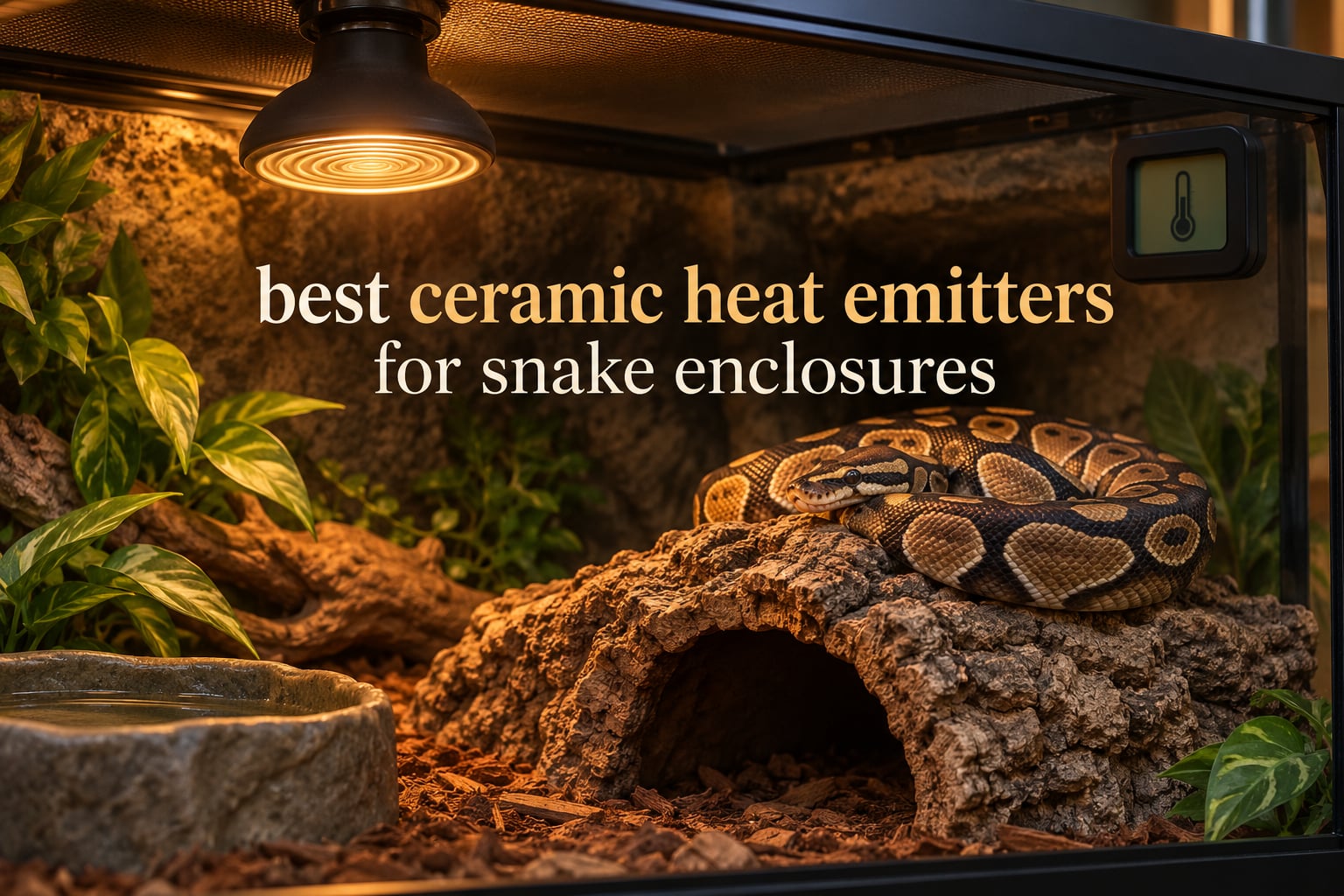
The best ceramic heat emitter for snake enclosures is the OMAYKEY 100W 2-Pack for a typical adult setup, the LUCKY HERP 150W 2-Pack if your enclosure runs large, and the HealSmart 100W 2-Pack if the highest average rating in the group matters most to you. We compared ten of the best-selling emitters on wattage, ceramic construction, rated life, fixture requirements and verified owner feedback so you can stop guessing which bulb your snake actually needs.
A ceramic heat emitter (CHE) is a solid porcelain infrared heating element that screws into a standard ceramic lamp socket and radiates heat with zero visible light output, which makes it the standard 24-hour heat source for nocturnal and crepuscular snakes. Unlike a halogen basking lamp, it does not produce a visible basking spot, so it belongs beside your daytime light rather than replacing it.
What makes this category confusing is not the products themselves. Every listing says the same four things: zero light, ceramic, long life, screw-in fit. The decision that actually matters is how emitter wattage maps to the volume of your enclosure, and no page-one guide publishes that mapping. We built it below, alongside a head-to-head on the ten emitters worth your money in 2026.
Our team also mapped how a CHE interacts with humidity, why the socket centre tab matters more than most keepers realise, and where a ceramic heat emitter stops being the right tool and a deep heat projector takes over. If you are still comparing glass and acrylic builds for a new enclosure, our steam shower enclosure guide covers the same sealed-glass heat-retention problem from the construction side.
Table of Contents
Top 3 Best Ceramic Heat Emitters for Snake Enclosures in 2026

OMAYKEY 100W Ceramic Heat Emitter 2-Pack
- 100W infrared heat with no light output
- ETL listed and fits porcelain E26/E27 sockets
- Two bulbs plus a digital thermometer included
- 15000 hour rated life
LUCKY HERP 150W Ceramic Heat Emitter 2-Pack
- 150W output suits 6x3x3 and larger enclosures
- Reaches rated temperature in about 4 minutes
- Thick ceramic shell rated up to 10000 hours
- Also sold in 50W 75W and 100W

HealSmart 100W Ceramic Heat Emitter 2-Pack
- Highest average rating in the group at 4.7
- No red glow at all from the black element
- Crack and moisture resistant for humid terrariums
- Two-year cover on a 100W pack
All 10 Ceramic Heat Emitters Compared Side by Side (October 2026)
| Product | Specifications | Action |
|---|---|---|
| OMAYKEY 100W Ceramic Heat Emitter 2-Pack |
|
Check Latest Price |
 OMAYKEY 75W Ceramic Heat Emitter 2-Pack OMAYKEY 75W Ceramic Heat Emitter 2-Pack |
|
Check Latest Price |
 Aiicioo 60W Ceramic Heat Emitter Aiicioo 60W Ceramic Heat Emitter |
|
Check Latest Price |
| LUCKY HERP 150W Ceramic Heat Emitter 2-Pack |
|
Check Latest Price |
| HealSmart 100W Ceramic Heat Emitter 2-Pack |
|
Check Latest Price |
 Fluker’s 100W Ceramic Heat Emitter Fluker’s 100W Ceramic Heat Emitter |
|
Check Latest Price |
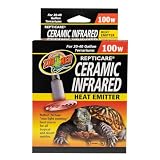 Zoo Med ReptiCare 100W Ceramic Heat Emitter Zoo Med ReptiCare 100W Ceramic Heat Emitter |
|
Check Latest Price |
 REPTI ZOO 100W Ceramic Heat Emitter 2-Pack REPTI ZOO 100W Ceramic Heat Emitter 2-Pack |
|
Check Latest Price |
 DOMICA 150W Ceramic Heat Emitter 2-Pack DOMICA 150W Ceramic Heat Emitter 2-Pack |
|
Check Latest Price |
 REPTI HOME 100W Ceramic Heat Emitter 2-Pack REPTI HOME 100W Ceramic Heat Emitter 2-Pack |
|
Check Latest Price |
1. OMAYKEY 100W Ceramic Heat Emitter 2-Pack – Best Overall for Snake Enclosures
OMAYKEY 2-Pack 100W Ceramic Heat Lamps with 1-pcs Digital-Thermometer
100W
E26 base
3.15 inch diameter
ETL listed
Includes digital thermometer
Pros
- Strong even radiant heat with zero light output
- ETL Listed for AC 90-120V
- Two bulbs plus a digital thermometer in the box
- Installs in any standard porcelain E26 or E27 socket
- 15000 hour rated life
Cons
- Supplies heat only and cannot replace a basking light
- 100W suits smaller enclosures more than large ones
- Needs an hour of cooling before handling
- Must be used in a porcelain socket
OMAYKEY’s 100W two-pack is the emitter we return to most often, and it earns the top spot on the strength of owner volume rather than a single flattering review. More than four thousand buyers have rated it, which means the failure modes are well documented rather than hypothetical. At 100W it is the right size for a 4x2x3 or 5x2x2 enclosure, which is where most adult ball pythons and adult corn snakes live.
The element is solid ceramic rather than a coated glass envelope, so it produces no red glow and no visible light at all. Install it in a porcelain E26 or E27 socket and your snake’s photoperiod stays clean through the night. Owners running this alongside a daytime halogen report that the animal settles on a normal activity pattern instead of pacing under a red lamp.
Two practical details set this listing apart from cheaper pairs. It is ETL Listed for AC 90-120V, which matters when you are running a high-wattage element unattended for years, and the box includes a digital thermometer so you can log enclosure temperature from night one. The stated rated life of 15000 hours is the highest in this group alongside the 75W sibling.
What enclosure size this pair handles well
This is a clean match for a 4x2x3 or 5x2x2 PVC enclosure, and it works in a 4x2x2 for a juvenile or a smaller adult. Use a dimming thermostat rather than an on/off unit, because a 100W element cycles hard in a small volume. It also works as the night half of a two-source setup, and on wire mesh you should recheck surface temperatures weekly.
Who should not buy this emitter
Skip it if you keep a tropical high-humidity species such as a green tree python or a boa constrictor and cannot commit to a humidity schedule. A CHE is an open radiant heat source with no moisture to add back, and you will spend the winter chasing evaporation you caused yourself.
Skip it too if you are buying your first fixture and have a plastic dome on hand. It needs a porcelain or heat-rated ceramic socket, and a plastic shell will soften. A reviewer also reported a bulb arriving cracked in the box, so inspect the element before you screw it in.
2. OMAYKEY 75W Ceramic Heat Emitter 2-Pack – Best Value for 4x2x2 Setups
OMAYKEY 2 Pack 75W Ceramic Heat Emitter Lamp, Reptile Heat Bulbs
75W
E27 base
2.95 inch diameter
ETL listed
Two bulbs per pack
Pros
- Even radiant heat with no light emitted
- ETL Listed at 75 watts
- Compact 2.95 inch diameter fits small dome fixtures
- Two-pack includes a spare bulb
- Easy drop-in screw installation
Cons
- Heat only with no visible light or UVB
- 75W is modest for anything larger than a 4x2x2
- Needs about an hour of cool-down before handling
- Must be mounted in a porcelain socket
The 75W two-pack is the value pick here, and the reason is simple: at 2.95 inches across it fits compact dome fixtures that larger 100W elements physically cannot enter. If your 4x2x2 is short on vertical clearance, this is often the only emitter that installs without improvisation.
Owners consistently describe the same clean behaviour: no light emitted, no red glow, and enough radiant heat to hold a small enclosure steady through a cold night. The two-pack format means a failed bulb is a swap rather than an emergency, and the white ceramic finish still runs hot enough to need a full hour before handling.
It is also ETL Listed, which puts it on the same safety footing as the pricier listings. The stated rated life is 15000 hours, and the one number to hold onto is 75 watts: that is a small-enclosure figure, and forcing it to cover a 5x2x2 or larger means the thermostat is on almost continuously.
That single wattage figure is also why the pair works best as a matched set rather than a set-and-forget install. A dimming thermostat lets you trim the output to hold a stable gradient instead of driving the element through a full on/off cycle every few minutes on a cold night, and the second bulb in the pack is what makes a mid-cycle failure a non-event.
Where the 75W size actually fits
This is the emitter for 4x2x2 enclosures and for QT and similar starter cages, and it doubles as a backup for a 4x2x3. The 2.95 inch diameter clears tight dome fixtures and shallow-height cages where a 100W element will not seat. Pair it with a dimming thermostat, since on/off cycling is what shortens element life in a small volume.
Who should not buy this emitter
Do not buy it for a 6x3x3, an 8x4x4, or a breeding rack. Seventy-five watts will not hold those volumes to a nocturnal python’s target range without a second source, and you would be chasing the temperature all night instead of maintaining it.
It is also the wrong pick for a keeper who wants visible light. There is none at all, so it cannot serve a diurnal species or a basking zone. And it needs a porcelain socket; plastic fixtures are a burn and melting risk at this temperature.
3. Aiicioo 60W Ceramic Heat Emitter – Best for Juveniles and QT Enclosures
Aiicioo Reptile Heat Lamp Bulb -60W Ceramic Heat Emitter No Harm No Light Infrared Heater Lamp for Chicken Coop Lizard Aquarium Snake Outside Dogs Brooder 110V,White
60W
AC 110-120V
2.95 by 3.94 inches
Up to 10000 hours
Pros
- Uniform sunlike radiant heat pattern
- Warms both surfaces and overall air temperature
- High-purity pottery clay resists cracking in humid setups
- Heats up quickly in a cold enclosure
- Also works in coops and brooders
Cons
- Heat only with no visible light or UVB
- 60W is the lowest output here and suits small enclosures only
- Runs very hot and needs an hour of cool-down
- Frequent on/off cycling shortens emitter life
Aiicioo’s 60W single bulb is the right call for a QT, a 4x2x2 juvenile setup, or a hatchling rack. It is the lowest output in this group, and that is exactly the point. A juvenile ball python in a small cage does not need 100 watts, and an oversized emitter in a small volume is the most common way a first enclosure overheats overnight.
The listing claims it raises both surface and ambient air temperature, which is unusual for a CHE and useful in a small enclosure where there is little mass to heat. The long wave infrared output is described as producing a sunlike, even pattern rather than a single hot point, and owners back that up with steady results across poultry brooders and small vivariums as well as reptiles.
The construction detail worth noting is high-purity pottery clay, which the manufacturer rates for cracking resistance in humid terrariums. Rated life is listed at up to 10000 hours, which is shorter than the 15000-hour figures on the OMAYKEY listings, so plan on a replacement cycle rather than treating it as a forever bulb. Because it is a single bulb rather than a pack, there is no spare, which is the main argument against it for a nocturnal python where an overnight failure is genuinely dangerous.
Why this is the correct wattage for a QT
Sixty watts matches the air volume of a QT or a small 4x2x2 without overshooting, and it is the standard answer for hatchlings and juveniles. As the animal grows you step up to 75W or 100W. Use a dimming thermostat, because the manufacturer guidance specifically warns against frequent on/off cycling.
Who should not buy this emitter
Skip it for any adult enclosure at 5x2x2 or above. Sixty watts will not hold an adult snake’s warm hide at temperature through a winter night, and the animal will spend the night cold rather than merely cool.
It is also the wrong choice if you need a spare on hand, since it is sold as a single bulb. And remember there is no visible light, so a diurnal species still needs a daytime basking lamp this cannot replace.
4. LUCKY HERP 150W Ceramic Heat Emitter 2-Pack – Best for 6x3x3 and Larger
LUCKY HERP 150W Ceramic Heat Emitter, Reptile Heat Bulbs, Ceramic Heat Lamp for Reptiles, Amphibian, Chicken, Dog, Cat (2-Pack)
150W
E26 base
120V
Two bulbs per pack
Up to 10000 hours
Pros
- Fast warm-up reaching rated temperature in about 4 minutes
- Thick ceramic shell rated for durability
- Zero light output for undisturbed nocturnal rest
- 150W suits larger enclosures
- Also available in 50W 75W and 100W
Cons
- Heat only and cannot supply visible light or UVB
- Runs extremely hot and needs a ceramic-rated fixture
- Two 150W bulbs draw more power than small emitters
- Requires 30cm clearance from the animal
The LUCKY HERP 150W is the emitter for a 6x3x3 or larger enclosure, and it is the only high-wattage option here that also sells in 50W, 75W and 100W variants. That range matters if you plan to move up enclosure sizes over the animal’s life, because the brand stays consistent across the range.
Warm-up speed is the standout measured claim: noticeable temperature rise in about ten seconds and rated temperature in roughly four minutes. In a large PVC enclosure that means the hide reaches a workable temperature long before a cold night settles in, and the two-pack means one bulb can cover a large volume while the second acts as a spare.
The shell is described as thicker special ceramic than an ordinary heating lamp, and that construction is why this listing carries a top-three placement in Terrarium Heat Lamps. Rated life is up to 10000 hours. Owners also note the practical instruction to keep the emitter more than 30cm from the reptile, which is where most burn incidents originate.
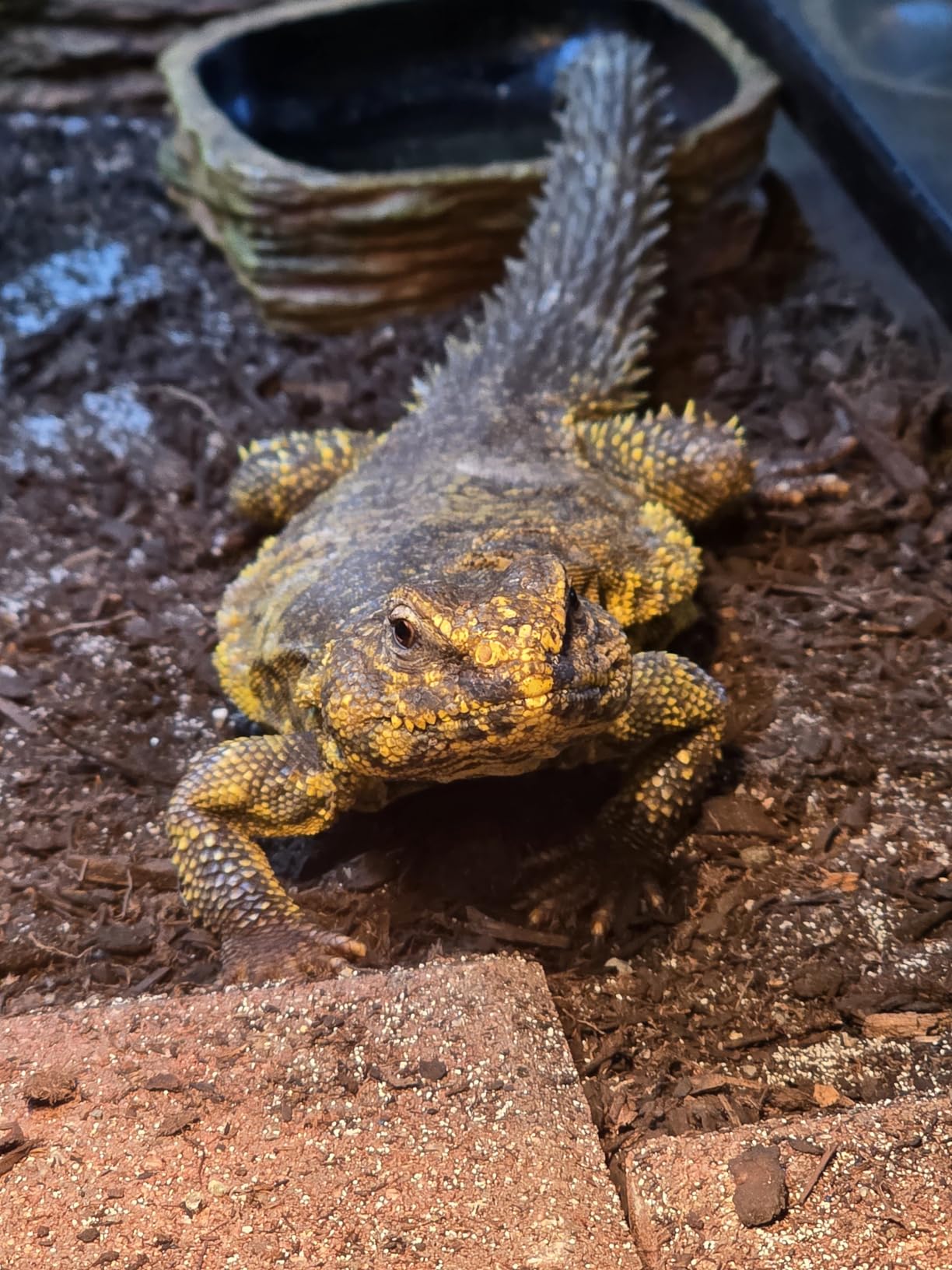
When 150W is the correct choice
Choose 150W for a 6x3x3, an 8x4x4 or a 10x4x4, particularly in a room that runs cool, because at that volume 100W elements are on continuously and never catch up. Two 150W elements also draw considerably more power, and in a 4x2x2 or 4x2x3 step down to the 100W or 75W variant from the same line.
Who should not buy this emitter
Do not buy the 150W for a small enclosure, a juvenile setup, or a species with low thermal requirements. A dimming thermostat will help, but you will be running the element at a fraction of its output and paying for capacity you cannot use.
It is also unsuitable as a daytime source for a diurnal species, since there is no light output at all, and it demands a genuine ceramic-rated fixture. Do not mount it in a plastic dome or a thin metal reflector without a heat-rated socket.
5. HealSmart 100W Ceramic Heat Emitter 2-Pack – Top Rated by Owners
HealSmart Reptile Heat Lamp 100W 2-Pack Ceramic Heat Emitter, No Light Emitting Heat Bulbs for Amphibian Pet Brooder Coop Incubating Chicken, Lizard Bearded Dragon Turtle Snake Terrarium Black
100W
E26 base
85mm by 100mm
Two bulbs per pack
1-year warranty
Pros
- Highest average rating in the group at 4.7 across more than 1000 reviews
- Black element produces no red glow at all
- Consistent heat reported holding 83-90F
- Crack and moisture resistant for humid terrariums
- Two bulbs per pack with a one-year warranty
Cons
- Heat only with no visible light or UVB
- Very hot surface so fixture rating and spacing matter
- Heat output reported easing after about six months
- Needs a heat-resistant fixture with a ceramic socket
HealSmart’s 100W two-pack carries the highest average rating in this group, at 4.7 across more than a thousand reviews, and that consistency is what sets it apart. Owners report two thermometers tracking 83-90F, which is a ball python’s target ambient range measured rather than assumed.
The black element produces no red glow whatsoever, and several owners single that out as the reason their snake resumed normal night activity after replacing a red lamp. The element uses a Ni-Cr-Alloy resistance wire inside high-purity pottery clay, and the manufacturer rates the design for crack prevention and moisture resistance in humid terrariums.
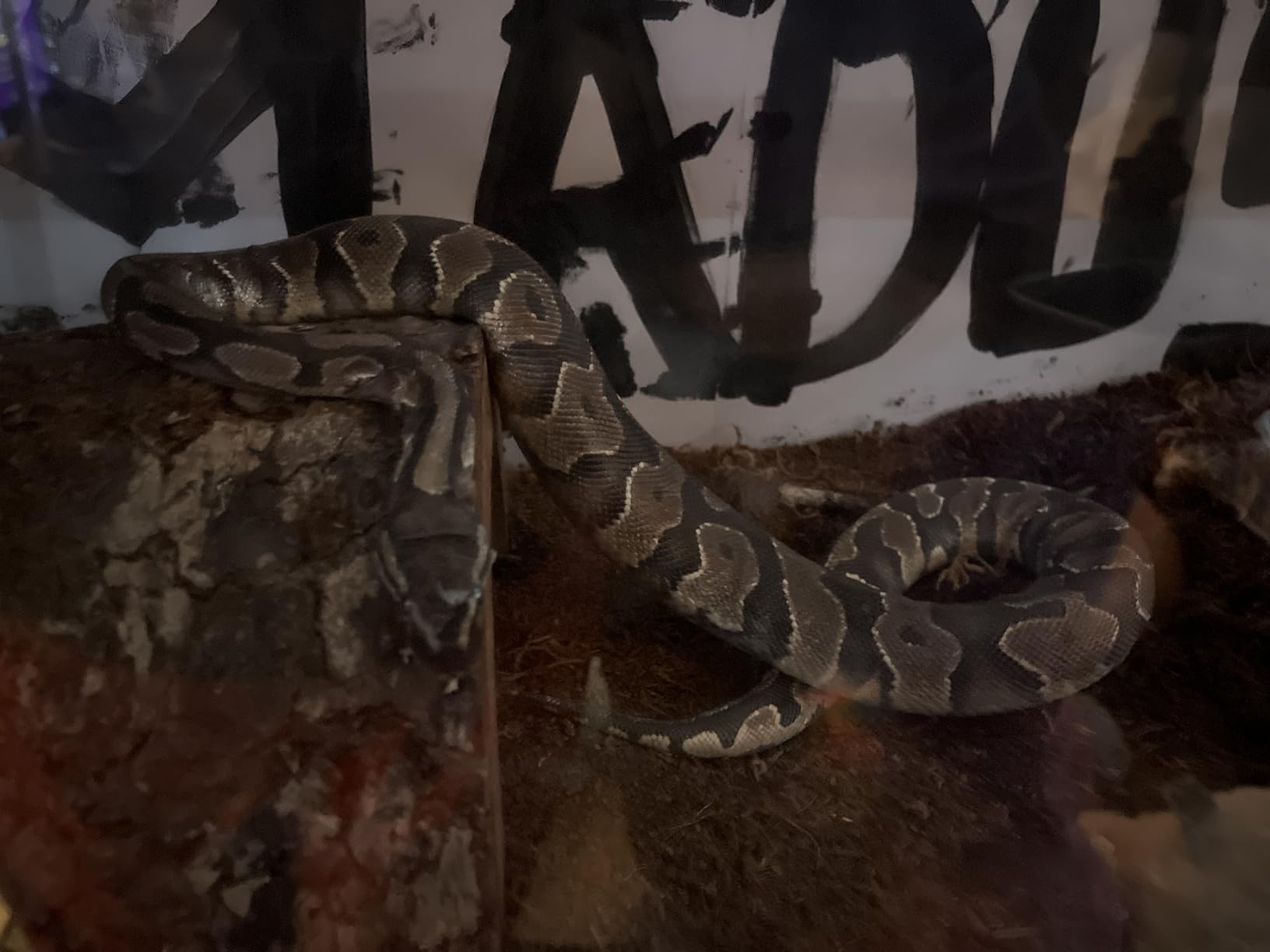
There is a stated one-year warranty and a 10000 hour rated life, with each bulb measuring 85mm in diameter by 100mm in length. One owner reports the pack still heating properly after two full winters of intermittent use. The reported weak point is gradual fade rather than sudden failure, with output easing slightly after about six months, so log surface temperatures monthly rather than assuming the bulb is fine.
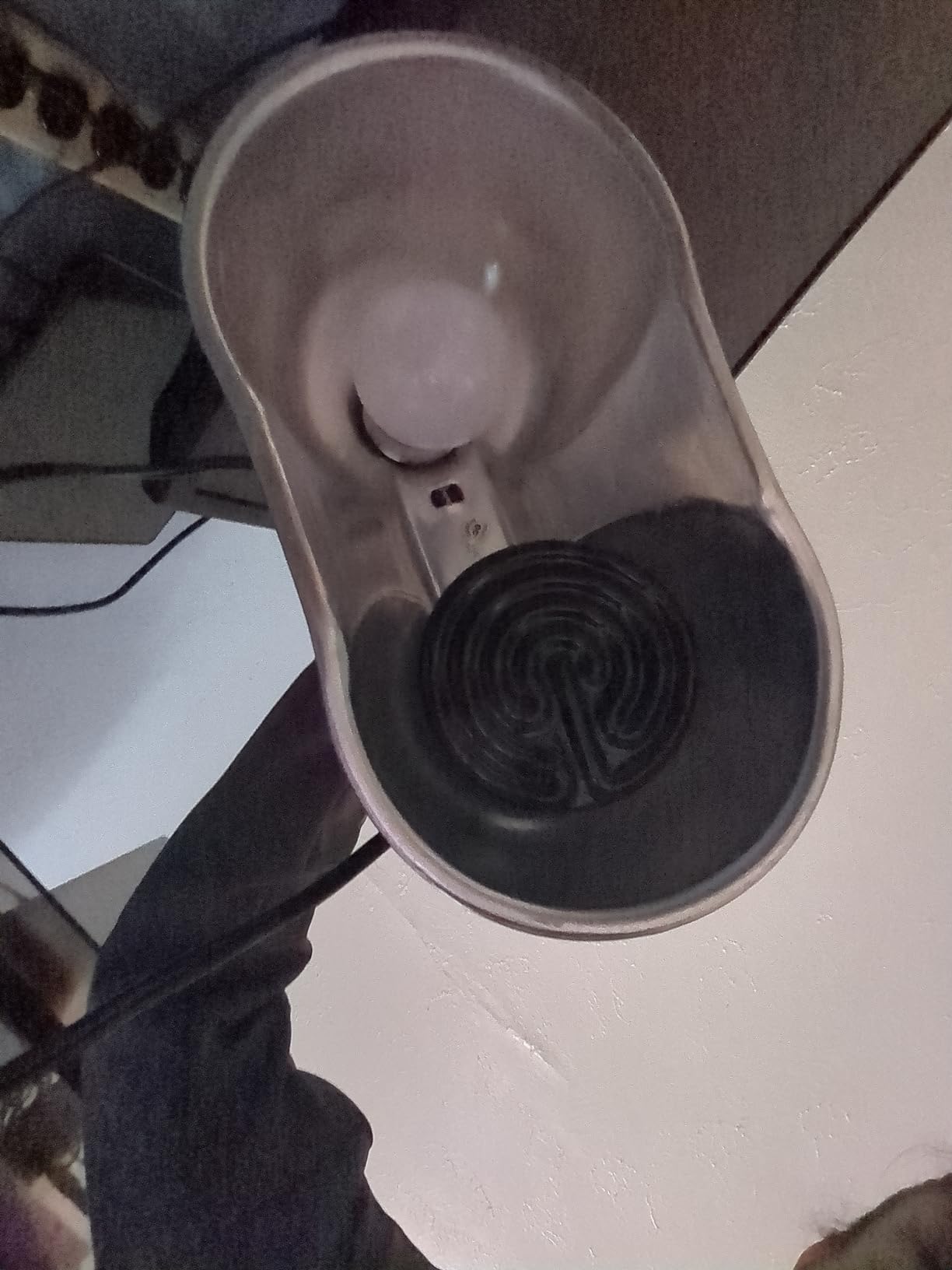
Why owners rate this pack highest
Three things drive the score: measured and repeatable heat, complete absence of light including red glow, and simple installation in a standard E26 heat-rated fixture. The dark finish also matters visually, since a completely blacked-out element leaves the enclosure looking unlit at night rather than glowing, which some keepers prefer in a bedroom setup.
Who should not buy this emitter
Skip it if you need a basking spot. There is no visible light, so a diurnal species still needs a halogen on a daytime timer, and this bulb only handles the night half of the cycle.
It is a poor match for very large enclosures at 100W, where the thermostat will run it continuously and the reported output fade will arrive sooner. And it needs a genuinely heat-resistant fixture, not a plastic dome.
6. Fluker’s 100W Ceramic Heat Emitter – Most Versatile for Long Service Life
Fluker’s Ceramic Heat Emitter, Natural Infrared Heating Bulb for Reptiles, 100 Watt
100W
Large circular emitter face
Teflon-free ceramic
Pairs with Repta-Clamp Lamp
Pros
- Owners report bulbs still working after roughly eight years of thermostat duty
- Large circular face widens the heated basking area
- No light output even in the white finish
- Teflon-free ceramic construction
- Established herpetology brand
Cons
- Costs more per bulb than generic two-packs
- Requires a separate Fluker's clamp lamp with switch
- No light output so it cannot act as a basking light
- Runs hot enough to require an accurate thermometer
- Units have reportedly cracked at the socket after long service
Fluker’s 100W is the longevity pick, and the reason is unusually concrete: owners report a unit still functioning after roughly eight years of continuous thermostat duty. Very few bulbs in any category carry that kind of track record, and it is the single strongest reason to pay more for a name-brand emitter over a generic two-pack.
The design detail that matters day to day is the large circular emitter face. It spreads radiant heat over a wider area than a narrow conical element, which means a longer warm section along the enclosure and fewer cold patches beside the hide. Owners also note that the white finish still emits no light at all.
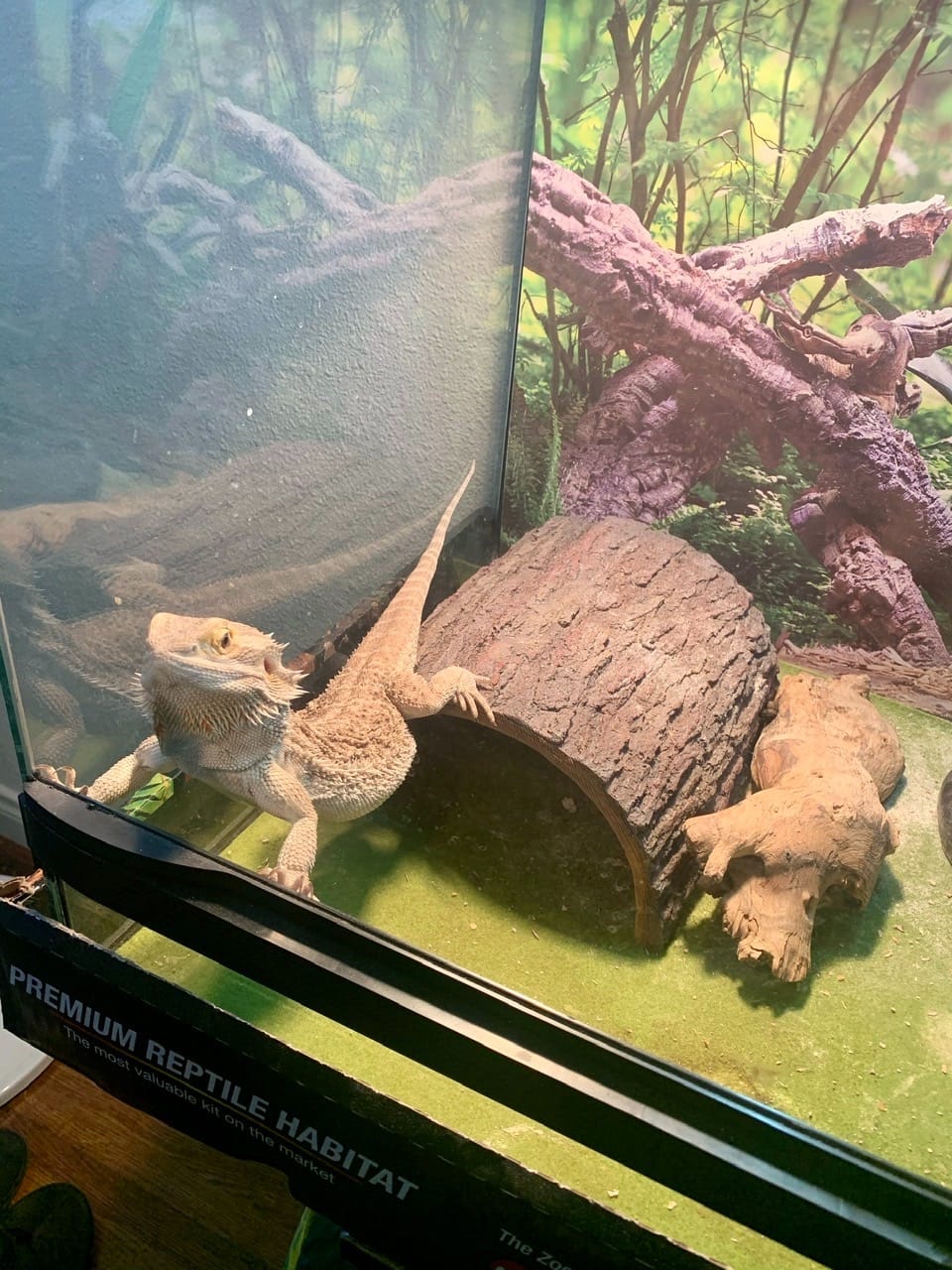
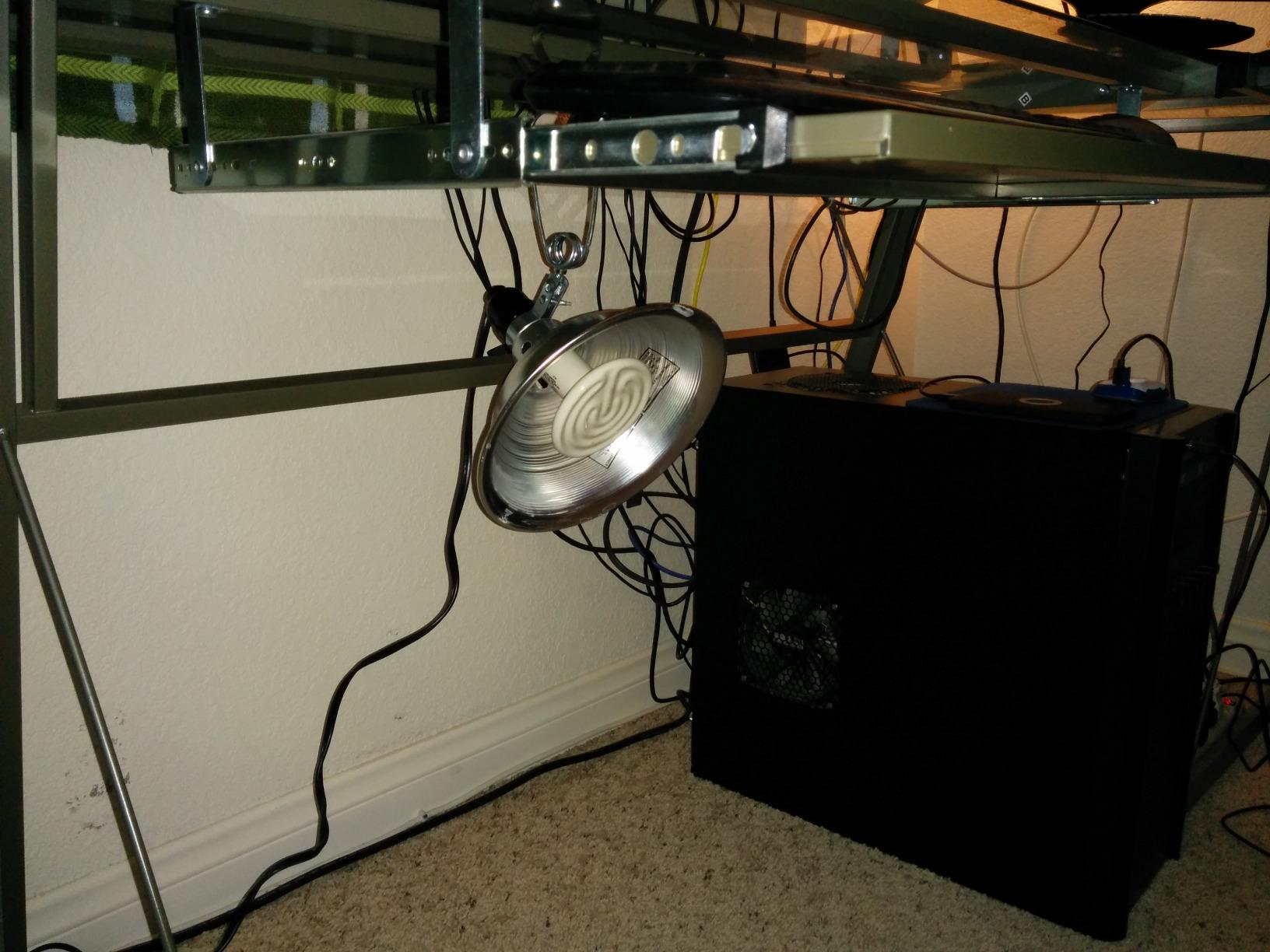
Construction is Teflon-free ceramic, which bird and reptile keepers consistently treat as a safety advantage over coated envelopes. The listing pairs it with the Fluker’s Repta-Clamp Lamp with Switch, so this is not a standalone fixture and you should budget for the lamp as part of the setup. The tradeoff is straightforward: you pay more per bulb and you need a separate fixture, and the element runs hot enough that an accurate thermometer is worth having.
What you gain with a name-brand emitter
Durability is the real return, and the wide emitter face is a functional gain in a 4x2x3 or 5x2x2 because it creates a longer usable warm zone. Pair it with a dimming thermostat for the smoothest control, and have an accurate digital thermometer or infrared gun on hand because the element runs hot enough to need one.
Who should not buy this emitter
Skip it if you need a fixture in the box, because this is a bulb only and it is designed for the Fluker’s clamp lamp. If you want a self-contained setup from one purchase, choose a two-pack instead and add your own ceramic socket.
It is also the wrong call if a diurnal species needs a basking spot, since there is no visible light. Remember the price difference is real, and for a first keeper on a tight budget a well-matched two-pack achieves the same thermostat-controlled heat for less.
7. Zoo Med ReptiCare 100W Ceramic Heat Emitter – Best for High-Humidity Enclosures
Zoo Med Repticare 100 Watt Ceramic Infrared Heat Emitter
100W
Porcelain
E26 base
Flat-face design
2-year warranty
Pros
- Flat emitter face projects heat further than conical designs
- Rated suitable for high-humidity terrariums
- Lifts terrarium air temperature roughly 10-20F above the room
- Two-year manufacturer warranty
- Made in America from porcelain construction
Cons
- Highest cost per bulb in this group for a single unit
- Sold as one bulb with no spare
- No visible light so it cannot serve as a basking light
- Porcelain element runs hot and needs careful mounting
The Zoo Med ReptiCare 100W is the pick for humid enclosures, and its flat emitter face is the reason. A flat face is more efficient than a conical design at projecting heat further into the enclosure, which matters in a tall cage where a narrow element heats its own face long before the animal feels anything.
Zoo Med rates it for high-humidity terrariums, and the porcelain construction is the reason that claim is credible. The listed effect on air temperature is roughly 10-20F above the surrounding room, which is the strongest ambient contribution of any emitter here and the main reason tropical keepers reach for this brand despite the drying side effects.
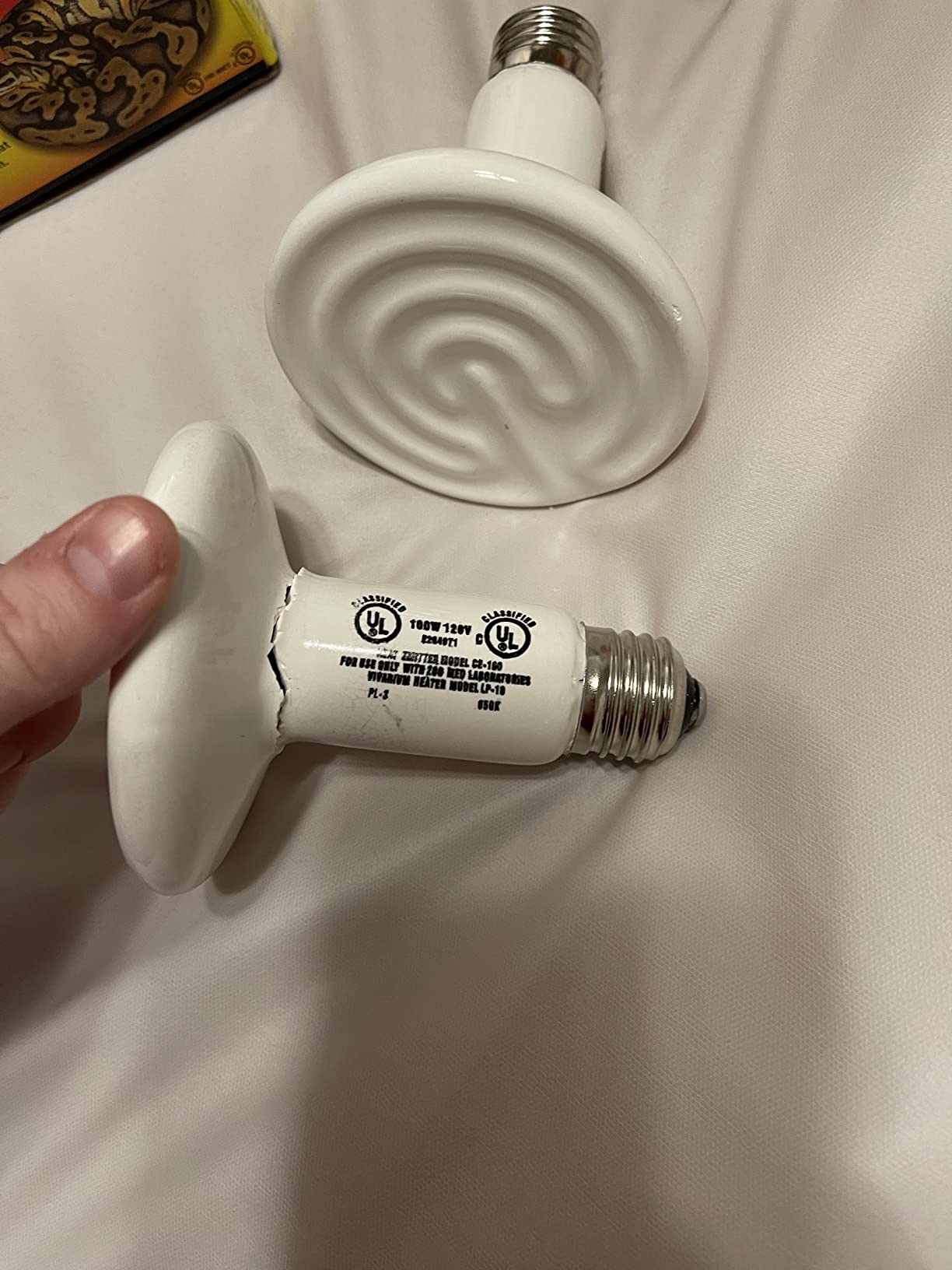
The warranty is the longest in this group at two years, and the product is made in America from porcelain. The tradeoffs are cost and the absence of a spare: it is the most expensive single bulb here, you get one bulb, and there is no visible light at all so it cannot double as a basking source. Porcelain runs hot, so mount it out of reach and allow cool-down before handling.
Why the flat face suits tropical setups
A flat face throws heat forward across the enclosure instead of radiating it in a narrow cone, so more of the air volume and more of the hide surface reach temperature. It is rated for high humidity, which is why it is the emitter we would choose over a generic two-pack for a boa or a colubrid setup, though you should still check humidity weekly.
Who should not buy this emitter
Do not buy it on a first-time budget with no fixture in hand. It is a single bulb at the highest cost per bulb in this group, and the two-packs cover the same night-heat job with a spare included.
It is also the wrong pick for a small 4x2x2 where 100W will overshoot, and for anyone who needs visible light. If your animal requires a daytime basking spot, budget for a halogen or deep heat projector alongside it.
8. REPTI ZOO 100W Ceramic Heat Emitter 2-Pack – Best Certified Ceramic
REPTI ZOO 100W Reptile Heat Lamp 2Pack Ceramic Heat Emitter Night Heat Lamp Bulbs Reptile Terrarium Heat lamp Tank Heat Bulb for Turtle Bearded Dragon Gecko Lizard Snake Chicken E26
100W
E26 base
Ceramic G40 shape
CE-certified and RoHS compliant
Two bulbs
Pros
- CE-certified and RoHS-compliant construction
- High-purity ceramic rated crack-resistant for humid glass terrariums
- Non-light emitting infrared heat
- Two bulbs per pack with 60W and 150W options
- Solid placement in the Terrarium Heat Lamps category
Cons
- No visible light or UVB so it cannot serve as a basking lamp
- 10000 hour rated life is shorter than 15000-hour listings
- Only a 90-day warranty which is the shortest here
- Very hot surface needs a heat-rated ceramic socket
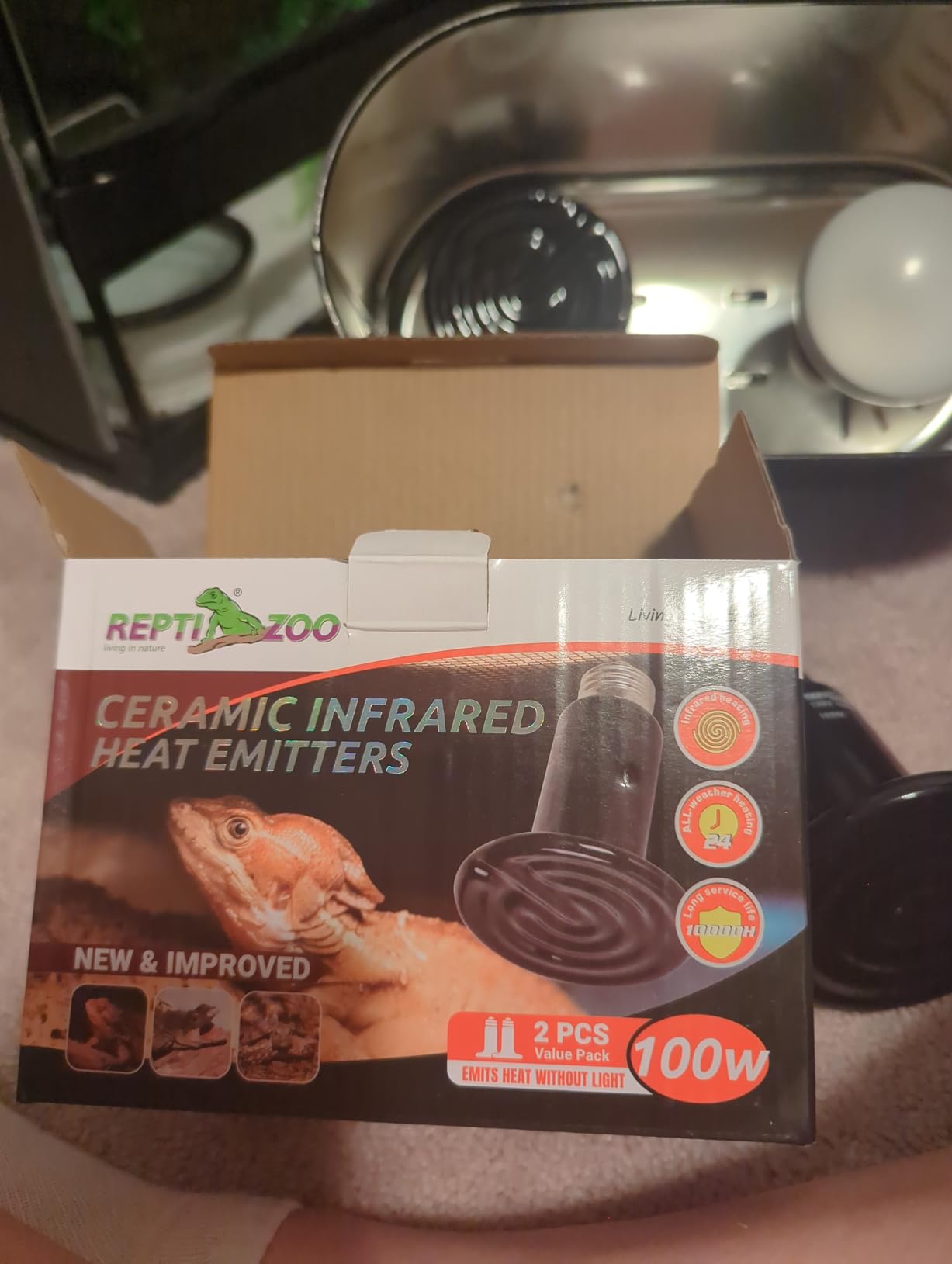
REPTI ZOO’s 100W two-pack stands out on certification. It is CE-certified and RoHS-compliant, which is unusual at this price point and gives you documented compliance rather than a vague safety claim. For anyone who wants a wet, humid glass terrarium and a long service interval, that is worth more than a longer warranty.
The ceramic is described as high-purity and crack-resistant, rated for use in high-humidity glass terrariums. Infrared output penetrates skin tissue to promote blood circulation without disrupting behaviour, and the manufacturer claims a 10000 hour rated life, roughly three times a traditional heat lamp.
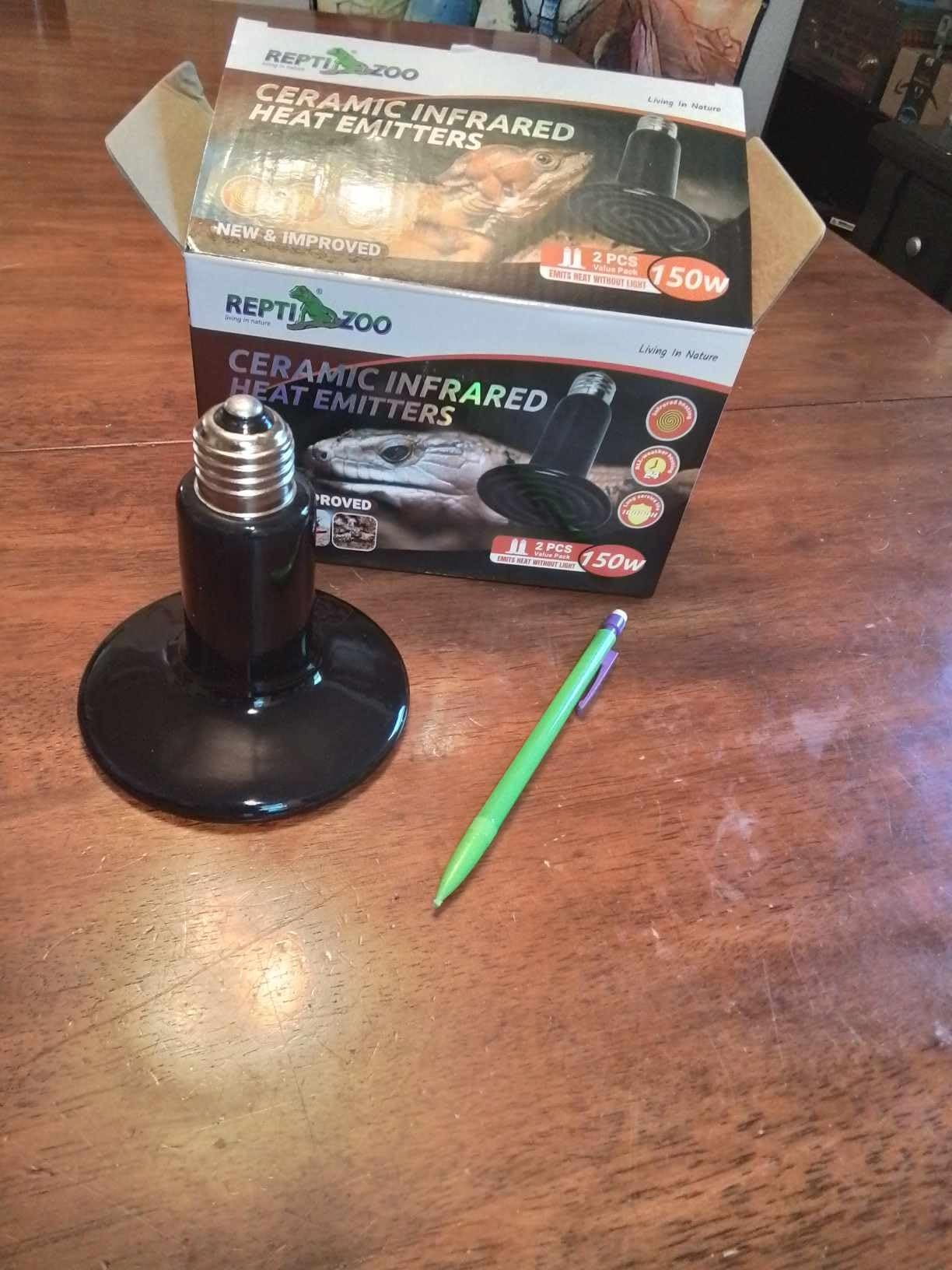
It is compatible with most E26 sockets, and the pack also comes in 60W and 150W versions, so the same brand covers a small juvenile cage and a larger adult enclosure. The G40 shape at 2.9 inches wide fits most standard dome fixtures without crowding, and the surface runs very hot, so it needs a heat-rated ceramic socket with clearance from the animal.
What the certifications actually cover
CE and RoHS compliance address material safety and restricted substances rather than heat performance, so treat them as a quality signal rather than a guarantee. Practically, the crack-resistant ceramic is what keeps the element intact in a humid enclosure. At 100W it fits a 4x2x3 or 5x2x2, and the 60W version handles a 4x2x2.
Who should not buy this emitter
Skip it if warranty length drives your decision. Ninety days is short against the two-year cover on the Zoo Med, and a bulb that fails inside a cold night is a genuine risk for a nocturnal species.
It is also the wrong pick for a diurnal basking species since there is no light, and it will not suit a large enclosure at 100W without a second source. Choose the 150W version of this line or a higher-wattage emitter instead.
9. DOMICA 150W Ceramic Heat Emitter 2-Pack – Best for Brooders and Extreme Heat Needs
DOMICA 150W 2 Pack Reptile Heat Bulb, Beared Dragon Ceramic Heat Emitter, E26 No Light Night Use Heater Bulbs for Turtle, Lizard, Snake, Amphibians, Pet Brooder Coop Chicken (150W-Large Tank)
150W
High-density ceramic
E26 base
110-120V
Compact 3 by 4.3 inch profile
Pros
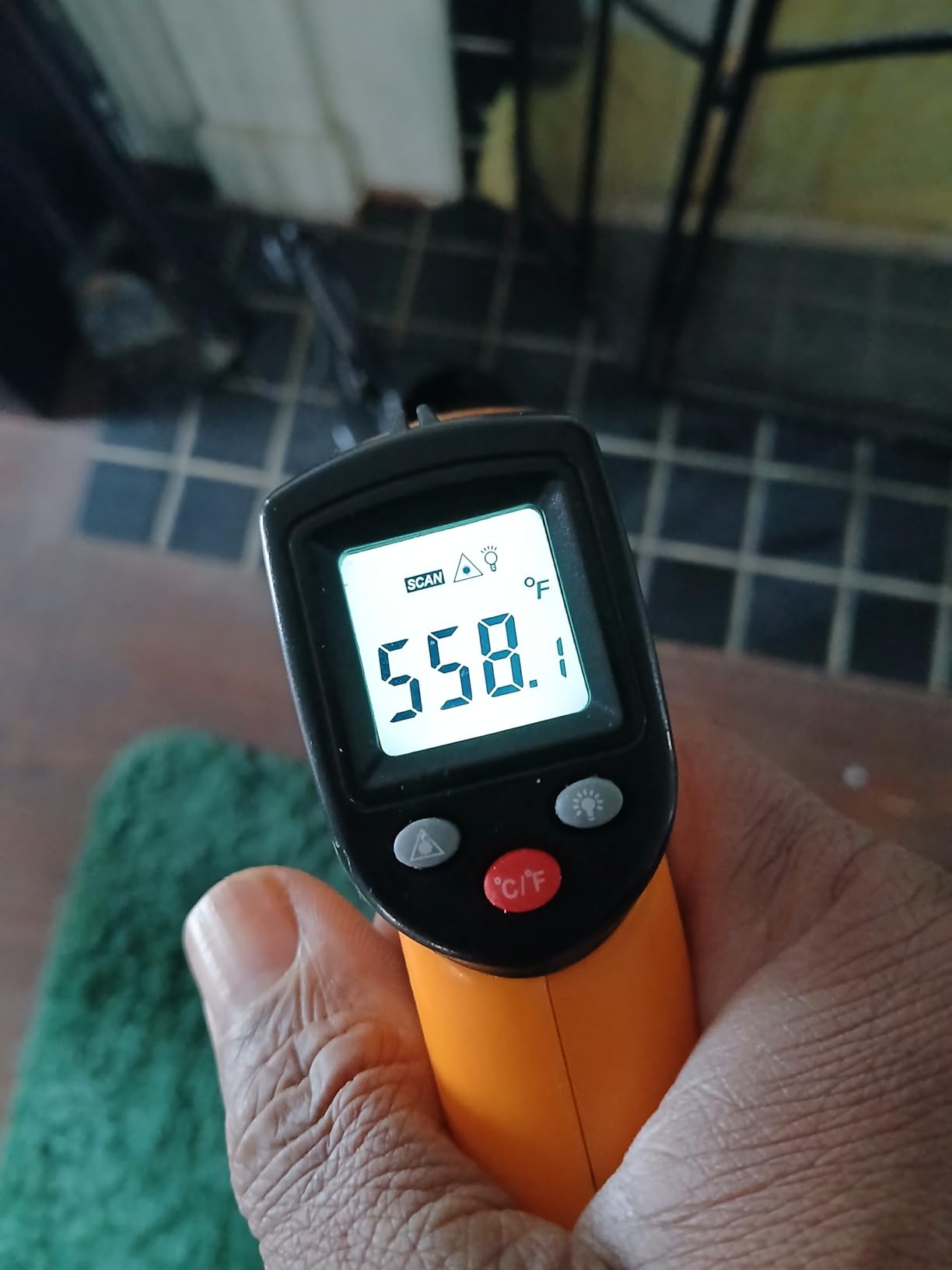
- High-density ceramic rated to withstand up to 500F
- Fast heat-up in low-temperature environments
- Compact profile fits most enclosures
- Four wattage variants labelled by tank size
- Reported to hold a steady warm zone over months
Cons
- No visual indicator that the bulb is on and one buyer reported a burn
- No light output so it cannot replace a daytime basking bulb
- Requires a 150W-rated fixture and clearance from flammables
- Highest share of one-star reviews among the higher-rated listings
DOMICA’s 150W is built for heat that other emitters would not survive, and the specification that sells it is the high-density ceramic rated to withstand up to 500F without warping. If you run a brooder, a rearing box, or a large enclosure in a cold room, this is the element that will not deform on you.
Owners report fast heat-up compared with traditional incandescent bulbs in low-temperature environments, and one buyer dropped a bulb without breaking it, which suggests genuinely dense ceramic. Another reports holding a tortoise basking zone near 80F reliably across several months of use.
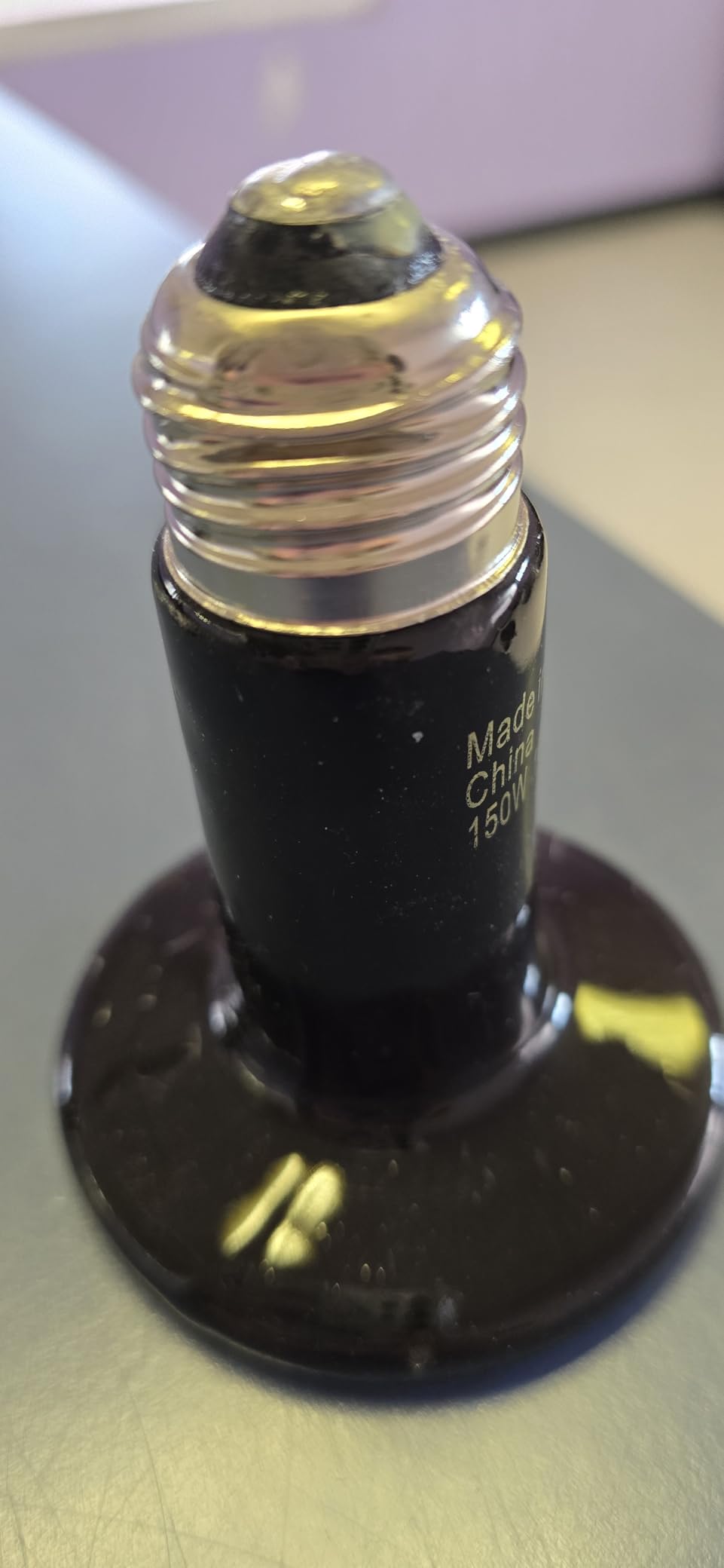
The variants are labelled by tank size at 50W, 75W, 100W and 150W, and the compact 3 by 4.3 inch profile runs on a standard E26 base at 110-120V as a direct replacement for a normal heat bulb. Note that with no light output at all, nothing indicates the bulb is on, and one reviewer describes permanent scarring from brushing it while changing a bulb. Mount it out of reach and add a guard.
When 150W high-density ceramic earns its place
Use the 150W variant in 6x3x3 and larger enclosures, in brooders and rearing boxes, and in reptile rooms that run cold overnight. For anything smaller, step down to the 100W or 75W variant of the same line, and pair it with a daytime basking bulb on a timer, since the light interference is exactly what this bulb is designed to avoid.
Who should not buy this emitter
Do not buy the 150W version for a 4x2x2 or a QT. It is far too much heat for that volume, and the absence of any glow makes the overheat harder to notice until you have already brushed the element.
It is also unsuitable for a diurnal basking species and for any enclosure where you cannot guarantee a heat-rated fixture and clearance from flammable materials. It carries the highest share of one-star feedback among the higher-rated listings here, largely around packaging and burn risk.
10. REPTI HOME 100W Ceramic Heat Emitter 2-Pack – Budget Pick With Four Size Options
REPTI HOME 100W Ceramic Heat Emitter (2 Pack), Reptile Heat Lamp Bulbs, Ceramic Heater for Amphibian, Pet Brooder Coop, Chicken, Dog, Cat
100W
Solid ceramic element
E26 base
120V
Up to 10000 hours
Pros
- Four pack options from 50W to 150W
- Solid ceramic shell rated stronger than ordinary heating lamps
- Reaches rated temperature in about 4 minutes
- Confirmed to keep snakes and turtles warm with no light
- Customer service replies within 24 hours
Cons
- Heat only with no visible light or UVB
- One buyer received a single bulb despite the two-pack listing
- Cracking and popping noise reported during warm-up
- A 75W unit was reported insufficient for a 75 gallon tank
- Faint burning smell in the first hours after switch-on
REPTI HOME’s 100W two-pack covers four wattages from 50W to 150W, and that range is the reason it is worth a look even against cheaper pairs. You can start a juvenile in a 4x2x2 at 50W and move to the same line as the animal grows, without changing brands.
The manufacturer states 100% infrared heat efficiency with directional heat and no light produced, reaching rated temperature in about four minutes after a roughly ten-second warm-up. The solid ceramic shell is described as stronger and more durable than an ordinary heating lamp, and it is rated for up to 10000 hours.
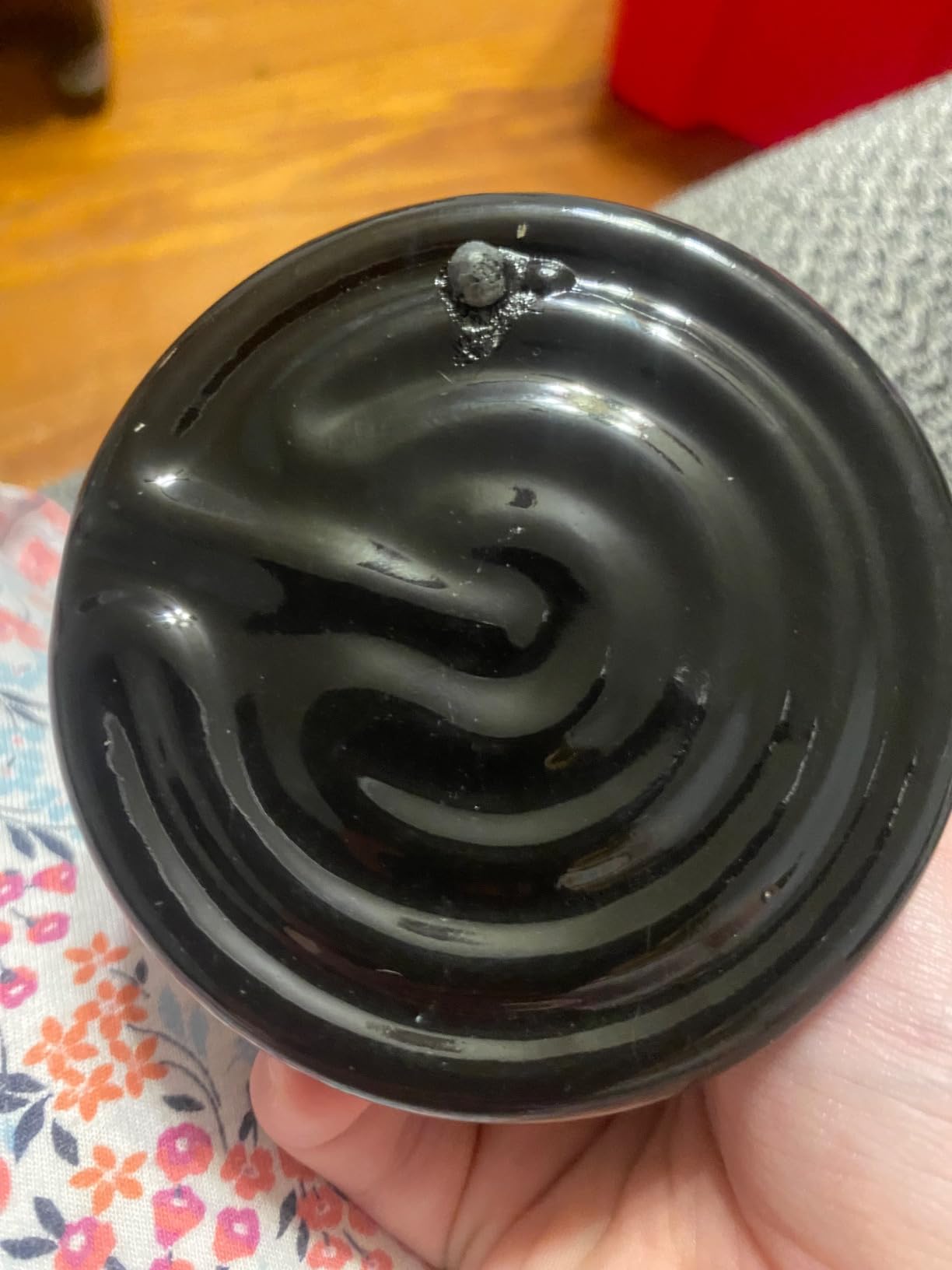
Buyers confirm it keeps snakes, bearded dragons and turtles warm with no light emitted, and the listing sits in a strong position in Terrarium Heat Lamps for its review count. There are three fair complaints: one German reviewer received a single bulb despite the listing stating a two-pack, the same reviewer reported cracking and popping as the emitter warmed, and a faint burning smell can occur during the first hours after switch-on.
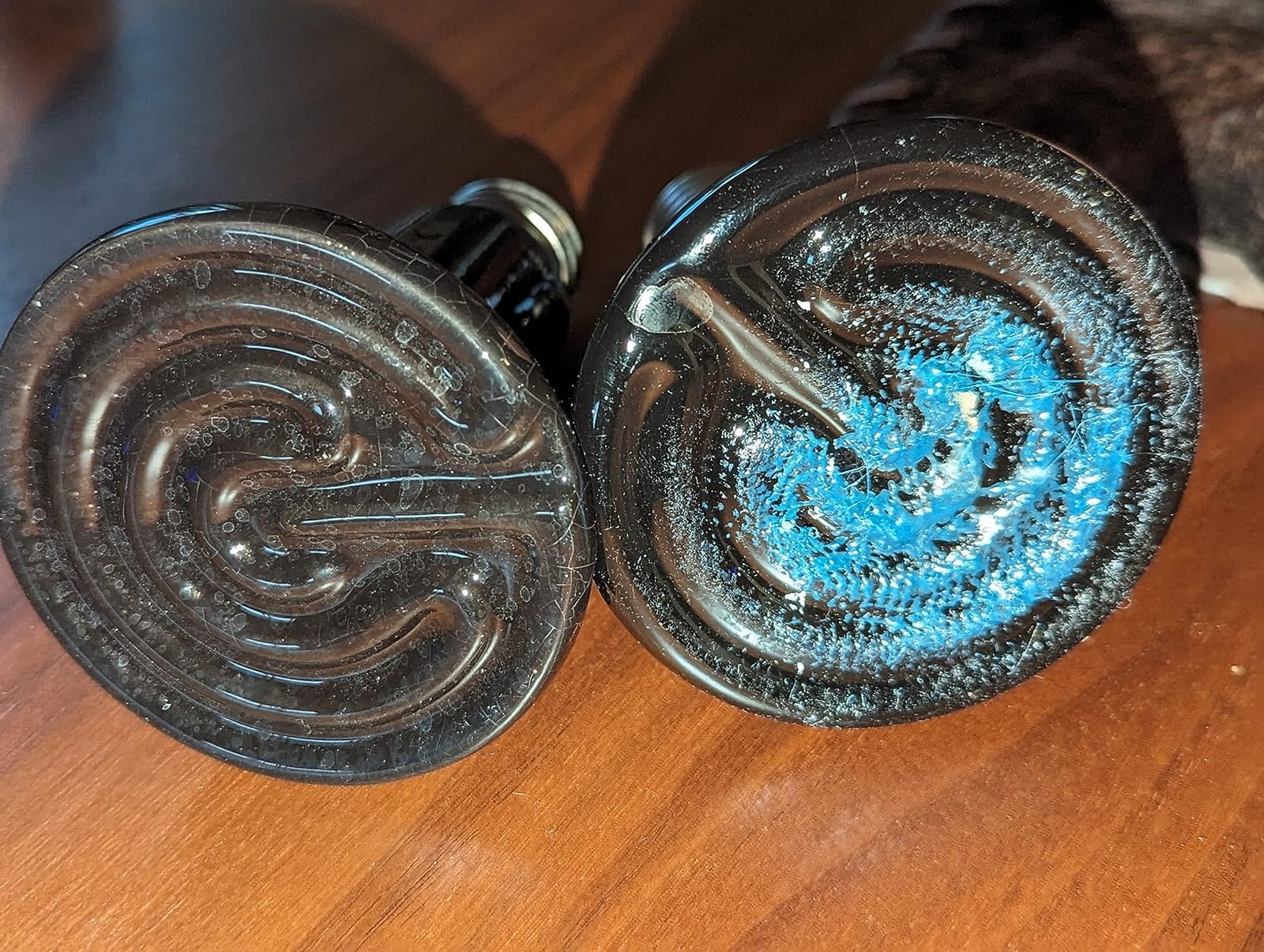
What the four wattage options are really for
They are for matching output to enclosure volume across a keeper’s progression: 50W for QT and 4x2x2, 75W for a 4x2x3, 100W for a 5x2x2, and 150W for 6x3x3 and up. One reviewer found 75W insufficient for a 75 gallon tank, which confirms the mapping matters more than the brand. Keep more than 30cm of clearance and avoid frequent on/off cycling.
Who should not buy this emitter
Skip it if you need a guaranteed two-pack in the box. A reported short shipment means you should count the bulbs on arrival, and a nocturnal snake left without heat because of a packaging error is a serious outcome.
It is also the wrong choice for very large enclosures at the lower wattages, and for any diurnal species that needs a basking spot. If cracking and popping noise bothers you in a quiet room, choose a listing with a longer stated rated life instead.
What Wattage Do I Need? Match Emitter Power to Enclosure Size
Match emitter wattage to the volume of your enclosure, not to the length of your snake. The most common first-keeper mistake is running 100W in a 4x2x2 because that is the wattage everyone mentions; the second is running 60W in a 6x3x3 and wondering why the animal stays cold.
Every figure below assumes an enclosure with a glass front, normal room temperature, and a thermostat probe placed at animal height on the warm side rather than directly under the emitter. Confirm all of it with an infrared temperature gun before you settle on a wattage.
4x2x2 and QT enclosures: a 40-60W emitter. This covers hatchlings, juveniles and small adult species in low-ceilinged cages. The Aiicioo 60W single bulb and the 50W variant of the REPTI HOME line both fit here.
4x2x3 enclosures: a 60-75W emitter. This is the most common adult size for a single ball python or a pair of corn snakes, and the OMAYKEY 75W two-pack fits most compact dome fixtures at this size.
5x2x2 enclosures: a 75-100W emitter. The OMAYKEY 100W two-pack and the HealSmart 100W two-pack both sit in the right band, and the Fluker’s 100W gives you a wider heated face.
6x3x3 enclosures: a 100-150W emitter. At this volume a 100W unit runs continuously and never catches up. The LUCKY HERP 150W or the DOMICA 150W will hold a gradient with room to spare.
8x4x4 and 10x4x4 enclosures: a 150W emitter, or two emitters on separate thermostats. Large adult boas, reticulated pythons and breeding racks need the headroom, and a single 100W will leave cold corners.
Two more variables change the answer. Wire mesh loses heat far faster than PVC or glass, so add a wattage step for mesh cages. And tall enclosures need a longer-throw element such as a flat-face design, because a narrow conical element heats its own face long before the heat reaches the floor where the animal sits.
How to Use a Ceramic Heat Emitter: 6 Steps for a Safe Install
Using a ceramic heat emitter is straightforward once the fixture and thermostat are right: screw the element into a porcelain socket, mount the fixture out of reach, connect a thermostat, place the probe at animal height, and verify surface temperatures before you trust the reading. Six steps, and three of them are safety decisions rather than assembly.
Choose the emitter wattage for your enclosure volume. Use the table above rather than the highest wattage you can physically fit. A 4x2x2 takes 40-60W and a 6x3x3 takes 100-150W.
Choose a heat-rated ceramic fixture. The socket must be porcelain or ceramic and rated to at least the emitter wattage, with a metal shade or guard. Never use a plastic dome or a socket with a plastic insulator near a 100W or 150W element.
Mount the fixture above and outside the reach of the animal. Keep more than 30cm between the emitter and the reptile, and secure the mount so the enclosure cannot be pulled down. Guard the bulb so a snake striking the glass or screen cannot reach it.
Connect a thermostat, not a plug. A dimming thermostat holds the set point with less frequent switching. An on/off thermostat works but cycles the element harder, and frequent cycling is the main cause of shortened emitter life.
Place the probe at animal height on the warm side. Not directly under the emitter and not on the cool side. A probe sitting in the warm hide gives you a reading that reflects what the animal actually experiences.
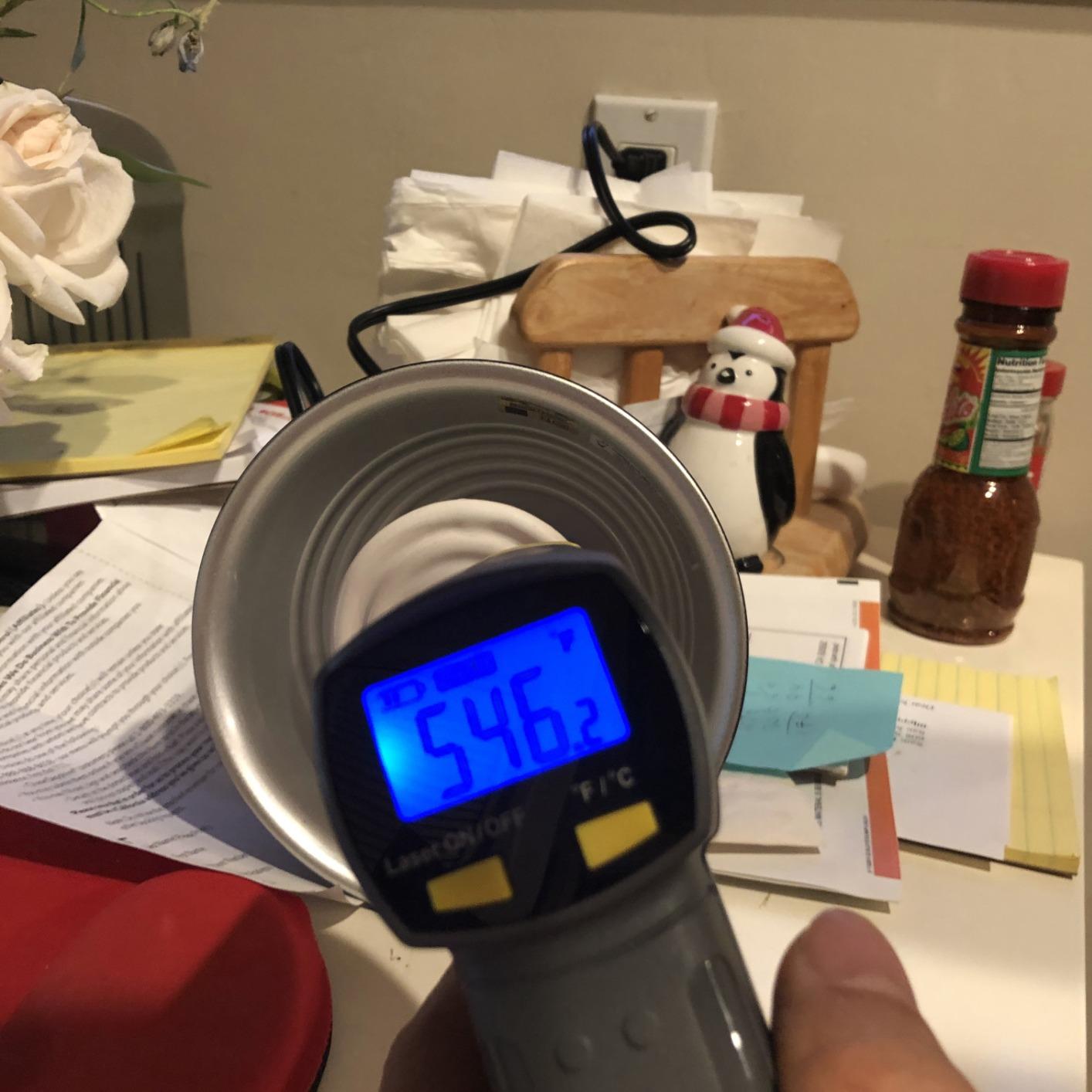
Verify with an infrared thermometer gun before you trust anything. Measure the emitter surface, the warm hide surface and the cool side. Log those three numbers weekly, because an emitter fails gradually rather than suddenly.
Why Ceramic Heat Emitters Dry Out Humid Enclosures
The main disadvantage of a ceramic heat emitter is that it is a radiant heat source with no moisture to add back, and it pulls moisture out of the enclosure air faster than a heat mat does. Nothing is wrong with the bulb; this is physics. The cure is not avoidance but compensation, and for tropical species a different heat source may be the better answer altogether.
It raises evaporation. Radiant heat warms surfaces and the adjacent air, and warm air holds more moisture, so the absolute amount of water in the enclosure drops over a night.
It has no reservoir. A heat mat warms a small area of substrate, while an emitter warms the whole upper volume, so more of the enclosure is losing moisture at once.
Compensate by measuring, not guessing. Put a hygrometer at animal height, check twice daily, and top up water whenever the reading falls below your species target. Most dry-out problems are actually a monitoring problem.
Compensate with substrate and ventilation. A deep moist substrate layer holds water and releases it slowly. Screen tops and ventilation settings trade humidity for fresh air, so raise humidity before you cut airflow.
Consider a different source for tropical species. A radiant heat panel or a deep heat projector warms the enclosure with far less forced evaporation. For a green tree python or a boa constrictor at high humidity, that is often the more sensible tool and the reason many experienced tropical keepers skip ceramic heat emitters entirely.
Thermostat and Fixture Safety: Never Skip Either
Never run a ceramic heat emitter without a thermostat. An emitter is a 100W or 150W resistive heater pointed at a small plastic-lined space, and the temperature in a closed enclosure rises far faster than most keepers expect on a cold night. A thermostat is not an upgrade here, it is the only safe configuration.
Dimming versus on/off. A dimming thermostat reduces power to hold temperature and switches the element less, which extends element life and reduces the audible click of cycling. An on/off thermostat is cheaper and works, but it puts full wattage through the element every cycle, and most manufacturers warn against frequent cycling. For a bulb you intend to keep for years, dimming is the better pairing.
Socket wattage rating. The ceramic socket must be rated to at least the emitter wattage, and the fixture needs a metal shade and a guard. Cheap plastic dome fixtures warp, crack or melt around high-wattage emitters within months, and a warped fixture near a live 150W element is a fire risk.
Probe placement. Put the probe at the animal’s height on the warm side, ideally inside or beside the warm hide. A probe directly under the bulb reads the emitter, not the animal, and you will end up with a cold hide and a thermostat that is satisfied.
The socket centre tab fix. Over time the metal centre tab inside the socket relaxes and stops making firm contact with the bulb base, which causes arcing, a flicker, a burning smell and a much shorter element life. Switch off the power, remove the bulb, and gently bend the centre tab to roughly a 30-35 degree angle so it presses against the base when the bulb is screwed in. Doing this once a year is the most effective maintenance step available to a keeper, and it costs nothing.
Ceramic Heat Emitter vs Deep Heat Projector vs Halogen vs Heat Mat
A ceramic heat emitter can replace a basking bulb for ambient and nighttime heat, but it cannot replace one for basking, because it produces no visible light. The right answer for a diurnal snake is both: a halogen on a daytime timer for a basking spot, and a ceramic heat emitter or deep heat projector for overnight ambient heat.
Ceramic heat emitter: zero light output, warms surfaces and to a lesser degree the air, long life, dries the enclosure. Best for nocturnal and crepuscular species needing 24-hour heat without light pollution.
Deep heat projector: no visible light, projects further and deeper than a CHE, holds surface temperatures better, and dries the enclosure less because it heats more efficiently. A better default for many diurnal and tropical setups.
Halogen basking bulb: visible light plus long-wave infrared-A heat that penetrates and creates a real basking spot. The best daytime basking option, but it needs a 10-12 hour day/night cycle and cannot be left on at night.
Heat mat: cheap and low output, warms a small patch of substrate rather than the volume, and does not create a meaningful gradient. Fine as a supplementary heat source, inadequate as the only source for most snakes.
The one-sentence version: infrared-A from halogens penetrates deepest and gives a basking spot, infrared-B from deep heat projectors is the efficient all-rounder, and infrared-C from ceramic heat emitters warms mostly surfaces with no light at all. Pick the spectrum that matches your species and its photoperiod.
How to Tell When a Ceramic Heat Emitter Is Failing
A ceramic heat emitter usually fades rather than dies, which is why most keepers replace them too late. Three signals tell you an element is on its way out: a blackened or carbonised element surface, uneven heat with a noticeably cooler area beside the hide, and a shorter interval between thermostat cycles.
Blackening and carbonising appear on conical designs first, because the element runs hottest at the tip. A flat-face emitter degrades more evenly, which is part of why the Zoo Med and Fluker’s designs tend to run longer. Crack the element and stop using it immediately rather than waiting for it to fail outright. Log three numbers each week with an infrared gun, and replace the bulb when the hide reading drops a few degrees week over week while the thermostat cycles more often.
Frequently Asked Questions
What wattage ceramic heat emitter do I need for a ball python?
A ball python in a 4x2x2 needs a 40-60W emitter, a 5x2x2 needs 75-100W, and a 6x3x3 needs 100-150W. Ball pythons are nocturnal, so run the emitter overnight as ambient heat and pair it with a daytime basking bulb on a timer. Hold a warm hide around 88-92F and a cool side around 78-82F, and verify both with an infrared thermometer gun rather than the thermostat set point.
How to use a ceramic heat emitter?
Screw the emitter into a porcelain socket rated to at least its wattage, mount it out of the animal’s reach with a guard, connect a dimming thermostat, place the probe at animal height on the warm side, and confirm surface temperatures with an infrared gun. Keep more than 30cm between the element and the snake, and never run one without a thermostat.
Can I use a ceramic heat emitter instead of a basking bulb?
Only for ambient and nighttime heat. A ceramic heat emitter produces no visible light, so it cannot create a basking spot that a diurnal snake needs to thermoregulate. The correct setup for a diurnal species is a halogen basking bulb on a 10-12 hour daytime timer, plus a ceramic heat emitter or deep heat projector for overnight heat. For a nocturnal snake, the emitter alone is enough.
What are the disadvantages of using a ceramic heat emitter?
The main disadvantages are constant moisture loss from the enclosure, weak basking heat, zero light output, and a very hot surface. It warms surfaces more than the air, dries humid setups, and cannot provide a basking spot. A dimming thermostat is mandatory, and the surface must be guarded and mounted out of reach.
What is the best heat lamp for reptiles generally?
It depends on the species. Diurnal reptiles such as bearded dragons need a halogen basking bulb for a real basking spot, and CHEs are the wrong answer for them because they emit no light. Nocturnal snakes and reptiles do well with a ceramic heat emitter or deep heat projector for 24-hour ambient heat, and tropical species often do best with a radiant heat panel or deep heat projector because they dry the enclosure less.
How long does a ceramic heat emitter last?
Expect between one and several years depending on wattage, cycling frequency and build quality. Listed rated lives in this category run from 10000 to 15000 hours, and owners report name-brand emitters still working after several years of thermostat duty. Frequent on/off cycling shortens life more than any other factor, so pair the emitter with a dimming thermostat and check the socket centre tab annually.
Which Ceramic Heat Emitter Should You Buy in 2026?
For most snake keepers, the OMAYKEY 100W two-pack is the ceramic heat emitter for snake enclosures to beat: it is ETL Listed, it ships with a thermometer, and more than four thousand owners have rated it, which is the best evidence base in this category. If your enclosure is 6x3x3 or larger, step up to the LUCKY HERP 150W, and if the rating tells you the most, the HealSmart 100W two-pack holds the highest average score here.
Match the wattage to the volume before anything else, run it on a dimming thermostat in a ceramic socket rated to at least that wattage, and never run one at all without a thermostat. For a boa constrictor or a green tree python in a high-humidity vivarium, reconsider the category entirely and use a radiant heat panel or deep heat projector, which dry the enclosure far less.
Whichever you choose, log the emitter surface, warm hide and cool side temperatures every week. That habit catches a failing element long before your snake does, and it is the cheapest piece of equipment in any reptile setup. If you are also working through the ceramic materials side of things for another part of your setup, we covered that in our ceramic coating guide.