
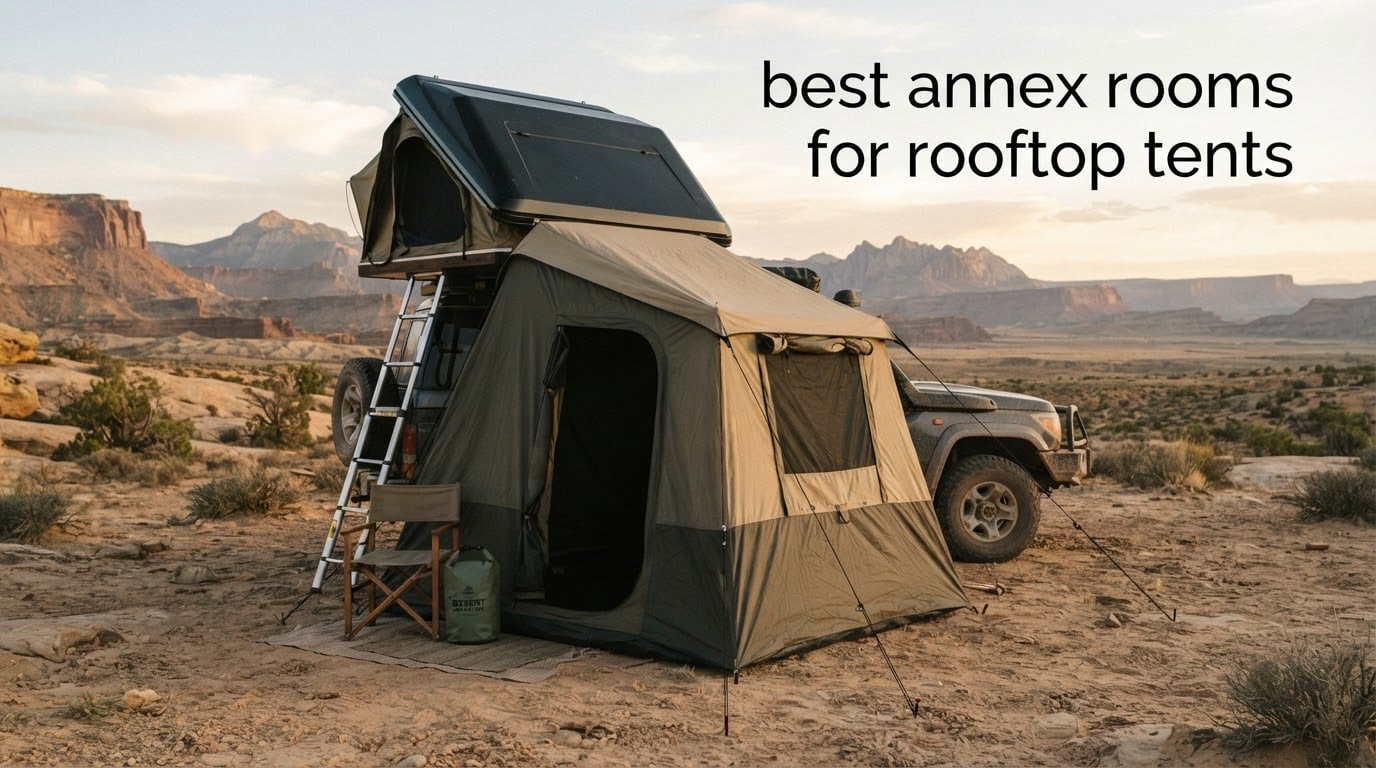
There is one rule that decides whether a rooftop tent annex is a good purchase or a wasted one: an annex only fits the exact tent model it was built for. A fabric room that hangs from the underside of your tent is useless if the zipper channel, the base rail spacing, and the perimeter dimensions do not line up with your specific unit. That is why the rooftop tents we rate in other guides each carry their own annex, and why cross-brand “universal” listings are almost always a return waiting to happen.
This roundup covers every dedicated rooftop tent annex room we could find with real owner feedback, which turned out to be a short list. Rooftop tent annex rooms are narrow, model-specific accessories, and the field is thin.
We looked at fabric weight, floor material, headroom, packed weight, warranty length, and the failure points owners actually report. Where a listing has only a handful of reviews, we say so plainly rather than dressing up a single star rating as a quality signal.
If you are still choosing the tent itself, start with our SUV rooftop tent guide before you start shopping annexes, because the annex you can buy is decided by the tent you pick. If your rig uses an awning instead, the comparison against canopy tents is worth a look too.
Quick answer: the ARB Simpson III annex is the best rooftop tent annex overall because it is the only unit in this group with meaningful owner volume behind it, and owners report that its fabric holds up in real storms. The Rugged Ridge Outland annex is the best rated, with a perfect 5.0 across its reviews and a 5 year limited warranty. The single biggest buying rule: match the annex to your exact tent model before you compare anything else.
Table of Contents
What Is a Rooftop Tent Annex?
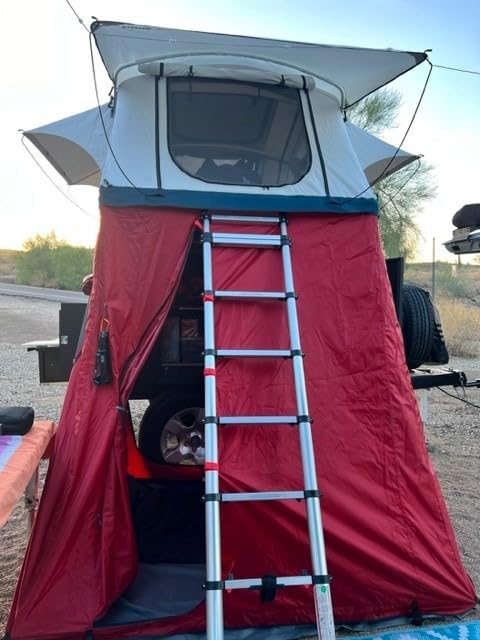
A rooftop tent annex is a fabric room that hangs from the underside of a vehicle-mounted tent and encloses the ground-level space beneath it, giving you a weatherproof changing room, gear storage area, or extra sleeping space on a zip-off floor. Most models zip their top edge into the tent’s rainfly channel or base rail, then stake out with tension rods and tie-down lines. Because the space below a rooftop tent is otherwise dead air over bare ground, an annex converts roughly that footprint into usable living area without buying a larger tent.
Two design decisions matter more than anything else. A removable PVC floor keeps mud, spilled coffee, and wet boots outside the sleeping space, and a fabric weight of 420D to 600D polyester Oxford tells you how the walls handle wind-driven rain and abrasion. Mesh windows and roll-up panels control condensation, which is the single most common complaint from owners who leave zippers open in wet weather.
The other thing to understand is weight. Annex weight sits on the ground, not on your roof rack, so a 15 pound annex does not eat into your crossbar dynamic load rating. It does, however, add 15 pounds to what you carry from the vehicle to the pitch, and that is a real consideration for solo campers. Trailers and pickup-bed campers with a truck bed tent already have ground-level rooms, so annex value is much lower there.
Top 3 Rooftop Tent Annex Picks in 2026

ARB Simpson III Annex
- Most-reviewed annex in the group
- Waterproof polyester build
- 13 lb packed weight

Rugged Ridge Outland Annex
- 5.0 average across reviews
- 5 year limited warranty
- 600D waterproof construction

Thule Approach Annex
- Rolls up into an open awning
- Adjustable height fits many vehicles
- Limited lifetime warranty
All Six Best Annex Rooms for Rooftop Tents (October 2026)
| Product | Specifications | Action |
|---|---|---|
| ARB Simpson III Annex |
|
Check Latest Price |
| Rugged Ridge Outland Annex |
|
Check Latest Price |
| Thule Approach Annex |
|
Check Latest Price |
 OVS TMBK Annex Room OVS TMBK Annex Room |
|
Check Latest Price |
 Naturnest Sirius 1 Plus Annex Naturnest Sirius 1 Plus Annex |
|
Check Latest Price |
 OVS XD Sherpa S4S Annex OVS XD Sherpa S4S Annex |
|
Check Latest Price |
1. ARB Simpson III Annex – Best Overall Rooftop Tent Annex
ARB 804100 Simpson III Brown Rooftop Tent Annex/Changing Room
Waterproof polyester
Aluminium poles
55 x 94 x 51 inch
13 lb
2 year warranty
Pros
- Most-reviewed annex in this group with 18 owner ratings
- Owners report fabric and hardware built to last many years
- Seams hold up in storms without leaking
- Heavy-duty zippers stay smooth
- Expands the tent into usable living or changing space
Cons
- Installation instructions are confusing for first-time users
- Two people recommended because of the weight at the hinge side
- Included pegs have a round cross section that can spin in wind
- No floor included
The ARB is the one annex in this entire roundup that a normal shopper can buy without gambling on a single review. Eighteen ratings is a real sample, and the pattern in them is consistent: people describe the fabric and hardware as the kind of thing that will still be there in ten years. Several owners specifically mention that the annex weathered storms without water coming through the seams, which is the test that matters most for a room you are standing in during a downpour.
Its footprint of 55 inches wide by 94.4 inches long by 51 inches high is not generous, and 51 inches of peak height means you are ducking rather than standing. For a changing room, a gear garage, or a spot to sit and pull off wet boots, that is plenty. For two adults sleeping, it is tight, though the listing rates it for four which reads as a family-lounge figure rather than a sleeping figure.
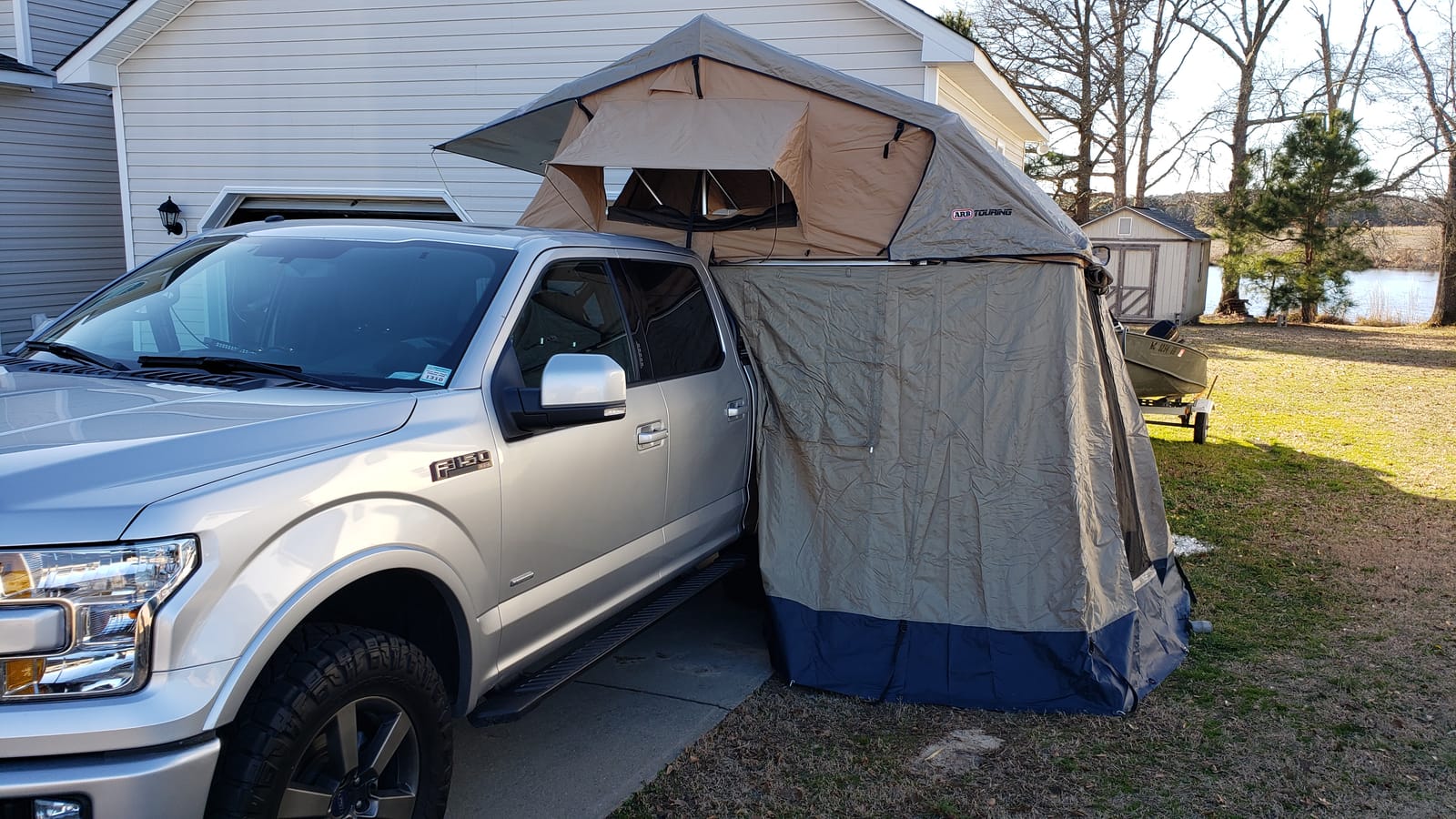
At 13 pounds packed this is a carry you can manage solo, though ARB’s own guidance is a two-person install because of the weight out at the hinge side when you are lifting it onto the tent base. That is a ten-minute job with two people and a longer, more awkward one alone. Owners who have done it a few times describe the first setup as the hard part and every setup after that as fast.
Those are the two details that decide whether this one works for you. It comes without a floor, so add a groundsheet if you plan to sleep in it or store anything that must stay dry. And the included pegs have a round cross section, which owners report can spin and let guylines release in wind. Bring your own angled stakes and the problem disappears.
Is the ARB Simpson III Annex worth the weight?
Thirteen pounds is mid-range among the annexes here, and none of it goes on your roof rack because the floor sits on the ground. If you camp solo and walk a distance from the vehicle, that is a real load to add to a camp move. If you have a second person or a cart, it is nothing.
The floor situation is the sharper question. Since no floor is included, a dry-mud-room setup costs you an extra groundsheet in weight and packing volume, which pushes the effective carry past the stated 13 pounds.
Is the ARB annex difficult to install?
It is awkward rather than difficult. Owners call the included instructions unclear, but they consistently report that the fit itself is straightforward once you understand the process, and that it becomes fast after the first attempt. Two people make it painless.
Budget extra care for the pegs. Because the round-cross-section stakes can spin and free guylines in wind, swapping in angled stakes is the single cheapest improvement you can make to this setup.
2. Rugged Ridge Outland Annex – Best Rated Fit With a 5 Year Warranty
Rugged Ridge | Tent Annex | 11704.06 | Fits Rugged Ridge Roof Top Tent (Part# 11704.05)
600D waterproof polyester
Detachable bottom
Snaps into tent channels
5 year warranty
Pros
- Perfect 5.0 average across every review on the listing
- Snaps into the tent attachment channels for snug full coverage
- Windows provide strong ventilation
- Rear panel unzips for access to camper storage
- Backed by a 5 year limited warranty
Cons
- Listed fit is specific to the Rugged Ridge Outland roof top tent
- Only three reviews
- so long-term durability is not documented
This annex scores 5.0 from every owner who has reviewed it, and the single detailed review is unusually informative. That owner reports the annex sliding into the channels of a Thule Low Pro 3 tent with full coverage, even though the product is branded for the Rugged Ridge Outland.
The specification sheet is where the confidence comes from. You get a 600D waterproof polyester body with a heavy-duty detachable bottom, ventilation windows, and a rear panel that unzips so you can reach storage built into the camper underneath. The 5 year limited warranty is the longest fixed-term coverage in this group, which matters when the number of owners documenting long-term use is small.
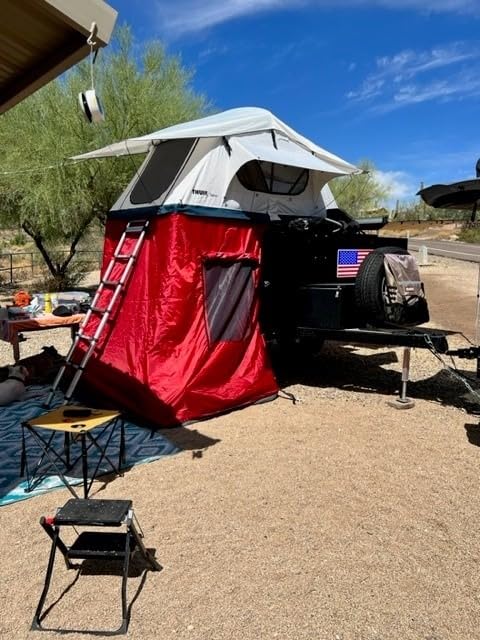
Packed weight is listed at 6.33 kg, around 14 pounds, which puts it in the middle of this group rather than at either end. The build uses aluminium or fibreglass poles with a polyester rainfly, a standard softshell construction.
The honest caveat is that three reviews is three reviews. Nobody has documented what this annex looks like after five desert seasons, and the warranty is the main protection you have against that unknown. If the Outland is your tent and you value warranty length, this is an easy pick.
Will the Rugged Ridge Outland Annex fit my tent?
It is listed for the Rugged Ridge Outland roof top tent, part 11704.05, and the manufacturer treats that as the supported fitment. Do not assume it transfers to another brand just because the channel felt right in one install report.
That said, the one detailed owner review describes a full-coverage fit on a Thule Low Pro 3, so if you own a Thule and your tent uses a comparable base channel, it is worth a ten-minute check before you write the annex off entirely.
Is a 5 year warranty worth much on a tent annex?
On a fabric room with straps, zippers, and stitching, a 5 year limited warranty is worth real money because those are exactly the components that fail. Only the Thule limited lifetime warranty exceeds it, and that one covers a different build class. Most competitors in this category offer one to four years, so this sits near the top of the practical range.
Warranty length also matters more when owner feedback is thin. With only three reviews available, the manufacturer backing the product is doing more work than the rating ever could.
3. Thule Approach Annex – Best for Turning a Room Into an Awning
Thule Approach Annex for Small Approach Rooftop Tent New, Adjustable Height
Recycled polyester
Removable tarpaulin floor
Adjustable height
10 sq ft vestibule
Pros
- Front and side doors roll up to convert the enclosed room into an open awning
- Adjustable height fits a wide vehicle range
- Removable tarpaulin floor keeps gear dry
- Mesh windows give ventilation without insects
- Limited lifetime warranty
Cons
- Water resistant rather than fully waterproof
- Fit depends on 63 to 85 inch ground-to-tent-base clearance
- Only 2 reviews and a wide rating split
The Thule is the only annex in this roundup with a genuine dual personality. Closed, it is an enclosed room for changing and gear. Open it up by rolling the front and side doors, and it becomes an open awning you can cook under or sit in with the sides up. For fair-weather camps that flexibility is the reason to buy it, and it is a genuinely useful design rather than a marketing line.
Adjustable height is the other quiet advantage. Thule recommends it for vehicles where the ground-to-tent-base distance falls between 63 and 85 inches, which is a very wide band and covers a lot of SUVs and trucks. That single measurement is the whole fitment question for this annex, so measure before you order.
The 10 square foot vestibule area and 215 cm maximum height put this one among the roomier options here, with a polyester floor and 100% recycled polyester shell. Build quality is the strongest part of the offer, and it is backed by a limited lifetime warranty.
Two things pull the rating down. It is water resistant with a coating, not waterproof, so sustained heavy rain will find the seams before it finds the fabric. And the two reviews we have split 55 percent five-star against 45 percent one-star, which tells you almost nothing except that experiences differ sharply. Judge it on the spec sheet and the limited lifetime warranty instead of the average.
Listed weight is about 16.3 pounds, which puts it in the middle of this group rather than at the top. None of that lands on your roof rack, since the floor sits on the ground.
Can you really cook under the Thule Approach Annex?
You can use it as an open awning, which owners and the manufacturer both describe with the doors rolled up. What you cannot assume is that the rolled configuration makes it weatherproof, because the fabric itself is water resistant rather than waterproof.
Plan to use the open configuration on fair-weather camps and close it up when rain is likely. The coated polyester handles showers well but is not built for sustained downpours.
Will the Thule Annex fit my vehicle?
Measure the distance from the ground to the base of your tent. Thule specifies 63 to 85 inches, and inside that range the adjustable height absorbs the difference. Outside it, the fit is not supported.
Because that measurement is forgiving, this annex fits more vehicles than the model-locked units in this guide. It still only suits the Thule Approach tent platform, but the vehicle range is broader.
4. Overland Vehicle Systems TMBK Annex – Best Value Waterproof Room
Overland Vehicle Systems LD TMBK Roof Top Tent Annex Green Base with Black Floor & Travel Cover – 420D Polyester Oxford Waterproof Material -1000g PVC Based Floor
420D polyester Oxford
Removable 1000g PVC floor
81 inch height
15 lb packed
Pros
- 420D polyester Oxford waterproof body with a fully removable 1000g PVC floor
- Heavy-duty zipper attachment straight to the tent
- Roll-up windows and doors that hook and lock closed for privacy
- Complete enclosure holds gear plus a person or two
- Rolls up compactly with a storage bag included
Cons
- Fits only the Overland Vehicle Systems TMBK rooftop tent
- Single review
- so there is no long-term owner feedback
- 15 pounds is a heavy carry for one
The specification sheet on this one is among the most detailed in the roundup, and that is exactly why we put it here rather than ranking it higher. You get a 420D polyester Oxford waterproof body with a fully removable 1000g PVC floor, which is a floor material owners frequently look for. The floor detaches completely, so you can wash it, leave it home in dry weather, or replace it.
Height is the standout number: 81 inches at maximum, the tallest peak height among the six annexes here, with a footprint of 49 inches by 49.5 inches. That is tall enough to stand in and change, which is the answer most buyers are actually looking for when they ask about interior height. The trade-off is shape. A near-square footprint at that height is more of a changing room and gear closet than a sleeping space.
Windows and doors roll up and hook-and-lock closed using heavy-duty grommets, so privacy and bug exclusion are both handled. The listing rates it for three people, and the enclosure is genuinely full-height on all sides, so it works as an overflow sleeping spot for a child or an adult on a short trip.
Attachment is a heavy-duty zipper straight into the TMBK rooftop tent, with support pole attachment through sleeves. Doors and windows use 120g breathable gaze material, and everything rolls up compactly into the supplied storage bag. A 4 year warranty sits mid-pack, ahead of most of the field.
Fitment is the hard limit. This attaches only to the Overland Vehicle Systems TMBK rooftop tent, so if that is not your platform, this page cannot help you. With a single review behind it, the case rests entirely on the specification sheet, which is unusually good.
Can you stand up inside the Overland Vehicle Systems TMBK Annex?
Yes. Maximum height is listed at 81 inches, which makes this the tallest enclosure among the six annexes we rated. That headroom is the feature owners across the community say matters more than floor area, and here you get it in a square footprint rather than a long low one.
The practical effect is that you can change, dress kids, and sort gear without crouching. For a changing room and gear garage, that is the difference between a space you use and a space you avoid.
Is one review enough to trust this annex?
No, and we will not pretend otherwise. One 5 star review is statistically meaningless as a quality signal, so the decision here runs on materials: 420D waterproof Oxford, a removable 1000g PVC floor, roll-up hook-and-lock panels, and a 4 year warranty.
Those are all verifiable from the specification side, which is a better basis than a single rating. If you own the TMBK and want a tall, fully waterproof room in one purchase, this is the one.
5. Naturnest Sirius 1 Plus Annex – Best for Family Overflow Sleeping
Naturnest Sirius 1 Plus Annex Room for Naturnest Sirius 1 Plus Rooftop Tent Only, Not Include Rooftop Tent
420D tear-resistant fabric
Blackout with mesh window
10 minute setup
1 year warranty
Pros
- Same 420D tear-resistant fabric as the Sirius 1 Plus tent
- Blackout design with a breathable mesh window for controllable privacy
- Kept one owner warm and dry through a Pacific Northwest rainstorm
- Setup reported at about 10 minutes using rails and a support pole
- Much faster than pitching a ground tent
Cons
- Requires the Naturnest Sirius 1 Plus rooftop tent
- which is sold separately
- Heaviest unit here at 35 pounds
- Condensation builds up if zippers stay open in wet weather
- Interior fits about 2 sleepers rather than the listed 3
This is the one to look at if your purchase driver is an extra sleeper. A family with a young child can use the ground-level room as overflow sleeping space instead of doubling up in the tent above, which is the single most common reason owners in rooftop tent forums add an annex. The listed dimensions of 143.7 inches long by 83.46 inches wide by 71 inches high give a long, usable footprint for a cot or a pair of pads.
Installation is the quiet winner here. Owners report about 10 minutes to connect one end to the rail under the tent, run the fabric connection with Velcro, and fix the support pole with wind ropes and ground nails. For comparison, a rooftop tent owner in the community cited roughly five and a half minutes to erect an entire tent and annex together, which is still faster than pitching a ground tent.
The blackout design with a breathable mesh window is a thoughtful call for a sleeping space. You get full privacy when you want it and airflow when you do not, and the 420D tear-resistant fabric is described as sunproof, rainproof, and windproof.
The one detailed owner review came from a week-long Pacific Northwest road trip, and that owner stayed warm and dry through a rainstorm. They also noted the inevitable truth about any enclosed fabric room in wet weather: condensation builds up if you leave zippers open. That is physics, not a defect.
Weight is the concern. At 35 pounds this is the heaviest annex in the roundup by a wide margin, and it needs two people to lift into position. The warranty is 1 year, the shortest here, though the manufacturer does commit to replacing damaged accessories. The rooftop tent itself is not included with this purchase.
Can a child sleep in the Naturnest Sirius 1 Plus Annex?
Yes, and this is the main reason to buy it. The long footprint at 143.7 inches fits a cot or a pair of sleeping pads comfortably at ground level, which spares a family from stacking extra bodies into the tent above.
Realistically the room fits about two sleepers even though it is listed for three, and condensation management matters more here than in a gear room. Keep the mesh window cracked and the blackout closed, and expect to wipe surfaces in the morning after a wet night.
Is 35 pounds too heavy for a solo camper?
For most solo campers, yes. This is the heaviest annex in the group and it needs two people to position, so solo overlanders should look at a lighter annex and accept a lower ceiling.
Because the weight sits on the ground it does not affect your crossbar dynamic load, but it does add 35 pounds to every camp move from the vehicle to the pitch. With a second adult, it is a short carry rather than a problem.
6. Overland Vehicle Systems XD Sherpa S4S Annex – Only for Sherpa Owners
Overland Vehicle Systems 18009811: Xd Sherpa S4S – Annex Room with Floor, Black Body & Grey Trim
Supplied with its own floor
Black body with grey trim
4 season
Easy setup fit
Pros
- Supplied with its own floor
- unlike several annex-only listings
- Sold alongside a matching XD Sherpa S4S rooftop tent platform
- Easy setup fit
- Backed by an established overlanding brand
Cons
- The only review on the listing is 1 star
- Specification listing is thin with no fabric weight or waterproof rating
- Fits only the XD Sherpa S4S rooftop tent
We are including this one for completeness rather than as a recommendation, and it is worth reading why. The good news is structural: this annex is supplied with its own floor, which several listings in this roundup omit, and it is sold alongside a matching XD Sherpa S4S rooftop tent platform from an established overlanding brand. If you already own or are buying that tent, the fit question is answered for you.
The documentation is where it falls apart. The specification listing gives you no fabric weight, no waterproof rating, no dimensions, and no packed weight, so you cannot compare it on any of the measures we used for the other five. It is also categorised as an awning rather than a tent annex, which is a small signal but not a good one.
Then there is the single review, which is one star with no written feedback and no owner photos to balance it. Nobody has documented a positive result on this listing. We are not going to spin that into a feature.
If you are a Sherpa S4S owner, the deciding factor is that included floor. A complete room with its floor in one purchase is genuinely convenient, and the brand backing it has been in overlanding for a long time. Ask the manufacturer directly for the fabric and weight specifications before you commit.
If you are anything else, this listing will not help you. It fits only the XD Sherpa S4S, and the information gap means you would be buying on faith rather than on evidence.
Is the Overland Vehicle Systems Sherpa S4S Annex well made?
We cannot tell you, and that is the honest answer. The listing states no fabric weight, no waterproof rating, no dimensions, and no weight, so there is nothing to judge the build against. The only owner feedback available is a single 1 star rating with no written detail.
The presence of a supplied floor and the backing of an established overlanding brand are the only positives on the record. Contact the manufacturer for spec confirmation rather than relying on the product page.
Should you skip this annex?
If you do not own the XD Sherpa S4S rooftop tent, absolutely. Fitment is locked to that platform and no cross-brand compatibility is offered.
Even if you do own it, the sparse documentation and a single one-star review make this a purchase to verify carefully. Ask for fabric specifications and check the warranty terms in writing before you order.
How to Choose a Rooftop Tent Annex
1. Match the exact tent model first. This is the only step that cannot be skipped. Every annex in this roundup is built for one specific tent, and the fit depends on rainfly channel position, base rail spacing, and the tent’s underside perimeter. Measure nothing until you have confirmed the model, and if a listing does not name the compatible tents, assume it does not know either.
2. Decide between enclosed room and awning. The Thule Approach rolls its doors up to become an open awning, while most other units here are enclosed rooms first. If you cook and sit outside more than you change and store, the convertible design is worth paying for. If you want weather protection, prioritise full wall coverage and hook-and-lock panels.
3. Check headroom against your real task. Owners consistently say headroom matters more than floor area, and the difference between 51 inches and 81 inches is the difference between crouching and standing. The ARB at 51 inches is a sit-down changing room, and the OVS TMBK at 81 inches lets you stand and dress. For a child or anyone with mobility limits, go tall.
4. Confirm the floor situation. Some annexes include a removable PVC floor, some include a detachable bottom, and the ARB includes none. If you plan to sleep inside or store anything that must stay dry, a missing floor means adding a groundsheet to your pack weight.
5. Weigh the packed weight against your camp move. Units here range from 13 pounds to 35 pounds, and none of that weight sits on your roof rack since annexes are ground-based. But it is weight you carry from the vehicle, which matters most for solo campers and least for families with two adults.
6. Look at warranty length as a proxy for build confidence. Warranties in this category run from 1 year to a limited lifetime, with the 5 year Rugged Ridge warranty the longest fixed-term one here. Longer coverage matters more than usual here because attachment straps, zippers, and stitching are the components that actually fail.
7. Set it up correctly for the weather. Attachment order matters: feed the top of the room into the tent channel, zip or Velcro it, spread the floor evenly, then stake out with tension rods and tie-downs. Owners report water pooling on annex walls when the floor is not spread flat during rain, which is entirely preventable at setup time. Tension rod orientation also changes between conditions: orient for wind when gusts are forecast, and re-angle toward drainage when rain is the concern. Brace the guyline points independently rather than relying on the tent frame alone.
8. Know the failure points before they happen. The most commonly reported problem across rooftop tent communities is attachment straps blowing out. One owner reported the outermost strap had completely blown its Velcro and webbing, then found a second inner strap had also gone, suspecting desert heat as the cause. Inspect your straps at the start of every trip, keep replacement webbing in your kit, and treat heat-exposed Velcro as a consumable part rather than a permanent connection.
When a Rooftop Tent Annex Is Not Worth It
Annexes are a polarizing accessory, and buying one for the wrong reason means carrying weight you never use. If you are camping a single night in fair weather with a solo setup and no children or pets, the dead space under your tent is exactly that: dead. You climb the ladder, you sleep, you climb down.
If you already run a truck bed tent or a trailer, you already own ground-level living space, so an annex duplicates what you have. The same applies if your rig has a full-size awning, which covers the changing and gear-storage function without a roof-mounted room to fold away each morning.
Weight is the other disqualifier. At 13 to 35 pounds, an annex adds more carry than most small tents, and the heaviest options require two people to lift into place. If you walk a real distance from your vehicle to camp, a backpacking-grade ground tent or a simple privacy shelter does the same job for a fraction of the load.
One more honest note for winter campers. Enclosed fabric rooms are not heated spaces, and owners who run a heater into an installed annex with a floorpan report staying comfortable overnight through snow and wind. That works because the annex contains the heat and blocks wind-driven cold. It is not the same as a four-season tent, and condensation management still applies.
Frequently Asked Questions
What is a rooftop tent annex?
A rooftop tent annex is a fabric room that hangs from the underside of a vehicle-mounted tent and encloses the ground-level space beneath it. It attaches through the tent’s rainfly channel or base rail and provides a weatherproof changing room, gear storage area, or extra sleeping space on a zip-off floor, turning otherwise unused ground space into usable living area.
Do rooftop tent annexes fit any tent?
No. Annexes are model-specific and will not cross brands. Fit depends on the rainfly channel position, base rail spacing, and the underside perimeter of your exact tent, so confirm the compatible tent model on the listing before you buy. A few owners report near-miss fits on visually similar tents, but treat that as a reason to measure, not a promise.
Which rooftop tent has the best annex?
Among the six we rated, the ARB Simpson III is the best overall because it has the only meaningful owner volume at 18 ratings, with reports of fabric and seams holding up in storms. The Rugged Ridge Outland is the best rated at a perfect 5.0 with a 5 year limited warranty, and the Overland Vehicle Systems TMBK gives you the tallest interior at 81 inches. Best overall depends on your tent platform first.
Is a rooftop tent annex worth it?
It is worth it if you camp more than a night or two, want to change out of wet clothes, need somewhere to keep muddy gear, or want overflow sleeping space for a child or third person. It is not worth it for a single fair-weather night, for a solo camper who will not carry the weight, or if you already have a truck bed tent, trailer, or full awning providing ground-level space.
How much does a rooftop tent annex weigh?
Packed weights in this group range from 13 pounds for the ARB to 35 pounds for the Naturnest Sirius 1 Plus annex, with the Thule Approach listed at about 16.3 pounds. Because an annex is supported on the ground rather than the rack, none of this weight counts against your crossbar dynamic load rating, but all of it is weight you carry from the vehicle to the pitch.
Can you sleep in a rooftop tent annex?
Yes. The Naturnest Sirius 1 Plus annex is built for it, with a footprint of 143.7 by 83.46 inches and 71 inches of height that fits a cot or a pair of pads. A Jeep Gladiator Forum owner reported sleeping in a cot inside an annex with plenty of room to spare. Expect condensation in wet weather, and note that most other units here are better suited to gear storage and changing than to sleeping.
How do you secure a rooftop tent annex in wind?
Stake out every guyline point independently of the tent frame, spread the floor evenly before tensioning, and re-angle the tension rods toward wind direction when gusts are forecast, then toward drainage when rain is the concern. Check attachment straps at every trip, because blown Velcro and webbing is the most reported failure point, and replace round pegs with angled stakes that cannot spin and free a line.
The Bottom Line
The best annex rooms for rooftop tents in 2026 are decided by fitment, not by features. Once you confirm your exact tent model, the ARB Simpson III is the safest overall buy with real owner volume behind it, the Rugged Ridge Outland carries the best rating and the longest fixed-term warranty, the OVS TMBK gives you the tallest interior at 81 inches, and the Naturnest Sirius 1 Plus annex is the one built for an extra sleeper. Match the model, check the floor, and check your carry weight before you order.
Specifications and owner feedback were verified against manufacturer listings and retailer pages in October 2026. Fitment details and included components change between model years, so confirm compatibility with the manufacturer before purchase.