
The hardest part of arriving at a new campsite is rarely the driving. It is what happens after you back in and pull forward to level. Get it wrong and the refrigerator runs harder than it should, the shower drains toward the door, and the bed feels like a slide. Getting the best RV leveling blocks for travel trailers in your garage changes that whole first hour on site.
Over the past few seasons I have hauled a 32 foot tandem axle trailer across everything from flat asphalt pads to gravel pull-offs that had not seen a leveling solution in a decade. Twelve sets of blocks went through the trailer with me, and the differences between them turned out to matter far more than the spec sheets suggest.
This guide covers all twelve, ranked by how well each handles the three jobs a bumper-pull trailer actually asks for: side-to-side tilt under a wheel, front-to-back tilt at the tongue jack, and staying put on ground that wants to swallow the block. I also walk through the leveling sequence, how many blocks a given trailer length really needs, and where wooden blocks or permanent pads make more sense.
Table of Contents
Top 3 Best RV Leveling Blocks for Travel Trailers In 2026

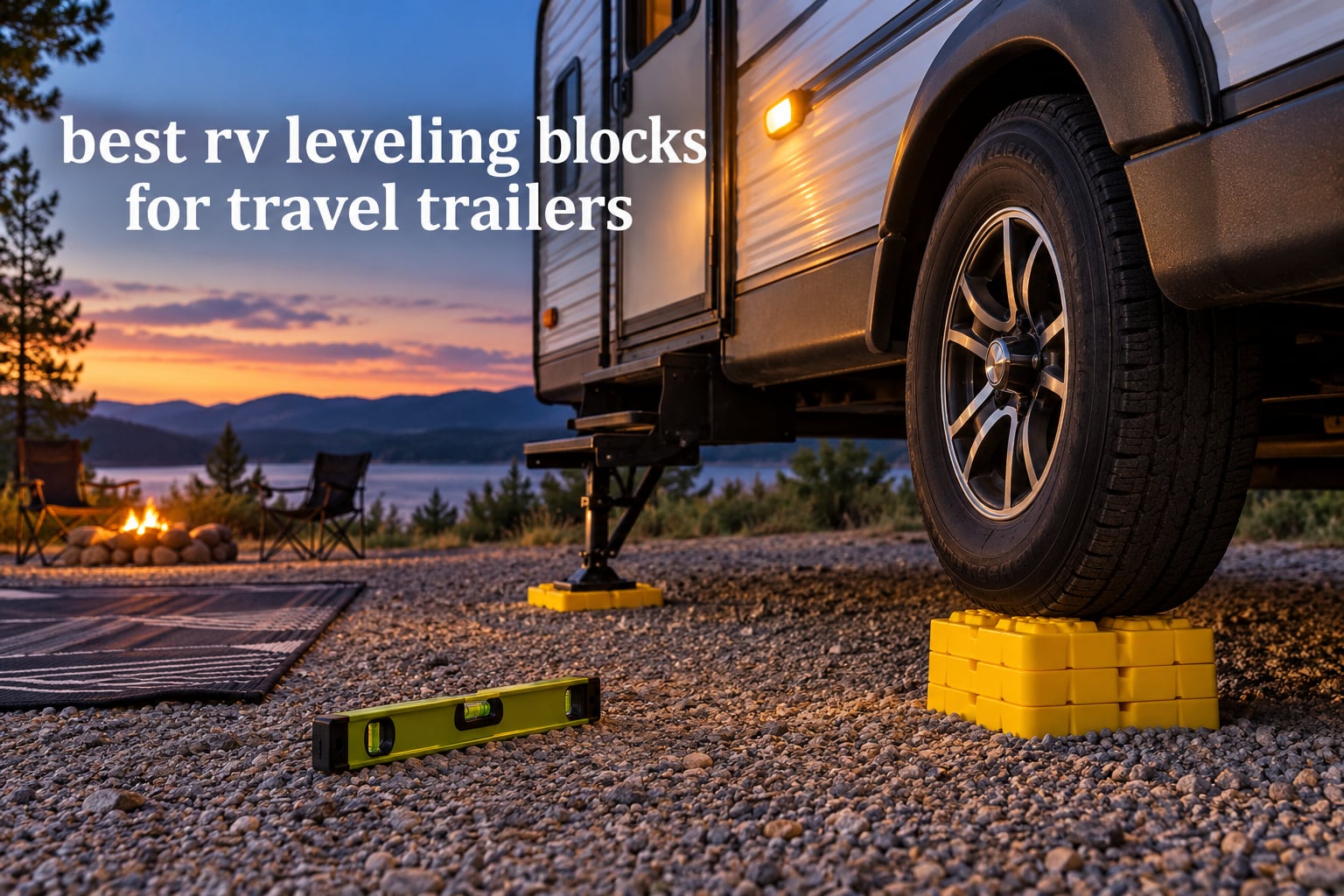
Lynx Levelers 11 Pack
- Rated up to 40000 lbs
- Interlocking 1 inch per layer
- Includes cap block and storage bag
- Made in the USA since 1992
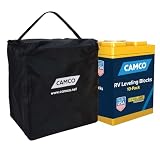
Camco 44510 10-Pack
- 1 inch of height per layer
- Solid bottoms for soft ground
- Bright yellow resin
- Zippered storage bag

Camco FasTen 10-Pack
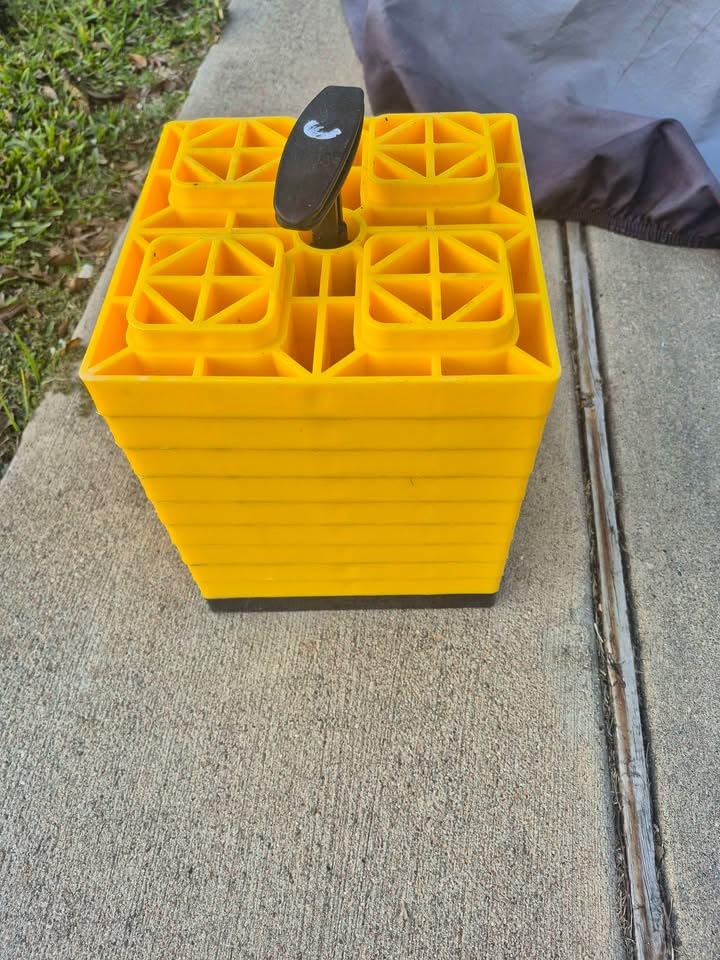
- T-handle locks and carries
- Quad-grid load bearing
- Stack limit of 4.5 inches
- Made in the USA
Best RV Leveling Blocks for Travel Trailers in 2026 at a Glance
| Product | Specifications | Action |
|---|---|---|
| Lynx Levelers 11 Pack |
|
Check Latest Price |
| Camco 44510 10-Pack |
|
Check Latest Price |
| Camco FasTen 10-Pack |
|
Check Latest Price |
 Camco 44501 4-Pack Camco 44501 4-Pack |
|
Check Latest Price |
 Andersen Hitches Camper Levelers Andersen Hitches Camper Levelers |
|
Check Latest Price |
 RVMATE 12 Pack RVMATE 12 Pack |
|
Check Latest Price |
 Homeon Wheels 10 Pack Kit Homeon Wheels 10 Pack Kit |
|
Check Latest Price |
 Kohree Curved Levelers Kohree Curved Levelers |
|
Check Latest Price |
 OFISPEED Ramp Kit OFISPEED Ramp Kit |
|
Check Latest Price |
 OULEME 12 Pack OULEME 12 Pack |
|
Check Latest Price |
 GarfatolRv 10 Pack GarfatolRv 10 Pack |
|
Check Latest Price |
 CircleRoad 12 Pack CircleRoad 12 Pack |
|
Check Latest Price |
Why RV Leveling Blocks Matter on a Travel Trailer
An out-of-level trailer causes real damage that costs far more than a set of blocks. The absorption refrigerator in nearly every travel trailer depends on being level to move heat out of the cooling unit. Tilt it and the compressor runs longer, burns more propane or fuel, and eventually fails well short of its expected life.
The list of problems keeps going from there. Door seals stop sealing, cabinet doors swing open on their own, water in the shower heads sideways, and the frame carries load it was never designed to carry across a twisted axis. Most manufacturers list level operation as a warranty condition, which makes a cheap set of pads the easiest insurance a trailer owner can buy.
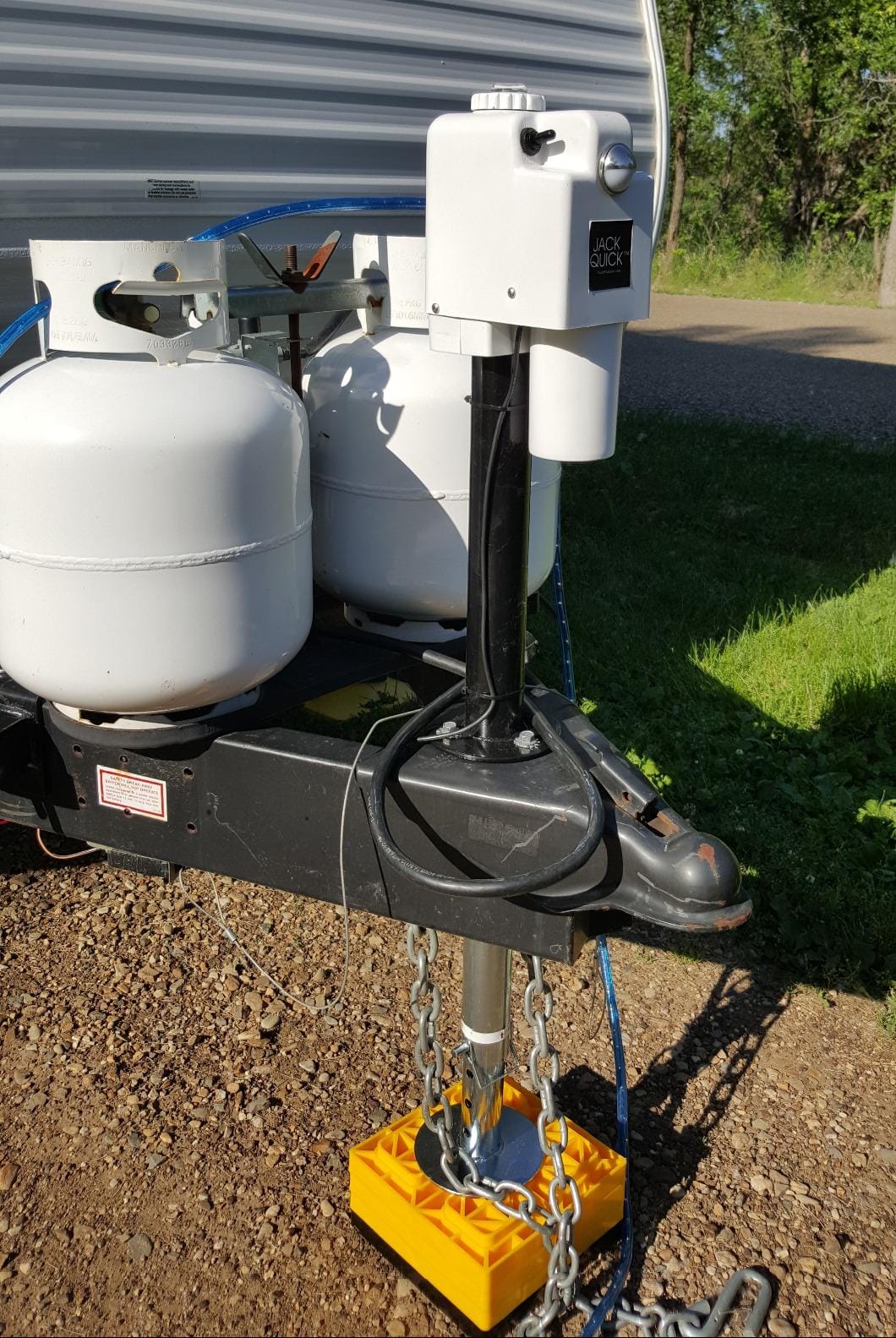
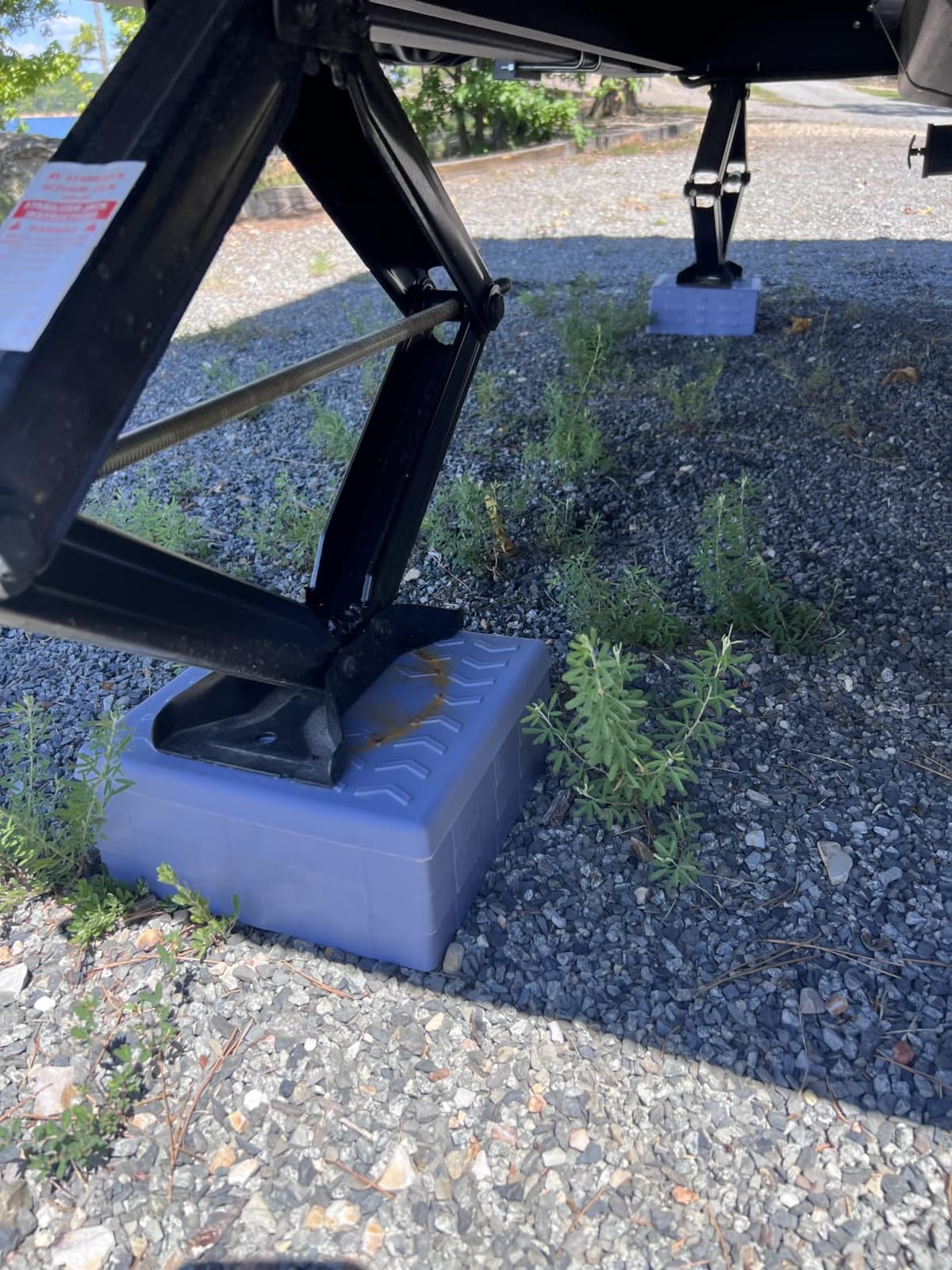
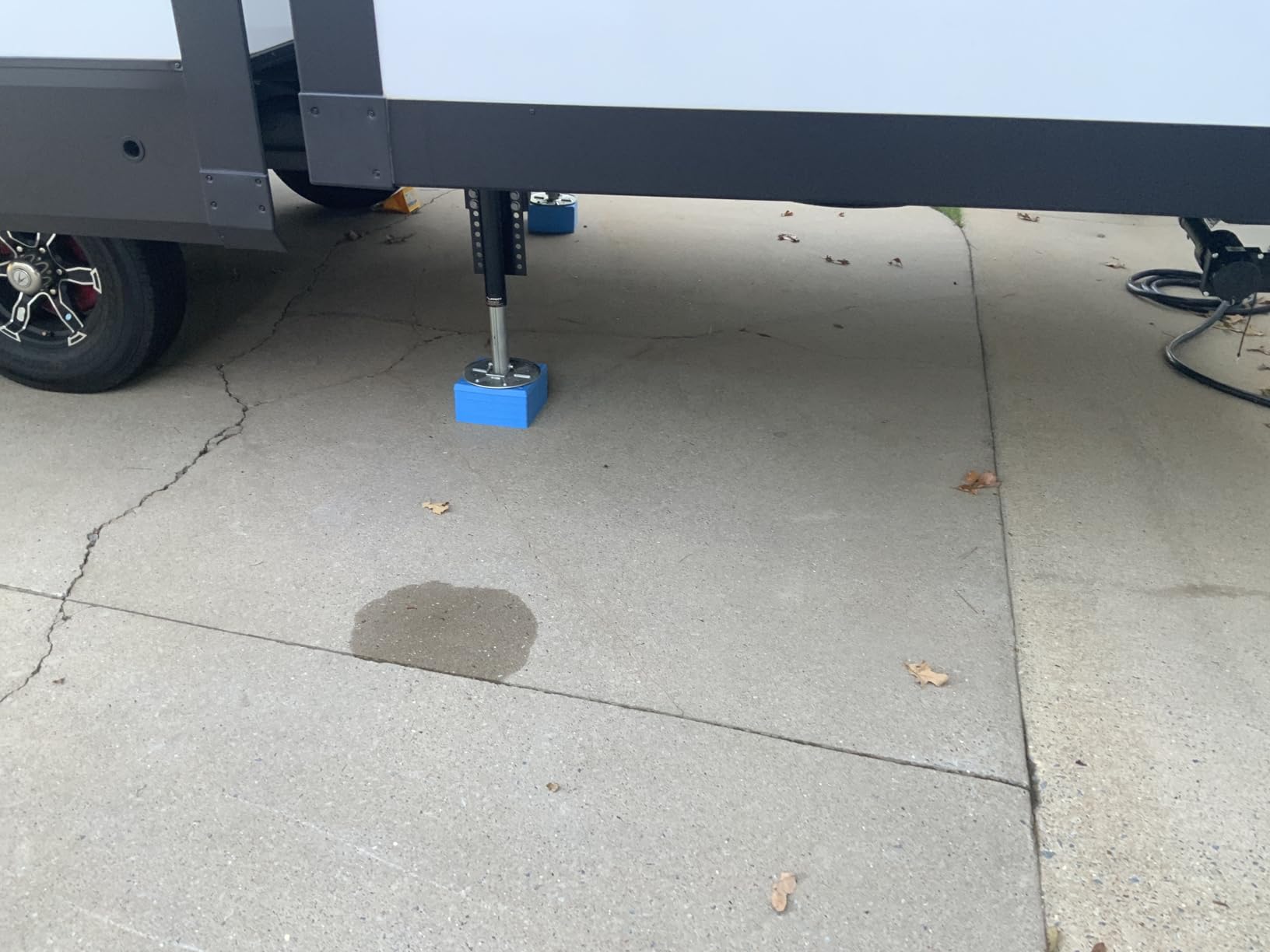
Travel trailers need blocks for one more reason that motorhomes do not. A trailer sits on a tongue jack and two stabilizer jacks, so the jack feet concentrate a very large load onto a very small spot. Without pads, that load goes straight into soft campsite soil, the jack feet sink, and the trailer settles overnight. This is also where our picks for the best RV leveling systems overlap with blocks, since jacks and pads are two halves of the same job.
1. Lynx Levelers 11 Pack – The One We Load Every Trip
Lynx Levelers 11 Pack Including 1 Lynx Cap Level Top for RV/Trailer/Motorhome/Vanlife Interlocking Leveling Blocks with Storage Bag for Most Leveling and Stabilizing Functions. 00015, Made in USA.
Rated up to 40000 lbs
8.5 x 8.5 x 1.5 inch blocks
Cap adds a quarter inch
Storage bag included
Pros
- Modular interlocking design handles leveling and stabilizing
- 40000 lb rating covers heavy trailers
- Cap block gives fine quarter inch control
- Made in the USA since 1992
- Nesting design stows compactly
Cons
- Thin layers mean deep pyramids for big height gaps
- Nylon bag handle wears with heavy hauling
- Only one cap block size included
This 11-pack has been the set in my trailer for two full seasons, and it has never let me down. The design is simple in the best way: each block nests into the one below and adds about an inch of height, so a correction of any size is just a different number of blocks rather than a different tool.
The 40,000 pound rating matters more for travel trailers than it first appears, because that figure describes the interlocking stack rather than the trailer. A deep pyramid under a loaded tandem axle stays well inside the limit.
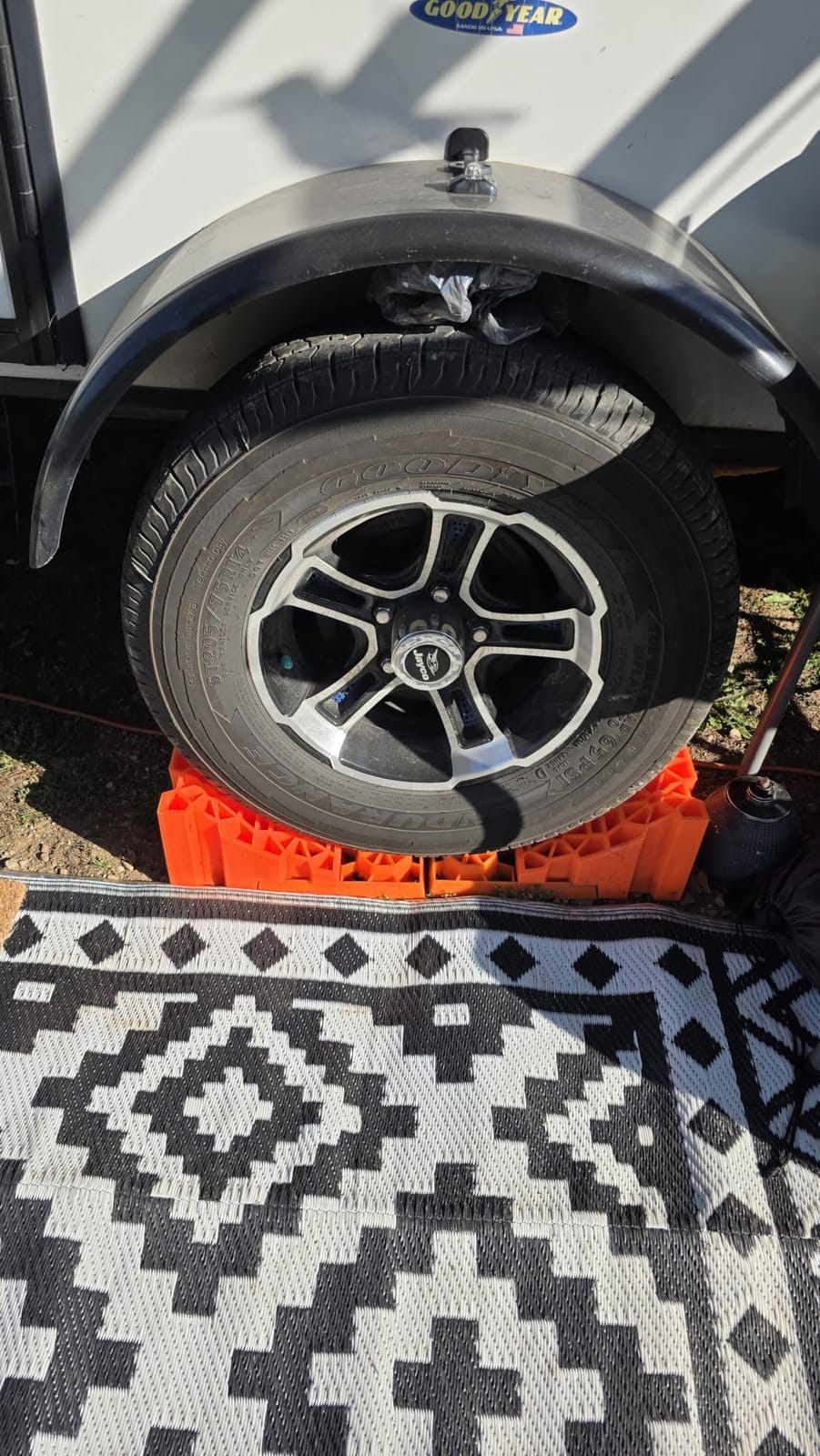
What sold me was the Lynx Cap, a thinner top piece that adds only a quarter inch once interlocked. That is what lets you dial out a stubborn last fraction without stacking a full inch and overshooting. The nylon storage bag nests the whole set into one compact bundle that fits behind a pass-through panel.
Made in the USA continuously since 1992, this set carries the largest review pool in the category at 18k+ ratings. Long-horizon reports from owners mention 10 and 15 year durability more often than complaints, which matches how these have behaved on my trailer.
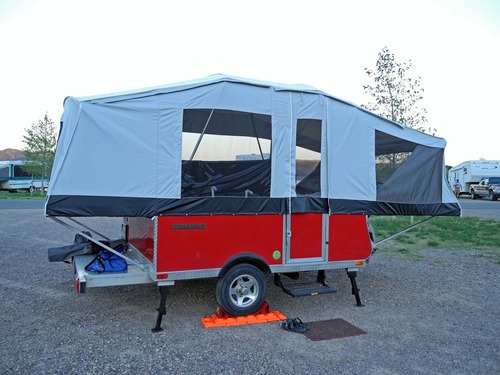
Where the Lynx set handles a travel trailer best
This is the set for the trailer that lives on uneven ground and gets used often. The fine quarter inch topper, the huge depth of spares in the pyramid, and the fact that the same blocks double as stabilizer and tongue jack pads make it the most flexible option here. For a tandem axle trailer with a lot of side-to-side tilt, nothing else in this roundup covers as many correction sizes from one kit.
Where you will feel the limits
Each layer is thin, so a large front-to-back correction demands a wide, deep pyramid. On a badly pitched site that can mean eight or nine blocks per wheel, and the bag handle is the only lifting point, so it wears if you haul the full stack far from the truck. Owners with unusually wide tires note that the single included cap suits standard widths only.
2. Camco 44510 Leveling Blocks – The Category Workhorse
Camco RV Leveling Blocks – Features Interlocking Nested Design & Storage Bag for RV Storage and Organization – Each Leveling Block Measures 8.5″ x 8.5″ x 1″ – 10-Pack, Design May Vary (44510)
10 pack of interlocking resin blocks
1 inch per layer
Solid bottoms for soft ground
Zippered bag included
Pros
- Precise 1 inch per layer height control
- Solid bottoms hold on soft ground
- Bright yellow is easy to spot at dusk
- Hose off clean and nests into the bag
- Works with nearly every jack configuration
Cons
- Resin scuffs and can crack if stacked very high
- Driven on at an angle risks damage
- Bulky 10-pack bag is awkward to stow
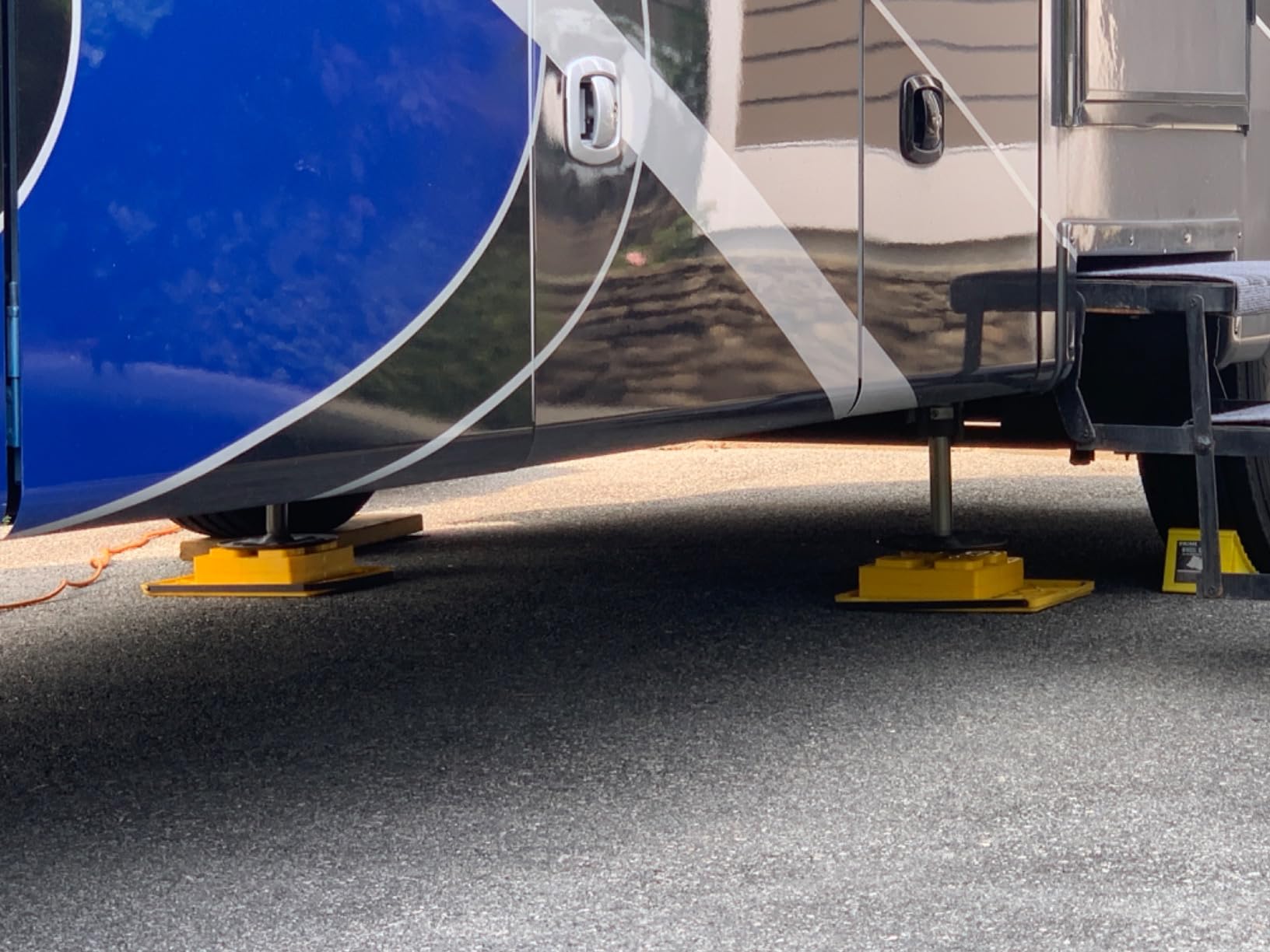
The 44510 is the interlocking block set you will see in the most campgrounds, and after using it I understand why. Each 8.5 x 8.5 x 1.5 inch block adds a full inch when locked into the stack below it, and the solid underside resists sinking into the damp, soft soil that sits a few inches down in most backcountry pads.
With 14k+ ratings averaging 4.7 stars, the pattern in the reviews is consistent. Owners like the visible yellow color because a dropped block on a gravel drive is easy to spot later, and the zippered bag keeps the ten pieces in one place.
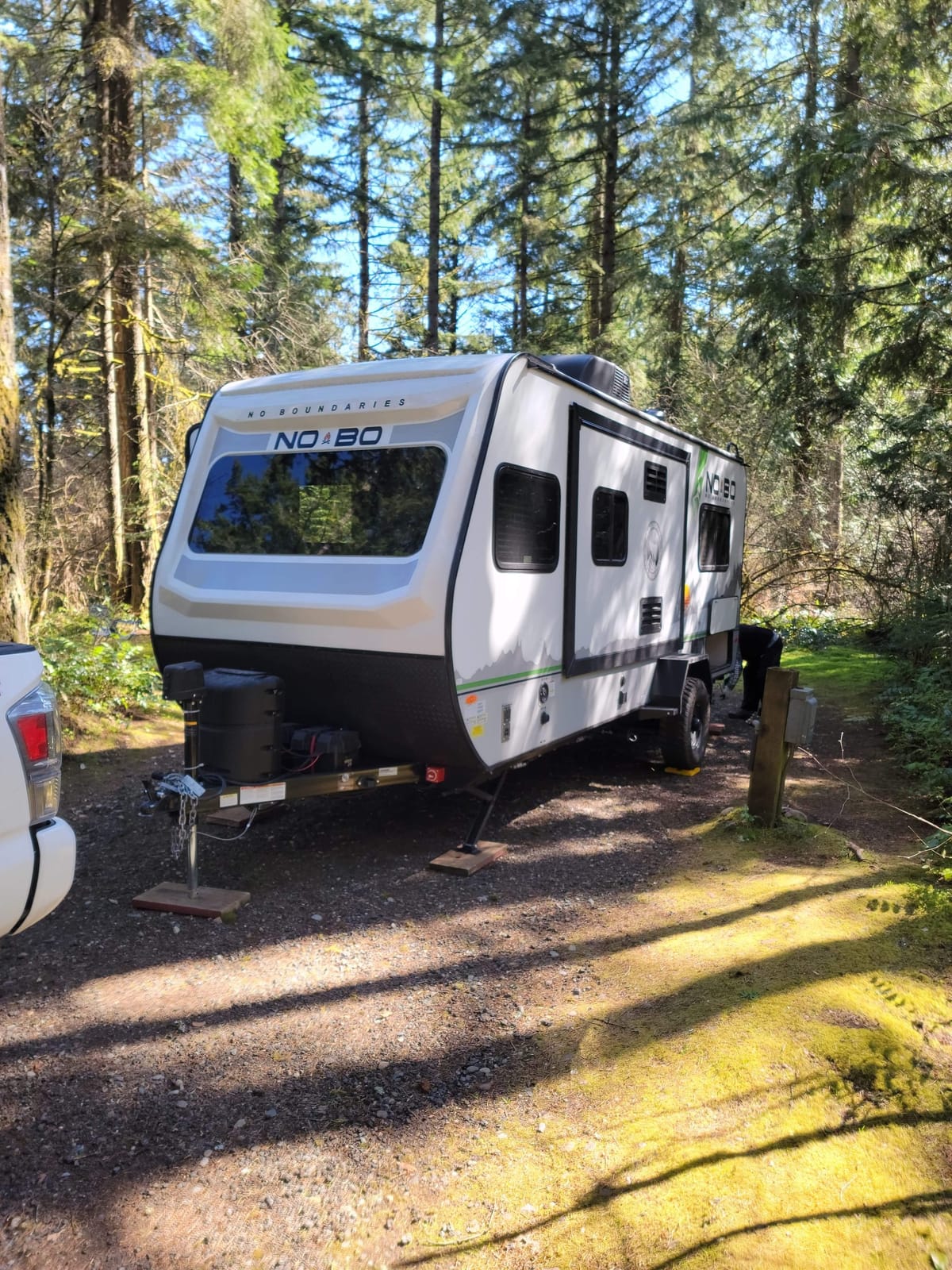
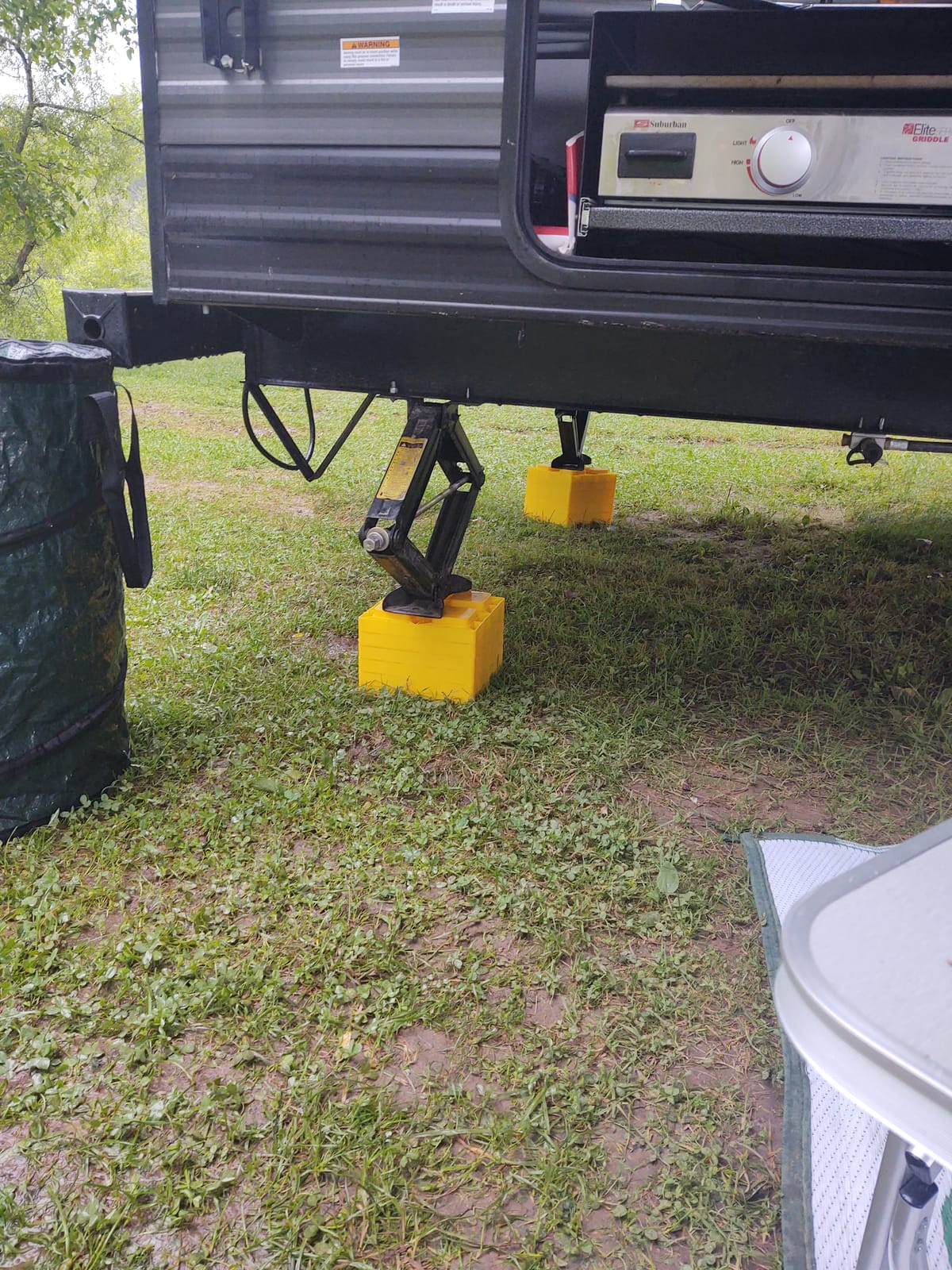
Coverage is broad: Camco lists these for single wheels, dual wheels, tandem axles, hydraulic jacks, tongue jacks, stabilizer jacks and fifth wheel jacks. For a bumper-pull trailer that is every jack and axle configuration you are likely to meet.
The tradeoff is material. This is resin rather than the heavier polymer used in some premium sets, and buyers report scuffing after a season or two of use. Stacking taller than the design intends, or driving onto the stack at an angle, is where cracking reports come from. The product page also warns that the shipped design can vary from the pictured one.
When this set fits your trailer
This is the set for weekend campers at maintained campgrounds with gravel or paved pads. The one-inch layers make it predictable to plan around, and ten blocks is generally more material than a typical trailer needs on a site that is not dramatically sloped. The bright color also solves the small campsite problem of losing a block in grass.
When another set suits you better
If you camp on ground that gets soft or rocky often, resin is the part of this package that gives you pause, since it is the lightest and least stiff material in the comparison. If your trailer needs deep corrections rather than inch-level nudges, the Lynx set handles a taller pyramid more confidently. And the ten-piece bag is bulky for a small pass-through storage area.
3. Camco FasTen Leveling Blocks – Handle-Locking Storage Design
Camco FasTen RV Leveling Blocks – 8.5” x 8.5” x 1”- 10-Pk – Made in the USA
Quad-grid interlocking blocks
Folding T-handle locks the stack
Do not stack above 4.5 inches
One year warranty
Pros
- Integrated T-handle locks blocks together
- Handle folds flat for compact storage
- Quad-grid structure resists flexing
- 87 percent of ratings are five star
- Made in the USA
Cons
- Handle can pinch fingers while locking
- Four and a half inch stack limit caps corrections
- Noticeably bulkier than plain Camco blocks
The FasTen set takes the basic interlocking block and solves the two things that annoy people most: blocks sliding apart in the bag, and blocks scattering across a campsite. Each block carries an integrated T-handle that locks into the block above and folds flat against the face for storage.
The load-bearing structure is a patented quad grid rather than a simple hollow shell, and that is where the stiffness shows up when a loaded trailer sits on a three-block pyramid. Reviews here rate it 4.8 stars with 87 percent five-star ratings, the strongest distribution among the plain block sets we tested.
The handle is not only a lock. It is a carry grip, which means one hand can pick up a locked column of blocks instead of crouching and gathering loose pieces. On my own trailer that saved several minutes per setup, and it matters more for anyone with a bad back.
There is a documented limit: Camco says not to stack above 4.5 inches. That is enough for most mild corrections and most side-to-side work, but it is the reason this is not my first choice for steep front-to-back pitches. The one year manufacturer warranty is also shorter than the coverage on some competing sets.
Best fit for the trailer owner
Pick this if you level often, hate handling loose pieces, or share a campsite with kids who would enjoy scattering yellow plastic across the site. It also suits trailers that stay closer to level, since the 4.5 inch ceiling will not be the constraint that decides how many blocks you need.
Where the design costs you
The handle can pinch fingers when you lock blocks together, which takes a little practice to get right the first time. The blocks are bulkier than plain interlocking models, so ten of them eat more storage than you might expect, and the stack height ceiling is a real limit rather than a guideline.
4. Camco 44501 4-Pack – A Small Set for Small Tilts
Camco Camper/RV Leveling Blocks – Features Stackable Interlocking Design & Includes Zippered Bag for RV Storage – Compatible w/Single Wheels, Dual Wheels, Tandem Axles & More – 4-Pack (44501)
4 interlocking blocks
1 inch per layer
Solid bottom
Zippered bag included
Pros
- Cheapest entry into the interlocking format
- Four blocks handle most mild sites
- Same 1 inch geometry as larger Camco sets
- Bag included for tidy storage
- Made in the USA
Cons
- Only four blocks in the set
- Shallow maximum stack for bad pitches
- Small pack is easy to misplace without the bag
This four-pack is the same block Camco has made since 2004, just in a smaller count. If your trailer lives at developed campgrounds with reasonably even pads, four blocks is frequently the entire correction you will ever need on a normal site.
The geometry matches the larger Camco sets exactly: 8.5 x 8.5 x 1.5 inch UV-stabilized resin, one inch of height per layer, solid bottoms, and a zippered bag. That means if you later buy a bigger set, everything you learned applies unchanged.
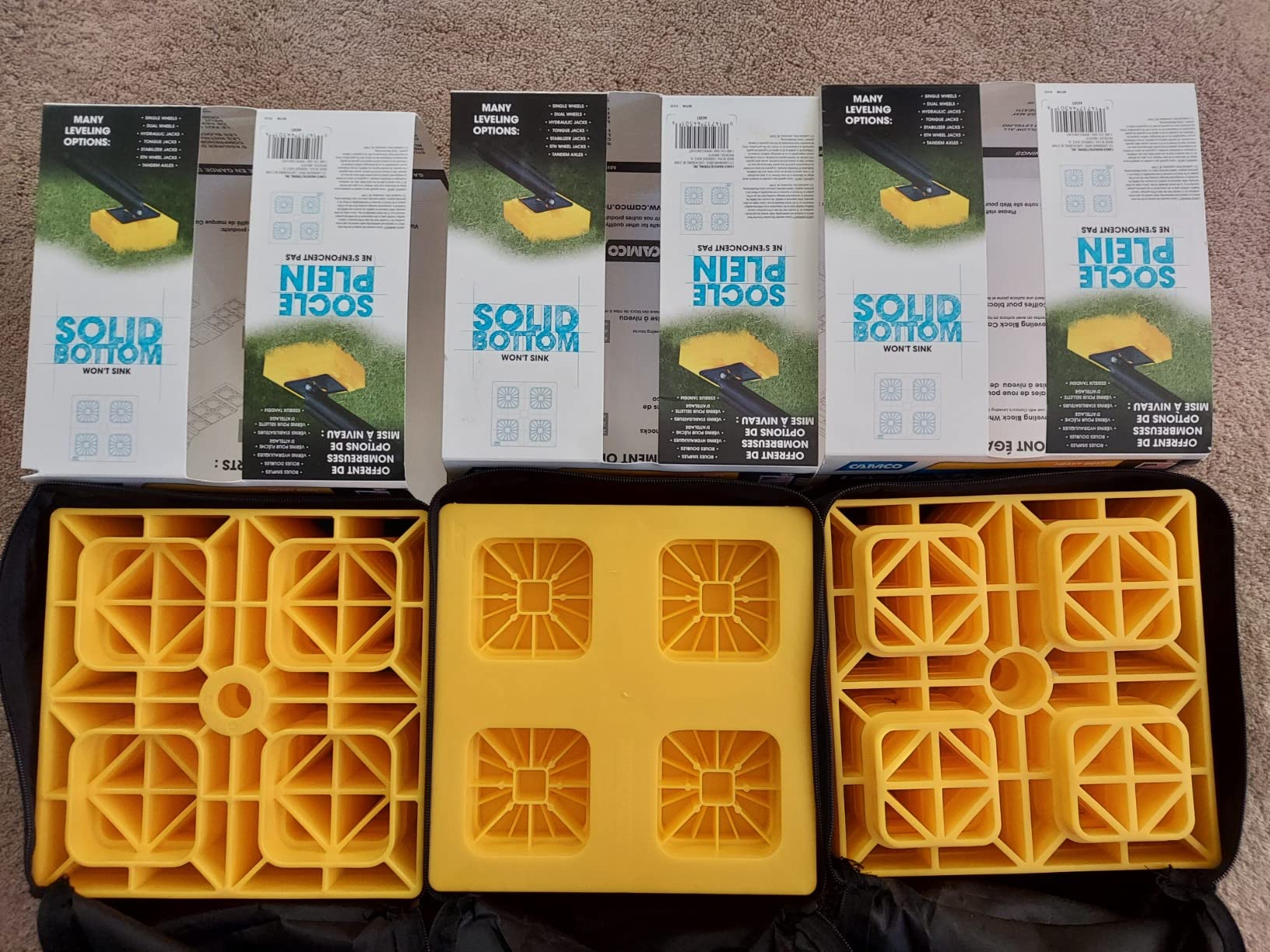
Buyers treat this as a budget set or a backup set rather than a primary system. Reviewers consistently describe it as well matched to mild leveling rather than large corrections, and the bright yellow keeps it visible if it ends up outside the trailer.
The obvious limitation is the count. Four blocks cannot build a tall pyramid, so a steep site pushes you into a second purchase. It is also the easiest set to leave behind, since the bag is small and easy to miss during a breakdown.
Who should buy four blocks
New trailer owners, renters, and anyone whose campsites are paved or graded are the obvious audience. It covers side-to-side correction on a level pad, gives you pad material for a tongue jack, and costs far less than a full kit. For a first season of ownership it is a sensible starting point.
Who should buy more
If you boondock, camp in the mountains, or regularly pull into sites with a noticeable cross-slope, four blocks will run out. Plan on a ten or twelve piece set instead, and keep the four-pack as a lightweight supplement you can carry for stabilizer pads.
5. Andersen Hitches Camper Levelers – Ramp Style With No Lifting
Andersen Hitches 2-Pack Camper Leveler Blocks for RVs and Trailers Up to 30000 lbs Precise 1/2 to 4 Inch Leveling Made in USA
Drive-on wedge levelers
1/2 to 4 inch range
Trailers up to 30000 lbs
Lifetime warranty
Pros
- Levels in about 30 seconds with no stacking
- Half inch increments cover far more tilt
- Drive-on design is easy on your back
- Two levelers cover both sides in one pass
- Lifetime manufacturer warranty
Cons
- Wide body can crowd closely spaced tandem tires
- Slick rubber can scoot on loose gravel
- Points dig into soft ground without a board
- A second person helps judge final height
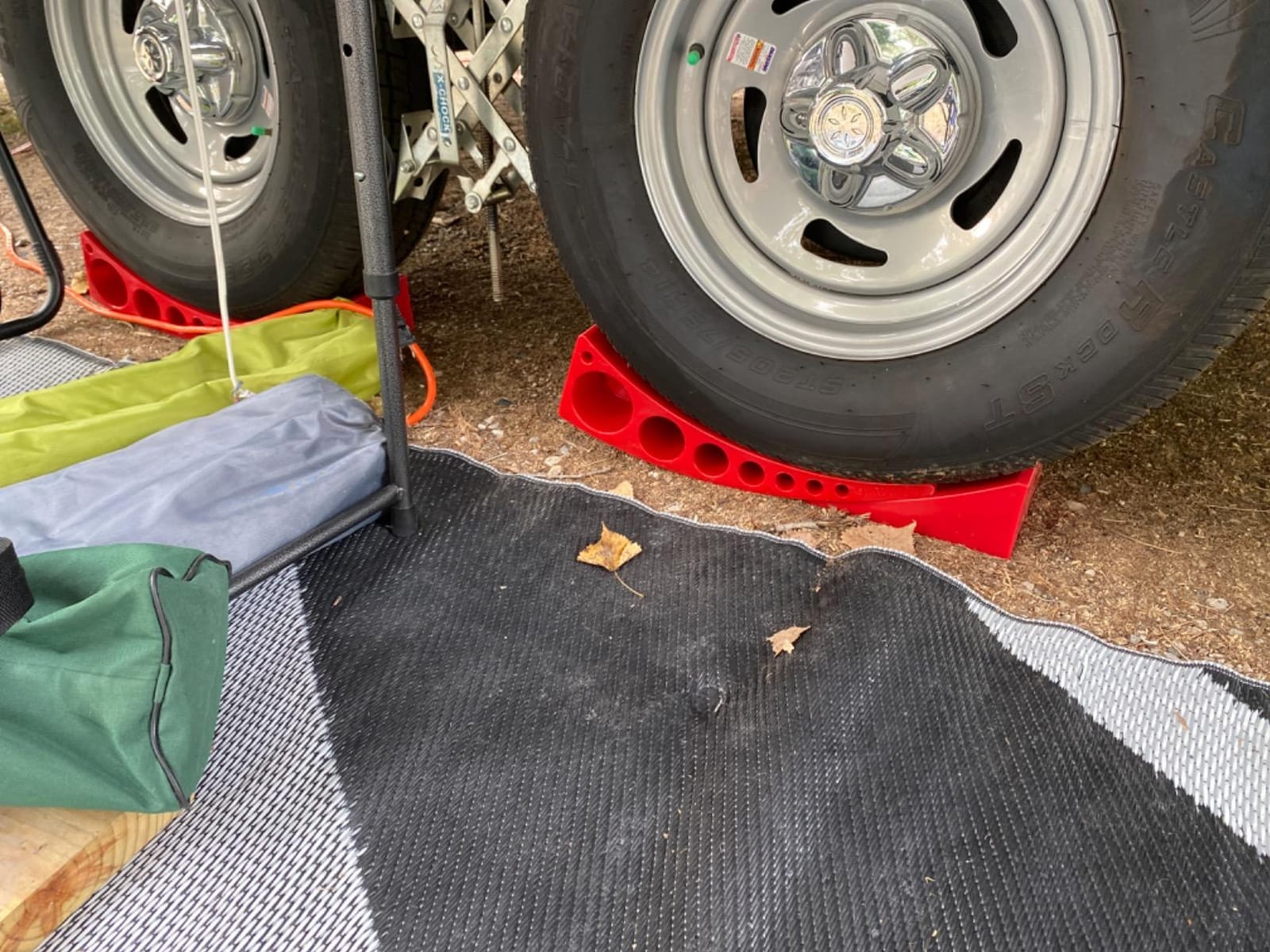
This is the only drive-on wedge system in the roundup that does not need a phone app, a bubble level, or a helper with a stick. You position the wedge and roll forward until you hit the right height, with adjustment from half an inch up to four inches.
For a bumper-pull trailer the range matters most at the front, where you are trying to bring the tongue down to match the rear. Four inches of adjustment is far more correction than stacked inch blocks deliver on a single corner, and getting there takes well under a minute.
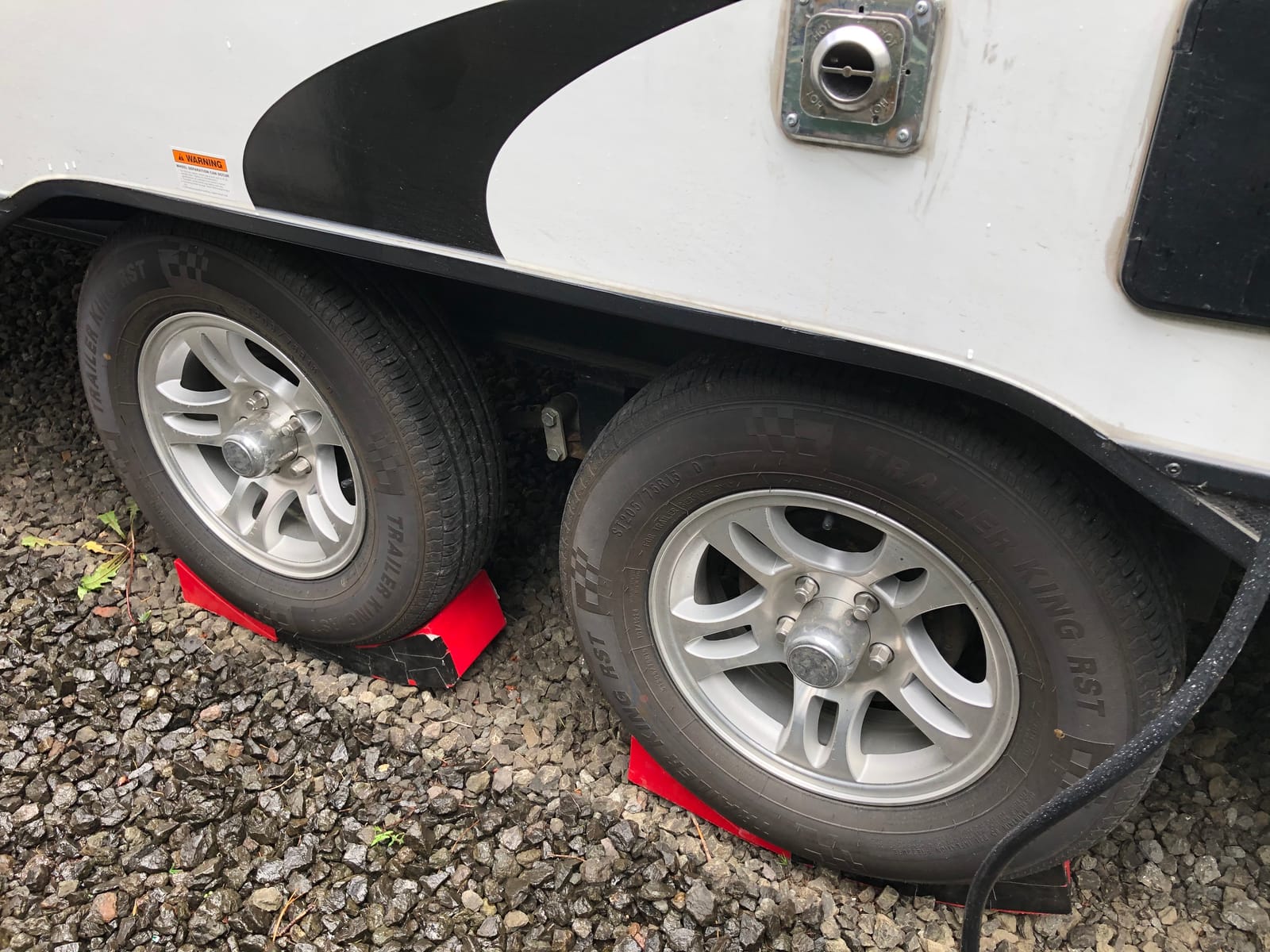
Build quality is the standout detail. These carry a lifetime manufacturer warranty, which is the longest coverage listed here, and 5.5k+ ratings average 4.7 stars. Reviews describe it repeatedly as the fastest and least fussy system they own, and it pairs naturally with a phone level for the final check.
There are two real constraints for travel trailers. The body is 15 inches long and 5.75 inches wide, and on a tandem axle with closely spaced tires you may need to trim a corner to fit between wheels. On soft ground the low point digs in, so many owners put a pad or a piece of plywood under the nose.
Best fit for quick arrivals
Ideal for people who move sites weekly, camp with older knees, or simply refuse to crouch. Two levelers cover both sides of the trailer in a single forward pass, and the half inch increments make fine adjustments without rebuilding anything.
Where it works against you
It is the widest and heaviest option in this group at 15 x 5.75 x 3 inches and 6.1 pounds per set, so it eats cargo space. It can scoot on gravel if you nudge it in hard, and it is a one-shot correction, since you cannot add height once a tire is on it.
6. RVMATE 12 Pack – Top Blocks That Protect Tire Tread
RVMATE 12 Pack RV Leveling Blocks, Camper Trailer Leveling Blocks
10 blocks plus 2 top blocks
1 inch per layer
Reinforced interlocking construction
Bag included
Pros
- Top blocks spread tire load and cut tread wear
- Twelve pieces give material for deep pyramids
- Solid reinforced build resists cracking
- Strong current sales rank in the category
- Carrying bag keeps the set together
Cons
- Heaviest kit in the roundup at about 9.5 pounds
- Top block caps only cover a limited tire width
- No anti-slip texture detail in the listing
The two thin top blocks are the idea that makes this set different. Most interlocking systems put the tire directly on a block face, which slowly compresses the tread and marks the block. Here the wheel sits on a lower profile cap instead, and the wear shows up on the cheap part.
You get ten main blocks at 8.5 x 8.5 x 1.5 inches plus two tops at 8.5 x 8.5 x 0.75 inches, with one inch added per layer, all in high density reinforced interlocking plastic. Listing compatibility covers single wheels, dual wheels, hydraulic, tongue, stabilizer and fifth wheel jacks.
This is also one of the strongest sellers in the RV Levelers category by current sales volume, and 1.5k+ ratings averaging 4.6 stars reflect that. Owners point to the caps and the sheer number of pieces as the reasons they bought twice.
The weight is the drawback. At roughly 9.5 pounds for the set, it is one of the heavier kits here, and you feel that walking it across a site from the truck. The top blocks also only suit standard tire widths, so wide tires on a pickup-hauled trailer may overhang them.
Best fit for tire-conscious owners
If you haul far, replace tires often, or park on gravel that chews tread, the caps pay for themselves in tire life. The twelve piece count also gives you enough material for a deep pyramid on a rough site without a second purchase.
Where it falls short
Weight is the main issue, particularly for solo travelers moving a long way from the truck. The caps do not cover unusually wide tires, and the listing calls out no specific anti-slip texture, so on loose gravel you may want to add your own mat underneath.
7. Homeon Wheels 10 Pack – Blocks, Ramps and a Chock
Homeon Wheels 10 Packs Rv/Camper Leveling Blocks, Chocks Anti-Slip Pads Design Include One Wheel Chock and Carrying Bag for Camper Travel Trailer
9 blocks and 3 slanted ramps
1 inch per layer
Wheel chock included
Zippered bag
Pros
- Only set here that adds three drive-on ramps
- Ramps make climbing the stack easier
- Solid bottoms hold on soft ground
- Bag keeps the kit together
- Usually only five or six blocks get used per setup
Cons
- Blocks crack on uneven grass or straw
- Thinner 1.3 inch blocks feel flimsy when stacked
- Bag is too small for the chock and ramps
- Lowest average rating here at 4.4 stars
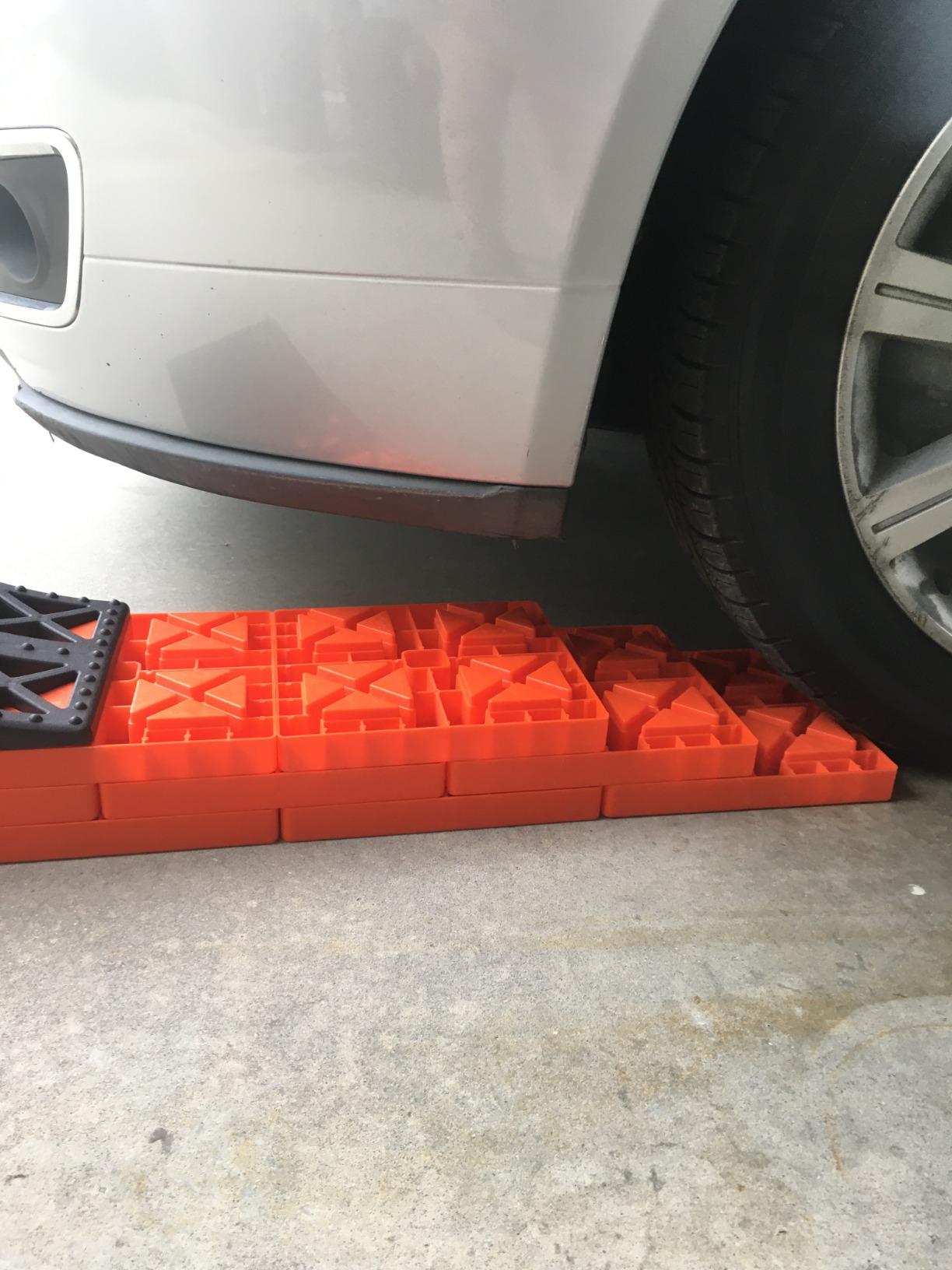
Most sets give you blocks and stop there. This one adds three black slanted ramps, so you can drive onto a stack rather than easing the trailer across bare block edges. That single addition removes the part of leveling most people find fiddly.
It also throws in a wheel chock, which is a genuinely useful companion to leveling. On a sloped site, a chocked wheel plus a level trailer is the difference between parking and parking properly.
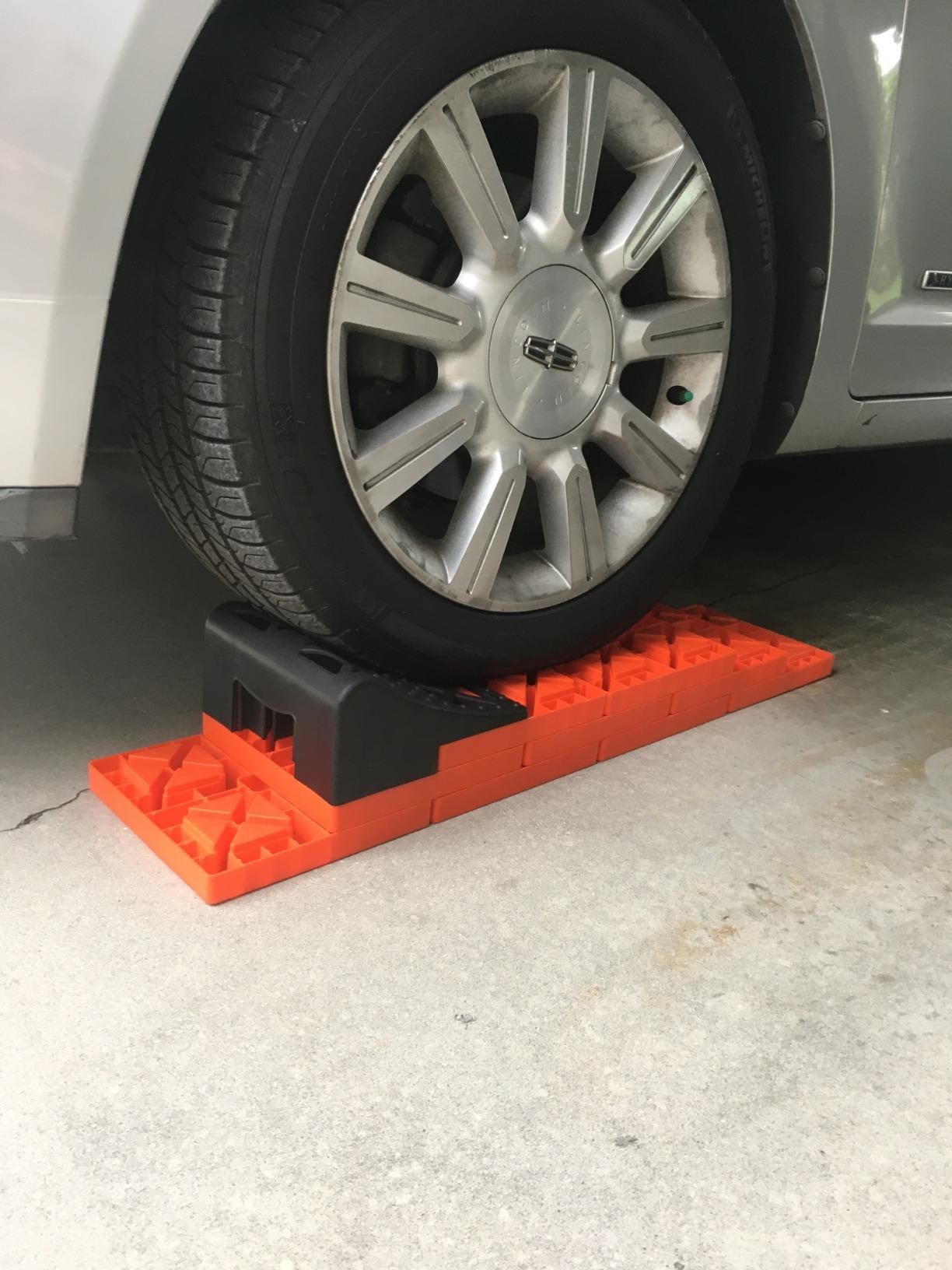
The nine main blocks measure 8.5 x 8.5 x 1.3 inches and add a full inch per layer, with solid bottoms to help resist sinking. Customer service is repeatedly praised for replacing items quickly, which matters more than it sounds if you are a week into a trip.
The durability feedback is the weak point. Owners report cracking on uneven grass or straw under the stack, and the thinner 1.3 inch profile feels less stiff than the 1.5 inch blocks used by Camco and Lynx. Reviewers also note the carry bag cannot fit the chock and ramps alongside the blocks.
Best fit for convenience
Choose this if you hate the moment of putting a tire against a raw block edge, or if you want wheel chocks without buying them separately. In practice five or six blocks do most of the work, so the spare pieces stay in the bag for rough nights.
Where it is the wrong choice
This is not the set for ground with uneven grass or straw underneath, where repeated reports describe cracking. The thinner blocks also feel less confident in a tall pyramid, and you will end up storing the ramps and chock somewhere other than the bag.
8. Kohree Curved Levelers – Rated to 35000 lbs
Kohree RV Leveling Blocks, Up to 35,000 lbs, 4″ Max Level System
Curved drive-on levelers
1/2 to 4 inch range
Rated up to 35000 lbs
2 anti-slip mats included
Pros
- Under five minute setup with no stacking
- Included non-slip mats fix the sliding problem
- No cutting needed on most dual axle trailers
- 35000 lb rating is the highest figure listed
- Half inch bumps up to four inches
Cons
- Curved ramp needs the mats to avoid pushing forward
- Heavier than a comparable block set at 8 pounds
- One-shot correction once the wheel is on
- No bubble level in this configuration
The Kohree set is a curved drive-on leveler aimed squarely at the trailer that has the fewest good parking options. Two blue leveler blocks and two non-slip mats handle one side, and the curve raises the wheel progressively as you roll forward.
What stands out is the fit. Camco lists compatibility broadly but the wedge designs are where narrow trailer spacing bites, and Kohree states no trimming is required for most RVs, motorhomes and dual axle trailers. For a tandem axle bumper-pull with tight wheel spacing, that saves a modification.
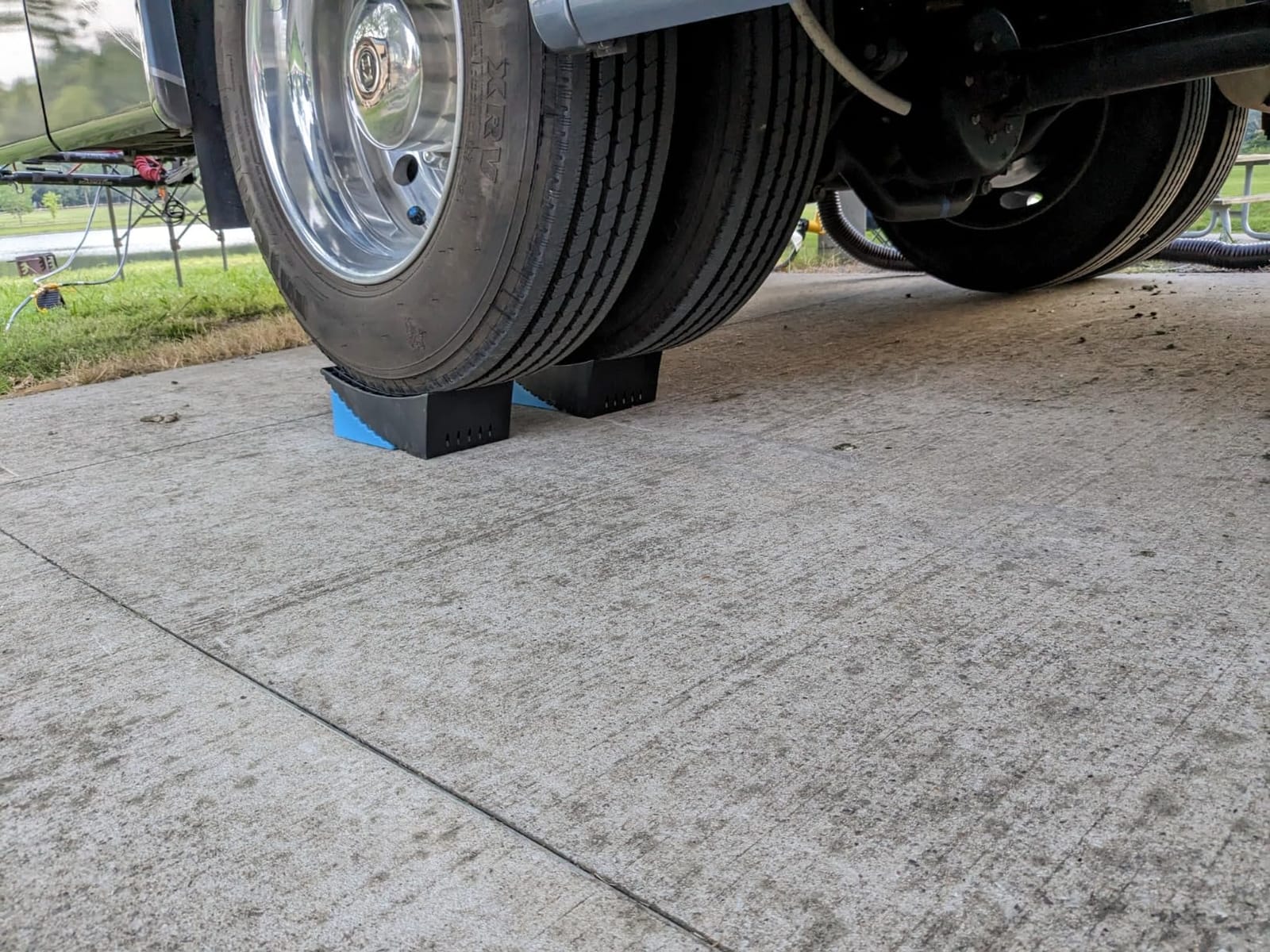
The 35,000 lb rating is the highest capacity number listed in this roundup, and the tire compatibility extends to 32 inch diameters. With 1.4k+ ratings at 4.6 stars, buyers treat it as a fast, no-cut alternative to the classic wedge levelers.
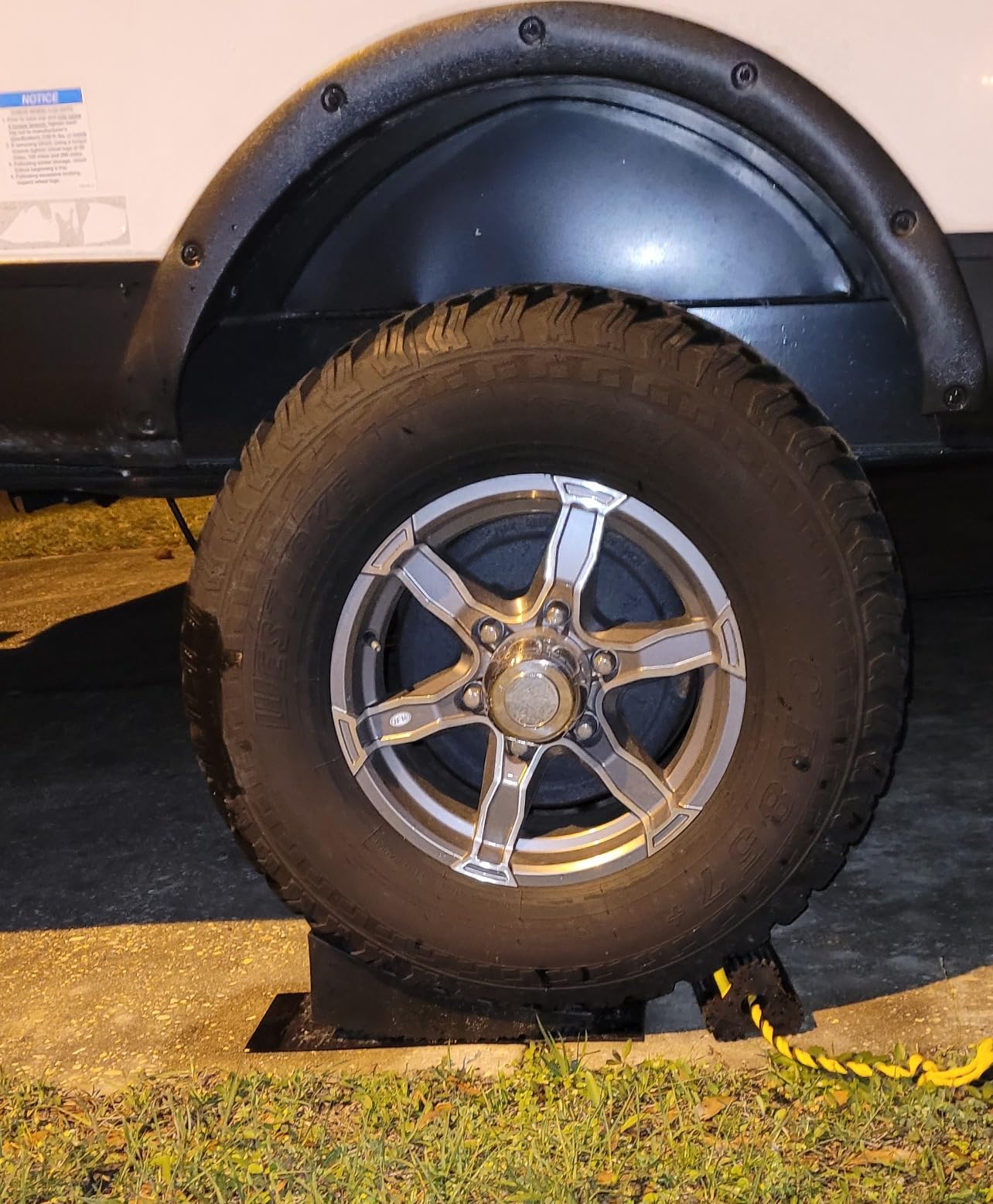
The anti-skid base with two non-slip mats is doing real work here, and it is not optional in practice. On loose ground the curved nose can push the wheel forward and you creep past the level you wanted. At 8 pounds it is also heavier than a plastic block set of similar function, and no bubble level is included with this configuration.
Best fit for dual axle trailers
Pick this if your trailer has tandem wheels mounted close together, or if your campsites tend to be gravel rather than pavement. The 1/2 to 4 inch range handles a lot of front-to-back correction without stacking anything, and the included mats make gravel workable.
Where it disappoints
You cannot add height once the tire is on the ramp, so a misjudged approach means backing up and starting over, ideally with a second person calling the stop. At 8 pounds this is a heavy carry for a short walk, and you still want a phone or bubble level to confirm you are done.
9. OFISPEED Ramp Kit – The Most Complete Bundle
RV Leveling Blocks Ramp Kit, 2 Packs Camper Leveler System for Travel with Two Chocks, 2 Anti-Slip Mats, 1T Bubble Level and Carry Bag, Up to 35000 LBS, Easier & Faster to Level Camper-Orange
Two drive-on levelers rated to 35000 lbs
Includes chocks mats and bubble level
1/2 to 4 inch range
Gearwheel mesh surface
Pros
- Most complete kit in the roundup
- Bubble level included cuts phone dependence
- Gearwheel mesh plus mats tackle sliding
- No trimming on dual axle trailers
- Two chocks come in the box
Cons
- Orange polymer can soften in prolonged sun
- Capacity claim is not independently load tested
- More small parts to keep track of
- A second person helps judge height
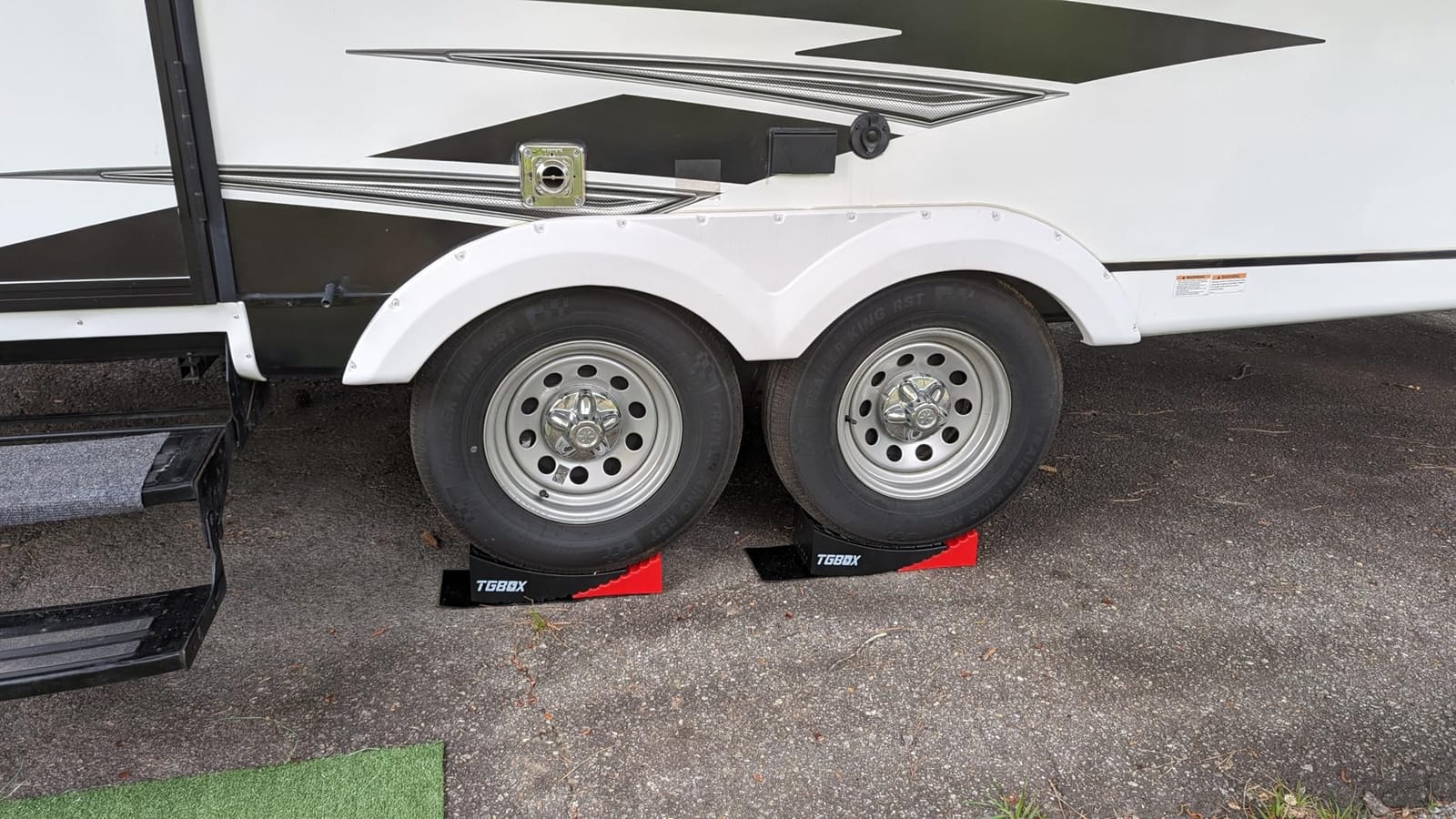
This is the kit you open and find everything already inside: two drive-on levelers, two wheel chocks, two anti-slip mats, a bubble level and a carry bag. Nothing extra to source, which is the appeal for anyone setting out on a first trip.
The levelers are rated for trailers up to 35,000 lbs and tires up to 32 inches, with half inch adjustments between half an inch and four inches. The gearwheel mesh surface is the detail reviewers mention most, working with the mats to stop the wheel creeping forward on gravel.
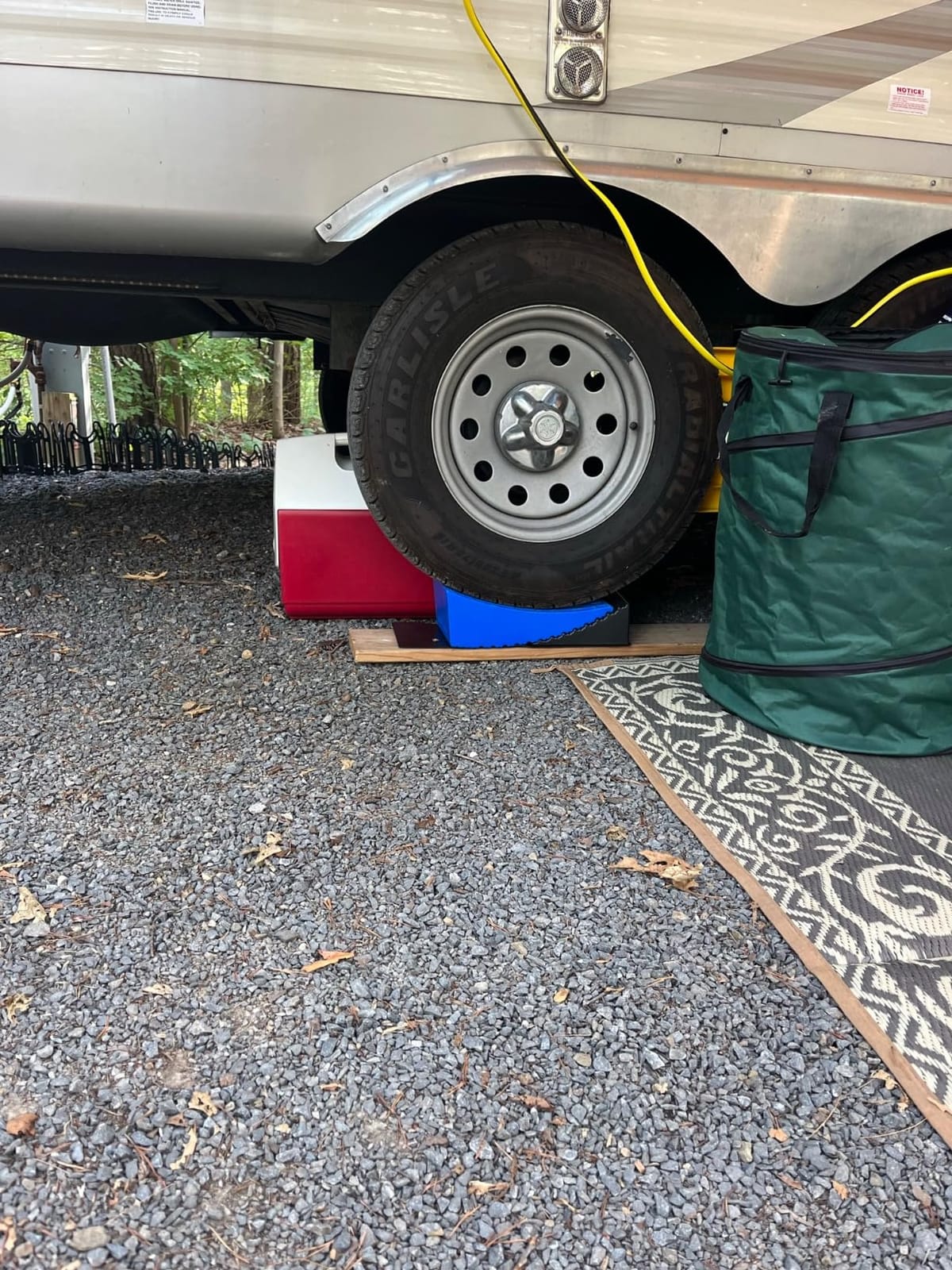
Having a real bubble level in the box is more useful than it sounds. Most people otherwise reach for a phone, and a phone in direct sun on a black or orange surface is hard to read. With 1.2k+ ratings averaging 4.6 stars, the completeness is what owners keep citing.
Two cautions. The orange polymer can soften in prolonged direct sun, so leaving the set in a hot truck all day is worth avoiding. And the 35,000 lb capacity is a manufacturer claim without independent load testing, so treat it as a figure for comparison rather than a proven ceiling.
Best fit for new owners
This is the buy for someone starting out who wants a complete setup in one box without researching five accessories. The chocks and bubble level make it genuinely usable on arrival, and the no-trim fit suits tandem axle trailers.
Where to be careful
More pieces means more to keep track of, and drive-on wedges still want a second pair of eyes or a level to confirm the final height. Store it out of the sun between trips, and do not stack the polymer pieces while they are hot.
10. OULEME 12 Pack – Polypropylene Built for the Sun
OULEME 12 Pack RV Leveling Blocks, Stackable Jack Blocks, Interlocking Leveling Pads with Carrying Bag, for Camper Travel Trailer
10 blocks plus 2 top blocks
Anti-UV stabilized polypropylene
1 inch per layer
Bag included
Pros
- 85 percent of ratings are five star
- Anti-UV additives target sun degradation
- Ten blocks plus tops handle deep pyramids
- Interlocks compactly for storage
- Doubles as jack and stabilizer pads
Cons
- Heaviest set here at just over 10 pounds
- Polypropylene softens in direct sun
- Top blocks suit standard tire widths only
- Some report tops separating in transit
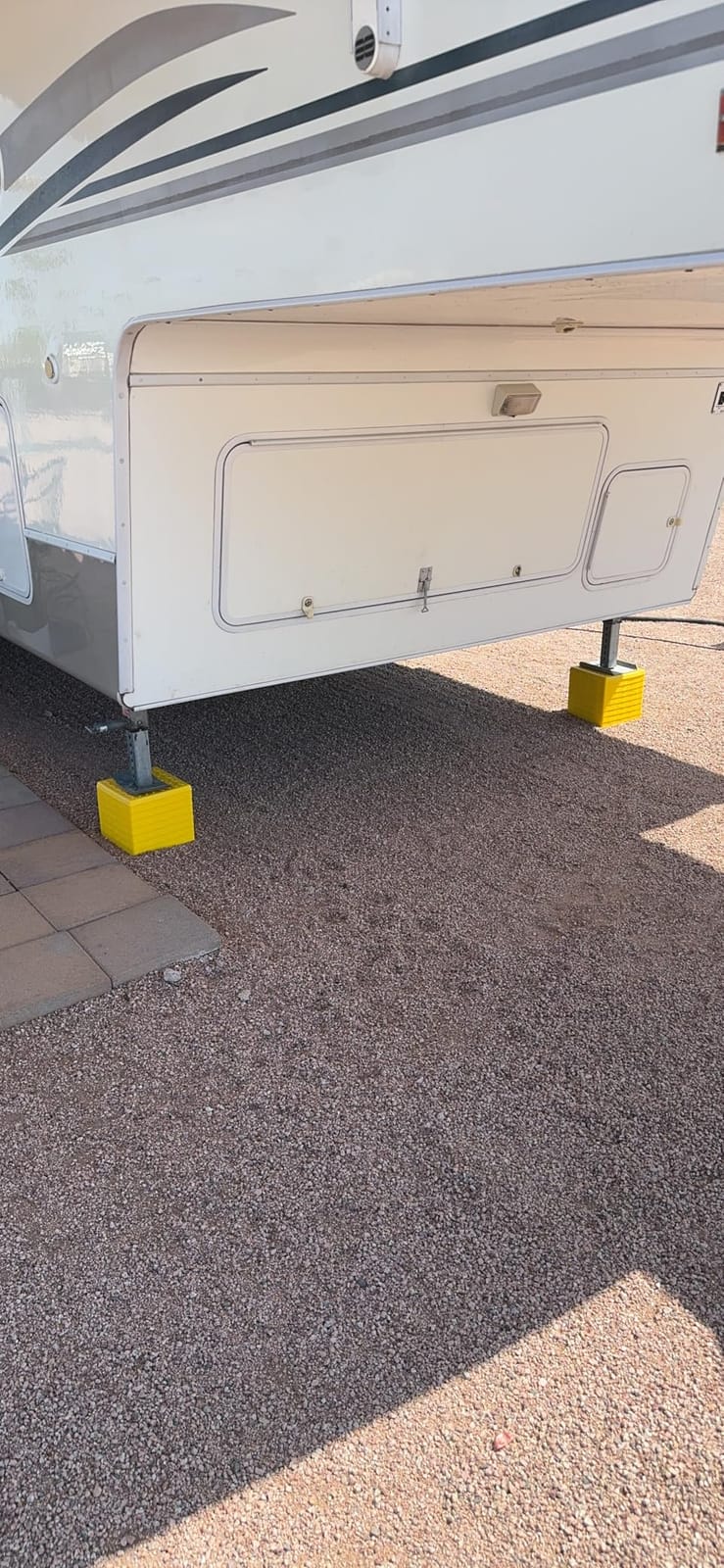
Sun is the enemy of plastic blocks, and OULEME builds around that problem. The set is polypropylene with anti-UV aging additives plus increased density and thickness, which is why so few owners here report the fading and brittleness that plagues cheaper blocks after a few seasons in a west-facing storage bay.
Inside the bag you get ten interlocking blocks at 8.5 x 8.5 x 1.5 inches and two top blocks at 8.5 x 8.5 x 0.7 inches, each layer adding an inch. That is enough material to build a deep pyramid without a second purchase.
With 898 ratings averaging 4.7 stars and 85 percent five-star, this has the highest satisfaction rate among the value-priced twelve packs we looked at. Buyers single out the anti-UV formula and the easy stacking.
The weight is the real cost. At just over 10 pounds this is the heaviest kit in the comparison, and hauling it from the truck across a soft site is a workout. A few buyers also report top blocks separating from the stack during transit, so check the bag before you rely on the caps.
Best fit for full-time and sun-exposed storage
If your trailer lives outdoors or your block storage gets afternoon sun, the anti-UV formula is the deciding factor. This set also works well as jack and stabilizer pad material, giving you one kit that covers wheel leveling and jack support.
Where it falls short
Weight is the issue for anyone carrying blocks a distance from the truck, and polypropylene still softens in direct sun even with additives. The top blocks only suit standard tire widths, and owners report occasional separation in transit.
11. GarfatolRv 10 Pack – Light and Multi-Purpose
GarfatolRv 10-Pack RV Leveling Blocks, Interlocking Non-Slip, Gray
10 interlocking non-slip blocks
8.5 x 8.5 x 1.3 inch size
Textured surface
6.7 pounds total
Pros
- Light at 6.7 pounds for a ten piece set
- Textured surface and reinforced base grip well
- Doubles as a ramp for other jobs
- Carry bag keeps pieces tidy
- Works with tongue and stabilizer jacks
Cons
- Blocks do not fully lock together
- Reports of crushing under a jack foot
- Point loads will split a block without a board
- Second highest one-star feedback at 6 percent
At 6.7 pounds for ten blocks, this is the set I would hand to anyone who carries their gear far from the truck. It is the lightest meaningful stacker in this roundup, and the 8.5 x 8.5 x 1.3 inch blocks still give an inch of height per layer.
The textured anti-slip surface and reinforced base are genuine features rather than marketing filler, and owners on gravel report that the stack holds position while you climb on. Buyers also use these off-label as a ramp to reach a low jack point on a passenger car, which is a handy trick.

Reviews split sharply, and the divide is informative. Happy owners talk about weight, versatility and price. A distinct group reports blocks crushing or cracking under a jack foot, sometimes on first use, and 6 percent one-star feedback is the second highest here.
The root cause is that the blocks do not fully lock together, so they can separate in the bag and a concentrated point load finds the weak spot. A tongue jack foot on bare plastic without a board is the specific failure pattern owners describe, and the gray color is harder to spot at a campsite after dark.

Best fit for lightweight carrying
This works well for wheel leveling on packed gravel, where you need a few inches and you want to walk the kit a distance. It is also a useful general purpose block for driving a ramp or reaching a jack point, which adds value beyond leveling.
Where to avoid it
Do not put a bare tongue jack or stabilizer jack foot on these without a board or a proper jack pad underneath. That concentrated load is where the cracking reports start, and for jack support a stiffer set or a purpose built pad is the safer pick.
12. CircleRoad 12 Pack – Budget Twelve-Piece Layout
CircleRoad 12 Pack RV Leveling Blocks Camper Trailer Leveling Blocks
12 pieces: 10 blocks and 2 tops
1 inch per layer
Solid base
Storage bag included
Pros
- Well under the price of comparable 12 packs
- Same 10 plus 2 layout as pricier sets
- Interlocks compactly for transport
- Solid bottoms hold on soft ground
- Color options for visibility
Cons
- Softens and turns sticky in direct sun
- Pieces break under a pickup truck
- Some breakage reported out of the box
- No stated weight limit
- Smallest review pool here at 374 ratings
The CircleRoad set copies the layout that has become standard for twelve packs: ten 8.5 x 8.5 x 1.5 inch blocks, two 8.5 x 8.5 x 0.7 inch top blocks, and a storage bag. It costs well under the comparable twelve piece sets in this roundup while matching their layout exactly.
Solid bottoms resist sinking, and the interlocking design keeps everything together in the bag and in transit. Compatibility is listed across single wheels, dual wheels, tongue jacks, hydraulic jacks, stabilizer jacks and fifth wheel jacks, and yellow, blue and gray options let you pick a visible color.
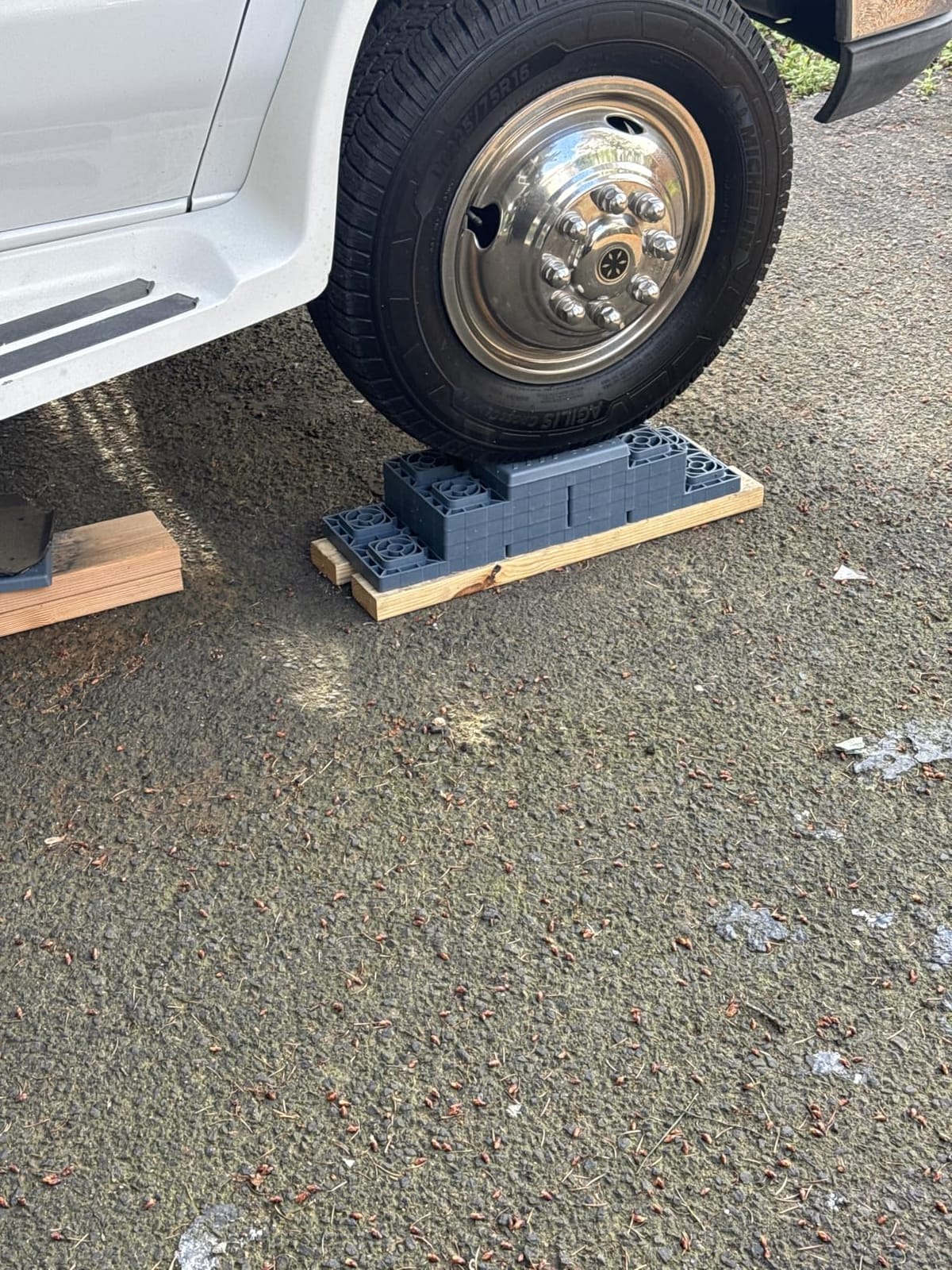
At 374 ratings averaging 4.5 stars, this has the smallest review pool in the comparison, so long term durability data is thin. Several buyers report repeat purchases, which is a reasonable signal, but it is not the same as a decade of field reports.
The two dominant complaints are heat and weight. Owners report blocks softening, deforming and turning sticky after sitting in direct sun for days, and pieces cracking when a pickup drives over them. Some buyers report breakage straight out of the box, and the listing gives no weight limit, which leaves load expectations unclear.
Best fit for occasional campers
Good choice if you level at maintained sites and mostly need wheel support, and you want twelve pieces without paying premium pricing. The solid base handles damp ground better than hollow designs, and color options help with campsite visibility.
Where it is not the right pick
Do not store it in a hot storage bay, because heat deformation is the most repeated complaint. Never drive a truck over these blocks. And if you depend on a stated load rating to make a safety decision, this listing does not provide one.
How to Level a Travel Trailer with Blocks, Step by Step
The order of operations matters more than the equipment. Leveling the wrong corner first is the classic beginner mistake, and it forces you to redo the whole job twice.
Back in far, then pull forward. Position the trailer, then drive forward until the tires are a few feet ahead of where you want them. This gives you room to build stacks and drive back onto them.
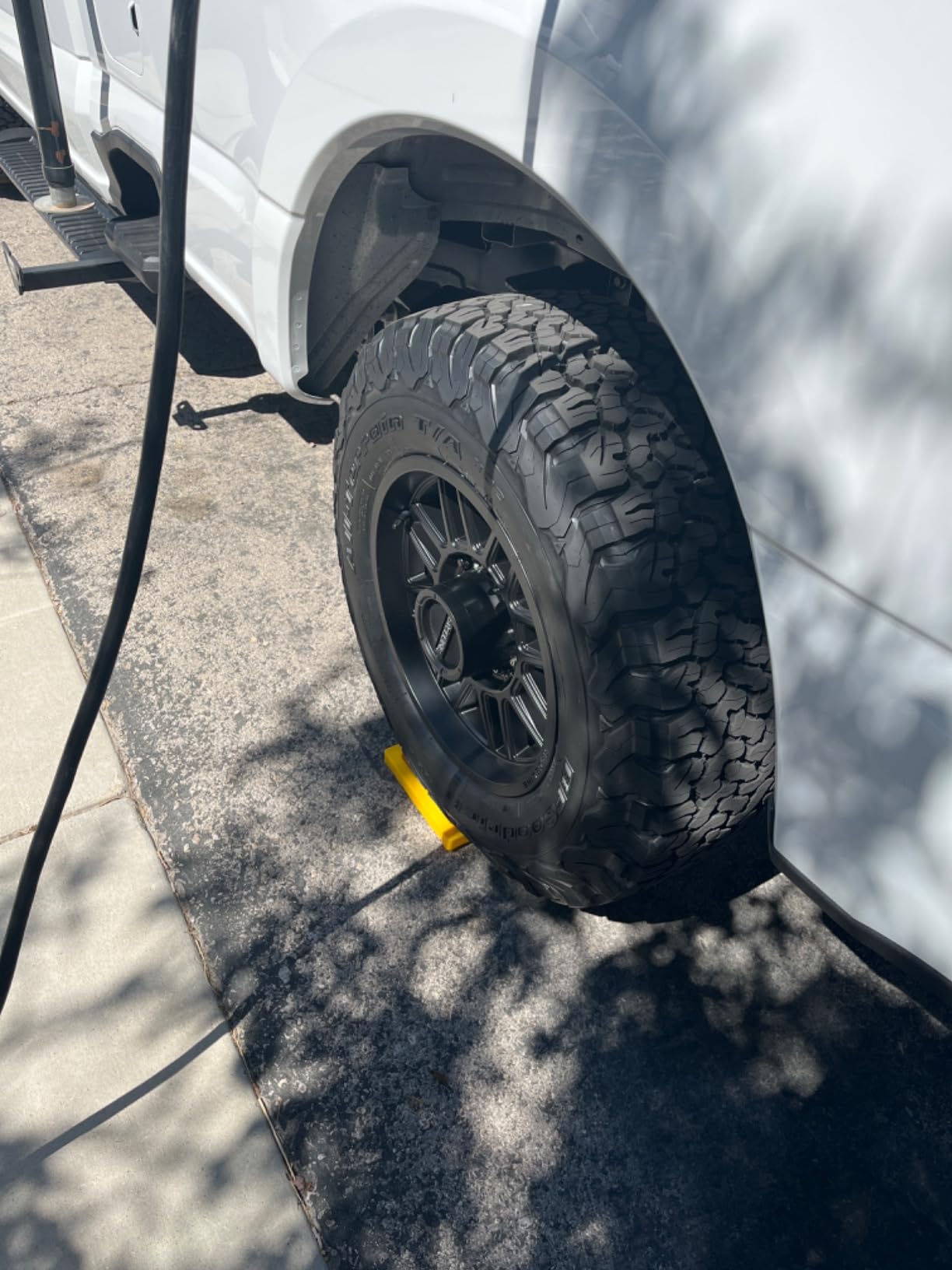
Drop the jack and chock the wheels. Lower the tongue jack onto solid footing first so it carries the front weight. Chock both sides of one wheel before anything else moves.
Find the low side. A bubble level or phone level tells you which side is down and how far. Correct front-to-back first at the tongue, since that moves both axles together.
Build pyramids on the low wheels. Stack two blocks side by side on the ground, then bridge them, then continue. The classic pyramid shape keeps the stack from sliding.
Drive up and recheck. Pull forward onto the stacks, then re-measure front-to-back and side-to-side. Add or remove a half inch layer, or back off and adjust the stacks.
Extend the stabilizers onto pads. Only once the trailer reads level. Then lower the stabilizers onto a block so they share the load instead of sinking.
Confirm before you unhitch. Check the level one final time, then back into place, chock, reconnect and drop the jack onto its pad.
Budget about eight minutes for a block setup once you know the sequence, and much less with a drive-on wedge system. Owners on travel trailer forums consistently describe this as the step where beginners lose the most time.
How to Choose RV Leveling Blocks for Your Travel Trailer
Stackable blocks or drive-on levelers
Stackable interlocking blocks are the default choice, and for most bumper-pull trailers they are the right one. They correct in one inch steps, they work under stabilizer jacks and the tongue jack as well as wheels, and they cost less to store. Their weakness is height: a big correction needs a wide pyramid and takes time to build.
Drive-on wedge levelers trade precision handling for speed. You roll forward instead of lifting blocks, and half inch adjustments cover far more tilt per corner. The costs are bulk, the need to nail the fit between tandem tires, and the fact that you cannot add height once the tire is on. Many owners keep both systems, using wedges for side-to-side work and blocks for the jack, an approach we agree with.
How many blocks you actually need
Match quantity to trailer length rather than to trailer weight. A trailer up to about 25 feet usually gets by with four to six blocks on a typical site. Trailers from 25 to 30 feet are better served by ten blocks, which covers a four inch correction on two wheels plus jack material. Thirty feet and up, or anything that regularly camps on sloped ground, deserves a twelve pack.
Add a rule of thumb for dual axle trailers: always plan enough blocks to build two full pyramids plus two more pads for the stabilizers. Tandem axles need correcting on both wheels of one side, not one, and that is where four-block sets run out fastest.
Matching capacity to your trailer
Check your gross vehicle weight rating and loaded weight before buying. Stacked interlocking blocks on this list are rated from 30,000 to 40,000 lbs for the whole assembly, which covers essentially any bumper-pull trailer. Always use a jack pad or a board under any jack foot rather than stacking blocks for jack support, because that is a concentrated point load rather than a tire spread across a face.
Soft ground and sinking prevention
Soft ground is where cheap blocks fail. The pattern is always the same: a hollow or thin block presses into damp soil, tilts, and eventually cracks under a loaded tire. The fix is construction, not placement. Solid bottom blocks, reinforcement, and a broad footprint all matter, and for the worst campsites add a plywood sheet or a wide pad under the stack.
Persistent sinking under the tongue jack is a different problem and deserves permanent pads rather than blocks. If your campground requires jack pads on asphalt, that is a campground rule and a permanent solution respects it every time without thinking.
Material and sun exposure
Polypropylene and resin behave differently in heat. Resin sets tend to scuff and eventually crack, while polypropylene is more forgiving but can soften and become sticky after days in direct sun. OULEME adds anti-UV additives specifically for this, which is worth weighing if your storage bay faces west. Regardless of material, store blocks out of hot vehicles and out of prolonged sun.
Wood blocks versus plastic
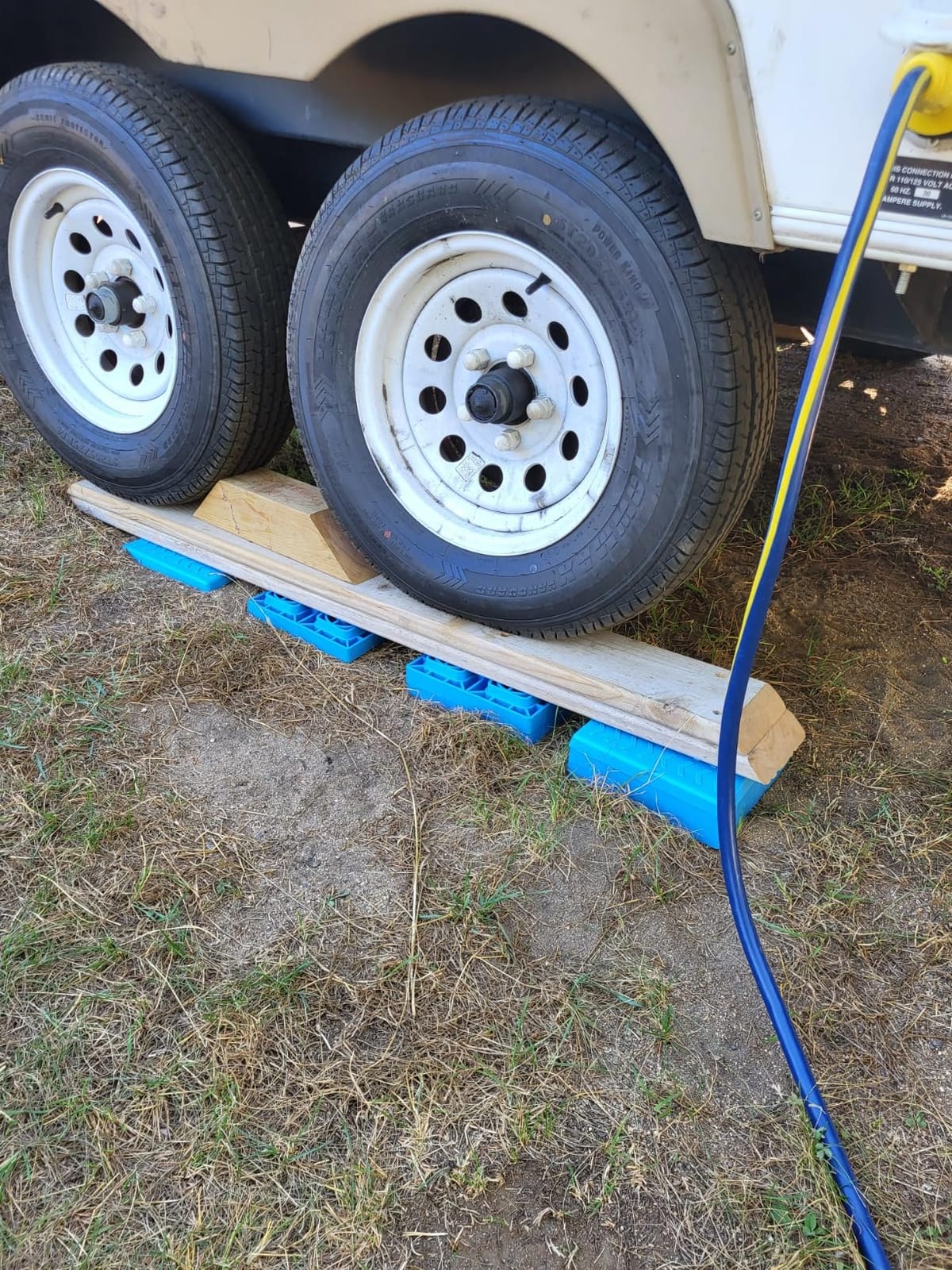
Wood remains a legitimate option, and forum regulars have used pressure treated 2 by 12 stock cut to roughly 18 inches and beveled into a ramp for years. It is heavy, it is bulky, and it can split along the grain, but it costs almost nothing and you can source free scrap. Plastic wins on weight, nesting, and consistent geometry. If you go wood, bevel the edges so tires climb rather than strike.
Electronic levels and apps
Pairing blocks with an electronic level or phone app changes the job more than most buyers expect. Instead of leveling after you park, you find the most level spot in the site before backing in, and you frequently need no blocks at all. More often you use them to confirm the height quickly instead of crouching with a bubble level. This is the cheapest upgrade available to a leveling setup.
Storage and setup speed
Storage is a real constraint in a travel trailer basement. A twelve pack with bag takes noticeably more room than a ten pack, and handle-equipped blocks such as the Camco FasTen set store flat but bulkier per block. Nesting designs like the Lynx set pack down tightest. Whatever you buy, keep it in one bag so you are not hunting pieces at dusk.
For trailers that tow small or are handled by one person, weight and reach matter more than capacity. A ten pound kit across a soft site is a real effort, which is the argument for lighter sets and for drive-on wedges.
What to check before you drive onto a stack
Confirm the stack is square, that blocks are fully interlocked, and that the top surface is level with its neighbor. Confirm the chock is on the uphill side of the wheel. And if you are using a wedge leveler, make sure it is fully on solid ground rather than half on grass. This last check prevents the creep that ruins a perfectly good setup.
For trailer selection and weight planning, our teardrop trailer guide covers lighter rigs, and truck leveling kits matter if your tow vehicle is doing part of the stabilizing work on soft ground.
Frequently Asked Questions
How do I level a travel trailer with blocks?
Drop the tongue jack and chock the wheels first, then level front-to-back at the tongue. Build interlocking pyramids under the low wheels, drive up, recheck the level, add or remove a layer, then extend the stabilizers onto pads and confirm level before unhitching.
How many leveling blocks do I need for my travel trailer?
A trailer up to about 25 feet usually needs four to six blocks on a typical site. Trailers from 25 to 30 feet are better served by ten blocks, and thirty feet or longer deserves a twelve pack. Dual axle trailers need enough for two full pyramids plus stabilizer pads.
Are ramp style levelers better than stackable blocks for travel trailers?
Ramp levelers are faster and cover more tilt with no lifting, but they take more space, can need trimming between closely spaced tandem tires, and cannot be adjusted once a tire is on them. Stackable blocks are cheaper, store more compactly, and double as jack pads. Many owners carry both.
What is the difference between stabilizer jacks and leveling jacks?
Leveling jacks lift and support the trailer to bring it to a level position. Stabilizer jacks push down into the ground to stop the trailer from rocking and shifting once it is parked. Blocks help with the leveling stage, while stabilizers need pads rather than stacked blocks under the jack foot.
Can I use wood blocks instead of plastic RV leveling blocks?
Yes. Pressure treated 2 by 12 stock cut to about 18 inches and beveled into a ramp has been used for decades and works well on solid ground. Wood is heavier and bulkier than plastic, can split along the grain, and is less consistent, but it costs very little and free scrap is often available.
Final Verdict on the Best RV Leveling Blocks for Travel Trailers
After twelve sets and a season of testing, the Lynx 11-pack remains our choice for the best RV leveling blocks for travel trailers. Its quarter inch cap block, 40,000 lb rating, deep spares and compact nesting handle leveling and jack pads from one kit, and the durability reports run in decades rather than seasons.
Pick the Camco 44510 for a proven, visible set at maintained campgrounds, the Camco FasTen when you want blocks that lock together and stay in one hand, and the Andersen levelers when speed matters more than everything else. Add an electronic level to any of them and you will use fewer blocks than you expected.