
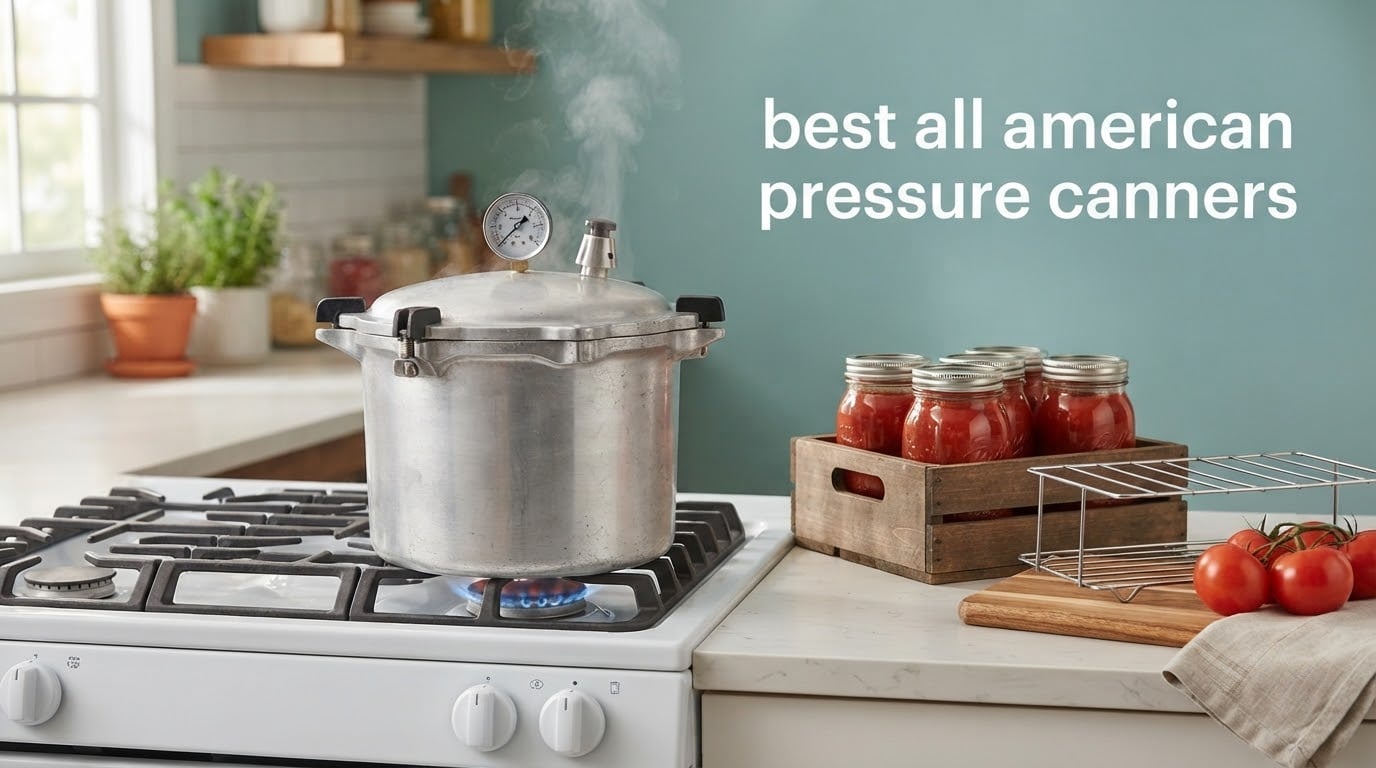
Among the All American pressure canners on the market, the All American 1930 15.5 quart pot, which the manufacturer also calls the 915, is the one we would put in the most homes. It holds four quart jars upright as a safe pressure canner must, seals metal to metal with no gasket to replace, runs on a weighted regulator instead of a dial that needs annual testing, and has been proven by more owner reviews than anything else in the category.
That said, the honest version of this answer matters. The All American line is the most expensive family of stovetop canners we looked at, and if the gap between it and a comparable Presto decides whether you can put food up this season at all, the cheaper canner is the correct purchase. We have included both sides of that comparison below, alongside two electric units, because a real buying decision is a comparison and not a brand loyalty test.
Two All American models make up the meat of this roundup: the 15.5 quart 915 and the 21.5 quart 921. The research behind this article turned up something worth repeating, which is that the whole brand rests on one design idea, metal to metal sealing with a weighted gauge, and that idea is the reason it lasts. If you are still working out the basics, our water bath canner guide covers the low-acid rule that decides whether you even need a pressure canner at all.
Our team worked through six pressure canners for this roundup, read the manufacturer material, and cross-checked owner feedback. What follows is a brand-focused guide with the closest competitors included, so you can see where the All American earns its premium and where it does not.
Table of Contents
Top 3 Picks for Best All American Pressure Canners in 2026

All American 1930 15.5 Quart 915
- Holds 10 pint or 7 quart jars
- Metal-to-metal seal with no gasket
- Weighted gauge with dial as reference only
- 18 lb cast aluminum body

All American 1930 21.5 Quart 921
- Holds 19 pint or 7 quart jars
- Metal-to-metal seal with no gasket
- Berry blue glossy finish
- Gas and electric stovetop compatible

Presto 02152 17-Quart Digital Canner
- Sensor maintains exact temperature
- No altitude adjustment required
- Holds quart jars upright
- 24.3 lb electric unit
All American Pressure Canners and Their Closest Alternatives (October 2026)
Every model below is listed with its pressure control type, jar capacity, and the practical drawback we found. The two All American pots are the models that answer this query, and the other four are the units serious canners actually weigh them against.
| Product | Specifications | Action |
|---|---|---|
| All American 1930 15.5 Quart (915) |
|
Check Latest Price |
| All American 1930 21.5 Quart (921) |
|
Check Latest Price |
| Presto 02152 17-Quart Digital |
|
Check Latest Price |
 Presto 01781 23-Quart Presto 01781 23-Quart |
|
Check Latest Price |
 NESCO NPC-9 9.5-Quart Electric NESCO NPC-9 9.5-Quart Electric |
|
Check Latest Price |
 Mirro 22-Quart Mirro 22-Quart |
|
Check Latest Price |
Do All American Pressure Canners Need a Gasket?
No. Every All American pressure canner seals its lid to the pot metal to metal, using screw-down handles and a machined rim instead of a rubber gasket, so there is no seal in the pot to replace on a schedule. That is the brand’s single defining advantage, and it is why the pot is still working after decades rather than ten years.
Two details are worth knowing before you buy. The dial on the lid is a reference indicator, not the control, and the manufacturer instructs you to rely on the weighted regulator sitting on the vent pipe. A separate rubber overpressure safety plug is the one consumable part in the whole design, and it is a low-pressure safety device rather than the primary seal.
One accuracy point that matters more than any feature list: the National Center for Home Food Preservation does not approve, certify, or endorse any brand of canning equipment. It publishes processing times for canners that meet three requirements, and you should check that any pot you buy, All American or otherwise, is built to hold four quart jars upright, controls pressure accurately, and lets you vent steam before pressurizing.
1. All American 1930 15.5 Quart (Model 915) – Our Pick for Most Homes
All American 1930: 15.5qt Pressure Cooker/Canner (The 915) – Exclusive Metal-to-Metal Sealing System – Easy to Open & Close – Suitable for Gas, Electric, or Flat Top Stoves – Made in the USA
Capacity 14.67 L
Weight 18 lb
Holds 10 pint or 7 quart jars
Cast aluminum
Pros
- No gasket to replace or money to spend on
- Weighted gauge needs no annual calibration test
- Only 18 lb empty which is light for its batch size
- Holds 7 quart jars so it qualifies as a real canner
Cons
- Costs far more than a comparable stovetop canner
- Not recommended for glass-top stoves
- Olive oil on the sealing rim every few uses
The 15.5 quart All American is the answer to a straightforward question, which is where should a serious home canner start. It is the model the owner community has tested longest, and the 4.9 rating across 9772 reviews is the largest validated track record in this group. Seven quart jars or ten pint jars per load is a batch size that keeps a household stocked without turning a Sunday into a lifting event.
Weighing in at 18 pounds empty, this is the lightest cast aluminum unit in the roundup by a wide margin, and that difference changes how a pot feels after the third batch of the season. Owners repeatedly describe lifting it onto the stove rather than carrying it, which is a two-person job or a firm-lift job either way. The 12.25 inch cube footprint also means it fits under standard range hoods where the taller units can struggle.
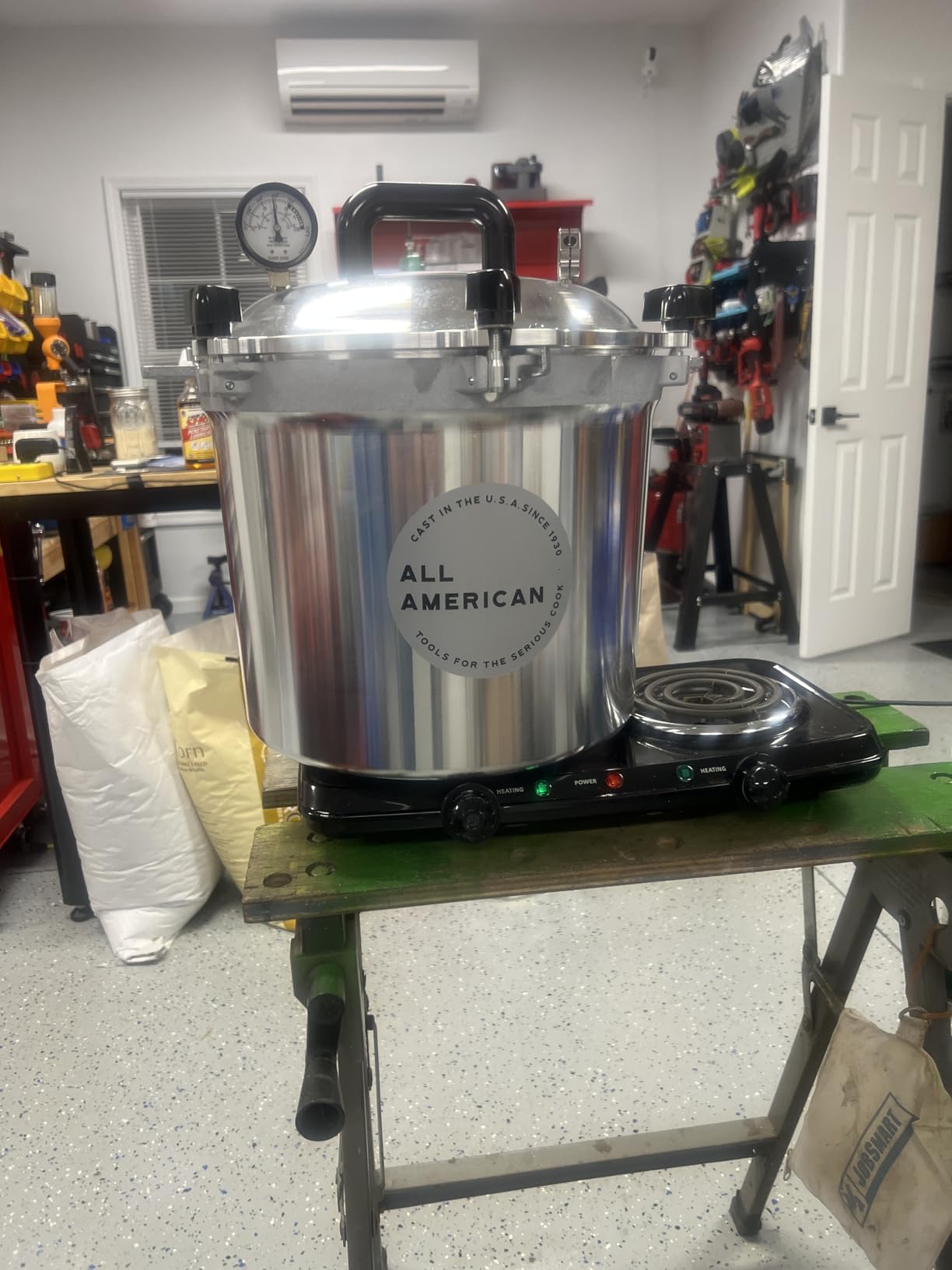
Operation is straightforward once you accept one habit. The weight goes on the vent pipe, the pot comes to a full boil, you vent steam, and then you wait for the weight to begin rocking at a slow and steady rate before starting your processing timer. Owners say the dial is there when you want reassurance, and that they use the weight for everything else. The steam gauge is easy to read and the satin finish wipes clean.
There is a small maintenance habit that catches first-time owners out. The machined sealing rim wants a film of olive oil every few uses, and the wing nuts are tightened in a star pattern so pressure seats evenly around the whole rim. Owners who skip that pattern are the ones who report an unexpected leak, and owners who follow it report none at all. The overpressure safety seal does need occasional replacement, which is the one part that eventually costs money.
What the 15.5 Quart Model 915 Does Well
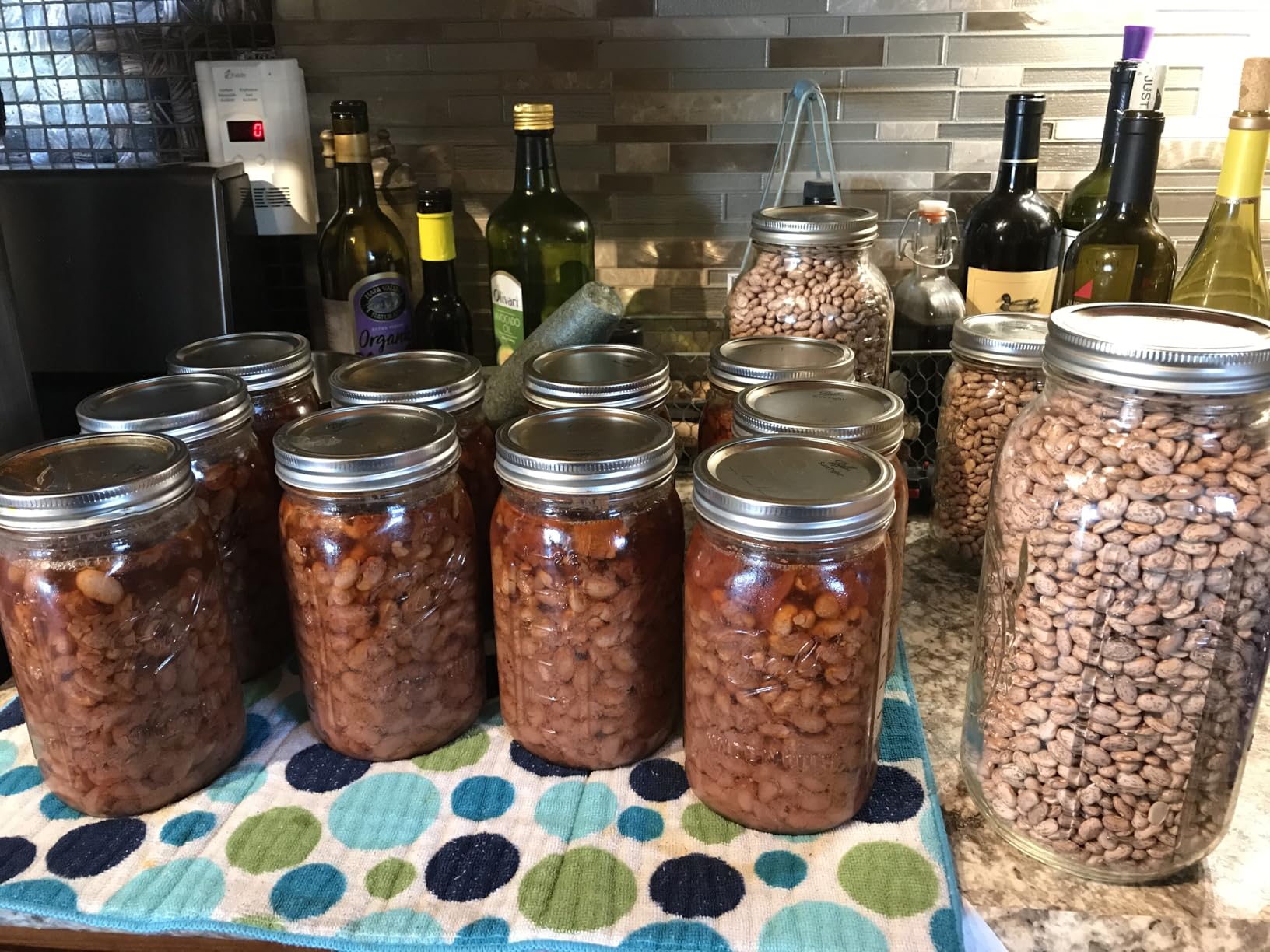
It gives you the full All American experience at the smallest sensible canner size, meaning the gasket-free seal, the weighted regulator, and the cast aluminum body all arrive in a pot that most kitchens can lift and store. Seven quart jars is a real canning batch, not a token one, so a two-person household can put up a meaningful season of low-acid vegetables in a few sessions.
For anyone who also wants to cook, the same pot handles beans, stocks, and tough cuts under pressure without a second appliance. The manufacturer lists gas, electric, and flat-top compatibility, and the 1 year limited warranty is the shortest warranty in this roundup, which is a genuine gap when the pot is built like a cast aluminum heirloom.
Where the 15.5 Quart Falls Short
If your stove is a glass-top ceramic surface, reviewers are consistent and blunt about skipping this model, because the cast aluminum base can scratch or crack the surface. Owners on induction report a different problem entirely, which is that cast aluminum is not a magnetic material and the pot simply will not heat. Plan on gas or a coil or radiant electric range before you commit.
First-time pressure canners report a real learning curve, mostly around heat management on the way to pressure rather than around the canning itself. A full load of ten pints takes a long time to reach a boil, and the pot is at its heaviest exactly when you want to move it. There is a comfort factor here that a decade of owners simply do not have anymore.
2. All American 1930 21.5 Quart (Model 921) – Best for Big Batch Days
All American 1930-21.5qt Pressure Cooker/Canner (The 921), Berry Blue – Exclusive Metal-to-Metal Sealing System – Suitable for Gas, Electric, or Flat Top Stoves – Made in the USA
Capacity 21.5 qt
19 pint or 7 quart jars
Gas and electric stovetop
Berry blue finish
Pros
- Largest pint yield of the two All American models
- Same proven metal-to-metal sealing system
- Glossy finish in a colour the silver model does not offer
- Manual hand control with no electronics
Cons
- Rating of 4.1 from only 16 reviews
- Limited owner feedback to draw on
- Costs more than the 15.5 quart model
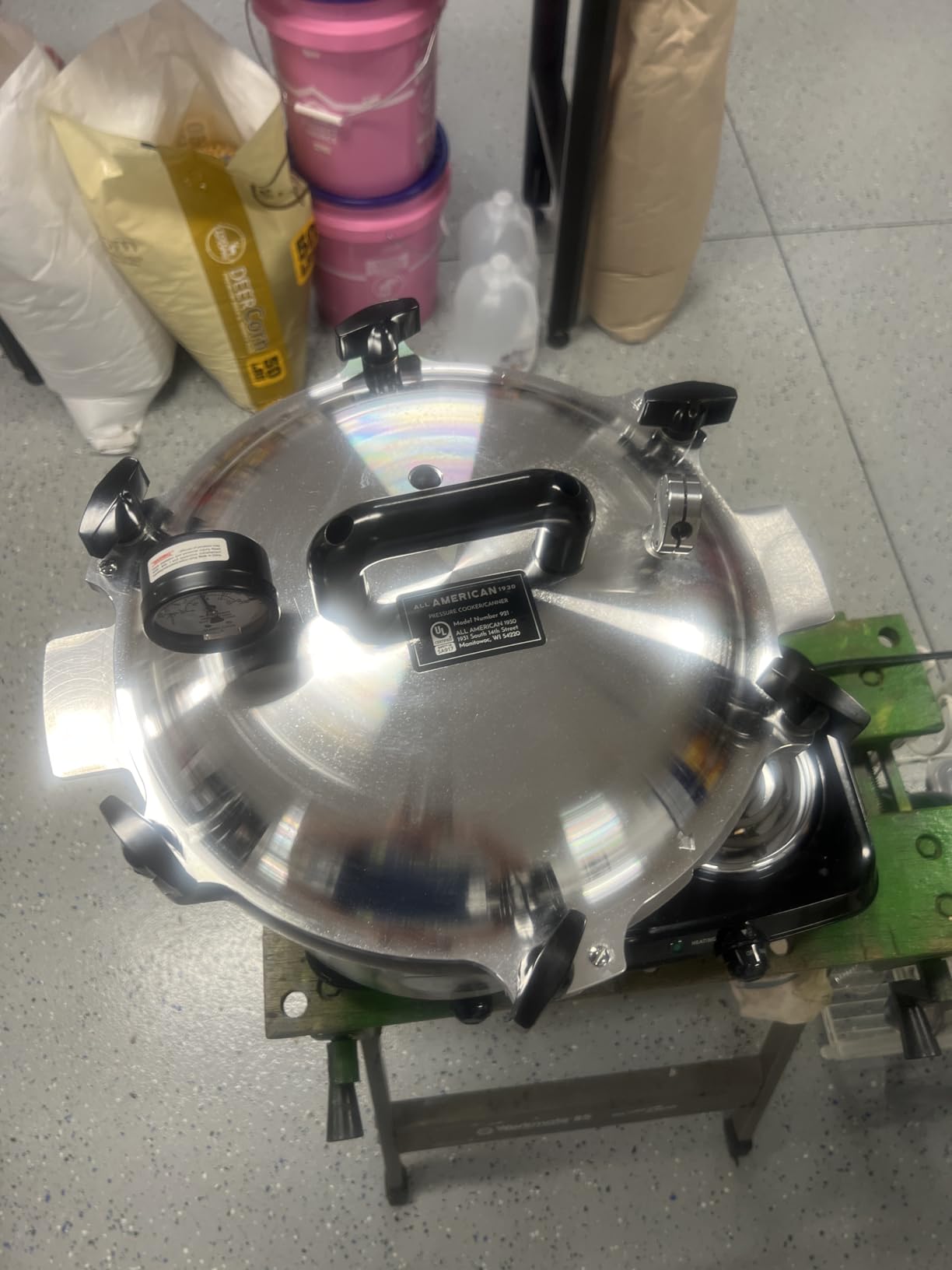
The 21.5 quart 921 is the same machine as the 915 with more pot, and that is exactly what it is for. Nineteen pint jars or seven quart jars per load is roughly double the pint output, and for a household putting up a winter pantry, a cottage food business, or a market garden’s worth of green beans, that difference is the whole point of buying a bigger canner.
The design carries over unchanged. Metal-to-metal sealing with screw-down handles, a weighted regulator on the vent pipe, a dial for reference, and the same cast aluminum body and machined rim with its olive oil habit. If you already understand the 15.5 quart, you already understand this one, and the learning curve is essentially zero.
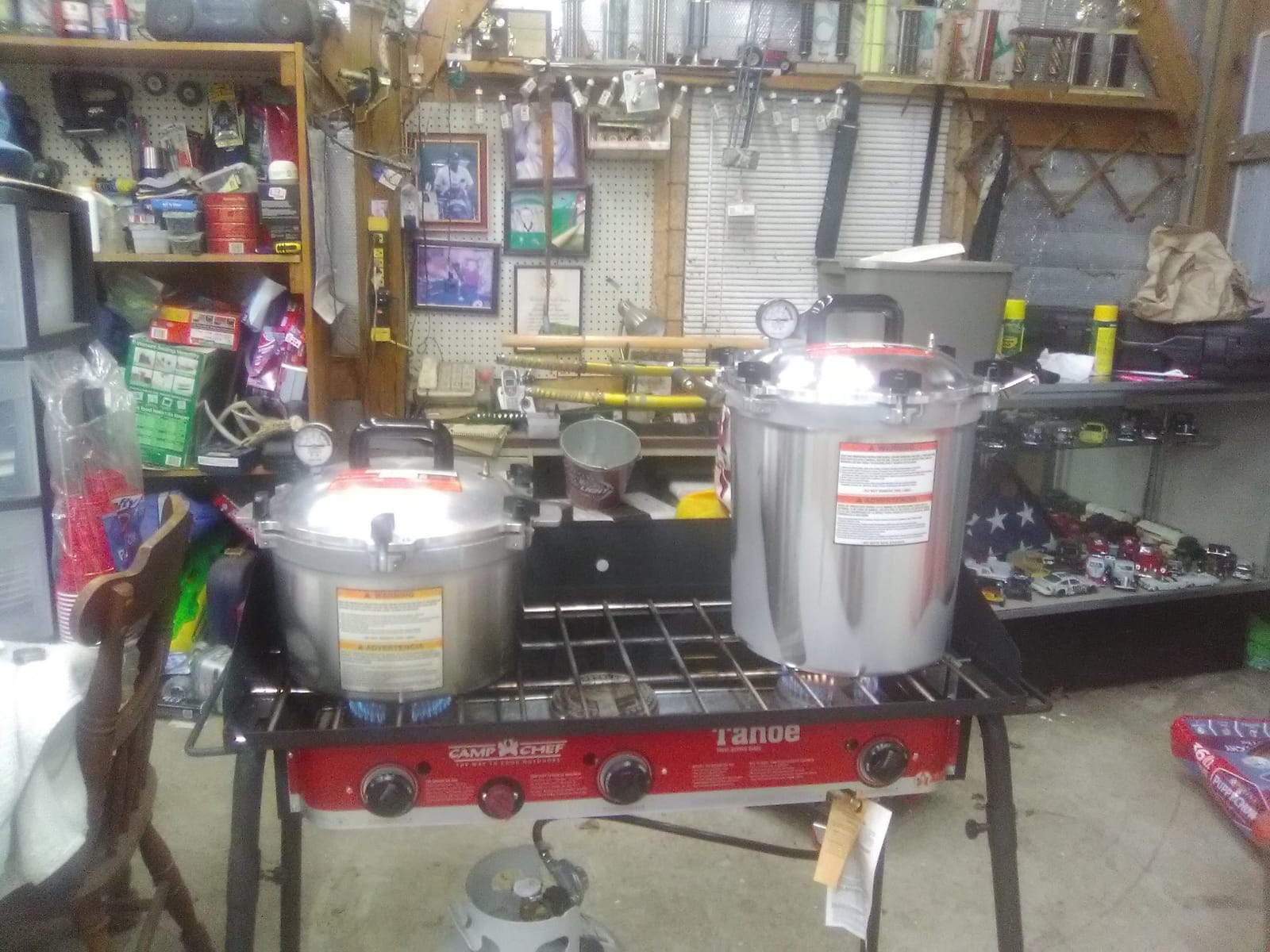
One thing buyers should weigh carefully is the feedback pool. With 16 reviews at a 4.1 rating, this listing is thin on owner history compared with the 4.9 across 9772 reviews the 15.5 quart has built up. That gap usually reflects a newer colour variant and a smaller group of owners rather than a different product, but it does mean you are buying on design reputation instead of accumulated experience.
The berry blue glossy finish is the reason most people end up on this listing rather than the silver 15.5 quart, and it is purely cosmetic, with no effect on the canning process. The pot is manual, hand-controlled, and mechanical, which for most canners is a feature, since there is no electronics to fail and nothing to reset after a power cut in the middle of a batch.
Who the 21.5 Quart 921 Suits Best
If you can a meaningful amount of food in a single sitting, this is the All American to buy. Double the pints per load means fewer heat-up cycles, fewer venting sessions, and less stove time overall, and a full load is where the gasket-free, dial-free design pays for its premium in saved minutes.
It also works well as a stock pot, since a 21.5 quart pot makes a serious quantity of bone broth. Owners running a small food business or splitting produce with a group of neighbours will get more use out of it than anyone else in this roundup.
Where the 21.5 Quart 921 Falls Short
Two years of canning at eighteen to nineteen pints per batch is a commitment, and a full pot is a serious load to move. If your canning happens in a few jars at a time, you are paying for capacity you will not use and handling weight you do not need.
The 4.1 rating on a small sample deserves attention too, and while the reviews are too few to establish a pattern, a rating that far below the sibling model’s 4.9 is worth factoring into a purchase of this size. Ask yourself whether the extra capacity justifies both the added cost and the thinner owner record.
3. Presto 02152 17-Quart Digital Pressure Canner – The Automated Alternative
Presto 02152 17-Quart Digital Pressure Canner
17 quart capacity
24.3 lb electric
Sensor-maintained temperature
Buckle closure
Pros
- Temperature sensor holds the target without watching the dial
- No altitude adjustment needed at any elevation
- LED display and control knob guide each step
- Holds quart jars for pressure and water bath canning
Cons
- Heaviest unit in the group at 24.3 lb
- Needs a dedicated outlet and 1485 watts of power
- Newer electric design so long-term durability is unproven
The Presto 02152 is the pressure canner you buy when watching a gauge feels like the part of canning you dislike. A built-in temperature sensor holds the processing temperature automatically, which removes both the manual monitoring and the altitude problem, since the sensor compensates on its own and there are no pressure steps to remember when you move to a higher elevation.
That single feature is the reason to consider it seriously. Weighted-gauge canners, All American included, run in 5, 10, and 15 pound steps, and at altitude you move up a step and shorten nothing. Here, the canner makes the adjustment for you, and the 4.6 rating across 5739 reviews suggests a lot of people are happy with that trade.

It is also genuinely dual-purpose, holding quart jars upright for both pressure canning and boiling water canning, so one appliance covers fruit, jams, jellies, pickles, and salsa as well as vegetables and meat. A control knob selects the method and an LED display walks through the steps, and a canning rack is included in the box.
There is no gasket to buy either, because electric pressure canners of this type seal under internal pressure, and the safety lock lid, automatic float valve, and pressure regulation system handle the rest. The extra-tall design is the reason it holds quart jars, and it is also the reason you need to check your counter depth before buying.
Why This One Is Not an All American, and Why That Is Fine
The cast aluminum, gasket-free, weighted-gauge design is not optional in the sense that it is a style preference. It is built for people who want a mechanical pot that never needs a plug, never needs a test centre, and can sit on a propane camp stove in a garage if that is where the canning happens. The digital canner answers a different need, which is confidence and automation.
Owners praise the sensor most, because it removes the failure mode that worries experienced canners, which is drifting pressure during a long low-acid process. The LED guidance also makes this one of the easier machines to hand to a beginner or to a helper who does not want to learn a weight system.
What to Watch Before Buying
At 24.3 pounds this is the heaviest unit in the group, and unlike a stovetop pot you cannot just lift it on and off. It needs a real counter position, a nearby outlet, and 1485 watts, which on some circuits means a dedicated line.
It is also a recent electric design, and that cuts both ways. You get the newest generation of electric canning hardware, and you are trusting a design that has not yet shown what it does after a decade of heat cycles. Aluminium-free stainless construction and the included rack are nice, but the electricity is a permanent dependency in a way a stovetop canner is not.
4. Presto 01781 23-Quart Pressure Canner – Top Rated for the Volume
Presto 01781 23-Quart Pressure Canner and Cooker
23 quart capacity
12 lb empty
Dial gauge
26 half-pints 20 pints or 7 quarts
Pros
- Largest review history in the group at 20113 reviews
- 12 year limited warranty
- 26 half-pints 20 pints or 7 quarts per load
- Includes a rack and a 76 page recipe book
Cons
- Dial gauge needs annual testing for accuracy
- Gasket needs replacement eventually
- Aluminum may react with very acidic foods
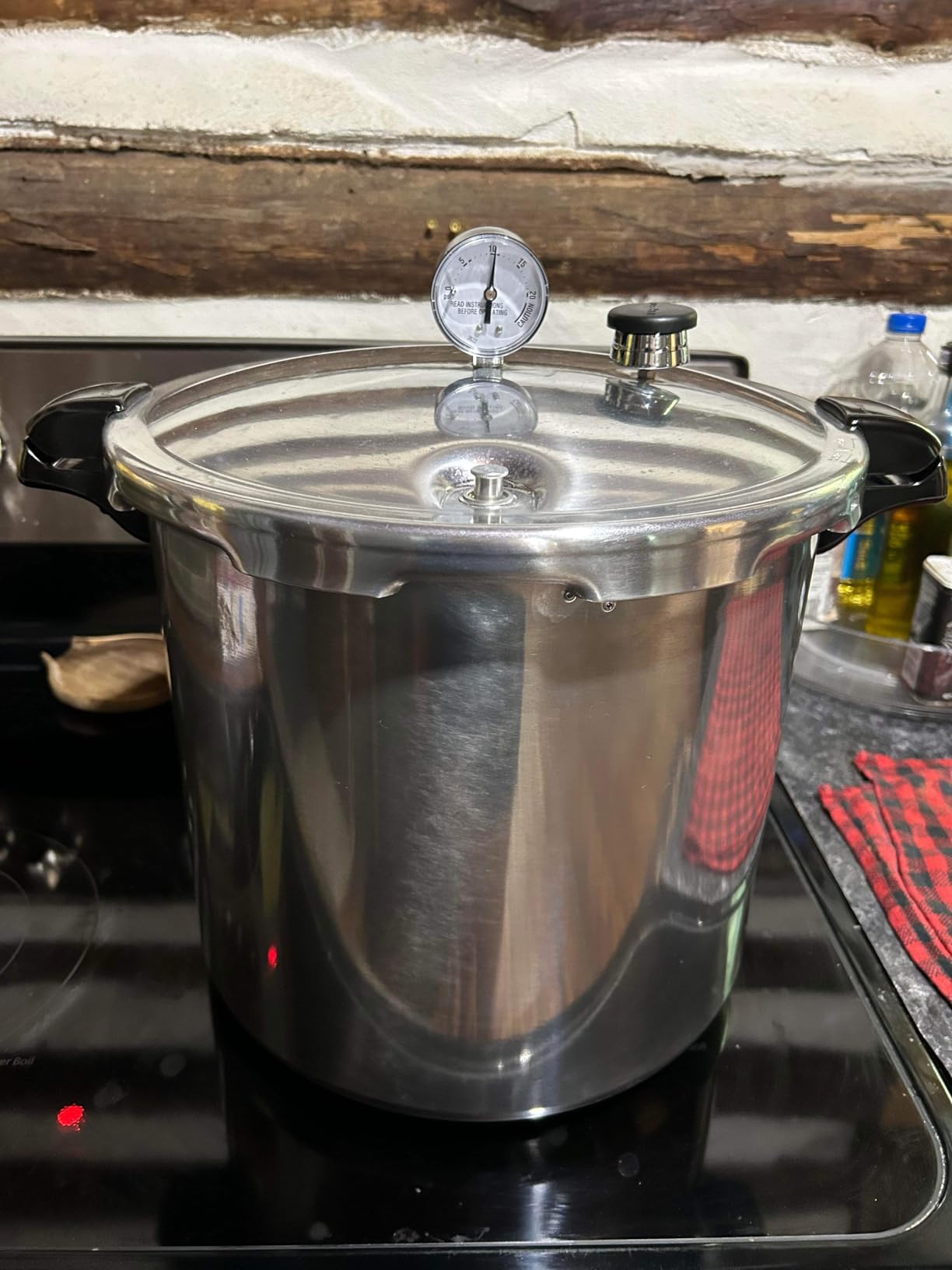
The 23-quart Presto is the answer for the buyer who wants the most food processed per unit of effort and money, and the 20113 reviews at 4.8 stars make it the most thoroughly used canner in this roundup. At 12 pounds empty it is the lightest stovetop pot here, and it holds 26 half-pints, 20 pints, or 7 quarts on a single rack.
Construction is heavy-gauge warp-resistant aluminum that works on regular and smooth-top ranges, which is a wider stove compatibility than the All American line claims. It doubles as a boiling water canner for fruits, jams, jellies, pickles, and salsa, and the deluxe pressure dial gauge registers the full processing pressure range, which is what makes it usable at altitude without a step change.

The honest tradeoff is the maintenance list. A dial gauge on a canner like this needs an accuracy test every year, and a gauge that reads more than about 2 psi off should be replaced rather than trusted. The gasket also has a service life, and aluminum is reactive enough that very acidic foods are better handled in glass or a lined pot.
That annual gauge test is where the All American argument gets emotional in forums, and it is a fair point. People who own both brands report that the moment they bought a proper adjustable weight for their Presto, the Presto came out of storage far more often. The 12 year limited warranty is the best warranty in this roundup by a wide margin, which partly answers the longevity objection.
Who Should Buy This Instead of an All American
Anyone whose budget is the deciding factor, and the gap between this and an All American pot is large enough that it changes whether canning happens this year or next. The warranty length means the long-run cost argument is not as one-sided as people assume, and the review volume means you are buying an extremely well-understood machine.
It is also the right pick for high-altitude homes that want a dial showing real pressure rather than a weighted step, and for people who would rather spend the savings on jars, fruit, and a second rack.
Where It Falls Short of the All American
Two recurring ownership costs sit on this canner and never appear on an All American. The gasket needs replacing eventually, and the dial needs testing every year, and finding a test centre is a genuine annoyance that many owners describe as a reason to avoid dial-gauge canners entirely.
Manual operation is the other factor. It requires active monitoring through the whole process, which is fine if you enjoy canning and less appealing if you are trying to walk away while it works. The 12 pound empty weight also means a full 20 pint load is a two-person lift.
5. NESCO NPC-9 9.5-Quart Electric Pressure Canner – Best for Beginners and Small Kitchens
NESCO NPC‑9 Smart Electric Pressure Canner and Cooker for Home Food Preservation, 9.5‑Quart Stainless Steel with Digital Controls
9.5 quart capacity
Digital electric
Stainless steel exterior
Fits 5 pint or 4 quart jars
Pros
- Fits 4 quart jars so it qualifies as a real canner
- Does not heat up the kitchen like a stovetop canner
- Canning rack steam rack and condensation catcher included
- Works as a pressure cooker slow cooker steamer and water bath
Cons
- Only 4 to 5 jars per batch so runs are long
- 1 year warranty
- Aluminum inner pot reacts with very acidic foods
The NESCO NPC-9 solves a specific problem, which is a small kitchen, a hot summer, or a person who wants to learn pressure canning without committing to a cast aluminum investment. It is a 9.5 quart electric unit with a removable nonstick inner pot that fits 5 pint jars or 4 quart jars per batch, and it meets the four-quart-jar minimum that makes it a legitimate pressure canner rather than a large pressure cooker.
Four quart jars is a modest batch, and that is the central compromise. The benefit is that it heats nothing on your stovetop, it does not warm the kitchen the way a gas canner does, and the digital display with preset programs and timer gives you repeatable cycles that are genuinely forgiving while you are learning what a processing time means.
The box is well equipped for the price class, with an aluminum inner pot, canning rack, steam rack, removable condensation catcher, and separate standard and high-altitude limiting valves. The safety lock lid, automatic float valve, and pressure regulation system handle the parts of pressure control that cause beginners the most anxiety.
Owners also use it four ways, as a pressure cooker, slow cooker, steamer, and water bath unit, which for a one-or-two-person household is a better use of the counter space than a large stovetop canner parked in a cabinet. The 4.7 rating across 3347 reviews reflects a well-liked small appliance rather than a specialist canning machine.
Why This Is a Legitimate Pressure Canner
The rule of thumb most guides use is simple, and a canner must hold four quart jars upright to count. The NPC-9 clears that bar, and the included high-altitude limiting valve means the pressure steps that weighted-gauge canners require are handled with a swap of a part instead of a change in process.
For someone canning for one or two people, this answers the size question that forum threads ask constantly. You are not buying a pot built for a harvest, you are buying a reliable small batcher that does not dominate the kitchen.
Where the NPC-9 Falls Short
Batch size is the limit, and anyone building a hundred-jar pantry will find 4 jars at a time painfully slow. The aluminum inner pot is the other recurring complaint, because it reacts with highly acidic foods, and wide-mouth pint jars are reported to be awkward to remove after processing.
The 1 year warranty is the shortest in this roundup, and owners note loud beeps at startup and during operation that are irritating in a small kitchen. Instructions are wordy with a learning curve, so it is easier than a weighted gauge canner but not hands-off.
6. Mirro 22-Quart Pressure Canner – The Weighted Gauge on a Budget
MIRRO 22 Qt Aluminum Pressure Canner with 3 Regulators, 5, 10 & 15 PSI
22 quart capacity
13.7 lb
5 10 and 15 psi regulators
Two racks included
Pros
- Three regulators included so you can start at the right pressure
- Weighted gauge so there is no annual dial test
- Two racks allow stacked jar batches
- Dual cool touch handles and dishwasher safe parts
Cons
- Gasket needs replacement eventually
- Rust colored staining around the steam vent after first use
- Not recommended for glass-top stoves
The Mirro 22-quart is the cheapest way into a weighted-gauge canner, and that is a real category of benefit, because weighted gauge means you are not watching a dial and not booking an annual accuracy test. Three regulators at 5, 10, and 15 psi come in the box, which is more than most canners at any price, and the two racks let you run a stacked batch rather than a single layer.
At 22 quarts with 13.7 pounds of empty weight, the capacity-to-weight ratio is competitive, and the dual cool-touch handles help when the pot is full. The locking mechanism and steam release valve give it a sound safety profile, and the natural interior with a mirror-polished exterior is easy to wipe down between batches.
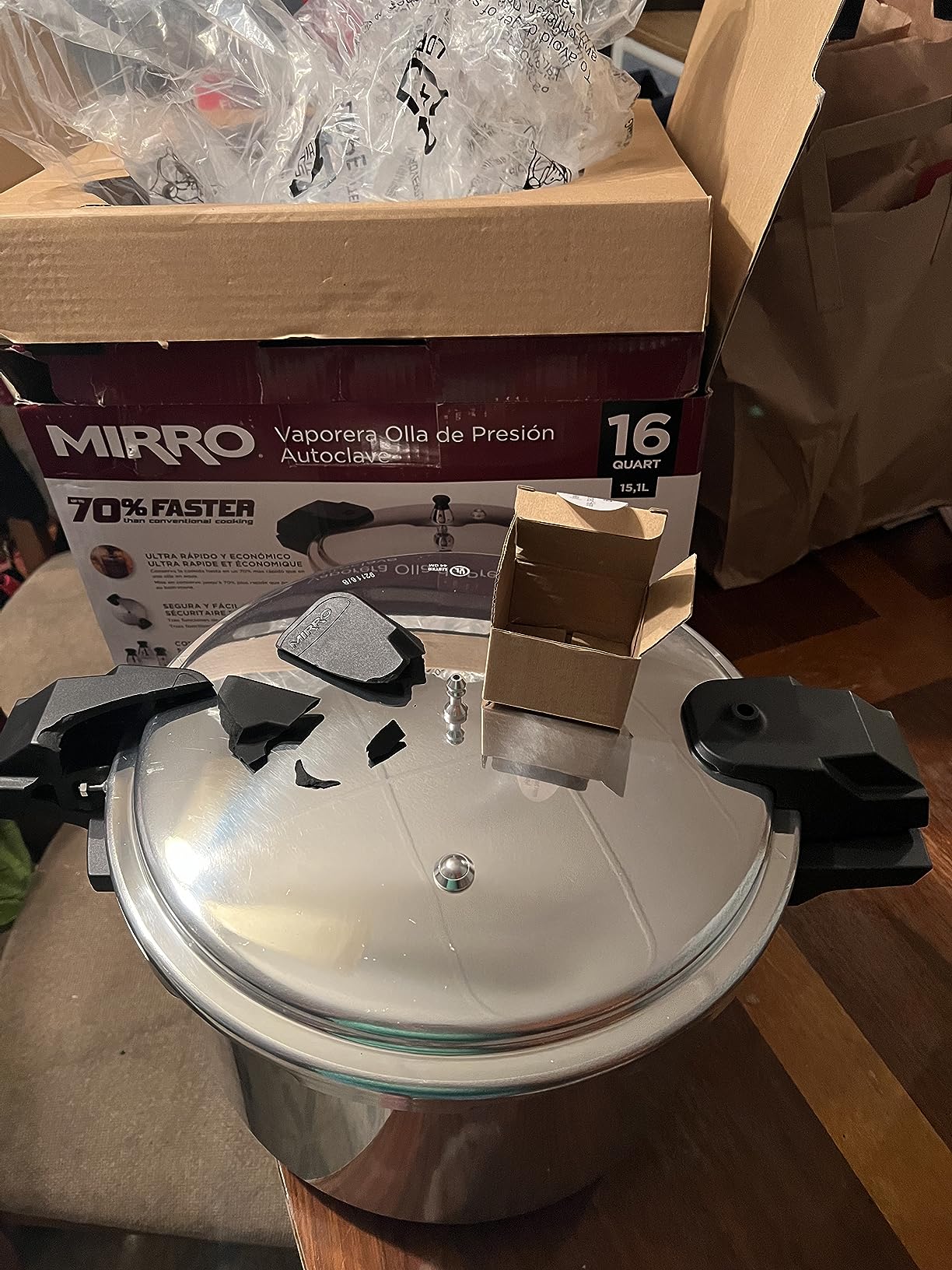
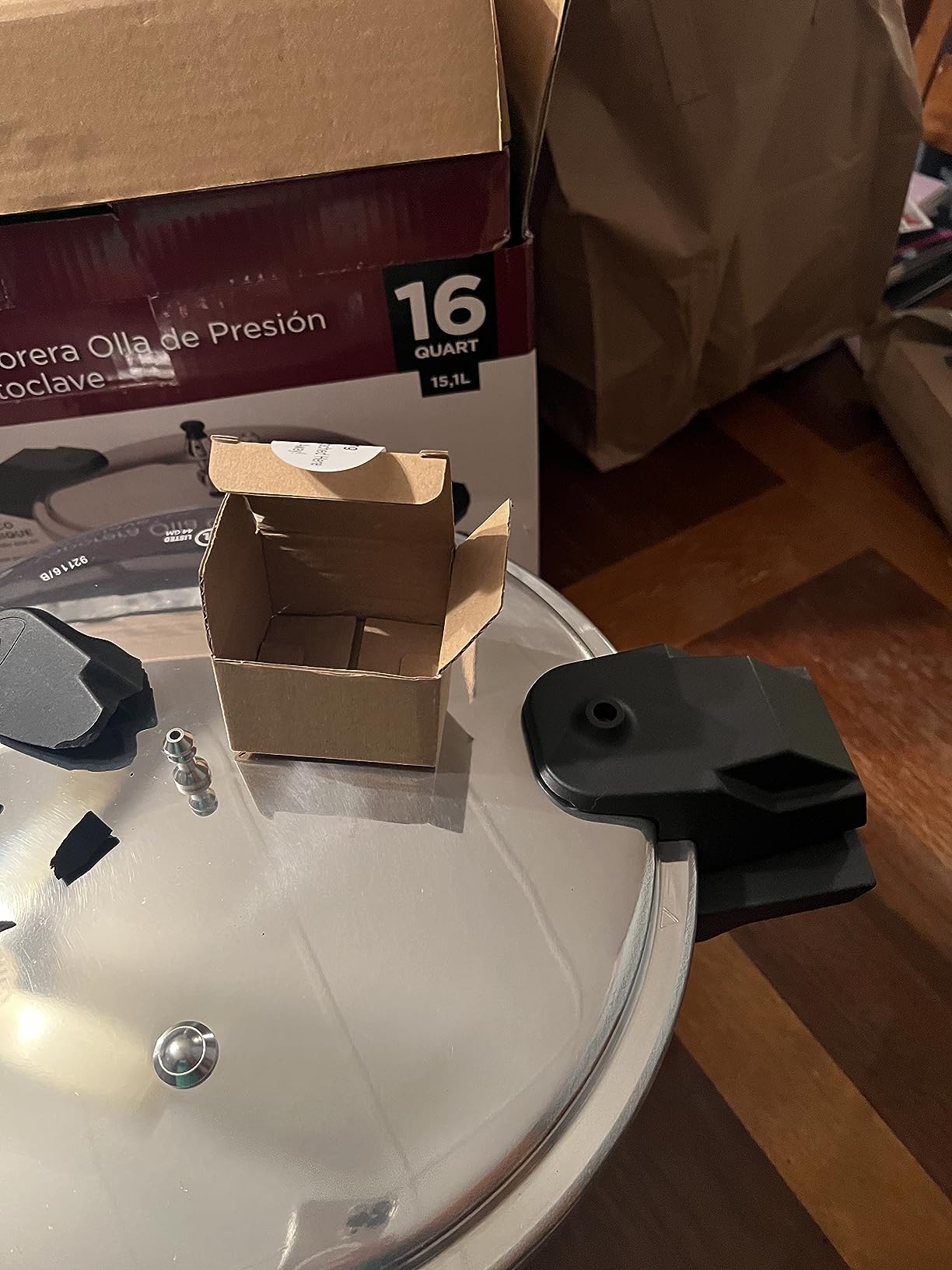
The most common complaint is cosmetic rather than functional. Owners report a rust-coloured stain that appears around the steam vent after the first use, and it does not affect operation. The second is procedural, since the regulator has to be pushed firmly onto the stem until you feel two distinct pops, and a half-seated regulator is a real hazard rather than a nuisance.
Like the other aluminum canners here, it reacts with highly acidic foods and reviewers suggest gas over glass-top surfaces. The gasket also has a service life, which is the recurring cost the All American design is built to eliminate. The 4.5 rating across 741 reviews sits in the middle of this group, which is fair for a mainstream budget unit.
What the Mirro Does Better Than a Dial-Gauge Budget Canner
Simple pressure control is the answer. A 10 pound regulator holds a processing pressure the same way on day one as it does on day five hundred, with no calibration, no test centre, and no judgement call about whether the dial is lying to you. That is the same core argument the All American makes, at a fraction of the cost.
Including all three regulators is a genuine convenience, and the two-rack setup lets you can more per load than a single-rack budget canner, which matters more than anything else when you are comparing the cost of a finished jar against a pot.
Where the Mirro Falls Short
The gasket is the ongoing expense, and unlike the All American it is a recurring part you will buy more than once over the life of the pot. That is the specific cost the All American removes, and it is worth factoring into any ten-year comparison you run.
Stainless-throw caution on stoves is the practical limit. Aluminum base on a glass-top stove is the same caution the All American carries, and reviewers are noticeably more pointed about gas for this model. With a 741 review history, the Mirro also has a thinner community record than the Presto, so you are relying more on the design than on accumulated owner experience.
How All American Pressure Control Actually Works
Almost everyone misreads the dial on an All American lid, so let us be clear about it. The manufacturer manual states that All American pressure cooker canners are weighted-gauge canners and that the pressure dial gauge is supplied as a reference only. The authoritative pressure control is the machined weight on the vent pipe, and there are three of them, at 5, 10, and 15 pounds. There is no 11 pound or 12 pound step, and home engineers who stack washers on a spindle to invent one are outside what the processing times assume.
The sequence runs like this. You put the weight on the stem, bring the pot to a full boil, and let it vent steam at that boil for ten minutes, because air in the pot changes the pressure behaviour. Then you wait until the weight begins to rock steadily, roughly three to four jiggles a minute, and only then does your processing time start counting.
At altitude, you move up a step rather than shortening the time, which is the practical reason weighted-gauge canners get an extra rule in the handbook. And there is a free self-check owners use to settle dial disagreements: compare the dial reading against the weight while it rocks, and if the two differ by more than about 2 psi, the dial is not telling you anything useful and the weight is what you follow.
What Size Pressure Canner Do You Need?
Map the batch to the household, not the other way round. A one or two person household that wants to can seasonal vegetables is well served by a small electric unit that holds four quart jars, which keeps the pot light and the process repeatable. A family of four putting up a winter pantry needs a unit that holds seven quart jars or roughly ten to twenty pints, and that is where the 15.5 quart All American sits.
Anyone with a garden, a market garden stall, or a cottage food business should buy by pints per load rather than by pot size, and the jump from ten pints to nineteen pints is the single biggest efficiency gain available in this roundup. Hold the 4 quart jar rule as a floor, since a canner that will not hold four quart jars upright is a pressure cooker, not a canner, and the processing times were not written for it.
Then check the two physical constraints people discover too late. Range hood clearance is a genuine issue, and a taller canner plus a large pot will not fit under a low hood, which is why we kept the 12.25 inch cube All American in the recommendation set. Stove weight capacity is the second one, since a full double-stack batch in a large pot is a serious load and a domestic range may not be designed for it. Cast aluminum will not heat on induction, so an induction-only kitchen rules out the All American line entirely.
All American vs Presto, Mirro and NESCO Compared
The All American is the only option in this group with a metal-to-metal seal and no dial-driven pressure, which means no gasket to replace and no annual gauge test. That is the entire premium, and it is a premium you pay for in spare parts and test centre trips that never arrive. Everything else in the comparison is about who you are and how you cook.
The Presto 01781 is the value play, with the largest review history in the group, a 12 year warranty, and the widest stove compatibility, at the cost of a gasket and a yearly dial test. The Presto 02152 trades the mechanical system for a temperature sensor, which removes altitude adjustments and monitoring but adds a power dependency and the highest empty weight here at 24.3 pounds.
The NESCO NPC-9 is the small-batch and small-kitchen answer, with the lowest capacity that still qualifies as a canner at four quart jars, and it leaves the kitchen cool while it works. The Mirro 22-quart is the cheapest entry to weighted-gauge pressure control, with three regulators and two racks in the box, and it keeps the gasket cost that the All American design exists to eliminate.
None of the four alternatives solves the two problems an All American solves, which are a seal that never expires and a regulator that never needs calibrating. If those two facts do not matter to you, the money is better spent on jars and produce.
How to Choose a Pressure Canner in 2026
Start with control type, because it decides the rest. Weighted gauge means mechanical simplicity and step-based pressure with no testing, and it is what the All American, the Mirro, and the Presto 01781 offer in different forms. Dial gauge means you see the actual pressure and can adjust precisely, which is useful at altitude and comes with an annual test. Digital means a sensor does the work and an outlet must be nearby.
Next, decide capacity against the smallest batch you will realistically run, and hold the four quart jar minimum as a hard floor. A canner you can lift and load with five jars will be used more than a canner you avoid because every batch is a two-person lift, and that is the most common regret owners report about oversizing.
Then check the physical stuff that no product page mentions. Measure your hood clearance, confirm your stove is gas or a conventional electric range rather than induction, and check the burner size. If you are buying electric, confirm the circuit can carry the draw without sharing with a microwave or a heater, since these units pull well over a thousand watts.
Finally, be honest about who should not buy an All American. If the cost difference decides whether you can food this season, buy the canner you can afford. If you can barely lift a heavy pot, the cast aluminum models are the wrong tool. If you are on induction, the entire line is out. And if you just want to cook beans, our pressure cooker guide will serve you better and cost less.
Frequently Asked Questions
Is there a pressure canner that doesn’t require a gasket?
Yes. The All American line seals its lid to the pot metal to metal with screw-down handles, so there is no gasket to replace. The only rubber part is a low-pressure overpressure safety plug, and a dual-lid electric unit like the NESCO NPC-9 also avoids a traditional gasket.
What is the easiest canning system for beginners?
Most beginners do best with a small electric canner that holds four quart jars, such as the NESCO NPC-9, because preset programs and a temperature sensor remove the monitoring and altitude steps. If you want a stovetop pot, a weighted-gauge model with a 5, 10 and 15 pound regulator set is simpler than a dial gauge.
What is the easiest pressure cooker to use for canning?
Any pressure cooker that holds four quart jars upright can be used for canning, and the all-metal units avoid gasket replacement entirely. A small electric pressure cooker with a locking lid and float valve, such as the NESCO NPC-9, is the easiest to learn on, while a stovetop model with a weighted regulator is the cheapest to run over time.
Do All American pressure canners need gaskets?
No. The lid clamps to a machined metal rim with screw-down handles, so there is no gasket in the seal. The separate rubber overpressure safety plug is a low-pressure safety device, not the main seal, and it is the only consumable rubber part in the design.
How heavy is an All American pressure canner?
The 15.5 quart model weighs 18 pounds empty, and larger cast aluminum models are heavier still. Owners typically set the pot on the burner rather than carrying it, and a full batch adds the weight of 20 to 40 pounds of jars and food on top of that.
Final Verdict: Which Pressure Canner Should You Buy?
For most people reading this, the All American 1930 15.5 quart is the answer. Seven quart jars, no gasket, no annual gauge test, 18 pounds empty, and the longest owner record of anything in this roundup. If you are putting up a genuinely large pantry, step up to the 21.5 quart 921 for nineteen pints a load.
If the All American price is the thing standing between you and a season of food, buy the Presto 01781 and put the savings into jars and produce. The right pressure canner, as the owners who use both brands keep saying, is the one you will actually reach for. Check the latest prices on each of the models above and decide against your stove, your hood, and your back.