
An oxygen absorber is a small sealed packet containing iron powder that chemically binds the oxygen inside a closed container, pulling levels down below 0.01% and preventing the oxidation that turns dry grains, flours and seeds rancid, stale or moldy. The process is one-way and takes roughly four hours to reach rated capacity inside a properly sealed container. Our pick for most people is the O2frepak 200cc 100-pack, with the ZRLEI 400cc and FreshUs 300cc close behind for larger mylar bags and mason jars.
We spent six weeks working through ten oxygen absorber packs across the full size range, from 100cc packets for quart jars to 1000cc packets for 5-gallon buckets. We read every spec sheet, counted packets per inner pack, checked whether the master bag reseals, and looked hard at the review patterns for split packets, lost potency and misleading indicators. Ratings alone do not tell you much in this category, so we weighted practical details like pack format and honest sizing guidance heavily.
One warning before we get into the list. Oxygen absorbers only work on properly dried food. Anything above about 10% moisture creates a botulism risk that no packet can fix, and sugar, salt and baking soda will clump into hard bricks rather than stay usable. If you are new to this, read the section on foods to avoid before you seal anything.
Table of Contents
Top 3 Picks for the Best Oxygen Absorbers for Food Storage (October 2026)
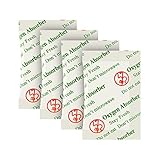
O2frepak 200cc 100-Pack
- 200cc capacity
- Anti-oil film design
- Triple-tested absorption
- 7.84 ounce pack

ZRLEI 400cc 100 Count
- 400cc for 1-gallon bags
- Packs of five
- Double-layer film
- Food-grade packaging
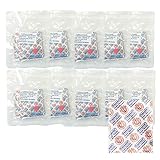
FreshUs 300cc 10-Pack Bundle
- 300cc capacity
- Ten packs of ten
- Made in the USA
- Works in jars and mylar
Those three cover the majority of home storage situations, and they do it for three different reasons. The O2frepak pack has the deepest review history in the group at more than 5600 ratings, which is the only real evidence available for a product whose payoff shows up years later. The ZRLEI 400cc is built for 1-gallon mylar bags and comes in packs of five so you are not opening ten packets to seal two bags. The FreshUs 300cc is the one to buy if mason jars are your main container, because the ten-packet inner packs limit how much of the batch you expose to air.
All 10 Oxygen Absorbers Compared at a Glance
| Product | Specifications | Action |
|---|---|---|
| O2frepak 200cc 100-Pack |
|
Check Latest Price |
| FreshUs 300cc 10-Pack Bundle |
|
Check Latest Price |
| ZRLEI 400cc 100 Count |
|
Check Latest Price |
 LIFJOY 500cc 120-Pack LIFJOY 500cc 120-Pack |
|
Check Latest Price |
 OxySorb 100cc 100-Pack OxySorb 100cc 100-Pack |
|
Check Latest Price |
 Wallaby 500cc 100 Count Wallaby 500cc 100 Count |
|
Check Latest Price |
 PackFreshUSA 500cc 50-Pack PackFreshUSA 500cc 50-Pack |
|
Check Latest Price |
 Hombao 700cc 100-Pack Hombao 700cc 100-Pack |
|
Check Latest Price |
 LinsKind 300cc 120-Pack LinsKind 300cc 120-Pack |
|
Check Latest Price |
 WOLF GROUP 1000cc 30-Pack WOLF GROUP 1000cc 30-Pack |
|
Check Latest Price |
Read across that table and two patterns stand out. First, capacity is the only real differentiator, because the iron chemistry is nearly identical across brands. Second, every pack that groups packets into tens exists for the same reason: an opened absorber starts working immediately, so unused packets are the most common thing wasted in this category.
How Oxygen Absorbers Actually Work
The chemistry is simple. Inside the packet is finely ground iron powder. Oxygen from the air inside your container passes through the packet’s semi-permeable outer film and reacts with the iron, oxidising it into rust. The oxygen molecules become chemically bound to the iron and cannot get back out, which is why the reaction only runs one way and why a used packet is permanently spent.
Rated capacity is measured in cubic centimetres, and it refers to the volume of oxygen the packet can absorb, not the volume of the container. That distinction trips people up constantly. A 300cc packet is rated for 300cc of oxygen, which works out to roughly 1500cc of ordinary air because air is only about one fifth oxygen.
Two practical consequences follow. First, your bag will not collapse the way a vacuum bag does. You will remove about a fifth of the air volume and the remaining four fifths simply expands to fill the gap. If your bag visibly shrank, you pulled a vacuum, not just an absorber. Second, absorbers do nothing about moisture. That is a desiccant job, and a silica gel packet is the right tool for dampness.
1. O2frepak 200cc Oxygen Absorbers, 100 Pack
O2frepak 200CC(100Packets) Food Grade Oxygen Absorbers Packets Food Storage
200cc capacity
100 packets
Anti-oil film design
7.84 ounces
Pros
- Largest review base in this roundup at more than 5600 ratings
- Anti-oil film works for both oily and non-oily foods
- Material triple-tested for absorption capacity
- Four-stage quality control
Cons
- Not individually wrapped
- so opening the pouch exposes every packet
- Does not pull a visible vacuum in bags
This is the pack we keep reaching for, and the reason is the review history. At more than 5600 ratings it is the only product in this roundup with enough long-term owner feedback to say anything at all about how it performs after a couple of years in a sealed container. Everything else here is a shorter book. The 200cc size is also the most flexible tier in the category, working for half-gallon mylar bags, large mason jar batches and smaller container groupings without being oversized.
The listing credits an anti-oil film design, which is a genuinely useful detail rather than marketing filler. Many absorbers are built for dry, starchy food and perform poorly with high-fat items because the oil blocks the iron surface. This pack is rated for both, which covers homemade jerky, nuts and freeze-dried meals as well as rice and beans. The packet material is described as tested three times for absorption capacity under food regulation.
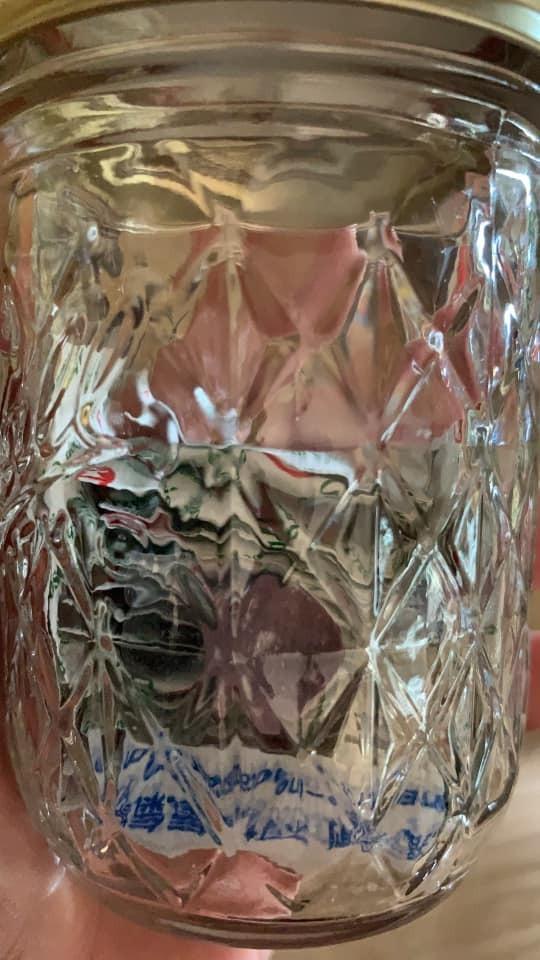
Our main criticism is packaging rather than performance. All 100 packets sit loose in one pouch, so the moment you open it every packet in the bag is exposed to open air and begins reacting. In practice that means you should only buy this size if you can seal a meaningful number of containers in one session. If you are packing a few jars a week, the ten-packet inner packs on the FreshUs or PackFreshUSA options make far more sense.
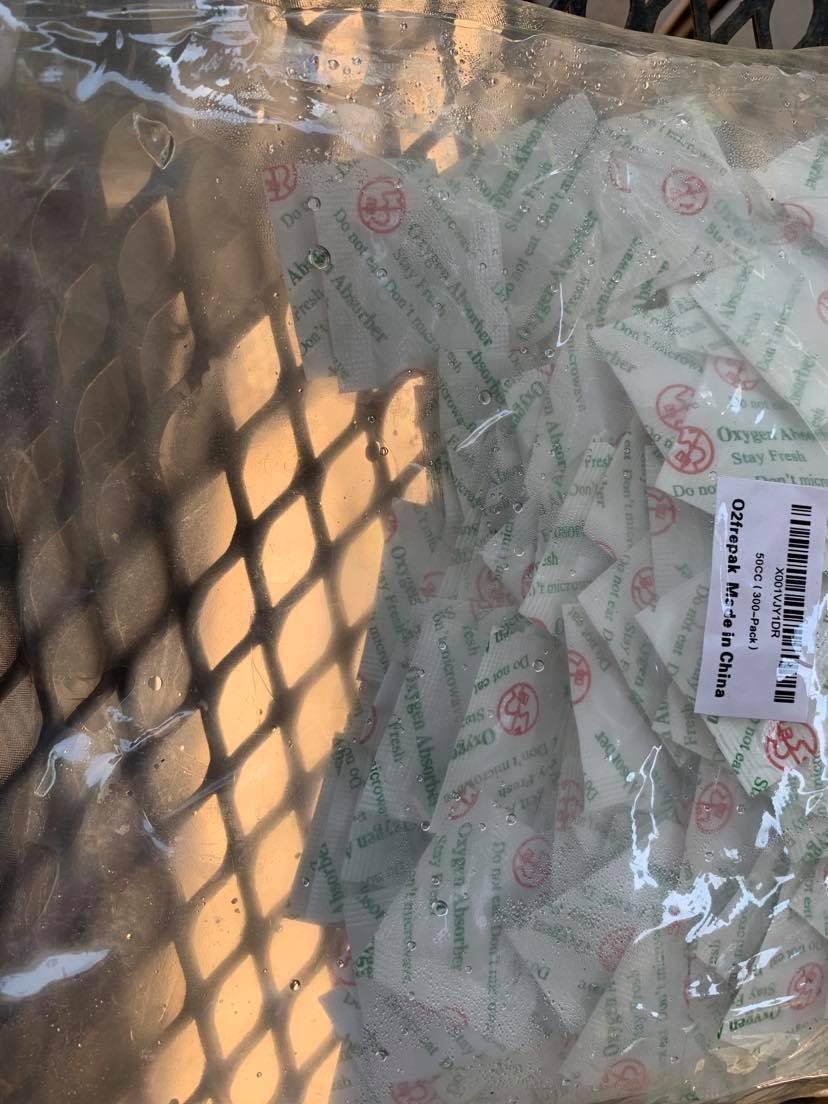
The second expectation-setting point: users regularly report being disappointed that the bag does not shrink. That is the oxygen-versus-air misunderstanding we described above, and it is the single most common complaint in the review set for this product. Judge it by the smell and taste of the food a month later, not by whether the bag looks vacuum-packed.
When This Pack Makes Sense
This is the right buy for anyone filling mylar bags in volume, working through a large harvest of home-dried food, or stocking a serious reserve. The 200cc tier handles most half-gallon bag jobs, and the anti-oil film means you do not need a separate product for jerky or nuts. If you can seal ten or more containers in a sitting, the loose pouch costs you nothing extra.
It is also a sensible default for anyone who has never used an absorber and wants to see how it behaves. A large body of owners reporting the same results is more reassuring than a smaller pack with a better-sounding spec sheet.
When You Should Pick Something Else
Skip it if you are sealing food slowly, a few jars at a time, because unused packets will lose potency in the open pouch. Choose a pack grouped into tens instead. It is also the wrong size for a 5-gallon bucket of rice, and it is not designed for liquid or fresh produce.
If your priority is seeing visible proof that absorption happened, expect a different experience. The OxySorb 100cc does that better in quarter-size containers.
2. FreshUs 300cc Oxygen Absorbers, 10 Packs of 10
FreshUS 300cc Oxygen Absorber(10 individual pack of 10 Packets, Total 100 Packets) – Long Term Food Storage (100, 300 CC)
300cc capacity
10 packs of 10
Made in the USA
Works in jars and mylar
Pros
- Subdivided packaging limits air exposure to ten packets at a time
- Smaller upgraded packet with the same rated effectiveness
- Endorsed by Harvest Right for freeze-drying use
- Listed as made in the USA by a food packaging specialist
Cons
- Outer pouch is opaque
- so you cannot see the inner packs
- Opening a pack of ten still exposes the remainder
- Indicator disc can discolor and confuse new users
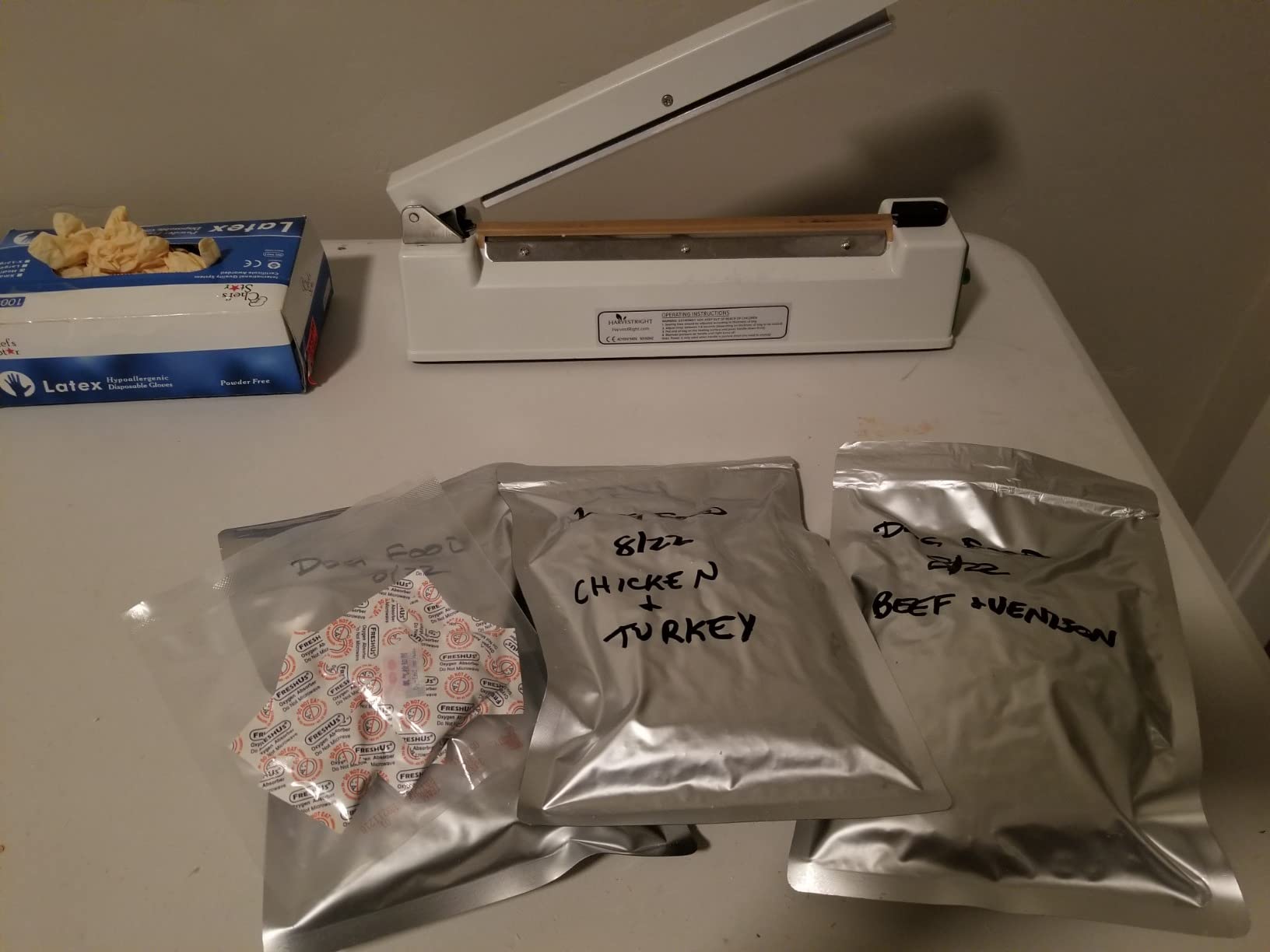
FreshUs is the pick for mason jar users, and the reason is the packaging design rather than the chemistry. You get ten individually sealed packs of ten packets, so opening one pack only exposes nine packets that you are not using. The listing also notes the upgraded packet is physically smaller than the previous version while carrying the same rated effectiveness, which matters if headspace is tight in your jars.
It is one of the few products here that states its country of origin. The technical details describe being made in the USA by a company focused on food packaging since 1993, and the brand is endorsed by Harvest Right for freeze-drying use. That endorsement explains why the same community keeps recommending it alongside Harvest Right equipment, and it is why we think it sits well next to a good food dehydrator in a home setup.
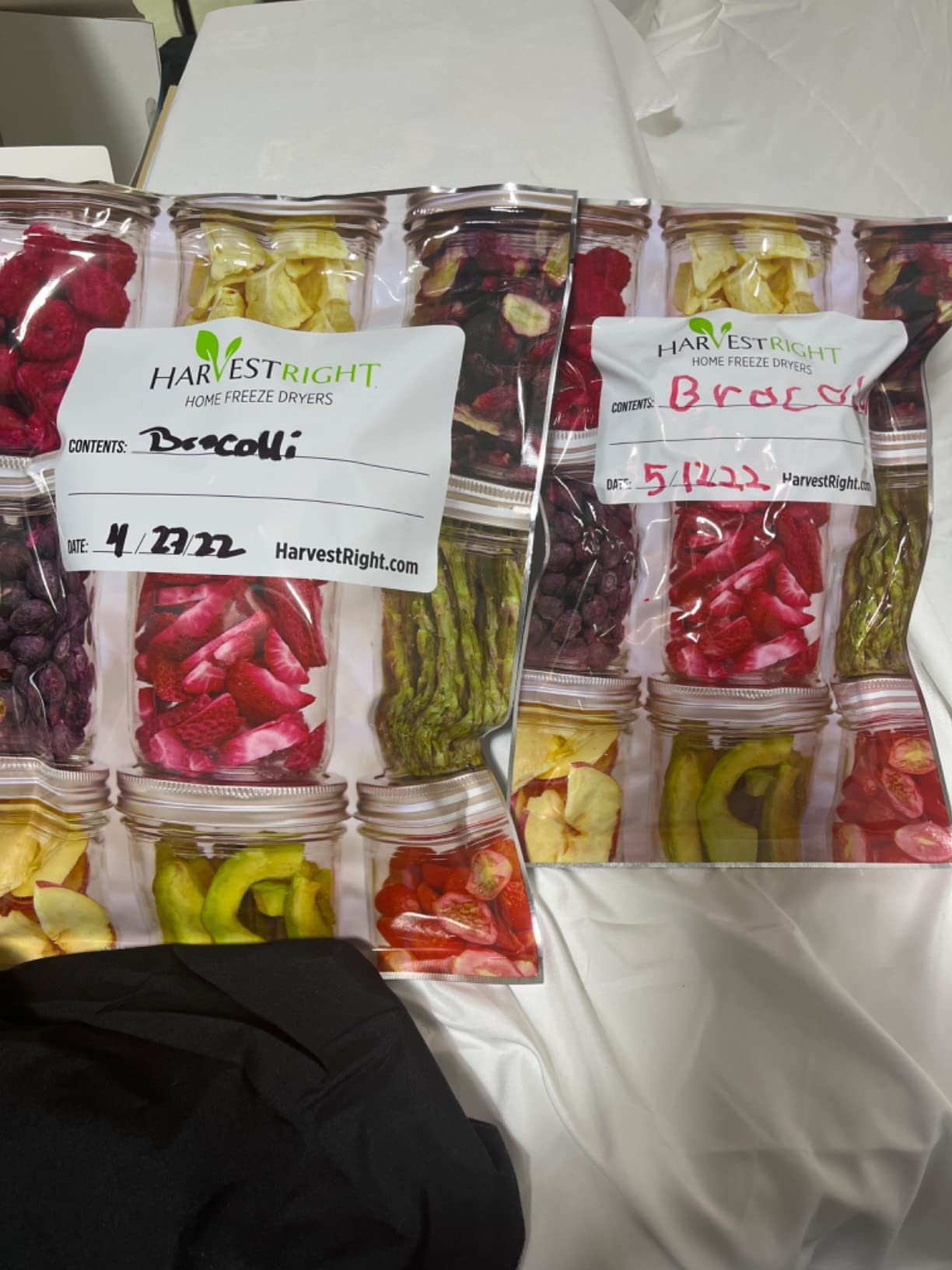
The 300cc capacity is a middle tier that works across quart mason jar batches, half-gallon and 1-gallon mylar bags, and vacuum bags. Reviewers consistently report years of shelf-stable storage across rice, beans and freeze-dried meals. The product is also easy to use alongside a processor for turning dried bulk food into powders, since a 300cc packet covers a substantial jar at once.
Two drawbacks are worth stating plainly. The outer pouch is not see-through, so you cannot visually confirm how many inner packs remain without opening it. And a common review theme is confusion over the indicator disc changing colour, which we cover in detail further down.
When This Pack Makes Sense
Choose this if your storage plan is mason jars rather than bulk buckets, or if you seal food in small batches across many sessions. The ten-packet grouping means a pack sitting in a cupboard for six months still has usable packets when you finally need them. It is also the safest pick for anyone who wants a documented USA origin.
If you run a freeze dryer or plan to, this is the one to buy. The 300cc tier handles a full jar of freeze-dried output in a single packet.
When You Should Pick Something Else
You need a larger capacity for 1-gallon mylar bags, where a 400cc or 500cc packet is the better match. And if your biggest container is a quart jar, a 100cc packet is a better fit and this size is simply oversized.
Buy the LinsKind 300cc if packet count matters more to you than origin, since you get 120 packets rather than 100 in a similar tier.
3. ZRLEI 400cc Oxygen Absorbers, 100 Count in Packs of Five
400cc Oxygen Absorbers for Food Storage – 100 Count (20x Packs of 5) – for Long Term Food Storage & Survival, Mylar Bags, Canning, Harvest Right Freeze Dryer, Dehydrated, and Preserved Foods
400cc capacity
100 packets in packs of five
0.34 kg
Food-grade packaging
Pros
- Packs of five cut waste when sealing only a couple of bags at a time
- 400cc is the right tier for 1-gallon mylar bags
- Double-layer anti-oil film handles freeze-dried and oily foods
- Heat sealed immediately after production
Cons
- Only offered in a single 400cc size
- so smaller containers need a different product
- Bags will not shrink because absorbers remove oxygen not air
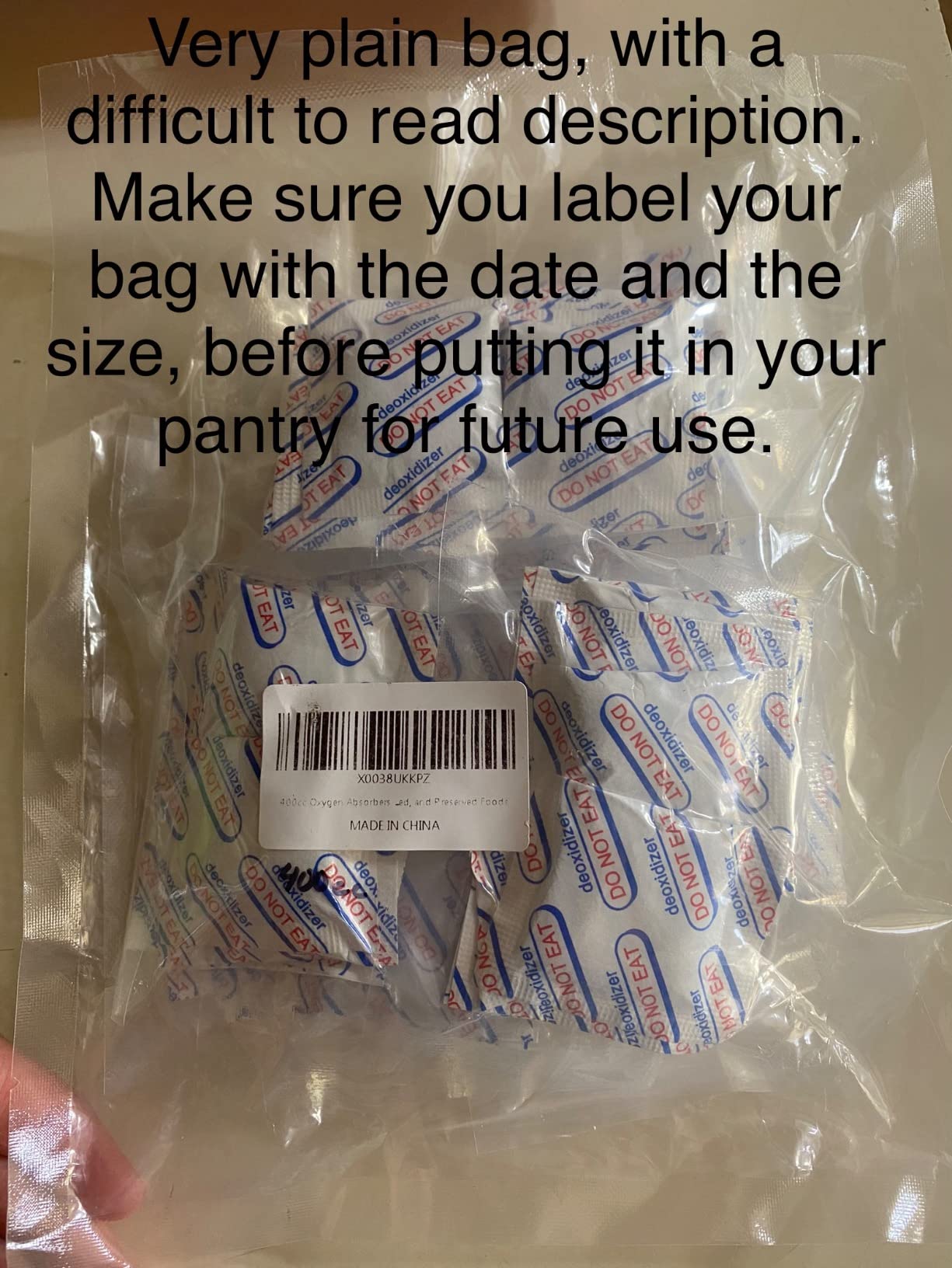
The ZRLEI 400cc is the most precisely targeted product in the list. A 1-gallon mylar bag is the single most common long-term storage container out there, and 400cc is the capacity tier that matches it without being oversized. The listing states this directly, which tells you the brand understands the sizing problem rather than just selling packets by weight.
The packs of five are the detail that won us over. Most competitors ship in tens, which is still too many if you are sealing two or three bags in an evening. Five lets you finish a batch and put the rest back. Reviewers mention this format repeatedly as the reason they keep coming back, and the 0.34 kg pack weight is a decent proxy for how much iron powder you are getting.
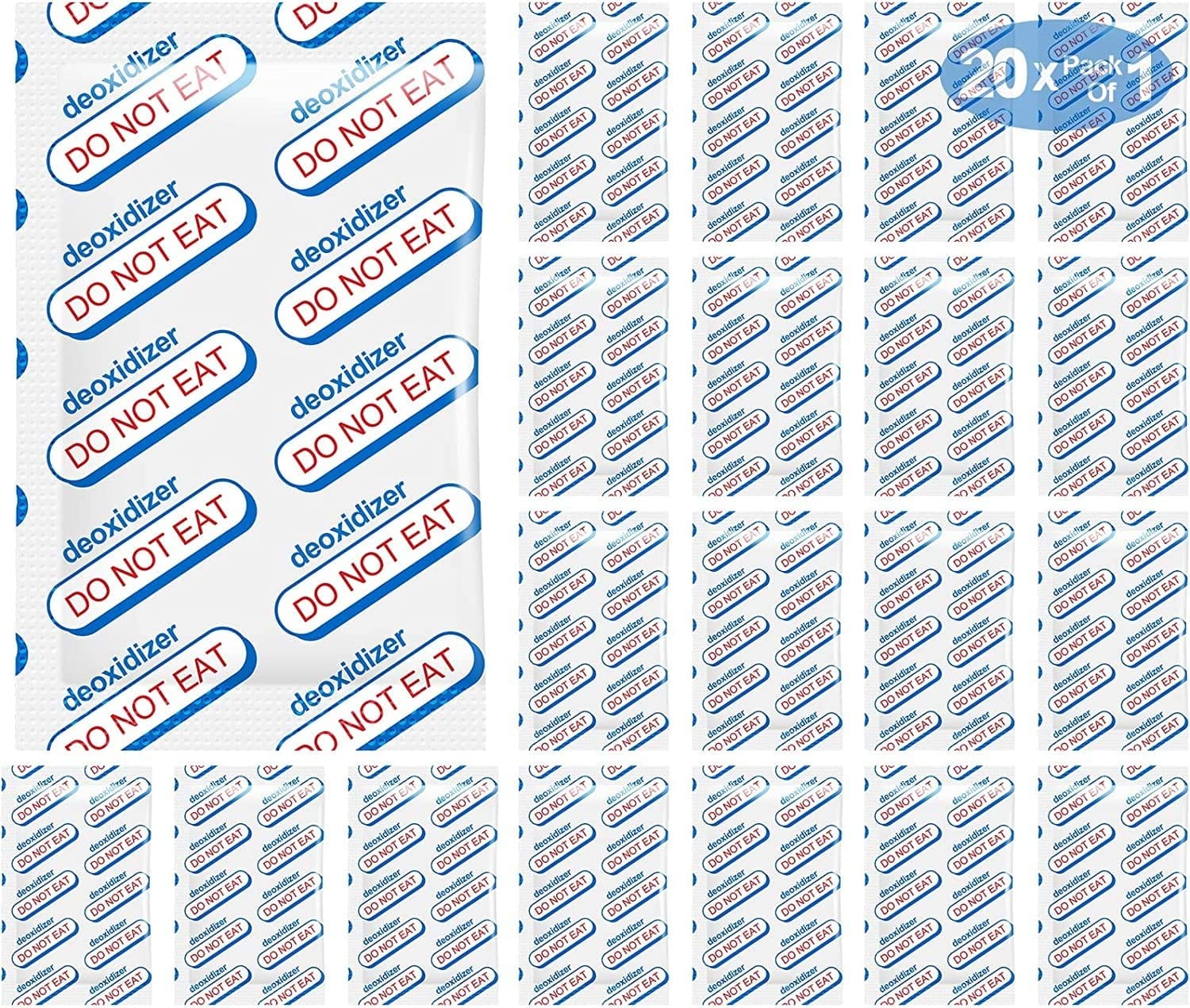
Freeze-dried and dehydrated food users are the core of the review base here, with consistent reports of food staying fresh across multi-year storage. The double-layer anti-oil film means the same packet works for freeze-dried strawberries as it does for wheat berries, which avoids buying a separate product for high-fat foods. Packaging is described as food-grade material that passed strict food testing.
The honest limitation is that this is a single-size product. If you also store smaller quantities, you will need a second pack. That is a real inconvenience for mixed storage, and it is why the 500cc options with broader size availability are worth a look if you want one brand across everything.
When This Pack Makes Sense
This is the one to buy if your entire storage system is built around 1-gallon mylar bags. It matches the container without waste, and the five-packet format suits someone who works through bags a few at a time rather than filling a garage shelf in one weekend.
It is also a strong choice alongside a food processor, because the 400cc tier covers ground flour and cereal output from a home-scale batch. Freeze-dryers do the same job on a different axis, and reviewers using this size with freeze-dried food report strong results.
When You Should Pick Something Else
Move up to a 500cc packet if your bags are on the larger side or air-heavy goods like flour and cornmeal are involved. Move down to 100cc or 200cc if you are working with mason jars, because 400cc in a quart jar is pure oversizing.
Skip it if you store a mix of container sizes and want a single brand to cover everything, since only one size is offered here.
4. LIFJOY 500cc Oxygen Absorbers, 120 Pack
120 Packs 500CC Food Grade Oxygen Absorbers (10 Pack in Individual Vacuum Bag ) , Oxygen Absorbers For Long Term Food Storage with Oxygen Indicator , Works in Mylar Bags, Mason Jars, and Vacuum Bags
500cc capacity
120 packets
10 pack per vacuum bag
0.44 kg
Pros
- Ten packets per vacuum bag limits waste on small batches
- Oxygen indicator disc confirms packets arrived usable
- Double-layer anti-oil film for oily and non-oily food
- Factory reports 18 years of experience with ISO9001 certification
Cons
- 500cc is oversized for anything under about 1.5 gallons
- Absorbers do not remove air so bags will not visibly collapse
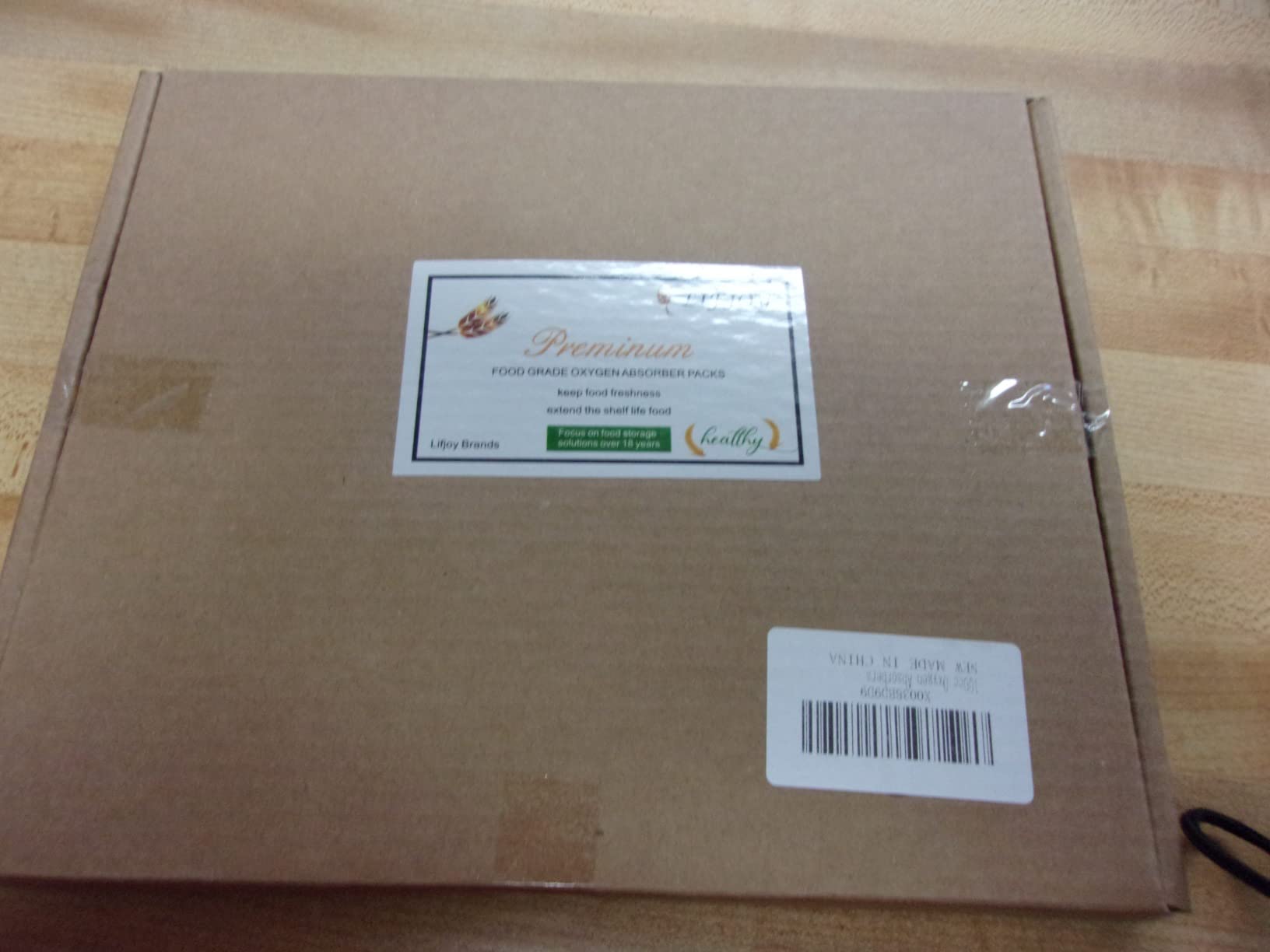
The LIFJOY 500cc works across 1-gallon bags and 1.5-gallon containers, and it carries the highest packet count of the 500cc options we tested at 120. That matters more than the headline capacity, because a household sealing steadily over a year goes through a lot of packets and count determines how long one purchase lasts.
The per-bag oxygen indicator is a small feature with real value. It tells you whether the ten packets in that bag are still viable before you commit them to a container, which is the cheapest insurance in this entire article. If a bag has been sitting somewhere warm or you are unsure how long it has been open, that disc removes the guesswork.
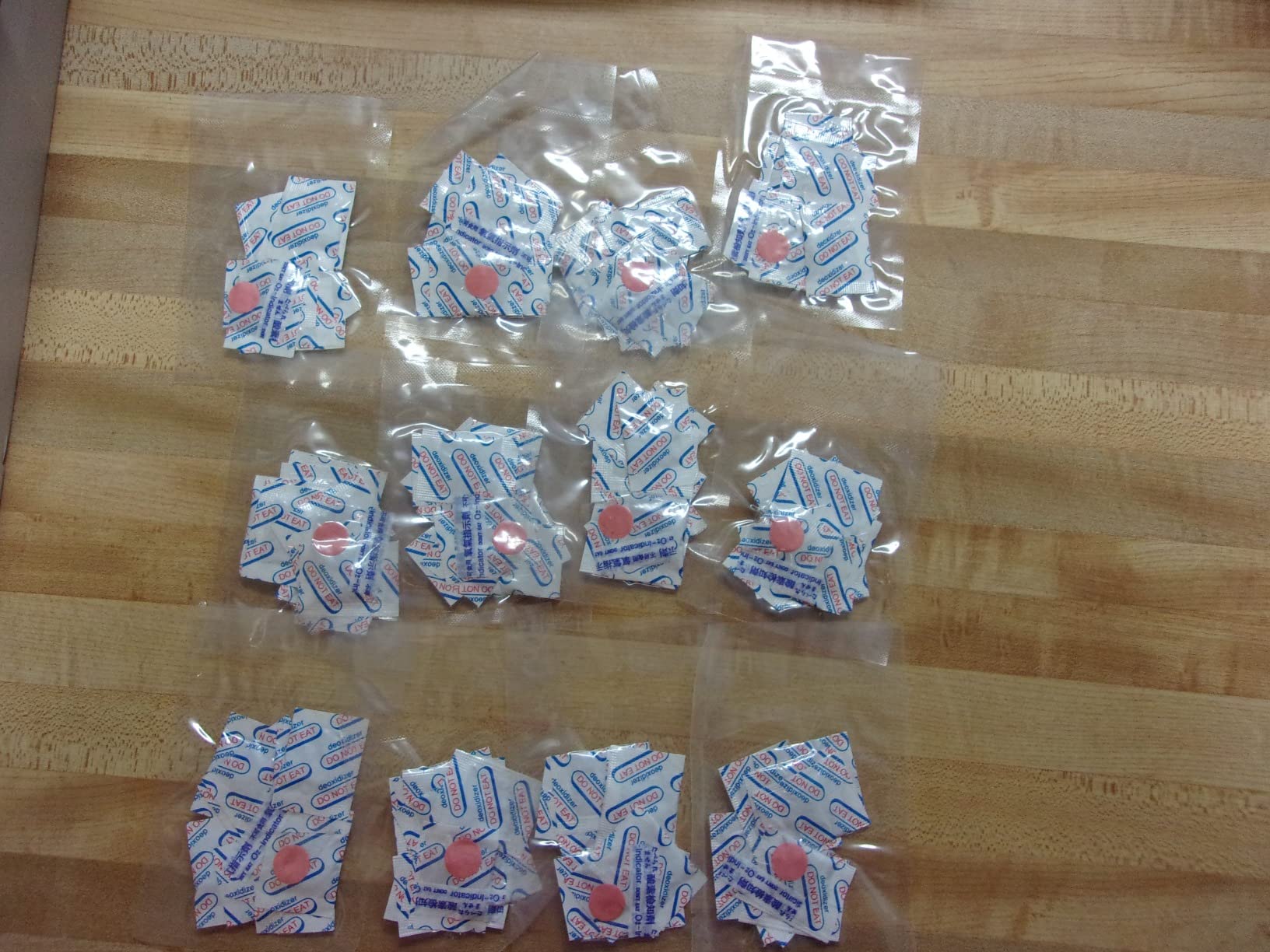
Reviewers highlight the vacuum-grouped ten-packs and the indicator as the standouts, with strong satisfaction around jerky, nuts, spices and freeze-dried food. The factory information given is specific rather than vague, citing 18 years of experience and ISO9001 certification, which is a reasonable signal given that absorption capacity depends on consistent iron granulation.
Size is the limitation. A 500cc packet is genuinely oversized for anything under roughly 1.5 gallons, and a pair of 300cc packets will do the same job in a 1-gallon bag at lower total cost. Use the 500cc tier where the container genuinely needs it.
When This Pack Makes Sense
Pick this if your storage runs to jerky, nuts, spices, candy, pet food or freeze-dried meals, since the anti-oil film is built for exactly those. It is also the one to buy if you want the highest packet count in the 500cc class and dislike running out mid-project.
The indicator disc makes it a good choice for anyone storing food over multiple years, because you can check packet viability without opening a sealed bag.
When You Should Pick Something Else
Do not use 500cc in jars or small bags. The 100cc and 200cc tiers exist for that and will do the same job. If your main container is a 5-gallon bucket, this is still one packet short of the usual recommendation of two 500cc units.
If your priority is packet count in a mid-range tier, the LinsKind 300cc pack carries 120 packets in a similar price band.
5. OxySorb 100cc Oxygen Absorbers, 100 Pack
Oxy-Sorb 100cc Oxygen Absorbers for Food Storage 100 Packs, Preserving Food Freshness with Food Grade Oxygen Absorbers for Long-Term Storage, O2 Absorbers Food Grade for Mylar Bags,Mason Jars,Canning
100cc capacity
100 packets
For containers up to 1 quart
11.2 ounces
Pros
- Reviewers report a visible vacuum pull and firm jar lids
- 100cc is a well matched size for quart jars
- Listing dates to 2001 with a long record of use
- Effective on brown sugar and dehydrated goods
Cons
- All 100 packets in a single pouch
- so opening exposes everything
- Users report about 15 minutes of working time after opening
- Packets get warm in open air and reseal warnings are easy to miss
The OxySorb 100cc is the smallest listing in this group, first available in 2001, which means a genuine two-decade record of owners using it. That longevity is more valuable here than a newer spec sheet, because the outcome of this purchase is not visible for years and a long-lived listing at least tells you the product did not quietly change underneath buyers.
The behaviour reviewers notice most is the visible vacuum pull on mason jar lids. A 100cc packet in a quart jar has just enough capacity to draw the lid down noticeably, which gives you immediate physical confirmation that the packet is doing something. That feedback loop is genuinely useful when you are learning the craft and want to know your seal was right.
It is also effective on brown sugar and dehydrated goods, where moisture control usually matters. Remember that the moisture work is being done by the food itself and by the seal, not by the absorber, so pair it with a desiccant if humidity is the problem.
When This Pack Makes Sense
Its common packaging is also a single pouch of 100 packets, the format that most invites waste. Because a 100cc packet is small, the cost of a wrong guess here is low, which makes this the lowest-stakes way to learn the technique before committing to larger containers.
It is also the right pick if you want visible confirmation at the jar lid, since the small capacity still pulls a seal on a quart container.
When You Should Pick Something Else
Skip it if you seal food slowly. The single-bag packaging is the weakest in this roundup, and opening it means all 100 packets begin reacting at once. Users also report roughly 15 minutes of working time after opening, so plan your batch around that window.
Move up to the 200cc or 300cc tier for half-gallon and 1-gallon mylar bags, or to two 500cc packets for a 5-gallon bucket.
6. Wallaby 500cc Oxygen Absorbers, 100 Count
Wallaby 500cc Oxygen Absorbers for Mylar Food Storage, Max Absorbing
500cc capacity
100 packets
Zipper-seal outer bag
1.57 by 2.16 inches
Pros
- Zipper-seal outer bag keeps unused packets organised and fresh
- Ten per inner pack limits exposure when packing in batches
- Suits 1-gallon mylar bags and Harvest Right freeze-dried food
- Heat sealed immediately after production and never repackaged
Cons
- Highest price per packet in this selection
- Bags will not shrink because absorbers remove oxygen not air
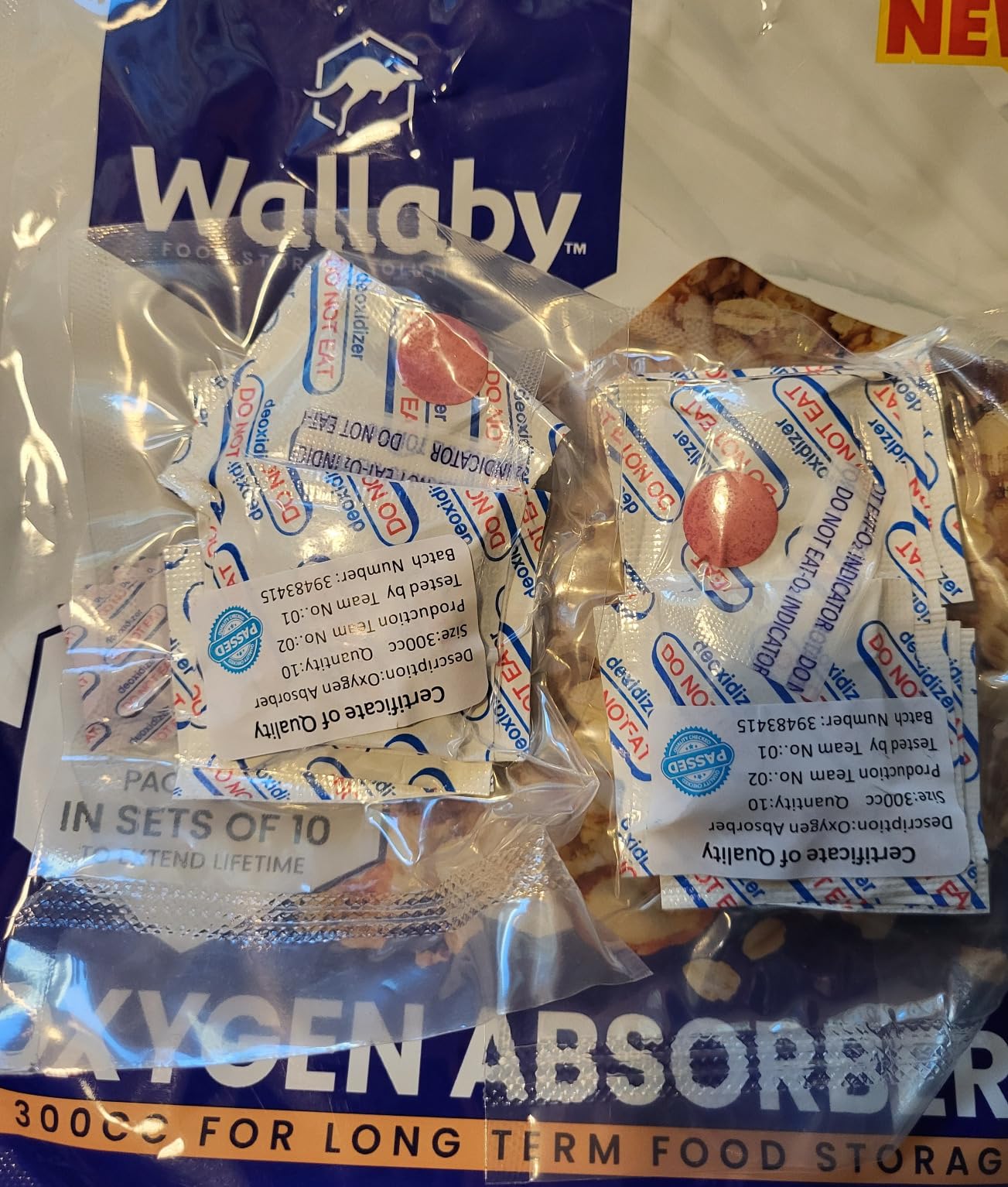
Wallaby is the strongest all-round pick here on packaging design, and it is the brand that shows up most often in the wider storage community as a default. The zipper-seal outer bag is a genuine improvement over a plain pouch, because it lets you close the bag properly after taking ten packets out rather than relying on a zip clip that will drift open in a cupboard.
At 1.57 by 2.16 inches per packet, these are compact enough to sit on top of the food layer in a 1-gallon mylar bag without taking up meaningful headspace. The packet material is described as food grade for both short and long term storage, and the packs are heat sealed right after production rather than repackaged later, which reduces the chance of a partially reacted packet reaching you.
Users in the Harvest Right community converge on Wallaby for both bags and absorbers, specifically because the absorption capacities line up with the bag sizes and the range covers small jars through large containers. That is the recommendation we would give too, since the same brand builds the bags and the packets and the sizing guidance actually matches.
The trade-off is straightforward. This is the most expensive packet in the group, and the price buys packaging quality and a trusted name rather than a measurable difference in absorption. If your budget is the deciding factor, a 500cc pack from another brand will do the same chemical work.
When This Pack Makes Sense
Buy Wallaby if you want the cleanest long-term storage system, particularly if you already use or plan to use their mylar bags. The zipper-seal bag and ten-packet inner packs remove the two most common complaints in this category, wasted packets and uncertainty about whether a stored packet is still good.
It is also a good fit alongside freeze-drying equipment, since the 500cc tier matches a 1-gallon mylar bag of freeze-dried food. If you already own a food warmer for rehydrating meals later, having the storage side sorted completes the setup.
When You Should Pick Something Else
Price is the honest reason to look elsewhere. Two 500cc packets is a meaningful outlay for a household storing a handful of containers, and the PackFreshUSA or LIFJOY 500cc packs cover the same capacity tier with comparable grouping.
It is also the wrong capacity for mason jars. Do not use a 500cc packet in a quart jar, and do not expect the bag to shrink when you open it months later.
7. PackFreshUSA 500cc Oxygen Absorbers, 50 Pack
PackFreshUSA: 50 Pack (5 x 10 Packs) – 500cc Oxygen Absorber Packs – Food Grade – Non-Toxic – Food Preservation – Long-Term Food Storage Guide Included
500cc capacity
50 packets in five packs of ten
1.45 pounds
Long-term storage guide included
Pros
- Ten-packet packs match how most people batch-pack food
- Per-pack oxygen indicator shows whether air reached the packets
- Reported to pull a visible vacuum on 1-gallon mylar bags
- Includes a storage guide with quantity and volume references
Cons
- Fewer total packets for the money than larger-count competitors
- Long-term results cannot be verified at the point of purchase
PackFreshUSA has the highest average rating in this lineup at 4.8, and it earns that in a way the others do not. The included long-term storage guide with common quantity and volume references fills a gap nobody else on this list addresses. Sizing is the number one source of confusion for new storers, and handing someone a reference card alongside the packets removes the guesswork entirely.
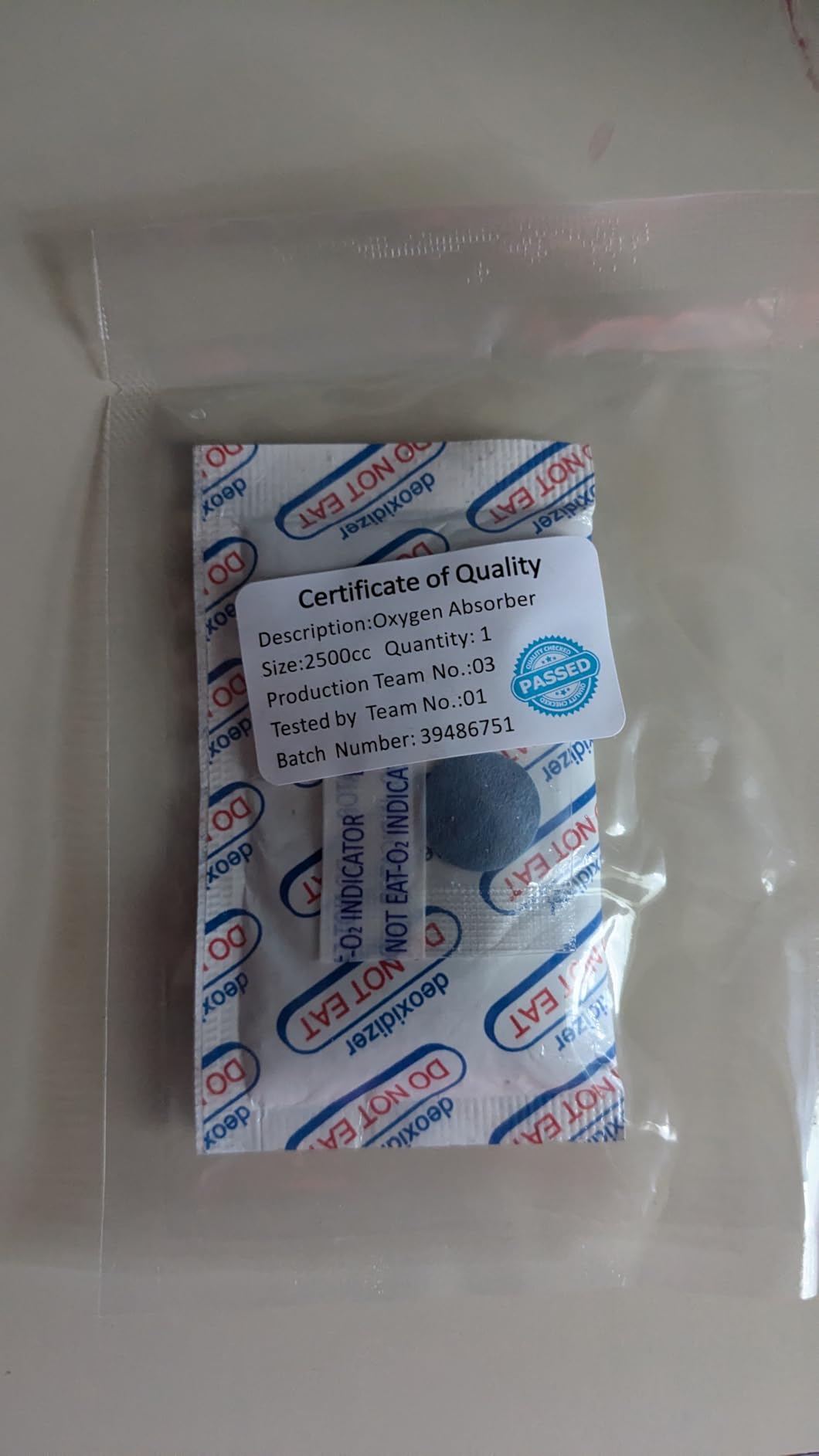
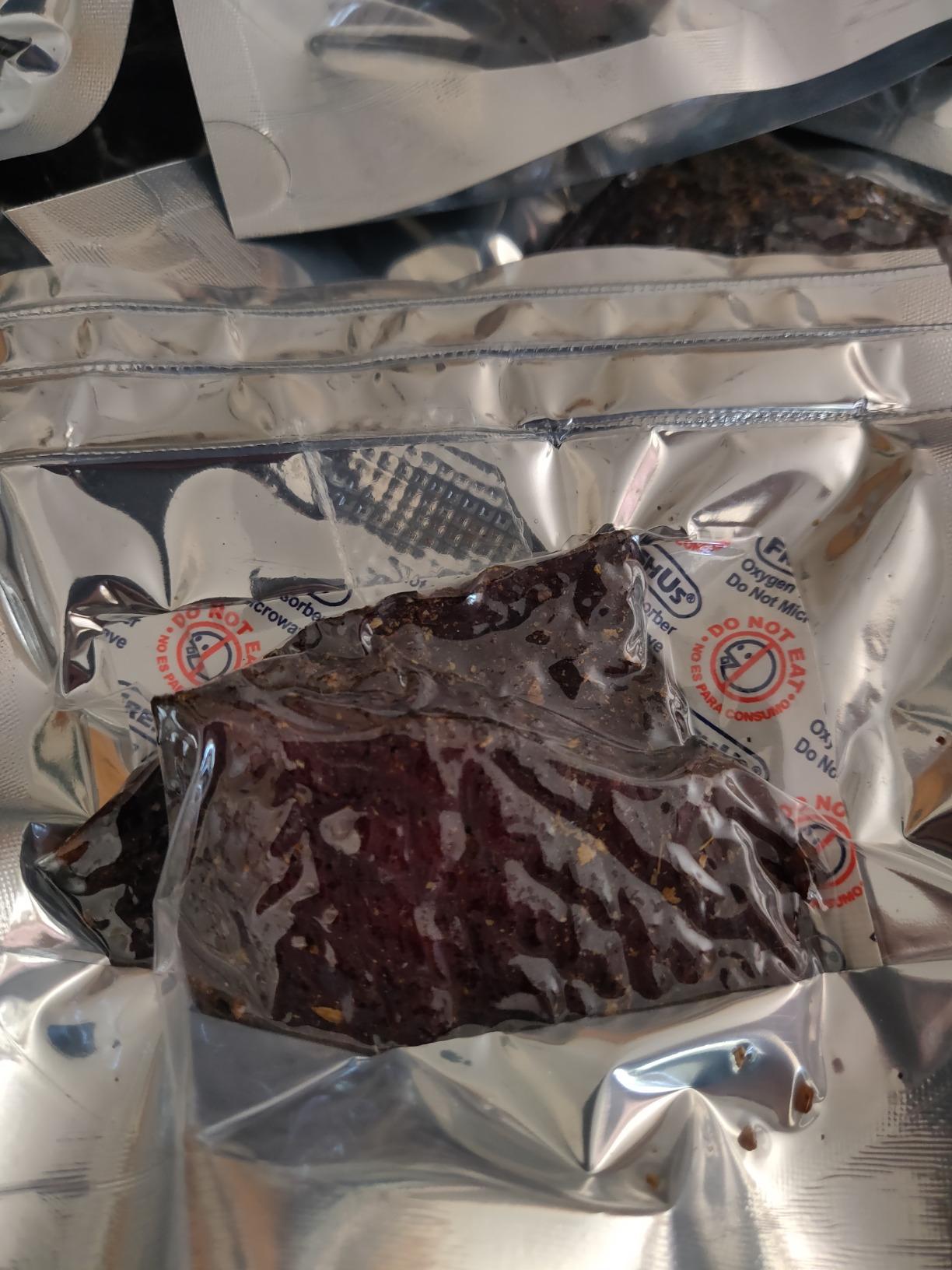
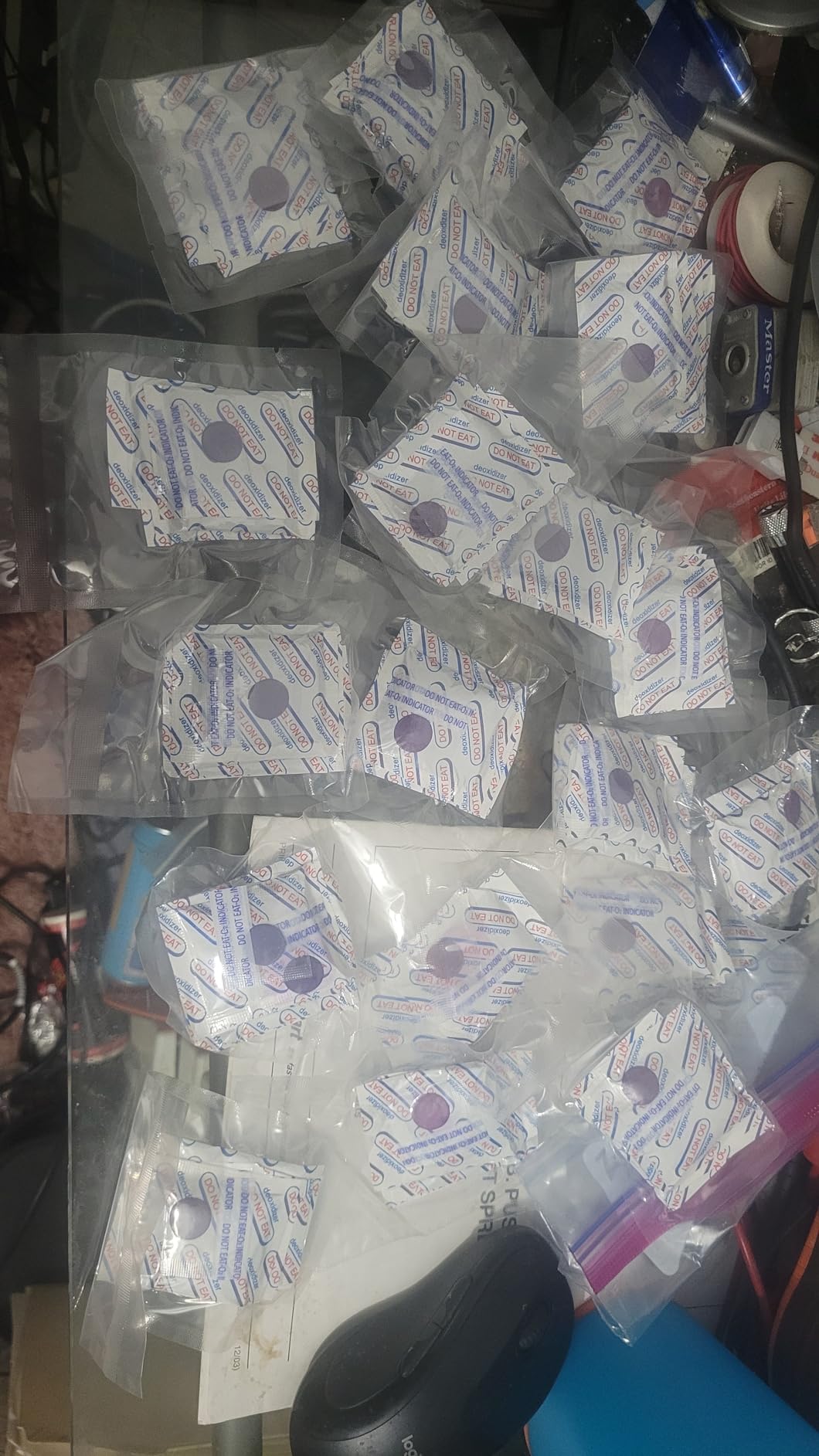
The per-pack oxygen indicator is described as pink when properly sealed and turning blue once opened, which is the clearest indicator explanation anywhere in this roundup. The pack also reports a visible vacuum pull on 1-gallon mylar bags even for air-heavy goods like flour and cornmeal, which is a stronger result than most listings claim at this capacity.
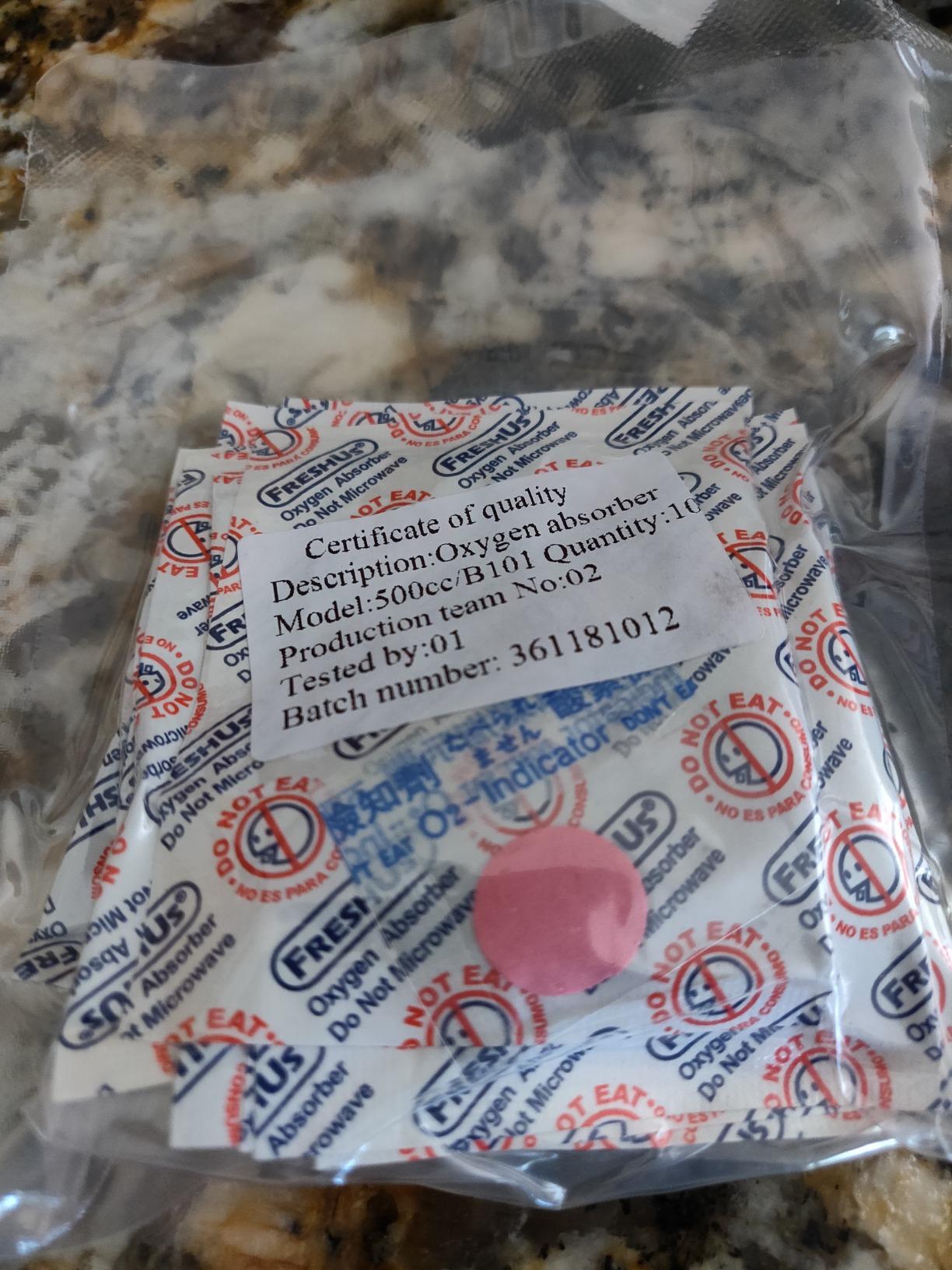
The ten-packet inner packs line up well with how most people actually work. Filling five or ten containers in a session is a realistic weekend batch, and the rest of the packets stay sealed in a pack that is still worth opening later. Unused packs can be dropped into a mason jar or resealed, which the listing calls out directly as a way to cut waste.
Two limitations are worth weighing. Fifty packets is a smaller count than most competitors at this tier, so you are buying less in a single order. And buyers correctly point out that there is no way to verify long-term performance at the moment of purchase, which is true of every product in this category, not just this one.
When This Pack Makes Sense
This is the one to buy if you are building your first serious reserve and want the sizing help as much as the packets. The guide and the indicator dots reduce the two mistakes beginners make, which are under-sizing the packet and trusting packets that have already partly reacted in an open bag.
It is also a good match for people storing flour, cornmeal and other bulky low-density goods in 1-gallon bags, where reviewers report an actual visible vacuum pull rather than just good results later.
When You Should Pick Something Else
Buy a higher-count pack if you want to cover more containers in one order. The LIFJOY 500cc gives you 120 packets against 50 here, which is a large difference for anyone with ten or more bags to fill.
It is also the wrong tier for mason jars entirely. Do not put a 500cc packet in a quart jar, and do not plan on using it for a single 5-gallon bucket, which normally takes two.
8. Hombao 700cc Oxygen Absorbers, 100 Pack
Hombao 700cc Food Grade Oxygen Absorbers -100 Packs (5 x 1 Vacuum Bag) for Storage, Packet Long Term Freshness – O2 Absorber Canning & Preserving Blue,pink
700cc capacity
100 packets
1.7 pounds
Anti-oil film design
Pros
- 700cc targets 2-gallon containers
- a tier none of the smaller packs in this list cover
- Anti-oil film suits high-fat foods
- Packets wrapped five to a vacuum bag to limit exposure
- Listing includes a size-to-container selection chart
Cons
- Lowest average rating here alongside WOLF GROUP and highest share of one-star feedback
- 700cc is overkill for anything under 2 gallons
- Some listing spec fields read as placeholder values
The Hombao 700cc fills a gap the 500cc options leave open. The next capacity step in this list jumps all the way to 1000cc, so 700cc is a practical middle for people working with 2-gallon containers who find that two 500cc packets feel excessive but a single 1000cc packet is more capacity than they need.
Its sizing guidance is the most complete on the page. The listing spells out a full range, from 100cc for a quarter gallon through 400cc for a gallon, 500cc for a gallon and a half, 700cc for 2 gallons and 1000cc for 3 gallons. That reference alone is useful, and the included selection chart reinforces it. Five packets per vacuum bag is a sensible grouping that sits between the single-bag and ten-packet formats.
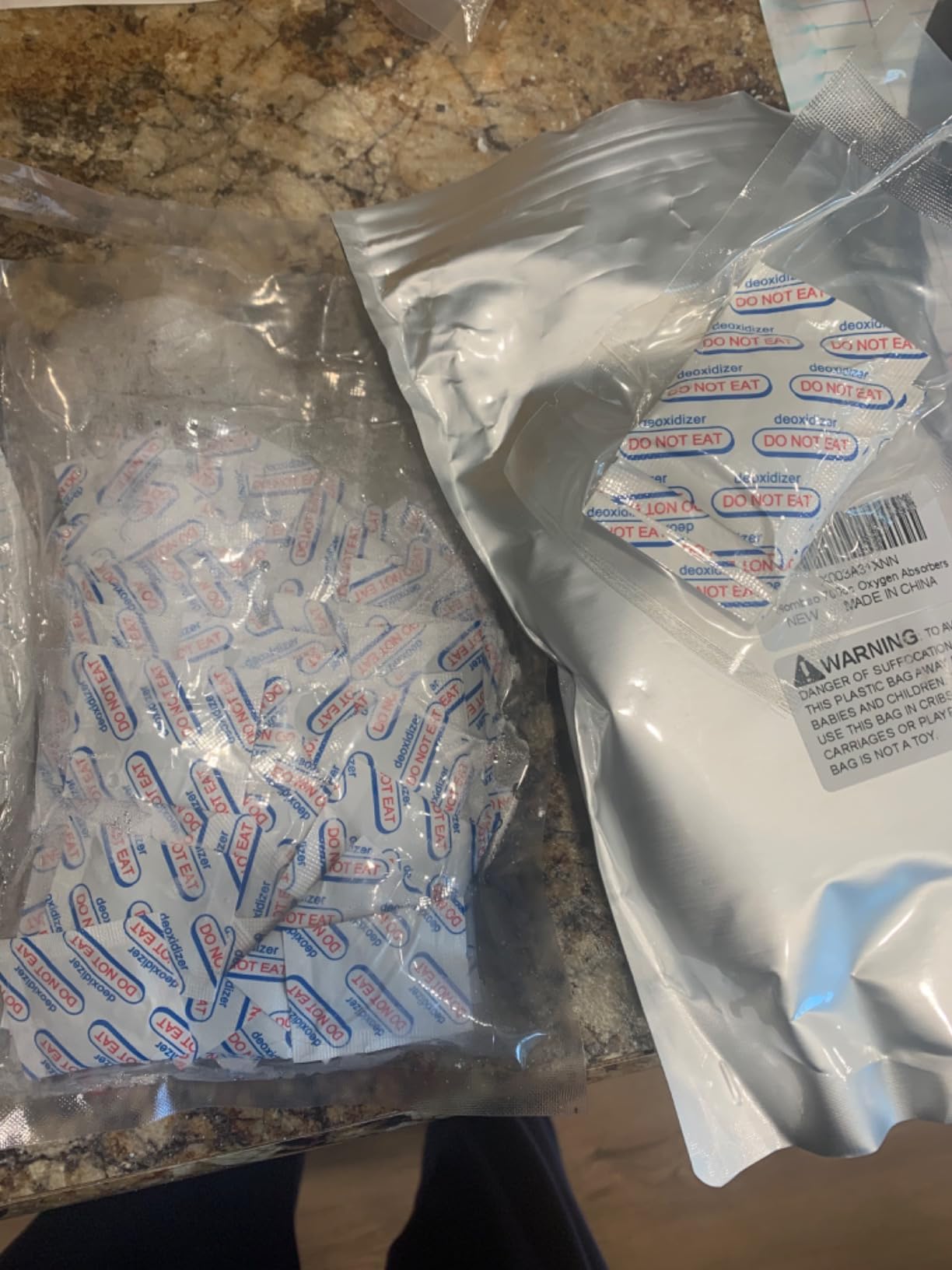
The anti-oil film design means this works for high-fat foods as well as dry grains, and the pack is a manageable 1.7 pounds for 100 packets. Buyers who use it at its intended capacity report high-capacity absorption holding up across large batches.
Where it falls short is consistency of feedback. It has the lowest average rating in this selection and the highest share of one-star reviews, plus some listing specification fields that read as placeholder data rather than real attributes. None of that points to a chemistry problem, but it does mean you have less long-term evidence behind the choice.
When This Pack Makes Sense
Use it when your containers are genuinely in the 2-gallon range and you want a single packet per bag rather than combining smaller ones. It is also reasonable for bulk dry goods where container volume is large but you prefer one packet for simplicity.
Choose it for high-fat foods if that is what you are storing, since the anti-oil film is built into the packet rather than added as an accessory.
When You Should Pick Something Else
Skip it for jars, mylar bags under 1 gallon and any small container. The capacity is simply wrong at that scale. If your main container is a 5-gallon bucket, the WOLF GROUP 1000cc pack is the more natural fit and the better-evidenced option.
If you want more peace of mind from the review history, the 500cc options from Wallaby or PackFreshUSA carry a longer record of owner feedback.
9. LinsKind 300cc Oxygen Absorbers, 120 Pack
LinsKind Oxygen Absorbers for Food Storage, 300CC, 120 Pack, Food Grade
300cc capacity
120 packets
10 pack per vacuum bag
Pink indicator included
Pros
- 120 packets in a mid-range price tier
- Ten packets per vacuum bag reduces waste
- Pink oxygen indicator in each pack
- Ranks high in the oxygen accessories category
Cons
- Ten per bag means you should use all ten or reseal immediately
- Not individually wrapped
- Some users report mason jars not sealing on the first attempt
On packet count per unit of money, the LinsKind 300cc is hard to argue with. You get 120 packets grouped into twelve vacuum bags of ten, and the 300cc tier is the most broadly useful size in the category, covering mason jar batches, half-gallon bags and 1-gallon mylar bags without being seriously oversized in any of them.
Each bag carries a pink oxygen indicator, so you can check viability before committing a group of packets. The manufacturing details given are specific, citing a factory with 18 years of experience and ISO 9001 certification, and the double-layer anti-oil film means the same packet covers jerky, nuts and spices as well as rice and beans.
The practical caveat is the ten-packet grouping. It is better than a loose pouch of a hundred, but it still expects you to seal ten containers or reseal the bag immediately. Reviewers who do fine with this rate it highly, and repeat buyers report consistent results across multiple orders.
When This Pack Makes Sense
This is the value pick for households sealing steadily rather than all at once, because the vacuum bags let you open a small amount and put the rest back. It is the strongest option when you want a large count at a mid-range tier without stepping up to the 500cc packs.
It works well for a mixed storage system covering jars through 1-gallon bags, which is more flexibility than the single-size ZRLEI pack offers.
When You Should Pick Something Else
If you seal fewer than ten containers at a time, the packs of five from ZRLEI are a better fit because you waste far less when a bag is opened. If you want documented USA origin, this listing does not make that claim and the FreshUs pack does.
For a 5-gallon bucket you need more capacity than 300cc, so plan on four of these or move to the 1000cc pack.
10. WOLF GROUP 1000cc Oxygen Absorbers, 30 Pack
30 Packs 1000cc Food Grade Oxygen Absorbers (3x packs of 10) Oxygen Absorbers for Food Storage, Long Term Food Freshness Works in Mylar Bags Mason Jars and Vaccum Bags
1000cc capacity
30 packets
Three bags of ten
Iron powder formula
Pros
- One packet covers a 3-gallon container or a 5-gallon bucket
- which no smaller packet here manages
- Three vacuum-sealed bags of ten protect unused packets
- Iron powder formulation can sit in direct contact with food
- Lowest price per 1000cc of capacity in this selection
Cons
- Only 30 packets per listing
- so bulk storers need repeat orders
- Smallest review base in the selection
- Some listing spec fields appear mismatched
A 5-gallon bucket is a large volume of air, and it is where smaller packets genuinely stop making sense. The usual guidance is a 1000cc packet for a bucket holding roughly 30 to 35 pounds of dry grain, which makes this the product that matches that number exactly rather than asking you to run four 300cc packets and hope.
Three individually vacuum-sealed bags of ten keep unused packets protected, which matters here because a 30-pack is a meaningful commitment and you will not use all of it in one session. The iron powder formulation is described as food safe for direct contact with the food layer, and the packets are intended to sit on top of the food in the sealed pouch.
The honest drawback is review depth. This has the smallest feedback base in the roundup, so long-term owner evidence is thin, and there is no per-pack indicator to confirm viability. For a product whose job is measured over years, that is a real limitation. The packets are also 8.48 ounces each, so check that your bucket liner and seal can handle a packet of that mass resting on top of the food.
When This Pack Makes Sense
Use it for 5-gallon buckets and other 3-gallon-scale storage, where one packet per bucket is far simpler than combining four smaller ones. It is also the lowest cost per 1000cc of absorption capacity in this group, which matters if you are filling several buckets rather than one.
If your plan is bulk long-term storage across many containers, the economics here are hard to argue with despite the smaller review base.
When You Should Pick Something Else
Do not use a 1000cc packet in a mason jar or a 1-gallon bag. The capacity is wildly oversized and you will be wasting most of it. If you only need a few containers, the 300cc or 400cc tiers are the right purchase.
If you want an indicator to check packet viability, choose a brand that includes one. And if you are not certain you will use 30 packets, the two 500cc packets in a 500cc pack are a lower-commitment route to the same result.
Oxygen Absorber Size Chart: Which cc for Which Container
Sizing is the one thing that genuinely changes results in this category, and it is the question we get asked most. Match the packet rating to the total internal air volume of your container, not to the weight of the food inside it. Here is the mapping we use.
50cc covers half-pint and small pint mason jars. 100cc covers pint and quart mason jars, and containers up to 1 quart. 200cc covers half-gallon mylar bags and larger jar batches. 300cc covers three-quarter gallon containers and small mylar bags. 400cc is the match for a 1-gallon mylar bag, the single most common container in home storage. 500cc fits 1.5-gallon containers and larger 1-gallon bags holding low-density foods like flour.
700cc targets 2-gallon containers. 1000cc fits 3-gallon containers and a 5-gallon bucket holding roughly 30 to 35 pounds of dry grain, or you can use two 500cc packets in the same bucket.
Over-absorbing is treated as cheap insurance rather than a risk in the storage community, and we agree with that reasoning. A packet that is slightly larger than the container needs simply finishes its work early. A packet that is too small quietly fails to reach the low residual oxygen level that protects the food, and you get rancidity back without any obvious sign that anything went wrong.
Foods You Should Not Use Oxygen Absorbers With
Some foods react badly to low-oxygen environments, and using an absorber on them does more harm than good.
Sugar clumps and can set into a hard brick that is very difficult to break up. Salt does the same thing, and a hardened block in the bottom of a jar is effectively wasted food. Baking soda is the third of the trio people most often get wrong for the same reason.
Anything above about 10% moisture should never go into a sealed low-oxygen container, because the conditions that keep oxygen out also create the low-acid, low-oxygen environment where Clostridium botulinum can grow. This is why every guide in this category insists on properly dried food first. Dehydrator and freeze-dryer output counts, provided it is bone dry all the way through.
Liquids and fresh produce are also out. Whole fresh fruit and vegetables respire and need airflow, and sealing them accelerates spoilage. Used packets should be discarded and kept away from children and pets, since the iron powder inside is not intended to be ingested.
How to Use Oxygen Absorbers Step by Step
Rice in a mason jar is the clearest worked example, because rice is the most commonly stored food and jars are the most beginner-friendly container. Dry the rice until it is crisp and snaps rather than bends. That texture is your confirmation that moisture is low enough for safe sealing.
Fill a clean, dry pint or quart mason jar, leaving two finger-widths of headspace. The oxygen you need to remove is in the jar itself and in that headspace, so extra empty room costs you more absorption capacity for no benefit.
Put the 100cc packet in last, resting on top of the rice rather than buried in the middle, then seal the lid immediately. The packet needs a sealed environment to draw oxygen through its permeable film, and it begins reacting the moment it is exposed. If you place it before you finish filling, you have started the clock early.
Add an oxygen indicator card if you have one, and leave it in place. Once the seal is confirmed, store the jar somewhere dark and cool. Absorbers do not need to be refrigerated, but heat and light both accelerate the decline of the food itself, which defeats the point.
For 1-gallon mylar bags the same logic applies with a 400cc or 500cc packet. Fill, add the packet on top of the food, heat seal the bag immediately, and do not open it afterwards. If you need to open a sealed bag, expect to add a fresh packet before resealing.
How to Tell If Your Absorber Is Working
Absorbers are single use and cannot be reset, so it helps to know what a working and a spent one look like. Many packs here include a small oxygen indicator disc, commonly pink when the packets are properly sealed and sealed from air. When that disc turns blue, packets in that group have been exposed and should be treated as reduced in capacity or discarded.
Colour descriptions vary between brands, so treat the disc as a relative indicator rather than an absolute one. Compare it against a disc from an unopened pack if you are unsure. FreshUs in particular notes that a damaged package or a blue indicator means the product should not be used, which is a clean rule to follow.
On the food side, the honest answer is that confirmation comes months later, not minutes. The best proxy is the absence of change: no mustiness, no greasiness in a grain that should be clean, and a vacuum feel at the jar lid if you sized the packet generously. Never cut a packet open to look inside, since destroying the seal vents the contents and ends the process.
How to Store Unused Absorbers
Unused absorbers start absorbing the moment the master bag is opened. That is not a defect, it is how the chemistry works, and it is the reason a loose pouch of a hundred packets goes stale in your cupboard while you slowly seal one jar a week.
Two habits fix this. Reseal the outer bag properly after each session, which is where the zipper-seal packaging on the Wallaby pack earns its place. Or drop the remaining packets into a clean, dry mason jar and screw the lid on, which is the trick recommended across the storage community and echoed in the PackFreshUSA guidance.
Both methods work by removing the packets from open air. Whichever you choose, buy the grouped-in-tens format if you seal food slowly, and treat any packet that has been loose in an open pouch for more than a few days as suspect.
Does the Brand Name Actually Matter?
Honestly, not as much as the packaging suggests. A long-running thread on r/Survivalist makes the point that most oxygen absorbers on the market come out of the same small number of US factories, with Sorbent Systems named repeatedly as a high-quality manufacturer. If two brands are filling packets from the same facility with the same iron granulation, the chemistry is going to be comparable.
That is not an argument for buying at random. It is an argument for judging on things you can actually verify. Capacity rating matched to your container, food-grade material documentation, and pack format that limits waste are all real, checkable differences. The logo on the front is the least reliable signal in the category.
Where brand does matter is support and matching equipment. If you already own a particular brand of mylar bag, buying that brand’s absorbers means the published sizing guidance actually lines up with your container. The wider storage community settles on a small number of well-known names for exactly that reason rather than because of measured superiority.
How to Choose an Oxygen Absorber: 6 Criteria
Absorption capacity. This is the first and most important filter, and it should be decided before brand. Use the size chart above and match the cc rating to your container volume.
Food grade certification. Look for explicit food-grade material documentation and a non-toxic claim. Several packs in this roundup state it plainly, and those that do are the safer default when storing food you will eat.
Pack format and resealability. This is the criterion most buyers ignore and most regret ignoring. Packs of five suit slow packers, packs of ten suit weekend batches, and a zipper-seal outer bag beats a loose pouch every time.
Absorption rate. Rated capacity is what the packet can absorb under proper sealing, roughly four hours in a closed container and faster in open air. Capacity is the number to compare across brands, since rate matters less once the container is sealed.
Country of origin. Made in the USA is a hard requirement for a large share of the homesteading community, and only some listings state it. FreshUs is the clearest example in this roundup with an explicit USA manufacturing claim. If origin matters to you, filter for it rather than assuming.
Cost per cc absorbed. Packet price alone is a poor comparison. Divide the total cost by the total cc of capacity in the pack, and remember that a slightly larger packet than you need is a smaller mistake than a slightly smaller one.
One more practical check covers the complaint that comes up most often in long-running community threads about packet durability. Some users report packets splitting or bursting inside the bag, which wastes both the packet and the food around it. Look for double-layer or pinhole-resistant film construction, and inspect packets before sealing. Several packs here specifically describe a double-layer anti-oil film design, which serves the same purpose.
Vacuum Sealer vs. Oxygen Absorber: Do You Need Both?
They do different jobs, and for long-term dry food storage the absorber is the more important of the two. A vacuum sealer removes air, which mostly means removing the nitrogen and carbon dioxide along with the oxygen, and it only holds that state as long as the bag material blocks gas exchange. A standard vacuum bag is a plastic laminate that is not rated for long-term storage, and oxygen migrates back through it over months.
An oxygen absorber works on the specific gas you care about and keeps working indefinitely, because the oxygen is chemically bound rather than merely removed. That is why every serious long-term storage setup uses absorbers, with a vacuum sealer as a helpful optional extra for reducing bulk volume and improving the initial seal.
Using both is not redundant. Sealing first reduces the total gas volume the absorber has to work through, which helps a smaller packet reach full capacity. Just remember the ordering rule: the absorber goes in before the seal, and the seal goes on immediately after.
Frequently Asked Questions
Which oxygen absorbers are best for long-term food storage?
Our top pick is the O2frepak 200cc 100-pack, which has the deepest review history in the category with more than 5600 ratings and an anti-oil film design. For 1-gallon mylar bags the ZRLEI 400cc is the better match, and for mason jars the FreshUs 300cc wins because its ten-packet inner packs stop unused packets from going stale. Whichever you choose, size the cc rating to your container volume first and packaging second.
What foods should not use oxygen absorbers?
Avoid sugar, salt and baking soda, which clump together into hard bricks when oxygen is removed. Also avoid anything above about 10% moisture, because the low-oxygen, low-acid environment created inside a sealed container raises the risk of botulism. Liquids and fresh produce should not be sealed with an absorber either, since fresh produce needs to respire.
Can you store rice in mason jars with oxygen absorbers?
Yes, and rice in mason jars is the standard starting project. Dry the rice until it is crisp and snaps rather than bends, fill a clean dry pint or quart jar leaving two finger-widths of headspace, rest a 100cc packet on top of the rice, and seal the lid immediately. The packet must be sealed inside the jar to work, so add it last and do not reopen the jar unless you insert a fresh packet.
How many oxygen absorbers to use in a 5 gallon bucket?
A 5-gallon bucket holding roughly 30 to 35 pounds of dry grain takes one 1000cc packet, or two 500cc packets, or four 300cc packets. Match the total capacity to the bucket’s internal air volume rather than the weight of the food. Each packet must sit inside the liner with the food and the liner must be sealed before the absorber can do any work.
Do you need a vacuum sealer if you use oxygen absorbers?
No. An absorber targets oxygen specifically and keeps working indefinitely because the oxygen is chemically bound to iron rather than merely removed, which is what makes it right for multi-year storage. A vacuum sealer reduces bulk volume and helps the initial seal, and ordinary vacuum bags are generally not rated for long-term storage. Many people use both, but the absorber is the component that does the real work.
How long do unused oxygen absorbers last?
Unused packets keep working as long as they are sealed away from open air, so the answer depends entirely on storage. In a loose open pouch they begin reacting immediately and lose capacity within days. Resealable master bags, packs grouped in fives or tens, and packets stored in a sealed mason jar all preserve unused capacity for as long as you keep them out of open air.
Conclusion
The best oxygen absorbers for food storage are the ones whose cc rating matches your container and whose packaging matches how fast you actually pack. The O2frepak 200cc 100-pack is the strongest all-round choice for bulk sealing, the ZRLEI 400cc is the precise fit for 1-gallon mylar bags, and the FreshUs 300cc handles mason jars and small batches with less waste than anything else we tested.
Get the sizing right first, keep unused packets away from open air, and never seal anything that is not properly dry. As we head into 2026, that is still the whole game.